Torching All That Is Sacred: Alexander Anon’s Story, Part Two

Torching All That Is Sacred — One Child’s Emergence From a Totalitarian Environment: Alexander Anon’s Story, Part Two

HA note: The author’s name has been changed to ensure anonymity. “Alexander Anon” is a pseudonym.

*****

In this series: Part One | Part Two

*****

Something people should know about me: I am a fighter. Now, I am not an obvious fighter, and if I was put into the ring, I guarantee nobody would put money on me; but that does not change what I am by nature. See, I am a quirky fighter.  I am weird.  I am unpredictable, though not always intentionally so.  For a while, I simply took what my parents dished out and did not question it.  I do not mean what they intentionally dished out; I mean that I adopted a victim mentality and pitied myself for being in the situations I found myself in.

As I grew older though, I started wanting to change things.  I would still take things timidly, but if they pushed too hard, a fire would flare up in me and I would push back.  Harder.  Through this, I learned that I am much stronger than I had ever previously thought.  I am not a victim; I am the one in control.  If my parents would chide me for engaging in foolishness, I would keep it coming and even ramp up my efforts.  What could they do?  I was invincible.  My foolishness knew no bounds; there were no depths which could be plumbed, no dregs that could be drained.  I could out resource them, outlast them, and outsmart them at virtually every corner until they admitted the futility of their efforts to make me into the cookie-cutter Christian homeschool child.  I had another advantage: the sibling just under me was much more openly defiant (although he used vastly different tactics), thereby allowing me to get by being just slightly less troublesome.

Since being in college, my mom has several times equated my academic success (completed undergraduate honors program with a GPA of 3.92) to having been homeschooled.  This is quite possibly true, but I have never quite had the heart to tell her the truth: her perceptions of my homeschooling experience are much different than my perceptions of that same experience.  If I was to be completely honest, what I enjoyed most was the freedom of homeschooling.  I could do what I wanted, when I wanted, and pursue whatever caught and kept my attention for as long as I wanted without interruption.  For me, at that point in my life, it meant creating Redwall cards that played similar to the Decipher Lord of the Ring’s trading card game.  I would spend hours reading the books, creating workable game mechanics and themes for each culture, and then drawing and coloring the cards.  I was an artist, and a not-too-bad one at that.  I was also an avid reader, but only if the book was of interest.  Many history books and other required readings were simply not to my tastes, and since there was no way to prove if I had actually read the book, I occasionally lied about how much of the book I had read in a particular day (or, at my worst, simply did not read the book while claiming I did).  I did this so that I could spend time doing what I wanted to do: Redwall cards.

I was also notoriously bad at science.  For a while, I thought I simply sucked at science.  Since then, I have realized I did not understand how to study at that point in time.  I would shove a bunch of scientific definitions in, then output them for the test.  On tests where there was more information to memorize, I would earn lower grades.  This measured nothing about my ability to actually understand science; it measured how well I could replicate 15+ definitions word-for-word, with each definition containing several sentences and sometimes looking more like paragraphs.  My junior year, she threatened to kick me into public school for my senior year if I failed a particular science test (since I wouldn’t then be able to pass that grade of science).  Needless to say, I took the ethical high ground and cheated my ass off.  I did not (and still don’t) think it is fair to both at once tell your child that public school is essentially hell and then threaten to send your child to that hell if they do not perform to your liking.

I mention these two aspects of my homeschooling life because they would later get me in trouble just when I thought I was home free in college.  After attending college a few years, I casually joked about how I sometimes wasn’t the best homeschool student as a kid.  To me, it was funny.  Look how well I’m doing in college despite goofing off the last few years I was homeschooled (11th & 12th grade).  My mom, on the other hand, broke out crying at even the hint that I had cheated or lied.  To her, my not taking some aspects of school seriously somehow reflected on her.  It told her she hadn’t done well enough homeschooling to make me care, even though not caring about school is typical for teenagers at that age and I had proven I could excel in college.  She had not failed in any sense of the word, since I was prepared for college and doing well.  But she did not see it that way; only saw that I was admitting homeschool had not been the perfect picture of happiness she thought it had been.

Secretly, deep down, I suspect the true reason she cried is because my goofing off the last 2 years I was homeschooled sent a clear message that I did not need her and homeschooling as much as she thought I did.  Did not need her as a teacher, that is.

This gets to the crux of the matter; it ties together this up-until-now rather bizarre and random story of my childhood.  I think that despite whatever reasons my mom thought she was homeschooling us for, her true motivation was to never have to be alone again after living her entire childhood virtually alone.  Homeschooling, while it may have been about us not getting hurt by others in public school, was also about her not getting hurt by nobody needing her.  It was about making us dependent on her, so that she felt wanted.  Needed.  Ironically, she sometimes lashed out when we expressed the very dependence on her that she had fostered in us.  More than a true need for us to be homeschooled was the need for her to have an identity outside of her children.  An identity that should have come from her relationship with my dad, and with friends her own age.  She needed to escape the burden of parenting for a time instead of embracing it even more fully and homeschooling us all.

I am not saying we should not have been homeschooled; but rather, homeschooling us should not have been the top priority.  She often screamed, “What about me? When do I get to do what I want to do?!?” when she got mad at us for needing her.  But the truth of the matter is this; she was too scared of nobody needing her to ever wander off and do something she wanted to do.  She was afraid that if she did wander off, she might return and find everyone had forgotten her, or worse: never even noticed she left in the first place.

This, then, is what I want to communicate: my entire childhood was shaped by events driven just as much by my mom’s need to be emotionally fulfilled as it was trying to give me what I needed in an education.

Possibly more.

The worst part is knowing she did not do this consciously, she simply failed to recognize what was going on and intervene.  This is not a ‘Fuck you, mom! Fuck you, dad!’ letter.  This is not an article to be used for arguing homeschooling is psychologically harmful and should therefore be overseen, controlled, or prevented by the government.  There is no political message here, no hint of animosity towards anyone; no purpose for saying any of this other than that it is the truth.

The truth.

Truth is never something I was good at hiding, or even wanted to hide.  I tell everyone who will listen that I would rather have a ‘fuck you!’ screamed in my face and punctuated with physical blows than have someone pretend to be my friend.  I do not care if I am physically assaulted; I care if I am told the truth.  Asshats are a dime a dozen; but honest people are virtually impossible to find.  Bluntness, that is.  People who throw social politeness under the bus in favor of calling it like it is.  The ‘ain’t no bullshit here, captain!’ kind of people.  There many honest people in the world, but few who will be blunt with you.

That is what I mean.

In order to avoid ending on a downer note, I will fully self-disclose that things have gotten so much better over the past few years I have been attending college.  Only my youngest brother and sister are still homeschooled, with my oldest sister having attended public school since 9th grade.  I do see my youngest brother struggle with many of the same things I did, but I know I am here to guide him through the confusion and pain that accompanies his upbringing.

More importantly, I know what helped me cope and have given him access to these means at a much younger age.  When I was growing up, I did not have anyone to reach out to about this.  My youngest brother can talk with me about this all; about how sometimes although our parents love us both very much, they do not act rationally and instead resort to violating their own rules and taking their emotional issues out on the children and use us to meet deep needs that we can never fullfill.  He can question me about why most people think the earth is billions of years old but he learns it is only several thousand.  I do not provide him with ‘the answers’, but ask questions to help him think through the issues on his own.

That is what true homeschooling should be: parents providing their children with an outlet to escape the biases and politics of public school without imposing their own biases and politics.  Because ultimately, that’s what homeschooling is: freedom.  Freedom to question authority, to question rules, to question the ‘no tolerance’ policies that are a virtual shitstorm in public schools.  My story is one of that freedom being unconsciously abused, but that same freedom can be used to free others from the abuses they may receive elsewhere.

As hinted at in my opening paragraph, eventually my parents figured a lot of their issues out and loosened the stranglehold conservative Christians had on their throats.  This legalism went to hell when our family became the black sheep of the congregation and the pastor and elders treated our family like shit.  We were accused of much, and treated like enemies instead of brothers and sisters in Christ like they claim to treat all believers.  What they failed to mention when you sign up is that their interpretation of the Bible only tells you to treat people as human if they think as you do and do not question what you demand of them.  Anyone who threatens their reputation, who is similar enough to them and then suddenly appears less than perfect, is quickly either intimidated to fall back into line or else cast out into the cold world to die a lonely and painful death.  Fortunately, our family pulled together and told them that while we appreciate their willingness to spend their entire lives with their heads on vacation in the wonderful world of Up-Your-Ass, our family preferred to admit we are living, breathing, feeling, fallible individuals who must address our shortcomings and forgive each other.

So yes, our family is no longer the perfect Christian, homeschooling family we once were. Thank God. And I mean that; I am both relieved to leave the bullshit and small-mindedness, and thankful to God for rescuing us from the bullshit.

As you can tell, I still believe in God. But not the Orthodox Presbyterian Church God that requires men to dominate women, for children to obey their parents without questioning what they are told to do, and for His followers to spend their time prior to dying and enjoying their life in blissful paradise feeling like shit because they believe happiness is automatically indicative of falling into sin.  Focusing on how fucked up you are, or others are, does nothing to solve the problem.  Even their own book tells them that much, but they still do not see despite claiming you do not see.  Slowly, their God died to me (not for me), and I can personally attest that this death did not occur on a cross.  It took place in my mind, after years of watching my family suffer the consequences of sucking it up when things got hard and pretending everything was alright.  However; this god did die at a cross.  Crossroad that is. The death of the OPC God was a crossroad where I switched paths.  Where our whole family switched paths.

I have never been more proud of our parents than when they essentially told our old OPC church to go fuck themselves. (This message was not communicated quite as bluntly, but the effect was the same).

In closing, I am not mad at my parents. I hold no bitterness for them, or anyone else, including the OPC church and their members.  I am still friends with many of them, and see the pleading looks in their eyes to come back when I occasionally visit.  But I see more than this.

Underneath the pleading for me to return to them I see another kind of pleading; a pleading for someone to rescue them from themselves.  As for me, I am never going back. Not permanently, although I do visit every once in a blue mooon. Having now experienced life in the open — in the sunlit world having emerged from Plato’s cave with the totalitarian forces striving to keep individuals locked away in the cave — I know what it is I will spend the rest of my life doing:

Fighting to free others from the blindness, from being emotionally used and feeling helpless to escape, whether it occurs while being homeschooled, public-schooled, or not schooled. Because using others, even unconsciously, to meet your needs is not right; and having gone through this myself, I find that I cannot wish it upon anyone else either.

We are Anonymous.

We are Legion.

We are Homeschooled.

*****

End of series.
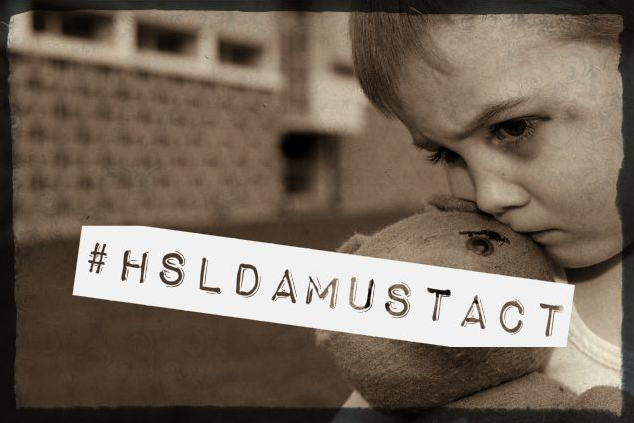
#HSLDAMustAct: History and Related Media

Screen Shot 2014-06-26 at 1.20.57 PM

April 17, 2013

On April 17, Love Joy Feminism’s Libby Anne — a former homeschool student, former attendee of Patrick Henry College’s summer camp on Constitutional Law taught by Michael Farris, and now-parent of two children; also, one of HA’s blog partners — began a five-part series looking at the relationship between HSLDA and child abuse. Of particular concern to many people who have read this series is that HSLDA has slowly but surely moved from homeschool advocacy to — by their own admission — reform of child welfare laws, including opposing anonymous tips, mandatory reporting, and mainstream definitions of child abuse. The five parts to this series are: (1) HSLDA and Child Abuse: An Introduction; (2) HSLDA’s Fight against Child Abuse Reporting; (3) HSLDA’s Stonewalling of Child Abuse Investigations; (4) HSLDA’s Defense of Child Abuse; and (5) HSLDA and the Deregulation of Homeschooling. Part five of the series was published on April 24.

April 20, 2013

The blogger from the Eighth and Final Square, inspired by Libby Anne’s series on HSLDA and child abuse, writes a post about her own homeschooling experience. It is entitled, “we were taught to fear the people who could help.” The author says she, too, was “instilled with a fear of CPS.” As a survivor of abuse herself, she says, “I wonder what would have happened if HSLDA wasn’t around, and the kids had been allowed to talk to CPS workers alone.”

April 22, 2013

Homeschoolers Anonymous started crossposting Libby Anne’s series on HSLDA in conjunction with a week of personal stories that explored the relationships between homeschooling, HSLDA, and the CPS: fears of the CPS, failures of the CPS, and how the CPS could have actually helped those who suffered abuse in homeschooling.

April 23 – May 2, 2013

After finishing her series on HSLDA and child abuse, Libby Anne continues to focus on issues of homeschooling, abuse, and HSLDA. She creates a legislative alert about one of HSLDA’s legislative alerts, urging people to counteract HSLDA’s efforts to stop SB 32, a bill “designed as a way to monitor and protect the well-being of children who are known to be at risk for child abuse or neglect based on prior incidences.” She argues that it is “simply false to suggest that there is nothing about homeschooling that might be attractive to neglectful or abusive parents.” She cites a plethora of horrific stories to explore the idea that, while “most homeschool parents are dedicated, responsible and loving,” “when abusive parents homeschool, the consequences for their children can be absolutely disastrous.”

May 6, 2013

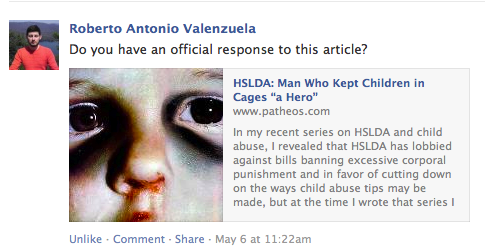
On May 6, Libby Anne writes a post entitled, “HSLDA: Man Who Kept Children in Cages ‘a Hero.'” In this post, she points out that Scott Somerville, an HSLDA attorney, called Michael Gravelle, a man charged with molesting his biological daughter, putting his adopted kids in cages, and later punching and shaking his own wife, a “hero.”

Later that day, someone posts Libby Anne’s article on HSLDA’s wall:

Picture 12 May 7, 2013

The very next day after someone posts Libby Anne’s article on Somerville’s hero comment on HSLDA’s Facebook page, HSLDA chooses to respond via a Facebook status:

Picture 13

The full text of their response is as follows:

It has come to our attention that HSLDA has recently been accused of condoning child abuse. HSLDA does not and will not ever condone nor defend child abuse. 

HSLDA receives hundreds of calls each year from parents who are under investigation by CPS, often based on false, anonymous, trivial, or malicious reports. The vast majority of these are determined by CPS or a court to be unfounded and are dismissed. Because of this, we do not immediately assume that everyone who is the subject of an investigation is guilty of child abuse or neglect. 

As a service to our members, we help homeschool families navigate the legal landscape in the early stages of an investigation before all the facts come to light. This could include helping families know their constitutional rights, helping them understand the legal process, or referring them to a local attorney. If the allegations include homeschooling, we generally will either assist their local attorney to defend homeschooling or represent the family on homeschool matters.

Of the three examples mentioned in a recent article, we did not represent two of the families and in the third we were involved on the question of homeschooling alone after the other issues were resolved by the court. 

We believe that every child deserves a healthy upbringing and that parents have the high honor and duty to meet that child’s needs. For 30 years we have been zealously advocating for the right of thousands of parents to responsibly homeschool their children. To the extent that any statements we may have made could be misunderstood to suggest that we condone the abusive actions of some we repudiate them wholeheartedly and unequivocally.

Libby Anne promptly responded to HSLDA’s response: “I’ve Had Enough: My Reply to HSLDA’s Response”.

Also in response to HSLDA’s response, R.L. Stollar, co-creator of Homeschoolers Anonymous, issued a challenge to HSLDA on their Facebook page: “HSLDA, will your leaders take a public and universal stand against child abuse and launch a public awareness campaign for your members on how to recognize and report child abuse in homeschooling?”

Stollar’s challenge to HSLDA was quickly mirrored by others. Heather Doney, one of HA’s blog partners, wrote, “Demanding an Answer from HSLDA,” where she says, “We deserve to know where the HSLDA stands. We deserve to know that they are thinking about this issue and that they are doing something about it. I, for one, am requesting an answer. Don’t make us wait too long, HSLDA.”

May 7 – 11, 2013

Homeschoolers Anonymous officially launches the #HSLDAMustAct campaign on May 8.

Rebecca Gorman, a former homeschooler, creates the official Change.org petition for the #HSLDAMustAct campaign.

A new website, Homeschooling’s Invisible Children, was launched by former homeschoolers to “to raise awareness of the horrific abuse and neglect that can take place when unfit caregivers use homeschooling as a cover for criminal child maltreatment.”

On May 9, HA announces the official petition in the post, “25 Reasons To Sign The #HSLDAMustAct Petition.”

Here is a full list of posts from bloggers covering the whole Libby Anne/HSLDA issue and the #HSLDAMustAct campaign since May 7:

Wide Open Ground: “Dear HSLDA and Homeschool Parents, What About My Friend Who Died?” and “HSLDA: Discourse Problem Between Fundamentalist and Outsiders”

Anthony B. Susan: “The HSLDA and Abuse: More Denial and Deflection”

Becoming Worldly: “S***t HSLDA’s Homeschool Parents Say”

Ramblings of Sheldon: “HSLDA: We Would Rather Stand Behind Abusers Than Their Victims”

The Home Spun Life: “Homeschoolers, Christians, HSLDA: We Must Do Better, Kids Are Being Abused”

No Longer Quivering: “Petition: HSLDA Address the Problem”

ThatMom: “HSLDA accused of turning blind eye to child abuse: you decide”

Kathryn Brighbill: “HSLDA and Child Abuse” and “Of Fundamental Rights, HSLDA, and Homeschooling”

Anonymous Wonderings: “On Homeschooling”

On May 10, the Christian Post took on the issue but framed it only as a Libby Anne vs. HSLDA issue: “Home School Legal Defense Association Accused of Protecting Child Abusers.” The Christian Post did not attempt to contact Libby Anne; they tried to contact HSLDA, but HSLDA did not respond. They also did not mention the petition.

May 12, 2013

As of Sunday, May 12, the #HSLDAMustAct petition has over 300 signatures from around the world. The signees are almost entirely from the homeschooling community itself. Former homeschool students, former and current members of HSLDA, and former and current homeschooling parents have all signed it. Signees are from everywhere from California to Louisiana to Pennsylvania, from the U.S. and Canada to Germany and Spain.

Also as of Sunday, May 12, HSLDA has still not responded to the #HSLDAMustAct campaign.

Conclusion

We will leave you with these thoughts from Lisa from The Home Spun Life:

“I have been a financial supporter of HSLDA for many years now and I am asking that they become more transparent with how they practice law, how they defend homeschooling, AND how they protect children in a homeschool that is abusive.

I know children are abused in a variety of types of homes. From poor to wealthy, from Christian to atheist, from public school to homeschools. Abuse happens. It’s tragic! We can’t only speak up about abuse when it happens in a public school. We have to speak up no matter where it happens. And we have to learn how NOT to respond to abuse allegations in the homeschool community.

Defending our freedom to choose our children’s education should never trump their freedom to live in a healthy and safe environment.

To the HSLDA,

As a supporter of yours, I am asking for you to clarify your mission to defend homeschool freedom. I am asking that you inform us and SHOW US how you are defending this freedom WHILE defending children in an abusive homeschool environment. HOW do you separate the defense to protect homeschool freedom WHILE NOT enabling abusive parents to further their abuse under your “protection”? HOW are YOU holding abusive parents accountable? HOW are YOU cooperating with local authorities to HELP victims?

We must do better. We must speak up.”

This Isn’t Just A Few Disgruntled People

HA note: The following is reprinted with permission from Kathryn Brightbill’s blog The Life and Opinions of Kathryn Elizabeth, Person. It was originally published on May 9, 2013 with the title “HSLDA and Child Abuse.”

"HSLDA needs to see that this isn’t just a few disgruntled people but that the homeschool community as a whole believes that it’s time for them to do something about this."
“HSLDA needs to see that this isn’t just a few disgruntled people but that the homeschool community as a whole believes that it’s time for them to do something about this.”

I’ve made no secret that I don’t exactly have the most positive opinion about the Homeschool Legal Defense Association’s brand of religious fundamentalism but I never thought that HSLDA was covering for and protecting child abuse. For all of their scare tactics, and for as much as I think that a legal defense organization is unnecessary in a post-Tim Tebow world, I always assumed that the training-up-the-next-generation-of-culture-warriors aside, it really was just about keeping homeschooling legal. That if they were representing a family, it was because the family was wrongly accused.

I found out recently that I was completely wrong.

HSLDA is pursuing a course of action that is helping to protect child abusers while doing nothing to protect kids.

Blogger Libby Anne at Love, Joy, Feminism, herself a K-12 homeschool graduate, has a series of posts exploring HSLDA and child abuse. It’s a long read but I encourage you to take your time to go read it all, it’s an informative series and it opened my eyes as to just how out there HSLDA really is on this.

Seriously, go read it, I’ll wait until you get back.

Have you read everything?

Good, let’s continue.

On Tuesday, HSLDA posted an indirect response to Libby Anne’s series by way of a message posted on their Facebook page. Their response is basically a bunch of buzzwords and denials that doesn’t address any of the actual allegations. Libby Anne responds here.

I had no idea about what HSLDA was really up to and my memories are filtered through the eyes of a homeschool kid reading the Court Report. I rather suspect that this is news to some of the people reading this as well. It makes me mad because this organization that I thought was there to protect homeschooling has ended up protecting abusers. They’d trot out the “success stories,” but they only ever care about the kids if the kids are making them look good. They don’t actually care about the safety and well-being of homeschooled kids, or if they do, their actions are an awfully funny way of showing it.

And here’s the thing.

The advice that HSLDA gives about not letting people into your home without a warrant, not talking without an attorney present, the whole nine yards, is absolutely the right legal advice that attorneys should be giving their clients. The question though, is why is HSLDA even getting involved in child abuse cases? Unless they think that parental rights and homeschooling include the right to lock your kid in a cage or beat, oh sorry, they call it spanking, your kid until you leave bruises and welts, just because a family homeschools shouldn’t mean that a child abuse investigation is automatically a homeschooling issue. HSLDA shouldn’t even be getting involved until the abuse investigation is resolved. And yet, when a friend sent me the link a few days ago to the story of a parents that beat their children until they broke bones and told me to, “prepare to raeg,” I wasn’t the least bit surprised to find out that HSLDA had represented the parents and claimed to World Net Daily that it was social workers persecuting a good Christian homeschool family.

Defending homeschooling should not mean defending abusers. That should be obvious, but apparently it’s not.

I would argue that if you really want to protect the ability to homeschool, making it clear that the homeschool community has a zero tolerance stance towards child abuse is the best way to do it. If HSLDA’s behavior in abuse cases ends up becoming synonymous in people’s minds with homeschooling, then any parent who decides to homeschool is going to be considered suspect. The best way to protect homeschooling is to stop covering for abuse and to make it clear that it will not be tolerated. Covering it up, denying, and stonewalling protects no one but abusers.

Because of this, I am joining with Homeschoolers Anonymous in saying that #HSLDAMustAct. HSLDA needs to stop covering for abusers, they need to acknowledge the problem, and they need to implement an education program to teach their members how to recognize abuse. Instead of instilling so much fear in families about child protective services that people are afraid to call, they need to educate families that abuse can happen in even “good Christian homeschool families” and that child protective services is there to protect kids in those circumstances.

It is high time for HSLDA to take proactive steps to combat abuse.

If you agree that HSLDA must act, add your name to the petition. HSLDA needs to see that this isn’t just a few disgruntled people but that the homeschool community as a whole believes that it’s time for them to do something about this. If you’re a homeschool parent, we especially need you to add your name to the list of people calling them to act. And while you’re at it, I’d strongly suggest considering cancelling your membership. If their complicity in abuse starts hitting them where it hurts—their pockets—they’re going to be more willing to act.

Torching All That Is Sacred: Alexander Anon’s Story

Torching All That Is Sacred — One Child’s Emergence From a Totalitarian Environment: Alexander Anon’s Story

HA note: The author’s name has been changed to ensure anonymity. “Alexander Anon” is a pseudonym.

*****

In this series: Part One | Part Two

*****

As I start, I wish to be clear that this story is intended to convey my experience of the complex phenomenon that was my homeschooling experience, not make broad claims about homeschooling in general; and that within this narrative I perceive not villains but instead numerous individuals that were products of factors they either did not understand or were helpless to change.  What follows is a tale of how homeschooling efforts collided with conservative Christian values to create the perfect maelstrom of do’s and don’ts, and the resulting insecurities I was left with in the wake of destruction caused by the brain-washing and intimidation tactics utilized by the primarily homeschooling congregation of the local Orthodox Presbyterian Church our family attended.

I guess the best place to begin this story is to discuss the dynamics of my parents’ relationships with each other, their seven children, and their parents growing up.  My mother had a hard life growing up, with her parents fighting constantly and physical violence prevalent.  Her experiences in public school were not much better, as she has mentioned on various occasions that she felt isolated, unwanted, and ignored.  The three main things she learned growing up were: (1) you keep fighting even when nothing is alright; (2) if nothing is alright, you shut up and pretend everything is alright; and (3) people will never give you what you want unless you trick them into giving you what you want.  My father, on the other hand, appears to have had a much healthier childhood, although certainly no childhood is ever without its scarring moments.

Although they are virtually mum on the circumstances surrounding their dating and eventual marriage, as best I can surmise my mom wanted to escape her emotionally damaging life at home and my dad possessed the perfect combination of charm and wit necessary to distract her from her emotional wounds.  Underneath his charm and wit; however, was an anger that would flare up from time to time and remind my mom of the dad she was forced to accept ‘loved her in his own way’, but certainly never expressed it in a manner that made her feel loved or accepted by him.

It was into this environment, sometimes wonderfully loving, other times frighteningly turbulent, that our parents brought seven children, of which I am the second oldest.  For the most part, we grew up in a stable, loving place and had the typical American childhood everyone longs for.

We were also homeschooled.

Much of the driving force behind my mom’s decision to homeschool us, I believe, was wanting to shield us from the horrible experience she had with public school.  Although our family never really talked about it, there was an unspoken understanding that people in general are mean, morally bankrupt, and frightening.  While never outwardly communicated, I tuned in to this message that people do not care about you and will ridicule you, and internalized it so that my self-confidence was (and still is, in many areas) virtually non-existent.

To this day I struggle to believe people in my college classes, on the street, in church, and everywhere else I go could find something to like about me.  Because people just don’t like or accept others.  People were monsters.  They were the unknown, and the unknown was frightening.

Our parents were overprotective of us.  Out of love, of course; but still overprotective to the point of being constrictive.  Even as teenagers, we were prohibited from riding our bikes further than a block away from our house.  This severely limited the number of friends we could have.

I can only remember a handful of times our parents had non-family members over to our house, and we certainly were not allowed to go to others’ houses to play unless they lived only a few houses away.  From this all, the message was clear: people are scary.  Something to be avoided.  I still have high social anxiety to this day because of our mom’s fear of being hurt by others.

One particular incident stands out to me.  My older brother was watching over a couple kids at a summer camp as a counselor for several weeks, and had made several friends (he was always more outgoing than I).  After the first week, one of the female friends he had made at camp returned to her home and sent a friendly email to my brother, who was still at camp.  I remember our mom flipping out to our dad because she thought my brother had a girlfriend.  I read the email myself; it was harmless.  The girl was just being friendly.  Even worse; why was the idea of my older brother (at that time in his teens) having a girlfriend something to freak out over?  Why did this idea deserve such a harsh, negative reaction?  I still do not understand to this day, and yet the message could not have been clearer: people are something we avoid.

To be clear, I am not trying to suggest that all homeschooling families are like this; this is certainly not the case, as I personally know family after family that encouraged their children to have as many friends as possible.  However; in our family, having friends almost always seemed bad.  There were a few exceptions.  A homeschooling family moved in down the street from us when I was a young teenager, and our families became as close as possible without being related by blood.  To this day, the two oldest boys in their family are my best guy friends.  Their family moved away after less than a year in our neighborhood.  A few years later, I met another homeschool family at our church and eventually became good friends with the two oldest girls.  Being friends with girls was new to me, since the only previous female friend I had made attended a homeschool co-op that our family left just a few weeks after I finally started feeling comfortable interacting with her.

Besides unintentionally (I truly believe my parents did nothing out of bad intent) restricting my access to friends for the greater portion of my childhood, several other areas of my life were censored out of a need to please God.  This was most noticeable in the music I was allowed to listen to.

I had no interest in music until our local church offered to pay for one cd for every 20 Westminster Shorter Catechism questions I memorized.  Being a homeschooler with little else to do, I beasted this mental feat.  Every time I recited 20 catechism responses, our mom would drive us to the local bookstore, listen to music samples from the cd’s we wanted, and read printouts of the lyrics.  Almost nothing was Christian enough for her tastes.  Newsboys’ Thrive, with its song ‘It Is You’ and lyrics “holy, holy is our God Almighty/ holy, holy is his name alone” was not good enough.  Relient K’s Anatomy of Tongue and Cheek, with lyrics such as “Never underestimate my Jesus/ You’re telling me that there’s no hope/ I’m telling you you’re wrong” (For the Moments I Feel Faint) was not good enough.

You get the picture.

I used to cry every time we returned from the bookstore with my 10th choice cd; or worse, empty-handed after killing an entire afternoon in the store reviewing lyrics.  The point of mentioning this isn’t to generate pity, or talk bad about my mom who I love very much; I bring this up because I learned several very important lessons through this experience:

1. Persistence

If a cd was shot down, my mom would agree to listen to it the next time we went.  Several times she would cave on the third or fourth listen simply because I kept making her listen to it again.  This was not always the case, as Skillet’s Collide album was shot down no matter how hard I tried to get her to accept it as Christian rock.

2. Self-Motivation

No one was going to get me the album I wanted to listen to unless I put in the hard work, constructed arguments my mom was willing to accept for why I should be allowed to have it (usually revolving around why the lyrics were “Christian” lyrics), and didn’t stop the barrage of arguments until I had won or was shut down completely.  Even when a particular album was shot down, I would pick a similar sounding album and push for that, because I suspected that while she claimed to be judging albums based on lyrical content, her genre preferences were also a significant deciding factor.  In other words, I became a social scientist formulating and testing hypotheses because of this process.  I am currently a first year Master’s student studying forensic psychology, and intend to pursue a Ph.D. in criminology.  The skills I learned as a result of these unpleasant music-judging trips have been invaluable to me throughout my academic journey.

3. There Is Always A Way

After trying for several years to get specific albums and failing despite all my best hypothesis testing and revising, I finally stumbled onto the perfect solution without even intending to.  My parents gave us the opportunity to play music, and after a few failed years of learning piano (I did not appreciate the teacher’s mechanical playing style and wanted to play a specific genre of music she did not let me learn), I took up guitar.  The guitar teacher was amazing in so many ways, the most important of which was he alternated between learning how to play and teaching me how to play the songs I wanted to learn.  For this, it was necessary to bring in a recording of the song for him to play along with and figure out the notes.  At first, I would bring in Christian music my mom had let me get.  Then, because I was embarrassed that the guitar teacher did not know any of these songs, I started bringing in more “secular” songs I had recorded on a cassette tape from the radio.  One day, I got the bright idea to search online to see if I could listen to the songs.  Quite accidentally, I discovered a place to illegally download mp3’s of the any song I ever wanted.  Needless to say, I secretly binged and downloaded hundreds of albums this way.  After years of secret listening to music this way and fearing being found out, I finally broke the silence and reported that I had access to any music I wanted and desired to pay the artists money to actually legally own the cd’s.  After the shock wore off, my mom reasonably agreed that the Christian thing to do was to pay money to own them legally since she couldn’t stop me from listening to them anyway, as long as I didn’t buy any “Eminem.”

One of my pet peeves growing up, and that will still get me fired up when I hear my dad tell my youngest brother this, is the phrase “just stop the foolishness.”  This phrase was the buzzword for enjoying yourself, reveling in the absurd nature of something, or presenting something logically impossible.  In other words, it was the response used to prevent a child from being a child and utilizing their imagination.

Foolishness was a concept derived from the Bible (particularly Proverbs), and foolishness was to be avoided at all costs.  Six year olds laughing at farts was “foolishness”; but it was not “foolishness” when my dad wanted to crack a joke about farts.  It was only foolishness if a child tried to add something on to our father’s joke that our dad did not find amusing.  Then, magically, what was not foolish only a moment ago became foolish.  I know my parents did not intend to link enjoying yourself or being happy with punishment, but they did.  One minute I was laughing and having a good time, the next I was being rebuked for foolishness because I had tried to add something of value to the conversation.

Not only did this make me fearful of being happy; it discouraged me from speaking up, because speaking up can inexplicably lead to being punished.

To be continued.

25 Reasons To Sign The #HSLDAMustAct Petition

25 Reasons To Sign The #HSLDAMustAct Petition

Please sign the #HSLDAMustAct petition on Change.org!

Yesterday we issued a challenge to HSLDA to commit to taking concrete steps to address child abuse in homeschooling. Specifically, we called for HSLDA, the public face of American homeschooling, to launch a public awareness campaign to fight abuse within our homeschooling communities.

We have an official petition hosted on Change.org. Please sign it and share it with your friends in person, through email, and via social media sites like Facebook and Twitter.

You might wonder, why should I sign this petition? To answer this question, we would like to share 25 reasons for doing so that were publicly posted on our petition’s page by signees. They come from all over, from California to as far as Germany. They are former homeschoolers, former employees and members of HSLDA, and homeschooling parents. These voices are growing by the day and they need to be heard.

So without further ado, here are 25 reasons to sign the #HSLDAMustAct petition:

*****

Sarah, UNIVERSITY CITY, MO:

This is important to me because I too was an extremely neglected and physically and emotionally abused homeschooled child.

Emily, APO, GERMANY:

As a former employee of HSLDA I am disheartened and sickened to hear of the child abuse cover ups and ignorning blatant neglect of children. This is deeply saddening to me.

Julie Anne, RICHLAND, WA:

Because it’s the right thing to do!

Jessica, BONNY DOON, CA:

I am a survivor of childhood abuse and worked in the field for years- My care goes deep, esp. when children are manipulated about the soul’s deep need to have a relationship with spirit, True Nature – God – by parents, ministers etc who use this need to abuse and distort children’s relationship with themselves, with God or no God.

Samuel, HUNTSVILLE, AL:

As a former homeschooler who did NOT deal with abuse firsthand, I DID witness how the “homeschool community” worked together to hide abuse that was occurring in families within its midst.

Ryan, SPRINGFIELD, OR:

Abuse happens everywhere, and this includes homeschooling families. HSLDA, the public face of homeschooling in the U.S., should make a public and principled stand against it.

Wesley, GRANADA HILLS, CA:

As a homeschooler who befriended children of two abusive homeschooling families, I know that these problems exist and must be addressed. Child abuse, both physical and (perhaps predominately) psychological, is a major problem in homeschooling circles and must be addressed. Parents who abuse their children do not deserve to be legally shielded from the state.

Matthew, COLORADO SPRINGS, CO:

I was a homeschooler, and I’m against child abuse!!!

Alessandra, ROANOKE, VA:

As someone who was homeschooled through highschool, and involved in HSLDA growing up, it’s important that whilst preserving the ability to homeschool, those involved in it not turn a blind eye to abuse and neglect. Fixing that problem needs to start from within the “homeschool movement.”

Mari, WATERTOWN, SD:

I was homeschooled which gave my parents numerous opportunities to abuse me. Homeschooling could be a great thing — but ONLY when it is done in a public manner and ONLY when parents are held accountable for their actions.

Sarah, OVERLAND, MO:

I am so torn about this. As someone who was homeschooled K-12 and homeschools my own children, I am a huge advocate for homeschooling rights and the ability to choose our own curriculum and such. But as a foster parent, I’ve seen abuse. I have friends who have suffered abuse. We cannot protect any abuser, and while I believe in “innocent until proven guilty”, we should not be allowing child abusers to continue homeschooling their kids when we would be fighting for removal of these kids for any other parent. I’ve seen abused kids going back to their abusers. I can’t imagine how it would feel if they were also allowed no escape from the abuser to even go to school. This is a very slippery slope as CPS is called for things like not vaccinating, but it does worry me when people don’t do basic doctor visits under the guise of “autonomy”. I know from experience that most cases of abuse are discovered at school and at dr visits. If we have nothing to hide, then we cannot be defending abusers.

Kierstyn, FREEPORT, ME:

As an ex-homeschooler raised in an abusive family who *are* still members of HSLDA, I’m tired of abusers being defended in court because “homeschooling” couldn’t possibly have anything wrong with it.

Chandra, FESTUS, MO:

It is morally repugnant and hypocritical that an organization that claims to defend parents right to educate their children (predominantly for religious purposes), will not address nor speak to the atrocities and abuses that occur because of the lack of oversight on parents who chose such an option. HSLDA, though in their statement has said, “We believe that every child deserves a healthy upbringing and that parents have the high honor and duty to meet that child’s needs;” will not define abuse, nor have they ever in their 30 year existence ever condoned or supported a piece of legislation that would provide protections for children and thereby recognizing that there are abusive (and even deadly) cases that have occured in the name of home schooling. In a country whose very freedom HSLDA touts, will not grant these same freedoms to the youngest and most vulnerable citizens of this great nation. It is time for a change. This is a human rights issue, and we will not be silent until we have seen such change take place.

Catherine, ALEXANDRIA, VA:

My parents abused me emotionally, physically, and spiritually for 18 years. Because I was homeschooled, they were able to do so constantly and could control every detail of my life. I’ve stayed silent for far too long, and there are many others who want to have a voice, but they are being silenced by their abusers–their parents. It’s time to shed some light on the dark side of homeschooling.

Hannah, MURRAY, NE:

As a former homeschooled student K-12 who was abused, I felt no protection and was told I should not report abuse to authorities, because my parents were told never to talk to CPS or the police by HSLDA. Now a mother, I realize the necessity of accountability for parents, including myself.

Kathryn, GAINESVILLE, FL:

As a homeschool graduate, I believe that it’s high time that HSLDA stop covering for abuse and neglect. It’s time for them to develop an abuse prevention program and to stop pretending this is not a problem.

Cheryl, ALEXANDRIA, VA:

I have spent the last 10 years of my adult life recovering from being given a tool box that does not fit in the world we live in. Scripture should never be used to oppress or to shield abusers. Stand up for the innocent, the children. It’s what Jesus calls us to.

Jai, CHARLOTTE, NC:

I was raised homeschooled. My parents were long time HSLDA members and all of us suffered severe spiritual abuse as well as mental abuse and the problems of the Quiverfull movement. I support this petition and ask that HSLDA school members in the definitions of abuse, child rights, and put forth a system for stopping it and reporting it when it occurs.

Shaney, AUSTIN, TX

As a former homeschooler, I’m appalled at HSLDA’s willingness to ignore, and even indirectly promote, child abuse. This needs to stop.

David, BEAVER FALLS, PA:

I was homeschooled and while I certainly did not live in fear of abuse, I also believe it’d be easy for negligent and abusive parents to go under the radar.

Scottie, TULSA, OK:

I have several friends and even family members who work with Child Protective Services. The information and advice HSLDA spreads in a nominal attempt to help homeschooling families defend their rights in reality only hurts their cause in the long run. Fighting CPS at every turn gives homeschoolers a bad name and makes it extremely difficult to investigate cases of actual abuse. HSLDA should be working WITH CPS and similar agencies to help root out ACTUAL cases of abuse whenever present, refuse to defend or speak well of parents who DO abuse their children, and recognize and communicate that some families SHOULD NOT homeschool their children, at least not without significan oversight and accountability.

Rachel, BLOOMINGTON, IN:

As a homeschooled child growing up, I bought the HSLDA line that Child Protective Services were out to take me and my siblings away from my parents because they were Christian homeschoolers. As a teen I read Michael Farris’s book, Anonymous Tip, which only cemented this fear. Teaching children that those who want to help them are actually out to hurt them is actually a tactic child abusers use to keep their victims under their control, and yet that is the message HSLDA gives to homeschooled children. For shame, HSLDA. For shame.

Naomi, FULTON, MO:

Even if 99% of homeschooling families were functional and happy, HSLDA must do something about the 1% where children are neglected and abused. To do otherwise is to be complicit with the crime and to send a message that HSLDA cares more about power than it does about children.

Scarlettah, LOS ANGELES, CA:

There are growing numbers of former homeschoolers telling of their abusive experiences enabled by the lack of internal and external awareness of and interest in keeping kids safe. There is a vacuum created when parental rights are preserved and elevated to the exclusion of children’s rights. Please work to protect these children, not just their parents.

Rebecca, LOS ALTOS, CA:

As a homeschooled student, I experienced and observed this problem first hand. My parents (and the rest of my homeschooling community) knew of at least one homeschooling family that had rather extreme abuse, but didn’t dare report it because of the message they received from HSLDA not to involve the government, lest it bring any additional oversight of homeschooling families. I believe that every child deserves to have their humanity respected and honored. HSLDA, stand up for children and stand up to abuse.

*****

Thank for your support thus far. Please continue to bring awareness to this crucial matter. Make your voice known on HSLDA’s Facebook page. Tweet HSLDA at @HSLDA with the tag #HSLDAMustAct.

Together, we can make homeschooling better.

Making My Own Way: Matthew’s Story, Part Two

HA note: The author’s name has been changed to ensure anonymity. “Matthew” is a pseudonym.

*****

In this series: Part One | Part Two

*****

High School Years

My first year in high school was wonderful for me. Finally, I was out of the house! I made friends and felt like I could finally breathe. I won’t go into great detail about my high school experience, since that isn’t the point of this story. However, I will point out a few things that I noticed over those four years:

• I discovered that I had a real problem with social anxiety. I’m not sure if this is hereditary or caused by my childhood. After reading some of the stories on this site, I’m thinking that it was a little of both.

• I was plagued by feelings of inadequacy. I thought I was not good enough, smart enough, athletic enough, witty enough… none of it. I did come to the realization that there are things that I’m good at, but it took years. In high school, I wound up trying everything since I had no idea where I fit in – I’d never had other kids around for me to gauge my own ability.

• I was plagued by guilt. Even if I hadn’t done anything wrong, I was often overcome by guilt over my (imagined and real) transgressions. This tied a lot into the messages we were receiving at church, which at this point were downright toxic.

• I had little-to-no self-confidence. As a homeschooler, you become so used to your parents’ authority, that you don’t really know how to make your own decisions, or when you do, you constantly second guess yourself.

So while getting out of the house was a welcome relief, I still felt like I was trying to overcome my upbringing.

At Home – Part 2

While I was off enjoying my high school experience, the “shit was hitting the fan” at home… oh, and how! My oldest younger sister had started hanging out with this girl she met at the homeschooling coop, and they decided they weren’t going to let being at home slow them down. I noticed one night that my sister and this girl, who was sleeping over, were acting really strange and goofy. Turns out, they were drunk! But how did they get the alcohol? After all, my parents didn’t drink. I later learned that my 12-year-old, shy-as-can-be sister stole it from a convenience store!

For my little sister, this would kick off what would become a six year blur of cigarettes, alcohol, promiscuous sex, drugs, and whatever else. To this day, I am convinced that the combination of home schooling and extreme Christian Fundamentalism destroyed her confidence. I remember her telling me, at 11, that she had given up and could never live up to the standard — I really think that she cracked under the pressure of that atmosphere.

She got pregnant at 17, got married, moved out, and hasn’t had issues with drugs or alcohol since. She and her husband now have 5 kids, all of whom are in public school, and her oldest daughter (13) is an exemplary student. All of her kids appear to be doing well.

Because of my sister’s meltdowns, I ended up getting away with a lot that I probably wouldn’t have otherwise. So in a roundabout way, I owe her a “thanks” for taking the pressure off me and humbling our parents. I did take advantage of her recklessness and flew under the radar as I started drinking at 15.

College

The drinking continued on into college. I could never shake the idea that I wasn’t good enough and that I was in a perpetual state of sin, so the alcohol helped me to ease the anxiety and mentally “check out” for long periods of time.

Then I’d get sober, feel horrible, and go cry to my Christian friends about how I was going to hell. My secular friends would shake their heads and wonder why I was so conflicted. This pattern continued until I got sober at about 26 years old.

Other things happened in college as well. My drinking habits combined with my lack of any sort of sex education made me a sitting duck when it came to STDs and unexpected pregnancy.

But despite all that, I managed to graduate.

Adulthood

Today, I don’t harbor any resentment over my upbringing, as I realize it could have been a whole lot worse! There were actually several good things that came out of it:

• Since much of my learning was from reading books and not in the classrooms, I’m very good at figuring things out on my own. This has been a very beneficial skill to have as an IT specialist.

• I don’t mind being alone. This is something I’m starting to see as a blessing. During my four year marriage (yes… I’m divorced) I was miserable most of the time. I always had to come home to a spouse who was either angry with me or trying to drag me to some function that I didn’t really feel like attending. Once I realized that marriage is not for me, I’ve been able to enjoy being a single dad, making my own way. Since as a kid, I often went out and about to do things on my own, it isn’t really much of an adjustment to do things and go places on my own today. I don’t need a large social circle.

• I’ve seen the damage that religious extremism causes and I can spot the warning signs a mile away. While I still attend church, it’s a seeker-sensitive, theology-lite congregation that just loves everyone. I take my kids on the weekends when I have them, but I don’t preach at them. Their faith is between them and God. I expect them to make mistakes and refuse to hold them to a higher standard than the one I hold for myself. I have no idea if God is real or if the Bible is completely true. If he is and his word is true, then I’m sure he’ll get my attention one way or another. But after years of unanswered prayers, a failed marriage, kids from multiple relationships, and alcoholism, I find it hard to believe that he is actively involved in our lives.

• I witnessed first-hand the despair and hopelessness of many disillusioned homeschooling parents. These are people who, by and large, poured their hearts and souls into raising Godly men and women. Seeing this convinced me that it’s best to adopt a “live and let live” parenting model and to love your children unconditionally! Even if my son winds up marching in the local gay pride parade with his boyfriend and my daughter ends up working overtime at the Diamond Club, I will still love them and welcome them in my home with open arms. Life is too short for fallouts over lifestyle choices.

Summary

Homeschooling was really just one piece of the whole dysfunctional puzzle. I’m sure that if other factors had been different, but I was still homeschooled, I might feel differently about it than I do now. That said, it is very encouraging to read accounts from other homeschoolers to confirm that many of my experiences are shared by others.

End of series.

Homeschooled Girls and Trash Cans: Latebloomer’s Story, Part Seven

Homeschooled Girls and Trash Cans: Latebloomer’s Story, Part Seven

HA note: The author’s name has been changed to ensure anonymity. “Latebloomer” is a pseudonym. Latebloomer’s story was originally published on her blog Past Tense, Present Progressive. It is reprinted with her permission.

*****

In this series: Part One | Part Two | Part Three | Part Four | Part Five | Part Six | Part Seven

*****

Part Seven: The World — (Not So) Evil and Dangerous!

"In some ways, I felt like my gay boss was a better example of love than many of the Christian people that I knew."
“In some ways, I felt like my gay boss was a better example of love than many of the Christian people that I knew.”

From hanging around with people such as Scott Lively in my fundamentalist Christian homeschooling community, I understood the danger that America was facing from the gay agenda.  I believed that the gay lifestyle was depraved and corrupt and a sign of rebellion against God.  I believed that God expected me to use political activism to stand up for righteousness and his design for the family.  I believed that my “pro-family-values” activism was actually me being loving to the deceived people around me, people who were just taking the easy way out by accepting every type of lifestyle.

Then one day I accidentally met a gay person.

It was at my first real job, when I was 23 years old.  My favorite manager, Chris, called the store one day while he was off-duty.  He chatted with the on-duty manager Katie for a few minutes; when she hung up, she remarked to me, “He’s so funny!  Why did he call me from a gay bar? haha!”

I was extremely confused.  “Yeah, that’s weird,” I said, trying to process the information, “Why would he be at a gay bar?”  Her jaw dropped, and she stared at me for a minute.  Then she said slowly, “Um…..because he’s gay.  Didn’t you know that?”

It was a huge moment for me, but a million panicked thoughts flooded my mind at once.  How was it that I hadn’t noticed anything “different” about him?  He seemed so normal and sweet, not at all detrimental to society!  He had always been so thoughtful to me, even from the first day I walked in the store in my awkward unstylish clothes and shyly handed him my resume.  He was the first guy to tell me that I was pretty, that I looked like his favorite childhood actress Molly Ringwald (he couldn’t believe that I had never heard of her).  But he was gay??  What was I supposed to do now??

I started to feel a huge spiritual burden for him, the feeling that I had a responsibility to help him get out of that damaging lifestyle somehow.  But how should I approach that topic with him?  Should I try to talk to him about turning away from that lifestyle and starting to follow Christ?  Or should I just invite him to church and let God speak to him through the sermons and the pastor?  I couldn’t really see either scenario playing out very well, so I waited and thought and prayed.

The more I thought about it, the more I realized that I had no idea what was inherently wrong with gay sex and gay love!  Why was it not equally valid?  It started to seem a very arbitrary thing to forbid, and reality didn’t match what I had been taught about it in Christian culture.  In some ways, I felt like my gay boss was a better example of love than many of the Christian people that I knew.  After all, he had hired me willingly, even though he knew that I was a very conservative homeschooler and very likely to be strongly anti-gay.  I knew he would not have gotten the same treatment from many conservative Christian employers.  Cautiously, I started to think to myself, “Maybe homosexuality is ok after all.”

And that was just one of many cracks that formed as my Christian worldview hit reality.  For the first time in my life, I was hearing about other worldviews directly from their source, instead of a filtered, watered-down version presented merely to strengthen my own worldview.  And, for the first time in my life, I realized it was possible to hold different opinions from my own without being “blind”, “deceived,” or “in rebellion against God” — my worldview was not so obvious, and “unsaved” people were not so bad after all.

But what were the implications for the Bible?  I had always tried to approach it simply, ready to believe the literal interpretation even when it required personal sacrifice.  To me, it was a timeless book, orchestrated by God, without contradiction, the only reliable source of truth.  But as cracks formed in my carefully-constructed Biblical worldview, in the end I had to decide what I thought about the Bible.  I had always avoided my natural curiosity about how the Bible came to us in its current state–it certainly didn’t fall from the sky in its present form!  Acknowledging my questions about it was terrifying, but ultimately necessary.  If it were really from God, and if I really genuinely wanted to know the truth about it, I shouldn’t have anything to fear.  So, very gradually, I looked at my beliefs and asked the hard questions.

My worldview said, “The Bible is the source for morality!”  — But then why does it condone things like genocide, and call men “godly” when they offer their daughters to be gang raped, and advocate forced marriages between a girl and her raper?  Why doesn’t it condemn slavery and child sacrifice and polygamy with child brides?

My worldview said, “The Bible is written by eyewitnesses, and their accounts don’t contradict each other!”  — Then why was I afraid to look at the supposed contradictions?  They are there, after all, and just saying they don’t exist isn’t a valid argument.  The Bible has internal contradictions on theology and history, and there are significant variations between historic manuscripts.  Also, many of the books have unknown authors and were first written sometimes hundreds of years after the events took place. In its present form, the collection of books we call the Bible doesn’t have even more contradictions because those other books were thrown out as “uninspired” simply because they contradicted too much.

My worldview said, “The Bible is the source of truth about salvation through Jesus!” — Then why are there over 2,000 language groups in the world today that have no way to access that truth?  Why have billions upon billions of people lived and died without ever having a chance to hear it?

I was rooting for my Biblical worldview to win, I really was.  It was comfortable because it was all I knew, and I really don’t like change.  However, in the end, it didn’t hold up very well against reality.  In the end, there were too many cracks, and my worldview shattered.  And when it shattered, I finally saw what a tiny box I had been living in, and what a huge, beautiful, and interesting world was out there to discover.

Since much of my personal growth happened while I was in college, some have said that my changing opinions were the result of “liberal college brainwashing”.  To those people, I doubt that I could say anything to change their opinion about that.  However, the fact is that at no time during my education at community college or Christian university were my opinions mocked or belittled.  At no time did anyone tell me what to believe or not to believe.

Unfortunately, the same cannot be said of the fundamentalist Christian homeschooling environment.  That is where you are told what to believe.  That is where other opinions are belittled.  That is where even questions are dangerous.  I don’t want to be part of that culture anymore.  To me, a worldview is not worth keeping if it requires ignoring or twisting reality to fit the worldview, pushing down your questions and doubts, and only listening to those who already agree with you.

These thoughts took a very long time to process, and my ideas are still a work in progress today.   For now, I am finding that many of my new ideas fit within a looser interpretation of the Bible, one where I don’t completely abdicate my responsibility to think about what’s right in today’s world.  I see that morality was a work in progress in the Bible, and I accept that it still is today too, and that I have a role to play.

*****

End of series.

Fighting Abuse Together: #HSLDAMustAct

Fighting Abuse Together: #HSLDAMustAct

By R.L. Stollar, HA Community Coordinator

Please sign the #HSLDAMustAct petition on Change.org!

Homeschoolers Anonymous is made up of a diverse group of people. We don’t really have a “thing” that we all agree on other than this: we have seen or experienced harm within the conservative Christian homeschooling movement and we think those stories should be told. The truth should be known.

The people involved with HA are not homeschooling’s worst nightmare. Rather we are its internal whistleblowers. We are all intimately aware of the problems in homeschooling because we were there. We’re former homeschool kids, former homeschool parents, and even current homeschool parents.

We know how unpopular it is to say, “Hey, I have some problems with homeschooling,” but we care about raising awareness so people can address the issues, make things better, and begin to heal. The first step is recognizing that a problem exists.

The Homeschool Legal Defense Assocation (HSLDA) made a decision yesterday. That decision was to respond via Facebook status (screenshot is here) to criticism from a former homeschooler who has been researching the impact and goals of HSLDA advocacy. This former homeschooler, Libby Anne (a blog partner of HA), came to the conclusion that HSLDA has not handled the issue of child abuse within homeschooling environments appropriately. Instead of responding to allegations of child abuse responsibly, HSLDA passed off these abusers as wrongly “persecuted” Christian homeschoolers.

These allegations are serious. When talking about Michael Gravelle, a man charged with abusing his biological kids and then putting his adopted kids in cages, Scott Somerville — an HSLDA attorney — called him a “hero.” This fact was documented by the Akron Beacon Journal and the Journal article has been preserved.

As if this was not enough, before this abuse case with the cages, Michael Gravelle had sexually molested his biological daughter, who ran away from home at age 16, which she personally disclosed in an interview. After the abuse case, Michael Gravelle punched and violently shook his wife. He was charged with domestic violence. Then a warrant was issued for his arrest because he failed to show up to his court hearing. Then Michael and his wife (not surprisingly) filed for divorce.

A man who molests his own daughter, puts his adopted kids in cages and shoves their faces in toilets as punishment, and then beats his wife is a “hero” to an HSLDA attorney?

With heroes like this, who needs villains?

Somerville made a massive error in judgment in calling this man a hero. If HSLDA does not condone child abuse, they should 100% condemn what Somerville said, and as directly as possible. At the very least. However, HSLDA said, “Any statements we may have made could be misunderstood to suggest that we condone the abusive actions of some we repudiate them wholeheartedly and unequivocally.” This does not cut it.

Perhaps Scott Somerville misspoke or truly did not realize what he was dealing with, but HSLDA is now trying to pass Somerville’s mistake off as a statement that “could be misunderstood.” At the very least HSLDA should have said “Scott Somerville was wrong to call Michael Gravelle a hero” rather than saying that such a comment had instead been “misunderstood.” If HSLDA cares about the well-being of homeschooled children, they should issue  a statement saying what homeschoolers should do when they suspect abuse within the homeschooling community.

Here’s the thing with abuse, people: it’s disgusting, it’s sickening, and we need to stand up to it. Abuse happens everywhere. As homeschooling advocates are so eager to point out, abuse happens in public and private schools. Absolutely! It happens in Christian homes and non-Christian homes, nuclear families and nontraditional ones. It happens in homes of every religion and race and — for all I know — hobby type. We help no one when we just point our fingers at the “others” and not take a good, hard look at ourselves in the mirror.

Abuse happens everywhere. Which means it happens in homeschooling families. It is time to stop whitewashing this fact. It is time that we in the homeschooling community join together and fight abuse in our own communities.

This is why I issued a challenge to HSLDA yesterday on their Facebook page:

Picture 5

Text reads, “HSLDA, will your leaders take a public and universal stand against child abuse and launch a public awareness campaign for your members on how to recognize and report child abuse in homeschooling?”

My call for HSLDA to launch a public awareness campaign against child abuse in homeschooling was quickly mirrored by others:

Picture 6

Picture 7

Picture 9

It has now been over 12 hours since a number of us former homeschoolers have issued this challenge to HSLDA. HSLDA has not responded and made no effort to unilaterally condemn Somerville’s calling a child abuser a “hero” or commit to taking concrete steps to address child abuse in homeschooling.

But.

But HSLDA did have time to post this instead:

Picture 8

It is time to stand together — within and without the homeschooling community — and demand that HSLDA, the public face of American homeschooling, launches a public awareness campaign to fight abuse within our communities. Make your voice known on HSLDA’s Facebook page. Tweet HSLDA at @HSLDA with the tag #HSLDAMustAct.

Whatever you believe about homeschooling, whether you are pro-regulation or anti-regulation, this is your moment. If you believe in self-policing, this is your time to prove it. If you believe in activism and making homeschooling better for the next generation, here is your spotlight.

We are going live with #HSLDAMustAct.

Together, we can make homeschooling better.

Homeschooled Girls and Trash Cans: Latebloomer’s Story, Part Six

Homeschooled Girls and Trash Cans: Latebloomer’s Story, Part Six

HA note: The author’s name has been changed to ensure anonymity. “Latebloomer” is a pseudonym. Latebloomer’s story was originally published on her blog Past Tense, Present Progressive. It is reprinted with her permission.

*****

In this series: Part One | Part Two | Part Three | Part Four | Part Five | Part Six | Part Seven

*****

Part Six: A Tomboy in Christian Patriachy

"If I had known the term 'badass' back then, I would have applied it to myself with pride."
“If I had known the term ‘badass’ back then, I would have applied it to myself with pride.”

I was not the type of daughter that my mother wanted. I was a tomboy.

My hair was very short and I preferred blue clothes. I wanted to run faster and climb higher than anyone. I wasn’t afraid of slimy frogs and worms, and I could kill a spider without batting an eye. I looked with confusion and disdain at the passive little girls with their hair-bows, sitting and talking about clothes and boys. If I had known the term “badass” back then, I would have applied it to myself with pride.

When I was young, my mom was more tolerant of this. After all, in the early days, there were mostly boys in my age group in our small homeschooling community. So I was free to run wild with the boys and join their sports games during our weekly park days.

However, puberty was looming, and it signaled the end of my adventurous life. It was time for me to learn to act like a “lady”, and the means of teaching was through one sentence: “That’s not very ladylike”.

I was a difficult student; after all, the rules seemed very arbitrary and I couldn’t see any advantages that compensated for the extra restrictions. The heart of the message seemed to be that I had to become extremely aware of my body in order to keep other people from being aware of it. A lady did not run. A lady did not sit with her knees apart. A lady did not lie down in public. A lady did not make random bodily noises or find them amusing. A lady did not use crude language like the word “crap” or “fart.” A lady did not wear tight or revealing clothing — for awhile, that meant no shorts or sleeveless shirts. A lady never pointed to or discussed her own body in public. And most of all, a lady never called boys or invited them into her bedroom (not even when I was 23, in a group, with my family home and my door open! What did my mom think I was going to do, have a blatant daytime orgy before my first kiss??).

And besides the extra restrictions, there were also extra responsibilities. I had to learn to sew and cook, things that my brother was exempt from. I tried and tried, but I was never able to enjoy these womanly skills. Eventually my mom gave up on me and moved on to teaching these skills to other more grateful homeschool girls, leaving me feeling jealous and rejected.

It didn’t help my situation that my sister took naturally to wearing cute dresses, having tea parties, and making crafts. She didn’t even need coaching, while I was unsatisfactory even with coaching. As I watched my brother leave for his many outdoor adventures with other boys, I felt cheated and limited, having been born a girl.

In some ways, I was lucky compared to many other girls in the Christian Patriarchy culture that attended Hope Chapel with us. I was never required to wear only dresses or have long hair. I didn’t have to take care of innumerable younger siblings. But most importantly, I was actively encouraged to go to college.

For many conservative Christians, higher education is seen as suspect because of the so-called “secular liberal bias” of universities and professors. That was the case for my family as well. However, my parents were unusual in our church and homeschooling community because they believed that even a daughter should be educated enough to support herself if necessary. So they encouraged me to attend a very conservative Christian college such as Bob Jones University, Pensacola Christian College, or Moody Bible Institute. They advised me to choose an area of study that would allow me to supplement my future husband’s income by working from home after I had children.

So, why didn’t I head off to college right away? After all, I was completely miserable at home due to the extremely authoritarian parenting style that my church promoted. There were really two reasons: first, my severe social anxiety made the thought of college overwhelming and terrifying. Second, my parents’ pro-college message was drowned out by the sexist anti-college message of my church.A couple more years of worsening family relationships, of increasing depression, of a sense of purposelessness, of no prospects of a church-approved way out of that mess — that was exactly what I needed to reach my breaking point. My exact thought process at the time was this: “I’ve been praying for guidance about my future for years, and I haven’t heard anything. I can’t go on like this. I’m going to just start moving and hope that God will steer me if I go the wrong direction.”As I left home for the first time at age 23, I felt small, weak, timid, and vulnerable, heading out into the great wide world all alone. There was no trace of my former badass self from childhood. So is the Christian Patriarchy right about women after all?People tend to live up to the expectations of those around them, what others believe they are capable of.  The sexist beliefs then become a self-fulfilling prophecy. The women in the church were told over and over that they were easily deceived and easily swayed by their emotions and needed a man’s protection/guidance. But denying women education and experience is what made them that way.College was a time of transformation for me; I was overcoming my severe social anxietydiscovering my true identity, learning to be comfortable with sexuality, and learning to set boundaries and take responsibility for myself.   Marriage has only continued that process, as my husband and I work to maintain an equal partnership–something truly beautiful that I didn’t know existed 7 years ago.Now I am a feminist stay-at-home mom.  I stay at home because I want to, because I love the bond I have with my little one and the adventures we have together as I introduce him to the world.  I can understand his excitement as he discovers what he’s capable of — because I’m finally feeling. it too.

*****

To be continued.

Making My Own Way: Matthew’s Story, Part One

HA note: The author’s name has been changed to ensure anonymity. “Matthew” is a pseudonym.

*****

In this series: Part One | Part Two

*****

I have been reading the posts on Homeschoolers Anonymous with great interest for the past few weeks. After giving it some thought, I decided to share my own experiences. I can identify with much of what has been posted here, even though my story isn’t as traumatic as some of those I’ve read here.

Early Childhood

I was homeschooled from grades K – 8 and in public school for grades 9 – 12. I believe that it was my dad’s idea to send me to high school full-time. I give him credit for this since it left my parents open to criticism from members of the church we attended. Had it been solely up to my mom, I probably would have gone to public school for math and science only and been at home for all other subjects. She typically had her own ways of doing things, and her ways didn’t always line up with conventional wisdom.

My parents started homeschooling me in the early 80’s (I’m 33). If I had to guess, I would say that they were influenced to do this by James Dobson’s Focus on the Family ministry and Mary Pride’s book, The Way Home. Back in the mid-80’s, there weren’t nearly as many groups and organizations for conservative, Christian homeschoolers. However, our family managed to link up with a church that had a few other families that were educating their kids at home, so we would get together with these other families on a weekly basis for a homeschooling coop.

Our curriculum was a hodge-podge of Saxon, Bob Jones, and Abeka. My memory is a little hazy on what curriculums we used for each subject, since my mom typically mixed and matched our text books from year to year. I am certain that my parents’ primary reason for homeschooling my three younger sisters and I was to pass on their religious beliefs. It may have had a little to do with my mom’s belief that she could give us a better education than the local public schools, but the main reasons were definitely religious in nature.

The church we attended started off as a group of charismatic, non-denominational Christians who just loved Jesus. Practically every member was a first generation “believer” and many had really traumatic pasts. There wasn’t too much emphasis on theology or formulating a consistent, Christian worldview, but the members were undoubtedly in love with the Lord. The pastor of this church had a particularly abusive childhood and had accepted Christ in his early 20’s. From there, he just started preaching. I don’t believe that he had a formal education at a seminary, but he was very sincere and spent his life studying the Word.

My early childhood was fairly pleasant. I didn’t mind homeschooling, mainly since I didn’t know any different, and because all my best friends were at church. Things were good up to the age of about 9 or 10. But then, slowly and subtly, the environment at church and at home began to change.

At Church

Our congregation started to get heavily involved in the Pro-Life cause and, in particular, Operation Rescue. We became very active in pickets and protests and even started sitting in front of abortion clinics. For a 10-year-old kid, the scene at these early protests and sit-ins leaves a real impression. On one side, you had the Christians, who were singing praise and worship songs while walking in a slow circle or sitting in front of the clinic. I never witnessed any of them behaving in a confrontational manner (although I did witness how they would go limp when the police would start hauling them into patty wagons).

On the other side were God’s enemies – the feminists, liberals, and atheists. These people would spew all kinds of hate and vulgarities at the Christians. As a kid, the contrast was stark. I couldn’t understand why these people were so angry at the Christians who were just trying to save the babies.

(Getting a little off track here… so back to the story.)

Not too long after getting involved in Operation Rescue, our church split up. About half the members stayed at the original church and the other half planted a new one that began meeting at an elementary school. Soon after the split, a new assistant pastor came on board. The new pastor was staunchly reformed and, within a few years, the church adopted a Reformed, Christian Reconstructionist theology. Christian Reconstructionists are fiercely post-millennial, meaning that they believe Christ will not return until all aspects of culture and government are under his “Lordship.”

What does this look like exactly? The book of Leviticus should give you some idea. The pipe dream of this movement is one where the constitution is replaced by Old Testament case laws. Public executions by stoning, slavery, and extreme patriarchy would be the “norm.” Separation of church and state would become a thing of the past. RJ Rushdooney was the patron saint of this movement.

Once our church adopted this theology, homeschooling became the main method for raising up our nation’s next generation of foot soldiers to usher in a theocratic “utopia.” Suddenly, evangelism was replaced by activism and joy was replaced by anger and paranoia. Rather than serving the community, the members became focused primarily on getting the right candidates elected into office, including a few from within our small church.

For years, my family had been the standard by which other homeschooling families in our community were measured. But then all these new homeschoolers started showing up. These families made my parents look liberal by comparison. They adhered to the courtship model and truly believed that public education was a tool of the devil. I did witness one marriage via courtship between an oldest daughter and one of the men in the church. My parents praised them as a shining example of biblical courtship.

They were divorced within a year.

At Home – Part 1

At about age 10, I started to realize that I was “different.” Kids in the neighborhood started asking me why I didn’t go to school. I’d probably give them some canned answer that my parents told me to recite when asked this question. But it still made me feel like an outsider. It also didn’t help that I had weak hand/eye coordination – I couldn’t hit a baseball! I’m sure if you’re a natural leader and athlete like, say, Tim Tebow, being homeschooled isn’t too bad. But for me, it felt like I was getting a double-whammy.

When you also take into account the fact that I was spending every day, 24/7, with my domineering mother and three younger sisters, well… let’s just say the fact I’m straight makes me living proof that homosexuality is not rooted in one’s upbringing.

Around grade 6, I had some sports-related activities going on at the local Middle School. I got to see kids goofing around, having fun, and just being kids. I was incredibly shy and did not know how to join in, but I really wanted to! I was tired of feeling like an outsider. I wanted to jockey for position in the middle school social hierarchy. I wanted to get teased or get in a fight. I wanted to flirt with girls. I was tired of spending my afternoons and summers cooped up with my mom and sisters. I wanted my own life – one that wouldn’t be under the constant supervision of my parents.

A few days later, I mustered up all the courage I had, and told my parents that I wanted to go to school. I’ll never forget my mom’s response: “NO WAY! OUT OF THE QUESTION! THAT’S FINAL!” I was crushed and cried for a few days. On top of this rejection, her and my dad laid a massive guilt trip on me for even wanting to go to school in the first place. Saying things like, “I can’t believe how ungrateful you are for all the sacrifices we have made so that your mother can stay home with you kids” or explaining to me “how disappointed God must be in me for being so ungrateful.” Then my mom would force out some tears to drive the point home.

Of course, whenever we were around my dad’s work colleagues or anyone else who was skeptical of homeschooling, I was expected to suck it up, be sociable, and tell them how great my homeschooling experience was. And I did… every time.

That rejection and those next two miserable years were the worst of my life. My parents used to be fond of telling us that we “have no idea how good we have it” as kids. But I’ll tell you, nothing I have encountered in adulthood rivaled the misery of 7th and 8th grade. It was like I died a little inside. However, worse than the initial hurt was the fact that the seeds were planted for my distrust and animosity not just of my mom, but of women in general. I really believe that those 13 years spent being micromanaged by a controlling, overbearing mother turned me off to ever wanting to live with a woman full-time again.

To be continued.