A Quiverfull of Definitions

CC image courtesy of Flickr, WannaBEEfarmer Jeff.

HA note: The following is reprinted with permission from Libby Anne’s blog Love Joy Feminism. It was originally published on Patheos on September 2, 2015.

I’ve increasingly seen the media use the word “quiverfull” used to describe the Duggars’ entire subculture, and that’s bugging me, because this use of terminology is neither very accurate nor very helpful. In its purest definition, “quiverfull” means abstaining from using any form of birth control and instead letting God plan your family, and yet I’m increasingly seeing it used as a label for an entire subculture. There are several issues with this.

First, “quiverfull” is usually a term used by outsiders looking in. The Duggars themselves have said they do not use the word to describe themselves, and honestly, it is fairly rare to find someone who does. My parents never used the term.

Second, many people who are often included under the “quiverfull” umbrella are not in fact quiverfull. For example, Michael and Debi Pearl actively preach against quiverfull teachings. They do not have a problem with couples using birth control.

Third, one can be quiverfull without adhering to patriarchy (this is actually a thing that really does exist), but this gets completely erased when the term “quiverfull” is treated as a wholistic descriptor for people like the Duggars.

The best way to implode some of the overlaps and issues here may be to tell you a story about something that happened to my mother. First, a word of background. As a child, I grew up reading Above Rubies magazine, which we received regularly. While even she does not use the term “quiverfull” to describe herself or her ministry, Above Rubies’ Nancy Campbell is probably the closest you can get to pure quiverfull, with her magazines full of stories of oversized families and tubal reversals. Her magazines center on the beauty of large families and the value of motherhood and the importance of accepting as many “blessings” as God has to send your way.

Some years back my mother attended an Above Rubies conference. She told me that when the other women at the conference found out that she had twelve children, they gathered around her and called her blessed (that’s Bible language for heaped her with praise and adoration). But when they asked her if she was open to having more children, she told them she had recently had her tubes tied. As a result result, she was shunned for the remainder of the conference.

My mother was really upset when she told me this story, because, she explained, Michael and Debi Pearl taught that a woman must bow to her husband’s will in areas like this, and it was my dad who had insisted on her getting her tubes tied even though she hadn’t wanted to. She felt that she had been unfairly shunned by these women. She wanted to have more children. She hadn’t wanted her tubes tied. I remember her crying over this decision. But my dad said he was going to lose his sanity if we had more children, and for all of the importance my mom put on welcoming every blessing God had to send along, she believed even more strongly in male headship and female submission, so she submitted and underwent a tubal ligation.

Actually, there’s one more thing I should share about my parents as long as we’re talking about definitions. My parents used birth control from time to time to space us children out a bit, but never methods they considered “abortifacient.” Yet even though they sporadically used birth control, they talked about children as “blessings” and spoke of raising us out to send us into the world to win souls and retake it for Christ, all of which is classic quiverfull rhetoric. Were my parents quiver full, then? Or were they not? There’s no real agreement on the definition of quiverfull, and there are plenty of homeschooling families that have more children than they might otherwise as a result of exposure to quiverfull rhetoric, but still use birth control to limit their family size. Where do they fit, exactly? Who is quiverfull, and who isn’t?

But let’s talk for just a moment about what I just described as “classic quiverfull rhetoric.” The term quiverfull is adapted from Psalm 127:3-5, which reads as follows: “Lo, children are an heritage of the Lord: and the fruit of the womb is his reward. As arrows are in the hand of a mighty man; so are children of the youth. Happy is the man that hath his quiver full of them.” From this verse comes both the rhetoric about children being a blessing (or a reward, or heritage) and the more militant rhetoric that positions children as a weapon and their father as a warrior.

Even here, within these rhetorics, different leaders place the emphasis differently. Nancy Campbell of Above Rubies focuses on the babies as blessings rhetoric and rarely uses rhetoric with a more militant focus. When I read her magazines as a child, her focus was always on mothers and childbearing. In contrast, Michael Farris of the HSLDA focuses heavily on military rhetoric when discussing the importance of having large numbers of children.

farris

In fact, you might very well argue that quiverfull has two separate rhetorics, one mother-focused and one militant-focused, which sometimes overlap and sometimes don’t. But more than this, neither of these rhetorics requires a full rejection of birth control. There are many many many families that use these rhetorics and also use birth control. In some sense, quiverfull rhetorics have invaded the Christian homeschooling culture more generally, and in so doing have become at once more diluted and more widespread and pervasive.

Even when using the purest definition of quiverfull (abstaining from birth control), you are going to find variations in emphasis between families. These variations will often depend on what Christian leader and ministry one became quiverfull through.  Bill Gothard preaches quiverfull within an authoritarian patriarchal family structure and through a ministry (ATI) that is often described as cult-like. Nancy Campbell preaches quiverfull through a ministry that is mother-focused and centered around babies and children. Campbell is still patriarchal, but the articles in her Above Rubies are written by mothers, not male pastors or authority figures. While both might be rightly described as quiverfull (though neither uses the word), the two ministries have very different feels and position their rejection of birth control differently.

The Duggars are followers of Bill Gothard. Their social circles (including both church and homeschool conventions) have long centered around Gothard’s Advanced Training Institute, and until recently, even their curriculum was ATI. The Duggars eschew birth control based on the teachings of Bill Gothard. In fact, essentially every one of the Duggar’s beliefs, from JOY (Jesus first, Others second, Yourself last) to the umbrella of authority, comes from Bill Gothard. Yes, the Duggars fit the technical definition of quiverfull (though they do not use that term themselves), but their essence is ATI.

The wider Christian homeschooling subculture the Duggars belong to is best understood as a cluster of overlapping circles, each circle representing a specific leader and/or ministry. There is Gothard’s ATI, there is Nancy Campbell’s Above Rubies, there is Michael and Debi Pearl’s No Greater Joy, and Michael Farris’s HSLDA, and Doug Wilson’s Credenda Agenda, and Jonathan Lindvall and others, and until recently there was Doug Phillips’ Vision Forum. These various groups and leaders may sometimes overlap, but they also have points of disagreement and position their various emphases differently.

My parents primarily followed Michael and Debi Pearl, Doug Phillips, and Michael Farris. But even then, they were not as close Pearl followers as those who go to the Pearls’ Shindigs, and they were not as close followers of Doug Phillips as those who attended his various conventions, and they were not as close followers of Michael Farris as those who sent their children to Patrick Henry College. In other words, there are those families who sample from a variety of these leaders and ministries, and there are those families who lock onto one and refuse to let go, joining an inner circle of sorts.

There are some ideas that these various individuals and organizations tend to share, but each leader and each ministry is slightly different, not only in focus but also in belief. These overlapping circles all tend to be patriarchal, though Farris encourages parents to send their daughters to college while Phillips argues against sending daughters to college and Gothard tends to be against anyone going to college. They all tend to favor large families, though Gothard is against birth control while Wilson is not, and Campbell’s reasons for opposing birth control are different from Farris’s. Perhaps the greatest point of commonality between these groups is the belief that children must be sheltered from the world and carefully trained in Christian beliefs.

Attempts to describe this constellation of groups as “quiverfull” run into serious definitional problems. While quiverfull rhetorics pervade many if not most of these overlapping circles, the number of families that give up birth control entirely is small, and even these don’t generally use the term “quiverfull” to describe themselves. One might argue that this subculture is better termed “patriarchal” than “quiverfull,” but even then I am given pause when I remember my mother’s experience at the Above Rubies conference she attended, and when I think of all of the letters the Pearls receive from women who desperately want to leave their childbearing up to God only to face resistance from their husbands.

In some sense this loose constellation of individuals and ministries is most united not by its emphasis on large families (to stretch the definition of quiverfull to its breaking point) or its emphasis male headship (which is a widespread belief among fundamentalist and evangelicals in general) but rather by its emphasis on using homeschooling to shelter children and train them up to follow God. Yet even that isn’t specific enough, because there are evangelical and fundamentalist homeschoolers who seek to shelter their children and give them a Christian education but don’t follow any of the leaders discussed above or become involved in the alternate universe that is this subculture. Perhaps it is the creation of a parallel culture in pursuance of this goal that is its most defining feature.

I’m not entirely sure where that leaves us. At the moment, we do not have a term that adequately describes the overlapping circles of leaders and organizations that make up the subculture that is conservative Christian homeschooling. Perhaps that is what we need—a new label. If nothing else, though, I hope I have given you a better grasp on the term “quiverfull” and the issues surrounding its definition, use, and meaning.

See also Quiverfull Is an Ideology, Not a Movement or a Cult.

Q&A with Jennifer Mathieu, Author of Devoted

Alisa Harris (l), Jennifer Mathieu (r).

HA note: The following interview is reprinted with permission from the Coalition for Responsible Home Education (CRHE) and Jennifer Mathieu. It was originally published by CRHE on September 22, 2015. 

To read a book review of Devoted by HA blog partner Kierstyn King, click here.

*****

In her novel, DevotedJennifer Mathieu enters the world of Rachel, a dutiful homeschooled daughter and sister to five younger siblings. As Rachel’s mother struggles through depression, Rachel cares for and teaches her younger siblings, escapes into forbidden books, and begins to wonder about the world outside. She reads the blog of Lauren, an older girl who left their community, and Rachel begins to question whether she really wants the path that’s set out for her: marriage, childbirth, and an end to her education. Mathieu deftly paints a very sensitive — and very realistic — portrait of a young girl whose education has effectively ended but who has so much more that she wants to learn. CRHE’s Board Member Alisa Harris spoke with Jennifer Mathieu about her research, what she learned from talking with homeschool alumni, and how her own experience as an educator played into the novel. Note: this interview has been edited for clarity and brevity.

Alisa Harris: Did you have any connection to the homeschool community before you started researching? How much did you know? 

Jennifer Mathieu: When I was growing up, I went to Catholic school my whole life. My family was a part of our community pool and there was a church community near us that got very involved. The pastor of the church was a college swimmer and became the coach of our community swim team. He brought his whole congregation with him. All of these children homeschooled. I had never known any homeschoolers in my life so every summer I would connect with these homeschooled kids and we would have fun in the summer and I would never see them during the school year. I remember I was always asking them why they were homeschooled. They would explain to me that it was part of their faith, that the Bible told them education was the responsibility of the parent. As a little girl, I remember feeling sorry for them because I felt like they lived for the summer. I felt like the summer was their time to have connections with a ton of other kids. That was my introduction and that’s where my curiosity began.

AH: What were your perceptions before you started your research and how did those perceptions change? What was the most surprising thing that you learned? 

JM: I think something that I intuitively knew or sensed ended up being affirmed by my research. I thought that one of the challenges of being homeschooled, for some children, would be when they had outpaced whatever curriculum they were given. What would happen when they had a hunger to learn more and their parents couldn’t teach them? I remember doing science labs and chemistry labs that were super complicated, and we needed a chemistry lab. I remember thinking How would you do that? How would you complete certain things like that as homeschooler? That was affirmed for me in my research.

Even though it seems so obvious to me now, I had never thought about what a homeschooler would do if they were in an abusive situation. As a teacher, I have to report if a kid tells me anything. Lauren is being physically abused in the book. Who is she supposed to tell? I never thought about the fact that if your only world is this insular homeschool community, if you are being abused who do you have to tell?

AH: You did interviews and talked in-depth with homeschool students and alumni to research the book. Did you look for other types of data too?

JM: Something that I didn’t realize was that the laws were relaxed in the 1980s. I’m a former reporter, I’ve been a teacher for 10 years so the whole topic fascinates me on multiple levels. I was surprised at how easy it is to homeschool in some states. When I taught in public school I noticed there would be kids who would suddenly disappear and we would hear they’re being homeschooled. I would think, They’re getting homeschooled? I know that family and I’m a little bit concerned. Sometimes it was used as an excuse not to have to send the kid to school and that terrified me as an educator.

AH: In addition to writing novels, you’re an educator who teaches English to middle and high schoolers. How did that experience and profession shape your research and the questions you asked as you got to know homeschooled students?

JM: As an educator, what I brought to it was the experience of getting to see a child become excited about learning. I’ve taught students like Rachel who are just intuitively curious. In my mind, Rachel’s an exceptionally bright child. She had to be that smart to want to be able to learn as much as she wanted to learn. I felt that was her avenue out because she became so curious–that hunger to know was what helped her leave. I’ve taught children like that who are exceptionally and incredibly bright and there is such a hunger to learn. I watch students like that get accepted to Yale and University of Texas and they’re just going to flourish and I can’t wait. I say, “Please stay in touch — I want to find out what you do for the world.” As an educator I thought what would it be like if one of these blooming flowers were trapped and wasn’t allowed to bloom? She wants to blossom, she wants to learn.

I used to read obsessively. That was just one thing that I did and I remember thinking back on that when I was writing Rachel’s character. I thought What if that’s all that she had? As an educator I imagined my brightest stars and put them in this environment where they wouldn’t be allowed to shine, and that’s kind of how I wrote Rachel.

AH: The educational picture in the novel is complicated. On the one hand, Rachel is clearly a smart and motivated student who is gifted in math and computers. On the other hand, she doesn’t seem to receive very much instruction for her own education and spends most of her school time teaching her younger siblings. How did you decide to deal with Rachel’s education? Were you surprised at the extent to which some homeschoolers are basically self-taught? 

JM: I was surprised to learn how much responsibility the older girls were given, especially in terms of instructing the little ones. There was an anecdote I read about a man, a father talking about how his 9-year-old daughter didn’t know how to read. He acknowledged that would make people uncomfortable but she was learning everything she needed to learn to be a wife and mother. I remember reading it and my blood just ran cold. I was so shocked.

I am a licensed educator in the state of TX. My teaching certificate is only for English and I could maybe teach my son up to about third or fourth grade level math. That was one thing that I learned as I started reading more — you can buy these curriculums off the internet, but you still need an instructor who can explain it. I don’t think I really realized how much the older girls were tasked with helping the younger ones, even though I would kind of see that in 19 Kids and Counting.

AH: Your novel faces the reality of abuse in the story of Lauren, the blogger Rachel reads, but it doesn’t sensationalize it or make that the focus of the novel. What went into your decision to acknowledge the reality of abuse but also not make it the focus? 

JM: I think that Lauren’s family is portrayed more one-dimensionally and more evil, obviously more abusive. I did not want Rachel’s parents to be one-dimensional. So many homeschoolers I talked to told me about how they loved their parents. Their parents maybe had dysfunctional childhoods of their own and they thought they were giving their kids what they didn’t have. I didn’t want to make Rachel’s parents overtly abusive because that would make it obvious for Rachel to leave. But I had read stories and heard anecdotes about homeschool children who had been abused. I wanted to work that into the narrative and show this more extreme, overt abuse that has gone on. That’s why Lauren’s story is in there. I was trying to show the continuum of the behavior that can go on in these families.

AH: Have you had any reaction from the homeschooling community, alumni or current? How has it been? 

JM: The reaction I’ve received has been very positive. It made me feel good because they said, “You told our story in a way that was not exploitative but was real.” I have had a couple of people say, “It was triggering for me to read it. I had to put it down. I was too emotional at parts.” I don’t want to make people cry, but if I am creating that reaction then it’s authentic. My hope is that people will read Devoted and if people are from that world, they will read the book and hopefully find some validation, perhaps find some encouragement to look forward to enhancing their education through other means.

Purity Culture and My Sexuality

HA note: The following is reprinted with permission from Cynthia Jeub’s blog CynthiaJeub.com. It was originally published on April 17, 2015. 

“I know that it’s a secret,
And that I gotta keep it,
But I want the lights on
Yeah, I want the lights on
And I don’t want to run away anymore
Leave the lights on, leave the lights on, leave the lights on
What would they say, what would they do?
Would it be trouble if they knew?” –Meiko

I had my heart broken twice before I realized I’d been in love. That might sound like an exaggeration or melodrama, but it’s actually possible thanks to the wonders of purity culture.

When I was a teenager, I read and re-read books like Sarah Mally’s Before You Meet Prince Charming, Eric and Leslie Ludy’s When God Writes Your Love Story, and Debi Pearl’s Preparing to be a Help Meet.

They kept me strong in my dedication to never think about sex, or to think about members of the opposite sex. I had my obsessions and celebrity crushes, but if the image of seeing someone naked ever entered my mind, I’d fight it out with quoting the Bible.

I knew I would only ever give my heart to one person – the man I would marry. He must show interest in me; women don’t initiate. The concept of mutual consent, mutual interest, was never introduced. If he didn’t reciprocate my feelings, it was a meaningless feeling, and feelings were worthless. I needed to control my very thoughts, so I could give my whole heart to my husband, along with my first kiss. Just toeing the line of saving sex for marriage was too low a standard for me.

Blame doesn’t fall on any one person for how I controlled my thoughts. It was a personal choice, something that was very important to me. The people around me reinforced the notion that I was doing the right thing. Some people were better at the game of self-thought-policing than I was, and they made me feel like I could never be good enough. Some people saw me as unapproachable because I was so sincere. Every failure looked like rebellion and felt like despair.

Surely I didn’t love my best friend when I started college. He didn’t love me, so I told myself to “guard my heart” and push away all emotions of attachment. At the same time, our late-night conversations kept me going through my darkest depression and most intense stress. I finally told him that I needed space to figure out why the sight of his name gave me such indecipherable pain.

It would take me months to unlearn what purity culture had taught me to do: conceal all desire, even from yourself.

So it was that I fell in love with a man, and didn’t realize what had happened until afterward. I just assumed I was straight because I was attracted to men. It never occurred to me that I might make the same mistake twice, equally blinded to my desires toward a girl.

It was similar – I had a crush on her, but didn’t know it. She once kissed another girl in front of me, and I desperately wanted to kiss her. Even that feeling was not enough to make me think I wasn’t totally straight. I figured I was just curious, having never been kissed. Giving gifts is something I rarely do and often feels like an obligatory chore, but I gave her thoughtful things that I knew she’d like.

When we had a fight that ended our friendship, I was devastated. Another friend asked if I’d been in love with her. I said no, of course I wasn’t.

A few months later I got an email, and was instantly interested – this person, who hadn’t revealed their gender or identity, matched me intellectually. I assumed the sender was male, and entertained thoughts of meeting, and we exchanged lengthy emails.

The person who wrote these intelligent, complex, and beautiful emails revealed that she was a girl, and I realized it made no difference to me.

I started asking my friends questions – you don’t see both the male and female body as equally attractive? I’d assumed that everyone appreciated the aesthetic differences between the genders.

In the world I grew up in, there were two kinds of people: straight, and broken. Nobody was born gay, the church and chapel services insisted. The idea of other identities on a spectrum was far outside our reality. The idea of romantic and sexual relationships other than marriage was blanketly labeled as “sin.”

Of course I’d think I was straight. If I could close off my feelings for men, I could certainly close off my feelings for women. It was only after I started to learn what attraction felt like, that I knew I liked girls. I always had liked girls. I just didn’t know that my experience was any different from anyone else’s, because we never talked about our feelings. We never defined our terms.

Humans are beautiful to me – whether they’re male, female, or non-binary.

You could call me sapiosexual, in that I love people for their intelligence, and my level of attraction depends on how smart and interesting the other person is. Many sapiosexuals, though, don’t find the human body sexually attractive, and I do. It’s also accurate to call me pansexual, because I’m open to dating non-binary or trans people, in addition to the binary genders. For me, the title I’ve chosen is bisexual.

I’m bisexual. There, I’ve come out, now you know.

Doug Wilson: “I Do Not Believe That This Situation In Any Way Paints Jamin as a Sexual Predator”

Natalie Rose Greenfield, image by author.

HA note: The following is reprinted with permission from Natalie Rose Greenfield’s blog My Naptime Journal. It was originally published on September 20, 2015.

For background information about Doug Wilson, Jamin C. Wight, and Natalie Rose Greenfield, see The Jamin C. Wight Story: The Other Child Molester in Doug Wilson’s Closet.

Content warning: detailed description of child sexual abuse.

I’ve debated whether or not to share the following letter publicly. It was given to me last week and out of respect for certain members of my family that don’t wish to have any further publicity over all of this, I’ve kept it to myself and a few close friends. But at some point every day for the last week I’ve been struck by the nagging reminder that this is no longer about me. It’s not about my family or the painful past experiences that tore us apart at the seams.  I’ve said it before, I don’t share all of this for my own personal gratification or because I’m stuck on being a victim. This is not me unwilling to heal and licking my wounds for the world to see. I share for the others. For my children, for your children, for other women or men who lost their voices when they were young and never quite found them again. By the grace of Divine Love I found my voice, and I wouldn’t sleep at night if I knew I had the power to help others and chose not to because it’s uncomfortable to talk about around the dinner table. Nobody likes talking about sexual abuse or children being hurt, and certainly no one wants to admit they could have done better or made wiser choices and thus prevented more innocent individuals from being hurt. I’m choosing not be in the latter category, so I’ll continue speaking.

Pictured below is a letter Doug Wilson wrote to the officer on my case on August 22nd, 2005. In it he tells of a ‘secret relationship’ which my parents knowingly allowed Jamin and I to enter into. He says this relationship was hidden from the broader community and though my parents didn’t realize there was ‘sexual behavior occurring’ between Jamin and I, they were aware that we were interested in each other and invited Jamin to live in our home. Doug goes on to say that it is important to note what kind of criminal this information makes Jamin. He says “I do not believe that this in any way paints Jamin as a sexual predator.”

Oh boy. I’m not entirely sure where to begin with this one.

Jamin expressed an interest in me to my parents when I was 14 years old, months after he’d begun grooming me and had already instigated a physical relationship with me. To say I had a crush on him would be an understatement – I was completely infatuated with him, as is common for abuse victims,  and had been since shortly after I met him at a church event when I was 13 years old. (No one knew the depth of my affection for him, of course, I think told my parents I thought he was pretty cool.) My parents told Jamin he could wait for me if he wanted to and they’d  reassess the situation when I was 18 years old. It was made exceedingly clear that in the meantime there was to be no ‘relationship’ whatsoever. As far as my parents knew there was no relationship, and from what I can tell any “confession” they made to Doug was taken out of context and/or deliberately twisted. There’s not much more to be said about this, honestly. My parents were naive and foolish, yes. They trusted him to respect the house rules regarding their daughter, partly because he’d been vetted by their own pastor as a seminary student. He didn’t follow the rules. I’ve written about this before, here. It doesn’t change the game.

What confuses me is how this information has any relevance to Jamin’s long term physical, sexual, mental and emotional abuse of me (before, during and after the time he lived in our home) or how it constitutes Doug writing to the magistrate judge and requesting leniency for him, or how it justifies Doug blaming and shaming my father (and mother) the way he did. Doug painted a picture in which the blame is dangerously shifted to my parents and away from a criminal. Ultimately, he was rather successful at his part in this, as Jamin’s charge and sentence were greatly reduced and he went on to criminally abuse more innocent victims after a very brief stint in jail.

I feel the need to rehash this particular line that Doug typed: “I do not believe that this in any way paints Jamin as a sexual predator.” Not a sexual predator? Forgive me if I’m beating a dead horse or being too loud about an uncomfortable topic, but Jamin is most certainly a sexual predator. Let me describe a scene to you, one scene of many, many more just like it. It’s late afternoon in an old house on B Street in Moscow. A 14 year old girl goes bounces down the stairs of her family’s 8-bedroom mansion to get her favorite pair of jeans from the laundry hamper. A 24 year old man follows her down the stairs and enters the laundry room behind her. He sneaks up behind her and grabs her by the shoulders, she shrieks, then giggles. “Shhhhh! C’mere!” He says. He pulls her by the hand into the dungeon-like bathroom adjacent to the laundry room. “Jamin, stop! My mom will hear us!” the girl protests. “Then be quiet” he says, pushing down firmly on the top of her head until she buckles to her knees. She knows what he wants, it’s what he always wants and she hates it. She begins giving it to him and a minute later they hear footsteps coming down the long basement stairs. The man shoves the girl away from him, she falls backward into the laundry room and he closes the bathroom door to finish the job himself. The girl jumps to her feet, wipes her mouth and runs up the basement stairs, shaking nervously as she passes her mother on way. A close call.

But according to the pastor of Christ Church, Jamin is not a sexual predator. What is he, then? An opportunist? If only my parents had kicked him out when he expressed interest in me, than he wouldn’t have been given the opportunity to hurt me? Anyone can see this is preposterous. Jamin’s crimes were premeditated and he would still have had access to me at church and in various other settings (he did, in fact, manage to ‘still get to me’ after he’d moved out). I could tell a hundred more stories about what he did to me but they’re all sickening so I’ll leave it at one.

So what now? Why am I blogging about this again? Because we need change and it’s not happening yet. The church needs to change the way it handles sexual abuse, and until the leaders are willing to come forward and say we were gravely wrong and we want to learn how to do better we will continue to face this problem again and again and we will hear from more victims and more lives will be destroyed as this is repeatedly swept under the rug. This is not just about Doug Wilson and the other leaders of Christ Church and Trinity Reformed Church that stood behind a dangerous sexual predator and welcomed him back into the fold, believing his cries of repentance. This happens in churches everywhere. It’s an epidemic of the worst kind and it is destroying countless lives. Churches everywhere claim they know how to handle abuse within their congregation, and the church certainly can play an important role in the healing of victims, but so much more is needed. Resources, education, trained professionals, and the willingness to step back and say “we need help”. Needing help is not a weakness, and that lie only adds insult to injury for those harmed by abuse.

So what can YOU do?

Stand with me. Demand change. Share your own story of abuse within the church and if you don’t have one or if you aren’t ready to share yours, then by all means share mine. Demand that the leaders of churches stop pridefully deflecting blame and ignorantly shaming victims while they stand behind predators. Urge them to show the love of Christ to the victims.

We can’t afford to let this one slip away into the night. It will only grow.

Here’s the letter Doug wrote to the officer (click images to enlarge):

God Made All of Me: Review and GIVEAWAY

Our parent non-profit organization Homeschool Alumni Reaching Out is giving away 2 free copies of Lindsey and Justin Holcomb’s new book, God Made All of Me! It is a simple and colorful way for Christian parents to teach their children about safety, speaking up about abuse, body positivity, and the importance of consent in everyday life.

To read our review of the book and enter the giveaway, click here!

The Feminist Homemaker

CC image courtesy of Flickr, Jay Morrison.

HA note: The following is reprinted with permission from Jeri Lofland’s blog Heresy in the Heartland. It was originally published on September 3, 2015.

“And what do you do?”

It’s an innocent question, neither nosy nor rude. One that pops up in the most casual of introductions all the time. And yet it can haunt some of us for hours afterward.

Why am I a stay-at-home mom?

I found myself mulling uneasily over this question after a conversation this summer exposed my own doubts and I got defensive. When I am uncertain, I tend to flounder and feel guilty. Should I want a career? Should I want to stay home?

When I was homeschooling, the justification was simple. I was already doing a “job”. (In hindsight, it’s apparent I wasn’t aware I had other options.) I have no regrets about those early years of pottytraining and naptimes and going to the park and teaching my little bookworms to read. Still, now that they’re older and in school all day, I’ve felt the need to rethink my reasons for not earning a paycheck.

My feminist values tell me that I need to be pulling my weight, that I should have the resources to support myself instead of being financially dependent on a relationship. I’m also afraid of perpetuating an outmoded patriarchal family model or unhealthy expectations of what a mom should look like.

However… not working does not automatically put me in the same category as Michelle Duggar. 🙂 And I’m privileged to know other ardent feminists who are unemployed, by choice, for various personal reasons. And so, I ponder.

As for expectations, my children see me pursuing knowledge and new skills. They see me involved in the community. They see me actively promoting equal rights for women. They see that Chris and I have independent interests and relationships. They know women working in a variety of fields. And they know every family operates by its own rules.

Chris and I have shed patriarchy gradually and embraced gender equality together. While there has been some shading and blending as we’ve adapted to these values, he remains our household’s breadwinner. And yet, we are a symbiotic team. We eat better food less expensively because I stay home and cook (our meals average $1.25/person!). He can focus on his career from eight to five and college classes on weekends because I can run the errands, take the cars for service, schedule appointments, shop, and sign the field trip forms. I can take classes, volunteer, exercise, help kids with homework, and cultivate supportive friendships because he brings in the income. And since he currently works at home, we get all kinds of extra moments during the day to connect as friends, freeing us to better focus on the kids when they are at home.

While extra income could ease some stresses, we are financially comfortable enough. If I worked part-time, my earnings would quickly diminish in higher food, fuel, and insurance bills. If I worked full-time, we would have more stress around daily school pick-ups and drop-offs. I would have much less time for the self-care that helps me manage my mental health. And instead of relaxed evenings together, we would have to pack all the laundry, shopping, organizing, and meal prep into that time slot.

To us, that time to just “be” after dinner and homework is worth more than we would gain if I went to work. It is a matter of what we value most this year. Our schedule and priorities are always evolving and we are open to change. But for now, we are savoring that closeness and flexibility.

On a personal level, overcoming years of emotional trauma and cult mind-control has been a long journey and there are still days when the demands of motherhood on top of that seem overwhelming. I’m grateful that I’ve had the option of concentrating on those aims without trying to hold a job at the same time.

Reflection on my domestic role has been time well-spent. These days I find myself prouder than ever of what I do and of the ways I contribute to our family’s well-being. I am a feminist homemaker: a cookie-baking, jelly-making, youngster-shuttling thriving woman who thinks for herself while advocating for the right of every woman in our community to make her own choices.

Toby J. Sumpter’s Denial of the Body of Christ Puts Abuse Survivors at Risk

Image by author.

By R.L. Stollar, HA Community Coordinator

Update: Peter Leithart offered a sincere, compassionate statement today regarding his involvement in the Jamin Wight situation, which you can read here: . I appreciate Leithart’s statement and hope it will encourage Sumpter, Wilson, and others to reconsider their current tactics and stances. I have accordingly changed several parts of this post that referred to Leithart.

Toby J. Sumpter is the Pastor of Trinity Reformed Church in Moscow, Idaho. Trinity is the “sister church” to Doug Wilson’s Christ Church and is a member of the Communion of Reformed Evangelical Churches (which Wilson started and presides over). More relevantly, Trinity is the church that homeschool alumnus and convicted child molester Jamin C. Wight attended while he preyed on a 13-year-old homeschooled girl.

In the wake of the recent dialogues and diatribes about Jamin C. Wight and how Doug Wilson and Peter Leithart mishandled the revelations of abuse (Leithart was Trinity’s Pastor at the time of the abuse revelations), Sumpter wrote a sort of apologia of his and his cohorts’ actions. He begins,

One of the accusations leveled against our community has been our lack of care for the victims of abuse. And wound into that accusation is the assumption that instead of caring for children and victims, our refusal to cow to the accusatory catcalls is necessarily just an act of self defense, defending leaders and pastors instead of the vulnerable little ones.

Sumpter’s apologia thus aims to prove otherwise: to prove that he, Wilson, and Leithart are the true defenders of abuse survivors and that the people with actual academic and professional training and experience of abuse prosecution and survivor advocacy are the ones harming survivors. He argues that pastors are not just pastors; they are spiritual “physicians”:

I’d like to begin with the nature of pastoring and spiritual healing. Like Jesus, the Great Physician, pastors are physicians who care for the souls of their people.

He then launches into an analogy about emergency situations, using the tragic terrorist attacks on September 11, 2001 as the analogy’s foundation. He talks about footage of the tragedy that he recently watched:

Yesterday was the fourteenth anniversary of 9/11, and I caught a few minutes of footage and interviews from survivors last night on the news. The footage of the trade towers collapsing and the men and women running (one pushing a stroller) is pretty haunting to watch as the smoke and dust billows out and down the streets of New York City. Then there are the wounded walking with blood on their faces. I watched a reporter run up to one man and put a mic in his face and ask what happened. But as the rescue crews dig in looking for survivors and medical professionals come on the scene to give aid, one of the first things they do is start putting up the yellow tape. In order for the emergency crews to do their work they’ve got to create a safe and secure space for that care to take place.

“In order for the emergency crews to do their work they’ve got to create a safe and secure space for that care to take place.” I actually think that is an important and helpful principle. But Sumpter takes it in an odd direction:

Pastors and elders are the emergency crews that frequently arrive on the scene moments after explosions. And when reporters show up and start accusing the rescue workers of harming people, it’s not helpful in the slightest. Maybe they even point to the wounded coming out of the rubble, they catch snippets of conversations on the radios, and then they set to their blogs reporting half truths and raising suspicions that the rescue crews are actually protecting the terrorists. Why are you protecting terrorists? Don’t you care about the victims?!

Imagine you’re a fireman, a nurse, a police officer in that situation. Yes, of course it is important for there to be true accountability. Yes of course firemen and law enforcement and medical teams could use their positions to do harm. But you don’t actually provide any true accountability by stirring up an angry mob outside the yellow tape, and rarely do you even get a complete picture by shoving a microphone in the face of one bewildered survivor. And please don’t read into this metaphorical scene as though I’m assigning certain people certain parts. I’m not. I’m just painting a scene that generally corresponds to the kind of work pastors have to do.

Sumpter makes clear with his last few sentences that he doesn’t want us to “read into” this scene he is painting. He’s not “assigning certain people certain parts.” “I’m not,” he insists. Except he is. He began his scene by saying that, “Pastors and elders are the emergency crews that frequently arrive on the scene moments after explosions.” Who are those emergency crews? They are “a fireman, a nurse, a police officer.” In “emergency situations,” then, pastors fill multiple roles: putting out fires, healing physical wounds, and punishing criminals.

In contrast to these good, helpful people (the pastors), Sumpter describes the evil, unhelpful people: “reporters.” And he obviously has in mind all the people calling Doug Wilson and Peter Leithart out because, when describing “reporters,” he slips ups and says, “then they set to their blogs reporting half truths and raising suspicions.” Well, reporters report on news sites. Bloggers blog. So the evil, unhelpful people Sumpter has in mind must be the people writing online about Doug Wilson and Peter Leithart. They are accusing Wilson and Leithart of mishandling abuse cases by inappropriately protecting child molesters, or as Sumpter puts it, “raising suspicions that the rescue crews are actually protecting the terrorists.”

Sumpter is being entirely disingenuous, then, in pretending that he is “just painting a scene that generally corresponds to the kind of work pastors have to do.” He is clearly describing how he feels about the current controversies over Doug Wilson and Peter Leithart’s mishandling of Steven Sitler and Jamin C. Wight‘s crimes. In his mind, he and Wilson are just trying to care for the victims of a terrorist attack. As CREC pastors, they’re the only ones — in Sumpter’s scenario — who have the ability to put out fires, heal wounds, and punish criminals. Anyone else — including actual news reporters like Katie Botkin, actual survivors of those child molesters’ crimes like Natalie Rose Greenfield, the actual parents of those survivors like Gary Greenfield, people with actual child abuse prosecution experience like Boz Tchividjian, other pastors who provide actual training in child protection like Mike Sloan and Beth Hart, or survivor advocates like myself who create child abuse prevention curriculums for homeschooling families — are apparently just running around for no purpose other than to make false accusations. And we clearly have no idea what we’re doing because, no, only the CREC pastors know how to be firefighters, nurses, and police officers.

The problem with Sumpter’s metaphor — and more importantly, the problem with Sumpter’s theological claim that pastors are not just pastors but prophets, priests, and kings in emergency scenarios — is that it denies the Christian doctrine of the body of Christ. We find this doctrine articulated in 1 Corinthians 12:

There are different kinds of gifts, but the same Spirit distributes them. There are different kinds of service, but the same Lord. There are different kinds of working, but in all of them and in everyone it is the same God at work. Now to each one the manifestation of the Spirit is given for the common good. To one there is given through the Spirit a message of wisdom, to another a message of knowledge by means of the same Spirit, to another faith by the same Spirit, to another gifts of healing by that one Spirit, to another miraculous powers, to another prophecy, to another distinguishing between spirits, to another speaking in different kinds of tongues, and to still another the interpretation of tongues. All these are the work of one and the same Spirit, and he distributes them to each one, just as he determines. Just as a body, though one, has many parts, but all its many parts form one body, so it is with Christ… The body is not made up of one part but of many.

The Christian doctrine of the body of Christ teaches that God gave different gifts to different people. God did not make everyone a teacher — and that’s probably good. As the Apostle James writes, “Not many of you should become teachers in the church, for we who teach will be judged more strictly.” (Incidentally, this is a lesson that Sumpter and Wilson would do well to revisit. Instead of acting like they are being unfairly persecuted because their actions entered public light, they should remember that they chose to become teachers and thus “will be judged more strictly” — and that is how it should be.)

God gave different gifts to different people. Not everyone is a foot in the body of Christ. Not everyone is a hand. It would lead to great confusion and pain in a body if a foot told a hand it had no purpose being a hand and that it, the foot, would take over hand duties. And then also took over ear duties. And eye duties. And mouth duties.

In the same way, pastors have the role of teaching and mentoring individuals and families within their faith communities. Unless otherwise trained, pastors are not to usurp the duties and roles of other parts in the body of Christ. Pastors are not to usurp the duties and roles of a child abuse prosecutor. They are not to pretend they know how to be a counselor to an abuse survivor with PTSD. They are not to act as if they need not listen to the advice of a survivor advocate. Each of these individuals has a duty and role within the body of Christ and those duties and roles are distinct from the pastor’s role.

Or as Victor Vieth, Executive Director Emeritus of Gundersen National Child Protection Training Center, puts it: “Stay within your field of expertise.”

In Sumpter’s analogy above, pastors should not play emergency crew. Pastors should play pastors. And they should step aside and let the emergency crew members do their jobs. And when they are later pastoring their churches, if questions about how to be a better pastor to those impacted by the emergency arise, they should give the floor and pass the microphone to those who actually know: the firefighter, the nurse, and the police; the child abuse prosecutor, the child abuse prevention teacher, and the professional survivor advocate.

Stay within your field of expertise.

Of course, Sumpter will have none of that. He refuses to acknowledge that as a pastor, he might be ignorant about things that are not under his jurisdiction and sphere of knowledge. He proclaims that,

Faithful shepherds imitate the Good Shepherd who lays His life down for the sheep. And they often lay their lives down by standing up to the paparazzi, to the reporters, and to the internet mobs that want to rip open the wounds that have healed, that are willing to risk further complications and secondary infections to satisfy their lust for knowledge and power, that want to diagnose your problems and offer you their home brew solutions from three thousand miles away.

And by “home brew solutions” Sumpter means the professional and informed advice of child abuse prosecutors like Boz Tchividjian and the professional and informed advice of pastors actually trained in child abuse prevention like Mike Hart and Beth Sloan. In all honesty, it is Sumpter (and Wilson and company) that prefer the “home brews.” They prefer to stay within their echo chamber and not let the other parts in the body of Christ do what God inspired them to do. They refuse to let the hand say to the foot, “You are doing a really bad job at hand-ing. Please let me help you.”

Stay within your field of expertise.

I’d like to conclude with one final observation. In his final thoughts, Sumpter says the following:

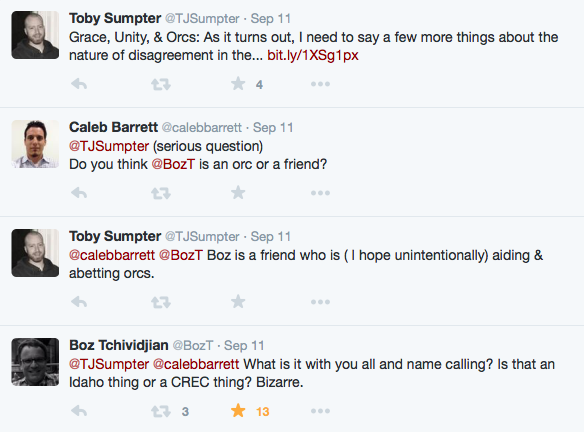
One astute observer replied to my last post pointing out that according to Tolkien, orcs were originally abused and tortured elves. And I have no doubt that some of our loudest, shrillest opponents truly are victims of great hurt and pain. And so I say to you, my friends, if you can hear me through the fray: Jesus our Savior bore our griefs and carried our sorrows.

I know who Sumpter is referring to because it’s me. This is the context:

Screen Shot 2015-09-15 at 3.03.25 PM

This is the context: Sumpter was calling those who disagreed with him “orcs.” Or to be more specific, Sumpter’s actual words were, “orcs, hags, and trolls,” “a mob of angry orcs,” and “orcs…screaming for blood.” In other words, Sumpter chose to focus on the handful of bottom-of-the-barrel internet commenters that every blog has instead of the sincere, thoughtful critics like Tchividjian, Sloan, Hart, and Julie Anne Smith — even Michael Reagan and Jefferson Bethke. (You can even go look at my previous posts on the subject; I have not used a single personal insult and I have not name-called once.) And then he chose to smear the sincere, thoughtful critics by pretending there was little difference between the groups. And to this I responded with the aforementioned comment:

Screen Shot 2015-09-15 at 3.09.31 PM

Considering this context, I’d like to point out the audacity of Sumpter to pretend this tweet somehow made his case. Sumpter said,

I have no doubt that some of our loudest, shrillest opponents truly are victims of great hurt and pain. And so I say to you, my friends, if you can hear me through the fray: Jesus our Savior bore our griefs and carried our sorrows.

Hear him through what fray? Well, probably the fray of Sumpter calling them hags and orcs and trolls. So yes, I hope you can hear the true message of Jesus through Sumpter’s personal insults. I hope you can know the message of Jesus is actually one of love instead of the message of derision and ridicule that Sumpter models. And I hope that Sumpter one day realizes that if he really thinks his critics are “victims of great hurt and pain,” he should stop gleefully rubbing salt into their wounds.

As a child, I absolutely loved Madeleine L’Engle’s Wrinkle in Time series. One the moments that has always stuck with me throughout my life was the “Naming” passage of the second novel, A Wind in the Door. In that passage, Echthroi — evil personifications of nihilism — try to “X,” or erase,” the protagonist Meg Murray. The Echthroi are overcome by the process of “Naming,” which L’Engle describes as re-integrating a character with its true, best self.

I would suggest that this is a better (and more Christlike) tactic for engaging people whom Sumpter finds “orcish.” If indeed they act out of great hurt and pain, then it would be more loving to speak to them as if they are not monsters, but human beings. Hurting human beings, yes, but human beings. People who are desperately trying to keep other people from being hurt like they were.

If Jesus encountered such people, I believe he would Name them, not X them.

I sincerely hope Sumpter, Wilson, and their communities can learn to do the same. And I think Peter Leithart today modeled how this can be done.

Social Workers Don’t Have It Out for Homeschoolers (According to HSLDA’s Own Numbers)

HA note: The following is reprinted with permission from Libby Anne’s blog Love Joy Feminism. It was originally published on Patheos on September 14, 2015.

A New Jersey homeschool family is suing after a social worker visited their home and asked questions about their curriculum, their children’s medical history, and the safety of the firearms stored in their house. Buried deep in an article about the case are these paragraphs:

The case highlights the tension between state social welfare agencies and homeschool families as the number of children being educated at home continues to grow. More than 2 million children are now involved in homeschooling, said Michael Farris Jr., spokesman for the Home School Legal Defense Association.

“When we get calls, it will more than likely be about a social case worker who says, ‘I got a call from someone else who says you’re not educating your kids,’ or ‘We’ve heard that you’re spanking your kids,’” Mr. Farris said.

“Homeschoolers are a unique case, especially because there will be someone, a family friend or even a family member, who disagrees with their choice to homeschool, so they’ll call in an anonymous tip,” he said. “That’s what we’re seeing probably the most.”

These paragraphs—and especially Farris Jr.’s quote—make it sound as though it is extremely common—nay, essentially universal—for homeschooling families to be reported to social services. But is this really true?

I do have some personal experience in this area. I was homeschooled from kindergarten through high school and we never had social services called on us. In fact, to my knowledge, social services was never called on any of the homeschooling families I knew growing up, at least during the years I was there. And yet, Farris Jr. wants to make it sound like friends or family members who disagree with families’ choices to homeschool are making near-constant calls to social services.

Of course, my experience is purely anecdotal. Perhaps HSLDA’s statistics are more complete—after all, they have 80,000 member families and urge these families to call them any time a social worker shows up on the door. With that many member families and the frequency with which homeschooling families are reported to CPS just because they homeschool, their phones must be ringing off the hook!

Well, no, they’re not. Only last month, Slate revealed this:

Farris said his group gets 300 calls a year from dues-paying members worrying about “social workers at the door.”

As Slate points out:

This number . . . represents just 0.35 percent of the HSLDA’s membership, assuming each call came from a different family.

And then there’s also a 2013 HSLDA article that contained this paragraph:

The evidence suggests that abuse in homeschooling families is rarer than in the general population. In 2011 (the last year for which data are available), 6.3% of all children in the U.S. were involved in abuse investigations. The same year, HSLDA assisted approximately 1.2% of our member families in child protective services (CPS) investigations. The vast majority of these investigations were based on frivolous accusations (such as the children being seen outside during school hours or concern about a possibly messy home) and closed as unfounded. While this statistic is not comprehensive, it can be seen as an indicator of a generally low rate of abuse among homeschoolers.

I’m not sure how to bridge the gap between 1.20% and 0.35%—that’s a pretty big discrepancy—but either way, that’s a very low percentage of homeschoolers overall. In fact, these numbers reveal that homeschoolers are less likely than other families to have social services called on them. While the article stats that 6.3% of children overall are involved in abuse investigations each year, the number I found was closer to 4% for both abuse and neglect. Whichever number you use, homeschool families are less likely than other families to be reported to CPS.

The article quoted above suggests that homeschool families are reported to social services less often than other families because they are less likely to abuse their children. While this is certainly possible, it should be noted that abusive parents who homeschool are more able to isolate their children from adults who might see and report than are parents who send their children to school. Without more research, it’s hard to know all of the factors that may be at play here.

But I have to say, there is some serious irony in the fact that those at HSLDA believe they can argue both that homeschooling families are constantly reported to social services by upset friends or relatives and that homeschooling families have a low rate of child abuse based on of how infrequently people call social services on homeschooling families. 

Of course, if HSLDA was honest about how infrequently their member families are frivolously reported to social services—i.e. almost never—they would probably have a harder time maintaining members.

Here’s the Perfect Example of Doug Wilson Minimizing Steven Sitler’s Abuse

By R.L. Stollar, HA Community Coordinator

Content warning: descriptions of child sexual abuse and abuse minimization.

In one of his many, many self-defensive blog posts, Doug Wilson provides us the perfect example of how he has minimized (and continues to minimize) the child sexual abuse perpetrated by Steven Sitler, the homeschool alumnus who attended Wilson’s New Saint Andrews College. The blog post is titled, “The Only Kind of Gospel There Is”, and was published Thursday, September 10, 2015. Wilson writes,

The twittermob has been circulating numerous untruths, among them that Steven Sitler is a child rapist. He was actually convicted of one count of Lewd Conduct with a Minor under 16 years of age (Idaho Code 18-1508).

Yes, of all the actually important and relevant aspects of the current dialogue about child molesters Steven Sitler and Jamin C. Wight, Wilson chooses to focus on this. The fact that Steven Sitler was not convicted of “Child Rape” but rather “Lewd Conduct With a Minor,” the implication of which is, of course, that “Lewd Conduct” is somehow less egregious. Thus these evil twittermobs are the real abusers, falsely accusing poor Sitler of something he never did.

Well, yes, Steven Sitler was never convicted of Child Rape. Yes, Sitler was convicted of Lewd Conduct With a Minor. And yes, in Idaho, those two charges are distinct (though advocacy groups and other states like Washington State consider them the same). But let’s look at the Idaho statute Wilson cites to determine what Lewd Conduct with a Minor actually is. This is from Idaho Code 18-1508:

LEWD CONDUCT WITH MINOR CHILD UNDER SIXTEEN. Any person who shall commit any lewd or lascivious act or acts upon or with the body or any part or member thereof of a minor child under the age of sixteen (16) years, including but not limited to, genital-genital contact, oral-genital contact, anal-genital contact, oral-anal contact, manual-anal contact, or manual-genital contact, whether between persons of the same or opposite sex, or who shall involve such minor child in any act of bestiality or sado-masochism as defined in section 18-1507, Idaho Code, when any of such acts are done with the intent of arousing, appealing to, or gratifying the lust or passions or sexual desires of such person, such minor child, or third party, shall be guilty of a felony and shall be imprisoned in the state prison for a term of not more than life.

Wilson wants us to believe, in other words, that Steven Sitler isn’t as bad as a rapist. No, all Sitler did was force a young child to engage in all sorts of other sex acts that are… “better”? “Less bad”?

And we do not have to guess as to what Sitler actually did. Because the father of one of Sitler’s abuse victims did tell the Idaho court what Sitler did to his child. This is a September 7, 2005 letter written by a victim’s family to Idaho Judge Stegner. ** Content warning for explicit description of child sexual abuse. ** Click the image to enlarge:

Private_Letter

In other words, Steven Sitler lured a 2 year old child into an isolated area and forced that toddler to perform oral sex on him.

And somehow this is important to Wilson to clarify… why? Why is it only important to Wilson that he wins these little semantic games with people bringing sincere and heartfelt concerns to him regarding his and his church’s actions? So he wins on this technicality. So what? What does Doug Wilson want? Does he want us to give him a round of applause for having the courage to say what no one else did: that poor Steven Sitler is falsely accused? That Sitler never raped a child? That Sitler instead only forced a 2 year old to perform oral sex on him? That somehow that’s a relief? That somehow that makes Wilson a courageous champion of truth?

If Wilson actually cares about the God he claims to love, he should set aside his pride and his desire to play games of technicality. Because at the end of the day, it really doesn’t matter to anyone except the Idaho court system whether Sitler “raped” a child or “forced oral sex” on a child. You know why? Because both are egregious cases of child abuse, for God’s sake!

I’d like to conclude with an excerpt from Mike Sloan and Beth Hart’s important article, “Doug Wilson’s Failure to Safeguard Children,” which I highly recommend you read here. Sloan and Hart write,

Where are the voices of the leaders of Reformed churches and Reformed networks who can gain a hearing from Doug Wilson and influence thousands of other pastors in their denominations and circles of influence? Where are the voices from The Gospel Coalition? Crossway, why are you giving a voice to a man who will not use his voice for voiceless? Who is asking Wilson, “Where is your grieving heart for this baby and the other victims? What child protection training are you putting in place or experts are you consulting so this does not happen again?”

Where indeed.

*****

UPDATE, September 12, 2015, 2 pm PT:

Doug Wilson has issued a clarification on his post. An image and the text of the clarification follow:

Screen Shot 2015-09-12 at 2.00.15 PM

Text is,

Important clarification: When I say above that Steven was convicted of one count, I was not meaning that this was his only offense, and neither was I seeking to minimize the egregiousness of his behavior in those other instances. That is why I argued, just below this, that the father in Texas who killed the molester he walked in on was fully justified. I should have made my meaning more clear than I did, which I could have done by putting the Texas paragraph first, and linking it expressly to Steven’s offenses. My apologies to any friends who missed my meaning here, and who thought I was trying to trim and be cute on Steven’s behalf. Such a misreading would be my responsibility. I believe there was at least one scenario where Steven could have been killed on the spot, and no injustice done.

Doug Wilson’s Shaming Letter to the Father of an Abuse Survivor

By R.L. Stollar, HA Community Coordinator

Content warning: discussion about child sexual abuse and victim-blaming.

In 2005, on behalf of the elders of Christ Church, pastor Doug Wilson wrote a letter to a member of his church, Gary. Gary is the father of Natalie Rose Greenfield**, the young woman who was sexually abused by one of Wilson’s students from 2000-2003 when she was 13-16 years old. I previously wrote about the story of that child molestor, Jamin C. Wight, a homeschooled alumnus.

Today, Greenfield made public the letter Wilson wrote to her father in 2005. To be honest, it made me sick just to read it. The way Wilson blames Gary for his daughter’s abuse, the way he tries to manipulate Gary into extending mercy to Wilson’s 24-year-old, youth ministry-bound child molester, is simply inexcusable.

With Greenfield’s permission, I am sharing a copy of the letter below. Click the images to see larger versions:

I think the most telling excerpts are these:

Although we believe the sins were very different, we also wanted to let you know that we have considered whether or not we should suspend you from the Supper for your dereliction of your duties as a father…

As Jamin is discovering, sinful behavior can have (and should have) destructive consequences. But different kinds of sins destroy in different ways, and we would urge you to have a merciful heart toward him, just as you would have others show mercy to you.

Wilson’s intentional comparison between Wight’s sins (carefully grooming and then sexually abusing a child) and Gary’s so-called “sins” (not detecting Wight’s careful grooming process and thus being unaware that Wilson’s student was molesting his 13-year-old girl) is one of the most victim-blaming pieces of writing I have ever had the misfortune of reading. And then Wilson doubles-down with the manipulation by urging Gary to have “a merciful heart toward” the man who molested his little girl, because, hey, Gary needs mercy to for his “sins,” too. If that’s not the most glaring example of religious abuse, I’m not sure what is.

Greenfield has written commentary about the letter’s context, which I would encourage you to read here. I want to highlight a few sections here. First, Greenfield points out that her father was actually wise in putting distance between himself and Greenfield and Wilson and Christ Church after the fact because of how destructively the latter was handling the situation:

How my father could be placed at a similar level of blame to this monster is completely unfathomable to me. My father’s response was shock and injury, and while I know there were many previous instances of him realizing this church was not a place particularly well-versed in exhibiting the love of Christ, I believe this was something of a nail in the coffin for him, as would be expected. I recently spoke with my father about the details of his additional communication with Doug concerning my abuse and it is true that my father told them to stay away from his family, but not until after he saw the despicable way the situation was being handled. In hindsight, perhaps it’s a good thing I wasn’t much ministered to.

Greenfield also identifies key failings in Wilson and Christ Church’s response, namely, that they were sorely ill-equipped to respond to child sexual abuse within their midst. And from Wilson’s current self-centered defense, it appears that not much has changed:

I knew I was being blamed for a good deal of the ‘sexual sin’ in my abuse from Jamin (not strictly from Doug but also from many other individuals in the church, mostly men and many of whom I had previously considered to be like older brothers to me, who wrote to the judge citing varying degrees of unladylike behaviors and temptress-like qualities I possessed as a 13 year old girl), and while the damage the deafening silence did to my psyche was extensive, it’s now clear to me they had no idea what they were doing. Not a clue. Doug’s daughter, Rachel, admitted as much when we met for coffee late last year to discuss her father’s involvement and my misgivings. She wasn’t privy to many of the details surrounding the situation but her general impression was that nobody really knew what to do for me. Considering their utter lack of knowledge in dealing with sexual abuse, I shudder to think of what support would have looked like, had I received any.

Katie Botkin also wrote commentary about the letter, which I also would encourage you to read here. Botkin asks some important questions:

Why would Wilson hold Gary accountable for Jamin’s crimes? And ask that Gary be merciful in Jamin’s court proceedings? I don’t know, but I’m guessing it had something to do with image control. It looks pretty bad if your seminary student is convicted as a child rapist.

Botkin also observes that,

By refusing to answer any questions about these cases and by refusing to apologize for his own actions, Wilson isn’t protecting “the sheep,” he’s protecting himself.

But it’s not just that Wilson is trying to protect himself. Honestly, this situation (and the Steven Sitler situation) have grown beyond the point at which Wilson has any control anymore over how they get portrayed. Yet Wilson still refuses to humble himself before God and those among God’s people he has hurt and alienated. Wilson’s unwillingness to compassionately and openly dialogue and reflect on his mishandling of these abuse cases points to an even deeper problem:

Doug Wilson continues to sacrifice the least of those among him to further his self-imaged empire. Wilson is walking a road far from the Samaritan’s footprints, and I shudder to think where that road will end.

** I am using Greenfield’s name with her permission.