HA note: The following is reprinted with permission from Libby Anne’s blog Love Joy Feminism. It was originally published on Patheos on April 15, 2013.
When individuals who attended public school talk about the negative experiences they had, point out that many public schools are failing or that certain practices in public schools leave much to be desired, and call for improving the schools and reforming public education, they don’t face accusations of being anti-public school, of just being bitter, of being angry at their parents, or of over-generalizing and calling all public schools universally bad. No one tries to silence them for “giving public schooling a bad reputation,” accuses them of trying to ruin things for everyone else, or says that the problem was just their shitty family situation.
Why is it that it’s just fine to call for reform of the public schools, hip even, but it’s taboo to call for reform of homeschooling? Why is criticism of public schools widespread and expected, but criticism of homeschooling by those who were homeschooled themselves causes everyone to lose their heads?
How is “people have shitty experiences in public schools too” a sensible answer to calls for reforming homeschooling? Do we shrug and say “people have shitty homeschool experiences too” when people call for reforming and improving public schools?
Why is it that criticism of homeschooling by those who were homeschooled is panned off as some form of adolescent rebellion while criticism of public schools is practically trendy?
Why is calling for reforming homeschooling portrayed as trying to “ruin things for everyone else” while reforming public schools is seen as an effort to make things better for everyone’s children?
Why is voicing criticism of homeschooling or talking about negative homeschool experiences portrayed as being anti-homeschool while criticizing public schools or talking about negative experiences in public schools isn’t similarly portrayed as being “anti-public school”?
Why do people shrug and say that bad homeschooling is just a result of shitty parents and there’s nothing to be done while at the same time arguing that we need school reform to improve shitty schools and implementing programs to help public school kids with shitty family backgrounds?
Why is criticizing public schools and calling for public school reform seen as healthy and good while criticizing homeschooling and calling for homeschool reform is taboo? Shouldn’t we want to improve and reform both, cut down on abuse and neglect in both, and ultimately work toward the best interests of children in whatever educational methods their parents have chosen for them?
Something is very broken about how we discuss this issue.
The following is a list of things that range from impolite to incredibly disrespectful that I have heard since I started speaking out about this issue. I’m (unfortunately) not making any of these up and I’ve actually had every single one of them either said to me or seen them said to others. If you don’t want to be a jerk, please don’t say any of the following:
Concerning homeschooling:
1. Tell me how good of a homeschooling experience you or someone you know had and imply that it cancels out mine.
2. Say that obviously it was just a parenting problem, not a homeschooling problem at all.
3. Say that obviously it was a religious fundamentalism problem/bible-based cult problem, not a homeschooling problem at all.
4. Say that I am not describing real homeschooling so I should not be talking about my experience like it was homeschooling at all.
5. Say that I need to be careful, that openly speaking about this will help enemies of homeschooling (nosy neighbors/government/the minions of the Antichrist) have the political cover to mess up or destroy homeschooling for the good homeschoolers.
6. Say that obviously because I am standing here today with a job/degree/spouse/all four limbs that the homeschooling I got really wasn’t too bad and therefore we all should keep calm and carry on.
7. Say that my parents only homeschooled because it was a problem with the school district and obviously any public school in my area/state/nation/world would have been worse.
8. Say that maybe my homeschooling experience was even secretly good and I likely don’t know enough about what I’d be comparing it to, with public school being so awful and all.
9. Say that you/your kid/someone you know had a much worse experience in public school/government school/a hole in the ground and so I should quit bellyaching and overdramatizing my homeschooling experience and instead just be grateful it wasn’t as bad of a story as the one you just told.
Concerning abuse:
10. Say that what happened to me was so uncommonly rare that it’s not something we need to be generally concerned about.
11. Say that you are sure that it was that my parents were uneducated/rural/brainwashed/obviously raised wrong and that’s why they did what they did, even though you know nothing about my parents’ background.
12. Say it is obvious that I am so hurt/broken/angry/bitter/emotional/weird/vengeful that I have lost track of reality, don’t know what I’m talking about on any of this, and no one should listen.
13. Say that I need to just let the past be the past, understand that parents make mistakes/are not perfect, then go forgive mine (immediately assuming that I haven’t), and stop disrespecting them by talking about this issue.
14. Say that the way life works is that your parents can raise you however they want/force you to be the person they ask/mess you up for the first 18 years of your life and then it will be your turn when you have your own kids.
Concerning religion and politics:
15. Say that if my parents were real Christians that this never would have happened.
16. Say that this is obviously a problem with Christianity itself and all homeschoolers should respond by being secular/atheist/Buddhist/some other faith.
17. Say that you seriously doubt (or had it laid upon your heart by Jesus himself) that it is in God’s will/my best interest/society’s interest for me to be talking/thinking/spreading lies like this and you will pray/worry/be quite concerned for me.
18. Ask me if I am aware that when I talk about my story it is mainly going to be helping people who hate homeschoolers/Christians/parents/Americans/suburban white people unfairly stereotype/hurt/oppress all of your group because people will mistakenly think you are like me and my family and obviously you are nothing like us at all.
19. Accuse me of being put up to this by teachers unions/liberal brainwashing/feminism/Satan and not having actual good reasons for how I characterize a problem I lived through and/or am studying.
20. Accuse me of being anti-homeschooling, anti-Christian, and anti-family all in one fell swoop because I said what happened to me should not happen to other kids.
Now that I’ve listed all the rude, insensitive, selfish, and potentially threatening things I can think of that you should not be saying to people who have shared their horrible (or even just a little bit bad bordering on mediocre) homeschooling experience (I’m sure I left some out, so please feel free to include them in the comments), here are eight examples of something that might be a good idea to say:
1. Thank you for sharing your story.
2. I am trying to understand where/when/how this occurred. Can I ask you? How did X, Y, or Z happen/come to be/take place?
3. What helped you get out/get better?
4. What do you think could have made this situation better/not happen at all?
5. What do you think someone like me might do or keep in mind to prevent this from happening to others?
6. What do you like to do today, now that you’ve left that environment?
7. Can I share what you said with my friend/relative/pastor/neighbor/blog readers/Facebook?
8. I wish you well and hope that tomorrow/this week/life/the future will be good for you.
Also, even if this stuff is foreign to you and you really have no idea (or maybe don’t care) what it is like to walk in the shoes of someone who has had this kind of homeschooling experience, please try for a moment to imagine how it would make you feel and what it might lead you to do and then have compassion. Personally, I love to argue and I have a lot of “fight” in me, but for many people who are sharing their story, just finding the words and the strength to do so is incredibly hard. People should not, under any circumstances, be pushing someone who’s telling a survivor story to defend themselves or expect them to deal with the kind of obnoxious behavior I listed above.
It’s hard to believe that it was just a month ago that we launched Homeschoolers Anonymous. So much has happened in so few weeks! This is really due to the amazing and wonderful support that you, our community of friends and family and advocates and peers, have so graciously provided.
In a mere month, our WordPress blog has reached nearly 100,000 views. More than 260 comments — almost universally positive — have been made on the site. Our Facebook page has received almost 300 likes. Our most popular post to date, a crosspost by blog partner Kierstyn King (“Sex™ (and the lies I was told about it)”), has been viewed over 3500 times; the second most popular post, R.L. Stollar’s “Homeschool Confidential, A Series: Part One,” has over 3000 views. Michelle Goldberg covered our story on the Daily Beast. We’ve also received coverage by the Daily Mail and Lez Get Real, both Google News providers. We’ve also received inquiries from other major media groups and will keep you posted on those developments.
This is a very difficult project. If you have any experience at all with the conservative Christian homeschooling world, you know how defensive they — we, really — have been, are, and will likely continue to be. You can see how afraid some of us are about speaking out with our experiences. Qualifications and disclaimers abound. The fact that such fear exists, merely about saying one has had a personally negative experience in homeschooling, is indicative that something has gone awry. No one should feel afraid of speaking up about abuse or hurt or pain. That is why we feel this community is so important and necessary. We want to create a platform for sharing and healing. We want to be a voice in defense of those who have been hurt.
It’s truly been a wild ride. We’ve been accused of being nut jobs, anti-God, anti-homeschooling, a vast liberal conspiracy manufactured by Obama, the NEA, and the ATF, and opportunists that want to take advantage of abuse victims in order to achieve vast fame and fortune.
But as someone much wiser than us once said:
Haters gonna hate.
We’re here and we’re not going away. We will continue to share stories, we will not be silenced by intimidation, and we will do our best to represent our collective voice accurately, compassionately, and strongly.
Thank you for your encouragement, support, and love. We are very grateful. Thank you, thank you, thank you.
In honor of our one-month anniversary, we’ve decided to take our top search terms — the phrases that people have Googled that have led them to us — and ask each HA Community Coordinator and Blog Partner to write a paragraph about one of the search phrases. (Some of us went over this paragraph limit.) This was presented to them as a creative challenge. They could write whatever they’d like that they thought was important to say to whoever might be drawn to our site because of the phrase in question. To make this a bit more challenging, we intentionally switched up who wrote about which search term, so it’s different than what that person might normally write about.
The idea is to highlight both the diversity of our voices and the unity of our mission.
So, without further ado, we present to you the first ever group post from Homeschoolers Anonymous!
*****
“homeschoolers abused” — by R.L. Stollar, HA Community Coordinator
Not all homeschoolers experienced abusive situations. Not all homeschoolers have the same story. The fact is, homeschooling is a vast and diverse phenomenon that includes different religions, different political beliefs, and an immense variety of educational philosophies and teaching styles. But from my own personal experience in the conservative Christian homeschooling subculture, I can confidently say that — within my particular subculture — there is a tendency to operate from an “Ideology First” mentality, instead of a “Children First” mentality. And when you elevate the importance of ideology over the humanity and well-being of kids, you can easily create cult mentalities. And cult mentalities can cause immense hurt and pain for so many people. They can create emotional, mental, physical, and sexual abuse.
Not all homeschoolers experienced abusive situations. But many have.
Not all homeschoolers have the same story. But there are striking similarities.
I want their stories — my story, our collective story — to be heard. And if you listen with an open heart and mind, maybe you can help us make homeschooling better in the future.
*****
“homeschoolers anonymous” — by Libby Anne, HA Blog Partner
Why homeschoolers anonymous? I think I understand why. The first time I met someone raised in the Christian homeschooling subculture who had, like me, grown up in a homeschooling family and then questioned and left the pervading ideology of that family and subculture, I was overwhelmed. Before, I had felt alone. Like it was just me. Invisible, unnoticed, an anomaly that people didn’t acknowledge, or even know, existed. When you realize that you’re not alone, that it isn’t just you, everything changes. And some of those who visit Homeschoolers Anonymous may still be in the closet or on the wall, unready or unable to make the leap, to say that there was something wrong, to speak about and acknowledge the hurt and the pain. And that’s why we’re here.
*****
“stand up for my children” — by Vyckie Garrison, HA Blog Partner
I know this will be controversial, but when I was asked to write about the search phrase, “stand up for my children,” I immediately thought of the period of time when all the abuse and dysfunction of our Quiverfull lifestyle culminated in a nasty court battle when I left my ex-husband and sued for custody of our six children who still lived at home.
My lawyer told me that I would need at least three people who would be willing to write affidavits for the judge stating that they were aware of abuse in our home. I was extremely discouraged because I believed I had done such a good job of covering up for my husband and protecting his reputation that nobody, with the possible exception of my mother, had any clue that there was anything amiss in our “big happy family.”
Undaunted, a fellow homeschool mom started making phone calls, and in about a week’s time, was able to gather more than 20 affidavits from friends, family, and acquaintances who all testified that they had been aware that the children and I were being abused.
That’s over twenty Christians who could have stood up for my children and spared us all those years of abuse.
I understand that as evangelical Christians we were all taught to fear the evil government social workers, but looking back now, I can honestly say that the court-ordered involvement of CPS was one of the best things that ever happened for my family.
I have plenty of suggestions for intervention and support (see the NLQ FAQ: How can I help my Quiverfull friend?), but if you clearly see children being abused or neglected, please call this hotline and get the family some outside, professional help: 1-800-4-A-CHILD.
*****
“homeschool uniform denim jumper” — by Nicholas Ducote, HA Community Coordinator
Jumpers, especially the denim variety, were the unofficial uniform of the homeschool mom. My mother had an entire closet full of jumpers in an array of colors, but none rose above her knee. I can count on two hands the number of times I’ve seen my mother wear pants in the last decade. I wish it wasn’t so stereotypical, but a quick Google search of the terms “denim jumper” will bring you to www.denimjumper.com – “your source for everything homeschooling.” Most Christian homeschooling sub-cultures emphasize modesty in young women, especially in reaction to what they see as an over-sexualization of young girls, but their attitudes often read like an unironic guide to rape culture (i.e. The Rebelution’s Modesty Survey). In short, women are told their bodies can make men lust and, in a revolting twist of logic, the immodest women is responsible for “defrauding” the lusting man. Young women are encouraged to hide their curves behind baggy jumpers or long skirts and modest tops. Fashion, they are told, only serves to bring excessive attention to the superficiality of a woman. Modest, godly women do not need to appeal to a man’s lust. Instead, she strokes his ego by serving in the cult of domesticity.
*****
“homeschool cult” — by Anna Ruth Fuller, HA Community Coordinator
Think about what a homeschooler looks like. What comes to mind? If images of religious children passing out pamphlets or holding signs comes to mind, you’re thinking too narrowly. If images of hippies unschooling their children comes to mind, you’re again thinking too narrowly. Broaden your thinking.
Homeschooling occurs everywhere and for all types of reasons. The same is true of public schooling and private schooling. How you choose to educate your children is your choice. However, it is important to remember that in all of this, children have a right to their own views that aren’t necessarily your own. This is true no matter what type of schooling they undergo.
So what happens when parents do not respect a child’s right to their own worldview? Now don’t get me wrong, I’m not talking about letting your children run amok. There’s a difference between pure hedonism and having a worldview.
Not letting your children choose their own worldview is a dangerous road to take. It might seem like a good idea at the time since it is easier to control a child’s thoughts than to guide them. Most parents these days recognize that guiding their chidren’s thoughts is the way to go, but there are those that still cling to controlling them.
It is considered bizarre to isolate your children from the world so that you can protect from worldly things. We are becoming a global society with the advent of the Internet. Preparing your child for the different worldviews they will face (and more importantly, how to respect them for what they are) is crucial to that child’s success. Yet there are many Christian homeschooling parents that purposefully decide to isolate their children from all of this. It is this type of homeschooler we are bringing to light here with our stories.
This brings me to my topic. One of the most popular search terms for our site has been ‘homeschool cult.’ When I learned that, I began think about whether we were really part of a cult as Christian fundamentalist homeschoolers. According to Wikipedia’s article on cults: “The word cult in current popular usage is a pejorative term for a new religious movement or other group whose beliefs or practices are considered abnormal or bizarre by the larger society.”
This definition makes me think we weren’t part of a cult. To have been a cult, we would have needed to have been unified religiously somehow. We weren’t. Each of us went to churches in conflict with each other on various minutiae. There was one thing that united us and that was the need to reclaim this country for the Christian God. Our parents wanted us to dream of a Christian nation and placed that first and foremost in our minds by excluding the teaching of other worldviews (thankfully this didn’t happen nearly as much to me as it did to others). We were trained up in debate to help us become better lawyers and politicians to lead this new country to its destiny. So in reality, we weren’t part of a cult in the religious sense. While there were certainly practices and behaviors that could be seen as cult mentalities to outsiders, we were less a part of a religious movement and more a part of a political movement.
*****
“homeschool and abuse and fanaticism” — by Kierstyn King, HA Blog Partner
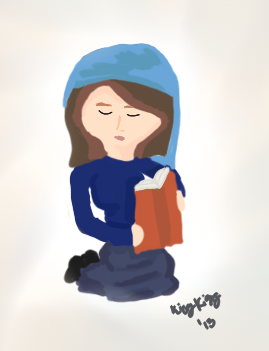
Art by Kierstyn King.
This is a touchy subject, because you’re screwed in the eyes of parents or vehement pro-homechooling-beyond-all-reason-crowds from the start. The fact is, this sentence and search term oddly defines my experience in a very succinct way, and like the lonely oppressed girl over here, it’s not a good thing. Homeschool and abuse and fanaticism don’t have to be related, but sometimes they are and here’s how: parents have the idea to homeschool, they then are told they must homeschool to essentially indoctrinate their children to their cause (fanaticism) which in some way or another usually is along the lines of “taking over the world” (who doesn’t want world domination?). Of course getting to that point means squelching the life out of the individuals you’ve stopped seeing as human and started seeing as arrows – focused solely on your needs, wants, and purpose you deny basic rights, dignity, and sometimes the security of unconditional love to the child you’re supposed to care about above everything else (abuse).
The unnecessarily necessary disclaimer here is: obviously not everyone is like that (but some people are).
*****
“why all of the attacks on homeschoolers” — by Julie Anne Smith, HA Blog Partner
I have been homeschooling my children for the last 20+ years. When I hear about “attacks” on homeschooling, I suspect there could be some confusion. Taking a closer look at the attacks, generally, it is not homeschooling in general that is attacked (ie, the education of one’s children at home), but more specifically, a lifestyle connected with the “Homeschool Movement.” The Homeschool Movement is associated with practices and ideologies not even remotely related to scholastic achievement, e.g., full-quiver lifestyle, patriarchy, purity and modesty teachings, etc. These practices and ideologies have had mixed, and sometimes very sad results. The methodologies employed to enforce these lifestyles can also be troublesome. The Homeschool Movement must not be confused with homeschooling. I believe homeschooling to be a valid and exceptional option for motivated and capable parents who have a vested interest in the proper education of their children.
*****
“homeschooling and mental illness” — by Latebloomer, HA Blog Partner
For a well-informed and supported parent, homeschooling may be an excellent way of supporting a child suffering from a mental illness. It could allow for high quality personalized instruction, easier access to appointments with medical professionals, and protection from peer bullying. Unfortunately, the combination of homeschooling and mental illness also has the potential to do great harm. For instance, children with mental illness can go undiagnosed for much longer if they do not regularly come in contact with trained educators and medical professionals. Distrust of those resources is very common in fundamentalist homeschooling circles, where parents are much quicker to blame unusual behavior on rebellion and worldly influences. An additional concern is the potential for harm when a child is homeschooled by a mentally-ill parent. The child will often be far more affected by the parent’s mental illness because of the increased time spent with the parent and the lack of time with other adults. For such children, the parent’s paranoia, depression, narcissism, etc, define their entire childhood and hinder them from developing positive and healthy relationships with others even in adulthood.
*****
“which is more effective for learning homeschool or public school?” — by Brittany Meng, HA Blog Partner
So you’re wondering which is more effective for learning: homeschool or public school. To answer this question more effectively, you should add the phrase “for my child.”
It all depends on what your child needs to be an effective learner. Here are a few issues to consider about the effectiveness of homeschooling for certain ages and needs.
Elementary school: Homeschool can be very effective for Elementary school because children often need one-on-one time to learn basics like reading and math, which are foundational for a strong education. If your child needs extra help in these subjects, homeschooling might be a good choice. On the other side of the coin, if your child is advanced in these areas, homeschooling might be good for your child as well. Nothing squashes the natural love for learning faster than a child who is bored. Homeschooling allows you to move at your own pace.
Middle School: Let’s just face it—middle school stinks for most people. Homeschooling will not remove all awkwardness, angst, self-doubt, or attitude problems from your child. However, if social issues are getting in the way of your child’s academic success, homeschooling may be a good option for your family.
High School: By this point, most young people are able to voice their educational and social needs. These wants and needs should be taken into consideration. This is also the point where parents need to consider how capable they are to meet the needs of their child, especially if he or she wants to go to college. I believe that homeschooling can be effective in high school but only with a strong outside support and supplemental network: classes at a local high school, community college, and/or homeschool co-op.
Personally, I believe that homeschooling becomes less effective for learning the older the child gets but this is a blanket statement. Only you can determine what your child needs.
You also have to consider the needs and abilities of your family: finances, time commitment (contrary to what many people think, your child needs as much academic attention from you in 1st grade as he does in 10th grade. Kids need accountability, motivation, and a sounding board for ideas), a strong support network, and whether or not you actually want to homeschool. Even if you feel that homeschooling would be the best option for your child, if you don’t want to homeschool, don’t do it. Homeschooling is a huge commitment. You can’t toe the water; you have to jump in with both feet. However, some states allow your child to be homeschooled by someone else. Check into all your options.
When choosing the best learning option for your child, it is important to consider what you and your child need and want both academically and socially. So, which is more effective public school or homeschooling? It all depends on your child.
*****
“pscyholgoy of bad/evil” — by Lana, HA Blog Partner
In conservative circles parents often have a tendency to refer to their children as all good or all bad. In public — that is, among other conservative families — kids often are forced to play the role of the perfect family, the perfect godly family. I felt this a lot as a child when we did cookouts with other homeschool families, or a respected homeschool family came over for dinner. I had to smile and pretend that I was godly (whatever that means) while everyone talked about how we were great and the future of America. At home our house was in shambles, but none of that mattered around our friends. Perhaps this alone would make a child go crazy. Why is it necessary to fake it? Why weren’t we genuine? Was it all in my head that my home was dysfunctional? Was it my fault when I was unhappy? Was my friends’ home totally perfect? These are legit questions that I and many others have experienced, but the confusion goes much further. For every time a child is praised as good, its likely that he or she is shamed as bad for the most ridiculous things at home. I was taught that I was not dressed until I wore a smile. If I did not wear a smile, I was ungrateful. If I expressed frustration (that admittedly did get out of hand sometimes), I was disrespectful. A simply bad act is escalated as totally evil or rebellious. There are plenty of homeschoolers who had it much worse, directly being called evil for not being submissive to an abusive situation. And so the soul is torn between good and evil. Sometimes kids just need to be told they are human. We aren’t perfect. We aren’t all bad. We’re human.
*****
“living my life” — by Heather Doney, HA Blog Partner
What my life was supposed to be was set. One story said that because I am a woman, by the time I was 30 I was supposed to have been married for a decade and have somewhere between 3-6 kids, homeschool them in a nice house, and be involved with a local church. The other story was that I was supposed to have a mid-level office job where I wore business suits and cute pumps, had a comfortable salary with decent benefits, ho-hum dates with guys who wore nice watches, and appletinis with the girls on weekends.
Neither are my life. I truly thought I was supposed to somehow make one or both my reality, that they were in fact the going realities available, but now I know they weren’t, at least not for me. I knew it just didn’t feel right, but I somehow figured I’d still end up in one or the other. I didn’t. I’m still just me, and while I do own a business suit and those cute pumps today, I generally wear flats or leather boots with jeans. I have only a laptop computer, not a cubicle, to go to. If I’d wanted a baby already I expect I could have had one, but I didn’t. I don’t go to church and I don’t even like appletinis (or guys who wear expensive watches, for that matter).
So while I didn’t want my life to look like either of these so-called options, I didn’t know what it should look like. What I knew it shouldn’t look like was what I call “living in the meantime.” I lived in the meantime for a few years and meantime mode is where you just let life happen to you, figuring it knows what is best, not-so-patiently waiting until it resembles one of your ideals. The scary thing is it likely never will. You can easily spend your whole life in meantime mode, waiting on serendipity to rescue you, and the thing most people forget about serendipity is that it isn’t just some happy accident or eureka moment that breaks you out of your ordinary life. Serendipity is what you find while you are out looking for, working on, and doing other things. Because serendipity requires action, it is a lot harder to find while in meantime mode or while you’re living someone else’s idea of your life, just going through the motions.
So to me living your life is not about doing one thing or another but about breaking out of that. It is about actively writing the next chapter to look differently, resetting the script, welcoming the changes, courting serendipity. It is about “if you build it, they will come.” In order to do that you have to do something scary though – be real about the person that you know you are, not stuck on the one you feel you “should” be. You can’t go squeezing yourself into a role that makes you look like you’re wearing somebody else’s style.
To live life, forget the ideal life someone else created for you and said should be yours.
I clearly remember having conversations with my mother about how “those people weren’t really homeschooling” and how our family and friends were getting it right. We talked about how they weren’t really part of any home school community, and their parents were just trying to get away from the responsibility they bore for the abuse they inflicted, by claiming the title “home schoolers.” The home school community distanced itself from these stories, claiming that the abuses of a few “nutjobs” shouldn’t impact the rights of the whole homeschool movement.
It’s been interesting to hear the same lines come up in response to the stories shared on this blog. In comments on other sites, I’ve read many things like, “you could find 30 abused kids in any school system!,” or “these kids’ parents were just crazy. That’s not what home schooling is really like!” It seems like many people invested in the homeschooling movement are reading this blog in the same way my mom read stories like the ones mentioned above — as extreme examples of abuse from people on the far fringes of the homeschool movement. I’ve read comments that go so far as to dismiss these stories outright. More people, though, lament the suffering they read about, but make comments that distance themselves from the problem. These extreme cases are hard to catch, the sentiment goes, because these families never show up to homeschool groups or 4-H clubs or churches or anywhere we (homeschoolers) might be able to intervene. “These kids were totally isolated! It’s not our fault!” they declare, explicitly or implicitly.
This is misguided.
For many of us who are sharing our stories, our families were not on the fringes of the homeschooling movement — we were at its center. Our parents were the ones running the debate leagues, and founding the AWANA programs. We were the ones winning awards, respect, and acclaim. We are the poster children of the homeschooling movement.
And yet, we suffered serious abuse and neglect, and no one intervened on our behalf.
As a survivor, I started asking why. I was (almost constantly) involved in a myriad of extracurricular activities, and none of the adults in my life intervened in the neglect I experienced. They either didn’t notice, or didn’t care.
This is what isolation looks like in the homeschooling community.
I interacted with many adults outside of the homeschool movement, in many different contexts, and I honestly don’t think any of them had an inkling of what was really going on. Homeschoolers have always been trained to put on our most adult, most mature face to the outside world. This has to with the ways we’ve been socialized and the pressure we face to be walking proof of the “success” of homeschooling — but that’s another post. Regardless, we’re excellent at being polite and reciting (often eloquently!) the ideas we’ve been taught. We therefore often make a very positive impression on outsiders — I can’t tell you how many times I was told how grown-up, how mature, how insightful I was when I was a tween. Most of the adults outside of the movement were so blown away by my irregularity (and my ability to discuss the classical origins of astronomical nomenclature) that they never asked deeper questions about my education or physical well-being, let alone about the emotional and spiritual abuse that was present in my home.
I also regularly interacted with adults within the homeschool movement, where parents should have been able to notice what was happening — and still, no one spoke up. Many of them didn’t (and still don’t) consider what many of us endured abuse — it’s just part of the process of “training up a child.” Many bought into the same vision of religious indoctrination and corporal punishment. The “us vs. them” mentality was huge, and “them” was often Child Protective Services. I’d still be surprised to hear of one home school parent reporting another. Even when the “moderate” parents didn’t agree with the techniques of the more fundamentalist ones, the “rights of the parent” continuously won out over the rights of the child. This line of reasoning is currently being used by the HSLDA to justify the refusal to ratify the UN Convention on the Rights of the Child.
The combination of these factors created a unique culture that fosters and covers up or ignores the abuse and neglect that happens at the center of its community. The case against Sovereign Grace Ministries, an evangelical denomination that promotes homeschooling, is just one example. We’ve experienced it, and we’re hurt. There was a deep sense of community in the homeschool movement, and many of us, as kids, trusted deeply in its people and institutions. Now that I’m an adult reflecting on my experiences, I feel betrayed. The people I trusted perpetuated the systems of indoctrination that harmed me, and facilitated my parents’ neglect.
This is what isolation looks like in the homeschooling community.
The invitation that this blog presents to the homeschooling community is to begin to take abuse, neglect, and indoctrination seriously, and refuse to look the other way. The children of homeschooling need advocates, and our parents aren’t always looking out for our best interest. Neither is the HSLDA.
The following piece was originally published by Sarah Jones on her blog ANTHONYBSUSAN with the title, “Homeschooling: Creative Alternative or Brainwashing Tool?” It is reprinted with her permission. Sarah has a master’s degree in postcolonial culture and global policy, and another degree in international studies. She was an Evangelical Christian at one point in her life, then a feminist member of the Emerging Church, and now describes herself as “agnostic, leaning atheist. Still a feminist though.”
The Daily Beast’s coverage of Homeschoolers Anonymous has reignited the perennial debate over the homeschooling movement and parents’ rights. As a former homeschooler, this is an intensely personal debate for me: I disliked the homeschool experience and I remain deeply critical of the Christian curriculum my parents employed. My own experience is not identical to the stories detailed in the Daily Beast article. I did not grow up in a Quiverfull home and my parents eventually became wary of the movement’s fringes. As a result, they did agree to send me and my brother to private and then public school. They’re not homeschool activists in any meaningful sense. Nevertheless, this article resonates with me, and I agree with the premise put forward by the members of Homeschoolers Anonymous: that homeschooling left me totally unprepared for the real world, and facilitated religious abuse.
“I hope that this Daily Beast article marks the beginning of a critical national conversation.”
Before I continue I want to make it clear that I understand that homeschooling isn’t intrinsically a social evil. Done well, it can certainly prepare children to excel in higher education. Moreover, I don’t intend to argue that the alternatives are without flaw. The state of public and private schools in the US is a valid concern. I’m not going to summarize that debate here, but I’m referencing it in order to show that I do understand why parents (like my own) may make the decision to homeschool. I’m concerned by a specific branch of the homeschool movement, and its emphasis on religious indoctrination.
Certain common themes emerge from the Daily Beast story. Readers are introduced to adults who spent their formative years engaged in a battle against secularism. There is much praise for homeschooling’s ability to encourage children’s natural gifts, but as these stories demonstrate, many Evangelical and fundamentalist families encourage these gifts in order to advance a specific ideological agenda. Those of us raised in the religious right will recognize the rhetoric. We’re meant to be culture warriors, engaged in battle to return America to its Christian roots. Homeschooling is meant to create a pure environment. Christian parents are free to teach (read: train) their children in an atmosphere free of secular corruption.
For obvious reasons, this attitude toward education lends itself easily to abuse, particularly when you consider that most of these families adhere to traditional gender roles that revere the father as the head of the household. When your father is your chief disciplinarian, spiritual adviser, breadwinner and the principal of your school, a patriarchal structure is so firmly entrenched that the possibility of addressing domestic abuse is incredibly unlikely. Additionally, it reflects the belief that children are the property of their parents, that children have no rights, independent of their parents. The potential consequences this attitude poses for the children subjected to it are evident from the Daily Beast piece and from the other stories provided by Homeschoolers Anonymous.
There are additional points of concern; namely, the overlap between this fringe and Christian reconstruction. R.J. Rushdooney, truly the father of contemporary Christian reconstructionism, advocated homeschooling as an alternative to secular education. Later figures like Michael Farris continue to champion homeschooling as a religious obligation for Christian parents. Precociousness is considered evidence that homeschooling works. In the comments of the Daily Beast piece, you’ll find at least two adolescent homeschoolers engaged in a passionate defense of the movement. They repeatedly cite their personal success, and the successes of their homeschooled peers, as evidence of homeschooling’s superiority.
As a homeschool alumna, I don’t credit my own academic success to my parents’ decision to homeschool. If anything I believe I’ve succeeded in spite of it. I’ve never received accurate scientific instruction and I had to re-teach myself history and government. My decision to pursue political theory at the graduate level is partially inspired by this drive to strip my thought process of the misinformation and bias I learned as a child. Similarly, I reject the belief that my current progressive views are derived from mere rebellion, as many current homeschoolers like to assert. Those of us who object to the movement do so for valid reasons, and I hope that this Daily Beast article marks the beginning of a critical national conversation about children’s rights and the need to better regulate home instruction.
The following piece was originally published by Karen Loethen on her blog Homeschool Atheist Momma with the title, “Still Looking for Disadvantages of Homeschool?” It is reprinted with her permission.Karen describes herself as “a homeschooling mum of two children (ages 15 and 12) and the wife of an amazing man.” She and her family “are Midwestern Americans, currently living in Brisbane, Queensland, Australia.”
I’ve been wondering, do I write pro homeschool stuff because I am simply reinforcing my insecurities about homeschooling?
No.
I write it so that others can find pro-homeschooling stuff easily.
While we can not reparent any of these wounded people who are trying so hard to heal themselves, we can offer them our love and seek to understand their claims. We, as homeschooling parents, should never attempt to discredit someone’s story (as I have seen on some of these sites). No, instead, we must learn from these experiences and offer these people our love and compassion. And offer them our thanks for being willing to share their stories. It takes courage in this world to stand up and disprove the majority. And, besides, they are people who are courageously, fearfully offering their life stories, hoping for healing.
If you go there, write nothing, or write only messages of love and support. It is homeschooling parents who are insecure and fearful themselves who do not allow these voices to be heard without confrontation. I understand that fear, but these boards are not the place to put one’s own issues out there.
As one woman at the Homeschoolers Anonymous website said, today, homeschooling is often portrayed in the media as some great and noble cause or as a quaint, folksy version of the Great American Dream. I’m grateful for the “improvement,” as homeschool has had a fairly dreadful rep for a long time. Sadly, some of that rep is well-deserved. I must also add that most of the stories (all the I have read today, in fact) share a fundamental Christian motivation or Evangelical basis for their isolationist and authoritarian approaches to their homeschooling and parenting. This is not the point of my post, but it is an essential piece of the puzzle.
I think of homeschooling as an extension of, as a part of, parenting.
In my mind there is no way to separate the two.
I think we should all have the right to freely educate our children without state involvement. But this presupposes that all adults are capable of making healthy and wise choices for their families and we know that this is not the case. But whose job is it to decide who should and who should not homeschool? No one is sitting in an office making lists of people who can and should become parents. Anyone can become a parent regardless of maturity, ability, mental issues, all other issues, etc. Parents of all ability levels have always existed in the world.
Maybe we can all agree that not all people who are parents should have been parents.
Similarly, not all people who homeschool should homeschool.
To homeschool, to parent, to the best advantage of one’s children, a parent needs to be mature enough to put the needs of themselves Last on the List and the needs of their children First on the List. A person suited to homeschool and parent children must have no philosophy, culture, or creed that puts anything, anything ahead of the good of the children. A person well-suited to parenting and homeschooling children is a person who is willing and able and apt to reflect upon new information and evidence and use that evidence and make changes, improvements, adjustments when necessary. The person adequately suited to parenting and homeschooling is a person who takes the time to learn about a variety of educational and parenting options and looks at those options carefully, making decisions based on what makes a better human being from each child.
And more, I believe that the best approach to parenting, in my opinion, is a person who manages to believe in their children, who even believes in the human race! I believe the more successful parent and homeschooling parent is one who finds humor in life and looks for fun. I believe it essential to think well of people. I think it necessary to put Love at the center of family life. I think it necessary to be a self-aware adult. And I think it necessary that I spend time locating my own issues, growth areas, and limitations. And seek to improve myself.
Yes, I can be a bit serious about this.
I believe that adults owe it to themselves and to their progeny to become the best people they can be.
Because when they don’t, it’s the kids who suffer.
A group of former homeschoolers are joining together to bring awareness to, and healing from, different forms of abuse in extreme homeschooling subcultures. The organization, Homeschoolers Anonymous (HA), is being coordinated by former homeschoolers across the United States, including California, Louisiana, Oregon, and Washington.
According to recent surveys, approximately 2 million children are taught at home in the United States. The total number of home-educated kids doubled between 1999 and 2007. While some are being homeschooled in non-Christian families, the National Home Education Research Institute claims almost three-quarters of those 2 million children have conservative Christian parents who aim to pass on their moral and religious values to their kids through home education. This makes religion the primary motivating factor behind this form of education.
HA’s creator is R.L. Stollar, who was homeschooled from K-12 and currently resides in Eugene, Oregon. He has a Master of Arts in Eastern philosophy and religion and is a freelance writer. Stollar says he came up with the idea for HA after realizing that many of his homeschooled peers suffered from some of the same emotional, mental, and physical problems that he does. Stollar says,
“I started talking last August to someone I knew in junior high and high school about some of the issues we both struggle with today. And it was interesting to see these similarities and that we both attributed them to the same things from our backgrounds.”
Stollar realized that many of his peers had stories like this. He decided to created Homeschoolers Anonymous to bring awareness to these stories and to inspire others to speak out. He intends for HA to give others courage:
“I think, for a lot of us, we are afraid to say what we feel, to say we have changed. A lot of us perceived the message of our world as ‘shut up, get in line, and prepare to take back the culture.’ That makes us, even as adults, timid and maybe even scared of community backlash if we were to say, ‘You know, I’m a different person now. I grew up, I’m an adult, and I have my own life.'”
Stollar connected with old friends on Facebook and made new ones. He found a community of people who shared the same vision. One of those people is Nicholas Ducote, who grew up in a family immersed in Bill Gothard’s Advanced Training Institute (ATI). He has his Master of Arts in History from Louisiana Tech University and is currently working on a book about lumber development in North Louisiana.
Ducote considers his upbringing to be a form of fanaticism. To him, fanaticism is any manifestation of an ideology that knows no compromise and uses children as vehicles of ideological advancement. Ducote says,
“The quaint, happy, innocent life of a child can quickly be replaced by the stark absolutes of fanaticism. Muslim, Christian, and Jew are one in the same monster. Their fanatics take different names, they act in different ways, but they are all the same.”
Stollar, Ducote, and team of others are eager to see the launch of their vision. Homeschoolers Anonymous has partnered with a number of well-known bloggers to help bring greater visibility to their stories of abuse and healing. These blog partners include Libby Anne’s Love Joy Feminism, Heather Doney’s Becoming Worldly, Vyckie Garrison’s No Longer Quivering, and Julie Anne Smith’s Spiritual Sounding Board.
About the blog partners, Stollar says,
“I’m really excited to be partnering with these individuals and groups who write about, among other things, their homeschooling experiences. Honestly, they’ve directly inspired [HA] because of what they do. They’ve really paved the way to speaking out about abuse within certain cultures.”
One of the blog partners, Julie Anne Smith, is a homeschooling parent herself. Smith has over 20 years of experience homeschooling her children. She believes HA will help both current and former homeschool kids, even other parents:
“Homeschool students and their parents have become part of a unique culture yielding a mixed bag of results. The first crop of homeschooled students are now adults, establishing their own lives and families. It’s important to take an honest look at homeschool history by reading personal stories — describing the joys and even disappointments of those who paved the homeschool trail.”
While HA hopes to talk candidly about abuse within homeschooling and provide methods of healing from that abuse, the group is careful to point out they do not oppose homeschooling itself. Stollar notes that,
“This isn’t anti-homeschool in any way. At the end of the day, this isn’t even about conservative politics or Christianity. It is more about anywhere and everywhere that communities and adults use religious or political ideology to deny children their humanity and freedom to be for the sake of advancing that ideology. That’s a cult mentality. And wherever that mentality exists, you create emotional, mental, physical, and even sexual abuse and trauma for children. We want to be a strong voice in opposition to that mentality through our life stories, through education and information.”
Homeschoolers Anonymous will be launching their website tomorrow, Sunday, March 17.
*****
This news release may be reprinted without permission in part or in entirety for promotional purposes.
“Generation Joshua wants America to be a perpetual city on a hill, a beacon of biblical hope to the world around us. We seek to inspire every one of our members with faith in God and a hope of what America can become as we equip Christian citizens and leaders to impact our nation for Christ and for His glory.”
~ William A. Estrada, Esq., Director of Generation Joshua
*****
The story that follows is a cautionary tale.
It is the story of a generation, overwhelmed and frightened by the 1960’s and 70’s, that wanted to create an isolated bubble in which to raise kids untouched by the chaos and depravity of the American world. It is the story of a generation that partied so hard that, ashamed of its doings, wanted its progeny to not do the things it did. It is a story of how you can so easily throw the proverbial baby out with the bath water — or, put another way, how babies always grow up and have to make their own decisions, no matter how hard their parents try to avoid that day.
***
This story is not meant to antagonize people, though it will surely antagonize many. It is not meant to attack anyone, but it will involve some serious disagreements. This story is first and foremost a personal statement of my personal experience — my experience of the conservative, Christian, homeschooling subculture in which I grew up.
I didn’t just grow up in the subculture. I was one of its most outspoken advocates and champions. I wasn’t merely a conservative, Christian homeschooler. I was raised and groomed to be a model for its tenets, an inspiration for my peers, and someone who trained my peers to also be advocates and champions.
I have struggled most of my life with sorting through everything I experienced as a homeschooler. Not the education, mind you — I can read, think, write, speak, and debate. But as I have been increasingly dealing with major depression, panic attacks, suicidal thoughts, and all sorts of other problems, I have been reflecting on my childhood. And I realize that the pressures put on me by the conservative, Christian homeschooling subculture have contributed significantly to my problems today.
It’s not the conservatism or the Christianity or the homeschooling, per se. It’s not my family. But it’s the combination of everything and especially my years in the homeschool speech and debate league that made me who I am. And lately I’ve been talking to other people who went through the same things. And I am starting to see patterns. I am starting to hear stories. Stories of pressure, control, self-hating, self-harming, and even abuse — emotional, physical, and sexual.
I am starting to hear that I am not alone in my problems.
Everyone, of course, has a different experience, even those who were homeschooled. Some of us were in the Home School Legal Defense Association. Some of us did speech and debate, while others did Teen Pact or Teen Mania. Some of us did Creation Science seminars; others did not. Some of us grew up in Quiverfull homes, or homes dedicated to Josh Harris’ model of courtship, or even betrothal homes. Some of us were allowed to date. We all have different experiences. Some of us are atheists now, or agnostics, or Buddhists, or still Christians. Some of us are liberal; others are conservative.
But there is a pattern emerging. And that pattern has a story that needs to be told.
***
What you might not know about conservative, Christian homeschoolers is that we are actually a smart bunch. Unlike the completely ridiculous cultural stereotype, many of us received more than adequate socialization. We had park days, sports teams, missions trips, and political rallies. We had drama clubs and the Bible verse memorization club AWANA — but more than that, many of us were in speech and debate leagues, moot court, summer camps dedicated to worldview training, and all sorts of other activities meant to make us articulate defenders and proponents of our beliefs.
We were, in fact, probably able to school our secular peers in argumentation and public speaking. And that was no coincidence. There is a vast, well-organized machine that yearly churns out advocates of the conservative, Christian, homeschooling viewpoint. We were part of the so-called “Generation Joshua,” the new generation meant to reclaim America for the glory of the Christian god.
To my subculture, Generation Joshua means two things. First, it is a Christian youth organization founded in 2003 by the Home School Legal Defense Association (HSLDA), created to train children to be activists for conservative candidates who support pro-life and otherwise socially conservative platforms. But more importantly, Generation Joshua is a metaphor. It is a rallying cry based on a jumbled amalgam of biblical stories with the purpose of inspiring conservative parents and their kids.
In the Old Testament, the Egyptians held the Israelites in captivity. The Hebrew God chose Moses to lead the Israelites out of captivity and into the Promised Land, a land flowing with milk and honey. But the Israelites and Moses disobeyed God on numerous occasions, so God made them wander in the wilderness for forty years, banning them from ever entering the Promised Land. But God had compassion on them, and chose a member of the next generation, Joshua, to lead the Israelites’ children into that land of milk and honey.
While this story is considered by academics and exegetes to be a straightforward historical narrative, conservative Christians have transformed it into a metaphor for the United States. In this metaphor, the Israelites are U.S. citizens. The U.S. was founded as a Christian nation, but the forces of secularism have held us in captivity as the U.S. progressed. So God — now the God of Republican, conservative Christians — chose homeschooling parents to lead the U.S. away from its godlessness and back to its Christian roots. But the parents were once part of that secularism, so God will not allow them to see the fruits of their labor. God has nonetheless shown compassion towards their efforts, so the parents’ children are the new Joshuas. These children are to be trained in God’s original plan for the U.S. to be a Christian nation, and they will grow up to invade all levels of the U.S. government and society and reclaim the U.S. for Republican, conservative Christianity.
To this end, all aspects of a homeschooled child’s life are to be tailored to this vision. Every effort is made to ensure that the children become full-fledged advocates of this viewpoint. You see, many conservatives fear one thing almost more than everything else, including Bill Clinton and abortion: that their kids will grow up and disagree with them. There is an enormous apparatus in place to prevent that calamity. There are books, videos, seminars, and camps dedicated to keep kids in line with their parents’ ideology. One of the most talked about and feared statistics every year is how many kids gave up on their parents’ beliefs once they go off to college. This statistic will go viral everywhere. It will terrify parents, reinforce their mission, and inspire them to push and brainwash harder, faster, stronger. You don’t want to be that parent — the parent with the bad seed, the apostate.
It can be a major embarrassment and shame or alienate parents or families out of their long-trusted circles. “The family that has the atheist kid?” Or, “The family that has that girl who got pregnant?” “Surely they raised their kid wrong. Let’s not associate with them anymore.”
It kills relationships.
To be clear, there are many kind, sincere, and well-meaning members of this subculture. There are parents who believe and know they can offer their children a better education than public schools; or who withdraw their kids due to personal handicaps, bullying, or other real and serious complications; or who are capable of teaching their kids to think for themselves instead of merely indoctrinating them.
That I am even writing this is itself a testament to both homeschooling as well as the power of human experience to triumph over human doctrine. I can read, write, reflect, and self-reflect. Much of that is due to a good education.
Much more, however, is due to the continual wrestling my mind had to do with everything in homeschooling that is not education — the attitudes, culture, worldview, and underlying biases that often are more important to homeschooling than the education itself. If homeschooling in a conservative, Christian environment was merely a parent rather than a publicly licensed stranger teaching me 1+1=2, I would not be writing this. But I am writing this, and that is because, where I grew up, 1+1=2 because God is a protestant Christian deity who wants us to reclaim a fallen United States of America for His glory.
***
As I slowly and painfully extricated myself from this world in which I grew up, I felt very alone. But the more I broke free and was willing to not just admit to others my differences in opinion but admit to myself I was changing (often the harder task, as I still fear that maybe I am wrong and thereby will be burned alive for eternity in God’s hell fire), I found that I was not alone. I would hear from increasingly large numbers of my peers, my former students, and even my former teachers that they, too, had or are trying to break free.
I had always been a rabble-rouser in homeschooling circles, but one from within being self-critical. So I am not unfamiliar with making waves and being chastised. So to take a significant, real break from this community is terrifying. But once I finally took a stand, I realized — sometimes, someone just needs to have the courage to say what others have been hoping to hear.
I think, for a lot of us, we are afraid to say what we feel, to say that we have changed. A lot of our subculture’s message to us was to shut up and get in line. That makes us, even as adults, fearful of a former community’s backlash. We have stuffed our questions and our seeds of discontent for so long that remaining silent has become a habit. Even as adults, we have that inner child who is terrified of saying, “Hey, I’m don’t want to be like that. I want to grow up. I want to have my own beliefs. I want to be my own human being.”
The fact is — I am my own human being. And I always was. I just was raised to not think that way. And I have witnessed with my own eyes, ears, body, and heart so much pain that comes from not acknowledging I am my own person. And I have heard of so many others’ pain. So I cannot keep silent any longer. I will no longer keep my mouth shut and I will no longer play the games of this strange world. While I do not oppose homeschooling in theory, how I have seen it practiced in many ways demands a reckoning.
From the Quiverfull movement to the betrothal/courtship mentality to Generation Joshua and the dominionist attitudes of HSLDA, there are many survivors who — like myself — are trying to put their selves’ pieces back together. We are slowly but surely standing together to make our voices heard. I want the world to hear our stories and I want to give hope to those who are still immersed in this subculture. There is a way to break free and reclaim your self.
So here I am today, deciding to take the leap and be honest about what I experienced and how I have changed.
***
I, Ryan Lee Stollar, long ago left Generation Joshua, and I think you should, too.
Homeschooling parents sometimes react badly to stories like mine. It’s generally the ones who see themselves as fighting an uphill battle with society, surrounded by enemies, feeling personally threatened when any problem within a homeschooling environment is openly discussed. I guess it should not be surprising, but I am often a bit shocked by how nasty and devoid of empathy things can get when people feel defensive. How did I become some “opponent” getting yelled at for being honest about how it really was for me and what I think the problems really are??
The people who do this often fall into a predictable pattern of trying to silence, drown out, invalidate, or scare away all potentially negative reviews, positioning themselves as a long-suffering yet expert victim trying to set the story straight, then beginning to (often viciously) attack and attempt to eviscerate the whistleblower’s credibility.
I find that kind of behavior pretty messed up to say the least, so I figured I’d just write down my responses to the 12 most common reasons why my story and my homeschool experience apparently don’t matter. The next time someone says one of these, instead of re-explaining myself, I’ll just send them a link.
1.) “You were not really homeschooled. Don’t generalize about your dysfunctional family experience.”
I may have been the only one to learn to read in that place, but we were registered as a private school with the state. We belonged to a CHEF homeschoolers group, signed a statement of faith, paid dues to HSLDA. Also, there are over 30 “survivor blogs” right here talking about pretty much the same thing. I don’t need to generalize. This is a bona fide pattern.
2.) “Plenty public school children get abused and get terrible educations.”
Because bad things happening in one place obviously makes it ok for them to happen in another…
3.) “There are crazies out there, but real homeschooling is always a good thing”
Homeschooling is very diverse, so there are many real kinds and more than a few fake ones. If by “real” you mean “most prevalent,” then no, I think it’s often a bad thing. Homeschooling was started with good intentions to liberate kids from rote learning but now the “culture war” crazies pretty much run the place. You people who are not trying to indoctrinate your kids are outnumbered.
4.) “Hey, I’m not hurting anyone over here and that other stuff is not my problem”
Here’s where I quote Edmund Burke and say “All that is necessary for the triumph of evil is that good men do nothing.”
5.) “I know plenty conservative Christian homeschooling families who are happy/well-adjusted/successful”
I too know some who I imagine genuinely are and plenty who I thought were and later learned were just playing the part like my family was. It’s hard to tell the difference. When kids get punished every time they disobey or display a “bad attitude” they learn to give “correct” answers, think “correct” answers, and even instinctively smile when sad or disappointed. Sometimes you can only tell something is wrong by their overenthusiasm and the weird hungry look in their eyes.
6.) “You just have an axe to grind”
I used an axe once in a rather unsuccessful attempt to chop wood. I have never sharpened one. I am a fan of peace, reconciliation, and forgiveness, burying the hatchet, solving the problems. I do not want anyone’s head on a platter.
7.) “You are not a parent so don’t tell me how to be a parent”
By age 12 I’d bandaged up more skinned knees, cleaned more snotty noses, rocked and patted more hiccuping infants, and cleaned more poopy toddler butts than plenty of grown folk. I may not have popped out any offspring of my own just yet but I can give you tried and true pottytraining tips, recipes for picky eaters, and bedtime reading suggestions too.
8.) “As a parent I alone will decide what is best for my children”
My Grandad once said “children don’t come into this world to you, they come into it through you.” I will always be grateful that he stepped in where it was “not his place” simply because my siblings and I mattered to him.
In societies where we are “our brother’s keeper” (i.e kindly say something or help the vulnerable when we see someone headed in a dangerous direction), we have stronger communities and happier people. When there are no safeguards for when people (parents included) make bad decisions or struggle (and everyone does), that’s when things can get real bad. Please don’t push things in that direction because you are scared people might misunderstand and judge. Telling everyone to butt out might not hurt your family but it contributes to a standard that hurts others.
9.) “You’ve never been a homeschooling parent yourself, so what do you know?”
I almost want to say “well, you went to public or private school, so what do you know?,” but that would be acting like experiencing homeschooling from the parental side means nothing, which is untrue and would be just like saying that experiencing it from the kid side doesn’t count. Fact is the first generation of homeschooled kids are now in their late 20′s and early 30′s. You now have “consumer reviews.” Ignoring those and just going with the recommendations of other first-time homeschooling parents means you are missing out on valuable info and your kids may one day be giving less than stellar reviews themselves.
10.) “You are obviously not a Christian or you’d understand”
Why do you have to be a “bible-believing Christian” to have a problem with the legalistic sickness and power-drunk behavior that stems from the so-called Christian homeschooling leadership and infects vulnerable families like it did my own? It looks nothing like love and everything like fear and controlling behavior. If God is love than devout Christians should have a bigger problem with this stuff than I do.
11.) “Shh! The government will persecute us and take our kids”
There were a few truancy prosecutions in the late 70′s. Acting like that’s still reality is HSLDA fearmongering and hype to keep themselves in business. Unless you get caught actually running a homeschool meth lab project or something, nobody’s taking your kids.
12.) “All the stats/facts/studies say homeschooling is the best option”
By this I assume you are referring to studies on homeschooling done by NHERI, a “research institute” run by Brian Ray. A study where an author self-quotes without caveats using data funneled in by an advocacy group (HSLDA) and with an only 23% survey response rate may convince most journalists for now, but once an alternative story comes out (and it is) that stuff just won’t hold water. Even if they were solid stats (and they aren’t), generalizing a self-selected sample (the “prep school” equivalent of the homeschooling crop) to the general public school environment (where low-performing students can’t opt out) is comparing apples to oranges.
Because of all the work the HSLDA has done convincing lawmakers to deregulate homeschooling, we just don’t have much real data on the lower-end homeschoolers aside from case studies and personal accounts. Not collecting information on these kids has only made them invisible, not nonexistent.
*****
My life is pretty good today. I don’t need to harp on the past. The reason I speak out is to use my experience to shed light on a problem. It is for friends who grew up like I did and didn’t get the opportunities I did. It is knowing little children are living today the way I did then. We need to listen to one another, brainstorm, form coalitions to make homeschooling better, to make education and society in general better, to raise our children in the best and most informed way possible, because that’s ultimately the goal, isn’t it? So please don’t yell at me or get defensive when I tell you about my homeschooling experience. Hear what I’ve got to say, ask me questions, and share your (hopefully much better) homeschooling stories. I’d love to hear them.



 Homeschoolers Anonymous