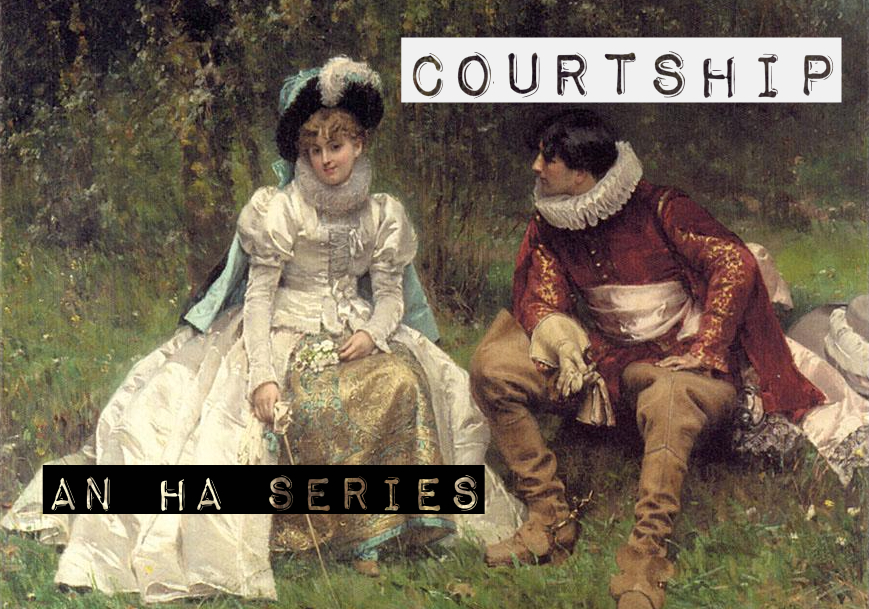
Announcing New Open Series on Courtship

Screen Shot 2014-12-29 at 5

By R.L. Stollar, HA Community Coordinator

As alumni of Christian homeschooling, many of us tried to kiss dating goodbye. We strove for purity, not passion. We wanted God to write our love story.

Through popular homeschool speakers like Reb Bradley, Jonathan Lindvall, Josh Harris, and Eric and Leslie Ludy, our parents desired to resurrect for us the courtship model of decades and centuries past. Some of us courted, did everything right, and our relationships were held up as the pinnacle of excellence; others of us courted, did everything right, too — only to see our relationships crumble and families torn apart. Still others of us refused to submit to the model, dating behind our parents’ backs, throwing our “purity” to wind — and ended up in loving, committed relationships. Or not.

Regardless of the results of your courtship story (or stories), you are welcome to share your experiences during HA’s next open series.

* Deadline for “Courtship” submissions: Saturday, February 14, 2015. *

If you interested in participating in this series, please email us at homeschoolersanonymous@gmail.com.

Please put “Courtship Series” as the title of the email.

As always, you can contribute anonymously or publicly. Let us know your preference when you email us.

How the Teachings of Emotional Purity and Courtship Damage Healthy Relationships

CC image courtesy of Flickr, Randi Deuro.

HA note: The following is reprinted with permission from Darcy’s blog Darcy’s Heart-Stirrings. It was originally published on January 18, 2011.

There are many times that I don’t realize just how much strange teaching I’ve had to “un-do” in my life until I try to explain them to someone else. This happened to me the other night. A dear friend and I were talking about our kids and how to help them transition from children to adults. The topic of dating and relationships came up and we started talking about my story. Sometimes it’s actually comforting to me to be met with blank or incredulous stares from people I consider “normal”, good Christians. It somehow validates my belief that some of the teachings I grew up with were very wrong.

I’ve also lately started facing the ways in which the teachings of “emotional purity”, (a la Josh Harris, the Ludys, and others) have damaged the part of my brain that makes healthy relationships function.

I define “emotional purity” in the same way that popular homeschool writers have: it is the idea of “guarding your heart”. Which sounds all noble and righteous and everything but in this context is really just a facade for fear. Fear of loving and losing. Fear of making the wrong choice. Fear of getting hurt. Fear of being damaged. Fear of not measuring up. In my life it meant never having a crush on a guy, never allowing myself to “fall in love”, basically training myself to shut down a normal, healthy, functioning part of my human heart.

I’m 27 years old, been married for almost 7 years. I rejected the teachings of courtship and emotional purity when I was 19. But their effects have yet to leave.

There are several ways that these teachings can damage a person’s heart.

1. They cause shame.

Shame because sometimes you can’t help but like one guy a little more than another. Shame because that’s “sinful” and “emotionally impure”. Shame because it sets a standard and proclaims that you are somehow shameful if you cannot keep it. You are considered damaged goods if you have fallen in love and had your heart broken. It was Josh Harris in I Kissed Dating Goodbye and the Ludy’s in several of their books that popularized the idea that everytime you fall in love or get “emotionally attached” to someone, you give away a piece of your heart. The more pieces you give away, the less of your heart you have to give to your spouse someday. He even went so far as to say that each of those former flames actually have some sort of hold on you. This has got to be the most bogus and the most damaging teaching of this entire movement. Love doesn’t work that way. The more you give, the more you have. My 3rd child doesn’t have less of my heart just because I’ve loved two other children before him. And, really, I haven’t given them “pieces” of my heart. I’ve given them each all of my heart. The miracle of love is that it multiplies by being given.

Each person I love has “a piece of my heart”…my best friend, my sisters, my husband, my parents, my kids. It is ridiculous to suggest that there is not enough of my heart to go around.

And what view of redemption does this teaching proclaim? Not one that I want anything to do with. It is an incompetent redemption.

2. They cause pride.

Pride because suddenly you are better than everyone else. Because you have never had a crush on a guy. You have kept your heart for your spouse. You didn’t say “I love you” til your wedding day. Pride in human accomplishment. Pride because you are so much more spiritual than that poor girl over there who is crying because her boyfriend broke up with her. Because your heart is whole and she just gave a piece of hers to a guy she isn’t married to. Pride because you did it right, she did not. You have more to give your future husband than she does. She is damaged goods, you are the real prize.

This is exactly what happened to the Pharisees. They made up laws that God never condoned, then patted themselves on the back for keeping them, while looking down on those who didn’t. This has nothing to do with the righteousness and grace of God, and everything to do with the accomplishments of man. I remember watching a video where one of the biggest names in the courtship movement bragged with obvious arrogance that he didn’t tell his wife he loved her until their wedding. And I thought “how twisted can we get?” We took something as simple as saying “I love you”, built a strawman rule around it (“saying I love you is defrauding”) then hung it like a trophy on our walls. Job well done, folks.

3. They create skewed views of relationships which lead to dysfunction

This is where I still struggle. Where others see nothing wrong, I am suspicious of every look, every situation, every witty exchange. I am still uncomfortable hugging one of my best friends who is a guy. Because we were never to hug or have physical contact, even innocent, with a guy. Voices in my head scream “defrauder!” just by giving a friend a quick hug. I feel ill at ease sometimes even talking to other men. Oh, they never notice. Because I’m really good at pushing those feelings away and acting “normal”. But I am bothered by my reaction to everyday situations. We were taught never ever ever to be alone with a guy. Because it could look bad. He could be tempted. You might start thinking impure thoughts. You might even *gasp* flirt!

I was trying to explain this to my friend and it came out sounding so….crazy and embarrassing. I told her if she was to walk out of the room, leaving me and her husband in the same room, my first reaction would be one of panic. “This might look bad…. what if he talks to me…what if someone else sees us….what is he thinking…” My second reaction, close on the heels of the first, would be a coping mechanism that I learned long ago: I calmly tell myself that “this is perfectly normal and perfectly innocent…he probably doesn’t even notice me…this is a Godly man I know and trust….the only person who would ever freak out about this is me….to the rest of the world there’s nothing wrong here”. I then calm down, act normal, and hope nobody noticed my crazy internal battle. Cuz they’d probably admit me to a psych ward. Thank you, Josh Harris and Co. I hatethis about myself! I am a strong, confident person. But the idea that I can defraud just by a look, that I could become emotionally impure just by a thought, that I might become damaged goods with pieces of my heart strewn all over tarnation, and that guys “only have one thing on their mind” and we need to help them control themselves, has truly negatively affected what should be normal interactions with my friends. Honestly, I don’t get embarrassed talking about much. But this admission isn’t easy for me.

Guess what? In the real world, men and women can have innocent relationships. They can talk to each other without one of them thinking there’s ulterior motives. They can laugh and exchange wits and, yes, even drive in a car together without anybody thinking anything dubious is happening. They are not naiive but they are not afraid of their own shadows. Purity and integrity in relationships can be there without being unnaturally freaked out about it. The other night, I stuck my tongue out at a guy friend who was teasing me and his wife cracked up laughing. As I laughed, I felt myself looking down on the situation, amazed that nobody thought twice about it, then amazed that I DID…that I had to push away feelings of guilt because what if someone thought I was *gasp* flirting?! This is one dysfunction that I really wish I could be freed from. Maybe time is the only cure and I need to be more patient with myself. These teachings have deep, rotten roots and it takes time to pull them all out.

4. They teach us to make formulas to be safe

1 + 1= 2. Emotional purity + Biblical courtship = Godly marriage. But life doesn’t work that way. You can do everything “right” and your life can still suck. You can do everything “wrong” and still be blessed. Rain falls on the good and evil. Time and chance happen to them all. People who follow the courtship formula still get divorced. Or stuck in terrible marriages. Courtship is not the assurance of a good marriage. Life is too complicated for that. Love involves vulnerability. When you choose to love, you are choosing to accept risking a broken heart. No formula can protect you. Life involves risk. Following God involves risk. He is not a “safe” God. But He is good.

God doesn’t seem to like formulas. Because formula is the opposite of faith. Formula says “I will follow a God that I’ve put neatly in a box, to give me the desired results”. Faith says “I will follow You even when I can’t see where I’m going, even when the world is collapsing around me”. Formula says “I will not risk, I will be in control of my future”. Faith says “I will risk everything, I will trust Whom I cannot see, surrender what I cannot control anyway.” Formula is the assurance of things planned for, the conviction of things seen. Faith is the assurance of things hoped for, the conviction of things not seen (Heb. 11:1). But we are afraid. So we control instead of trust. We don’t take a step unless we can see where we’re going. We build neat little formulas and say “THIS will keep me safe!” Then we blame God when our puny formulas fail.

These teachings need to be stopped. They were new in my generation and now I, and others like me, are reaping the fruit of them. And the fruit is rotten to the core. I’m sure those who promoted such ideas had good intentions. But good intentions aren’t enough. Without Truth and Grace they can do more harm than good. Thanks to those good intentions, we are seeing an entire generation of homeschool alumni who have no idea how to have normal relationships. I have talked with literally hundreds of alumni my age, and am not exaggerating the extent of the issue. It’s nice to know I’m not alone in my dysfunction but discouraging as well. What is encouraging is that most of us have determined to stop the insanity. We will not be passing these things to the next generation. Instead we will teach our children to love God with all that they have, all that they are; and to love and respect others as they love themselves.

I leave you with the words of a very wise man:

“To love at all is to be vulnerable. Love anything, and your heart will certainly be wrung and possibly broken. If you want to make sure of keeping it intact, you must give your heart to no one, not even to an animal. Wrap it carefully round with hobbies and little luxuries; avoid all entanglements; lock it up safe in the casket or coffin of your selfishness. But in that casket- safe, dark, motionless, airless–it will change. It will not be broken; it will become unbreakable, impenetrable, irredeemable.”

~C. S. Lewis

Emotional Purity and Courtship: A Few Years Later

Should Parents Be “Involved” in Their Children’s Love Lives?

Screen Shot 2014-07-03 at 1.50.01 PM

HA note: The following is reprinted with permission from Libby Anne’s blog Love Joy Feminism. It was originally published on Patheos on June 30, 2014.

Blogger That Mom (Karen Campbell) recently began a series on courtship. I don’t know where she will take the subject as she goes on through the series, but I did want to touch on the premise she begins with—that parents need to be involved.

The Necessary Parent

When we attended Bill Gothard’s IBLP Basic Seminar back in the mid-80s, one of the topics he covered was dating. This was before he had moved into his courtship teachings and even before anyone we knew of had started discussing things like courtship and betrothal. In fact, courtship, to us, was how our grandparents and sometimes even our parents would refer to meeting, getting to know, and preparing to marry each other. In fact, they didn’t often refer to relationships with the opposite sex outside of the goal of being married one day.

Our grandparents on both sides had been in “til-death-to-us-part” marriages and each of our parents were close to celebrating golden wedding anniversaries. We made the same commitment and we knew that, as parents, we wanted to encourage our own children to do the same. But we also knew we had not always chosen wisely along the way and hoped to see our children avoid some of the bumps in the road we had encountered.

Isn’t it interesting that often parents will do this with children when it comes to making career or educational choices, involvement in extracurricular activities, and financial decisions but it is hands off when it comes to dating and marriage?

So we began listening to the many voices of instruction and took away one really important truth that, I believe, is central to the whole discussion of dating, courtship, marriage, and our children.

Parents need to be involved.

In The Joy of Relationship Homeschooling ~ when the one anothers come home, a central theme I discussed is the importance of relationship building beginning before birth so that mentoring our children through the big decisions of life will be a natural, organic process. Too often we believe that once children reach a certain age, we are supposed to sit on the sidelines and watch them makes choices, for good or for bad, without giving them any input. This is folly. Scripture commands us to practice the one anothers of Scripture with our brothers and sisters in Christ, beginning with our precious children! As they become adults, we approach them just as we do other believers, admonishing, exhorting, bearing their burdens, forgiving, etc., all aspects of the dating, courting, and marriage years.

“Parents need to be involved,” That Mom says when speaking of dating, courtship, and marriage. What exactly does it mean for parents to be “involved”?

My landlady, Linda, once told me a story about her relationship with her own daughter. It seems when her daughter was a young adult she entered a relationship that soon became abusive. Linda wanted her daughter out of the situation, but her daughter was insistent that she loved her boyfriend and that the relationship was fine. Linda knew that trying to convince her daughter to leave the relationship would likely make her daughter pull away from her, so she simply voiced her concerns in a natural way and then dropped it. Then, instead of trying to extricate her daughter, Linda focused on being there for her daughter.

Linda told me that she wanted to make sure that when her daughter eventually realized that she needed to get out she would know she could come to her mother for help. No judgement, no guilt trips, no manipulation, no constant hinting. Just love and acceptance. And sure enough, after a few years her daughter realized that the relationship was broken and came to her mother, because she knew that her mother accepted her, and loved her, and would be there for her. No “I told you so,” no pointed looks, no judgement.

Was Linda “involved”?

When I was in college I met a young man named Sean. Sean was not homeschooled, but in other ways his background was similar to my own. Sean and I quickly gravitated toward each other, and eventually our friends took us aside separately and told us we were perfect for each other and really should try making a go of it. So Sean and I approached my father about beginning a “courtship,” given that that was what I had been raised to expect. My father spoke with Sean and then gave his permission to begin a courtship.

Sean was asking some big questions at the time, but my father believed he was what he called “an honest seeker,” and that everything would work out in the end. My father had always told me that it would take a particular kind of man to make me willing to submit, and he hoped Sean might be that man. But then I concluded, after some intensive research into the issue, that God had created through evolution rather than in six days. My father took this as a sign that Sean was leading me astray, and he ordered us to break up.

I couldn’t do it. My father was a stalwart young earth creationist, and I had just realized that he was fallible. I didn’t feel that I could obey my father in this when I knew Sean so much better than he did and his only problem with Sean was that Sean, too, believed that God had created through evolution—something I no longer saw as wrong or a problem. I told my father that I would not break up with Sean, and I took my love life into my own hands.

And here I sit, happily married to Sean for over half a decade. We have two children together. Sean is a wonderful father, partner, and provider. Even my parents have warmed up to him, and enjoy him when we come visit. But even as I made good relationship choices on my own and have a solid relationship with a wonderful man, my relationship with my parents was utterly and completely destroyed.

My parents believed they had a right to vet my partners and set the pace of my relationships, and when I told them no their response ruined our relationship. I stopped coming home because they made living there an utter torture of guilt and manipulation. My family almost didn’t come to my wedding, and when my parents decided to come at the last minute, they chose to sit in the back. My siblings were not allowed to be in the ceremony. What relationship we have today was built over the rubble of shattered dreams.

Were my parents “involved”?

When Sean and I first started “courting,” we spoke to his parents as well as mine. His parents were surprised that we had come to them, but when we asked for their advice they gave it. Some of their advice we followed, and some we did not, and they never gave us any trouble for the parts we did not follow. They accepted that we were adults capable of making our own decisions.

When Sean and I got engaged, his parents thought we were marrying a bit young. They told us that we were still young and that we would face hard times if we went ahead with our plans. But they didn’t tell us this with the expectation that we would do as they advised, and they didn’t make involvement in our wedding plans contingent on their timing. They simply offered advice, take it or leave it, no guilt, no manipulation, nothing. When we decided to go ahead and marry as planned Sean’s parents immediately pitched in however they could and helped with the planning of the rehearsal dinner, the wedding, and the reception.

Were Sean’s parents “involved”?

Do you see what I’m getting at here? At issue is how we define “involved.”

Parents should absolutely be there for their children, and they should absolutely offer advice, both solicited and (at times) unsolicited. But (adult) children have are not obligated to follow this advice, and their parents have no business calling the shots. 

When parents think their (adult) children are under some sort of obligation to follow their advice, or that they as the parents have a right to call the shots, the results are incredibly toxic. So if by “involved” we mean Linda, or Sean’s parents, I’m all for it. But if by “involved” we mean my parents, I couldn’t be more opposed.

Even today, thinking about everything that happened before Sean and I married brings up a whole host of painful feelings that swirl around in my chest and my gut. My relationship with my parents will never be fully restored. There was too much hurt between us. I have many friends today who had the same thing happen, and watched the courtship process destroy or severely damage their relationships with their parents.

I also have a problem with the way this culture approaches “mistakes.” 

You can’t keep your children from making mistakes, and frankly you probably shouldn’t. My parents embraced courtship because they believed that it would help us children avoid some of their own mistakes. Both of my parents dated before meeting each other, and neither was a virgin when they married. They felt that these things had had made things harder for them, and they wanted to spare us that. But sometimes children need to make their own mistakes. We learn from our mistakes, and sometimes things parents think are mistakes turn out to be growing experiences.

I can’t say whether Linda’s daughter wishes that her relationship with her abusive ex had never happened, but from Linda’s telling of the story it’s clear that her daughter learned and grew through the experience. More to the point, Linda could not have prevented her daughter from making her mistake, and trying to do so would only have damaged her relationship with her daughter. Sometimes we simply have to make mistakes for ourselves, as painful as it may be for our parents to watch.

As for Sean and I, marrying as young as we did did result in several years of economic hardship. I remember months when I had to decide between buying meat and buying ice cream. That may sound silly, but I agonized over decisions like that. But I wouldn’t give up those early, hard years for the world. Sean and I scraped by, and we grew together through that time. Sean’s parents were right that it wouldn’t be easy, but Sean and I were not wrong in choosing to give it a go anyway.

Yes, I parent differently from my parents. Yes, I want to give my children things I never had. But parenting that is at its heart reactionary can be dangerous—as can parenting that attempts to realize an impossible utopia. I once heard it said that we won’t repeat our parents’ mistakes, we’ll make new ones, and I see some truth to that. My parents might have been trying to save us from their mistakes, but they made a whole host of other mistakes while trying to protect us from those mistakes.

Oh and also? Parents don’t “need to be” involved in their children’s love lives.

My parents’ involvement in my relationship with Sean ended when they decided to devote all of their energies to ending our relationship, and you know what? Sean and I are happily married all on our own. Believe it or not, young adults are perfectly capable of making responsible and healthy relationship decisions on their own. Advice without strings or guilt or manipulation can be helpful (especially when solicited), but we really can make our own decisions without bringing down disaster, I promise.

I wish these parents would stop trying to butt in on their children’s love lives and instead simply focus on being there for their children. Without strings. Young adults need support and encouragement from their parents, not guilt trips and emotional manipulation. Their parents should be their children’s cheerleaders, not their referees.

I want to finish with a comment from reader MrPopularSentiment:

There’s another kind of involvement that I wanted to bring up. When my husband and I started dating, his parents treated our relationship seriously. Everyone else rolled their eyes and assumed that we’d break up within a short span of time, so there was no need to really get to know us as a couple, but his parents treated me like I was there to stay and worth getting to know.

And it was with no strings attached, too. When my sister-in-law had a stormy, abusive relationship, they treated her husband as a permanent fixture when he was there, and they just didn’t mention it when he wasn’t (the “punishment” phase of the abuse cycle). When she finally left him and found someone new, they treated the new guy as her permanent partner.

It was wonderful to feel like we were being taken seriously by adults, and it did so much to build up my relationship with my in-laws. Soon after I started dating my husband, I was going out on day trips alone with his parents and hanging out with his mother. And now, nearly 15 years later, we have a really good relationship with them.

It also meant that they were the ones we felt comfortable coming to when we needed help or advice, because we knew that it would be given without judgement. So not only is this style of involvement so much healthier for the parent-child relationship, it also meant that we were more open in talking to them, which meant that they knew more about our lives and had more opportunities to give us pointed advice that really has helped us avoid mistakes.

I couldn’t agree more.

My Elaborate Plan

Screen Shot 2014-05-15 at 11.52.19 AM

HA note: The following is reprinted with permission from Kierstyn King’s blog Bridging the Gap.  It was originally published on March 8, 2014.

Five years ago, on my birthday, I left home.

Obviously, there’s a lot of backstory to this, and, I guess, this is that story.

I didn’t say goodbye – I couldn’t say goodbye. I was terrified that if I did, if I told them I was leaving, that they would shut me in my room, and jam the door and not let me out. That they wouldn’t let me out of their eyesight ever again, despite my having reached legal age where they couldn’t do anything – and I would have fought, you bet your ass I would have fought. I would have called whoever I could, police included, if they locked me up when I was 18 – but I didn’t want that to happen, I didn’t need that delay, I didn’t need that pressure or the guilt trips that would then ensue and cause me to acquiesce.

My mom was 9 months pregnant with the last child, due any day – I prayed that my mom would have the baby before my birthday, so I didn’t have that weight on my shoulders. I talked about how praying never really worked for me, this wasn’t any different.

I had spent the last three months planning my party, working on my parents to let me go to the mall by myself without a sibling. I told them of my plans many times – how I was going to hangout and eat dinner with friends and then we’d go to a movie and they could pick me up at like 10 or 11 when the movie let out.

I started carrying a messenger bag with me everywhere I went months ahead of time too, so when I packed what I was bringing with me, and brought it to the mall, they wouldn’t notice anything different. I always had a jacket in there to keep it looking full, no one thought anything of it. On my birthday, I packed my vital records that I had kept/hidden after getting my driver’s license the month prior, my HSLDA diploma, my laptop, a pair of clothes, and my conveniently travel sized birthday presents.

I convinced my family to celebrate my birthday early, before I left for the mall because I would be home after the kids went to bed and we had church in the morning. They didn’t really like it, but they went along with it.

I had bought all of my siblings presents with some leftover amazon money from christmas or something, and put them in my backpack by my bed with a note dividing up my stuff and saying I love them.

I got to the mall, and my closest friends met me and we had an early dinner and that was as far as the plan I told my parents about went, because after that, my actual plan came into play.

This plan, the escaping part, had been in the works for over six months.

In August of 2008, right before the olympic opening ceremonies, Alex and I woke up to an email in our inboxes from my parents saying “we have decided to end the relationship between Alex and Kierstyn and are forbidding them from speaking to each other.”

This happened conveniently after my mother had yet another positive pregnancy test (or whatever it was that indicated to her that she was pregnant and had every reason to control my entire existence again). Things had started going downhill since that May, and the last time Alex and I had seen each other in person(June), we created this plan.

If my parents broke us up (because they had been acting like they were about to and causing a lot of drama and being suddenly very negative and pushy and ridiculous) that on my birthday Alex would come get me, and we would run away.  If it was on my birthday, there would be nothing legally my parents could do, since I was legally an adult – we would be free to do whatever. We hoped it wouldn’t come to that.

July happens, Alex is asking about a proposal (the earliness, yeah, okay, they were pushy) twice is what sent them over the edge – twice because they didn’t respond the first time and the vacation he was planning on proposing to me on was coming up soon and he needed to buy tickets.

Interestingly, when Alex asked my dad in general about proposing, my dad gave a whole-hearted yes that lasted until the next morning when my mom took me aside and told me that my dad had changed his mind. This wasn’t the only time this had happened – dad endorsing something, then going to bed and “changing his mind” I knew it was bullshit, I knew my mom was actually behind it and the subsequent announcement of the pregnancy sent me over the edge. I was livid that my mom was having yet another baby, I cried on the phone to Alex telling him that my life was over – because in many ways, it was, this was the one that was going to do me in, if there was one that was going to do that. I realized I couldn’t keep living as my parents slave but I also had no choice. At this point I didn’t realize that what was happening was abusive and wrong, I thought I was wrong. This pregnancy is when the shit hit the fan.

So August, the email happened. The email obviously created an email fight and I was too emotionally distraught to deal with it, so I told people to stop CCing me. I screamed and cried uncontrollably, I went outside where I was alone and there was room only to have my mom come out and tell me to get back inside or someone will think something is wrong (ya think? asshole). I went in, and she sat on my bed and deigned to tell me she understood what I was going through (um, she has no idea what it’s like for parents to decide they can retract your adulthood, control every move of your life, and break you up with your boyfriend just by being parents – her parents didn’t do that). I glared at her through streaming tears, and managed to muster “only for six months”, she said “no” shook her head and left, as I watched her, still glaring.

This triggered a borderline suicidal depression, or whatever it is that results in suicidal ideation – because I did that a lot. I was already depressed (but I didn’t know it until I started meds and realized what not depressed felt like, and realized that was not what I had ever experienced), but this was just, every time I thought I hit bottom, the bottom caved in and I fell deeper deeper deeper into an increasingly dark abyss, of confusion and self loathing and numbness. I was always waiting for another shoe to fall because they kept hitting my head, it was unbearable, and the entire six months, that went unnoticed. No one said anything. In fact, I barely talked to my parents at all except to go over my birthday plan and be demanded of. I felt so alone and uncared for and every day I felt like I was dying inside, and every day I was reminded just how much my parents really didn’t give a shit about me as myself, only in relation to my service to them.

Interestingly enough, I had told my parents, after my trip in June, that Alex and I were planning on running away together should they break us up, because they were all like “we feel like maybe if things keep going this way we’ll have to stop it” and I was like “yeah, well, if you do, I’m leaving” and they didn’t believe me, or remember this conversation. I remembered it because I thought I was screwed – turns out my parents don’t have much of a memory for things I say, unless it makes them angry and/or bent on punishing me. And before anyone dares get into “but parents are wiser” territory, this was about stuff that had been completely resolved, stuff that happened because I was projecting things (my parents) onto people, and stuff that was cleared up because I was apologized to. And also about petty theological disagreements my parents had with his parents. Nothing that had anything at all to do with the relationship or the relationship dynamics between Alex and I – just them and his parents (again. my parents destroyed so many of my friendships because of their disagreements with parents).

So, I bode my time, I flew under the radar, I became what felt like invisible – I made plans to get my driver’s license in January, started carrying my messenger bag around in October or November, and started birthday planning in November, and was beyond that, never noticed.

I told some people I trusted about my plan, and was supported, mostly – except for one person who was supportive at first, and then was like, you have to tell your parents because youth pastor said and I was like “…” but all my close friends, all the ones who’d been with Alex and I from the start, knew sort of what was going on and were super supportive – which meant the world (and still does <3). Then I left, I left on my birthday without saying goodbye, before my mom had the baby. My grandparents had come up for the baby/to be around to help, so I wasn’t leaving them hanging. I don’t know what it says about me that I still, five years later, have to justify my escape with but my grandparents were there, so I knew the kids would be taken care of, and I wasn’t abandoning them altogether.  I think I feel like people will still be like, but you left your siblings! Which, I’m pretty sure is not the reaction people should have, because I shouldn’t have had to have been my siblings’ (essentially) primary caretaker in the first place. Strangely enough, I’ve never had that reaction, but it could be because I always pre-emptively answer it.

It killed me though. Leaving without saying goodbye killed me. I mean, I said goodbye, but not with the “I’ll never see you again probably” ending, but I hugged and kissed them before I left, because I needed to. Because, I was leaving everything. Leaving didn’t trigger a change of heart on my parents, it just enraged them. I didn’t know if I’d ever see them again, honestly, I still don’t know if I’ll ever see my siblings again. My grandparents paid for our plane ticket to see my family in the December of 2009, and that’s the last I’ve seen of them.

My parents have spent the last five years telling my siblings not to be like me.

In 2010 my parents decided they wanted nothing to do with me until I apologized to them for the hurt I caused. It destroyed me. I didn’t leave my room for two weeks.

I don’t know how to say this emphatically enough, leaving was hard, it was brutal, it wasn’t something I did willy-nilly, it destroyed me, there were times I re-thought leaving at all because I knew it meant leaving my siblings and believe it or not I do give a shit about them. Ultimately I left, because it was a life or death choice. I could stay, and wither and die – internally, definitely, and with a daily increasing possibility of physically – or I could leave, and have a chance at life and then be there on the other side for my siblings when they get older – or at least have that chance. So I left. I left on my birthday five years ago, and it was the hardest thing I’ve ever done (to. this. day.).

I just wish that maybe people really understood what that meant – means – feels like.

Chaste Courtship and Ethics

Screen Shot 2014-04-17 at 4.06.07 PM

HA note: The following is reprinted with permission from Lana Hobbs’ blog Lana Hobbs the Brave. It was originally published on March 12, 2014.

I read this post yesterday, and it made me mad: “Jessa Duggar Will Have a Chaste Courtship — and My Kids Will, Too” by Kacy Faulconer.

Luke and I had a “perfect” courtship. No holding hands even, until the wedding.

After several year’s retrospect, I don’t really think it set us up any better for marriage than dating would have. In fact, dating would probably have been a lot simpler. We would have dated earlier, with less pressure, and more of a feeling of choice (it was by choice but also under intense pressure of ‘purity’). We wouldn’t have gained some of the baggage we did by having a complex, parent-involved relationship. I, especially, would have been my own agent, instead of my wishes being submitted to everyone else’s (and the triangulation in our families during that time was mind-boggling).

Had we dated, Luke and I would have been able to let physical closeness progress more naturally, and I don’t necessarily even mean sex before marriage — but just leaning on his shoulder when I was sad, that kind of thing. I can’t tell you how much it hurt not to be able to do that. Because I have negative touch in my past, it would have been really nice to have gradual healing touch. And sex before marriage? Had we done it, I’m sure we would have survived. The only difficulty would probably have been the shame, and that was something we were taught.

Chaste courtship, the writer of the piece claims, won’t repress her children:

I’m not repressing them. I’m freeing them. I have sons who need to learn restraint and respect. I have daughters who will be empowered by abstinence because they can simply sidestep the issues, pressures, problems, and pitfalls of promiscuity.

Look, just because you claim something is freeing, doesn’t make it so. Her ‘empowered’ daughters, like myself, won’t be able to safely learn about consent or their own bodies until marriage, at which point they’ll be expected to have sex every time their husband wants it. My big advice from my mom was ‘don’t say no too often’ (my dad did a better job with ‘the premarriage talk’). They’ll never feel like they own their bodies, because before marriage their bodies are owned by their parents, who feel it is their duty to keep their children pure, and after marriage they’ll feel like they belong to their husbands.

Parents who raise their children this way are trying to do what they think is best.

The problem is, they are motivated by fear to control their children. Fear that their kids will have sex, fear that their kids will ruin their lives somehow. They raise them to get an end result, it seems, because the end (a promised good marriage) justifies the means (intense control and denying their children bodily autonomy). I’m studying Ethics in my Philosophy class, and realized that many fundamentalists probably operate under a consequentialist system of ethics. (See also, spanking children to get godly offspring, or to not be embarrassed by fussing kids in public. I think it’s consequentialism.)

I operate under a more deontological view (also called ‘duty ethics’), there are acceptable actions, and unacceptable actions, and you should do what is right because it is right, and not because of the end result. One big rule of deontological ethics is that humans should never be treated as a means to an end.

And regarding the subject at hand, I believe it is wrong for a parent to control their adult child, no matter how good an end they hope to achieve for them. I think women should be able to own their own bodies and be touched only on their own terms, not their significant other’s terms, and certainly not their parents’ terms.

For another takedown of Mrs. Faulconer’s post, see Libby Anne’s post.

P.S. I’ve heard people saying that ‘parents can’t control their adult children’. Well actually, I think they can, especially when they’ve raised their children to mindlessly obey, and have kept them from taking steps towards independence like having a real job. It’s hard to go against your parents when they are the only way you have food and a place to eat. It’s also hard when you know that independence, or ‘disobedience’ could get you cut off from your family and everything you know. Would my parents have done this? I don’t know, and they didn’t when my brother dated against their approval. But I was still trying to please them and never would have tested it.

Matthew and Maranatha Chapman Withdraw from 2014 CHEO Convention

By R.L. Stollar, HA Community Coordinator

As of yesterday, Matthew and Maranatha Chapman are no longer presenting at Christian Home Educators of Ohio’s (CHEO) annual homeschool convention this summer. 

The Chapmans have recently provoked controversy due to increased attention to their advocacy of marrying homeschool girls in their “middle-teens” to older men.

Matthew Chapman was a keynote speakers and his wife Maranatha was slated as a featured speaker. The Chapmans have recently provoked controversy due to increased attention to their advocacy of marrying homeschool girls in their “middle-teens” to older men.

The following statement appeared on CHEO’s convention page as of December 16, 2013 (PDF version):

The CHEO board regrets to inform Ohio homeschoolers that Matthew and Maranatha Chapman have notified us that they will not be attending the upcoming CHEO convention in 2014 as previously planned. The Chapmans deeply desire that all those attending the convention would be built up and encouraged in the Lord, and expressed that they will miss seeing the many friends and acquaintances they made from when they were here several years ago. CHEO appreciates their humble service in ministry and wish for them the best.

CHEO has not specified the reasons for the Chapmans’ change of plans, nor have they made any public comment or statement on the Chapmans’ advocacy of child marriage or whether this advocacy was the reason for withdrawal.

Matthew Chapman to Headline the 2014 CHEO Convention

Source: Kindling Publications

HA note: The following is reprinted in a modified format with permission from Libby Anne’s blog Love Joy Feminism. It was originally published on Patheos on December 3, 2013 with the title, “Matthew Chapman, and Why I Included Lauren’s Picture.”

Matthew Chapman wrote the following in 2003, five years before he gave his daughter Lauren away in marriage. In it he referred to his marriage at age 27 to Lauren’s mother Maranatha, who was only 15 at her wedding:

I know that in my case, I cannot even begin to fully communicate the wonderful gift Maranatha’s father gave to me in his daughter on the day we married. All her life, he had called her to trust him and follow him, even when she didn’t understand or, perhaps, even agree with how he was leading her, and she did. A few nights before our wedding feast, when Maranatha was dressed and ready and waiting for me to come, the doorbell rang and it was her dad who showed up instead. He assured her the wedding feast was not that particular night, and asked her to change her clothes and join him for a special dinner. He took her to a nice restaurant where they had a wonderful evening talking and sharing and laughing and crying together. Then, at one point, he told her, “Sweetheart, all your life you have submitted to me, trusted me, and followed me, and you have done this well. But, when Matthew comes and takes you, all of that transfers over to him, even if that means he leads you in ways that vary from how I would do things.” And when I went to get her, she followed her dad’s final lead right into my headship of her. Wow! Did I walk into a good deal or what?!

…I had no idea how common this sort of thing was, because no one in my homeschool community had married before age 18, and I still don’t know how common it is—but it’s clearly more common than I had hoped. What really bothers me here is the age difference bit. If these parents were marrying their 16-year-old daughters off to other families’ 17-year-old sons I would still be concerned, but when they’re marrying their 16-year-old daughters off to full grown men significantly older in both years and experience, I am appalled—and not in small part because of quotes like Matthew Chapman’s.

I also learned is that Matthew Chapman is going to be a keynote speaker at Christian Home Educators of Ohio’s annual homeschool convention this summer.

This is a major convention, and this past summer the now-discredited Doug Phillips was a keynote speaker. Voddie Baucham spoke there in 2012, as did Eric Ludy. In addition to Matthew serving as keynote speaker, his wife Maranatha is slated as a featured speaker. Matthew runs Kindling Publications, and both Maranatha and Lauren is featured heavily on organization’s website.

Like it or not, it appears that the mainstream of the Christian homeschooling movement, its major convention circuit, has chosen to give a platform to those who practice and promote the marriage of girls of 15 and 16 to much-older men. Here is something else Matthew Chapman wrote in 2003:

Parents, I would also charge you to consider this. The way many Christian homeschooling parents raise their daughters, they mature rather quickly and develop significant capacities by a relatively young age. By their middle-teens, many daughters (but by no means all) possess the maturity and skills to run their own home. My point is to encourage you to be open to the Lord and take to heart that some of your daughters may be ready to marry sooner than your preconceived ideas have allowed for. And why not, if they are truly ready? What is the purpose of holding out for a predetermined numeric age if they are legitimately prepared and the Lord has brought His choice of a young man along for her? Don’t be surprised if this is some of the fruit of your good parenting in bringing forth mature, well-equipped, Godly young daughters. However, I seldom think this will be the case for most young men—it takes them (us) a lot longer to get to where they need to be. I have also seen that, oftentimes, a difference in age—even a significant one—with the man being older, helps make for a better fit.

This is the man who is now being given the keynote slot at major Christian homeschooling conventions.

People need to know this.

Matthew Chapman promotes the marriage of homeschool girls in their “middle-teens” to older men, endorsing an age difference, “even a significant one,” as making “for a better fit.” Matthew Chapman not only followed this advice in his own marriage, but also in marrying his daughter Lauren off immediately after her sixteenth birthday to a man of twenty-six.

What does this say of the Christian homeschooling movement?

…Where are the voices speaking out against this? Where are the Christian homeschooling leaders saying that this is wrong?

I’m searching for them, but I’m finding only crickets—crickets, and Matthew Chapman serving as keynote speaker at major Christian homeschooling conventions.

Jonathan Lindvall and Child Marriage: The Maranatha Story

HA note: The following is reprinted with permission from Libby Anne’s blog Love Joy Feminism. It was originally published on Patheos on December 2, 2013

Maranatha’s courtship story has been told and retold in homeschooling circles at least since the 1990s, and is held up by many as an ideal. But there’s one thing that is routinely left out of the story. Just how old was Maranatha Owen when she married Matthew Chapman at the culmination of a parent-guided courtship/betrothal process?

We often think about child marriage as something that happens in other countries, but not here.

I’ve generally thought of it that way too, even with my background. I grew up in a conservative evangelical/fundamentalist homeschool community where no one dated and everyone talked about and aspired to courtship. But in my community essentially no one started courting before attaining legal adulthood. Recently I’ve been hearing other stories, though, far different stories—and one of those stories is Maranatha’s, which I will tell in a moment.

There were a couple of relevant reasons those in my community put off courtship. First, courtship was scary, and the consequences were huge. If you courted and then broke it off that had the potential to look really really bad. After all, the whole reason for foregoing dating was the idea that for every romantic relationship you have, you give away a piece of your heart that you will never get back. Second, courtship was about finding a marriage partner, and long courtships or engagements were seen as causes for fleshly temptation. Therefore it made no sense to begin a courtship before you were actually ready for marriage. And thus we waited.

There are some Christian homeschooling leaders, Jonathan Lindvall primary among them, who brush these reasons aside and preach the godliness of youthful courtship.

Lindvall argues for avoiding the heartache of broken courtship by means of heavy parental control and what he likes to term “betrothals.” If parents help their children find godly partners, love will follow eventually, or so his argument goes. Lindvall and others like him also argue that young people are ready for marriage far earlier than “the world” may recognize, and that waiting rather than marrying young only leads to temptation and the possibility of going astray.

And now we turn to the story of the 1988 betrothal and marriage of Matthew Chapmen and Maranatha Owen. I will begin by summarizing the story as told by Lindvall, and will then answer the question of the couple’s age.

Having began saved at age 19, Matthew Chapman felt led to the ministry. He attended Baylor University’s ministerial program and began serving as a ministerial intern at a large church in Waco, Texas. During this time he began to look for mentorship from an older man at the church, a homeschooling father named Stan Owen. Stan became Matthew’s spiritual father, and the two spent a great deal of time together. In the summer of 1986, Stan began to feel that God had destined Matthew to marry his daughter Maranatha. Without talking to either Matthew, his spiritual son, or Maranatha, his biological daughter, Stan dedicated the two together in marriage in prayer before God.

In early fall of 1986, Matthew confessed to Stan that he was troubled by a strong attraction to Stan’s daughter Maranatha.

He confessed that he found her “very attractive” and that she had become “a distraction.” “I don’t know what to do about it,” he said. According to Lindvall’s telling, “Matthew was certain this attraction could not be right since Maranatha was so much younger than he.” ”Have you ever considered that this may be a good thing?” Stan asked him in response, “How do you know this isn’t from the Lord?” But Stan went on to tell Matthew that Maranatha wasn’t ready for marriage yet, and that he therefore needed to put a hold on his feelings for a while. Matthew continued to be a frequent guest in Stan’s home, constantly in contact with Maranatha and the rest of the family, but was forbidden to tell Maranatha about his feelings or have any physical contact with her.

Shortly after this Maranatha told her father that she had “an interest” in Matthew. As time went by Maranatha found her “attraction” to Matthew “increasingly distracting.” She told her father about her crush as she had been taught to do. Stan told Maranatha that she needed to “keep her heart pure and focused on the Lord” and to “wholly give herself to the Lord without any lingering desire for Matthew.” And Maranatha obediently sought to do just that. Of course, Stan had already decided to give Maranatha to Matthew, so this was simply a matter of biding his time until he decided Maranatha was ready.

A year later, in early fall of 1987, Matthew felt that God had told him by direct communication that he, Matthew, was to marry Maranatha. Matthew shared with his mentor what God had told him, and asked permission to propose to Maranatha. Stan confirmed that the thoughts may well have been from God, but asked Matthew to wait a little longer, promising to share when he had heard from God himself.

Several months went by and Christmas arrived. Stan’s Christmas present to Matthew was a Christmas card with the words “This year for Christmas, I am going to give you the greatest gift I could ever give you” on the front.

Inside was a photograph of Maranatha.

There were also instructions: “On January 1st, you may ask Maranatha to marry you.” The instructions stated, however, that while Matthew and Maranatha could become engaged Stan would not give Maranatha to Matthew until he determined she was ready, which might be months or years. Matthew proposed and Maranatha accepted.

Stan wanted to do things as they were done in the Bible, when betrothal was legally binding. Therefore, on February 22, 1988, just over a month after Matthew’s proposal and Maranatha’s acceptance, the two were legally married at the courthouse. Maranatha continued to live in her father’s home until her official “wedding” day, which, although she was already legally married, would be when she would begin her married life.

The summer of 1988, Stan decided that Maranatha was ready. In the six or so months since Matthew’s proposal and Maranatha’s acceptance, Matthew had prepared a home for them to live in and Maranatha had sewed a wedding dress. After dinner one day, Stan unexpectedly and without prior warning informed Matthew and Maranatha that the time was fast approaching. But Stan wanted to reenact the Biblical story of Jesus as bridegroom and the Church as his bride, so he did not give either Matthew or Maranatha a date.

Immediately after Stan’s surprise announcement, Maranatha was taken by her family members to the home of another Christian family. There Maranatha waited for Matthew to come and claim her. Every day between 3 pm and midnight she dressed in her wedding dress and sat with her suitcase, waiting. Finally, at long last, Stan told Matthew that the day had arrived, and Matthew came to the house where Maranatha was staying, claimed her, and took her to a surprise wedding feast Stan had prepared, complete with guests, singing, and dancing. The couple then left on their honeymoon and began their married life.

So now let’s talk ages.

When Matthew first expressed his interest in Maranatha—interest Stan affirmed as from God but asked Matthew to put on hold—Maranatha was 13 and Matthew was 26.

When Matthew heard from God that he was to marry Maranatha, and begged Stan to let him propose marriage to her, Maranatha was 14 and Matthew was 27. When Stan gave Matthew the go ahead to propose to his daughter, Maranatha was 15 and Matthew was 27. They were the same ages when they married just over a month later, and when Maranatha left her father’s home and the couple began their married life together Maranatha was 15 and Matthew was 28.

The original story doesn’t include any ages at all. I suspect that Lindvall and others felt these ages were appropriate, but were concerned that some might be put off by the idea of a 15-year-old girl marrying a 27-year-old man. I found the ages by looking them up on public record. They’re not available on the internet or in print otherwise.

Marrying girls off so early does several things. For one thing, it precludes them having other options. They have not finished their academic education and are not qualified for anything besides homemaking. And even then, what fifteen-year-old is truly ready to run a home in today’s world? For another thing, such early marriage means a girl marries before she has time to completely mature and form her own outlook on life. But then, sadly, that’s rather part of the point. This sort of arrangement, after all, functions not as an independent adult making her own decisions but rather as a property transfer—and it is explicitly stated as such.

Matthew wrote this in an article titled Thoughts on Betrothal (15 Years Later):

I know that in my case, I cannot even begin to fully communicate the wonderful gift Maranatha’s father gave to me in his daughter on the day we married. All her life, he had called her to trust him and follow him, even when she didn’t understand or, perhaps, even agree with how he was leading her, and she did. A few nights before our wedding feast, when Maranatha was dressed and ready and waiting for me to come, the doorbell rang and it was her dad who showed up instead. He assured her the wedding feast was not that particular night, and asked her to change her clothes and join him for a special dinner. He took her to a nice restaurant where they had a wonderful evening talking and sharing and laughing and crying together. Then, at one point, he told her, “Sweetheart, all your life you have submitted to me, trusted me, and followed me, and you have done this well. But, when Matthew comes and takes you, all of that transfers over to him, even if that means he leads you in ways that vary from how I would do things.” And when I went to get her, she followed her dad’s final lead right into my headship of her. Wow! Did I walk into a good deal or what?! I’ll tell you what though, having a wife with a heart like that makes you all the more want to seek the Lord and lead her faithfully.

Parents, I would also charge you to consider this. The way many Christian homeschooling parents raise their daughters, they mature rather quickly and develop significant capacities by a relatively young age. By their middle-teens, many daughters (but by no means all) possess the maturity and skills to run their own home. My point is to encourage you to be open to the Lord and take to heart that some of your daughters may be ready to marry sooner than your preconceived ideas have allowed for. And why not, if they are truly ready? What is the purpose of holding out for a predetermined numeric age if they are legitimately prepared and the Lord has brought His choice of a young man along for her? Don’t be surprised if this is some of the fruit of your good parenting in bringing forth mature, well-equipped, Godly young daughters. However, I seldom think this will be the case for most young men—it takes them (us) a lot longer to get to where they need to be. I have also seen that, oftentimes, a difference in age—even a significant one—with the man being older, helps make for a better fit.

Matthew says that homeschooled girls mature quickly.

While I’m sure there are some homeschooled girls for whom this is true, I know the sort of homeschooled girls he’s talking about—they’re the ones raised to care for big families, cook, clean, and take care of babies, wear long dresses, practice submission, and learn a modest temperament. Maturity isn’t the ability to make a pie or change a diaper. Maturity isn’t the ability to quote a Bible verse or stay silent rather than gushing over the latest fad. And while we’re at it, running a home in today’s world takes more than knowledge of cooking, cleaning, and childcare.

Let me take a moment to address two objections I’ve seen raised. First, it is true that many girls in mainstream society date as early as 14. However, the courtship or betrothal process is closer to actual literal wedding planning than it is to dating. Courtship and betrothal are quite literally about getting married, and not at some nebulous time in the future but now. Second, it is true that it used to be more common for women to marry younger, even as young as 15. However, it was never as common to marry so young as we tend to think it was looking back (in fact, there are entire historical periods where people married just as late as we do today), and besides, the world today is not the same as the world of the past. Average age of marriage is generally a result of societal and economic factors that actually, like, matter.

Maranatha’s story is an extreme, yes, but it is not the only one of its kind. In 2008, only weeks after turning 16, Maranatha’s daughter Lauren married a man who was 26, a man who had already been interested in her for several years. And I’ve been hearing other stories too, stories of courtships begun at age 14 and marriages entered into at 16 or 17. Right now, my heart is sad for girls married off before they have the time to live, to learn who they are, to forge their own beliefs and outlook on life—girls married off so early other options are severely limited, and in such a patriarchal setting that even consent is curtailed.

In case you’re wondering, Matthew and Maranatha were married in Texas.

The law in that state requires parental permission for marriages involving those who are 16 or 17, and a special court dispensation for marriages involving those under 16. I suspect that the law was different in 1988, and that this is the reason Maranatha’s daughter Lauren married immediately after turning 16 rather than before.
Relationships, A Series: Part Eleven — Conclusion, Don’t Brush Off the Next Generation

Screen Shot 2013-07-29 at 9.52.55 AM

HA note: This series is reprinted with permission from Caleigh Royer’s blog, Profligate Truth. Part Eleven of this series was originally published on June 18, 2013.

*****

Also in this series: Part One: What Is Courtship? | Part Two: We Were Best Friends | Part Three: The Calm Before The Storm | Part Four: To Lose One’s Best Friend | Part Five: To My Darling Clementine | Part Six: The Storm Starts Brewing | Part Seven: The Five-Year Relationship Plan | Part Eight: The Means To An End | Part Nine: We Made It | Part Ten: I Am A Phoenix | Part Eleven: Conclusion, Don’t Brush Off the Next Generation

*****

Part Eleven — Conclusion, Don’t Brush Off the Next Generation

For the past two weeks, and more, I have been working through Phil’s and my story.

I’ve gotten very interesting feedback. A lot of positive feedback and that seriously has meant a lot. I have felt more sure of myself, our story, and of what Phil and I have especially as I worked through the entire story. Unveiling our story, working out the hardest parts, and writing about the things that went wrong has only further solidified my feelings of why I don’t believe in parent-driven, parent-controlled relationships.

(NOTE: I think what I have to say could make some of you parents who read my blog feeling discouraged or angry. Please know that I am not writing to push anyone’s buttons, point the finger to say you did wrong. I am simply writing what I have observed, what my thoughts are on the topic and where my husband and I sit with this. I know I don’t have kids yet, so maybe my perspective will change, but for right now, I am writing as the child who experienced these things.)

First, I want to give a little background to why Phil and I have reached this point.

One of the biggest difficulties in our relationship prior to marriage was the lack of being taken seriously. Yes, we were and still are young, but we were completely serious and were not taking our relationship or our goals lightly. We both felt very strongly that God had given us each other, and we were 100% committed to getting married.

What was heartbreaking for us was feeling like our parents laughed at us, called us too young.

In my case, my dad brushed everything off and made me feel like I literally was crazy when he in fact didn’t know my own mind or heart. I have heard multiple people call some of my generation and the generations under my generation as the generation that is fading away, that can’t make responsible decisions, or make wise choices.

While I agree that I do not have the perspective of many, many years of life, or the “wisdom from experiences” right now in my life, that does not mean that I am incapable of making good, informed decisions that are wise and exactly what I’m supposed to do right now for me.

While I am not someone who has lived for over 50 years, been through many, many things, and has (hopefully) wisdom from experience, I am someone who has already lived 22 years, I have been through a lot, and my perspective right now is important. I think my perspective is especially important right now because I have not been faced with total cynicism yet, I have not lost the dreams and imagination that makes me me and that comes with youth. I have a fresh perspective that I think as an adult I will lose the older I get unless I keep using imagination, continuing to stretch my mind in creating new ideas.

I have a problem with parents who brush off their children’s dreams, ideas, and experiences.

It creates this idea that children are stupid and can’t think for themselves. The more parents brush off their children, the more that idea gets reinforced.

Am I suggesting that it’s the parents’ fault that young adults can’t seem to make good decisions, be responsible, or even dream? Yes, maybe I am. See, I have a unique perspective. I just went through the child’s side of a relationship, I have been on the other side of parenting. And I expect to be taken seriously because I know that my perspective is not any less important than the parents.

Frankly, I think getting a child’s perspective and not just the parents is important in getting the full picture.

There are at least two sides to every story, so why not go right to the people (and yes, children are people) who are being directly influenced by parenting ideas like parent-driven relationships? Can you see what I’m getting at yet? If a parenting style is shutting down your child (at any age), teaching them that their opinions are unimportant, insignificant, and that mom and dad’s opinions are the only thing that counts, that’s dangerous and has a lot of potential to damage the child’s capability to grow up with a healthy self-worth and a confidence in their own opinions.

Growing up, I learned/taught myself how to read at a very young age. By the time I was ten, I was reading college level books, and understanding them. I worked on stretching my mind, my understanding of my surroundings without really realizing that I was doing that. As I got closer to graduating high school, becoming of age (turning 18) and the potential of being in relationship, I fully and wholeheartedly bought into my dad ruling and controlling who, when, and where I got married.

I bought into this because that was all I knew.

I had no reason to think anything other than that could or even would work.  I had no problem letting my dad be my decision-maker, letting him be my heart, mind, and my opinions.

I didn’t realize that letting my parents control an entire relationship from start to finish left no room at all for my own opinions, feelings, or decisions.

It is the equivalent of treating me like a child, a toddler incapable of really making a complicated decision. But even toddlers have opinions and likes and dislikes.

Phil and I will not treat our children and their love interests how we were treated. We believe in letting our children have their own opinions and taking them seriously. We want to be able to raise our children to be fully function adults able to make their own decisions, confident in their own opinions, and able to trust us to help them if they need help.

I know what it feels like to not be taken seriously or to not be heard.

I want to make sure that I document those feelings so I can look back when I have children my age now and remember what it felt like to be their age. I don’t want to forget the perspective I have now. One day, I will most likely have a child who will tell me that I don’t understand and I want to be able to look back and remember.

Parent-Driven Relationships

You will find “Parent-Driven Relationships” most often among Quiverfull and Patriarchy cultures. Especially the homeschooling culture that is tied into these two.

I need to make a specific distinction here.

The usual circumstances for this set-up is when a daughter gets into a relationship, “dad” is especially controlling and protective. Daughters are special property to dads in these cultures, and thus it is usually the father of the daughter who is driving the relationship.  It all stems back to the idea that “dad” is “God” in the home.

“Dad” is the ultimate authority, he is the final say on everything, including his adult daughter’s choice of hairstyles (not kidding).

Add in daughters who are unusually, unhealthily complacent and content to stay at home until they are 30+, willing and happily ready to give “dad” total control of their lives and you get a living nightmare of control, abuse, manipulation, and brainwashing.  When “dad” drives the relationship, controls everything from which boy/man gets accepted into the precious family fold, to how much time the girl and guy get to talk, spend together, including assigning one or more of the girl’s multiple siblings to play “chaperon” — individual personalities and individual hearts get lost.

This idea for relationships is not only not Biblical, it is not an accurate interpretation of the Biblical ideas it’s supposed to be based on. The Old Testament structure of parent-driven relationships is based on daughters literally being property that is sold and traded for goods, money, and social standings.

Not only are we not in that era anymore, women are not property.

We are whole beings with hearts, minds, and souls, very capable of making wise decisions and holding good, strong opinions.

Now, here is what I think a parents’ role in their children’s relationships should look like. I think it should look like parents respecting their children’s opinions, decisions, hearts, and being there to help, share advice when asked, and to be a trusted person.

I think it’s great that some parents have a relationship with their children that automatically puts them in this situation. But that’s not all parents, all children, all situations. I believe that as a child becomes a young adult, and they start reaching the age of marriageability, and they look for a relationship, only they will know who is the right person for them.  A healthy adult will know who is right for them. Phil and I felt frustrated more times than I’d care to recount with older parents, friends, not taking us seriously, not believing how strongly we felt about getting married.

We alienated ourselves from a lot of those people because we couldn’t be ourselves around them.

We felt put down.

I applaud the parents who have healthy, strong relationships with their growing children, and it makes me very happy when I see healthy relationships as the result.

That is good.

*****

End of series.

Relationships, A Series: Part Ten — I Am A Phoenix

Screen Shot 2013-07-29 at 9.52.55 AM

HA note: This series is reprinted with permission from Caleigh Royer’s blog, Profligate Truth. Part Ten of this series was originally published on June 12, 2013.

*****

Also in this series: Part One: What Is Courtship? | Part Two: We Were Best Friends | Part Three: The Calm Before The Storm | Part Four: To Lose One’s Best Friend | Part Five: To My Darling Clementine | Part Six: The Storm Starts Brewing | Part Seven: The Five-Year Relationship Plan | Part Eight: The Means To An End | Part Nine: We Made It | Part Ten: I Am A Phoenix | Part Eleven: Conclusion, Don’t Brush Off the Next Generation

*****

Part Ten — I Am A Phoenix

I finished chronologically writing our story yesterday.

Although, in a weird way, I haven’t finished it.

Our story still continues, and even though I reached over 2,000 words with almost each post, I left a lot out. Like, pages upon pages of information, memories, circumstantial happenings left out. I had the opposite of a writing hangover yesterday. My mind was buzzing with freshly remembered memories and I felt like I needed to go back and add even more to each part.

Like I didn’t talk about how we had nicknames for each other, how Phil called me Lady Mysterious because he couldn’t figure me out in one conversation like he could most girls.  I called him DLF; reminiscent of The Chronicles of Narnia. Or how Phil said that I was like a good book; a good book that makes you think and that you can’t read in one sitting. I didn’t mention how it became my goal in life to make him laugh.

Do you know how rewarding it is to know that you can make someone laugh?

Especially after he had told me that he didn’t laugh much. I still have a mischievous side to me that will try to catch him off guard by doing something he least expects. Tell you what, I have pulled some awesome stuff on him, and thoroughly enjoyed making him speechless.

I haven’t talked about how Phil once compared me to an onion, multi-layered and all that. He covered his tracks by hastily saying I smelled so much better than an onion. We even once tried to write a book together. It was going to be called The Official Guide to Modern-day Hermitage. Trust me, that would have been one heck of a spectacular book!

We both have felt the pull of wanting to be hermits for a very long time.

I didn’t mention how I stupidly almost ruined our friendship at the beginning. I held on to these very damaging ideas of emotionally purity and how I couldn’t be friends with a guy unless I was going to marry him. When Phil asked for a week of communication silence, I retaliated and basically told him our friendship was wrong, we needed to stop talking, and I apologized for “allowing the friendship to reach this point.” Gah, I was so stupid! I broke his heart without even realizing it because I thought that was the right thing to do. Girls, if you any of you are ever in a situation with a guy like this, put yourself on the line and speak the truth. Be bold, be honest, and be real.

Don’t let “purity-catchphrases” get in the way of a real friendship.

I didn’t write about how high and mighty I felt when I told Phil that our friendship was wrong. I don’t want to remember just how rude I was to a genuinely caring guy who was falling in love with me. I don’t like mentioning just how goody-two-shoes I was about a lot of things, especially when it came to relationships. I was a thoroughly messed up girl, and yet, I thought I was doing it right.

This is what is coming back to me as I work through the details I left out about our story.

It’s in those details that the guilt lies. It is in those details that I remember just how flippant I was with this precious man’s heart. Even though having him ripped from me was devastating, I needed that wake up call. I needed to know just how much I needed him. I needed to see that I could love him, and did. I needed a slap to the face for how much I played with him and wasn’t honest. I don’t like remembering or reading about how shallow I was with hinting I liked a guy when talking with Phil, but never being honest and saying look, I like you, really, I do.

I didn’t mention about a little red heart I made for Phil.

He told me one day after the six months of silence that he really wanted a token of love from me. I thought about it, and before I even thought all the way through it, I had crocheted a perfect red heart. From the day I gave it to him, to this very day, he still carries that heart with him. I didn’t mention that I still have the first two roses he ever gave me. Those roses — one red, one pink —are tucked away in a thin wooden box which I still open every once in awhile. I still have the first dozen white roses he gave me on our first officially dressed up date.

I didn’t mention how much I hated saying goodbye to him.

Out of everything that happened to us, having to say goodbye every night for so long was the worst thing. There is something about saying goodbye to the one you love that really eats at you. Our first words to each other after being pronounced man and wife were now we don’t have to say goodbye!

I have a sense of being unfinished. Maybe, one day, I will write about our first year, and this past year. Our story does not end at our wedding day, it has continued and will continue until the day we die. 

I have learned to never say never when it comes to writing about something.

We both have looked back on our relationship and recognized it as a testing ground for us both. I have often taken the stand that God was/is preparing us for something as we went through our pre-marriage relationship.

I say “bring it on!” to anything that’s coming in our future. If we were able to get through what we did, then there is no reason why we won’t make it through anything else that might be coming. Going through those three years of trial after trial only taught me more about being resilient. The past four and a half years have proved to me that I can make it. The past six months have taught me that I am strong.

I am a Phoenix, I will continue to bounce back even stronger than before.

Phil and I made it through some of the worst years of our lives only to come out stronger in love, in trusting each other to have the other’s back.

I believe that unarmed truth and unconditional love will have the final word in reality. This is why right, temporarily defeated, is stronger than evil triumphant.

– Martin Luther King, Jr.

*****

To be continued.