Michael Farris’s Testimony Before the Senate on the UN Convention on the Rights of Persons with Disabilities, Part 2: By Rachel Lazerus

sources

HA note: The following is reprinted with permission from Libby Anne’s blog Love Joy Feminism. It was a guest post by Rachel Lazerus and was originally published on Patheos on November 12, 2013. Rachel Lazerus received her MPP from the Harris School of Public Policy at the University of Chicago in 2012. She is currently researching comparative methods of reporting homeschooling achievement.

Part One

In his opening argument against the UN Convention on the Rights of Persons with Disabilities, Farris asserted that the pro-treaty side was not doing its due diligence and had not thoroughly analyzed the full legal effect of the law. “We don’t hear citations to articles of the treaty,” he intoned. “We don’t hear consideration of the reports, the concluding observations, by the Committee on the Rights to Persons with Disability. We don’t hear the kind of legal analysis that would be appropriate for analyzing the legal impact of this treaty.” Consistent with this criticism, Farris cited two experts known to be sympathetic toward the treaty in order to support his legal analysis: Columbia University’s Louis Henkin, one of the most influential legal scholars in the realm of human rights and international law, and University of London’s Geraldine Van Bueren, a leading human rights expert.

If you read my previous post on Michael Farris’s testimony before the Senate Foreign Relations Committee—and you should—you will know that prominent homeschool advocate Michael Farris is arguably the holdup to the Senate signing the UN Convention on the Rights of Persons with Disabilities (CRPD). Last week he testified before the Senate Foreign Relations Committee, arguing that the Senate should not ratify the treaty because doing so would limit parents’ rights to make decisions for their children and ultimately have a negative effect on homeschooling—even though Farris is essentially the only one to interpret the treaty in this way. When the Senate signs a treaty, it often also has to pass new laws for implementation, which will put the treaty into effect. This is not the case with the CRPD, because the CRPD itself is based on the Americans with Disabilities Act, which is already a part of U.S. law.

Farris denies that this is the case: he believes that ratifying the CRPD will inexorably lead to changes in US law.

During his testimony, he cited references to Henkin and Van Bueren, whose arguments he claims the Senators have neither read nor even considered. But the problem here is not the Senate: it’s Farris.

Out of my desire to understand his reasoning, I looked up Farris’s citations and read them in their original context. What I found was stunning: the simple reality is that Farris took both Henkin’s and Van Bueren’s statements out of context and misapplied them to his own twisted legal theory. By citing each quote out of context, Farris was able to, as Senator Menendez said, take “a noncontroversial statement and twist it into something that’s rather sinister.”

The very basis of Farris’s protestations against the CRPD, then, is a lie.

The Henkin Citation

In his opening statement, Farris quoted this line by Louis Henkin:

[…] the United States apparently seeks to ensure that its adherence to convention will not change or require change in US laws, policies, or practices, even when they fall below international standards. […] Reservations designed to reject any obligation to rise above existing law and practice are of dubious propriety: if states generally entered such reservations, the convention would be futile. […] Even friends of the United States have objected to its reservations that are incompatible with that object and purpose and are therefore invalid. The United States, it is said, seeks to sit in judgment on others but will not submit its human rights behavior to international judgment. To many the attitude reflected in such reservations is offensive. The conventions are only for other states, not for the United States.

Louis Henkin.
Louis Henkin.

Note the bracketed ellipses.

For those readers unfamiliar with academic conventions, an ellipsis is used to indicate that text has been left out of a longer text. This is why a movie critic can write a review saying “this movie was no fun or good, you should stay home and spend the money for your family’s tickets on a new couch” and the movie producers can run an ad saying the critic said “fun…good…for your family”. Ellipses can disguise or hide what someone really said. Always take note when you see lots of ellipses.

Farris’s usage here was less egregious than the hypothetical movie producer’s ad, but did leave out important context. The full context of what Henkin said is found in an article he authored titled “U.S. Ratification of Human Rights Conventions: The Ghost of Senator Bricker,” published in The American Journal of International Law, Vol. 89, No. 2 (Apr., 1995), pp. 341-350. If you have access to JSTOR, you can read it here. The words Farris left out are in bold.

By its reservations, the United States apparently seeks to assure that its adherence to a convention will not change, or require change, in U.S. laws, policies or practices, even where they fall below international standards. For example, in ratifying the International Covenant on Civil and Political Rights, the United States refused to accept a provision prohibiting capital punishment for crimes committed by persons under eighteen years of age. In ratifying the Torture Convention, the United States, in effect, reserved the right to inflict inhuman or degrading treatment (when it is not punishment for crime), and criminal punishment when it is inhuman and degrading (but not “cruel and unusual”).

You can see why Henkin—again, a leading human rights lawyer—would be rather appalled at the US ducking such a provision, which is indeed contrary to the “object and purpose” of the treaty. (Indeed, the Supreme Court later prohibited capital punishment for persons under the age of eighteen in 2005’s Roper v. Simmons.)

Farris admitted that while the context was different, Henkin’s “principle was applicable” to the treaty at stake. This is denying a rather major contextual change. The main difference between Henkin’s argument in 1995 and Farris’s argument in 2013 is that when ratifying the International Covenant on Civil and Political Rights (ICCPR), the United States used a reservation in order to create a loophole, thus allowing the US to continue to execute juveniles under the age of 18 who were convicted of capital crimes. There is no such similar loophole being created by any proposed reservations to the Convention on the Rights of Persons with Disabilities (CRPD). Farris may genuinely believe that the reservations create such a loophole, but Farris also has a rather idiosyncratic view of both the phrase “the best interests of the child” and the purpose of the UN that is not reflected in mainstream thought and would not be supported by Henkin.

Furthermore, the issue remains: why cite Henkin? Henkin’s legal opinion is that the US should ratify treaties with fewer reservations in order to increase accountability to other UN member nations and that the US should enact legislation that would bring it to the same human rights standard as other foreign nations. Farris, who wishes to “enact an amendment to the Constitution so the demogogues [sic] in Washington DC can never again subject this nation to the duty to follow the law of the United Nations”, clearly does not wish to cede any type of sovereignty or oversight to the UN. He certainly would not want the US to follow the same kind of homeschooling laws currently practiced by Germany. It is very strange that Farris would be citing Henkin’s views on this one particular issue even as he admits that he disagrees with the substance of Henkin’s views, as well as with the conclusions that Henkin draws: Henkin thought that the US should stop using RUDs to duck responsibilities to foreign nations, while Farris would apparently prefer that the US stop signing treaties altogether.

(Perhaps Farris is regularly sloppy, or perhaps he’s just not very good with details, but it’s interesting to note that not only did Farris misspell Henkin’s name twice in his written brief, he also continually referred to Henkin in the present tense during his testimony. He did not seem to realize that Professor Henkin had passed away in October 2010. In contrast, Senator Menendez properly referred to Henkin using the past tense, and noted that not only would Henkin be in favor of the treaty, the human rights institutions that Henkin had founded and participated in also support ratification of the treaty.)

The Van Bueren Citation

Geraldine Van Bueren.

I earlier mentioned Farris’s idiosyncratic views on the phrase “the best interests of the child.” It’s certainly one he uses often; he referred to it six times during his testimony. In Farris’s view, this phrase is the smoking gun that reveals the perfidious nature of the UN treaty and its sinister aim to steal children from their parents’ authority and place them under the government’s control. His citation for this claim is always the same quote from Geraldine Van Bueren, which he cites as “Geraldine Van Bueren, International Rights of the Child, Section D University of London, 46 (2006).

Best interests provides decision and policy makers with the authority to substitute their own decisions for either the child’s or the parents’, providing it is based on considerations of the best interests of the child.

This is clearly a passage that has imprinted on Farris’s brain, as he cites this exact quote in eight different documents on ParentalRights.org (in addition to citing various other quotes from different sections of the same document of Van Bueren’s).

Like the previous quote from Henkin, it is incomplete and taken out of context.

I found a more complete version of Van Bueren’s quote in her 1995 work, “The International Law on the Rights of the Child,” on page 45—46, in a section called “The New Principles of Intervention.” The fuller context of the quote, which I located, makes it clear that Van Bueren is providing a historical overview of the way that the best interests standard has been applied, rather than stating the definitive legal view of the position.

Although the best interest of the child is common in domestic legislation it is not expressedly incorporated into many major human rights instruments. So, for example, neither the European Convention on Human Rights nor the International Covenant on Civil and Political Rights includes any such reference. This is partly because the rights approach of human rights treaties is at odds with the traditional welfare approach of best interests which undermines the child’s autonomy. Therefore, the inclusion of best interests of the child in a rights treaty, the Convention on the Rights of the Child, suggests that this traditional concept has been remoulded. In its broadest application the principle is articulated in article 3(1) of the Convention, which provides that, “In all actions concerning children whether undertaken by public or private social welfare institutions, courts of law, administrative authorities or legislative bodies the best interests of the child shall be a primary consideration.” [ . . . ]

As has been frequently observed, although the question is viewed from the child’s best interests, the answer is frequently given from an adult perspective. Best interests provides decision and policy makers with the authority to substitute their own decisions’ for either the child’s or the parents’, providing it is based on considerations of the best interests of the child, Thus the Convention challenges the concept that family life is always in the best interests of children and that parents are always capable of deciding what is in the best interests of children.

Farris may not agree with this expanded version any more than he agrees with the limited quote he has been using, but by placing Van Bueren’s quote in context, it’s clear that she is discussing the way that one specific convention—the UN Convention on the Rights of the Child (CRC)—uses the phrase “the best interests of the child”. And in fact, an unbiased look at the full context of Van Bueren’s work would show that, far from Farris’s view of a static and nefarious concept, Van Bueren argues that the phrase “best interests of the child” is not a “legal term of art” but rather an evolving legal concept that has been interpreted differently over time by various conventions on human and child rights.

(Since Farris also opposes the ratification of the CRC, it is worth including a short parenthetical on that treaty. Contrary to Farris’s assertions on the subject, the CRC actually supports the child’s right to be raised by his or her parents and includes numerous other provisions on the importance of parental involvement and decision-making in children’s upbringing. Yes, the CRC challenges the idea that parents always know what is best for their children—and the existence of abusive and neglectful parents suggests that this idea very much needs to be challenged—but it does not in fact make children wards of the state as Farris would have his followers think. For more, see this fact sheet published by UNICEF.)

The attentive reader will wonder why I am using a different text than Farris did for this quote.

The answer is quite simple: the book that Farris cites does not exist.

Van Bueren has never published a book called “International Rights of the Child”, nor does she list any books published during the year 2006. Searching for the same citation that Farris used in his written testimony only turns up documents on his website ParentalRights.org, or articles referring positively to Farris and his views. Indeed, I may be the first person ever to check Farris’s citation for accuracy.

I suspect, though I cannot outright prove, that instead of citing Van Bueren’s work directly, Farris is citing a study guide from a class he took for his distance-learning LLM.

The circumstantial evidence for this conclusion is very great. The program that Michael Farris has likely enrolled in can be found here, and it advertises as a selling point that the programs “have been developed by academics within Queen Mary and UCL Law departments.” Van Bueren is a professor at Queen Mary College at the University of London, and a course called “International Rights of the Child” is listed in the course catalogue for the distance-learning LLM (page 40). The required text for the class is a book written by Van Bueren. The class is broken down into four sections labeled A, B, C, and D, which matches the citations Farris uses throughout ParentalRights.org. While I was not able to locate the study guide for Section D, I did find a study guide for Section C, which seems to be a summary of Van Bueren’s earlier work. It appears that Van Bueren took part in preparing or at least approved the adaptation of her previous work into modules for the course offered by the University of London, which would explain why an identical sentence shows up in two works dated 11 years apart.

I have reached out to Michael Farris on his Facebook page and asked if he could clarify his sourcing for the Van Bueren quote. He has not yet responded to me, though he has posted several links since I asked. I would welcome any clarifications he can provide, and I’m sure Libby Anne would give him space to reply to this and the other questions I’ve raised.

It is not clear to me that Farris is deliberately twisting the context of Van Bueren’s quote, at least not in the same way that he knowingly used Henkin’s quote to apply to a different situation than the one Henkin intended. It is entirely possible that Michael Farris, while doing the required coursework for his online LLM degree from the University of London, stumbled upon the truncated quote he cites so regularly in his articles. If the quote appeared on its own when placed in the study guide, he may not have realized the greater context of the quote, and thus may have interpreted it as a prescriptive guide for using the phrase “best interests of the child”, and not as a descriptive definition given at one point in time, by one particular convention on children’s rights. If this is so, then Farris, like many graduate students before and after him, simply skipped doing the further required reading. In this scenario, he is guilty of doing only the bare minimum reading in order to graduate, rather than being guilty of the odiousness of deliberately and repeatedly twisting the context of the quote in order to further his own agenda.

Or, as he did to Henkin, he understood the context of Van Bueren’s quote, but deliberately took her words out of their original context in order to mislead others.

In both cases, he has committed the very great sin of improperly citing an unpublished study guide or course module as though it were a published book, incidentally making it very difficult for anyone to find the original citation. It’s almost like Farris felt he had something to hide.

And while it is a great rhetorical device to cite the direct and unvarnished words of your opponent—the observant reader will note my fondness for the tactic—it works best when you understand your opponents’ arguments. Farris does not understand Van Bueren’s text, and is willfully misapplying Henkin’s argument. His appeals to authority and expertise are thus invalid.

Conclusion

Now let’s return to Farris’s testimony last week.

Farris said on his facebook page afterwards that giving his testimony to the Senate “wasn’t really any fun.” I must admit, tearing apart Michael Farris’s flimsy excuses for a legal argument has been great fun for me, though I do worry it is unsporting to be fighting a battle of wits with someone who shows every indication of having arrived unarmed.

Here’s the real problem, though. For all my snark here? Farris has won. And he is continuing to win.

Farris may have made himself look like a fool in front of the Senate, but he has shifted the Overton Window of homeschooling policy.

We are unable to talk about ratifying a treaty on the disabled—a treaty which we are already following all of the requirements of—without multiple reassurances that homeschooling will remain unrestricted. These are completely unrelated topics and they should never have been conflated in the first place. The only reason we are talking about them together now is because of the twisted and outright false legal reasoning of a man who cannot string a sentence together about why homeschooling and disability are being discussed together without resorting to fallacies, and a man who hours afterwards is already trumpeting how persecuted he was. He cannot tell the truth about an event, even when the Senate session is broadcast exposing him for what he is.

On his Facebook page, Farris posted the following:

The shots were cheap and it wasn’t really any fun.

But here is the point. When the left stoops to these kinds of tactics, it is a sign of two things:

1. They have no effective answers to the substance of my arguments.

2. I am having an impact.

I hope that these blog posts have demonstrated to you that there are indeed very effective arguments for Farris’s arguments, and that Senators Boxer, Durbin, and Menendez used them well during the committee hearing. But I cannot deny the truth of Farris’s second assertion. He is having an impact. He has an agenda. And he has been using the members of HSLDA to implement that agenda.

It is long past time to take control away from the abuser.

In the same Facebook post I cited above, Farris claimed that “the left” is targeting certain Republican senators who have previously voted against the treaty and ask them to change their vote. It’s now long past time for the left—and the center, and the right—to do just that. On PBS’s Newshour, Senator Menendez said that he counts 61 votes affirmed for the treaty, including Democrats, Republican, and Independents. For the Senate to pass the treaty, he needs 67. You can—and should—get involved. It’s as simple as picking up your cell phone.

To quote Farris himself in a fashion he may agree with, “If we let [Farris] get away with these tactics—our movement, indeed our country is doomed.” Truer words.

Michael Farris’s Testimony Before the Senate on the UN Convention on the Rights of Persons with Disabilities, Part 1: By Rachel Lazerus

HA note: The following is reprinted with permission from Libby Anne’s blog Love Joy Feminism. It was a guest post by Rachel Lazerus and was originally published on Patheos on November 11, 2013. Rachel Lazerus received her MPP from the Harris School of Public Policy at the University of Chicago in 2012. She is currently researching comparative methods of reporting homeschooling achievement.

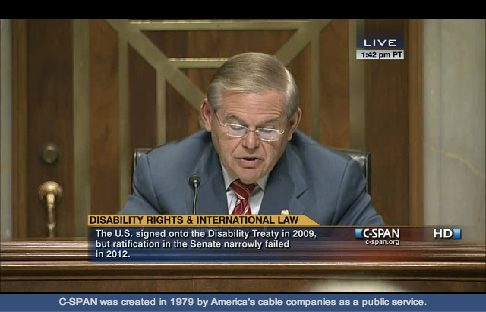
Last year, Michael Farris, homeschool advocate and founder of the powerful Home School Legal Defense Association, was instrumental in blocking the ratification of the UN Convention on the Rights of Persons with Disabilities (CRPD), despite its complete irrelevancy to homeschooling issues. Senator Robert Menendez (D-NJ) is now bringing the treaty back to the Senate, hoping to ratify it in this current session. Last week, Michael Farris was a witness for the Senate Foreign Relations Committee, testifying on why he thinks this treaty would be bad for the U.S.

farris

You probably didn’t watch Farris’s testimony last week, and his followers probably didn’t either. In fact, Michael Farris is banking on them not having seen it. You see, Michael Farris hopes they will accept his description of the hearing, of how mean and unbalanced it was, and how vicious the “Democrat” senators are. Farris hopes his followers will call their senators and demand that they vote no on the treaty. And of course, Farris hopes his followers will donate money to HSLDA in their outrage!

The problem is that Michael Farris’s description does not match up with reality.

While Farris told his followers that the Democratic senators sought to “vilify and destroy” him, in actual fact they treated his arguments against the treaty with the respect they deserved. Many of Farris’s legal analyses were countered by the other witnesses and the Senators. His demeanor throughout the hearing was aggressive and at some points incredibly rude and disrespectful to sitting Senators. And the “petty, silly, and personal attack” that Farris decries was, in fact, a response to Farris’s appeal to his own authority, one which he has used both here and previously to brush off criticism of his legal analysis.

In this post I will examine Farris’s description of the hearing, what actually happened, and some of the issues involved. I will look at Farris’s exchanges with Senators Boxer, Durbin, and Menendez, and contrast what actually took place with how Farris portrayed what took place in a fundraising letter he sent out to HSLDA members later that day. In my next post I will delve more into the legal issues at hand. I believe that this is an issue you should care deeply about, because the political power that Farris has is predicated on his position as leader of HSLDA, and his rejection of the UN Convention on the Rights of Persons with Disabilities (CRPD) is entirely consistent with the philosophies he’s built his political base around—and also because there are compelling reasons the U.S. for the U.S. to sign the CRPD.

Of course, you don’t have to take my word for any of this. You can watch and read Farris’s testimony for yourself and judge whether or not my description is accurate. First, you can watch the Senate hearing here (or here). Second, you can read my own transcription, which I made while watching it, my curiosity piqued by Sarah Jones’ description (my transcription is not perfect and may have some flaws or typos). I was not able to transcribe the entire two-and-a-half hours of the panel, and therefore I have not included all of the arguments or debate on the CRPD, but I was able to cover all of Farris’s testimony, as well as his back-and-forth conversations with Senators Corker, Boxer, Durbin, Johnson, Menendez, and Coons.

Background

Before I dissect Farris’s arguments and his back and forth with the various senators, I want to lay out some basic, noncontroversial, unchallenged facts about the Convention on the Rights of Persons with Disabilities (CRPD):

  1. The CRPD has already been ratified by over 130 countries around the world.
  2. The US has signed but not ratified the CRPD.
  3. Until the US ratifies the CRPD, no US representatives are able to take part in the Committee on the Rights of Persons with Disabilities, which monitors implementation. This limits US involvement in implementation of disability laws in other countries — of concern to US citizens traveling abroad — and in the interpretation of the treaty by the UN.
  4. Michael Farris is the most prominent voice opposing the ratification of the CRPD. Farris’s argument is that because there is no explicit mention of parents’ right to determine their children’s education, ratifying the treaty could potentially affect homeschooling. This is not in line with legal precedent of how the courts determine the US’s obligations under treaties such as these.
  5. Under debate currently in the Senate are a number of RUDs—reservations, understandings, and declarations—that the US may attach to its ratification of the treaty. While these are a common practice by the US and other countries, Farris is arguing that the only type of reservation he would accept is one invalidating the treaty.
  6. According to his opening testimony, Farris agrees with the emotional and political arguments in favor of ratification, but he believes that despite every assurance he has received to the contrary, ratifying the CRPD will change US law.
  7. If Farris had not decided to protest the CRPD, it is very likely it would have been ratified last December.

While Farris has characterized the pro-treaty side as being “Democrat” and “left”, this is not actually the case.

The CRPD has bipartisan support in the Senate, with Democrats, Republicans, and Independents all being in favor of the treaty. While Farris noted that two of the witnesses were “sitting senators”, he neglected to note that both Mark Kirk (IL) and Kelly Ayotte (NH) are sitting Republican senators, or that the other pro-treaty witnesses included Tom Ridge, a Republican who served as Secretary of Homeland Security under President George W. Bush, and Richard Thornburgh, a Republican who served as Attorney General under President George H.W. Bush. The Americans with Disabilities Act, on which the CRPD is based, was signed in 1990 by President Bush and passed the House by a vote of 377 to 28 and the Senate with a vote of 91 to 6. Several of the at the committee hearing made note of the remarkably bipartisan nature of this bill, and made it clear that supporting the rights of the disabled and of veterans is neither a Democratic nor a Republican issue, but a human rights issue.

Farris’s characterization of the treaty as a plot by “the left” is thus both fundamentally dishonest and a cheap ploy to get donations from people who dislike the “Democrat” party.

Barbara Boxer’s “Attack”

boxer

With this background, we now turn to the substance of Farris’s characterization of his interactions with three Senate Democratic committee members. Farris described his back-and-forth by Senator Boxer this way:

After we gave our introductory remarks, the personal attacks began. Senator Barbara Boxer (CA), the second most senior Democrat senator on the committee, asked me if HSLDA or ParentalRights.org has ever raised money during our battle against UN control over children and families with disabilities. Instead of asking her if she had ever raised money during her campaigns for U.S. Senate, or whether any of the pro-UNCRPD organizations raise money for their fight, I explained that HSLDA is funded by you, our members. ParentalRights.org is funded solely by donations.

Senator Boxer’s attack, however, was not really against me or HSLDA. It was against you, and every other homeschool family who has ever supported HSLDA because you believe in our mission to defend the God-given right of parents, not faceless bureaucrats, to care for and educate our children. Senator Boxer thinks that your membership in HSLDA and your support of our critical work to defend homeschooling, support widows and single parents through the Home School Foundation, and the work of ParentalRights.org to pass a constitutional amendment makes you an evil special interest that must be vilified and defeated.

Contrast this description with what was actually said during the two minutes that Senator Boxer spent addressing Farris. You can view the relevant video here or read the transcript as follows:

Boxer: “Now, Dr. Farris, you say that you’re speaking for the disabled, but your statements are directly contradicted by organizations that work every day, 24/7, to protect disabled kids, like the United States International Council on Disabilities who states, quote, ‘this treaty protects parental rights and highlights the important role of parents in raising children with disabilities.’ Unquote. And TASH, you know that organization, says quote, ‘nothing included in this treaty prevents parents from homeschooling. This treaty embraces the spirit of the Individuals with Disability Education Act, the Americans with Disabilities Act, and all disability non-discrimination legislation.’ But you, Dr. Farris, argue the opposite. You once even said, and I quote,‘the definition of disability is not defined in the treaty and so my kids – my kid wears glasses, now they’re disabled. Now the UN can get control of them.’ Well, I have to say in my opinion, that is nonsense that if a child wears glasses [Boxer touches her own glasses], then the child is considered disabled. So I wonder what is behind your fight. And I just ask this question for the record. Have you ever tried to raise funds by telling parents this treaty will limit their ability to decide what is best for their children?”

Farris: “Senator, our organization is funded by membership dues, not by contributions.”

Boxer: “So you’ve never sent out an e-mail asking for funds to fight—”

Farris: “No, the Homeschooling Legal Defense Association, um, is associated also with a group called ParentalRights.org. Parentalrights.org has indeed sent out fundraising emails—”

Boxer: “Thank you very much.”

Farris: (overlapping) “But, Senator, the substantive answer is, the treaty doesn’t ban homeschooling. What the treaty does is shift the decision-making power from the parent to the government. That is what the meaning of the best interests standard is.”

Boxer: “Well, that is not something that I agree with, nor do any of the organizations.

Farris: (overlapping) “Well—”

Boxer: “Thank you very much.”

Farris lied when he categorized Boxer’s questioning as an attack on HSLDA families. Boxer was not attacking, or even coming close to attacking, any HSLDA family. She simply asked Farris a question—whether he was using his opposition to the CRPD as a fund-raising cash cow—that he was embarrassed to answer. She never used the words “evil special interest”—an interesting choice of words by Farris, given that he has done more than anyone else to turn homeschooling families into a special interest group. Perhaps Farris, flushed in his residual embarrassment after his performance, accidentally admitted his private categorization of HSLDA families.

What Senator Boxer was actually getting at was Farris’s practice of issuing bald-faced lies about the implications of the CRPD in order frighten homeschooling parents so as to raise money for his organizations.

And the fact that Farris turned around and sent this letter out—including a P.S. asking for money (“Finally, even though Senator Boxer doesn’t want you supporting the battle against the UNCRPD and for U.S. sovereignty, you can donate if you wish”)—is an example of his inability to understand either what Senator Boxer was getting at or that what he is doing is fearmongering and wrong.

For the record, this very e-mail reveals that Farris is officially sending fundraising e-mails from HSLDA.org in order to fund “the battle against the UNCRPD and for U.S. sovereignty”—the exact thing he denied doing just hours earlier in front of the Senate Foreign Relations Committee, when he claimed that he only sent out such emails from ParentalRights.org. Senator Boxer was onto something. Farris is indeed making inflammatory and incorrect assertions about what happened in order to raise money. Ironically, his attack on Senator Boxer justifies her line of questioning.

Senator Durbin’s “Misunderstanding”

durbin

Next came Farris’s mischaracterization of Senator Durbin, the Democratic senator from Illinois. Here is Farris’s description of their interaction:

Next, Senator Dick Durbin (IL), another senior Democrat on the committee, falsely argued that HSLDA’s position is that the Americans with Disabilities Act (ADA) is the threat to homeschool freedom. The fact is that HSLDA strongly supports the ADA and other laws advancing the freedom and dignity of persons with disabilities which our democratically elected representatives have passed. What’s more, the UNCRPD would actually threaten parental rights which are enshrined in the IDEA [the Individuals with Disabilities Education Act]. I explained to him that it was the UNCRPD, not the ADA, which was the threat. He ignored me and persisted in stating that HSLDA believes the ADA was the threat. Logic teachers call this a straw man argument, which is used by people who do not wish to debate the merits of an issue.

Again, Farris’s recollection is simply incorrect. You can view the relevant video here, or read the transcript as follows:

Durbin: “I am just stopped cold with this argument by Mr. Farris that the Americans with Disabilities Act is going to put an end to homeschooling in America. Is that your position?”

Farris: “That’s not my position. My position is that the treaty changes the, the legal requirements in this country that it’s just not correct to say that there is no duty to change American law in accordance with the treaty. So, since I believe there will be required to be, uh, an implementation act that complies with the requirements of the treaty I think that at that point in time that’s when the problems will arise.

Durbin: “Mr. Farris—”

Farris: (overlapping) “Not under the ADA itself.”

Durbin: “Mr. Farris, the fact that the administration is not asking for an implementation act and made it clear that it’s not seeking it because the Americans with Disability Act already is controlling, and has been extensively litigated, sets disability standards in our country higher than any in the world, you don’t find that convincing.”

Farris: “That’s the same administration that’s prosecuting the homeschooling family to try to expel them from the United States who came here—”

Durbin: “Under the ADA? Under the Americans with Disabilities Act?”

Farris: “No, they came here under our law of asylum. But the question of the case is—that case is also pending before the Supreme Court, and the question is—”

Durbin: “Well, Let me just say Mr. Farris—”

Farris: “I guess you don’t want me to answer the question.” *flounces back in his seat*

Durbin: “I don’t think you can answer because you want to talk about something other than the American Disability Act or the convention on disabilities, and that’s what we’re here to discuss.”

Farris: “The convention with disabilities has a different legal standard than the ADA.”

Durbin: “I can tell you—”

Farris: (overlapping) “There are numerous disability organizations that say so. I include their citations in my written testimony. I’m not the only one that says that. The CRPD committee agrees with me.”

Durbin: “And I would just say to you, Mr. Farris, that if we’re going to have a battle of the organizations supporting or not supporting this, I think we’re going to prevail. Because we have the mainstream disability organizations across America who are supporting the adoption of this convention on disabilities. And I—I just, I struggle with this notion that we are somehow going to stop this effort, this effort to extend the rights to the disabled around the world for fear of something which you can’t even clearly articulate when it comes to homeschooling. […] This is not going to affect homeschooling, it’s very clear that it will not. And the Americans with Disabilities Act for twenty years has not affected homeschooling. I yield back my time.”

Far from “stating that HSLDA believes the ADA was the threat”, Durbin is very clear: because the US is already bound by the ADA, which holds the US to a higher standard than the CRPD would hold the US, there will be no changes required in US law should the US ratify the CRPD. As Farris originally got involved with this treaty obstensibly in order to prevent changes in homeschooling law, this is not an irrelevant point that Durbin is making.

(Farris actually talks quite a bit about the Romeikes, a German family that is trying to get asylum in the U.S. on the basis of Germany’s essential ban on homeschooling. I personally don’t see the relevance of the Romeike family to the CRPD, and connecting the two seems to fall under the slippery slope fallacy. You can read more about the Romeike family hereherehere, and here.)

It is also clear from the video and transcript that Farris is not exactly acting with the proper decorum due to a sitting US senator or expected in a senate hearing. He is rude, interrupts the senators multiple times, and, when frustrated, resorts to mouthing off. Once I got over my initial shock, I found myself full of questions. Personally, I was not homeschooled, nor have I ever participated in any type of moot court. Is this kind of display in this sort of formal setting considered acceptable for homeschooled students? For participants in moot court? Wouldn’t judges dock points for display of temper? Surely Farris knows that when giving testimony as an expert witness, it is advisable not to behave like a lawyer on “The Good Wife”?

But let us not let our shock at Farris’s visible display of disrespect distract us from Farris’s legal disrespect of Durbin’s very sound arguments.

Durbin, a former trial lawyer, makes numerous strong legal points that poke holes in Farris’s flimsy argument. For example, a large part of Farris’s argument relies on the assumption that US law will need to change in order to accommodate the new treaty. As the treaty is non-self-executing, this would have to be accomplished with an Implementation Act passed by both Houses of Congress and signed by the President. However, as Durbin pointed out, this is not necessary in the case of the CRPD. This is corroborated by the UN website on the Treaty on Disabilities:

Except in the rare case that the laws in a country already conform fully to the requirements of the Convention, a State party will normally have to amend existing laws or introduce new laws in order to put the Convention into practice.

As Durbin states, the US is exactly that “rare case” that the laws already conform to the requirements of the Convention—because the Convention was based on our current disabilities law! Perhaps Farris should consider this an example of American exceptionalism in action?

It is also incredibly ironic that Farris describes Durbin as using a logical fallacy (“straw man argument”) when in fact a large part of part of Farris’s own argument against ratifying the CRPD relies on a logical fallacy–the slippery slope fallacy. See for example what Farris said in response to a question by Senator Menendez about whether or not Farris views this treaty as a “wedge issue” (you can also view the video here):

“I believe that, uh, this treaty would be the first in a—in a line of human rights treaties that would be coming before this treat—before this committee. The committee—the convention on the rights of the child—Senator McCain misspoke, I’m sure, earlier—we have not ratified that treaty. And so, I think that would be coming next. The convention on the elimination of all forms of discrimination against women, that would be coming after that. I think that, that this treaty is the first of many treaties that would be in this, in this range, that is what is intended by that comment.”

As Farris should be well aware, a slippery slope fallacy is often “used by people who do not wish to debate the merits of an issue.” Perhaps he would agree that it is used only by those who lack the ability to make more substantive arguments.

Senator Menendez’s “Dismissal” 

Menendez

This leads us to discuss Senator Menendez’ questions. Although Menendez’s questioning of Farris lasted over eight minutes (you can view the full video here), Farris seems to have only remembered a brief snippet of the exchange (which you can watch here). In Farris’s own words:

And finally, near the end of the hearing, Senate Foreign Relations Committee Chairman Bob Menendez (NJ) said, by way of dismissing HSLDA’s legal arguments about how the UNCRPD is binding under international law, “I appreciate that you have an LLM from London which is as I understand from a distance learning course….” The room packed with supporters of the treaty burst out in rude and loud laughter, forcing Chairman Menendez to gavel the room to order.

Again, while this was a personal attack aimed at me intended to sideline my arguments, Chairman Menendez was admitting that he had no response to HSLDA’s arguments about the dangers of the UNCRPD and international law. He showed that he will resort to petty, silly, and personal attacks rather than substance.

Let me first say that I find it repugnant for anyone, regardless of where they obtained their education, to dismiss anyone else solely on the basis of their education.

It is a sad truth that access to education is not equally distributed across the world, and very often access is limited to people who are already relatively privileged in money, time, and social status. Distance learning courses and degrees can be used to change this: in fact, it is very likely that due to Article 24 of the CRPD, on educational rights of persons with disabilities, would lead to the increasing availability of distance-learning courses and degrees such that “persons with disabilities are not excluded from the general education system on the basis of disability.”

However, I do not believe that this was an attempt by Senator Menendez to attack Farris in order to distract from “substance.” Rather, I believe that Senator Menendez’s comment about Farris’s degree is justified by Farris’s earlier attempt at credentialism and, in yet another logical fallacy, an appeal from authority.

In his opening statement, Farris said to the committee (view the video here):

Turning to the issue of homeschooling, uh, I’ve been criticized by many in the press for, uh, fearmongering on this topic. But I have never seen anyone write a legal analysis. It’s just simply conclusions, just assertions that I have incorrectly analyzed the lawness. I have an LLM in International Law from the University of London, I have coached six—excuse me, seven—national championship moot court teams that debate constitutional law, I have written the legal analysis and I dare anyone to read my legal analysis and answer it with legal analysis, not conjecture and raw assertion.

Farris is the one who introduced his credentials—the only person testifying to do so, and in my opinion a rather gauche move—as his authority for making this legal argument.

Farris, while mentioning that he did receive his LLM from the University of London, notably did not include the fact that it was from the distance-learning program, leading the casual viewer to believe that Farris attended the University of London in-person, rather than through the distance-learning program.

In fact, this is something of a pattern for Farris. His bios on both HSLDA.org and ParentalRights.org mention the LLM from the University of London but do not indicate that it was a distance learning program. He also represented himself this way to a reporter from the Boston Globe:

Farris, meanwhile, stood by his assertion that he understood the treaty better than Republican supporters such as Thornburgh. Farris, a graduate of Gonzaga University School of Law, said he has better legal training when it comes to treaties.

“I have an LLM in international law from the University of London,” Farris said, referring to a postgraduate degree that is similar to a master’s program. Asked for details, Farris said he didn’t go to London for the degree; it came in a “distance learning” course and culminated in a proctored exam at a local community college.

“He is just flat wrong,” Farris said of Thornburgh’s sworn testimony that the treaty won’t change US law. “If he wrote that on an international law exam, at any law school, he would fail.”

Farris is misrepresenting himself and his law degree in public all the time, and yet he uses this misrepresented law degree as the authority backing his legal opinions. Does Farris believe that there is a distinction between “University of London” and “University of London, distance learning program”? If not, why does he continually forget to mention the type of program he went through?

In short, I believe that contrary to Farris’s account, Menendez was not making fun of Farris’s degree at all. He was instead making fun of Farris’s appeal to authority. If Farris was honest about the provenance of his degree, if he did not so frequently use it as a justification for his legal theory, then Farris would not be able to be so easily and frequently embarrassed by anyone pointing out the actual program he attended. And if Farris’s legal arguments were stronger, he would not need to resort to the fallacies of credentialism and appeals from authority at all—which is, by the way, yet another fallacy.

(As a side note, Farris complained on his Facebook account after the hearing that “they attacked me personally for ‘fear-mongering,’ misrepresentation, fund-raising, political motives, and having earned an LLM through distance learning.” As I listened to the video of the entire conference, I kept count: the only reference to ‘fearmongering’ made during this Senate hearing was the above reference made by Farris himself. That said, I myself prefer to interpret this as Farris accusing himself of fearmongering.)

Perhaps it’s because he was so embarrassed with the jibe about his degree, but Farris does not seem to have understood any of Menendez’s actual legal points, some of which will be discussed in my next post. As a matter of fact, Menendez actually states Farris’s position more clearly than Farris is able to articulate it: “you argue that the treaty creates obligations others do not see, and then you suggest that the United States must follow your interpretation as in terms of ratifying the treaty.”

In short, Menendez does engage with Farris’ legal arguments and legal reasoning.

Menendez goes on to say:

“I think that where we have a fundamental disagreement here, is that under the Constitution, the President and the Senate determine our obligations under international treaties and therefore the reservations, understandings, and declarations are the resolution and consent—are what are binding.”

Farris is welcome to all the opinions he likes—that’s his Constitutional right as an American. But his opinion of legal theory is not considered binding. The Senate determines the boundaries of the reservations attached to the treaty—this is its Constitutional duty under Article II, Section 2. In Farris’s attempt to protect the United States from encroachments on its sovereignty by the UN, he seems to be ignoring the parts of the Constitution which guarantee the American people freedom from him.

Conclusion

But don’t just let Senators Boxer, Durbin, and Menendez convince you that Farris’s arguments are ridiculous. I may not have a law degree, but I do know how to read and I’m willing to do a little bit of legwork when it comes to research. Farris claims again and again that his opponents have attacked his motives or his degrees rather than attacking his actual evidence—a claim that is false, as we have seen. Farris also continually pads his arguments with citations from other legal scholars, using these experts as a buoy to support his claim that his interpretation of the CRPD is the correct one. In my next post, I will do what Farris urges—but what I don’t think he actually expects anyone to do. I will read the experts he cites to back up his interpretation—and I will do so in their original context.

And when I do so, I think I can prove to you that he never expected anyone to do this, or else he wouldn’t have left himself so very open to being exposed as such a fraud.

Part Two >

When Did Homeschooling and Parental Rights Mean Anti-Gay?

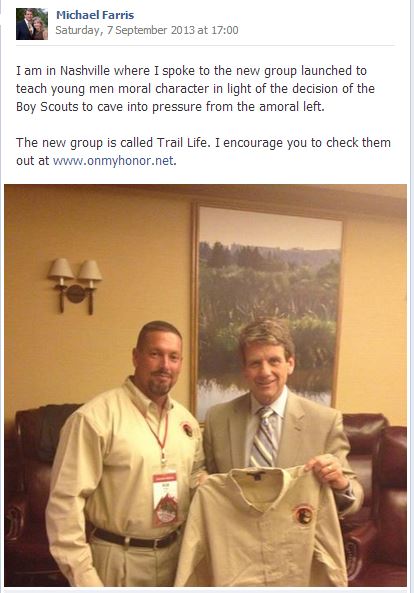
Original photo posted on Michael Farris' Facebook page here: https://www.facebook.com/photo.php?fbid=468390293258668&set=a.351585204939178.76024.351012244996474&type=1
Original photo posted on Michael Farris’ Facebook page here: https://www.facebook.com/photo.php?fbid=468390293258668&set=a.351585204939178.76024.351012244996474&type=1

HA note: The following is reprinted with permission from Kathryn Brightbill’s blog The Life and Opinions of Kathryn Elizabeth, Person. It was originally published on October 2, 2013.

Well, I guess it was too much to hope for that Farris et al. would speak out against the egregious threat to the rights of gay parents in Russia. When a concerned former homeschooler asked him about it on his Facebook page, he pretty much blew her off by saying that because it wasn’t a homeschooling issue he wouldn’t do anything.

Funny though, how he doesn’t have the time and isn’t willing to take the effort to speak out against the proposed legislation in Russia to take children away from gay parents, but he did find time to be at the launch of Trail Life. Trail Life, for the uninitiated, is the organization that just formed as an alternative to the Boy Scouts. To be precise, it was founded as an alternative by those who do not like it that the Boy Scouts is no longer kicking children out of the Scouts for being gay. Note, the Boy Scouts still does not allow anyone over 18 to be involved with scouting if they’re gay, but that’s not enough for the Trail Life folks.

If you’re not kicking kids to the curb if they come out, you’re caving into the pressures of the amoral left.

Source: https://www.facebook.com/photo.php?fbid=468390293258668&set=a.351585204939178.76024.351012244996474&type=1

Again, let me remind you, no time to speak out against Russia wanting to take gay parents’ children away since it’s not homeschooling related, but plenty of time to go help launch a group that differentiates itself from the Boy Scouts by targeting children in the culture war. Yes, that’s what they’re doing.

They’re putting kids in the cross hairs of the culture wars. It’s kids who are going to get booted out of Trail Life, it’s kids who they want to get booted out of the Boy Scouts. Kids.

Not surprisingly, Farris has a bit of a persecution complex about all of this. Here’s the relevant conversation from the comments on his post.

farris2

Two things here. The first is that as a K-12 homeschooler and homeschool graduate, I’m tired of the media treating Michael Farris as if he speaks for all homeschoolers. He doesn’t. He certainly does not speak for me.

The second is this. When Michael Farris talks about “the homosexual community and their elitist friends and the courts,” he’s painting this as an us versus them battle between his band of conservative Christians on one hand and the aforementioned homosexual community and their elitist friends and the court on the other. He is mistaken. There is no us versus them. There is only “we.”

Not just “we” in the abstract, “We the People,” sense either. “We” as in, the people his movement is fighting against aren’t some “other.”

Mr. Farris, we are you—

—your family members, the kids who sang in the church choir and went to AWANA every week, who were trusted to babysit for other homeschoolers because we were part of the community, the homeschool kids who listened when you said that we were the generation who would change America.

You’re fighting so hard, but you aren’t fighting for liberty, you are fighting to deny liberty to people who are not so different from you.

Mr. Farris, it was your con law book for homeschoolers that inspired me as a teenager to want to go to law school.

I listened to you when you said that homeschoolers were going to change the country and I believed it. If I’m some activist elite, Mr. Farris, it’s because you and the homeschool movement created me. When I worked on an amicus brief in Perry and Windsor, it was because of the seeds you planted in me to go to law school.

We are not others, this is not us versus them, and it never has been, no matter how much you try to make it that way.

So… About That “Homeschooled Hero” George Washington

george-washington-portrait

By R.L. Stollar, HA Community Coordinator

George Washington is the greatest homeschooler of all time.

Homeschool advocates love that sentence. It’s like the knife driven into the heart of public education, the garlic wielded against the vampiric detractors of homeschooling.

What a solid sentence. The syntax is perfect.

There’s just one problem with it: it simply isn’t true.

I honestly don’t know where the myth of George Washington as homeschooler originated. When Rob Shearer wrote about Washington back in 1998 for Practical Homeschooling, he never mentions Washington was homeschooled. He says that Washington was “one of the most important figures in American History.” So if he was homeschooled, that would seem like a good time to mention that fact. But he doesn’t.

My guess would be the myth originated three years later with alternative education activist John Taylor Gatto, who is widely celebrated in homeschooling circles. In Gatto’s classic critique of American public education, the 2001 book The Underground History of American Education, he states:

“Washington had no schooling until he was eleven, no classroom confinement, no blackboards. He arrived at school already knowing how to read, write, and calculate about as well as the average college student today… Washington also studied geography and astronomy on his own…”

Gatto, however, never says Washington was “homeschooled.” Though he does point out that, “Washington attended school for exactly two years.” Which is not “exactly” true, but we will get to that in a bit. The point is, Gatto says that Washington mainly taught himself but also received formal education to complement that self-teaching.

Yet somehow Washington is today considered a classic example of homeschooling’s power. He is included in those many and sundry lists of “famous homeschoolers.” There’s even a website for “Famous Homeschoolers” (www.famoushomeschoolers.net) that includes him. (Does anyone fact check those lists, by the way? Because I swear 75% of the people listed in most of those do not qualify, just like George Washington.)

Just last week, the Homeschool Legal Defense Association (HSLDA) dedicated the entirety of its Home School Heartbeat radio program to Washington.

Just last week, the Homeschool Legal Defense Association (HSLDA) dedicated the entirety of its Home School Heartbeat radio program to Washington.

The title of their week’s series was — surprise! — “Homeschooled Leader: George Washington.” The series’ description says, “The father of our country was a surveyor, general, president—and homeschooler.”

HSLDA’s Mike Smith gushed throughout the week about Washington and his homeschooling and how wonderfully it shaped him and his legacy for the U.S. (emphasis added):

“Who was America’s greatest homeschooler? Some say it was George Washington… America owes its very existence to one of the greatest homeschoolers of all time… Like most frontier families at this time, homeschooling was the most viable option for a child’s education… This homeschooler and statesman transformed the world, setting the course for freedom and away from tyranny… Americans owe their freedom to the efforts of our Founding Fathers and to this man who diligently studied and learned the truths of life at home.”

Just one small problem: George Washington is neither an example of homeschooling nor an example of education done well.

To some extent, deciding whether someone was/is homeschooled or not is complicated. There are so many different forms of home education these days. So let’s go ahead and set some arbitrary definitions. For “homeschooling,” we will use “to teach school subjects to one’s children at home.” And for “homeschooled” we will use a definition that HSLDA could agree with — the definition that HSLDA’s research buddy Brian Ray used earlier this year: “one should consider a person to be ‘homeschooled’ if the majority of his school years were in homeschooling.”

So let’s look at George Washington.

There isn’t a lot of information about Washington’s early life. Any legitimate account of his early life and education will admit this. So here are a few different accounts of what we do know:

George Washington’s education resulted from a process of close study and imitation of the Virginia elite… Born into mid-level gentry status, Washington seized opportunities to fill in gaps in his formal education… A formal education alone could not have imparted him with such admirable self-control. Washington’s social education enabled him to maintain a delicate balance between ambition and modesty throughout his life. (Source)

In the normal course of events, George Washington would have become an Oxford don and followed the profession of his English father… He received the least formal schooling of any of the Founding Fathers and remained self-conscious about this lack all his life… George Washington did not sit down and write of his childhood, as Thomas Jefferson and Benjamin Franklin did… He seems to have been ashamed of his impoverished childhood and his poor education… He apparently began to learn to read, write, and keep sums from a tutor, a convict… By the time his brother Lawrence returned in his red-and-blue uniform, George was already crossing the river each morning to the log schoolhouse in Fredericksburg… In all, George Washington received between seven and eight years of schooling. For nearly four years, he took the ferry each morning to Fredericksburg. (Source)

Between seven and eight years of schooling. Four under the tutelage of a convict and four at a public log school. This is a very different story than Gatto’s “two years” fable. And what schooling Washington got was scarce, so scarce that Gatto saying Washington’s lack of formal education was somehow positive is an insult to Washington’s experience. Why? Because Washington did not consider his lack of formal education to be positive:

Washington had only limited formal schooling. In later life, he felt somewhat self-conscious about what he considered his ‘defective education.’ Spurred by this sense of deficiency, he developed a lifelong habit of reading… Despite this effort, he remained unsure of his learning.” (Source)

So self-conscious was he of his lack of education, and so defective did he consider the little bit of education that he received, that Washington went out of his way to educate his stepson, Jack Custis. He hired a private tutor for both Jack and his sister Patsy for over six years. He sent Jack to boarding school in Maryland. After boarding school Washington sent Jack to New York for college. And note, Wasington “left the direction of Jack’s schooling to these instructors.”

This cannot be overstated: George Washington was embarrassed by his lack of education. Self-conscious. Ashamed. You can see how this influenced him in his advocacy for public education near the end of his life:

As George Washington ended his term as the first president of the United States, he left with a few parting words. Washington’s Farewell Address of 1796 delineated many of the recommendations Washington had for the future of his country. Amongst these suggestions was a public education system. (Source)

In this address Washington said,

Amongst the motives to such an Institution, the assimilation of the principles, opinions and manners of our Country men, but the common education of a portion of our Youth from every quarter, well deserves attention. The more homogeneous our Citizens can be made in these particulars, the greater will be our prospect of permanent Union; and a primary object of such a National Institution should be, the education of our Youth in the science of Government. (Source)

So let’s get this straight: Washington’s dad bought a full-time tutor for him. Washington also attended an institutional school for at least 50% of his education. And somehow he was homeschooled? Since when was homeschooling considered 50% being tutored by a convict and 50% attending a public school?

This fails both the definition of “homeschooling” and the definition of “homeschooled.”

Even if you still consider Washington to be homeschooled, there’s the more important aspect of this story: George Washington had the least formal education of the Founding Fathers and considered that a bad thing. He considered his lack of more formal education to be defective to the point that it obviously haunted him for his entire life. This spurred him to push for public education for his own relatives and the brand new United States of America.

That’s a “homeschooled” hero?

Look, I don’t mind if people create lists of famous homeschoolers. It’s a testimony to the fact that homeschooling can be awesome and has been awesome and that education should be democratic and flexible and tailored to every individual.  But if you’re going to create a list of famous homeschoolers, I have two very simple rules:

(1) Make sure the people were actually homeschooled.

(2) Make sure the people don’t consider their education defective.

Including George Washington violates both of those rules.

Of course, if George Washington were alive today and said his “homeschooling” (if you still want to consider it that) was lacking and defective and he wished he could have gone to that log school more, we already know from Josh Powell’s situation how HSLDA would respond. It would be something like, “Buck up, kiddo! Log schools crush creativity! Be glad you got taught by that convict at home!”

A Quick and Dirty Primer on HSLDA

Screen Shot 2013-09-17 at 1.49.33 PM

A Quick and Dirty Primer on HSLDA, By Kathryn Brightbill

Kathryn Brightbill blogs at The Life and Opinions of Kathryn Elizabeth, Person.

Did you find your way to Homeschoolers Anonymous because of the press coverage of the Wunderlich and Twelve Tribes cases in Germany? Or did the Romeike case in the United States send you hunting for more info on this HSLDA group that keeps showing up in news stories?

Then this story is for you.

It is in no way meant to be exhaustive, just to provide basic information for people who did not grow up in the homeschooling world and are unfamiliar with HSLDA’s activism.

Early Days

HSLDA was founded by Michael Farris in 1983. At that time, homeschooling as a movement was in its infancy, and because parents were concerned about the legality, the idea of a legal defense and advocacy organization dedicated to homeschooling was an attractive one.

Throughout the 1980s and 1990s, HSLDA was involved in liberalizing the homeschooling laws in states across the US, mobilizing homeschoolers to bombard their legislators with phone calls, telegrams in the early days, faxes, and emails. During this time period most of the restrictions and regulations on homeschooling were removed so that in many states there is now minimal oversight of homeschooling families to ensure that children are receiving an education.

In 1991, HSLDA went international with the formation of HSLDA Canada.

A turning point came in 1994 when HSLDA used the power of its network of homeschooling parents to fight against H.R. 6, a federal bill that said that non-public schools applying for federal funds must have teachers certified in the subject matter in which they teach. For reasons that are not entirely clear since the bill was about non-public schools that received federal money—an issue completely unrelated to homeschooling, HSLDA decided that H.R. 6 meant that the federal government would require homeschoolers to be certified teachers. Although many other homeschool leaders disagreed with HSLDA’s analysis and did not see any threat to homeschooling in the bill, nevertheless, HSLDA mobilized tens of thousands of homeschoolers to contact congress and in the process discovered just how powerful a political network they had built.

HSLDA Branches Out: Non-homeschool-related activities

When you are an organization that is run by conservative members of the religious right (Farris was an attorney with Concerned Women for America who fought against the Equal Rights Amendment, former HSLDA attorney Doug Phillips is the son of Constitution Party presidential candidate and former Nixon administration member Howard Phillips, to give a few examples), and you have built a powerful grassroots network that will do your bidding, the temptation to limit your work to homeschooling is evidently too great to resist.

Coming on the heels of the H.R. 6 fight in 1994, HSLDA touts their involvement in killing the US ratification of the UN Convention on the Elimination of All Forms of Discrimination Against Women (CEDAW), a human rights treaty.

The only UN member states that have not ratified CEDAW are Iran, Palau, Somalia, South Sudan, Sudan, Tonga, and the United States.

In 1995, HSLDA took a case in Virginia, In re Brianna, where the parents were charged with neglect for refusing to vaccinate their child. HSLDA successfully argued that the parents should be given a religious exemption from providing childhood vaccinations to their child. HSLDA’s timeline of events does not indicate that this case had any connection to homeschooling.

In a case where the only relationship to homeschooling was that the party involved was a former homeschooler, HSLDA and Michael Farris took on the case of Michael New, a soldier who refused to wear a UN beret as part of United Nations peacekeeping actions. In a 1995 Court Report cover story, the case was described as, “Michael New v. the New World Order,” a reference to fundamentalist Christian beliefs about the End Times and the United Nations as ushering in a one world government that would lead to the rise of the antichrist.

In 1997, a constitutional amendment drafted by HSLDA, the “American Sovereignty Amendment, H.J.R. 83,” was introduced by Congresswoman Helen Chenoweth (R-ID). The amendment, which did not go anywhere, would have changed the Constitution so that treaties were no longer on the same level as the US Constitution. The text of the amendment is not available online, but it is evident from HSLDA’s own description that it would have had significant effects on the United States’ ability to meet its treaty obligations.

By 2003, HSLDA decided to organize young homeschool students into Generation Joshua to create a generation of young, politically active kids who could provide the manpower on the ground in conservative political campaigns. Generation Joshua was designed to build a second generation of kids to carry forth the culture war battles of their parents.

In 2004, despite the fact that it has not even the slimmest connection to homeschooling, HSLDA backed a constitutional amendment to ban both same-sex marriage and civil unions.

Another way that HSLDA expanded their reach beyond homeschooling was with the 2007 launch of ParentalRights.org, an advocacy organization devoted to expanding parental rights free from government interference. This includes advocating for a Parental Rights Amendment that would subject all laws relating to parental decisions on the upbringing, care, and education of their children to the highest level of judicial scrutiny, a standard that is extremely difficult to overcome, and which would remove almost all legal protections from children.

HSLDA was also instrumental in blocking United States ratification of the UN Convention on the Rights of Persons with Disabilities, despite the fact that the treaty mirrors the Americans with Disabilities Act.

On the treaty front, HSLDA has also led the fight against the ratification of the UN Convention on the Rights of the Child. Among their objections to the treaty is that it would prevent minors from being sentenced to life in prison—something that the international community agrees is unacceptable but that the US still practices. They also object to the fact that the convention uses the best interest of the child standard in determining matters involving children, even though the best interest of the child standard is the guiding standard in American family law already. Furthermore, they oppose the idea that children should have a right to be heard in decisions relating to their interests.

The only countries that have not ratified the UN Convention on the Rights of the Child are Somalia, South Sudan, and the United States. HSLDA bears much of the responsibility for America’s failure to ratify the treaty.

HSLDA and Abuse

Starting from 1992 on, HSLDA’s timeline lists their involvement in an increasing number of cases where homeschool families were accused of child abuse unrelated to homeschooling itself. Further, HSLDA’s timeline credits their work with member families in defeating Virginia Senate Bill 621, a bill that did not involve homeschooling but rather the standard of proof in child abuse investigations.

They also brag on their timeline about their role in killing a 1997 bill in New Hampshire that would have defined isolation of children as a form of abuse, because they believe it could apply to homeschoolers. This certainly suggests that HSLDA believes that some homeschool parents isolate their children to the point that a bill designed to protect children from abuse would apply, and thinks this is okay.

This is particularly relevant given the accusations against the Wunderlich family—HSLDA says that the family wasn’t abusive, but HSLDA doesn’t think that extreme isolation is abuse.

In his 1996 novel, Anonymous Tip, a story intended to dramatize the position that Child Protective Services are a threat to families, Michael Farris repeatedly has his protagonists insist that spankings that leave bruises are not necessarily evidence of abuse.

For more on HSLDA’s handling of child abuse cases, see Libby Anne’s extensive documentation on HSLDA and abuse, including their fight against child abuse reporting, the time they called a man who caged his children a “hero”, and their opposition to Florida’s proposed law that would have defined leaving bruises and welts on children as abuse.

This is not to say that HSLDA supports child abuse. As Libby Anne explains, it is entirely possible to abhor abuse while still taking actions that end up protecting abusers.

Michael Farris’ other non-homeschooling activism

An overview of HSLDA would be incomplete without noting at least some of Michael Farris’ other activism during his time with HSLDA. In addition to an unsuccessful 1994 run for Lt. Governor of Virginia, Farris was the founder of the Madison Project, a political action committee that bundles small donations in support of right wing candidates. Furthermore, his support of right wing candidates extended to backing John Ashcroft for President in 1998 and Mike Huckabee in 2008 (chastising other leaders of the right for not backing Huckabee sooner), and has mobilized Generation Joshua in support of Ken Cucinelli’s run for governor of Virginia.

As already mentioned, before founding HSLDA, Farris worked with Concerned Women For America in fighting against the Equal Rights Amendment that would have guaranteed equal constitutional rights for women. Also in the early 1980s, he worked with the Moral Majority in Washington state to try to get sex education materials removed from libraries.

Farris has also taken to fighting other broader culture war issues after the founding of HSLDA. Writing an amicus brief on behalf of Patrick Henry College in the Hollingsworth v. Perry (Prop. 8) United States Supreme Court case, he argued that if the government recognized marriage between two people of the same sex it would make it harder for Patrick Henry College to continue with their current (discriminatory) policies.

More recently, he spoke at the founding meeting of Trail Life, USA, the scouting group that was formed as an alternative to the Boy Scouts after the Boy Scouts stopped kicking gay kids out of the Scouts. The head of the Trail Life organization has gone on record stating that he believes that parents accepting their gay children is a form of child abuse. Farris, for his part, seems to agree with the head of Trail Life that gay children should be subjected to reparative therapy, a form of therapy condemned by every major psychiatric organization because it is psychologically harmful to the point of being abusive.

In Conclusion

While HSLDA may have started as a homeschooling advocacy organization, over time they have shifted and expanded their focus, fighting against international treaties, expanded child abuse legislation, and fighting for broader religious right causes. They are an organization founded and led by religious right activists who treat homeschooling as yet another front in the ongoing culture wars.

How American Homeschoolers Enabled and Funded German Child Abuse

By R.L. Stollar, HA Community Coordinator

*****

“Without the assistance of American homeschoolers, these advancements would not have been possible.”

~ Homeschool Legal Defense Association, concerning German legal association Schulunterricht zu Hause

*****

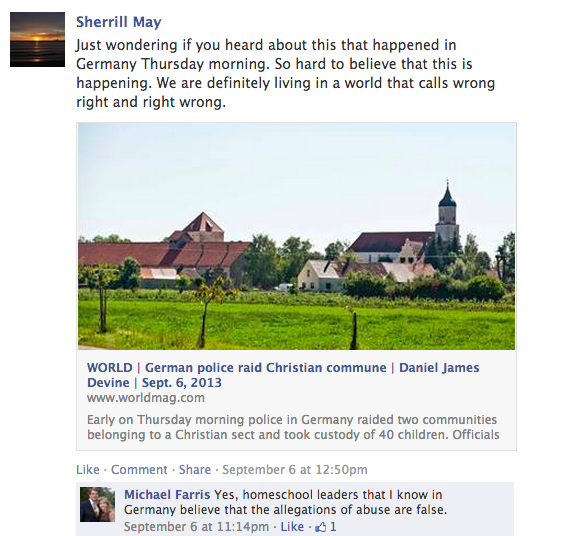
Last week, German police raided a monastery and farm belonging to a religious sect in Bavaria. They removed 40 children on allegations of child abuse. While the event was originally portrayed by the sect as well as American right-wing news sources as religious persecution, that portrayal was quickly proven wrong. Video evidence of cruel and systematic abuse of children surfaced.

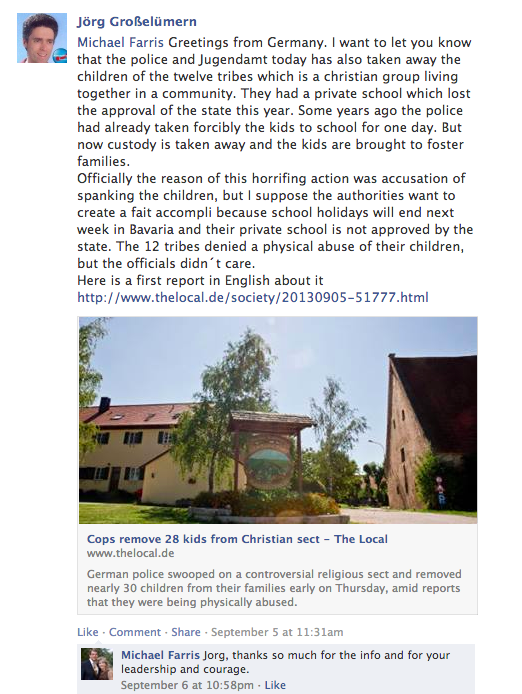
Some homeschool advocates originally attempted to chalk this up as another example of “German intolerance” of homeschooling. German homeschool advocate Jörg Großelümern, who leads the HSLDA-allied Netzwerk Bildungsfreiheit (or Network for Freedom in Education), had brought the situation to the attention of Michael Farris, chairman of HSLDA, the U.S.-based homeschool lobbying organization. Großelümern alleged that “the authorities want to create a fait accompli because school holidays will end next week in Bavaria and their private school is not approved by the state.” Farris responded in turn, “Thanks so much for the info and for your leadership and courage.”

When evidence surfaced of real and horrific abuse, however, these homeschool advocates immediately distanced themselves from the sect. Großelümern backpedaled: “I didn’t know what was going on behind the curtain of this sect. They didn’t tell the truth and things must be judged differently now.”

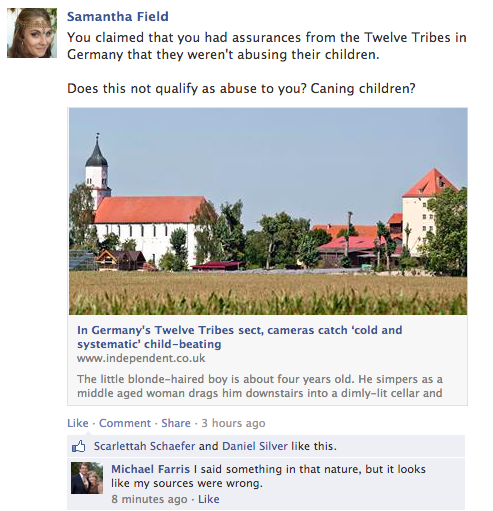
Farris added that, “My sources were wrong,” Which makes sense, since his source was Großelümern.

People can, and do, make mistakes. People can have lapses of judgment. But the elephant in the room is how a German homeschool leader like Großelümern, and an international homeschool advocate like Farris, would not first wait to find out what was “going on behind the curtain.” It is slightly unsettling that their gut reactions to allegations of child abuse in a group universally recognized as a cult was to assume the best about sect parents over the well-being of children. 

But more than this, it is entirely disingenuous.

The sect in Bavaria, otherwise known as the Twelve Tribes, has been actively defended directly and indirectly through the actions of American homeschool advocates — most notably, by HSLDA itself — for the last decade. These advocates have organized legions of American homeschoolers and funneled over $100,000 of American money to groups that have directly and unabashedly supported this sect and its “rights.” Whether through sheer ignorance, or turning a blind eye, HSLDA and fellow homeschool advocates have encouraged Americans to both enable and fund child abuse in Germany.

A Summary of the Twelve Tribes

The Twelve Tribes is a religious cult founded in 1972. I say “cult” not as a dismissive pejorative but because its former members have declared it to be such, using descriptions such as: “The Community instills intense fear in their members,” “The Twelve Tribes cult denied my right to make free will choices,”  and “mind control.”

Former members also argue that common allegations of child abuse within the Twelve Tribes are not only real, but more prevalent than even the news reports state:

  • “Former members made many accusations of child abuse and I’ll state unequivocally that abuse (physical, mental and emotional) occurred.”
  • “The newspapers often sensationalize information, but the child abuse within the Twelve Tribes was 10 times worse than reported.”
  • “We witnessed the beating of children almost to the point of death.”

The sect was created by Gene Spriggs in Chattanooga, Tennessee and was influenced by the “Jesus Movement” of the time. The sect’s beliefs mirror those of Christian fundamentalism and Messianic Judaism. They homeschool their children, hold to a form of Quiverfull ideology, and champion home births with midwives. Adherents to Spriggs’s sect have branched out from Tennesse and now live in Canada, Australia, Brazil, Spain, Germany, Argentina, and the United Kingdom. In 2001, a New York branch of the sect got in trouble over child labor allegations.

The most recently newsworthy branch is the branch in Germany, where it is known as “Zwölf Stämme.”

Zwölf Stämme

The Twelve Tribes branch in Germany acquired the Klosterzimmern estate in Bavaria, Germany in the summer of 2000.

The sect believes homeschooling is the only Christian form of education. Since, according to them, education “must take place within the ‘church’ or the community of believers,” “[they] train [their] children in [their] own homes.” They also “do not send [their] children to college because they “do not think college is a healthy environment.”

On Thursday, September 5, 2013, German police removed 40 children from the Twelve Tribes’ monastery and farm — their homes in Klosterzimmern and their other home at the Georg-Ehnes-Platz. The Twelve Tribes’ original press release from September 5 portrayed the removal as religious discrimination or persecution, that they were “found guilty based on their association with a religious faith” and that “no specific evidence was produced against any individual affected.”

However, according to the Guardian UK, the police were very clear that the raid was due to “accusations of child abuse.” The state education ministry also was clear, according to the German paper The Local, that it “did not have anything to do with topic of school attendance.”

Unlike some of the reports you might have heard from HSLDA, Fox News, WorldNetDaily and WORLD Magazine, German children are not necessarily required to attend public school nor is homeschooling carte blanche illegal. The German government sanctions public, private, and religious schooling. (In fact, Article 7, Paragraph 4 of Germany’s constitution guarantees the right to establish private schools.) They even sanction homeschooling for families who travel significantly as well as families with sick children.

Indeed, the Twelve Tribes themselves originally had a license to operate a private school. But according to the Guardian, they lost this license due to “unfit teachers”:

Teaching licences were recently withdrawn from the sect’s own school near the town of Deiningen, near Augsburg, with inspectors declaring its teachers unfit.

On their website, the Twelve Tribes say that, “Our children grow up in a loving environment and are educated in the spirit of charity.” Though just last year there were concerns as well, according to the Guardian:

Following a magazine investigation last year in which the abuse allegations were raised, the sect strongly denied allegations of abuse, declaring: “We are an open and transparent community which does not tolerate any form of child abuse.”

So the sect denied allegations of abuse. Yet the police said that the raid was due to “fresh evidence indicating significant and ongoing child abuse by the members.” Though, of course, that is not how WORLD Magazine and others presented the situation. WORLD emphasized that police “didn’t offer details” and highlighted the supposed illegality of homeschooling in Germany and how police had recently “forcibly removed” the children of “a homeschooling family” — as if to connect the Twelve Tribes situation with the “persecution” of German homeschoolers in general.

Now the evidence is out there, though. Not only does it have nothing to do with homeschooling, it also is not pretty. According to the Independent on September 10, 2013, in an article entitled “In Germany’s Twelve Tribes sect, cameras catch ‘cold and systematic’ child-beating”:

Within the space of a few hours, six adults are filmed in the cellar and in an underground school central heating room beating six children with a total of 83 strokes of the cane. The graphic and disturbing scenes were shown on Germany’s RTL television channel last night. They were filmed by Wolfram Kuhnigk, an RTL journalist equipped with hidden video cameras and microphones, who infiltrated a 100-strong religious community run by the fundamentalist “Twelve Tribes” sect in Bavaria earlier this year. Kuhnigk claimed to be a lost soul to gain entry… He collected 50 beating scenes on camera… Mr Kuhnigk’s clandestinely obtained evidence prompted police and youth workers to raid two “Twelve Tribes” communities in Bavaria last Thursday… The evidence he collected at the sect’s community in a former monastery near the village of Deiningen exposes a dark world in which children have no rights and are subjected to round-the-clock surveillance and persistent beatings for the most trivial offences.

While the exposed child abuse is horrifying and not related to German homeschool laws, this is not the first time the Twelve Tribes has been in trouble. They were in trouble as recently as 2004, and that situation involved homeschooling. It also coincided with another important German homeschool situation.

Two Sets of Seven Families

Between 2004 and 2005, 2 different sets of 7 homeschool families each ran into trouble with the German school system. The first set of 7 involved the Twelve Tribes community in Klosterzimmern — the exact same community that just got busted for cold and systematic child abuse. The second set of 7 involved families from a fundamentalist Baptist community in Paderborn, Westphalia. Since right-wing media and American homeschool advocates often compared and connected these two sets of 7 families, it is important to look at each.

The Twelve Tribes Seven

In September of 2004, 7 homeschooling fathers from the Twelve Tribes were arrested for refusing to send their children to state-approved schools. To understand what happened, we must first rewind to 2002. Remember, too, that the Twelve Tribes had only acquired the Klosterzimmern estate in Bavaria a mere two years prior in 2000. So this is occurring shortly after they took residency in this area.

In October of 2002, German police raided the Twelve Tribes and took their children to a nearby primary and secondary school — as is required by law. While the raid led to dramatic scenes, not much actually happened. The kids were taken to school, the Twelve Tribes’ families were heavily fined, and then the Twelve Tribes families did not pay the fines. The bailiff actually felt some sense of sympathy for them.

Two years later in September of 2004, despite everything that happened, the Twelve Tribes still refused to send their children to state-approved schools and still refused to pay the fines. Since they refused to pay the fines for two years, the fines — according to the German newspaper The Spiegel — had reached “a six-figure sum.” So finally, after two years of breaking the law, 7 of the homeschooling fathers from the Twelve Tribes were arrested and placed in prison.

That same month, over in the United States, Ron Strom from WorldNetDaily wrote an article about the situation entitled “7 HOMESCHOOLING DADS THROWN IN JAIL.” He reported,

Seven homeschooling fathers in Germany spent several days in jail for refusing to pay fines that were imposed on them for failing to send their children to government schools. The fathers, who are part of the Twelve Tribes Community in Klosterzimmern, Germany, were forced to spend between six and 16 days in what the group’s website translates as “coercive jail.”

One of the homeschooling fathers who was arrested wasted no time comparing the situation to Nazi Germany:

The ‘wrong’ of the members of the resistance in the Third Reich is being praised today, the members are being esteemed as heroes.

Strom ends his article with instructions for how to help:

Those wishing to help the cause of homeschooling in Germany can contact a legal defense organization there, Schulunterricht Zu Hause E.V.

So the members of a sect had flagrantly violated the law on several occasions and refused to accept both the penalty for that violation as well as obey the law after the fact. Strom from WorldNetDaily presents the situation as something Nazi-like, and then appeals to readers to send money to a specific organization: Schulunterricht Zu Hause.

We will get to this “legal defense organization” Schulunterricht Zu Hause shortly. But I want to point out what the end result of all this legal drama was. Through the efforts of Schulunterricht Zu Hause and another organization, the Twelve Tribes were actually successful. Because at the end of August 2006, the Twelve Tribes won permission to run a private school:

A group of fundamentalist Christians in Bavaria has won a long battle for the right to privately teach their children — without sex ed and lessons on evolution…The members of the fundamentalist Christian sect “Zwölf Stämme” (Twelve Tribes) have won a victory of sorts in their fight to educate their children outside of Germany’s state school system. Bavarian officials have agreed to let the group’s 32 school-aged children be taught by their own teachers in a private school.

According to German broadcaster DW, the Twelve Tribes receiving permission to run their own school — that omitted sex education and evolution science — was not merely a victory for the sect. It was, more importantly, a homeschool victory:

In Germany, there have been partial victories for such [homeschooling] parents. A group of fundamentalist Christian parents in Bavaria recently won the right to have their children taught by their own teachers in a private school subject to state oversight. That helped end a standoff between the religious group called the Twelve Tribes who don’t want sex education and evolution taught to their children. But the truce is temporary — the school is on a one-year trial.

Fast forward now to July 2013, two months before evidence of widespread child abuse surfaced. The Twelve Tribes had their education license — according to the German paper The Local — revoked due to “a lack of suitable teachers.” So not only did these children experience unfit teachers and thus likely educational neglect (as evidenced in July 2013), but also they were being systematically beaten (as evidenced in September of 2013). And note: this is because the Twelve Tribes successfully won permission to run their own private school, courtesy of the efforts of Schulunterricht Zu Hause and others.

The Paderborn Seven

The other set of 7 homeschooling families are from Paderborn, Westphalia. Their situation arose mere months after the Twelve Tribes situation. In January of 2005, we once again hear from Ron Strom from WorldNetDaily:

German Christians who choose to homeschool their children are coming under continued enforcement action by the government, with one group of families fearful they may lose custody of their kids. According to Richard Guenther, an American expatriate who lives in Germany, several families in the town of Paderborn currently “are being heavily persecuted for their faith.”

So in September of 2004 we have seven families from Bavaria. And now there are seven families from Paderborn. (We also are hearing about Richard Guenther, who will be important shortly. So remember his name. And keep remembering Schulunterricht Zu Hause.) Strom makes sure to connect these seven families from Paderborn to the seven families from the Twelve Tribes:

As WorldNetDaily reported [in other words, as Strom himself reported], Seven homeschooling fathers from the Twelve Tribes Community in Klosterzimmern spent several days in jail last fall for refusing to pay fines that were imposed on them for failing to send their children to government schools.

The Paderborn Seven became a news sensation among right-wing media and particularly among homeschool advocates. What had happened, according to a Germans news source on June 19, 2005, was that a community of fundamental Baptists decided to boycott public schools because of “sex education” as well as “anti-fundamentalist-Christian and corrupt education” practices in the schools. Mediation talks were first attempted by the school system, and then fines and penalties.

The German news source, too, compared the Paderborn Seven to the Twelve Tribes Seven, saying, “Similarly violent clashes between authorities and fundamentalist Christians are so far known only from Bavaria.” In fact, the Paderborn Seven attempted to take a page from the Twelve Tribes book by similarly asking for permission to create their own private school. However, according to the Brussels Journal in February of 2007, this request “was rejected by the German authorities” because a court ruled the Baptists had shown “a stubborn contempt” for the state’s educational duties as well as the necessity of children’s development.

As soon as the Paderborn case blew up, HSLDA was on it. The same month it started, January of 2005, HSLDA sounded the alarm:

Seven homeschool families in Northwest Germany are being forced to enroll their children in public school…In order to help these seven homeschool families in Germany, we urge you to call or write to the German Embassy immediately.

HSLDA continued lobbying for the Paderborn Seven, encouraging thousands of American homeschoolers to call and email the Germany embassy. Also, in the May/June 2005 edition of their Court Report, HSLDA mentioned that another organization was similarly lobbying, and that both organizations’ lobbying efforts were working together:

In January, local school officials threatened to prosecute seven families for homeschooling in Paderborn County, Germany. Home School Legal Defense Association immediately sent out two e-lerts, which prompted thousands of phone calls and emails to the German Embassy… Simultaneously, Schulunterricht zu Hause e.V. (School Instruction at Home) attorneys Rich and Ingrid Guenther, who are also homeschooling parents, mediated with the authorities on behalf of the seven families… The combined force of the Guenthers’ influence and the flood of embassy contacts persuaded some officials to call for the legalization of homeschooling and delayed prosecution for nearly three months.

So persuasive was this two-pronged effort on behalf of HSLDA and Schulunterricht zu Hause — which means School Instruction at Home — that German officials were rethinking their positions. Also, prosecution of the Paderborn Seven was put on hold.

Notice, again, the involvement of Schulunterricht zu Hause and Richard Guenther — the latter, we now find out, is an attorney of the former. However, Guenther is not only an attorney. According to HSLDA in March 22, 2005, Rich Guenther is “the head of School Instruction at Home, a German homeschool advocacy group.”

In the midst of a media frenzy over the Paderborn case, American homeschoolers immediately conjured up Adolf Hitler and Nazism. Several homeschoolers have pointed to Mary Pride’s Practical Homeschooling magazine as the source for this imagery. On February 17, 2005, Practical Homeschooling made the (very historically false and simplifying) association between compulsory government education and the Third Reich: “One of Hitler and his buddies’ first acts on taking office was to establish the Reich Ministry of Education and give it control of all schools… Current German officials seem to have this same Nazi-inspired view.”

This Nazi imagery has been repeated time and time again. In the Brussels Journal, August 2005:

Home-schooling has been illegal in Germany since Adolf Hitler outlawed it in 1938 and ordered all children to be sent to state schools…As Hitler knew, Germans tend to obey orders unquestioningly.

Note, too, that the Brussels Journal also references the Twelve Tribes Seven:

Last year the police in Bavaria held several homeschooling fathers in coercive detention.  They belonged to Christian groups who claim the right of parents to educate their own children, but they are not backed by the official (state funded) churches.

Bob Unruh from WorldNetDaily jumped on the Nazi bandwagon a year later, when talking about the Romeike family’s situation, calling it “a Nazi-like response from police.” Unruh also pointed to HSLDA’s involvement in the historically inaccurate Nazi comparison, saying: “[HSLDA] also noted that homeschooling has been illegal in Germany probably since 1938 when Hitler banned it.” Even the late Christopher Klicka from HSLDA played the inaccurate Nazi card in 2006.

(This is a side note, but a necessary one considering all these Nazi references: if your first reaction to something that the German people do that you do not agree with, is to conjure up imagery of Adolf Hitler and Nazism, that is a sign of xenophobia. If you start describing actions of particular people in terms of a whole group of people and those terms involve inherently negative stereotypes, then — yeah, you are a xenophobe. Germans like being compared to their own culture’s own worst nightmare as much as Americans do — in other words, not at all. So consider how you would like it if, every time the United States did something wrong, people constantly brought up the atomic bombing of Hiroshima. It would become a sore subject very quickly, would it not?)

The Religious Right’s Global Intentions

To properly understand why HSLDA, an American lobbying organization, as well as American homeschoolers are involving themselves in a foreign country’s domestic policies, one must consider two distinct yet intimately connected phenomena: (1) the American Religious Right’s global intentions and (2) HSLDA’s global legal strategy. The former is the larger context in which the latter exists, and the latter explains HSDLA’s current international tactics.

Since the 1990s, the American Religious Right has become concerned about, and thus interested in, domestic courts and their decisions. While evangelicals had amassed significant political clout through the Republican Party, they had simultaneous lost significant clout through the court systems. Defeats in the courts, according to Legal Affairs in 2006, is what inspired the Religious Right in the 90’s to create public interest firms, including “Pat Robertson’s American Center for Law and Justice [ACLJ], and Liberty Counsel [LC], affiliated with the Rev. Jerry Falwell.” Important to the larger narrative here is that, in 1994, James Dobson of Focus on the Family as well as Bill Bright from Campus Crusade created the Alliance Defense Fund (or ADF), which recently was renamed the Alliance Defending Freedom. Dobson and Bright “formed the ADF as a counterweight to the ACLU.”

Through groups like the ACLJ, LC, and ADF, the Religious Right has won significant court battles. But in the early 2000s, a new threat was perceived: international law. In 2003, the U.S. Supreme Court overturned an antisodomy law in Lawrence v. Texas. Writing the majority opinion, Justice Kennedy referenced the decriminalization of sodomy by both the British Parliament in 1967 as well as the European Court of Human Rights in 1981. 2 years later, Kennedy again referenced both foreign and international law (Roper v. Simmons).

As Legal Affairs pointed out in 2006, “It didn’t escape the notice of evangelical Christians that judges had looked to foreign courts in two cases that struck at the heart of their agenda.” Consequently, the Religious Right became highly concerned with international law. Organizations like ACLJ, LC, and ADF began the process of created international networks and foreign organizations in order to counter the perceived influence of foreign and international law on American law: first, to change foreign and international law so that it would reflect their own American values; and second, to change foreign law and international law so that, should it influence American law in the future, that influence would be in a way they considered good and righteous.

The result has been nothing less than the full-scale global export of American culture wars. As the American Prospect said in their 2007 article, “Tomorrow, the World,”

Over the past 10 years, American Christian conservatives, once focused on the U.S., have begun to take the culture wars global, developing networks of like-minded activists worldwide, delving into legal battles overseas, and taking with them the scorched-earth tactics that have worked so well in the United States. As the Christian right has expanded its base in America, it has secured more resources with which to venture abroad… Evangelical Christianity and other conservative religious movements gain force in Europe.

The American Prospect points to a number of organizations from the Religious Right that are engaging in the exporting of conservative Christian values, including the ADF. One organization that they highlight is the International Human Rights Group (IHRG), a Christian conservative organization run by a man named Joel Thornton. IHRG “runs many seminars for European lawyers” teaching them “how to bring their faith into politics,” and focus on “winning key cultural debates, from abortion to home schooling.”

What is very interesting about many of these groups is that they are often one and the same. In fact, many of them are nothing more than “shell organizations.” They exist to address one or two issues and then they are disbanded. For example: The ADF, according to Legal Affairs, “has financed locally based lawyers to intervene in a number of foreign cases.” One group of lawyers that the Allied Defense Fund funded was the “European Defense Fund” (EDF), which no longer exists. The EDF was created for one and only one purpose:

With ADF funding, lawyers from a new allied organization, the European Defense Fund, are advising German Christian parents who home school their children but fear they will be prosecuted for failing to send them to school, as Germany’s laws require they do.

So EDF was funded by ADF to defend German homeschoolers — though it also maybe had some project involving the Olympics, according to their now-defunct website. And who was the founder? According to Rome News-Tribute on March 11, 2007, the founder was an American attorney from Rome, Georgia: Joel Thornton. Thornton, former chief of staff for Pat Robertson’s American Center for Law and Justice, was “founder of the former European Defense Fund.” However, the EDF was “recently renamed the International Human Rights Group.” So EDF and IHRG are the same thing: an ADF-funded organization led by Joel Thornton to defend German homeschoolers. And if you look at IHRG’s original website, the organization dealt with one and only one issue: German homeschooling. (Their current website is similarly sparse.) And not only is EDF/IHRG “ADF-funded,” it really just is an extension of ADF. Even HSLDA, as an ally of ADF, referred in 2008 to Thornton’s efforts as efforts from “the Alliance Defense Fund.”

So part of the Religious Right’s global strategy of influencing and changing foreign and international law has specifically involved homeschooling. According to the Christian Science Monitor in 2007, this is because German homeschoolers’ plights have “struck a chord with US evangelicals, who often see home-schooling as a way to instill Christian values.” This had led Americans to rush to their aid, “providing legal counsel and lobbying the German parliament.” This is, of course, exactly what the Religious Right is hoping for. They want American Christians and homeschoolers to fight these cultural wars for them.

Through ADF’s efforts and Thornton’s work as both the EDF and IHRG, the American Religious Right is impacting Germany politics, the goal being “to ward off precedents that might someday be used against the ADF’s causes in American courts.” As the American Prospect said, “In Germany, Thornton’s International Human Rights Group” (as well as other allies, which we will talk about shortly) “have taken up more than a dozen court cases dealing with home schooling.” That is actually a conservative estimate. The Christian Science Monitor has said IHRG “has had a hand in more than 40 German home-schooling cases.”

All in all, Thornton believes he has been extraordinarily successful through IHRG and EDF. So successful, in fact, that he and other U.S. culture warriors are mapping out the future and figuring out where next to export American-style culture wars to. Once Europe is conquered, where next? Well, the Middle East, actually:

…It’s all a long way from 10 years ago, when Thornton remembers finding almost no one in Europe who understood how to win the culture wars. Now, the Christian right has done well enough in the Old World that it is looking for new, even less hospitable lands. “The next logical place for us is the Middle East, and we’ll also be able to have an impact,” says Sekulow of the European Center for Law and Justice. “We will succeed there, too.”

HSLDA’s Global Intentions

Just as the Religious Right has set its sight on foreign and international law since the 1990s, so, too, has HSLDA. In fact, everything that you are seeing and hearing about regarding the current situation with the Romeike family is part of a larger, premeditated plan of action that HSLDA came up with over a decade ago. I do not propose that as a conspiracy theory. Rather, this very fact was laid out in detail by HSLDA’s Michael Donnelly three years ago, in the March/April 2010 edition of Court Report.

In that Court Report, Donnelly begins with the January 26, 2010 decision by a U.S. immigration judge to grant the Romeike family asylum due to “persecution for homeschooling.” Donnelly compares German homeschoolers to “the courageous English families who fled to Plymouth, Massachusetts, in 1620.” The granting of asylum (later overturned) was a significant legal precedent at the time. As Donnelly points out, this was “the first case ever to recognize homeschooling as a reason for granting asylum.”

While HSLDA and Donnelly were ecstatic for the Romeike family, they were more ecstatic about something else: that their political strategy seemed to have payed off. That judge’s decision was the Golden Egg of HSLDA’s decade-long plan to get homeschooling established as a fundamental and human right — not just to shake up Germany’s laws, but more importantly — as in the case of the Religious Right’s international efforts in general — to influence U.S. law. I am not making this up. This is what Donnelly himself said: “The Romeikes’ asylum victory is the culmination of years of groundwork to protect homeschooling.”

Years of groundwork for what? Donnelly explains:

Home School Legal Defense Association has been tracking the plight of German homeschoolers for years. In the early 1990s, then–HSLDA President Michael Farris became aware of the struggles homeschooling families were facing in several European countries during his travels on behalf of Christian Solidarity International.

Over the next decade or so, Farris and the late Christopher Klicka would visit Germany frequently and champion German homeschoolers. As early as September of 2000, the Washington Post wrote an article entitled, “Home-school movement goes global.” The Post highlighted how American homeschoolers protested Germany’s homeschooling policies. How HSLDA encouraged American homeschoolers to “[barrage] the German Embassy with e-mail, letters and phone calls.” HSLDA itself bragged in 2000 about how “U.S. home-school families began an aggressive campaign…directed at the German Embassy in Washington, which resulted in thousands of phone calls, more than 800 e-mail messages and 400 letters urging the German government to make home schooling legal.”

“Our goal,” said HSLDA’s Christopher Kilicka, “is legalization of home schooling throughout Germany.”

But HSLDA needed more than phone and internet bullying to be successful. According to Donnelly, “a comprehensive strategy was needed.” This was needed less for Germany’s own sake but more for international reasons: “if Germany could continue to get away with persecuting homeschoolers, other countries might follow its lead.” Which led HSLDA to think personally: “such a trend may not stay on the other side of the Atlantic.”

Donnelly explains that, in looking at losses homeschoolers experienced in Germany, prospects were not promising. Germany’s supreme courts rejected homeschoolers’ claims. In fact, the courts said — and I find this fascinating — that homeschooling (rather than forbidding homeschooling — “was an abuse of parental rights.” So in 2007, Michael Farris and Mike Donnelly met with Germany homeschool advocates — and more importantly, attorneys from Schuzh. Schuzh is the shortened name of the group I mentioned earlier: Schulunterricht zu Hause, or School Instruction at Home. Together, HSLDA and Schulunterricht zu Hause “laid out a new three-part strategy of legal defense, humanitarian assistance, and political influence.”

Key to this strategy, Donnelly says, was creating a Marxist-like “war of position,” or an inversion of German values. Their strategy required a page from Antonio Gramsci’s cultural hegemony playbook: “changing public opinion.” Since there were hardly any homeschoolers in Germany — the latest numbers are approximately 400 families total — HSLDA realized there was no way they could “exert any kind of political influence.”

So they decided to engage in political theater — an international act of high performance art.

HSLDA’s director of litigation “suggested considering a political asylum case.” HSLDA’s first opportunity to do so was in 2006, when they agreed to help a Germany family “get to Canada and file a claim for refugee status.” However, later that year, Uwe and Hanne Romeike fell into HSLDA’s lap. In October of 2006, the Romeike children were taken from their family by German police and placed into a state-approved school.

At the time, Jörg Großelümern (the director of Netzwerk Bildungsfreiheit) expressed support for the family: “The Netzwerk Bildungsfreiheit strongly empathises with the Romeike family, whom many of us know personally to be an intact and conscience-driven family.” (Interesting side note, considering it was Jörg Großelümern who brought the recent Twelve Tribes issue to Michael Farris’ attention: there is a rumor, which I honestly cannot find verification of, that the Romeike family — HSLDA’s token German homeschoolers — is affiliated with the Twelve Tribes. That would certainly be a fascinating backstory.)

During a homeschool conference in Germany, Donnelly told Romeike that if his family would leave Germany for the U.S., “HSLDA would support [them] in a claim for political asylum.” After selling one of his pianos to fund the trip (because apparently HSLDA could not afford it?), Uwe Romeike moved his family to the U.S. in August 2008. Note that the Romeikes have been in the U.S. since 2008. That is how long HSLDA’s overarching international plan has been in motion, a plan that — according to Donnelly — was aiming for one thing:

“To be able to say that homeschooling is a human right.”

HSLDA and Schulunterricht zu Hause

In addition to overwhelming German embassies with phone calls and emails as well as employing a political asylum case as an Gramscian exercise, HSLDA’s international strategy also required legal “boots on the ground” in Germany. So in August of 2000, Christopher Klicka and HSLDA created a legal defense organization for homeschoolers in Germany. As Crosswalk reported on January 30, 2005, HSLDA “started a legal organization for home schoolers in Germany called Schulunterricht zu Hause, or ‘School Instruction at Home.'” It is also known as “Schuzh.”

Schulunterricht zu Hause was the culmination of efforts by the late HSLDA attorney Christopher Klicka, who — according to the Washignton Post in 2000 — “had contact with home educators in 25 nations around the world over the past couple of years.” In October of 2001, Klicka talked about the organization in a letter to the Brazillian Embassy:

I worked to help network the Germans lawyers and home schoolers and we were able to establish a national home school organization called School Instruction at Home in that country.

The person in charge of Schulunterricht zu Hause as early as 2002 was Richard Guenther. According to HSLDA itself, Guenther’s work through the HSLDA-created organization in Germany was sponsored by “the generosity of American homeschoolers.” HSLDA repeatedly asked for American homeschoolers to financially support Guenther and his organization. This is from 2004:

HSLDA is asking for families to consider donating financial support for the cause of freedom in Germany. You can send donations to the Home School Foundation, earmarked for German homeschoolers. Please go to http://www.hslda.org/elink.asp?ID=1211 . We will send the donations on to Schulunterricht zu Hause.

Encouraged by HSLDA, American homeschoolers donated $100,000 to the organization. Furthermore, not only did HSLDA create the organization, it was intimately involved, as Christopher Klicka was on the board. HSLDA also provided the initial funds. According to a January 4, 2006 article by Education Week entitled, “U.S. Home Schoolers Push Movement Around the World,” 

The legal-defense association [HSLDA] taps into its fund for international support — about $15,000 a year — to subsidize start-ups of legal organizations. Other times, Mr. Klicka raises money from American home-schooling parents to support their counterparts overseas… One leader of [Germany’s] homeschooling movement is Richard Guenther, an evangelical Christian and the director of a legal-defense organization founded five years ago. Mr. Klicka organized American home schoolers to raise $100,000 for the organization, and he serves on its board.

Today, HSLDA’s International page for Germany has two organizations officially listed: Netzwerk Bildungsfreiheit (led by Jörg Großelümern) and Schulunterricht zu Hause e.V. (formerly led by Richard Guenther, and currently lead by Armin Eckermann).

So HSLDA created Schulunterricht zu Hause in 2000, using member dues to fund its start-up. Then HSLDA rallied American homeschoolers to raise $100,000 for the organization. And HSLDA’s Klicka served on its board. What did Schulunterricht zu Hause do with that American support and money?

With that question, we come full circle to the Twelve Tribes.

HSLDA, ADF, and the Twelve Tribes

I have already pointed out that both the Religious Right in general as well as HSLDA specifically have invested in the German homeschool movement, the former through ADF (and consequently EDF and IHRG) and the latter through Schulunterricht zu Hause. What I should point out first is that these two organizations are actually not that distinct.

The director of HSLDA’s Schulunterricht zu Hause was Richard Guenther.

But Richard Guenther was also the “Director of European Operations” for the ADF’s International Human Rights Group.

So both of these American organizations that rallied American Christians and homeschoolers for “German homeschooling freedoms” had the exact same person in leadership. This ought not be surprising, since IHRG’s Joel Thornton was a huge fan of Christopher Klicka and HSLDA. In fact, in 2000, right around the time when HSLDA was beginning their international strategy as was ADF, Thornton said in his eulogy of Klicka that he “spent time with Chris…in the ACLJ’s offices at Regent University.  Chris was there for the national convention, and he was there to see what could be done to help the home school families of Germany.” (By the way, even Kevin Swanson supported the German homeschool movement and Richard Guenther’s role in it, exclaiming that, “Civilization is dying in Europe.”)

And what did that result in? According to the Christian Science Monitor in 2007,

IHRG and its German ally, Schuzh, have won several cases and scored some coups at the negotiating table. Take, for instance, the case of the Twelve Tribes, a controversial evangelical movement that was founded in the US. Followers live in small, communal groups largely cut off from society. Until last August, a pocket of Twelve Tribes disciples in Bavaria had been locked in a struggle to keep their children out of public schools… IHRG and Schuzh were able to persuade the Bavarian ministry of education to allow the group to set up its own school.

Also, from the American Prospect:

Thornton’s group and [Schulunterricht zu Hause] helped get the German state of Bavaria to allow disciples of Twelve Tribes, a controversial American evangelical group called a cult by some of its ex-members, to set up its own school.

Both ADF and HSLDA’s Schulunterricht zu Hause were the organizations that enabled the Twelve Tribes — the sect that just got busted for cold and systematic child abuse — to win permission to keep their kids isolated from the rest of the world. In fact, mere months after the Twelve Tribes were first prosecuted by violating German law, HSLDA asked American homeschoolers to donate to Schulunterricht zu Hause:

Please continue to support School Instruction At Home, which HSLDA helped to establish in Germany… Please consider donating to School Instruction at Home… Please go to http://www.hslda.org/elink.asp?ID=1211 to make a tax-deductible gift to the organization…

Sincerely,

Christopher J. Klicka
HSLDA Senior Counsel

Not only did HSLDA and ADF support, enable, and fund the Twelve Tribes through the efforts and money of American Christians and homeschoolers, HSLDA partnered with the sect to lobby German embassies. According to Barbara Smith’s Home Education Foundation in New Zealand in January of 2005,

Home educators in Bavaria, the Twelve Tribes Community, have been fined for not sending their children to school…Richard Guenther, an American ex- patriate who lives in Germany and is helping the Twelve Tribes Families, says, “The claim of the parents is that the local school is raising the children to be promiscuous and the girls prostitutes.”…The American Home School Legal Defense Association (HSLDA) and the Twelve Tribes Community are both encouraging home educators everywhere to email the German authorities

Side Note About Homeschool Politics

Richard Guenther was a key player in the German homeschooling movement since the early 2000s. After HSLDA created Schulunterricht zu Hause, he was the director. He was also appointed Director of European Operations of the IHRG/EDF by the ADF. He has been referred to as “the HSLDA of Germany” as well as “the Lafayette of German homeschooling.”

So, you might be wondering, why have you not heard about him in the last few years?

Well, Richard Guenther is the pseudonymous “Mr. Smith,” who has authored many articles for HSisLegal.com, arguing in recent years that — no joke — HSLDA has singlehandedly destroyed the German homeschool movement through sectarian, patriocentric politics. A chronological timeline of the HSLDA/Guenther debacle — which apparently involved tensions with Homeschooling Pillar Gregg Harris and Vision Forum’s Doug Phillips — can be read here. Note, too, that Richard Guenther’s son, Hans, was interviewed by Gregg Harris’ sons Brett and Alex on September 28, 2005 on their Rebelution blog. They were “thrilled with the quality of his answers.” It seems the children’s parents were not as keen about each other.

Honestly, this seems like a repeat of the Seelhoff vs. Welch debacle, with Harris and Farris marginalizing out of their movement someone who is “out of sync” with the “vision.”

Enabling and Funding Child Abuse

Placing the recent revelations about the Twelve Tribes sect into this historical context changes the shape and color of how both Jörg Großelümern and Michael Farris initially responded to the German police raid. This sect is not some random group that appeared on the headlines, thereby excusing the homeschool advocates’ unfortunate assessments of what happened. Rather, this sect is one of the most prominent examples of the Religious Right and HSLDA’s international strategy for defending homeschooling freedoms abroad.

On account of the efforts by ADF and HSLDA’s German organization, the Twelve Tribes won the right to continue to keep their children isolated from the rest of the world. This was an extraordinarily important case, as it would lay the groundwork for the next case a few months later, involving the Paderborn Seven. What ADF and HSLDA did for the Twelve Tribes was both directly and indirectly funded by American Christians and homeschoolers, who were led to believe that their money and time would be used to support healthy families and their right to direct their children’s education.

Yet ADF and HSLDA chose to defend a high control religious sect. One can say, “We didn’t know what was happening behind the curtain” all one wants to, but that does not explain why they did not take the time to figure that out (which seems to be a really important why, considering HSLDA previously called a man who kept children in cages a “hero”). It does not justify the fact that they used over $100,000 of American money and the dues of their members to create Schulunterricht zu Hause which used that money and support to defend a sect of child abusers. Because of ADF and HSLDA’s tinkering in German affairs, the children of the Twelve Tribes have lived for almost a decade in near-isolation.

The children of the Twelve Tribes suffered horrifying abuse until last week because American dollars enabled and funded that abuse.

“My sources were wrong,” Michael Farris said.

How many other sources of yours have been wrong, Mr. Farris? And how many other children have suffered because of them?

The Twelve Tribes, Child Abuse, and Michael Farris

The village of Klosterzimmern near Deiningen, Germany is home to the "Zwoelf Staemme" (or, "Twelve Tribes").
The village of Klosterzimmern near Deiningen, Germany is home to the “Zwoelf Staemme” (or, “Twelve Tribes”).

HA note: The following is reprinted with permission from Libby Anne’s blog Love Joy Feminism. It was originally published on Patheos on September 11, 2013.

Last week, German authorities removed 40 children from the Twelve Tribes sect.

Police raided a Christian sect in southern Germany, taking 40 children into foster care on suspicion they were physically abused and seizing sticks allegedly used to hit them, authorities said Friday.

Members of the so-called “Twelve Tribes” sect acknowledged that they believe in spanking their children, but denied wrongdoing.

The Twelve Tribes sect, founded in Tennessee in the 1970s, boasts 2,000 to 3,000 members and has faced child abuse complaints and the removal of their children in the past. In Germany, they have run up against both the country’s ban on spanking and its ban on homeschooling. Last year, the Twelve Tribes community there, which resides in its own compound separated from the surrounding community, founded its own private school to get around the ban on homeschooling; within the last couple of weeks, that school was shut down when it was found that it did not employ the required certified teachers. Accusations of abuse cropped up at the same time, and last week Germany authorities removed the children.

Several days ago Jörg Großelümern, who runs Netzwerk Bildungsfreiheit (Education Freedom Network) in Germany and is listed on HSLDA’s Germany page as one of two contacts for German homeschoolers, posted a link to the story on Michael Farris’s facebook wall along with some explanatory text. Michael Farris responded (for those who don’t know, Farris is the founder of the Home School Legal Defense Association—HSLDA—and is probably the most prominent spokesperson for homeschooling in the United States). You can see the exchange as follows:

germany1

Later that day, one of Farris’s followers posted another link, voicing her dismay, and Farris again responded. You can see the exchange below:

germany2

Today, the full extent of the charges against the Twelve Tribes group have come to light. And guess what? They have it all on film. [Trigger warning for abuse.]

The little blonde-haired boy is about four years old. He simpers as a middle aged woman drags him downstairs into a dimly-lit cellar and orders the child to bend over and touch the stone floor with his hands. Another little boy watches as the woman pulls down the first boy’s pants and then draws out a willow cane.

“Say you are tired!” commands the woman in an emotionless voice. The swoosh of the willow cane is audible as it strikes the screaming child’s bottom three times. The little boy refuses to say he is tired so he is hit again and again – a total of ten times – until, in floods of tears, he finally says “I am tired.”

Within the space of a few hours, six adults are filmed in the cellar and in an underground school central heating room beating six children with a total of 83 strokes of the cane. The graphic and disturbing scenes were shown on Germany’s RTL television channel last night.

They were filmed by Wolfram Kuhnigk, an RTL journalist equipped with hidden video cameras and microphones, who infiltrated a 100-strong religious community run by the fundamentalist “Twelve Tribes” sect in Bavaria earlier this year. Kuhnigk claimed to be a lost soul to gain entry. “Seeing this systematic beatings made me want to weep, it made me think of my own two children,” he said. He collected 50 beating scenes on camera.

Samantha, a fellow homeschool graduate, posted the link to the article detailing the filmed abuse to Farris’s facebook wall, and again he replied. Here is the exchange:

germany3

Farris should have waited for the facts before speaking—and he really needs to find more reliable sources.

To be honest, one of my biggest concerns about Farris is that he seems to always give the parents the benefit of the doubt and to assume that abuse allegations are false (invented by vengeful authorities with corrupt motives, of course). Assuming that parents are innocent before even looking at the evidence means that abused children go unnoticed and ignored. (Not coincidentally, speaking before having the facts is how HSLDA attorney Scott Sommerville ended up calling child abuser Michael Gravelle a hero. Oops.)

The default should not be to assume that the parents are innocent and the charges drummed up by vengeful authorities and lying children. The default position should be to take immediate steps to protect the children and then remain cautious and wait for the facts to come in. Somehow I don’t find it surprising that Farris places the interests of the moment above its children.

Where Is Your Sense of Compassion, HSDLA?

Screen Shot 2013-07-31 at 2.48.45 PM

HA note: The following is reprinted with permission from Libby Anne’s blog Love Joy Feminism. It was originally published on Patheos on July 31, 2013.

*****

Josh Powell wanted to go to school so badly that he pleaded with local officials to let him enroll. He didn’t know exactly what students were learning at Buckingham County High School, in rural central Virginia, but he had the sense that he was missing something fundamental.

By the time he was 16, he had never written an essay. He didn’t know South Africa was a country. He couldn’t solve basic algebra problems.

So starts a recent Washington Post article about Virginia’s religious exemption.

Powell was taught at home, his parents using a religious exemption that allows families to entirely opt out of public education, a Virginia law that is unlike any other in the country. That means that not only are their children excused from attending school — as those educated under the state’s home-school statute are — but they also are exempt from all government oversight.

School officials don’t ever ask them for transcripts, test scores or proof of education of any kind: Parents have total control.

. . .

Josh Powell eventually found a way to get several years of remedial classes and other courses at a community college.

Now he’s studying at Georgetown University.

. . .

Josh Powell, now 21, wonders how much more he could have accomplished if he hadn’t spent so much time and effort catching up.

“I think people should definitely have the freedom to home-school as long as it’s being done well and observed,” he said. “I don’t see any reason for there not to be accountability.”

Most of all, he worries about his siblings: There are 11. One, old enough to be well into middle school, can’t read, Josh Powell said.

Now he’s trying to get his brothers and sisters into school, to ensure that they don’t have to work as hard as he did to catch up — or get left behind.

Go read the whole thing—the article is excellent. The long and short of it is that Josh’s parents used Virginia’s religious exemption clause to get out of any requirement to teach him anything, and then proceeded to give him what he knew was a substandard education, despite his desire to learn more than they were teaching him. In the end, Josh overcame all of that and managed to obtain remedial classes at a community college (without his parents’ help, I should add) and then gain admission to Georgetown. And now, he wants to see the law changed so that other children will not find themselves in his situation.

What I want to turn to now is HSLDA’s response. Before I do that, I should mention that the article includes a quote from Michael Farris. It’s not long:

The law is completely clear, said Michael Farris, chairman of the Home School Legal Defense Association, who has claimed the exemption for his family. It doesn’t make sense to have the public school system regulate home schools, he said, because he thinks home schools are far more successful.

As to whether there could be children getting an inadequate education, he said: “Well sure, it’s possible. But there are whole public school districts that are slipping through the cracks.”

Dear Mr. Farris: What you said is called “tu quoque.” It is a logical fallacy. You are a lawyer, you should know that.

Now with that out of the way, what I really want to look at is the official response HSLDA issued the day after the Washington Post article came out.

“Oh, my God, I have a chance to learn!” The Washington Post’s recent article about Virginia’s religious exemption statute includes this fascinating quote from Josh Powell, the young man who never attended public school because his parents obtained an exemption on religious grounds.

The article criticizes the law that allows the exemption and lobbies for its change. But let’s slow down and think this through.

How many public school teachers ever hear their students say, “Oh, my God, I have a chance to learn”? Very few. Because sadly, public schools crush many kids’ desire to ever learn again. And this has been documented.

The largest study comparing homeschool students to others (by Dr. Lawrence M. Rudner, University of Maryland) amazingly revealed that homeschool 8th grade students score the same as 12th grade public school students!

Why do homeschool students score an almost unbelievable four grade levels ahead of others by 8th grade? It’s very simple. It’s not that homeschool kids or their parents have higher IQs—I suspect they don’t. It’s simply that homeschools don’t crush a kid’s inborn desire to learn.

What is HSLDA’s evidence that public schools crush children’s “inborn desire to learn” while homeschooling doesn’t? The Rudner study.

Let’s review, shall we?

Somehow I feel like we’ve been over this before. (Also, if you haven’t, you should read this excellent article as well.) What did Rudner’s study say and how does he feel about the way HSLDA uses it?

Rudner’s study was funded and sponsored by the Home School Legal Defense Assocation.  It analyzed the test results of more than 20,000 home schooled students using the Iowa Test of Basic Skills, and it was interpreted by many to find that the average home schooled student outperformed his or her public school peer.  But Rudner’s study reaches no such conclusion, and Rudner himself issued multiple cautionary notes in the report, including the following: “Because this was not a controlled experiment, the study does not demonstrate that home schooling is superior to public or private schools and the results must be interpreted with caution.” Rudner used a select and unrepresentative sample, culling all of his participants from families who had purchased curricular and assessment materials from Bob Jones University.  Because Bob Jones University is an evangelical Christian university (a university which gained a national reputation in the 1980s for its policy of forbidding interracial dating), the sample of participating families in Rudner’s study is highly skewed toward Christian home schoolers.  Extrapolations from this data to the entire population of home schoolers are consequently highly unreliable.  Moreover, all the participants in Rudner’s study had volunteered their participation.  According to Rudner, more than 39,000 contracted to take the Iowa Basic Skills Test through Bob Jones, but only 20,760 agreed to participate in his study.  This further biases Rudner’s sample, for parents who doubt the capacity of their child to do well on the test are precisely the parents we might expect not to volunteer their participation.  A careful social scientific comparison of test score data would also try to take account of the problem that public school students take the Iowa Basic Skills Test in a controlled environment; many in Rudner’s study tested their own children.

Rudner himself has been frustrated by the misrepresentation of his work. In an interview with the Akron Beacon Journal, which published a pioneering week-long investigative series of articles on home schooling in 2004, Rudner claimed that his only conclusion was that if a home schooling parent “is willing to put the time and energy and effort into it – and you have to be a rare person who is willing to do this – then in all likelihood you’re going to have enormous success.”  Rudner also said, “I made the case in the paper that if you took the same kids and the same parents and put them in the public schools, these kids would probably do exceptionally well.”

In other words, the Rudner study doesn’t say what HSLDA says it says, and Rudner himself is frustrated about how HSLDA is misusing and misinterpreting his study. In other words, HSLDA’s supposed “proof” that public school stifles a child’s “inborn desire to learn” while homeschooling does not is proof of no such thing.

Back to HSLDA’s response to the Washington Post article:

When he hit community college, Josh attended remedial classes designed to serve public high school graduates, then zoomed ahead. Now he attends one of the nation’s top 25 universities, earning good grades while working part time and carrying a heavy academic load. Not too bad for a kid who thought he had a bad secondary education!

If Josh had attended public schools, he would have statistically had a 1-in-5 chance of growing into an illiterate adult. The National Assessment of Educational Progress revealed that 21.7% of adults in Josh’s native Buckingham County are illiterate. This is the wreckage of thousands of young people whose desire to learn has been crushed in the public schools.

I wonder if any of the other kids in Josh’s remedial classes went on to attend one of the nation’s top 25 universities. I doubt it.

Maybe Josh didn’t learn that South Africa was a country while he was being homeschooled. But he arrived at the gates of young adulthood with his inborn desire to learn fully intact, and that has served him very well indeed. The Virginia religious exemption statute deserves its place of respect.

The HSLDA response is, in essence, “your bad homeschool experience is nothing to complain about, because you could have a fate worse than receiving an incompetent homeschool education while begging to learn—you could go to public school!” Is HSLDA completely incapable of saying “we’re sorry your situation was so bad, we feel that it is a terrible thing for any child to slip through the cracks”? Are they incapable of hearing “that hurt me” and responding with “we’re sorry”?

All I have to say is this: Where is your sense of compassion, HSLDA?

How Bad Homeschool Research Hurts Homeschoolers

HA note: The following is reprinted with permission from Kathryn Brightbill’s blog The Life and Opinions of Kathryn Elizabeth, Person. It was originally published on July 24, 2013.

When I was in college, I was one of the participants who answered the NHERI/HSLDA/Brian Ray survey of homeschooling graduates. I don’t remember how I got the survey, probably via email forward from my mom, but what I do remember is sending an email to my family after taking it in which I said something about how I wouldn’t believe a thing from the eventual study results. Aside from the fact that an email forwarded among homeschool groups asking people to take an internet survey is a lousy way of getting a representative sample (especially when we’re talking more than a decade ago, when we were nowhere as close to ubiquitous computing as we are now and computer access was still largely along socioeconomic lines), the survey itself was rife with methodological problems.

My memory is of a survey where I could tell exactly what answer they were looking to find, based on both the questions asked and the possible answers given for those questions. It was a survey that, even as a college student who had a positive experience and didn’t have the criticisms of the system that I do now, was so bad that I wondered why anyone would design it the way they did unless the goal was not usable data but a certain set of predetermined results.

If I got anything out of being homeschooled for twelve years by a math teacher, it’s a healthy appreciation for numbers. Numbers explain the world, or at least they can explain the world if they’re used correctly. Without good numbers, you might as well be stumbling around in the dark bumping your shins into the furniture. Bad numbers are even worse than no numbers; they’re like spreading Legos on the carpet while stumbling around in the dark with bare feet.

The HSLDA/NHERI numbers on homeschooling are like stumbling around on that Lego-strewn carpet. Aside from the aforementioned homeschool graduate survey, they also have test scores that they trot out to prove that homeschoolers do better on standardized tests than other students.

Except that the numbers don’t show that. What they actually show is the results of those homeschooled children whose parents not only use achievement tests (which isn’t all of them), who were aware of the NHERI survey (again, not all of them), and who agreed to submit their children’s scores for a study that they were already told was intended to make homeschooling look good. We have no idea how representative that group is of homeschoolers as a whole because it was self-selected and we don’t know whether that self-selected group in any way mirrors homeschoolers as a whole.

The modern homeschool movement is more than 30 years old and we still don’t have a good idea of homeschooling demographics. We know that they’re predominantly white and might be mostly religious (but even the religious makeup is hard to guess because the religious and the secular homeschoolers seldom run in the same circles). We don’t know what the socioeconomic makeup of the homeschool population is, and we don’t know the average education level of parents or a breakdown of those parents’ degrees. Without that, we can only guess at whether the socioeconomic levels of homeschoolers in NHERI’s test score data in any way represent homeschoolers as a whole.

Homeschoolers are fiercely independent even without taking into consideration that the religious ones don’t trust outside researchers because they’ve been told by HSLDA for years that outsiders want to hurt homeschooling. As for the secular unschoolers, they aren’t exactly fans of the establishment, which makes it hard to pin them down as well. Compounding the problem, the people the religious ones do trust (aka, HSLDA and NHERI) aren’t interested in giving good data, they’re interested in giving a good sales pitch for homeschooling. And so, we’re stumbling around in the dark knocking our shins into furniture and stepping on stray Legos.

There are a handful of small studies about adult former homeschoolers, but the rest is guesswork. We don’t have a good picture of the socioeconomic status of homeschooling families. We don’t really know how homeschoolers as a population do on achievement tests because we don’t have any surveys that aren’t self-selected. We don’t even have a good idea of how many people are homeschooling. It might be a million and a half, it might be twice that. We need good data and we simply don’t have it.

Are the kids I knew in high school who were all upper middle class children, mostly of parents with degrees in STEM fields, an accurate representation? What about the kids I knew when I was younger whose blue collar parents had no college and were passing their non-standard English dialect on to the kids rather than standard English grammar? Was my dad right when he always said that math was a weakness that homeschoolers needed to watch out for because the kids were being taught primarily by mothers who had been put on the consumer math track in school? Was I right when I used to tell people that the reason they thought homeschoolers were weird was because the normal ones who are in the majority didn’t advertise that they were homeschooled?

I don’t know because no one does.

And yet the Brian Ray/NHERI research keeps getting repeated in conservative and mainstream media even though it doesn’t actually tell us anything.

I understand why homeschool parents want to like the NHERI numbers; they help reassure them that they’re on the right path and not totally screwing up their kids with the homeschool choice. That’s why what NHERI’s doing with self-selected, unscientific research methods is so messed up. Parents, good parents, are relying on data that’s given a veneer of science but that may well be leading them to make educational choices that aren’t the best possible for their children. If math education, for example, really is the weakness for homeschoolers that my dad thought it was, homeschoolers need to know that so they can compensate for the weakness. If more than a fringe number of homeschool kids are having trouble fitting in with mainstream society because of the homeschool bubble, parents need to know that to correct for it.

With nothing but bad data to rely on, parents are left stumbling around in the dark hoping that they aren’t going to bash their shin on the corner of the coffee table or step on a stray Lego. That’s not serving homeschool parents well, and it’s certainly not doing anything for the kids.

When Michael Farris Threatened To Send The FBI After A Homeschool Kid

When Michael Farris Threatened To Send The FBI After A Homeschool Kid

By R.L. Stollar, HA Community Coordinator

*****

“Once upon a time, long before Instagram, Twitter, Tumblr and Facebook, there was a web blogging service called Xanga.”

~NBC, June 2013

******

It was the beginning of December last year when the words lit up my computer screen like lights on a Christmas tree:

“PATRICK HENRY COLLEGE CHANCELLOR MICHAEL FARRIS THREATENS TO SUE QUEERPHC!”

I had no idea what QueerPHC was. But I knew Patrick Henry College. It was that college I thought about going to back when I competed in NCFCA. Honestly, apart from a few friends from my debate days going to PHC, I hadn’t given as much as a passing thought to PHC in the years since.

In fact, I probably would still be unaware of happenings at PHC — still unaware of the existence of QueerPHC — if it were not for Michael Farris.

So in a sense, I need to thank Michael Farris for bringing QueerPHC to my attention. If Farris never threatened to sue the group, I — like a lot of people, probably — wouldn’t have known anything about it.

But threaten to sue he did. And that is why I am writing this story.

A little background information:

In July of 2012, a group of Patrick Henry College alumni got together and created a blog. Their very first blog post was on July 3, where they said:

“This is a collaborative blog produced by several Patrick Henry College (PHC) students, current and former. We, being a group of people, do have varying opinions and beliefs, but one thing we do share in common is our desire to help and encourage other Patrick Henry College students, current and former, in any way that we can.”

The purpose of the blog was to provide education and information about LGBT issues, because PHC itself did not offer such education and information:

“Patrick Henry College does not offer courses in Queer Studies, Sex Ed, or Gender Equality. However, these are issues that are of pressing importance in our culture today and are of importance to us personally. We hope to use this blog to provide information on those topics that are taboo at PHC.”

For the next few months, Queer PHC posted about a variety of issues, all without any public disturbance from PHC itself. The pseudonymous writing team of Kate Kane, Captain Jack, and Alan Scott wrote about growing up queer, people denying the existence of LGBT people, ex-gay therapy, and how the student newspaper, Patrick Henry College Herald, addressed homosexuality issues.

But then the proverbial shit hit the metaphorical fan.

Over the first weekend in December, Michael Farris, the college’s chancellor, used his own Facebook page to contact Queer PHC and threaten them with a lawsuit:

Photo from Queer PHC.

Text is,

This page is in violation of our copyright of the name Patrick Henry College. You are hereby notified that you must remove this page at once. On Monday we will began [sic] the legal steps to seek removal from Facebook and from the courts if necessary. In this process of this matter we can seek discovery from Facebook to learn your identity and seek damages from you as permitted by law. The best thing for all concerned is for you to simply remove this page.

Find another way to communicate your message without using the term ‘Patrick Henry College’ in any manner.”

The problems with what Farris said and did are astounding. Not only is this a completely nonsensical interpretation of copyright law, not only is it slightly outrageous that Farris would pretty much threaten to “out” the individuals behind the group, but Farris used a personal Facebook page to communicate a legal threat on behalf of an entire college. Did he consult with the college’s board before making a legal threat on behalf of the college? Did they approve of the Facebook message? (Were they even aware of it beforehand?) These are important questions, especially considering what happened next.

What happened next was the Streisand effect. So incomprehensible was Farris’ strategy of internet bullying and censorship based on false legal issues that his threat suddenly exploded — Gangnam style — across the Internet.

On December 3, New York Magazine immediately scooped the story. Then the local newspaper. Then a flurry of bloggers, including Libby Anne at Patheos. Then Inside Higher Ed. Then the Chronicle of Higher Education. Even the New York Times picked it up.

Of course, as soon as the controversy started (and probably once the PHC board realized what a bizarre and inappropriate action Farris had undertaken), Farris recanted — this time through a public comment on Queer PHC’s status:

Photo from Queer PHC.

But it was too late. The PR damage had begun.

When I heard about Farris threatening a perfectly legal Facebook group with an unfounded, frivolous lawsuit, I was floored. What better way to damage the credibility and reputation of not only PHC, but the homeschooling movement, by using abusive techniques like threatening fellow professed Christians with erroneous legal action? Not only fellow professed Christians, but your own former students?

But something about what Farris did to Queer PHC didn’t feel surprising. In fact, it felt familiar.

I couldn’t quite put my finger on it. But I was having a sense of deja vu.

Eventually, it struck me. And I went searching through my vast archive of saved emails from my old Hotmail account. And I found it.

In the early 2000s, when all of us homeschool speech and debate alumni were either still in high school or just beginning college, we socialized on Xanga. Xanga is to social media what Grandmaster Flash is to rap: really, really old school. Created in 1999, Xanga was around before Facebook, even pre-dating when most of us were on Myspace. Xanga was kind of like an public online diary: you could make posts, like other peoples’ posts, and subscribe to other people to stay connected. And that was about it.

(And yes, if you’re morbidly curious, my Xanga is still up. So feel free to search my teenage angst and amateur attempts at poetry, philosophy, theology, and public diary-writing for evidence you can use against me in the future.)

I created my Xanga profile on March 18, 2004. Most of my close friends from NCFCA and CFC had Xanga accounts as well. As this was really the beginning of social media, there weren’t really any parents using Xanga. It was primarily a teenage activity.

After a few months, two separate individuals created parody Michael Farris accounts. One was created on May 28, 2004. The other was created on July 26, 2004. (As you can see from these links, the accounts have since been scrubbed clean.) I don’t really remember much from the later account that was created, but I remember the first one because a friend of mine made it. It was clearly marked as a parody account, did not attempt to impersonate Farris to deceive anyone, and wasn’t even “offensive.” While a lot of us debaters were “punks” in one sense or another, we were still conservative Christian homeschoolers. So my friend’s parody account of Michael Farris did not involve things like dick jokes. I remember Fake Farris’s posts being along the lines of “I AM MICHAEL FARRIS AND OMG HOMESCHOOLING WILL SAVE THE WORLD!!!”

You know, immature attempts at ironic comedy that failed miserably. But again, nothing that even came close to slander. Nor identity theft. As it clearly stated it was a parody account, it didn’t even violate Xanga’s technical terms of use.

In 2004, on Xanga, you could “subscribe” to other peoples’ accounts. This would be the equivalent of “liking” or “following” a Facebook page today. Since I was one of the only people that used my real name on Xanga, and I was subscribed to the michael_farris parody account, I was the only person that Farris could recognize to contact about the account.

Oh yes, he contacted me about the parody account! Perhaps I just got ahead of myself. In 2004, Michael Farris — President of Patrick Henry College — was apparently monitoring what high school homeschool debaters were doing on a social media site. And as soon as he saw a parody account of himself, he went into militant mode.

On Wednesday, July 28, 2004, nearly a decade before he employed erroneous legal threats against Queer PHC, Michael Farris emailed me. In another way that this parallels the QueerPHC debacle, Farris contacted me with his official “PHC Office of the President” email address. The following is a screenshot of what he said, along with the text:

Screen Shot 2013-06-21 at 1.50.00 AM

Text is,

From: “PHC Office of the President” <president@phc.edu>

To: <suavedrummerboy@hotmail.com>

Subject: Ryan is this you?

Date: Wed, 28 Jul 2004 17:17:34 -0400

Ryan,

This is Mike Farris–the real one from Patrick Henry College.

I see you as a subscriber to a xanga website named Michael_Farris. Your posts there seem to indicate that you know who this is who is running this.

I just went through a difficult time shutting down another xanga site called “michaelfarris”.

I am prepared to take civil and criminal legal action against this person. Identity theft is a crime. It is also subject to civil action (if for no other reason) than it violates Xanga’s terms of use. I want your acquaintance to save himself a lot of legal grief.

Here’s what he needs to do. Delete absolutely everything from the site. Then, send me the password to the site so that I can take control of it so that neither he nor anyone else can ever steal my identity in this manner again. If he does this I absolutely promise I will take no action of any kind against him. If he does not do so (and do so promptly) I will go after him with vigor.

It may seem funny to some, but it is not funny in the least to me. I will turn this over to the FBI if I have to. But seems it seems pretty obvious that this person is or was an NCFCA debater I wanted to try to quietly end the problem without the need for drastic measures.

Can you help?

Mike Farris

Yes, almost a decade before Michael Farris tried to bully and threaten Queer PHC with a frivolous lawsuit because he didn’t like what they were doing, Farris also threatened a Christian homeschool kid with civil and criminal action — even going so far as to invoke the FBI. As if the FBI would’ve given a @#$% about some kid’s Xanga account in 2004. But we were young. We had no idea. I was terrified. I immediately told my friend. He was terrified as well. What Michael Farris hoped to accomplish — using inaccurate legal concepts to coerce a highschooler into turning over the account information to a perfectly legal parody account — was successful.

A decade later, Farris apparently still uses the same tactics.

The funny thing is, this email I received would’ve likely slipped away into oblivion, covered by the dust of my long-forgotten memories. But in the same way that Queer PHC’s existence occurred to me because of Farris’ threat against the group, my remembrance of the email was likewise resurrected. To some, the very fact that I am bringing it into the open might seem petty and vindictive. But I do not reveal it for those purposes.

I am publicizing this email because of the trend I have repeatedly seen from the leaders of the Christian homeschooling movement. I am remembering the censorship employed by NCFCA leaders when forensics alumni, coaches, and students attempted to protest BJU’s history of institutionalized racism. I am remembering a personal censorship, which I will talk about next week during our Resolved: series. I am remembering how Farris went after Queer PHC. I am remembering how HSLDA chose to block former homeschool students from its Facebook page for speaking up about abuse during our #HSLDAMustAct campaign.

What I experienced a decade ago, what Queer PHC experienced last year — these are not isolated incidents. They are symptoms of a problem: the problem of how this movement chooses to interact with its whistleblowers. It has groomed us to “take back the culture.” Yet when we try to do so, the movement suddenly realizes “the culture” we want to take back is not the Evil Candyland of Liberalism, but our very own home — homeschooling itself.

If you are not toeing the line, if you question the movement’s assumptions, if you even dare to make parody accounts — the movement wants to shut you down and silence you. And Michael Farris led the way, is leading the way, by the choices he made and continues to make.

Considering Farris’ railings against Obama’s “tyranny” as of late, I cannot help but wonder: how exactly does bullying and censorship of young people demonstrate the ideals of freedom?