Bill Gothard on Education: Jeri Lofland’s Thoughts

advanced_seminar_0

Jeri’s post was originally published on her blog Heresy in the Heartland  on September 8, 2013. It is reprinted with her permission. Also by Jeri on HA: “Generational Observations”, “Of Isolation and Community”“His Quiver Full of Them”, “David Noebel, Summit Ministries, and the Evil of Rock”, and “The Political Reach of Bill Gothard”.

My parents began homeschooling me in third grade, and enrolled in Gothard’s Advanced Training Institute, a curriculum exclusively for alumni of his Advanced Seminar, before I started seventh grade. Our family was part of ATI until I reached my mid-twenties.

The following statements are the main points from a session of Bill Gothard’s Advanced Seminar. They can be found on pages 88-91 of the accompanying workbook and on his website. Looking back, these “principles” explain so much of my educational experience.

Advanced Seminar Session 16: Successful Education

(Bill Gothard)

  • The ultimate goal of education is not to produce a degree, but to produce many godly generations.
  • God charges parents and grandparents, not teachers, with the responsibility to train their sons and daughters.
  • God established the home, not the school, as the primary learning center; the school and church must be recognized as extensions of it.
  • The most destructive force in school is peer dependence, and parents must constantly work to protect their children from it.
  • God wants the priorities of every family to be built around daily engrafting of Scripture, rather than accumulating man’s knowledge.
  • The ability of sons and daughters to stand alone is the result not of rules, but of principles that assure a superior way of life.
  • When knowledge is learned before godly character, it produces pride and arrogance.
  • Parents who teach sons and daughters at home must be accountable to a local church (Christian school and the government).
  • Sons and daughters thrive with appropriate responsibility, and it is God’s goal that they be mature in their youth.
  • God gave boys and girls differing aptitudes; when children are taught together, boys are programmed for failure.
  • When schools group children by ages, older examples are cut off and rebels usually rise to leadership.
  • When the Bible is separated from courses, the contents come under the control of human reasoning.
  • True socializing takes place not in the arbitrary groupings of school, but in the real world of children-to-adult relationships.
  • Valuable learning time is lost in school; two hours of home teaching is equivalent to six hours of school teaching.
  • The key to effective education is not just a trained teacher and a professional curriculum, but a concerned parent and a motivated child.

God has set a limitation on learning; thus, academic freedom is no justification for studying the details of evil.

Inge Cannon (pictured here with her husband) helped Gothard develop the ATI curriculum in the early 1980's. She later directed HSLDA's National Center for Home Education.
Inge Cannon (pictured here with her husband) helped Gothard develop the ATI curriculum in the early 1980’s. She later directed HSLDA’s National Center for Home Education.

As an ATI student, I attended numerous conferences that became pep rallies for volunteerism with the Institute or urged us to study our favorite topics from the safety of our homes. (I even spent eighteen months enrolled in IBLP’s unaccredited correspondence law school!)

Inge Cannon was one familiar conference speaker. Cannon holds a master’s degree in education and helped Gothard develop the ATI curriculum in the early 1980’s. She later directed the National Center for Home Education, a division of HSLDA.

At an opening session of the 1990 ATI training conference held at the University of Tennesee in Knoxville, Inge Cannon warned us against the dangerous “High Places” of education. As she talked, I took careful and enthusiastic notes. I was just fourteen, and excited about this chance to sit with the adults.

In the Bible, God repeatedly told the ancient Israelites to tear down the idolatrous “high places”. Cannon thus defined a high place as:

“any goal or objective so commonly accepted that it is validated and esteemed as good, even though it violates the will and word of God”.

According to Cannon, the following “high places” are educational myths for home-educating parents to avoid.

The High Places of Education

(Inge Cannon–June 23, 1990)

  • Comparison–i.e., SAT tests and bell-shaped curves, parents should not base their curriculum on these; also pluralism that pressures those with strong beliefs to “give in to those who believe nothing”
  • Grading–earning a teacher’s certificate, for example, merely means one has passed the right courses, not that one is “qualified to produce results”
  • Completion–filling in all the blanks or answering all the questions or taking the final exam does not mean the educational task is complete; the object is to “know” the material, not merely to “cover” it
  • Equivalency–“believing that a curriculum is proper and right when it matches the academic sequence and requirements of traditional, formal education”
  • Tangibility–“believing only what I can see or touch is real, thereby de-emphasizing those elements that require faith or minister to the spirit of my child”
  • Self-expression–“believing that the arts are too personal to be governed by absolute standards”; the arts can never be amoral
  • Methodology–“believing there is only one right way to teach a lesson”
  • Socialization–“Children don’t learn anything good from one another!”
  • Exposure–exposing children to all kinds of knowledge is unnecessary for a well-rounded education; children should be ignorant of evil, they shouldn’t understand dirty jokes, they shouldn’t study false religions; “There are some things God doesn’t want us to know.”
  • Statistical Verification–believing [the Bible] “needs to be verified  by scientific measurements before choosing to obey its instructions”

During my time in ATI, I was just one of thousands of young people who were told that we didn’t need college credits, that college would corrupt our minds with “vain philosophies” and threaten our faith, that there are some things “God doesn’t want us to know”, and that employers would come looking for us because of our diligence, obedience, and virtue. So, many of us dutifully eschewed degrees in favor of home-based study.

Gothard, incidentally, later changed his mind and now even touts the Ph.D. degree Lousiana Baptist University conferred on him in 2004, much to the chagrin of those of us for whom the new dispensation came too late. Hundreds of former ATI students live today with the socioeconomic consequences of what we were taught, even as we struggle to catch up to our college-educated peers.

The Political Reach of Bill Gothard: Jeri Lofland’s Thoughts

Bill Gothard, Mike Huckabee, and the Leiningers at a 2007 Huckabee for President fundraiser.

Jeri’s post was originally published on her blog Heresy in the Heartland  on September 5, 2013. It is reprinted with her permission. Also by Jeri on HA: “Generational Observations”, “Of Isolation and Community”, “His Quiver Full of Them”, and “David Noebel, Summit Ministries, and the Evil of Rock”.

With Bill Gothard’s ceaseless emphasis on authority, obedience, and chain-of-command, it should be no surprise that he is compulsively attracted to men (and more rarely, women) whom he perceives to be in a position of power. He believes without question that his organization has answers that can solve the problems faced by any public official, if they can only work together to promote Gothard’s vision.

This characteristic has resulted in an extensive mycelial network whereby Gothard silently influences public policy across the country.

Its reach is difficult to measure, however. While Gothard loves to privately advertise his latest affiliations, he always exaggerates their scope or significance. And he frequently drops an old project when something shinier comes along.

Below I list some of Gothard’s better-known political alliances*. Since I left the organization in 1999, there are undoubtedly more fibers of connection now than I am able to trace here. As time passes, however, we can also see more clearly whether his “new approach” has yielded “lasting solutions” for those who have advocated them.

*There is no doubt that Gothard favors conservative political causes. I once heard him describe Rush Limbaugh as “our man on the radio”.

INDIANA

During his two terms as mayor of Indianapolis, Stephen Goldsmith partnered with Gothard to create the Indianapolis Training Center, selling a city-owned building to IBLP for a token $1 around 1993. During Goldsmith’s unsuccessful bid for Governor, ITC staff (many of them minors, most from other states, some salaried by the non-profit IBLP and others paying for the educational opportunity of working there) assisted the mayor’s campaign, running a mailing center from the top floor of the hotel and handing out campaign literature at polling places on Election Day. Some even registered to vote in Marion County to support him.

George W. Bush later made Goldsmith his chief domestic policy adviser. 

Goldsmith “helped formulate the president’s ‘faith-based initiatives’, which give tax dollars to churches.” In 2010, New York City Mayor Michael Bloomberg chose Goldsmith to be his deputy mayor of operations, a position which included oversight of law enforcement agencies.

Goldsmith’s domestic policy came into question when he was arrested for assaulting his wife, Margaret in their home. Though Margaret later recanted her story, Goldsmith was pressured to resign. According to Mr. Bloomberg, “I think that domestic violence is a phenomenally serious scourge on our society. We work very hard to attack the problem of domestic violence and the implication — the accusation — unfortunately made it untenable for him to continue to work for the city.” Stephen Goldsmith filed for divorce earlier this year.

Back in Indianapolis, Margaret Goldsmith had worked for juvenile court judge James Payne, who used his court to send delinquent Marion County youth to the Indianapolis Training Center as an alternative juvenile detention facility. Despite investigations into allegations of child abuse at the ITC, Judge Payne was made Director of Indiana Department of Child Services, a post from which he resigned last year after charges of interference with a DCS neglect case involving his grandchildren.

FLORIDA

With support from followers Rep. Steven Wise (R-Jacksonville) and now-Congressman Dan Webster (R-Orlando), Gothard considered opening a similar youth training center in Jacksonville, Florida in 1997. Though that never materialized, Jacksonville children were sent by the court system to the correctional residential program at ITC.

Delinquent youths were designated “Leaders-In-Training” and spent their days studying the Bible, watching Bill Gothard lecture videos, doing the chores necessary to run a hotel, filling in homeschooling workbooks from Accelerated Christian Education, memorizing character qualities, and dressing up for dinner. Denim, television, and rock music were strictly forbidden. Discipline reportedly included solitary confinement in “prayer rooms” and spanking without parental notification.

According to The Cult Education Institute, former Florida governor Jeb Bush “implemented Gothard’s controversial character education program, Character First!, at his charter school in Liberty City.

The governor also publicly encouraged the Palm Beach County School Board to approve Character First!, which is also listed as a model program in state law.”  (Watch for more on the Character Training Institute in a future post.)

ARKANSAS

Gothard touts former governor of Arkansas Mike Huckabee‘s name on materials promoting his “Character Cities” initiative. The two were photographed together at a private campaign luncheon in Houston in late 2007.

For years, Gothard cultivated close ties to Huckabee, an alumnus of Gothard’s “Basic Seminar”, and to Jim Dailey, mayor of Little Rock. With encouragement from Mayor Dailey, Gothard opened his Little Rock Training Center in an empty VA hospital purchased by Hobby Lobby and donated to Gothard’s Institute.

Despite Gothard’s grandiose vision, the enormous structure was in poor repair and was never utilized as fully as the Indianapolis facility. Still, it served as a base for the Institute’s prison ministry. Gothard quotes Governor Huckabee’s support for conducting his seminars for Arkansas inmates: “I am confident that these are some of the best programs available for instilling character into the lives of people.”

Having gotten his foot in the door in Arkansas, Gothard combined forces with CCA, the nation’s largest operator of privatized correctional institutions, to promote his intense lecture-based seminars inside more prisons.

Gothard was enthusiastic about character education being made mandatory in Arkansas schools and visualized schools restructured into age-integrated “learning teams” instead of age-segregated classrooms. The Institute also operated a secretive character-building Eagle Springs program for youth in rural Altheimer, Arkansas. (The Eagle Springs program was later moved to Skiatook, Oklahoma. Many allegations of corruption and abuse have been made by girls who participated in the program involuntarily.)

Another Gothard devotee is Jim Bob Duggar, a Springdale Republican who served two terms in the State House, now best known for the reality show “Nineteen Kids & Counting“. Not only are the Duggars enrolled in Gothard’s homeschooling program, the Advanced Training Institute, their family website links to at least twenty Institute programs and calls Gothard’s organization their “#1 Recommended Resource“. Jim Bob and wife Michelle are featured speakers at ATI national conferences.

Though Duggar lost his last two election bids, he hasn’t abandoned politics. During the 2012 presidential primary, Jim Bob and his well-known family campaigned for candidate Rick Santorum. Duggar’s oldest daughter has worked closely with the current IBLP indoctrination program for girls, while his oldest son now directs political lobbying for the conservative Family Research Council.

OKLAHOMA

The Family Research Council was founded by Jerry Regier* in 1983. He was succeeded as president by Gary Bauer and eventually became a versatile member of Oklahoma Governor Frank Keating’s administration. Regier was Keating’s Cabinet Secretary of Health and Human Services as well as Acting Director of the State Department of Health, tasked with reinventing “the scandal-ridden” agency. Like Mayor Goldsmith in Indianapolis, he is a proponent of partnerships between government departments and the faith community. Under his leadership, Oklahoma became inundated with materials from the Institute’s character training program, which was largely created at Gothard’s training center campus in the heart of Oklahoma City.

According to an article in the St. Petersburg Times, “Regier brought Character First! management training to the Department of Juvenile Justice [in Oklahoma]. In this program, employees are recognized on their anniversaries and birthdays for certain character traits they exhibit. He encouraged the use of several of Gothard’s programs with juvenile offenders before a U.S. Senate subcommittee in 1996, including a “log cabin ministry” that places juvenile offenders in cabins in the wilderness with peers who are trained by Gothard’s Advanced Training Institute.”

Like the Indianapolis Training Center, the Oklahoma building was formerly a hotel. It was purchased by Kimray, Inc. and leased to IBLP for $1 a year. Kimray is run by Tom Hill, who served on Gothard’s Board of Directors for over a decade and piloted the secular adaptation of Gothard’s “character qualities” in his company.

Gothard gathered support from numerous state and local officials prior to establishing operations in Oklahoma. A 1994 news article lists several:

Several local officials wrote letters to Mayor Ron Norick supporting Gothard’s program, including state Rep. Carolyn Coleman, R-Moore, and Sen.Howard Hendrick, R-Bethany. Both joined other local officials in a visit to Gothard’s juvenile education center in a renovated Indianapolis hotel last spring.

With them were Richard DeLaughter, assistant Oklahoma City police chief, and John Foley, director of Oklahoma County’s juvenile division.

DeLaughter said… the facility emphasizes the Bible “so it obviously is not for every kid and every family. ” “I don’t think anybody thought it was the end all and be all answer for every one of our juvenile problems,” he said. “As an option, it was pretty good. “

Rep. Joan Greenwood (R-Moore) was a homeschooling mom who used Gothard’s curriculum. Howard Hendrick later served as Director of Oklahoma’s Department of Human Services. At Hendrick’s retirement, he was replaced by former Oklahoma City prosecutor Wes Lane, who has been a speaker at Gothard’s “Character Cities” conferences. On the DHS Commission, Lane was responsible for investigations into cases of child abuse and neglect.

Congresswoman Mary Fallin (now Governor of Oklahoma) joined Tom Hill and Oklahoma City Mayor Mick Cornett in welcoming attendees at a Character First! conference. That 2009 conference was held at the refurbished hotel where I served as an ATI student volunteer in 1999. I remember the character posters on the walls in the lobby, and reciting Bible passages to one of the “adults” (I was in my twenties) before dinner–the only meal offered on Sundays–was served in the dining room.* (Governor Keating later recommended Jerry Regier for a post in Florida Governor Jeb Bush’s administration. When Bush made Regier his Secretary of Children and Families, Regier quickly implemented the CharacterFirst! program within the department. Regier now works in the U.S. Dept. of Health and Human Services.)

GEORGIA

Sonny Perdue, former governor of Georgia, has spoken at national IBLP conferences. The Insurance Commissioner for the State of Georgia, Ralph Hudgens, is not only an ATI homeschooling dad but also sits on the Institute’s mostly harmless Board of Directors.

TEXAS

Another “advisory board” member whose name no longer appears on the IBLP website is San Antonio billionaire Dr. James Leininger, a shrewd investor described as “one of the most powerful people in Texas politics”. Leininger and Rick Perry have had a rewarding symbiotic relationship for many years as Perry rose through Texas state politics. See a photo of Bill Gothard and Mike Huckabee with Dr. Leininger at his Houston home on Flickr.

Congressman Sam Johnson (R-TX) formerly chaired the IBLP board and has recognized Gothard’s Institute from the House floor.

Burn In Case Of Evil: Cain’s Story, Part Four

Burn In Case Of Evil: Cain’s Story, Part Four

HA note: The author’s name has been changed to ensure anonymity. “Cain” is a pseudonym.

*****

In this series: Part One | Part Two | Part Three | Part Four

*****

My Home “Education”

A lot of people read this site and remark on how accomplished, out-spoken, and well-educated we all seem.  Many have remarked that it was obviously homeschooling that made us who we are.  The answer to that question is complicated because I am what I am because of, and despite of, homeschooling.  When your entire social life and community K-12 is homeschooled, of course these influences significantly impacted my life.  But much of my adult life has been spent “re-learning” everything (from social skills, to history, to biology, to relationship etiquette).  I was taught about all of these things through homeschooling.  Some subjects I was never taught properly in high school and my insufficiency handicapped my educational opportunities.

My mother was the primary instructor and, bless her heart, she only had a GED and a few college classes.  It’s not that my mother is not smart, or stupid; it’s that she was not qualified to give me a high school education.  I consider most of my educational experiences before 8th or 9th grade to be generally positive.  I excelled in spelling, math, science, and language arts.  I really had an interest in science at an early age – I can remember enjoying earth science, nuclear science, and astronomy/space.  As I entered high school, a few things happened.  First, we got involved in ATI (a homeschooling cult) when I was about 10, but by my high school years the “Wisdom Booklets” became my primary textbooks (other than math).  Second, I became involved in NCFCA/CFC when I was 13 – started debating at 14.  Third, I started liking girls and “rebelling” by falling for them and having innocent phone and text conversations.

We used Saxon math as a supplement to the Wisdom Booklets.  I excelled at geometry, basic algebra, and word problems.  I’ve always enjoyed problem solving.  As I got involved with advanced geometry and algebra II, my mother simply could not keep up.  I would call my older sister, who was pursuing an engineering degree, and she would try to help me through it.  But math-by-phone is no substitute for a math teacher.

I think about 15 or 16, when I got involved heavily in debate, my mom stopped requiring me to do math.  Debate literally took over my life and I spent about 40 hours a week researching, writing speeches, and talking to friends in homeschool debate.  I consider my friends from CFC/NCFCA as the closest thing to a “high school class” because they were the only social group that I interacted with somewhat limited parental oversight.  I excelled at debate and it fed my father’s interest in history and politics.  So for three years all I did was debate, which was vastly superior to Wisdom Booklets.  My education with Wisdom Booklets made me think that AIDS was a gay disease and my sex mis-education was downright reckless.  I “learned” about logarithms intertwined with the tale of Jesus multiplying the loaves and fishes.

When it came time to submit my high school transcript for college (and to apply for state scholarships) my parents sat down at the computer and literally made up my transcript.  Debate-related activities and research were labeled under lots of different titles (American History, Composition, Logic, Civics, Public Speaking, English, etc).  Of course, I got A’s in all of these categories.  Now, my parents had some semblance of ethics and they decided I needed to complete some science courses to qualify for the state’s college entrance requirements.  My science courses in high school were pathetic, with the exception of computers because my dad worked in the industry for his entire adult life.

During most of my junior and senior years, I worked full-time and debated.  There was a long-distance Latin course from PHC, chemistry, and biology course interlaced with working and debate.  I got C’s in all of these classes and I’m pretty sure I had to cheat on two of the finals just to pass.

Technically, I took a chemistry and biology course, but in reality, I learned nothing about those subjects.  My mom wasn’t that knowledgeable in sciences. I used the Apologia biology textbook.  I remember bumbling through the biology book, not understanding anything I was reading.  Mostly because there was no grand narrative, like evolution, to make sense of all the different species.  I excelled in college biology, but not until I understood the topics from an evolutionary perspective.  My chemistry course was me and my homeschooled friend learning from his father, who was a doctor.  The “classes” lasted for maybe a month or two, but then life got busy and I stopped going.  He didn’t really follow-up, for whatever reason, and my parents didn’t seem that interested either.  So I taught myself chemistry?  Nope, I suck at chemistry – on a very basic level.

As a side note, I’m great with computers because of my father, but I never took a programming class beyond Visual Basic.  He tried to teach me about things, but it always seemed like I was missing part of the story – like he wasn’t “dumbing it down” enough.  Looking back, I realize it’s because my father was trying to teach me only the practical applications of computers while never learning the scientific theory.  I know he knows all about it, but I don’t know that he was qualified to teach it to a child.  It’s not like I gained marketable skills from my computer education.

I was also a huge asshole when I began college. I’m sure you know the type: fundamentalist Christian debater.  I had no idea how to navigate relationships with non-homeschooled people and it took a year or two, many broken friendships, and loneliness to find friends.  I was also encouraged through programs like Summit to challenge my “evil, secular humanist” professors in class – to “stand up” for Jesus in the public classroom.  I was prepared to enter an atmosphere that antagonized Christians and Christianity.

College was fantastic, but difficult and filled with substance abuse.  I realized that I had ADD, but self-medicated for sometime with cannabis.  Alcohol and cannabis helped with the anxiety –social, existential, spiritual, school and parent-related – and helped me to socialize with big groups.  I still can’t socialize with big groups of people easily and I lucked into taking a lot of Honors classes with small class sizes.  I almost lost my big scholarship (which required me to keep a 3.5) in my sophomore year because I got terrible grades in science and foreign languages.  I didn’t know how grades or tests worked, let alone how to study.  I excelled in political science and history, so that’s where I stayed.  I didn’t take biology until my senior year.  I finally understood it and, since then, I’ve developed a keen interest in neurobiology, psychopharmacology, psychology, and health care issues.  At this point, I’d love another two or three years of school to get a B.S. and another three to get an M.S., but that part of my life is over now.

I remember a time in middle school when I really wanted to be an engineer and I still think I could have excelled at it, if it wasn’t for my homeschooling.  Yes, I have an MA, but I’m confident I could have a stable, well-paying job in a science-related field.  My liberal arts education came easily to me, but I would have relished the challenge of advanced science and math.  Almost every public school student has a somewhat competent math teacher and most have access to AP calculus.  Yes, debate is a great skill and it has made me successful, but I’ve always been jealous of people who excelled in math or science – like I once did – and moved seamlessly into the job market.

To be continued.

Burn In Case Of Evil: Cain’s Story, Part Three

Burn In Case Of Evil: Cain’s Story, Part Three

HA note: The author’s name has been changed to ensure anonymity. “Cain” is a pseudonym.

*****

In this series: Part One | Part Two | Part Three | Part Four

*****

Why It’s Not Just About the Past and My Bitterness

"Their identity as conservative Republicans is almost as important as their identity as Christians."
“Their identity as conservative Republicans is almost as important as their identity as Christians.”

As I sat down to a steak dinner with my parents after my MA graduation ceremony (8-2012), the conversation drifted to my younger sister’s future plans.  She is being homeschooled much in the same way I was, except with a hefty dose of Victorian ideas on gender roles and sexuality. (She is truly brilliant and reads tremendous amounts of literature. She could likely score a 30+ on the ACT and receive a scholarship.) I asked her if she still intended to go to college — she used to talk of being a veterinarian – and she replied that my father gave her a choice. She could either have him pay for her wedding or her college. I said that giving a young girl such a choice was cruel and my father replied that he had “lost confidence in college since [my] education obviously failed me.” And I said, “Well, I guess it failed [my older sister] too.” He said, no it hadn’t, because she is now a Christian, homeschool mother who generally agrees with them religiously. So basically, he said college failed me because I don’t believe what he does. 

Throughout my years at college, in a rural town in the Bible Belt, he has used this line of thought many times. I discovered in conversation with my extended family that he led them to believe I’d been “brainwashed” at college by my professors. I’d confronted my father numerous times about how insulting this was, but he really didn’t get it. Not until I told him that my being a liberal was actually going against the grain did he begin to respect me.

They continue to expect me to be a person that I’m not. I’ve written about how there are two versions of me and I want to focus on a few occasions during and after college that illustrate how their beliefs have continued to hurt me. Nearly every time we get together, conversations devolve into arguments about politics because their identity as conservative Republicans is almost as important as their identity as Christians. They insult my beliefs by saying that they are just a phase – when I am living in the “real world,” I will surely be conservative like them.

When I tried to explain that their twisted worldview makes nearly every minute political and social issue into a religious issue, my father simply did not understand. He responded…“Yes I try to live my life in obedience to the Word of God in the Bible. That means these beliefs inform all I do in my life. If that insults you then truly Jesus was correct in stating that those that followed Him would enter into conflict, even with their own family.”

When I visited home for Christmas with my then-fiancé, my mother started a conversation on Christmas morning about how the rise of feminism ruined America. To give some background, my wife is incredibly close to her mother, who divorced when she was young. My wife’s mother worked extremely hard and worked her way up the corporate ladder. My wife draws a lot of inspiration from her mother. Now to the conversation. My mother said that women should never have been given the right to vote, that birth control broke down the American family, and women in the workforce was simply not the proper place for women. My mother subscribes completely to the submission doctrines of fundamentalist Protestantism and, suffice it to say, my wife is very empowered. Like most Christmases with my family, it devolved into a heated argument and my wife was very offended by what my mom said. My mom was literally saying women like my wife’s mother were ruining America.

Nearly six months after my graduation-fight with my parents, my mother finally decided to weigh-in. My father and I sent a barrage of emails back and forth, because I cannot control my emotions when we get into arguments.  After a lot of small talk, the conversation turned to my sinful lifestyle. My mom asked me if I was “pure” on my wedding day. I told her no I wasn’t and I didn’t want to talk about my sex life with her. She reminded me of a pledge I made to her at the age of fourteen, promising abstinence until marriage. I told her that was very unfair to bring up something like that. Then she proceeded to tell me how I would face “consequences” later in my marriage because of my sins.Then she told me the reason we fight is because I just “feel guilty” about all my sinning. She never said anything about my living with my fiancée before our marriage. Only after we were married did she choose to judge me. She didn’t even understand why her comments were judgmental – to her she was just imparting some righteousness. It’s like she forgot to judge me two years ago, so she did it then. But to my mother, it’s not “judging,” it’s just telling the truth – she likes to call herself a prophet.

So I told her some truth. That I think they raised me in a fundamentalist cult and that’s why I don’t get along with them. Especially because they believe all the same things they used to. She tried to say they believe differently now, but couldn’t name a single area where they’ve changed their minds, except they watch more TV now. So when mom is crying on the phone telling me that “we don’t get along because your conscious is guilty” or that I broke a promise to “stay pure” that I made to her at 14, I go to a very dark place.

Whenever we go back to arguing about the things we’ve literally been arguing about for a decade, I am physical affected. The sort of panic attacks I used to have come back and I have a lot of trouble controlling my emotions. They still think rock is evil, they are going to push my sister into courtship like they did me, they are going to fuck her up.  My only twisted hope is that I can reach out to her when they start to become senile.

I don’t enjoy spending any time with them because I just leave feeling shitty. I’m so sick of it. It’s emotionally and intellectually exhausting. They say things like “we’re proud of you” but they only ever talk about my accomplishments. When it comes to my intelligence, morals, or ethics, I’m just a dirty liberal sinner to them. The fact that, after seven years of this, they still refuse to see past my political beliefs and have made no real efforts to get to know me is incredibly discouraging. I have made a lot of efforts to be more reasonable, less argumentative, and I try to never bring up an issue that would spark an argument.  The reason it’s still hard for me is because they aren’t over it and they still inject it into my life. In the past, it was easier to pretend like it didn’t bother me and I figured mom and dad would grow out of it (like almost all of my friends’ parents).

It would be different if my parents made an effort to get to know me – instead of the me I used to be. They still give me Lamplighter books for Christmas, which are out-of-print works of fiction, re-printed by Christian Book Distributers because they are explicitly Christian. I have no interest in these shitty books – I will be reading Harry Potter to my children. I recently moved across the country and they have taken literally no interest in my safety or my new home. Part of why I moved was to get away from them. I don’t want to be obligated to see them – ever.  Maybe after years of space, I can start to forgive them. It feels like every time I make myself vulnerable, usually against my better judgment, it ends in pain. Every time I let things go, more gets piled onto me.  It’s unfortunate, but the less time I spend interacting with my parents, the happier I am.

To be continued.

Of Isolation and Community: Jeri Lofland’s Story, Part Two

Jeri’s story was originally published on her blog Heresy in the Heartland. It is reprinted with her permission. The first part of Jeri’s contribution to HA is “Generational Observations.”

I took the bus to Willow Hill Elementary for kindergarten and first grade. At recess my friends and I would play hopscotch, jump rope, explore, or make-believe together. Occasionally, they would invite me to their homes to play or for a birthday party. I was active in Sunday School, too. Though I was too shy to say much to them, I knew many adults at church and in my neighborhood. My parents were part of a small fellowship group and the families did lots of things together: picnics, fireworks, a hayride, swimming at the lake.

When my parents became homeschoolers, our social circle tightened. Mom was afraid the state might “take us away” if anyone reported us. One sunny morning she hauled all of us to the grocery store at what seemed like the crack of dawn to get her shopping done before “school hours”. I still played with the kids next door, but only on designated “play days”. We had the same church friends for a while, and I looked up to my Sunday School teachers, but we left our church because some people there were displeasing God. Yes, it was confusing. I rarely attended Sunday School (or youth group) after that, even when we were in churches with other kids my age. Most of my socialization now was with other homeschoolers: sledding parties, picnics, occasional field trips and converging on fields and orchards to glean free produce.

As homeschooling gained popularity, we became less concerned about being put in foster care. But then my parents joined a new group: ATIA. The Advanced Training Institute (of America) was an elite level of membership for followers of Bill Gothard and his Institute in Basic Life Principles (formerly Institute in Basic Youth Conflicts). My parents had attended his seminars for years. Now his homeschooling program offered a way to get the loyal, loving, godly family you always wanted. Financial freedom, stronger character, better health, and fulfilling family relationships included! Plus, all the educational materials, from math to language arts, were based directly on the Bible!

We moved across town that summer, to a farmhouse in the country. My dad started his own business: it was different to have him working from home all day. And we embarked on the new ATI adventure. Our social circled narrowed even more from that point, consisting of church acquaintances (we changed churches every few years) and conservative homeschooling friends. We saw my grandparents twice a year at most; while skeptical of many of our religious quirks, they tried not to rock the boat or criticize my parents to us kids. There were no trusted adults in my life that didn’t defend my parents’ beliefs and lifestyle choices.

We joined a larger evangelical church and my parents were admired for their dedication. With six children now, we could really fill up a pew.  Now in my mid-teens, I longed to make friends but had little in common with my peers there. Many of their activities (movies, concerts, parties, sports, even jobs) were forbidden in my family. There were hardly any other homeschoolers.  I looked forward to ATI conferences where I could meet others my age that dressed, behaved, and thought like I did. A few became penpals and are still friends today.

Later, we moved to even more conservative churches where homeschooling was the norm.  At home, there were babies to change, toddlers to feed, and children to educate; my help was sorely needed, and often appreciated. I had a friend at church, and meeting for lunch together was a rare and special treat.  There were no boyfriends, no dates. St. Paul said we should be content with food and clothing. I had a bed and three meals a day and could earn a little spending money from my dad besides. Now in my 20’s, I tried to use my loneliness to push me closer to God. I tried to mentally prepare for a life of singleness if necessary, while yearning for a soulmate of my own.

I was 22 when I moved out of state to work (unpaid) for one of Gothard’s “ministries”. My social network was limited to other cult members (we attended only churches that had been “approved” by the leadership and shopping outings were on an as-needed basis). Chores at the center were mandatory, as was scripture memory and attendance of daily morning Bible studies. Still, I made new friends from all over the country and savored the chance to live and work with peers.

After six months of volunteering for room and board, the law dictated that the Institute put me on the payroll. With only $13 left in my checking account, I was relieved to hear this! I was a minimum-wage employee for one year, moving from the Oklahoma center to the Indianapolis compound to the “Headquarters” campus in Illinois, working in three different departments before I was summarily fired because Gothard felt my 20-year-old brother threatened his authority. My parents called me late one night to tell me that Bill Gothard wanted them to pick me up the next morning and take me home to Michigan. He didn’t tell me himself, nor did my boss. Being ignorant of life “on the outside”, I had no idea how abnormal this was, but it hurt like hell. I started packing my belongings. My dad arrived at noon, I shook hands with the man I would marry two years later, and we headed “home”.

After a year and a half of full-blown work for the cult, this trip was surreal—like going back in time. I sipped my Arby’s Jamocha shake and tried to sort out what was happening.  I felt discarded, displaced, separated from friends without a chance to say goodbye. For weeks, I cried myself to sleep. I was in a place I did not want to be, and I’d had no say in the decision. In my grief, I found comfort in stroking one of the new barn kittens; it died. My mom miscarried what would have been a 12th baby. We heard that another young man who had also been exiled from the cult had drowned on the Fourth of July. The ATI director left his wife for his secretary. The whole world was going crazy and it was taking me with it.

Over the next year, I started taking more responsibility for my own life. I had my first job interview, worked part-time, visited other church groups, began to consider college courses, and applied for short-term placement with an overseas missions organization (Wycliffe Bible Translators). I spent a summer studying linguistics at the University of North Dakota and meeting all kinds of cool people from around the world. I loved college, even the exams! Away from my parents and the cult for the first time in my life, I bought my first pair of jeans, my first pair of shorts. I went to the movie theater with friends! I had my first sip of wine, my first taste of beer. I explored different churches, and enjoyed music that had once been forbidden. I spent time with guys who intrigued me, and turned down a guy who didn’t. I played my heart out on the piano. When my parents tried to exert control over my [male] friendships from hundreds of miles away, I was conflicted. I cried, but I complied.

In the fall, I flew to the Philippines where I spent ten difficult yet glorious months learning from the best mentors I could have asked for. The Wycliffe base at Nasuli was a humming multi-cultural haven set in a natural paradise. Though I assisted the missionary-linguists in their work, mostly I was being healed. From the security of friends and coworkers who loved and accepted me, I began dissecting my past and daring to think for myself. Tentatively, then with greater confidence, I let myself question the cult. I let go of deeply-embedded fears. I allowed myself to grieve over my experience with the Institute. I saw what a respectful, caring community looked like.

Nasuli was so unlike the churches and training centers I’d been part of. Here, individuality was valued; the group drew strength from diversity of opinion and expression. Instead of pasting a smile on the surface, these men and women spoke honestly of their emotional experience, both positive and negative. Rather than demanding perfection and informing on those who failed to measure up, these people tolerated each other, quirks and all, often making excuses for a neighbor’s idiosyncrasies. And nobody ever minded having fun.

Quiet Dog (Bite Hard): Thomas’ Story

Quiet Dog (Bite Hard): Thomas’ Story

HA note: The author’s name has been changed to ensure anonymity. “Thomas” is a pseudonym. This story was written as a companion piece to Cain’s stories. Originally, Cain and Thomas wrote their stories to intertwine and this story makes reference to the book burning Cain discussed.

*****

“Fuck Martha Stewart.”

~ Tyler Durden

They say my friend Cain is hard to get along with. That he’s sometimes dogmatic in his beliefs, sometimes ungentle in an argument, sometimes a bit arrogant and sometimes insensitive with how others feel. These same people will invariably turn to me and say, “but why do you get along so well with him? You’re caring, and sensitive, and you listen to other people’s opinions and never push others aside—you’re everything Cain is not!”. But this is unfair and a terrible misunderstanding. What they don’t understand is that those very same qualities that make Cain an “asshole” are the very same reasons we get along so well. In fact, I admire the asshole in Cain.

I want to be that asshole someday.

You see, it’s not that I’m nice. Or caring. Maybe I am sensitive, but if I had to be brutally honest (and I do, really, want to be brutal) my sensitivity stems from deep-seated insecurity. I am not kind because I am kind, I am kind because I am deathly afraid. Afraid of what you might think about me, afraid of what think about me, afraid of what you might do, afraid of what might do, and afraid afraid afraid of a thousand other fears. Sometimes people look at me and for no reason at all, without any sort of context, without even having met me before, and say, “you need to calm down”. Or sometimes they notice that I seem to shake very subtly all the time and ask me if I’m cold. And I’m so lost in my own head, chasing my own mental tail, that this sudden interruption in my inner-dialogue startles me, and I always look wild-eyed and scared, and I never know what to say in return so I stammer, and mumble, or just say absolutely nothing. Which probably doesn’t help the perception that I need to calm down.

What’s worse is they’re absolutely right. I do need to calm down. But how does one simply tell oneself to calm down? Trust me, in my head I’m screaming at myself to calm down, but that other anxious me in my head will always turn to the yelling me, laugh, and say with the accusatory finger, “No, YOU calm down!”. It’s a vicious cycle, the most morbid sort of tail-chasing invented by dog or man. It’s a terrible circle I’ve been drawing for my entire life, though I can’t necessarily blame any one thing or the other. I don’t believe in cause and effect. Maybe it’s all things wrapped up into one psychic knot. So let me unravel some of the threads before we return to my friend Cain, because in order to understand my relation to Cain, you have to understand me, and to understand me, well… you won’t. But for starters you’ll have to understand the concept of lapdogs, role-playing, and a book called Fight Club.

I was always a sickly child. With this condition and that condition, from infancy to adolescence to adulthood, I had one problem after the next. So obviously I spent a lot of time at home, with my mother, who coddled me. Don’t take this to mean I hold a grudge against my mother for coddling her sick child (who would?), just that God or Fate or stupid Bad Luck or whatever force that dictates these things saw to it that I was destined to become Mommy’s Favorite. I hogged all the attention; from my sister, from my brother, probably even from my father. I was always sent home from school (when I was going to school—later I would be homeschooled), I always had to be rushed back from a friend’s house early, always had to sit on the benches while my little league teammates played the game… essentially I was always in her lap. Like her quiet, dependent little dogs she loved so well. So it was inevitable that as she became so firmly attached to me, I became attached to her. Nobody would ever diagnose themselves with an Oedipal Complex, but I was unwittingly usurping my entire family’s place to be with my mother. And if you knew my mother, she was the Household.

If I wasn’t in my mother’s lap I was in the hospital. I bet you don’t know what Pyloric Stenosis is, but it’s no fun. It’s when your esophagus doesn’t connect into your stomach for one reason or the other. One reason is the sphincter in your stomach is too loose around the tubing of the esophagus, so your food spits back out of your stomach. The other reason (mine) is that your esophagus is too high up, so my food spit itself back out of my stomach. The results of both is you throw up every time you eat something. Or whenever you are jostled too much. My parents had an affectionate name for those Johnny-Jump-And-Bounce contraptions you put babies in—you know, those little seats suspended by bungee cords babies like to bounce in. Well, they called my Johnny-Jump-And-Bounce Johnny-Jump-And-Puke. I would go down, then up, then puke, then down, then up, then puke. I was a vomit machine, and always therefore crying. Why would they allow this to go on? Because Pyloric Stenosis usually corrects itself if you have the former cause, where the sphincter is too loose. But I, of course, had the latter cause, which doesn’t. So after countless medical examinations, after all the poking and prodding into my orifices, into surgery I went. They said the scar would disappear, but it hasn’t. It simply stretched.

I bet you know what Croup is, though. They call it the “barking cough”, which I believe is terribly ironic looking back. Here I was, the “quiet dog” in mother’s lap, with a barking cough. Oh, but Croup is not just having a bad cough. No sir. Have you ever felt your lungs rattle your entire body? Not just rattle, but shake, shake every fiber and nerve and bone and tissue and blood vessel in your body. It’s like having your own personal earthquake. Do you know what it’s like to have your throat constrict to the point where it is no larger in diameter than a coffee straw? How much oxygen can you get breathing through a needle-point? Have you ever had to sleep outside, in the snow, cradled in your father’s lap just so you can live through a single night? I have.

They say Croup is a childhood illness. I had it until about age 14. Almost every year, at around the same time, from as far back as I can remember I was in the hospital for a week at a time. I once worked at Blockbuster and I was always complemented on my movie trivia knowledge, like that’s such a noble thing to have. They never ask why I know so much about movies. If they could only see me sitting in a Croup tent, isolated from the world by a wall of plastic, watching the world imitated through technicolor tubes eighteen-plus hours a day for a week at a time, they’d probably pity me, rather than congratulate me. I remember one particular movie I watched almost every time, and I can’t watch it now without having a terrible feeling of tightness around the chest. My dad rented it for me, probably not remembering that I had seen it so many times before, and probably not thinking about the irony of the movie’s title and its associations with my condition. Or maybe he did, and it was his subtle way of striking back at all the attention I was stealing from his wife.

It was called The Abyss.

Not that my father was a cruel man. He was simply a passive man. My mother walked all over him, commanded him to sit, to stay, to roll over. She set the rhythm of the family and had the whole house at her beck and call. When her mood was down, so were ours—when they were up, we were up. But the downs seemed more frequent. And no, it was not entirely her fault either. I told you at the beginning that I can’t blame one thing or the other, but all, and my mother is no exception. She too was sick all the time and would spend weekends in her room watching TV, like me during Croup season, only every weekend. She had also been in a terrible car accident and was pretty thoroughly doped up on pain meds most of the time.

Physical illness can do terrible things for the mental and emotional state of a person, particularly if that person has a lot of mental and emotional baggage to begin with—and she had truckloads. Her family was, let’s just say, dysfunctional, like mine only in polar opposites. While we were caught up in religious fervor, ardent conservativism, what Cain would describe as fanaticism, hers was decadent, loud, liberal and with only the smallest attempt at appearing Christian. It’s funny how one moves from opposite to opposite. It’s true what they say, about opposites attracting. But that’s probably because these opposites are extremes, and one naturally leads to the other. Like how hope unfulfilled leads to despair, or unrequited love leads to hate. In my mother’s case, the extremes of liberalism led to the extreme backlash of conservatism, much like what we see happening in the news all the time. “The gays” pass a pro-homosexual marriage bill in California, Christians get it repealed, and Mormon churches get the short end of the shit-stick. Left to right to left to right… but imagine this in a microcosm of the home and you have the buildup of one dysfunctional home to the next in dysfunctional opposition to the first. Presto, neato, you have my family.

Cain was not the only person to experience a book burning. But while his family, at least from what I can gather, stuck to the fanaticism track, mine kind of waxed and waned back and forth between fanaticism and more relaxed religiosity. At times, usually when we were in a Baptist Church, our standards would give a little and I could watch PG-13 movies, or read books that had an occasional dirty word, or play video games with a moderate amount of violence. But when we joined more “spirit filled” churches, like the Pentecostal Church or “non-denominational spirit-filled congregations”, the fervor reached its zenith and we would have to gather all the material we had allowed, all the movies and music and books that had meant so much to me in my prepubescence and angsty teenage years, gather them up in one huge monument to the filth of modernity, and after my father had read a particular passage and explained to us the damage that this garbage was doing to our souls (while my mother would speak in tongues and occasionally repeat something my father had said), we would light the match and ceremoniously watch it burn. The smoke rose up to the heavens, like the sacrifices of so many little lambs centuries before us, in praise of God’s holy sanctification of our home.

During this time I went along with it, keeping my mouth shut, biting my tongue, and being the image of the perfect son. I learned to be passive, like my father, and never say anything against the orders of the day. I did what they told me to do, rarely got in trouble, read my Bible and prayed before each meal and before bed. In a phrase, I was just like my mother’s tame little domesticated dogs, quietly and eagerly awaiting that reassuring pat on the head and to hear the words “good boy”, because I was tired of potentially being bad all the time, I just wanted to hear that I was doing good. In fact, I don’t even remember the items that I burnt, all those things that had meant so much to me. Because when my parents told me they were evil, they were evil. I burned them willingly. But the only item I specifically remember being burnt was my copy of a role-playing game called Morrowind. In the fictional world of Morrowind, I could be anybody I wanted to be, do anything I wanted to do (good or bad) and change the (fictional) world in any way I saw fit. I was powerful.

You see, I remember burning Morrowind because Morrowind offered me an escape from me, because deep down, any quiet dog hates himself for being quiet, for being passive and docile. They desperately want to run around the house, to bark at cats and passing cars, to pee inside, to dig holes in the yard—they desperately want to be a dog, as a dog should be. But for fear of the words “bad dog”, they whimper, they tuck their tails between their legs and spend half their life pleasing their master, and the other half sleeping away the boredom. With the burning of that video game, I burned the last bridge to my escape.

God still has a taste for blood, but now we sacrifice images instead of animals.

And then came ATI. Advanced Training Institute. Which was really just a cute way of saying “Advanced Brainwashing Propaganda”. My science textbooks told me everything in existence was made in six days. That the earth was six thousand years old. My sociology and psychology (though we didn’t call it those “liberal” titles, they represented to us “worldviews”) taught me that masturbation was homosexuality because I was having sex with myself and I was obviously the same gender as me—an offense worthy of hellfire. Being the teenage boy that I was, of course I was masturbating like the world was ending tomorrow. So though I yearned for heaven, I secretly felt I was destined for Hell. Contraception was evil because it wasn’t trusting God to give you what you need. Any music with a beat was evil, because of some horseshit about Africans being essentially demon worshiping witch doctors who corrupted the white man through Elvis Presley because of his association with the black culture. Not that my parents went all that far, but still, these were the people we associated with, and some of it rubbed off on my parents.

Cain was in the same program, as well as the homeschooling speech and debate program we were in, where we met. And I think this is the sweetest revenge, that this dynamic duo of asshole and quiet dog should meet in the shelter of its doghouse. If we start the revolution that burns the world like so many evil books, know right now that it started in the very place that tried to keep us from the world.

Irony is a motherfucker.

But it was through ATI that I came upon the book that changed my life. It was called Fight Club. And yeah, it’s a little cliché now, what with the movie and the subculture that surrounds it, but fuck it, if it reaches so many people so deeply, that’s because it has something to say goddammit. I read that book while I spent a year in Taiwan with ATI, supposedly “teaching” kids English (though we were really undercover evangelists). Not that they would have approved, but for the first time I was away from home, with people that didn’t really know me. I could be anybody I wanted to be, do anything I wanted to do (good or bad). Taiwan was my Morrowind in the real world, and for the first time, I was considered the bad dog. Me! The quiet dog turned bad. I took a note from Tyler Durden and made it my personal quest to upset the precarious little perfect psuedo-world these little undercover evangelists lived in. And like the unnamed narrator of Fight Club, I wanted to destroy their beautiful world. Not that I didn’t like them to an extent, or that I didn’t even make friends with some of them—in fact, I still am friends with some of them and I cherish those friendships. It’s just that I felt they were misled. They worried about the wrong things. They knew what a duvet was. So I made it a habit to tell one cannibal joke at dinner, every dinner. I wouldn’t go on all their stupid little church visits, though I was forced to attend the “house church service” we held together (though then I wouldn’t sing along, wouldn’t share).

It was in this silence at church that I learned to turn my curse of being the quiet dog into a virtue. Sometimes not saying a damn thing communicates the most. All these empty words of God, and grace, and sin, and all their piddling little “daily struggles” to “overcome the sinfulness inside them” taught me that what these people considered hallow were really hollow. Little did they know that all those hours I disappeared in I was taking a train to the nearest city, going to the dingiest bars I could find, reading all those dirty little books, watching all those forbidden movies, starting up a healthy smoking addiction—my “daily struggle” was not against sin, it was to find the next! I was struggling with sin to overcome righteousness. While they were trying to overcome the world, I was trying to become it. While they were trying to convert the world, I was trying to embrace it.

And then came the day that I returned home. To my fence. To my leash and the patting patronizing hands who expected me to be such a good boy. And unfortunately I had not yet gathered enough strength to bark at my masters. It’s one thing to be whoever you want to be to people you don’t know, where you have the freedom to make yourself, like a character out of a role-playing game, before they can have an image of you pre-formed in their heads, but when you return back to the people who helped make you out of an egg and a sperm, who impressed upon you the concept of evil and good, who trained you, who clipped your nails, scooped up your poop, taught you to sit, stay, lay, and roll over, who know you… then they see only the quiet dog. They only see the unnamed narrator before he fabricated Tyler Durden for himself. Still weak, still pushing paper at his job, measuring days by the color of his boss’ tie, still stuck in conversation with himself as himself. Whereas the unnamed narrator could kill Tyler in the end but keep the better part of Tyler, the admirable part, and be OK in a mental asylum—I had simply lost Tyler and returned to the beginning.

But if Cain is an asshole, if he is dogmatic in his beliefs, sometimes ungentle in an argument, sometimes a bit arrogant and a bit insensitive to how others feel, that’s only because he’s living in Morrowind. He actually believes his beliefs, and if that conflicts with yours, then yours have to either conform or make way or simply accept it and walk your way. Maybe this isn’t all positive (nothing is), but at least he made himself and carries that with him, no matter how hard that image slaps the face of the image people expect him to carry. He’s the Tyler Durden to my “Jack”, the leader to the follower.  And when someone turns to me and expresses incredibility that the nice, kind-hearted little boy that I am could be such good friends with that prick, Cain, I’ll just smile and say, “woof”.

This project Mayhem was his idea, and whether or not he’s subtly making me or I him, or both, or whether we stand alone on the same turf of ground, we can both share the delight of a good bonfire.

Burn, baby, burn.

I’m tired,

tired of the gallivanting,

pussy-footing,

tamed and domesticated

sort of love.

The love we buy in shops,

staring out

with pitiful eyes from cages,

saying please,

please take me home,

take me home

and keep me there until

you put me down.

This sick puppy love begs

at tablecloths

for the little leftover scraps

of boredom,

of having nothing better to do.

If only,

if only it took it, instead of asked.

No,

I want to grow out my hair,

file down my teeth

and sharpen my trimmed claws.

No more birds,

I want to leap onto a gazelle

and tear it apart,

I want to chase down a zebra

to see how it tastes.

I want to rip off our rotting skin,

and spell love

and lust and hate and fear and joy

in intricate letters

with our intertwining entrails,

then gather them

back together with new-grown arms

and make ourselves anew.

Burn In Case Of Evil: Cain’s Story, Part Two

HA note: The author’s name has been changed to ensure anonymity. “Cain” is a pseudonym.

*****

In this series: Part One | Part Two | Part Three | Part Four

*****

"I don’t take spiritual advice from cultists."
“I don’t take spiritual advice from cultists.”

There are two versions of me: my parents’ version of me and my version of me.  Before my high school years, I don’t think there were two versions of me.  Instead, there was just the version my parents wanted.  This is probably true of most children, but my parents were fundamentalist Christians involved in ATI – a homeschooling cult.

In my middle school years (I can’t really tell time by years, or by grades, my youth is blurred and marked by big events or debate resolutions), my parents plunged me into the patriarchal/men-must-be-leaders movements of the 1990s.  They saw homosexuality, single women, women in authority, and feminism as threats to traditional gender roles.  So they trained me to be a warrior for godly men.  ATI’s version of this was called ALERT (Ralph has written about it here) and they liked to play Boy Scouts – but with less fun and more Bible study.  I became a biblical scholar around this age, constantly studying passages, their Greek and Hebrew meanings, cross-referencing those passages in lexicons and study tools, and recording my observations on something called the “Meditation Worksheet.”  Ironically, these worksheets prepared me deconstruct my cultic worldview and to rebuild my own worldview– whoops!

I was that really Christian kid that probably drove you nuts.  I preached to my Christian neighbors that they shouldn’t be reading the NIV because it was Satan’s tool to undermine the divinity of Jesus.  I passed out tracts at restaurants.  I was not afraid to judge everyone, as a thirteen year old, and inform them about the Straight and Narrow Path to Holiness.  Some of my closest friends became the pastor of our small Southern Baptist church – we would regularly discuss theology.

In high school, I started to think for myself and form my version of me (I’ll call it “me-me” and my parents’ version “parent-me”).  Whenever me-me would discuss his thoughts with my parents, I would come into conflict with them.  Their Christian worldview permeated every sector of knowledge – biology, geology, and especially politics, history, and religion.  Throughout my high school years I vacillated between me-me and parent-me.  At will, I could “turn off” all the parts of myself that my parents disliked.  However, when there was something me-me really wanted that I couldn’t just “turn off” my desire for, it drove me crazy.  Usually it was girls.  It wasn’t a sexual thing, I just loved the intimacy and having someone I could share all my teenage angst with.  My parents and I fought for probably five years over girls.

My parents decided that I needed some relationship indoctrination, so I got to learn all about “courtship.”  Courtship is about as traditional and stupid as it sounds.  I was told that I was supposed to “guard my heart” against “serial dating.”  They made dating and breaking up sound like this violent emotional crime that left people with long-term scars.  This meant that, before I entered into any relationship, I was supposed to ask my parents’ permission before I asked the girl’s father for permission to date her.  Mind you, all power and authority over women was supposed to flow through men.  Like any good patriarchy.  Physical contact during a courtship is almost always a strict no-no.  You are not allowed to hold hands, kiss, hug, or even be together alone.  Some of the courtships I have seen have ended in terrible marriages and, in one case, double homicide.

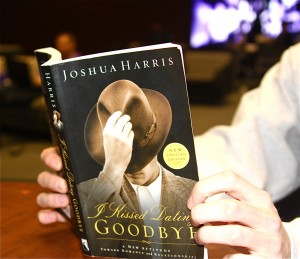
This idea of courtship was huge and fixated on sexual purity and emotional purity.  It grew huge after Joshua Harris’ book I Kiss Dating Goodbye and it was advocated at basically every homeschooling event and by most institutions.  Some groups formed solely for the purpose of educating people about courtship and Patrick Henry College (started by Michael Farris to train homeschoolers to be influential in Washington, D.C. politics).  ATI was huge about courtship, they even advocate betrothal!  That’s where the children have even less power in their romantic lives and the parents “pick” out a decent mate for them, then they are forced into a marriage because it’s “God’s will.”  Of course, only fathers, and occasionally mothers, know God’s will

So commitment in my romantic relationships was usually propelled by the guilt of needing to be in a “courtship.”  Of course, you aren’t supposed to court until the man is financially able to support a woman, which meant I was supposed to avoid romantic relationships til my mid-20s.  This was unacceptable, so I just engaged in quasi-courtship with three different girls through high school – sort of promising to marry them all, planning our lives and futures together, and then usually they broke up with me because God told them to (though I was an ass).

I remember I would form a lot of what would become my identity on the car rides home from something.  My truck became my only escape on a daily basis – with my truck came the first time in my life I had literal freedom.  I could go where I wanted, when I wanted.  That freedom usually provoked thoughts and I would work big issues like courtship in my mind listening to music.  I’m always amazed at how my parents will dismiss me-me and try to guilt and shame parent-me out of the shell.  De-construction and re-construction your identity is not easy and my parents always acted like it was fun for me to rebel.  Yes, when I was a teenager it was fun to let the immature me-me out for a joy ride, only to be clamped down on and repressed.  But that excitement ended in college.  I slowly came to a peace about myself that did not depend on my parents, or their affection.  Finding the me-me was one thing, but synthesizing that into my emotions was much more difficult.

I say all this to try and explain both of the versions of myself.  I can be parent-me, I can turn it on, and turn off my own desires and personality.  It took years for me to even find out what me-me wanted from life and I found a tremendous peace when I discovered my desires and not my parents’.  Throughout college, I would go home and I would let a little more of me-me come out – it was a very slow “coming out,” to borrow a phrase.  I admitted to smoking tobacco.  That I wasn’t a libertarian anymore, I was a liberal – lots of these involved political discussions where my parents felt almost as betrayed that I no longer shared their political beliefs than if I had renounced the faith.  I never did renounce Christianity, only the corrupt vessel of the Christian church.  Admitting I was dating took awhile – I just recently admitted I believed in evolution.  Usually, each admission of the me-me ended in a fight or conflict.  Even in college, they could not let go.

When I first started dating my wife, I asked if she could stay the night in my parent’s house because I needed a ride back to school.  My father said he wasn’t comfortable with that because it would give my younger sister a bad example of “serial dating.  To put this in perspective, this would be the second girl I brought home to my family ever.  I said that I was really serious about this girl and if they chose to act like this, I would tell my girlfriend, and I would understand if she didn’t want my children around them.  This sobered them up quickly and they agreed to let her stay.  But it demonstrates the types of conflicts that would occur when me-me contradicted parent-me.

When my parents manage to convince me to attend their church, my mom always expects me to sing.  My mother and I spent a lot of time bonding in the church choir when I was younger, so she expects me to find the same joy in it now as I did then.  It simply does not work like that.  Me-me does not enjoy church because it reminds me of all the negative feelings of guilt, shame, and intense pressure to be good.  These days when it comes to spirituality, me-me cannot compromise.

Even now that I am married, my parents still want and expect parent-me.  I don’t like the same things, I’m not the same person, and when they laugh and reminisce about the great times they had with parent-me, I can’t help but feel uneasy inside.  They reminisce for parent-me because they know they may never see him again.  They still try to draw on the guilt and shame they instill in me by saying things like “that’s not what we wanted for your life.”  Or telling me the consequences of my sins, then questioning why I don’t think certain things are sins.  When they pressure me-me to revert to parent-me, I get angry, defensive, and emotional.  So I just stop expecting anything, sharing anything, being vulnerable.  I don’t want parent-me for my life – that should mean something.  And I don’t take spiritual advice from cultists.

To be continued.

Burn In Case Of Evil: Cain’s Story, Part One

Burn In Case Of Evil: Cain’s Story, Part One

HA note: The author’s name has been changed to ensure anonymity. “Cain” is a pseudonym.

*****

In this series: Part One | Part Two | Part Three | Part Four

*****

Religious fanatics simply ruin children.

"Evil rock and roll saved my life."
“Evil rock and roll saved my life.”

The quaint, happy, innocent life of a child can quickly be replaced by the stark absolutes of fanaticism. Muslim, Christian, and Jew are one in the same monster. Their fanatics take different names, they act in different ways, but they are all the same.  Fanatics know no middle ground.  They know no compromise – other than our mutual destruction. Bill Gothard turned my parents cultists and they focused all their energies “training up” a perfect son. My parents attended an Institute of Basic Life Principles conference and eventually joined ATI, Gothard’s homeschooling cult.  I remember my mom coming in to tell me we were going to burn some things to remove the evil:

“Honey, your father and I have decided to make some changes around the house.  We’re going to stop getting cable and we’re going to get rid of some of our things.”

“Ok, mommy. What are we getting rid of?”

“We are going to get rid of our evil books,” she said.

I had never thought a book could be evil. But I certainly wanted to get rid of all the evil books we had! My parents explained that we would be burning books, movies, and records. 

 “Of course, mommy!  I’ll look through my books right now!”

There was only one book that stuck out to me as especially “evil.” I can’t recall the exact title, but I remember that the title had something to do with the devil. Of course, it was really just about a submarine voyage, or maybe some Moby Dick variation. It was part of a compilation, so my mother said we didn’t have to burn the whole book, maybe just the title page. Not many people have experienced a book burning, I must say. I guess that makes me special?

Children are so impressionable. In retrospect, most everything I was taught was ridiculous and mostly untrue. Rock and roll was not invented by the devil, or even just by the “evil Africans” who brought over their “demon beats” in an attempt to corrupt America. But what child is going to risk being possessed by demons just because they listen to rock music? I certainly wasn’t. It was easy for others to convince me I needed to proselytize, pass out tracts, and otherwise make myself a general asshole. My adolescence was little more than a protracted church service.  When you’re homeschooled, the son of fanatics, and not allowed to even go in the neighbor-children’s houses, it’s difficult to think for yourself. I was always a well-mannered, funny kid, so I had friends, but I was beyond sheltered. 

I always felt that “normal kids” had it so easy. I envied the kids that attended private school and my parents would not let me attend a school outside of our home. Of course, I did not envy the public school kids, because I was told that they were being brainwashed by a communistic system and God was being forced out. Before I became involved in NCFCA (a Christian, homeschool speech and debate league), I was a huge sports nut and I always craved the camaraderie and friendship of the people on my team. My parents did not allow me to go into my neighbor’s houses because I might see some television – yes, I am being serious. 

Without the internet, without Wikipedia, or without message boards, it’s possible that I would be a mindless, fanatical robot. But, for a sheltered child with very little contact with the outside world, the internet is like heaven. Unfortunately, that internet usage was limited by firewalls, parental filters, and the like. However, Wikipedia was never blocked, nor was peer-to-peer downloading. Most children without sex-ed are left to flipping through encyclopedias and dictionaries to discover sexual issues. I knew the very basics from my parents, but they never cared to elaborate. I was taught that AIDS was a GAY DISEASE, that gay people received from being gay. I was taught that if I had more than one sexual partner, I would most likely get an STD. Reading studies, normal people’s thoughts, and seeing that my parents were crazy about just about everything helped me grow up a lot. 

The internet was my trail-guide on the trip to knowledge and enlightenment. When you hear of the 18th century “Enlightenment,” some people might think that term is a bit ostentatious, but I disagree. There is nothing like the pure bliss of understanding the truth. Indeed, to cut through the bullshit that the powers-that-be throw at you on a daily basis. To rise above the propaganda. To cut through the paranoia. Some people call me arrogant, and I suppose I can come across that way. But really, I just want to share my enlightenment. 

The strangest feeling is after your enlightenment, when you return home. My relatives had served in the military, been “around the block,” and refused to believe that my college education gave me any insight into the truth. To my reborn self, everything in my parent’s home became a symbol of my oppression and repression – all the books, the magazines, the religious rituals before mealtime, and the constant use of Biblical allusions in conversation. Every conversation with them eventually comes to a head with their religious beliefs – a black and white world.  Every time I asked them for advice, I don’t get just a normal answer with life advice. It’s all about God’s will, his plan, his desires. 

For the longest time, I could not even admit to my parents that I believed evolution was true. It took me three years to work up the courage to tell them that. I knew it would upset them because they spent so much time indoctrinating me about creationism. When we get into arguments and they start breaking out Bible verses and condemnation, I have an uncontrollable physical reaction. So many arguments in high school, which usually involved them telling me to stop talking to a girl that I really liked, ended with me feeling trapped and isolated. On one occasion, at the age of fifteen, my parents made me call the girl I’d secretly been IM’ing (because I wasn’t allowed to talk to girls over email or IM and they caught me) and break up with her. Then they sentenced me to a month of solitary confinement – I was banned from talking and hanging out with any of my friends. I could attend the weekly speech class held in our home, but that was it. I was stuck in my parents’ house, trapped by their ideologies, with no one to talk to. As you can imagine, that’s a lot for a 15 year old to handle. 

Essentially, I was imprisoned and the people who put me in there were constantly there with me. I couldn’t go to school every day and get that escape and that’s all I wanted. My only escape was a Sony Walkman that included an FM radio. I remember laying in my water bed, with my headphones in, tears streaming down my cheeks. I don’t know exactly what emotion I was feeling at the time. I don’t know if there’s any worse feeling than being forced to not speak to the one girl who loves you and listens to you. Sure, I was only 15 and I wasn’t going to marry the girl, but why be a bitch about it, mom and dad? I knew my dad kept many handguns in his room and plenty of ammo. At the time, I was in total desperation. I couldn’t tell anyone about how I was feeling, not even my guy friends. This left the thoughts and feelings to run laps around my brain, never stopping. The only way I felt like I could be whole again was to kill myself.

Translucent, I wonder the halls,

In search of companion,

In search of purpose,

Cannot gain traction.

Reaching out, my hand passes through,

All the bodies,

All the walls,

Everything.

Ironically, that’s when evil rock and roll saved my life. I don’t know if I would have actually killed myself, but I was pretty damn close. The fact that I heard that specific song at just that time seemed absolutely divine. The girl I’d been forced to break up with and I both loved Green Day, especially the song Time of Your Life (Good Riddance). Thanks, Green Day. Their punk asses understood my teenage angst and told me that everything would be ok.  After this point, I decided I had to have privacy and I had to have an escape.

My laptop became my secret diary, if you will. It included all the instant messages I sent to the girls I wasn’t supposed to be talking to, all the movies I wasn’t supposed to download, and let’s not even mention all the evil rock and roll I wasn’t supposed to even own. As I said before, even my internet was covered with protections. If I ever visited a site that could be considered related to drugs, sex, nudity, anarchism, or full of profanity, my parents would receive an email telling them exactly where I went. The internet was also set to go off at 10pm. This was pretty shitty since all my girlfriends were long-distance (you just try to date someone who lives in the same city when your parents track your every move). I found a way to circumvent the Evil Firewall and talked to my girls on AIM or Gtalk. 

I dove headfirst into books, films, and music. I wanted to learn about these beautiful expressions of self that touched me so dearly. I read books about what good films were supposed to look like and my friends and I made our way down IMDB’s Top 250 Movies. I obsessively began to immerse myself in popular culture. I went 15 years not understanding movie references, pop songs, and TV shows. I know it seems petty, but when everyone is talking about their favorite band, something they saw on tv, it’s easy to feel excluded. Even the other homeschool kids could listen to rock music, but not me. But after that I didn’t care because I just wanted to be able to cultivate healthy relationships with people who liked me. 

To be continued.

homeskooled )q.e.d.): A Poem by Adam O’Connor

homeskooled )q.e.d.): A Poem by Adam O’Connor

*****

johnny asked a question

his momma couldn’t answer

billy popped a pill

he knew he couldn’t handle

then the dog got hit

while out runnin’ the street

that boy limped home

and he got a treat

so i woke up late

and left my bed unmade

so I could come home

to fall asleep again

some love too much

and others too little

but both

clip

and snip

what is held

most tender

cause the lesson

done took

much more

than it gave

so see

i dig me some

shallow graves

*****

adam
Adam O’Connor.

About Adam

Adam O’Connor’s homeschooling was, at first, sprinkled with other forms of education. Homeschooled for preschool, he then went on to attend public school for the first and second grades, private school for third, charter school for the fourth and fifth before finally returning to his homeschooling roots for the remaining years of primary education. His family joined CHEF, where he taught photography and tutored in English for his local chapter. In his sophomore year his family joined NCFCA and IBLP / ATI. He found himself a modest success at speech and debate and competed in the national tournament in his junior year. The year following his graduation he left with a small group as an ATI sponsored initiative to teach English in Yuli, a rural town in Hualien, Taiwan. It was during this year that the accumulated years of indoctrination and his otherwise ultra-conservative, hyper-religious mindset began to unravel and he soon found himself in a crisis of faith. Although it took much longer to fully realize the effects of this year, he lost his faith in Taiwan and came home unrecognized and at odds with the social circles he had spent his entire life thus far building. He spend the next year commuting to Nicholls until transferring to Louisiana Tech for nearly three more years, dropping out one quarter shy of graduation. He is now pursuing his writing, particularly poetry, and hosts the Secret Meetings of the Dinky Tao Poetry Hour, the second oldest reading in New Orleans, currently located at the Neutral Ground Coffee House. He has been seen reading at the 17 Poets at the Goldmine, the open mic at Buffa’s, and was featured at the Apple Barrel on Frenchman for the Book Fair in 2011. He is currently working on his first book of poetry, entitled “…till the moon howls back”.

Visit his poetry blog here.

The Bonfire Chorus: A Poem by Adam O’Connor

The Bonfire Chorus: A Poem by Adam O’Connor

*****

I was born

with a mouthful of ash

from all the books

we had not yet burned;

drifted southward

off northern steppes

with the sulphiric taste of sin,

and shame,

and a hopeless hope

landing snowflake

on fiery tongues

shouting hallelujahs;

“hosanah,

“the son has come.”

When my father

took the clot of blood

from my hand,

he gave me a shovel and a torch

and joined the bonfire chorus

to sing blasphemous refrains:

“Follow us down

         “to the swinging trees,

      “and we can show you

          “where the saviors be.

     “And mark where

           “the tapping crow flies,

      “and he can show you

            “where your brother lies.”

So now it is time again,

and again time has come again,

the time to burn and bury–

The Mongols will ride again!

The Mongols will ride again!

and burn all the words again,

and bury the broken images again.

And the dust

shaken from history’s march

will land snowflake

on parched lips,

cracking with their smiles

and singing,

“hallelujah,

“hallelujah,

“let’s do it all again”.

*****

adam
Adam O’Connor.

“The Bonfire Chorus,” about O’Connor’s experiences with book burning as a child in ATI, was originally published on his poetry blog here. It is reprinted with his permission.

About Adam

Adam O’Connor’s homeschooling was, at first, sprinkled with other forms of education. Homeschooled for preschool, he then went on to attend public school for the first and second grades, private school for third, charter school for the fourth and fifth before finally returning to his homeschooling roots for the remaining years of primary education. His family joined CHEF, where he taught photography and tutored in English for his local chapter. In his sophomore year his family joined NCFCA and IBLP / ATI. He found himself a modest success at speech and debate and competed in the national tournament in his junior year. The year following his graduation he left with a small group as an ATI sponsored initiative to teach English in Yuli, a rural town in Hualien, Taiwan. It was during this year that the accumulated years of indoctrination and his otherwise ultra-conservative, hyper-religious mindset began to unravel and he soon found himself in a crisis of faith. Although it took much longer to fully realize the effects of this year, he lost his faith in Taiwan and came home unrecognized and at odds with the social circles he had spent his entire life thus far building. He spend the next year commuting to Nicholls until transferring to Louisiana Tech for nearly three more years, dropping out one quarter shy of graduation. He is now pursuing his writing, particularly poetry, and hosts the Secret Meetings of the Dinky Tao Poetry Hour, the second oldest reading in New Orleans, currently located at the Neutral Ground Coffee House. He has been seen reading at the 17 Poets at the Goldmine, the open mic at Buffa’s, and was featured at the Apple Barrel on Frenchman for the Book Fair in 2011. He is currently working on his first book of poetry, entitled “…till the moon howls back”.