Possibly over half a million American women obediently serve their parents’ households, locked in a perpetual childhood, with no means of escape.
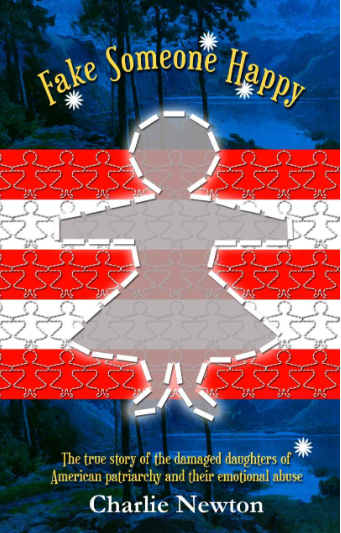
Charlie Newton’s “Fake Someone Happy” is about a young English musician who accidentally becomes entangled in the American Patriarchy movement.
Call it the Quiverfull Movement, Christian Patriarchy, the Stay at Home Daughter Movement, or Reconstructionism — that’s as close as you’ll get to giving it a name. Adherents simply call it ‘obeying God’ or, even, ‘loving God’. What it is at essence is the modern American denial of women’s humanity, the entire deprivation of her rights, the erasure of her personality. And it’s vividly portrayed Charlie Newton’s recent non-fictional, anonymized short novel, ‘Fake Someone Happy’.
The story is about a young English musician who accidentally becomes entangled in the American Patriarchy movement. What begins as a joyful immersion into a community of loving, picture-perfect families devolves into an horrific submersion into a world of exploitation, coercion, and betrayal which challenges the heroine’s understanding of friendship, the world, and herself.
I highly recommend this book as a window into the world of American Christian Patriarchy.
As a survivor of this subculture, I can vouch for the accuracy of the depiction. In fact, this world and the plight of its survivors is rarely depicted in such vivid detail. Some might nit-pick at the fact that the writing does not constitute a literary masterpiece; however, the author has achieved the significant triumph of transporting her readers to this vast, hidden, and rarely-depicted dark world.
I do have some reservations about the book’s depiction of a survivor after her escape. The heroine’s unfamiliarity with the psychology of second-generation cult members and American Christian cultural norms manifests in understandable frustration which, however, the author fails to resolve. My suggestion to readers is to read this book in combination with others that delve deeper into the psychology of survivors of Christian Patriarchy and their journey of recovery, healing and growth.
To that end, I recommend the following books:
Quivering Daughters, by Hillary McFarland — The story of the exploitation of a daughter of Christian Patriarchy and her theological journey to empowerment and freedom.
Pilgrim’s Wilderness, by Tom Kizzia — A journalist’s masterfully written and insightful account of a Patriarchal family with subjugated adult children which moves to the Alaskan wilderness, with an excellent treatment of the psychology of captivity and escape.
Quiverfull, by Katherine Joyce — A rigorous investigation of the modern Patriarchy/Quiverfull movement.
HA note: The following is reprinted with permission from Julie Anne Smith’s blog Spiritual Sounding Board. It was originally published on October 15, 2013 with the title “Are Daughters the Biggest Threat to the Christian Patriarchy Movement and Reconstructionism?”
Whether they say it publicly or not, I believe that Christian leaders in the Reconstructionist and Homeschool Movements view adult daughters to be the biggest threat to their agenda in furthering their ideologies.
In this video trailer of The Return of the Daughters, you can hear the urgency of this movement, the fear-mongering blaming the feminists as the primary cause of the destruction of the idolized godly family image.
Stay-at-home daughters — it’s a matter of choice
I want to be clear what my beef is with this movement.
It is not the idea of daughters staying at home if they choose to stay at home. It’s about an adult daughter not being allowed to make choices for herself. It’s the idea that if daughters don’t stay at home under their father’s “protection,” they are not being biblical – that the only right way is if a daughter has her father’s blessing on all of her choices, including marriage – and that marriage is very selective as the father wants to make sure that his future son-in-law holds to the same Patriarchal beliefs as he.
I am sick and tired of the implication that young ladies who go to college are trying to perpetuate the feminist agenda and destroy families, simply for making the adult choice to further their education.
In studying the patterns of abuse in churches, the control tactics the proponents of this movement use are similar.
Why does this issue have to be so black and white? Because it’s about control. We see love-bombing of daughters, building her up in her femininity, her homemaking skills, but there is no allowance for an adult daughter to question of authority, to have differing viewpoints, to have a mind of her own.
If adult daughters are not sold on the concept of first being comfortable at being stay-at-home daughters, and then stay-at-home moms, the authoritarian position of the Patriarch, and thus, the entire Movement, is diminished. Any diminishing of their role as Patriarch by a daughter challenging or questioning them would be looked at as disobedience and sin and divisive, just as in spiritual abuse patterns, any questioning of a pastor’s authority would be labeled as divisive. Do you see the parallels?
Their ideology is that husbands will be spiritual heads of the home, will rule over their wives and families and wives will humbly submit without question to everything they say. They will be reproducing babies and raising them with the same ideologies: boys will grow up to be men and heads of households and will rule their families spiritually. Daughters will grow up and embrace their “biblical role” as submissive wives/mothers.
But ask these folks what happens when abuse enters the picture?
Does the wife and children get support? Or what about a death of a husband or disability or unemployment? Does the church assist these families in real and practical ways? Or is the family abandoned and the wife accused of sin when she attempts to earn income for her impoverished and broken family?
…O, treason of the blood! Fathers, from hence trust not your daughters’ minds By what you see them act. ~ Othello
Daughters who are allowed to think for themselves, make their own choices, are viewed as a threat
It is my belief that daughters who go against this system, who go to college, learn how to think for themselves, are viewed as a threat. It is wrong to challenge, to question, undermine, speak out against this destructive movement.
I’m certain that Patriarchs know this real threat and that is why we are seeing so much building up daughters positively by glorifying the godly wife role and encouraging the relationships with fathers and daughters.
Patriarchal fathers must win their daughter’s heart at a very young age, win her approval and trust, in order to successfully perpetuate this cycle.
I am now convinced that for many Patriarchs, the agenda is not to honestly build the relationship between the father and daughter. Rather, fathers are using their daughters to instill in them what they believe to be the godly ideology and sell the daughters on their role in continuing and supporting this ideology. This is accomplished through purity balls, purity covenants, books, videos, conferences or retreats like this:
God’s Word speaks volumes to the relationship between fathers and daughters: His most sacred duty is her protection and preservation from childhood to virtuous womanhood. He leads her, woos her, and wins her with a tenderness and affection unique to the bonds of father and daughter. Success in his life mission is directly related to the seriousness and compassion with which he seeks to raise her as an industrious, family-affirming, children-loving woman of God.
She, in turn, looks to her father as a loving picture of leadership, of devotion, and of care. Her relationship with her father will help to define her view of the worth of a woman, the meaning of fulfillment and contentment, and her vision for virtue. When these relationships are realized and cultivated, the generational mission of the Christian family is secure.
Is it any wonder that Satan is on the prowl seeking to tear the hearts of daughters from their fathers, and driving wedges of indifference between them — fathers with no time for their little girls, and young ladies who have replaced the love of their fathers with the acceptance of peers and inappropriate romantic relationships? The Vision Forum Ministries Father & Daughter Retreat is one step on the journey of recovering the preciousness of this relationship so crucial to the kingdom-building work of the Church. (from Father & Daughter Retreated Sponsored by Vision Forum)
Sadly, I also think that some fathers are unknowingly climbing aboard this fast train of destruction.
They don’t understand the system in which they are caught.
They believe what they are doing is good for their families and daughters and don’t understand the price it will have on their family. It really is not about a relationship for many. It is about an agenda.
As I have been following trends in the Homeschool Movement, what I am seeing is that those fathers who tightly control their daughters and their lives — do not allow them to have educational and work choices, do not allow them to make important life decisions, do not allow them to think for themselves spiritually or own their own faith — will likely lose their daughters in adulthood.
They may in fact lose a relationship with their daughters forever.
HA note: The following is reprinted with permission from Julie Anne Smith’s blog Spiritual Sounding Board. It was originally published on October 12, 2013 with the title “Homeschooled Adult Daughters Held Captive at Home, Prevented from Getting College Education.”
*****
“There are too many homeschooled girls who need help overcoming the legal obstacles their parents put in their path to a college education. It also bothers me that the leaders of the Christian homeschooling movement preach that young girls shouldn’t get a ‘regular’ education – that they should only be trained in domestic arts and ‘female’ tasks.”
In an effort to “raise up a child in the way they should go,” some Christian homeschool parents are essentially kidnapping their daughters, only teaching “homemaking” skills, even denying and preventing them from getting a college education.
The father is involved in all aspects of his adult daughter’s lives until marriage.
Earlier this week, my young friend, Nicholas Ducote, co-founder of Homeschoolers Anonymous, wrote something that resonated with me. It hit me hard because this was a path our family was heading down. He was writing about the plight he has seen among a number of young ladies who are part of the “Homeschool Movement,” the subculture of fundamentalist Christians who adhere to the Patriarchal lifestyle in which the father is very involved in all aspects of his adult daughters’ lives, even through adulthood until they are married — married to a husband approved by the father.
Nick, a former homeschool student, has earned his Master’s degree. He knows the challenges he faced in getting his degrees. But it struck me how Nick was clearly upset about the injustices he saw facing his female homeschool peers.
In the Homeschool Movement, this educational imbalance among the sexes is not perceived as an injustice whatsoever. In fact, to even think of sending an adult daughter “off to school,” is to some, heretical. As recent as a month ago, a homeschool mom and friend of mine posted on Facebook that her adult daughters would not be going to college — that she and her husband “just don’t believe in that.”
It makes me wonder: did her parents make all of her decisions when she became an adult? Probably not.
Here is a screenshot I saved from a homeschool wives group on Facebook several months ago and you can see the similar mindset:
I used to believe this way.
In the Homeschool Movement, I was taught to believe that if we sent our daughters off to college, they would want to use that education, get a job, might even earn more money than their husbands. This was “not right” because husbands were supposed to be the breadwinners and mothers were to be busy at home with the children. They claimed this was all the work of feminists and the feminist influence on society was breaking up families and demeaning men.
Feminism was the cause of the moral decay in society.
I’ve been a homemaker for nearly 27 years. I have loved staying home with the children. It is wonderful for mom to stay home with her children. But is it the only way? Is it always possible? Is it really all that black and white as “they” portray it to be? Can we have decent families in which a mom works part-time?
Leaders in the Homeschool Movement spend an exorbitant amount of time selling their rhetoric in words and in materials (books, videos, blog articles) sharing what they believe to be the ultimate role of women as homemaker: how to be respectful and submissive wives, how to cook, sew, how to raise children, etc.
If you are a young girl raised in this environment, your know your lot in life is: get married to your approved husband, have many children, teach your children at home, and hopefully, your children will do the same.
It is important to note the basis of this ideology. The ultimate goal in the Homeschool Movement is to be fruitful and multiply and “take dominion” of the world. Dominionism and Reconstructionism are foundational roots from which everything in the movement is cultivated.
Nick then discussed a young lady who has been in the spotlight lately, Malala. If you are unfamiliar with Malala, I encourage you to read about this courageous young lady who is making her voice be heard in a country where women’s voices are squelched.
“Malala Yousafzai is a Pakistani school pupil and education activist from the town of Mingora in the Swat District of Pakistan’s northwestern Khyber Pakhtunkhwa province. She is known for her activism for rights to education and for women, especially in the Swat Valley, where the Taliban had at times banned girls from attending school. (Source)
Here is a video Nick included of Malala. The Taliban tried to assassinate this young lady because of her powerful voice and she survived and her voice is even stronger and now has international attention. Please listen to this amazing interview.
Nick writes:
What is especially disturbing is when you hear Malala talk about how the Taliban in the Swat Valley of Pakistan wants to take education away from girls. You would hope, in the 21st century, young women would have basic access to education.
I will be loud and proud about my homeschooling advocacy because my heart is broken on a regular basis when homeschooled teenagers trapped in fundamentalism contact me trapped, struggling to assert themselves and pursue the future they want. Sometimes parents deny FAFSA signatures, or they edit their transcript if they apply to an “unapproved” school. I have talked to homeschooled girls who were literally trafficked (for sex and for labor).
Some homeschooled adult daughters fare no better than Pakistani young ladies when it comes to education.
Nick is right. We expect this kind of thing in Pakistan, but not in the US. Some of these young ladies who have officially graduated from their homeschool high school are not allowed to even choose whether they go to college or not. College is simply not allowed. They are destined to be a “stay-at-home-daughter,” serving parents, helping with the remaining children at home, help with cooking, cleaning around the house, etc.
In the United States of America, we have young female adults — I said adults — who are living at the home of their Christian homeschooling parents, unable to make adult decisions of where they can live, where they can go to school, who they can be friends with, where they go on the internet, etc. They are essentially forced to follow the path of their parents. They are cut off from the outside because their internet use, cell phone use is highly monitored.
Now some of these young ladies go along with this without any dissension. This is the only life they’ve ever known. They have been sheltered from the “world” or society. Their friends are people from church, from homeschool groups, etc.
This is their norm.
Some may do fine with this. They will allow their parents to help select a husband for them, get married, have babies and continue living the legacy their parents planned for them.
However, there are other young ladies who want to explore life outside of the life and rule of their parents. They want the opportunity to go to school and further their education. But they are not allowed this opportunity. They are prevented. How can this be? In this day and age?
These parents hold the keys to their adult daughters’ freedom. They are the ones who decide whether they will turn over their signed homeschool high school transcript. They are the ones who must sign and turn over info for FAFSA documentation for financial aid. They decide whether their daughters can get a driver’s license, work outside the home, etc.
In the United States of America, there are young ladies held against their will in their parents’ homes and they are trapped.
They don’t know where to go. They don’t know how to escape. They don’t know how to get schooling. They are completely isolated.
I am a member of the family
I am a member of the housework crew
I am my parent’s possession
I am their trophy
I am a representative for Christ
I am a future mother in a future family preparing to serve a future husband
I am not an individual.
Feelings are superfluous, needs are selfishness, I do not know the vocabulary of self.
I am depressed overly dramatic
I am hungry gluttonous
I am tired and overworked lazy
I am sick weak
I have anxiety lack faith
I need affirmation whine too much
I need privacy am selfish
I need to be respected punished
I do not deserve to have needs.
So I take tweezers and tear a blade out of my father’s razor. And I keep the razor in a tiny jewelry box that my grandma gave me, under the cotton, because nobody can see it, because using it is selfish, and I am ashamed. But nothing compares to the relief of sliding the blade across the soft parts of my thighs, my calves, my ankles, my wrists.
Simultaneously punishing myself and expressing my hurt.
People deserve love
people deserve support
people deserve respect
But I don’t know these things
Because I am not an individual
I am not a person
I do not know the vocabulary of self.
My first year in high school was wonderful for me. Finally, I was out of the house! I made friends and felt like I could finally breathe. I won’t go into great detail about my high school experience, since that isn’t the point of this story. However, I will point out a few things that I noticed over those four years:
• I discovered that I had a real problem with social anxiety. I’m not sure if this is hereditary or caused by my childhood. After reading some of the stories on this site, I’m thinking that it was a little of both.
• I was plagued by feelings of inadequacy. I thought I was not good enough, smart enough, athletic enough, witty enough… none of it. I did come to the realization that there are things that I’m good at, but it took years. In high school, I wound up trying everything since I had no idea where I fit in – I’d never had other kids around for me to gauge my own ability.
• I was plagued by guilt. Even if I hadn’t done anything wrong, I was often overcome by guilt over my (imagined and real) transgressions. This tied a lot into the messages we were receiving at church, which at this point were downright toxic.
• I had little-to-no self-confidence. As a homeschooler, you become so used to your parents’ authority, that you don’t really know how to make your own decisions, or when you do, you constantly second guess yourself.
So while getting out of the house was a welcome relief, I still felt like I was trying to overcome my upbringing.
At Home – Part 2
While I was off enjoying my high school experience, the “shit was hitting the fan” at home… oh, and how! My oldest younger sister had started hanging out with this girl she met at the homeschooling coop, and they decided they weren’t going to let being at home slow them down. I noticed one night that my sister and this girl, who was sleeping over, were acting really strange and goofy. Turns out, they were drunk! But how did they get the alcohol? After all, my parents didn’t drink. I later learned that my 12-year-old, shy-as-can-be sister stole it from a convenience store!
For my little sister, this would kick off what would become a six year blur of cigarettes, alcohol, promiscuous sex, drugs, and whatever else. To this day, I am convinced that the combination of home schooling and extreme Christian Fundamentalism destroyed her confidence. I remember her telling me, at 11, that she had given up and could never live up to the standard — I really think that she cracked under the pressure of that atmosphere.
She got pregnant at 17, got married, moved out, and hasn’t had issues with drugs or alcohol since. She and her husband now have 5 kids, all of whom are in public school, and her oldest daughter (13) is an exemplary student. All of her kids appear to be doing well.
Because of my sister’s meltdowns, I ended up getting away with a lot that I probably wouldn’t have otherwise. So in a roundabout way, I owe her a “thanks” for taking the pressure off me and humbling our parents. I did take advantage of her recklessness and flew under the radar as I started drinking at 15.
College
The drinking continued on into college. I could never shake the idea that I wasn’t good enough and that I was in a perpetual state of sin, so the alcohol helped me to ease the anxiety and mentally “check out” for long periods of time.
Then I’d get sober, feel horrible, and go cry to my Christian friends about how I was going to hell. My secular friends would shake their heads and wonder why I was so conflicted. This pattern continued until I got sober at about 26 years old.
Other things happened in college as well. My drinking habits combined with my lack of any sort of sex education made me a sitting duck when it came to STDs and unexpected pregnancy.
But despite all that, I managed to graduate.
Adulthood
Today, I don’t harbor any resentment over my upbringing, as I realize it could have been a whole lot worse! There were actually several good things that came out of it:
• Since much of my learning was from reading books and not in the classrooms, I’m very good at figuring things out on my own. This has been a very beneficial skill to have as an IT specialist.
• I don’t mind being alone. This is something I’m starting to see as a blessing. During my four year marriage (yes… I’m divorced) I was miserable most of the time. I always had to come home to a spouse who was either angry with me or trying to drag me to some function that I didn’t really feel like attending. Once I realized that marriage is not for me, I’ve been able to enjoy being a single dad, making my own way. Since as a kid, I often went out and about to do things on my own, it isn’t really much of an adjustment to do things and go places on my own today. I don’t need a large social circle.
• I’ve seen the damage that religious extremism causes and I can spot the warning signs a mile away. While I still attend church, it’s a seeker-sensitive, theology-lite congregation that just loves everyone. I take my kids on the weekends when I have them, but I don’t preach at them. Their faith is between them and God. I expect them to make mistakes and refuse to hold them to a higher standard than the one I hold for myself. I have no idea if God is real or if the Bible is completely true. If he is and his word is true, then I’m sure he’ll get my attention one way or another. But after years of unanswered prayers, a failed marriage, kids from multiple relationships, and alcoholism, I find it hard to believe that he is actively involved in our lives.
• I witnessed first-hand the despair and hopelessness of many disillusioned homeschooling parents. These are people who, by and large, poured their hearts and souls into raising Godly men and women. Seeing this convinced me that it’s best to adopt a “live and let live” parenting model and to love your children unconditionally! Even if my son winds up marching in the local gay pride parade with his boyfriend and my daughter ends up working overtime at the Diamond Club, I will still love them and welcome them in my home with open arms. Life is too short for fallouts over lifestyle choices.
Summary
Homeschooling was really just one piece of the whole dysfunctional puzzle. I’m sure that if other factors had been different, but I was still homeschooled, I might feel differently about it than I do now. That said, it is very encouraging to read accounts from other homeschoolers to confirm that many of my experiences are shared by others.



 Homeschoolers Anonymous