The Story of an Ex-Good Girl: Part Nine

Barn

HA Note: The following is reprinted with permission from Exgoodgirl’s blog The Travels and Travails of an Ex-Good Girl. It was originally published on August 21, 2014 and has been slightly modified for HA.

<Part Eight

Part Nine: Smile

I was reading an article about the Duggars this morning.  People were commenting about how “happy” the children were and how that was evidence of a healthy, well-balanced upbringing.  It reminded me of my own upbringing and how “happy” we always looked…to outsiders.

This was because we followed one of the cardinal rules of Godly Christians (as defined by Mr. LaQuiere).  You may not know this rule, because, poor you, you probably grew up without the benefit of Mr. LaQuiere’s Super-Christianity, so I’ll just tell you right now what it is: ALWAYS SMILE!  This is because the only godly facial expression is a smile.  It’s true that there are multiple godly emotions… happiness… gratefulness… sorrow over your sin… but they can pretty much be covered with the one facial expression (some lenience can be given for the “sorrow” category, but only if it’s the right kind of sorrow).

Not only is a smile important because it portrays our proper gratefulness to God for all our blessings, and because it provides a “good witness” for God, and our parents, and godly large families, and homeschoolers, all of whom we represent…but it’s a way to change how you feel on the inside!

I’ll show you what I mean.  The following was written by the mom of the K family I mentioned earlier, who has her own website (www.raisinggodlytomatoes.com) and book about raising godly children (it’s not a gardening book, though gardening can also be a godly activity, if done correctly):

THE OUTSIDE REFLECTS THE INSIDE

One cherished, but highly erroneous belief is that a parent should not correct a child for displaying a wrong emotion, because the child will “suppress” the emotion rather than change it. Experience convinces me otherwise. Require young children to display the right emotions outwardly and their hearts will change, producing the right attitudes and emotions inwardly as well.

Of course you can’t simply order your children to “be happy”. If the child is small, it works much better to tell him to “smile” or “straighten up your face.” If the child is very young, I’ll cheerfully say, “Let’s see a smile now”, or “Where is your smile?”

The child may initially resist, but when he finally obeys, the resulting smile will often break into a radiant grin, accompanied by sincere laughter and other expressions of genuine joy. It is hard for a small child to hide his true feelings. It is equally difficult for him to display an emotion that he does not really feel. Get him to smile on the outside and invariably he will smile on the inside.

A joyful heart makes a cheerful face, but when the heart is sad, the spirit is broken.  Proverbs 15:13

(excerpt from http://www.raisinggodlytomatoes.com/ch09.php)

So, to recap, in order to avoid showing the “wrong” emotions, if you require your small children (and the rest of them too) to “smile on the outside”, you will change their hearts and get them to have the “right” emotions and attitudes instead.  Also notice the verse at the bottom, which clinches it: if you have a joyful heart, you’ll have a joyful face! (This may sound somewhat different from the lesson “if you have a joyful face, you’ll have a joyful heart”, but that’s just semantics.  Don’t be so nit-picky, for gosh sakes!)

You can easily see that smiling is the first line of defense against all attitude problems.

Smiling will change your heart – smiling will make you happy – smiling will help you be godly!

This necessity to smile was tacked on to most requirements: instant obedience…with a smile!  Do your chores… with a smile!  Finish being spanked… now smile!

You can see how “smiling” and “looking happy” becomes the necessary mask that all children raised in this belief system must wear.  (The Duggars also follow this, by the way – read up on Bill Gothard’s ATI character-training program, which they are a part of, and you’ll find plenty about having a “bright countenance”, and how looking unhappy is publicly shaming your parents/authorities.)  It’s not a choice, and it has nothing to do with how ‘happy’ they really are or aren’t.

The main problem I have with this type of training is that it not only separates all emotion into two categories of “good” or “bad” – but it also teaches children from the earliest possible ages to stuff their emotions.

This happened to me (to be fair, it was already happening to me to some extent before I met Mr. LaQuiere, because my dad was very anti-emotion…but it was reinforced and drilled home by the training I received from Mr. LaQuiere all through my formative years).  I learned that not only should I not ever express negative emotions like anger, or disappointment, or unhappiness, because they were sinful (unless it was, say, “righteous anger” – but somehow only our dads ever managed to feel this one, while disciplining us, go figure), but I learned how not to feel those negative emotions, disassociating myself from them for years.  This latter part wasn’t expressly taught to me, but being a smart kid, I figured it out on my own.  I taught myself to “think my way out of feeling”.  Any bad feeling I had, I thought through logically, analyzing it, until the feeling faded, and only the analysis remained.  I also discovered that if I held my breath, the overwhelming emotion would fade.  I trained myself to stay calm and not cry, or get angry this way.  I got so good at this that it became second-nature

Anytime something bad happened that would trigger a negative emotion, part of me would just “shut down” all by itself, and I felt…nothing.

Not happiness, not sadness, not anger…nothing at all.  It was like being in an alternate reality where no emotions existed.

I’ll touch more on this later, specifically on the journey God had to bring me through to learn to feel things again, but I’ll just say now that living emotion-free is not healthy for anyone, and especially for a child.  Emotions are sign-posts of what is going on beneath the surface.  Emotions tell us to look deeper and see what need is being missed.  Telling a child who you’ve just severely punished to smile…as tears stream down his face…does not teach him to have a joyful heart.

It teaches him to hide, even from himself, what he really feels, and who he really is.

If you don’t know what you really feel anymore, you lose your God-given signposts meant to alert you to danger.  Instead of a built-in-warning-system for unmet needs, or dangers to be avoided, you learn rigid control over your outward expressions, and you start to live on the surface only, without even realizing it.  But it makes it easier for parents to avoid difficult situations with their children…to avoid dealing with difficult emotions their children are experiencing…it makes parenting easy, because you only have to enforce a one-size-fits-all set of rules, not deal with the complexities of childhood and individual needs.  This is why I was told there was “nothing to be sad about” when I watched my brother being severely beaten, and told not to cry when Baby J was being suffocated in couch cushions.  I was taught to ignore my strong emotions that told me this was bad and wrong, and to put blind trust in my authorities instead, who told me it was right and good.  In retrospect, it’s little wonder I learned it was safer to divorce myself from emotions entirely.

I don’t smile as much today as I did back then, but when I do, at least it’s genuine!  And my children?  They cry, or feel grumpy, or are happy, without having their emotions prescribed for them and enforced through threats and punishment.

We’re working on learning parenting techniques together that affirm them for who they are, and address their needs, instead of placing their only value in being a “happy” advertisement for me or God.

I love when they smile!  But I will never tell them to.

Part Ten>

photo credit: Joel Dinda via photopin cc

Reflections of a Homeschool Graduate: Part Two

Homeschool

HA Note: The following is reprinted with permission from Kallie Culver’s blog Untold Stories. It was originally published on June 16, 2014 and has been slightly modified for HA.

<Part One

Homeschooling: The Girl Behind the Mask

For my family, homeschooling was both a calling my parents felt and a practical venture for a season. I am the only child, in my family of nine children, who was homeschooled from Kindergarten through 12th grade. My parents initially started homeschooling my older sister and I for practical reasons. At first it was because the Christian school my older sister attended did not have room for both of us the year I was supposed to enter – so, rather than put us into two different schools, my mom chose to school us at home that year.

At that time, we lived in California, where my father was completing his Master’s in Divinity with the Master’s Seminary under the leadership of John MacArthur. It was also during this time that my parents befriended and came under the mentorship of Gary and Ann Marie Ezzo, the founders of Growing Families International, the authors of the well- known parenting book Baby Wise, and subsequent parenting curriculum Growing Kids Gods Way. After graduating from seminary, my father took the position of Texas State Director for Growing Families International, which allowed us to move back home to our family ranch in the Texas panhandle. For the three years my father held that job, it required him and my mom to travel all over the state of Texas and to surrounding states for numerous leadership and parenting conferences, often on a weekly basis. Given how extensive their travel schedule was, my parents found that homeschooling was a practical choice to continue.

However, after my Father resigned from that position and settled into life at the ranch permanently, the decision to homeschool moved from just being a practical one to something my parents felt God was calling our family to continue. Some of my parents’ best friends in the area were already homeschooling as well, and through them we had discovered an active homeschool group in the Texas and Oklahoma panhandle area, known as the Santa Fe Trail Homeschool Association. We soon joined this group and met many family friends in the area who also homeschooled. Many of these families were also members of ATI, (Advanced Training Institute, under the leadership of Bill Gothard) so although we never officially joined ATI, we soon began to actively participate in several of their events, programs, and social networks. As we began to get more deeply involved with these homeschool circles, adopting the mindsets, teachings, social norms, and beliefs became second nature. The more time we spent and the deeper relationships we formed, the more natural it became.

Never for a moment did I ever think I would leave that community, much less question it, feel betrayed by it, or have aspects of it haunt me for years after I left it.

One of my greatest struggles in life stems from the fact that I have been a people pleaser from a young age. For a long time I believed my worth as a person and happiness in life were determined by the number of friends I had, making people happy, keeping the peace, and fitting in. I see now how that drive and belief affected everything about my young life. I can even see it intricately interwoven into my choice to adopt my family’s faith at eight years old.

For years, if someone asked me to put Jesus or my faith into one word – it was the word “Friend.” I remember, as a child, watching my friends and other members of my family go to the front of the church every first Sunday of the month for communion, but I was never allowed to go. So one Sunday when my father came back to the pew, I asked him, “Why can’t I take communion?” His response was that communion involved having a relationship with Jesus, and this was a way for those who wanted and lived out a relationship with Christ to remember Him and commune with Him. Of course he put that message in words that an eight year old would understand, but the heart of what I remember him saying was that you had to be friends with Jesus to take communion. That was something I could understand and was something I did not want to be left out of. So that day, right there in that pew I asked my dad if he could pray with me. In my simple understanding, I asked Jesus into my heart and to be my friend that would never leave me. That friendship is what I have clung to for years.

From then on, for many years, prayer for me was talking to my best friend. I could pray about whatever I was really feeling and I was never rejected or admonished for that. This is also what led to my first love for writing, as I began journaling at the age of nine, where I wrote to Jesus instead of in the common Dear Diary format. I have numerous journals saved in a box under my bed telling the saga of my childhood in letters to Jesus. That tradition stayed with me well into college, until I began to doubt whether even that friendship I trusted for so long would survive. Even then the journaling habit remained, while I just left the salutation off and continued writing in a conversation style wondering some days if the God I had been writing to for so long was really listening or had ever actually listened for that matter.

Through these years of being in a spiritual wilderness questioning everything, it has also been that foundational friendship that I keep coming back to. I know from both friends and others with similar backgrounds that, once they found the courage and were willing to strip away every aspect of their faith adopted because of family expectations, the community, a sense of obligation, or a lack of knowledge about any other alternative – for many there was nothing left. For those who have chosen to walk away from faith altogether, I value and respect them just as much as those who I know have wrestled to find new understandings of faith, because I know that, growing up the way we did, to make that decision is probably one of the hardest they will ever make. Choosing to hold up our beliefs to the light of truth and be deeply honest about what we can really stand behind with integrity is no small feat.

It would be so much easier in many cases to just be silent about how you really felt and keep up a mask for appearance’s sake. For me, when I strip everything away that I am holding onto just for loyalty, for loved ones, or for fear of the truth – I could never completely dismiss the relationship I have felt and built with God from a young age. It’s not for a lack of questioning the idea; it’s more that I know now, through countless sleepless nights wrestling over it with gut wrenching sobs, or laying there in the blackness with silent tears coursing down my cheeks, that despite all my confusion, my anger, my deepest fears, or my unanswered questions, I still can not deny that a relationship of a lifetime is there.

What makes me believe that? It’s not the numerous hours I spent in church, reading scripture, memorizing scripture, studying or debating doctrine, or living the quintessential Christian life. It’s the comfort I found as a child in believing I had a friend who actually cared. It’s the peace I grasped for as a teenager, who spent years hiding a paranoid fear of the dark and of rape. I can never forget the number of nights that I spent with a lamp on knowing that God was the only one listening and how prayer was often the only means for finding any sleep. It’s the faith and expression of God my husband saw in me that I couldn’t even see myself. Even though my faith and how I daily experience a relationship with God have changed, and even though there have been many days questioning its very existence – I know it is still there. Christ’s life still draws me with his exemplary compassion to serve and love people around him. There is a mystery, a silence, a peace, a love, and a source of life beyond me that still beckons me to rediscover faith on my own.

When it comes to honestly evaluating my thoughts, feelings, beliefs, and experiences concerning homeschooling, however, I see now that it was a perfect mask. It was a place where my people-pleasing personality, self-doubt, and self-hatred made me readily embrace the more legalistic homeschooling culture I was surrounded by.

I was twelve when I attended my first ATI Basic Seminar, and I went home vowing to never listen to music with a drum beat in it and to memorize all of Romans 6, 7, and 8. Next came the Advanced Seminar, followed by the Anger Resolution Seminar, both of which I came home from with lists of notes and new resolutions to follow. It frustrated me to no end at the time that my dad would never commit to actually joining ATI, and so I did my best to be a loyal follower without actually being a member. My sister and I excitedly signed up for the King’s Daughter Magazine, which we looked forward to every month to read about other girls out there living just like us learning how to be godly young women preparing to be godly wives and mothers.

I lived and breathed teachings on purity, modesty, and courtship, making sure I was a pristine example with every outfit, action, word, and thought. I watched the Character First! videos countless times, memorized the poems and songs, learned how to play them on the piano, and began to dream of the day I could go to a training center to teach it myself. That dream would later come true when I was seventeen and moved to the Oklahoma City ATI Training Center for my spring semester to work with the Character First team. The list of experiences I had and the norms I adopted are too many to list.

So what began as a lifestyle and calling for my parents, for me became a lifestyle and mantra of my own.

Homeschooling was the only right form of education, because even considering the alternative would mean admitting my doubts, questions, and envy of other kids my age that went to school. Those emotions I felt were weak and selfish, so I hid behind judging them for being different and felt sorry that they didn’t have parents who heard God like mine did. Judging them, preaching at them, pitying them, and praying for them became second nature, hiding the honesty of my envy and confusion. Just writing that makes my heart ache, when I think about the girl that I was back then. I think of the friends and extended family that I know who put up with me, while I pushed them further and further away with my arrogant self-righteousness. A girl so desperate to hide the world of fear I lived in. A girl who touted the good girl routine like her life depended on it, because to ever put down that mask was unthinkable.

Emily Freeman could not have worded my life more perfectly when she wrote, “I was a good girl and I wanted to be a good girl, but it often kept me from saying what I really meant.” In fact, my desire to be good even kept me from exploring my own opinion, and I grew up to believe that my opinions didn’t actually matter much anyway. I avoided vulnerability for fear of being rejected or being labeled as needy. Good girls aren’t needy; they are needed. And so instead of living free, I lived safe.

To admit I wanted or needed something different meant I questioned God and my parents. To be myself was something I was convinced no one wanted or cared to even notice. I gobbled up legalism, rules, and doctrine like they were food for my soul. A list to perform… Perfection and routine… I could do that. It would take years before I realized I was on a train headed for nowhere but endless heartache. It would take my entire world being shattered before I would come to understand that not only was God not looking for me to be perfect, but also people who really loved me weren’t looking for that either. In reality, all I wanted was to feel I belonged, but instead all I knew how to do was to try to fit in, and my efforts continually left me wanting.

Brene Brown so poignantly states, “We either own our stories (even the messy ones), or we stand outside of them— denying our vulnerabilities and imperfections, orphaning the parts of us that don’t fit in with who/what we think we’re supposed to be, and hustling for other people’s approval of our worthiness. Perfectionism is exhausting because hustling is exhausting. It’s a never-ending performance.”

This was my world.

Homeschooling for me was a never-ending, exhausting performance.

Part Three>

Man Shares Personal Testimony of How Bill Gothard Used Bible Verses Which Led to the Abuse of Children

Belt

HA note: The following is reprinted with permission from Julie Anne Smith’s blog Spiritual Sounding Board. It was originally published on March 26, 2015 and has been slightly modified for HA.

Last month, “Dash” commented on an older SSB article, Bill Gothard’s New Program/Ministry: Total Success Power Teams. He used some strong words to describe his experience:

I am a survivor of Gothard’s cult. I experienced unspeakable physical, sexual, and emotional abuse from my mother and father, who were at one point among Gothard’s “model parents.” Gothard is not human. Gothard does not deserve compassion. Gothard is not a man, and he does not have the slightest shred of decency or humanity within him. Bill Gothard is a monster in human form, and as far as I am concerned, he can’t die soon enough.

In the comments, Dash was asked to share more, and did so with me privately. I have compiled them into this article (and at least one more article). Dash’s words were difficult for me to read, especially because of my own abusive childhood, but also because of many years of teachings I was subjected to as a parent, including Gothard’s materials, so I am going to issue trigger warnings for anyone who might be triggered by childhood abuse, by spiritual abuse, etc.

triggerzone1

Dash Explains Why He is Telling His Story Now

I have chosen to share my story with you because I’m 44 years old and it’s time for me to start talking, to anyone who cares enough to listen. I’ve already lost more than half my time to Gothard, and I want my life back. He’s 80 years old and I believe he is still damaging people in alarming ways, and he is leaving behind a deeply rooted, vile and secretively violent institution that seems to be poised to grind forth in his absence and continue churning out his awful work upon the next generation. I want to put a stop to IBLP, and I want to end Gothard’s legacy as utterly as possible. Everything he has ever written, touched, or talked about is poisoned and poisonous, and it must be destroyed.

Specifically, I’d like to talk about those aspects of Gothard’s teachings which were protocols for physical abuse: examples include blanket training, beating children with rods, and the sheer exasperation of parents whose children failed the rules of the program which would result in explosions of rage and indiscriminate hitting. In particular, Gothard’s distortions of the following verse were extremely detrimental:

Proverbs 23:13- Withhold not correction from the child: for if thou beatest him with the rod, he shall not die.

Gothard devoted a great deal of written material, both IBLP and ATI, to using this verse as a premise for encouraging brutal beatings, albeit using roundabout phrasing and “soft” language which absolved him legally of any actual responsibility. At least, that’s how my parents interpreted it.

Part of my frustration in confronting Gothard stems from the fact that my family threw out a lot of Gothard’s most offensive ATI literature, some of which included blatantly racist arguments encouraging white followers to apply the “Quiverfull” practice, and to avoid miscegenation (in addition to the pamphlets encouraging beatings). So I can’t document a lot of these anecdotes. The basic literature quoting Proverbs 23:13, however, is part of the Red Book I believe; so it begins there.

“Spanking” vs Beatings

Also, I would like to be very clear about this point: “spanking” was not what we experienced in my family. These were actual beatings, ranging anywhere from five minutes to an hour or more. The beatings were delivered to the buttocks, thighs, and lower back, and sometimes the hands, fingers, and forearms (defensive injuries), in response to any perceived slight, offense, or rules violation.

Depending on the severity of the punishment, anything from a wooden spoon to a 3/4″x2′ dowel rod was used. My parents actually had an array of dowel rods to choose from (at least a dozen) ranging from a thin one about 1/8″ thick to the 3/4″ terror previously described. Occasionally my dad would use his belt, a heavy leather belt with a weighty brass buckle. Not often, though, because the belt would leave visible bruises.

My sister and I would go to school with huge black and purple welts across our buttocks, carefully placed so that they were covered by our clothes, and we would sit at our desks in excruciating pain with tears streaming silently down our faces. This was during our initial participation in ATI, but before we enrolled full-bore in home-schooling.

My parents were very clear that these practices were part of our Gothard instruction.

On the few occasions when I met Gothard in person, he actually stated that he believed spanking made children healthier and more successful. He would then quote the proverb about beating. He was very good about mincing words in order to evade responsibility.

If you have questions at this point, it would help the dialogue. I’m happy to type everything I can think of, but I get so bogged-down and blinded with rage that it becomes difficult to think clearly. Answering questions is very focusing for me.

(JA note:  On the next post, I have asked Dash specific questions and he responds to those questions.)

I’m not interested in confronting Gothard on Christian terms, in accordance with church protocols. He forfeited that privilege decades ago. I want worldly justice. I want a genuine reckoning from the man. I want to burn his entire legacy to the ground, and stand amid the ashes and say to the world, “This was a man who ruined thousands upon thousands of lives. Nothing to see here. Please move along.”

The greatest and most dangerous fallacy that I keep hearing from Gothard apologists is the argument “Gothard may be imperfect, but his teachings are still right.” No, no and no. This is a lie: an ugly, flat-out foul and evil lie, intended to continue perpetuating Gothard’s abusive legacy. Everything Gothard teaches is wrong, all of it, even his direct Scripture quotes, because the CONTEXT is wrong. It places Gothard in the seat of worship instead of Christ. Everything Gothard ever taught or ever will teach must be discarded. If people want answers, they should listen to the Holy Spirit, and not any human teacher.

The Dangerous Fallacies of Gothard Apologists

I’ve stated this in a previous email, but it bears repeating. The greatest and most dangerous fallacy that I hear from Gothard apologists is the argument “Gothard may be imperfect, but his teachings are still right.” This is blatantly false. Everything Gothard teaches is wrong, all of it, even his direct Scripture quotes, because the CONTEXT is wrong. It places Gothard in the seat of worship instead of Christ.

Everything Gothard ever taught or ever will teach must be discarded. If people want answers, they should read the Bible and listen to the Holy Spirit. They should not listen to Gothard or any other human teacher; they should make up their own minds.

The second greatest fallacy I hear from Gothard apologists is “Many families have a great experience in IBLP and ATI. If your family had a bad experience, it’s because you misinterpreted Gothard’s intentions.” This is also blatantly false. I believe Gothard does in fact intend for parents to beat their children. I would argue that anyone who claims to have had a good experience with Gothard, IBLP, or ATI is either lying, deluded, or sadists themselves. If you got 4-5 years into ATI and you actually applied everything in the publications that Gothard sent you, especially the material based on Proverbs 23:13, you would have had an identical experience to mine.

I would argue that those who believe that they had a positive experience with Gothard are the ones who are in fact misinterpreting his intentions… just as I would argue that those who defend his behavior from the ongoing accusations of sexual misconduct are deluding themselves as to his true nature, and are blind to the damage he has inflicted.

Dash Believes Bill Gothard to be a Con Artist and Explains Why

I believe that Gothard is a consummate con artist. In spite of the endless documentation of the damage he has done, Gothard still manages to convince his inner circle of friends that he is a good man with good intentions who merely stumbled a little bit, and his victims are more to blame than he is for making such a big deal out of “nothing.” There are two explanations for this phenomenon:

  •  The first explanation is that genuinely hurting people, like my mother, who are desperate for real answers and a real connection with God, are easily misled by Gothard’s overpowering charm, his carefully crafted image, and his claims of secret knowledge and a special understanding of the Bible. These people are broken to begin with, and the hurt piled on hurt that Gothard inflicts is too much for them to comprehend; they defend Gothard out of reflex as all abuse victims will defend an abuser, due to Stockholm syndrome and an inability to comprehend their own damages and failures.
  • The second explanation is that Gothard appeals to genuine sadists and sociopaths, such as your commenter Alfred who obviously has zero concern for Gothard’s victims and is committed entirely to defending Gothard and behaving as vindictively toward his accusers as possible. These people are reprehensible scumbags. I would use a more graceful word to describe them, but there isn’t one.

JA note: Alfred, who was mentioned above, is Alfred Corduan, who commented on this SSB postYou can also see his comments on articles at the Gothard survivor site, Recovering Grace websitewhere he continually defends Bill Gothard. 

 I would like to close at this time by saying that while I no longer call myself a Christian, I never gave up on Christ. I still believe in the Great Commandment:

“‘Love the Lord your God with all your heart and with all your soul and with all your mind.’  This is the first and greatest commandment.  And the second is like it: ‘Love your neighbor as yourself.’ All the Law and the Prophets hang on these two commandments.”

I don’t do so well with the first part; loving God is next to impossible when I don’t know who God is, and I blame Gothard for that. I may yet end up in hell, and there’s nothing I can do about it. So I focus on the second part, and I try to love my fellow-man as best I can. That’s the best I can do. I can’t save myself. Only God can do that, if he wants to.

Part Two>

photo credit: bark via photopin cc

Wanting to Date, Being Told to Wait: Adah’s Story, Part Three

Screen Shot 2014-12-29 at 5

HA note: The author’s name has been changed to ensure anonymity. “Pearl” is a pseudonym. Other names have been changed to obscure identities.

Content Warning: Descriptions of emotional, physical, sexual, and religious abuse.

Part Two

Part Three: Me and My Dearling

I am one of the fortunate females in the fundamentalist/patriarchal culture to have attended college, albeit under my parents’ watchful eye.

In school I had caught the attention of one of my classmates who refused to leave me alone. Despite giving him the cold shoulder, Dearling decided to be my friend, no matter what it took. He was irresistible, and in a good way. He understood me and my background, and he had the most enduring patience I have ever encountered. I didn’t want to have a romantic relationship with him though. I was deathly afraid of what my parents would do this time. I had met the man of my dreams, but I was paralyzed.

Slowly but surely, Dearling melted my heart from the inside out. I tried to break up with him preemptively multiple times, but we couldn’t stay away from each other. I told my parents he was just a friend. They made it clear that he better remain that way. When they realized that we were more than friends they tried to break us up. They put impossible rules on us that even by courtship standards would be seen as ridiculous. I was their daughter, and they were not about to let me be wooed by my Dearling.

We tried to keep the rules to show a spirit of cooperation. Instead, seeing that the rules were failing to make us hate each other, my parents made them worse. So we got engaged. But we kept it a secret because I was still afraid, living under my parents’ constant scrutiny. I lost weight and became borderline anorexic. I lied to be with my Dearling but I was dying inside.

I had to choose between my parents and my Dearling.

I thought choosing my parents was they only way to obey God. I had been guilted into obeying my parents by a fundamentalist interpretation of the Bible so many times that I didn’t know I had true choices as an autonomous adult. I was at a breaking point. I tried to give the ring back, by my Dearling’s love for me overcame my fear. We told my parents. They played nice for a while, but then things started getting much, much worse. After a few more months of hell—verbal, physical, emotional, and spiritual abuse, I moved out. Not with my Dearling, because that would be wrong, according to what I believed at the time.

Finally, we could date and love each other they way we had been longing to for months. And then we eloped.

My Dearling and I have been married for a while now. I don’t talk to my family anymore. I can’t do it without extreme anxiety and panic attacks. We tried to reconcile with my parents but they never could see what they did wrong. They just tried to manipulate us more and more. So we had to close the door.

Maybe one day they’ll see that they didn’t fail in raising their children just because they rejected their version of “right.” Maybe they’ll learn, like I have, that consent is important, that individuals have autonomy and are not owned by anyone else, that love is a choice and cannot be stopped or force, that feminism and birth control are not inherent evils, that it’s okay to ascribe to different brands of religion, and that at the bottom of good relationships is one thing: respect. My Dearling and I respect each other and we are happy. We dated, wouldn’t be forced into courtship, and we are okay.

In fact, we are more than okay, we are ecstatically happy.

End of series.

Wanting to Date, Being Told to Wait: Adah’s Story, Part Two

Screen Shot 2014-12-29 at 5

HA note: The author’s name has been changed to ensure anonymity. “Pearl” is a pseudonym. Other names have been changed to obscure identities.

Content Warning: Descriptions of emotional, physical, sexual, and religious abuse.

Part One

Part Two: Failures—Mark, Elisha, and Brent

I met a guy in NCFCA. Let’s call him Mark.

He was a bit older than I was and his family was in ATI too. He was cute, but the best part for me was that he was “sooo godly.” We chatted online a lot, and I developed a crush on him. In other words, I didn’t “guard my heart” like I was supposed to. I went on a Journey to the Heart (IBLP speak for going to the woods and learning how depraved you are and what you need to do to be acceptable before God for ten straight days). I convinced myself that this crush was wrong and I need to stop talking to Mark. I took a “vow” of single service for a year, until I was 18. Then I would be “old enough” to get married and it would be okay to have feelings for a guy.

Of course, Mark, who still had a crush on me, didn’t take this very well and we still ended up talking a lot. He wanted to come to visit and meet my family. They told him no. He was going to ask to court me.

Eventually I got over him, but not before he called my dad and apologized for “stealing my heart.” That just proved to me how perfect he was. Now I realize if I had married him I would probably have several children by now and would still be part of everything that I now eschew.

I guess I have my parents to thank for that.

A couple years passed. I had a few crushes but nothing substantive, and I had yet to hold a guy’s hand. Then I met Elisha. I dated him for six months behind my parents’ backs. As soon as they found out, they forced us to break up. I was heartbroken, so we kept in contact…a little here, a little there. In reality, even though he said he loved me, he just wanted to see what he could get out of me. He preyed off my innocence.

A few months after the forced break-up, I went back to him, and he raped me.

He raped me, and I didn’t know it was rape because he used his finger. I bled for days and I didn’t know it was a crime. He told me never to come back because I’d refused what he wanted. I didn’t realize that I shouldn’t feel guilty. I thought it was all my fault, so I suffered the trauma in silence.

A few months later I found out Elisha was a pimp. He was a pimp who abused and manipulated me, and I had no idea. I thought it was all my fault. I felt guilty for something that would never have happened if I’d been taught to recognize abuse instead of living in it. I felt guilty when I should have been feeling free for finally being away from him. I was drowning in despair because I thought I was worthless to any other man because of what I’d done with Elisha, even though I had never consented to any of it.

But I wasn’t taught consent, so I didn’t know any better.

After Elisha I met Brent. Ours was a long-distance relationship and my parents controlled every second. They wanted to know about every text and phone call so that things wouldn’t “move too fast.” But then when I wanted to go visit him, they insisted on meeting him too. Instead they scared him off by their intensity and he broke up with me in an email. My parents had interfered with my past three relationships.

Surely once I turned 21 they would let me be an adult and make my own decisions.

Part Three >

Wanting to Date, Being Told to Wait: Adah’s Story, Part One

Screen Shot 2014-12-29 at 5

HA note: The author’s name has been changed to ensure anonymity. “Pearl” is a pseudonym. Other names have been changed to obscure identities.

Content Warning: Descriptions of emotional, physical, sexual, and religious abuse.

Part One: Background

I am the youngest daughter of a homeschooling family.

Somewhere around my tenth birthday, my parents joined ATI. Up until that point, we were a pretty typical evangelical family. However, in the last few years, my parents had seen their older children rebel and walk away, and they didn’t want that to happen to the younger ones. They wanted guaranteed success stories, and they fell hook, line and sinker for the polished picture of bright-eyed obedient children becoming perfect adults. What my parents didn’t realize was that none of us would ever turn out like they wanted. Their dream family has fallen apart.

I’m not blaming them for how things turned out, but at the same time, they do bear responsibility for what happened under their roof.

I had a special relationship with one of my brothers. We were pretty young, so everything that happened was pretty innocent. I loved my brother and wanted to marry him and do what married people do. I found comfort hugging him for long periods of time. I liked to hid in the pantry or the attic and fondle his private parts. One day my mom found us hugging in the laundry room and, after much prying, convinced us to tell her everything we had done together. She put all the responsibility on my brother and wouldn’t let us near each other. She made me feel ashamed of what I had done and afraid of my brother. Not once in all this time did I realize that it was impossible for either of us to feel any sort of sexual pleasure because we were both prepubescent.

I simply wanted love and was desperate to feel close to someone.

My mom stayed at home and homeschooled us, but much of the time we were left by ourselves. My dad was a workaholic, and my mom, still undiagnosed, suffers from major depressive disorder and is possibly bipolar. She was emotionally manipulative, and would proclaim her love, feign sadness, or even disappear for hours or days in order to get what she wanted. In our house, it was always about making mom happy.

Another one of my brothers would act out so severely that even as a teenager my dad would whip him with a belt. I don’t know how severe it was because I usually managed to avoid whippings, although the wooden spoon still got used with frequency until I was thirteen. So, my brother, who was constantly angry, would often be left in charge whenever my mom went out. Then the brother I loved and I would be the subject of his abuse. My brother and I still have scars from what he did to us. We never said exactly what happened to us when my parents were gone, but we did tell them that we didn’t want him in charge because we were afraid of him.

I always wonder why they never pursued finding out what he had done, but I suppose it’s just their way.

And so, my abusive upbringing continued. I got a purity ring when I was sixteen, but never received sex education. I read all the “right” books: I Kissed Dating Goodbye, Passion and Purity, The Bride Wore White, Before You Meet Prince Charming, Captivating, etc. I was told to “stay pure,” whatever the hell that meant.

I would soon find out.

Part Two >

Bill Gothard’s Brother Accused of Racketeering, Stealing Millions from the Elderly

Bill Gothard (l), David Gothard (r).

By R.L. Stollar, HA Community Coordinator

Bill Gothard, who resigned last year from the Institute for Basic Life Principles (IBLP) on account of sexual abuse and harassment charges, is not the only member of the Gothard family to face accusations of illegal activity. Florida State Attorney General Pam Bondi filed a lawsuit last December against Gothard’s brother,  David Locke Gothard. The lawsuit alleges that David engaged in racketeering and fraud, stealing millions of dollars from his victims — primarily elderly people — by means of a Ponzi scheme. According to Naples Daily News,

The state’s lawsuit alleges that since 2003, David Locke Gothard and his companies engaged in racketeering and other illegal activity in Florida that continues today. The defendants transferred patents between themselves, solicited investors by using false representations about patents, their “alter ego” companies and products, which produced no sales, the lawsuit says, alleging they then created bogus documents to operate a “patent assertion entity,” collecting millions in illegally-obtained funds.

 Roger Nixon, an alleged victim of David’s Ponzi scheme, told Naples Daily News that David used his brother Bill’s ministry — IBLP, which created a popular homeschooling curriculum, the Advanced Training Institute (ATI) — to attract potential targets. Nixon says Gothard defrauded him out of his entire savings:

“He’s defrauded us out of our life savings,” said Nixon, adding that he lost $285,000 after meeting Gothard through his church a decade ago. “We’re flat broke. We didn’t have hot water for a year.” Nixon said Gothard used his brother’s church ministry “to lure victims in the name of Christianity.”… “David Gothard makes Bernie Madoff look like a kid playing in a sandbox,” Nixon said.

This is not the first time that David Gothard has been in trouble with the law. He was sentenced to 2 years in a California prison in 1986 for illegally selling over a million dollars in securities. David is also not the only Gothard brother to be in trouble. Another brother of Bill’s, Steve Gothard, was accused in the 1980’s of sexually preying on his employees.

You can read the full story from Naples Daily News here.

Why Mocking the Duggar Children Should Be Off-Limits

Image from the Duggar Family Blog, links to source.

HA note: The following is reprinted with permission from Kathryn Brightbill’s blog The Life and Opinions of Kathryn Elizabeth, Person. It was originally published on December 23, 2014.

I’ve said it before on social media and I’ll say it again here. The mocking of Duggar children is not something I can get behind. Criticize the Duggar parents for what they’re doing to their children, criticize Jim Bob, Michelle, and Josh for their anti-LGBT activism, that’s fair game. Mocking the kids isn’t.

Kids like the Duggars, who aren’t being given a real education (you don’t get a real education from ATI Wisdom Booklets), who aren’t allowed college, and who aren’t even allowed a single private conversation with someone of the opposite sex until they’re married, are the ones I’m trying to help.

TLC may put a pretty face on it, but make no mistake, the Duggars are part of a high-control, authoritarian cult. ATI creates an alternate reality, complete with their own version of history and science, and a theology that seems, on the surface, to be orthodox Christianity but is anything but. ATI even redefines language, Scientology-stype.

This is but one small example of the way that ATI indoctrinates its members, but check out their definitions of the character qualities that Bill Gothard decided were important. I’ve included a few of those character qualities below. Notice how most of those definitions are nothing like the dictionary definitions of those words?

When I was a kid some ATI friends gave us the “Character Clues” game, which was supposed to teach you those traits by having you match traits to definitions. Apart from being the world’s most boring game, we gave up on it quickly because the whole thing was redefining words. We could give up on the game because learning Gothard-approved definitions of words was dull, but for people who are part of the ATI cult, learning an entirely new vocabulary is a step in the cult indoctrination process. A process the kids have no say in.

The Duggar kids’ entire version of reality, down to the meaning of the words they use, is the one created by being raised in the cult. Unlike Jim Bob and Michelle, who lived lives outside of the cult before joining, the Duggar kids have nothing to compare anything to. Their entire reality is shaped by the cult and everything they see in the rest of the world they’re seeing through the lens of the cult. TLC gives them a broader set of experiences than most ATI kids have, but they’re still experiencing it through the filter Bill Gothard created. That’s all they know.

Mocking the kids for doing the only things they’ve ever known isn’t doing anything other than entertaining yourself at the expense of kids being raised in an extremely controlling, if not outright abusive, home. That’s cruel. It needs to stop.

David Barton: Homespun History

Screen Shot 2014-09-20 at 1.30.24 PM

Jeri Lofland blogs at Heresy in the Heartland. The following was originally published by Jeri on September 10, 2013, and is reprinted with permission. All photos are courtesy of Jeri.

History was my favorite subject as a kid.

I devoured the Little House on the Prairie series, was enchanted by Ben and Me, and giggled through Jean Fritz’s junior biographies of King George III, Samuel Adams, and Patrick Henry. I would slip away into “the study” to read and re-read the fourth grade A Beka textbook on the American colonists, the lives of the presidents in our 1968 World Book, or tales of Marco Polo and Christopher Columbus.

Later, our bookshelves bulged with biographies of Lincoln, Anabaptist stories of the Reformation, and thick volumes from Bob Jones University Press skimming across the centuries from ancient Greece to World War II. Once, Dad brought me home a copy of Kennedy’s Profiles in Courage. And I could recite most of the dialogue from “A More Perfect Union“, Brigham Young University’s dramatic film about the Constitutional Convention.

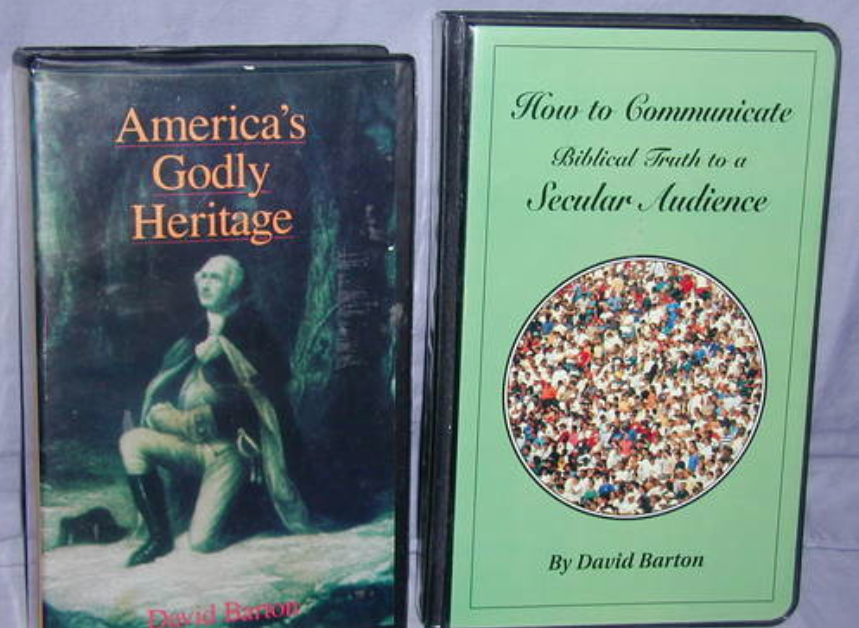
When Bill Gothard first distributed David Barton‘s “America’s Godly Heritage” to homeschooling families in his Advanced Training Institute, I was entranced. We listened to that first cassette together and marveled at Barton’s rapid-fire diction. After that, I would follow along with the tapes with my notebook and pencil and try desperately to copy out the quotations from the Founders as Barton galloped from one to the next at rodeo speed. Protected as I was from secular influences and celebrity worship, Barton was the equivalent of a rock star in my world. I collected Barton’s numerous books and a stack of cassettes. I copied out and memorized my favorite lines. When he addressed the national ATI conferences in Tennessee, I was giddy with excitement. I wished the audience would quit applauding so he could fit in more of his speech!

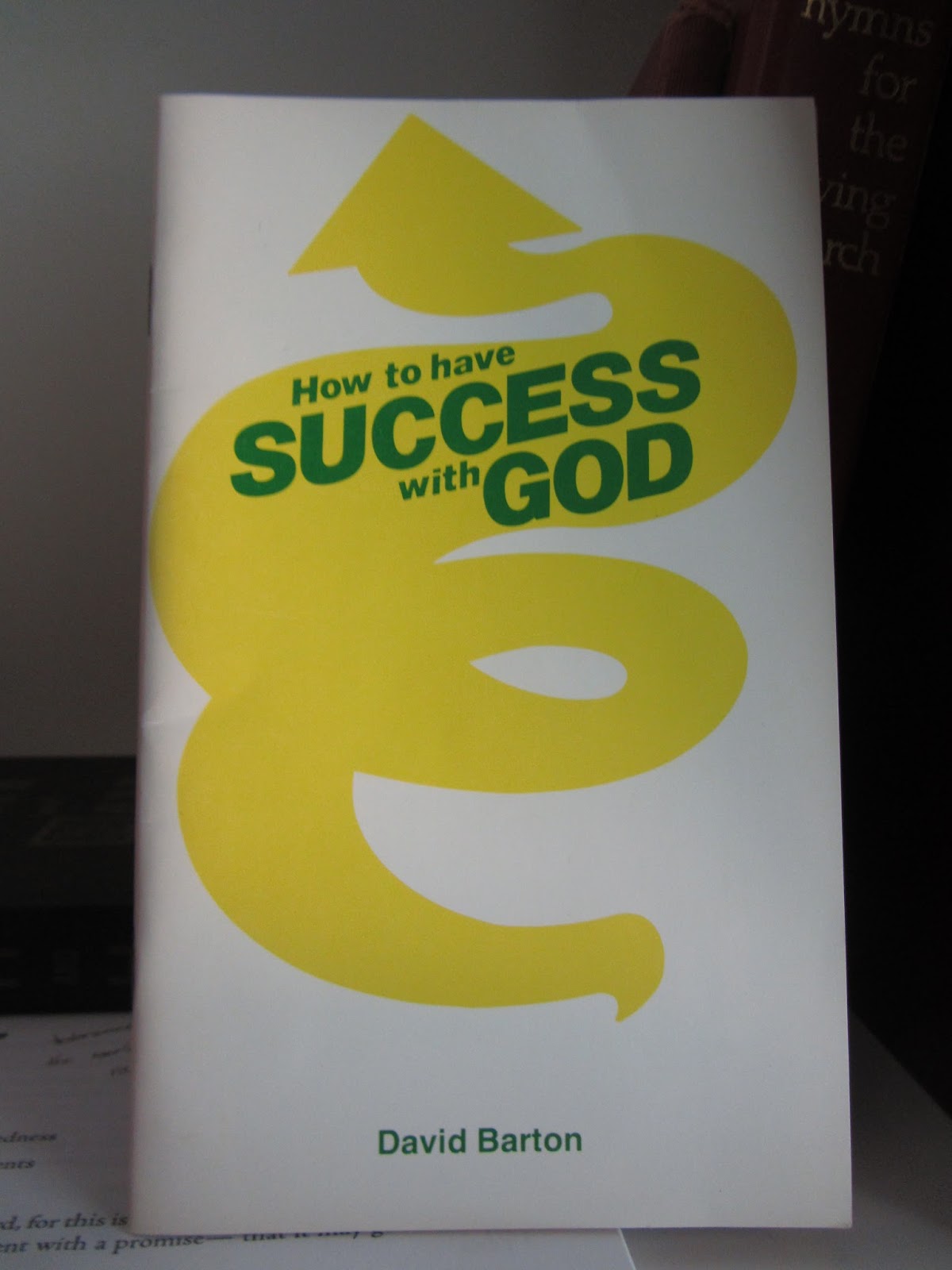
Besides Barton’s books on American history, I even purchased his obscure 31-page booklet How to Have Success With God, published in 1984:

“To God, obedience is better than anything.”
“The more you do of what you hear from God, the more you will hear from God what to do!”
“Be a Christian who enjoys obeying God and you will enjoy being a Christian!”

IMG_3694
Besides Barton’s books on American history, I even purchased his obscure 31-page booklet How to Have Success With God.

Today, “David Barton is a former Vice Chairman of the Republican Party of Texas and a political consultant for the Republican National Committee. He is also a bestselling author and political activist who has worked diligently to arouse true patriotism and restore America to her Biblical foundation.”

But back then, Barton and his organization Wallbuilders had not yet gained notoriety outside Texas. In time he would get chummy with Sen. Sam Brownback of Kansas, U.S. Rep. Todd Akin of Missouri, and the chairman of Gothard’s Board of Directors, Congressman Sam Johnson of Texas. Brownback would say of Barton, “His research provides the philosophical underpinning for a lot of the Republican effort in the country today — bringing God back into the public square.” And that was a mission I supported wholeheartedly.

When my worldview began to unravel, however, I revisited the Wallbuilders’ website, curious for answers that would settle some of my doubts. For the first time I realized that David Barton has no credentials as an historian or an archivist. He holds a B.A. in religious education from Oral Roberts University and has been both a [math and science] teacher and a principal at a private Christian school in his hometown of Aledo, Texas.

As a homeschooled student myself with limited exposure to the ways of academia, I could sympathize with Barton’s ignorance of correct protocol for citing sources. But I was flummoxed to learn that he lacks primary sources for some of his quotations. Including some of my favorite quotations–lines I used to recite glibly at candidates who brought up the spurious “separation of church and state”. Now this was unsettling.

I hadn’t heard David Barton for well over a decade when he appeared as a guest on “The Daily Show with Jon Stewart”. Well, here was a blast from my past! I settled in to listen to the Texan’s familiar too-rapid drawl and was surprised. Before, I had only heard Barton lecture to sponge-like crowds. His material seemed much less concrete in an interview before a skeptical audience. (And this incredible exchange with Glenn Beck puts Barton much closer to “unintentional comedian” than “educator.”)

Disillusioned with Barton, and with those who unquestioningly accept his version of the past, I discarded the remaining Wallbuilders publications on my bookshelf and set out to round out my re-education on American history and the variegated experiences and ideals of the brilliant yet flawed men who penned our founding documents. Thus did they launch these United States on her voyage into their future, hoping that we would prove equal to the task of sailing her, of maintaining her trim and keeping her prow pointed forward.

Even if we were to concede that America was intended to be a “Christian” nation (in spite of plain evidence to the contrary), even if we acknowledge that weather patterns were divine intervention on behalf of the Continental Army and that the Holy Spirit inspired the writing of the Constitution, even if we were to accept Barton’s version of the past, how would that enlighten our present conversation? It does not therefore follow that George Washington would now use his influence in favor of creationism in science textbooks. It would be presumptive to assume that John Adams would cast his vote today for pointless transvaginal ultrasounds or that James Madison would oppose national healthcare. We could not even conclude that Thomas Jefferson would want his children reciting a pledge to a flag, much less to a nation “under God”.

Mike Huckabee thinks our country would be improved we the people were all forced “at gunpoint, no less” to listen to David Barton’s spin on our history. But I cannot help wondering how our Founding Fathers would respond today if they could hear Barton’s appeal to an unrecognizable tradition. These men jettisoned the heavy time-worn design in favor of a revolutionary new ship of state they believed capable of carrying “we the people” through the vicissitudes of history. They were open-minded scientists, philosophers, and inventors, eagerly seeking and adopting new information and technological advances. Certainly, our nations’ founders looked to the past for guidance as they plotted a new course. But to David Barton, history and tradition are anchors with which to slow progress and avoid forward-thinking.

When my daughter was very young, she used to protest when we explained disagreeable facts. “I don’t want that to be true!”, she would cry. Perhaps Barton is ignorant of the way he misleads and misinterprets evidence in order to achieve his political agenda.

Or perhaps he just doesn’t want history to be true.

Gothard’s Sex Rules: Marital Consent? What’s That?

Screen Shot 2014-07-22 at 4.37.57 PM

HA note: The following is reprinted with permission from Libby Anne’s blog Love Joy Feminism. It was originally published on Patheos on May 13, 2014.

My family never attended one of Bill Gothard’s seminars, and we didn’t use Gothard’s curriculum. We children were, instead, raised on the outskirts of Gothardism. We knew people who were followers of Bill Gothard, and we imbibed a few of his teachings (umbrella of authority, anyone?), but that was the extent of it. As things began to snowball over the past months and Gothard was exposed as a sexual predator and ultimately relieved of his leadership position, I wanted to learn more about what Gothard actually taught, in his own words. So I purchased Gothard’s “Advanced Seminar Textbook,” which was published in 1986 and can be found used on Amazon. I’m not going to blog through it page by page, but I do plan to write some posts on various sections. Today I offer my first of these posts.

In his textbook, Gothard covers his rules for periodic abstinence during marriage, which centers on a woman’s menstrual cycle (pages 175—185). Of all of Gothard’s teachings, this may be the one I’m most unfamiliar with, as it is foreign to anything taught in the evangelical church my family attended. In this post, I will cover the first pages of this section and then finish with a letter Gothard received from a follower.

To start out, here are the rules Gothard lays out as “God’s laws on abstinence”:

What Are God’s Guidelines for Times of Abstinence? 

  1. During the menstrual cycle—Ezekiel 18:5-6
  2. Seven days after the menstrual cycle—Leviticus 15:28
  3. 40 days after the birth of a son—Leviticus 12:2-4
  4. 80 days after the birth of a daughter—Leviticus 12:5

Gothard’s critics tend to do two things: they call him a “legalist” and argue that his teachings in this area come from the Old Testament and are therefore invalid, as the Old Testament is superseded by the New Testament. Here, on the first page of this section, Gothard directly counters both of these arguments.

First, Gothard urges his readers to “distinguish between legalism and godly living” and states that: “(1) Legalism is trying to earn salvation; (2) Legalism is trying to live the Christian life with the energy of the soul; and (3) Legalism is following ‘the letter,’ not ‘the spirit.’” Gothard uses Bible verses to back all of this up, focusing especially on II Corinthians 3:6. Gothard argues that he is not teaching legalism but rather godly living.

Second, Gothard pulls up each time the New Testament references “uncleanness” and uses that to claim that the Old Testament teachings regarding a woman’s menstrual uncleanness is still valid. This is a fascinating attempt, but it does not actually work, as it’s pretty clear he’s proof texting and he comes across as being unaware that the New Testament was written in a different language from the Old Testament. Still, that he at least tried is fascinating.

Now I want to turn to the first of the “Benefits of Abstinence” Gothard lays out.

1. It builds self-control.

When sex drives are misused, they become self-consuming and can never be satisfied. Burned-out lusts call for new forms of perversion, which become even greater tyrants of unfulfillment.

Okay, so here’s the thing. If I’m overeating and I know I’m overeating, and it’s making me feel unhealthy, I can fix that by moderating what I eat. I don’t need to spend time fasting to do that. In fact, fasting in order to lose weight can easily lead to binge eating when the fast is over. I guess what I’m saying is that there are better ways to foster a healthy and balanced sex life than abstaining and then (presumably) binging.

But what’s actually going on here becomes more clear with the letter Gothard prints from one of his followers, and it’s not pretty.

How a Commitment to Abstinence Transformed a Marriage

I am writing to report what has happened in our marriage since our decision to follow God’s guidelines for abstinence. To be honest, I was waiting to see if the changes in our lives were short-lived or permanent. Now after a third of a year and five menstrual cycles, I am encouraged that our decision was correct, Biblically-based, and that the Lord is blessing our marriage more than ever before.

Let me start at the beginning. Our dating relationship was based on the physical, not on the spiritual. It ended in pregnancy and then marriage. She was sixteen, I was twenty.

Depending on the state, this might not have been legal.

After we married, our sex life became a shambles. My physical drives were impossible for her to satisfy, and even with a daily physical relationship, I became involved in pornography and other impure habits.

If you’re having sex daily and yet you’re not sexually satisfying, it’s probably worth seeing a doctor or a therapist.

After ten years of marriage we attended our first Basic Youth Seminar. When you went over the consequences of defrauding in dating, I suddenly realized my problem and our marriage problem.

And exactly how do we explain all of the couples who had sex before marriage and are currently in healthy, sexually fulfilling relationships?

I asked God to forgive me for defrauding her before marriage, and for the first time in my life, I began exercising self-control.

Also for the first time in ten years of married life, we began to experience true sexual intimacy. Our relationship continued to improve, but my wife still felt forced to submit to me, and she worried daily about whether or not she would have to ‘make love’ that night.

Wait. Wait wait wait. So the whole time this guy was having sex daily, his wife was only participating because she believed her role, as his wife, was to submit to him and be sexually available. You know, the fact that she felt she had to have sex with him whether she wanted to or not might just play some part in why their sexual relationship wasn’t fully satisfying him.

I began having difficulty exercising self-control.

I really want to know what this means. Was he raping her?

Then we attended your Corporate Leaders Seminar and learned about abstinence during the menstrual period and for seven days after the period. I knew immediately that this is what God wanted me to commit to, and it scared me to death! I couldn’t picture myself being committed to anything like that!

However, God gave me the strength and encouragement to talk to my wife. We discussed it and that day, with her permission, I made a commitment to follow that principle.

Now he’s concerned about getting his wife’s permission?

The relief within my wife was almost visible. The “fear” is gone from our marriage.

Well of course her relief was almost visible! His poor wife knew she would have have two weeks of blessed relief from her husband’s constant (and unreciprocated) sexual demands!

We now have a freedom we never experienced before. We are blessed to the point that we almost feel guilty when we are around our Christian friends who are completely loaded down with problems. Our lives have been transformed by applying this and other principles from God’s Word.

You replaced consent with biblically-mandated periodic abstinence, you asshole.

A Confirming Report from the Wife

I cannot tell you how much the material on abstinence has meant to me and our marriage. I have never experienced what has been happening in our marriage since we began following the principle of abstinence.

It is indeed a miracle!!!! Through the power of the Holy Spirit, my husband has exercised real self-control in the area of our sex life. I feel so loved, cherished, and protected! I have been able to respond to him as seldom before. The difference in our relationship is difficult to describe, but very wonderful to experience. Thank you again for motivating us to choose God’s best.

Someone tell this poor wife about consent and marital rape.

I didn’t expect to be this frustrated when I opened the volume to these pages, but I am. I am really, really frustrated. It appears that Gothard is using abstinence during the period and for seven days after the period as a replacement for consent within marriage. With these teachings, women who find themselves forced to submit to sex they do not want—forced by their believe that that is the wife’s biblical role—can find relief in two solid weeks of freedom from those demands.

This is sick.