Michelle Duggar’s Hypocrisy Regarding Sexual Predators

Members of the Duggar family with Bill Gothard at one of Gothard’s IBLP programs, “Journey to the Heart,” where children are taught to “identify blind spots or secret sins that are keeping them from completely surrendering to God.”

By Shaney Lee, HARO Board Member

The Duggars have made the news again—but this time, it’s not because of another pregnancy, engagement, or wedding.

This time, family matriarch Michelle Duggar has made the news for a robocall made to citizens of Fayetteville, Arkansas, warning them about a new bill being considered by the city. The bill “protect citizens against discrimination in employment, housing, and public accommodations on the basis of their sexual orientation, gender identity, socioeconomic background, marital status, or veteran status,” according to the website ThinkProgress. Michelle’s concerns (or at least, the concerns of the Arkansas Family Council as expressed by Michelle) have to do with granting trans women access to public accommodations for females, such as restrooms and changing areas.

In the robocall, Michelle Duggar urges Fayetteville citizens to vote against the bill so that “men,” particularly “males with past child predator convictions” would not have a legal right to enter spaces designated for “women and children.” (Despite her effort, the bill passed in the early morning hours on Wednesday, 6-2.)

Much has already been written about the transphobic nature of Michelle’s call. While that in and of itself is concerning (especially since the attitude Michelle is promoting is the exact attitude behind the high rates of violence towards trans* individuals), there’s another aspect to this that major media outlets have failed to pick up.

To put it bluntly, Michelle Duggar is a hypocrite.

She supposedly cares about keeping women and children safe from sexual predators, yet her family continues to be associated with a known sexual predator: Bill Gothard.

Nearly every ad on the right hand side of the Duggar Family's website is to one of Bill Gothard's programs.
Nearly every ad on the right hand side of the Duggar Family’s website is to one of Bill Gothard’s programs.

The Duggars have long been huge supporters of Bill Gothard and his ministry, Institute of Basic Life Principles. They have long used ATI curriculum in their homeschool and promoted it on their website. Their website currently has links to Advanced Training Institute, Oak Brook College of Law (another organization started by Bill Gothard), and has prominent advertisements for the ALERT academy (again, another organization related to IBLP and started by Bill Gothard). Gothard’s Advanced Seminar Textbook was influential in the Duggars’ decision to not use birth control. Photos on the official Duggar family website include an album from an ATI conference in 2010, including a picture of Jim Bob with Bill Gothard himself. Jim Bob and Michelle are listed as IBLP conference speakers for this year.

Bill Gothard resigned from IBLP and all its affiliates back in March of this year when over 30 women accused him of sexual harassment. The stories of some of these women are well-documented on the website Recovering Grace. And yet, in the face of overwhelming evidence showing Gothard to be a sexual predator, the Duggars have said nothing. In fact, they continue to profit from promoting ATI and IBLP.

(The Duggars have also been connected with sexual predator Doug Phillips of Vision Forum. They have similarly been silent about him, though all links to Vision Forum seem to be scrubbed from their website.)

In addition to showing a lack of personal integrity, Michelle’s call reinforces that common misconception that sexual predators are strangers. This is simply not the case–particularly when it comes to children. In the majority of sexual assault and abuse cases, the perpetrator was someone the victim knew. While this does not make sexual assault by strangers “rare” by any means, the narrative surrounding who sexual predators are and how they operate allow people respected by the community and in leadership positions to continue to sexually abuse people for years before anyone will speak up.

Source: http://www.duggarfamily.com/
Jim Bob Duggar and Bill Gothard at an ATI conference. Source: http://www.duggarfamily.com/

It allows people like Bill Gothard to get away with their abuse.

Michelle Duggar is more than willing to throw trans* people, who are no more likely to be sexual predators than anyone else, under the bus, while refusing to do the uncomfortable work of publicly denouncing a known predator whom she has supported and promoted for years.

Furthermore, trans* people are actually more like to be the victims of sexual assault or physical violence:

  • “Most studies reveal that approximately 50% of transgender people experience sexual violence at some point in their lifetime.” (Source)
  • “People who identify as transgender were 28% more likely to experience physical violence than those who are gender normative.” (Source)

This is unacceptable. If the Duggars want to have any credibility in speaking out against sexual predators, they must sever all ties with IBLP and publicly speak out against Gothard, as well as apologize for contributing to the bigoted attitudes that put trans* people at risk.

Join the conversation on Twitter: #DuggarHypocrisy.

Gothard’s Sex Rules: Marital Consent? What’s That?

Screen Shot 2014-07-22 at 4.37.57 PM

HA note: The following is reprinted with permission from Libby Anne’s blog Love Joy Feminism. It was originally published on Patheos on May 13, 2014.

My family never attended one of Bill Gothard’s seminars, and we didn’t use Gothard’s curriculum. We children were, instead, raised on the outskirts of Gothardism. We knew people who were followers of Bill Gothard, and we imbibed a few of his teachings (umbrella of authority, anyone?), but that was the extent of it. As things began to snowball over the past months and Gothard was exposed as a sexual predator and ultimately relieved of his leadership position, I wanted to learn more about what Gothard actually taught, in his own words. So I purchased Gothard’s “Advanced Seminar Textbook,” which was published in 1986 and can be found used on Amazon. I’m not going to blog through it page by page, but I do plan to write some posts on various sections. Today I offer my first of these posts.

In his textbook, Gothard covers his rules for periodic abstinence during marriage, which centers on a woman’s menstrual cycle (pages 175—185). Of all of Gothard’s teachings, this may be the one I’m most unfamiliar with, as it is foreign to anything taught in the evangelical church my family attended. In this post, I will cover the first pages of this section and then finish with a letter Gothard received from a follower.

To start out, here are the rules Gothard lays out as “God’s laws on abstinence”:

What Are God’s Guidelines for Times of Abstinence? 

  1. During the menstrual cycle—Ezekiel 18:5-6
  2. Seven days after the menstrual cycle—Leviticus 15:28
  3. 40 days after the birth of a son—Leviticus 12:2-4
  4. 80 days after the birth of a daughter—Leviticus 12:5

Gothard’s critics tend to do two things: they call him a “legalist” and argue that his teachings in this area come from the Old Testament and are therefore invalid, as the Old Testament is superseded by the New Testament. Here, on the first page of this section, Gothard directly counters both of these arguments.

First, Gothard urges his readers to “distinguish between legalism and godly living” and states that: “(1) Legalism is trying to earn salvation; (2) Legalism is trying to live the Christian life with the energy of the soul; and (3) Legalism is following ‘the letter,’ not ‘the spirit.’” Gothard uses Bible verses to back all of this up, focusing especially on II Corinthians 3:6. Gothard argues that he is not teaching legalism but rather godly living.

Second, Gothard pulls up each time the New Testament references “uncleanness” and uses that to claim that the Old Testament teachings regarding a woman’s menstrual uncleanness is still valid. This is a fascinating attempt, but it does not actually work, as it’s pretty clear he’s proof texting and he comes across as being unaware that the New Testament was written in a different language from the Old Testament. Still, that he at least tried is fascinating.

Now I want to turn to the first of the “Benefits of Abstinence” Gothard lays out.

1. It builds self-control.

When sex drives are misused, they become self-consuming and can never be satisfied. Burned-out lusts call for new forms of perversion, which become even greater tyrants of unfulfillment.

Okay, so here’s the thing. If I’m overeating and I know I’m overeating, and it’s making me feel unhealthy, I can fix that by moderating what I eat. I don’t need to spend time fasting to do that. In fact, fasting in order to lose weight can easily lead to binge eating when the fast is over. I guess what I’m saying is that there are better ways to foster a healthy and balanced sex life than abstaining and then (presumably) binging.

But what’s actually going on here becomes more clear with the letter Gothard prints from one of his followers, and it’s not pretty.

How a Commitment to Abstinence Transformed a Marriage

I am writing to report what has happened in our marriage since our decision to follow God’s guidelines for abstinence. To be honest, I was waiting to see if the changes in our lives were short-lived or permanent. Now after a third of a year and five menstrual cycles, I am encouraged that our decision was correct, Biblically-based, and that the Lord is blessing our marriage more than ever before.

Let me start at the beginning. Our dating relationship was based on the physical, not on the spiritual. It ended in pregnancy and then marriage. She was sixteen, I was twenty.

Depending on the state, this might not have been legal.

After we married, our sex life became a shambles. My physical drives were impossible for her to satisfy, and even with a daily physical relationship, I became involved in pornography and other impure habits.

If you’re having sex daily and yet you’re not sexually satisfying, it’s probably worth seeing a doctor or a therapist.

After ten years of marriage we attended our first Basic Youth Seminar. When you went over the consequences of defrauding in dating, I suddenly realized my problem and our marriage problem.

And exactly how do we explain all of the couples who had sex before marriage and are currently in healthy, sexually fulfilling relationships?

I asked God to forgive me for defrauding her before marriage, and for the first time in my life, I began exercising self-control.

Also for the first time in ten years of married life, we began to experience true sexual intimacy. Our relationship continued to improve, but my wife still felt forced to submit to me, and she worried daily about whether or not she would have to ‘make love’ that night.

Wait. Wait wait wait. So the whole time this guy was having sex daily, his wife was only participating because she believed her role, as his wife, was to submit to him and be sexually available. You know, the fact that she felt she had to have sex with him whether she wanted to or not might just play some part in why their sexual relationship wasn’t fully satisfying him.

I began having difficulty exercising self-control.

I really want to know what this means. Was he raping her?

Then we attended your Corporate Leaders Seminar and learned about abstinence during the menstrual period and for seven days after the period. I knew immediately that this is what God wanted me to commit to, and it scared me to death! I couldn’t picture myself being committed to anything like that!

However, God gave me the strength and encouragement to talk to my wife. We discussed it and that day, with her permission, I made a commitment to follow that principle.

Now he’s concerned about getting his wife’s permission?

The relief within my wife was almost visible. The “fear” is gone from our marriage.

Well of course her relief was almost visible! His poor wife knew she would have have two weeks of blessed relief from her husband’s constant (and unreciprocated) sexual demands!

We now have a freedom we never experienced before. We are blessed to the point that we almost feel guilty when we are around our Christian friends who are completely loaded down with problems. Our lives have been transformed by applying this and other principles from God’s Word.

You replaced consent with biblically-mandated periodic abstinence, you asshole.

A Confirming Report from the Wife

I cannot tell you how much the material on abstinence has meant to me and our marriage. I have never experienced what has been happening in our marriage since we began following the principle of abstinence.

It is indeed a miracle!!!! Through the power of the Holy Spirit, my husband has exercised real self-control in the area of our sex life. I feel so loved, cherished, and protected! I have been able to respond to him as seldom before. The difference in our relationship is difficult to describe, but very wonderful to experience. Thank you again for motivating us to choose God’s best.

Someone tell this poor wife about consent and marital rape.

I didn’t expect to be this frustrated when I opened the volume to these pages, but I am. I am really, really frustrated. It appears that Gothard is using abstinence during the period and for seven days after the period as a replacement for consent within marriage. With these teachings, women who find themselves forced to submit to sex they do not want—forced by their believe that that is the wife’s biblical role—can find relief in two solid weeks of freedom from those demands.

This is sick.

I Fight These Demons So I Can Explain The Scars: Shiphrah’s Story, Part Two

Screen Shot 2014-07-08 at 3.23.10 PM

HA Editorial note: The author’s name had originally been changed to ensure anonymity. “Shiphrah” was a pseudonym. I am editing this today because I am ready to say that Shiphrah is me. I wrote this and asked that it was posted anonymously because I had only begun to explore the depths of my memories and my pain at that time and I needed an outlet to work through it. I no longer feel the need for anonymity, no longer am I afraid to claim the darkest parts of my story. I am Darcy, and this is my story and my pain and my healing. ~Darcy Anne, HA Editorial Team 

Part One

Part Two

I grew up thinking I was unworthy.

Unworthy of love, nice things, friends, God’s favor. I strove to be the kind of person who would be worthy of these things, but always fell short. I did everything I could to look the part on the outside: I dressed modestly and acted like a godly young lady and played the part as best I could.

“Fake it til you make it,” my Mom liked to say to me.

My journals of that time are so filled with anguish and desire to be accepted and to be good. I can barely read them. I want to go back there and hug that girl and tell her that she WAS worthy, she WAS good, she was enough. But I can’t. I can’t go back there and comfort that girl with the broken heart that was broken by the ones who were supposed to protect it. I am left with the woman she has become. The woman who has had to teach herself how to be loved and how to accept worthiness and how to see herself and the world through different eyes.

When a boy fell in love with me, and I with him, they all did their best to convince him that I was a terrible, selfish person and he would be sorry if he married me. That they knew me better and I was just putting on an act to impress him. He was skeptical, but thought maybe they really did know better. So he watched me, befriended me, and realized I was every bit the person he thought I was and my mom and sister were crazy.

I coudn’t understand why he would persist in loving a person like me, but he did and it was such a wonderful feeling.

I was so afraid he would find out who I really was and would run far away. But that didn’t happen. We fought for our relationship against my parent’s wishes and we married very young and very in love. Not too long after we were married, we were talking and I said “Well, I am a selfish person”. He looked at me in surprise and said, “Why do you say that?” It was my turn to look at him in confusion and say, “Well, my mom and sister always told me I was selfish and I struggled my whole life to not be, but I guess it’s just who I am and I thought you knew that.” He took my face in his hands, looked right into my eyes, and said, “You are the most selfLESS person I have ever met. Never let anyone convince you otherwise. You can’t fool me. I know who you are. They don’t know who you are.”

I cried that day, at 20 years old, for the first time thinking that maybe I wasn’t the person my family had tried to convince me I was, that my religion tried to convince me I was, that I needed to hide and pretend not to be so people would love me. Maybe I really was loveable and the fact this man had married me wasn’t because I had fooled him into it. But it would be 5 more long years before I was able to clearly see how dysfunctional my past was, the part that fundamentalist religion and homeschool culture played, and began to heal and figure out who I was really and to fight for myself. It would be 10 more long years before I was able to put a label on the treatment I received from them.

Emotional Abuse. The systematic diminishment of another person….their worth, their dignity, their character.

“Emotional abuse is like brain washing in that it systematically wears away at the victim’s self-confidence, sense of self-worth, trust in their own perceptions, and self-concept. Whether it is done by constant berating and belittling, by intimidating, or under the guise of ‘guidance,’ ‘teaching,’ or ‘advice,’ the results are similar. Eventually, the recipient of the abuse loses all sense of self and remnants of personal value. Emotional abuse cuts to the very core of a person, creating scars that may be far deeper and more lasting than physical ones.” (University of Illinois, Counseling Center)

Spiritual Abuse. The use of religion and spirituality to control, manipulate, coerce, dominate, and beat down. To control behavior and thoughts by religion.

“Spiritual abuse occurs when someone in a position of spiritual authority, the purpose of which is to ‘come underneath’ and serve, build, equip and make God’s people MORE free, misuses that authority placing themselves over God’s people to control, coerce or manipulate them for seemingly Godly purposes which are really their own.”   (Jeff VanVonderen, The Subtle Power of Spiritual Abuse)

I can’t tell you what came first: the dysfunction or the religion.

But they worked together to create a complete brain-washing and erasing of my self-worth and self-concept. Our religion taught that self-esteem was really pride and God hates a prideful heart. We were not to think highly of ourselves but to remember that we were nothing without God and probably nothing even with His help. To be told that I was a selfish, horrible person but that they loved me anyway “because you’re our daughter/sister” is no different than this view of God that makes us all worms who are only worthy of anything because God created us and therefore must love us. Turning the idea of a “relationship with God” into an abusive relationship between a narcissist and a victim. A manipulative power-play. Is it any wonder that “God’s people” turn out abusive when they see Him as such?

If I try to say any of this to my family, to recount my experiences and feelings, I am told I’m overreacting, too sensitive, too emotional, that these things never happened or “didn’t happen like that”. I’m told that even if they did happen, I should forgive and move on because family is the most important thing in life and I’ll regret making a fuss over the past. That I was raised in a good home and was loved and am ungrateful. I am denied, belittled, and word has spread that I’m a crazy, unstable person who has a chip on my shoulder and is trying to tear apart our happy family. But I am done accepting their definition of who I am, their portrayal of my identity.

I am not who they think I am. I am so much more.

I am worthy of love. I am a good person. I am a human being, wife, mother, and friend. I love unconditionally and fiercely. I fight for the people I love and for people I don’t even know because I desperately want them to know that they are worth it. I fight my own demons to give my children a healthy mother and so I can explain the scars to them someday and they can know that I valued them by valuing myself —

— That I fought for them by fighting for myself. That I broke the cycle.

“Adult survivors of emotional child abuse have only two life-choices: learn to self-reference or remain a victim. When your self-concept has been shredded, when you have been deeply injured and made to feel the injury was all your fault, when you look for approval to those who can not or will not provide it—you play the role assigned to you by your abusers.

It’s time to stop playing that role, time to write your own script. Victims of emotional abuse carry the cure in their own hearts and souls. Salvation means learning self-respect, earning the respect of others and making that respect the absolutely irreducible minimum requirement for all intimate relationships. For the emotionally abused child, healing does come down to “forgiveness”—forgiveness of yourself.”

~Andrew Vachss, taken from this excellent website: The Invisible Scar.

Q: What Do Doug Phillips and Bill Clinton Have in Common? (Besides the Whole Preying-on-Women Thing.)

Screen Shot 2014-07-05 at 2.54.07 PM

By R.L. Stollar, HA Community Coordinator

A: They both supported Michael Farris’s efforts to pass the Religious Freedom Restoration Act, the law at the heart of the recent Hobby Lobby case before the Supreme Court.

You’ve probably heard about the Religious Freedom Restoration Act (RFRA). It’s at the core of the Burwell v. Hobby Lobby Stores, Inc. Supreme Court case, which (on a 5-4 decision) held that,

As applied to closely held corporations, the regulations promulgated by the Department of Health and Human Services requiring employers to provide their female employees with no-cost access to contraception violate the Religious Freedom Restoration Act.

If you’ve been following the Hobby Lobby case, you probably have a strong opinion one way or another about whether the case was appropriately decided. You’ve also probably heard your “liberal” friends on Facebook mourning the fact that RFRA exists or your “conservative” friends trying to rub RFRA’s existence in their liberal friends’ faces by saying something like, “Bill Clinton signed it! Chuck Schumer signed it! Ha!”

But whatever side you take, and however liberal or conservative you might be, one salient fact stands out: a Democrat president might have signed the Religious Freedom Restoration Act into law, but it was master-minded by none other than Michael Farris, president of HSLDA. My source for that claim? Michael Farris himself.

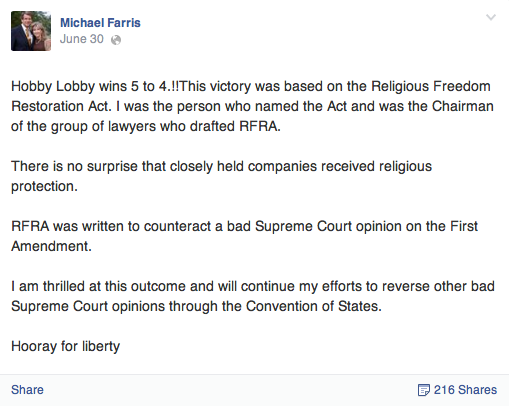
The day the Hobby Lobby decision came out, Farris wasted no time in claiming credit for it on his public Facebook page:

Screen Shot 2014-07-02 at 11.48.20 AM

Relevant text is:

Hobby Lobby wins 5 to 4.!!This victory was based on the Religious Freedom Restoration Act. I was the person who named the Act and was the Chairman of the group of lawyers who drafted RFRA.

Really, Farris is being modest in just saying he named the RFRA and supervised the drafting of his text. The fact is, he also “organized a broad coalition of groups to support it” and worked to assuage “pro-life groups” who “feared that the RFRA would extend women’s legal rights to get abortions.” Farris’s work immediately payed off, as HSLDA was able to capitalize on the RFRA in homeschool legal cases and then-HSLDA attorney (now former) Jordan Lorence used it to champion explicit housing discrimination against an unmarried couple.

Historically speaking, it is ironic that the RFRA is now being championed by “conservatives” as a “conservative” piece of legislation. Almost 2 decades ago, libertarian groups were criticizing the RFRA, contending it was unconstitutional because it “exceeded Congress’ power to regulate state and local government” and was merely “Congress’s attempts to redefine constitutional rights via the enforcement clause of the Fourteenth Amendment.” (In fact, the Supreme Court partially agreed, striking down parts of the RFRA, with Justice John Paul Stevens declaring it was a “law respecting an establishment of religion’ that violates the First Amendment to the Constitution.”) Legal scholars similarly argued it “establishes an across-the-board scheme that deliberately singles out religious practices, en masse, as a congressionally favored class of activity.”

(Of course, if you are familiar with Michael Farris’s actual legal theories and not just his rhetoric, none of this should surprise you. Farris is a far cry from actual conservatism and a far cry from federalism. He is more of an opportunistic expansionist. This is evidenced no more humorously in the fact mentioned above: that the Supreme Court struck down part of a law Farris oversaw the drafting of because it was an unconstitutional expansion of the federal government’s powers over and against states’ rights. Nonetheless, HSLDA continues to praise the RFRA.)

But here’s the best part, for all you homeschool trivia buffs out there: After Farris got to name the RFRA and chair the group of lawyers who drafted it, and after it passed the House and Senate and was sent to then-President Bill Clinton to sign, Farris was unable to make the signing ceremony. So who did Michael Farris send in his stead, to be there on this momentous occasion and celebrate one of his crowning political victories?

Doug Phillips.

Yeah, that Doug Phillips.

I’ll let HSLDA tell its own story, since they already did in the 1993 November/December Court Report:

Religious freedom regained significant protection on November 16, as President Clinton signed into law the Religious Freedom Restoration Act of 1993 (RFRA). Home School Legal Defense Association president Michael Farris was one of the original drafters of the bill. HSLDA had worked diligently over a three year period for RRFA’s passage.

Among those in attendance at the ceremony for the signing of the RFRA in the White House Rose Garden, was Doug Phillips, Director for Government Affairs for the National Center for Home Education. Phillips attended in the place of Farris, who was out of town and unable to attend. After the signing, President Clinton spoke with Phillips and extended his gratitude for the role Farris played in the RFRA drafting and coalition-building process. “Tell Mike, I really appreciate the work he did drafting [the RFRA],” President Clinton told Phillips.

It’s interesting how all these so-called “fringe” individuals — individuals like IBLP’s Bill Gothard and Vision Forum’s Doug Phillips — keep popping up in cases of immense national import. Gothard directly influenced the ideology of the Hobby Lobby owners, the ideology that inspired Burwell v. Hobby Lobby Stores, Inc. And Farris, Phillips, and HSLDA ensured the success of the RFRA, the law that ensured Hobby Lobby’s legal success. So fringe, you know?

“Fringe.”

You keep using that word, I do not think it means what you think it means.

I Fight These Demons So I Can Explain The Scars: Shiphrah’s Story, Part One

Screen Shot 2014-07-08 at 3.23.10 PM

HA Editorial note: The author’s name had originally been changed to ensure anonymity. “Shiphrah” was a pseudonym. I am editing this today because I am ready to say that Shiphrah is me. I wrote this and asked that it was posted anonymously because I had only begun to explore the depths of my memories and my pain at that time and I needed an outlet to work through it. I no longer feel the need for anonymity, no longer am I afraid to claim the darkest parts of my story. I am Darcy, and this is my story and my pain and my healing. ~Darcy Anne, HA Editorial Team 

Part One

I was never good enough.

From as far back as I can remember, I was never good enough. I was told I was selfish, lazy, prideful, rebellious, and argumentative. I was told I needed to ask God to forgive me and make me a good person through Him (because we could never be good on our own, only with Jesus’ help and then it was never to our credit, only to His).

When my little sister picked fights with me and I lashed out at her, I was the one scolded, grounded, spanked, had things taken from me, forced to spend time with her to “help us get along”, told to get along and be nice and stop being so selfish and be a better example because I was the oldest. She often got away scott-free, even when she started it. I was told numerous times that if I couldn’t learn to get along with my sister then I couldn’t have friends. Family is more important than friends and how you treat your family tells you how you will treat friends. And if you treat friends better than family, you’re a special kind of hypocrite. I tried to explain why it was easier to treat my friends better. Because they were nice to me.

I was then told that Jesus said “what good is it if you love those who love you?” but loving people who aren’t nice to you is much better in God’s eyes.

Everything I did was criticized. It was never good enough. There was always something to be fixed, some way to do things better. I remember being about 12 years old and telling my mom in exasperation, “All you ever do is criticise me. You never tell me what I do right, only ever what I do wrong.” She first acted surprised and denied it, then promised to try to notice the good before telling me the bad. That didn’t last very long and felt very fake even when she tried. Like she was straining to find something good to say to get it out of the way so she could go on to grasp “this teachable moment”. Of course, when I resisted the “teachable moment”, I was the one at fault for being “unteachable”.

To this day when someone says “teachable moment” I recoil.

I was always “unteachable” because I often argued with my mom’s criticism. Because her words stung and fighting them off was my only defense, as little as it was. I was good with words and knew how to wield them as weapons of defense. I often had Proverbs quoted at me that said that people that were unteachable were fools and only those willing to listen to constructive criticism were people of good character whom God loved. So I guess that was just another thing that God hated about me too.

I was told constantly that I was selfish, and it didn’t take long for my sister to take up that anthem against me. Of course, sister had “a servant’s heart” and was selfless and kind and I should be more like her. She was generous and I was stingy. I only thought of myself and my needs and God was not pleased with that. I should ask God to give me a servant’s heart. I spent many hours as a child crying to God to give me this elusive servant’s heart that I apparently lacked and needed before my mom would accept me and my actions. Then maybe my sister wouldn’t hate me either. We were given roles very early in life and we played them well. She learned early how to manipulate our parents against me and she was always believed over me.

I was a child of many emotions. Sensitive, thinking, opinionated, deeply feeling.

But I quickly learned that some emotions were not acceptable, maybe even a sin, and I was not allowed to express them.

I learned that if I was angry, it was “godly” to forgive and forget that anger and definitely don’t express it. “Be angry but do not sin” meant “be angry but never tell anyone or show it”. There were times I wanted to scream because of the pent-up feelings of anger at my parents, anger at my sister, and anger at myself for being angry with them. I must be the terrible person they said I was because I couldn’t stop being angry and sad all the time. I begged God to make me nice and happy and sweet. “Why can’t you be sweet like your sister?” was something I heard often. I often escaped with a book into my favorite tree, away from everyone I could possibly sin against, away from the constant criticism of my actions and “bad attitudes” and the reminders that I was rebellious against God and my parents.

When I was an early teen, things only got worse. Thanks to a cult leader called Bill Gothard and his seminars and his followers, my family finally found answers to all our problems and embraced the promises to have the perfect godly life if we followed the Basic Principles. I was 14 and I thought, yes! This is the answer! The rule list that will finally make me a good person whom my family will love, who will be worthy of their love and acceptance. I poured my heart and soul into the materials, spending hours praying to God to forgive me for all the ground I gave to Satan. For not accepting my parents as the hammer and chisel that were molding me into the diamond I was meant to be. My resistance of their umbrella of authority must be the reason I’m a bad, selfish person. I was determined to finally fix my broken soul. I befriended many “godly girls” who were homeschoolers and whose families understood and followed the secrets of a godly life, hoping their goodness would rub off on me. Eventually, those girls popped into arguments between me and my mom….”why can’t you be more like them? They would never treat their parents and sister the way you do.” I wanted nothing more than to be “more like them” and tried even harder.

I had many teary confessions to my parents for being rebellious. They piled on the modesty books and the courtship books and all the books that told me I was a naturally bad person and needed my parents as my authority because I couldn’t trust my heart to know what was best for me. I ate them up, thinking i would find the answer to all my problems. When my sister would lie about me, get me into trouble, pick fights with me until I snapped at her, I would take a breath, search my own heart for any evil thoughts, and beg her to forgive me for being selfish. She always did, of course. It was very magnanimous of her as a good, generous person to forgive my selfish actions.

There were some dark times in there. For a while I was convinced that since I was such a terrible person and my family hated me so much, that maybe God hated me too and what was the point of me living? I began to fantasize about ways I could kill myself and relieve my family of the burden of me. I never went through with anything.

I was afraid of death, that God really did hate me and would send me to hell and I couldn’t die until I turned into a better person.

Part Two >

“Everyone is Forgiving”: Bill Gothard’s Bold-Faced Lies

Screen Shot 2014-07-05 at 1.20.37 PM

Jeri Lofland blogs at Heresy in the Heartland. The following was originally published by Jeri on July 3, 2014 with the title “When Apologies Make It Worse,” and is reprinted with permission.

Since Bill Gothard had to resign from leading his Institute in Basic Life Principles amid allegations of inappropriate behavior toward female staffers, he has made few public statements. But in private, he has been far from silent.

An article published last week by Mother Jones stated:

These days, Gothard says, he is busy “contacting people I’ve offended and asking them to forgive me.” Asked how this process is going, he chirpily replies, “Wonderful. People are very grateful and everyone is forgiving.”

However, some former IBLP staff members take issue with Gothard’s version of the facts. Gothard has made efforts to contact them, they say, and “grateful” was not a word that came to mind.

One woman, who has had contact with Gothard since his resignation from IBLP, dismissed his attempted “apologies” as unethical and disingenuous. As this woman has requested anonymity, I will refer to her here as “Sally”. After her story was published on the website Recovering GraceGothard sought to engage Sally in an email correspondence. She has given me permission to share the content of those emails here. Gothard did not reply to the last message included below.

******

Sally,

I was grateful for my talk with ***** and he told me of his contact with you. It would be an answer to prayer to be able to be reconciled with you and I would appreciate any direction you would have towards this goal.

Sincerely, Bill Gothard

******

Bill,

As a starting point, I would like to know why you have resigned as president of IBLP?

Sally

******

Thank you, Sally, so much for your response. I resigned from the Institute because I have finally realized that relationships with the Lord and others are far more important than the work I do for Him. I have offended many individuals including you and it is my desire to be reconciled with as many as possible in the years to come.

Sincerely, Bill

******

Bill,

You say that you have offended many individuals including myself.

I would like you to be specific regarding the manner in which you believe you have offended me.

Sally

******

Sally,

I apologize for the delay in getting this message to you. For many years I have treasured the memories of the friendship that we had. I am praying that this can be restored. Some of my actions were inappropriate and offensive. Is it possible to hear your perspective on these wrong actions so that I can more precisely understand and acknowledge my fault and seek your forgiveness?

Sincerely, Bill

******

Bill,

I should not have to explain to you what was “inappropriate and offensive” about your actions towards me. It is very wrong of you to ask me to recount them for you, and I do not intend to do so.

If you sincerely desire my forgiveness and you wish for reconciliation, then you need to acknowledge your offensive behavior in an honorable, fearless and truthful manner. If you are not willing to do this, then please do not contact me again.

Sally

******

Readers of the accounts on Recovering Grace will recall that Gothard commonly groomed his victims of sexual and/or emotional abuse by urging them to confide to him all the sexual details of previous relationships. It would appear from this series of emails that even at nearly eighty years old, he still takes a voyeuristic interest in hearing his victims describe the shame he sought to burden them with.

“He consistently asks the girl to tell him what it is she thinks he has done. Then he apologizes for ‘her perceived’ grievances. There is no ownership of his behavior. He’s putting it all back on the the victim.”

And once again, Gothard is breaking his own fundamental rules–this time for apologies. In his Basic Seminar textbook, he wrote a whole chapter on the right way to clear one’s conscience by asking forgiveness.

bsFor example, Gothard’s text points out:

It does little good to ask forgiveness for a small offense when in reality that offense is only a fractional part of a much greater offense.

Also:

There are several ways to ask forgiveness which are guaranteed not to work–such as, “I was wrong, but you were too”; “If I was wrong, please forgive me”; “I’m sorry”, etc. There is one genuine statement which reflects true sincerity and humility: “God has convicted me of how wrong I have been in (my attitude and actions). I know I have wronged you in this, and I’ve come to ask, will you forgive me?”

Carefully choose the right wording

  • Your words must identify the basic offense
  • Your words must reflect full repentance and sincere humility

 …One of the hardest statements for any person to make is, “I was wrong.” It is a lot easier to say, “I’m sorry about .. ” It is also much easier to say, “Please forgive me” than it is to ask, “Will you forgive me?” and wait for the answer.

Gothard then gives examples of wrong wording:

“If I’ve been wrong, please forgive me.”

And right wording:

“God has convicted me of how wrong I’ve been in ______ (Basic Offense). I’ve called to ask will you forgive me?”

This request, spoken in the right attitude, is certain to be well-accepted by the one to whom it is directed. This approach must include correction of any attitudes or actions which caused the offense and also restitution for any personal loss which was suffered by the one offended.

Oh, yes, restitution. Did you see that mentioned in the emails to Sally? No, I didn’t, either.

But let us go on. The seminar manual taught that one should not go into too much detail, and emphasized the principle with a verse from the New Testament:

In Scripture we are warned that, “It is a shame even to speak of those things which are done of them in secret.” (Ephesians 5:12) This warning definitely applies when asking for forgiveness. It is neither important nor appropriate to review impure details of an offense. This only tends to stir up the mind of the hearer to the past. 

And yet Gothard needs more details so he can “more precisely understand and acknowledge” his fault? Hmmmm.

Of course Gothard wrote the seminar text long before email, but he recommends making apologies only by phone or in person, not by correspondence. I have highlighted some relevant points in Gothard’s explanation:

Please don’t write a letter. Most people are tempted to use this method because it is so easy and the least painful to their pride. But it is not effective for many reasons. First, it documents your past offenses and your purpose is to erase them. Second, a letter can be misused by the one receiving it. This only complicates the problem. Third, it often embarrasses the one receiving it, and they may never reply to it. Fourth, a letter doesn’t allow you to gain their verbal assurance of forgiveness. That is a very important factor for you and for the one you have offended. A verbal forgiveness allows him to become free of his bitterness.

Oh, yes, bitterness! So we ask forgiveness in order to help our victim “become free of his bitterness”? No wonder these women are frustrated!

Let me give you a tip, Bill. Forgiveness alone is not enough to erase your many offenses. And the women you used for your own sexual or emotional gratification are wiser and more self-protective now. This is not about restoring a friendship, it is about your manipulative abuse of your position.

“I am not trying to reconcile – I am trying to bring to attention a problem that has been ongoing for forty years. I forgive him, but I have no wish to reconcile with him.” 

–“Sally”

Perhaps most interesting of all, though Gothard’s attorney friend-turned-investigator failed to contact any of the women who spoke out on the Recovering Grace website, Gothard himself is contacting them. He is even contacting other women who have not publicly spoken about their IBLP experiences but who were indeed mistreated by him. Would he possibly be working from memory here? And if his memory is that sharp, why would he need to ask for more details?

This is, after all, a man who taught millions exactly how to ask forgiveness for the offense of “Behaving improperly on a date“:

Wrong Confession: “I realize that I was wrong in necking with you on our date. Will you forgive me?” 

Right Confession: “I realize that I have been wrong in my selfish actions and attitudes toward you when we were dating. It would mean a great deal to me if you would forgive me. Would you forgive me?”

…be as brief and as clear as possible…. Talking too much will not only “sidetrack” the whole purpose of your coming, but may give the impression that you are trying to justify or explain your offenses in order to minimize them. 

You don’t say, Bill? You don’t say.

Should Parents Be “Involved” in Their Children’s Love Lives?

Screen Shot 2014-07-03 at 1.50.01 PM

HA note: The following is reprinted with permission from Libby Anne’s blog Love Joy Feminism. It was originally published on Patheos on June 30, 2014.

Blogger That Mom (Karen Campbell) recently began a series on courtship. I don’t know where she will take the subject as she goes on through the series, but I did want to touch on the premise she begins with—that parents need to be involved.

The Necessary Parent

When we attended Bill Gothard’s IBLP Basic Seminar back in the mid-80s, one of the topics he covered was dating. This was before he had moved into his courtship teachings and even before anyone we knew of had started discussing things like courtship and betrothal. In fact, courtship, to us, was how our grandparents and sometimes even our parents would refer to meeting, getting to know, and preparing to marry each other. In fact, they didn’t often refer to relationships with the opposite sex outside of the goal of being married one day.

Our grandparents on both sides had been in “til-death-to-us-part” marriages and each of our parents were close to celebrating golden wedding anniversaries. We made the same commitment and we knew that, as parents, we wanted to encourage our own children to do the same. But we also knew we had not always chosen wisely along the way and hoped to see our children avoid some of the bumps in the road we had encountered.

Isn’t it interesting that often parents will do this with children when it comes to making career or educational choices, involvement in extracurricular activities, and financial decisions but it is hands off when it comes to dating and marriage?

So we began listening to the many voices of instruction and took away one really important truth that, I believe, is central to the whole discussion of dating, courtship, marriage, and our children.

Parents need to be involved.

In The Joy of Relationship Homeschooling ~ when the one anothers come home, a central theme I discussed is the importance of relationship building beginning before birth so that mentoring our children through the big decisions of life will be a natural, organic process. Too often we believe that once children reach a certain age, we are supposed to sit on the sidelines and watch them makes choices, for good or for bad, without giving them any input. This is folly. Scripture commands us to practice the one anothers of Scripture with our brothers and sisters in Christ, beginning with our precious children! As they become adults, we approach them just as we do other believers, admonishing, exhorting, bearing their burdens, forgiving, etc., all aspects of the dating, courting, and marriage years.

“Parents need to be involved,” That Mom says when speaking of dating, courtship, and marriage. What exactly does it mean for parents to be “involved”?

My landlady, Linda, once told me a story about her relationship with her own daughter. It seems when her daughter was a young adult she entered a relationship that soon became abusive. Linda wanted her daughter out of the situation, but her daughter was insistent that she loved her boyfriend and that the relationship was fine. Linda knew that trying to convince her daughter to leave the relationship would likely make her daughter pull away from her, so she simply voiced her concerns in a natural way and then dropped it. Then, instead of trying to extricate her daughter, Linda focused on being there for her daughter.

Linda told me that she wanted to make sure that when her daughter eventually realized that she needed to get out she would know she could come to her mother for help. No judgement, no guilt trips, no manipulation, no constant hinting. Just love and acceptance. And sure enough, after a few years her daughter realized that the relationship was broken and came to her mother, because she knew that her mother accepted her, and loved her, and would be there for her. No “I told you so,” no pointed looks, no judgement.

Was Linda “involved”?

When I was in college I met a young man named Sean. Sean was not homeschooled, but in other ways his background was similar to my own. Sean and I quickly gravitated toward each other, and eventually our friends took us aside separately and told us we were perfect for each other and really should try making a go of it. So Sean and I approached my father about beginning a “courtship,” given that that was what I had been raised to expect. My father spoke with Sean and then gave his permission to begin a courtship.

Sean was asking some big questions at the time, but my father believed he was what he called “an honest seeker,” and that everything would work out in the end. My father had always told me that it would take a particular kind of man to make me willing to submit, and he hoped Sean might be that man. But then I concluded, after some intensive research into the issue, that God had created through evolution rather than in six days. My father took this as a sign that Sean was leading me astray, and he ordered us to break up.

I couldn’t do it. My father was a stalwart young earth creationist, and I had just realized that he was fallible. I didn’t feel that I could obey my father in this when I knew Sean so much better than he did and his only problem with Sean was that Sean, too, believed that God had created through evolution—something I no longer saw as wrong or a problem. I told my father that I would not break up with Sean, and I took my love life into my own hands.

And here I sit, happily married to Sean for over half a decade. We have two children together. Sean is a wonderful father, partner, and provider. Even my parents have warmed up to him, and enjoy him when we come visit. But even as I made good relationship choices on my own and have a solid relationship with a wonderful man, my relationship with my parents was utterly and completely destroyed.

My parents believed they had a right to vet my partners and set the pace of my relationships, and when I told them no their response ruined our relationship. I stopped coming home because they made living there an utter torture of guilt and manipulation. My family almost didn’t come to my wedding, and when my parents decided to come at the last minute, they chose to sit in the back. My siblings were not allowed to be in the ceremony. What relationship we have today was built over the rubble of shattered dreams.

Were my parents “involved”?

When Sean and I first started “courting,” we spoke to his parents as well as mine. His parents were surprised that we had come to them, but when we asked for their advice they gave it. Some of their advice we followed, and some we did not, and they never gave us any trouble for the parts we did not follow. They accepted that we were adults capable of making our own decisions.

When Sean and I got engaged, his parents thought we were marrying a bit young. They told us that we were still young and that we would face hard times if we went ahead with our plans. But they didn’t tell us this with the expectation that we would do as they advised, and they didn’t make involvement in our wedding plans contingent on their timing. They simply offered advice, take it or leave it, no guilt, no manipulation, nothing. When we decided to go ahead and marry as planned Sean’s parents immediately pitched in however they could and helped with the planning of the rehearsal dinner, the wedding, and the reception.

Were Sean’s parents “involved”?

Do you see what I’m getting at here? At issue is how we define “involved.”

Parents should absolutely be there for their children, and they should absolutely offer advice, both solicited and (at times) unsolicited. But (adult) children have are not obligated to follow this advice, and their parents have no business calling the shots. 

When parents think their (adult) children are under some sort of obligation to follow their advice, or that they as the parents have a right to call the shots, the results are incredibly toxic. So if by “involved” we mean Linda, or Sean’s parents, I’m all for it. But if by “involved” we mean my parents, I couldn’t be more opposed.

Even today, thinking about everything that happened before Sean and I married brings up a whole host of painful feelings that swirl around in my chest and my gut. My relationship with my parents will never be fully restored. There was too much hurt between us. I have many friends today who had the same thing happen, and watched the courtship process destroy or severely damage their relationships with their parents.

I also have a problem with the way this culture approaches “mistakes.” 

You can’t keep your children from making mistakes, and frankly you probably shouldn’t. My parents embraced courtship because they believed that it would help us children avoid some of their own mistakes. Both of my parents dated before meeting each other, and neither was a virgin when they married. They felt that these things had had made things harder for them, and they wanted to spare us that. But sometimes children need to make their own mistakes. We learn from our mistakes, and sometimes things parents think are mistakes turn out to be growing experiences.

I can’t say whether Linda’s daughter wishes that her relationship with her abusive ex had never happened, but from Linda’s telling of the story it’s clear that her daughter learned and grew through the experience. More to the point, Linda could not have prevented her daughter from making her mistake, and trying to do so would only have damaged her relationship with her daughter. Sometimes we simply have to make mistakes for ourselves, as painful as it may be for our parents to watch.

As for Sean and I, marrying as young as we did did result in several years of economic hardship. I remember months when I had to decide between buying meat and buying ice cream. That may sound silly, but I agonized over decisions like that. But I wouldn’t give up those early, hard years for the world. Sean and I scraped by, and we grew together through that time. Sean’s parents were right that it wouldn’t be easy, but Sean and I were not wrong in choosing to give it a go anyway.

Yes, I parent differently from my parents. Yes, I want to give my children things I never had. But parenting that is at its heart reactionary can be dangerous—as can parenting that attempts to realize an impossible utopia. I once heard it said that we won’t repeat our parents’ mistakes, we’ll make new ones, and I see some truth to that. My parents might have been trying to save us from their mistakes, but they made a whole host of other mistakes while trying to protect us from those mistakes.

Oh and also? Parents don’t “need to be” involved in their children’s love lives.

My parents’ involvement in my relationship with Sean ended when they decided to devote all of their energies to ending our relationship, and you know what? Sean and I are happily married all on our own. Believe it or not, young adults are perfectly capable of making responsible and healthy relationship decisions on their own. Advice without strings or guilt or manipulation can be helpful (especially when solicited), but we really can make our own decisions without bringing down disaster, I promise.

I wish these parents would stop trying to butt in on their children’s love lives and instead simply focus on being there for their children. Without strings. Young adults need support and encouragement from their parents, not guilt trips and emotional manipulation. Their parents should be their children’s cheerleaders, not their referees.

I want to finish with a comment from reader MrPopularSentiment:

There’s another kind of involvement that I wanted to bring up. When my husband and I started dating, his parents treated our relationship seriously. Everyone else rolled their eyes and assumed that we’d break up within a short span of time, so there was no need to really get to know us as a couple, but his parents treated me like I was there to stay and worth getting to know.

And it was with no strings attached, too. When my sister-in-law had a stormy, abusive relationship, they treated her husband as a permanent fixture when he was there, and they just didn’t mention it when he wasn’t (the “punishment” phase of the abuse cycle). When she finally left him and found someone new, they treated the new guy as her permanent partner.

It was wonderful to feel like we were being taken seriously by adults, and it did so much to build up my relationship with my in-laws. Soon after I started dating my husband, I was going out on day trips alone with his parents and hanging out with his mother. And now, nearly 15 years later, we have a really good relationship with them.

It also meant that they were the ones we felt comfortable coming to when we needed help or advice, because we knew that it would be given without judgement. So not only is this style of involvement so much healthier for the parent-child relationship, it also meant that we were more open in talking to them, which meant that they knew more about our lives and had more opportunities to give us pointed advice that really has helped us avoid mistakes.

I couldn’t agree more.

A *Real* Investigation into IBLP

iblp
IBLP’s Headquarters in Oak Brook, Illinois.

Jeri Lofland blogs at Heresy in the Heartland. The following was originally published by Jeri on June 22, 2014, and is reprinted with permission.

Thoroughness:

Knowing what factors will diminish the effectiveness of my work or words if neglected

–Bill Gothard

Bill Gothard’s buddy David Gibbs, Jr. has now completed his “investigation” into allegations made against Gothard by former IBLP staff members. According to the IBLP board earlier this week,

“…the Board sought the facts through a confidential and thorough review process conducted by outside legal counsel. Many people were interviewed, including former Board members, current and past staff members, current and past administrators, parents, and family members.

“At this point, based upon those willing to be interviewed, no criminal activity has been discovered.”

But according to the team at Recovering Grace,

“…not one of the women who have shared their stories on our site were personally contacted by Gibbs Jr. or his investigative team, including Charlotte, who alleged molestation.

Perhaps Gibbs Jr. needs to brush up on his Character Qualities.

It would seem that Gibbs’ investigation focused narrowly on certain allegations of sexual impropriety (some of which Gothard has admitted to, resulting in his resignation). However, this is but the sensational tip of the iceberg and ignores the broad scope of hurtful, unethical, and even illegal activities that have damaged numerous lives associated with the Institute in Basic Life Principles.

Gothard promoted his organization as “Giving the world a new approach to life” and following God’s “non-optional principles”. A ministry that prides itself on being “under authority” should have nothing to fear from the truth. And yet, the testimonies of some former students and staff members paint a disturbing picture. Some of these stories of life under the auspices of the Institute have been published on Recovering Grace. Others have been shared more privately. Some victims are willing to have their names attached to their experiences while others prefer anonymity, or pseudonyms.

Each of the incidents outlined below could likely be explained away on its own. But taken together they suggest a pattern that I believe is worthy of deeper examination. The Board of IBLP can write, “We dedicate ourselves to help build up families and individuals,” but if these situations actually took place, the Institute’s so-called “ministry” is a farce, with or without Gothard, and IBLP should be shut down to prevent further abuse of power.

real investigation of IBLP might look into allegations of the following:

OSHA and other code violations at all locations: Indianapolis, Oak Brook, Elms Plantation, Oklahoma City, Eagle Mountain, Eagle Springs, Northwoods, Big Sandy, Flint, South Campus, Little Rock, Nashville, and others

For example:

  • Lack of permits: illegal remodeling, dredging a lake without a permit, improper electrical wiring
  • Poor fire safety: hiding fire extinguishers and fire pulls behind paintings or décor items; silencing a monitored fire alarm to avoid disrupting conferences, not reporting fires to fire department
  • Improper supervision: letting teens work on upper-story building exterior or fire escapes without safety harness
  • Injuries: electrical shocks from unsafe practices, minors injured while operating power tools, carbon monoxide poisoning of kitchen volunteers
  • Faulty elevators
  • Violations of residential occupancy limits

Prayer rooms (especially at 2820 N. Meridian, Indianapolis):

  • locking minors in solitary confinement without notifying parents
  • locking minors in solitary without access to a restroom
  • withholding food or medication
  • spanking minors without parental consent

Failure to protect children by reporting abuse:

  • failure to report sex acts with or molestation or attempted sexual molestation of minors in IBLP’s care at the ITC (Rodger Gergeni)
  • failure to report sexual abuse of minors in ATI families (Bill Gothard)
  • pressure on homeschooled victims not to report physically abusive parents
  • shaming victims of sexual assault and neglecting to counsel them to contact police
  • pressuring ATI moms not to divorce abusive husbands who posed a danger to the children

Educational neglect:

  • failure to educate “homeschooled” minors who were sent to IBLP centers by their parents
  • using A.C.E. curriculum for children sent by the courts
  • violation of child labor laws
  • children (9-10 years old) working in the kitchen or cleaning bathrooms, sometimes rising as early as 4 or 5 a.m. to work
  • unpaid teenagers working 12-18 hour days in the hotels (cooking, industrial laundry, cleaning hotel rooms and public restrooms)
  • selling teens unaccredited degrees (Telos.edu) without adequate explanation of their value

Forced fasting:

  • on weekends, designated prayer days, and other times when meal preparation was inconvenient
  • though some children were sent there by the state and other students paid for room and board, only two meals were served on Saturday and only supper on Sunday
  • sometimes only two meals a day were served for weeks in a row
  • requiring students to turn in care packages
  • also mandatory weight checks (Weigh Down) for staff women, involuntary diets, forced exercise
  • failure to recognize eating disorders such as anorexia (even when girls were passing out)

Medical neglect:

  • withholding or confiscating prescription medication (including antidepressants, an asthma inhaler, post-surgery pain medication)
  • refusal to get prompt medical treatment for severe burns, broken bones, concussions, pneumonia, collapsed lung, high fevers, torn ligaments, acute food poisoning–many former students trace chronic health problems to untreated conditions that arose at training centers
  • treating injuries with alternative remedies such as sugar water injections (Dr. Hemwall)
  • letting doctors or dentists with revoked licenses treat students at training centers

Campaign ethics:

  • sending youth to campaign for Indianapolis judicial and mayoral candidates
  • providing private services to a public official (Lt. Gov. Mary Fallin) in Oklahoma

Employer issues:

  • pressuring employees not to record overtime on time sheets
  • advising employees that submitted overtime hours would not be paid
  • mandatory unpaid evening work teams for employees (washing dishes, cleaning carpets, scrubbing bathrooms)
  • paying less than minimum wage, paying minimum wage minus “rent”
  • firing employees without due process or notice
  • refusal to pay workers’ compensation
  • instructing employee to lie to hospital staff to protect the “ministry”
  • praising employees who gave up their paycheck to become volunteers
  • allowing children under 16 to work more than twenty hours a week
  • sexual harassment of junior staff or students by adult staff

ALERT:

  • physical abuse, medical neglect, solitary confinement, unsafe equipment, psychological abuse
  • refusal to contact parents regarding medical emergencies
  • keeping four teens tied together by the feet for an entire day, resulting in injury
  • a unit of under-dressed teen boys standing outdoors in sub-freezing temperatures at night until one confessed to a minor infraction
  • disregard for basic safety precautions
Mistreating Russian orphans in Moscow and at Indianapolis South Campus:
  • foster families spanking children and even teens
  • children spanked for minor misdeeds
  • English-speaker spanking Russian child without an interpreter present
  • withholding meals from children for disciplinary purposes or feeding them only dry rolled oats and water
  • child labor (reports of children required to clean toilets at 5 a.m.)
  • using orphans to “encourage” financial donors

Restricted communication from training centers:

  • limited access to public phones, email, fax, or internet
  • reading students’ outgoing or incoming mail, confiscating mail or making students open mail in presence of a leader
  • censoring outgoing email
  • telling students what to tell (or not tell) their parents about situations at the training center
  • limiting who a student or employee was allowed to correspond with outside
  • restricting conversation or interaction between fellow students

Psychological abuse:

  • lengthy, repetitive, or middle-of-the-night “counseling” sessions (berating and brainwashing)
  • restricting sleep
  • piping loud music into bedrooms
  • assigning staff to night duties on consecutive nights (along with their day jobs)
  • requiring student to wash clothing by hand until she had earned “privilege” of using the laundry facilities; requiring staff to recite extensive Bible passages before breaking a fast
  • confiscating clocks
  • hours of forced labor intended to “break will” or “conquer rebellion”

Violations of privacy:

  • not permitting students to take bathroom breaks or use the restroom alone, or with the door closed
  • confiscating personal items such as clothing, music, photographs, medication, and cell phones

Miscellaneous:

  • sending unreported cash through customs on staff member’s person
  • exaggerating or misrepresenting facts in newsletters
  • promotional video about ALERT describing a pilot “rescue” omitted the fact that it was ALERT’s own plane that crashed while taking aerial photos of the property)
  • personal gifts of cash or clothing from Gothard to his favorites
  • discrimination against males who appeared “too effeminate” and females who were overweight or not “feminine” enough
  • photoshopping hair, clothing, and landscaping for newsletter photos
  • selling overpriced plant kits to ATI families under fraudulent advertising
  • serving old (long-expired) donated food or insect-infested grain
  • transferring minors across state lines between “training opportunities” without parental permission or notification
  • insisting that Character First was not affiliated with Gothard

With former ATI students and IBLP staff reporting incidents like these, is it any surprise that so few choose to use Gothard’s materials with their own children?

IBLP’s Statement Is A Disgrace

Screen Shot 2014-06-17 at 8.04.15 PM

By R.L Stollar, HA Community Coordinator

Earlier today, the Institute in Basic Life Principles (IBLP) released a statement by their board concerning the resignation of Bill Gothard and the many allegations against him concerning sexual misconduct and abuse. You can view the statement in entirety on IBLP’s website here. We have also archived a PDF of the statement on HA here.

The statement begins, unsurprisingly, with praise for IBLP itself. The board speaks glowingly of their own ministry, saying “each of us has been positively impacted by the relationships, teachings, and opportunities available through the Institute in Basic Life Principles.” That this is how the board chose to begin a statement on such a serious matter is rather telling.

The board then discusses the results of their “investigation” into Bill Gothard’s actions. They say the following:

In response to allegations against Bill Gothard, the Board sought the facts through a confidential and thorough review process conducted by outside legal counsel. Many people were interviewed, including former Board members, current and past staff members, current and past administrators, parents, and family members. At this point, based upon those willing to be interviewed, no criminal activity has been discovered. If it had been, it would have been reported to the proper authorities immediately, as it will be in the future if any such activity is revealed.

The fact is, the “thorough review process” was not conducted by “outside legal counsel.” It was, rather, conducted by David Gibbs, Jr. — a longtime associate of Gothard’s ministry. As Jeri Lofland at Heresy in the Heartland has pointed out,

Gibbs, whose Christian Law Association has been described as “the Fixers for fundamentalism”, gave three sermons at last year’s ATI training conference in Nashville and is slated to address this year’s conferences, too.

Considering not only Gibbs’s relationship with Gothard and his own history of defending child abusers, as Jeri also detailed, I have little faith in the legitimacy of the “review process.” It is entirely unsurprising that “no criminal activity has been discovered,” and I have no reason to believe that, was it discovered, that the IBLP would actually report it. The board has been aware of sexual abuse by both Bill Gothard and his brother for decades, and their track record on reporting it has been dismal. Earlier this year, Recovering Grace told Charlotte’s story, which included disturbing details about Gothard’s “long hugs” and sexually charged questioning of a young woman. And as Libby Anne at Love Joy Feminism pointed out,

The IBLP Board knew that Bill was acting in appropriately toward her when she was a 16-year-old secretary at headquarters in 1992, and yet they simply sent her home and kept things quiet.

In 1992. And nothing was done. Nor was anything done as early as 1980:

Even before this, people knew and chose to cover for Gothard. There was a sex scandal in 1980 that involved Gothard’s indiscretions (it seems he made a habit of visiting the female staff in their beds at night), and yet people were willing to ignore, overlook, cover for, and outright lie about what happened.

Now, in today’s statement, the IBLP board has sadly chosen to continue their history of whitewashing and denialism. It may be a new board, but the actions remain the same.

The most tragic part of this, to me, is that while IBLP is willing to admit wrongdoing on the part of Gothard —

The review showed that Mr. Gothard has acted in an inappropriate manner, and the Board realizes the seriousness of his lack of discretion and failure to follow Christ’s example of being blameless and above reproach.

— there is not a single moment where the IBLP board takes the time to say what should be most obvious:

“We’re sorry.”

Not once.

If he acted in such an inappropriate manner that “the Board unanimously agrees that Mr. Gothard is not permitted to serve” in any IBLP role, could you maybe, you know, apologize?

Nope. Not once.

Not once does IBLP take a long, serious look at the devastation their ministry’s leader — and his twisted false gospel — have had on thousands of young people and families. Not once do they say, “We’re sorry about that.” Not once do they take seriously their role as stewards of a ministry that allowed a man in power to take advantage of young women under his authority — be it criminal or simply “in an inappropriate manner,” as they spin it. Not once do they say, “We’re sorry,” to those young women and their siblings and families for the broken hearts and hurting souls.

I mean, seriously, IBLP? Was it that difficult for you? Did you not know how to say a simple, “I’m sorry”? Here, let me Google that for you.

The board needs to take full responsibility for their leader’s actions and sincerely apology for those actions, whether criminal or simply “inappropriate.” They need to make amends to every individual grieving and suffering. They need to reassess their own organizational structure and teachings and consider how to ensure that such actions never happen again, nor get swept under the rug for decades. As it stands, IBLP’s latest statement is a disgrace to the name of the God they claim to serve.

Farris: Patriarchy Makes Kids Gays and Atheists

Photo source: http://www.theproudatheist.com/products/gaytheist

HA note: The following is reprinted with permission from Libby Anne’s blog Love Joy Feminism. It was originally published on Patheos on June 4, 2014.

If you read my blog, you’re probably aware of the Christian homeschooling subculture’s patriarchy problem. A variety of prominent Christian homeschool leaders have been promoting patriarchal family structures at homeschool conventions and in homeschool publications for well over a decade, and two of those leaders—Bill Gothard and Doug Phillips—have recently fallen, engulfed in scandal. Michael Farris, another prominent Christian homeschool leader, has since come out criticizing these leaders and the “patriarchy” they taught. Now Farris has openly criticized “patriarchy” as part of a keynote address while keynoting at a homeschool convention in Florida.

Here is a clip from Farris’s speech, followed by a transcription. In this section of his speech, Farris speaks of homeschool graduates who grew up in patriarchal homes.

The majority, I think, are walking with God. A significant minority, however, have rejected God entirely. A significant number are way way out there. And the critics that we’re seeing arising from inside the homeschooling movement—from young people in their twenties, mid-twenties mostly are the oldest group that are loudly criticizing homeschooling on the internet and so on and in other venues—were almost all raised in these kinds of homes, almost all, and there is no pretense of christianity in most of their lives. There are open homosexuals involved, there are atheists involved, there are people that utterly reject everything that we believe in and make no pretense about it. And so the idea that people are going to create generational patriarchal legacies, that didn’t work out for them very well. We’re not seeing that. You erect a false view of god for your children, don’t be surprised if they reject god entirely. That ‘s what’s going to happen. So what do we do as a movement first I would suggest that we run as far away from patriarchy and legalism as we can.

Okay, wow. I have been excited about Farris condemning patriarchy because, regardless of his motives, his words may prevent at least some families from going down that toxic rabbit hole. But this? The patriarchy turns kids into gays and atheists? That is why he’s condemning it? Not, oh I don’t know, patriarchal homeschooling hurts people? Farris has read the stories on Homeschoolers Anonymous (or at least is aware of them), but his conclusion is not “patriarchal homeschooling is toxic” but rather “patriarchal homeschooling turns kids into gays and atheists”? For serious? 

Is Farris unaware that this is still formula parenting? Farris is saying homeschool parents should run away from patriarchy because it will turn their children gay and atheist. He’s acting as though you just have to find the right form of parenting and then, viola! Your children will not be gaytheists.

What Farris apparently does not realize is that for many of us our parents’ insistence on us adopting their exact religious beliefs was just as constricting and painful patriarchal aspects of our upbringing, if not more so. My troubles with my parents started not when I rejected patriarchy but rather when I determined that God had used evolution to create the world. Ardent young-earth creationists, my parents all but disowned me. That they could treat me like that, and that they could insist on young-earth creationism in the face of clear scientific evidence, made me realize I needed to think through everything they had taught me, because any bit of it could be wrong. That path didn’t lead straight to atheism, taking me first through some other flavors of Christianity.

If anything “made me” an atheist, it was not my parents’ belief in a patriarchal family structure but rather their insistence on blatantly unscientific beliefs and their decision to value their religion over their children, punishing me emotionally for any step I took away from their party line. But I sincerely doubt we will hear Farris speak out against any of this, because frankly, he’s the one who planted these seeds in my parents in the first place.

Farris told homeschool parents, including my parents, that they were the Moses generation, removing their children from Egypt (the public schools) and educating them in the wilderness of Sinai (homeschooling). We children, Farris said, were the Joshua generation, raised up to take back the promised land of Canaan (aka to “retake America for Christ”). But then some of us, myself included, rebelled against the entire purpose we were being raised for and decided Canaan was just fine the way it was and that slaughtering its inhabitants sounded like a very bad idea. That is what provoked our parents’ backlash against us, as they sought for something to blame for our utter failure. That is why we felt suffocated, as our parents blamed us for falling short of the lofty goals Farris had fed them.

But you know what? I don’t see Farris backtracking on any of that.

For more on Farris’s suggestion that patriarchal homeschooling turns kids gay, I’d point you to Kathryn Elizabeth’s excellent piece on the topic, “We’re Here, We’re Queer (and patriarchy had nothing to do with it).”

But I would be remiss if I didn’t mention another problem with Farris’s speech, and that is how he defined “patriarchy.” If Farris were telling his audience that they should give up their belief in male headship and female submission, even if he were saying it to prevent children from turning out as gaytheists, I would be honestly and truly impressed. Why? Because Farris has for years taught that wives must submit to their husbands even if their husbands tell them not to go to church, or not to listen to tapes of sermons at home. Farris rejecting the belief in wifely submission so common to the Christian homeschooling subculture could be game-changing. And his stern rejection of “patriarchy” ought to indicate that he’s doing just that, right? Wrong.

In his speech, Farris stated explicitly that wives are to submit to their husbands. Farris may be oblivious to this fact, but that is patriarchy. Farris made this statement to eschew what he apparently thought was patriarchy—the belief that every woman must submit to every man. But this idea was never taught by anypatriarchal Christian homeschool leaders. Think you that Doug Phillips would have had his daughters submit to the man they walk by in the grocery store? No. In fact, Phillips’ argued that if everyone woman remained in submission to her god-given male authority, he would protect her from the wiles of other men. Similarly, Gothard coined the term “umbrella of authority” and promised his followers that if they submitted to their god-given authority (singular), they would be safe from the storms of this world.

In other words, Farris set up and knocked down a straw patriarchy and endorsed actual patriarchy in a speech ostensibly condemning patriarchy. Can you tell I’m frustrated? This thing writes itself like a comedy sketch.

But by all means, Farris, make the real problem gay and atheist homeschool graduates (hi!), not the actual suffering caused by toxic ideologies. I should point people back to my post on Monday, because this is yet another example of a homeschooling parent making homeschool graduates like myself the problem rather than actually engaging our concerns. In other words, it isn’t that Farris has a problem with the toxic ideas we’re calling out, it’s that he has a problem with our existence.

But you know what? At least we have their attention now.