Homeschool Sex Machine: Book Review by Kierstyn King

HA note: The following is reprinted with permission from Kierstyn King’s blog Bridging the Gap.  It was originally published on July 13, 2014.

Homeschool Sex Machine is a great way to understand what it’s like to grow up male in the midst of purity culture.

The author of Homeschool Sex Machine, Matthew Pierce, writes from his perspective growing up in a religious homeschool environment where purity culture reigned supreme and being pubescent meant you were trouble.

I read it earlier last week, and was just overcome with feels. It’s a short read – and captures that cringe-y kind of hilarity that you get when you read something funny but it’s also oh-so-relateable. That “been there” kind of thing that reminds you of when you were also a young pubescent kid trapped in that crazy world, and the mental lengths you went to so you could maintain purity but still also…be dealing with puberty.

Homeschool Sex Machine is also a great way to understand what it’s like to grow up male in the midst of purity culture. As much as I could relate, it was also eye opening to notice just where some of the emphasis changed. While Matthew maybe wasn’t told to cover up or get raped, the idea of attraction being evil (and by proxy dehumanizing women to be temptresses placed by satan, and men mere hormone balls) and all that entails was rampant. When your complete virginity and purity is the most important thing about you, things get fucked up pretty fast. Crushes? what are those even? pre-marriage feelings? sounds like a bad idea.

Anyway, I could go on, but for a cheeky look at purity culture and growing up in that world, just…go read the book.

It’s funny, it’s cathartic, it’s a little uncomfortable in a good way, but mostly, it’s just good. Find it on amazon.

*****

HA note: Lana Hope also reviewed Homeschool Sex Machine! Read the review here.
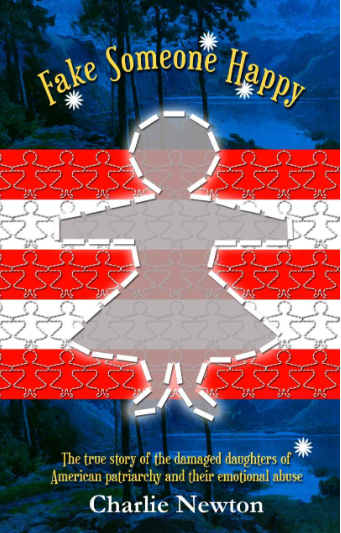
“Fake Someone Happy”: A Book Review by Rebecca Irene Gorman

Also by Rebecca on HA: “I Was Beaten, But That’s Not My Primary Issue With Homeschooling.”

Possibly over half a million American women obediently serve their parents’ households, locked in a perpetual childhood, with no means of escape.

Charlie Newton's "Fake Someone Happy" is about a young English musician who accidentally becomes entangled in the American Patriarchy movement.
Charlie Newton’s “Fake Someone Happy” is about a young English musician who accidentally becomes entangled in the American Patriarchy movement.

Call it the Quiverfull Movement, Christian Patriarchy, the Stay at Home Daughter Movement, or Reconstructionism — that’s as close as you’ll get to giving it a name. Adherents simply call it ‘obeying God’ or, even, ‘loving God’. What it is at essence is the modern American denial of women’s humanity, the entire deprivation of her rights, the erasure of her personality. And it’s vividly portrayed Charlie Newton’s recent non-fictional, anonymized short novel, ‘Fake Someone Happy’.

The story is about a young English musician who accidentally becomes entangled in the American Patriarchy movement. What begins as a joyful immersion into a community of loving, picture-perfect families devolves into an horrific submersion into a world of exploitation, coercion, and betrayal which challenges the heroine’s understanding of friendship, the world, and herself.

I highly recommend this book as a window into the world of American Christian Patriarchy.

As a survivor of this subculture, I can vouch for the accuracy of the depiction. In fact, this world and the plight of its survivors is rarely depicted in such vivid detail. Some might nit-pick at the fact that the writing does not constitute a literary masterpiece; however, the author has achieved the significant triumph of transporting her readers to this vast, hidden, and rarely-depicted dark world.

I do have some reservations about the book’s depiction of a survivor after her escape. The heroine’s unfamiliarity with the psychology of second-generation cult members and American Christian cultural norms manifests in understandable frustration which, however, the author fails to resolve. My suggestion to readers is to read this book in combination with others that delve deeper into the psychology of survivors of Christian Patriarchy and their journey of recovery, healing and growth.

To that end, I recommend the following books:

Quivering Daughters, by Hillary McFarland — The story of the exploitation of a daughter of Christian Patriarchy and her theological journey to empowerment and freedom.

Pilgrim’s Wilderness, by Tom Kizzia — A journalist’s masterfully written and insightful account of a Patriarchal family with subjugated adult children which moves to the Alaskan wilderness, with an excellent treatment of the psychology of captivity and escape.

Quiverfull, by Katherine Joyce — A rigorous investigation of the modern Patriarchy/Quiverfull movement.