** In the introduction to my blog series in 2012 about Adult Homeschoolers I wrote that “everyone turned out fine.” This phrase may seem odd and may even seem hurtful to some HA readers and writers due to the fact that many of the stories on HA deal with the painful past of many adult homeschoolers. The purpose of sharing that “everyone turned out fine” was to state that everyone who participated in my series is now a strong, functioning adult who has worked through or is working through any struggles from their homeschooling background.
The purpose of my series was to look at the “good, bad, and ugly” issues of homeschooling in an honest and fair way, with the underlying thread of hope by sharing the experiences of many adults from all around the USA. I hope that, as you read, you will be able to identify with the stories of these men and women as they share the reasons their parents home schooled, their elementary and high school years, the “best” and “worst” thing about homeschooling, adjusting to college, socialization issues, and if they plan to homeschool their own children.
I hope that as you read, you will also feel hope; know that you are not alone.
*****
Part One: Why I Wanted to Write This
I was a first generation homeschooler.
…meaning my parents starting homeschooling in in the late 1980s right after it became legal in Nebraska (where I was born). In my elementary years, when someone asked where I went to school, 99% of the time my answer would produce a furrowed brow and the question, “What is homeschool?”
Nowadays, everyone knows someone who is homeschooling or who was homeschooled. First generation homeschoolers have grown up, gone to college, and have started families of their own.
What do they think of their homeschool experience?
Were they happy and satisfied? Did they wish for more?
Were they prepared for college academically and socially or were they scared, unprepared and awkward?
Are they stereotypes of homeschoolers true? (homeschoolers are brainy/stupid/socially stunted/well rounded/fill in the blank?)
I spent hours on the internet, trying to find articles, blogs, anything written by former homeschoolers about their homeschool experience. I was disappointed by what I found (or the lack there of). Either I found stats about how homeschoolers are successful (with no personal testimony involved) or personal testimonies that I distrusted because I thought they were too “Pollyanna” in nature. I wanted to read about the honest experiences of adults homeschoolers, the good and the bad, the advantages and disadvantages, their thoughts on their academic experiences and the issue that homeschoolers everywhere never seem to escape:
“What about socialization???”
So I put together a short survey and and used the wonderful world of social networking to launch this blog series. I received 42 responses from adult homeschoolers from all over the USA (childhood friends, people I went to college with, friends, and friends of friends).
I am excited to share the data I have collected with you: adults who were homechooled, parents who are homeschooling their own children (and may be wondering, “Am I doing the right thing? Am I messing up my kid? WHAT ABOUT SOCIALIZATION????”), or anyone else who is curious about the lives and experiences of homeschoolers.
Here is a little sneak peek at the end of the story: Everyone [that took my survey] turned out fine. **
Not always “happily ever after” and not without some bumps, awkwardness, struggles, and obstacles on the journey to adulthood.
But, really, everyone [that took my survey] turned out fine.
[Some] parents, breathe a sigh of relief.
And keep reading.
You can look forward to personal testimony about topics such as:
Why first generation homeschool parents decided to homeschool
The academic and emotional experience of homeschoolers in grades K-8
The academic and emotional experiences of homeschoolers in grades 9-12
Do homeschoolers pursue higher education?
Were they truly prepared academically?
Were they truly prepared socially?
What is the best thing about homeschooling (so many people said the same thing! amazing!)
What former homeschoolers wish was different about their experiences
The inside perspective about the advantages and disadvantages of homeschooling
Do former homeschoolers plan to homeschool their own children?
The homeschoolers perspective on society’s thoughts and opinions about homeschooling
This series will be honest in every way, exploring the good, the bad, and everything in between. While my posts will primarily be focused on the results of the survey, I will also share my thoughts and experiences as they relate to the survey results.
I hope that this series inspires conversation, stirs up memories (for former homeschoolers), incites conversation, provides insight and information, and ultimately encourages those who read. Please feel free to comment, ask questions, and share your own thoughts and experiences.
It’s hard to believe that it was just a month ago that we launched Homeschoolers Anonymous. So much has happened in so few weeks! This is really due to the amazing and wonderful support that you, our community of friends and family and advocates and peers, have so graciously provided.
In a mere month, our WordPress blog has reached nearly 100,000 views. More than 260 comments — almost universally positive — have been made on the site. Our Facebook page has received almost 300 likes. Our most popular post to date, a crosspost by blog partner Kierstyn King (“Sex™ (and the lies I was told about it)”), has been viewed over 3500 times; the second most popular post, R.L. Stollar’s “Homeschool Confidential, A Series: Part One,” has over 3000 views. Michelle Goldberg covered our story on the Daily Beast. We’ve also received coverage by the Daily Mail and Lez Get Real, both Google News providers. We’ve also received inquiries from other major media groups and will keep you posted on those developments.
This is a very difficult project. If you have any experience at all with the conservative Christian homeschooling world, you know how defensive they — we, really — have been, are, and will likely continue to be. You can see how afraid some of us are about speaking out with our experiences. Qualifications and disclaimers abound. The fact that such fear exists, merely about saying one has had a personally negative experience in homeschooling, is indicative that something has gone awry. No one should feel afraid of speaking up about abuse or hurt or pain. That is why we feel this community is so important and necessary. We want to create a platform for sharing and healing. We want to be a voice in defense of those who have been hurt.
It’s truly been a wild ride. We’ve been accused of being nut jobs, anti-God, anti-homeschooling, a vast liberal conspiracy manufactured by Obama, the NEA, and the ATF, and opportunists that want to take advantage of abuse victims in order to achieve vast fame and fortune.
But as someone much wiser than us once said:
Haters gonna hate.
We’re here and we’re not going away. We will continue to share stories, we will not be silenced by intimidation, and we will do our best to represent our collective voice accurately, compassionately, and strongly.
Thank you for your encouragement, support, and love. We are very grateful. Thank you, thank you, thank you.
In honor of our one-month anniversary, we’ve decided to take our top search terms — the phrases that people have Googled that have led them to us — and ask each HA Community Coordinator and Blog Partner to write a paragraph about one of the search phrases. (Some of us went over this paragraph limit.) This was presented to them as a creative challenge. They could write whatever they’d like that they thought was important to say to whoever might be drawn to our site because of the phrase in question. To make this a bit more challenging, we intentionally switched up who wrote about which search term, so it’s different than what that person might normally write about.
The idea is to highlight both the diversity of our voices and the unity of our mission.
So, without further ado, we present to you the first ever group post from Homeschoolers Anonymous!
*****
“homeschoolers abused” — by R.L. Stollar, HA Community Coordinator
Not all homeschoolers experienced abusive situations. Not all homeschoolers have the same story. The fact is, homeschooling is a vast and diverse phenomenon that includes different religions, different political beliefs, and an immense variety of educational philosophies and teaching styles. But from my own personal experience in the conservative Christian homeschooling subculture, I can confidently say that — within my particular subculture — there is a tendency to operate from an “Ideology First” mentality, instead of a “Children First” mentality. And when you elevate the importance of ideology over the humanity and well-being of kids, you can easily create cult mentalities. And cult mentalities can cause immense hurt and pain for so many people. They can create emotional, mental, physical, and sexual abuse.
Not all homeschoolers experienced abusive situations. But many have.
Not all homeschoolers have the same story. But there are striking similarities.
I want their stories — my story, our collective story — to be heard. And if you listen with an open heart and mind, maybe you can help us make homeschooling better in the future.
*****
“homeschoolers anonymous” — by Libby Anne, HA Blog Partner
Why homeschoolers anonymous? I think I understand why. The first time I met someone raised in the Christian homeschooling subculture who had, like me, grown up in a homeschooling family and then questioned and left the pervading ideology of that family and subculture, I was overwhelmed. Before, I had felt alone. Like it was just me. Invisible, unnoticed, an anomaly that people didn’t acknowledge, or even know, existed. When you realize that you’re not alone, that it isn’t just you, everything changes. And some of those who visit Homeschoolers Anonymous may still be in the closet or on the wall, unready or unable to make the leap, to say that there was something wrong, to speak about and acknowledge the hurt and the pain. And that’s why we’re here.
*****
“stand up for my children” — by Vyckie Garrison, HA Blog Partner
I know this will be controversial, but when I was asked to write about the search phrase, “stand up for my children,” I immediately thought of the period of time when all the abuse and dysfunction of our Quiverfull lifestyle culminated in a nasty court battle when I left my ex-husband and sued for custody of our six children who still lived at home.
My lawyer told me that I would need at least three people who would be willing to write affidavits for the judge stating that they were aware of abuse in our home. I was extremely discouraged because I believed I had done such a good job of covering up for my husband and protecting his reputation that nobody, with the possible exception of my mother, had any clue that there was anything amiss in our “big happy family.”
Undaunted, a fellow homeschool mom started making phone calls, and in about a week’s time, was able to gather more than 20 affidavits from friends, family, and acquaintances who all testified that they had been aware that the children and I were being abused.
That’s over twenty Christians who could have stood up for my children and spared us all those years of abuse.
I understand that as evangelical Christians we were all taught to fear the evil government social workers, but looking back now, I can honestly say that the court-ordered involvement of CPS was one of the best things that ever happened for my family.
I have plenty of suggestions for intervention and support (see the NLQ FAQ: How can I help my Quiverfull friend?), but if you clearly see children being abused or neglected, please call this hotline and get the family some outside, professional help: 1-800-4-A-CHILD.
*****
“homeschool uniform denim jumper” — by Nicholas Ducote, HA Community Coordinator
Jumpers, especially the denim variety, were the unofficial uniform of the homeschool mom. My mother had an entire closet full of jumpers in an array of colors, but none rose above her knee. I can count on two hands the number of times I’ve seen my mother wear pants in the last decade. I wish it wasn’t so stereotypical, but a quick Google search of the terms “denim jumper” will bring you to www.denimjumper.com – “your source for everything homeschooling.” Most Christian homeschooling sub-cultures emphasize modesty in young women, especially in reaction to what they see as an over-sexualization of young girls, but their attitudes often read like an unironic guide to rape culture (i.e. The Rebelution’s Modesty Survey). In short, women are told their bodies can make men lust and, in a revolting twist of logic, the immodest women is responsible for “defrauding” the lusting man. Young women are encouraged to hide their curves behind baggy jumpers or long skirts and modest tops. Fashion, they are told, only serves to bring excessive attention to the superficiality of a woman. Modest, godly women do not need to appeal to a man’s lust. Instead, she strokes his ego by serving in the cult of domesticity.
*****
“homeschool cult” — by Anna Ruth Fuller, HA Community Coordinator
Think about what a homeschooler looks like. What comes to mind? If images of religious children passing out pamphlets or holding signs comes to mind, you’re thinking too narrowly. If images of hippies unschooling their children comes to mind, you’re again thinking too narrowly. Broaden your thinking.
Homeschooling occurs everywhere and for all types of reasons. The same is true of public schooling and private schooling. How you choose to educate your children is your choice. However, it is important to remember that in all of this, children have a right to their own views that aren’t necessarily your own. This is true no matter what type of schooling they undergo.
So what happens when parents do not respect a child’s right to their own worldview? Now don’t get me wrong, I’m not talking about letting your children run amok. There’s a difference between pure hedonism and having a worldview.
Not letting your children choose their own worldview is a dangerous road to take. It might seem like a good idea at the time since it is easier to control a child’s thoughts than to guide them. Most parents these days recognize that guiding their chidren’s thoughts is the way to go, but there are those that still cling to controlling them.
It is considered bizarre to isolate your children from the world so that you can protect from worldly things. We are becoming a global society with the advent of the Internet. Preparing your child for the different worldviews they will face (and more importantly, how to respect them for what they are) is crucial to that child’s success. Yet there are many Christian homeschooling parents that purposefully decide to isolate their children from all of this. It is this type of homeschooler we are bringing to light here with our stories.
This brings me to my topic. One of the most popular search terms for our site has been ‘homeschool cult.’ When I learned that, I began think about whether we were really part of a cult as Christian fundamentalist homeschoolers. According to Wikipedia’s article on cults: “The word cult in current popular usage is a pejorative term for a new religious movement or other group whose beliefs or practices are considered abnormal or bizarre by the larger society.”
This definition makes me think we weren’t part of a cult. To have been a cult, we would have needed to have been unified religiously somehow. We weren’t. Each of us went to churches in conflict with each other on various minutiae. There was one thing that united us and that was the need to reclaim this country for the Christian God. Our parents wanted us to dream of a Christian nation and placed that first and foremost in our minds by excluding the teaching of other worldviews (thankfully this didn’t happen nearly as much to me as it did to others). We were trained up in debate to help us become better lawyers and politicians to lead this new country to its destiny. So in reality, we weren’t part of a cult in the religious sense. While there were certainly practices and behaviors that could be seen as cult mentalities to outsiders, we were less a part of a religious movement and more a part of a political movement.
*****
“homeschool and abuse and fanaticism” — by Kierstyn King, HA Blog Partner
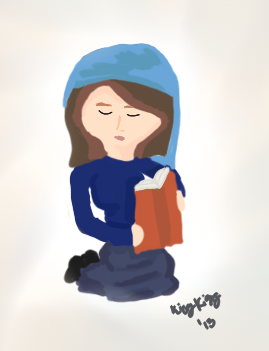
Art by Kierstyn King.
This is a touchy subject, because you’re screwed in the eyes of parents or vehement pro-homechooling-beyond-all-reason-crowds from the start. The fact is, this sentence and search term oddly defines my experience in a very succinct way, and like the lonely oppressed girl over here, it’s not a good thing. Homeschool and abuse and fanaticism don’t have to be related, but sometimes they are and here’s how: parents have the idea to homeschool, they then are told they must homeschool to essentially indoctrinate their children to their cause (fanaticism) which in some way or another usually is along the lines of “taking over the world” (who doesn’t want world domination?). Of course getting to that point means squelching the life out of the individuals you’ve stopped seeing as human and started seeing as arrows – focused solely on your needs, wants, and purpose you deny basic rights, dignity, and sometimes the security of unconditional love to the child you’re supposed to care about above everything else (abuse).
The unnecessarily necessary disclaimer here is: obviously not everyone is like that (but some people are).
*****
“why all of the attacks on homeschoolers” — by Julie Anne Smith, HA Blog Partner
I have been homeschooling my children for the last 20+ years. When I hear about “attacks” on homeschooling, I suspect there could be some confusion. Taking a closer look at the attacks, generally, it is not homeschooling in general that is attacked (ie, the education of one’s children at home), but more specifically, a lifestyle connected with the “Homeschool Movement.” The Homeschool Movement is associated with practices and ideologies not even remotely related to scholastic achievement, e.g., full-quiver lifestyle, patriarchy, purity and modesty teachings, etc. These practices and ideologies have had mixed, and sometimes very sad results. The methodologies employed to enforce these lifestyles can also be troublesome. The Homeschool Movement must not be confused with homeschooling. I believe homeschooling to be a valid and exceptional option for motivated and capable parents who have a vested interest in the proper education of their children.
*****
“homeschooling and mental illness” — by Latebloomer, HA Blog Partner
For a well-informed and supported parent, homeschooling may be an excellent way of supporting a child suffering from a mental illness. It could allow for high quality personalized instruction, easier access to appointments with medical professionals, and protection from peer bullying. Unfortunately, the combination of homeschooling and mental illness also has the potential to do great harm. For instance, children with mental illness can go undiagnosed for much longer if they do not regularly come in contact with trained educators and medical professionals. Distrust of those resources is very common in fundamentalist homeschooling circles, where parents are much quicker to blame unusual behavior on rebellion and worldly influences. An additional concern is the potential for harm when a child is homeschooled by a mentally-ill parent. The child will often be far more affected by the parent’s mental illness because of the increased time spent with the parent and the lack of time with other adults. For such children, the parent’s paranoia, depression, narcissism, etc, define their entire childhood and hinder them from developing positive and healthy relationships with others even in adulthood.
*****
“which is more effective for learning homeschool or public school?” — by Brittany Meng, HA Blog Partner
So you’re wondering which is more effective for learning: homeschool or public school. To answer this question more effectively, you should add the phrase “for my child.”
It all depends on what your child needs to be an effective learner. Here are a few issues to consider about the effectiveness of homeschooling for certain ages and needs.
Elementary school: Homeschool can be very effective for Elementary school because children often need one-on-one time to learn basics like reading and math, which are foundational for a strong education. If your child needs extra help in these subjects, homeschooling might be a good choice. On the other side of the coin, if your child is advanced in these areas, homeschooling might be good for your child as well. Nothing squashes the natural love for learning faster than a child who is bored. Homeschooling allows you to move at your own pace.
Middle School: Let’s just face it—middle school stinks for most people. Homeschooling will not remove all awkwardness, angst, self-doubt, or attitude problems from your child. However, if social issues are getting in the way of your child’s academic success, homeschooling may be a good option for your family.
High School: By this point, most young people are able to voice their educational and social needs. These wants and needs should be taken into consideration. This is also the point where parents need to consider how capable they are to meet the needs of their child, especially if he or she wants to go to college. I believe that homeschooling can be effective in high school but only with a strong outside support and supplemental network: classes at a local high school, community college, and/or homeschool co-op.
Personally, I believe that homeschooling becomes less effective for learning the older the child gets but this is a blanket statement. Only you can determine what your child needs.
You also have to consider the needs and abilities of your family: finances, time commitment (contrary to what many people think, your child needs as much academic attention from you in 1st grade as he does in 10th grade. Kids need accountability, motivation, and a sounding board for ideas), a strong support network, and whether or not you actually want to homeschool. Even if you feel that homeschooling would be the best option for your child, if you don’t want to homeschool, don’t do it. Homeschooling is a huge commitment. You can’t toe the water; you have to jump in with both feet. However, some states allow your child to be homeschooled by someone else. Check into all your options.
When choosing the best learning option for your child, it is important to consider what you and your child need and want both academically and socially. So, which is more effective public school or homeschooling? It all depends on your child.
*****
“pscyholgoy of bad/evil” — by Lana, HA Blog Partner
In conservative circles parents often have a tendency to refer to their children as all good or all bad. In public — that is, among other conservative families — kids often are forced to play the role of the perfect family, the perfect godly family. I felt this a lot as a child when we did cookouts with other homeschool families, or a respected homeschool family came over for dinner. I had to smile and pretend that I was godly (whatever that means) while everyone talked about how we were great and the future of America. At home our house was in shambles, but none of that mattered around our friends. Perhaps this alone would make a child go crazy. Why is it necessary to fake it? Why weren’t we genuine? Was it all in my head that my home was dysfunctional? Was it my fault when I was unhappy? Was my friends’ home totally perfect? These are legit questions that I and many others have experienced, but the confusion goes much further. For every time a child is praised as good, its likely that he or she is shamed as bad for the most ridiculous things at home. I was taught that I was not dressed until I wore a smile. If I did not wear a smile, I was ungrateful. If I expressed frustration (that admittedly did get out of hand sometimes), I was disrespectful. A simply bad act is escalated as totally evil or rebellious. There are plenty of homeschoolers who had it much worse, directly being called evil for not being submissive to an abusive situation. And so the soul is torn between good and evil. Sometimes kids just need to be told they are human. We aren’t perfect. We aren’t all bad. We’re human.
*****
“living my life” — by Heather Doney, HA Blog Partner
What my life was supposed to be was set. One story said that because I am a woman, by the time I was 30 I was supposed to have been married for a decade and have somewhere between 3-6 kids, homeschool them in a nice house, and be involved with a local church. The other story was that I was supposed to have a mid-level office job where I wore business suits and cute pumps, had a comfortable salary with decent benefits, ho-hum dates with guys who wore nice watches, and appletinis with the girls on weekends.
Neither are my life. I truly thought I was supposed to somehow make one or both my reality, that they were in fact the going realities available, but now I know they weren’t, at least not for me. I knew it just didn’t feel right, but I somehow figured I’d still end up in one or the other. I didn’t. I’m still just me, and while I do own a business suit and those cute pumps today, I generally wear flats or leather boots with jeans. I have only a laptop computer, not a cubicle, to go to. If I’d wanted a baby already I expect I could have had one, but I didn’t. I don’t go to church and I don’t even like appletinis (or guys who wear expensive watches, for that matter).
So while I didn’t want my life to look like either of these so-called options, I didn’t know what it should look like. What I knew it shouldn’t look like was what I call “living in the meantime.” I lived in the meantime for a few years and meantime mode is where you just let life happen to you, figuring it knows what is best, not-so-patiently waiting until it resembles one of your ideals. The scary thing is it likely never will. You can easily spend your whole life in meantime mode, waiting on serendipity to rescue you, and the thing most people forget about serendipity is that it isn’t just some happy accident or eureka moment that breaks you out of your ordinary life. Serendipity is what you find while you are out looking for, working on, and doing other things. Because serendipity requires action, it is a lot harder to find while in meantime mode or while you’re living someone else’s idea of your life, just going through the motions.
So to me living your life is not about doing one thing or another but about breaking out of that. It is about actively writing the next chapter to look differently, resetting the script, welcoming the changes, courting serendipity. It is about “if you build it, they will come.” In order to do that you have to do something scary though – be real about the person that you know you are, not stuck on the one you feel you “should” be. You can’t go squeezing yourself into a role that makes you look like you’re wearing somebody else’s style.
To live life, forget the ideal life someone else created for you and said should be yours.
HA note: The following is reprinted with permission from Brittany’s blog BAM. It was originally published on March 26, 2013.
Scene: Walking home from dropping the boys off at school. I stopped to chat with a fellow mom.
Other mom: Hey there! Are you on Facebook?
Me: (thinking, Who isn’t??? I LOVE FACEBOOK!) Yes!
OM: You should join our new group, the Perrymont Parent. It has the picture of the school as the profile pic.
Me: Awesome! I’ll join.
OM: Great! By the way, we are looking for parents to write a brief note about their child’s teacher, what you like about them, or whatever, to put in the school newsletter.
Me: I love my kids’ teachers! I’ll be sure to write a little something.
And I did. I joined the FB group and I spent 7 minutes composing a short love note for each Pre-K teacher for my twins. Because I do love their teachers. I love their school!
I love their Public School.
And the fact that I love their Public School is a little surprising to me. Here’s why:
As a former homeschool student, the prevailing thought was that all public schools were “bad.” Public school students were only “a number” in the classroom, would get lost in the crowd, and would therefore get a “bad” education. Public school kids were a “bad” influence because of their “worldliness” and bad attitudes. All the teachers were some combination of atheist/evolutionist/Marxist/liberal/lesbian/tree hugger and that was “very bad.”
Growing up, I was deathly afraid of public school.
Fast forward 20+ years and I am much smarter, wiser, more logical, and less silly.
I also have twin boys who are school age.
Last year when I launched my blog series about Adult Homeschoolers, the drive behind the project was my overwhelming, agonizing, paralyzing decision about whether or not to homeschool or send my kids to public school (private school wasn’t an option). All those fears from my childhood were blunging my brain, making my stomach cramp, and keeping me awake at night.
So I dove into exploring my educational past, and the educational experiences of so many other homeschool students. I talked the ears off my husband (who went to public school) and my best friend (who went to private school). I accosted to every mom I came in contact with (friends, strangers–whatever!) who happened to mention that she had school age children and threw out that loaded question: “So, public school?….how do you like it? Have you had a good experience?”
And, amazingly(!), all of those moms who sent their kids to public school answered, “YES!”
I had to face my fears with Truth:
My husband, a product of that “bad” public school system, turned out perfectly fine. In fact, as far as I’m concerned, way better than “fine.”
Through writing my homeschool series, I realized that I, as my children’s parent, will still be the #1 influence in their lives. I could still have a great relationship with my boys. I could still teach them about God and having a relationship with Him. I could still raise them to be respectful, grateful, loving men.
Even if I choose not to homeschool.
Even if I sent them to Public School.
So, we enrolled them in the small neighborhood Public School that is literally right across the street from us. I nervously asked my husband, “So, what is registration?” and then filled out all the forms, crossed all the T’s, dotted all the i’s. And they started school in August.
They loved it.
A few weeks later, I nervously asked my husband, “So, what is a ‘parent/teacher conference’? What do I say? What do they say?” and then went to have a one-on-one with my sons’ Public School teachers.
And I loved them.
They are wonderful women: kind, patient, creative, loving, and darn good educators. My children are learning so much in a loving, creative environment. My husband and I are constantly saying that each teacher is perfect for the personality and learning style of each of our sons. During one of our parent/teacher conferences, I told one teacher that she had been an “answer to my prayers.” She then shared about her relationship with the Lord.
Yep, the public school teacher.
The uncharted waters of Public School have been far from “bad.” They have been good, so good for our family.
I do know that all the stereotypes that I encountered as a homeschool student were probably not completely unfounded. Many parents have had justifiably bad experiences with public school classrooms, teachers, and their child’s peers.
However, stereotypes are just that: stereotypes. They are not true in every instance, or even most cases. And after our experience in the Public School system, I now take those stereotypes with a healthy grain of salt. As a former homeschooler, I am more than happy to shed my fears and add “Public School” to the list of viable options for my children as my husband and I continue to make conscience decisions about what is best for their education.
 Homeschoolers Anonymous