The Story of an Ex-Good Girl: Part Eight

Barn

HA Note: The following is reprinted with permission from Exgoodgirl’s blog The Travels and Travails of an Ex-Good Girl. It was originally published on August 19, 2014 and has been slightly modified for HA.

<Part Seven

Trigger Warning: Depictions of physical abuse and gaslighting

Part 8: A Whip for the Horse, a Bridle for the Donkey, and a Rod for the Back of a Child!

From the beginning, my little brother B was a happy-go-lucky troublemaker, more interested in exploring and trying new things than in whatever rules he might be breaking!  Like most small boys, he was often getting into things he shouldn’t, being loud, engaging in rough boy-play, and sometimes careless with the truth.  Nothing too unusual for a small boy (or girl!).  These small misdemeanors brought scoldings from my parents, after which he’d continue on his happy-go-lucky little way.  He wasn’t a bad kid.  He was just a kid.

His personality did not sit well at all with Joe LaQuiere and his philosophy of parenting.  Everyone had the responsibility to be self-controlled and model godly behavior at all times, he said, and children were absolutely no exception.  The reason everyone around Mr. LaQuiere had bad results (bad children) while his were good was that he recognized that it was a misconception that children needed to act and be treated as children.  They should absolutely not be held to a lower standard than anyone else – that was insulting them and their Creator.

They were subject to the same expectations as adults.

And if they violated the rules, stern discipline was the key to correcting the problem.  “As the twig is bent, so grows the tree”, said Mr. LaQuiere.  If you want to correct the wrong bent in a twig, you must exert as much force as necessary to force it to stay in a straight position and maintain that force until the new position becomes permanent.  Children are malleable.  If they are expected to act like adults, they will learn to act like adults.  They will rise to the level of expectation placed on them – and if they don’t, it is the responsibility of their parents to forcibly hold them to those expectations.

From the first, Joe LaQuiere zeroed in on my brother B as a “bad seed” in need of a strong hand of correction.  He didn’t like his attitude, his carelessness about rules, his little-boy jokes, or his tendency to be found in the middle of any mischief.  These were all characteristics of a fool, he said.  Mr. LaQuiere despised anyone who was a fool.

Because B was a fool, Joe decided he needed to make an example of him whenever possible, to teach him (and the rest of us watching) a lesson about how God feels about fools.  This started when B was five years old.

One of the character flaws Mr. LaQuiere hated most in B was a tendency to lie to avoid getting in trouble.  As B was always getting scolded for getting into mischief, he’d often lie about things to avoid being punished for his little crimes.  Mr. LaQuiere decided this was one thing he would not stand for, and he intended to stamp it out quickly and forcibly. He informed everyone in the group that my brother B was “a liar”, and nothing he said was to be trusted at any time.  Unless there was independent verification from someone else “trustworthy”, any statement B made was jumped on and accused of being a lie.  Mr. LaQuiere encouraged all the men in the group to join in on “helping” to correct B in this way.  One time, the husband of my mom’s best friend, Mr. W, decided he would give B an object lesson.  He pointed to a green ball on the grass and asked him, “What color is that ball?”  B said it was green.  Then this man turned to me, and asked me, “What color is that ball?  Tell me it’s yellow.”  I didn’t know what to do, but I knew I had to respect and obey all adults, so I squirmed a little, and said it was yellow.  He turned to B and said, “See?  You’re a liar.  I trust your sister because she tells the truth.  You…you’re a liar.  It doesn’t matter what you say: everything you say is a lie.”  That scene impressed itself deeply on my memory and my conscience.  It was just one of many conflicts that raged in my heart from then on.

I knew B hadn’t lied, but I was told that adults were infallible, not-to-be-questioned, and God’s direct representatives to us.  How does a child reconcile those two things?

Punishments (though they were never called that–Mr. LaQuiere made it clear that this was “discipline”, never punishment) were many and varied.  B was often made to stand in the middle of the floor for some misdemeanor or other, and stay there all day, missing meals, until Mr. LaQuiere said he could move.  He wouldn’t be allowed to work with the other boys and men (“that is reserved for boys with good character who we can trust”) and was made to help Mrs. LaQuiere with laundry and other “women chores” as a mark of shame.  He had all privileges revoked, even the privilege of speaking sometimes, or having anyone speak to him for days at a time.  He was “tomato-staked”, which meant he was to be within twelve inches of Mr. LaQuiere or my dad at all times, and not allowed to interact with anyone, because he “couldn’t be trusted” out of their sight.  But those were the mild punishments.

“The rod is for the back of a fool,” Mr. LaQuiere would say, and he didn’t mean it figuratively.  In the bottom drawer of a tall chiffonier in his living-room he kept The Paddle.  About 2 1/2 feet long, and 1/4 inch thick, the Paddle was made of wood and had finger-grips carved into it, to make spanking easier for Mr. LaQuiere.  It was an instrument of fear to all of us and used to “correct” children for anything from minor rule infractions to major “sins of rebellion”.  The offending child would be sent to fetch their own instrument of punishment and bring it back to Mr. LaQuiere.

In our own homes, our parents would inflict corporal punishment: in Mr. LaQuiere’s home, he always carried it out personally, no matter whose child it was.

B was sent to get the Paddle more than any other child in our group.

Being “paddled” involved telling the child to bend over and hold his ankles.  They were not to let go under any circumstances until Mr. LaQuiere finished the punishment and said they could move.  They were also only allowed to cry silently, or as silently as possible.  Wails or screams were punished with further beating.  Any infraction of the rules resulted in starting the punishment over again.  The minimum number of “paddles” was 5, but that was reserved for extremely minor infractions, or for very young children, maybe 3 – 5 years old.  For most of us, the average beginning number was 10, but this was quickly increased for any breaking of form while being paddled: if you let go of your ankles, Mr. LaQuiere started counting again from the beginning.  If you put your hands behind you and they got hit with the Paddle, Mr. LaQuiere started again from the beginning.  If you cried loudly, he started over.  If your crying sounded angry, he started over, and sometimes tacked on extra paddles for showing “rebellion”.  It was common for my brother B to be struck upwards of 20 times during one “paddling”.

Each “paddle” was accomplished by Mr. LaQuiere taking a full-bodied swing and hitting the exposed rear end of the child with the full force of an adult male (this was modified for the small children, but it still hurt good and proper, as it was intended to).

For the children that were considered “good”, like me, spankings were rarely experienced first-hand.  Instead, Mr. LaQuiere told my parents that I was a child “who learned best by watching”.  Meaning that I wasn’t actually committing offenses deserving of being spanked, but I was forced to watch all my siblings and friends get spanked, because that would teach me to be “afraid of sinning” and I would be even less likely to sin myself.  I was forced to watch a lot of these spanking as a young child.

What made it the most traumatic for me, even more than seeing my terrified brother or cousins being hurt, their wide eyes streaming tears as they fought to hold back the cries that would earn them further punishment, was the fact that Joe LaQuiere treated it like it was funny.

He would smile, laugh, and even joke with the other adults while he was carrying out these beatings.  This was to show that he wasn’t punishing “in anger”, but out of love and genuine care for us.

Once when I was 9 or 10, during a public “paddling” of my brother B, I ran into the dark front room and hid under the piano, my tears mixing with my panic.  I sat there in the dark, hugging my knees, until Mr. LaQuiere’s oldest daughter came and found me and coaxed me out, telling me “everything was fine”, and “there was nothing to be sad about”.  I dried my tears and went with her, but the fear remained.  Maybe these kinds of experiences – watching my siblings be hurt by other adults while my parents watched and joined in laughter – are why I can’t remember ever being afraid.

I live with fear every day of my life since then, and it took me well over a decade after we left to realize that it is really not normal for a child to live life in constant fear.

The thought of how I’d feel if my own children were forced to endure or watch the things I was made to, makes me want to vomit.

When my brother B was 10, he developed a nervous tic – an involuntary twitch in his eye. I’m personally surprised it didn’t start sooner. It started off happening every time an adult made eye contact with him but increased until it was nearly a constant thing.  It was nearly impossible for him to look anyone in the eye.  To correct this “misbehavior”, Mr. LaQuiere told my parents to put rubber bands on his wrist, and snap him every time he did it.  His wrists were red from then on; even so, it was a long time before he could learn to control the eye twitching.

“Paddlings” were not the only punishments my brother B endured.  As he got older, it seemed like any and every expression of anger, contempt, disgust and violence was fair game.  The most violent of the treatment took place during the times we were working construction with the rest of the families.  My memories of this time are somewhat hazy, maybe because my subconscious is protecting me, but I easily recall him being called “lazy” “foolish” “ignoble” “idiot” “knucklehead” “stupid”, and other names — not by other children, but by the adults.  In addition to the regular beatings he received in public, or behind closed doors in Mr. LaQuiere’s home office, he was often dragged places by his hair.  He was thrown against walls.  He was held up against the wall by his throat, high enough that his feet dangled off the ground.  These things were mostly done by Mr. LaQuiere and the other men in the group, but eventually they were also done by my father in the privacy of our own home, as he fought to control an increasingly-troubled B who was getting older and older, and still a “problem” to his authorities.

Other children were considered “hardened” and “problem children”, but none received as much time and attention at the hands of Joe LaQuiere as my brother.

B was targeted for verbal, emotional and physical abuse from the age of 5 until we left the group when he was 13 (though the pattern continued at home for many years after that).

Years later, my dad would express regret over this treatment of B, but his most recent comments on the situation to me were that “he doesn’t have much sympathy for B and J, because they weren’t ‘innocent’, and also, it’s hard to feel too bad for them when they’ve gone on to make bad life choices as young adults”.

I’d like to ask my dad why he considers my brothers “not innocent” for acting like children, but seems to carry no lasting guilt for himself for letting other full-grown men physically abuse his sons and joining in on it himself.

I’d like to ask him how he can see the devastation and depression in my brother B that followed and that has plagued him through his adult years, and not feel responsible.  How he can’t see the link between the abuse and the high level of control they grew up under and their tendency to make “bad choices” later on.

But I also feel guilt myself.  Guilt that I didn’t stand up for my brother.  That I didn’t tell somebody who could have stopped it, though we were strongly ingrained with fear of Child Protective Services, and heard horror stories of older children who “informed” on their parents, and had CPS come snatch all the children away.

So calling CPS would never have entered my mind as a possibility, even if I hadn’t been too afraid to take action.  Though my adult logic can admit that I couldn’t have done much, if anything, to stop the abuse, I still feel guilt and grief over what was done to my brothers, and my own inability to stop it.

Part Nine>

photo credit: Joel Dinda via photopin cc

The Story of an Ex-Good Girl: Part Four

Barn

HA Note: The following is reprinted with permission from Exgoodgirl’s blog The Travels and Travails of an Ex-Good Girl. It was originally published on August 2, 2014 and has been slightly modified for HA.

Trigger warning: graphic depictions of infant abuse

< Part Three

Part Four: Rebellion is as the Sin of Witchcraft

Later on, in that first year of Wednesday night meetings, I remember the child-training starting in earnest.  My youngest brother at the time, J, was a year old, and I remember him being an exceptionally happy baby.  He had reddish curls and an infectious grin, and he laughed all the time!  We have pictures of him playing in the grass, or being bounced by my sister or mom, and playing in the sand at the beach, and he was smiling in all of them.  That all changed.  Mr. LaQuiere decided it was time to teach his parents-in-training how to properly train obedience in children.  The only way to get good obedience in was to get bad rebellion out, starting as young as possible (which in our case was already too far behind us he said–if he had known us sooner he could have started training J when he was only a few months old and still a fresh slate; but as J was already a year old and set in his ways, we had better not lose any more time!)  So the process was started of teaching a wiggly toddler to sit quietly and obediently on his parents’ laps.  Refusing to sit still, whining, or worst of all, arching the back in protest, were all signs of rebelliousness in a baby (we were directed to the verses of how “foolishness is bound up in the heart of a child” and assured that babies are born with this sinful rebellion that starts to show itself practically the moment they arrive home from the hospital).

This rebellion needed to be corrected, because rebellion was the most serious and evil of all childish sins – “like unto the sin of witchcraft”, as the King James Bible says.

This correction was accomplished in various ways.  Mostly it was through repeated swats and slaps on J’s leg or bare bottom, hard enough to sting, every time J tried to get down or refused to sit still.  They worked with him on this for longer and longer periods of time, but instead of turning docile he fought it harder and harder.  He cried a lot, and these “training sessions” dragged on, and on, often into the wee hours of the morning.  Mr. LaQuiere assured my parents that though J was clearly a very rebellious little boy, they could break his will and train it out of him, if they would be firm and not give up!  So they kept at it, day after day.  Little J would cry himself hoarse, but he wasn’t allowed to get down, or fall asleep, or even nurse, until he submitted and obeyed by sitting still and not crying.

Often times Mr. LaQuiere would insist that J had to be trained only by my dad, because it was clear he wanted his mommy, and he shouldn’t get his way because that would reinforce his rebellion.  At least once, when they were fighting him (training him) all night and couldn’t get him to stop crying, they took turns, at Mr. LaQuiere’s direction, holding him with his face stuffed into the sofa cushions until he stopped crying, when they’d let him up to breathe. Then he’d catch his breath, cry some more (“disobedient, rebellious cries”), and they would stuff his face back into the cushions.  This was bewildering and terrifying to me as a young child.

My world was suddenly confusing and no longer safe.

I was intensely distressed at my baby brother’s crying and at how much he had to be punished.  At the red marks on his legs.  At Mr. LaQuiere’s insistence that they pull down his little diaper to spank him because it “didn’t hurt enough” being spanked through a thick diaper.  Confusingly, my parents seemed all right with this and assured me in whispers that everything was fine – this was for Baby J’s own good, and he was only crying because he didn’t want to be good.  It was in his power to stop it and be obedient at any time.

Over the course of the next few months, 1-year-old J eventually gave in and stopped fighting.  He also stopped smiling.

He became a sullen, withdrawn baby, and this change in temperament was permanent.  He never went back to being the bouncing, bubbly baby I remembered.  His sullenness was further evidence of his rebellious nature, we were told.  His laughter wasn’t the only thing that was silenced: he didn’t speak his first word until he was nearly 4.

This was the beginning of the “secret” child-training methods that my parents were to learn from Mr. LaQuiere and use over the next eight years that we were a part of his group.

Part Five>

photo credit: Joel Dinda via photopin cc

Man Shares Personal Testimony of How Bill Gothard Used Bible Verses Which Led to the Abuse of Children: Part Two

Belt

<Part One

HA note: The following is reprinted with permission from Julie Anne Smith’s blog Spiritual Sounding Board. It was originally published on March 31, 2015 and has been slightly modified for HA.

The following is Part 2 of Dash sharing how the teachings of Bill Gothard influenced his parents to “spank” his siblings. Although I know Dash’s identity, he has asked to remain anonymous. Dash’s account shows that they were not spankings, but abuse:

I am a survivor of Gothard’s cult. I experienced unspeakable physical, sexual, and emotional abuse from my mother and father, who were at one point among Gothard’s “model parents.” Gothard is not human. Gothard does not deserve compassion. Gothard is not a man, and he does not have the slightest shred of decency or humanity within him. Bill Gothard is a monster in human form, and as far as I am concerned, he can’t die soon enough.

I asked Dash questions about his childhood and more specifics about how he was disciplined. Again, I must issue a trigger warning to those who have experienced abuse.  There may be some parents reading who used to follow Gothard’s teachings and have now left that behind. This, too, might be difficult for you to read.

triggerzone1

In the following, Dash responds to my questions. My questions are in green:

What kinds of things did you and your sister do that resulted in “spankings?”  Can you give an example of what disobedience looked like, i.e, talking back, not doing what you were told to do, etc.?

It’s hard to dredge up specific examples of behaviors that resulted in beatings (I’m going to use the term “beating” rather than “spanking,” because that’s what they were), because frankly my recollection of the events leading up to the beatings are hazy. However, punishable offenses included: Not getting a chore done on time, or to the required degree of perfection (chores included dusting, vacuuming, taking out the trash). Arguing or fighting with my siblings (to clarify, I have an older sister and younger brother), and I mean trivial things like arguing over which record we were going to listen to or who got to play with which stuffed animal. Arriving home late from a friend’s house, arriving home late after school, not getting out of bed promptly in the morning, complaining about going to church. The list is endless.

As our family began to seriously decay and slide toward doom, punishments extended to include: making a salad incorrectly, accidentally dropping a dish or a milk bottle, getting the bathroom floor wet during a bath, not setting the table for dinner quickly enough, forgetting to put clothes in the laundry basket, putting a book back on the bookshelf in the wrong place.

In other words, any trivial perceived imperfection became grounds for beatings.

One of the worst beatings of my life was administered by my mother around nine years old when we were making chocolate chip cookies. I was given the task of running the hand-held mixer, which I was happy to do because then I might get one of the detachable beaters with cookie batter on it after. I was standing on a stool, and I turned to ask my mother a question. Being an absent-minded kid, when I turned I unconsciously lifted the mixer out of the batter and cookie dough flew all over the wall. My mom went livid and slapped me full in the face, knocking me sprawling off the stool. She then dragged me bawling upstairs and beat me with the 3/4″ dowel rod for almost 30 minutes.

What made them stop the beatings after an hour or however long?  Was there something you or your sister did that helped them to stop? Were your parents looking for signs of remorse?  Did they finally give up?

The stipulation was that we had to hold still and submissively accept the beating, and we had to stop crying and be silent and not make a sound. This was a specific part of Gothard’s beating protocol, found in one of his pamphlets: the silent, limp submission to a beating was his metric for a “repentant spirit.”

To this day, I cannot show normal emotional responses to my environment as a result of this aversive conditioning; I reflexively suppress every emotional response.

I cannot maintain a long-term relationship with a woman because of this emotional dysfunction, which is why I am still single at 44. I have had therapists hint that I might be a sociopath because of the superficial appearance of this emotional dysfunction, which I know not to be the case. I have emotions; I just cannot show or express them properly. It makes me want to kill myself.

Did your parents talk to you while you were getting spanked?  How was their tone of voice? Were they yelling or did they use a normal tone of voice?  Did they use scripture while “spanking?”  Did they pray with you after?

They would yell and scream and bellow. They would tell us what bad, awful, evil, horrible, sinful children we were. In the beginning, there was no pretext of spiritual context; later on as I got older and the beatings continued, my father began making attempts to pray with us after a beating, as if it was a spiritual exercise. For the most part, however, the beatings took place in an atmosphere of apoplectic, psychotic rage, especially when my mother was administering them. I use the term “psychotic” because my mother has been diagnosed as bipolar, and her fits of apoplexy were probably manic fugues. It was terrifying. To this day I have nightmares about it.

Did they realize you were bruised?  Did they ever acknowledge they went overboard or apologize?

The bruising and other injuries (which at one point for me included a broken finger, and for my brother once included a broken forearm) were never acknowledged by my parents. It was implied that we deserved it.

“That’s what you get for your sinful disobedience” was the message.

My parents have never really acknowledged the specific details of what they did. Both of them have acknowledged that hitting us was wrong, but we can’t discuss details properly because they are so horrified and humiliated by the recollection of what they did to us. My mother has sobbing fits when I try to bring any of this up. Both my parents have tried to make amends through financial reparations: paying for therapists, occasionally helping with rent or medical bills. But I’m still broken, so everyday life is a constant struggle. I wake up every morning and look in the mirror, and I have to find a reason not to kill myself.

I have a cat that I adopted 13 years ago who snuggles with me and is my little buddy. Having a cat is the only thing that keeps me going; I have to take care of my cat, so I can’t kill myself. I have to focus on something other than myself in order to go on living. It’s pretty bleak.

I’d like to state again for the record that Gothard apologists are remorseless sadists, and this includes that Alfred character who comments on your blog. These people KNOW THAT THESE THINGS ARE HAPPENING IN THE IBLP/ATI PROGRAM, AND THEY ARE FINE WITH IT. They are sociopaths.

And Gothard is a monster, because he knows about these events and he ENCOURAGES THEM.

photo credit: bark via photopin cc

Man Shares Personal Testimony of How Bill Gothard Used Bible Verses Which Led to the Abuse of Children

Belt

HA note: The following is reprinted with permission from Julie Anne Smith’s blog Spiritual Sounding Board. It was originally published on March 26, 2015 and has been slightly modified for HA.

Last month, “Dash” commented on an older SSB article, Bill Gothard’s New Program/Ministry: Total Success Power Teams. He used some strong words to describe his experience:

I am a survivor of Gothard’s cult. I experienced unspeakable physical, sexual, and emotional abuse from my mother and father, who were at one point among Gothard’s “model parents.” Gothard is not human. Gothard does not deserve compassion. Gothard is not a man, and he does not have the slightest shred of decency or humanity within him. Bill Gothard is a monster in human form, and as far as I am concerned, he can’t die soon enough.

In the comments, Dash was asked to share more, and did so with me privately. I have compiled them into this article (and at least one more article). Dash’s words were difficult for me to read, especially because of my own abusive childhood, but also because of many years of teachings I was subjected to as a parent, including Gothard’s materials, so I am going to issue trigger warnings for anyone who might be triggered by childhood abuse, by spiritual abuse, etc.

triggerzone1

Dash Explains Why He is Telling His Story Now

I have chosen to share my story with you because I’m 44 years old and it’s time for me to start talking, to anyone who cares enough to listen. I’ve already lost more than half my time to Gothard, and I want my life back. He’s 80 years old and I believe he is still damaging people in alarming ways, and he is leaving behind a deeply rooted, vile and secretively violent institution that seems to be poised to grind forth in his absence and continue churning out his awful work upon the next generation. I want to put a stop to IBLP, and I want to end Gothard’s legacy as utterly as possible. Everything he has ever written, touched, or talked about is poisoned and poisonous, and it must be destroyed.

Specifically, I’d like to talk about those aspects of Gothard’s teachings which were protocols for physical abuse: examples include blanket training, beating children with rods, and the sheer exasperation of parents whose children failed the rules of the program which would result in explosions of rage and indiscriminate hitting. In particular, Gothard’s distortions of the following verse were extremely detrimental:

Proverbs 23:13- Withhold not correction from the child: for if thou beatest him with the rod, he shall not die.

Gothard devoted a great deal of written material, both IBLP and ATI, to using this verse as a premise for encouraging brutal beatings, albeit using roundabout phrasing and “soft” language which absolved him legally of any actual responsibility. At least, that’s how my parents interpreted it.

Part of my frustration in confronting Gothard stems from the fact that my family threw out a lot of Gothard’s most offensive ATI literature, some of which included blatantly racist arguments encouraging white followers to apply the “Quiverfull” practice, and to avoid miscegenation (in addition to the pamphlets encouraging beatings). So I can’t document a lot of these anecdotes. The basic literature quoting Proverbs 23:13, however, is part of the Red Book I believe; so it begins there.

“Spanking” vs Beatings

Also, I would like to be very clear about this point: “spanking” was not what we experienced in my family. These were actual beatings, ranging anywhere from five minutes to an hour or more. The beatings were delivered to the buttocks, thighs, and lower back, and sometimes the hands, fingers, and forearms (defensive injuries), in response to any perceived slight, offense, or rules violation.

Depending on the severity of the punishment, anything from a wooden spoon to a 3/4″x2′ dowel rod was used. My parents actually had an array of dowel rods to choose from (at least a dozen) ranging from a thin one about 1/8″ thick to the 3/4″ terror previously described. Occasionally my dad would use his belt, a heavy leather belt with a weighty brass buckle. Not often, though, because the belt would leave visible bruises.

My sister and I would go to school with huge black and purple welts across our buttocks, carefully placed so that they were covered by our clothes, and we would sit at our desks in excruciating pain with tears streaming silently down our faces. This was during our initial participation in ATI, but before we enrolled full-bore in home-schooling.

My parents were very clear that these practices were part of our Gothard instruction.

On the few occasions when I met Gothard in person, he actually stated that he believed spanking made children healthier and more successful. He would then quote the proverb about beating. He was very good about mincing words in order to evade responsibility.

If you have questions at this point, it would help the dialogue. I’m happy to type everything I can think of, but I get so bogged-down and blinded with rage that it becomes difficult to think clearly. Answering questions is very focusing for me.

(JA note:  On the next post, I have asked Dash specific questions and he responds to those questions.)

I’m not interested in confronting Gothard on Christian terms, in accordance with church protocols. He forfeited that privilege decades ago. I want worldly justice. I want a genuine reckoning from the man. I want to burn his entire legacy to the ground, and stand amid the ashes and say to the world, “This was a man who ruined thousands upon thousands of lives. Nothing to see here. Please move along.”

The greatest and most dangerous fallacy that I keep hearing from Gothard apologists is the argument “Gothard may be imperfect, but his teachings are still right.” No, no and no. This is a lie: an ugly, flat-out foul and evil lie, intended to continue perpetuating Gothard’s abusive legacy. Everything Gothard teaches is wrong, all of it, even his direct Scripture quotes, because the CONTEXT is wrong. It places Gothard in the seat of worship instead of Christ. Everything Gothard ever taught or ever will teach must be discarded. If people want answers, they should listen to the Holy Spirit, and not any human teacher.

The Dangerous Fallacies of Gothard Apologists

I’ve stated this in a previous email, but it bears repeating. The greatest and most dangerous fallacy that I hear from Gothard apologists is the argument “Gothard may be imperfect, but his teachings are still right.” This is blatantly false. Everything Gothard teaches is wrong, all of it, even his direct Scripture quotes, because the CONTEXT is wrong. It places Gothard in the seat of worship instead of Christ.

Everything Gothard ever taught or ever will teach must be discarded. If people want answers, they should read the Bible and listen to the Holy Spirit. They should not listen to Gothard or any other human teacher; they should make up their own minds.

The second greatest fallacy I hear from Gothard apologists is “Many families have a great experience in IBLP and ATI. If your family had a bad experience, it’s because you misinterpreted Gothard’s intentions.” This is also blatantly false. I believe Gothard does in fact intend for parents to beat their children. I would argue that anyone who claims to have had a good experience with Gothard, IBLP, or ATI is either lying, deluded, or sadists themselves. If you got 4-5 years into ATI and you actually applied everything in the publications that Gothard sent you, especially the material based on Proverbs 23:13, you would have had an identical experience to mine.

I would argue that those who believe that they had a positive experience with Gothard are the ones who are in fact misinterpreting his intentions… just as I would argue that those who defend his behavior from the ongoing accusations of sexual misconduct are deluding themselves as to his true nature, and are blind to the damage he has inflicted.

Dash Believes Bill Gothard to be a Con Artist and Explains Why

I believe that Gothard is a consummate con artist. In spite of the endless documentation of the damage he has done, Gothard still manages to convince his inner circle of friends that he is a good man with good intentions who merely stumbled a little bit, and his victims are more to blame than he is for making such a big deal out of “nothing.” There are two explanations for this phenomenon:

  •  The first explanation is that genuinely hurting people, like my mother, who are desperate for real answers and a real connection with God, are easily misled by Gothard’s overpowering charm, his carefully crafted image, and his claims of secret knowledge and a special understanding of the Bible. These people are broken to begin with, and the hurt piled on hurt that Gothard inflicts is too much for them to comprehend; they defend Gothard out of reflex as all abuse victims will defend an abuser, due to Stockholm syndrome and an inability to comprehend their own damages and failures.
  • The second explanation is that Gothard appeals to genuine sadists and sociopaths, such as your commenter Alfred who obviously has zero concern for Gothard’s victims and is committed entirely to defending Gothard and behaving as vindictively toward his accusers as possible. These people are reprehensible scumbags. I would use a more graceful word to describe them, but there isn’t one.

JA note: Alfred, who was mentioned above, is Alfred Corduan, who commented on this SSB postYou can also see his comments on articles at the Gothard survivor site, Recovering Grace websitewhere he continually defends Bill Gothard. 

 I would like to close at this time by saying that while I no longer call myself a Christian, I never gave up on Christ. I still believe in the Great Commandment:

“‘Love the Lord your God with all your heart and with all your soul and with all your mind.’  This is the first and greatest commandment.  And the second is like it: ‘Love your neighbor as yourself.’ All the Law and the Prophets hang on these two commandments.”

I don’t do so well with the first part; loving God is next to impossible when I don’t know who God is, and I blame Gothard for that. I may yet end up in hell, and there’s nothing I can do about it. So I focus on the second part, and I try to love my fellow-man as best I can. That’s the best I can do. I can’t save myself. Only God can do that, if he wants to.

Part Two>

photo credit: bark via photopin cc

Pills and Popsicles: Mahalath’s Story

HA notes: The author’s name has been changed to ensure anonymity. “Mahalath” is a pseudonym.

My mother up and decided around the time of puberty that I had ADD. She’d just bring it up randomly, saying that’s why I wasn’t focusing on my work, getting good grades, etc. There were two problems with this. The first was that she demonized ADD. It was a “condition” that made me lesser than my peers.

I was treated like I was broken.

Some days, depending on her mood, I was purposefully causing it; other days it was something I could not help that would plague me for the rest of my life. She spoke to me in a high voice, like you would a baby, and would constantly ask me if I understood the simplest things. It took me some time many years later to get a proper understanding of ADD because of this.

The second problem was that I did not have ADD. Immediately upon her initial announcement, I did some research of my own and discovered that with the exception of some memory issues (hereditary from my dad) I did not display any symptoms.

Many years later, professionals confirmed for me what I had believed as a child: I do not have ADD. I have never had ADD.

I tried and still do try to convince my mother of this every time the subject is brought up. But there was no convincing her. She started checking magazines about special needs children from the library and reading them around me. After homeschool conventions she’d bring back these weird things that were supposed to help me “focus”. There was this weird beanbag thing I was supposed to keep on my lap, a plastic spinning thing for the end of my pencil, an enormous timer for each assignment. None of these did any good, apparently. So she started making me take these caffeine pills. They were stupid and yellow, bought from Walmart in bottles of fifty. They didn’t do anything for me. Really, I felt no effects at all. But I had to take two every day, regardless of where I was. She literally pulled me aside at a youth event because it was “time for my pill”. I kept telling her they didn’t work, and it was ages before she realized I was right.

So around the age of fifteen, I was in the office of my pediatrician (a small private practice), and they made me take this test with colored boxes. I tried to answer as normally as possible. Then they came back with big smiles and said I no longer had to take the caffeine pills. I was thrilled, but then the doctor held up a paper of blue and yellow pills and said that these were my new ones. They proceeded to talk about the price, effects and frequency, completely ignoring my frantic questions. When I left that day, the only thing I knew was that I only had to take one per day at breakfast. This seemed more reasonable, so I was willing to give it a try.

The first day I took this new pill was the day of a friend’s 16th birthday party. It was at the church, so I was allowed to attend unchaperoned as long as I was picked up early. Soon after entering the designated party area I realized something was wrong. It wasn’t that I was quite overdressed and old fashioned (which I was), or that everyone already knew everyone else and I was alone (which I was). There was a movie playing on the TVs at both ends of the room, so I tried to focus on the Phantom of the Opera, which I had never seen before. Yet even this opportunity to learn about popular culture could not hold my attention.

I felt dizzy and sick to my stomach. All the noises seemed far away, and my mind seemed foggy and dark. Everything seemed duller, almost as if it was not there at all. And I realized suddenly that this was due to the medication. I was horrified. The rest of the party was spent silently crying the darkness of the “movie house” theme as the beautiful normal people laughed and ate cake.

Perhaps I was still adjusting, I reassured myself. These effects could be temporary. But these side effects continued on, and soon the most terrible truth hit me between the eyes: because of the pills, I could no longer daydream. This was indeed what the pills had been designed for, but I needed to daydream. Escaping to my private world of fantasy was my primary coping mechanism to surviving my homeschool experience. When I couldn’t stand the emotional abuse, the ever increasing rules, the loneliness, I retreated into my head. Suddenly, I became a starship captain, mountain climber, or long lost princess. I’d paint a Hitler mustache or bunny ears on my unsuspecting parents as they screamed at me, and it made things better for a bit. Dreams were my oxygen, and now I couldn’t breathe.

That year became “the year of hell”. My schoolwork suffered. Depression overwhelmed me once again, almost stronger than the initial onset. I read books like they were food, bargained for every extra scrap of TV, played music constantly to keep the pain at bay. Any stimulation for my suddenly still brain was coveted. I begged my parents to let me stop. When they refused, I hid pills in increasingly complicated ways. Upon discovery of my schemes, it became mandatory to watch me take the pills every day, like a prisoner. Choked breakfast table sobs went unrecognized, and discussion was not permitted.

A year later, I went for my yearly doctor’s appointment. I had planned how, in calm tones, I would make my case directly to the pediatrician. As soon as the topic was brought up, my mother started to babble on about how wonderful the medicine was and how much better I was. I began my piece, but immediately I was shouted down by both pediatrician and parent, claiming that I didn’t know what was best for me. I looked a lot better now, insisted the physician, and my mother claimed my behavior had improved. Denying her claims did not help.

Asking about the test I had taken a year ago was fruitless: it “didn’t mean anything”. When I inquired as to the basis for this knowledge, she said, “I see you in Bible study every week. You are a lot more focused now.”

It was then that the true nature of the situation became apparent. The doctor and my mother were friends. Close friends, it seemed, as they chatted about the most recent passage that the group had been studying. Of course this woman believed her. This group that I was marched to every Thursday morning was quite large, but I was still stunned. How had I never noticed before?

All of my carefully constructed calm was gone. In tears and hysteria I pleaded my case yet again. I explained how the medication was hurting me, how I couldn’t focus on anything, why I needed to be able to daydream. With everything in me I tried to make them understand what they were doing to me, but it was all for naught. They simply smiled thinly, reiterated my “disease”, and told me that I would continue to take the medicine. In fact, the pediatrician suggested, a higher dose might be a good idea.

They exited the room, and I broke down. What if it was like this forever? What if I never got away from my parent’s home and I wasted away, lifeless and desperate?

I started sobbing hard and I couldn’t stop, because I’d lost control over my own mind, quite literally, and there was nothing I could do.

A soft knock on the door frame caused me to look up. A student nurse stood in the open doorway, looking concerned. She had sat in the corner during my examination, silent and observing. Now she tiptoed inside again to where I was curled in a ball on the crinkly paper of the counter. In a soft voice, she asked if I wanted a popsicle.

I was touched by this tiny act of sympathy, and said yes. She flitted away, returning in a minute with the orange flavored treat. Remaining in the room a moment longer before rushing out again, she rubbed my back and looked at me with sympathy. She did not say a word, but this little act of kindness helped calm me down and gave me hope that not everyone was out to get me. Student nurse, if you ever read this, thank you for what you did for me.

Some time after this, I was informed that I would no longer have to take the blue and yellow pills and would resume the caffeine pills twice a day. Any annoyance at this earlier means of control was gone, and I reacted joyfully. Of course, I asked why. Why did I no longer have to take the prescription drugs? Could it be that someone had finally heard my cry for help? No. The pills had just gotten too expensive.

I cannot overstate how much of an impact this experience had on my life.

To this day I become agitated in all matters concerning medication, doctors, or really anything to do with the medical practice.

Yes, if something became seriously wrong I would force myself to take medicine. I would get myself to a hospital if the need arose. But these convictions have only been a recent development, and the condition would need to be quite serious (a.k.a. detached limb). This is not a healthy view, I know. I’m working on it.

This doctor was a close friend of my mother. They went to Bible Study together. They were friends. Other than that test that “didn’t matter”, her diagnosis of me was based on my mother’s accounting of my behavior. There was no actual medical analysis involved in the whole affair, nor did anyone bother to explain things to me or ask how I felt, physically or emotionally. And of course, mother knows best.

While on medication, it was as if someone had erected a brick wall in my mind, keeping all the creative, imaginative parts of me blocked off, so I couldn’t access them. I could not think beyond the here and now, and even that seemed all blurry and dark. My head hurt sometimes, a few times I literally felt short of breath. I lost any faint sense of time that I possessed. Everything ran together in my mind and got confused and jumbled up. I had trouble focusing on the words on a page. It was terrifying.

The worst part was when I began to doubt my own sanity.

Perhaps my mother was right? Perhaps I really did have ADD? Perhaps this WAS the way normal people felt? Well, if this was normal I didn’t want it. It hurt. Besides, I didn’t have ADD. I didn’t! Or did I? I spent many nights crying myself to sleep, sure that I was losing my mind. It is only now, after a professional diagnosis (utterly terrifying, by the way) that I can confidently say that I do not have ADD, nor did I have it as a younger child.

Even though I’ve chucked the bottle of caffeine pills my mother sent me for college, even though I’ve had someone properly assess me, even though I am learning about medical care in a whole new light, it is not over for me. I am safe, I tell myself, no one will ever force me to take pills again. But I was still misdiagnosed and improperly medicated.

The scars from this will never go away

Drinking From the Final Straw

Screen Shot 2015-02-25 at 3.07.47 PM

HA note: The following is reprinted with permission from Cynthia Jeub’s blog CynthiaJeub.com. It was originally published on February 25, 2015. 

Trigger warnings: alcohol abuse, child abuse, graphic descriptions

“We were addicted to the blueprint
But we threw it in the flames and now we’re never gonna trace it
You, you lied
Ha ha ha ha I was right all along
Good job, good job
You fucked it up…
Now you’re walking on your own
Rain falls down, I’m not answering my phone
I got to phase you out my zone
Hope you realize now that I am never coming home
You were meant to be alone.” –Charli XCX

I wrote a post on addictive personalities as a prerequisite to an element I haven’t talked about yet on my blog. Many people who were, like me, abused in the Christian-homeschool-patriarchy movement, still maintain at least moderately rocky relationships with their parents. I gave up, in the end, because of the events surrounding how my parents started drinking.

One day near the end of 2013, I visited my parents’ house. Mom was in bed, recovering from her last miscarriage. She’d saved the fetus, named him Ezra Mark, dressed him and taken pictures, and buried him in the backyard. What shocked me the most, though, was that she had a bottle of Jack Daniels on her nightstand.

“Mom, why do you have hard liquor? I’ve never seen alcohol in our house.”

She said something about dealing with the pain. She was referring to both the emotional pain of losing a child, and the physical pain of blood loss. She insisted, though, that she was only taking small amounts of it as a medicinal solution.

I accepted this answer. After all, I drink alcohol sometimes. I wouldn’t want to be a hypocrite.

On the 6th of January last year, mom’s sister Debbi died suddenly. She was only 52, and she’d practically raised my mom and her brothers and sisters, because my maternal grandmother was, as previously mentioned, addicted to alcohol. I asked for time off work so that I could travel to Minnesota for my aunt’s funeral.

Mom was losing both a sister and a surrogate mother, and she turned to alcohol with the shock and grief. I’d always taken care of my mom, but she was making me worried. We ordered drinks on the plane. When we got to my paternal grandparents’ house, she asked me to sneak more liquor for her from their cupboard. It didn’t matter what it was – she had no taste preference, it was to numb herself.

Within weeks of our return to Colorado, dad was drinking, too. They had wine regularly, and there was a twelve-pack of beer in the fridge. When I asked about it, mom said that since she couldn’t have kids anymore (a statement I never got full clarification for), it was okay to have alcohol now.

Again, I accepted this. I didn’t accept alcohol for myself until I realized there was space between alcoholics and people who completely abstained. The problem was, mom and dad had never seen someone demonstrate moderate drinking. I assumed that they only drank when I was there, which was once or twice a week.

Once in the spring, we built a bonfire in the backyard and roasted marshmallows. Dad was acting strangely – less mature than the kids. He wanted to burn a whole door, and he threw it on the fire, scattering sparks and making the fire spread and smother. When I told him he was being dangerous, he laughed at me. My brothers and I nervously sat him down and contained the fire ourselves. It would take me months to look back on that night and realize dad had had at least three drinks, and was playing with fire around children.

By the time I started to get suspicious, I realized my parents were showing all the red flags of addiction: denial, minimization, and defensiveness.

Lydia was living with them again, but only kind of. She slept on the floor in the girls’ bedroom for a month, so technically she didn’t have to pay $500 rent. Mom sometimes lamented that Lydia didn’t have a bed to sleep in, but Lydia knew she didn’t mean it. She lived there to be around the kids. I couldn’t take the way I felt suffocated there.

Lydia started counting drinks when she wasn’t busy with work. Dad said to her, “I’m not an alcoholic, I just have a couple of beers in the evening.” Whenever Lydia voiced criticism about the alcohol, dad took her outside and yelled at her – for the first time in her life, he swore at her regularly. My parents weren’t being themselves, and it was getting dangerous.

Dangerous, because if you can’t admit that you’ve had a few drinks, you can’t admit that you need to wait before driving, or stay away from fire. Responsible drinkers keep count and stay accountable. The house felt less and less safe.

The last day went something like this…

I come in the house on a Thursday.
Mom offers me wine.
I turn her down, saying I try not to drink more than once every two weeks.
She looks hurt and suspicious, like I’m putting myself above her.
She adds what would have been my serving to her half-drank glass.
I start counting mentally: that’s two glasses of wine altogether for her, and it’s 5 p.m.
I offer to help with dinner, we talk about work and how my therapy is going.
I give vague, slow answers to her questions.
I watch as she drinks half the glass again, and refills it.
It’s a clever way to lose count.
Meanwhile, dad is outside at the grill.
He’s finished a beer when mom brings him his wine.
When we sit down to eat, mom’s wine glass is full again, and dad is drinking from a non-transparent covered cup.
I wait for him to get up, then I taste his drink. It’s kombucha mixed with wine.
He can’t possibly be drinking for the taste.
It’s 9 p.m. now. They’re both still unfinished with their wine glasses when we do family prayers, bless and kiss the children, and send them to bed.
Dad asks Lydia and me if we want to play a game.
We say no.
Yes, I think you do, he counters.
We really don’t.
But we don’t even know what the game is, he says.
We say it’s obvious that he wants to play a drinking game, and we’re not interested.
He looks dejected and rather disbelieves that we’ve just said no to him.
Before I leave that night, I ask mom: “Do you drink every night?”
She laughs loudly. It’s pretentious and insulted.
“Of course we don’t!”
I turn to my 12-year-old sister and murmur in a lower tone: “Do they drink every night?”
She nods slightly so mom doesn’t see.
The next time I visit, they don’t serve alcoholic beverages.
It’s like they’re trying to prove without words that they don’t drink every night.
It’s too late.

It was early September when Grandma – my dad’s mom, Judy – messaged me to ask how I was doing. I opted for honesty, and told her everything. She used to be an alcoholic, and she’d been a sober AA member for as long as I could remember. She saw what her and her husband’s alcoholism did to her kids. Surely she’d understand that something needed to be done so my parents didn’t hurt her grandkids.

She called me, and I told her what was happening. She said it sounded like alcohol abuse that had gone on for nearly a year, but she conservatively chose not to call it addiction.

She also questioned the validity of my story, because I was only going off hearsay from my siblings and extrapolation. I wasn’t living there and I couldn’t watch my parents all the time, so I couldn’t be sure.

Grandma said she was worried about my parents, since their alcohol use indicated stress.

“But Grandma,” I asked, upset now, “What about the kids? Aren’t you worried about them, too?”

“Well,” she said slowly, “I think you and your sisters have turned out okay. I’m amazed at the resilience I’ve seen in you and your siblings.”

“So you’re more concerned about my parents than about the kids.”

“I’m concerned about my son, and as a parent I want to know why he’s so stressed.”

“Well Grandma, that’s not good enough for me. I’m concerned about my brothers and sisters who are stuck there, and it’s not safe. What am I supposed to do?”

This part of the conversation was well-practiced for her. “I’ve worked with recovering addicts for decades, and we always learn the serenity prayer, do you know it?”

“Yes, I know it. I don’t think it applies here, Grandma.”

“God grant me the serenity to accept the things I cannot change…”

I burst into tears, and for the first time in my life, I vented my full anger at an elder in my family. Elders are to be respected, never contradicted. I broke protocol. “No, Grandma! I do not need you to tell me to answer this with prayer and acceptance! That is not what I need right now!”

She was quick to backpedal, rephrasing her words, trying to find some other practiced line that would please me. I realized that my dad had learned his habit of using all the right words from his mother.

Nobody was going to help me or listen. So I blogged about my parents being abusive. Grandma told me she felt like her heart was going to break, and I didn’t respond. If her heart could break and she could still treat my trapped siblings with indifference, I had no reason not to hurt her feelings.

The day before my dad released the podcast responding to my blog post “Melting Memory Masks”, I met with one of my brothers for lunch. He told me the alcohol was gone. Dad had thrown all of it out, saying that if it meant so much to Lydia and me, it wasn’t worth keeping. I asked why dad didn’t say that to me directly. My brother didn’t know.

Alcohol was the breaking point. It’s what made me realize that I had so few allies in my family, and that I needed to get away for myself. That’s what made 2014 different from all the years before it.

CHEA Rejects HARO Exhibitor Application Over “Philosophical Difference”

CHEA

By R.L. Stollar, HA Community Coordinator

Christian Home Educators Association of California (CHEA), California’s statewide Christian homeschool organization, rejected Homeschool Alumni Reaching Out‘s (HARO) application to exhibit at their July 2015 convention in Pasadena, CA, keynoted by Israel Wayne and Norm Wakefield. HARO had applied to exhibit its free child abuse awareness curriculum as well as provide physical copies of that curriculum free of charge to convention attendees. Gerald McKoy, President of CHEA, cited “duplicative” efforts in the area of child abuse awareness and prevention as well as “a significant philosophical difference between” HARO and CHEA.

The text of CHEA’s rejection letter from McKoy follows:

Thank you for your request to exhibit at our convention. Like you, CHEA is very concerned about all forms of child abuse, and we appreciate your concern in this area.

However, we will not be able to accommodate your request to exhibit your curriculum at our convention. This is for two main reasons: 1) we feel this is duplicative of our current efforts in this area, and 2) we feel there is a significant philosophical difference between your organization and ours.

CHEA is concerned for all victims of child abuse of any kind, whether in a homeschooling family or not. Unfortunately, this is a problem in our culture as a whole, which we believe is a direct result of sin in our world—”all have sinned and fallen short of the glory of God”—not specific to the homeschooling community. Many studies have been conducted regarding the presence of abuse in our society, and we are grieved that this is a problem that is present in the homeschooling community as well.

CHEA maintains a webpage within the Leadership portion of its website to assist member leaders in this area. We are working to improve and update that area, and we are also in the process of publishing materials for all of our members regarding the problem of child abuse and the signs to be aware of in recognizing it.

We also recognize a significant philosophical difference between CHEA and Homeschool Alumni Reaching Out and its affiliated website Homeschoolers Anonymous.

Again, CHEA remains adamantly opposed to any form of child abuse in families that homeschool and those who do not. CHEA will continue its efforts to educate its members and member organizations in recognizing signs of abuse and the proper response to such signs. We wish you the best in your efforts to protect children.

For the Board of Directors,

Gerald McKoy

President

CHEA

While I encouraged to hear the organization aims to make better efforts to educate members about child abuse, I am saddened that McKoy and the other Board Directors of CHEA chose to provide a nebulous “philosophical difference” as reason to reject HARO’s application. No member of CHEA’s board made an effort to contact HARO to discuss what this difference is; thus, HARO is unaware of the content of that objection. Furthermore, my father personally served CHEA for several years as their convention organizer, so I am not unfamiliar with the organization. I fondly remember spending summer weekends at CHEA conventions, helping my father set up and tear down the events. I would have been happy to discuss any potential disagreements.

Finally, it is important to point out that “duplicative efforts” in the area of child abuse awareness and prevention should be more than welcomed in the homeschooling world. This topic has been sorely neglected for decades and we need as many efforts to rectify this silence as possible. It is not a topic that should be relegated to Leadership-only sections on websites. It should be broadcast loudly for all homeschool parents and communities to hear. We must do this work together, as leaders, parents, and — most often neglected — as alumni who understand a different side to homeschooling.

This is the second convention that has rejected HARO’s request to exhibit, following the Great Homeschool Conventions’ retraction last year.

I hope and pray that others will be more receptive in the future.

Full image of CHEA’s letter follows:

10615388_10152641037107761_7548486045302166604_n

My Regret: Phoenix’s Story

siblings

HA note: Phoenix blogs at The Eighth and Final Square.

Content warning: descriptions of infant spanking.

Two years old. Rebellious. Self-willed. Wicked. Too young to like or dislike anything. Too young to have opinions.

Wait…what?!?

Uhh yeah, that’s my parents for you.

They don’t believe in the “terrible twos”…they believe in “terrible hearts”.

You know, the verse in Proverbs that says foolishness is bound up in the heart of a child but the rod of correction will drive it from him. And the verse that the heart is wicked and who can know it. So the first problem is, they don’t come to parenting with the view that these are people. They come to parenting with the view that these are wicked little sinners who need a radical change, whose thoughts and feelings and opinions and likes and dislikes don’t matter because it is all selfish willfulness.

Cue the dinner table. There’s a very small child in the high chair, whom dad is feeding. This child is a baby, really…crawling, maybe walking; can’t even say real words yet.

“Open up!” dad says, moving the spoon towards her.

She accepts that bite, but doesn’t like the food, and spits it back out.

“No, you eat it,” dad says, scooping it back up and attempting to give it to her again.

She makes a disgusted face and turns her head. We all laugh at the cute little shudder she makes.

“Don’t laugh, it encourages her,” dad says, still trying to force the bite with the slightly more stern command “Open”. He presses the spoon against her soft mouth, trying to force it open.

When she continues resisting, he moves her head to face him and commands sternly, “Open.”

She may open her mouth at that point, or she may not; in which case he takes the tray off the chair and gives her a few loud swats, sets her back down, and resumes with the “open” stuff.

Meanwhile the rest of us try to ignore it and eat our dinners.

If she still doesn’t open her mouth, again with the swats, and she sits there crying, looking at him with terror in her eyes, her nose running all over the place. If her mouth is open from crying, he shoves it in. If she tries to spit it out, he doesn’t let her, and she accepts that she has to keep it in her mouth.

Then comes the battle to get her to swallow.

What one-year-old do you know who knows the meaning of the word “swallow”, let alone “open”? Most one-year-olds are lucky to know the word “no”.

I’m sitting there, dying inside, longing to take her in my arms, wipe her tears, blow her nose, and cuddle her safe in my arms.

Nobody, not even mom, was allowed to give her any comfort. Not even dad did, until she did whatever he wanted. And if he got tired of spanking her, he sent her to bed…and when she got up she had to eat the same thing she disliked. Because her likes and dislikes didn’t matter. Nothing mattered except that she obeyed the first time, every time.

My only regret is that I didn’t stick up for her, for them, every time it happened with I don’t know how many of them, probably all, at one time or another.

The last time it happened when I was there, I was so close to exploding that had he spanked her one more time, I would have done something. I just wish I had…that I had stood up long before.

And that is my regret.

Homeschooled Kids Matter: A Response to Will Estrada

Screen Shot 2015-01-07 at 5.01.14 PM

By R.L. Stollar, HA Community Coordinator

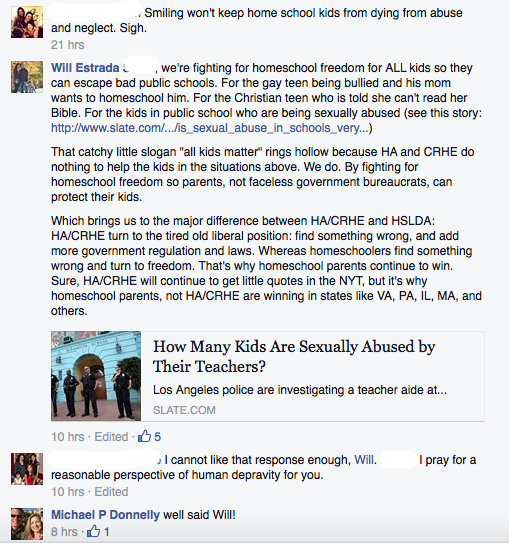
Recently Will Estrada, HSLDA’s Director of Federal Relations, posted on social media an image of himself and HSLDA’s Deputy Director of Federal Relations Andrew Mullins heading to Washington, D.C. with the statement, “Snow won’t keep us from fighting for freedom on behalf of millions of homeschoolers around the world!” A homeschool alumna commented on the image, saying, “Smiling won’t keep home school kids from dying from abuse and neglect.”

Will Estrada responded (and fellow HSLDA attorney Mike Donnelly agreed with in a subsequent comment) with the following:

We’re fighting for homeschool freedom for ALL kids so they can escape bad public schools. For the gay teen being bullied and his mom wants to homeschool him. For the Christian teen who is told she can’t read her Bible. For the kids in public school who are being sexually abused (see this story: http://www.slate.com/…/is_sexual_abuse_in_schools_very…)

That catchy little slogan “all kids matter” rings hollow because HA and CRHE do nothing to help the kids in the situations above. We do. By fighting for homeschool freedom so parents, not faceless government bureaucrats, can protect their kids.

Which brings us to the major difference between HA/CRHE and HSLDA: HA/CRHE turn to the tired old liberal position: find something wrong, and add more government regulation and laws. Whereas homeschoolers find something wrong and turn to freedom. That’s why homeschool parents continue to win. Sure, HA/CRHE will continue to get little quotes in the NYT, but it’s why homeschool parents, not HA/CRHE are winning in states like VA, PA, IL, MA, and others.

Here is an image of the interaction:

estrada

Since Estrada seems unfamiliar with what HA/HARO actually is and does, and confuses us with the Coalition for Responsible Home Education (CRHE), I figured I’d clear up some things for him:

HA is Homeschoolers Anonymous, an internet project of the non-profit organization Homeschool Alumni Reaching Out (HARO). As an organization, HARO gives its unqualified support to children who experience a negative or threatening environment in public schools. This is why, from day one of our organization’s launch, we have made explicit that we support homeschooling. As HARO’s FAQ page states, “We believe that homeschooling is a powerful, useful tool. It represents a democratic approach to educational progress, innovation, and creativity. It allows a child’s learning environment to be tailored to individual and personal needs. When homeschooling is done responsibly, it can be amazing.”

HARO’s mission is to support homeschooling families and communities by educating those families and communities how to make homeschooling safer and more supportive to at-risk children. We created a free curriculum on child abuse awareness that such families and communities can download and utilize. Our presentation Facing Our Fears: How the Voices of Homeschool Alumni Can Help Homeschooling gives multiple constructive suggestions for how homeschoolers can rethink certain ideas that have created problems for alumni. We have more such curriculums and presentations in development. We are currently offering a scholarship for homeschool alumna who are entering STEM fields.

So yes, Estrada, HARO does help kids who want to be homeschooled… by helping to make sure homeschooling is a place that they actually want to be and in which they will thrive.

In contrast, here’s the sad truth about what Estrada said: HSLDA’s “help” for these children ends the day they become homeschoolers. Estrada and his organization are “fighting for freedoms” for homeschooling parents; they have no interest in fighting for the freedoms and rights of homeschooled children. In fact, HSLDA — and Estrada himself — have repeatedly gone on record opposing any rights for children. They refused to launch a public awareness campaign about child abuse for their members. They have made light of educationally neglected children. They have gone to bat for parents who put their children in cages. They have defended convicted child abusers. They have given legal and financial support to more than one abusive high-control group. They have promoted books that encourage physical child abuse and gave a Lifetime Achievement Award to a man who has been accused since the 1980’s of sexually harassing and molesting over 30 women. They even refused to help a homeschool mom who was desperate for guidance after her child was allegedly molested by the child of another homeschool leader.

HSLDA has made the lives of numerous homeschooled children a nightmare.

There are homeschooled children who remained trapped in abusive homes because of HSLDA

So while HARO believes strongly in the power of homeschooling and believes it should be an option for children (especially at-risk children), we are not going to give Estrada gold stars for pretending that somehow bullied LGBT* kids can “escape bad public schools” because of HSLDA. He doesn’t get to whitewash his organization’s history towards either children’s rights or LGBT* issues. And we refuse to entertain Estrada’s revisionist attempt to clothe HSLDA as a champion of LGBT* children when he and his organization daily and explicitly contribute to their dehumanization and oppression.

Finally: HARO is not the same organization as the Coalition for Responsible Home Education (CRHE), which Estrada could have discovered with a simple Google search. HARO has never been quoted in the New York Times. But if we ever have the opportunity, we would tell the newspaper the same thing we would tell Estrada: that HARO’s position is neither to “add more government regulation and laws” nor to “turn to freedom”; HARO’s position is that we must stop turning a blind eye to the children left damaged and abandoned when organizations like HSLDA value “winning” more than actual children’s lives.

Since HSLDA has made clear they are willing to let homeschooled children be the collateral damage of their “winning” strategies, others must rise to the occasion and do the hard work of protecting those in harm’s way. This is the task to which HARO has dedicated itself.

Homeschooled kids do matter. The question is whether or not HSLDA will someday acknowledge that fact.

Things HSLDA Opposes: State-Mandated Medical Exams for Homeschoolers

Screen Shot 2014-12-10 at 8.59.25 PM

HA note: The following is reprinted with permission from Libby Anne’s blog Love Joy Feminism. It was originally published on Patheos on December 24, 2014.

View series intro here, and all posts here.

New Jersey is one of eleven states that do not require homeschooling parents to notify education officials of their intent to homeschool, and from time to time bills introduced into the state’s legislature have sought to change this. In 2010, a bill was introduced that would have required parents to provide notice of homeschooling at the beginning of the year and turn in a portfolio documenting the child’s educational progress at the end of the year. Unsurprisingly, HSLDA objected, but it was another part of this bill and HSLDA’s response that caught my eye.

Namely, what caught my eye was this bit:

2. A parent or guardian of a home-schooled child shall provide documentation to the resident district board of education no later than September 1 of each school year that the child has undergone an annual medical examination.

You can see the logic here. Annual medical examinations are important. I know several homeschool alumni who have life-threatening medical conditions today—conditions that were preventable and would have been noticed and treated had they seen a doctor as children. Requiring homeschooled parents to take their children to a doctor each year makes sense, and would have made a world of difference for these alumni.

But HSLDA objected:

This bill (companion to S3105) treats every homeschool parent like a child abuser by requiring them to give their school system documentation of a medical exam every year for every homeschooled child.

Yes, in HSLDA’s world, if you are required to take your child to the doctor for a checkup each year, you are being treated like a child abuser. This makes especially little sense when you realize that parents of public school children are also required to take their children to the doctor and submit documentation, and that each public school is required to carry out annual hearing and vision screenings and examine children for various chronic conditions. Does this mean that all parents of public school students in the state being treated like child abusers?

Let’s talk about the abuse aspect for a moment, though. When bills are introduced with the intent of making it harder for abusive parents to use homeschooling as a cover for their mistreatment, HSLDA and organizations like it often complain that homeschoolers are being “singled out.” The problem with this argument is that it is rarely true—public school children are seen by mandatory reporters every day, and many states, like New Jersey, require doctor visits and conduct examinations of their own. However imperfect it may be, there is a system in place in the public schools for identifying and dealing with chid abuse or medical neglect. There is no such system for homeschooled students.

I stated already that I think requiring homeschooling parents to take their children to the doctor each year makes sense simply as a way of preventing medical neglect, but there is indeed another aspect as well. HSLDA has this to say of abuse concerns:

The media carried reports recently about the Division of Youth and Family Services (DYFS) failing to protect an allegedly homeschooled child in danger—with tragic results. In effect, S3105 punishes parents for the failures of DYFS.

It’s true: New Jersey has had its share of homeschool child abuse horror stories. But as you can see, HSLDA blames these tragedies solely on DYFS, enabling them to ignore the role homeschooling can play in concealing abuse and making it harder for social workers to gain access to that child. When an report is made about a child who attends public school, social workers will frequently speak with the child on site, before or after school. This is not possible when a report is made about a homeschooled child—and children sometimes die as a result. Similarly, teachers will often report when other adults in a child’s life will not, and removing a child from contact with teachers can mean the end of reports—and the end for the child. So HSLDA can pretend all they want that these cases are all the fault of social services’ incompetency, but they’re wrong.

Now yes, the vast majority of homeschooled students do not homeschool to hide child abuse—but it does happen. When a child dies or is horrifically neglected, it’s normal for officials and lawmakers to look at the system and ask what went wrong—and how they can change things so this won’t happen again. This happens when the victim attends public school, and when the victim is homeschooled. If having an annual medical examination has the potential to help even a few abused homeschooled children—doctors are mandatory reporters, remember—I’m all for it. After all, what do we lose?

So, what is the practical effect of HSLDA’s opposition to this bill? Put simply, preventing this bill allows homeschooling parents to not take their children to the doctor—ever, if they so choose. While many homeschooling parents will take their children to the doctor regardless, others won’t. Without required medical examinations, it will be easier for abusive homeschooling parents to hide their maltreatment—and in addition, more homeschooled children will have preventable conditions go unnoticed and undiagnosed, in some cases resulting in chronic or life-threatening medical conditions as adults. And I’m not just saying this—I know homeschool alumni who never saw the doctor as kids, and suffer permanent consequences today.

Unfortunately, the bill ultimately died in committee. But if nothing else, HSLDA’s opposition to this bill makes it obvious that they’re not working for the interests of homeschooled children.