When Homeschool Leaders Looked Away: The Old Schoolhouse Cover-Up

By Hännah Ettinger (Wine & Marble) and R.L. Stollar (Homeschoolers Anonymous). Several updates and corrections made on 10/16/2014 are highlighted at the end of the story.

American Christianity is actively facing a sexual abuse crisis This crisis is more than just the evangelical community’s time to face their failings and follow in the steps of the Catholic church. It is a crisis of power and of children’s rights. It is a story about protecting abusers in order to preserve existing power structures in evangelical communities. Sexual abuse in Christian homeschool communities continues to be uncovered as leaders and organizations like Bill GothardDoug PhillipsC.J. MahaneyBob Jones University, and Patrick Henry College have faced heat for either their own sexual abuse of those under their spiritual authority (Gothard, Phillips), or protecting sexual predators in their communities (Mahaney, BJU, PHC). Each of these names is closely linked to the Christian homeschool community. What began as a trickle of stories about abuse is quickly becoming a flood.
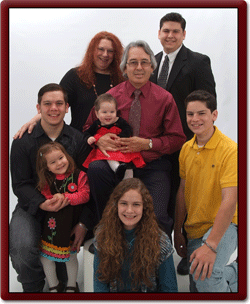
Photo from The Old Schoolhouse. Image links to source.

The authors (Ryan and Hännah) were recently approached by Eric Novak, who, like us, grew up in Christian homeschooling circles. Eric was employed from 2008-2011 by Paul and Gena Suarez, founders of The Old Schoolhouse magazine, which boasts a readership of around 200,000. Paul and Gena speak at homeschool conventions and are seen within the homeschool community as advocates for the homeschool lifestyle. The Suarezes, like many Christian homeschool parents, have endorsed the Pearls’ parenting books. The Suarezes’ main business, The Old Schoolhouse magazine, is endorsed by the Great Homeschool Conventions and James Dobson.

Over the last few years, a number of stories have come to light about children violently abused by their parents and caregivers in the name of “biblical” parenting practices. Some, like Hana Williams, have even died. This abuse is often linked to the parenting teachings of Christian authors Michael and Debi Pearl. The Pearls’ teachings are especially loved in the conservative Christian homeschooling community. Homeschooling’s Invisible Children documents many of the cases where abuse has been directly connected to use of the Pearls’ book To Train Up A Child, which teaches parents to use corporal punishment to break the spirits of their children to make them submissive to God’s will.

During Novak’s time as an employee of  TOS (and later, as he became a close friend to the Suarezes’ oldest son, who we’ll call “Jake”), he discovered that the Suarez and Igarashi families (the mothers of both families are sisters) are embroiled in an intense feud over physical and sexual abuse that has allegedly occurred in the family.

Hope Chapel

It all began at Reb Bradley’s church. Situated in Citrus Heights, California, Hope Chapel Christian Fellowship was pastored for 17 years (until 2004) by Reb Bradley. Bradley, a zealous advocate of courtship and “child training,” was a common fixture at California Christian homeschool conventions. Like other homeschool lumineers such as Henry Reyenga, Voddie Baucham, Doug Philips, and Scott Brown, Bradley was a promoter of “family integration,” believing age segregation in churches goes against the Bible. Through his company, Family Ministries, Bradley made a name for himself by calling for sexual “purity” and family-led courtship as an alternative to dating for love-struck teenagers. His teachings on corporal punishment closely resembled those of Michael and Debi Pearl. Ethiopian adoptee Hana Williams’ parents, Carri and Larry, who “disciplined” Hana to death, attended Hope Chapel for several years before they moved to Washington, the state in which Hana was tragically killed by her parents’ use of “child training.”

Around 2004, Hope Chapel struggled with internal controversy: Bradley’s daughter and the son of Paul and Mary Schofield (also important figures in the California Christian homeschool scene) began courting. But the process unraveled into a bitter, chaotic mess. A number of other church attendees, disillusioned with Reb Bradley’s ideals, broke away and formed their own church. These attendees included Steve Hauser and his wife Julie, Paul and Mary Schofield, Roy Ballard, Geoff and Jenefer Igarashi, Richard and Deb Wuehler, and Paul and Gena Suarez. The rabid anti-gay activist Scott Lively and Hope Chapel attendee, previously known for violently assaulting a woman and currently being sued for crimes against humanity, decided to take Bradley’s side in the controversy.

Today the Suarezes stand accused of protecting know child predators. You can read the background story here. Their accusers include not only their own family—two of Gena Suarez’s sisters, Jenefer Igarashi and “Megan” (her name has been changed to protect her privacy)—but also some of the same people who once joined them during the Hope Chapel church split, including the Hausers. Furthermore, one of the known child predators they are accused of protecting is Roy Ballard, also once a member of their new splinter church, and now in prison for criminal sexual assault. All of the events that follow, in fact, originally began in this church that splintered off from Reb Bradley’s Hope Chapel.

“Cinderella”: the Physical Abuse of Megan

What Eric Novak learned about the Suarez family involved alleged physical abuse of their children as well as alleged sexual abuse within the family. According to the various accounts, the Suarezes 22-year-old son, Luke, sexually abused two of his younger siblings and his young cousin, the son of Jenefer Igarashi. Luke currently has continued access to his siblings, as he lives at home with his parents. He is regularly in contact with children in the homeschool community, thanks to his family’s business. According to Novak, the Suarezes often get put up in the homes of other homeschool families when they travel. Novak relates:

“They continued going to conventions and such, and I know that for a fact that at conventions, they’ll like stay with homeschool families, and he’ll like, sleep in the younger kids’ rooms. And that’s what I’m most concerned about.”

The physical abuse allegations involve the abuse of all of the Suarez children, as well Gena’s youngest sister, “Megan.” When Gena’s mom died, Paul and Gena took in Megan, Gena’s third sister. Megan was 13 years old and Gena was around 26. Megan claims that once she joined their family, Gena turned into a fairy-tale worthy evil surrogate mother, turning Megan into house help and depending on her for her primary childcare support. It got to the point where even the neighbors jokingly called Megan “Cinderella,” according to a written statement by Megan (given to Hännah by Eric Novak):

Even friends and neighbors of Gena and Paul would refer to me as “Cinderella.” It was evident to all who knew us what my role in the family was: babysitter, house cleaner and servant… and physically or mentally abused (instead of properly disciplined), when I would act childish or foolish.

I was left in charge and instructed to care for and discipline the younger children in the home – even told to strike them in the face when ‘disobedient’ or ‘disrespectful’ (they’d give me ‘slapping privileges’), which still haunts me today. They also immediately took and used every penny of nearly $10,000 that my mother had left for me when she passed away (…When I moved in with the Suarez’ [sic], they got access to that account and spent every bit of the money).

Megan alleges that the Suarezes didn’t just use her for free labor and steal the money her parents left her. She says they physically abused her and their other children and claimed that the abuse was God’s will. It seems like they employed the Pearls’ parenting methods quite studiously. This is also from Megan’s written statement:

I witnessed and was a victim of physical and mental abuse while in the home. I watched Gena as she would strip her youngest son down (around 4 yrs old), put him in the bathtub and run cold water over his face so that he couldn’t breathe. They would have their second oldest son strip down naked and repeatedly douse him with cold water. Gena would brag that she “finally found a punishment that would get them to obey”. She would also have her children stand in the corner so long they were forced to wet their pants. I also remember seeing her boys be made to ‘make up from a fight’ by inappropriately kissing various parts of each other’s body to the point of everyone in the room feeling awkward and uncomfortable… except for Gena, who would laugh. I remember the way she once used me to ‘teach [Jake] a lesson’ by convincing him to run away and then telling him it was a ‘test’ and then proceeding to give him 100 spankings when he packed a bag. Again, remembering back on these things makes me sick almost to the point of throwing up. She would pinch us and pull our hair on a regular basis. I remember having her grab my hair and walk me down the hallway. Punishments for ‘bad behavior’ were cruel and unusual things like sleep depravation (having to get up in the middle of the night and clean the house or run up and down a hill on the property in the dark), or being told to get in my bed and pull the sheets over my head and stay there the entire day. Regularly I would beg to be allowed to correspond with my father, who lived in Alaska. I was always given a firm “no” and would have to sit for about 3 hours and listen to all the reasons why I could not have a relationship with my biological dad… because he was ‘in sin’. Instead I was forced against my will to call Paul ‘dad’ and refer to him as my father- or I’d be punished. I was also instructed to refer to Gena as my ‘mom’ and again, would be ‘dealt with’ if I refused. I was 13 when I moved in with them, and 17 when I fled.

Paul also could be, and often was, very cruel. I remember being seated in front of him on the couch (him in a chair very close to me), and he would be lecturing me. Each time I would speak, he would kick me hard in the shins with his steel-toed boots. There were also numerous times when he would slap me in the face or push me up against a wall as he yelled and repeatedly poked my chest over and over with his finger.

Close to the time I finally fled, it had gotten to the point that I didn’t want to live anymore. I would fantasize about dying. I couldn’t please them no matter how hard I tried. I was literally a slave in the home and punished as such when I couldn’t meet their impossible standards. What hurt the most after I fled was knowing the abuse that would continue in the lives of the children.

After Megan escaped, she found support in her other older sister, Jenefer Igarashi, and has thrived. She is now married and mentors in her community and is herself a homeschool mom. She remains a devout Christian.

Suarez Teenager Molests 6-Year-Old Igarashi Kid

In the spring of 2007, the Igarashis and the Suarezes had a falling out over a church-related disagreement, and then 6 weeks later, according to a plethora of corroborating accounts, it was discovered that Luke, the then-teenage son of Paul and Gena Suarez, “repeatedly molested” the 6-year-old son of Geoff and Jenefer Igarashi. The Igarashis discovered this when the 6-year-old began frantically grabbing his own neck one evening and acting erratically. He began tearfully describing the “sexual attacks” his older cousin had inflicted on him.

Jenefer immediately contacted the Suarezes. According to a now-private statement by Jenefer on her blog, the nephew “admitted everything”. He and his parents assured the Igarashis they would “self report” to the CPS and would see a “Christian counselor”. Two separate emails obtained by us verify that: (1) on July 5, 2007, in response to an email sent by Jenefer Igarashi describing the sexual assault of her son, Paul Suarez admitted “Luke’s sins” were “horrible”; and (2) on May 30, 2008, Paul Suarez again admitted his son was guilty of committing “shameful sin” against the Igarashi boy. “What our son did was so shameful,” Paul wrote, “that it brought my wife and I to tears”.
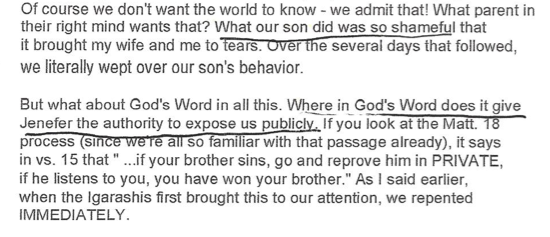
Excerpt from Paul Suarez's May 30, 2008's email.
Excerpt from Paul Suarez’s May 30, 2008 email.

Eric Novak was close with the family during the time the Igarashis discovered their son’s alleged sexual abuse at the hands of Luke. According to Novak, the most help the family got was a few counseling sessions:

“The sheriff got involved—here’s the thing. Only one instance of sexual abuse was ever reported. So his siblings were never reported. Only the Igarashi’s son was one that was reported. So, in that instance, the sheriff got involved and they were like, well he’s a minor—cause he was 14—so now we need to take him to counseling and he’ll go through three sessions of counseling and at the end of it, if he’s fine, then we’ll be done. And so he went through three sessions of counseling and they were like, that’s it”.

The Igarashis suggested they resolve their differences with Christian mediation via Peacemakers, a Christian mediation group headed up by homeschool leadership confidant Ken Sande. But the Suarezes refused. They wrote an email to the Igarashis on September 7, 2008, and said “utilizing Peacemakers” was “an absurd idea” and suggest that they (the Igarashis) “may not even be saved”. They said Jenefer and Geoff had to first “repent” of their own sins–a reference to the initial falling out over church politics—before the Suarezes would consider talking to them about the 6-year-old’s molestation allegations.

Excerpt from a September 7, 2008 email sent by the Suarezes to the Igarashis.

The Suarezes also promised the Igarashis that they would step down as publishers of their magazine and relinquish their leadership roles. The following is from a July 4, 2007 email sent by Paul Suarez to Jenefer Igarashi:

Excerpt from a July 4, 2007 email sent by Paul Suarez to Jenefer Igarash.

The pertinent text is:

We have no intent of compounding this offense by remaining on as the leaders [sic] of TOS. Obviously we are not qualified to continue on as publishers of a Christian magazine. We are already in talks with handing the magazine over to someone more suitable than ourselves. Please keep this business decision confidential as there are more people’s livelihoods at stake than our own. This is not to say that you should not report this incident to whomever you feel necessary. However, spreading this misfortune by talking or blogging to others not involved or directly related to this incident would serve no purpose. Please know that we certainly don’t intend on playing the hypocrite by sweeping this mess under the rug. Again, we have no interest in protecting our own reputations, only the livelihoods of those who depend on TOS.

This never happened. California business records demonstrate that The Old Schoolhouse Magazine, LLC has remained active since 2005 and its principals remain Paul and Gena Suarez. Furthermore, the Suarezes continue to this day to represent themselves as reputable leaders (both publishing and otherwise) in homeschooling communities.

More Cover-Ups and One Last Attempt

Since 2008, the Igarashis felt their hands were tied in exposing the abuse to the public. But earlier this year, after watching the Disney movie “Frozen,” Jenefer was overwhelmed with a desire to try at reconciliation again. The Igarashis also learned in March of this year that their son was not the only sexual predator allegedly protected by the Suarezes.

The Igarashis learned about Mike Marcum, whose father (according to Novak) is Paul Suarez’s “right hand man in all things TOS-related.” Mike was arrested, and pleaded guilty in 2010 for possession of child pornography. According to Jenefer’s now-private statement, Mike was welcomed into community gatherings by the Suarezes despite them knowing he was being investigated for the child pornography charges. “When one of the families in their group found out,” Jenefer wrote, “the husband alerted other families that they knew had been exposed to the perpetrator. Their goal was simply to protect all children involved and make sure each parent had the opportunity to talk to their children and ascertain safety”. Instead of encouraging this family’s actions to protect children, Paul and Gena Suarez berated them. Jenfer wrote that the family was “called to a meeting with my sister and her husband and were ‘beaten with scripture, pulled completely out of context’ for about three hours. They were told they were gossips and were sowing discord and acting unbiblical”.

In addition to Mike Marcum was Roy Ballard, one of the individuals who originally joined the church that splintered off from Reb Bradley’s Hope Chapel. Ballard was convicted of criminal sexual abuse against children. According to Julie and Steve Hauster, also members of the splinter church, the Suarezes refused to believe a young child claiming she had been inappropriately touched by Ballard and instead belittled and shamed her and her family.

Reinvigorated with the desire to bring these stories of abusers to light, the Igarashis began counseling with their new pastor in February 2014. Desiring to abide by the principles of Matthew 18, the Igarashis enlisted a large number of fellow homeschool parents and drafted a group letter (involving several well-known leaders in the Christian Homeschool Movement) in the drafting process. The Igarashis sent a draft of the letter to the Suarezes on April 4. A copy of the letter was also sent to Heidi St. John, one of the most popular speakers for the Great Homeschool Conventions and a longtime family friend of both the Suarezes and Igarashis. The so-called “Super Mom of Homeschooling” who hosts “mom PJ parties”, St. John was informed by Jenefer that a third child molestation cover up (the case of Mike Marcum) had been discovered.

The Igarashis Appeal to HSLDA’s Michael Smith

Jenefer also decided to contact another friends: HSLDA President Michael Smith. Jenefer called Smith on his personal mobile phone 3 times as well as emailed him with her plea for help.

Email sent by Jenefer Igarashi to HSLDA President Michael Smith.

An excerpt from her April 8, 2014 email to HSLDA’s Smith reads as follows:

It’s been a while since we’ve talked.

My husband asked me to email you. I don’t know if you remember that Gena Suarez.(The Old Schoolhouse Magazine) is my sister. We had a (very) difficult split 7 years ago.

Last month we put together another effort to call them to repentance. 20 people have given testimony against them (including [name redacted], [name redacted], [name redacted], and others)

The document we’ve sent them has been ignored.

…we were told that *morally* we had some decisions to make since we know there have been recent cover ups (dealing with convicted sex offenders — Suarez’s pushing to allow access within family settings and bullying people who spoke out). I have testimony and direct proof of this. The men are listed on sex crime registers. Both men were convicted of crimes against children. This is in addition to their son (a highschooler at the time) who repeatedly victimized our little son.We are trying to make a decision whether or not to let convention leaders know about this issue.

The [name redacted]/Teach Them Diligently are our friends and know about this issue and so does [name redacted] (also our friend), who helps run CHEA of California. But as of yet, we’ve not informed anybody else.

My husband asked me earlier today if I would contact you and ask your advice. HSLDA has been the watchdog/protectors of the homeschool movement since the early 80s. You all have not only protected legitimate homeschoolers but have made sure the Homeschool Community (at large) was not used as a haven for abusers.

We really are not sure what should be done in this case. On one hand we are nervous about knowing about their patterns/ keeping children safe, but on the other hand we are talking about my sister who I love. After the Doug Phillips tragedy I feel like the homeschool movement could be damaged with another high profile scandal. This is a horrible position any way you look at it.I know you are a very busy man, but any light you could shed on this would be very appreciated.

Mike Smith never responded to any of Jenefer’s pleas. The Old Schoolhouse remains an HSLDA-suggested resource promoted to HSLDA members at a special discounted rate.

Enter Heidi St. John, Brennan Dean, and the Great Homeschool Conventions

The joint letter the Igarashis sent to the Suarezes (and copied to Heidi St. John) on April 4 was not received well. According to Novak, the Suarezes “ignored both the letter that had been crafted by the individuals (list of 20) and also Jenefer’s pleas to her sister to work with her”.

Heidi St. John, however, was dismayed by the fact that Jenefer involved her in the situation. St. John sent a number of emails to Jenefer in response. In one of those emails, St. John wrote, “This is a huge distraction for us in the middle of the busiest season of the year. We have neither the time nor desire to be part of it”. St. John also told Jenefer that she had talked to HSLDA’s Michael Smith and Smith told her that, “HSLDA will not be getting involved in it.”

According to Novak, the Suarezes then attempted to strong-arm Jenefer. Novak says, “They got the letter from Jen on April 4th — and never emailed back. Instead, their move was to rope in Heidi St. John and have GHC call Jenefer’s workplace and request that she be kept out of the GHC event, the weekend of April 24th”. Allegedly pressured by St. John, the GHC leadership agreed to block Jenefer from the convention. This happened on April 23 when Jenefer Igarashi was at the airport, about to board a flight to the Great Homeschool Convention in Ohio. Jenefer is an employee for a well-known company that exhibits at homeschool conventions around the United States. While waiting to board, Jenefer received a call from her employer. That employer had received a phone call from Kim McMillan, Exhibitor Coordinator for the Great Homeschool Conventions. According to Novak, McMillan told Jenefer’s employer she was calling on behalf of GHC president Brennan Dean requesting that Jenefer not be sent to the convention because of her “threatening emails” to the Suarezes.

It is important to note that the emails in possession of the authors indicate that Heidi St. John was entirely aware of the allegations that the Suarezes had ignored child abuse and—according to Jenefer and other collaborating accounts—decided to look away, despite writing the blog post “Don’t Look Away” a mere month before. In that post, St. John declared that,

What’s more troubling to me is the lack of concern that the homeschool community seems to have for the victims of Gothard’s and Phillips teachings. There seems to be more concern for protecting these men and their “ministries” because it may have a negative impact on homeschooling than for the lives of the people who have been hurt and abused.

What in the world are we thinking?

Her own words appear to be self-indicting.

David Gibbs III Offers to “Help”

Two days later, on April 25, Jenefer received a call from someone she did not know: David Gibbs III. Gibbs seemed to appear out of nowhere. He had been in the news earlier this year as the defender of another abuse victim—Lourdes Torres-Mantufuel, the target of Doug Phillips’s alleged sexual molestation.

Gibbs appeared to be a godsend, a knight in shining armor. Gibbs allegedly told Jenefer that he “didn’t even really know” the Suarezes and was simply told by Heidi St. John and Brennan Dean that there was an “issue” with which he could help by arranging an “unbiased mediation” with the Suarezes. After trying to years to arrange that very thing, this seemed like a break in the dam to Jenefer. So on April 25, 2014, Jenefer sent Gibbs a slew of private documents for him to examine before the mediation effort. Most notable was the aforementioned private testimony by Megan, detailing her horrific abuse at the hands of Gena and Paul from the years of 1995-2001—abuse so intense that she became suicidal.

Jenefer sent the testimony with the understanding that it would be confidential and believing that she could trust Gibbs. But that trust began eroding when one of Jenefer’s children realized Gibbs was a part-owner as well as a corporate sponsor and organizational partner of the Great Homeschool Conventions—the company that just banned Jenefer from their convention and featured Heidi St. John. GHC has only three corporate sponsors: one is The Old Schoolhouse and another is David Gibbs’ National Center for Life and Liberty. Jenefer also found out Gibbs was a columnist for The Old Schoolhouse.

David Gibbs III is a columnist for the Old Schoolhouse Magazine.

Jenefer’s trust in Gibbs vanished entirely when Gibbs, the Suarezes, and the Igarashis met on May 5, 2014 for a final mediation attempt. At the beginning of the meeting, Paul Suarez pulled out a document: the confidential testimony of Jenefer’s sibling. Somehow the confidential testimony of an abuse victim — given only to Gibbs — had fallen into the hands of the victim’s alleged abusers: the Suarezes.

The Mediation

The mediation attempt was a grueling process, lasting around 10 hours. According to a written report of the meeting, Paul Suarez attempted to use the mediation to lecture people, and was consequently asked to leave the room along with Jenefer’s husband. When Jenefer confronted Gibbs about whether he would advise Lourdes Torres-Manteufel to sign such a mediation agreement, Gibbs allegedly grew irate and declared, “You’re no Lourdes Torres!” According to this report, Gibbs eventually pushed Jenefer and Geoff to sign a mediation agreement he drafted. The agreement declared that the Suarezes agreed to stop “shunning” the Igarashis but on the condition that Jenefer was to cease talking about all the potentially damning information they had. It was also insinuated that they could be sued if they chose to speak up. We have a copy of the mediation agreement but are not at liberty to publicize more than the following image from it.
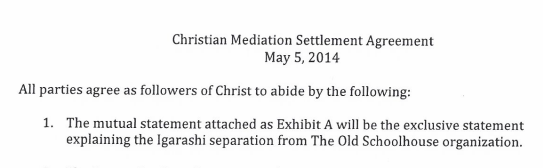
Excerpt from the Suarez/Igarashi mediation agreement.

The Suarezes’ pastor in Tennessee was involved in the meeting, and has not yet reported the Suarezes for child abuse, despite having read Megan’s statement and voicing concern for the remaining children at home. The following is from an email by Jenefer to Novak (and given to Hännah by him) debriefing the meeting in May:

And then her PASTOR (they brought a pastor who drove up with them from TN) said, “I’m concerned about the child abuse” and then he said, “How about we write up an agreement that states the Suarez’s were wrong for dividing with the Igarashis and then I will personally begin monitoring the Suarez’s with our board of elders, examine their household and interview their children and then periodically report to you directly, Jenefer.” Then he said, “the Suarez’s are in the process of joining my church and if we let them be members we are definitely going to want to keep an eye on this. We don’t want them in our church if they are going to behave like that.”

The pastor, Charlie Scalf of Roan Hill Baptist Church, didn’t return our call inquiring about the Suarezes’ membership standing at their church. Days after signing the agreement, something inside Jenefer snapped. She finally had the chance to be un-shunned after 7 years. But it was not worth the cost to her: the cost of pretending she agreed with a philosophy that protects child abusers and punishes those who speak out.

So on May 24, 2014, she violated the terms set by Gibbs’s mediation agreement and wrote a public blog post revealing both the alleged sexual assault against her son and the Suarezes’ alleged roles in covering up both that assault and other child predators in their communities. This blog post caused an outrage among the other parties involved in the mediation agreement. Jenefer eventually made the post private and password-protected. But several weeks later, she again decided to go public—despite pressure by Gibbs to not do so. On June 19th, she wrote a second blog post about the abuse. Novak suggests that her reasons for doing so were because she believed that Paul and Gena had breached their side of the agreement as well. In the July 19th post, Jenefer writes:

I’ve been accused of trying to ‘vindictively take down The Old Schoolhouse Magazine. I reject that accusation. Paul and Gena made the choice to habitually divide with believers over secondary issues. They have also made the choice to condemn (multiple) families who spoke out against child predators.

They made the choice to continue pursuing the spotlight as national leaders after knowing their highschooler [sic] repeatedly molested more than one child. In my opinion, they should have stepped down and dealt with their family issues. Instead, they built an audience and created a following. I feel no obligation to protect their leadership position in the homeschooling community. It was their choice to push this issue public.

They refused to deal with us privately (we tried repeatedly) and then seven years later, when they finally met with us (with a supposed ‘unbiased mediator’) they refused to acknowledge any error over their unbiblical belief of shunning Christians over secondary issues. Nor did they see a problem with condemning families who refused to accept what amounts to a ‘zero accountability’ stance for child sex predators. It is because of their choices that this is now playing out in front of an audience that they, themselves, created.

Here’s a helpful motto: Don’t do things that you don’t want people to find out about. It’s not the job of the ‘abused’ to protect their abusers ‘popularity’.

Now 14 years old, the Igarashi’s son wants people to know what happened to him (taken from a June 19th blog post written by Jenefer):

…he told me he wanted to speak plainly. He told me that he was angry — really angry — that his older cousin had forced him to live with such disgusting memories. He also told me that he hated the idea of being known as the kid who had ________ happen to him. He said he was fearful of having a tainted reputation and was nervous about being kept out of certain circles of friends who might look at him weird if they knew. I sat quietly and just listened to him as he spoke. And then what he said surprised me. He said, “I think that being concerned about how I’m viewed is selfish, though. I don’t want my reputation to be more important to me than knowing we might be able to help prevent others from having to live through what I have to deal with”.

This child is right to be worried that others will have to deal with this same stuff. If these allegations are true, the statistical probability that the Igarashi son and the two Suarez siblings are not Lukes only victims is high—the “average” pedophile will  have many, many victims have before getting caught (numbers vary, but most sources estimate between 100-200). So much time has been wasted because these families have delayed legal action by years of attempting Christian “reconciliation”. Jenefer and her husband initially left their jobs at TOS shortly after their son’s abuse, but felt they had to keep quiet due to years of alleged threats and intimidation from Gena. Gena is alleged to have further attempted to squash Jenefer professionally by going behind her back to request that Christian media outlets like Crosswalk.com remove pieces Jenefer wrote for them while she was a TOS employee. The Suarezes have even threatened Eric Novak with a libel lawsuit over his Facebook posts warning about their abuse.

Everyone who spoke to both of us is terrified of Paul and Gena.

The Suarezes have controlled the narrative thus far, and Gena’s sisters (both of whom evidence passion to see Luke, Paul, and Gena brought to justice) both initially spoke with us in extensive detail about the situation. However, they later took our conversations off the record out of fear of retaliation. While Eric Novak expressed similar hesitations, he decided that exposing the alleged abuse was worth the risk. These fears evidence the power alleged abusers have to control the narrative by keeping their victims silent and afraid of punishment. Eric says he hopes the Suarezes see justice for their alleged physical abuse of their kids and for Luke’s alleged sexual abuse of his siblings and cousin.

To date, the Suarezes and The Old Schoolhouse have not responded to these allegations with a public statement. Rather, as reported on Homeschoolers Anonymous on July 2, 2014, TOS has been stating privately—via emails—that all of these allegations are false. “TOS and the Suarez family are aware of the allegations circulating online”, TOS declared. “They are false”. In light of the fact that the authors have emails on file from the Suarezes themselves admitting several of the allegations are true, these current statements by TOS appear intentionally and maliciously false.

Even more disturbing is the revelation—again, verifiable—that some of the biggest names in Christian homeschooling (HSLDA’s Mike Smith, GHC’s Brennan Dean, GHC’s Heidi St. John, and NCLL’s Dave Gibbs III) have known about both the child abuse allegations and the alleged cover-up of the abuse for substantial periods of time and have chosen to ignore it, remain silent, or bully others into silence.

This might be the most widespread, institutional cover-up of child and sexual abuse allegations among homeschool leaders and communities to date.

Note: The authors reached out to HSLDA, GHC, TOS, Heidi St. John, and David Gibbs III for comments. None of them replied by the time of publication.

*****

Updates, 10/16/2014:

HSLDA, GHC, TOS, Heidi St. John, and David Gibbs III have yet to respond to any of our requests for comments. However, both HSLDA and Heidi St. John issued statements yesterday, October 15. Read HSLDA’s statement here; read Heidi St. John’s statement here. Jenefer Igarashi responded today here.

Corrections, 10/16/2014:

* The original story incorrectly implied that Jenefer Igarashi directly contacted Anne Miller, President of the Home Educators Association of Virginia. The contact was made via a third party.

* The original story stated that, during the mediation attempt, “Paul Suarez stormed out of the room at one point and never returned.” Paul did not storm out; rather, he was asked to leave the room along with Jenefer’s husband after creating difficulties during the mediation.

* The original story said David Gibbs III said “You’re no Lourdes Torres!” to Jenefer Igarashi in response to him allegedly giving the testimony of her younger sibling to the Suarezes. This has been corrected to reflect that Gibbs allegedly said that in response to Igarashi asking if Gibbs would make Lourdes sign a mediation agreement with Doug Phillips.

* The original story said that the GHC leadership allegedly agreed to block Jenefer Igarashi from the convention due to pressure from Heidi St. John and Paul and Gena Suarez. Igarashi’s public statement today says,

When I accused Gena of punishing me by having me blocked from this convention, Mr. Gibbs stopped me and said, “Gena didn’t ask to have you blocked. Heidi St John did.” There were a total of five witnesses to that statement. When I asked why in the world Heidi would have anything to say about it, my sister began quoting, verbatim, from a private email I had sent Heidi.

The story has been changed to reflect this.
Hurts Me More Than You: Christine’s Story

Screen Shot 2014-09-23 at 10.15.16 AM

*****

Trigger warning for Hurts Me More Than You series: posts in this series may include detailed descriptions of corporal punishment and physical abuse and violence towards children.

*****

Willfully Disobedient: I Was a “Lovingly” Spanked Child

HA note: Christine’s story originally appeared on her blog on September 24, 2014 and is reprinted with permission.

“I was spanked but I turned out just fine.”

“There is a difference between spanking and beating a child. This story clearly crosses the line.”

“Sometimes parents need something a little more to get a child’s attention. I was only spanked when I was doing something dangerous or being a hellion.”

“I deserved it and needed it.”

I inhale sharply as I read through the comment section of an article about NFL player Adrian Peterson’s indictment for child abuse after whipping his son bloody. The glow of my iPad screen is harsh in my otherwise darkened bedroom. Maybe staying up reading the internet wasn’t such a great idea. I quickly glance over at my sleeping husband and cats while I debate getting up or staying in bed. I know this topic has already captured me and it is after one in the morning.

My heart is racing and my mouth dry as I click the “comment” button. I’m nervous, triggered into an emotional response that I still haven’t learned to control, that I’m not sure I want to control. Anger and frustration bubble in the pit of my stomach. Anxiety grips my chest as it claws up my throat. Adrenalin washes over my limbs, which twitch under the sheets. It’s time to fight. Feeling most secure in my bed, I opt to stay as I roll onto my stomach for better access to my tablet keyboard. Then, walking the line between complete emotional cyber meltdown and rational, logical, mind changing academic argumentation, I begin to type the same response I have been sharing in comment sections for the last five years.

Over these years spanking “debates” have made me crazy because many people don’t seem to understand the abuse and damage that so called deliberate, “calm”, or “loving” spanking leaves behind. There seems to be an assumption that so long as the physical hit is done with love and doesn’t leave a mark, then this is not violence or abuse. My mother performed these calm, loving spankings on me and my sisters. They were terrifying and shaming. They were also so normalized that I used to argue that spanking was ok and necessary for children to learn valuable lessons.

I had such an internalized notion of my own badness or rebellion that I believed I deserved such discipline.

My mother ascribed to the teachings of James Dobson, founder of Focus on the Family. His books Dare to Discipline and The Strong-Willed Child outline steps for parents to follow to make their children compliant. Dobson claims that children should not be disciplined when the parent is angry but that children need to know spanking will be the consequence of “willful disobedience.” He claims that this is a formula for loving correction that will not harm children. However, the thing about the term “willful disobedience” is that it boils down to lack of compliance, which is often found in the actions of just being a child. This was my experience.

There are any number of reasons that I or my sisters were considered to be willfully disobedient. Any instance of not obeying my mother was a prime example of my naturally sinful nature. I have been spanked for running in church, climbing a neighbors tree, following my friends into the woods, or not answering a question when addressed. Disobedience also came as a group if I was unable to maintain the obedience of others. On one occasion my mother tasked me with rounding up my young sisters after church. We would all often scatter after the church service, finding nooks and crannies to play in while our mother talked with the pastor. I tried to wrangle them, get them to the front door, but they were still playing when mom was ready to leave. Due to our collective defiance we were informed that we would be spanked as soon as we were home.

My mother was always calm when calling me to her bedroom, a dusky room with pulled curtains that diffused the afternoon light. It was perpetually warm with the smell of my parents. It was a room that I was only allowed to enter when invited and under other circumstances I would have found it comforting. But not today. I am instructructed to get The Wooden Spoon from the utensil holder in the kitchen and bring it with me. The Spoon or a wooden hairbrush were often used instead of her hand because these were considered to be “neutral objects.”

Spanking with her hand would be abuse. This was correction.

The Wooden Spoon
With tears already rolling down my cheeks, I approach my mother shaking with fear and shame.

Why didn’t I get my sisters to come faster? I should have been better. More good. I wanted to be good but seemed to have a hard time obeying.

She closes the bedroom door softly behind us. She is sure not to slam it because that would indicate anger and spanking a child when angry would be abuse. This was correction. My mother’s voice is soft when she explains that, in the Bible, God says children need to obey their parents. Parents who do not discipline their children actually hate their children.

“This hurts me to spank you but I do it because I love you.”

I don’t want to end up in hell where I will be tortured and gnash my teeth for eternity but I also don’t want to be hit. I continue to cry, tasting the wet salt on my lips. I hope that this time she will change her mind. Not that she ever has. Pointing out my pre-spanking tears my mother warns me that they won’t get me out of this. For her, a child crying in the face of discipline is manipulative and a sign of a sinful nature. She can not give in.

Once across her knees she hits my bottom swiftly and rhythmically. I do not remember how many times she would hit me but I know she was dedicated to spank as many times as it took for me to cry “genuine tears of contrition and remorse.” I know that I cried harder while controlling my desire to wail or scream. Crying this way was considered theatrical and attention seeking. It might have even gained more spanks so I avoid it and try to give my mother’s loving correction respect.

Afterward, she stands me up in front of her and straightens my clothes before I fall into her arms and sob my apology into her chest. With tears in her own eyes she reminds me again that this hurts her more than it does me. This was for my own good. I promise never to transgress again. “I love you,” she coos as she hugs me. If she did this without love, then it would be abuse. But her love makes it a correction. I thank her for loving me so much that she refuses to spare the rod. I do not want to be spoiled. Her own tears subside as she prepares for the next child to correct and signals my time to leave. The others are waiting for their turn. I need to send the next one in.

This form of discipline was normal in my house growing up. Although, it did become less frequent with each new daughter. She would later describe the two youngest as “spoiled” due to their lack of spankings as young children while reminiscing fondly about how I used to try and keep my sisters obedient.

I bitterly told her that I was trying to save them. She just smiled.

As a teenager and young adult, I held onto the belief that spanking with love was the only real way to teach children right from wrong, yet I had a hard time imagining what it would be like to hit my own child someday. I began to question this method as a psychology major when I read studies that clearly illustrated the lasting psychological harm spanking has on children. However, it wasn’t until my mid-20s, when on a city bus, I had a discussion with a friend about childhood spanking and I described my discipline “without anger” experience. As the bus rumbled and bustled around us, I watched as horror, pity, and sadness crept across her face. With tears in her eyes she replied, “I am so sorry that was done to you.” I was taken aback. So deep was the internalization of my own “badness” as a child that I tried to assure her it was no big deal. Spanking did me good. I deserved it. I needed it. I was a bad child.

But how can a child of ten, six, or two years old be bad? And how can anyone claim that the child deserves physically violent discipline? Why would anyone want to equate love with physical violence?

It has been heart wrenching to come to new conclusions about how a parent “loved” me. After a lot of reading and evaluation I now understand how being treated this way had a negative impact on my mental health and conditioned me to ignore my personal boundaries or emotional needs. I now call “spanking with love” what it is: abuse. I have a zero tolerance for any form of physical violence toward children or adults.

I want people who claim that “spanking with love” or “without anger” or “within prescribed parameters” to realize that I am that child. I do not fully relate to other’s abuse stories that include lashings from belts or punches to the head or angry outbursts. My mother claimed to love me every step of the way. She was calm and collected. I had warnings and was given a consequence. My experience is the loving discipline that so many claim to support. And yet, when I share these details I am always met with the response that my experience is clearly abuse and that is not what the debater is talking about. They tell me it was done to them or it wasn’t so bad and that they deserved it and so do their own children. All I can really say to that is what my friend said to me, I am sorry that you have been treated that way. I hope you can see you are more valuable than what was done to you and that you do not need to perpetuate harm.

The stories of others in similar situations have been a life raft in my most troubled waters. In telling my story recently, I also thanked another for telling theirs. I needed that person. Maybe others need me. To you I say, I understand you. I have been there.

You are so strong and have survived so much. I am with you in this.

Why Does This Have To Be Public?: Cynthia Jeub’s Story, Part Three

Image from Cheryl Spieth Gardiner. Image links to source.

HA note: The following is reprinted with permission from Cynthia Jeub’s blog CynthiaJeub.com. It was originally published on October 7, 2014. 

< Part Two

A lot of people are asking me why everything I’m saying must be public. Why not just go to counseling, why not sort it out privately?

We have tried. I’ll go into more detail later. In short, as my little sister explained it today: “mom and dad believe the way to solve their family problems is if they can’t control a child anymore, they kick them out and won’t let them back unless we agree to more control.”

My first sister was kicked out in the early 2000s, and at 18 years old she was given the option to live in Kevin Swanson’s basement, having counseling sessions with him and my parents every night until she succumbed to their authority, or to leave and never see us again. She lasted for two weeks before she couldn’t take it anymore, and I didn’t see her for three years.

My second sister was more abused than any of us, and she just hopes we can all get along. The most healthy thing she did for herself was literally move to the other side of the world. She’s very torn over me going public, so please, if you have the urge to contact somebody or ask questions, message me or Alicia or Lydia. She doesn’t need the extra pressure.

When our parents kicked Lydia and me out last year, we saw the pattern for the first time, and thought perhaps we were wrong to feel abandoned by our older sisters. I tried to confront my parents more than once, and it always ended with me in tears, feeling guilty and ashamed for ever seeing anything wrong with them. Mom and dad found a counselor last month who we planned to go see, but then they took the liberty of spending two long sessions telling their own story to this counselor before inviting Lydia and me to join the conversation, and asked us to write an essay about our top three grievances so they could deliver these to the counselor secondhand.

We gently informed them that we thought they were controlling and cared too much about their reputation, and they said they disagreed. We said there was physical, emotional, and financial abuse, and they didn’t reply. We backed out – there were too many red flags surrounding the attempt to reconcile. We later found out that this counselor was recommend by a family friend who gave Christian counseling to both my sister Alicia and me (conflict of interest), and who made me distrust therapy in general for a long time.

Lydia and I received messages from my dad saying we would not be allowed to visit our family until we followed their demands to reconcile on their terms. Both of us heard the phrase “Our love is unconditional, but our welcome is not.”

This abuse and dysfunction has been going on for the two dozen years since my parents met – and my mother abused my older sisters before my dad entered the picture. My parents chose to make everything public when they put us on TV, happy and smiling, to demonstrate how great our family was. Extended family knew about it, observers noticed hints of it, nobody did anything. My youngest brother is three years old, so if nothing happens, my parents will continue doing this for at least another fifteen years. My older sisters didn’t have a voice. I’m using mine now.

Part Four >

Hurts Me More Than You: Alice and Beth’s Stories

Screen Shot 2014-09-23 at 10.15.16 AM

*****

Trigger warning for Hurts Me More Than You series: posts in this series may include detailed descriptions of corporal punishment and physical abuse and violence towards children.

*****

Alice’s Story

I knew that I could get spanked for things I wasn’t even involved in, like my 3 year old brother talking and shouting when we were all supposed to be asleep. If he didn’t confess, or if Mom just didn’t care who was talking, we all got spanked.

Mom didn’t stop spanking me until I was about 9 years old. Even then, I still had moments of Oh my God, is she going to hit me this time too? When she’d burst into the bedroom I shared with my siblings, I very quickly tried to tell her that I wasn’t the one talking, or I just pretended to be asleep. Sometimes that worked and my ass would be spared.

I don’t remember all of Mom’s punishments. My sister claims that we were sometimes whipped with switches from our forsythia bush. I remember plucking the switches to bring to my mom to whip my sister with, but I never remember being whipped with them. Probably because those memories were a lot more painful, physically and mentally.

I know I’ve blocked stuff out, because my memories from 6 to 9 years old are patchy and it just feels like there’s stuff missing.

But there are things I’ll always remember, like the plastic black spatula my mother used (and broke in a fit of rage one night when she walked in, slammed it up against the dresser, and yelled at us). I’ll always remember the rage etched on her face when she stormed into the room. I’ll always remember silently seething when she brought us in later, apologized, and hugged us. I’ll always remember hating her as a child, because she showed little patience for us.

Even as I transition in adulthood, I’ll still live with what she’s done to me. It’ll stay with me for the rest of my life, but at least it’ll teach me to never inflict violence on my own children, God willing I have some. Through the pain, there is a lesson for both my mother and I, and for me it is this:

Violence breeds respect based on fear, but true respect is born out of mutual love.

And that’s a mindset I hope to practice when I have my own kids. With my partner’s help, I’ll be gentle and kind towards our children and not hurt them like my mother hurt me.

*****

Beth’s Story

My dad made “spankers” out of conveyer belt that he cut and sanded. He even put a hole in one end so you could hang it on a hook. We had two of them and my parents would warn us not to ever try to hide them. He gave some to my friends’ parents and I liked to make fun of my friends who were only hit with wooden spoons. Conveyer belt stings, but leaves no welts because of its surface area. It is blunt force but not as blunt as a baseball bat.

It is the perfect way to hit your children and leave no evidence.

My dad hated spanking me and so did my mom. And so, when I had a rebellious attitude, they usually told me they would “have mercy” on me, as Jesus had mercy on our souls, and that though I deserved a spanking, I wasn’t going to get one. But when I did get a spanking, they were very very angry with me. My dad has apologized, now that I am an adult, for only ever “spanking in anger.” He was the child of an alcoholic and was determined to do everything right, to be the best and most responsible dad there was. That makes him easier to forgive than other childrens’ parents, who spanked with cold detachment.

But I got older and stopped being spanked, and my parents did not understand why I cringed when they raised their voices. It was a reflex. My guts seemed to drop out and my legs turned to jelly when I knew they were angry at me. They got angry when I was secretive and moody and I flinched when they came up too suddenly behind me. That made them angrier. They weren’t abusive parents and I shouldn’t treat them like it.

I have forgiven them for spanking me, but not for hitting my little brother, who used a wheelchair because cancer paralyzed his legs.

He died when he was five.

I don’t know what he could possibly have done to merit a beating. I don’t want to ever ask them. I tread around the subject now, because I no longer live at home and want to keep the peace. The momentary act of hitting or being hit is small potatoes compared to the aftershock. I am afraid I will be cringing my whole life.

P.S. The relief I feel after writing this is huge.

The Breakthrough Moment: Cynthia Jeub’s Story, Part Two

Screen Shot 2014-10-06 at 10.15.59 PM

HA note: The following is reprinted with permission from Cynthia Jeub’s blog CynthiaJeub.com. It was originally published on October 6, 2014. 

< Part One

“How can I pretend that I don’t see
What you hide so carelessly?
…It’s not what it seems
Not what you think
No, I must be dreaming…
Help, you know I’ve got to tell someone
Tell them what I know you’ve done
I fear you…” -Evanescence

I have blogged very little about my family, even though I know many of you follow me because you’re interested in what a girl with fifteen brothers and sisters has to say.

I never thought of much to write about. My family felt normal to me. There was nothing deeply introspective or philosophical about it. My lifestyle was intriguing for people because we were different. That’s all.

Recently, the trending hashtag #WhyIStayed gave domestic violence victims a chance to tell their stories. They piled in by the hundreds – women and men explained how spouses, significant others, and parents had abused them. I chimed in with this tweet:

jeubtweet

The most informative thing I first saw about domestic violence was Leslie Morgan Steiner’s TED talk, “Why domestic violence victims don’t leave.”

In it, she says that when we ask why the abused people don’t leave, we’re asking the wrong question. Such a question blames the victim for being in the situation. She also tells her own story, and says she didn’t know it was happening.

Her husband beat her, but she didn’t think of herself as a battered wife. That’s how many, many victims feel before they get out. Abuse is the norm, especially for children raised in abusive homes. Some abusers may even tell their victims that it could be worse, and abuse is what happens in other homes, but not here.

Often, victims don’t realize it’s a problem until the breakthrough moment. For me, the breakthrough was a few things – being told that I couldn’t live in my parents’ house anymore was one. For Steiner, the breakthrough was “a particularly sadistic beating.”

Every morning I wake up and think, “How did I never see it before?”

Some days, I have trouble getting up in time for work. It’s debilitating to look at my past as something different than what I thought it was.

Nobody has to ask me why I never said anything about my past in abuse. I ask it of myself, and I question my own sanity. I trusted my parents completely, and I couldn’t identify manipulation or emotional abuse. I was physically abused, and I don’t just mean that I’m opposed to spanking.

I didn’t know I was abused. For every violent incident or when my parents lost their tempers, I had three options. First, I could blame myself and assume I deserved it, or that one of my siblings deserved it. Second, I could see this instance as isolated and minimal, totally out of character, and thus erase my logical ability to recognize patterns. Third, if the first two options didn’t work, my parents apologized profusely and demanded forgiveness, which meant I could never bring it up again.

The life of abuse isn’t full of anger, getting thrown and smacked and bruised, and being yelled at and torn down. That’s only part of it. You also feel special and needed. You don’t feel like life is hell, even if it is, because you know how to force a smile. It feels good to damage your own health and wellbeing for your abusers, because you’re told that you’re doing what is right. You fight for acceptance and admonition, because you’re always getting small tastes of it, and it’s always just out of reach.

The breakthrough moment isn’t the only reason domestic violence victims don’t leave. They also stay in their situations because they feel trapped. Once they know what’s going on, it’s unsafe to leave.

The reason it’s unsafe is because nobody knows about it, and if you speak up, the perpetrator threatens and punishes.

I wasn’t safe to talk about my family life until now. I had to get a new bank account, so my dad could stop financially abusing me with easy transaction-making access. I had to get my own car, so my mom could stop using rides to my much-needed mental health therapy as reason to tell me I was ungrateful if I stepped out of line. I had to buy my website’s domain name from my dad so he couldn’t delete my blog for prying the mask off my family’s face.

These stories have always existed. I was taught to tuck them away as if they never happened. To speak of them would be unforgiving.

There’s so much to tell. I’m assuming that those of you who don’t know anything about my family can use Google to fill yourselves in on what I’m referencing. My parents love the spotlight, so it’s not hard to find the pieces.

Ages will be estimated. Because my parents deny so much of what happened, I can’t confirm exactly when certain events occurred. I’ve chosen to include specific ages for the sake of narrative.

Also, I want to say a thing about abuse. I am not labeling everything in the following stories as abuse. Some things are abusive, some things are just a little weird, and some things are totally common. “Bad” and “common” are not mutually exclusive terms, but I want to be clear that I don’t classify everything my parents ever did as abusive.

Never letting my older sister and me grow our hair very long, and pressuring my sister who wanted short hair to keep it long, was bizarrely controlling. It was just a piece, a detail, of how our bodies were not our own.

But the time my mom grabbed my ear as a small child and threw me on the hard wood floor so my head rang, or the time my dad hit my sister over forty times with a belt not as punishment, but because she had a rebellious spirit, or when my brother wasn’t allowed to attend his regular extracurricular activities for a couple of weeks so nobody would see the bruises my mom left on his face…I think it’s fair to call those things abusive.

I’m just telling stories about my past, so there’s a mix of everything: the abusive, the controlling, the bizarre, the good, how I dealt with it, and how I see it now. I’m undecided on a whole collection of things. Parenting, for instance, is something I can only write about as someone who well remembers being a child, not from the perspective of a parent.

I predict this, and some of it has already happened since Friday’s teaser: people will say it’s disrespectful to put these stories on display. Others will say I’m complaining about things that aren’t a big deal. Still others will discredit my voice because I sound angry and hurt, as if the people who’ve been hurt have no right to speak up about what they’ve experienced. I will be, and have already been, accused of lying. I’m prepared for all of these things.

You have to reassure people when you’re talking about such things, so here’s that reassurance: I have a great support system from friends since losing trust in my parents and connection with my siblings. Yes, I have friends who disagree with me, so I have accountability. Yes, I’m prepared for being accused of slander and I can back up my claims. I’m moving forward in my career, and I’m in mental health therapy. I am living in a safe place.

I hope my stories are redemptive.

Part Three >

Melting Memory Masks: Cynthia Jeub’s Story

Screen Shot 2014-10-03 at 2.45.29 PM
Cynthia Jeub. Photo courtesy of CynthiaJeub.com.

HA note: The following is reprinted with permission from Cynthia Jeub’s blog CynthiaJeub.com. It was originally published on October 3, 2014. 

Trigger warnings: child abuse, self-harm

Hey, girl, open the walls, play with your dolls, we’ll be the perfect family. –Melanie Martinez

~eight years ago~

“Mom, dad, I’ve been hurting myself since I was four. I’ve kept it a secret for ten years, and I don’t think anybody else in the world does it. I want to tell you because we’re going to film for TV, and I might lose control in front of the cameras. I don’t want to make our family look bad.”

“Are you still doing it?”

“No. I quit a few years ago.”

“Then your sin is forgiven. We’ll go ahead with the filming. Just don’t tell anyone.”

Picture! Picture! Smile for the picture! Pose with your brother, won’t you be a good sister?

~seven years ago~

“Mommy, stop hitting him! He’s only eleven!”

“Do something, Cynthia! I’m scared…she’s not stopping!”

~a few days later~

“What happened to him? Did he get in a fight with his brother?”

“No. Mom got mad and slapped him. She wouldn’t stop, so I pulled her off of him. He’s wearing makeup so you can’t see the whole bruise and where he was bleeding.”

Everybody thinks that we’re perfect; please don’t let them look through the curtains.

~six years ago~

“I’m going to sit here while the producer interviews you. I’m here to help you remember to say what’s true.”

“Okay, daddy. I trust you.”

Don’t let them see what goes down in the kitchen.

~five years ago~

“Mom, look! I watched ten kids and cooked food and cleaned the house while you were gone!”

“You didn’t do the dishes?! You don’t appreciate that I was gone shopping all day. I do so much work around here, and I can’t be gone for a few hours without coming home to a mess! I need to work in a clean kitchen, and it’s your fault I can’t! I don’t ask for much!”

Places, places, get in your places

~three years ago~

“Is it that cutting thing again? I thought you were over that.”

“I’m scared because I want to kill myself, daddy.”

“Are you sure you’re not just trying to fit in with your college friends, pretending to have problems like theirs?”

No one ever listens, this wallpaper glistens

~two years ago~

“You’re not telling your therapist that you’re having problems with self-harm and depression, are you?”

“No, mom. I’m there because I’m angry with my two older sisters for turning their backs on God and being rebellious, and hurting my parents.”

“Good. I don’t think that’s really something to tell your counselor about.”

Throw on your dress and put on your doll faces.

~one year ago~

“I remember when you were spanked with a belt every day, even though you didn’t do anything wrong most days.”

“So you remember that, too? Weird…I asked mom why they did that, and she said it never happened. I thought there must be something wrong with me.”

D-O-L-L-H-O-U-S-E

~this year~

“Do you remember that one time that mom slapped your face until you had cuts and bruises, and I had to pull her off of you?”

“I know it happened because you and our other siblings were there, but I don’t remember it.”

“You blocked it out?”

“I guess so. Anyway, she said she was so sorry, and it would never happen again.”

“Did it happen again?”

“Yeah, but I was asking for it then. I was a disagreeable boy when I was going through puberty.”

“Don’t you think maybe moms shouldn’t hit their kids over and over until they bruise?”

“Our parents aren’t that bad, Cynthia. You need to stop saying that they’re abusive.”

I see things that nobody else sees.

Part Two >

*****

About the Author

Red-Streak-Square-300x300

Cynthia Jeub is a blogger at Cynthiajeub.com where she writes about insights on epic living. As a writer, she focuses on faith, philosophy, and the importance of storytelling. She’s most well-known for her reality TV appearances with her family of 18 on The Learning Channel and WE-TV. A theatre major at the University of Colorado at Colorado Springs, she edits for her school’s student newspaper, The Scribe.

*****

HA note: In light of these allegations by Cynthia (one of Chris Jeub’s daughters), the HARO board is uncomfortable with hosting Chris’s post, “Stiff-Necked Legalism.” We have retracted that post and its comments.

Hurts Me More Than You: Darcy’s Story

Screen Shot 2014-09-23 at 10.15.16 AM

*****

Trigger warning for Hurts Me More Than You series: posts in this series may include detailed descriptions of corporal punishment and physical abuse and violence towards children.

*****

They Spanked Me “Right”: Darcy’s Story

(You can read more about Darcy on her blog)

My parents disciplined us “right” — just like the books said.

They were always calm and loving, rarely spanking out of anger. They truly loved us and believed that if they did not punish for wrong-doing with a spanking, we would not turn into good, moral people. They were not selfish and did nothing for their own benefit, but for ours.

Usually, a discipline session would start when one of us would do something wrong. This could be any infraction from “back-talking” to disobedience to lying. And “back-talking” could mean anything other than “yes, ma’am”. Because obedience should be instant and cheerful with no negotiating or it’s not true obedience. We could not have an opinion, only first-time obedience.

We would get sent to our parent’s room to wait til it was convenient to them to come discipline us. There were times when they’d forget they sent us there. Then they’d feel guilty and let us off the hook.

We often hoped they’d forget about us.

We’d sit there waiting in mental agony. One of them would come into the room, sit us on their lap when we were little, or when we were older, just sit next to us on the bed. They somberly explain that foolishness is bound in the heart of a child and a spanking will drive it far from us. That children are to obey their parents in the Lord, for this is right. That they had to spank us because they had to obey God and God wanted them to punish our sin, just like God punishes their sins. Then we’d lay on the bed, often with our pants off since pants provided cushion from the blows, and get 3-4 swats with a wooden spoon or switch, never their hands (although hands were last resort if they couldn’t find a wooden spoon). If we resisted at all, it would be another 3-4 swats for not submitting to the deserved punishment.

I had a very difficult time laying there still while being hit so I often got double or triple spankings.

Submission and a broken will were just as important as the punishment for our sins. After all, if your heart is not right, what good will a punishment do? They’d then hug us for a while, tell us they loved us, that they had to do this because they loved us and loved God and wanted to obey God. I remember seeing tears in their eyes on occasion.

When they said “this hurts me more than it hurts you” I believe they really believed that and that it really did hurt them.

Not everyone trapped in fundamentalism can completely shut off their hearts.

I often sat there in rage waiting for my parents to come spank me, angry at myself for getting caught or not being able to keep my mouth shut, making myself feel better by plotting all kinds of revenge on them. I have a very distinct memory of being 6 years old and laying on my bed after a spanking, rage consuming me, longing for the day when I was bigger and stronger and I could hit them back, dreaming of all the violent things I would do to my mom. This made me feel overwhelmingly guilty yet satisfied at the same time.

The very last time I was spanked, I was 13 years old. I had “back-talked” to my mom, and in a fury she sent me to my room. She came in to spank me and I initially tried to submit, but I couldn’t take it any more. I was taller than her by that time. I turned around and tried to grab the spoon, defending myself. She became even more enraged, but I also sensed her surprise. We repeated this multiple times, both of us crying, until she gave up and told me to stay there til my dad came home. Hours later, Dad came into the room and sat down. I was sullen and depressed. But, for the first time, I realized that I was able to stop them now and this elated me. Dad talked to me, I don’t remember what was said or if I was even listening at that point, but that was the end of the day-long discipline battle. They never tried spanking me again. My other siblings weren’t spanked past 8 or 9 years old.

My parents were often asked “How do you get your kids to obey like they do? Your children are so well-behaved!” They’d smile and counsel other parents on godly discipline. I smiled on the outside like the good girl I was, but on the inside I seethed and thought “if only you and they knew that we’re just really good at not getting caught.”

Spanking and authoritarian parenting didn’t make us “good kids”.

It made us sneakier kids, clever kids, kids who knew how to play the system to get what we wanted and avoid what we didn’t.

I daresay that when people proclaim “My parents spanked us right, never in anger”, they would describe a spanking like my parents practiced. And perhaps their parents were like mine, good people duped into thinking that if they didn’t punish and control their children, those children would end up rebels, perverts, and in jail. They took literally the proverb that promised if children are beaten, their souls would be saved from hell. Parents like mine were not the abusers you read about: people who were perverted and got off on beating their kids. They were not evil. Yet they practiced abusive parenting techniques because they listened to the wrong people, accepted fear as a motivator, and gave in to the tantilizing promise that they could direct their children’s future “in the way they should go”.

They made the wrong choices for all the right reasons.

Stories of horrendous abuse abound in our circles, but I write this to show that abuse happened even among the non-extreme families, inflicted by the parents who only wanted good for their kids. That abuse in discipline is not just physical but often psychological and almost always spiritual.

I saw what I now know to be glimpses of empathy and doubt in my parents, the logic inherent in them trying to get through the illogical spiritual abuse of the system that they were in, that they were inflicting on their kids. It’s not so easy to just be angry at them when I see them as victims of pervasive spiritual abuse. Yet they did have a choice.

They chose that abusive system, a system that hurt them and hurt their children.

Eventually much later, they chose to leave it. But that was not before the damage had been done, damage I and my siblings and my parents are still recovering from a decade later. My story and others like mine are complicated. The emotions that follow us are complicated. Rage and anger are mixed with empathy and forgiveness, and there’s no telling which one of those will come out on any given day — as memories come to the surface and our stories are processed and healed. I have given myself permission to feel them all, without trying to justify my feelings to myself.

Yes, they loved me. But they also hurt me. One of those is not more real than the other.

My parents spanked us “right”. Yet it was all still so very wrong.

How Not to Address Marriage or Child Abuse

Screen Shot 2014-09-20 at 2.13.08 PM

HA note: The following is reprinted with permission from Libby Anne’s blog Love Joy Feminism. It was originally published on Patheos on September 3, 2014.

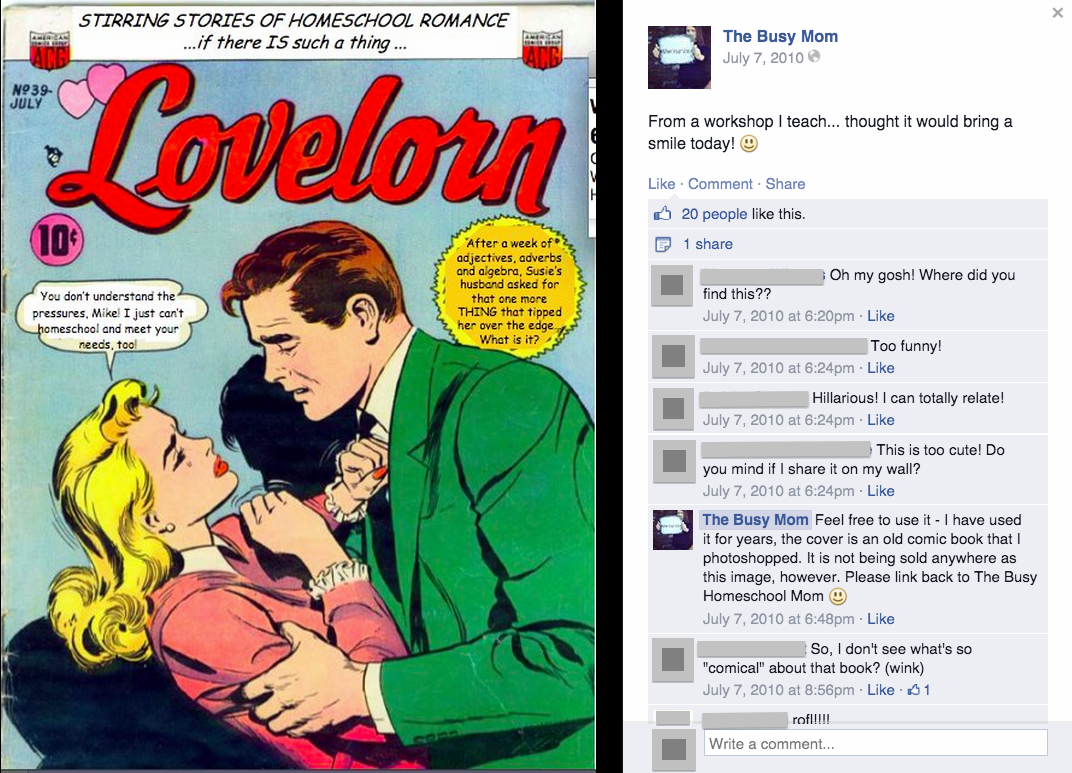
I recently came upon an image posted on Facebook by homeschool mom, speaker, and writer Heidi St. John.

I’m not sure what’s more disturbing—this image, or that none of the moms commenting on it saw this image as disturbing.

Rape-Culture-FB

The image is photoshopped from an old comic that depicts an employee sexually assaulting his “frigid” boss (see here and here or view the full comic here). Sure, one could try to argue that the image has been removed from that context, what with the new words in the bubbles and all, but that fails given the tear on the woman’s cheek and the fact that she is clearly trying to fight the man off (notice her pounding fists). Whatever the words, the image clearly depicts a woman futilely trying to fight off a stronger man’s advances. In fact, in the context St. John provides the image, it appears to be depicting attempted marital rape.

Heidi St. John runs The Busy Mom blog and holds retreats for homeschooling moms. She and her husband run several ministries, including Firmly Planted Family and Firmly Planted Co-ops, which has member co-ops across the country and offers a workbook on how to make sure your homeschool co-op is “firmly planted”. St. John is also the author of The Busy Homeschool Mom’s Guide to Romance, among other books. The author’s blurb is as follows:

busymomHomeschooling offers parents the best opportunity to shepherd their children both academically and spiritually. Yes. It’s worth it. But do you ever feel as if your life is all homeschool all the time? Do you ever wonder where the girl your husband married went? This book is for every mom who has collapsed into bed at the end of the day, looked into the eyes of her husband and promised tomorrow, she’d have time for him. Trouble is, tomorrow finds her more exhausted than the day before. If you have ever felt caught between the demands of homeschooling your children and meeting the needs of your husband, you’re not alone. Read and discover how even a busy homeschool mom can make time to nurture her marriage. It s not as hard as you think and more important than you may realize. Pre-order your copy today!

I am sure St. John has some genuinely good advice. The Amazon reviews of her book (which I have not read) speak of chapters on things like household organization and “me time.”

My concern with St. John centers on two things: first, her use of the comic book image makes me concerned about what she teaches regarding sex and consent, and second, her treatment of HA and HARO on her facebook wall makes me concerned about how her homeschool co-op ministry addresses (or does not address) things like abuse or neglect.

First, the comic book image.

The trouble is that an image like this, in the Christian homeschooling community St. John is very much a part of, arrives in a context already influenced by writers like Debi Pearl and the teachings of Bill Gothard and others. These leaders explicitly teach that a wife should never say “no” to her husband’s sexual advances. These leaders do not recognize the existence of marital rape, because they see sex within marriage as the husband’s right.

Coming in this cultural context, St. John’s image is not “funny.” It’s a problem.

It normalizes coercion and marital rape.

Second, St. John’s treatment of HARO and HA.

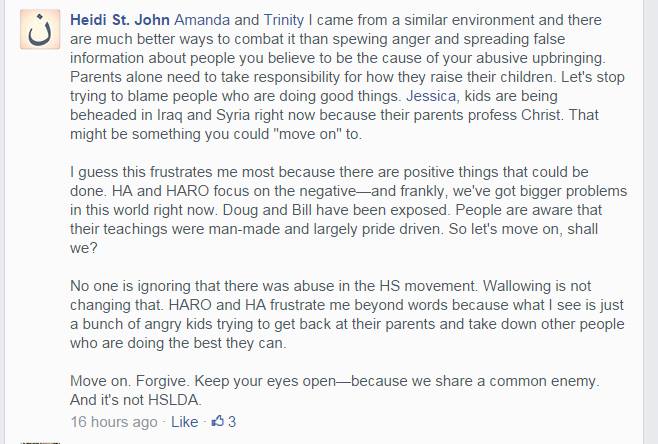
Last week St. John posted a defense of HSLDA on her facebook wall, and several homeschool alumni who had mutual friends with her left comments sharing their stories and trying to explain their concerns with an organization that defends child abusers and elevates parental rights while denying that children have rights. St. John’s responds was this:

HARO-and-HA

St. John’s response to abuse in the homeschooling environment is “we’ve got bigger problems in this world right now” and “move on.” She calls homeschool-alumni-turned-reformers “a bunch of angry kids trying to get back at their parents.”

This should not be acceptable.

I’d like to see St. John reach out to member co-ops with information on recognizing and reporting abuse and neglect, perhaps using resources developed by HARO or CRHE, but her response here suggests that she doesn’t see this as a priority. Instead, she’d rather stick with praising HSLDA and condemning homeschool alumni who point out that HSLDA’s policies protect abusers (which they do). My concerns here are much, much bigger than Phillips and Gothard. Those two leaders have gone down in scandal, but they were never the center of my concerns. The valuing of belief over people, the glossing over things like consent, the minimizing of the need to protect children—these are things that concern me.

And St. John reminds us, once again, that these things haven’t disappeared with Phillips and Gothard.

Failing to Understand the Dynamics of Abuse: Focus on the Family on Adrian Peterson and Corporal Punishment

Screen Shot 2014-09-17 at 1.29.11 PM

HA note: The following is reprinted with permission from Libby Anne’s blog Love Joy Feminism. It was originally published on Patheos on September 17, 2014.

Yesterday, Time Magazine’s parenting section featured an article by Focus on the Family’s Jared Pingleton. The article, titled “Spanking Can Be an Appropriate Form of Child Discipline,” addresses the controversy surrounding Adrian Peterson’s suspension from the Minnesota Vikings on pending child abuse charges after leaving open lacerations on his son. In his article, Pingleton makes a case for corporal punishment while clearly calling Peterson’s actions abuse.

Pingleton begins his article with this stand-alone sentence, in bold:

We won’t go wrong if we exercise a firm and consistent hand with a soft and loving heart.

The problem with this statement is that Peterson was exercising a “firm and consistent hand,” and he was disciplining “with a soft and loving heart.” After being taken to court for injury to a child and then suspended from his team, Peterson apologized for causing his son harm, but he was very clear initially that he did not see anything wrong with his actions—and for good reason. After administering corporal punishment to his son, Peterson texted this to the child’s mother:

Never do I go overboard! But all my kids will know, hey daddy has the biggie heart but don’t play no games when it comes to acting right.

This is exactly what Focus on the family and other groups that advocate corporal punishment promote—the argue that a parent should act from a heart full of love, but exercise a firm hand when it comes to obedience and doing what is right. Is it any wonder that Peterson felt he had done nothing wrong? Many Americans were outraged by pictures of Peterson’s son—and for good reason!—but it makesabsolutely no sense to respond to this case by stating that corporal punishment should involve “a firm and consistent hand” and “a soft and loving heart.” In Peterson’s case, it did.

A parent can have “a firm and consistent hand” and “a soft and loving heart” and still abuse their children.

Before I go on, a few words of background. My parents used corporal punishment and did everything “right,” but my experience was nevertheless negative. Today I practice positive parenting and gentle discipline with my own children. Based on my experiences and a wide array of research, I would like to see corporal punishment phased out. I consider all forms of corporal punishment ethically wrong, though it’s worth noting that I do understand that not all are equally harmful. Slapping a child on their clothed bottom in an attempt to make a point is not the same thing as striking a child with an object and leaving bruises or welts. I dislike the term “spanking” because it erases these sorts of distinctions and everyone seems to define it differently. Finally, to avoid confusion I tend to adhere to the guidelines generally followed by social services and reserve the label “abuse” for corporal punishment that causes bodily injury (i.e. bruises, welts, and worse). That is the definition I will be using throughout this post.

My concerns with Pingleton’s article are twofold. First, Pingleton others child abusers to the extent that he makes it impossible to consider that seemingly normal, loving people could be child abusers. The reality is that child abusers often get away with their actions because they can fool those around them into seeing them as kind, loving people who would never harm their children and thus can’t be child abusers. Second, Pingleton reinforces the many justifications child abusers use to defend their actions. Child abusers are rarely malicious or sadistic. More often, they believe that they are just trying to do right by their children, and that pain is how children learn. Yes, Pingleton condemns child abuse, but he seems to lack any understanding of the dynamics of abuse. If he actually understood these dynamics, he would see that his words also serve to make abusers invisible and reinforce their justifications.

Here is an example of how Pingleton others child abusers:

There is a giant chasm between a mild spanking properly administered out of love and an out-of-control adult venting their emotions by physically abusing a child.

In creating this dichotomy between abusive and nonabusive parents, Pingleton is clearly putting Adrian Peterson’s actions in the “out of control adult venting their emotions by physically abusing a child” category. But there has been no indication that Peterson was out of control (i.e. that Peterson was not in careful control of his actions the entire time) or that he was venting his emotions (Peterson has been clear that the punishment was administered to teach his child to not shove other children). Pingleton is trying to shove Adrian Peterson into a child abuse box he has fashioned many sizes too small, because he doesn’t understand who child abusers are or how they operate.

The reality is that there is no “chasm” between “mild spanking properly administered out of love” and “an out-of-control adult venting their emotions by physically abusing a child.”

Instead, there is a sliding scale. There is also no clear and obvious line between a “spanking” and a “beating.” This is what corporal punishment advocates like Pingleton miss. Adrian Peterson was not on one side of this scale or the other—he was somewhere in between. Different people put the line between acceptable parental behavior and abuse at different points on that line, as is made obvious by the fact that some Americans have defended Peterson’s actions as not abusive. This idea that there is a “chasm” between reasonable discipline and child abuse is nonsense.

We often have this caricature of a child abuser in our mind—out of control, angry—and while some abusers do fit that profile others do not. But when we believe abusers look like this caricature we have created, we create a situation where Adrian Peterson can still insist that he is not a child abuser—because he does not look like that. But the reality is that child abusers often don’t look like that at all. In fact, sometimes they look like this:

This idea that child abusers are some sort of monsters and that normal, loving people do not abuse their children a serious, serious problem.

It allows us to miss and overlook very real abuse because the perpetrators are nice, and smile, and say the right things. The reality is that abusers are very good at fooling others and looking picture perfect, and if we don’t understand that we will be likely to brush warning signs under the rug when they do appear.

Pingleton goes on:

It is vital, however, that spanking be administered within proper guidelines. The reports about the punishment meted out by Peterson to his son, and the consequent injuries his son suffered, indicate his behavior on that occasion was far outside those boundaries.

If this is what he wants to argue, Pingleton needs to drop his whole “we won’t go wrong if we exercise a firm and consistent hand with a soft and loving heart” schtick, because Peterson followed that short line of advice and did go wrong. Does Pingleton seriously think that parents who abuse their children don’t believe in being firm and consistent and administering discipline out of love? Does he not know that most parents who abuse their children say things like “this is for your own good” and “I’m only doing this because I love you”? Is he unaware that child abusers say things like “children need a firm hand” and “we have to be consistent”?

I’m glad that Pingleton recognizes that Adrian Peterson abused his child, but I’m troubled by his total lack of understanding of why it happened. He seems completely unaware that what he thinks is a caution against abuse—”we won’t go wrong if we exercise a firm and consistent hand with a soft and loving heart”—is in fact the very argument Peterson used to insist that there was nothing wrong with what he did when he left his son with open lacerations. If Pingleton wants to protect children from being abused, he needs to stop making abuse-enabling statements like that.

That Pingleton has no understanding of the dynamics of abuse is bizarre given that he is the director of Focus on the Family’s counseling program.

Pingleton goes on to give some guidelines for appropriate corporal punishment. He says that it should only be used in “cases of willful disobedience or defiance of authority,” and that “a child should always receive a clear warning” first and understand why they are being punished. The punishment should take place in a private area and should be “lovingly administered” and should not involve “the potential to cause physical harm.” Afterwards, the child should be told once again why they were punished, to ensure that they understand and have learned the intended lesson.

From what I have read, it appears that the only point where Peterson did not follow Pingleton’s advice was in causing physical harm—the open lacerations. But once again, the line here is less obvious that Peterson thinks. My own mother carefully followed the guidelines Pingleton laid out, but she did on very rare occasions leave bruises or welts, and on one occasion she drew blood with a switch. She nevermeant to leave bruises or welts, and certainly never intended to draw blood that one time. But when you’re hitting your child’s soft, bare bottom with a wooden paddle or a switch cut from a tree (my mother used both), it’s harder to make sure you don’t leave bruises, welts, or cuts than one might think. And as Peterson has said many times, he never intended to leave open lacerations—he did not realize that the switch he used would do that much damage to his son’s skin.

What I’m trying to point out is that while Pingleton thinks he is drawing an obvious and simple line between abuse and appropriate discipline, the line he is drawing is not nearly as obvious or clear as he thinks. A parent following Pingleton’s guidelines for administering corporal punishment can leave marks on a child completely unintentionally. After all, striking a child naturally involves some risk of harm. Lydia Schatz’s parents used a plastic switch to administer corporal punishment. This switch broke down the girl’s muscle tissue, and when fragments of muscle tissue entered her bloodstream it caused liver failure.

Lydia’s parents never intended for this to happen and in fact had no idea it could happen, but Lydia still died.

Later on in his article, Pingleton makes it very clear that corporal punishment should hurt. After explaining that parents have a responsibility to discipline their children, Pingleton quotes from the Bible:

No discipline seems enjoyable at the time, but painful. Later on however, it yields the fruit of peace and righteousness to those who have been trained by it. (Hebrews 12:11)

Pingleton argues that teaching children right from wrong should hurt—even that it must hurt—but that it’s for the child’s own good and will yield longterm fruits. This idea that discipline has to hurt, but will pay off in the long run—this was also part of Adrian Peterson’s justification for his actions. Whether Pingleton realizes this or not (and given his understanding of the dynamics of abuse it is likely that he does not), this is yet another argument commonly used by abusers—what they’re doing should hurt, they say, because that’s the only way the child will learn their lesson.

In his texts to his son’s mother, Peterson explained that the reason he went on for so long was that the child did not cry. He took that as an indication that he wasn’t hitting hard enough to get the message across—because getting the message across had to involve pain. Because of his belief that correcting his child’s actions must involve pain, Peterson denied that he had done anything wrong.

Pingleton ends his article with this paragraph:

Parenting is a hard job. None of us do it perfectly. And to make it even more challenging, none of our kids come with an instruction manual attached. But our children need us to do it to the best of our ability, with all the wisdom, love, gentleness and strength we can muster. We won’t go wrong if we exercise a firm and consistent hand with a soft and loving heart.

Pingleton finishes with the same sentence with which he began. He clearly wants to emphasize it. Pingleton says over and over again that abuse is a tragedy and is wrong, wrong, wrong, but he does not seem to recognize that his own words are inadvertently reinforcing child abusers’ justifications for their actions. Does he not realize that child abusers say things like “I’m only trying to make them a better person“? How is he unaware that child abusers say things like “pain is how children learn“?

Ultimately, this is one of my biggest problem with the arguments made by advocates of corporal punishment. Most of their arguments in favor of corporal punishments are the same arguments used by child abusers to justify their abuse. Their only caution against abuse appears to be clarifying that corporal punishment should be administered out of love rather than anger, but this plays into incorrect stereotypes about what child abuse looks like and is less helpful than they seem to think. Suggesting that parents use their own judgement to make sure they don’t go to far is equally unhelpful.

Most child abusers tell their children they are doing this because they love them, and most would deny that they’ve gone too far, or that they ever intend to harm their children.

How can Pingleton not see how his own words can be used to justify not only corporal punishment he considers appropriate but also actual child abuse? How can he not see that child abusers are not all evil monsters venting their anger on their children, and that suggesting that there is a huge “chasm” between child abusers and other parents serves to keep parents from self reflection and prevent people from seeing child abuse right in front of their eyes? How can he be Focus on the Family’s head of counselingand not see this?

I Am a Survivor: Elizabeth W.’s Story, Part Two

Screen Shot 2014-09-16 at 11.30.22 AM

< Part One

Trigger warning: graphic descriptions of physical and verbal abuse.

Part Two

Looking back, I can see that after we moved and no longer had immediate neighbors to hear the screaming when she beat me or my brother, she felt much less restrained and the violence increased in frequency and intensity.

If I was quiet and withdrawn (which was pretty much always) and mom decided my quietness was “rebellious” or “disrespectful”, or if I forgot to say “ma’am” after addressing or answering her she would begin screaming at me, calling me a disrespectful whore/slut/tramp/bitch, while simultaneously slapping me across the face hard enough to knock me down. She began to use bigger and better weapons than her hands and the bristle side of a hairbrush. I was beaten with length of copper pipe, pieces of two by four, a thick wooden yardstick (which broke on me eventually), thrown down stairs, had my wrists twisted until she forced me to my knees, screaming in agony, was dragged around the house by my hair and my head bounced off any and all hard objects. She tried to suffocate me several times, held me down and forced a pillow onto my face with all her weight, while screaming she was going to kill me and she wished I would die. I had my head and face forced under a pouring tub faucet and held there until I thrashed my way out of her grasp.

These things happened at least several times a week, sometimes more than once a day, interspersed with the verbal abuse, and her refusal to address me by name, but rather as “bitch” or “slut’. I was regularly told I was “ugly”, “fat”, “disgusting”, “crazy”, and “stupid”.

For those who think I may have been a “difficult” teenager from 11-16 or so when this pattern really took off – I never raised my voice to my mother, never cursed at her, never had friends over or snuck out, never wore anything other than black, baggy clothes (which is hardly slutty), never disobeyed a direct order, never did an illegal drug, smoked or drank, and only ever argued by politely stating I didn’t want to do something, or I thought she was mistaken. The latter two always resulting in a beating or several, so rarely did I dare say no to anything.

In public, my siblings and I were always perfectly behaved, rarely speaking, never making noise of stepping out of line. Mom only had to give us that angry glare that promised later retribution for us to think twice about doing anything at all. There was no one around who knew us beyond the brief homeschooling afternoons with the LEAH group who could have possibly known that anything was terribly wrong in our house. We were so isolated, there was no one I could have spoken to, even had I found the courage to do so.

We’d been trained to fear the authorities and Child Protective Services and had no friends or family to speak of.

Mom “volunteered” me to go work at St. Vincent de Paul soup kitchen once a week to win points with the local Catholic church she dragged us to once in a while. At first I was furious that she had volunteered me without even asking me, but after a while I realized it was a few hours a week out from under her thumb and grew to enjoy it. Mom also signed me up for confirmation classes at the local Catholic church, after she had begun attending workshops run by a fundamentalist Catholic homesteading family who also homeschooled their twelve children.

Mom decided it was time for all of us to get more “spiritual”, and began three times a day “prayer circles” where we would all be forced to sit and read aloud from the Bible and sing hymns that the “Fahey’s” (the Catholic family she was imitating) sang. She instituted a clothing change, head-coverings for the girls (I refused), she began making ankle length dresses for herself and us (I also refused), and only long sleeved button down shirts for the boys. She threw out our shorts and t-shirts, started getting rid of her college feminist lit, and any and all of our books she found too “worldly”. Mom sold the computer my grandparents had bought for us, got rid of our tiny video and cd collection, and began instituting even stricter rules for us to follow. So during these changes I attended confirmation classes at the local church, which I despised and between the forced Bible study there and the forced Bible study at home quickly grew to despise Christianity and the confining, narrow-minded tenets the Bible espouses. I never spoke my thoughts aloud, but my mother could tell from my face when I wasn’t agreeing or complaisant enough and my face invariably led to new beatings and verbal abuse.

Mom began to use the Bible as an additional weapon, quoting the “Thy shall honor thy father and mother”, and telling me that God said I must be obedient and respectful to her. (Even though I was always obedient and never voiced any disrespect.) This just furthered my disgust for the Bible, although I now see that, like homeschooling it was simply being used by my mother to her ends, not necessarily bad unto itself.

I was falling deeper and deeper into a depression that seemed like it was swallowing me whole. I started sleeping really late every day, shuffling through my duties with my head down and my mouth shut. I began snapping at my siblings when mom wasn’t looking, I had no patience for their demands for my attention or their quarrels. My brothers began fighting viciously with each other, first when mom was out, later even when she was home, resulting in beatings for them as well as me. I knew my mother hated me, I didn’t know why.

I tried so hard, for so long, to be what she wanted me to be, obedient, respectful, responsible, but never seemed to find her approval or even a respite from her rage.

I am, at my core, fundamentally an honest person, having no talent for acting, for pretending to be happy when I am not. This was my downfall. If I had only been a better actress, perhaps I could have fooled her into thinking I was, in fact, what she wanted me to be, rather than merely doing whatever I was told with my face betraying my misery and despair.

I tried to kill myself twice.

Once, at summer camp, I stepped in front of an oncoming semi truck with a feeling of exultant freedom and calm. A boy who liked me happened to be standing nearby and turned around and yanked me out of the road as the truck went by. The second time, my brother Alexander and I were coming home from the paper route and I decided the easiest way to end my misery would be to poison myself. I picked a handful of deadly nightshade berries and was about to throw them down my throat when my brother jumped up and slapped them out of my hands and started screaming and crying hysterically.

I felt sad, resigned, and guilty for terrifying him so, and didn’t try to kill myself again.

1997, was the last year of my paper route as mom decided it was allowing me too much freedom and she wasn’t making enough money off of it/me to be worth the trouble, so she called my boss and “quit” for me. I was devastated by this, as it was among my last outlets for momentary respite from the hell that was my home.

The following year I got my first real job, washing dishes at a local pizzeria for minimum wage. I was ecstatic at being able to get out of the house a few evenings a week and being allowed to save a little money to buy a puppy for my sixteenth birthday. After about six months, my mother called and told my employer that I could no longer work there because I was sleeping with a married 30 year old man who was a coworker there. All this because I had spoken to him on the phone (about a dog) while she was listening in, and she said she could tell we were having sex by the tone of his voice. Really. There was no other evidence for her accusation, that was it. Mom convinced herself that this was true even though both he and I told her she was mistaken and crazy. She then beat me, off and on, for the next two days for this delusional belief until I could stand it no longer.

I packed my things and lived on the streets of Buffalo for next three weeks.

I camped out in the basement of an abandoned apartment building, slept in a refrigerator box when I could, and mostly just tried to process what on earth to do next. Going home was not an option, if I stayed another minute I knew I would kill myself, I felt as if I was being slowly crushed by my life and there was only a spark of life and spirit left. After a few weeks, I found a runaway shelter who helped me track down my biological father who came and got me.

My mother’s insults and degradations became ever more creative and hateful, designed to wound. They did. To this day, simply recalling these things makes me shake uncontrollably and I do not believe that my littlest sisters should have to wait until things get as bad as they were when I was driven to the streets before someone should step in. I have only waited this long because I had hoped that mom had changed her behavior as she claims, and because she is still my mother and I was, (and still am) hesitant to speak the truth and have her never speak to me again.

Contrary to what I’ve been told by DCS when I made a statement regarding my two sisters still trapped there, physical abuse is not the only threat to a child at home. Emotional and verbal abuse leave damage far deeper, with myriad consequences to a child. Emotionally fragile, sensitive teenage girls do not need to have what little self confidence and self respect they have destroyed by the one person in the world who is supposed to support them, believe in them, and give them strength to take on the struggles of life. My mother does not, and never has provided any of those things.

On the contrary, her words tore me down to the ground and I have spent half my adult life rebuilding my self image and confidence solely because of the things she said every day of my childhood.

End of series.