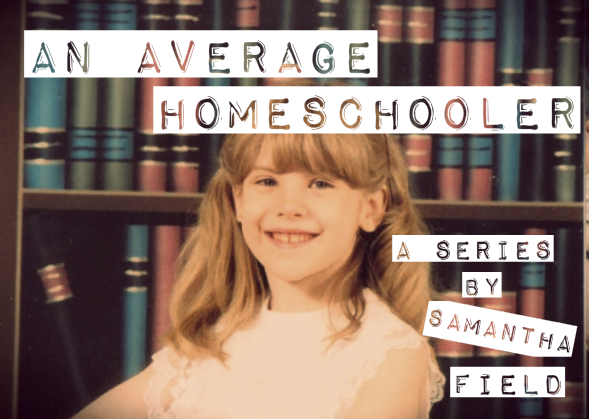
An Average Homeschooler: Part Four, Junior High

Screen Shot 2014-01-06 at 12.38.16 PM

HA note: This series is reprinted with permission from Samantha Field’s blog, Defeating the Dragons. Part Four of this series was originally published on December 11, 2013. Also by Samantha on HA: “We Had To Be So Much More Amazing”“The Supposed Myth of Teenaged Adolescence”“(Not) An Open Letter To The Pearls”,  “The Bikini and the Chocolate Cake”, and “Courting a Stranger.”

*****

Also in this series: Part One, Introduction | Part Two, The Beginning | Part Three, Middle School | Part Four, Junior High | Part Five, High School Textbooks | Part Six, College

*****

Junior high was a difficult transitional phase.

My mother and I continued fighting over school– some weeks, on a daily basis. Part of this was due to the fact that I’ve always been ferociously independent. I’m what my husband calls a “dirty rotten little rule follower,” but part of what that means to me is that I like to be left alone. You can trust me to do what I’m supposed to be doing (most of the time), and I intensely dislike being monitored. That came to the forefront, and something my mother and I struggled with all through 7th grade was my insistence that I can do this by myself. She was also dealing with my younger sister hitting 4th grade, and this is when my homeschooling experience radically changed– and when, in my impression, many homeschoolers make the same transition.

Junior high or early high school is when homeschoolers start teaching themselves.

Granted, this is not always true, but in my experience, it almost always is. There are as many reasons for this as there are homeschoolers– some of us come from huge families, and it’s impossible for parents to give older children the attention they need. Sometimes it’s because of situations like mine, when we start feeling that we can handle it without our parents. I think my reaction is a natural part of child development– I was, after all, 13 in 7th grade. However, in homeschooling culture, rebellion is not permitted to exist, and the natural independence that children start exerting around 13 is conflated with rebellion. For many of us, our teenage years were incredibly stifling– although many of us didn’t recognize it at the time. I certainly didn’t. I was extraordinarily proud of how I wasn’t going to be “one ofthose teenagers” who “think they know better than their parents.”

The only way my “teenager” stage was allowed to come out was in this way– in taking over my education.

I started doing all of the work by myself and occasionally going to my mother with questions. This is enough of a pattern in homeschooling that some of the major homeschooling curricula distributors have created entire programs around it.

In 8th grade, we started using the A Beka Video school, although we chose not to use them for accreditation. It was insanely expensive and my parents could barely afford it, but it seemed to suit what I needed, and it had an incredibly good reputation among homeschoolers. At first it was amazing, and I ate the whole thing up. Toward the end of the year, though, the program was brutal and exhausting. The videos are not set up for homeschooling the way we were doing it. In order to really make the videos work, a teacher needed to be there with you– doing the reviews, checking homework, administering quizzes– or you’re just going to be sitting in front of a TV for six hours.

Eventually, I grew incredibly bored with the videos.

When I started fast-forwarding through all of the homework checks and the quiz grading on the tapes as well as the classroom work sessions, I realized that there was rarely anything on the tapes that was actually teaching me anything.

I stopped watching any of the videos for English and math, preferring to do the work on my own, and only watched the lecture portions of history and Bible (which, anyone remember Mr. McBride’s history classes? The day I met him I told him that I would save the best lessons and watch them during sleep overs. Seriously. We did that.). In short, by the spring quarter, the videos turned out to be a gigantic waste of money for us.

It also convinced me that I would absolutely hate school– that, along with taking the 7th grade standardized test, which I got extremely good marks on. My reading ability tested out of the park, and everything else was well above average. Those, combined, fed into what I believed about homeschooling compared to public schooling– homeschoolers are smarter, better educated, and more free-thinking than public school students. Public education can only result in stifling a child’s creativity, destroy their intellect beyond repair, and give them nothing more than socialist indoctrination.

So, we turned to Alpha Omega Switched on Schoolhouse for 9th grade. That turned out to be a disaster. The science for that year was physical science of some stripe, and they were trying to teach me how to convert units– except the units in the homework problems frequently weren’t measuring the same things– seriously, you can’t convert a unit of force into a unit of volume. I was so confused I asked my mother to look at it– she rolled her eyes and we stopped using the program in the middle of the year. My mother purchased other textbooks and I spent the rest of 9th grade playing catch-up.

Junior high, though, is mostly when I started understanding how much pressure I was under.

I realized that one of the reasons why homeschooling is considered superior to all other forms of education is that homeschoolers are “better-educated” and “smarter.” We test better. We’re better-read. We’re more articulate. We can socialize with adults better. We spend a lot of time de-bunking homeschooling “myths” and “stereotypes“. We write whole tongue-in-cheek pieces answering “common questions about homeschooling.” And, in junior high, I became one of them. Suddenly, it was my job to convince everyone that I was fantastic. I had to get better grades. I had to read more books.

Every single time I left the house I had to be ready to mount a defense for homeschooling.

All of that convinced me more than it convinced anyone else. It wasn’t that homeschooling and public education have different strengths, different weaknesses. Homeschooling had to be better in every conceivable way.

And I had to be an example of that.

To be continued.

An Open Letter to Debi Pearl

Screen Shot 2013-11-08 at 5.31.15 PM

HA note: The following is reprinted with permission from Libby Anne’s blog Love Joy Feminism. It was originally published on Patheos on October 24, 2013.

Dear Debi,

I was very excited when I read your article of this past August, titled “The Roland Study.” In that article, you began with this opening paragraph:

My grandson Roland, who just turned one, has taught me more about the development of babies and toddlers than I learned my first sixty-plus years of life. It is not that he is such a fine teacher; it’s just that, now that I’m a grandmother, not responsible for meeting the daily needs of my children, I can seriously focus on what makes him tick:  how much he understands, what causes him joy or anxiety or fear, his interests and responses—and, most importantly, what a child is capable of learning at various ages.

I am glad to know that you, like me, have become fascinated by listening to children and trying to understand what makes them tick.

It’s amazing, isn’t it? I am writing because I am concerned about your husband’s book, To Train Up A Child. I understand that he stands by what he wrote there, but I have read the book multiple times and feel that the central messages of that book run contrary to what you wrote in your article.

Let me offer some examples.

First is the way one views the natural behavior and needs of infants and toddlers. You urge parents to “always assume your cranky baby is sleepy, sick, or bored, and do something to alleviate the problem or meet the need.” This is wonderful advice! Yet in to To Train Up A Child, Michael has this to say of a cranky baby:

As the mother, holding her child, leans over the crib and begins the swing downward, the infant stiffens, takes a deep breath and bellows. The battle for control has begun in earnest. Someone is going to be conditioned. Either the tender-hearted mother will cave in to this self-centered demand (thus training the child to get his way by crying) or the infant is allowed to cry (learning that crying is counterproductive). Crying because of genuine physical need is simply the infant’s only voice to the outside world; but crying in order to manipulate the adults into constant servitude should never be rewarded. Otherwise, you will reinforce the child’s growing self-centeredness, which will eventually become socially intolerable.

In other words, you say that cranky babies should be assumed to be sleepy, sick, or bored, but Michael urges parents to view a cranky baby as selfish or rebellious.

Which is it? Should a parent respond to a cranky baby with love and compassion, as you urge, trying to find a way to meet that baby’s needs, or should a parent view a cranky baby as “self-centered” working to “manipulate”?

Next is the issue of actually listening to your children. In your article you write that, as a result of “studying” your grandson Roland, you felt as though you were “quietly listening to him speak before he could actually talk.” Yet nowhere in To Train Up A Child does Michael focus on teaching parents to parents to listen to their small children, whether they can talk or not. In fact, the word “listen” appears only three times in the book. It once refers to a girl listening to train whistles, and once to a father listening to his daughters sing, and the third time it is the child who must listen, not the parent:

However, if you are just beginning to institute training on an already rebellious child, who runs from discipline and is too incoherent to listen, then use whatever force is necessary to bring him to bay. If you have to sit on him to spank him then do not hesitate. And hold him there until he is surrendered. Prove that you are bigger, tougher, more patiently enduring and are unmoved by his wailing. Defeat him totally. Accept no conditions for surrender. No compromise. You are to rule over him as a benevolent sovereign. Your word is final.

In other words, you urge parents to listen to small children, to try to hear what they’re trying to say, but Michael focuses on forcing them into submission without ever mentioning listening to them.

Which is it? Should parents listen to their children, even young babies and toddlers, or should children be the only ones to listen, required to “surrender” because the parent is “bigger” and “tougher”?

Finally, when speaking of your study of Roland, unable yet to walk, you state that “I could clearly see that he knew what was happening and wished he could join the parade of feet running here and there.  This baby boy was frustrated by his baby body.” Yet nowhere in his book does Michael point out that children might be frustrated, whether by the limitations of their bodies or by anything else. For instance, Michael states this:

How many times have we observed the grocery store arena? A devious little kid sits up in the command seat of the shopping cart exercising his “childhood rights” to unlimited self-indulgence. The parent fearfully but hopelessly steers around the tempting “trees of knowledge of good and evil.” Too late! The child spies the object of his unbridled lust. The battle is on. The child will either get what he wants or make the parent miserable. Either way, he conquers.

In other words, you urge parents to consider that they’re children’s actions may be the result of natural frustrations, but Michael seems completely unaware that this could be the case

— or else he simply doesn’t care.

Which is it? Should babies and small children be assumed to be rebellious and selfish, or should parents consider that their children’s behavior might be the result of natural frustration, like Roland’s frustration with not being able to walk? Why does Michael not address the fact that the child in his anecdote might be hungry, or overstimulated, or tired?

I know this may be hard for you to hear, Debi, but many parents who read To Train Up A Child come away viewing their children’s normal behavior as sinful and interpreting their children’s natural needs as selfish as a result. They don’t come away with the idea that they should listen to their children or try to understand what makes their children tick, because that’s not in there.

Let me take a moment to tell you a bit of my own story. When my daughter Sally was ten months old, she discovered some potted plants on our coffee table. I told her “no” but she would not give up her interest in them, and, as a result of reading To Train Up A Child, I saw that as disobedience and the beginning of life-long rebellion. So I began to switch her hand every time she touched the plants. Nothing worked, and our relationship suffered. It was only when I called the contest off and took some time to try to understand Sally’s perspective—something never suggested in To Train Up A Child, by the way—that everything changed and my relationship with my daughter began to blossom. Rather than viewing her actions as disobedience or sin or selfishness, I sought to meet her at her level and understand what made her tick.

You said in your post that you have learned more in the last year about the development of babies and toddlers than you learned in the entire first six decades of your life.

Debi, I’m asking you, please reread To Train Up A Child and examine the advice given there with your new understanding in mind.

Ask yourself what message parents will take away from the way babies and toddlers are portrayed, described, and represented. Ask yourself about how articles like this and this and this teach parents to view and understand children. And then ask yourself whether it might be time to pull production of the book.

Thank you for listening,

Libby Anne