Melting Memory Masks: Cynthia Jeub’s Story

Screen Shot 2014-10-03 at 2.45.29 PM
Cynthia Jeub. Photo courtesy of CynthiaJeub.com.

HA note: The following is reprinted with permission from Cynthia Jeub’s blog CynthiaJeub.com. It was originally published on October 3, 2014. 

Trigger warnings: child abuse, self-harm

Hey, girl, open the walls, play with your dolls, we’ll be the perfect family. –Melanie Martinez

~eight years ago~

“Mom, dad, I’ve been hurting myself since I was four. I’ve kept it a secret for ten years, and I don’t think anybody else in the world does it. I want to tell you because we’re going to film for TV, and I might lose control in front of the cameras. I don’t want to make our family look bad.”

“Are you still doing it?”

“No. I quit a few years ago.”

“Then your sin is forgiven. We’ll go ahead with the filming. Just don’t tell anyone.”

Picture! Picture! Smile for the picture! Pose with your brother, won’t you be a good sister?

~seven years ago~

“Mommy, stop hitting him! He’s only eleven!”

“Do something, Cynthia! I’m scared…she’s not stopping!”

~a few days later~

“What happened to him? Did he get in a fight with his brother?”

“No. Mom got mad and slapped him. She wouldn’t stop, so I pulled her off of him. He’s wearing makeup so you can’t see the whole bruise and where he was bleeding.”

Everybody thinks that we’re perfect; please don’t let them look through the curtains.

~six years ago~

“I’m going to sit here while the producer interviews you. I’m here to help you remember to say what’s true.”

“Okay, daddy. I trust you.”

Don’t let them see what goes down in the kitchen.

~five years ago~

“Mom, look! I watched ten kids and cooked food and cleaned the house while you were gone!”

“You didn’t do the dishes?! You don’t appreciate that I was gone shopping all day. I do so much work around here, and I can’t be gone for a few hours without coming home to a mess! I need to work in a clean kitchen, and it’s your fault I can’t! I don’t ask for much!”

Places, places, get in your places

~three years ago~

“Is it that cutting thing again? I thought you were over that.”

“I’m scared because I want to kill myself, daddy.”

“Are you sure you’re not just trying to fit in with your college friends, pretending to have problems like theirs?”

No one ever listens, this wallpaper glistens

~two years ago~

“You’re not telling your therapist that you’re having problems with self-harm and depression, are you?”

“No, mom. I’m there because I’m angry with my two older sisters for turning their backs on God and being rebellious, and hurting my parents.”

“Good. I don’t think that’s really something to tell your counselor about.”

Throw on your dress and put on your doll faces.

~one year ago~

“I remember when you were spanked with a belt every day, even though you didn’t do anything wrong most days.”

“So you remember that, too? Weird…I asked mom why they did that, and she said it never happened. I thought there must be something wrong with me.”

D-O-L-L-H-O-U-S-E

~this year~

“Do you remember that one time that mom slapped your face until you had cuts and bruises, and I had to pull her off of you?”

“I know it happened because you and our other siblings were there, but I don’t remember it.”

“You blocked it out?”

“I guess so. Anyway, she said she was so sorry, and it would never happen again.”

“Did it happen again?”

“Yeah, but I was asking for it then. I was a disagreeable boy when I was going through puberty.”

“Don’t you think maybe moms shouldn’t hit their kids over and over until they bruise?”

“Our parents aren’t that bad, Cynthia. You need to stop saying that they’re abusive.”

I see things that nobody else sees.

Part Two >

*****

About the Author

Red-Streak-Square-300x300

Cynthia Jeub is a blogger at Cynthiajeub.com where she writes about insights on epic living. As a writer, she focuses on faith, philosophy, and the importance of storytelling. She’s most well-known for her reality TV appearances with her family of 18 on The Learning Channel and WE-TV. A theatre major at the University of Colorado at Colorado Springs, she edits for her school’s student newspaper, The Scribe.

*****

HA note: In light of these allegations by Cynthia (one of Chris Jeub’s daughters), the HARO board is uncomfortable with hosting Chris’s post, “Stiff-Necked Legalism.” We have retracted that post and its comments.
Is the Christian Homeschool World Really Changing?

Screen Shot 2014-04-22 at 5.31.34 PM

HA note: The following is reprinted with permission from Libby Anne’s blog Love Joy Feminism. It was originally published on Patheos on April 22, 2014.

Things are changing in the Christian homeschooling world. Vision Forum has fallen and ATI is shaken. People are talking, really talking, and the narratives are shifting.

Some are still resisting this conversation.

They claim that Doug Phillips’ fall had nothing to do with his patriarchal ideology. With both Phillips and Gothard, they argue, the problem was with the leader, not the belief system. These claims are dispiriting, because in some sense these leaders are interchangeable. Old ones will fall, new ones will rise, and if the ideology remains the same nothing will change.

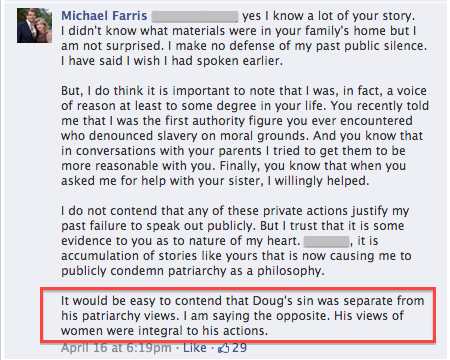
But other leaders are being more honest. They, Michael Farris and Chris Jeub among them, are connecting the dots and calling out a problem deeper than an individual leader. In this facebook comment, Farris responds to a homeschool graduate’s reiteration of her story (I’ve marked the relevant bit):

m1

When I read these things, I am reminded of evangelical attempts to soften toxic ideas so that they become more palatable, and that concerns me. For example, I heard evangelical leaders at the megachurch I grew up attending walk the idea of male headship back to spiritual leadership and breaking the tie when husband and wife cannot come to an agreement. While I appreciate that there are evangelicals who have moved away from an emphasis on total wifely obedience and submission, the idea of male headship itself is a problem, and softening it doesn’t change that. Is the walked-back view better? Yes, but it’s still a problem.

I wonder how far Christian homeschooling will change over all of this, and whether that change will be deep or surface-level. All Doug Phillips did was take ideas already out there—the idea of the Joshua Generation, the emphasis on male headship and wifely submission, the idea that girls should be encouraged to be homemakers and discouraged from having careers—and deepen each, using direct language, until his words and dictates became an embarrassment.

If Christian homeschool leaders see Phillips’ direct language and strident emphasis as the problem and fail to realize that it is at the core the underlying ideas that they themselves have long held that is the problem, change will be shallow indeed.

The word “patriarchy” is not the problem. The ideas that underly that word are the problem.

If the Christian homeschool leaders who are speaking out today reject the word “patriarchy” but hold onto the idea that a wife must submit to her husband, what have we actually gained? What is actually different?

Israel Wayne of Family Renewal wrote that:

In September of 2013, Michael Farris, founder of the Home School Legal Defense Association (HSLDA) spoke to state convention coordinators and other national homeschooling leaders, at the annual leadership conference they sponsor. He warned against the dangers of the excesses of extreme child discipline and a low view of women that has taken hold in some corners of the homeschooling community. He warned that unless homeschooling leaders actively speak against abusive and unGodly approaches to child discipline and unBiblical views of Patriarchal authority (that demean and devalue women), we risk losing our very legal freedom to homeschool.

From Wayne’s description, it sounds like Farris told other homeschool leaders that they needed to speak against child abuse and the devaluing of women or else homeschool freedoms would be at risk. The emphasis here appears sorely misplaced. Shouldn’t the primary concern be for the children who are abused and the women who are devalued rather than for the possibility that people will react to these abuses by turning against the legal freedom to homeschool?

I should note that I very much question what Farris means by “our very legal freedom to homeschool.” I suspect what he actually means is our freedom to homeschool without oversight or accountability. And here is a very real issue—Farris is now speaking out against “patriarchy,” and it appears that he may begin speaking against child abuse (though that remains to be seen), but he is still against legal accountability for homeschooling, accountability that would support children’s right to an education and their right to an upbringing free from abuse or neglect.

HSLDA’s current president, Mike Smith, will be presenting this keynote address at an upcoming homeschool conference:

Remembering the Reason, Renewing the Vision A general overview of the challenges, burdens and benefits of homeschooling from a veteran homeschool father and leader. Addressing the potential homeschooler, the new homeschooler, the veteran homeschooler and all homeschoolers in between, Mike outlines the success of homeschooling in academics and socialization, describes legal and legislative advances,and concludes that homeschoolers have earned the right to be left alone. 

This last bit is a serious problem. Whether or not Farris indeed intends to speak out loudly and publicly against patriarchy and child abuse, his organization will continue to work against legal reforms that help fight these problems, reforms that would bring homeschooled children into contact with mandatory reporters or ensure that homeschooled girls are not passed over educationally because of their gender. A change in culture is needed, yes, but the unregulated nature of homeschooling in many states both contributes to and is a result of that culture.

We need more. Homeschooled children deserve more.

But this is only the start of the things that concern me as I watch this current moment. Israel Wayne followed up on his discussion of Farris comments with these unfortunate paragraphs:

Mr. Farris has sounded a much-needed warning. My concern, however, is that when we over-react and swing to the other ditch, we end up teaching only love, grace and mercy (with no boundaries for children). By rejecting “Patriarchy” (abusive or domineering tendencies of men towards their wives and families), we may revert to the Feminism of the 1960′s, and all the problems that came with it, that led many women to react 180 degrees in the other direction by staying home and homeschooling their children. By rejecting rigid step-by-step rules about issues like strict clothing mandates and courtship procedures, we may revert back to the kind of sexual permissiveness that led to the legalism in the first place.

Do we really want to go back to families where mom is trying to pull that whole family uphill all by herself, while dad is off playing golf, letting mom run the family all by herself? Do want three-year-olds who rule the parents with an iron fist and parents who jump at their every demand? Do we really want teens who are groping their girlfriends in the back seat of a car because we don’t want to impose a legalistic standard on them? Do we really want to encourage the kind of American narcissism that says children are a nuisance and O.8 children is the goal, because we want to avoid the imbalance of policing bedrooms and imposing doctrines not clearly spelled out in Scripture?

This is not change, this is more of the same. What we need is change, real change. I think we’re at a moment of contingency where we might see such change, but to be honest. I don’t feel all that hopeful at the moment. I worry that the change will be more in gloss than in substance.

I can promise you one thing—I’ll keep pushing.

Is This a Discussion?: Sarah Jones Says No

conversation

*****

As we all try to make homeschooling better, are we having an open discussion?

Sarah Jones says no, Lana Hope says yes.

*****

HA note: The following is reprinted with permission from Sarah Jones’ blog Anthony B. Susan.  It was originally published on December 7, 2013.

This post began life as a pensive reflection on my life as a homeschool apostate. I’ll be blunt: I’m too angry to write that post. I spend so much time trying to separate myself from extremism and militancy that’s personally frustrating to be so stymied by anger now. But that is where I find myself.

I am furious with homeschool parents who, for days, have been telling me that I’m just bitter: a barely competent child whose rage can be invalidated and debased as ‘lashing out.’

I am weary of Christian patriarchs like Chris Jeub who feel obligated to repeatedly insert themselves into the narrative emerging from our stories of homeschool abuse. This week, Jeub hastened to assure his fellow homeschoolers that we “apostates” haven’t really abandoned the faith; that we’re just asking questions. In doing so, he reduced our entire movement to a monolith more palatable to his fundamentalist audience. It didn’t matter that many of us, like myself, have abandoned the faith and are happy for it. But we’re here, patriarchs, and we’re not going anywhere, so you might as well admit we exist.

Jeub’s post is so distressing to me because I see it as a ploy to retain some control of the narrative we’ve tried to produce. Let me be very clear: this story is not about Chris Jeub. It’s not about any patriarch, for that matter. It is about us. Don’t you dare re-center this around yourselves.

It is time for you to sit down and pass the mike. The guinea pigs are talking.

You had your chance to run your social experiment. Now the results are in and patriarchs, it doesn’t look good for you. You deliberately created a cultural hierarchy that enshrined your place of privilege as divine right. The people you’ve oppressed for decades are trying to speak, and every time we make a sound you drown us out.

I am not looking for a conversation. I think the time for conversation has passed, if it ever existed at all. If you’re not willing to discard Christian patriarchy completely, to acknowledge the horrifying damage it has wreaked on those rendered powerless by it, then you are not my conversation partner: you are the enemy in my fight for liberation. If you are not willing to stop viewing your children as property to be controlled, there is no discussion to be had.

Moreover: I think it actually endangers the fight against Christian patriarchy to view its proponents as conversation partners. They actively perpetuate oppression, and I don’t see it as my responsibility to train them in the ways of allyship. Their voices have been so dominant for so long that I believe it will be impossible to make ourselves heard as long as they’re still speaking. There have been calls for conversation. But conversation is only really possible if both partners are operating as equals; those of us who left Christian patriarchy aren’t yet equal to those who perpetuate it.

Some day, yes, that might change. But in order for that change to occur, Christian patriarchs are going to have to recognize that it’s not their turn to speak.

They’re going to have to cede power.

Counting Sheep

sheep

By R.L. Stollar, HA Community Coordinator

Recently Kathryn Joyce wrote a story for The American Prospect on the rise of the responsible homeschooling movement. I have never seen a piece on this movement spread as quickly as Joyce’s. It lit up Facebook and Twitter like a forest fire starving for oxygen.

If you haven’t read it, you should do so. (You should also check out responses it inspired from Hännah EttingerChris Jeub, and Kate Schell.) Don’t let the length scare you away. The piece is amazingly detailed, giving voice to a diversity of individuals previously not amplified in this conversation. And don’t let the name, “Homeschool Apostates,” cause you to hesitate. The name is an inversion of Kevin Swanson’s radio broadcast where he himself used the phrase to marginalize and dismiss us.

I shy away from Facebook wall debates when stories like this are shared by my friends. I watch them unfold, silently and from a distance. At the very least, I want to understand how our rhetoric is received and interpreted; I may not comment, but I am listening. I want to know what is being said — both positive and negative — so I can continue to improve my own communication and our shared messages.

One individual’s comment on a friend’s wall stuck with me.

I have heard this sort of comment before. In fact, I considered it ironic that this individual said it in such a way that indicated he thought himself clever. Fact is, it’s dreadfully unoriginal. Everyone in this movement has heard it a million times before. But this time it provoked new thoughts for me. The comment is as follows:

As long as millions of families homeschool, it will always be possible to find some who are outliers and thereby call into question the practice. Tis a common practice of the statistically challenged.

Ah, yes. A jazz riff on the “not all homeschoolers are like that” argument. “Not all homeschoolers are like that” is the broken record of homeschool abuse denialism. My inner sarcastic debater wants to respond like this:

Screen Shot 2013-12-06 at 8.43.30 PM

However, my shared humanity understands that sarcasm isn’t always the best rhetorical strategy. There are better strategies:

  • Reiterating time and time again that we do not think all homeschoolers are “like that”;
  • Reminding the skeptical voices in the conversation that, in the absence of required registration (or at least notification) of homeschoolers (which the mainstream homeschool lobby opposes), we will all remain statistically challenged because we will have no reliable statistics;
  • Pointing out that nearly all homeschool research has involved self-selective surveys that describe the participants but prove nothing about homeschooling in general.
  • Providing counter-self-selective surveys, like the 2013 HA Basic Survey which pretty much “proves” as much as most of Brian Ray’s research — namely, still nothing about homeschooling in general.

If you think the statistical side is lacking, you’re welcome to get in line. We’re right there with you. Those of us speaking up aren’t to blame for a lack of statistics.

That’s the fault of irresponsible homeschool advocates.

(What sort of statistics do you want anyways? Statistics of dead kids? Exactly how many dead kids will it take before we’re taken seriously? While we’re busy trying to make homeschooling better, you get busy figuring out how much abuse you can tolerate before you act, too. Deal?)

For today, however, we are all in the same position: we are feeling around in the dark with anecdotes and stories. You might tell different anecdotes and stories than I might. I choose to respect your storytelling. Whether you choose to respect mine is not in my control.

But at least remember that I have stories. In fact, I probably have more than most homeschool students and parents. I spent a decade of my life traveling around the United States because of homeschool speech and debate — meeting new people, making friends, competing in tournaments, and teaching thousands of homeschool teenagers. I have taught the children of national homeschool leaders.

All this while I was a teenager myself.

As a homeschooled teenager, I saw things that you parents have not seen in your own communities. I have lived a life that you parents have never lived. It is like an alternate universe. My first taste of hard alcohol was provided by the son of one of the most prominent national homeschool leaders. I have lived this life. So while I don’t have statistics for you, and while we in this movement are trying to fix that inherited problem, keep in mind that my “anecdotes” — and our stories — carry the enormous weight of experience.

Have you seen the underside of this world? Because I have. The rabbit hole goes down deep, and I have yet to reach the bottom. There are so many hurting kids, now as there was back when I was a kid. There are secrets and sorrows and fears. We have shared those secrets as friends, we have carried each other’s sorrows, we have whispered our fears like prayers.

But maybe you’re right. Maybe at the end of the day, we’re in the minority.

Maybe we are statistically challenged.

The possibility doesn’t faze me one bit.

Because I don’t look to you for a stamp of statistical approval. I don’t take my cues from your homeschool orthodoxies or your convention speakers.

I take my cues from my conscience. And my conscience says go to where the shadows lurk, to create safe places even where the wild things are.

See, a long time ago, I heard a story. It was about a shepherd who had a flock of 100 sheep. One day, one of those sheep got lost. Instead of remaining with the 99, the shepherd did not sleep, did not stop, until he found that the lost one.

I learned social justice from that story. I learned the meaning of activism. I found the meaning of revolution — that you can “change the world” all you want, you can “redeem the times” ad nauseum. But if you neglect the little ones, it’s all for naught.

See, I learned that Jesus of Nazareth was not content with 99 sheep when 99 sheep means that one gets left behind to suffer in silence and solitude.

And I saw how the Pharisees did not understand. I saw how they looked at each in bemusement, clicked their tongues at Jesus for fretting so much about that one fringe sheep, saying, “Tis a common practice of the statistically challenged.”

But Jesus dealt with human beings, not statistics.

Human beings are what I want to deal with, too.

So go ahead. Keep surveying your 99 award-winning sheep. Us “bitter apostates” will be out in the wilderness, searching for the one you abandoned.

Love Misapplied: A Response to Chris Jeub

Screen Shot 2013-11-19 at 10.36.36 PM

HA note: The following is reprinted with permission from Libby Anne’s blog Love Joy Feminism. It was originally published on Patheos on November 9, 2013 as a response to Chris Jeub’s article for HA, “Stiff-Necked Legalism.” We extended to Chris the opportunity to write a follow-up post, but he decided to respond directly on Libby Anne’s original post. You can view his response here.

I grew up hearing about Chris Jeub.

He was a big name in NCFCA homeschool debate circles, and while I never met him I did use the evidence briefs he put out. The Jeubs had 16 kids and were deep into the patriarchal and controlling ideas at the heart of the most conservative strains of the Christian homeschooling movement. In fact, they kicked their daughter Alicia out of the family and shunned her completely when she became “rebellious.” However, Chris says that he and his family have since left that whole legalistic mess.

In fact, Chris is, I think, the only current Christian homeschooling leader who has written a post for Homeschoolers Anonymous.

All of the Jeubs’ book titles have the word “love” in them. Even their blog title has the word. Their move away from legalism involved embracing love. Then why, I have to ask myself, does their approach make me so very uncomfortable? Oh right! Because the problem I had with my parents was not that they didn’t love me. They did.

The problem I had with my parents was that they didn’t accept me.

I would feel a whole lot more comfortable if instead of Love in The House and Love Another Child, the Jeubs titled their books Acceptance in This House and Accept Another Child.

I just read Chris Jeub’s recent blog post Pattern of the Fallen. Here’s an excerpt:

I consider it tragic when people walk away from God. Sometimes they leave in a huff, sometimes they’ve intellectually wrestled, sometimes they dive into crazy sin and blow up their lives. Whatever the story, they are no longer walking with God, and that’s sad.

I’ve seen a pattern, though. This may give you hope. Wendy and I see this time and time again. Any separation between man and God can be attributed to a lack of love.

. . .

One is of a former student of mine who, on the surface, is angry with God. He and I have had rich conversations, but he’s struggling with some genuine relational hurdles that he finds bothersome. Here’s what I find encouraging: this young adult has a deep heart of compassion and love for people. He’s justifiably ticked at people who treat others wrong. His doubts about God stem from the lack of love from the so-called Christians in his life. Funny, I believe God is love (1 John 4:8), so though he is denying God’s love, he’s still running with God whether he believes it or not.. . .

There is a pattern here, don’t you see it? You probably see it in your family. For me, every single squabble or fight we have (sibling vs sibling, parent vs parent, parent vs child) can be attributed to a lack of love. Wendy and I have found that when we focus on love, solutions to the fights work their way out. A quick read and application of 1 Corinthians 13:4-7 solves a lot of problems in our household.

Remember: LOVE is the most excellent way (1 Corinthians 12:31). This reality slaps us up now and then. The trials, heartbreaks, disillusions, confusion, and turmoil in life can often be whittled down to a lack of love in our lives. Someone along the way failed to love, it is as simple as that.

No. Just, no.

Do you know, I would rather be accepted than loved.

Want to know why? Because my parents loved me until it hurt so much that I thought the inside of my chest was going to implode—and not in a good way. I have spent hours curled into a ball sobbing because of how much my parents loved me. I have been ripped apart, shredded, and mangled by their love. Through all of this, I honestly didn’t want my parents to love me. I just wanted them to accept me.

Before you say that love includes acceptance, I’ll point out that for Chris Jeub it clearly doesn’t. Chris very clearly can’t accept the former student he mentioned. Instead, he has to spent an entire paragraph saying that his former student is an atheist because he is angry at God, and that this former student is actually really following God or he wouldn’t have a heart to help those in pain. That is not acceptance. That is so not acceptance. Speaking from personal experience, that kind of thing can feel like a slap in the face to the person on the receiving side of it.

I grew up in a family that had a lot of love. I honestly don’t think I even for a moment questioned whether I was loved. My parents told us frequently that they loved us, and they were always physically affectionate toward us. Mom read us books, baked cookies with us, did crafts with us and sewed clothes for our dolls. Dad showed us how to plant a garden, built us playground equipment, read aloud to us on winter evenings, played board games with us, and took us swimming. My parents centered their lives around us, and we always felt incredibly loved.

And in the end, that is why it hurt so much.

When I was in college, I began to form my own beliefs and to disagree with my parents. Sex? Drugs? Alcohol? No. It was things like just how God went about creating the world, whether or not God required unmarried adult daughters to obey their fathers, and whether I needed my parents’ permission to go out with a guy. But while my parents had buckets of love, they had not a drop of acceptance. They didn’t stop loving me, and in many ways that’s what hurt so much. It hurt that these people who loved me so profoundly could stand in front of me in tears and tell me how much my actions and beliefs hurt them. It hurt so much my insides shriveled. And don’t say they didn’t actually love me. They did. If they hadn’t, that period wouldn’t have been nearly so painful.

Love is a very slippery thing.

Anyone can claim to have it, and people can claim it means anything they want.

For example, I am willing to bet that most abusive parents would claim that they are acting out of love for their children. And are you really going to argue that legalistic parents don’t love their children? Really? Indeed, I’ve heard it argued that the most loving thing a parent of a gay teen can do is to refuse to accept that child’s homosexuality. Telling that child that they are accepted, it is argued, only validates that child’s sin and keeps them from coming to wholeness in Jesus. I grew up hearing from religious leaders who told parents that if they truly loved their children, they must require them to submit to parental control and punish them with the rod when they are disobedient. In fact, I would go so far as to say that the religious leaders I grew up hearing from preyed on parents’ love for their children.

So when Chris Jeub goes on and on about how the solution to dysfunctional Christian homeschooling is love, I can’t help but say no. No, it most certainly is not. If I had experienced a lack of love, my life would have been a whole lot simpler and a whole lot less painful.

The problem isn’t a lack of love. The problem is a lack of acceptance.

The problem is love misapplied.

Stiff-Necked Legalism: By Chris Jeub

HA note, October 3, 2014:

In light of recent allegations by Cynthia Jeub (one of Chris Jeub’s daughters), the HARO board is uncomfortable with hosting Chris’s content. You can view the original post and comments as a PDF here.