LGBT, Queer, And Other Things That Make Us Say, “What Does That Mean?”: Deborah
HA note: The author’s name has been changed to ensure anonymity. “Deborah” is a pseudonym.
I grew up hearing a great deal about how evil gay people were and how the whole world was going to be destroyed either directly by them or by God because “the righteous” didn’t murder all of “the gays”. So I thought I knew what it meant to be gay and really didn’t care if that was different from transgender, queer, or any number of other terms I heard. In fact, none of these terms mattered all that much to me because (forgive my even using the term) I just lumped them all together and called them “sodomites” and figured that they were all pedophiles as well.
Then one day I began to realize that these were real, live people I was talking about in such hateful terms and would have treated like trash if I had met them. These same people with hopes and dreams and feelings were really just as human as straight people were. At that point, I decided to meet some of these people, do some research, and see what was really going on with them. It was very awkward at first. I knew I had to put away the offensive words, but I really didn’t know what was or wasn’t offensive or what the non-offensive words meant. Thankfully, I had some patient friends who walked me through all of that.
If you relate to this dilemma, let me help you out. Here is my little friend, The Genderbread Person 2.0
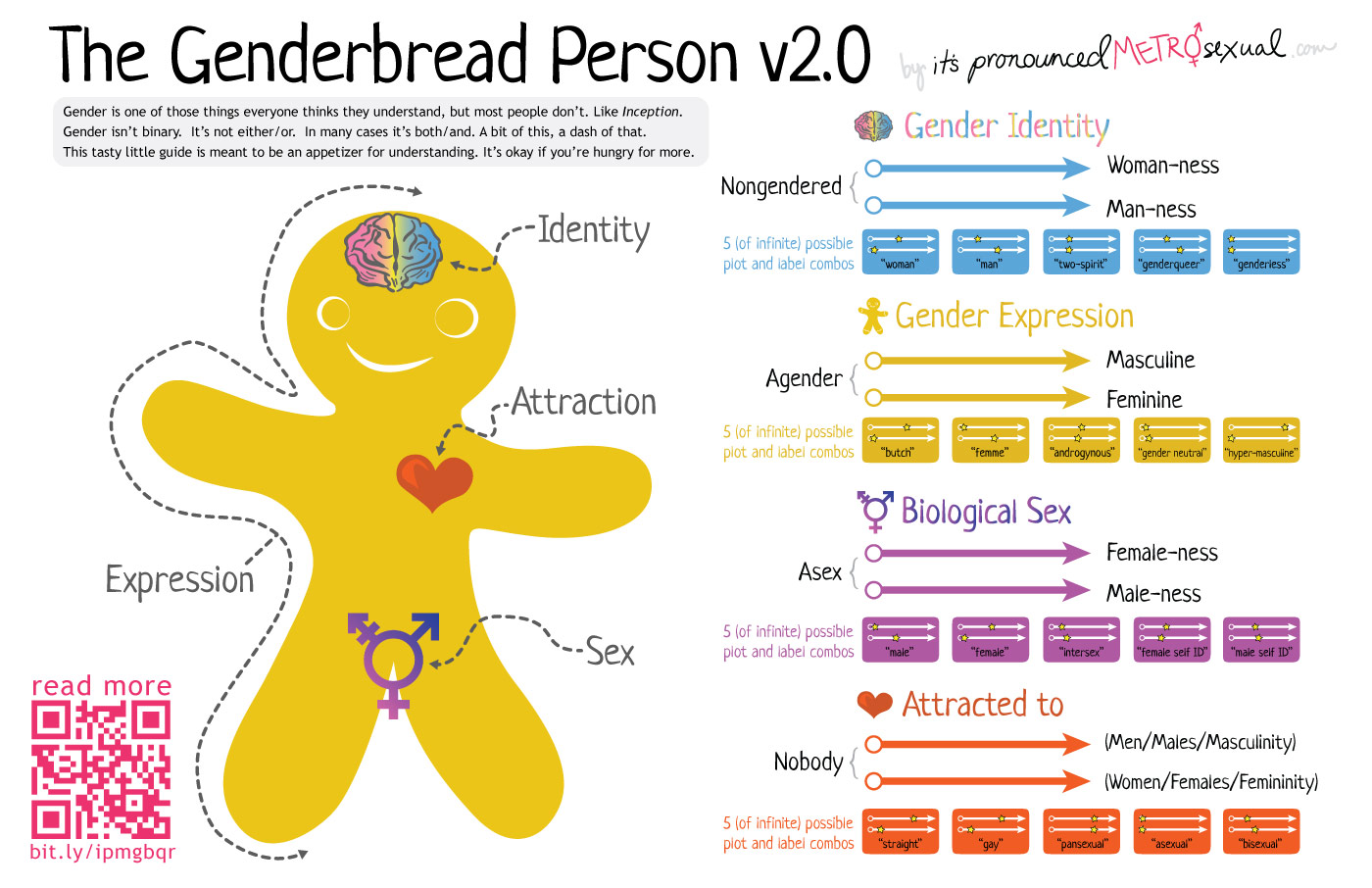
I know it is confusing at first. You may notice that each category is on a continuum. That is because these things are not completely black and white.
Gender Identity: Here we have the most commonly known terms “male” and “female” as well as other possibilities. This is a person’s truest gender and can only be determined by that person. Always, when referring to people, use words that line up with their gender identity. If that is unknown or they identify as something like “genderqueer” or “genderless” then gender neutral pronouns such as “ze” or “zir” may be appropriate. It is never ok to call a person “it”.
Gender Expression: Not to be confused with biological gender or gender identity, gender expression refers to outward things such as clothing, hairstyle, and mannerisms.
Butch: gender expression that is toward the masculine side
Femme: gender expression that is toward the feminine side
Androgynous: gender expression that has characteristics of both the masculine and the feminine
Gender Neutral: gender expression that is neither characteristically masculine nor feminine
Biological Gender: This is a person’s physical gender. While we generally refer to people in terms of male and female, some people don’t fit very well into either category. We are not all born with clearly male or female genitalia. Those who have both male and female physical characteristics at birth are said to be “intersex”. (Here is where I discourage use of the term “hermaphrodite”, which is no longer appropriate.)
Attracted to: (Also often referred to as “sexual orientation”) Just like the heading says, it really is all about who you are attracted to. Please don’t question someone’s sexual orientation. If you say you are hungry for tacos, it would just be silly to tell you that you really want lasagna.
Straight: a person who is generally attracted to people of the “opposite” gender.
Lesbian: a woman who is generally attracted to women.
Gay: a man who is generally attracted to men. (“Gay” is also used when referring to lesbians. Lesbians are gay, but gay men are not lesbians.)
Bisexual: a person who is attracted to both men and women.
Pansexual: someone who can be attracted to people of any biological gender or gender identity.
Asexual: someone who has little to no sexual attraction to anyone. Again, please do not question this. If you say you are not hungry, it would be rude of me to say that you have just never tried good food or don’t know what you like or want. Also, do not say that most women are asexual. This is untrue and offensive.
And now for some other terms that you may be wondering about.
LGBTQ: This refers to the subset of humans who do not fit the mold of “cisgender person who is only attracted to persons of the opposite gender”. The letters stand for Lesbian, Gay, Bisexual, Transgender, and Queer or Questioning. There are other acronyms such as QUILTBAG, and sometimes people will leave out a letter or two that they don’t like. I hate to say it but there are some in the LGBTQ community who, in spite of everything they have experienced, have a hard time accepting those unlike themselves. Personally, I think the entire culture is becoming more accepting and that includes the queer community. GLBT is the same as LGBT, just with a couple letters switched. I’m sorry I can’t cover the whole queer alphabet soup, so if you hear something and wonder about it, there is always Google.
Cisgendered: a person whose biological gender and gender identity match from birth.
Transgender: a person whose biological gender at birth is different from their gender identity. Transgender persons may be Male to Female (MTF) meaning that their biological gender at birth was male, but their gender identity and therefore true gender is female; or Female to Male (FTM) meaning that their biological gender at birth was female, but their gender identity and therefore true gender is male. “Gender dysphoria” is the term for the negative feelings a transgender person has toward their biological gender before transitioning. This feels much the same way a cisgendered person would if they woke up one day and found that their gender had changed while they slept. The difference would be that the transgender individual would be expecting to wake up in the wrong body – so there might be somewhat less screaming from shock involved.
When referring to a transgender person, always use terms associated with their gender identity, not their biological gender. Terms like “he-she” or “shemale” are completely unacceptable in this context. They tend to imply that the person is a sex-worker. Transgender persons often dress based on their gender identity, take hormone replacement therapy (HRT), and have surgery so that their body matches their gender identity. It is impolite to ask them where they are at in the process or for details on how these things work. If you want information on what transgender individuals go through physically, look it up. Would it be appropriate if I asked you what your genitals look like and what hormones you have in your body?
Queer: used as an umbrella term to cover anyone who is not exactly straight and cisgendered. Some people still feel negative vibes are associated with this word, so I personally would not use it to refer to an individual unless they first used it to refer to themselves. It can be used to refer to the whole community when alphabet soup gets tedious.
A: This is another letter that is sometimes added to the alphabet soup. It stands for Allies. If you are straight and cisgendered, but support equal rights for all, you are an Ally. Wear the title proudly. (Just please don’t try to make yourself sound cool by using this title if you don’t actually support anti-discrimination laws and gay marriage. Many in the community can respect you for being on the fence or even not wanting these laws, but don’t try to pretend you are doing us favors simply because you don’t use cruel language or don’t tell people we should be killed. It shows that you have no idea what it is like to be us.) If you are an ally, we welcome you to the community and thank you for your support.
If you are still a little worried that you will use the wrong word at the wrong time, take heart. The important thing is that people know you are trying to choose kind and appropriate words. Don’t be afraid to apologize if you make a mistake or ask if you are not sure about something. If you don’t insist on using offensive language, most people are more than willing to overlook a few mistakes.
Ok, wow! If you made it through all of that, you deserve a little fun. A friend showed me this. Maybe you will like it. If you have an iphone, take it out, press and hold the button, then ask, “Siri, are you a boy or a girl?” Siri will likely say something along the lines of, “Animals and nouns have genders. I do not.” It is easy to imagine Siri as a woman because ze has a “woman’s voice” in English (American). If, however, you switch to English (United Kingdom) ze suddenly has a “man’s voice”. While I have a tendency to prefer thinking of zir as a woman, ze is genderless. I now respect Siri’s gender identity and use gender neutral pronouns.
 Homeschoolers Anonymous