An Interview with “13:24” Author M Dolon Hickmon

Artwork courtesy of "13:24," http://1324book.com.
Artwork courtesy of “13:24,” http://1324book.com.

Note from R.L. Stollar, HA Community Coordinator: I am honored to interview M Dolon Hickmon, author of the brand new novel “13:24,” for HA You can read my review of his novel here. Hickmon is a child abuse survivor, a writer and an anti-abuse activist. He married his wife in 2007, and they have one daughter together. He dedicates his time and skills to advocating on behalf of mistreated children, often in cooperation with children’s rights groups and other advocates. Learn more about him at his book’s website here.

*****

M Dolon Hickmon is a child abuse survivor, a writer and an anti-abuse activist.

HA: Thank you for being willing to do this interview. Can you tell us a bit about your personal background?

MDH: My parents were ‘saved’ in an Independent Baptist church when I was between three and four years old. It was a high-control group, with a family model based on male dominance. My earliest memories are of beatings and of witnessing domestic violence. Our pastor’s solution to spouse- and child abuse was to call for perfect obedience, so that the family head would have no reason to be provoked. Fortunately my mother kept trying until she found a secular psychologist who helped convince our abuser to leave that church.

HA: 13:24 is an intense, brutal, and deeply personal — yet vastly accurate — read. What inspired you to write it?

MDH: The easiest way to answer that is with a comparison: Thirty years ago, child molesters were pictured as violent rapists, who attacked unwary strangers. Victims were expected to make an immediate outcry. Meanwhile, accusations against coaches, parents, or priests were met with disbelief, or dismissed as bizarre flukes. Today, we know that society had those percentages backwards; it was actually stranger attacks that were a vanishing minority. But it took decades for sexual abuse survivors to convince schools, churches, police officers, prosecutors and judges that their policies were based on bad assumptions.

Today, on the subject of physical abuse, society is where we were on sexual abuse fifty years ago. Our entire system of thought is based on a set of almost clownish stereotypes. 13:24 exposes our false assumptions. It is based on real crimes, on real science, and on real survivors’ experiences. But what makes it disturbing is that when people are exposed to the truth, they immediately realize that our entire culture is off in the woods, when it comes to dealing with this problem. We are fighting imaginary boogeymen, while the actual perpetrators walk free among us.

HA: There are so many different ways you could have written something powerful about your personal experiences and the impressive amount of research you have done of the subject of religiously-motivated physical abuse. What attracted you to a novel as your method of delivery?

MDH: Outside of therapy groups, discussions of physical abuse tend to be dominated by the opinions of people who have not experienced it. These people are often kindhearted and well intentioned, but their understanding of the problem is shallow. It’s hard to address their mistaken beliefs, because they hold the majority and agree with one another. The novel is unique because we remember what we’ve read as if it were a personal experience. I think this is the key—for the majority to have a way of adding the victims’- and survivors’ perspective to their pool of shared experience.

HA: It has been noted — by people who grew up in cultures similar to the ones you describe in your book — how uncannily accurate your descriptions are of certain thought-patterns and sociopolitical realities within conservative American evangelical worlds. You also go into great detail about police and social work. Can you describe what your research process was and how long it took?

MDH: Often, it was as easy as Googling a phrase that I recalled my abuser had said. I also consulted with quite a few authorities, including a psychologist and trauma researcher, a retired vice detective, an active Postal Inspector, a working dominatrix, a police dog trainer, and others.

HA: Even though you tell the story through words in a novel, you really paint a vivid picture of Rehoboam’s music — lyrics, rhythm, melodies, even what their live performances feel and sound like. Why did you place such an emphasis on music?

MDH: In several instances, readers see an instigating childhood experience, and then discover through Josh’s lyrics how his adult mind has processed that event. However, the music is also part of a much bigger social dilemma: When a teenager commits murder, society is quick to consider to the influence of music, television or videogames; but when innumerable parents discipline their children to death, people are reluctant to examine the claims that are being made in the parenting advice that all of them read. I don’t know the answer, but I found the double-standard interesting to consider.

HA: 13:24 ends on an emotionally somber note: neither prescriptively hopeful, nor necessarily hopeless. Without giving anything away, can you talk about why you chose to end on the particular emotional note you did?

MDH: People who overcome child abuse are remarkable, because they have accomplished something that is both difficult and rare. I think the media belittles that accomplishment by making it seem as if every child abuse victim overcomes and is stronger for that experience, in the end. The reality is that there are a lot of unhappy endings. Children die, and those who survive often wind up addicted, or in prison; they make messes of their marriages, and do regrettable things to their own kids. I think 13:24 offers readers a balanced ending, which reflects the range of responses that are normal for human beings.

HA: In your discussion of religiously-motivated physical abuse, both in the novel and elsewhere, you hold nothing back in pointing to how pervasive the relevant problems are: existing not only private schools and home schools, but also public schools. What are some facts you think are important for homeschool advocates in particular to know about parallel problems in private and public schools? And how can or should we work together to address these problems?

When it comes to sexual abuse, we now realize that it is not enough for adults to be watchful and protective; children must be taught to protect themselves, because when abuse occurs, it is usually only the victim and the perpetrator in the room. We need a similar revolution in our thinking about physical abuse. You can’t leave it to parents, because abusers are never going to willingly give victims advice on how to escape. So whether you are a pastor, a neighbor, or family member, the obligation is for all adults to appropriately discuss physical abuse with the children they come in contact with. Kids should know that discipline does not leave children injured or scarred, or feeling worthless or terrified.

HA: One of my favorite sections in 13:24 was the “group therapy” scene were characters talk about the real physiological impacts trauma can have on the body, particularly the brain. Do you think there’s any connection between religious fundamentalists’ fear of taking mental health issues seriously and their unwillingness to talk about child abuse?

MDH: The church is certainly not the only institution that is failing to fully address those two issues. But given that corporal punishment is no longer recommended by any group of secular experts, I think the responsibility is now on pastors to be proactive in educating very young church members about the difference between discipline that is constructive, and physical abuse, which only contributes to mental health problems, substance abuse and rebellion.

HA: What’s next for you? Are you writing another novel?

MDH: I am in the pre-planning stages for a second novel. This one will also deal with abuse and spiritual themes.

HA: Thank you once again for doing this interview. Any closing thoughts?

MDH: I would like to ask everyone to consider how your own conversations about child discipline might seem to a child who is being physically abused. Are you explaining correction so that a five- or nine year old abuse victim can understand when she needs help? Do your words convey that abuse is unacceptable and that other adults will believe and protect? Because if you are not teaching kids to protect themselves from physical abuse, who will?

*****

Homeschoolers Anonymous is pleased to announce that we are teaming up with M Dolon Hickmon to give away free hard copies of his powerful new novel, 13:24Click here for information on how to enter.

When Homeschoolers Turn Violent: Cylena Crawford

Screen Shot 2014-03-02 at 5.36.11 PM

Series note: “When Homeschoolers Turn Violent” is a joint research project by Homeschoolers Anonymous and Homeschooling’s Invisible Children. Please see the Introduction for detailed information about the purpose and scope of the project.

Trigger warning: If you experience triggers from descriptions of physical and sexual violence, please know that the details in many of the cases are disturbing and graphic.

*****

Cylena Crawford

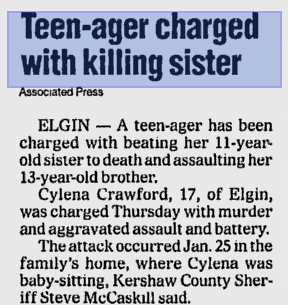
On January 25, 2001, 17-year-old Cylena Crawford from Elgin, South Carolina was left to feed, care for, and discipline her brothers and sisters while her mom worked and her father was otherwise occupied. That day, however, her “discipline” meant brutally beating both her 13-year-old brother Michael and 11-year-old sister Korresha — and the latter fatally so. Korresha died the following day from bleeding to death.

On January 25, 2001, Cylena Crawford brutally disciplined both her 13-year-old brother Michael and 11-year-old sister Korresha — and the latter died as a result.

Cylena was the oldest child in the Crawford family. Her mother Sylvia worked 2 jobs to support the family and her father Lawrence was a Nazarite priest who believed in Pentecostalism. All of the Crawford children were allegedly homeschooled by Lawrence, though “he often wasn’t home” and neighbors “rarely saw the children” outside their mobile home. Cylena had four siblings: Michael (13), Korresha (11), and 2 others (a boy, also 11 years old, and a girl 9 years old). Cylena reportedly “often was left in charge.” The entire responsibility of her siblings fell to her: she fed them and, “if they got out of line, would spank them.” In 2000, the year prior to the murder, social services were called to the Crawford home due to an anonymous tip about neglect, but no neglect was able to be substantiated.

On the day of the beatings, Cylena was left in charge of her siblings as was usual. After Michael and Korresha did something wrong (it remains unclear what exactly), she started disciplining them with a 1-1, 18 inch board. However, according to reports, something went wrong: “Once she started, she got carried away with the 11-year-old.” Authorities said Cylena beat Korresha “on the head, body, arms and legs,” and Michael “in the back and about the body.”

Complicating the situation was the fact that Lawrence was home this day. Not only that, but Korresha was still alive when her mother returned as well. Despite being disoriented, Korresha told her parents about the beatings at 10 pm the same day. They did nothing, however, until the following morning when Lawrence found her unconscious on her bedroom floor. Despite being rushed to the hospital, Korresha was unable to recover. Officials said she “bled to death after blood seeped through her muscle tissues for several hours.”

What role Lawrence played in the murders is unknown. The father originally told authorities he was away when Cylena beat her siblings, but he later admitted to being home at the time. Thus on February 25, 2001, he was also charged with murder. He was sentenced in 2004 to life in prison. Cylena’s murder charges remained intact and she was admitted to a mental health hospital. Her mother Sylvia was also charged with neglect in light of the fact that Korresha was allowed to bleed profusely overnight and was not taken into the hospital until she was unconscious.

View the case index here.

Ignorance is Safety?: Christina’s Story

Screen Shot 2014-02-12 at 7.48.57 PM

Series disclaimer: HA’s “Let’s Talk About Sex (Ed)” series contains frank, honest, and uncensored conversations about sexuality and sex education. It is intended for mature audiences.

Pseudonym note: The author’s name has been changed to ensure anonymity. “Christina” is a pseudonym.

Trigger warnings: the following story contains descriptions of physical and sibling sexual abuse of a child.

*****

“I know a bad word.”

I was seven, standing in the bathtub and my mom was washing my hair.

“Tell me what it is.”

“I don’t want to say it.”

“Tell me what it is or else I’ll spank you.”

I was petrified, my heart was racing a mile a minute. I couldn’t tell mom; I was afraid of being punished for even knowing the word. I was shaking and crying. My mother took out the hot-glue stick that we were regularly beaten with and proceeded to spank me there in the bathtub. Between each swat she would order, “tell me!” until, sick with fear and pain, I told her.

The dirty word: Bra.

Hello, my name is Christina. My purpose for writing this today is to help those who have gone through something similar to me and to spread awareness to those who haven’t.

Growing up, my mother told us nothing about sex. Nothing. As girls, she didn’t educate us about having your period, bras, body changes, nothing.

I was introduced to sex when my brother molested me on Christmas day when I was eight years old. He was only eleven at the time and I write this with his permission. In the last year my brother told me stories of what led up to that day. He was only four years old when our mother would “spank” him until bruises formed for “touching his penis”. Other than these beatings he had received no sexual education at all when he stumbled across pornography on the internet. He didn’t even know the word pornography when he described to me what he had seen. I didn’t know what it was but I knew it was wrong. I was too scared to tell anyone what happened on Christmas, so I kept quiet for four months. In the meantime my brother had molested my little sisters as well, and I knew about it. I told my brother not to hurt my sisters anymore, so when it didn’t stop I finally got up the courage to tell my older sister.

My sister told my mom, who called our youth pastor for help.

Our youth pastor called Child Protective Services, and my brother was removed from the home.

He lived in foster care for a year and we weren’t allowed to see him during that time. When he finally came home things were awkward between us for a while, but when we were willing to open up to each other he was able to apologize, and we were able to talk openly about what happened. If I wasn’t terrified to go to my mom for help, the whole situation might have been prevented. My mom was not a person I could go to with my fears and questions. She never talked about sex, and never made us feel that we could talk with her about whatever we needed to talk about.

I thought I had cancer. I was eleven and scared to death. After weeks of worrying I built up the courage to talk to my mom. I told her I was developing these lumps.

Her exact words were, “welcome to adulthood.” Nothing else.

I lay awake that night and put the pieces together. I wasn’t dying after all. In the months that followed I stole my sister’s bra, and on three separate occasions I shoplifted bras from stores. During that time I kept dropping hints to mom, but she made it awkward, and I was so nervous. My mother never made herself available for any serious conversations. Even when approached, she would make the conversation as short and surface as possible. Finally, at age thirteen, I got up the courage to confront her. I told her how I had been shoplifting and taking from my sisters and her reply was, “why didn’t you tell me I needed to take you shopping?” I told her that she made it hard for me, but she wouldn’t listen. She waited seven months before she took me bra shopping for the first time.

I began to watch pornography regularly when I was eleven.

I don’t know how to tell you why. I would go to great lengths to be able to access a computer with internet. I began to masturbate. It was an unsaid rule in our household that anything sexual outside of marriage was evil. Because of this, I felt guilty for masturbating, I felt like I was defying God. I prayed to God, promising that I would never masturbate again. The next day I broke that promise. I felt like shit, like I had let God down. I was weighed down with a load of guilt. I felt I deserved death.

I was prepared to hang myself; the only thing that kept me from tightening the rope was the thought that if I left them, my little sisters will go through exactly what I did, and I want to be around to prevent that from happening.

When I was fourteen I tried to be open with my mother. I told her what I went through as a pre-teen and a teen, and her response was to send me to therapy; she didn’t want to handle me herself. One day on the drive home I was trying to explain to her how she wasn’t there to help me as a kid going into my teenage years, but she refuses to listen. We start talking about masturbation, and she tells me anything sexual outside of marriage is wrong. There I was, opening up to my mother and sharing how I tried to hang myself as an eleven year old because I felt so guilty, and she contributes to my guilt, telling me that what I did was wrong. No comfort, no empathy, no help. Just guilt. I ask her, “from a biblical perspective, how is it wrong?” She can’t answer me.

I pushed the question, and she finally told me, “you need to move out. I don’t want you around your little sisters.”

I am no longer living with my mom. I feel free to talk about masturbation, sex, and gender expression with my siblings, something I never felt I could do before. My brother and I have had conversations I never saw us having. Today I am inspired to help others, and I feel more confident about how I want to raise my children. My mother lost custody of my younger sisters in August and I know that they have a brighter future ahead of them.

I am so grateful that they will never experience what I did.

My sister has also written about her sexual education, the link to it is here.

German Churches Up in Arms over Abuse Study

HA note: The following is reprinted with permission from Jennifer Stahl’s blog Yeshua, Hineni. It was originally published on November 25, 2013.

German Bible. Photo by J. Stahl.

In following the story of the Twelve Tribes, I had become aware of a study on religious families and their children, tendencies towards abuse and such being carried on within Germany. I had heard about the study. But not being registered to either the Evangelical, Free Evangelical or local Catholic Churches, we were not polled for the study, though we are a religious household.

I am somewhat curious as to what was in the survey itself. It seems rather revealing that the Free Evangelical churches are showing many of their members do, in fact, regularly beat their children.

For those who do not know, this is illegal to do in Germany.

One of my many concerns within the homeschooling movement and the greater German church community (especially after coming out of this environment in the United States) is to get away from the punitive and corporal punishment mindset, seeing children as sinful inconveniences unless they’re perfectly behaving like little adults and back to what the Bible actually teaches; namely love and parenting being a job of parent and child to do together.

My second major concern was finding on Amazon.de teachers such as: Michael and Debi Pearl (To Train Up A Child is now removed, but No Greater Joy volume 1volume 2 and volume 3 remain); Ted Tripp has three books represented (this remains, and as does this also); James Dobson‘s harmful books; Bruce Ray’s Withhold Not Correction (also a Spanish edition!); Gary Ezzo‘s books; Elyse Fitzpatrick’sTim Kimmel‘s (there is a second book here), and a couple other religious punitive-based child training manuals can be found.

Finding those books means that there is a market here in Germany. That, as someone who was raised so punitively, terrifies me. It terrifies me because this means there are other children being raised this way, who will not know a day in their lives where just being children is not a sin.

I had heard that some time back, that one branch of the Evangelical Churches in Germany had made statements against corporal punishment and other punitive discipline methods, which created some shock when I saw the results of this study: 45,000 students from 9th grade forward and about 11,500 adults were polled (so over 50,000 individuals) and they found that one in six very religious children are smacked by their parents or given other punitive disciplinary methods against their undesirable behavior(s).

In the Catholic and other Protestant students, the rate is considerably lower, if not rare.

The results of the study were published here, and does run through Google Translate in a mostly discernible manner into English. The name of the study is “Christian religiosity and parental violence. A comparison of familial socialization of Catholics, Protestants and Members of the Free Churches.”

More on the study and why everyone’s up in arms:

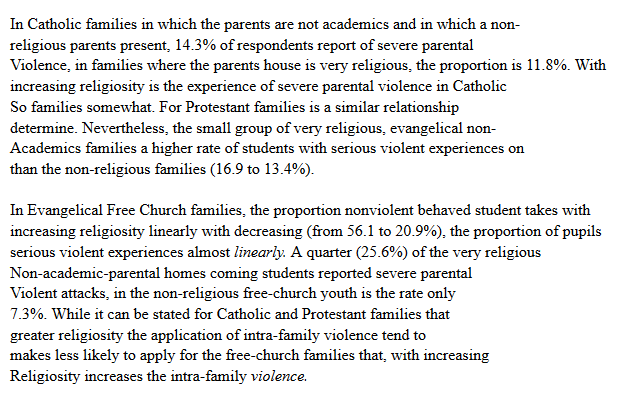
With parents from free churches that have no academic training, but declared themselves as “religious” or “very religious”, the trend is even more pronounced: More than a quarter of the surveyed children from these families has at some juncture suffered massive violence in their household. The study’s authors also provide a possible explanation: There is “a Christian tradition of parental driven beating as discipline for children.”
NDR – Freikirchen wehren sich gegen Gewaltstudie

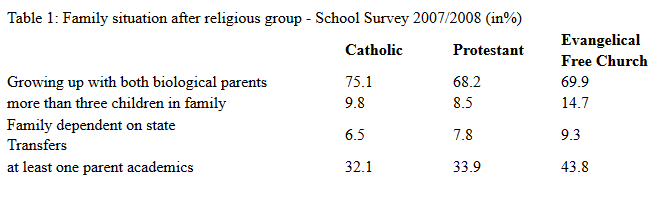
The findings in the survey are quite shocking to me. I’ll post some of the figures below for those of you who don’t have time to sift through a pages long PDF:

image1
Source: http://www.ndr.de/regional/niedersachsen/freikirchen109.pdf

image2
Source: http://www.ndr.de/regional/niedersachsen/freikirchen109.pdf

image3
Source: http://www.ndr.de/regional/niedersachsen/freikirchen109.pdf

image4
Source: http://www.ndr.de/regional/niedersachsen/freikirchen109.pdf

Now, these are in order, but without all of the information behind what makes this all so shocking. What I want to point out is that this is consistent with studies done in the United StatesCanada, the United KingdomAustralia and elsewhere as it pertains to parental violence towards children and its affects on the children involved. One study paper that someone had pointed me towards a couple of years ago was “The Long Shadow: Adult Survivors of Child Abuse.” Psychology Today has several articles about this phenomenon as well. One that stands out in my memory is “The Lingering Trauma of Child Abuse.” (Note: My list is not exhaustive, but just to give an example of what one will find on the subject.)

Articles referenced within this NDR article and the PDF are as follows:

…in the late 90s the German Parliament had established a Study Commission to look at so-called sects and mind-control groups. The study found that in fundamentalist Christian communities there is a widespread “…significant advocacy for physical punishment…”
NDR – Kinder schlagen im Namen Gottes 21.12.2011

NDR.de: Critics say the national church must be clear in distancing themselves from such fundamentalist positions. Shouldn’t you make it clearer that you do not agree with such  positions [about corporal punishment being biblical]?

[Kerstin] Gäfgen-Track: In the case of these parenting books and this position, I can speak for the national church, because we draw a very clear line of demarcation. We have nothing to do with such, so we want to continuing having nothing to do with such. We wish to strongly condemn such counselors. [Ted Tripp and so on]  
NDR:  “Wir verurteilen das aufs Schärfste” 21.12.2011

…as they contradict the law and [Christian Beliefs], there is a secret culture of spanking among devout Christians… Parents who follow these beliefs belong to denominations such as those [found in the] Evangelical Free Churches and the Jehovah’s Witnesses who are apt to taking the Bible literally, and consider doubts about the Word of God as whisperings of Satan.
Süddeutsche Zeitung: Liebe geht durch den Stock 30.9.2010

…It is striking that the violence of evangelical parents seem to have a lasting effect on their young. With [such] systemic beatings, it may be that parents seek to break the will of children so that they would assimilate the beliefs of adults; warn psychologists..
Süddeutsche Zeitung: Schläge im Namen des Herrn  17.10.2010

There was a study published in April of this year (2013) by infoSekte in Zürich, Switzerland entitled “Erziehungsverständnisse in evangelikalen Erziehungsratgebern und -kursen.” (Yes, this too can be run through Google Translate!) It is 61 pages long, detailing “Problematic trends such as corporal punishment or psychological violence arising in connection with certain child rearing methods … [and] possible effects of certain parenting styles.” Also explained in the document is how Switzerland signed and ratified the UN Rights of the Child in 1997; and such parenting styles are incompatible with such an agreement.

The UN Rights of the Child is the very same document that many Christians in the United States have pushed for a refusal to ratify since the 1990s.

(The US has signed, but not ratified as of this date in time.) Also something to note; Michael Farris has really pushed home-schoolers into a frenzy over it as taking away parental rights to discipline punitively and claim it is “biblical.” (For the uninitiated, Michael Farris is the head of Patrick Henry College, The Homeschool Legal Defense Association (HSLDA) and loosely affiliated with Schuzh, which defends many German home-schoolers in court. You may have recently seen Michael Farris in the news pushing against the UN Convention on the Rights of Persons with Disabilities.

If you get a chance, please do read this study. I understand that 61 pages is awfully long, but it is worth it. There is a serious problem when familial violence becomes an accepted piece of one’s culture and religious upbringing — when we normalize it to the extent that no one is shocked at all.

Issues brought forward by the Twelve Tribes in Germany are not at all shocking in many parts of the United States because such methods have become so normalized.

So many people believe it is the right thing to do. Anything contrary is “unbiblical.” That is not to say that there are not Christians, like myself, who believe that corporal punishment is actually what is contrary to the Bible.

If one wishes to claim that the Bible teaches beating their children, I would have to recommend you go back and actually investigate those claims for yourself as this is not understood to be the case within the Jewish community; and from whom we get the proof-text “spanking”/”smacking” passages from. It is a purely Christian phenomenon that came into place some time in the middle ages, as far as I can find at this juncture. Before, corporal discipline was for adult members of the faith who wished to submit themselves to flagellation.

One book that discusses this phenomenon and suggests a better way is Samuel Martin’s Book, Thy Rod And Thy Staff They Comfort Me: Christians and the Spanking Controversy.  I have others, should you wish to peruse them, but they are not free.

There are wonderful articles referenced here in an older post on my blog and I also have a ton on my Pinterest parenting boards, should you have an account there.

If you don’t know about the Pearls and their harmful teaching, I’d be happy to throw you more than the recommendation to read Hermana Linda’s Blog and this review of the Pearl’s ministry.  I would also like to mention that any court willing to speak with me personally is more than welcome to discuss punitive upbringing, homeschooling, corporal punishment proof-texts, etc.  I’m not an expert, but I’ve lived through it and am working to change things with my children and advocating for others to the best of my abilities.

Update: Michael and Debi Pearl and critiques about them and information on the Hana Williams case were on CNN last night via Anderson Cooper. If you still doubt the methods this couple advocates, look no further.

I would like to leave with a closing message by Robbyn Peters. It is “Violence: A Family Tradition.” For those who are still unconvinced, I ask that you please consider Robbyn’s words and investigate for yourself.

Feeling Empathy for Christian Patriarchy Parents and Leaders

HA note: The following is reprinted with permission from Heather Doney’s blog Becoming Worldly. It was originally published on November 13, 2013.

I did a couple things I never expected to do yesterday. I had a thought-provoking conversation that left me thinking about how it is easy to decide that someone is an enemy, a jerk, a selfish person. It is easy to determine that people are unworthy, undeserving, maybe even unclean. It is easy for them to decide that about you too.

Yesterday I found myself talking about my blog with my Dad. 

He’d found out about it a month ago. It hadn’t mattered to me. We hadn’t spoken since before Father’s Day. I expected we might never speak again and it might be for the better. But I got off the phone from that thought-provoking conference call and sat in my chair for a bit, thinking. Then I called my Dad.

Why? Well, sometimes you find out information that humanizes people a bit more, that explains why, and that makes you realize you attributed motives to them that weren’t exactly accurate or that didn’t contain some missing pieces of a bigger picture.

The more adults I talk to or learn from who are walkaways from the Quiverfull and Christian patriarchy stuff, or even ostensible leaders or former leaders within it, the more I see them as not abusers and power-grabbers per se, but also victims. They often had harsh upbringings filled with authoritarianism and loss or were constantly uprooted, never knowing what to expect next.

My Grandad, the man I looked up to and loved so much, was not the same man when my Dad and his siblings were kids. He’d just gotten back from Vietnam back then.

He was a tyrant.

He beat his kids, like his father before him.

Even my Grandad said it, telling me “I was a son of a bitch, and I was a son of a bitch to my kids.” He realized later in life that kids need something different then what he’d gotten and what he’d given. He told my Dad, “Don’t raise your kids like how I raised you.”  My Dad thought he had found a different way. Except it wasn’t really all that different.

Him and my Mom got sucked into extreme religion like a drug when they were just kids, each not yet 20 years old. They became true believers. They more or less still are. That sort of faith easily attracts young people from dysfunctional families who are looking for guarantees, assurances that family life will be different, better, and that heaven awaits if they follow what I have occasionally referred to as “the faith equivalent of the Nutrisystem diet.”

They were trying and failing and starving away on the inside and it was as hard growing up with them as if they had been on drugs.

I thought of Dr. David Gil, a social policy professor I had at Brandeis, in his late 80′s and a holocaust survivor, a man who had testified before Congress against corporal punishment of kids back in the 70′s and had spent much of his career working on fostering reconciliation after atrocities. He’d spoken of society’s ills all coming back to unmet human need. That we have kick the dog syndrome, we have substance abuse, we have wealth hoarding, we have people treating other people (generally weaker people) like objects, and almost all of it is due to stunting – people not being able to reach their full potential during their formative years because the previous generation has hurt them, and the fact that they were born into a society that did not meet their needs starting at a young age. Dr. Gil talked about how people-led movements for equality and social change were all that could alter this dynamic. That it was about interpersonal interaction, sharing, and giving, collaboration rather than competition.

I am not a Star Trek nerd, but this video really moves me. Patrick Stewart’s father was an abuser. He watched his mother get abused as a small boy and couldn’t do anything about it. Later on he learned that it was untreated mental health problems from wartime experiences that caused his father to have so many issues, and while it did not excuse the abuse (because nothing does) it did help him develop empathy for his father. So he is doing work to help veterans and work to help battered women, in order to honor them both, in order to help others avoid beingthem both. I thought it was so moving because this is someone who gets what the cycle really is like. Hurt people hurting people.

We can sit here loathing each other, re-wounding each other, blaming each other, but an eye for an eye truly does make the whole world blind.

I thought about how people often try to improve a dysfunctional world by creating little Utopias and about how people do what they can with the tools they have and sometimes when you have a hammer everything looks like a nail, and sometimes you get caught up in hammering away at everything only to get stopped in your tracks when you least expect it and find that you do have empathy for where someone is coming from simply because you see humanity there. Even if they’ve done things you think are shitty and even if you don’t agree with their outlook much at all. You remember that they are a person too, and if you remember that they are a person they just might remember that you are a person and then as two people you can do the hardest and most special thing that people can do, which is to be people, together.

So many homeschool parents who got sucked into the Quiverfull and Christian patriarchy stuff are still hurting. 

They secretly bear so much shame. So much self-loathing. So much guilt and fear and they are tired and worn down. They often have too many kids and not enough resources or answers. They are trying to pick up the pieces of their lives, decide where their boundaries are, figure out what’s right and what’s wrong and what’s bullshit. I don’t think a lot of them are doing as good of a job as I’d expect, but then again I do have pretty exacting expectations, very little tolerance for the sort of brokenness that reminds me of my childhood. It’s pretty triggering.

But I am trying to be more forgiving. I am trying to bear in mind that once safety has been ascertained, that forgiveness is an option and sometimes recovery, rehabilitation, and reconciliation are too.

I try to remember that at one time they were all babies – they were all cute and innocent little children making mud pies or pushing their peas around their plates. They were all pimply teens trying to figure out what to do with crushes and first loves and first kisses and broken hearts and whether their friends liked them and their clothes conveyed the right message about who they were on the inside. They were learning about education and vocations and how to pay the bills in a world where none of those things were simple (and still aren’t). They were learning how to be parents and what it meant when nobody had ever taught them how. None of it was easy.

They went through hardships, too.

Hardships that caused damage and misconceptions and harms that they passed down to the next generation and sometimes the people around them in one form or another.

I expect most of the time they didn’t mean to cause hurt, but they did and we can’t change the past. We can only look to the future and try to do what we can with what we’ve got. I’m not a fool. I know the odds of my Dad and I having the sort of quality relationship that I would desire in an ideal father-daughter sense is unlikely bordering on neigh impossible. But maybe our relationship can be more than nothing. Maybe it can be more than him getting old and dying and me not seeing him for years before that day. If it has to be nothing I’m ok with that. But something would be better.

And that’s why I called my Dad. I told him that he was worthy of forgiveness. I told him that I forgave him. I told him that I had two rules. He couldn’t tell me what to do and he couldn’t try to rewrite the past. He said ok. Then we talked.

We talked about an old family photo my sister had texted to all of us, when I was just a baby and my parents were young, starry-eyed, and impossibly good looking, and how the picture reminded him of when I was small and he took me to the University of New Orleans once. He said he remembered how happy I was there. I said yes, that I’d remembered that visit, walking up the liberal arts building stairs, him buying me a Coke (a rare treat) out of the vending machine, and seeing adults poring over their books and listening to lectures in classrooms.

He said, “I did good things too, you know. I did good things too.”

I said, “I know, Dad. I remember the good things too. I remember them.

He told me that when he watched the Al Jazeera video he agreed with Pat Farenga’s perspective more than mine, that he felt I did a good job but my framework was off, that he figured modern technology and online schools solved a lot of the homeschooling issues I was concerned about, and with my skills (and here he sounded proud) that I should work towards bigger issues, things that could do more for society, that homeschooling was small. I replied that Pat was a nice guy and we just disagreed about a few things, and I figured if I used my education anywhere, I should start close to home, in an area I know, and so that’s what I was doing.

I said I didn’t do it to shame him. I did it to help other kids.

So I’m gonna call my Dad again in a few days and see if we can start small, start with more good things, attempt to be family to one another, and meantime I’m gonna work on some child abuse prevention resources so that other families can stop the cycle before it gets as bad as it did in mine.

I’m not going to whitewash everything and act like its peachy keen now (because there has been a lot of damage done and a lot of work still needs to be done to bring things in a positive direction and it’s a pretty tall order) but I am hopeful. There is still room for redemption. There is still room for improvement. We are all still alive. Or most of us are anyway, and those who aren’t should be held in our memories, their stories and hardships learned from, their lives honored, the lessons not forgotten.

It is a punitive, careless, and authoritarian culture that hurts us.

This issue isn’t about Christianity. It isn’t about homeschooling. It isn’t about families. It isn’t about faith or love or loyalty. It’s about power. Power that the fearful grasp onto or lash out with. That is what we need to try so hard to end, to use our own power to do.

Sharing is still caring. There is still room to learn and grow and try to make the best of the present, using what we know from the past. There is room to accept broken people and wounded people and people who have done serious harms that are not able to be erased but who are trying to do better now, even if they don’t hardly know the way. We don’t have to do it. We don’t have to do anything. But we can. If we want to.

I’m still pretty early in my career, green in the public policy profession, but today I wanted to share this lesson that I learned, that hit home, that I hope to always remember.

We think we’re just working on metrics, policy issues, and stakeholders and then we run into raw humanity – unmet human need, trauma, and people trying to find a way to get by and make it better than they’ve had it. Maybe this shouldn’t change our goals but our methods. Remind us that it’s never “just business.” It’s always personal.

Everyone is a person.

Silent No Longer: Lani Harper’s Story, Part Two

Screen Shot 2013-11-02 at 8.01.15 PM

HA note: The author’s name has been changed to ensure anonymity. “Lani Harper” is a pseudonym.

*****

Trigger warning: graphic descriptions of physical abuse.

*****

Part One

He closed the door behind us, and told me to pull my pants down and bend over as he dramatically pulled his belt out of the beltloops of his pants. Disobedience was not an option and would most certainly grant me a far worse session with the belt, so I pulled my pants down. Sometimes my mother would let us leave our underwear on, but JD never did. Once I tried to wear double underwear, anything to help dull the blows a bit, but got found out and the reprisal was so severe that I never did it again.

But for JD, all our beatings were naked from the waist down, and if we were wearing a dress, then we were totally naked.

I stood half bent over, holding the edge of the bed, while his mountainous bulk shadowed me from the ceiling light. And braced myself for what was to come. No amount of bracing kept me from stumbling to keep my stance, to keep from falling over. I was a small child and he used all his substantial force to emphasize every strike. Though my legs trembled violently and could barely hold me up, I knew that falling over meant starting over.

With each strike, I was to count out loud. I tried to order my wobbly tongue and quavering jaw to speak clearly enough that I wouldn’t have to begin again, but inevitably I cried and he could not understand me. This meant restarting multiple times, and his frustration when I lost track of where I was. The numbers I pictured in my mind wouldn’t stay still. In the middle somewhere, overcome with humiliation, anger, frustration and other emotions I could not name, I urinated. And prayed that my underwear and culottes tangled around my ankles would absorb the warm liquid, prayed that my socks would catch any straggling drips, prayed that it would not wet the carpet beneath my feet.

I gripped the end of their comforter so hard that I made fists in spite of the fabric in my palms. Gripped harder and harder so as to resist the powerful instinct to raise my hand to shield my bare behind. But I had done that before too, and not only did my arm get the brunt of a lash or two, but I had to begin all over again, ensuring the beating lasted longer.

Hot saltiness tumbled down my cheeks until I was almost gagging on my tears, combined with the warmth of urine down my leg, and the all-encompasingness of my humiliation threatened to drown me.

Indeed, I prayed for death in those moments.

I seem to remember 18 being the magic number, though the number changed every time. This, I guess, so that we would always be wondering, and he would always be in control. I was never sure when exactly he would decide I’d had enough.

When he was finished, he made me recite a verse or two while pulling my clothes back on with trembling fingers. There was a lecture about how how this was his God-given duty to show love to me and help me become less sinful, that I deserved more, worse and should be thankful, that this was hard and he didn’t like it but it was necessary and in my best interests.

Then he would duct tape my mouth shut, a concrete reminder that I was never to say anything to anyone.

My mouth was now shut, and I knew I was to keep the tape on all night, during my sleep. Now go clean yourself up, hurled at me with disgust in his voice.

I did not get to finish my half-eaten meal, but was sent still-hungry to clean up the table and kitchen. I did not regret not being made to sit down, but moving was difficult. My sister Andie was to help me, both to ensure that the job was completed properly and also so that I didn’t sneak scraps off plates to try to ease my hunger. Anyway, the tape over my mouth prevented further eating. Her eyes burned compassion into me whenever I dared look at her.

My mother actually told me after one beating that I would not remember these episodes and that if I did, it meant I was bitter. I remember thinking that I was okay with that because I did not want to forget what she had done to me and how much I hated her in that moment.

I always walked out of The Bedroom with newly-kindled anger and hatred at my parents.

The bruises stayed for weeks, but often there would be another beating before the bruises from the previous incident had completely healed such that my skin was a mottled mess of yellow and green old wounds mixed with the bright red-purple of the new welts. The frumpy, blousy style of the early 80s, combined with the mandated-loose clothing of the fundamental churches actually worked to my benefit: I could hide my wounds, though even the softest cloths chafed my swollen, cracked and oozing skin.

And always, on the way out, he would say, remember, what happens in The Bedroom stays in The Bedroom, and what happens in This House stays in This House. And he would send me away with the knowledge that he was watching and all-knowing, that he would know if I told even my siblings, which would result in another lesson. We were never allowed to comfort each other, though there were a few hasty, whispered words to the newly-beaten one in the dark of our room.

We did not dare hug.

I cried myself to sleep, fiercely dashing the tears from my cheeks, attempting to wipe them away before they sogged the adhesive and loosened it from my skin. I had to be able to show him my still-taped mouth first thing in the morning. After a while, we stole tape so that we could remove the tape while we slept, then replace it in the morning.

The Pearls published their book about the time I graduated from high school, but my parents had been using their methods, espoused by Jack Hyles and Lester Roloff at the time, from our infancy in the late 1970s. Contrary to what the Pearls, Gary Ezzo, Jack Hyles and others who espouse this way of rearing children believe, this expectation of a surface appearance or semblance of obedience actually works against the parents who use it: in our family, it created bitter children adept at hiding their bitterness. It created strife and hardened our hearts (that they thought they were softening) against our parents: we hated them.

It created a subversive culture of deeply angry children with secretive, ignored and repressed anger, who lashed out at each other because we could not lash out at our parents. It created a culture of blind obedience instead of teaching us how to make good and informed decisions. It ignored the fact that we would grow up and move out, and kept us in this perpetual childhood for longer than is natural. As a result, I spent much of my twenties figuring out things and growing personally in ways I should have been able to during my teen years. Finding indpendence and autonomy, discovering my authority and my rights that were denied me.

It wasn’t until I had children that I realized spanking isn’t hard, it is easy.

It is easy to hit, and once you have begun a habit of hitting, the next hitting episode comes easier and easier until it’s rote, instinctual, without thought, automatic. Hitting is also a gateway to anger: the more I hit my kids, the angrier I became and the easier it was to become angry. I recognized this very early, while my kids were still very little, but though they were nothing as severe as my own beatings as a child (three swats with a spoon while clothed), I regret every episode of spanking them.

I do not remember my last beating, though they continued in much the same fashion until I was sixteen. I still remember the humiliation and ferocious anger at being violated on the outside by the beating and on the inside by the changes they sought to force into us, by the association to God and spirituality. It affects me decades later and has thus shaped my views on everything from parenting to God to spirituality, to self-worth and more.

I got out without really knowing what I was running from or why…and was shunned, but that’s a story for another time. Decompressing and deprogramming continue into the present, but I hope that telling my stories will begin to dispell the power my parents and their secrets still hold over me.

My name is Lani Harper, and I am a survivor.

Silent No Longer: Lani Harper’s Story, Part One

Screen Shot 2013-11-02 at 8.01.15 PM

HA note: The author’s name has been changed to ensure anonymity. “Lani Harper” is a pseudonym.

*****

Trigger warning: graphic descriptions of physical abuse.

*****

How to sum up the first twenty years of my life in a few paragraphs? The stories are too numerous and shocking for me to process, let alone speak of.

The memories tumble over one another, leaving me gasping for air as I look with new eyes at my childhood. A childhood I thought was near-idyllic for many years. Even after I started to see my parents as too harsh on us as kids, it took nearly a decade and a half for me to put the label on it. The stories are many, but they all begin with a single point. I cannot tell the rest until I tell the beginning, the root from which all other things sprung. I am a 36 year old woman, a wife of more than ten years, mother to three.

Yet I still feel like a 6 year old girl being tersely instructed to not tell, or else.

They taunted me with mysterious unnamed events that they assured me I didn’t want but would befall me if I spoke, told me they were only able to spare me these horrible things if I kept the Code of Silence. They told us that this was how Christians disciplined their children. Other people outside of our faith wouldn’t understand why we did things this way. They were ignorant, through no fault of their own, and we had to spare them this particularly harsh reality of Christian families.

Logically, I know that he will not beat me or physically harm me now, but emotionally, psychologically, I still hold a terror that he will. Yet I am compelled to speak and encouraged by those who have gone before to tell their stories. Sad, that this is how we bond, that we have been reduced to clinging desperately to one another in our shared woundedness.

My name is Lani Harper, and I was abused.

I am the middle child of five, the third girl, and my father always introduced us like this: This is Number One Daughter (hand on Libbie’s head), Number Two Daughter (hand on Andie’s head), Number Three Daughter (I always tried to duck his hand; I hated the heaviness on my head), Number One Son (a pause while he puffed himself up with pride at introducing our brother Dale), and Number Five (hand on Evie’s head). Number One was better than Two, Two better than Three, but we all paled in comparison to Number One Son. He was never “Number Four”.

I grew up in a house where my father JD exercised complete and aboslute authority over all. His word was, we joked then (but with an underlying seriousness) law. And he brooked no challenges, no contrariness, no insubordination. To do so was to incur the wrath, to bring down his heavy hand of judgment in the form of severe disciplines. I suppose he may have always had this sort of near-obsession with power and control, and joining the military because he was flunking out of college only reinforced these authoritarian tendencies and cemented them by practice, giving him tools and methods to use on us, his insubordinates. He often commented on how running a house was similar to running a ship. And, he would say, I want to run a tight ship.

We were commanded to fall in line and to call him Sir.

Children in this culture are viewed as the property of the parents, and especially of the father. When termed that way, instead of viewing a child as a gift, a blessing, an individual entrusted to two people to nurture into an independent, educated, intelligent, functioning member of their community and citizen of their country, one begins to see how little children are valued.

Children are not people. They are not worthy. They are born sinners, with the innate and persistent duty to sin against their parents. It is an us-versus-them mentality: the children are against us, are going to undermine us, are going to undo us at an elemental level. Consequently, the parents’ focus becomes the need to stand firm against their children’s “wiles”, and to guard themselves against being drawn astray by their children. To be strong and stronger than their children. To resist their children anytime the parents feel pulled against their will, their desires, their instincts. And then to deny their children as they ask for things, in an attempt to show the children, as my father would say, who’s boss.

With this perspective, every small blunder became magnified under the perception that we were elementally sinful, deliberately devious, manipulative, intentionally-subversive.

And it was punished as such. It was a society obsessed with control, evidenced by the behavior of the man’s children. We were brutally instructed on how to act, how to speak, how to comport ourselves in the home such that when outside the home, we would not embarrass them with our childishness.  We were drilled a horrid play-acting at home with severe punishment even for transgressing in practice – until we relinquished our will and just did things the way he wanted them.

So we sought to learn the mercurial rules, learn to be good, learn to do anything and everything we could to not bring about the abuse.

We were happy because children are happy until given a reason to be otherwise.

Happiness, I believe, persists as a desperate pursuit in order to feel normal, and to try to balance out or paint over some of the darkness in the home with something beautiful. It is a pursuit critical to their sanity, offering an escape from the horrors they have to face.

It took years after having kids of my own before I gathered courage to myself to describe to my husband how my parents spanked my siblings and me. After hesitantly giving the details, with a guarded watchfulness in my eye to see if he’d scoff or brush it off as inconsequential, he surprised me.

That’s not a spanking, he said, that’s a beat-down.

I had to change my definition: I now refer to them as “beatings” and not “spankings”. Definitions make all the difference.

The beatings began, like for most children raised in this early pre-solidified fundamentalist culture, in infancy. The weapon of choice grew with us, beginning with a wooden spoon or ruler. Then it was a ping-pong paddle, then a yard stick, and finally JD’s very thick leather belt folded in half, and beatings were given for any number of perceived-failings large and small.

During dinner one night, I stood to reach into the center of the table to give myself a second helping. I remember being excited, though whether at serving myself or being granted a rare second helping, I am not sure. I was about eight and small in stature, and I had a half-full glass of milk. In my childish exuberance, I reached over my glass and knocked it over. And froze. Maybe it didn’t happen. Maybe they would let it go. The milk seeped into the crack between the leaf and the rest of the table, wetting the place mats and the table runner underneath the dishes.

Let’s go, JD said with a sigh of exasperation and thew his napkin on the table, looks like you need a lesson with the belt.

And so, in the middle of the meal, I was escorted to The Bedroom. I knew what doom awaited me. All for spilling some milk. I knew that, if I were allowed to finish my meal, that I would be allowed no further drink because spilling my glass might have been purposeful.

He closed the door behind us, and told me to pull my pants down and bend over as he dramatically pulled his belt out of the beltloops of his pants.

Part Two >

Homeschool to Public School

school

HA note: The following is reprinted with permission from Heather Doney’s blog Becoming Worldly. It was originally published on December 23, 2012.

I figured since I am one of the rare former Quiverfull kids that was both homeschooled and public schooled, I’d talk about my experience. First off, though, I want to say that I find the debate about whether homeschool or public school is inherently better to be the educational equivalent of arguing whether Coke or orange soda is better. It’s utter foolishness when people act like their personal preference is the only one that counts. Overall I believe that human beings are resilient and adaptable creatures, capable of learning in many different environments if given the opportunity and some quality mentoring. If I was choosing how to educate my own kids, I’d want mixed methods, the best of both worlds.

I realize looking back that I have had two different kinds of homeschooling and two different kinds of public schooling, so figured I’d share my experience with each.

Neglectful Unschooling

The first kind of homeschooling I had was unschooling without the very necessary cultivation and introduction to resources aspect.

Basically it was educational neglect.

This is a pretty common problem in the unschooling world from what I understand. I also got intensive religious messages and was forced to submit to rigid and oppressive gender roles. The bits of educational instruction I got were often pretty abusive too because every now and then, when my Dad got it in his head to formally teach me something, the session would generally end with me getting a spanking, grounded, or having the papers thrown at me in disgust because I was “being stupid,” “obstinate” or “stubborn and difficult.” Unsurprisingly, all that did was leave me with a pretty decent math phobia and worries about my mental capabilities. My parents also often told my sister that she was just stubborn and didn’t want to learn to read.

Thing is, my Mom said she didn’t really teach me how to read. She just read me books out loud when I was small and soon I was reading them back to her. That pattern didn’t happen with my sister or any other siblings because it isn’t typical. Yet my parents expected it to work that same way somehow.

They had little understanding of how kids actually learn, or what motivates them, or that it simply isn’t the same for each kid.

I was a self-directed learner who ate up the few books that had been donated to us by other homeschoolers and the boxes full of classic literature that my Grandad sent me. I didn’t get to go to the library. I just read these books and sometimes when I got too absorbed and forgot to wash dishes or change diapers, my Dad came in, snatched my book from me, hit me with it, and yelled at me. My Mom went from claiming that my book reading was “constructive” to saying that it was “selfish.”

Classic Home Tutoring

After this first kind of homeschooling experience had been thoroughly put to shame by my grandparents and the Sylvan standardized testing they secretly got for me and my sister, I started the second kind of homeschooling. It generally involved sitting at a desk every day at the same time, working through problems, diagramming sentences, having problem sets to solve and a row of sharpened pencils, with regular interspersed “field trips.”

Now I had to answer to my tough, tattooed up old Grandad, a former Navy commander who’d never homeschooled anyone or previously had the desire to.

He had flown me out West to stay with them for a few months and to give an excellently intensive if sometimes harsh go of his brand of tutoring, motivated by his love and concern for me.

My Grandad and I drove each other crazy at times but ultimately bonded for life. He loved being a homeschooling grandfather. He would go on to do the same with my other school age siblings, and later told me that he found his role in his grandchildren’s education to be one of the most satisfying things he’d done in retirement.

He was not motivated by any sort of religious instruction goals, but rather valued and had respect for classical curriculums that connected history to current events, modern life, and a versatile skill set. He also said being cosmopolitan and well-rounded was the primary goal of education.

It wasn’t just about finding a job or about knowing stuff, but making yourself question and think, being a world citizen.

He introduced me to books on Native American history, and Greek and Roman mythology. He brought me outside at night to point out the Seven Sisters of the Pleiades among the stars and tell me the story, and recount what these constellations had meant to sailors of old. He and my Grammy took me to museums and national parks and to go try sushi, fried rattlesnake, and spanikopita. They brought me to see Phantom of the Opera. They got me once a week snow-skiing lessons with teens my age. I was encouraged to find pen pals among them and to practice penmanship, and so I did. I was told to keep a diary and a scrapbook where I wrote down my experiences and saved mementos from events.

I still have those things and they are some of my most valued belongings.

My Grandad continually said, “The world needs lerts, so be alert!”

At the end of our intensive tutoring sessions or a day walking in the redwoods, or a day learning about volcanic activity while swimming at Mammoth Lakes hot creek, my brain would feel tired in a satisfied sort of way. I knew without a doubt that I was learning and it made me much happier about life. I loved it.

When I went back home to my parents, my Grandad gave me a self-study schedule written out on a yellow legal pad so I could hopefully somewhat replicate this rapid rate of absorption. I wish I could say I kept up with the books like he’d had me doing at his house, but I didn’t. No one was pushing me at home, so I only studied what I liked, and what I liked were novels that I could become totally absorbed in and ignore the stressful reality of a family situation I now loathed even more.

Cliquey Public School

Because my parents still weren’t teaching us and my Mom had pretty much given up, the next year we all got sent to public school.

I was both excited and scared. The local high school was known as the “bad school in the good district.” Over a third of the kids (including me) got free lunch because their parents were poor, and it was about half white, half “people of color” — mostly black and creole, a few Hispanic and Vietnamese. My school did really well in sports, less so in academics.

At registration nobody checked to see if I was up to grade level or oriented me to what public school would be like, instead simply assigning me to 9th grade based on my age.

The first week of classes were absolutely overwhelming.

I got laughed at on the bus for handing the driver the paperwork and saying, “My Mom said to give you this.” After being isolated so much, now I was constantly surrounded by people my own age, hundreds of conversations going on in the lunchroom at once, but nobody wanted to sit by me. They already had friends. I was an unwelcome stranger. Someone even threw my backpack on the floor and told me to go sit somewhere else. Finally I got invited to sit at a lunch table by a guy who had a lisp and I gratefully shared eating space with him, a “super-senior,” a pregnant girl, and a tall skinny gamer who wore his backpack on one shoulder and ran to lunch when the bell rang in order to be first in line. They were nice to me, the first friends I made, and I will be forever grateful. They reassured me and gave me hints after I got lost going to my home room class, received a detention for lateness, and got glared at often because I apparently unknowingly stared at people. I’m sure I did stare.

These teenagers were fascinating and I’d never seen anything like it.

Then there was the weirdness of learning how to do homework and study for tests and figure out when and how you are or aren’t supposed to ask questions in class while surrounded by people who’d done these things their whole lives. Everybody assumed I should just know this stuff and was from another planet when I didn’t.

By the end of the first week I was pretty much singled out as a weird kid, by both teachers and students.

One teacher thought I might have a learning disability and scheduled a parent-teacher conference. Classmates made fun of my Walmart shoes. Some boy asked me for a blow job and got people laughing when it was obvious I had no idea what that was. A group of girls walked by and one put gum in my hair. A boy hit me in gym class, I hit back, and we both got suspended for fighting under the “zero tolerance” rules. That’s how for a short time I became one of the “bad kids.”

I had to attend three nights of “PM school” with other suspended kids from around the district, some who’d thrown chairs at teachers, had sex in the bathrooms, set things on fire, or brought vodka to school hidden in Sprite bottles. We all sat around in a circle and talked about what we did wrong and what we should do better next time. Most of them were pretty disrespectful and said school was stupid and they couldn’t wait to drop out when they turned 16.

I really hit the culture shock head on right there.

Why didn’t they want an education? I’d had to fight so hard to get mine and I had no intention of letting anything take it away from me.

Around that time I discovered that high school was two-tiered. There were the regular and remedial classes and then the honors classes and advanced placement classes. The kinds of people who took either of the latter were treated better. Honors and AP classes also had people who were more invested and were given more in-depth information, but nobody else in that classroom seemed to feel as enthusiastic about learning as me. I was absorbing everything all at one time — the coursework was only part of it. How to walk, how to talk to people, what were appropriate topics of conversation, what to wear, what not to say seemed even more crucial.

Often it seemed there were more important things I was missing in my education than book learning, and I just made social mistake after social mistake. I was made fun of ruthlessly about them, remembering even one of the coaches laughing when some boys threw balls of paper at me in civics class.

I told my parents about the bullying once.

When my Dad’s response was, “Well, it’s ok with me if you drop out.” I never said another word about it.

I didn’t want them to have any excuse to pull me out. I just soldiered through. I made up my mind I would not be one of the dropout crowd. Here’s the thing about bullying though — it often just happens to new kids. Once your quirks and social status have been thoroughly made fun of, then you start to become accepted. The hazing (however wrong it is) is over. Girls start to give you tips about how to dress and talk and ask if you want a cigarette (no thanks), and guys start to flirt and ask to copy your homework (um, no. Well…maybe an exception for that cute one).

The learning curve that first year and a half was quite steep and I was stuck between different educational worlds where I had to know very different things to get by. I failed my first algebra class (what on earth were those letters doing in the math problems?!) and so sophomore year I took remedial math and honors English and history. I got invited to work on the school newspaper and the literary publication due to my work in honors English, and I got suspended again for getting in another fight (in the middle of class, no less) in remedial Algebra. This time I knew what these school fights required, so when the girl called me out and threw a punch, I grabbed her by the hair and hit her in the head a bunch of times until some guys pulled us apart. Now I figured people would get the message and nobody was going to threaten or try to fight me again.

I was also going to make her pay for ruining my perfect attendance record.

After serving my suspension, I apologized profusely to my poor math teacher (she was this nice Pentecostal lady who patiently tutored me during free time in math class and at lunch), and about six months later I made peace with the girl I’d fought.

I’d listened to the principal talk to her Mom and realized her home life was harder than mine.

Still, what would have once seemed counterintuitive to me — fight harshly to avoid more fights — had worked. Nobody tried fighting me again and the bullying subsided.

College-Bound Academic Track

By the time junior year came around I pretty much had the high school thing down. I was now one of the “smart kids” due to being in honors and AP classes. I rarely got detentions and never got suspended again. I found myself being nice to new people and often befriending exchange students, giving them the same tips I’d needed myself. I made a number of good friends, had lots of acquaintances, got good grades, passed notes in class, had a couple short-term boyfriends, and went to a number of high school dances.

I was passing for normal, working at the local grocery store, and feeling like my life was headed in the right direction.

Except for how awful it often was at home.

Quiverfull Values vs. Public School Values

My parents were still ideologically attached to the Quiverfull stuff even though their marriage was disintegrating and it was plain to see that actively living it was no longer doable. I had thoroughly rebelled against all of it and my younger siblings were now oriented in a similar direction. According to my Mom I was a bad example — disrespectful, a negative influence, and I had a poor attitude.

When I was given a Good Attitude Award at school for all my Key Club volunteer work, I waved it at her as vindication.

It was ignored though. Her criteria were different. I faced one perspective at school and another at home. At home I had to help care for a bunch of younger siblings in addition to homework, and was still hit by my Dad as “punishment,” (even though I fought back) right up until I moved out at age 17. After that I tried to throw all of it in the past, start college, and successfully “pass as normal.”

So do I think homeschooling can be great?

Yes.

Do I think public school can be great?

Yes.

Can they each be mediocre and uninspiring? Yes.

Can they both be awful and hurtful and soul sucking and practically the worst thing ever? Yes.

Can you work to overcome the bad stuff? Yes.

It’s all about implementation and setting goals and neither can be successfully done in a vacuum, ignoring what else is going on around you.

When people just look at the labels and decide whether it’s good or bad based on only that, they are being incredibly shortsighted. Education has so much more to do with mentorship, respect, and access to a challenging and inspiring curriculum.

I loved the type of homeschooling my Grandad did, and I loved my AP high school classes and the friends I made (some of whom I am still close to).

But most of all I loved going to college. It was like the best of the homeschooling and public school worlds combined. I could choose my classes, topics, and schedule, yet I had people guiding and supervising my work, helping me improve it.

I value my education and expect to always be committed to lifelong learning, no matter the setting.

Christian Discipline, A Child’s Perspective: Jessica’s Story

Screen Shot 2013-10-23 at 9.59.19 PM

Also by Jessica on HA: “Copy Kids—The Immorality of Individuality.”

*****

Trigger warning: graphic description of physical abuse.

*****

Awaking from a fitful slumber, I turn over and squint to see the clock.

It’s 2 am, dad is home.

Who will it be tonight? If I hear one of my brother’s screaming, it probably won’t be me. I close my eyes, clasp my hands. “Dear God, I know you’re busy and I know this is selfish, but please just let dad go to bed tonight.”

I hear boots in the hallway and I curl into the fetal position under my blanket, shaking.  Please not me. Please not me.  Please not me and click, my door knob turns.  It’s me.  I pretend to be asleep.

“Get up.” 

No explanation. I do not know what I did. It does not matter. I stand up, shaking. Dad slings me over the side of the bed and I sob, “Please dad, please don’t.”

Swat. 1….2….3…

I make the mistake, I put my hands over my buttocks.

“Daddy please stop”

Crack!

A heavy leather mechanics belt slices into my hands, instantly excruciating and yet numb. I move them quickly or he will hit them again.  Painfully slowly, biting my cheek until it bleeds. I count in my head. 4…5…6….7……..18….19…20…21….22…. and it ends.

I collapse on the bed.

Dad says “I love you.” Then he turns and walks out shutting my door behind him. 

I listen to the boots walk down the hall and disappear. Silently, I walk into my bathroom, vomit into the toilet, clean it up and then run my hands down my 10 year old lower back, backside and thighs.

I have welts.

Some of them are bleeding.

My hands are already purple. I need a story, how did I get that shape mark on my hands… I’ll think of it in the morning. I go back to bed and finally allow myself to cry and think about how good life would be if my father were dead. Simultaneously, though, sad that he would be gone.

He is my dad after all. 

Tomorrow my classmates will know he hit me.  I won’t tell them, they won’t see the bruises, they’ll just know. They’ll see how awful I must be to make my dad hit me like that.  Why am I so awful?

I know I deserved it God, that’s why you didn’t stop him.

The Road to Depression: By RD

Screen Shot 2013-09-06 at 4.18.02 PM

The Road to Depression: By RD

HA notes: The author’s name has been changed to ensure anonymity. “RD” is a pseudonym.

I’ve finally come to terms with the fact that I was abused as a child.

While an uncomfortable reality, it was necessary in order to understand what was wrong with me. To be clear, I wasn’t seriously abused (as if one form was abuse was better than another…) but it was there.

While I don’t remember much of my childhood, there are parts I do remember. If I told a lie, it was (10) spankings with my father’s belt. Same thing for if I snuck something. (Stealing only applied if I took something from a store, which only happened once. And even that is debatable; I was between 5 and 6 years old waiting in line with my mom at the grocery checkout, and I took a pack of gum and opened it. Broad daylight, no subterfuge; I think it was an action born out of ignorance than ill-intent. But “sneaking” was taking any food or candy while at home that wasn’t approved.) If I used a “dirty word” I had my mouth washed out with soap.

My mother was fond of the “wait until your father gets home” method as well.

I can remember days that I had really angered her, and she passed that anger on to my dad via a phone call during the day. As soon as I heard the garage door open that evening, I knew the first thing my father would do was smack me upside the head.

It’s a very odd thing to know you’re about to get hit very hard, but to take no evasive or protective action because doing so only increases the punishment.

This abuse works; that’s the tragedy with the Pearl’s method or other methodologies based on corporal punishment. They work. But it is the underlying psychological impacts that belie the merit of these methods. Cocaine or methamphetamines will help keep you awake, but we all know it’s not wise to take these things. So why is the value of “training” or corporal punishment still debated?

My parents were members of HSLDA. I remember their receiving the Court Report and Focus on the Family magazines and other publications that called homeschooled families to action in order to fight the government from over-reaching. I realize now that many, if not all, of these stories were extremely over sensationalized or outright misrepresentations of the truth, similar to the drama unfolding with the Romeike story.

But to my parents these stories were real and reminded them of the dangers of this world.

As I was growing up, I couldn’t play outside during normal school hours because a city official might see me, think I was skipping school, and something terrible would happen. I was told that if Child Protective Services ever had the slightest suspicion of child abuse, they would show up and take me and my brother away from our parents and put us in a foster home. I was told that psychology wasn’t really valid; a psychiatrist would try to pin all a person’s problems on the parents while prescribing unnecessary pills. All these lessons were carefully crafted to try to create a particular world view, a view that sees anything that is not Christian as evil, harmful, or detrimental.

So what does all this have to do with mental health? I’m getting to that point, but I still have a few more bricks to lay in my foundation.

I’ve mentioned in a previous piece that my parents chose to homeschool me primarily because I was diagnosed as a young child with ADD. I even took Ritalin until I was 11 to 12; I cannot remember at what age I started taking it. I do remember as I grew older that my parents began to express the belief that ADD was over-diagnosed and that children are supposed to have energy and be hyperactive and all that. I’m not sure where they picked up on that idea, if it was from some of the Christian homeschooling circles, but it served to create in my young mind that ADD wasn’t real, that parents used that as an excuse for their child misbehaving or not performing.

My father was also an extreme perfectionist.

I can remember many nights staying up exceedingly late trying to figure out some math or science problem as he berated me because I’m was smart enough that I should know how to do something or that the mistakes I made were because I was being careless.

There is nothing quite as powerful as a backhanded compliment.

“My dad thinks I’m smart, but if I was smart I should be able to figure this problem out. Therefore either 1) I am not as smart as he thinks and thus a failure or 2) I’m as smart as he thinks but I’m failing to apply myself.” This method of thinking, created by a backhanded compliment, is very destructive to mental image.

So where does all this lead?

The abusive methods advocated by people like the Pearls are akin to dog training (very loose analogy) except without positive methods. You are training a child for instant, unquestioning obedience without thought, but you don’t reward the obedience.

You excessively punish the failing.

Thus as a child grows up, as I grew up, I focused on what was wrong, not what was right. Even today when I look at something, my first thoughts are what is wrong with it. While this helps me most times as an engineer, it is a very harmful mindset to have.

When you combine this way of looking at things with the perfectionist mentality I received, it creates a very negative self-image.

When children are raised with the message that if they have faith in Jesus or live their life according to the Bible then they will be blessed, it creates a very false expectation. Anything bad that happens, any misfortune, becomes interpreted as God’s punishment for not being faithful enough, for failing in your walk with him. I’ve seen this illustrated over and over again in the stories I’ve read of people involved in the courtship culture.

Now add to that the distrust of science, society, or psychology. As these negative thoughts, this negative self-image grows in the mind, the fundamentalist worldview pops up and says “you can’t be depressed; there’s no such thing. You are having these thoughts, this self-loathing, because you realize how out of tune you are with God’s will.”

This only creates a downward spiral that leads to more depression.

In my case, this spiral was fueled by my ADD. Throughout college I still carried my parents’ view that ADD wasn’t real; it was simply children being children. While I don’t deny that there are many cases of ADD (now ADHD) that are wrongfully diagnosed, I understand it is very real. Any adult reading this who suffers from ADHD will know exactly what I mean (and if you don’t suffer from it, you can find some excellent lectures by Russel Barkley on YouTube.). I cannot focus or concentrate if there are external distractions; put simply, ADHD is an executive function failing of the brain.

As I struggled through university with my ADHD untreated, I constantly felt like a failure as my GPA slowly dropped down to a 2.9. This lead to depression and even self-mutilation for a time. It wasn’t until several years into my professional career that I began to see a counselor, and later a psychiatrist, and began to identify the problem and take the steps to correct it.

But this is the danger of the fundamentalist’s method of child rearing. By linking bad things, misfortunes, with disobedience to god and equating negative thoughts as god’s working to convict the wayward child, it establishes a tragic downward mental spiral that if left untreated can end in suicide.