10 Things (Former) Homeschoolers Wish Their Parents Knew While Homeschooling

12098056_f1024

Introduction by Nicholas Ducote, HA Community Coordinator; list is a group effort by numerous members of the HA community.

*****

UPDATE, 01/05/2015: The title of this piece is, “10 Things Homeschoolers Wish Their Parents Knew While Homeschooling.” It is based on members of the HA community finding the “10 Things” in a homeschool parent’s article similar to statements they commonly heard growing up. The similarity proved too close for comfort. Thus these community members are expressing their reactions to those statements from their own experiences. This list represents the experiences of those contributors; it does not claim to be the universal homeschooling experience.

*****

Two days ago, this post came across my Facebook feed titled “10 Things Homeschool Moms Wish You Knew.” The blog post is generally about defenses of their homeschooling methods, especially in regards to math education, socialization, grade-level, and comparisons with kids who attend public schools. Her second “Thing” disturbed me greatly because, like her son, I could plan a Bible study (about math!) at age 15, but I still struggle with basic high school math.

“2. Our kids are behind in school.

It’s true. My daughter can’t spell “were” to save her life. She’s 13, for goodness sakes. My son hasn’t opened his math book in…well, let’s just say, it’s been a while. They are behind in some subjects. But, let me let you in on a little secret…your kids are behind too. Now, before you start arguing with me that your child just made principal’s honor roll, let me ask you this: Can your 17 year old change the brakes on a car? No? What have you been teaching him? Can your 13 year old plan a Bible lesson and teach a whole room full of students? No? What has she been studying?? Mine can do that and more.”

While changing the brakes on your car will save you some money on occasion, missing out on a fundamental math education will substantially limit your capabilities as an adult. Not every child is gifted in math, but that doesn’t mean you give up or don’t keep at it.

So in the spirit of viral counter-lists, our survivor community has compiled their own:

10 Things Homeschoolers Wish Their Parents Knew While Homeschooling

1. Your choice to homeschool was never about us. It was about control, it was about you. It was about creating little robots that mimicked your beliefs and did what they were told so that you could show off how superior we were to the whole world. It wasn’t the best decision for us, sometimes it was a really bad decision. But that didn’t matter because your belief that homeschooling would save your kids and make them Super Christians matter more than our individual needs.

2. Some of us were behind in school and are now behind in life. This is not a good thing.

Don’t assume real-life experience and book-learnin’ are mutually exclusive…. and don’t assume that we got either one. Our parents phrased it as this tradeoff existed between “well, your kids are up to grade level, but MINE have life skills,” but often, it didn’t work that way at all. We didn’t get the education we should have had, but we also did’nt learn most of the things that would have helped us in the “real world” later on. Bills? Checkbooks? Banking? Insurance? Credit cards? Managing money, being self-supporting, holding down a job, driving, etc etc etc? Nah.

3. Fundamental schooling is more important than your religion. Forcing your beliefs down our throats at the cost of educational building blocks is immoral

4. Despite the lies you’re told, you don’t have to homeschool to be a Christian. Have a little faith in your own parenting abilities when your kids go to public school. When our parents got impatient because we couldn’t learn what they were teaching, they should’ve changed how they taught or sent us to school so we could actually learn. Not screamed or locked themselves in the bathroom.

5. Admit when you’re in over your head. It’s okay.

6. That’s legit. People should leave kids alone.

7. It would’ve been nice to know what our grades were. That way when we graduated and entered the real world, we would know whether we were good competition for our peers or woefully behind and unable to get scholarships and jobs.

8. You say we were socialized. Which actually meant that we were pretty good at talking to adults. But many of us have no idea how to relate to peers. Peers scare the crap out of us. Kids are good, we can talk to kids. But some of us still struggle to see ourselves as adults and peers of adults and struggle to relate and socialize with other adults our age. This is the product of most homeschooling socialization.

9. You worry? Did you ever stop to think those worries were legit? You say “if you can’t say anything nice about our choices, then please just don’t say anything at all.” But you also describe educational neglect and your children’s lack of basic skills. I was glad every time someone stood up to my parents – like when my grandparents fought for months for my parents to allow me to receive a newspaper subscription.

10. You said “We like being different. We are okay being different, and we hope you can appreciate us for our differences!” Do you think your kids feel the same way? Would they even tell you if they didn’t? Because my mom said the same things. But the fact was I hated being different. I hated being weird and the freak. I hated it all and was miserable because of it. So speak for yourself.

Fault and Educational Neglect

Screen Shot 2014-09-15 at 10.46.44 PM

HA note: The following is reprinted with permission from Kierstyn King’s blog Bridging the Gap.  It was originally published on August 28, 2014.

I don’t usually post about things Kevin Swanson says, and I usually try not to pay attention to it, but a recent week’s broadcast…hurt more than usual. For a synopsis/highlights that will keep most of your eyeballs intact, you can read this post from HA.

One of the highlights, and…what’s sort of turned me into an odd little puddle, is this bit (emphasis mine):

Kevin: when someone says, I could have had a better education than that provided by my mother or by my father, that’s really, really, really hard to prove. How, how, how do you know that? Maybe it was a character problem on YOUR part. Maybe you didn’t obey your parents! Maybe you didn’t study your books like you were told to! And to think that you could have had a better education if you had done it this way versus that way is extremely hard to prove.

Steve: Right!

(laughter)

Kevin: Extremely hard to prove!

Steve: Because you can’t go back and do it that way!

Kevin: You can’t! (laughter) You can’t… and even if you could have, you would have dragged your same old person, with your same old character flaws, with your same old slothfulness issue, into the public school or private school setting or other setting ‚ and you could have done worse…

Steve: Yeah.

Kevin: …than you did with your parents — trying to do whatever they could have done with you, even with all of your character issues that you’re dealing with. It’s fun to blame your parents for your OWN lack of character!

And then there’s this charm (emphasis mine):

Kevin: I’m talking about Christian homeschool families. Their values are primarily first and foremost not to get their kid into Harvard or get them a good job.

Steve: Right.

Kevin: That’s not primary. It’s not being sure that the kid can read Plato before he’s 12 years of age…

Steve: Yeah.

Kevin: …and get really messed up with the wrong worldview. (laughter) That’s not the goal. See, homeschoolers bring in other values: like relationship building, character building, work, worship. These are important.

What struck me is my parents have said essentially the exact same thing that Kevin did in the second quote. Multiple times. I remember in no uncertain terms hearing that the most important thing educationally was that we were able to read and understand the bible, write just enough to communicate, and do basic math. NOTHING ELSE MATTERED. This is what Kevin Swanson advocates, this is what my parents believe, and importantly:

This is not a full, well-rounded education.

He talks about how fake educational neglect is, makes fun of the people who have pushed through it, pretends the people living in it don’t exist, and blames the (current and former) students with little to no power over their own education, for their own neglect.

He talks about how children should be learning “work, relationships, character, and worship”….

Well sir, that was my entire childhood, and you know what, I was educationally neglected! I taught myself and my parents bragged about it from the age of 10, I did everything I could possibly do, everything I knew to do, and it doesn’t change the fact that my education was neglected. It was not my fault. I’m not lazy, and wasn’t a lazy student – I was  an over-worked student who’s parents cared more about being served and looking good than their children and the quality of their education.

Swanson is advocating for educational neglect, and then turning a blind eye to the people who say, no, my parents did do what you said and that’s the problem, and instead labeling them whiners, traitors, and Benedict Arnold’s.

Well if talking about my lack of education and working to put regulations in place so my siblings and other kids have a chance means I’m a traitor, so be it.

But don’t you tell me that my lack of education was my fault as a child.

That was out of my control, it’s not blaming my parents for my flaws, it’s abuse.

P.S. I would have done amazing in a traditional school setting, before my parents took me out of pre-k, it was amazing and I loved it. No one asked me if I wanted to be homeschooled, they just said “we’re gonna homeschool you from now on” and being the ripe age of 3 or 4, I just wanted to make sure I could be picked for Show-and-Tell still. I don’t remember doing show-and-tell after leaving school though.

CHEC’s Kevin Swanson and Steve Vaughan on the “Little Whiners” and “Benedict Arnolds” of Homeschooling

Screen Shot 2014-08-28 at 1.09.10 AM

By R.L. Stollar, HA Community Coordinator

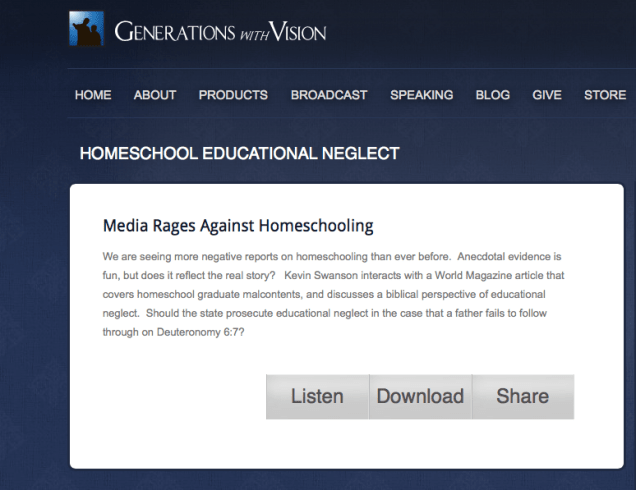
Yesterday we were “blessed” with the Generations Radio episode “Homeschool Educational Neglect: Media Rages Against Homeschooling.” In that episode, Kevin Swanson (former CHEC Executive Director and current Director of CHEC’s Generations With Vision program) and Steve Vaughan (CHEC Board Member) responded to Daniel James Devine’s “Homeschool debate” article published by WORLD Magazine on August 25, 2014. Here is Swanson’s own description of the episode:

We are seeing more negative reports on homeschooling than ever before.  Anecdotal evidence is fun, but does it reflect the real story? Kevin Swanson interacts with a World Magazine article that covers homeschool graduate malcontents, and discusses a biblical perspective of educational neglect. Should the state prosecute educational neglect in the case that a father fails to follow through on Deuteronomy 6:7?

Sound like fun?

Well, in case it does not, I saved you the teeth-grinding and transcribed the entire episode here.

Swanson and Vaughan go after WORLD rather mercilessly, accusing them of “cutting down” and creating a “firing squad” against fellow Christians. Furthermore, they insinuate that WORLD is too daft to know how to use a concordance and may have socialists on its staff. This is all curious considering that Swanson had no problem using WORLD to advertise his “Apostate” book just a few months ago. It’s also curious because Swanson and Vaughan neglect the fact that WORLD’s own Editor-in-Chief is the Distinguished Chair of Journalism and Public Policy at Patrick Henry College, the same college at which Michael Farris is Chancellor. They further neglect the fact that WORLD is probably the most go-to news source for conservative Christian homeschoolers. So whatever “bias” WORLD Magazine has, it clearly isn’t against Farris, HSLDA, or homeschooling. That Swanson and Vaughan would immediately jump to that conclusion is indicative of their own paranoia, not anything about WORLD turning an ideological leaf on homeschooling.

If you want to read the entire transcript of the episode, you can do so here. Below are the “highlights” from it. (Be forewarned you might need to steel your mind and stomach for abuse denialism and apologisms and homophobia galore.)

My final comment before I turn you over to the minds of Swanson and Vaughan is this:

Yesterday Michael Farris and HSLDA declared to the world that they are “drawing a line in the sand.” But time and time again they say this and yet it seems like nothing but word gamesit isn’t trueit minimizes or refuses to acknowledge the atrocious and previous lack of lines, or it isn’t enough. And sometimes, like today, when I am so disturbed, heartsick, and saddened by Kevin Swanson’s hatred, cruelty, and antichrist-like behavior towards homeschool alumni, and I see that HSLDA’s “line in the sand” means nothing when it comes to standing up to someone like Swanson — and thenthen I see Swanson promoting his book “Upgrade,” a book that HSLDA’s very own president J. Michael Smith said “should be in the hands of every homeschool family in America”

Then I want to say: You really have built your lines on sand, HSLDA, haven’t you?

I think Libby Anne said it best:

Real leaders speak out against dangerous teachings or leaders when speaking out is still difficult rather than letting others do the heavy lifting and waiting to speak out until speaking out is easy.

And on that note, here are some highlights from Kevin Swanson and Steve Vaughan’s “Homeschool Educational Neglect”:

WORLD Magazine just found “the 25 people” upset and created a “circular firing squad”:

Kevin: They [WORLD] found the 25 people upset with home education…

Steve: …yeah…

Kevin: …that started the little IHateHomeschool.com and then they gave them a nice little publicity piece. And HSLDA, you know, did their faithful thing, they wandered up to the microphone and tried to fight for homeschooling and its reputation but…

Steve: Yeah they got a paragraph in the middle of the article. (laugh)

Kevin: They did. But, but you know what? And I realize that makes news. I realize that the 25 people upset in America make news. But they’re not interviewing the 3.2 million kids who have been homeschooled. That didn’t show up in the magazine. And I don’t see that showing up much in the magazine [WORLD] these days. But you know, here’s the problem with Christian organizations. They turn into circular firing squads.

Steve: Yeah. (laughter)

Steve: You know how that works? Everyone just stands in a big circle. Aim, fire, shoot. And everybody falls.

WORLD Magazine covering abuse and neglect is just “cutting each other down”:

Kevin: What is with WORLD Magazine, guys? I mean, come on. Aren’t we supposed to be one big family? Isn’t there supposed to be a little bit of symbiosis happening in the Kingdom of God? We are overwhelmed, we are outnumbered. The, the other side is gonna kill us when it comes to homeschool freedoms, the freedom to speak against homosexuality. The left is on the rise, baby! Barack Obama is President of the United States, the most pro-infanticide president ever to serve and what are we doing? Cutting each other down? I don’t think so! Try not to do that!

To be real abuse, abuse must be verified by 2 or 3 witnesses; it is the result of the sexual revolution:

Kevin: Let me say from the outset that sexual abuse, physical abuse — that’s verifiable, 2 or 3 witnesses, etc., etc., k? — a court or trial works through the issue and sure enough, someone was sexually abused? — that’s really, really bad.

Steve: Yeah.

Kevin: That should not happen.

Steve: Anywhere. (laughter)

Kevin: Anywhere. Thank you! And I think it’s due to the fact that we had this sexual revolution that unleashed itself in the 1950’s and 1960’s. And America and many other nations around the world have become a sexual cesspool in which homosexuality, incest, sexual abuse, all sorts of things are happening.

Spiritual abuse, emotional abuse, and educational neglect are laughing matters to to Kevin Swanson and Steve Vaughan:

Kevin Swanson: When you talk about things like spiritual abuse, emotional abuse, educational neglect — we’re talking about things that are very, very slippery. Very, very hard to get your hands around. Okay? (laughter)  And it’s fun for people to use those terms because, you know, you can just bring accusations against anybody and everybody as you use the slippery terms that are very, very hard to define.

Steve: So yeah, how would you define spiritual abuse?

Kevin: Yeah! Or emotional abuse! What IS that? What exactly is that?

Steve: “Well she spoke harshly to me and used the Bible to let me know I was wrong, so I was spiritually and emotionally abused.”

Kevin: Right, right! Someone came up to a rapist and said, “It’s wrong to rape!” (pretending to be rapist:) “Oh you’re abusing me! You’re abusing me! That’s not very grace-filled! You know, what in the world are you doing? Accusing me of sin? That’s terrible! Oh I’m so abused! I’m so abused!”

Steve: Yeah! “You need to honor your father and mother!” “Oh my!”

(laughter)

Kevin: “I’ve been so abused…” (laughter)

When kids are educationally neglected, it’s really just their own fault for being lazy:

Kevin: when someone says, I could have had a better education than that provided by my mother or by my father, that’s really, really, really hard to prove. How, how, how do you know that? Maybe it was a character problem on YOUR part. Maybe you didn’t obey your parents! Maybe you didn’t study your books like you were told to! And to think that you could have had a better education if you had done it this way versus that way is extremely hard to prove.

Steve: Right!

(laughter)

Kevin: Extremely hard to prove!

Steve: Because you can’t go back and do it that way!

Kevin: You can’t! (laughter) You can’t… and even if you could have, you would have dragged your same old person, with your same old character flaws, with your same old slothfulness issue, into the public school or private school setting or other setting ‚ and you could have done worse…

Steve: Yeah.

Kevin: …than you did with your parents — trying to do whatever they could have done with you, even with all of your character issues that you’re dealing with. It’s fun to blame your parents for your OWN lack of character!

Making fun of a homeschool alumna who was regularly beaten and neglected by her parents:

Steve: Here’s the case with the WORLD Magazine article and this gal who wrote this. 31 years old. One of the things she was complaining about was that she still counts on her fingers and has to double-check the tip on her restaurant table.

Kevin: That’s 40% of public school graduates, by the way.

Steve: 31 years old now! She’s 31 years old and she set up a website and started an organization apparently counting on her fingers! And so, you know, give me a break!

Kevin: Yeah.

Steve: If you can do THIS, you can COUNT.

Kevin: And if your parents failed in 18 years, or 12 years, of education, she’s had an additional 13 years!

Steve: Right!

Kevin: So, so…

Steve: GROW UP!

(laughter) (more laughter)

Steve: READ SOME BOOKS!

(laughter)

Steve: THERE ARE BOOKS OUT THERE ON MATH! YOU CAN LEARN HOW TO NOT COUNT ON YOUR FINGERS!

(laughter)…

Kevin: So this little whiner, talking about her bad experience with home education, um, you know she’s had 13 years to learn how to count.

Steve: Right!

Kevin: And to learn how to add. And still hasn’t happened. Sounds to me like there’s something wrong. With HER.

On WORLD Magazine not knowing what a concordance is:

I think WORLD Magazine should think biblically about these things. What does the Bible say about educational neglect? Again, look it up in the concordance! See, people aren’t used to that. Let me explain to you what a concordance is. A concordance is typically found in the back of a Bible. You can find them online. It’s called BibleHub.com. Go there. And… and you look up the word. “Educational neglect.” Look it up in the Bible. You say it’s not there? Yeah. Yeah, exactly! Why? Because it’s not an issue.

On what educational neglect REALLY is and WORLD Magazine maybe having socialist employees:

Educational neglect is the failure to teach God’s Word as you sit in the house, as you walk by the way, as you rise, as you lie down. Okay? So, so, so those are the categories in which we should be thinking, friends. And, now, here’s the next question: How do we prosecute that through the civil magistrate? That’s the next question that comes to the mind of the socialists — whether they work for TIME Magazine or whether or not they working for WORLD Magazine. I don’t know if socialists work there or not.

On educational neglect being a joke:

We’re back on the Generations Radio broadcast talking about homeschool educational neglect. Educational neglect: “when my fa—, when my parents did not get me into Harvard.” (using fake whining voice) “Why didn’t my parents get me into Harvard? What’s wrong with them?” And you know, the point is, the point is, the goal is not to get you into Harvard. The goal is to get you into Heaven.

Basic reading and math ought not be of primary importance to Christian homeschool families:

Kevin: I’m talking about Christian homeschool families. Their values are primarily first and foremost not to get their kid into Harvard or get them a good job.

Steve: Right.

Kevin: That’s not primary. It’s not being sure that the kid can read Plato before he’s 12 years of age…

Steve: Yeah.

Kevin: …and get really messed up with the wrong worldview. (laughter) That’s not the goal. See, homeschoolers bring in other values: like relationship building, character building, work, worship. These are important. So it’s not that you can count when you are 31 years of age.

On homeschool alumni being “homeschool whiners” and “traitors”:

These homeschool whiners, let’s get back to what they’re really all about. They’re jettisoning a biblical world and life view. They’re looking for more socialism. They want more governmental controls of education. They want more socialist services sticking their noses into homeschoolers around America. This is their agenda. From what I’ve read. And, and they’re traitors. Traitors to the cause. The cause of what? The cause of freedom! The cause of anybody who wants to fight for freedom against the rising tide of totalitarianism and socialism in America! I am seeing a lot of these guys. They’re bitter…

Steve: Yeah.

Kevin: …against the values represented by home education and their parents. And it’s probably due to broken relationships in the home. So they walk away from the home, all embittered against their parents and whatever stinkin’ issues their parents ever stood for. And whatever friends their parents ever hung out with. And they’re just angry, bitter people who are, have it in for home education.

On how to logic:

Steve: They’re [homeschool alumni] blaming the whole homeschooling movement. They’re taking… they’re… they’re actually committing the fallacies of… it’s, it’s a genetic fallacy. It’s a fallacy of generalization, that you take the small bit and you say that must be true of the whole. So, so since Judas was one of Jesus’s disciples and he betrayed Jesus, then ALL of the disciples must—

Kevin: —must be a bunch of nutcases—

Steve: Yeah. And so. So yeah.

Kevin: And yeah. That happens when you go irrational when, when your relationships bust up and you begin to hate everything about whatever your parents were associated with because those relationships went sour.

On the “PatrickHenryGayBlogspot.com” or “whatever that is”:

Kevin: These ex-homeschoolers to which WORLD Magazine is giving credence are pro-homosexual. They’re right there behind the emerging gay movement in Christian colleges. They’re encouraging the PatrickHenryGayBlogspot.com or whatever it is. Uh, don’t go there. I said it wrong on purpose. They’re encouraging the homosexuals showing up at the conservative Christian colleges as well and giving them as much credence as possible. Why? Because they are apostates. They’re embracing everything the Bible doesn’t. They’re embracing socialism, totalitarianism, homosexuality. If it’s ugly, if it’s wicked, if it’s totalitarian, they love it!

Homeschool alumni are “Benedict Arnolds”:

Kevin: These traitors are nothing new in the history of the world, my friends. Um, and they’re making it hard on the rest of us. But that’s what the Benedict Arnolds have always done.

Transcript of Kevin Swanson and Steve Vaughan’s “Homeschool Educational Neglect”

Screen Shot 2014-08-28 at 12.42.27 AM

HA note: The following is a transcript of the Generations Radio episode “Homeschool Educational Neglect: Media Rages Against Homeschooling,” broadcast on August 27, 2014. It features Kevin Swanson (former CHEC Executive Director and current Director of CHEC’s Generations With Vision program) and Steve Vaughan (CHEC Board Member). The program is a response to Daniel James Devine’s “Homeschool debate” article published by WORLD Magazine on August 25, 2014. This transcript was created by HA Community Coordinator R.L. Stollar.

See the context of and “highlights” from the episode here. Content warning for transcript: abuse denialism and apologism and homophobic remarks.

*****

(introduction, not transcribed)

Kevin: Today we’re going to take a look again at homeschooling. Why? Because homeschoolers, generally speaking, like to restore and reintegrate the family — as a family in the 21st century. And homeschoolers tend to like freedom. They’re the ones fighting for freedom. You want to find anybody interested in decreasing the influence of government in our lives in an era where 60% of the GNI is consumed by governments at all levels up from 9% in 1900? You want to find people interested in backing government off from education, backing government off from family-owned economies, backing government off from all areas of life? Homeschoolers at the forefront of fighting tooth and nail for any semblance of freedom left in the 21st century. I’m thankful for home educators. It’s hard to find anybody else fighting the good fight for freedom in the 21st century.

There are a few. There are some. Here and there. But not very many.

Hey you want to look at the Tea Party and you want to find the people who are fighting at the forefront for freedom? Tends to be homeschoolers. Not always. But I tell you what, you want to find pro-lifers out there? Tend to be homeschoolers.

People out there on the front lines of the battle fighting for the right to life — generally speaking, you’re going to find homeschoolers. K? Homeschoolers at the forefront of a battle for restoring family, faith, and freedom in the 21st century. and I’m thankful for them.

Steve: Amen.

Allright, so there’s my little spiel. Now, now, WORLD Magazine. Now I’ve been getting WORLD Magazine since the 1980’s. I used to think that WORLD Magazine was interested in home educators and home educators were some of their primary market. They were the ones buying the magazines.

Steve: Yeah, we did that.

Kevin: Then they got a lot, a lot, a lot of spread to public schools. A lot, a lot, a lot of spread to private Christian schools. And homeschool has kinda taken the back seat, I think. That’s my impression, Steve. Maybe I’m wrong. Someone can correct me if I’m wrong. But the recent piece published in WORLD Magazine on home education was not particularly positive.

Steve: Yeah it was particularly negative. (laughter)

Kevin: You think it was negative? It was more negative than positive.

Steve: Yeah.

Kevin: I think so too. You know they found the 25 people upset with home education…

Steve: …yeah…

Kevin: …that started the little IHateHomeschool.com and then they gave them a nice little publicity piece. And HSLDA, you know, did their faithful thing, they wandered up to the microphone and tried to fight for homeschooling and its reputation but…

Steve: Yeah they got a paragraph in the middle of the article. (laugh)

Kevin: They did. But, but you know what? And I realize that makes news. I realize that the 25 people upset in America make news. But they’re not interviewing the 3.2 million kids who have been homeschooled. That didn’t show up in the magazine. And I don’t see that showing up much in the magazine these days. But you know, here’s the problem with Christian organizations. They turn into circular firing squads.

Steve: Yeah. (laughter)

Steve: You know how that works? Everyone just stands in a big circle. Aim, fire, shoot. And everybody falls. What happened? We turn into circular firing squad way too much. And I think it was a couple months ago they kinda had a negative piece on Mike Farris.

Steve: Yeah.

Kevin: And they apologized afterwards, thankfully. But what is with WORLD Magazine, guys? I mean, come on. Aren’t we supposed to be one big family? Isn’t there supposed to be a little bit of symbiosis happening in the Kingdom of God? We are overwhelmed, we are outnumbered. The, the other side is gonna kill us when it comes to homeschool freedoms, the freedom to speak against homosexuality. The left is on the rise, baby! Barack Obama is President of the United States, the most pro-infanticide president ever to serve and what are we doing? Cutting each other down? I don’t think so! Try not to do that!

Now we talk a little about homeschooling negligence and homeschooling abuse. Now granted there are abuse cases out there. We know that.

Steve: Oh yeah.

Kevin: And sexual abuse, physical abuse, in the homeschool is as bad as it is anywhere else. And there’s a lot of it out there. Here’s an article from a South Dakota newspaper referring to child sexual abuse there. The estimate is 8% of kids in South Dakota are sexually abused. That’s bad. That’s really bad. That’s really, really, really bad. If we’re close to 1 in 10 kids in South Dakota are sexually abused, that’s really, really bad.

Steve: Now that’s overall, all the families of South Dakota?

Kevin: That’s right, that’s right. And WORLD Magazine, to their credit, did report that 7% of kids complain to some sort of unwanted touching in public schools.

Steve: Right. And that’s nationwide?

Kevin: That’s nationwide. So a lot of the sexual abuse is coming in public schools. But let’s not negate that issue. And HSLDA apparently has said 1.2% of HSLDA members complain of some kind of abuse. Or something like that.

Steve: Yeah, yeah but I think that’s the state complaining of homeschooling abuse…

Kevin: Yeah, yeah, yeah.

Steve: …which could be a messy house. It might be that they didn’t have the right to… [cut off]

Kevin: It’s not just sexual abuse. It could be a messy house. It could be a lot of things. Ok, so it’s very possible there’s way, way, way less abuse happening in homeschools than in the rest of the population.

Steve: Yeah but it makes the news when it happens.

Kevin: Yeah. It does. It does. And of course what we’re talking is the minus 3 standard deviations. And it’s ok to refer to some of the abuse cases happening. That’s newsworthy. But we’ve got to keep these things in perspective.

Steve: Right.

Kevin: And by the way the report did not include references to individuals who have been sexually abused in homeschools. As far as I could tell, that was not part of the story. So first of all, let me say from the outset that sexual abuse, physical abuse — that’s verifiable, 2 or 3 witnesses, etc., etc., k? — a court or trial works through the issue and sure enough, someone was sexually abused? — that’s really, really bad.

Steve: Yeah.

Kevin: That should not happen.

Steve: Anywhere. (laughter)

Kevin: Anywhere. Thank you! And I think it’s due to the fact that we had this sexual revolution that unleashed itself in the 1950’s and 1960’s. And America and many other nations around the world have become a sexual cesspool in which homosexuality, incest, sexual abuse, all sorts of things are happening.

Steve: Yes.

Kevin: Which is a very very sad thing, a very very bad thing. And may God bring repentance to the nation.

Ok. But when you talk about things like spiritual abuse, emotional abuse, educational neglect — we’re talking about things that are very, very slippery. Very, very hard to get your hands around. Okay? (laughter)  And it’s fun for people to use those terms because, you know, you can just bring accusations against anybody and everybody as you use the slippery terms that are very, very hard to define.

Steve: So yeah, how would you define spiritual abuse?

Kevin: Yeah! Or emotional abuse! What IS that? What exactly is that?

Steve: “Well she spoke harshly to me and used the Bible to let me know I was wrong, so I was spiritually and emotionally abused.”

Kevin: Right, right! Someone came up to a rapist and said, “It’s wrong to rape!” (pretending to be rapist:) “Oh you’re abusing me! You’re abusing me! That’s not very grace-filled! You know, what in the world are you doing? Accusing me of sin? That’s terrible! Oh I’m so abused! I’m so abused!”

Steve: Yeah! “You need to honor your father and mother!” “Oh my!”

(laughter)

Kevin: “I’ve been so abused…” (laughter) “…because this Christian is telling me that I’ve sinned against God and I need to repent.” Ok, so if that’s spiritual abuse… (laughter) …I don’t think the Apostle Paul would agree with you. Put it that way.

But when someone says, I could have had a better education than that provided by my mother or by my father, that’s really, really, really hard to prove. How, how, how do you know that? Maybe it was a character problem on YOUR part. Maybe you didn’t obey your parents! Maybe you didn’t study your books like you were told to! And to think that you could have had a better education if you had done it this way versus that way is extremely hard to prove.

Steve: Right!

(laughter)

Kevin: Extremely hard to prove!

Steve: Because you can’t go back and do it that way!

Kevin: You can’t! (laughter) You can’t… and even if you could have, you would have dragged your same old person, with your same old character flaws, with your same old slothfulness issue, into the public school or private school setting or other setting ‚ and you could have done worse…

Steve: Yeah.

Kevin: …than you did with your parents — trying to do whatever they could have done with you, even with all of your character issues that you’re dealing with. It’s fun to blame your parents for your OWN lack of character!

Steve: Oh yeah!

Kevin: It’s fun to do! And I’m sure there are a lot of kids out there who are doing just that! They’re running across the country. Yeah! Their parents pointed out their sin, pointed out Christ. But they still rebelled and they were scoffers and they refused to take the correction their parents gave them. They violated every single principle in the Book of Proverbs. They made a point not to follow through on anything in the Book of Proverbs! Nothing! And at the end of their educational experience at home, they didn’t succeed. They didn’t make it into Harvard.

(laughter)

Steve: Right! But here’s the case with the WORLD Magazine article and this gal who wrote this. 31 years old. One of the things she was complaining about was that she still counts on her fingers and has to double-check the tip on her restaurant table.

Kevin: That’s 40% of public school graduates, by the way.

Steve: 31 years old now! She’s 31 years old and she set up a website and started an organization apparently counting on her fingers! And so, you know, give me a break!

Kevin: Yeah.

Steve: If you can do THIS, you can COUNT.

Kevin: And if your parents failed in 18 years, or 12 years, of education, she’s had an additional 13 years!

Steve: Right!

Kevin: So, so…

Steve: GROW UP!

(laughter) (more laughter)

Steve: READ SOME BOOKS!

(laughter)

Steve: THERE ARE BOOKS OUT THERE ON MATH! YOU CAN LEARN HOW TO NOT COUNT ON YOUR FINGERS!

(laughter)

Kevin: I ran into a family, Steve, a couple of years ago, and these guys had made it through Littleton public schools for 12 years. Okay? They had taken the special needs track as well. Okay, for 12 years, both of them, they got married at 20, 22 years of age and they couldn’t read. Okay? Littleton public schools had spent 100, no, no, excuse me, $347,000 on the education of these kids. They couldn’t read. So they went to church and there were some elderly church people who, you know, took them in and taught them how to read. They were concerned because they went down to the library to get some Dr. Seuss books and he said they couldn’t read the big 27 point font stuff.

Steve: Wow.

Kevin: And they got concerned because they were having kids. Pregnant with the first. So, so they went to some folks in the church and the church folks helped them. They taught them how to read. And so they thought to themselves: Okay, let me get this straight. The Littleton public schools spent $347,000 and they couldn’t teach us how to read. (laughter) They couldn’t pull it off!

Steve: I know there are stats out there about how many seniors can’t even read their diplomas.

Kevin: Oh, yeah, yeah, yeah, yeah. It’s really high. Functional literacy really, really, really high. In fact, college graduates? It’s about 40%.

Steve: Yeah. Isn’t that crazy?

Kevin: College graduates! So this little whiner, talking about her bad experience with home education, um, you know she’s had 13 years to learn how to count.

Steve: Right!

Kevin: And to learn how to add. And still hasn’t happened. Sounds to me like there’s something wrong. With HER.

Steve: Yeah! Or she’s whining without any reason.

Kevin: Yeah! So anyways this couple decided, you know, if the public schools spent $347,000 and couldn’t teach us how to read, why would we send our kids to these schools? That was their logic. And I’ve met this family again — well, it’s been about 10 years — and their kids are doing very well. Very, very well.

Steve: Yeah.

Kevin: They’ve got 8 kids. They live in Nebraska. They’re doing very, very well… So anyways, so why are we sending our kids to public schools? And, and ok, there are sort of the minus 3 standard deviations everywhere. Thankfully homeschoolers are averaging somewhere around the 80th percentile for reading and literature and such. So, if they’re at the 80th percentile, my guess is that there’s got to be something like 93% above the functional literacy level. Or 99% above the functional literacy level! Therefore, people like WORLD Magazine are going to have to look HARD and LONG for the 1%!

Steve: Yeah, that’s right.

Kevin: The minus 3 standard deviations on the standard curve! And they found them! Evidently they found them, they interviewed them!

Steve: Yeah! Yeah, and if you take a look at just the overall standardized tests, homeschoolers score consistently in the 60 to 80% percentile average, for public schools 50%. So, so we’re above that, too.

Kevin: The other, psssh, illustration given by the WORLD Magazine article was a young lady whose parents were divorced. And, and here’s one thing that almost every educator understands: that if the family situation is dysfunctional, the marriage is breaking down, there’s divorce in the family — the kids generally are not going to do well in school.

Steve: Right. No matter where they go.

Kevin: No matter where they go! Oh yeah! The reason you’ve got such problems in public schools is not the teachers, generally speaking. It’s the home life. And just taking a kid who is raised in a dysfunctional home — single mom, etc., etc. — putting them in the public schools is not going to fix the problem necessarily. In fact, it generally doesn’t fix the problem. Why? Because they come from dysfunctional home backgrounds. There’s a reason why inner-city schools typically are producing the very worst results. Well, that’s because the family situation for these kids attending these inner-city schools are dysfunctional. And you can’t fix the problem by fixing the schools! And you can’t fix the problem by fixing the education! I’m sorry, you’ve got to fix the family relationships. You have to fix the family. And that should be a no-brainer.

Moreover, I think WORLD Magazine should think biblically about these things. What does the Bible say about educational neglect? Again, look it up in the concordance! See, people aren’t used to that. Let me explain to you what a concordance is. A concordance is typically found in the back of a Bible. You can find them online. It’s called BibleHub.com. Go there. And… and you look up the word. “Educational neglect.” Look it up in the Bible. You say it’s not there? Yeah. Yeah, exactly! Why? Because it’s not an issue. What’s the issue?

Steve: Family.

(laughter)

Kevin: The issue is discipleship neglect.

Steve: Right.

Kevin: The issue is, biblically speaking — if we were thinking biblically — not, not with the psychobabble of the world gives us — but if we’re thinking biblically, educational neglect is the failure to teach God’s Word as you sit in the house, as you walk by the way, as you rise, as you lie down. Okay? So, so, so those are the categories in which we should be thinking, friends.

And, now, here’s the next question: How do we prosecute that through the civil magistrate? That’s the next question that comes to the mind of the socialists — whether they work for TIME Magazine or whether or not they working for WORLD Magazine. I don’t know if socialists work there or not. But, but the question in the minds of a socialist that are in the Christian population and the non-Christian population is: If there is an educational neglect — where a parent refuses to teach their children God’s Word as you sit in the house, as you walk by the way, as you rise, as you lie down — the question in their minds is, should the State prosecute it? My answer is: No.

Steve: No!

Kevin: Thank you! I’m glad that you have a biblical worldview, too!

Steve: Oh yeah!

(laughter)

Kevin: Oh it’s incredible, Steve’s got a biblical worldview, I’ve got a biblical worldview!

(laughter)

Steve: Yeah!

Kevin: Yeah! The State doesn’t prosecute it! So, who prosecutes it? Um, well — where there are church relationships! Where there is somebody who cares! Here’s one thing I’m learning, Steve: the State can’t fix these problems. They can’t fix the family. They can’t fix educational neglect.

Steve: They’re not designed to!

Kevin: They can’t! And it doesn’t matter how many compulsory [unintelligible] laws they pass down, it doesn’t matter how many… uh, their minions they hire… to enter into every single home and double-check and double-check and double-check. It doesn’t matter! It doesn’t fix the inner-city family! It has NEVER fixed the inner-city family! It has never fixed the educational problem in the inner-cities where there is all kinds of dysfunctionality in the families. Friends, the government can’t fix it! Period! Get. That. Down. Straight!

Those of you working for WORLD Magazine and Time Magazine and anywhere else where there’s people trying to be the do-gooders and trying to fix society’s problems: how you fix society’s problems, it doesn’t happen by government. It happens by people who care. Yeah. People who care. People in the church, people in the community, who come side by side and help those families to homeschool and disciple their kids. That’s how it gets fixed.

(commercial break, not transcribed)

Kevin: We’re back on the Generations Radio broadcast talking about homeschool educational neglect. Educational neglect: “when my fa—, when my parents did not get me into Harvard.” (using fake whining voice) “Why didn’t my parents get me into Harvard? What’s wrong with them?” And you know, the point is, the point is, the goal is not to get you into Harvard. The goal is to get you into Heaven.

Steve: Amen!

(laughter)

Kevin: Mike Smith gives that talk. Heaven, not Harvard!

Steve: Right.

Kevin: Um, the goal is to teach as you sit in the house, as you walk by the way, as you rise, as you lie down. And teach what? The Word of God. The goal is biblical discipleship in the Word of God because the Word of God is the core in the education program of a child. And I understand there are secularists who may listen to the program and don’t believe that. I understand. That’s a different worldview, a humanist worldview. I don’t. I have a biblical worldview.

Steve: Yeah! And so, really, when they talk about spiritual abuse, spiritual abuse REALLY is not following Deuteronomy 6.

Kevin: Yeah, it’s not teaching the Word of God as you sit in the house.

Steve: Right! And that’s what’s really going on. They’re thinking that when you DO do that, that’s spiritual abuse.

Kevin: And, and, and the problem is Huffington Post would not agree with you.

Steve: Yeah, that’s right!

(laughter)

Kevin: Or Patheos.com. Or Apostate.com or wherever. Um, here’s the other thing I think we ought to draw into this: Homeschooling families are not like public school families. They have different values. Generally speaking. Now, some share values, but I’m talking about Christian homeschool families. Their values are primarily first and foremost not to get their kid into Harvard or get them a good job.

Steve: Right.

Kevin: That’s not primary. It’s not being sure that the kid can read Plato before he’s 12 years of age…

Steve: Yeah.

Kevin: …and get really messed up with the wrong worldview. (laughter) That’s not the goal. See, homeschoolers bring in other values: like relationship building, character building, work, worship. These are important. So it’s not that you can count when you are 31 years of age. Now hopefully that’s a by-product…

Steve: Yeah.

Kevin: …of other things that have been happening. But homeschool families are focused on other priorities. And that’s a shocker to the world out there.

Steve: Yeah. Yeah, there’s a — do you remember the dad and the daughter who, like, split the city and went out into the wilderness and lived in a tent for a while?

Kevin: Yeah, right, right, right.

Steve: And she ended up, you know, they were so afraid that she was horribly abused and didn’t know anything. And she scored way high.

Kevin: She scored as a 12th grader, a high school graduate, at 12 years of age. And they’d been woods-schooling for 4 years. I remember that story. Um, but again, the goal is not to be sure that your child is hitting the 97th percentile in math or reading.

Steve: Yeah!

Kevin: That’s not the goal. That’s not the goal.

Steve: Jesus said something about that. “What does it profit a man to gain the whole world and yet lose your soul?”

Kevin: Yeah. Well, what socialists are doing — and I’ve seen this more and more, Steve, and I’m concerned about WORLD Magazine and I hope that they don’t go this direction — but what the socialists are doing is they’re looking for the minus 3 sigma cases and using it as the PR case against home education…

Steve: Right.

Kevin: …in America. I’ve seen this a hundred times if I’ve seen it once. I… And… And, you know, that’s what they do. That’s what they do. Never mind the fact that homeschoolers are registering, averaging, at the 87th percentile, and Dr. Ray’s study looked at other teaching— other testing services beyond Bob Jones. I think he was looking at a broader slice of the population than the Rudner study in the 1990’s. So I think Dr. Ray nailed it with the Ray study that came out about 3, 4 years ago. And the overall core average was running somewhere around 87 percent. And remember the Rudner study of the 1990’s was running somewhere around the 83rd percentile point.

So, so, you know, the bad guys are gonna come after us one way or another. I’m just hoping the good guys would understand a biblical perspective on issues like this and fight for freedom. A little faith! A little courage to get out there and shove this back in the faces of the socialists and the homeschool whiners that — by the way, these homeschool whiners, let’s get back to what they’re really all about. They’re jettisoning a biblical world and life view. They’re looking for more socialism. They want more governmental controls of education. They want more socialist services sticking their noses into homeschoolers around America. This is their agenda. From what I’ve read. And, and they’re traitors. Traitors to the cause. The cause of what? The cause of freedom! The cause of anybody who wants to fight for freedom against the rising tide of totalitarianism and socialism in America! I am seeing a lot of these guys. They’re bitter…

Steve: Yeah.

Kevin: …against the values represented by home education and their parents. And it’s probably due to broken relationships in the home. So they walk away from the home, all embittered against their parents and whatever stinkin’ issues their parents ever stood for. And whatever friends their parents ever hung out with. And they’re just angry, bitter people who are, have it in for home education. Now, not everybody. But there’s a handful out there that are making some noise. And as far as I am concerned I’m not giving their websites any credence whatsoever.

Steve: Right. And what they need to do is put the blame where the blame actually is supposed to be. They’re blaming the whole homeschooling movement. They’re taking… they’re… they’re actually committing the fallacies of… it’s, it’s a genetic fallacy. It’s a fallacy of generalization, that you take the small bit and you say that must be true of the whole. So, so since Judas was one of Jesus’s disciples and he betrayed Jesus, then ALL of the disciples must—

Kevin: —must be a bunch of nutcases—

Steve: Yeah. And so. So yeah.

Kevin: And yeah. That happens when you go irrational when, when your relationships bust up and you begin to hate everything about whatever your parents were associated with because those relationships went sour. Moreover, these ex-homeschoolers to which WORLD Magazine is giving credence are pro-homosexual. They’re right there behind the emerging gay movement in Christian colleges. They’re encouraging the PatrickHenryGayBlogspot.com or whatever it is. Uh, don’t go there. I said it wrong on purpose. They’re encouraging the homosexuals showing up at the conservative Christian colleges as well and giving them as much credence as possible. Why? Because they are apostates. They’re embracing everything the Bible doesn’t. They’re embracing socialism, totalitarianism, homosexuality. If it’s ugly, if it’s wicked, if it’s totalitarian, they love it! Why? Because they’re turning away from the values they were raised with.

And guess what? This has happened since Day One. Think about Demus. Think about Alexander the Coppersmith. Think about Judas. I mean, these people have existed since the beginning of the Christian Church. And these traitors are nothing new in the history of the world, my friends. Um, and they’re making it hard on the rest of us. But that’s what the Benedict Arnolds have always done.

Steve: And that’s nothing new either.

Kevin: Yeah, exactly. So, now, now, let’s get back to home education. Are there problems with home education? Yes. Yes. There are problems. And, and, and we need to be the first to confess the weaknesses. Where there are weaknesses, confess them. And, and their slothfulness is an issue. Now again, is it any different, public schools versus private schools versus homeschools? I doubt it. Slothfulness with young men? Yeah. It’s a huge problem.

Steve: Yeah.

Kevin: Huge problem. Lack of discipleship for young men because they’re stuck, tied to their mothers’ apron strings until they’re 18 years of age? Yeah, that’s dysfunction. I’ve seen that. Yeah, I’ve seen single moms out there who may have these co-dependent relationships with kids and they won’t do any schooling at all with them. It’s just this weird little co-dependency. They won’t let them go to the public schools, won’t let them go to private schools, and they won’t even homeschool them because they’re just sitting there in the house in this sort of weird, co-dependent relationship. It’s all self-centered. Self-centered, self-centered. Yeah, yeah, yeah. Yeah, you see, you see issues — sin issues — in people’s lives everywhere.

Steve: Right.

Kevin: And as you see those things, I think the church, the local church, needs to address them.

Steve: Yeah! See, really, this is a, not only a family problem, but it’s also a church discipline issue as well. And that’s a whole different show.

Kevin: It is, yeah.

Steve: But it is. I mean, you know, there’s a book Jay Adams wrote that I just really liked about church discipline. And it’s not, you know, most people think of church discipline as a way to kick people out of church. But really, church discipline is a right that everybody has in the church. A well-disciplined church is gonna turn out well-disciplined families, which will have an effect on the community at large.

Kevin: Well, Steve, to close off the program, my hope is that homeschool leaders get a little chutzpah to ‘em and fight the good fight, engage the battle of ideas, come back to a distinctively biblical world and life view and be more self-consistent to it. Stop being so wishy-washy and… And those leaders who are discouraged, I think they’ve been beaten up by an increasingly hostile media to homeschooling. And, and we can expect that.

Hey, you know, homeschooling is making an impact. Of course the enemy’s upset. Of course the media, the academy, the political world is going to note and they’re gonna come after us and they’re gonna do their best to discourage us. But, man alive, get a little faith! You know, dig in for the long haul! Be self-consistent to your world and life view and encourage the next generation of homeschoolers — who, hopefully, should be more self-consistent — and, and, and more committed to the vision of home education than the previous generation.

That’s why I wrote my book “Upgrade: The 10 Secrets to the Best Education For Your Child.” And hopefully this will give vision to tens of thousands of people listening to the program, especially to our kids and grandkids who need a vision for educating their kids — a distinctively biblical vision because education is a point at which we have seen massive apostasy from the Christian faith. This is the catalyst to apostasy. So if you want to see a restoration of the good things of life, it’s gotta happen in the education of the next generation.

The bad guys understand it. Now it’s time for the good guys to figure it out. And that’s why I wrote my book “Upgrade: The 10 Secrets to the Best Education For Your Child.” Also, “Keep the Faith: Volume One” deals with the historical Christian perspective of education based on 2,000 years of the greatest Christians who have ever written anything on Christian education. You need to get these books. Get these resources. And empower the next generation to be even more faithful than we were.

The vision for home education, for family-based education? You’ll find it in my book “Upgrade: The 10 Secrets to the Best Education For Your Child” and our website, KevinSwanson.com.

(end transcript)
In which my genitals mean I don’t learn math or science

Screen Shot 2014-07-05 at 2.28.15 PM

HA note: The following is reprinted with permission from Kierstyn King’s blog Bridging the Gap.  It was originally published on February 9, 2014.

Alright, you have my attention. Anyone who can wield a soldering iron like that is worth some attention. […]

– youtube commenter (comment since removed by author – creepy part, also removed…by me)

I was denied physics because I was born female. I had been taught all my life leading up to that point that girls don’t use power tools, that girls don’t build, that girls can’t understand higher math, that girls can’t hammer straight, that girls can’t and don’t understand science or engineering, and that all of those things are for boys.

So when we moved and joined science olympiad and I was partnered with people who needed partners, and one of them was a dude and our project was to make an egg-car thing and get the egg to go so far and hit a tiny wall without breaking, I was unable to assert myself. I was told to sit on the sidelines because this was boy stuff, all the boys – my dad, brother, grandpa, and my partner, took over the project while I was a mere bystander.

Anytime I did try to help, I was laughed at and ridiculed because I couldn’t hammer a nail straight – because I was never allowed to build – my entire life, I was never allowed to build – I could hammer a nail into a wall to hang something, but not into two pieces of wood, that was boy stuff. They took my inability as an excuse to continue to take over the project and leave me out of it.

My job, in my science project was to put the rubber bands on the plexiglass wheels that the boys decided were best, and load the weights into the pulley that held the car-holder door shut and released the car/opened the door when it dropped (because weight). The only enjoyment I had was to call them tiny footballs because they were fishing weights and looked like footballs and everyone ridiculed me for that. I was so devastated about the entire project that I was just like, THIS IS THE ONE JOY I HAVE OKAY, LET ME CALL THEM THAT.

It was horrible. The entire time no one bothered to give me anything but cursory detail about what they were doing or how it worked. No one bothered to teach me physics, because I was a girl and wouldn’t need to know anyway, I was just there so my partner could enter. No one taught me the math or told me about the calculations or why they decided on plexiglass wheels and a twist system besides “this would work best because you (not me, my partner) can calculate how many turns you need for the distance”.

My entire life I have been afraid of power tools and under the impression that I would never be able to use them effectively because of my genitalia (like a vagina is power tool kryptonite). I was convinced that somehow something world ending would happen were I to try – or maybe not world ending, but it at least would break and not work. I was never allowed to touch anything, only told to stay away, barely allowed to watch, never taught.

I am angry that because I was born in this body I was not allowed to learn how to build, to learn about physics, but instead I was only told I was bad at it and ridiculed every time I made the slightest attempt to understand.

I would never need to know these things to be a wife and mother, so why bother wasting the energy, right?

Sexism and gender roles ruined my math and science education – they denied me either, and instead lied to me, tying my mental ability to my genitalia, and my life’s purpose to bodily functions.

This is why building ikea furniture, and houses in minecraft, and learning how to solder, and making little electronics work is so huge to me.

This is me standing up against my parents – who were my teachers – and learning SCIENCE because I CAN, because it is WORTH LEARNING, because I am SMART and I HAVE ALWAYS LOVED SCIENCE and was never allowed to try, never given the math skills or the time of day to learn it because I was told my entire life it was pointless for ME to learn it. I was relegated to the sidelines when I was supposed to be being educated, but I’m not anymore.

I am building things and I am soldering and I am damn good at it. 

I hate it when I’m made out to be magical because I both have boobs and enough dexterity to solder. It’s not magic, I am not a unicorn, and thinking that it’s somehow remarkable for a person with female genitalia to hold a soldering iron is sexist. It’s the same kind of sexism that kept me from learning math and science in high school, and it is not okay.

Go ahead and be impressed that I can do things, but be impressed because I’m fighting against my past, because I’m carving my way out of the cage my parents tried to place me in, not because I have boobs and dexterity.

Fuck the Patriarchy.

A *Real* Investigation into IBLP

iblp
IBLP’s Headquarters in Oak Brook, Illinois.

Jeri Lofland blogs at Heresy in the Heartland. The following was originally published by Jeri on June 22, 2014, and is reprinted with permission.

Thoroughness:

Knowing what factors will diminish the effectiveness of my work or words if neglected

–Bill Gothard

Bill Gothard’s buddy David Gibbs, Jr. has now completed his “investigation” into allegations made against Gothard by former IBLP staff members. According to the IBLP board earlier this week,

“…the Board sought the facts through a confidential and thorough review process conducted by outside legal counsel. Many people were interviewed, including former Board members, current and past staff members, current and past administrators, parents, and family members.

“At this point, based upon those willing to be interviewed, no criminal activity has been discovered.”

But according to the team at Recovering Grace,

“…not one of the women who have shared their stories on our site were personally contacted by Gibbs Jr. or his investigative team, including Charlotte, who alleged molestation.

Perhaps Gibbs Jr. needs to brush up on his Character Qualities.

It would seem that Gibbs’ investigation focused narrowly on certain allegations of sexual impropriety (some of which Gothard has admitted to, resulting in his resignation). However, this is but the sensational tip of the iceberg and ignores the broad scope of hurtful, unethical, and even illegal activities that have damaged numerous lives associated with the Institute in Basic Life Principles.

Gothard promoted his organization as “Giving the world a new approach to life” and following God’s “non-optional principles”. A ministry that prides itself on being “under authority” should have nothing to fear from the truth. And yet, the testimonies of some former students and staff members paint a disturbing picture. Some of these stories of life under the auspices of the Institute have been published on Recovering Grace. Others have been shared more privately. Some victims are willing to have their names attached to their experiences while others prefer anonymity, or pseudonyms.

Each of the incidents outlined below could likely be explained away on its own. But taken together they suggest a pattern that I believe is worthy of deeper examination. The Board of IBLP can write, “We dedicate ourselves to help build up families and individuals,” but if these situations actually took place, the Institute’s so-called “ministry” is a farce, with or without Gothard, and IBLP should be shut down to prevent further abuse of power.

real investigation of IBLP might look into allegations of the following:

OSHA and other code violations at all locations: Indianapolis, Oak Brook, Elms Plantation, Oklahoma City, Eagle Mountain, Eagle Springs, Northwoods, Big Sandy, Flint, South Campus, Little Rock, Nashville, and others

For example:

  • Lack of permits: illegal remodeling, dredging a lake without a permit, improper electrical wiring
  • Poor fire safety: hiding fire extinguishers and fire pulls behind paintings or décor items; silencing a monitored fire alarm to avoid disrupting conferences, not reporting fires to fire department
  • Improper supervision: letting teens work on upper-story building exterior or fire escapes without safety harness
  • Injuries: electrical shocks from unsafe practices, minors injured while operating power tools, carbon monoxide poisoning of kitchen volunteers
  • Faulty elevators
  • Violations of residential occupancy limits

Prayer rooms (especially at 2820 N. Meridian, Indianapolis):

  • locking minors in solitary confinement without notifying parents
  • locking minors in solitary without access to a restroom
  • withholding food or medication
  • spanking minors without parental consent

Failure to protect children by reporting abuse:

  • failure to report sex acts with or molestation or attempted sexual molestation of minors in IBLP’s care at the ITC (Rodger Gergeni)
  • failure to report sexual abuse of minors in ATI families (Bill Gothard)
  • pressure on homeschooled victims not to report physically abusive parents
  • shaming victims of sexual assault and neglecting to counsel them to contact police
  • pressuring ATI moms not to divorce abusive husbands who posed a danger to the children

Educational neglect:

  • failure to educate “homeschooled” minors who were sent to IBLP centers by their parents
  • using A.C.E. curriculum for children sent by the courts
  • violation of child labor laws
  • children (9-10 years old) working in the kitchen or cleaning bathrooms, sometimes rising as early as 4 or 5 a.m. to work
  • unpaid teenagers working 12-18 hour days in the hotels (cooking, industrial laundry, cleaning hotel rooms and public restrooms)
  • selling teens unaccredited degrees (Telos.edu) without adequate explanation of their value

Forced fasting:

  • on weekends, designated prayer days, and other times when meal preparation was inconvenient
  • though some children were sent there by the state and other students paid for room and board, only two meals were served on Saturday and only supper on Sunday
  • sometimes only two meals a day were served for weeks in a row
  • requiring students to turn in care packages
  • also mandatory weight checks (Weigh Down) for staff women, involuntary diets, forced exercise
  • failure to recognize eating disorders such as anorexia (even when girls were passing out)

Medical neglect:

  • withholding or confiscating prescription medication (including antidepressants, an asthma inhaler, post-surgery pain medication)
  • refusal to get prompt medical treatment for severe burns, broken bones, concussions, pneumonia, collapsed lung, high fevers, torn ligaments, acute food poisoning–many former students trace chronic health problems to untreated conditions that arose at training centers
  • treating injuries with alternative remedies such as sugar water injections (Dr. Hemwall)
  • letting doctors or dentists with revoked licenses treat students at training centers

Campaign ethics:

  • sending youth to campaign for Indianapolis judicial and mayoral candidates
  • providing private services to a public official (Lt. Gov. Mary Fallin) in Oklahoma

Employer issues:

  • pressuring employees not to record overtime on time sheets
  • advising employees that submitted overtime hours would not be paid
  • mandatory unpaid evening work teams for employees (washing dishes, cleaning carpets, scrubbing bathrooms)
  • paying less than minimum wage, paying minimum wage minus “rent”
  • firing employees without due process or notice
  • refusal to pay workers’ compensation
  • instructing employee to lie to hospital staff to protect the “ministry”
  • praising employees who gave up their paycheck to become volunteers
  • allowing children under 16 to work more than twenty hours a week
  • sexual harassment of junior staff or students by adult staff

ALERT:

  • physical abuse, medical neglect, solitary confinement, unsafe equipment, psychological abuse
  • refusal to contact parents regarding medical emergencies
  • keeping four teens tied together by the feet for an entire day, resulting in injury
  • a unit of under-dressed teen boys standing outdoors in sub-freezing temperatures at night until one confessed to a minor infraction
  • disregard for basic safety precautions
Mistreating Russian orphans in Moscow and at Indianapolis South Campus:
  • foster families spanking children and even teens
  • children spanked for minor misdeeds
  • English-speaker spanking Russian child without an interpreter present
  • withholding meals from children for disciplinary purposes or feeding them only dry rolled oats and water
  • child labor (reports of children required to clean toilets at 5 a.m.)
  • using orphans to “encourage” financial donors

Restricted communication from training centers:

  • limited access to public phones, email, fax, or internet
  • reading students’ outgoing or incoming mail, confiscating mail or making students open mail in presence of a leader
  • censoring outgoing email
  • telling students what to tell (or not tell) their parents about situations at the training center
  • limiting who a student or employee was allowed to correspond with outside
  • restricting conversation or interaction between fellow students

Psychological abuse:

  • lengthy, repetitive, or middle-of-the-night “counseling” sessions (berating and brainwashing)
  • restricting sleep
  • piping loud music into bedrooms
  • assigning staff to night duties on consecutive nights (along with their day jobs)
  • requiring student to wash clothing by hand until she had earned “privilege” of using the laundry facilities; requiring staff to recite extensive Bible passages before breaking a fast
  • confiscating clocks
  • hours of forced labor intended to “break will” or “conquer rebellion”

Violations of privacy:

  • not permitting students to take bathroom breaks or use the restroom alone, or with the door closed
  • confiscating personal items such as clothing, music, photographs, medication, and cell phones

Miscellaneous:

  • sending unreported cash through customs on staff member’s person
  • exaggerating or misrepresenting facts in newsletters
  • promotional video about ALERT describing a pilot “rescue” omitted the fact that it was ALERT’s own plane that crashed while taking aerial photos of the property)
  • personal gifts of cash or clothing from Gothard to his favorites
  • discrimination against males who appeared “too effeminate” and females who were overweight or not “feminine” enough
  • photoshopping hair, clothing, and landscaping for newsletter photos
  • selling overpriced plant kits to ATI families under fraudulent advertising
  • serving old (long-expired) donated food or insect-infested grain
  • transferring minors across state lines between “training opportunities” without parental permission or notification
  • insisting that Character First was not affiliated with Gothard

With former ATI students and IBLP staff reporting incidents like these, is it any surprise that so few choose to use Gothard’s materials with their own children?

Prison: Leah’s Story

window

HA note: The author’s name has been changed to ensure anonymity. “Leah” is a pseudonym.

I would sit and stare out my bedroom window for 20 or 30 minutes? Maybe it was an hour? Time seemed irrelevant, and I certainly wasn’t going anywhere. My home was literally my prison. I had less privacy and freedom than most inmates in any state penitentiary, and unlike many inmates in a normal prison, I was unable to take classes to better myself for when I “got out”.

I was home schooled K-12…

… well, sort of.

I don’t remember my mom actually teaching me anything after the 6th grade. My brother “dropped out” when he was in 10th grade (and by dropped out I mean my mom didn’t know how to teach him algebra so they both just gave up, and he got a job as a waiter in a restaurant). After that my mom pretty much gave up on my sister’s and my education. I think part of it was because she didn’t think (as females) that we really needed an education. I begged her to let me go to school. It was all I had wanted from the time I knew what school was, but she refused.

I on the other hand, refused to go down without a fight, so I taught myself through high school. I made my own schedule according to what I imagined they did in “real” schools and I stuck to it, day in and day out. I would wake up every morning at 6am, get dressed and hit the books. It was difficult, not only because I had no idea what I was doing, but also because my mom and stepdad split up when I was 15. My mom took some odd jobs cleaning and watching kids (and by my mom I mean she accepted and took credit for the jobs but my sister and I did an equal share of the work). She then took a job making sermon recordings at the church, and so the nanny job fell completely to me. I, however, received no compensation for this, of course. I also felt responsible for my younger sister, and tried to teach her what I could.

I had no contact with the outside world, other than church on Sundays. We were never involved with any other home school groups, not even with the other families who home schooled in our church. I felt so terribly alone. I was very depressed and developed an eating disorder, both of which went completely unnoticed by my mom.

I wish I could say that as soon as I turned 18 and walked out the door I was free, but sadly, I cannot. The most agonizing aspect of my experience is that my mind became my prison. I left so inadequate because my education didn’t feel “real”. It felt like I was lying to the world. It didn’t matter that I did well on my SAT’s, or that I made good grades in college (when I finally got up the courage to go, with no help or guidance whatsoever from my parents).

I was utterly terrified of the great big world I knew was out there, but wanted desperately to be a part of it.

I started college when I was 21 and worked my way through, first through community college and then on to a 4 year college where I graduated with a BS. I met and married my husband while I was in school and I now have a 15 month old boy, whom I will not be homeschooling.

I still sometimes struggle with a feeling of inadequacy and like I am somehow missing something that other people are not, but I am very glad that I didn’t give up on myself, even when it seemed like everyone else had. I strongly believe that there should be better rules in place for parents who wish to home school. Some parents are not qualified to be teachers, and they are doing their children a great disservice by not just admitting to this fact. It can often become a form of abuse, and should be regulated like everything else.

Homeschool to Public School

school

HA note: The following is reprinted with permission from Heather Doney’s blog Becoming Worldly. It was originally published on December 23, 2012.

I figured since I am one of the rare former Quiverfull kids that was both homeschooled and public schooled, I’d talk about my experience. First off, though, I want to say that I find the debate about whether homeschool or public school is inherently better to be the educational equivalent of arguing whether Coke or orange soda is better. It’s utter foolishness when people act like their personal preference is the only one that counts. Overall I believe that human beings are resilient and adaptable creatures, capable of learning in many different environments if given the opportunity and some quality mentoring. If I was choosing how to educate my own kids, I’d want mixed methods, the best of both worlds.

I realize looking back that I have had two different kinds of homeschooling and two different kinds of public schooling, so figured I’d share my experience with each.

Neglectful Unschooling

The first kind of homeschooling I had was unschooling without the very necessary cultivation and introduction to resources aspect.

Basically it was educational neglect.

This is a pretty common problem in the unschooling world from what I understand. I also got intensive religious messages and was forced to submit to rigid and oppressive gender roles. The bits of educational instruction I got were often pretty abusive too because every now and then, when my Dad got it in his head to formally teach me something, the session would generally end with me getting a spanking, grounded, or having the papers thrown at me in disgust because I was “being stupid,” “obstinate” or “stubborn and difficult.” Unsurprisingly, all that did was leave me with a pretty decent math phobia and worries about my mental capabilities. My parents also often told my sister that she was just stubborn and didn’t want to learn to read.

Thing is, my Mom said she didn’t really teach me how to read. She just read me books out loud when I was small and soon I was reading them back to her. That pattern didn’t happen with my sister or any other siblings because it isn’t typical. Yet my parents expected it to work that same way somehow.

They had little understanding of how kids actually learn, or what motivates them, or that it simply isn’t the same for each kid.

I was a self-directed learner who ate up the few books that had been donated to us by other homeschoolers and the boxes full of classic literature that my Grandad sent me. I didn’t get to go to the library. I just read these books and sometimes when I got too absorbed and forgot to wash dishes or change diapers, my Dad came in, snatched my book from me, hit me with it, and yelled at me. My Mom went from claiming that my book reading was “constructive” to saying that it was “selfish.”

Classic Home Tutoring

After this first kind of homeschooling experience had been thoroughly put to shame by my grandparents and the Sylvan standardized testing they secretly got for me and my sister, I started the second kind of homeschooling. It generally involved sitting at a desk every day at the same time, working through problems, diagramming sentences, having problem sets to solve and a row of sharpened pencils, with regular interspersed “field trips.”

Now I had to answer to my tough, tattooed up old Grandad, a former Navy commander who’d never homeschooled anyone or previously had the desire to.

He had flown me out West to stay with them for a few months and to give an excellently intensive if sometimes harsh go of his brand of tutoring, motivated by his love and concern for me.

My Grandad and I drove each other crazy at times but ultimately bonded for life. He loved being a homeschooling grandfather. He would go on to do the same with my other school age siblings, and later told me that he found his role in his grandchildren’s education to be one of the most satisfying things he’d done in retirement.

He was not motivated by any sort of religious instruction goals, but rather valued and had respect for classical curriculums that connected history to current events, modern life, and a versatile skill set. He also said being cosmopolitan and well-rounded was the primary goal of education.

It wasn’t just about finding a job or about knowing stuff, but making yourself question and think, being a world citizen.

He introduced me to books on Native American history, and Greek and Roman mythology. He brought me outside at night to point out the Seven Sisters of the Pleiades among the stars and tell me the story, and recount what these constellations had meant to sailors of old. He and my Grammy took me to museums and national parks and to go try sushi, fried rattlesnake, and spanikopita. They brought me to see Phantom of the Opera. They got me once a week snow-skiing lessons with teens my age. I was encouraged to find pen pals among them and to practice penmanship, and so I did. I was told to keep a diary and a scrapbook where I wrote down my experiences and saved mementos from events.

I still have those things and they are some of my most valued belongings.

My Grandad continually said, “The world needs lerts, so be alert!”

At the end of our intensive tutoring sessions or a day walking in the redwoods, or a day learning about volcanic activity while swimming at Mammoth Lakes hot creek, my brain would feel tired in a satisfied sort of way. I knew without a doubt that I was learning and it made me much happier about life. I loved it.

When I went back home to my parents, my Grandad gave me a self-study schedule written out on a yellow legal pad so I could hopefully somewhat replicate this rapid rate of absorption. I wish I could say I kept up with the books like he’d had me doing at his house, but I didn’t. No one was pushing me at home, so I only studied what I liked, and what I liked were novels that I could become totally absorbed in and ignore the stressful reality of a family situation I now loathed even more.

Cliquey Public School

Because my parents still weren’t teaching us and my Mom had pretty much given up, the next year we all got sent to public school.

I was both excited and scared. The local high school was known as the “bad school in the good district.” Over a third of the kids (including me) got free lunch because their parents were poor, and it was about half white, half “people of color” — mostly black and creole, a few Hispanic and Vietnamese. My school did really well in sports, less so in academics.

At registration nobody checked to see if I was up to grade level or oriented me to what public school would be like, instead simply assigning me to 9th grade based on my age.

The first week of classes were absolutely overwhelming.

I got laughed at on the bus for handing the driver the paperwork and saying, “My Mom said to give you this.” After being isolated so much, now I was constantly surrounded by people my own age, hundreds of conversations going on in the lunchroom at once, but nobody wanted to sit by me. They already had friends. I was an unwelcome stranger. Someone even threw my backpack on the floor and told me to go sit somewhere else. Finally I got invited to sit at a lunch table by a guy who had a lisp and I gratefully shared eating space with him, a “super-senior,” a pregnant girl, and a tall skinny gamer who wore his backpack on one shoulder and ran to lunch when the bell rang in order to be first in line. They were nice to me, the first friends I made, and I will be forever grateful. They reassured me and gave me hints after I got lost going to my home room class, received a detention for lateness, and got glared at often because I apparently unknowingly stared at people. I’m sure I did stare.

These teenagers were fascinating and I’d never seen anything like it.

Then there was the weirdness of learning how to do homework and study for tests and figure out when and how you are or aren’t supposed to ask questions in class while surrounded by people who’d done these things their whole lives. Everybody assumed I should just know this stuff and was from another planet when I didn’t.

By the end of the first week I was pretty much singled out as a weird kid, by both teachers and students.

One teacher thought I might have a learning disability and scheduled a parent-teacher conference. Classmates made fun of my Walmart shoes. Some boy asked me for a blow job and got people laughing when it was obvious I had no idea what that was. A group of girls walked by and one put gum in my hair. A boy hit me in gym class, I hit back, and we both got suspended for fighting under the “zero tolerance” rules. That’s how for a short time I became one of the “bad kids.”

I had to attend three nights of “PM school” with other suspended kids from around the district, some who’d thrown chairs at teachers, had sex in the bathrooms, set things on fire, or brought vodka to school hidden in Sprite bottles. We all sat around in a circle and talked about what we did wrong and what we should do better next time. Most of them were pretty disrespectful and said school was stupid and they couldn’t wait to drop out when they turned 16.

I really hit the culture shock head on right there.

Why didn’t they want an education? I’d had to fight so hard to get mine and I had no intention of letting anything take it away from me.

Around that time I discovered that high school was two-tiered. There were the regular and remedial classes and then the honors classes and advanced placement classes. The kinds of people who took either of the latter were treated better. Honors and AP classes also had people who were more invested and were given more in-depth information, but nobody else in that classroom seemed to feel as enthusiastic about learning as me. I was absorbing everything all at one time — the coursework was only part of it. How to walk, how to talk to people, what were appropriate topics of conversation, what to wear, what not to say seemed even more crucial.

Often it seemed there were more important things I was missing in my education than book learning, and I just made social mistake after social mistake. I was made fun of ruthlessly about them, remembering even one of the coaches laughing when some boys threw balls of paper at me in civics class.

I told my parents about the bullying once.

When my Dad’s response was, “Well, it’s ok with me if you drop out.” I never said another word about it.

I didn’t want them to have any excuse to pull me out. I just soldiered through. I made up my mind I would not be one of the dropout crowd. Here’s the thing about bullying though — it often just happens to new kids. Once your quirks and social status have been thoroughly made fun of, then you start to become accepted. The hazing (however wrong it is) is over. Girls start to give you tips about how to dress and talk and ask if you want a cigarette (no thanks), and guys start to flirt and ask to copy your homework (um, no. Well…maybe an exception for that cute one).

The learning curve that first year and a half was quite steep and I was stuck between different educational worlds where I had to know very different things to get by. I failed my first algebra class (what on earth were those letters doing in the math problems?!) and so sophomore year I took remedial math and honors English and history. I got invited to work on the school newspaper and the literary publication due to my work in honors English, and I got suspended again for getting in another fight (in the middle of class, no less) in remedial Algebra. This time I knew what these school fights required, so when the girl called me out and threw a punch, I grabbed her by the hair and hit her in the head a bunch of times until some guys pulled us apart. Now I figured people would get the message and nobody was going to threaten or try to fight me again.

I was also going to make her pay for ruining my perfect attendance record.

After serving my suspension, I apologized profusely to my poor math teacher (she was this nice Pentecostal lady who patiently tutored me during free time in math class and at lunch), and about six months later I made peace with the girl I’d fought.

I’d listened to the principal talk to her Mom and realized her home life was harder than mine.

Still, what would have once seemed counterintuitive to me — fight harshly to avoid more fights — had worked. Nobody tried fighting me again and the bullying subsided.

College-Bound Academic Track

By the time junior year came around I pretty much had the high school thing down. I was now one of the “smart kids” due to being in honors and AP classes. I rarely got detentions and never got suspended again. I found myself being nice to new people and often befriending exchange students, giving them the same tips I’d needed myself. I made a number of good friends, had lots of acquaintances, got good grades, passed notes in class, had a couple short-term boyfriends, and went to a number of high school dances.

I was passing for normal, working at the local grocery store, and feeling like my life was headed in the right direction.

Except for how awful it often was at home.

Quiverfull Values vs. Public School Values

My parents were still ideologically attached to the Quiverfull stuff even though their marriage was disintegrating and it was plain to see that actively living it was no longer doable. I had thoroughly rebelled against all of it and my younger siblings were now oriented in a similar direction. According to my Mom I was a bad example — disrespectful, a negative influence, and I had a poor attitude.

When I was given a Good Attitude Award at school for all my Key Club volunteer work, I waved it at her as vindication.

It was ignored though. Her criteria were different. I faced one perspective at school and another at home. At home I had to help care for a bunch of younger siblings in addition to homework, and was still hit by my Dad as “punishment,” (even though I fought back) right up until I moved out at age 17. After that I tried to throw all of it in the past, start college, and successfully “pass as normal.”

So do I think homeschooling can be great?

Yes.

Do I think public school can be great?

Yes.

Can they each be mediocre and uninspiring? Yes.

Can they both be awful and hurtful and soul sucking and practically the worst thing ever? Yes.

Can you work to overcome the bad stuff? Yes.

It’s all about implementation and setting goals and neither can be successfully done in a vacuum, ignoring what else is going on around you.

When people just look at the labels and decide whether it’s good or bad based on only that, they are being incredibly shortsighted. Education has so much more to do with mentorship, respect, and access to a challenging and inspiring curriculum.

I loved the type of homeschooling my Grandad did, and I loved my AP high school classes and the friends I made (some of whom I am still close to).

But most of all I loved going to college. It was like the best of the homeschooling and public school worlds combined. I could choose my classes, topics, and schedule, yet I had people guiding and supervising my work, helping me improve it.

I value my education and expect to always be committed to lifelong learning, no matter the setting.

An Open Letter to My Former Highschool Teachers: By Sarah Henderson

HA note: Sarah Henderson blogs at Feminist in Spite of Them about her journey from Quiverfull to Feminist. The following post was originally published on her blog on October 15, 2013 and is reprinted with her permission.

Dear Teachers,

When I came to the high school at age 17, I had absolutely no idea how to be a student.  

Many of you know by now that I didn’t know what a teacher-student dynamic was. I hope you understand that up to that point I had been around adults who mostly made stuff up as they went along, and expected respect from authority that was derived simply from being bigger and older, not from legitimate accomplishment. To a scared 17 year old, it looked the same at first, because of the authority aspect.

In the three years I went to high school, I learned to respect you for the knowledge and expertise you represent. I think I was supposed to respect you simply for being teachers, adults, and authority figures, but instead I respected the time and effort it took to become teachers, and the skill and patience that kept you there.

I remember sitting in my first class, which was a grade nine math class. That was a difficult thing for me, to enter a class with people three years younger than I was. But to the teacher who taught that class, and the second teacher who took over part way through (this was when the big math shuffle happened), thank you.

Thank you for seeing my anxiety and deciding to explain to the entire class what the 8:25 bell was, even though they clearly knew.

Thank you for for patiently explaining what the relationship between decimals and fractions was. I really didn’t know. To the librarian, thank you for making the library a safe place. I would have been very afraid of that environment and never gone there, especially because some students really avoided it. But you always said hello to me and that made me feel special even though you did that with everyone.

I liked that you knew my name. It made me feel less anonymous and afraid.

To my language teachers, thank you for doing what it took to allow me to have the best swath of language courses that I could in three years. To my drama and music teachers, these classes pulled me out of my shell the most. I learned that for the first time I could be a meaningful part of something significant. You taught me to not be afraid and to simply do, and that putting myself out there was not dangerous. Thank you for recognizing my ability to create, and giving me the chance to do that with costumes.

To my science teachers, thank you for creating a safe environment to learn. It was a bit of a rocky road for me, and a lot of that came out in science classes for some reason, but you were patient and somehow I never failed a science class, for which I am grateful.

To my guidance counselors, thank you for not making me muddle through a grade nine phys. ed. class with 13 and 14 year olds and expose my complete lack of knowledge about various sports. Thank you for taking the time to place me in the appropriate levels of classes and being willing to juggle that for three years. Thank you for the time you spent listening to me and believing me.

Thank you for calling family and children’s services with me.

Thank you for trusting that even though I didn’t always know how to act appropriately, I was learning as quickly as I could, and thank for seeing that I could succeed. Thank you for not punishing me when I engaged in self-injury at school. I didn’t know how inappropriate that was until you told me.

I didn’t actually know that self-injury was a “thing” or a big deal. I had never heard of it

But I had been doing it for a decade by then.

To my principals, thank you for not suspending me or punishing me for mistakes I made, and thank you for trusting that they were legitimate errors and not deliberate. Thank you for making allowances where you did but also for drawing the line where you did. The fact that you did draw some lines and said that there were certain things I did need to do, helped me learn to function more fully in a society with expectations. I learned that there are provisions for when you need them, but I also learned to take responsibility and action when I was able. Thank you for recognizing how challenging school was for me, and thank you for doing it in a way that celebrated success, not difficulty.

To my English teachers, thank you for the impact you have had on my life. From Grade 11 English where you gently explained to me what an essay actually was and how to write one (I really didn’t know), to writer’s craft and children’s literature where I had a chance to be creative, these classes allowed me to feel successful because I was able to achieve decent grades and take pride in what I wrote. You recognized when I was trying hard even if my results were not stellar. You explained to me how to improve when I was not happy with a grade. You suggested books for me to read as you started to learn more about my past. Thank you for being available to me and hearing me. Thank you for supporting me and helping me process through these classes. Thank you for letting me start off doing presentations in private but pushing me to do them to the class when you knew I was ready.

Thank you for teaching me the value of writing. That positive experience is why I am able to use the written word to share my story now.

To all the teachers and other staff at the high school, thank you for encouraging me and helping me learn how to be a student. Thank you for treating me with dignity even when I didn’t act very dignified. Thank you for being willing to overlook my shortcomings in exchange for investing in a brighter future. Thank you for being kind even when I was rude, thank you for knowing when to let things slide and when to push me to do better.

Thank you for being gentle with me when I was going through rougher times, and thank you ever so much for taking it as a given that I would go to university. Once I reached a certain point in high school, it was not really treated by you as optional that I would go, instead it was simply a question of where and what.

I owe a great deal to you.

People do not always get a chance to hear about the positive impact they had with a smile or a short conversation, and this letter is intended to make sure you are aware of that impact.

Thank you.

Sincerely,
Sarah Henderson

Recovering…: By Lana Martin

Screen Shot 2013-09-06 at 4.18.02 PM

Recovering…: By Lana Martin

A while back, I had a vivid dream.

I am standing in my parents’ house. The house I grew up in. The house that, in my waking hours, sends shivers down my spine at the mere thought. Police have ordered an evacuation of the area.

Something terrible is about to happen.

I tell my parents they need to leave the house. Get in my car and drive away with me. They seem to not hear me. My dad is sitting in his chair, watching a muted TV. My mom is sleeping in bed. No, really, I tell them: we all need to go. I feel panicked. I’m responsible for moving them to safety. As they fail to look at me or stir, I realize that I have to leave. Their bodies seem trapped in a soundless chamber. There’s no hope for us to escape together. If I stay, I will die. I go back to my car. As I pull onto the highway, I feel deeply sad and guilty. I feel as though I’m abandoning my family and that I should to go back for them.

As I drive on down the highway, I sense a giant explosion behind me. The house I grew up in has disappeared into a massive, fiery mushroom cloud.

This dream took place at a point in my life when I was actively confronting my past.

I was coming to terms with the physical abuse, the emotional abuse, the spiritual abuse. I was trying to shed the deep shame I had long carried about the way I was homeschooled for eight years. I lived, for the most part, in isolation and received no parental education. I read and “graded” my own workbooks. I assumed domestic responsibility and took care of my mother, whose mental health and functionality deteriorated as our years spent homeschooling progressed.

The house that exploded was my prison for eight years.

The living room was where my mother slept on the sofa all day. The kitchen was where my slapdash dinners of canned and frozen food were consumed in uncomfortable silence. My parents’ bedroom was where my father beat me as a small child. The family bathroom was where I nursed the bruises and welts.

My bedroom was a sanctuary, almost shielded from my mother’s overbearing scrutiny of my thoughts and emotions.

The field behind this house, it was the true oasis. Freedom could only be found in the open prairie grassland. Trees, unlike my distant father, do in fact hug back.

Children who are homeschooled in the fundamentalist Christian subculture are particularly vulnerable to the effects of unmanaged mental illness. Stigma surrounding mental health problems is particularly strong when one’s wellbeing is tied to a positive relationship with God. Fundamentalist Christians often avoid psychiatric help and effective talk therapy due to their skepticism of scientific and humanistic thought. Learning disorders are seen as malevolent inventions of the public school system. Violence toward women and children can be normalized and justified with authoritarian, patriarchal ideology.

Black-and-white thinking and paranoia-driven behavior nicely fill the Reconstructionist mold.

Adolescent depression is perceived not as a medical condition or experiential phenomenon, but as a sinful teenage rebellion. The imposed isolation characteristic of many abusive homeschooling situations only worsens these problems for both parents and children who are struggling to identify and manage a mental illness.

I used to see myself as just another survivor of child abuse and family dysfunction, another piece of collateral damage in the Christian fundamentalist “culture war”. My homeschool situation was a failed social experiment, a delusional fantasy of my mother’s quite realized, a convenience for my father. These are clinical, academic terms and they reflect the stark lens through which I rigidly viewed myself, my history, and the psychiatric symptoms I experienced as a young adult.

And, so I thought, my depression, anxiety, insomnia, hypervigilance, dissociative episodes, panic attacks, persistent sadness, suicidal thoughts, and explosive anger might be easily resolved once removed from the toxic home in which I grew up. I should be able to get over the past and move on with life once free, employed, and college-educated. But it didn’t work out that way.

Ten years later and 1500 miles away, I still felt like an awful person, permanently damaged, incomplete.

I still drowned in shame when I thought about my past, but couldn’t shed a tear over my injuries and losses. And I still experienced quite a few undesirable symptoms of unresolved stress and trauma. I judged myself harshly for this perceived failure.

Fast-forward to a point in my life, five years into therapy, when this stoic attitude begins changing. I see my parents more clearly for who they are: selfish, exploitative, and severely maladjusted. I know that neglect impacted me perhaps more so than abuse. I struggle to feel present because I was not seen, valuable because I was not respected, calm and centered because I was not protected. I cannot remember a time when I did not feel responsible for my parents’ welfare, simultaneously fearful of my dad’s anger and my mother’s psychotic delusions.

In working with these memories and feelings in therapy, I have gradually let down my defenses. I have peeled the proverbial onion down to the part where, if I was hurt by the other person in the room, my usual defense tactics of denying, rationalizing, dissociating, and, perhaps, hissing and growling would not be enough. But the other person in the room has not hurt me, and deep vulnerability has in fact not been unpleasant.

My instinct to fortress my soul is quite strong; my desire to regenerate and heal is yet stronger.

Reacquainting myself with buried emotions has led me to feel more fully human and deserving of kindness. Through the years of sorting through my fragmented memories with my therapist, through time I remember, feel, and react to them in a new way. A way that resonates in some deep place I hadn’t known existed. That feels more relieving than triggering. That clears self-doubt from my narrative.

My therapist demonstrates empathy for me through each of these developmental phases; in turn I feel compassion and forgiveness for myself in the past and present. Because of this experience, I’m hopeful that one day I will feel comfortable discussing my past outside of that oasis.

I want to believe my therapist is not the only person capable of appreciating my true self and the strange experiences of my childhood.

Hindsight tells me that my intuition led me to this place because I wanted to see what it would feel like. I spent a young lifetime fearing authority, internally fighting coercion, and managing my image to please others, prevent conflict. I was curious what it would feel like to let go, to allow someone else to do the fixing, the soothing, the pushing, thinking of the right words to say and being most concerned with how I might feel in response to them.

At some point I began to sense this happening. It felt incredibly, intoxicatingly good.

Some days I feel really sad without knowing exactly why. I often dream of losing something very dear but not actually knowing what it was. Now I know at least part of this loss. And now I grieve my injuries and losses, in words and tears, alone and with others.

At the end of my dream, I did not mourn the shattered house.

I kept driving away, without looking back.