The Impact of Parental Values and Opinions on Educational Outcomes

CC image courtesy of Flickr, Our Lady of Disgrace. Image links to source.

HA note: The following is reprinted with permission from Sarah Henderson’s blog Feminist in Spite of Them. It was originally published on her blog on December 17, 2014.

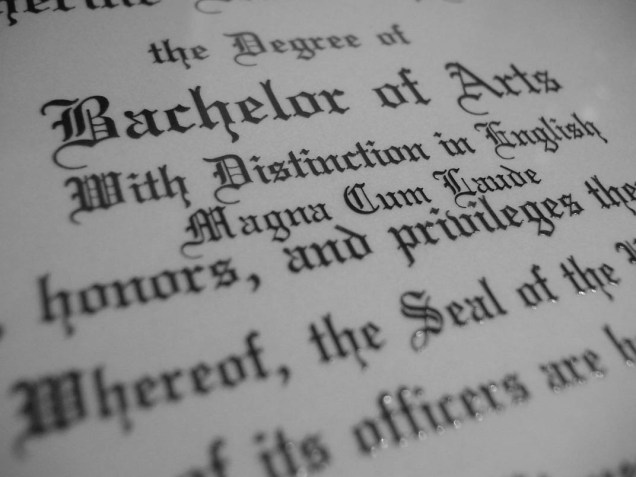
The impact of attitudes towards education, especially higher education, and its impact on adult life, has recently come up in discussion in the home school survivor community. We all have different experiences and heard variations of different messages while growing up in homeschooling families. Here is my experience:

My parents didn’t place much value on education. We were homeschooled in a way, meaning we were at home and some effort was made to buy books and teach lessons. But the underlying organization and structure wasn’t there, and they didn’t have the motivation or follow through to make it happen. We received a relatively decent education in the first few grades, I assume; we learned to read and do basic math in those years. But no one received any education past about grade 6-8, depending on the subject.

They taught that you didn’t need college or university to succeed in life. They said that because we were homeschooled, we were special, and people would understand that and recognize the extraordinary intelligence we were gifted with, without needing a diploma to prove it. They talked about the bullying and abuses that were perpetrated by public school and high school teachers. My mother described at length times that she was publicly humiliated in class by her teachers, and how she could not stand the public schools and that they were protecting us from those abuses.

As a girl though, there were really no plans for me to have a future at all.

Other than vague mentions of a husband and kids in my future, it wasn’t discussed. Even the emphasis on me needing to be able to cook, clean, and help raise my siblings was mainly openly rooted in my parents’ need for my help, and it was not even masked as ‘training for the future’ except to outsiders (conservative fundamentalist outsiders). Oddly, sometimes when I talked about wanting a career, it wasn’t really shot down, and my parents told me to trust their education system and I would get where I wanted. They brought back the line that I was incredibly smart and special, and that satisfied me and I believed it.

My brothers were told they could  have any career they wanted, without college. They were told that someone would hire them or they could have their own businesses, all without college or even finishing high school. They said that years of education was part of the new age government control system and we needed to break free.

Due to the chaos in my childhood home, both of my close in age brothers did not achieve more than an average of a grade 8 or 9 education. They have spent time as adults earning a GED, with various rates of success. They most certainly were not granted excellent careers on the basis of being special and homeschooled.

Because I attended high school against my parents’ wishes and also went to university, my story is different, however I can still speak to the impact of the anti-college attitude.

Because there was no direction in my life, with no real hopes and dreams, until I was 17, I didn’t see the point of pursuing much education at all. What line should be drawn on when to end the homeschooling process when the goal is not college? So I did not resist when my parents stopped making an effort to educate me. I did not advance at all academically between age 10 and age 12. I made some more progress at age 12, but once I was 13 or 14 their impact on my education was pretty much over. I continued to read Bob Jones textbooks until I was 15, and wrote down answers on my own, but it was for myself, no one checked them.

I did not complete a grade 8 education at that time. I was not taught math past grade 6 until I went to high school at age 17. I never had any intention of pursuing a high school education until the year I turned 17, although I had a vague plan to go to university. The year I turned 17, my grandparents told me that I wouldn’t be able to go to university without a secondary education.

So I went to school, and I struggled. I struggled with ambivalence, knowing that it wasn’t what my parents wanted me to do, and some doubt because of the message I had received that I was special and shouldn’t have to prove it. But the courses were hard and unlike my experience with the Bob Jones textbooks, guessing didn’t work, especially with math. I had two dear math teachers who did a phenomenal job, but it’s hard to describe the crushing feeling of inadequacy you experience when you find out at age 17 that the 14 year old students are more educated than you.

The ambivalence followed me into university. I was only at the highschool for two and a half years, not nearly long enough to reverse all the messages about how unnecessary higher education was. I still tried for a while to guess and at least prove to myself that I already knew everything and didn’t need to learn. Because I didn’t learn how to build and maintain a career from my parents, since they did not do this, I felt guilty about having that as a goal. I felt guilty because it somehow felt arrogant, and I still had some feelings of inadequacy. I felt guilty because I was also proud of myself and felt guilty about the pride. I was also a bit afraid, because people warned me that higher education corrupts; although they seemed just as worried about the high school being corrupting as they were about university.

I finished university, and it turns out I was quite academically inclined. But not special. I still needed to learn, and to do that I had to learn how to learn first. I think that some people who are believers in homeschooling might read this and think that I needed to learn how to learn to fit into the public school mold, but that is not what I mean. I was able to learn as much as my mother was able to teach me; basic reading, writing and arithmetic. I believe there is such a thing as academically successful homeschooling, and in those cases those students continue to learn how to learn as their ability to process increasingly more complex information progresses. When children are not taught how to learn, or when there are other circumstances that disrupt that process, such as abuse, their progress can become stalled.

Growing up with parents who have negative attitudes towards education can remove motivation from bright young students, when there is nothing to strive towards.

It can create confusion when students do decide to pursue education. And for those that internalize those messages, and do not pursue education, the cost is high. Without an education, it is hard to get jobs. Where I live, even Subway and McDonald’s ask that you either have a high school diploma or show that you are working on one. Getting into a trade can also be difficult, as most of the trades jobs eventually require you to get a “ticket” which means going to school, and if you haven’t learned how to learn and test, you won’t be able to succeed in the trade program either.

Although some workplaces look at experience, moving up in companies and getting promotions can be heavily based on education as well, meaning that even those with experience can stay in entry level positions (at entry level wages) because of lack of education. Saying that one was homeschooled will not get someone a job or a promotion, and if people have not excelled in the learning process and become critical and reflective thinkers, their people skills and self management will also suffer.

Even a girl who is raised in a conservative home and wants to be a homeschooling mother needs to know how to learn, and has to have learned enough to effectively homeschool her children. She needs to be reflective and a critical thinker in order to manage a home and a family, and to juggle the responsibilities of teaching and parenting effectively. She will need to be able to learn how to parent, and how to deal with it if a child has special needs.

The stakes are high, and an education holds more weight than just a piece of paper. 

I Am Trans, And I Am Beautiful: Haley

I Am Trans, And I Am Beautiful: Haley

HA note: Melissa, Haley’s spouse, will be sharing her thoughts tomorrow. Their courtship and coming out stories have been shared by Melissa on Patheos.

I grew up homeschooled from age 8-16 when I started taking classes at community college. I am the oldest of five with four sisters younger than me. My dad was a pastor and my mom stayed home to homeschool all of us. We were very conservative politically and religiously. Almost all of our friends went to the church pastored by my dad and another pastor homeschool dad. Almost every child in the congregation was homeschooled. It was a very conformist place. Diversity was measured in curriculum of choice, whether Abeka, Bob Jones, Sonlight, etc. Almost all of my social outlets happened at church under the control and observation of the homeschool parents. If you didn’t like that control, tough luck, you didn’t have access to anything else.

As a means of survival growing up, I figured out that agreement with the system was the only way to survive. I watched some other kids try to buck the system and suddenly they had no homes or they lost the ability to drive a car, or their parents stopped supporting their education. I also observed families where kids were given very little academic education in favor of gender role based education for girls to become wives and mothers while the boys were taught how to learn handy practical physical labor skills. I lived in a family that tolerated higher education as long as you kept saying the right thoughts. I was part of a forensics class in community college that I enjoyed but my parents seemed to dislike the gay professor who coached the team and they worried about influences over my life. I quit forensics after only one semester because of their worries.

The gender bias towards men becoming big earners with power while women were supposed to tend home and hearth and be a man’s helpmeet was kinda weird to observe for me. You see, ever since I was a child I’d wished I was a girl (at birth I was assigned male and raised by my folks that way). When I was 11 I read a history book (a secular one that sneaked into the home) about Christine Jorgenson the first American to publically transition from male to female and I immediately thought, “Someone else like me.” But I already had heard the denouncements of gay people. I had been hearing the strict, strict, strict conceptions of gender all my life. I knew that this awareness was something I should never ever talk about. In fact, I spent my adolescence on a roller coaster of simply hating myself for my sin and perversion. I accepted the lie that there was something seriously wrong with me. I plowed myself into my religious faith in an attempt to save me from my “sinful” desires to be female. No amount of repressing would put it out of my mind for long. I’d look in the mirror and wonder what I’d look like as a woman. I’d sneak moments of untraceable internet access to look up transgender people and information about them. I’d secretly hide elements of women’s clothing in my room, and then often feel super guilty and throw them out only to buy more later. As I considered a career, I felt that the ministry was the highest calling, it was all that I knew growing up as a preacher’s kid, and it was a career that I could never gender transition in because that wouldn’t be possible. I needed to protect myself from myself or so I thought.

Oddly, homeschooling in some ways had a couple of upsides to being transgender. And here is why. It was easier keeping up appearances around your peers when you only saw them at most a few times a week. I didn’t suffer some of the bullying that my trans sisters experienced in public school settings. Also the exclusive homeschool setting gave me opportunities to day dream and imagine. During these times I would often image myself as a woman. However, the homeschool setting was a terrible place to be transgender overall. You couldn’t meet other people like you and if they started giving clues they might be like you, they’d be kicked out of the church and the community. It has been fascinating as an adult to meet other queer homeschooled adults. We were there the whole time, it was just we all knew that saying anything about our identity would get us thumped and humiliated. I feared my parents somehow figuring out I was trans, I had read in Christian publications like World about therapies to try to make people straight. I knew these therapies sounded awful and I didn’t want to ever be subjected to them.

Basically, growing up homeschooled I had had no access to life on the outside. I didn’t know anything about jobs, taxes, how the government actually worked, basically nothing. The closet was an act of self preservation while homeschooled. You couldn’t let that get known. There were times when I got very mad about not being able to change my feelings so that I wanted to be a male. I would get depressed and contemplate suicide over feeling frustrated that I couldn’t change and not wake up wanting to be female. I also had severe anxiety about everything. I developed an ulcer when I was 17 and a college student. My parents were very focused on my grades. I performed well gaining magna cum laude in community college, and summa cum laude for my undergraduate degree at a local Christian College. When I went off to seminary, working for my dad’s ministry, and with him holding the purse strings, I poured my life into school and work. When I was excessively busy it would reduce the amount of thoughts about being a woman. But it would never go away or even let up for whole days. I could maybe have an afternoon of work where I didn’t think about trans people and being a woman but never more than that.

And for those who might argue being trans is a choice that isn’t the case because women in the homeschooling community are less than men. I understand that now as a liberal participant of society today. There is no reason for a homeschool “boy” to want to be a “girl.” And I knew it even back then. If I was a girl, my options in life would be reduced by the community. If I got married and had a baby, I would never have a career, I would have to obey my husband. I would have very little autonomy. Being a guy which felt all wrong to me had so many benefits compared to the women I’d known growing up that it kinda made it a little bit easier at that time pretending to be a guy to retain that level of control over my life. As I started meeting women outside the homeschooling community and saw how they could live their own lives, I realized that I could be a woman and live a good life and have personal autonomy. Patriarchy is a terrible teaching and it degrades women. It was oozing everywhere in the homeschooling community I grew up in.

But when I was hiding who I was, I was still steeped in the homeschooling community and I started courting this other homeschooled girl named Melissa from a family that then numbered nine siblings and today numbers 11. I was almost 20 and she had just turned 20 when we married. After a quick supervised courtship I proposed to her and we married. Within a few months of our marriage we had already suffered a miscarriage and were just waiting for children to be given to us. I went to seminary the summer I was married and plowed myself into my studies. We tried to live up to the ideology we’d been raised in. Melissa had been denied higher educational opportunities and due to my dad’s “job” for me which taxed me heavily working 80+ hours a week of school and his projects, she didn’t work and was my stay at home wife until our first baby was born. She got pregnant and had our first baby when we were 21.

When I was twenty-three I was burned out working for my dad, trying to start another homeschooler church in the city I’d gone to seminary in, finishing seminary, and becoming a parent to two. I was in crisis. My gender issues were still raging, I was getting disillusioned by the ideology I’d grown up with but didn’t know any alternatives. After a tumultuous summer, I took a call to serve a church in Canada over 1000 miles away from both of our families in Illinois. I served that congregation for three years and it was during that time that I finally was far enough away from the craziness of the Christian Homeschooling Movement to live my own life. We had two children born in Canada. I started reading things I never had before. I started meeting more normal people where women worked jobs. I discovered some of the stuff I’d heard in the U.S didn’t seem all that relevant in Canada. Finally, I came out to my wife as transgender when I was 24 and we started a two year journey to acceptance.

During that journey Melissa realized she was more lesbian than straight and I had always known I was attracted to both sexes and our relationship deepened and grew more intimate than ever before. Instead of being play actors doing our “roles”; we were two people living our lives together. During that time period our marriage became a real partnership. When I was 26 I started the process of gender transition and left the ministry. I was so proud of that day when I legally became Haley. In the 18 months since then, I went back to school to be a cosmetologist and am now employed as a stylist. Melissa entered the workforce for really the first time and she has thrived. Our parents took things badly but really they controlled our lives for long enough. Homeschooling is the ultimate tactic to retain control of children who should be developing into autonomous adults. I am very proud that my oldest child attends public school and will be joined by her sister next year.

Being transgender and homeschooled wasn’t cool. I think everyone deserves to have teachers and people other than their parents who invest in them. I gained so much from the teachers I’ve had in higher education and it was huge that these people were outside of my family system. I also believe that experiencing diversity is awesome. I didn’t knowingly meet in person another trans person than myself until after I was already in the process of gender transition. That is how isolated and homogenous my circle of contact was. I had very little exposure during homeschooling to the outside world. Even ethnic minorities were quite mysterious. This is not okay!

I am so glad that I have met so many vibrant LGBT homeschooled young people who got out.  We are okay just the way we are. Growing up homeschooled we had every reason to hide our identity but now that we are adults, we can be ourselves finally. I am the happiest I’ve ever been. I love being me. I no longer feel like an actor in my own life. I am glad to be a woman, wife, mother, friend, and cosmetologist! I love raising my four kids and having them know me for who I really am. I am glad to have the truth out there.

I am trans, and I am beautiful.