The following is a list of things that range from impolite to incredibly disrespectful that I have heard since I started speaking out about this issue. I’m (unfortunately) not making any of these up and I’ve actually had every single one of them either said to me or seen them said to others. If you don’t want to be a jerk, please don’t say any of the following:
Concerning homeschooling:
1. Tell me how good of a homeschooling experience you or someone you know had and imply that it cancels out mine.
2. Say that obviously it was just a parenting problem, not a homeschooling problem at all.
3. Say that obviously it was a religious fundamentalism problem/bible-based cult problem, not a homeschooling problem at all.
4. Say that I am not describing real homeschooling so I should not be talking about my experience like it was homeschooling at all.
5. Say that I need to be careful, that openly speaking about this will help enemies of homeschooling (nosy neighbors/government/the minions of the Antichrist) have the political cover to mess up or destroy homeschooling for the good homeschoolers.
6. Say that obviously because I am standing here today with a job/degree/spouse/all four limbs that the homeschooling I got really wasn’t too bad and therefore we all should keep calm and carry on.
7. Say that my parents only homeschooled because it was a problem with the school district and obviously any public school in my area/state/nation/world would have been worse.
8. Say that maybe my homeschooling experience was even secretly good and I likely don’t know enough about what I’d be comparing it to, with public school being so awful and all.
9. Say that you/your kid/someone you know had a much worse experience in public school/government school/a hole in the ground and so I should quit bellyaching and overdramatizing my homeschooling experience and instead just be grateful it wasn’t as bad of a story as the one you just told.
Concerning abuse:
10. Say that what happened to me was so uncommonly rare that it’s not something we need to be generally concerned about.
11. Say that you are sure that it was that my parents were uneducated/rural/brainwashed/obviously raised wrong and that’s why they did what they did, even though you know nothing about my parents’ background.
12. Say it is obvious that I am so hurt/broken/angry/bitter/emotional/weird/vengeful that I have lost track of reality, don’t know what I’m talking about on any of this, and no one should listen.
13. Say that I need to just let the past be the past, understand that parents make mistakes/are not perfect, then go forgive mine (immediately assuming that I haven’t), and stop disrespecting them by talking about this issue.
14. Say that the way life works is that your parents can raise you however they want/force you to be the person they ask/mess you up for the first 18 years of your life and then it will be your turn when you have your own kids.
Concerning religion and politics:
15. Say that if my parents were real Christians that this never would have happened.
16. Say that this is obviously a problem with Christianity itself and all homeschoolers should respond by being secular/atheist/Buddhist/some other faith.
17. Say that you seriously doubt (or had it laid upon your heart by Jesus himself) that it is in God’s will/my best interest/society’s interest for me to be talking/thinking/spreading lies like this and you will pray/worry/be quite concerned for me.
18. Ask me if I am aware that when I talk about my story it is mainly going to be helping people who hate homeschoolers/Christians/parents/Americans/suburban white people unfairly stereotype/hurt/oppress all of your group because people will mistakenly think you are like me and my family and obviously you are nothing like us at all.
19. Accuse me of being put up to this by teachers unions/liberal brainwashing/feminism/Satan and not having actual good reasons for how I characterize a problem I lived through and/or am studying.
20. Accuse me of being anti-homeschooling, anti-Christian, and anti-family all in one fell swoop because I said what happened to me should not happen to other kids.
Now that I’ve listed all the rude, insensitive, selfish, and potentially threatening things I can think of that you should not be saying to people who have shared their horrible (or even just a little bit bad bordering on mediocre) homeschooling experience (I’m sure I left some out, so please feel free to include them in the comments), here are eight examples of something that might be a good idea to say:
1. Thank you for sharing your story.
2. I am trying to understand where/when/how this occurred. Can I ask you? How did X, Y, or Z happen/come to be/take place?
3. What helped you get out/get better?
4. What do you think could have made this situation better/not happen at all?
5. What do you think someone like me might do or keep in mind to prevent this from happening to others?
6. What do you like to do today, now that you’ve left that environment?
7. Can I share what you said with my friend/relative/pastor/neighbor/blog readers/Facebook?
8. I wish you well and hope that tomorrow/this week/life/the future will be good for you.
Also, even if this stuff is foreign to you and you really have no idea (or maybe don’t care) what it is like to walk in the shoes of someone who has had this kind of homeschooling experience, please try for a moment to imagine how it would make you feel and what it might lead you to do and then have compassion. Personally, I love to argue and I have a lot of “fight” in me, but for many people who are sharing their story, just finding the words and the strength to do so is incredibly hard. People should not, under any circumstances, be pushing someone who’s telling a survivor story to defend themselves or expect them to deal with the kind of obnoxious behavior I listed above.
It’s hard to believe that it was just a month ago that we launched Homeschoolers Anonymous. So much has happened in so few weeks! This is really due to the amazing and wonderful support that you, our community of friends and family and advocates and peers, have so graciously provided.
In a mere month, our WordPress blog has reached nearly 100,000 views. More than 260 comments — almost universally positive — have been made on the site. Our Facebook page has received almost 300 likes. Our most popular post to date, a crosspost by blog partner Kierstyn King (“Sex™ (and the lies I was told about it)”), has been viewed over 3500 times; the second most popular post, R.L. Stollar’s “Homeschool Confidential, A Series: Part One,” has over 3000 views. Michelle Goldberg covered our story on the Daily Beast. We’ve also received coverage by the Daily Mail and Lez Get Real, both Google News providers. We’ve also received inquiries from other major media groups and will keep you posted on those developments.
This is a very difficult project. If you have any experience at all with the conservative Christian homeschooling world, you know how defensive they — we, really — have been, are, and will likely continue to be. You can see how afraid some of us are about speaking out with our experiences. Qualifications and disclaimers abound. The fact that such fear exists, merely about saying one has had a personally negative experience in homeschooling, is indicative that something has gone awry. No one should feel afraid of speaking up about abuse or hurt or pain. That is why we feel this community is so important and necessary. We want to create a platform for sharing and healing. We want to be a voice in defense of those who have been hurt.
It’s truly been a wild ride. We’ve been accused of being nut jobs, anti-God, anti-homeschooling, a vast liberal conspiracy manufactured by Obama, the NEA, and the ATF, and opportunists that want to take advantage of abuse victims in order to achieve vast fame and fortune.
But as someone much wiser than us once said:
Haters gonna hate.
We’re here and we’re not going away. We will continue to share stories, we will not be silenced by intimidation, and we will do our best to represent our collective voice accurately, compassionately, and strongly.
Thank you for your encouragement, support, and love. We are very grateful. Thank you, thank you, thank you.
In honor of our one-month anniversary, we’ve decided to take our top search terms — the phrases that people have Googled that have led them to us — and ask each HA Community Coordinator and Blog Partner to write a paragraph about one of the search phrases. (Some of us went over this paragraph limit.) This was presented to them as a creative challenge. They could write whatever they’d like that they thought was important to say to whoever might be drawn to our site because of the phrase in question. To make this a bit more challenging, we intentionally switched up who wrote about which search term, so it’s different than what that person might normally write about.
The idea is to highlight both the diversity of our voices and the unity of our mission.
So, without further ado, we present to you the first ever group post from Homeschoolers Anonymous!
*****
“homeschoolers abused” — by R.L. Stollar, HA Community Coordinator
Not all homeschoolers experienced abusive situations. Not all homeschoolers have the same story. The fact is, homeschooling is a vast and diverse phenomenon that includes different religions, different political beliefs, and an immense variety of educational philosophies and teaching styles. But from my own personal experience in the conservative Christian homeschooling subculture, I can confidently say that — within my particular subculture — there is a tendency to operate from an “Ideology First” mentality, instead of a “Children First” mentality. And when you elevate the importance of ideology over the humanity and well-being of kids, you can easily create cult mentalities. And cult mentalities can cause immense hurt and pain for so many people. They can create emotional, mental, physical, and sexual abuse.
Not all homeschoolers experienced abusive situations. But many have.
Not all homeschoolers have the same story. But there are striking similarities.
I want their stories — my story, our collective story — to be heard. And if you listen with an open heart and mind, maybe you can help us make homeschooling better in the future.
*****
“homeschoolers anonymous” — by Libby Anne, HA Blog Partner
Why homeschoolers anonymous? I think I understand why. The first time I met someone raised in the Christian homeschooling subculture who had, like me, grown up in a homeschooling family and then questioned and left the pervading ideology of that family and subculture, I was overwhelmed. Before, I had felt alone. Like it was just me. Invisible, unnoticed, an anomaly that people didn’t acknowledge, or even know, existed. When you realize that you’re not alone, that it isn’t just you, everything changes. And some of those who visit Homeschoolers Anonymous may still be in the closet or on the wall, unready or unable to make the leap, to say that there was something wrong, to speak about and acknowledge the hurt and the pain. And that’s why we’re here.
*****
“stand up for my children” — by Vyckie Garrison, HA Blog Partner
I know this will be controversial, but when I was asked to write about the search phrase, “stand up for my children,” I immediately thought of the period of time when all the abuse and dysfunction of our Quiverfull lifestyle culminated in a nasty court battle when I left my ex-husband and sued for custody of our six children who still lived at home.
My lawyer told me that I would need at least three people who would be willing to write affidavits for the judge stating that they were aware of abuse in our home. I was extremely discouraged because I believed I had done such a good job of covering up for my husband and protecting his reputation that nobody, with the possible exception of my mother, had any clue that there was anything amiss in our “big happy family.”
Undaunted, a fellow homeschool mom started making phone calls, and in about a week’s time, was able to gather more than 20 affidavits from friends, family, and acquaintances who all testified that they had been aware that the children and I were being abused.
That’s over twenty Christians who could have stood up for my children and spared us all those years of abuse.
I understand that as evangelical Christians we were all taught to fear the evil government social workers, but looking back now, I can honestly say that the court-ordered involvement of CPS was one of the best things that ever happened for my family.
I have plenty of suggestions for intervention and support (see the NLQ FAQ: How can I help my Quiverfull friend?), but if you clearly see children being abused or neglected, please call this hotline and get the family some outside, professional help: 1-800-4-A-CHILD.
*****
“homeschool uniform denim jumper” — by Nicholas Ducote, HA Community Coordinator
Jumpers, especially the denim variety, were the unofficial uniform of the homeschool mom. My mother had an entire closet full of jumpers in an array of colors, but none rose above her knee. I can count on two hands the number of times I’ve seen my mother wear pants in the last decade. I wish it wasn’t so stereotypical, but a quick Google search of the terms “denim jumper” will bring you to www.denimjumper.com – “your source for everything homeschooling.” Most Christian homeschooling sub-cultures emphasize modesty in young women, especially in reaction to what they see as an over-sexualization of young girls, but their attitudes often read like an unironic guide to rape culture (i.e. The Rebelution’s Modesty Survey). In short, women are told their bodies can make men lust and, in a revolting twist of logic, the immodest women is responsible for “defrauding” the lusting man. Young women are encouraged to hide their curves behind baggy jumpers or long skirts and modest tops. Fashion, they are told, only serves to bring excessive attention to the superficiality of a woman. Modest, godly women do not need to appeal to a man’s lust. Instead, she strokes his ego by serving in the cult of domesticity.
*****
“homeschool cult” — by Anna Ruth Fuller, HA Community Coordinator
Think about what a homeschooler looks like. What comes to mind? If images of religious children passing out pamphlets or holding signs comes to mind, you’re thinking too narrowly. If images of hippies unschooling their children comes to mind, you’re again thinking too narrowly. Broaden your thinking.
Homeschooling occurs everywhere and for all types of reasons. The same is true of public schooling and private schooling. How you choose to educate your children is your choice. However, it is important to remember that in all of this, children have a right to their own views that aren’t necessarily your own. This is true no matter what type of schooling they undergo.
So what happens when parents do not respect a child’s right to their own worldview? Now don’t get me wrong, I’m not talking about letting your children run amok. There’s a difference between pure hedonism and having a worldview.
Not letting your children choose their own worldview is a dangerous road to take. It might seem like a good idea at the time since it is easier to control a child’s thoughts than to guide them. Most parents these days recognize that guiding their chidren’s thoughts is the way to go, but there are those that still cling to controlling them.
It is considered bizarre to isolate your children from the world so that you can protect from worldly things. We are becoming a global society with the advent of the Internet. Preparing your child for the different worldviews they will face (and more importantly, how to respect them for what they are) is crucial to that child’s success. Yet there are many Christian homeschooling parents that purposefully decide to isolate their children from all of this. It is this type of homeschooler we are bringing to light here with our stories.
This brings me to my topic. One of the most popular search terms for our site has been ‘homeschool cult.’ When I learned that, I began think about whether we were really part of a cult as Christian fundamentalist homeschoolers. According to Wikipedia’s article on cults: “The word cult in current popular usage is a pejorative term for a new religious movement or other group whose beliefs or practices are considered abnormal or bizarre by the larger society.”
This definition makes me think we weren’t part of a cult. To have been a cult, we would have needed to have been unified religiously somehow. We weren’t. Each of us went to churches in conflict with each other on various minutiae. There was one thing that united us and that was the need to reclaim this country for the Christian God. Our parents wanted us to dream of a Christian nation and placed that first and foremost in our minds by excluding the teaching of other worldviews (thankfully this didn’t happen nearly as much to me as it did to others). We were trained up in debate to help us become better lawyers and politicians to lead this new country to its destiny. So in reality, we weren’t part of a cult in the religious sense. While there were certainly practices and behaviors that could be seen as cult mentalities to outsiders, we were less a part of a religious movement and more a part of a political movement.
*****
“homeschool and abuse and fanaticism” — by Kierstyn King, HA Blog Partner
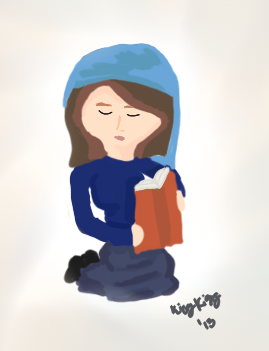
Art by Kierstyn King.
This is a touchy subject, because you’re screwed in the eyes of parents or vehement pro-homechooling-beyond-all-reason-crowds from the start. The fact is, this sentence and search term oddly defines my experience in a very succinct way, and like the lonely oppressed girl over here, it’s not a good thing. Homeschool and abuse and fanaticism don’t have to be related, but sometimes they are and here’s how: parents have the idea to homeschool, they then are told they must homeschool to essentially indoctrinate their children to their cause (fanaticism) which in some way or another usually is along the lines of “taking over the world” (who doesn’t want world domination?). Of course getting to that point means squelching the life out of the individuals you’ve stopped seeing as human and started seeing as arrows – focused solely on your needs, wants, and purpose you deny basic rights, dignity, and sometimes the security of unconditional love to the child you’re supposed to care about above everything else (abuse).
The unnecessarily necessary disclaimer here is: obviously not everyone is like that (but some people are).
*****
“why all of the attacks on homeschoolers” — by Julie Anne Smith, HA Blog Partner
I have been homeschooling my children for the last 20+ years. When I hear about “attacks” on homeschooling, I suspect there could be some confusion. Taking a closer look at the attacks, generally, it is not homeschooling in general that is attacked (ie, the education of one’s children at home), but more specifically, a lifestyle connected with the “Homeschool Movement.” The Homeschool Movement is associated with practices and ideologies not even remotely related to scholastic achievement, e.g., full-quiver lifestyle, patriarchy, purity and modesty teachings, etc. These practices and ideologies have had mixed, and sometimes very sad results. The methodologies employed to enforce these lifestyles can also be troublesome. The Homeschool Movement must not be confused with homeschooling. I believe homeschooling to be a valid and exceptional option for motivated and capable parents who have a vested interest in the proper education of their children.
*****
“homeschooling and mental illness” — by Latebloomer, HA Blog Partner
For a well-informed and supported parent, homeschooling may be an excellent way of supporting a child suffering from a mental illness. It could allow for high quality personalized instruction, easier access to appointments with medical professionals, and protection from peer bullying. Unfortunately, the combination of homeschooling and mental illness also has the potential to do great harm. For instance, children with mental illness can go undiagnosed for much longer if they do not regularly come in contact with trained educators and medical professionals. Distrust of those resources is very common in fundamentalist homeschooling circles, where parents are much quicker to blame unusual behavior on rebellion and worldly influences. An additional concern is the potential for harm when a child is homeschooled by a mentally-ill parent. The child will often be far more affected by the parent’s mental illness because of the increased time spent with the parent and the lack of time with other adults. For such children, the parent’s paranoia, depression, narcissism, etc, define their entire childhood and hinder them from developing positive and healthy relationships with others even in adulthood.
*****
“which is more effective for learning homeschool or public school?” — by Brittany Meng, HA Blog Partner
So you’re wondering which is more effective for learning: homeschool or public school. To answer this question more effectively, you should add the phrase “for my child.”
It all depends on what your child needs to be an effective learner. Here are a few issues to consider about the effectiveness of homeschooling for certain ages and needs.
Elementary school: Homeschool can be very effective for Elementary school because children often need one-on-one time to learn basics like reading and math, which are foundational for a strong education. If your child needs extra help in these subjects, homeschooling might be a good choice. On the other side of the coin, if your child is advanced in these areas, homeschooling might be good for your child as well. Nothing squashes the natural love for learning faster than a child who is bored. Homeschooling allows you to move at your own pace.
Middle School: Let’s just face it—middle school stinks for most people. Homeschooling will not remove all awkwardness, angst, self-doubt, or attitude problems from your child. However, if social issues are getting in the way of your child’s academic success, homeschooling may be a good option for your family.
High School: By this point, most young people are able to voice their educational and social needs. These wants and needs should be taken into consideration. This is also the point where parents need to consider how capable they are to meet the needs of their child, especially if he or she wants to go to college. I believe that homeschooling can be effective in high school but only with a strong outside support and supplemental network: classes at a local high school, community college, and/or homeschool co-op.
Personally, I believe that homeschooling becomes less effective for learning the older the child gets but this is a blanket statement. Only you can determine what your child needs.
You also have to consider the needs and abilities of your family: finances, time commitment (contrary to what many people think, your child needs as much academic attention from you in 1st grade as he does in 10th grade. Kids need accountability, motivation, and a sounding board for ideas), a strong support network, and whether or not you actually want to homeschool. Even if you feel that homeschooling would be the best option for your child, if you don’t want to homeschool, don’t do it. Homeschooling is a huge commitment. You can’t toe the water; you have to jump in with both feet. However, some states allow your child to be homeschooled by someone else. Check into all your options.
When choosing the best learning option for your child, it is important to consider what you and your child need and want both academically and socially. So, which is more effective public school or homeschooling? It all depends on your child.
*****
“pscyholgoy of bad/evil” — by Lana, HA Blog Partner
In conservative circles parents often have a tendency to refer to their children as all good or all bad. In public — that is, among other conservative families — kids often are forced to play the role of the perfect family, the perfect godly family. I felt this a lot as a child when we did cookouts with other homeschool families, or a respected homeschool family came over for dinner. I had to smile and pretend that I was godly (whatever that means) while everyone talked about how we were great and the future of America. At home our house was in shambles, but none of that mattered around our friends. Perhaps this alone would make a child go crazy. Why is it necessary to fake it? Why weren’t we genuine? Was it all in my head that my home was dysfunctional? Was it my fault when I was unhappy? Was my friends’ home totally perfect? These are legit questions that I and many others have experienced, but the confusion goes much further. For every time a child is praised as good, its likely that he or she is shamed as bad for the most ridiculous things at home. I was taught that I was not dressed until I wore a smile. If I did not wear a smile, I was ungrateful. If I expressed frustration (that admittedly did get out of hand sometimes), I was disrespectful. A simply bad act is escalated as totally evil or rebellious. There are plenty of homeschoolers who had it much worse, directly being called evil for not being submissive to an abusive situation. And so the soul is torn between good and evil. Sometimes kids just need to be told they are human. We aren’t perfect. We aren’t all bad. We’re human.
*****
“living my life” — by Heather Doney, HA Blog Partner
What my life was supposed to be was set. One story said that because I am a woman, by the time I was 30 I was supposed to have been married for a decade and have somewhere between 3-6 kids, homeschool them in a nice house, and be involved with a local church. The other story was that I was supposed to have a mid-level office job where I wore business suits and cute pumps, had a comfortable salary with decent benefits, ho-hum dates with guys who wore nice watches, and appletinis with the girls on weekends.
Neither are my life. I truly thought I was supposed to somehow make one or both my reality, that they were in fact the going realities available, but now I know they weren’t, at least not for me. I knew it just didn’t feel right, but I somehow figured I’d still end up in one or the other. I didn’t. I’m still just me, and while I do own a business suit and those cute pumps today, I generally wear flats or leather boots with jeans. I have only a laptop computer, not a cubicle, to go to. If I’d wanted a baby already I expect I could have had one, but I didn’t. I don’t go to church and I don’t even like appletinis (or guys who wear expensive watches, for that matter).
So while I didn’t want my life to look like either of these so-called options, I didn’t know what it should look like. What I knew it shouldn’t look like was what I call “living in the meantime.” I lived in the meantime for a few years and meantime mode is where you just let life happen to you, figuring it knows what is best, not-so-patiently waiting until it resembles one of your ideals. The scary thing is it likely never will. You can easily spend your whole life in meantime mode, waiting on serendipity to rescue you, and the thing most people forget about serendipity is that it isn’t just some happy accident or eureka moment that breaks you out of your ordinary life. Serendipity is what you find while you are out looking for, working on, and doing other things. Because serendipity requires action, it is a lot harder to find while in meantime mode or while you’re living someone else’s idea of your life, just going through the motions.
So to me living your life is not about doing one thing or another but about breaking out of that. It is about actively writing the next chapter to look differently, resetting the script, welcoming the changes, courting serendipity. It is about “if you build it, they will come.” In order to do that you have to do something scary though – be real about the person that you know you are, not stuck on the one you feel you “should” be. You can’t go squeezing yourself into a role that makes you look like you’re wearing somebody else’s style.
To live life, forget the ideal life someone else created for you and said should be yours.
I was talking with a homeschooled friend the other day who was raised fairly similar to how I was, with a more structured and less impoverished environment, and we were sharing stories. This and a few other things got me thinking. We both went on to higher education, got our masters degrees. The conversation between us turned to whether homeschooling was preferable to public schooling. While the homeschooling environment was very oppressive and abusive for us both, we each had access to classic literature and read voraciously as a coping mechanism. Favorite books would be read 3, 4, 5, sometimes 6 times over. I think this intensive, almost obsessive, consumption of the written word is one reason why a number of former homeschoolers who have had neglectful educational environments can often write eloquently, in an almost old-fashioned way.
Still, I am sure there are many more who did not get into reading like this and whose voices are not being heard. I knew a homeschooled kid who could barely read or write when he was a preteen, but could repair everything from lawnmowers to electronics just by self-taught tinkering. I often wonder what became of him. I would like to find some of those people too, and feel that those of us who write stories should help them write theirs, share theirs. (Then maybe they can help us fix that jammed door or the broken old-school Nintendo game set in the basement.)
Anyway, so my homeschooled friend and I discovered that despite the problems and the loneliness, we both cherished certain aspects of what we learned as homeschoolers, largely left to our own devices, and we both felt that if we had been sent to public school as little kids, we would not be who we are today, that we wouldn’t value the same things. He was homeschooled the whole way through, so he also expressed concern that he would have been bullied for a health condition in a public school. I told him that I was bullied when I started high school initially, not for any health condition, just for being socially backwards. A few aspects of the bullying I experienced were rather bad (like someone putting gum in my hair once), but most of it was just incredibly awkward. There were many gaps where I tried to connect and failed painfully, many awkward and lonely times before I found friends to eat lunch with and learned social norms. (See Lindsay Lohan’s movie Mean Girls, which accurately captures the feeling on homeschool to high school culture shock.) It lasted almost a year and by then I was seen as properly integrated so it stopped.
So I told my friend that I thought the bullying would have been a bearable phase for him and that the main risk I saw from public school was absorbing the lack of enthusiasm about learning and knowledge endemic to a typical middle-of-the-road public school. He would have learned a lot of different things, but he wouldn’t have likely read all those books that have informed his hopes and dreams because they would not have been assigned, and if they had, depending on what kind of school he went to, by then he might have already been trained into not caring.
Most people I knew in public school only did the assigned work and the bare minimum at that. I guess this is normal, but it was shocking to me – I fought so hard to get an education, then ran into others’ lethargy about learning, an expressed desire for good grades without putting in the work, and widespread dependence on the grade book and teachers’ expectations for self-worth. I think it was much more a problem with the system than the people, although some people certainly stood out in both good and bad ways.
I took honors and advanced placement classes because I had the drive and ability to, so I met and became close with friends who felt similarly about the value of knowledge as I did. I had some good teachers who taught me a lot and who I still love and respect, and a principal and an assistant principle who supported me and tried to integrate me as much as they were able. I also had a terrible guidance counselor, one who knew I grew up poor, and after I’d taken the ACT and made a 25 (a good score), crisply noted that being on the B+ honor roll didn’t mean I was in the top of my class, and then she told me “college isn’t for everyone. There’s community college and trade schools.”
I sent my guidance counselor’s negative comments into the same mental trash bin I reserved for my parents’, so I naturally assumed other people wouldn’t take her seriously either, only later realizing they might not have had a lovable old military grandfather talking to them about degrees and high-powered careers, counteracting her negative message.
Maybe it should not have surprised me back then that certain classmates of mine who also grew up poor but were by all standard metrics very good students (certainly better students than me), went on to work at Wal-Mart, or Waffle House, or enlist in the military, and forgo college altogether. It did come as a pretty big shock to me though, as I’d absorbed the idea of a “meritocracy,” the idea that your skills and abilities are what set you apart. Whenever I see it being something else that sets people apart it still sucks. It just plain and simple sucks.
It also makes me angry when I reflect that I wasn’t the only one who heard this not-so-subtle tune of low expectations while in the guidance counselor’s office. I feel that my fellow students from low-income families deserved better. The truth is maybe she was right though, since the statistics indicate that only 11% of students who grow up below the poverty line complete college. However, the fact is I am now one of that 11%, and I expect that if I’d been in public school the whole way through, absorbed more of the social values on what being poor meant, perhaps the bar for my own dreams would have been set a bit lower.
Overall I am really glad I got to have my Grandad’s intensive tutoring (a form of homeschooling) and I am glad I got to attend public school. Attending public school helped me to familiarize myself with social norms, connect with classmates and make friends (a number of whom I still have), and do all those lovely things like go to prom and have an awkward 10 year class reunion. I have good memories of passing notes in class, volunteering in the concession stand, and cheering my high school football team as they won the state championships.
However, there are a lot of things that do make me want to hold my nose when I consider the entire public school system across our nation, with all the inequality, discrimination, busywork, and reinforced social stratification it brings. That’s why people like John Holt advocated homeschooling as an “underground railroad” away from it in the first place. He saw this and he felt that highly structured authoritarian classrooms were generally not the best learning space and I think in many ways he is right.
Considering where I am today, a person with a master’s degree who is kicking around the idea of going for a PhD, I also realize I need to take a fuller view beyond my own experience. I could say “oh, it turned out fine for me. No harm no foul.” However, although I can speak to what educational neglect is like, ultimately my experience has not been that of the average educationally neglected homeschool kid. My trajectory drastically changed. If I had been left there without outside help, I doubt I’d be writing here today, plain and simple. It would be beyond my sphere of knowing. I would be keeping my head down, working a low-wage job somewhere. That’s what too many kids from poorly run, under-resourced, low-performing public schools also do. The neglected homeschool kids and the neglected public school kids are both neglected kids. They are ultimately the same group.
So this debate of public school versus homeschool that keeps cropping up seems really silly and often rather irritating to me. Homeschool and public school are both options — chicken and fish, apples and oranges, paper and plastic. Sometimes, given the circumstances or personal preference, one option is obviously better than the other, sometimes it isn’t. It is important to have the best versions you can available so people can make the most of the choices.
So why do people keep talking about homeschool or public school being better or worse when the real question is, “How do we get kids, including kids from families living in poverty, to reach their full potential?” I don’t know. But I think we need to think about why we do it and then think how we can fix it.
Like I said in my recent guest post for Libby Anne (which I am pleased to say was chosen as an Editor’s Pick for the whole Patheos website), I think it ultimately comes down to children’s rights. If the needs of children are seen as being important and the voices of children are seen as being important then both homeschooling and public schooling must work to improve the experience of kids who struggle, live with few resources, and who have seen and dealt with hardship beyond their years. There are cracks in both systems and there should be no “throwaway” children in either. Pointing fingers does nothing to erase what is going on for these kids.
So if you want to pick a dichotomy, if you really need one, then think about the “haves versus the have-nots,” the kids who have people in their lives who truly care about their education and wellbeing and have high expectations for them versus the ones who don’t. Those groups exist in both homeschool and public school and they are pretty serious problems in both worlds. That is the variable that educational success is dependent on, not whether you are sitting in a classroom or a living room.
HA note: The following is reprinted with permission from Heather Doney’s blog Becoming Worldly. It was originally published on January 30, 2013.
I was just asked if I could add my blog to No Longer Quivering, a site for people who have left and are speaking out against the Quiverfull movement and people who are interested in learning about such things. My blog will now be cross-posted under the Spiritual Abuse Survivors Blog Network. I guess this is sort of a big deal for me, particularly considering the role NLQ bloggers had in helping me understand my own story.
“Spirituality, faith, was just as much a tool for my parents to control and hurt me as the belt or the red stick, or being put ‘on restriction.'”
Being a researcher at heart, even in the middle of a meltdown, when I was hit by these scary and to me inexplicable symptoms (flashbacks, nightmares, insomnia, concentration problems, a generally creeped-out on-edge feeling, and feeling compelled to avoid people for reasons that made no sense even to me), I started googling late into the night (and early into the morning) for answers. I finally typed in “overcoming childhood abuse,” not even mentally sure that what had happened to me qualified as “legitimate” abuse, with all the levels of doubt and denial that were in between me and the past. I quickly discovered that that’s what this was, and I ended up making a counseling appointment where I was told I had PTSD. I didn’t accept that either (yeah, authority issues), until with more research, I realized that yes, it was true. I did.
It was through trying to solve this issue, find others like me (hopefully ones with good advice and happy outcomes), that I googled “homeschooling and child abuse.” I came across the NLQ site, Chandra’s posts, and then I looked at some other posts, Melissa’s, then Vyckie’s story. I read it all with a lump in my throat. This was exactly what had happened to me. How? People were talking about spiritual abuse. Had I been spiritually abused? Was that a real thing? I had never even considered it because that would have meant considering spirituality itself, an off-limits topic in my mind.
I spent considerable time trying to wrap my head around all this information and getting to the point of where I decided to publicly tell my story, and can honestly say blogging about spiritual abuse is still never something I imagined myself doing.
As someone who considers myself agnostic, sees the idea of God as being a giant question mark, a blank I’m not too worried about filling in, writing about spirituality seems kind of hypocritical to me, like a virgin writing about sexual experience, or an old man writing about what it’s like to be a young girl, or a pastor writing about what it’s like to be Jesus. It is a topic that is sort of removed from my day to day life, and one that I still haven’t fully addressed or worked through I think.
The concept of spiritual abuse (or even emotional or verbal abuse) existing didn’t cross my mind growing up. It was the physical abuse, material neglect, and the educational and medical neglect that I was primarily concerned with. All of those issues had a spiritual component though. It was because the spiritual aspect of life took up all the room, the fact that everything was seen as spiritual, that made life pretty dangerous sometimes and often at least generally unpleasant and sad for the physical side.
Few people knew that I had stopped believing in God at age 11 or that I’d been repeatedly told I was on a “pathway to hell” after ill-advisedly sharing my new perspective on religion with my mother. If I did mention it to anyone, I turned it into some sort of a pastor’s daughter joke. Deep down it wasn’t funny though.
I once walked out of a high school play about the garden of Eden that my then boyfriend, now husband, had invited me to. Shaking with rage, I explained to him how not only was the dialogue crappy, but in this version Eve was wholly blamed for the fall, and how inaccurate and anti-woman it was. He just looked confused. I had never talked about how attending funerals or weddings or services where I’d hear someone preach was a weirdly nerve-wracking experience for me, that even people inviting me to church or questioning my beliefs made me very uncomfortable. When my mother-in-law invited me to go see Mel Gibson’s “The Passion of the Christ” movie, the only possible answer was no.
I didn’t want to explain that there had been a spiritual component to me being dragged across the floor by my hair (headship, disobedience), or having my butt and legs covered in welts from an old leather belt, or living in fear of the red stick (spare the rod, hate your child). I didn’t like to discuss the fact that my siblings and I didn’t have medical or dental care before I turned 17 (trust in the Lord with all things), or that the medical neglect had started when I, the firstborn of my mother’s 9 children, had almost died due to an unexpected breech birth at home, no prenatal care, and unlicensed “birth assistants” from church rather than real midwives. I didn’t want to recall how all childhood injuries and illnesses I had, including a hernia, a broken tooth, and a concussion, were responded to with only “home remedies” and prayer. I didn’t mention how scary it was to be an 8 year old, watching my dehydrated little brother’s eyes roll back in his head, knowing “laying on of hands” is all he would get and if he died of the flu it would have been seen as “God’s will.”
My parents said it was all in the bible, that I’d come to understand. So I read the bible and saw a lot worse things happening, genocide, rape, war, women and children treated as chattel. I told my parents the bible was barbaric and disgusting, like them. I rejected the idea of submission or having some burden due to the sin of Eve. I bluntly said that girls should not be forced to constantly care for their younger siblings just because their parents didn’t properly understand birth control or abstinence. I even *gasp* told my Dad to quit loafing and go put his own cup in the sink. Because of this, and my penchant for responding to abuse with explosive violent anger (using your fists is solely a manly thing apparently), I was viewed as somehow not feminine, not desirable or womanly or any of the things I should be. My parents even told me no man would want to marry me, that because I rejected their ideas that guys too would reject me and go find other, more pleasing, girls. This hurt because, like most people, more than anything I wanted to find love, to feel I was desirable and worthy of love.
The spiritual side of me got put in a trunk with mothballs. There was no other option, really. Spirituality, faith, was just as much a tool for my parents to control and hurt me as the belt or the red stick, or being put “on restriction.” It was safer for it not to exist at all. So I grew up without feeling any sense of faith, without praying, without imagining that there was any higher power, that there was anyone there for me except the real people that I knew, and they weren’t there as often as I needed them, leaving me largely alone with my troubles, ultimately needing to solve them myself. I figure some people would describe this as incredibly sad. Others would say it’s accurate. My take? Heck if I know.
When I stopped believing at such a tender age, I never really revisited it. Well, I did a few times, going to church with friends as a teen, but I wouldn’t attend more than once after learning the same bible verses used to cause pain in my family were blithely being recited or referred to in this church, often in what seemed to be a similar context. This experience would make me so uncomfortable that it only reinforced not questioning or revising my stance.How could I feel safe? It was better to make an excuse and not even approach it, not have my friends think less of me or feel hurt when I said I didn’t want to go back to their church. How could I not like church? Was it because I didn’t respect their choices? Was it because my soul wasn’t right?
For a while I just wished religion didn’t exist. Then nobody would inquire about my “church home,” or invite me to bible study with virgin margaritas, or ask if my family was Catholic. My favorite answer for that last one, before I knew Quiverfull was the name for it: “No, they’re Nondenominational bordering on Southern Baptist with a little Pentecostal and Christian Scientist thrown in.”
My distaste wasn’t just confined to Christianity either. I was pretty rude and dismissive to a (slightly annoying) cousin-in-law who was into Wicca. When a very nice Jewish friend invited me to a Passover Seder, I found the beef brisket and matzo ball soup to be amazing culinary delights (the gefilte fish slightly less so) and the traditions very moving, but I still got a lump in my throat when it was my turn to read about Moses from the Haggadah. When Muslim friends of mine invited me to an Eid al-Adha dinner honoring the day Abraham didn’t kill Isaac, I brought a bottle of sparkling grape juice and thoroughly enjoyed hanging out and eating Egyptian macaroni bechamel casserole, fragrant Afghan rice, and spicy Pakistani mutton biryani, but secretly wished we were celebrating something that hadn’t been used as a veiled threat against me by my parents growing up.
Apparently I’ve always had low-grade PTSD symptoms that could be triggered by religious activities even though to me that was just my normal baseline level. I guess in many ways these issues also manifested as post-traumatic resilience. I had this intensity that helped me learn and remember, a semi-photographic memory, an obsession with literature and the written word, a fascination with learning what made people tick, with picking out errors in an argument. I had a little “bullshit alarm” that beeped in my head. I was also lucky (or perhaps somehow blessed). The few opportunities I had to make things better I took and those turned into more opportunities. It wasn’t because I was being intentionally strategic either, rather that I was truly excited about learning and positive human interaction. I intellectualized things though, I put a wall up, and that wall is definitely still there.
So today I am an un-spiritual person writing about spiritual abuse.
 Homeschoolers Anonymous