German Churches Up in Arms over Abuse Study

HA note: The following is reprinted with permission from Jennifer Stahl’s blog Yeshua, Hineni. It was originally published on November 25, 2013.
German Bible. Photo by J. Stahl.

In following the story of the Twelve Tribes, I had become aware of a study on religious families and their children, tendencies towards abuse and such being carried on within Germany. I had heard about the study. But not being registered to either the Evangelical, Free Evangelical or local Catholic Churches, we were not polled for the study, though we are a religious household.

I am somewhat curious as to what was in the survey itself. It seems rather revealing that the Free Evangelical churches are showing many of their members do, in fact, regularly beat their children.

For those who do not know, this is illegal to do in Germany.

One of my many concerns within the homeschooling movement and the greater German church community (especially after coming out of this environment in the United States) is to get away from the punitive and corporal punishment mindset, seeing children as sinful inconveniences unless they’re perfectly behaving like little adults and back to what the Bible actually teaches; namely love and parenting being a job of parent and child to do together.

My second major concern was finding on Amazon.de teachers such as: Michael and Debi Pearl (To Train Up A Child is now removed, but No Greater Joy volume 1volume 2 and volume 3 remain); Ted Tripp has three books represented (this remains, and as does this also); James Dobson‘s harmful books; Bruce Ray’s Withhold Not Correction (also a Spanish edition!); Gary Ezzo‘s books; Elyse Fitzpatrick’sTim Kimmel‘s (there is a second book here), and a couple other religious punitive-based child training manuals can be found.

Finding those books means that there is a market here in Germany. That, as someone who was raised so punitively, terrifies me. It terrifies me because this means there are other children being raised this way, who will not know a day in their lives where just being children is not a sin.

I had heard that some time back, that one branch of the Evangelical Churches in Germany had made statements against corporal punishment and other punitive discipline methods, which created some shock when I saw the results of this study: 45,000 students from 9th grade forward and about 11,500 adults were polled (so over 50,000 individuals) and they found that one in six very religious children are smacked by their parents or given other punitive disciplinary methods against their undesirable behavior(s).

In the Catholic and other Protestant students, the rate is considerably lower, if not rare.

The results of the study were published here, and does run through Google Translate in a mostly discernible manner into English. The name of the study is “Christian religiosity and parental violence. A comparison of familial socialization of Catholics, Protestants and Members of the Free Churches.”

More on the study and why everyone’s up in arms:

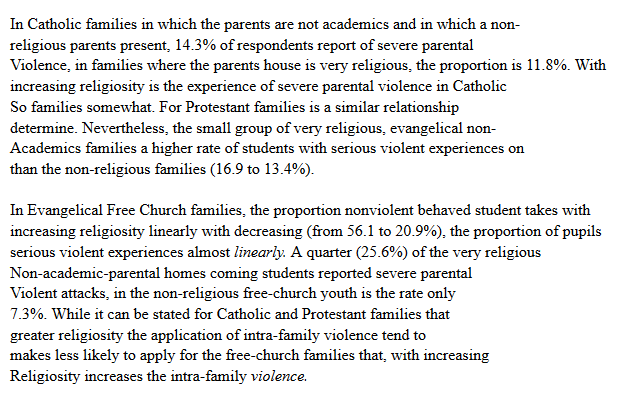
With parents from free churches that have no academic training, but declared themselves as “religious” or “very religious”, the trend is even more pronounced: More than a quarter of the surveyed children from these families has at some juncture suffered massive violence in their household. The study’s authors also provide a possible explanation: There is “a Christian tradition of parental driven beating as discipline for children.”
NDR – Freikirchen wehren sich gegen Gewaltstudie

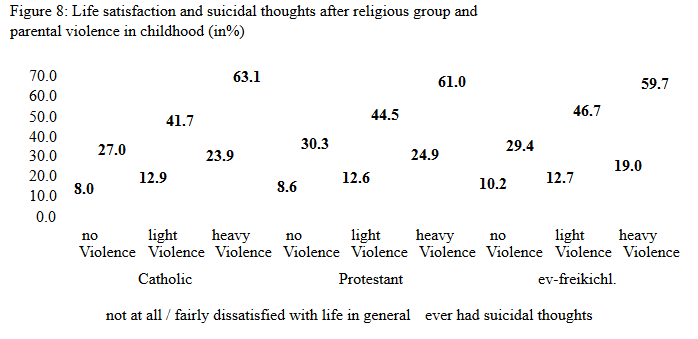
The findings in the survey are quite shocking to me. I’ll post some of the figures below for those of you who don’t have time to sift through a pages long PDF:
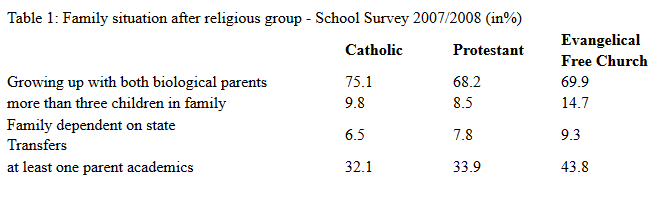
image1
Source: http://www.ndr.de/regional/niedersachsen/freikirchen109.pdf
image2
Source: http://www.ndr.de/regional/niedersachsen/freikirchen109.pdf
image3
Source: http://www.ndr.de/regional/niedersachsen/freikirchen109.pdf
image4
Source: http://www.ndr.de/regional/niedersachsen/freikirchen109.pdf

Now, these are in order, but without all of the information behind what makes this all so shocking. What I want to point out is that this is consistent with studies done in the United StatesCanada, the United KingdomAustralia and elsewhere as it pertains to parental violence towards children and its affects on the children involved. One study paper that someone had pointed me towards a couple of years ago was “The Long Shadow: Adult Survivors of Child Abuse.” Psychology Today has several articles about this phenomenon as well. One that stands out in my memory is “The Lingering Trauma of Child Abuse.” (Note: My list is not exhaustive, but just to give an example of what one will find on the subject.)

Articles referenced within this NDR article and the PDF are as follows:

…in the late 90s the German Parliament had established a Study Commission to look at so-called sects and mind-control groups. The study found that in fundamentalist Christian communities there is a widespread “…significant advocacy for physical punishment…”
NDR – Kinder schlagen im Namen Gottes 21.12.2011

NDR.de: Critics say the national church must be clear in distancing themselves from such fundamentalist positions. Shouldn’t you make it clearer that you do not agree with such  positions [about corporal punishment being biblical]?

[Kerstin] Gäfgen-Track: In the case of these parenting books and this position, I can speak for the national church, because we draw a very clear line of demarcation. We have nothing to do with such, so we want to continuing having nothing to do with such. We wish to strongly condemn such counselors. [Ted Tripp and so on]  
NDR:  “Wir verurteilen das aufs Schärfste” 21.12.2011

…as they contradict the law and [Christian Beliefs], there is a secret culture of spanking among devout Christians… Parents who follow these beliefs belong to denominations such as those [found in the] Evangelical Free Churches and the Jehovah’s Witnesses who are apt to taking the Bible literally, and consider doubts about the Word of God as whisperings of Satan.
Süddeutsche Zeitung: Liebe geht durch den Stock 30.9.2010

…It is striking that the violence of evangelical parents seem to have a lasting effect on their young. With [such] systemic beatings, it may be that parents seek to break the will of children so that they would assimilate the beliefs of adults; warn psychologists..
Süddeutsche Zeitung: Schläge im Namen des Herrn  17.10.2010

There was a study published in April of this year (2013) by infoSekte in Zürich, Switzerland entitled “Erziehungsverständnisse in evangelikalen Erziehungsratgebern und -kursen.” (Yes, this too can be run through Google Translate!) It is 61 pages long, detailing “Problematic trends such as corporal punishment or psychological violence arising in connection with certain child rearing methods … [and] possible effects of certain parenting styles.” Also explained in the document is how Switzerland signed and ratified the UN Rights of the Child in 1997; and such parenting styles are incompatible with such an agreement.

The UN Rights of the Child is the very same document that many Christians in the United States have pushed for a refusal to ratify since the 1990s.

(The US has signed, but not ratified as of this date in time.) Also something to note; Michael Farris has really pushed home-schoolers into a frenzy over it as taking away parental rights to discipline punitively and claim it is “biblical.” (For the uninitiated, Michael Farris is the head of Patrick Henry College, The Homeschool Legal Defense Association (HSLDA) and loosely affiliated with Schuzh, which defends many German home-schoolers in court. You may have recently seen Michael Farris in the news pushing against the UN Convention on the Rights of Persons with Disabilities.

If you get a chance, please do read this study. I understand that 61 pages is awfully long, but it is worth it. There is a serious problem when familial violence becomes an accepted piece of one’s culture and religious upbringing — when we normalize it to the extent that no one is shocked at all.

Issues brought forward by the Twelve Tribes in Germany are not at all shocking in many parts of the United States because such methods have become so normalized.

So many people believe it is the right thing to do. Anything contrary is “unbiblical.” That is not to say that there are not Christians, like myself, who believe that corporal punishment is actually what is contrary to the Bible.

If one wishes to claim that the Bible teaches beating their children, I would have to recommend you go back and actually investigate those claims for yourself as this is not understood to be the case within the Jewish community; and from whom we get the proof-text “spanking”/”smacking” passages from. It is a purely Christian phenomenon that came into place some time in the middle ages, as far as I can find at this juncture. Before, corporal discipline was for adult members of the faith who wished to submit themselves to flagellation.

One book that discusses this phenomenon and suggests a better way is Samuel Martin’s Book, Thy Rod And Thy Staff They Comfort Me: Christians and the Spanking Controversy.  I have others, should you wish to peruse them, but they are not free.

There are wonderful articles referenced here in an older post on my blog and I also have a ton on my Pinterest parenting boards, should you have an account there.

If you don’t know about the Pearls and their harmful teaching, I’d be happy to throw you more than the recommendation to read Hermana Linda’s Blog and this review of the Pearl’s ministry.  I would also like to mention that any court willing to speak with me personally is more than welcome to discuss punitive upbringing, homeschooling, corporal punishment proof-texts, etc.  I’m not an expert, but I’ve lived through it and am working to change things with my children and advocating for others to the best of my abilities.

Update: Michael and Debi Pearl and critiques about them and information on the Hana Williams case were on CNN last night via Anderson Cooper. If you still doubt the methods this couple advocates, look no further.

I would like to leave with a closing message by Robbyn Peters. It is “Violence: A Family Tradition.” For those who are still unconvinced, I ask that you please consider Robbyn’s words and investigate for yourself.
The Mutterpass: Motherhood, Healthcare, and Homeschooling in Germany

Screen Shot 2013-09-17 at 1.49.33 PM

The Mutterpass: Motherhood, Healthcare, and Homeschooling in Germany, By Jennifer Stahl

HA note: The following is reprinted with permission from Jennifer Stahl’s blog Yeshua, Hineni. It was originally published on September 26, 2013 with the title, “German Homeschooling Cases – Things to consider.”

One of the arguments that I keep hearing from family, friends and acquaintances in North America and other English-speaking areas of the world about home-schooling in Germany is: “Homeschooling should not be regulated! Parents have the right to educate their children as they see fit! Should officials be doing welfare checks on babies and toddlers to make sure that they are well cared for?”

I usually stammer a bit and try to explain that things are just so different here with German culture vs. American or Canadian culture. With the healthcare system that we have, women who are prenatal and postnatal are well cared for and children are seen as an investment and something that the entire “village” should protect.

It all starts when you get your first positive pregnancy test.

No, really. It does.

First, you get your pregnancy test at the apothecary. It will not be available elsewhere, because that is strictly behind-the-counter stuff. You’ll be advised by the nice people at the apothecary that if it is positive, to contact your OB/GYN, and if you don’t have one, to contact your Hausarzt (The General Practitioner that you’re seeing), and get a referral to a good OB/GYN.

You pop out the pregnancy test and without a doubt, it’s positive. You might take another, but it too is positive. “Well, we’re having a baby!”  Or, whatever variation of that which was said in your home.

The next step is simple.

You contact your Hausarzt for the referral to an OB/GYN, or, you contact your friends really quickly and find out who is the best in the area. Then, you call and say “(Appropriate time of day greeting here)! My name is ________ from __________; and I just took a pregnancy test and it’s positive. Last missed period was on ________.” And before you can say “OK,” they’ve already hauled out the appointment book and are squeezing you in right away.

When the appointment date arrives, you will be given the almighty “Mutterpass“.

This is a mother’s passport and will remain with you your entire pregnancy and through to your postnatal checkups. This is your copy of your medical records. All appointments will be logged here, your test results on any blood tests or other tests that need to be done, how you’re measuring, and all ultrasounds.

 The Mutterpass has information that contains all relevant data on the health of the mother, such as blood group; iron content in the blood, test results for hereditary – and infectious diseases (hepatitis B , HIV , rubella); the condition of the child — such as position, weight, size, etc. up to the birth;  and the expected date of birth. Even after the child is born, some important facts about the child, and the postpartum follow-up of the mother, (6-8 weeks after birth), is recorded in the Mutterpass. In an emergency, Doctors have all this information and are able to respond faster.
Wikipedia

The mother passport has 16 pages. Each (double) page deals with various aspects of the health of mother and child.
Familienplannung.de [Tons of information here, including what is found in the Mutterpass] See also: Rund ums Baby and this PDF, which have example pages of what is in the Mutterpass.

Due to the length of my post today, I did want to share TheLocal.de‘s wonderful series “Motherhood in the Fatherland”. I know that sharing these posts seems like a lot of reading. I tend to over-share in this area, so I’d rather spare those details and let Sabine walk you through the process. Sabine has a tendency to walk one through all the fun steps of culture shock while maintaining an “Oh, right, this is how this works.”

Prior to choosing where you will give birth, your next choice is what midwife will be attending you for all your postnatal and breastfeeding needs.

Once you’ve secured her (usually a her, or so I’ve been told), you will have a visit or two to get to know each other, fill out medical information and share who your doctor is so that they can work together. You’ll also hand over your insurance card so that s/he can be paid on time for all the hard work that will be done.

Usually the midwife visits only a few times over the course of a couple of months to assess whether or not your child is growing adequately, you’re bonding well, or if you have PPD or other complications. She will also work with your OB/GYN on doing examinations at home, at a time that things are still very delicate, and you won’t be wanting to sit in the car or on waiting room chairs. She’ll ensure that your uterus is, indeed, going back to normal size, that it is functioning as it should, and that things are healing nicely.

After giving birth, you’ll spend some time recuperating. Birth is hard, messy business and it takes a while to bounce back. Most mothers will be off of work for at least a few months, but usually an entire year, or longer.

Mothers in Germany will receive “Elterngeld“, which will basically help with those extra needs that crop up when you have a little one join your life.

Parental leave is rather generous, allowing fathers to even take as many as fourteen weeks off from work to help his wife or partner out. There have been a few recent news articles discussing the generous leave and stipends to stay at home that are given to new mothers:

“We have this expression, ‘rabenmutter’, which doesn’t even exist in other languages. ‘Ravenmother’. It means a bad mother and a woman who works is often considered a ‘rabenmutter’ in Germany.”
Is the German insult ‘Raven mothers’ holding back women at work?

The federal government passed a law late last year introducing a monthly childcare supplement of €100 to €150… which translates roughly to “money with which to care for someone.” It’s expected to cost the government €1.2 billion each year.
As of August, this supplement will be paid to parents of children aged three and under who are not in a state-subsidized daycare.
German childcare allowance raises questions about working moms

…women who are both underemployed and underpaid. German women work fewer hours than women in most other OECD countries (see chart). The gap in median pay is the third-widest in the club, after South Korea’s and Japan’s. That is partly because mothers stay at home. In 2008 just 18% of children under the age of three were in formal child care, against an OECD average of 30%.
German family policy – Pay to stay at home

…On average, a mother of one takes three years off, a mother of two up to seven years off and even then only goes back to work part-time…
With child care this good and affordable, what is it that’s keeping German mothers out of the workplace? …School often finishes at midday, it’s hard to find any job that fits this schedule.” … “There’s also a culture of mothers not working,” another mother added, “and those who do might get called a Rabenmutter.” That’s a raven mother – one who doesn’t care about her children.
The reluctant hausfrau: being a German mother

After having our first check-up with the pediatrician at the hospital of our choice, we learned rather quickly, that your children also get a copy of their medical records in an “U-heft” (Untersuchungsheft: children’s examination folder) which is also known as a “Gelbes Heft” (Yellow folder). This will house all copies of medical data from the child’s birth, through their eighteenth year. Like the Mutterpass, it is advised you take it and the Impfpass  [vaccination passport] along if you go on a trip anywhere, especially out of the country.

Prior to moving to Germany, in 2005, a law was passed in several Länder (German states) that made these check-ups legally binding, and prosecutable if you miss them.

Originally, there were ten checkups mandated, but this has changed in the last year or so with several additional check-ups added to the folder and us being told we will have additional appointments.

Children’s preventative checkups are to ensure that defects and diseases… especially those which endanger the normal physical and mental development of the child … are recognized quickly by a pediatrician, early enough to initiate appropriate therapy. At the same time studies are carried out to document cases of neglect , abandonment , child abuse or sexual abuse…
Wikipedia

Since the early seventies there were, in the Federal Republic of Germany, ten statutory checkups for children and adolescents, but not all parents were taking their children to these voluntary health checks.
Due to the appalling cases of child neglect – and child abuse…  Experts in child and youth services, child protection, physicians, doctors and many politicians began demanding federally regulated, legally mandatory, screenings for all German children.
Vorsorgeuntersuchungen

  “We have revised all mandatory checkups from the U1 to J2,” Hartmann said. The questionnaires that doctors will fill out with feedback from the parents, will in future, explore various risk factors [for example in the areas of exercise, nutrition, media consumption and parent-child interaction.]
Barmer und Kinderärzte starten neue Kindervorsorge­untersuchungen

We received the following letter in 2008:

Ladies and gentlemen, dear parents,
On the 1st of January 2008, the Hessian Child Health Protection Act came into force in Hessen. The pediatric check-ups (U1, U2, U3, U4, U5, U6, U7, U7a, U8, U9) have become mandatory by this law. To ensure that all check-ups, beginning with U4 have been conducted to U9, the …Hessian children’s care center based at the University Hospital of Frankfurt is responsible. . .
Hessisches Kindervorsorgezentrum

We ended up with three or four additional check-ups, leaving us with about fifteen or so before our children will be 18. So, double that, and we’ll be in the doctor’s office at least thirty-odd times in twenty years of being parents, barring illnesses that have us in more frequently.

One of the more frequent arguments I hear from my friends and acquaintances in the US are summed up very well by Hermana Linda at Why Not Train a Child?

My opinion is that parents are responsible for their children, the state is not. I do not believe that the state should take charge of children unless there is a dire circumstance such as obvious abuse. I do not believe that the state should be checking on children in order to make sure that they are not being abused. . .
It is just as easy, if not easier, to abuse a child before they reach school age. So, if we’re going to worry about school aged children being abused, why not worry about pre-school aged children being abused..?
Why Not Regulate Homeschoolers?

Well, as you can see, Germany doesn’t work like the United States or Canada. Nope, not at all.

Children are not only part of their family, but part of a wider, well-networked village.

Also unlike the United States, Germany has outlawed punitive discipline — you get the picture. Some areas are more granola than others, but, for the most part, Germany is very protective of mothers and children. It is also very proactive with health issues, and looking to stamp out and educate parents on how to prevent child abuse.

Germany has no separation of church and state like the United States, so it is expected that you will likely be religious, and additionally have the support network of your local church, synagogue or mosque.

If you do not, groups like CaritasDiakonie, and such are available to you, and you will be informed by your midwife about something like MOPS that is available from your local church, as well as about 100 different types of “Mommy and me” activities.

With the check-ups in place, there has been a decrease in reported abuse cases. Sadly, I cannot find these numbers at the moment, but I trust one of my German readers will know where I can find that again. I’d lost my laptop at the beginning of the year, which means I lost a vast mess of data from my old favorites, which included all of this.

I’ve had friends who argue, “With all these precautions, how could anyone educate at home?” — People do it all the time. Generally speaking, those people are either celebrities, government officials, parents who move frequently or parents of children with illnesses that necessitate schooling at home or in a hospital. It’s done every day.

I believe, if we could take care of the issue of curriculum and ensuring that parents are well supported, that education at home could be possible. My line of thinking is quite similar to what was blogged at Homeschooling’s Invisible Children today:

We do not want to do away with homeschooling… We would simply like to see convicted child abusers or sex offenders barred from homeschooling, light monitoring when families with a previous history of neglect or abuse begin homeschooling, and yearly academic assessments (via standardized test or portfolio review) to ensure that families who claim to be homeschooling are not doing so to hide abuse rather than to educate their children.

I believe that if the government could work with the families who are already schooling at home, they could come to some sort of agreement.

Well, that is my hope. We’ll see what is decided as more proceedings go through the court system, what is decided for the future of the German educational system.