Adult Homeschoolers Speak Out: Part Five, The Highschool Experience

Adult Homeschoolers Speak Out: Part Five, The Highschool Experience

HA note: The following series is reprinted with permission from Brittany’s blog BAM. Part Five was originally published on May 30, 2012.

*****

Also in this series: Part One: Why I Wanted To Write This | Part Two: Survey Stats and Large Families | Part Three: Top 3 Reasons Parents Homeschool | Part Four: Academic and Emotional Experiences, K-8 | Part Five: The Highschool Experience | Part Six: College? Prepared or Not? | Part Seven: What About Socialization? | Part Eight: The Best Thing vs. What Was Missing | Part Nine, Do Former Homeschoolers Want to Homeschool? | Part Ten: Are the Stereotypes Better or Worse?

*****

Part Five, The Highschool Experience

Isn’t it funny that when you are going through an experience you can think, “Wow! This is awesome!” and then looking back you can think, “umm….wow. That could have been a lot different/better.” (Maybe that is how most of us feel about our adolescence….?)

This is kind of how I feel about my homeschool experience in high school. During those 9th-12th grade years, I loved being homeschooled. But now that I am 10 years post high school graduation (with a BA and MA under my belt), I have different feelings about what was good and what could have been better.

Many of the adults who participated in my survey felt the same way as I did but, as a majority, had a “good” experience academically and emotionally. However, the numbers were not as positive as when people looked back at their elementary/Jr. High years.

Here’s a little comparison:

Academically:

Here is what some of them had to say about their positive academic experience in high school:

Beka R. 25 from KS: Good – I finished my high school curriculum somewhere around age 14 and then was able to do extra studies and college classes on political science and English to help prepare me for college. 

Jonathan M. 30 from TX: Here I know that I (in many ways) received a better education to prepare me for the real world. 

Elizabeth J. 24 from VA: We had the Abeka video classes, and we watched all of our classes on DVDs. Mom had researched the core classes of most high schools and what was required for colleges and we took, Math, English, Health, Science, History, Bible, Spanish, and my mom was in charge of PE. We has all of these classes every day. However, for the most part it seems very easy. I had a lot of control over my education because I was the one who was mostly in charge of studying and finishing assignments. Mom just graded everything. Other than that we were pretty much left to ourselves.

Nara N. 30 from NC: Academically: I was still above grade level. I graduated 2 years early at 16 and probably could have graduated at 15 except what would I have done then, too young to have my driver’s license even?

Bradley H. 23 from VA: Academically it was superb, from what I can remember . . . I was able to pursue science in a more rigorous fashion being homeschooled, and so I was able to prepare for college well.

Stuart G. 29 from VA: One of the best parts about my high school years was that it brought out an initiative to teach myself. My mom just gave me the books and the rest was up to me. For me, that was an important tool for me to learn, because I was learning self-discipline that would prepare me for higher level education and my career later down the road. I also began to help out with the education of my younger siblings, particularly in math. Perhaps this exercise was helping me better grasp fundamental concepts of certain subjects as well as challenging me to succinctly explain ideas, events, rules, etc. to my siblings. 

Many responders mentioned being taught high school subjects from other homeschool parents in a co-op setting; everyone thought this was a good experience. Also, many also said that they dual enrolled in college in their later high school years, giving them a head start on college classes.

As you can see from the statistics and these testimonies, many homeschool students felt that they had an excellent high school education.

However, here are the statistics for the “other side” of the story

  • 31% (13) of responders said their high school education was “not good” or “could have been better.”

Here are a variety of reasons they gave for these answers:

  • Felt under educated*
  • No guidance from outside adults (like a guidance counselor) concerning education*
  • Did bare minimum to get by
  • Could have been challenged more*
  • Parents not involved in education /  no accountability from parents / parents were too busy
  • Realized they could have achieved more
  • Difficulties and frustrations in math / science / English
  • Not as many opportunities as in a traditional school*
  • Didn’t try hard
  • Laziness (parental or personal)

In looking at all these reasons, I realize that the majority are not unique to the homeschool experience (the ones I marked with * are, perhaps, more related to homeschooling inadequacies than others). I wanted to put a star by “parents not involved” etc. but I realize that this is a gray area for many reasons:

1. If a parent is not involved in a child’s public or private school education, this could and may be a detriment to the student’s overall education

2. Many (if not most) homeschool parents encourage their high school children to be independent learners, and many students flourish in these opportunities (as seen in some of the quotes above).

3. I, myself, took charge of my own education from 8th grade-12th grade (picked my own curriculum, planned my lessons, was very independent of my parents in my education) and I turned out “fine.”

But.

Lack of parental involvement is, I feel, one of the main reasons that my high school education could have been better, though at the time, I thought I was “amazing” for being “so responsible”! I’ll talk about the pros and cons of independent learning for homeschoolers when I write about homeschooling and the college experience.

If I was going to give any “take-away” advice on this point, I would say, “Kids still need their parents to be very involved in their education (pushing, encouraging, guiding, advising) in high school, maybe even more than in the elementary years.”

Emotionally, the stats between being happy homeschooling in younger years vs. high school are only 8 points apart.

19% (8 adults) said that they had a very negative emotional experience for these reasons:

  • Felt like they missed out on a lot
  • Lack of friends / no friends
  • Lack of social experiences
  • Family problems / Bad relationship with parents
  • Felt trapped by parents decisions
  • Wanted to fit in w/ others
  • Felt intense academic anxiety (not good enough)
  • Difficulty socializing w/ others (I’ll be covering this topic in a future post!)

23% (10 adults) had mixed emotions, meaning “I liked some things, but…”

Here are some reasons they gave for having difficulty emotionally (Some of the answers are the same as above. The difference between the two groups is that the above group had a decidedly negative emotional experience for the reasons given; the group below said that their experience had some good parts but also difficulties):

  • Difficulties w/ parents,
  • Lots of teasing from non-homeschooled peers
  • Felt awkward
  • Difficulty finding friends
  • Felt something was missing from high school experience
  • Difficulty w/ curriculum (more of an academic issue but for several students, this cause emotional problems as well)
  • Struggle with shyness
  • Really wanted to go to public school

It is great to see that, overall, homeschooled high schoolers have had good experiences both academically and emotionally. Somehow though, I wish the satisfaction rate was higher for both academics and emotions (even personally). As I stated in my very first post, everyone [in my survey] “turned out fine” and, at best, have worked through their limitations that came from homeschooling or, at worse, learned to accept this part of themselves.

The truth is, everyone goes through “crap” during the high school years, either in public, private or homeschool. The struggles for public/private school students are often very different — and not just the “unholy trinity” of sex, drugs and alcohol. Like it or not, homeschooled high schoolers still experiment sexually and are tempted by drugs and alcohol. But homeschool students often go through personal struggles that their non-homeschooled peers do not have to deal with.

What do you think? 

Were you homeschooled in high school? How was your experience academically and emotionally?

Do you homeschool (or plan to homeschool) your high school student? Do any of these results surprise you?

Please share your comments below! And feel free to share this post with others that may be interested or may benefit from this series.

*****

To be continued.
Adult Homeschoolers Speak Out: Part Four, Academic and Emotional Experiences, K-8

Adult Homeschoolers Speak Out: Part Four, Academic and Emotional Experiences, K-8

HA note: The following series is reprinted with permission from Brittany’s blog BAM. Part Four was originally published on May 28, 2012.

*****

Also in this series: Part One: Why I Wanted To Write This | Part Two: Survey Stats and Large Families | Part Three: Top 3 Reasons Parents Homeschool | Part Four: Academic and Emotional Experiences, K-8 | Part Five: The Highschool Experience | Part Six: College? Prepared or Not? | Part Seven: What About Socialization? | Part Eight: The Best Thing vs. What Was Missing | Part Nine, Do Former Homeschoolers Want to Homeschool? | Part Ten: Are the Stereotypes Better or Worse?

*****

Part Four, Academic and Emotional Experiences, K-8

Welcome (or welcome back!) to this series about the experiences of Adults who were homeschooled! Today we will look at what former homeschoolers thought about their schooling experience from Kindergarten through 8th grade and how they remember feeling emotionally (liked it, didn’t like it, etc).

I thought this post was going to be pretty simple to write. I had read through all the surveys once and was thinking, “Oh, everyone had such a good experience in these grades and they all loved it!”

However, after reading through the surveys for a second time and crunching some numbers, I realized that my first impression was a little (too) rosy.

Here’s the short version:

  • 91% or 39 adults said their Academic experience was good (“Great!” “Awesome!” etc).
  • Only 9% (or 4 participants) said that it “could have been better.”

Emotionally, the numbers were a little different.

  • 65% of adults (or 28 people) said that their emotional memories were good (“I loved it!” “I really enjoyed it.” etc) or that they had no memory of how they felt (2 participants or 4%).
  • 30% (13 participants) of adult homeschoolers said that they struggled with negative emotions concerning this time in their lives. (To see survey demographics, click here).

Here are some of the Academic testimonies from the survey:

Kelly C.; 29 from VAI have really pleasant memories of my homeschooling experience as a child. My mom only has a high school education and I feel like with the curriculum she had and the homeschool community we were a part of that I was not slighted in the least from receiving a good education.

Elizabeth J., 24 from VAI loved it! . . . We only had three formal classes: Math, Spelling, and Grammar. And the rule was, once you finished the set assignments for the day, you were finished from school. So most days we would start around eight in the morning and be finished by 9:30 or 10. There were other things that we did sometimes: Handwriting, phonetics, field trips (we visited probably every important or historical site in Virginia). Also my siblings and I read like crazy. We would go to the library every Friday and get as many books as we could carry and my sister and I would read each other’s books. But we all had to get one science and one history book and write a report on it.

Nara N., 30 from NCAcademically: my Mom always chose curriculum from all kinds of places and at whatever grade level was appropriate for us in each subject. My brother and sister (twins) did not even always do the same curriculum for each subject. I was basically always above grade level and never knew what “grade” I was in.

Matthew W., 30 from OHFor the most part everything was good. I enjoyed the benefits of homeschooling and we had a lot of friends that were also homeschooled. We were in some pretty good homeschool groups and took some cool field trips. 

Christine M., 31 from  KSIt was a good, very positive experience. There were times I wanted to try out public school, but I loved knowing I could be done with my schoolwork before lunch and spend the rest of the day creating, exploring, playing, and just enjoying being a kid instead of dreading the homework that would follow me home. I had lots of time with friends at church, co-op, and in my neighborhood. I also had lots of time to foster my interest in piano.

Stuart G., 29 from VAAcademically: Admittedly, in these first years of home-schooling there was some frustration because my mother was trying to navigate the new waters of schooling at home, and being teacher for all eight of her children. On the positive side, I was given the freedom to more seriously pursue subjects I was personally interested in. My curriculum therefore, was tailored to my needs and natural inclinations, which in turn, made learning more enjoyable for myself, and (I believe) all of my siblings.

Corinna R., 35 from VAAcademically I did much better than I would have otherwise as my parents were able to cater to areas where I had a harder time (like math) and also push me and provide extra opportunities where I was gifted (like music).

Kellan A., 23 from KS:  I really enjoyed it. I feel like I learned a lot and got an extremely good groundwork for the future.

O. G., 29 from KSI thoroughly enjoyed being homeschooled. I think we had a great support group and I had a great relationship with my mom and sister. Academically I probably could have been challenged a bit more…

Emotionally, no one [in my survey] had a completely “bad” emotional experience. However, the ones whom I placed in this category indicated that they had struggled with negative emotions for about 2 years, usually starting around 5th grade. Others noted that Jr. High was a hard time emotionally (which is often a hard time for kids whether they are homeschooled or not).

Reasons cited for negative emotions:

  • Wanted to go to public school
  • Felt like he or she was missing something
  • Felt different
  • Didn’t feel “normal”
  • May have lengthened struggle with shyness
  • Was angry about being taken out of school
  • Felt like parents had too much going on to help
  • Lack of social activities

Interestingly, many participants tied their emotional experience to the availability of social experiences. (A note concerning interpretation: I had to use my personal judgement in determining the emotions behind the words/experiences in some of the surveys. For example, see academic results above where many just said, “I really enjoyed it.”).

I have included both positive and negative testimonials below:

Kelly C., 29 from VA:  [T]he community that we were a part of was wonderful for me as far as socializing. I think there is a big misconception (among the non-homeschooled) that homeschoolers do not socliaze and for me that was not true. We were involved in many activities with other homeschoolers; I participated in 4-H, we had weekly get-togethers at the park or skating rink as well as field trips to various historical/educational facilities.

However, while Kelly noted feeling “wonderful” about these experiences, M.V. relates more negative feelings toward very similar experiences. This just shows that different students had different emotional needs.

M.V., 27 from KSEmotionally, I had friends and social opportunities . . . I don’t feel like I was deprived of social events. At the same time, I don’t think I had much in the way of developmental activities. Sometimes kids this age get involved in a sport or a musical instrument: I had choir, 4-H and long walks through the pastures around our house, none of which were really conducive to developing my future skills and personality as an adult. I think the lack of developmental activities here contributed to more problems in high school.

Here is another contrast between experiences, this one concerning personality:

Nara N., 30 from NCEmotionally: I think I did just fine. I’m naturally quiet/introvert. Sometimes I wonder if public/group private school might have brought me “out” more, but I think it probably would actually not have been good for me as a young child, and would have created a lot of extra stress in my early life.

E. H., 21 from DEEmotionally, it may have lengthened my struggle with shyness, but it meant I was able to unfold in my own time and with invaluable personal/family/spiritual growth in the mean time.

S. M., 29 from WV shows a good contrast between someone who had a good academic experience but who struggled emotionally:

I was full of anxiety because I felt I was getting less of an education that my peers. I always felt educationally and intellectually inferior the entire time. Academically, I did well.

M.L., 26 from NE and M.D., 19 from KS both had positive experiences in earlier grades but struggled emotionally as they got older:

M.L., 26 from NEThe younger years I really enjoyed it, I loved being with my brothers while doing school, I felt challenged to always keep up with them . . . However with life changes, baby, sicknesses/health conditions in the family I felt that my education wasn’t as important as other things going on. Whenever I had questions about school, I felt like my mom had too much going on to help me. In 5th grade I really struggled with school, I felt like all of a sudden it was really hard, I didn’t understand it, it took me forever, I didn’t feel challenged to do well because my brother who had always been a year ahead of me was now behind me and the others were too far ahead so I had no motivation to do well it school. It was the first time I begged to go to public school, I thought, “even if I hate school, at least I would be with my friends. 

M.D., 19 from KS: My view of homeschooling up to [5th grade] was fairly accepting. I remember a few moments of jealousy toward other kids my age who got to spend their days with their friends in public school, but for the most part homeschooling was normal for me, and I didn’t question it. 

I remember middle school being the time when I really started questioning whether I wanted to be home schooled. I was becoming more involved in my church youth group and less involved in the home school group and because of this I was surrounded by kids who attended public school. 

On the other hand, other adults recorded strong, positive emotions in looking back on these years:

Stuart G., 29 from VAEmotionally: I was happy and enjoyed strong relationships with my siblings due to the fact that we were schooling together. Furthermore, my bond with my parents became stronger because of the increased time we were spending together. Especially effective was my father’s involvement in my education, which had not existed prior to home-schooling. 

There was also a noted lack of turmoil that many of my peers in public/private atmospheres experienced. Because we missed out on much of the “drama” middle-school and high-school atmospheres cultivate, we were more at peace with ourselves (choosing things we were truly interested in without regards to what was “popular” at school, etc), and amongst ourselves.

Overall, homeschoolers [in my survey] looking back at their elementary and Jr. High years remember being satisfied academically and happy emotionally (though I think some of the responses concerning emotional satisfaction are very thought provoking).

What about you? 

If you were homeschooled, what do you think about your academic and emotional experiences looking back at K-8th grade?

If you homeschool your children, what thoughts or concerns do you have about their academic and emotional lives?

Please feel free to comment and ask questions!

Also, feel free to share these posts on Facebook or other social networking sites if you feel that others would benefit from or be interested in this series!

*****

To be continued.

Adult Homeschoolers Speak Out: Part Three, Why Parents Homeschool

Adult Homeschoolers Speak Out: Part Three, Top 3 Reasons Parents Homeschool

HA note: The following series is reprinted with permission from Brittany’s blog BAM. Part Three was originally published on May 25, 2012.

*****

Also in this series: Part One: Why I Wanted To Write This | Part Two: Survey Stats and Large Families | Part Three: Top 3 Reasons Parents Homeschool | Part Four: Academic and Emotional Experiences, K-8 | Part Five: The Highschool Experience | Part Six: College? Prepared or Not? | Part Seven: What About Socialization? | Part Eight: The Best Thing vs. What Was Missing | Part Nine, Do Former Homeschoolers Want to Homeschool? | Part Ten: Are the Stereotypes Better or Worse?

*****

Part Three, Top 3 Reasons Parents Homeschool

While growing up, I heard my mother describe homeschooling as “a lifestyle” countless times to curious inquirers who wondered why anyone would embark on such an endeavor. In the late 1980s, when my family started homeschooling, the question of “why” was very apropos, considering that homeschooling was illegal or newly legal in many states.

Keeping in mind these historic details, I was very intrigued to discover the answers to the question “Why did your parents choose to homeschool, from your understanding?” from first generation homeschoolers. (To learn more about why I decided to explore these questions, click here!)

(While reading, please keep in mind the last part of the question: from your understanding. All of these responses come from the adults looking back on their experiences and to understand why their parents decided to homeschool).

An example from my own family might give insight into the wide variety of answers I got:

My oldest sister, (Amberley, 33 years old), gave this answer:

Well, homeschooling was not legal in Nebraska when I started school, so I don’t know if Mom would have homeschooled me from K or not… But she said I was a brat and wanted me to get along better with my siblings. But I think there was also the religious aspect of things, where they wanted me to be able to study the Bible and learn about things from a Biblical perspective (ie. Bible as a subject, creation).

My second oldest sister, (Chelsea, 30 years old) also mentioned the “getting along with siblings” part, as well as religious reasons.

I, personally, don’t remember my sister being “a brat” (that just makes me laugh a bit). However, the following story is what I remember my parents telling us about why they started to homeschool:

My oldest sister was in the AWANA program (a church based Bible memory club) that met on Wednesday nights. Amberley was so tired in the morning that she had a very difficult time getting up for school. My parents decided that Biblical education (like the AWANA program provided) was of greater value that academic education that required my sister to get up early in the morning. These circumstances greatly influenced my parents’ decision to start homeschooling. 

My younger brother (Kellan, 23 years old) gave this reason:

Well, all of you guys were homeschooled so by the time I rolled around I guess they just had to.

My brother’s answer, of course, is very tongue-in-cheek, but I think it gives a good example of how siblings can have different perceptions of the same event.

Most of the homeschoolers who took the survey cited multiple reasons that influenced their parents’ decision. But the # 1 reason for homeschooling on the surveys mirrored my own family’s reasons for homeschooling: Religious Reasons or Convictions. 

Here are some direct quotes from the survey:

(To see Survey Statistics, Click here)

Melissa Ann G., 26 from VA:   Parents decided to homeschool us for religious reasons.

Christine M., 31 from KS: [My parents] wanted us to have a religious foundation to our education

Jeremy D., 18 from VA: My parents didn’t like “ungodliness” of public school . . . they felt God calling them to homeschool us.

Emily M., 26 from FL: I believe it was primarily because they are very conservative and strong christians and they felt that public schools taught things they didn’t believe and they also thought that it opened up a lot of room for temptations and misguidance.

Elina C., 25 from KS: They didn’t like the evolution stance that was being taken in the school system and wanted to have the freedom to teach us creation.

Jenna C., 28 from KY: [My parents homeschooled] to keep us sheltered from many of the negative influences of the world, and to instill a love of God in our hearts.

And many others:

  • 12 people (myself included) specifically mentioned “religious conviction”as a primary reason for homeschooling
  • 6 people said that their parents wanted to protect them from “worldly,” “ungodly,” or “bad influences
  • 3 people stated that their parents “wanted to teach the Bible”

While religious convictions was the # 1 answer, the next highest response was related to Academics or dissatisfaction with Public or Private Schools.

Stuart G., 29 from VA mentions academic reasons along with others:

My parents were unhappy with the public school environment and the quality of education we were receiving. The straw that broke the camel’s back was an incident in which my sister was being bullied and the administration was ineffective in dealing with the perpetrator. After this incident, my parents decided to try homeschooling on a trial basis. After the first year, it was clear that homeschooling was the right way to go for our family.

Elizabeth J., 24 from VA stated:

My mother wanted to protect us from the negative influences found in public schools, and later (after my sister spent 3rd grade at a private Christian school) to give us a more personalized, at-our-level, education. My mother taught us at the level that we were capable of, not holding us back or going on ahead of us. She also wanted to avoid the bullying and cliche-ishness that were in the schools. 

Kaitlin G., 22 from KS explained that “My brother and I needed more 1 on 1 attention in certain subjects and we were not getting that in public school.”

  • 7 people stated that their parents believed “they could do a better job” than public/private school
  • 5 mentioned that parents “didn’t like the public schools”
  • 2 cited that the parents wanted to have more control over their child’s education
  • One mentioned being “bored” in school
  • One family had a child who was academically advanced

Finally the third highest response after Religious Convictions and Academics was because parents did not want their children being taught Sex Education (5 people mentioned this, though this reason was primarily coupled with religious convictions).

One participant saidThey believed it was God’s will for parents to take active responsibility for their children’s education. This was precipitated by early sex-education in my older brother’s second grade class.


Kelly C. 29 from VA also gave this reason: [My mom] did not want the public school system’s influence (in particular evolution and sex education) on my education. She preferred being able to teach me with a godly influence.

I found these top 3 reasons for deciding to Homeschool fascinating. Other reasons included:

  • Military/ lived overseas (4)
  • Bullying (3)
  • Private/ Christian School too expensive (3)
  • Family closeness (3)
  • Flexibility (3)
  • Disagreement w/ school
  • Thought it would be fun (I particularly liked this answer!)

In closing this very long and informative post, I wanted to share what, I believe, is is a uniquely insightful response for why parents decided to homeschool.

Christy L., 28 from CA said:

My mom started out homeschooling (I am the oldest) and did it for my first two years of school. Before I started second grade she decided to put my brothers and I into public school for two reasons 1. She does not enjoy teaching kids how to read 2. My brother was chronically ill and it was getting to be too much to homeschool and care for him. My parents then decided to homeschool all 5 kids during 6-8th grade. They wanted to ensure that we had a good bible education and felt that middle school is the time that kids really pull away from their parents and they didn’t want that. 

I so enjoyed this response because I believe it shows wise parent(s) who knew her likes and dislikes (nothing wrong with not enjoying teaching kids to read!) personal limitations (having a child who was chronically ill), and their own personal convictions about teaching the Bible and their faith, as well as developing family closeness. Christy eventually went back to public school from 9-12 grade and felt prepared and grateful for this new experience as well.

What about you?

If you were homeschooled, why did your parents choose to do so (from your understanding)?

If you homeschool your children today, what are your primary reasons for doing so?

Please feel free to comment on the above responses, or ask questions! I will do my best to answer them and provide what insight I may.

*****

To be continued.

Adult Homeschoolers Speak Out: Part Two, Survey Stats and Large Families

Adult Homeschoolers Speak Out: Part Two, Survey Stats and Large Families

HA note: The following series is reprinted with permission from Brittany’s blog BAM. Part Two was originally published on May 24, 2012.

*****

Also in this series: Part One: Why I Wanted To Write This | Part Two: Survey Stats and Large Families | Part Three: Top 3 Reasons Parents Homeschool | Part Four: Academic and Emotional Experiences, K-8 | Part Five: The Highschool Experience | Part Six: College? Prepared or Not? | Part Seven: What About Socialization? | Part Eight: The Best Thing vs. What Was Missing | Part Nine, Do Former Homeschoolers Want to Homeschool? | Part Ten: Are the Stereotypes Better or Worse?

*****

Part Two: Survey Stats and Large Families

Here are the demographic statistics from the survey I conducted about the experiences of adults who were homeschooled.

To better understand the following data, here is my own demographic information:

  • Name: Brittany Arpke Meng
  • Born in: Nebraska
  • Grew up in: Kansas
  • Currently live in: Virginia
  • Age: 28
  • Number of siblings: 4
  • Number of years homeschooled: 12 (1st-12th)
  • Marital status: Married; spouse was not homeschooled
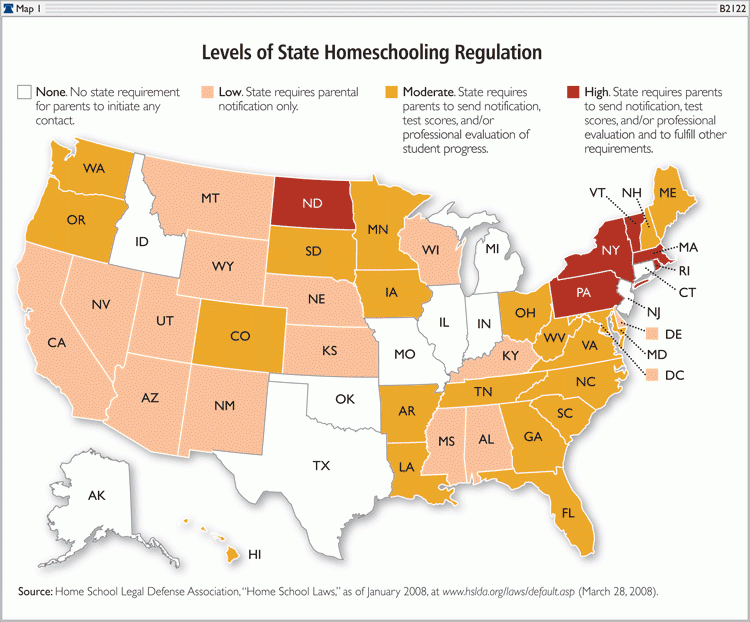
Current info about levels of government regulation for homeschoolers per state.

Total number of surveys: 44

Women: 34

Men: 10

(Sadly, the results are a little estrogen heavy, but the male perspective I received was excellent!)

These homeschoolers grew up in:

  • Kansas (16)
  • Virginia (7)
  • South Dakota (3)
  • New York (2)
  • Nebraska (2)
  • Florida (2)
  • Wisconsin
  • Illinois
  • New Mexico
  • North Dakota
  • Washington
  • Texas
  • California
  • Georgia
  • South Carolina
  • North Carolina
  • Ohio
  • Colorado
  • Illinois
  • Military family (3)
  • Overseas

These adults now live in:

  • Virginia (13)
  • Kansas (6)
  • Mississippi (2)
  • Georgia (2)
  • Florida (2)
  • California (2)
  • Oklahoma (2)
  • Iowa
  • Texas
  • North Carolina
  • West Virginia
  • Delaware
  • Missouri
  • Kentucky
  • Ohio
  • Nebraska
  • Washington
  • France
  • Japan (2)
  • Germany
  • Cayman Islands
  • Turkey

Age range: 18-37 (my minimum requirement was for the participant to be out of the house for at least one year)

Average age: 26

Fun fact: this means that earliest these families started homeschooling was around 1980!

Number of siblings range: 0-13

Average: 3 siblings

Number of years homeschooled range: 5-13

Average: 11 years

Marital status:

  • 22 married (4 spouses had homeschooling experience)
  • 16 single
  • 2 Divorced
  • 2 Engaged
  • 2 in a relationship

I included the sibling information because, in my own experience, homeschooling families tend to have large families. As you can see, the range of siblings in each family is pretty dramatic (from an only child to a family of 14 children!) The average of 4 children in a family seems pretty “normal” to me. Many homeschoolers talked about relationships with siblings in the surveys so that is why I included this information.

I also wondered though, “Does the “largeness” of a family affect the homeschooling experience positively or negatively?” I didn’t receive overwhelming data on this point but I think that two examples may provide a good contrast to answer this question.

M. M. a 29 year old from CA was the oldest of 8 children. She describes a negative experience related to family size:

My mom didn’t seem to be involved very much in my individual learning or invested in only my education since there was so many kids. I felt this was a disadvantage to me . . .My mom would start at the youngest child and work her way up to the oldest in going over their homework, teaching, etc. I don’t think she got to me very often.”

In 12th grade, M. M. did her homeschooling with another family where the other mother kept all of the young people accountable for their work.

This is just one example, of course. But in this case, family size seemed like a detriment to M.M’s homeschooling experience.

Contrasted with this is Beka R’s story, a 25 year old from Kansas and the 2nd oldest in a family of 14 children. Though Beka came from the largest family in survey group, she implied that academics were a very strong focus and stated that family relationships were the most positive part of her experience:

“One of the best things homeschooling did was allow for strong family relationships – we had school on Saturdays and had Thursdays off because that reflected my dad’s work schedule, and those Thursdays with my dad are something I’ve always cherished. I think that the primary influencers of my foundational years were my parents and grandparents, and that is something that has always shaped my values.

Most responders had a very strong family and the number of children did not seem to negatively affect the homeschooling experience (or they didn’t mention it). I think it is interesting that homeschoolers have large families though and, in my own experience, homeschooling helped make relationships with my family stronger.

What do you think? 

Did you come from a large family who homeschooled? Did it enhance or take away from your education?

Please comment or ask any questions!

*****

To be continued.

Adult Homeschoolers Speak Out: Part One, Why I Wanted to Write This

Adult Homeschoolers Speak Out: Part One, Why I Wanted to Write This

HA note: The following series is reprinted with permission from Brittany’s blog BAM. Part One was originally published on May 24, 2012.

*****

Also in this series: Part One: Why I Wanted To Write This | Part Two: Survey Stats and Large Families | Part Three: Top 3 Reasons Parents Homeschool | Part Four: Academic and Emotional Experiences, K-8 | Part Five: The Highschool Experience | Part Six: College? Prepared or Not? | Part Seven: What About Socialization? | Part Eight: The Best Thing vs. What Was Missing | Part Nine, Do Former Homeschoolers Want to Homeschool? | Part Ten: Are the Stereotypes Better or Worse?

*****

Series Preface for HA

** In the introduction to my blog series in 2012 about Adult Homeschoolers I wrote that “everyone turned out fine.” This phrase may seem odd and may even seem hurtful to some HA readers and writers due to the fact that many of the stories on HA deal with the painful past of many adult homeschoolers. The purpose of sharing that “everyone turned out fine” was to state that everyone who participated in my series is now a strong, functioning adult who has worked through or is working through any struggles from their homeschooling background.

The purpose of my series was to look at the “good, bad, and ugly” issues of homeschooling in an honest and fair way, with the underlying thread of hope by sharing the experiences of many adults from all around the USA. I hope that, as you read, you will be able to identify with the stories of these men and women as they share the reasons their parents home schooled, their elementary and high school years, the “best” and “worst” thing about homeschooling, adjusting to college, socialization issues, and if they plan to homeschool their own children.

I hope that as you read, you will also feel hope; know that you are not alone.

*****

Part One: Why I Wanted to Write This

I was a first generation homeschooler.

…meaning my parents starting homeschooling in in the late 1980s right after it became legal in Nebraska (where I was born). In my elementary years, when someone asked where I went to school, 99% of the time my answer would produce a furrowed brow and the question, “What is homeschool?”

Nowadays, everyone knows someone who is homeschooling or who was homeschooled. First generation homeschoolers have grown up, gone to college, and have started families of their own.

My own children are now almost school age (I have twins who will be 5 in October) and in recent months I have been contemplating my own schooling experience.

I wondered:

  • Do former homeschoolers want to homeschool?
  • What do they think of their homeschool experience?
  • Were they happy and satisfied? Did they wish for more?
  • Were they prepared for college academically and socially or were they scared, unprepared and awkward?
  • Are they stereotypes of homeschoolers true? (homeschoolers are brainy/stupid/socially stunted/well rounded/fill in the blank?)

I spent hours on the internet, trying to find articles, blogs, anything written by former homeschoolers about their homeschool experience. I was disappointed by what I found (or the lack there of). Either I found stats about how homeschoolers are successful (with no personal testimony involved) or personal testimonies that I distrusted because I thought they were too “Pollyanna” in nature. I wanted to read about the honest experiences of adults homeschoolers, the good and the bad, the advantages and disadvantages, their thoughts on their academic experiences and the issue that homeschoolers everywhere never seem to escape:

“What about socialization???”

So I put together a short survey and and used the wonderful world of social networking to launch this blog series. I received 42 responses from adult homeschoolers from all over the USA (childhood friends, people I went to college with, friends, and friends of friends).

I am excited to share the data I have collected with you: adults who were homechooled, parents who are homeschooling their own children (and may be wondering, “Am I doing the right thing? Am I messing up my kid? WHAT ABOUT SOCIALIZATION????”), or anyone else who is curious about the lives and experiences of homeschoolers.

Here is a little sneak peek at the end of the story: Everyone [that took my survey] turned out fine. **

Not always “happily ever after” and not without some bumps, awkwardness, struggles, and obstacles on the journey to adulthood.

But, really, everyone [that took my survey] turned out fine.

[Some] parents, breathe a sigh of relief.

And keep reading.

You can look forward to personal testimony about topics such as:

  • Why first generation homeschool parents decided to homeschool
  • The academic and emotional experience of homeschoolers in grades K-8
  • The academic and emotional experiences of homeschoolers in grades 9-12
  • Do homeschoolers pursue higher education?
  • Were they truly prepared academically?
  • Were they truly prepared socially?
  • What is the best thing about homeschooling (so many people said the same thing! amazing!)
  • What former homeschoolers wish was different about their experiences
  • The inside perspective about the advantages and disadvantages of homeschooling
  • Do former homeschoolers plan to homeschool their own children?
  • The homeschoolers perspective on society’s thoughts and opinions about homeschooling

This series will be honest in every way, exploring the good, the bad, and everything in between. While my posts will primarily be focused on the results of the survey, I will also share my thoughts and experiences as they relate to the survey results.

I hope that this series inspires conversation, stirs up memories (for former homeschoolers), incites conversation, provides insight and information, and ultimately encourages those who read. Please feel free to comment, ask questions, and share your own thoughts and experiences.

*****

To be continued.

New Homeschool Parents, Be Wise: Shadowspring’s Thoughts

The following post by Shadowspring was originally published on her blog Love. Liberty. Learning. She describes herself on her blog as, “a home school mom near the end of my career home schooling and looking forward to what life has to offer next. I am a follower of Jesus and a lover of freedom, as it is for freedom that Christ has set me free (Gal 5:1).” This post is reprinted with her permission.

I am so proud of all the home school graduates I have met!

Without exception, they are all strong-willed, courageous people who are finding their own authentic way in life.  I think that no matter the quality of one’s educational experience, or the degree of emotional nurture vs. emotional neglect or abuse even, home schooling in itself transmits these qualities by its very nature.  To home school is to go against the flow of larger society, and children who are home schooled constantly hear that decision praised.  Even the religious home schools (maybe especially the religious home schools?) are continually hearing that going against what is easy and popular when conscience calls you to do so is a good thing, the right thing, the best thing.

So it is no surprise then, that these home school graduates have a strong sense of responsibility to improve the lot of those who come after them. Homeschoolers Anonymous is a web site dedicated to sharing the stories of home school graduates that will not be featured at home school conventions or plastered on the cover of Practical Homeschooling magazine.  (These stories need to be heard, too!) It was created by home school graduates, to help improve the lives of home schooled children who come after them.  Their goal is to improve things by the shining the light on areas that need improvement.  All of the stories shared there are authentic, written by home school graduates themselves.  These stories need to be told, and the home school community needs to listen and learn. 

New home school parents especially, be wise! Take notice!  Don’t just listen to the home school salespeople trying to get you to be just like them.  Do not be foolish, only listening to those whose children are still at home.  They have the option of still believing they are doing everything right and because of that, they can predict how life will turn out for their children.  Those whose children are already grown adults, that’s who you should be seeking out for advice.

You are in a much better position than earlier home school parents, because you have the opportunity to inspect the fruits of the labors of home school parents who came before you.  Make the most of that opportunity!  As scripture counsels (Proverbs 18:17, Luke 14:28-33), get all sides of a story before you decide.  Really investigate what you are trying to accomplish.  Check out what has already been done by other people so you can figure out what you want to do differently and what you want to emulate.

I realize this will be difficult, for many reasons. One is that when a family experiences “failure” — any result that is outside the advertised shiny, bright, happily subservient, doctrinally and sexually pure teenager — that family will disappear from most home school support groups.  Sometimes they are kicked out, but more often they drop out. These parents may feel ashamed that the product of their home school didn’t turn out as advertised.  They may be asked to leave, especially if the results they are experiencing don’t conform to the religious side of expectations.  A poorly educated but morally upright teen/young adult is not nearly so embarrassing to many home school support groups as a teen/young adult who is seen as morally compromised.

On the other hand, they may leave the support group because of disillusionment.  When their marriage is falling apart, their teenager turns up pregnant, or is caught doing drugs, shoplifting, looking at porn, etc. then they may wake up to the fact that they have bought into and been promoting a lie and want no part in it anymore. Or they may be compelled to put their children in public school because of any number of reasons — a severely ill parent, financial constraints that require the home schooling parent to work — and so leave the home school support group.  All home school support groups require that a family be home schooling to belong, so any family that stops home schooling for any reason will not be at support group meetings sharing their stories.  You will have to search them out.

And the final reason that talking to home school graduates, and parents who have graduated all their students, to see where life takes them, is the passage of time.  You won’t hear about gay home schooled Christian teens because they don’t come out to their parents until years have passed since leaving home.  You won’t hear about atheist home schooled graduate of Christian home schools because they don’t leave the faith for years after leaving home.  In fact, you won’t hear about any of the graduates who go off script after leaving home unless their dong so actually involves criminal activity that splashes across the headlines, like the Couty Alexander story in Louisiana.

A summary of the Couty Alexander story: A home school boy dutifully marries the courtship bride his and her parents decided upon. His wife gets pregnant right away because they follow the script and don’t use birth control.  Coudy goes to work, and interacts with people outside of the home school movement for the first time.  He falls in love with a co-worker, quite unexpectedly I am sure.  He has never experienced such strong attractions before, as he was assigned his wife and wasn’t allowed to even date.  He and the co-worker begin a romance.  And somehow, truth always outs.  His young bride finds out about the affair.  Maybe he even told her himself, I don’t know.  As she is packing to leave him, the weight of the shame that will fall on him from his community overwhelms him, and in a panic, he kills his young bride.  That is a direct result of the Christian home school fantasy and the expectations he felt to fulfill them as a star of the movement.  He was never allowed to just be Couty, and figure out who he was at heart and what he wanted.  His life was dedicated to doing what his parents wanted, because somewhere along the line the Christian home school community became confident that what they wanted, God wanted.  It ended in heartache.

All of the Christian home schooled youth want to please God.  Those whose parents and churches claim to speak for God the most adamantly are the ones whose children are at most risk of leaving the faith eventually.  You can not control their environments forever, and eventually they will start to run into the mysteries of life and find the pat answers they were taught are insufficient.  You will read many stories along this vein at Homeschoolers Anonymous but you won’t hear them at your home school support group. They won’t be brought up onto the platform at home school conventions (though some were paraded there back when they were still teens at home) to tell their story today.  They will not be featured in home school magazines.

All of which is a real shame.  The inquiry for truth seems to have been abandoned by the home school movement’s leadership. They believe they know all truth, and so they just dismiss and ignore all reality that exposes their “truth” as a lie.  Instead of being smart enough to listen to the adult children, children raised by all the standards and methods the movement promoted, leadership is just doubling down on the standards and methods that have failed.  They turn deaf ears to anything that doesn’t support what they want to believe.  That isn’t right. Home schooled children deserve better!

Finally, the absolute worst stories out there, the ones we as home schoolers want to ignore and should not, are the stories of child abuse.  Sexual abuse, physical abuse, emotional abuse, spiritual abuse is happening in the home school community, and the home school community had best address it!  It’s no use trying to explain it away with the True Scotsman defense. Our adult home schooled graduates are well versed in the dynamics of logic and debate.  No, it’s happening.  It happened under our watch, under my watch.  So, what are good home school parents going to do about it?

HSLDA’s response to these stories of neglect and abuse?  Silence. Denial of being in any way responsible for these children.  Not shock, not horror, not remorse.  Instead of leading the charge to put distance between nurturing home schooling families and abusive home schooling families, something that can only happen with transparency and accountability, HSLDA is trying to make it easier for abusive parents to home school. Witness this recent attempt to remove all transparency and accountability from the home school law in Iowa.  The current regulations are not burdensome and they are working well.  Why would HSLDA be working to remove all accountability and transparency from Iowa home school regulations?

That’s a question every home schooling parent, every home school support group leader, every home school support group member, should be asking themselves.  I know I never had anything to hide, and was in fact proud of the education and the home environment I was providing.  If you, home schooling parent, can’t say the same, you shouldn’t be home schooling.  You should make sure your children receive lots of love, good nutrition, emotional nurture and educational opportunity every day.  If you are doing that, and  I believe most home schooling parents are doing just that, then you should be open and transparent to the community in which you live about what goes on behind your closed door.

 Live such good lives among the pagans that, though they accuse you of doing wrong, they may see your good deeds and glorify God on the day he visits us. ~ 1 Peter 2:12

The public needs to be able to see your good deeds.  Being transparent and accountable honors God.  Don’t seek to hide in the darkness of obscurity, be eager to show the world the wonderful work that your home school in accomplishing!  Do it for the children, because Jesus calls us to love children  (all children, not just our own) and treat them with dignity and care.  Read carefully Matthew 18:1-9.

It’s time for the home schooling community to cut out and cast away families that abuse their children!  The only way to do it is to come out in the open and show the world what’s happening in all our home schools.  The righteous will be rewarded, the wicked will be found out, and all of society will be better off for it.

Lead the way, home schooled graduates! Lead the way, new home school parents!  Don’t let the old guard lock you into making the same mistakes they (we) made.  Do it not only for your children, but for all children.  Heads up! You are the new face of home schooling.  Please let it be an open and honest face, publicly displayed, that has nothing to hide and much about which to proudly smile.