Adult Homeschoolers Speak Out: Part Three, Why Parents Homeschool

Adult Homeschoolers Speak Out: Part Three, Top 3 Reasons Parents Homeschool

HA note: The following series is reprinted with permission from Brittany’s blog BAM. Part Three was originally published on May 25, 2012.

*****

Also in this series: Part One: Why I Wanted To Write This | Part Two: Survey Stats and Large Families | Part Three: Top 3 Reasons Parents Homeschool | Part Four: Academic and Emotional Experiences, K-8 | Part Five: The Highschool Experience | Part Six: College? Prepared or Not? | Part Seven: What About Socialization? | Part Eight: The Best Thing vs. What Was Missing | Part Nine, Do Former Homeschoolers Want to Homeschool? | Part Ten: Are the Stereotypes Better or Worse?

*****

Part Three, Top 3 Reasons Parents Homeschool

While growing up, I heard my mother describe homeschooling as “a lifestyle” countless times to curious inquirers who wondered why anyone would embark on such an endeavor. In the late 1980s, when my family started homeschooling, the question of “why” was very apropos, considering that homeschooling was illegal or newly legal in many states.

Keeping in mind these historic details, I was very intrigued to discover the answers to the question “Why did your parents choose to homeschool, from your understanding?” from first generation homeschoolers. (To learn more about why I decided to explore these questions, click here!)

(While reading, please keep in mind the last part of the question: from your understanding. All of these responses come from the adults looking back on their experiences and to understand why their parents decided to homeschool).

An example from my own family might give insight into the wide variety of answers I got:

My oldest sister, (Amberley, 33 years old), gave this answer:

Well, homeschooling was not legal in Nebraska when I started school, so I don’t know if Mom would have homeschooled me from K or not… But she said I was a brat and wanted me to get along better with my siblings. But I think there was also the religious aspect of things, where they wanted me to be able to study the Bible and learn about things from a Biblical perspective (ie. Bible as a subject, creation).

My second oldest sister, (Chelsea, 30 years old) also mentioned the “getting along with siblings” part, as well as religious reasons.

I, personally, don’t remember my sister being “a brat” (that just makes me laugh a bit). However, the following story is what I remember my parents telling us about why they started to homeschool:

My oldest sister was in the AWANA program (a church based Bible memory club) that met on Wednesday nights. Amberley was so tired in the morning that she had a very difficult time getting up for school. My parents decided that Biblical education (like the AWANA program provided) was of greater value that academic education that required my sister to get up early in the morning. These circumstances greatly influenced my parents’ decision to start homeschooling. 

My younger brother (Kellan, 23 years old) gave this reason:

Well, all of you guys were homeschooled so by the time I rolled around I guess they just had to.

My brother’s answer, of course, is very tongue-in-cheek, but I think it gives a good example of how siblings can have different perceptions of the same event.

Most of the homeschoolers who took the survey cited multiple reasons that influenced their parents’ decision. But the # 1 reason for homeschooling on the surveys mirrored my own family’s reasons for homeschooling: Religious Reasons or Convictions. 

Here are some direct quotes from the survey:

(To see Survey Statistics, Click here)

Melissa Ann G., 26 from VA:   Parents decided to homeschool us for religious reasons.

Christine M., 31 from KS: [My parents] wanted us to have a religious foundation to our education

Jeremy D., 18 from VA: My parents didn’t like “ungodliness” of public school . . . they felt God calling them to homeschool us.

Emily M., 26 from FL: I believe it was primarily because they are very conservative and strong christians and they felt that public schools taught things they didn’t believe and they also thought that it opened up a lot of room for temptations and misguidance.

Elina C., 25 from KS: They didn’t like the evolution stance that was being taken in the school system and wanted to have the freedom to teach us creation.

Jenna C., 28 from KY: [My parents homeschooled] to keep us sheltered from many of the negative influences of the world, and to instill a love of God in our hearts.

And many others:

  • 12 people (myself included) specifically mentioned “religious conviction”as a primary reason for homeschooling
  • 6 people said that their parents wanted to protect them from “worldly,” “ungodly,” or “bad influences
  • 3 people stated that their parents “wanted to teach the Bible”

While religious convictions was the # 1 answer, the next highest response was related to Academics or dissatisfaction with Public or Private Schools.

Stuart G., 29 from VA mentions academic reasons along with others:

My parents were unhappy with the public school environment and the quality of education we were receiving. The straw that broke the camel’s back was an incident in which my sister was being bullied and the administration was ineffective in dealing with the perpetrator. After this incident, my parents decided to try homeschooling on a trial basis. After the first year, it was clear that homeschooling was the right way to go for our family.

Elizabeth J., 24 from VA stated:

My mother wanted to protect us from the negative influences found in public schools, and later (after my sister spent 3rd grade at a private Christian school) to give us a more personalized, at-our-level, education. My mother taught us at the level that we were capable of, not holding us back or going on ahead of us. She also wanted to avoid the bullying and cliche-ishness that were in the schools. 

Kaitlin G., 22 from KS explained that “My brother and I needed more 1 on 1 attention in certain subjects and we were not getting that in public school.”

  • 7 people stated that their parents believed “they could do a better job” than public/private school
  • 5 mentioned that parents “didn’t like the public schools”
  • 2 cited that the parents wanted to have more control over their child’s education
  • One mentioned being “bored” in school
  • One family had a child who was academically advanced

Finally the third highest response after Religious Convictions and Academics was because parents did not want their children being taught Sex Education (5 people mentioned this, though this reason was primarily coupled with religious convictions).

One participant saidThey believed it was God’s will for parents to take active responsibility for their children’s education. This was precipitated by early sex-education in my older brother’s second grade class.


Kelly C. 29 from VA also gave this reason: [My mom] did not want the public school system’s influence (in particular evolution and sex education) on my education. She preferred being able to teach me with a godly influence.

I found these top 3 reasons for deciding to Homeschool fascinating. Other reasons included:

  • Military/ lived overseas (4)
  • Bullying (3)
  • Private/ Christian School too expensive (3)
  • Family closeness (3)
  • Flexibility (3)
  • Disagreement w/ school
  • Thought it would be fun (I particularly liked this answer!)

In closing this very long and informative post, I wanted to share what, I believe, is is a uniquely insightful response for why parents decided to homeschool.

Christy L., 28 from CA said:

My mom started out homeschooling (I am the oldest) and did it for my first two years of school. Before I started second grade she decided to put my brothers and I into public school for two reasons 1. She does not enjoy teaching kids how to read 2. My brother was chronically ill and it was getting to be too much to homeschool and care for him. My parents then decided to homeschool all 5 kids during 6-8th grade. They wanted to ensure that we had a good bible education and felt that middle school is the time that kids really pull away from their parents and they didn’t want that. 

I so enjoyed this response because I believe it shows wise parent(s) who knew her likes and dislikes (nothing wrong with not enjoying teaching kids to read!) personal limitations (having a child who was chronically ill), and their own personal convictions about teaching the Bible and their faith, as well as developing family closeness. Christy eventually went back to public school from 9-12 grade and felt prepared and grateful for this new experience as well.

What about you?

If you were homeschooled, why did your parents choose to do so (from your understanding)?

If you homeschool your children today, what are your primary reasons for doing so?

Please feel free to comment on the above responses, or ask questions! I will do my best to answer them and provide what insight I may.

*****

To be continued.
Adult Homeschoolers Speak Out: Part Two, Survey Stats and Large Families

Adult Homeschoolers Speak Out: Part Two, Survey Stats and Large Families

HA note: The following series is reprinted with permission from Brittany’s blog BAM. Part Two was originally published on May 24, 2012.

*****

Also in this series: Part One: Why I Wanted To Write This | Part Two: Survey Stats and Large Families | Part Three: Top 3 Reasons Parents Homeschool | Part Four: Academic and Emotional Experiences, K-8 | Part Five: The Highschool Experience | Part Six: College? Prepared or Not? | Part Seven: What About Socialization? | Part Eight: The Best Thing vs. What Was Missing | Part Nine, Do Former Homeschoolers Want to Homeschool? | Part Ten: Are the Stereotypes Better or Worse?

*****

Part Two: Survey Stats and Large Families

Here are the demographic statistics from the survey I conducted about the experiences of adults who were homeschooled.

To better understand the following data, here is my own demographic information:

  • Name: Brittany Arpke Meng
  • Born in: Nebraska
  • Grew up in: Kansas
  • Currently live in: Virginia
  • Age: 28
  • Number of siblings: 4
  • Number of years homeschooled: 12 (1st-12th)
  • Marital status: Married; spouse was not homeschooled
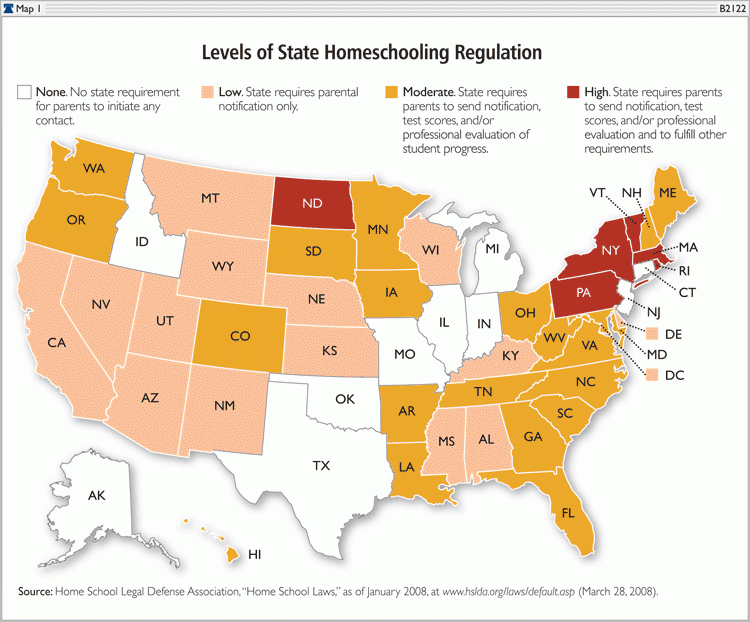
Current info about levels of government regulation for homeschoolers per state.

Total number of surveys: 44

Women: 34

Men: 10

(Sadly, the results are a little estrogen heavy, but the male perspective I received was excellent!)

These homeschoolers grew up in:

  • Kansas (16)
  • Virginia (7)
  • South Dakota (3)
  • New York (2)
  • Nebraska (2)
  • Florida (2)
  • Wisconsin
  • Illinois
  • New Mexico
  • North Dakota
  • Washington
  • Texas
  • California
  • Georgia
  • South Carolina
  • North Carolina
  • Ohio
  • Colorado
  • Illinois
  • Military family (3)
  • Overseas

These adults now live in:

  • Virginia (13)
  • Kansas (6)
  • Mississippi (2)
  • Georgia (2)
  • Florida (2)
  • California (2)
  • Oklahoma (2)
  • Iowa
  • Texas
  • North Carolina
  • West Virginia
  • Delaware
  • Missouri
  • Kentucky
  • Ohio
  • Nebraska
  • Washington
  • France
  • Japan (2)
  • Germany
  • Cayman Islands
  • Turkey

Age range: 18-37 (my minimum requirement was for the participant to be out of the house for at least one year)

Average age: 26

Fun fact: this means that earliest these families started homeschooling was around 1980!

Number of siblings range: 0-13

Average: 3 siblings

Number of years homeschooled range: 5-13

Average: 11 years

Marital status:

  • 22 married (4 spouses had homeschooling experience)
  • 16 single
  • 2 Divorced
  • 2 Engaged
  • 2 in a relationship

I included the sibling information because, in my own experience, homeschooling families tend to have large families. As you can see, the range of siblings in each family is pretty dramatic (from an only child to a family of 14 children!) The average of 4 children in a family seems pretty “normal” to me. Many homeschoolers talked about relationships with siblings in the surveys so that is why I included this information.

I also wondered though, “Does the “largeness” of a family affect the homeschooling experience positively or negatively?” I didn’t receive overwhelming data on this point but I think that two examples may provide a good contrast to answer this question.

M. M. a 29 year old from CA was the oldest of 8 children. She describes a negative experience related to family size:

My mom didn’t seem to be involved very much in my individual learning or invested in only my education since there was so many kids. I felt this was a disadvantage to me . . .My mom would start at the youngest child and work her way up to the oldest in going over their homework, teaching, etc. I don’t think she got to me very often.”

In 12th grade, M. M. did her homeschooling with another family where the other mother kept all of the young people accountable for their work.

This is just one example, of course. But in this case, family size seemed like a detriment to M.M’s homeschooling experience.

Contrasted with this is Beka R’s story, a 25 year old from Kansas and the 2nd oldest in a family of 14 children. Though Beka came from the largest family in survey group, she implied that academics were a very strong focus and stated that family relationships were the most positive part of her experience:

“One of the best things homeschooling did was allow for strong family relationships – we had school on Saturdays and had Thursdays off because that reflected my dad’s work schedule, and those Thursdays with my dad are something I’ve always cherished. I think that the primary influencers of my foundational years were my parents and grandparents, and that is something that has always shaped my values.

Most responders had a very strong family and the number of children did not seem to negatively affect the homeschooling experience (or they didn’t mention it). I think it is interesting that homeschoolers have large families though and, in my own experience, homeschooling helped make relationships with my family stronger.

What do you think? 

Did you come from a large family who homeschooled? Did it enhance or take away from your education?

Please comment or ask any questions!

*****

To be continued.

Adult Homeschoolers Speak Out: Part One, Why I Wanted to Write This

Adult Homeschoolers Speak Out: Part One, Why I Wanted to Write This

HA note: The following series is reprinted with permission from Brittany’s blog BAM. Part One was originally published on May 24, 2012.

*****

Also in this series: Part One: Why I Wanted To Write This | Part Two: Survey Stats and Large Families | Part Three: Top 3 Reasons Parents Homeschool | Part Four: Academic and Emotional Experiences, K-8 | Part Five: The Highschool Experience | Part Six: College? Prepared or Not? | Part Seven: What About Socialization? | Part Eight: The Best Thing vs. What Was Missing | Part Nine, Do Former Homeschoolers Want to Homeschool? | Part Ten: Are the Stereotypes Better or Worse?

*****

Series Preface for HA

** In the introduction to my blog series in 2012 about Adult Homeschoolers I wrote that “everyone turned out fine.” This phrase may seem odd and may even seem hurtful to some HA readers and writers due to the fact that many of the stories on HA deal with the painful past of many adult homeschoolers. The purpose of sharing that “everyone turned out fine” was to state that everyone who participated in my series is now a strong, functioning adult who has worked through or is working through any struggles from their homeschooling background.

The purpose of my series was to look at the “good, bad, and ugly” issues of homeschooling in an honest and fair way, with the underlying thread of hope by sharing the experiences of many adults from all around the USA. I hope that, as you read, you will be able to identify with the stories of these men and women as they share the reasons their parents home schooled, their elementary and high school years, the “best” and “worst” thing about homeschooling, adjusting to college, socialization issues, and if they plan to homeschool their own children.

I hope that as you read, you will also feel hope; know that you are not alone.

*****

Part One: Why I Wanted to Write This

I was a first generation homeschooler.

…meaning my parents starting homeschooling in in the late 1980s right after it became legal in Nebraska (where I was born). In my elementary years, when someone asked where I went to school, 99% of the time my answer would produce a furrowed brow and the question, “What is homeschool?”

Nowadays, everyone knows someone who is homeschooling or who was homeschooled. First generation homeschoolers have grown up, gone to college, and have started families of their own.

My own children are now almost school age (I have twins who will be 5 in October) and in recent months I have been contemplating my own schooling experience.

I wondered:

  • Do former homeschoolers want to homeschool?
  • What do they think of their homeschool experience?
  • Were they happy and satisfied? Did they wish for more?
  • Were they prepared for college academically and socially or were they scared, unprepared and awkward?
  • Are they stereotypes of homeschoolers true? (homeschoolers are brainy/stupid/socially stunted/well rounded/fill in the blank?)

I spent hours on the internet, trying to find articles, blogs, anything written by former homeschoolers about their homeschool experience. I was disappointed by what I found (or the lack there of). Either I found stats about how homeschoolers are successful (with no personal testimony involved) or personal testimonies that I distrusted because I thought they were too “Pollyanna” in nature. I wanted to read about the honest experiences of adults homeschoolers, the good and the bad, the advantages and disadvantages, their thoughts on their academic experiences and the issue that homeschoolers everywhere never seem to escape:

“What about socialization???”

So I put together a short survey and and used the wonderful world of social networking to launch this blog series. I received 42 responses from adult homeschoolers from all over the USA (childhood friends, people I went to college with, friends, and friends of friends).

I am excited to share the data I have collected with you: adults who were homechooled, parents who are homeschooling their own children (and may be wondering, “Am I doing the right thing? Am I messing up my kid? WHAT ABOUT SOCIALIZATION????”), or anyone else who is curious about the lives and experiences of homeschoolers.

Here is a little sneak peek at the end of the story: Everyone [that took my survey] turned out fine. **

Not always “happily ever after” and not without some bumps, awkwardness, struggles, and obstacles on the journey to adulthood.

But, really, everyone [that took my survey] turned out fine.

[Some] parents, breathe a sigh of relief.

And keep reading.

You can look forward to personal testimony about topics such as:

  • Why first generation homeschool parents decided to homeschool
  • The academic and emotional experience of homeschoolers in grades K-8
  • The academic and emotional experiences of homeschoolers in grades 9-12
  • Do homeschoolers pursue higher education?
  • Were they truly prepared academically?
  • Were they truly prepared socially?
  • What is the best thing about homeschooling (so many people said the same thing! amazing!)
  • What former homeschoolers wish was different about their experiences
  • The inside perspective about the advantages and disadvantages of homeschooling
  • Do former homeschoolers plan to homeschool their own children?
  • The homeschoolers perspective on society’s thoughts and opinions about homeschooling

This series will be honest in every way, exploring the good, the bad, and everything in between. While my posts will primarily be focused on the results of the survey, I will also share my thoughts and experiences as they relate to the survey results.

I hope that this series inspires conversation, stirs up memories (for former homeschoolers), incites conversation, provides insight and information, and ultimately encourages those who read. Please feel free to comment, ask questions, and share your own thoughts and experiences.

*****

To be continued.