Getting Bi Ain’t Easy, No Matter Where You Are: Isaiah

Getting Bi Ain’t Easy, No Matter Where You Are: Isaiah

HA note: The author’s name has been changed to ensure anonymity. “Isaiah” is a pseudonym.

I don’t think growing up bisexual or otherwise sexually complex is easy in American culture, regardless of how you’re educated. I suffered through long issues of self-illegitimacy as a consequence of bisexual erasure, which can happen in mainstream culture just as easily as in evangelical circles.

That said, the relationship between homeschooling and the development of sexuality is a complicated one. All things being equal, homeschoolers — especially those with healthy social lives — would have the same basic kind of sexual development as anyone else. But in the largest and most representative homeschooling culture, it’s apparent that all things are very much not equal.

The glaring difference between being homeschooled and publicly educated is the potential for isolation, and that can play havoc on myriad factors of development even if you’re part of a relatively liberal family. The more isolated from the multiplicity of human behavior you are, the more critical every small cultural influence is, and the more damaging harmful beliefs can become.  In my experience, there is no place this hits harder than in the development of one’s own sexuality, especially for those who don’t fit easily into archetypal, simplified cultural frames.

As I have mentioned in a previous essay on this site I was raised in a relatively liberal Christian home but studied a fundamentalist curriculum, which was rarely contradicted despite my family’s milder beliefs. The media I watched and listened to, the books I read, and my family life in general never argued with this fundamentalist ideology, and it became a strong part of my reality.

My mother’s inherent empathy and lack of an authoritarian personality wouldn’t allow her to follow the most bigoted aspects of her faith, and she did not “protect” me from certain cultural influences as many other homeschooling parents did. I knew that gay people existed and didn’t think much about it — I simply assumed they were people who fell in love with their own gender instead of the other one. I knew, too, that people sometimes loved other people but didn’t get married to them, or that people could love more than one person at once.

But this knowledge was tempered by severely restrictive cultural archetypes — gay men were like women, gay women were like men, people who loved each other always “should” get married, and so on. My curriculum helped to push these mainstream archetypes into my consciousness too, and went even further as it became more strongly fundamentalist over the years.

All the subjects — history, math, science, Bible, and English — attempted to discuss sexuality in their own way. But they did so in very limited terms, probably to avoid offending the really fundamentalist parents who made up part of their target market.

History and math made poor platforms for propaganda about sex and human relationships, so they were largely free of this particular stain save the occasional Bible verse. Science never mentioned sexuality in any way for over nine years, then one day, in grade ten, a unit about human sexuality and anatomy was introduced. It was ten percent anatomy and physiology, and ninety percent propaganda — mostly the standard lines that define the purity culture and the cult of the “traditional family”. Nowhere in this lesson plan was anything other than straight, male-dominated sex mentioned, even as behavior to avoid — and once the lesson plan was finished, sexuality was never mentioned again until the next grade year.

English and “Bible” both hit the hardest with moral teachings, English doing so mainly through its reccomended reading list and Bible accomplishing the task merely by existing. There was never a fire-and-brimstone shakedown to scare you off from “immoral” behavior — which meant essentially anything but male-dominated missionary heterosexual sex within wedlock — but it became clear very quickly what was acceptable and what wasn’t.

I will give my former curriculum credit for its relative subtlety compared to other brands of evangelical education, but the message still stuck. I can remember being taught about “purity”, which, though emphasized to girls, made its point with boys too. Through cognitive dissonance or ignorance, I actually never perceived my curriculum’s obvious prejudice against homosexuality (which was never actively acknowleged, just hinted at constantly) or its extremely black-and-white morality with regards to sex and marriage, both of which I had been raised to perceive in a more tolerant way.

None of this mattered to me for much of my childhood, of course. I began to develop sexually fairly early and have always possessed a somewhat high sex drive, but I didn’t begin to have any issues until after my pre-teen years.

I grew into a teenager in an environment much more isolated than where I lived as a child, and for various reasons fell into a state of chronic but functional depression for several years. The overwhelming feeling of illegitimacy in my sexual identity was a major factor in perpetuating my depressive tendencies, and to this day can act as a trigger for depression. When the agonizing confusion I felt in my early teenage years finally stopped, and I realized the cold truth of my own variances in sexuality, I became mentally paralyzed with the idea that there was something wrong with me, something that I could not find a way to fix.

I was a torrent of repressed emotions nearly all of the time, afraid to express myself for fear of being thought evil or crazy in some way. In the depths of my mind, my instincts constantly pushed me to feel as though there was nothing at all wrong with me, that I was legitimate and had every right to exist as I was, whatever that may be. But without any cultural context or knowledge that bisexuality or sexual fluidity existed, I could never fully accept this idea. Whenever the disharmony between my instincts and my fear and guilt was brought to light, depression would take hold again and I would feel inwardly dull for hours or days. This was by no means the only reason for my depression, but it was probably the largest single factor at any given time. It peaked and finally began to slip the further I moved from the religion and curriculum I was raised with, and now that I have abandoned them completely, only their murky shadows remain.

I can’t say what was unique about my homeschooling experience, as it relates to sexuality, compared to a conventional education. It would be much more clear-cut if I identified as simply “straight” or “gay” — and likely more predictable too.

I’m sure those who are homeschooled in a truly evangelical environment — not the milquetoast one I was raised in — would prefer the risks of being bi in public school to the almost certain abuse and erasure they would suffer at the hands of fundamentalist families. But being bi, and especially learning that you’re bi, is usually a difficult and traumatic experience in both mainstream culture and the various homeschooling subcultures. Bisexual and sexually fluid people are far harder to stereotype and classify than people who identify as gay or straight or transgender, and as such have very little cultural presence, often being treated as mysterious and alien or vicious and predatory when they are given a space to exist at all. The ease with which bi and fluid people can get out of the game by simply sublimating part of their identity and identifying as merely “gay” or “straight” compounds the problem.

The fact is, having any sexuality that’s difficult to stereotype is hard no matter where you come from. When I was depressed all those years, I craved one thing more than anything else — existence. I didn’t need acceptance, permission, or tolerance — just the right to exist. In short, I needed to not be erased. But if you were to ask me whether it would have made a difference had I not been homeschooled, whether I would have been allowed to exist had I been sent to a conventional school instead, I can only say that I don’t know.
Tough Love: Susie

Tough Love: Susie

HA note: The author’s name has been changed to ensure anonymity. “Susie” is a pseudonym.

Hi, my name is Susie. I am a gay woman in my 20’s who was raised in a very conservative Christian homeschooling family in the South. I have been “out” for six years.

A few weeks before my 22nd birthday I had a revelation; I figured out what was “wrong” with me. I realized — I’m gay. And what’s more, even though I was a very conservative Christian, I had complete peace about my sexuality. I knew some within my circle probably wouldn’t accept my sexuality, but I thought my family would accept it. My mom started asking me if I was gay or if I thought I was gay when I was about 14 years old and a few of my siblings had asked me as well as I got older. I had shown little to no interest in the opposite sex, and we all know how abnormal that is in the homeschool community.

My family is very close-knit, so shortly after I realized I am gay, I told them. Their reactions were nothing like I had imagined. Honestly, I must have been totally naïve because I really thought they would support me and still accept me. Instead, my family totally freaked out on me. My mother cried and cried. My dad tried to comfort me by telling me that I am young and just haven’t met the right guy yet. My older brother actually had the nerve to ask me if I was just trying to eccentrically prove that you could have conservative values yet be gay.

My family was — and, I am sure, still are — well known in the conservative Christian homeschooling community. So my mom kept asking me “What will people think?” For her, what people thought about me being gay — and how that reflected on my family — was a huge concern.

Most conservative Christians are against psychology and therapy. Somehow or another its anti-God or whatnot. I am sure that is a topic in and of itself…anyway! My mom called around, found a ‘Christian Therapist’ and sent me to this therapist.

During this time, things were extremely hard for me at home. My family treated me totally differently. Every conversation was about my struggle. I was under complete surveillance; my every move and action was monitored. My mom kept track of the mileage in my car based on the approved places I was allowed to go, which was pretty much limited to my therapist. I was not allowed to go to the therapist without a chaperone, which typically was one of my siblings. My cell phone had been confiscated and I was not allowed to get on the Internet without — yep, a chaperone. At the time, I was a partner in the family business so my parents really controlled every aspect of my life.

After a few weeks of gay therapy, I was still gay so my parents did the unthinkable. They both, in my opinion, totally slipped over the edge of reason. I had gone to my therapy appointment and when I came home, as I was pulling in the driveway I realized my driver’s license was not in the console of the car where I usually kept it. So I went inside and asked my mom if she knew where my driver’s license was. Long story short, in an effort to “protect me from myself,” my dad had taken my driver’s license, passport, social security card, birth certificate, credit card and debit card and put them all in a safety deposit box at the bank. I had no legal identity!

I am trying to share enough details to paint the picture, without boring you. So I am going to cut to the chase.

My mom ended up driving me two hours away, in my car, with some of my things and dropped me off with $7 to my name. Tough love is what they called it. I was lucky enough that a friend had a house with two of his friends and they let me stay in an open room. I had no bed, just a pillow and a sleeping bag with some clothes. I didn’t even have a blanket.

Tough love.

I have not been home in six years. Three of my four siblings refuse to talk to me. Two of my siblings have gotten married; I was not at either of their weddings, nor was I invited. I have two nephews and a niece, I have not met any of them and I don’t think I ever will.

Sounds pretty sad right? Well it is. I am not going to lie, I miss them. I miss them so much it breaks my heart.

But you know what? That’s their choice, not mine. I may be missing out on their lives but they are missing out on mine, as well.

Within a year of coming out, I had been made homeless, put through hell, I am sure I had a breakdown. But I discovered who I am, what I am made of, what I can go through and I leveraged my stubbornness into becoming a hardcore fighter. And best of all, I met the love of my life. We just celebrated our five-year anniversary.

Coming out, for me, was a spiritual experience as much as it was a literal/physical one. Depending on feedback to this post, I can and will share more. Just let me know. I can go on and on about homosexuality and the Bible/Christianity.

Guard Your Heart, Part One: Kathryn E. Brightbill

Kathryn Brightbill blogs at The Life and Opinions of Kathryn Elizabeth, Person.

*****

In this series: Part One | Part Two

*****

It turns out that it’s easy to guard your heart when you’re not attracted to someone, but I’m getting ahead of myself here. To begin this story, we need to go back in time, back to when I was a homeschool kid growing up in the ‘80s and ‘90s.

Despite my parents running the private school for homeschoolers, and my mom finding herself spending far more time on the phone giving advice to new homeschoolers than she would have liked, and that one time that they wound up helping to put together a state-wide homeschool convention (something they vowed never to do again), my family wasn’t nearly as connected to the homeschooling subculture as many people. There really wasn’t that much of a homeschooling subculture when my parents started homeschooling, since back in the mid ‘80s there weren’t many homeschoolers.

Most of the national opportunities like debate weren’t around until I was done, or nearly done, with high school. Also, my mom didn’t particularly like hanging out with other homeschool moms and talking about each other’s children, and (with the exception of the aforementioned convention) avoided homeschool conventions like the plague. The parade of supermoms in denim jumpers and white sneakers who sewed all their own clothing, baked all their bread, and still found time to design grade-appropriate unit studies made her feel inadequate—after all, she didn’t do a single unit study in 18 years of homeschooling, hated denim jumpers, and especially wasn’t going to be sewing the aforementioned jumpers. That’s not to say I didn’t have more than my fair share of homeschooled friends, but they were mostly ones I knew from non-homeschool circles, and I never considered myself one of those homeschoolers. We were about as mainstream as they come.

I don’t remember where we first heard about courtship, just that somewhere along the line when I was in middle school it began to become fashionable even among the friends who were mainstream homeschoolers. These were not the people who made their daughters wear shapeless jumpers and wouldn’t let them cut their hair; they were the cool people with the latest clothes who educated their sons and daughters equally, and it all seemed so reasonable couched in the idea that it was all about waiting until you were done with college and had a career before pursuing a serious relationship. And didn’t it make sense? After all, when my parents met my dad had already finished his first master’s degree and my mom was 28, independent, and had even studied in the UK and traveled around Europe. What was the point of rushing into a series of relationships before you even had the chance to live?

This not being the 19th century, none of us knew how this whole courtship thing was supposed to work in the modern era, but then someone had given someone else some tapes from this guy who talked about courtship, and he went by the name Little Bear Wheeler, and, oh, you should listen to him because he might be a little out there but he’s entertaining. And so off my family, who hated homeschool conventions and avoided them like the plague, went to hear this Little Bear fellow speak. That’s how these things seem to work in the homeschool world and how normal families get pulled into extremism. You start out reasonably and the next thing you know you’re wearing your one and only denim skirt (because you instinctively knew that’s what you needed to do to blend in) and you’re listing to a guy cosplaying as a pilgrim who’s telling you that the Puritans didn’t date.

I don’t remember many details, it’s been nearly twenty years, but I do remember hearing, over and over, that you needed to, “guard your heart.” If you guard your heart, then you won’t give pieces of it away to the wrong guy. If you guard your heart, then you won’t have frivolous crushes on guys who would never be suitable mates. Guard your heart. Guard your heart. Guard your heart. If you’re really spiritual and godly, you’ll be able to guard your heart until the right season of your life.

It was a message that grew into a chorus in the homeschool circles I grew up in. Guard your heart, always and in every situation, guard your heart. By the time I neared the end of high school, the chorus had grown into a cacophony, as courtship went mainstream into evangelicalism with Josh Harris’ “I Kissed Dating Goodbye.” And by the time I made it to college, it seemed as though everyone had read it, and even if they called their relationships, “dating,” it was still operating on those general principles.

Through all of this, I patted myself on my back because I wasn’t getting any “frivolous” crushes on guys, and clearly this meant that I was super spiritual and doing a great job of guarding my heart. It turns out it had less to do with being super spiritual than it had to do with being super gay.

But again, I’m getting ahead of myself.

I’ve never asked my parents about this, so I don’t know what they would have done if one of us had wanted to date in high school, or what they would have said if we’d have read all of the courtship material, listened to the speakers, and announced that we thought it all bunk. My parents didn’t have a problem with me voicing an opinion that was different than theirs, and if I had objections to courtship back then, I suspect that I could have brought those up and we would have discussed it. Except that I didn’t have any objections because my siblings and I all bought into it. It didn’t matter that we were as mainstream as they come, that my sister and I both wanted educations and careers and had been taught we could be and do whatever we set our minds to, that my brothers didn’t want to marry someone who wasn’t their equal, we still bought into it. Their experiences and opinions are not my story to tell, other than to say that despite all buying into it, eventually we all decided that the whole courtship system was a problem.

By the time you make it through college you think that you know yourself. College is when you’re supposed to find yourself, after all. And so, even after I decided that courtship was bunk, I never stopped to consider that the reason I hadn’t met the right guy had anything to do with anything other than the fact that my hometown has a serious dearth of college educated, available men. Seriously, it’s quite literally one of the worst metropolitan areas in the country for a college educated single woman to find a guy with an education, and there are plenty of statistics to back that up. It was an easy excuse, especially considering that my sister spent plenty of time complaining about the demographics too. So easy an excuse, in fact, that it never crossed my mind that it was an excuse.

To be continued.

From Homophobe to Gay Rights Advocate: Libby Anne

From Homophobe to Gay Rights Advocate: Libby Anne

HA note: The following is reprinted with permission from Libby Anne’s blog Love Joy Feminism. It was originally published on Patheos on January 16, 2012.

I didn’t meet a gay person growing up. “Homosexuals” were talked about in tones of disgust and sorrow, and we children knew that it was wrong for “men to kiss men” and “women to kiss women,” and that the Bible condemned homosexuality, but it was all in the abstract. It was about those depraved people who were out there trying to ruin marriage and subvert youth, not about any actual people we knew.

This is the story of how I met gay people, heard their stories, realized that they were human, and changed my position on homosexuality.

I met my first gay person in college. I didn’t know he was gay when I met him. Bobby was just the clean-cut, fun-loving guy who hung out in the dorm lounge and cheered everyone up with his words of encouragement. Bobby was smart, compassionate, and encouraging, he was there for everyone and everyone loved him. He came from a good family and was extremely successful in school, headed toward a career in computers. Halfway through freshman year Bobby came out as gay. This was completely unexpected.

Growing up, the most important things my parents and church had emphasized about homosexuality was that it was a choice, and that it was a horrible, ruinous, depraved lifestyle. Bobby challenged the later of these two teachings, for I could not understand how this wonderful, loving, compassionate young man could be holding such depravity inside. I had expected every gay person I met to be sporting piercings, tattoos, outlandish clothing, foul language, hedonism, depression, and likely several incurable diseases leading him to his grave. Bobby challenged this expectation because he did not fit it, not in the least.

Later in college I met a biology graduate student, Eric, who was openly gay. Like Bobby, Eric was clean-cut and respectable. I enjoyed talking to him about evolution, global warming, and other science-related issues. Because I knew him only ephemerally, I felt comfortable enough to ask him how he first figured out that he was gay. He explained to me that when he was nine or ten a friend of his showed him a playboy magazine he had found, and that was when he first realized he was different, because that magazine was doing something for his friend that it didn’t do for him. As he went through adolescence, he was never sexually attracted to females. Instead, he was sexually attracted to other males. This was not, he explained, something he had chosen, and it was not something he could change. After all, being gay had cost him his entire family, which had rejected him when he came out.

Eric thus challenged the second thing I had been taught about homosexuality, that it was a choice. Eric explained most emphatically that being gay was not something he had chosen and not something he could change, not anymore than I could change being sexually attracted to males.

In graduate school, I had a gay coworker, Doug. His background was similar to mine, growing up in a conservative religious family very involved in the church. Doug explained that being gay was never something he asked for, and that as a teen he prayed that it would disappear. He heard the teachings of his church about the evils of homosexuality, and he came to despise himself, to wish that he were dead, to feel that he and his family would be better off if he were dead. Finally, halfway through high school, he attempted suicide by swallowing a bottle full of pills. This left him violently ill, vomiting blood, but did not kill him. In college, after years of hiding it, he finally came out as gay, and for the first time the depression lifted and he felt that he could truly be himself. For the first time, he was truly at peace, truly happy, truly fulfilled.

Meeting gay people thus threw into question the things I had been taught about homosexuality as a child: that it was a choice and that it was a depraved, hideous lifestyle. Yet even with this, I had been taught that the Bible condemned homosexuality. I knew that if this was the case then whether or not homosexuality was a choice and regardless of how nice or loving or normal-seeming gay people might be, it was wrong. Yet it was during these same years that I realized that I could not take the Bible literally, and and that I must understand it in its proper cultural and historical context. I soon learned that the Bible’s condemnation of homosexuality is not at all as clear cut as I had been raised to believe it, and I did not see how a God of love could create people with homosexual attractions and then condemn them for it. As I began to see God’s love as more important than his judgement, and his ways as less black and white than our narrow understandings, I reevaluated my theological position on this issue. A few years later I became an atheist, which made what the Bible says or does not say about homosexuality irrelevant.

Today, I feel completely comfortable around the gay people I meet and befriend. They are people just like me, with their own hopes, dreams, and interests. They are not defined by their homosexuality any more than I was by my heterosexuality. Today at long last I can accept gay people without any remnant of my earlier inside squeamishness or disgust.

Furthermore, stories like Doug’s have turned me into a big of a gay rights activist. Something like 30-40% of gay youth attempt suicide just like he did, not because being gay gives them depression but because the homophobic messages they receive from their families, churches, and communities make death seem more attractive than life. Last week on NPR I heard the story of a gay young man whose mother suspected he was gay when he was only ten, and took him out into the woods, pointed a loaded gun at him, and told him that this was the place she would shoot him through the head if he ever became a “faggot.” There is also the story of my bisexual friend who was rejected from her religious community when she came out as bisexual, even though she had been raised in that community from infancy.

There is also the fact that if Bobby, or Eric, or Doug wanted to marry their partners (two of the three are in long-term relationships), in the states where they currently live they could not. They would not be allowed to visit each other in the hospital or make medical decisions, they could not file joint tax refunds or have any of the other benefits that go to married couples. I hear people like twice-divorced Newt Gingrich condemning gay marriage as a threat to the institution of marriage, and I become angry inside. Bobby, Eric, Doug, and the other gay people I have befriended are not bad people. In fact, they are some of the most loving, accepting people I know. They deserve to have the right to marry the person they love just as much as I, or Newt Gingrich, or any heterosexual person can.

I understand where people like Newt Gingrich are coming from. I understand that they believe God has condemned homosexuality and that they harbor a veritable library of destructive myths and stereotypes about gay people. They are my parents. They are the church I grew up in. I get it. It’s just that I no longer agree with them. Today, I believe in equality.

Coming Out: Kierstyn King

Coming Out: Kierstyn King

HA note: The following is reprinted with permission from Kierstyn King’s blog Bridging the Gap It was originally published on May 1, 2013.

I’ve never talked about this explicitly publicly – I’m open about it to people who ask, and I don’t hide it, but I’ve never really felt the need to come out and say it (because honestly, it’s no one’s business).

The reason I’m coming out with it now, is because I embrace it – I’m proud of it even, and it would come out eventually, so why not?

I’m bisexual. It took me a long time to admit to myself due years of repressing my sexuality growing up, years of feeling guilty because I wasn’t completely straight – but I embrace it now, I love this about me, and it’s so freeing to be open about it.

The other reason I haven’t mentioned it was because I was afraid of the fallout with family. I’m not anymore, because it doesn’t matter. I’m not a different person just because I’m bi (I’ve always been bi) – but this doesn’t mean that I flirt or drool over every female I encounter, just like I don’t do that with every male that I encounter. Just because I’m not 100% straight doesn’t mean that I’m on the prowl or uncommitted to my husband (because he’s my favorite person. period.).

Actually the openness about it has been beneficial to our relationship – because hiding part of yourself from your spouse or significant other is never a good thing.

So here I am – I am the same, I haven’t changed (except for getting a tattoo) – I’m just not hiding anymore.

Genderbread-2.1

Growing Up Gay Is Like Growing Up In A Warzone: Andrew Roblyer

By Andrew Roblyer

When I first sat down to write this piece, I had never really asked myself what role I thought that homeschooling played in my life with regard to my sexuality.  I knew what role I felt Christianity has played, but in my experience homeschooling isn’t synonymous with Christianity of any type, even conservative fundamentalism.  And as I have created a virtual pile of crumpled up attempts to put my thoughts into words, I’ve been confronted over and over again with the fact that my homeschooling experience is, just like everyone else’s on this site, unique to me.

In our family, homeschooling was a way of structuring our studies; the overall way we were brought up had more to do with our faith than with our choice in educational styles.  I know that if we hadn’t homeschooled, we probably would have been at church almost as often, I would have been just as introverted and nerdy, and many of my issues with faith and sexuality still would have manifest themselves in my life.

In other words, I realized that I can’t blame “homeschooling” or even “the homeschooling movement” for the majority of my struggle in coming to accept and love the person that I am.  What I can (and want to) do is explore the ways that my experience as a homeschooler accentuated that struggle.  In the end, I hope that this piece will outline some of the challenges homeschooling brings for people like me that identify as lesbian, gay, bisexual, or trans*. (* Why the asterick?)

I didn’t know what “homosexual” meant until I hit puberty around age 13.  But once I was informed of its meaning, I distinctly remember a thought crossing my mind: “That’s what I am.”  At the time I didn’t fully comprehend the implications of that realization, but I knew that it wasn’t a good thing.

In many ways, I grew up a stereotypical “gay boy,” interested in cooking and reading and playing house with all of the girls in the neighborhood.  I studied ballet and loved theatre and choir.  I designed my dream house in my head and loved interior decorating shows like Trading Spaces.  I played with dolls and stuffed animals.  All of the “signs” were there, but really the only thing that mattered is that I never once looked at one of my female friends and developed a sudden case of the butterflies.  Instead, I crushed on the boys at Scout meetings or youth group or children’s choir.

To their eternal credit, my parents never stifled my creativity or my passions.  I remember several lectures about my limp wrists and walking like a man (no hip-swaying), but those were more about external appearances and protecting me from the comments that they heard far more than I did.  And despite having a father who was in the military, I was never subjected to parental chats about “manliness,” because my parents were far more concerned with my character than any external trappings.

But from the moment I learned what “homosexual” meant, I knew that I would never truly be the person they wanted me to be, because I knew that I was inherently flawed.  And as is often the case with things like this, once I knew what the word meant, I began noticing it everywhere.  But in the conservative Christian circles (including homeschooling support groups) I was a part of, it was rarely something I heard in its entirety.  Instead, it was like something just out of the corner of my eye, a fleeting shadow in the midst of a conversation.   It was that-sin-which-must-not-be-named.

Even though nobody wanted to be the one to say it, it came up over and over in conversation, often in the form of discussions about “manliness” and masculinity.  What was and wasn’t appropriate for men to do, how men should dress, how men should behave.  I was once asked, in high school, to have a discussion with two younger boys about their “effeminate behavior” and remind them that it was how “the homosexuals” behave.  And it was in moments like that, when the shadowy topic stepped squarely into my field of vision, that the fear was the strongest.

I often equate growing up gay to growing up in a warzone, where bombs fall all around you day after day after day.  Eventually the abject terror you feel when one lands nearby fades into a constant clenching in your stomach that you don’t even realize, because while you can’t entirely relax, you can’t afford to run at full alert at all times.  I saw and heard so many gay people attacked and condemned by the people I grew up with that my stomach was perpetually clenched, terrified that their rhetoric and doctrine would be used to attack me if they ever found out.

I did everything I could to try and “fix” myself, including looking into electroshock therapy, though thankfully I had to have a parent’s consent and there was no way I wanted to tell my parents.  Eventually, after a failed attempt to turn myself straight by dating my then-best-friend (a woman) in college, I reached the end of my rope.

I fell into a deep depression, was suicidal on multiple occasions, and through it all was desperately trying to reconcile my faith (and thus the large majority of my friends and family) with my sexuality.  Eventually, through the grace of God and the support of my parents, I came out of the closet.  It was not a firm step; it was more of a feeble stumble.  But it was a freeing experience, and one that was filled with a peace and understanding that I have come to know as the peace of God.

Since then, my faith has become stronger, but my human relationships have drastically changed.  Many of the people I knew when I was growing up are people that I voluntarily disconnected from when I came out, terrified of how they would react.  After all, I knew people who verbally and publicly advocated the death penalty for people who identified as gay.  And I stopped teaching in the homeschooling community (I was a debate coach), because I was scared that the incorrect but prevalent rhetoric I heard so often in that specific community linking child molesters to homosexuality would be used to try and accuse me of hurting the students I worked with.  Thankfully in the time since, I have found people, both former homeschoolers and non, to support me in my faith and my sexuality

So which pieces of my struggle are related to growing up in a conservative Christian environment and which are related to being homeschooled?  This distinction is important to me because, again, the form of academic education I received was, in many ways separate from the spiritual education I received, and I think that many of my struggles would have taken place even if I had been public schooled.  But there are some differences.

1. Homeschooling allowed for a more insulated environment.  While my faith and my academic structure were separate, the support groups and social activities we engaged in as a family were almost exclusively groups that were conservative Christians and homeschoolers.  While there is always the potential for cliques in public or private school environments, you are exposed to a wider array of students and of teachers, simply because of the sheer numbers.  As a homeschooler, I interacted with the same group a lot and had fewer opportunities to meet and interact with different people.

2. Homeschooling’s smaller social circles meant that word traveled fast.  While this is true in any contained environment, the lack of anonymity that might be possible in a larger educational environment mean that it was much harder to justify having conversations about topics that made people uncomfortable, such as sex and sexuality.  For this reason, any and all sexual topics were taboo and “dirty.”  This created a significantly sex-negative environment that still has repercussions for me today.

3. Homeschooling’s all-encompassing nature gives little reprieve.  While my parents always endeavored to teach us to think first and foremost, the constant presence of both family and other homeschoolers meant that you had little time away from those influences.  This was positive in some ways, but as a result could leave you with little opportunity to process and deal with issues related to those people you were around for so many hours of the day.  This is, perhaps, one of the greatest drawbacks I see to homeschooling, and the precise reason that so many parents I knew chose to homeschool: tight, constant control over their children’s lives and educational experiences.

4. The homeschooling environment was so repressed in so many ways that my “eccentricities” often went unremarked on by many of the people I interacted with.  Perhaps my parents received more concerned comments, but the contained environment in which I grew up in many ways explicitly rewarded my “sensitive” nature while implicitly criticizing my “manhood” and “manliness.”

Many of the other parts of homeschooling that I might connect to my struggle to reconcile my faith and my sexuality are, in my opinion, more strongly linked to conservative Christianity, so I’ve left them out for now.

In the end, would not being homeschooled have made my coming out easier?  I don’t know.  In some ways, I think so, in that I would not have felt so insulated and tied to a relatively small number of people who collectively made it known that my sexual orientation was unacceptable.  My parents have been so incredibly supportive and loving during my coming out process, but I sometimes struggle to differentiate between the things they specifically taught me at home and what the homeschooling community as a whole contributed to my development.

This is why I am so grateful for efforts like H.A.  The isolation and insulation created by homeschooling is so powerful that it can be dangerously enticing to parents who hope that their children will live in a certain way.  If the potential for that isolation is not balanced in some way, either from inside or outside of that community, the results can be disastrous.

That is the reason I felt it was important to both write this story down and put my name on it:  because I know that there are hundreds and thousands of homeschooling youth struggling with the same questions I did.  They are probably feeling isolated and insulated and alone, just like I did.  They are likely severely distressed at the thought that they have to choose between the (relatively few) people in their lives that they interact with regularly and being true and honest to who they are.

It is for them that I hope my story (and those of the other H.A. contributors) can help raise the questions that need to be asked to help make homeschooling a better environment for all.

LGBT, Queer, And Other Things That Make Us Say, “What Does That Mean?”: Deborah

LGBT, Queer, And Other Things That Make Us Say, “What Does That Mean?”: Deborah 

HA note: The author’s name has been changed to ensure anonymity. “Deborah” is a pseudonym.

I grew up hearing a great deal about how evil gay people were and how the whole world was going to be destroyed either directly by them or by God because “the righteous” didn’t murder all of “the gays”.  So I thought I knew what it meant to be gay and really didn’t care if that was different from transgender, queer, or any number of other terms I heard.  In fact, none of these terms mattered all that much to me because (forgive my even using the term) I just lumped them all together and called them “sodomites” and figured that they were all pedophiles as well.

Then one day I began to realize that these were real, live people I was talking about in such hateful terms and would have treated like trash if I had met them.  These same people with hopes and dreams and feelings were really just as human as straight people were.  At that point, I decided to meet some of these people, do some research, and see what was really going on with them.  It was very awkward at first.  I knew I had to put away the offensive words, but I really didn’t know what was or wasn’t offensive or what the non-offensive words meant.  Thankfully, I had some patient friends who walked me through all of that.

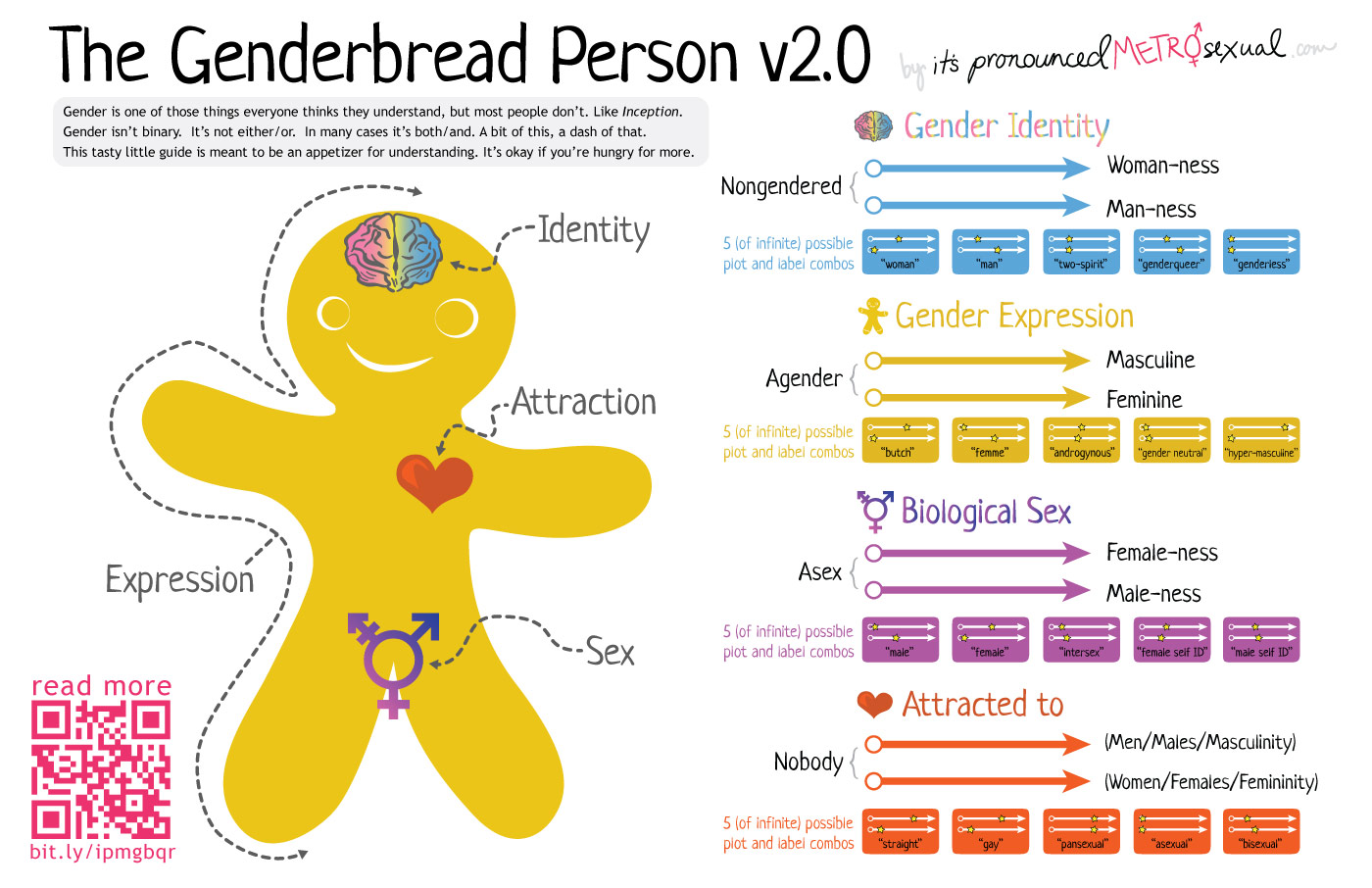
If you relate to this dilemma, let me help you out.  Here is my little friend, The Genderbread Person 2.0

Genderbread-2.1

I know it is confusing at first.  You may notice that each category is on a continuum.  That is because these things are not completely black and white.

Gender Identity: Here we have the most commonly known terms “male” and “female” as well as other possibilities.  This is a person’s truest gender and can only be determined by that person.  Always, when referring to people, use words that line up with their gender identity. If that is unknown or they identify as something like “genderqueer” or “genderless” then gender neutral pronouns  such as “ze” or “zir” may be appropriate.  It is never ok to call a person “it”.

Gender Expression: Not to be confused with biological gender or gender identity, gender expression refers to outward things such as clothing, hairstyle, and mannerisms.

Butch: gender expression that is toward the masculine side

Femme: gender expression that is toward the feminine side

Androgynous: gender expression that has characteristics of both the masculine and the feminine

Gender Neutral: gender expression that is neither characteristically masculine nor feminine

Biological Gender: This is a person’s physical gender. While we generally refer to people in terms of male and female, some people don’t fit very well into either category.   We are not all born with clearly male or female genitalia.  Those who have both male and female physical characteristics at birth are said to be “intersex”.   (Here is where I discourage use of the term “hermaphrodite”, which is no longer appropriate.)

Attracted to: (Also often referred to as “sexual orientation”) Just like the heading says, it really is all about who you are attracted to.   Please don’t question someone’s sexual orientation.  If you say you are hungry for tacos, it would just be silly to tell you that you really want lasagna.

Straight: a person who is generally attracted to people of the “opposite” gender.

Lesbian: a woman who is generally attracted to women.

Gay: a man who is generally attracted to men.  (“Gay” is also used when referring to lesbians.  Lesbians are gay, but gay men are not lesbians.)

Bisexual: a person who is attracted to both men and women.

Pansexual: someone who can be attracted to people of any biological gender or gender identity.

Asexual: someone who has little to no sexual attraction to anyone.  Again, please do not question this.  If you say you are not hungry, it would be rude of me to say that you have just never tried good food or don’t know what you like or want.  Also, do not say that most women are asexual.  This is untrue and offensive.

And now for some other terms that you may be wondering about.

LGBTQ: This refers to the subset of humans who do not fit the mold of  “cisgender person who is only attracted to persons of the opposite gender”. The letters stand for Lesbian, Gay, Bisexual, Transgender, and Queer or Questioning. There are other acronyms such as QUILTBAG, and sometimes people will leave out a letter or two that they don’t like. I hate to say it but there are some in the LGBTQ community who, in spite of everything they have experienced, have a hard time accepting those unlike themselves. Personally, I think the entire culture is becoming more accepting and that includes the queer community. GLBT is the same as LGBT, just with a couple letters switched. I’m sorry I can’t cover the whole queer alphabet soup, so if you hear something and wonder about it, there is always Google.

Cisgendered: a person whose biological gender and gender identity match from birth.

Transgender: a person whose biological gender at birth is different from their gender identity. Transgender persons may be Male to Female (MTF) meaning that their biological gender at birth was male, but their gender identity and therefore true gender is female; or Female to Male (FTM) meaning that their biological gender at birth was female, but their gender identity and therefore true gender is male.  “Gender dysphoria” is the term for the negative feelings a transgender person has toward their biological gender before transitioning.  This feels much the same way a cisgendered person would if they woke up one day and found that their gender had changed while they slept.  The difference would be that the transgender individual would be expecting to wake up in the wrong body – so there might be somewhat less screaming from shock involved.

When referring to a transgender person, always use terms associated with their gender identity, not their biological gender.  Terms like “he-she” or “shemale” are completely unacceptable in this context.  They tend to imply that the person is a sex-worker.  Transgender persons often dress based on their gender identity, take hormone replacement therapy (HRT), and have surgery so that their body matches their gender identity.  It is impolite to ask them where they are at in the process or for details on how these things work.  If you want information on what transgender individuals go through physically, look it up.  Would it be appropriate if I asked you what your genitals look like and what hormones you have in your body?

Queer: used as an umbrella term to cover anyone who is not exactly straight and cisgendered.  Some people still feel negative vibes are associated with this word, so I personally would not use it to refer to an individual unless they first used it to refer to themselves.   It can be used to refer to the whole community when alphabet soup gets tedious.

A: This is another letter that is sometimes added to the alphabet soup.  It stands for Allies.  If you are straight and cisgendered, but support equal rights for all, you are an Ally.  Wear the title proudly.  (Just please don’t try to make yourself sound cool by using this title if you don’t actually support anti-discrimination laws and gay marriage. Many in the community can respect you for being on the fence or even not wanting these laws, but don’t try to pretend you are doing us favors simply because you don’t use cruel language or don’t tell people we should be killed.  It shows that you have no idea what it is like to be us.) If you are an ally, we welcome you to the community and thank you for your support.

If you are still a little worried that you will use the wrong word at the wrong time, take heart.  The important thing is that people know you are trying to choose kind and appropriate words. Don’t be afraid to apologize if you make a mistake or ask if you are not sure about something. If you don’t insist on using offensive language, most people are more than willing to overlook a few mistakes.

Ok, wow! If you made it through all of that, you deserve a little fun.  A friend showed me this. Maybe you will like it.  If you have an iphone, take it out, press and hold the button, then ask, “Siri, are you a boy or a girl?”  Siri will likely say something along the lines of, “Animals and nouns have genders.  I do not.”  It is easy to imagine Siri as a woman because ze has a “woman’s voice”  in English (American).  If, however, you  switch to English (United Kingdom) ze suddenly has a “man’s voice”.  While I have a tendency to prefer thinking of zir as a woman, ze is genderless. I now respect Siri’s gender identity and use gender neutral pronouns.

Homeschoolers Are Out: An Introduction

By R.L. Stollar, HA Community Coordinator

*****

“You’re homeschooled? That’s gay.”

I was probably 5 or 6 when a neighborhood kid who attended public school first articulated the idea that me being homeschooled was “gay.” Of course, nothing about my parents’ decision to teach me at home had anything to do with homosexuality. Plus I’m straight. But that’s not what the kid meant, was it?

What that kid meant was that homeschooling was stupid, and stupid things are gay things, thus equating gayness with stupidity. That kid was also 5 or 6. I have not had contact with him since we played games in the middle of our quiet, suburban street in San Jose, California so many years ago. For all I know, he might now be an outspoken straight advocate for marriage equality, or even gay himself. His use of “gay” at the age of 5 or 6 was probably cultural, something he picked up on in school or maybe from a homophobic parent. Pop culture — then and and today — has often associated “gay” with negativity.

As an awkward homeschool kid who had occasional interactions with kids from public schools (we were allowed to play with them after school in our neighborhood), I always encountered one of two reactions from my friends: either (1) homeschooling was awesome to them because they thought it meant we just got to stay home and play video games all day, or (2) homeschooling was gay. I don’t really remember why they would think homeschooling was anything less than awesome (usually I would pretend that, yeah, we did get to play video games all day, just so they would think I was cool). But it’s possible they saw I was a total dork and deduced that, if total dorks are usually called “gay” and I was a total dork who was homeschooled, then homeschooling must be gay, too. That’s kid logic for you. (Ironically, many adults today still use kid logic.)

The numerous times I heard “homeschooling is gay” stick so lucidly to my mind because it was the first time I ever heard about “gayness.” It wasn’t until years later, when I learned from the conservative Christian homeschooling curriculum and worldview programs that homosexuality was evil and political nefarious, that I consciously thought about LGBT things. But from that one moment through probably half way through my undergrad program, both mainstream and homeschool cultures reinforced this idea that “gay” was synonymous with bad.

This idea, this deeply rooted hatred and desire to discriminate, is by no means unique to the conservative Christian homeschool movement. Yes, you have followers of Rushdoony who actively call for LGBT individuals to be stoned. Yes, you have people like Michael Farris who actively campaign against Prop 8 and the simple right of people of any gender to have a foundational relationship based on legal equality. But at the same time, it seems like almost every other day that I read some heartbreaking story of a gay kid in public school who was bullied to the point of suicide. Every time I turn on the radio I hear a hip hop star throwing gay slurs left and right.

The fact is, LGBT individuals face almost insurmountable discrimination and dehumanization on a daily basis. They experience this in their home life, in home schools, in private schools, in public schools, at work, and when they try to do something as simple as hold hands in public at a restaurant.

In creating this week’s focus on LGBT homeschool awareness, it needs to be clear that the pain and hurt that LGBT individuals experience happens universally. It is not unique to homeschooling. Indeed, with the significant amounts of bullying that these friends and peers of ours can experience in public schools, homeschooling can actually be a safe haven. Sex advice columnist Dan Savage minced no words that homeschooling as an educational option could save lives. When a gay 15-year-old boy from La Grande, Oregon hung himself earlier this year on account of being bullied, Savage noted that the boy, Jadin, had begged his parents to home school him to get him away from the cruelty. Savage said,

My heart breaks for Jadin’s parents and I don’t doubt that they’re filled with regret and I don’t want to make their pain worse. But I’m going to repost my advice for parents of bullied gay teenagers because there are other Jadins out there who haven’t harmed themselves but who may be at risk of doing so:

If you know your gay kid is being bullied at his school err on the side of overreacting. Err on the side of doing something drastic. Err on the side of turning your own life upside down. Because you don’t want to find out the abuse was more than your kid could bear when it’s too fucking late to do anything about it.

Straight parents: If you know your gay kid is being brutalized in his school and you’ve complained and it’s gotten worse, get him the fuck out of there. Homeschool him. Homeschool him and sue the school. Move away. Move someplace more tolerant. Move someplace better. If you can’t move away—or if you can’t move right away—send your son or daughter to live with relatives in another city, a better city…. And straight parents? Once you realize your kid is gay—which parents of gay kids usually realize long before their gay kids realize it themselves—take a long, hard look at the community in which you live. Take a long, hard look at the church where you worship. Take a long, hard look at the schools your kid will be forced to attend.

Then decide if staying put is worth your child’s life.

My heart goes out for Jadin, and for every kid that felt or feels so scared of being him or herself that suicide seems the only option. My heart goes out for all the kids that are hiding who they are, because of this fear. Savage makes a really good point, people: when our communities cease to be unsafe, we need to get out. When public schools cease to be safe for bullied LGBT kids, homeschooling can be an ally to the LGBT movement.

That  being said, many of us in conservative Christian homeschooling subcultures know that not all homeschooling communities are safe for LGBT individuals. Growing up gay or trans or even asexual in a world where the loudest voices demonize gay marriage and advocate stoning can be gut-wrenching and brutal. We who have been through this world know the horror stories: the kids that were kicked out of their homes, that were rejected by nearly everyone who knew them, that were forbidden from ever contacting family and friends again.

This week, Homeschoolers Anonymous honors the voices of our LGBT friends and peers. We are giving a platform to the stories of those homeschoolers who weathered the storm: the ones that are still terrified of coming out, the ones that have come out and experienced rejection, the ones that have come out and found acceptance, and the ones that are still processing everything and putting their selves’ pieces back together.

This week is for everyone that has felt different. The L’s, B’s, G’s, T’s, A’s, Q’s — ah hell, this week is for the whole alphabet of humanity!

Homeschoolers are gay. And so many other things, too. And all of us at HA — regardless of our identities and orientations — stand together in solidarity in the affirmation of each other’s humanity, beauty, and worth.

*****

Update, 05/21/13:

The heart and soul of this week’s LGBT homeschool awareness series is to stand in solidarity with our friends and peers of all sexual identities and orientations. I came up with the title, “Homeschoolers Are Gay,” based on consultation with some personal friends who are LGBT homeschoolers. The goal was to use a title that was inclusive, catchy, and poked fun at pop culture’s perjorative use of “gay” and tendency to otherize. That being said, a concern was raised yesterday that this title can feel alienating to some members of the LGBT community. And if even one person feels alienated, that is one person too many. The whole purpose of this week is to include everyone.

So, after further consultation with several of this week’s writers, I am choosing to rephrase this week’s series as “Homeschoolers Are Out.” I would also like to stress that, whenever I say “LGBT,” I am not limiting the week to those specific letters. All identities and orientations are welcome. I will be changing the main graphic for the series to reflect this rephrasing.

My sincerest apologies to anyone that felt excluded.

On another note: thanks, everyone, for the amazing support yesterday as this series begins. The stories we will be hearing this week are near and dear to my heart, as they are the stories of people I care about and love.