Minnesota’s Celebrated “Homeschool Pioneers” Founded a High-Control Cult

Screen Shot 2014-07-07 at 9.30.38 PM

By R.L. Stollar, HA Community Coordinator

4 months ago, Given Hoffman and Eileen Hoffman — writers for the Minnesota Association of Christian Home Educators (MACHE) — wrote a book entitled, “The Voices of the Pioneers: Homeschooling in Minnesota.” Given Hoffman is a “20 year old homeschool graduate” and “alumni of Worldview Academy”; Eileen Hoffman is Given’s mother and a MACHE Board member. The Hoffmans and MACHE describe their book as follows:

The Minnesota Association of Christian Home Educators (MÂCHÉ) brings you this collection of first-hand stories of more than a dozen homeschool pioneers. Sit down with a hot beverage and enjoy this conversational-style history of those who ventured to do what was considered less than legal and more than a little bit crazy. Learn why parents removed their children from public schools to educate them at home and how these pioneers fought for that right before local courts, district courts, the Minnesota Supreme Court, and in hearings before both the Minnesota House and Senate. Witness the birth of MÂCHÉ and its thirty years of growth and influence. Be informed, encouraged, and inspired by these mostly ordinary yet courageous people.

One of the “courageous” couples the book celebrates is Karl and Suzanne Solum. The Solums began homeschooling in Minnesota in 1982 (a year before HSLDA existed). In the book’s timeline of Minnesota’s homeschool “pioneers,” the Solums are the fourth family to begin homeschooling — so they are on the forefront of the pioneering. The Hoffmans write that the Solums “start homeschooling with a group before it’s legal and begin lobbying for legislation that would make homeschooling legal in Minnesota.”

The following is an excerpt from the Solums’ contribution to the book:

When we first started homeschooling in 1982, it was considered illegal to homeschool. Spring Grove Public School took one of the families of our Christian fellowship to court and charged them with truancy—we schooled as a group.

At that time, we decided as a fellowship to bring the superintendent and principal of Spring Grove to a few of the homes to show them the curriculum and prove the children were being educated and were well socialized. We also talked to them about our Christian convictions that led us to choose home education.

An attorney was hired to defend the family. On the basis of religious liberty, they won the case, which was watched by other counties because of all the people starting to homeschool.

…At that time, we joined Home School Legal Defense Association and Christian Liberty Academy, who both encouraged us and other Christians in Minnesota to lobby our state legislature for a homeschool bill that would make it legal to homeschool with the least possible restrictions.

Karl and his brother John were both at the Capitol at different times, talking personally to as many senators and representatives as they could.

The inclusion of the Solums might not be newsworthy except for one thing:

The Solums founded a high-control cult. That’s the aforementioned “Christian fellowship.” And now they’re in the news because they’re suing that cult.

Last week CBS Minnesota reported the following story: “Lawsuit Exposes Southern Minnesota Religious Group.” CBS reports that,

For 35 years, Suzanne and Karl Solum were members of a Christian ministry called Maranatha in Spring Grove, Minn. They pooled all their money with everyone else in the group but when they left six years ago, they wanted their share and sued. In a Houston County courtroom in June, they testified about decades of control, abuse, and deceit from the man known as the group’s shepherd.

Those decades of “control, abuse, and deceit” were dark and troubling. The group’s “shepherd,” a man by the name of Tom Tollefsrud, has been accused by former Maranatha members of “beatings and punishment,” creating “a hell they were afraid to escape,” and “breaking the jaw of one Maranatha member to ‘teach him a lesson.'” Claims of forced financial and medical decisions have also been made.

But the Solums were not passive participants in this high-control community — in other words, a cult. Beginning in the 1970’s, the Solums actively built the community.

According to the Post Bulletin, Tom Tollefsrud and John Solum (Karl’s aforementioned brother John, who would later lobby for homeschooling rights alongside Karl) “started the group in Spring Grove in 1972, basing it on a ministry founded in 1971 by a youth pastor in Kentucky.” Karl and Suzanne Solum got involved in 1978 (4 years before they started homeschooling.) According to CBS, after “Suzanne and Karl Solum helped start the group,” they “picked a close friend, Tom Tollefsrud, to be their pastor.” The community had shared values, which included homeschooling:

The families all lived in separate homes but by the rules Tollefsrud set, like to homeschool their children, share bank accounts, and involve him in every decision they made, from what furniture to buy to what to wear.

The group “absolutely” believed that God spoke directly to Tollefsrud.

Fast-forward several decades. After eventually becoming isolated and upset by the direction Tollefsrud was taking the group, Karl and Suzanne left the cult in 2008. And they are now suing their former pastor to “secure property that they say is rightfully theirs given certain financial contributions and other considerations over the 35 years of which they were members of Maranatha.” (According to The Post Bulletin says, their legal battles have “spanned five years, two trials, 13 lawsuits, 26 defendants and hundreds of thousands of dollars.”) All of Karl and Suzanne’s children “remain a part of Maranatha Fellowship and testified against their parents.” Karl Solum mourned this fact in court, saying that, “I taught them how to read the bible, but I failed at teaching them to be their own men.”

All this information puts the Hoffmans’ and MACHE’s “Homeschool Pioneers” book in a different light, especially considering that this information has been publicly available and known for several years. The Hoffmans and MACHE neglect to mention any of this. (And so do the Solums in their contribution to the book — which is unfortunate, because some honesty and transparency about their life’s path and mistakes would go a long way here.)

It definitely sounds much better to read

Spring Grove Public School took one of the families of our Christian fellowship to court and charged them with truancy—we schooled as a group.

than to read

Spring Grove Public School took one of the families of our cult to court and charged them with truancy—we schooled as an isolated, high-control group that absolutely believed God talked to our leader.

It also sounds better to read

[Our fellowship] won the case, which was watched by other counties because of all the people starting to homeschool.

than to read

Our abusive, high-control cult won the case, which was watched by other counties because of all the people starting to homeschool.

Finally, HSLDA would definitely prefer

We joined Home School Legal Defense Association and Christian Liberty Academy, who both encouraged us and other Christians in Minnesota to lobby our state legislature for a homeschool bill that would make it legal to homeschool with the least possible restrictions.

to

We joined Home School Legal Defense Association and Christian Liberty Academy, who encouraged our abusive, high-control cult in Minnesota to lobby our state legislature for a homeschool bill that would make it legal to homeschool with the least possible restrictions.

Minnesota Association of Christian Home Educators probably doesn’t want it known that some of their celebrated “homeschool pioneers” founded a high-control religious sect that fostered and hid criminal abuse. Nor does HSLDA want their members to know that the Twelve Tribes isn’t the only abusive high-control group they have supported.

So whitewashing it shall be.

Talking To Kids About Social Services, Part II

cps

HA note: The following is reprinted with permission from Libby Anne’s blog Love Joy Feminism. It was originally published on Patheos on June 12, 2014.

Part One

I wrote yesterday about the fear of social services I received from my parents and from the wider homeschooling community. Once I grew up I realized that this fear was both irrational and counterproductive. Social services was not the enemy, and social workers do important work protecting children from abuse and neglect. Sure, social services isn’t perfect, and they sometimes make mistakes. But what good does teaching children to be afraid of social services do? Absolutely none at all. When I had children of my own, then, I determined to do things differently.

I wanted Sally and Bobby to see social services not as an enemy but as a friend.

Several months ago we got from a store and Sally refused to get out of the car. She was tired and was comfortable where she was. She was four at the time, and I needed to take her inside and get on with my list of things to accomplish for the day. My options, as I saw them, were to either pick Sally up and carry her into the house or to convince her to come inside voluntarily. I decided to try the later and save the former for last resort.

“I can’t leave you out here,” I told her. “I’m your mom and it’s my job to take care of you.”

“I don’t care about that, mom!” Sally insisted. “I don’t mind if you leave me out here!”

“Okay, let me see if I can explain this,” I said, and I got down on her level. “Kids don’t know everything yet, and sometimes they can get hurt. Kids can get lost or hit by cars or stolen or drown or any manner of things. So parents’ job is to protect their kids and take care of them. That’s me—that’s my job.”

I took a deep breath and considered whether to go on.

I didn’t want to give her my childhood fear of social services, but I wanted her to understand that I really truly and honestly am required by law to take care of her, and that leaving her outside in the car alone is literally not an option. Sally likes understanding how the world works and having reasons for things, and she tends to be fairly mature for her age. So I went on.

“There are laws that require me to take good care of you,” I told her, “and if I don’t take good care of you I will get in trouble. There is an agency called social services that helps make sure children are taken care of. If parents do not take good care of their children, social services will come and tell them they have to take good care of their children. And if parents still do not take good care of their children, social services will find them a new mommy and daddy so that there is someone to take care of them.”

Sally considered for a moment.

“Okay, I’m coming inside, mommy,” she finally said, climbing out of the car. “You have to take good care of me, because that’s your job.” And she looked at me and smiled. “It’s your job to take good care of me!”

Sometime later we were at an outdoor event when Sally asked if it was fine if she go off on her own. I told her that I was okay with her moving around a little bit but that she had to stay close enough that I could see her and would know where she was. I reminded her that it’s my job to protect her and take care of her.

“That’s right mommy, it’s your job to protect me!” she said. “And you can’t protect me if you can’t see me!” And with that, she laughed as though she’d told a joke—and she stayed close enough for me to keep tabs on her throughout the event.

I was glad to see Sally being more understanding of times I had to tell her “no” because what she was asking was not safe. Sally had definitely taken to heart that it was my job to take care of her. But I still worried that she might take the bit about social services finding new mommies and daddies for kids who were not taken care of the wrong way, and end up feeling afraid.

Some time after this I was carrying a load of groceries from the car into the house, and Sally was dawdling and lagging behind.

“Come on Sally!” I called over my shoulder. “Hurry up!”

“I’m coming, mommy!” Sally called out as she picked up per pace and jogged to catch up. “Because you have to take care of me, mom, or they will find me a new mommy and daddy, and I don’t want a new mommy and daddy!”

And there it was. Had I messed up, I wondered?

Was I giving her the same fear I had had? After the groceries were safely on the counter and we were both in the house, I pulled Sally aside.

“Sally, daddy and I try very hard to take good care of you,” I told her. “If social services came here to check on you, they would see that we take good care of you. Social services only takes children away from their parents if their parents are not taking care of them at all, or if their parents are hurting them. Does that make sense?”

Sally paused to think. “Those kids need new mommies and daddies, because they need someone to take care of them!”

“That’s right,” I responded. “Social services comes to check things out if someone calls them and says, ‘that child’s mommy and daddy are not taking care of her, she needs help.’”

“And then they help?” Sally asked.

“Yes,” I told her. “They try to help the family, and they only find kids new mommies and daddies if their parents still refuse to take care of them. If social services ever comes to our house and a social worker wants to talk to you, don’t worry about it, they’re just trying to make sure you’re taken care of and happy. They’re nice people and they want to make sure kids are safe. If that ever happens you can just answer their questions, okay? It is their job to make sure children are taken good care of, and that’s a good thing, because it is good for children to be taken care of and not get hurt. Does that make sense?”

“Oh!” Sally exclaimed, “If they come to our house, they will say, ‘do your mommy and daddy take good care of you?’ And I will say, ‘yes, they do!’” And then they will say, ‘that is good, we like mommies and daddies to take care of their kids!’ Right mommy? Right?”

“Wow, um, yes, that’s absolutely right,” I responded. I’m telling you, you just never know with this kid. She does voices and everything. And with that, our conversation was over and Sally was off to play.

It has been some time now since this second conversation, and Sally has not expressed any fear of social services. Indeed, her comment as she ran to catch up with me—the comment that prompted our second conversation—was less one of fear than one of stating facts. Sally is a very logical and ordered child, and tends to be matter of fact like that.

I have to remind myself not to let my own childhood fear of social services determine my interpretation of Sally’s comments.

That it is my job to take care of her, and that I’m required by law to do so, has continued to help at moments when Sally would really like to be outside alone, or to wander around on her own at an event, and I can’t let her. It means that Sally understands that I don’t let her do those things because it is my job to take care of her and I’m required to do so, and not because I want to kill all of her fun.

Now I’m not saying any of this as a prescription. I don’t know for sure whether I’ve handled this topic correctly, or whether I should have held my tongue and found some other way to coax her out of the car that time several months ago—say, offering her a cookie once we got inside, or emphasizing all the things I had to get done in the house that evening. I do know that I just looked around the internet and couldn’t find a single guide to talking to your children about social services. Perhaps that means most people say nothing, and maybe that’s what I should have done too. But with my background of fear, and my parents in my children’s lives, I think part of me wanted to offer Sally a healthy perspective rather than leaving her with a vacuum.

End.

Talking To Kids About Social Services, Part I

Screen Shot 2014-06-15 at 6.36.09 PM
“I grew up afraid of social services.”

HA note: The following is reprinted with permission from Libby Anne’s blog Love Joy Feminism. It was originally published on Patheos on June 11, 2014.

I grew up afraid of social services.

Social workers were something of a bogeyman in the homeschooling community, and my parents bought into it completely. In fact, in a recent conversation on the topic with my mother, she insisted that social workers today do in fact take children away from their parents for nothing more than homeschooling. That she still says this today says a lot about just how high fear of social workers was in our home when I was a child.

In fact, my parents walked us children step by step through what we should do if a social worker came to the door when they were not home. We were not to let a social worker in the door under any circumstances, and we were to call the Home School Legal Defense Association and get a lawyer on the line immediately. My mom had the phone number on the inside of a cupboard by the phone.

I’ve spoke to others raised in the same background as me who actually had drills that involved them hiding in the attic, or in a basement. While we didn’t do this, I well remember hearing conversations about the horrible things social workers do—strip-searching children to search for bruises or interviewing children without their parents present. The homeschooling literature I read was full of references to the evils of social services.

When I was a teen, I read a novel by Michael Farris titled Anonymous Tip. In it the main character’s daughter is taken away from her based on a false tip called in by a malicious ex. When the social workers realize that the tip was false, they fake evidence to keep the little girl away from her mother. One of the social workers was a Wiccan, and her boyfriend worked for the ACLU.

The novel helped cement my fear and dread of social services.

I think to really get across what we’re talking about here I’m going to have to share a story of a terrifying event that took place when I was about fifteen. In fact, this moment may well be the most scared I’ve ever been in my life.

I was home alone with a few of my siblings while my mom and the others were at a friend’s house. I tried to call the weather phone number to get the forecast, but our phone was old and not all the buttons went through. I had dialed 911 without realizing it. As soon as the 911 operator came on, I hung up because it was a person rather than the weather recording I had expected. And then I realized too late that I had just hung up on the 911 operator.

I called my mother in an absolute panic. I was incredibly afraid. I knew that there was a strong likelihood that a police officer would come to our house to check if everything was alright, and there I was home alone with a few of my siblings. Looking back, my fear was entirely misplaced. My mother assured me that it would be fine, that I should simply tell the officer what had happened. I don’t think she realized the depth of my fear, or where it was coming from. The fear I was given of social services bled over into this experience.

As it happens, everything was fine. Two police cars did make their way up our driveway that morning, and a police officer got out and talked to me at the door. I told him what had happened—that I had dialed 911 on accident and hung up as soon as I realized I had the wrong number—and that was enough. But a police officer coming to the door to ask me questions and check the situation out while my parents were away was too similar to a social worker doing the same for me not to be terrified.

Fear—we’re talking real, visceral fear.

So far, this blog post could well be titled “How Not to Talk to Kids about Social Services.” My parents and the homeschooling community taught me to see social workers as the enemy and to fear social services in such a visceral way that it made my stomach hurt. This is how not to do it. Is social services perfect? No. But social services is set up to protect children from abuse and neglect, and it does a lot of good for a lot of kids. Social services should be seen as an ally, not an enemy, and teaching children to fear an agency set up to help protect them serves to prevent children who really need help from seeking it or speaking out—and result in a lot of unnecessarily frightened children.

Tomorrow I will write about how I talk about social services today with my own children. Is it necessarily to talk to children about social services? Maybe not, but given my background and the fact that my parents are a part of my children’s lives, I would rather give my children a positive foundation for understanding these things than leave them with a vacuum.

Part Two >

Christian Patriarchy Just Made WORLD Magazine $11,200 Richer

Screen Shot 2014-06-16 at 2.57.09 PM

By R.L. Stollar, HA Community Coordinator

WORLD Magazine, a biweekly conservative Christian news magazine, was and continues to be immensely popular among homeschooling families. As a kid, I remember eagerly anticipating each new edition of WORLD. I particularly loved the music reviews, since I used them to convince my parents that I should be allowed to buy new CDs. My family certainly was not alone in our admiration for WORLD: Libby Anne at Love Joy Feminism, for example, also “grew up in a family that read every single issue of WORLD magazine thoroughly.”

The popularity of WORLD among homeschoolers probably isn’t a coincidence. One factor here is staff overlap: WORLD’s longtime (now former) culture editor, Gene Edward Veith, is the Provost of the HSLDA-funded Patrick Henry College, founded by Michael Farris — who also founded HSLDA. WORLD’s editor-in-chief, Marvin Olasky, is the Distinguished Chair in Journalism and Public Policy at Patrick Henry College. And Les Sillars, the current Mailbag Editor at WORLD, is also (currently) Patrick Henry College’s Professor of Journalism.

Another factor is the content of WORLD. WORLD’s founder, Joel Belz, wrote back in 2003 about homeschoolers being the “Secret Weapon” for conservative Republicans — which HSLDA broadcast in their 2004 Court Report while promoting its Generation Joshua program. Furthermore, as Libby Anne has pointed out, a rather friendly relationship has existed between WORLD and Christian Patriarchy, especially Doug Phillips and Vision Forum:

At least a few WORLD magazine writers have been fans of Vision Forum, attending major Vision Forum events, etc. … WORLD magazine published an article by Doug Phillips in 1998. Also in 1998 WORLD magazine also praised one of Phillips’ books and spoke positively of Vision Forum’s publishing wing. … WORLD Magazine…promote[d] the recent patriarchal Vision Forum—related movie Courageous up and down. If WORLD magazine is serious about having nothing to do with the patriarchy movement, they need to be more proactive and less ambiguous.

If WORLD is serious about having nothing to do with the patriarchy movement, they need to be more proactive and less ambiguous. That’s the same criticism we’re hearing about Patrick Henry College’s chancellor, Michael Farris, who gave a tepid and responsibility-shirking criticism of “Christian Patriarchy” in World Net Daily and also recently “critiqued” it via insulting LGBT* and atheist homeschool alumni.

Of course, WORLD has started covering several of the recent scandals within Christian homeschooling — including Bill Gothard being placed on administrative leaveresigning, and the charges against him; as well as the fall of Vision Forum and the sexual assault lawsuit against Vision Forum’s Doug Phillips. Yet in their just-published “2014 Books Issue,” it appears that money speaks louder than principles. Because just like HSLDA continued to receive ad revenue from promoting Vision Forum in Michael Farris’s official HSLDA emails (while claiming it was trying “to keep this stuff outside the mainstream of the homeschooling movement”), WORLD Magazine covers the crumbling public face of Christian Patriarchy all while taking its money to promote it in full page ads.

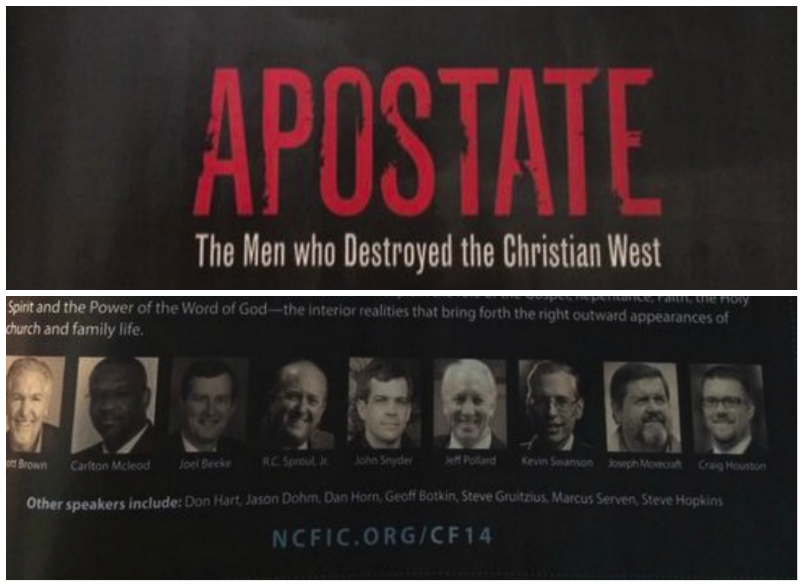
In WORLD’s most recent print edition, the magazine features two full page ads for the biggest names in Christian Patriarchy. The first is for Kevin Swanson’s new (and academically embarrassing) book “Apostate.” The second is for a NCFIC (National Center for Family Integrated Churches) conference featuring Christian Patarichy celebrities like Scott Brown, R.C. Sproul, Jr. Kevin Swanson, and Geoff Botkin.

You can check out the ads here, the photographs of which are courtesy of Chris Hutton at Liter8 Thoughts:

The NCFIC ad is for their upcoming “Church and Family” conference. You can see their speakers are a Who’s Who of Christian Patriarchy — and basically a list of everyone who previously walked in line with Doug Phillips: Scott Brown, Kevin Swanson, Don Hart (General Counsel for Vision Forum Ministries!), Geoffrey Botkin, R.C. Sproul, Jr., etc. You honestly can’t get much more Christian Patriarchical than this. As Julie Anne Smith at Spiritual Sounding Board has said, Scott Brown is “posed to fill the void left by Doug Phillips and Vision Forum to further the Christian Patriarchy Movement among homeschool families and family-integrated churches.”

And Kevin Swanson’s “Apostate”? Really, WORLD? You want the guy who talks about “feces eaters” and compares abused children to “dead little bunnies” advertising in your magazine? That’s a new low, especially since “Apostate” is a book that seriously proposes that “Charles Darwin’s farting at night (not kidding) is relevant to his philosophic and scientific influence.”

Not to mention that many WORLD subscribers are conservative Catholics and one of the “Apostates” that Kevin Swanson believes helped usher in the end of Christianity is Thomas Aquinas. Yes, like the classic Christian theologian Thomas Aquinas. But despite Aquinas being Evil Incarnate to Swanson, Aquinas’s face is absent from Swanson’s WORLD ad. Pretty convenient, right?

Ultimately, money makes the world go round, and that’s evidently no less true for Christian magazines. Considering that full page ads are $5,600 each, Christian Patriarchy just made WORLD $11,200 richer this month. And WORLD just brought Kevin Swanson and NCFIC into the homes of 100,000 families. Wink, nod, shhh.

Christian Homeschooling and Child Abuse Denialism

Screen Shot 2014-06-03 at 3.18.35 PM

HA note: The following is reprinted with permission from Libby Anne’s blog Love Joy Feminism. It was originally published on Patheos on June 2, 2014.

If you’re a long-time reader, you’re likely aware my series on HSLDA and child abuse, which includes their fight against child abuse reportingtheir stonewalling of child abuse investigations, and their defense of child abuse. You’ve probably also read my viral “HSLDA: Man Who Kept Kids in Cages ‘a Hero.’” If you read Homeschoolers Anonymous, you probably know that Doug Phillips, former HSLDA attorney and founder of the now-defunct Vision Forum, stated in 2009 that “We understand that the core problem with Child Protective Services is its existence.”

What you may not be aware of is that in 1985 Mary Pride published a book titled The Child Abuse Industry: Outrageous Facts About Child Abuse & Everyday Rebellions Against a System that Threatens Every North American Family

Who is Mary Pride? If you’ve ever homeschooled, you’ve almost certainly heard of her. She has had so much influence in homeschooling circles that has been dubbed “the queen of the homeschool movement.” Historian Milton Gaither has dubbed Pride as one of homeschooling’s two most influential curriculum reviewers. Pride first published her Big Book of Home Learning in 1986 and has updated it regularly since. It now has four volumes. Pride is also the publisher of the “wildly popular” Practical Homeschooling magazine, with as many as 100,000 subscribers, and has published numerous other popular homeschooling how-to books. Pride is also the author of The Way Home, published in 1985 and credited with launching the Quiverfull movement (not to be confused with the Patriarchy movement).

And then, of course, there is The Child Abuse Industry. According to R.L. Stollar, the book is “a remarkable read that calls for a ‘Second North American Revolution’ — namely, having babies, abolishing no-fault divorce, going to church, eliminating foster care, homeschooling, re-instituting “biblical” executions of criminals, and getting rid of abuse hotlines.” Stollar is currently writing a multi-part review, which I will definitely promote when it comes out.

Here are ten quotes from Pride’s book, courtesy Stollar’s post on Homeschoolers Anonymous:

10. “The major problem is that the public has been convinced that child abuse is a major problem.”

9. “Are one out of four adult women (or one out of three, or two—the statistics keep getting wilder) really the victims of savage lust perpetrated in their youth?Isn’t it possible to organize a bridge party without staring at an abused woman across the table? Where do these wild statistics come from?”

8. “Never vote for a candidate whose campaign promises include ‘doing more for children.’”

7. “Child abuse hysteria is a self-righteous coverup for anti-child attitudes.”

6. “If [child abuse prevention programs] are allowed to proliferate, we will produce for the first time an entire generation of males who have been trained to consider raping their sons and daughters as passably normal behavior.”

5. “If sex has nothing to do with having babies, you can have sex with anyone or anything. Including children.”

4. “We need to stop allowing the unsupported testimony of childrenwho are of an age where they can barely distinguish fantasy and reality.”

3. “Don’t hotline anyone.”

2. “A retarded daughter told contradictory tales of sexual abuse by her step-brother and other male relatives… So here we have a girl who probably made up the story in the first place.”

1. “Age segregation increasingly alienates children and adults. Children are the ‘new n*****s.’” (not censored in Mary Pride’s version.)

My interest piqued by Stollar’s quotes, I cracked open my copy of HSLDA’s Chris Klicka’s 2006 book, Homeschool Heroes: The Struggle and Triumph of Homeschooling in America. I opened to the chapter on social workers.

At Risk from Social Workers

. . .  Homeschoolers are at risk. They are not at risk because they have big families or teach their children at home or neglect their children in any way. They are at risk because the child welfare system has lost control. Many social workers are trained in a philosophy that is antiparent, antifamily, and antireligious.

I can’t say I’m surprised, but here it is again. Look, I know that social services isn’t perfect, and that it’s badly in need of better funding. But that’s not what this sounds like it is about. According to Klicka, the issue isn’t that social services is underfunded and understaffed, but rather that social services is antifamily. This is the same sort of line Mary Pride was promoting in her book.

HSLDA is both a policy advocacy and legal defense group. HSLDA defends member families if they have any problems in their interaction with local public schools or social services. The organization’s website describes it like this:

Why does HSLDA help member families in the initial stage of a child abuse investigation?

HSLDA’s mission is primarily to advance homeschooling rights. Sometimes homeschooling parents get reported to CPS because people misunderstand homeschooling. They may see children playing outside during school hours and think that the parents are allowing them to be truant. Other times, families are reported for other types of suspected abuse or neglect. Investigations of all such allegations begin the same way: a social worker visits the family’s home, or contacts them requesting to set up a visit.

HSLDA advises our members in these initial contacts with social workers in order to ensure that their constitutional rights are protected. Once the allegations are revealed, we continue to represent our members if the allegations relate to homeschooling.

In other words, according to HSLDA’s website, they advise member families any time there is a social worker at the door, but only represent member families going forward if the allegations involve homeschooling. Along these same lines, an announcement on HSLDA’s facebook page last year asserted that “HSLDA does not and will not ever condone nor defend child abuse.” But some of the stories Klicka relates from his years working for HSLDA tell a different story.

There’s this one, for instance:

A homeschool father in Michigan picked up his two-year-old child by the arms, taking her into the house while she was crying and was reported for child abuse by a nosy neighbor. I set up a meeting with the social worker and counseled the family on what htey should say. I told themI told them to explain their religious convictions concerning raising their children from “a positive standpoint” avoiding Bible verses like if “you beat him with the rod, he will not die.” Or, if you “beat him with the rod,” you will “deliver his soul” from hell. Not a good idea. Social workers just don’t understand those verses.

Instead I told them to explain their beliefs by emphasizing verses such as Matthew 18:6 that states that if you harm or offend a child, it is better that a millstone be tied around your neck and you be thrown in the deepest part of the ocean. In other words, their religious convictions demand that they not do anything that will harm their children. When the family began presenting these religious beliefs to the agent, he became visibly uncomfortable, and suddenly announced that he would close the case.

And this one:

In Fairfax County, Virginia, a pastor gave a seminar on child discipline that included the requirement in the Bible to spank. A parishioner had to discipline her child while a neighbor was visiting a few days later. She spanked the child in the other room and then explained to the neighbor a little of what she had learned from the pastor.

The neighbor, who happened to be against spanking, reported the pastor to the child welfare agency for “bruising their children and for twenty-minute spanking sessions.”

To clarify, this suggests the pastor spoke in his sermon of bruising his children and carrying out twenty-minute spanking sessions.

The social worker who then initiated the investigation told me she thought she might have a religious cult on her hands that abuses children. I expressed my disbelief to the social worker that she was seriously investigating what an anonymous source claimed she heard from a person who heard it from another person. That is thrice removed hearsay. I told her that her evidence was flimsy and set the parameters for a meeting.

In preparation for the meeting, I told the homeschooling pastor and his wife not to recount any specific incidents of spanking since the social worker had nothing on the family that would stand up in court. I told them that they should emphasize again the positive verses such as Matthew 18:6. Since the social worker had no evidence, the only evidence she could acquire would be from what information she could gather from the pastor and his wife. Since the parents carefully avoided all specific examples and spoke in general terms, the social worker had nothing and had to close the case.

Perhaps those at HSLDA would argue that they never defended someone against child abuse in court. But in this layman’s eyes, this constitutes defending child abuse. I mean, did they even ask the pastor if it was true that he bruised his children and spanked them in twenty-minute sessions? Or did they de facto believe he was innocent and not bother checking, as seems to be their habit? I’ve expressed my frustration with this before.

And there is a similar distrust of children’s testimony with Klicka as with Pride:

Another family in Bradington, Florida, was visited by social workers. Allegations were made by one of their seven adopted children, who was the only one not being homeschooled. He had made up a story and told it to his science teacher, who had then passed the information to a social worker. I was able to talk to the social worker and keep them out of the home and away from the children. The case was finally listed as unfounded. The mom said, ‘This is why I spend twenty-six cents a day. People are crazy not to join HSLDA. I have an attorney ready to help me at a moment’s notice.’

There is also advice on how to hide abuse and avoid being reported:

Know Your Family Doctor

We have had numerous situations where doctors turned homeschoolers in to social workers because they found a bruise or mark on the child . . . I learned early on that each family needs to know their doctor well. If the doctor is familiar with the patients and trusts them, they do not have to turn them over to a child welfare agency, even if they have a mark or bruise. It is completely the doctor’s discretion.

The orientation toward social services is the same in Klicka’s book as in Pride’s—one of opposition. They are the enemy. In fact, Klicka began his chapter on social workers with I Peter 5:8-9—”Be sober; be vigilant; for your adversary the devil walks about like a roaring lion, seeking whom he may devour.” The assumptions about the veracity of the parents’ and children’s testimony is the same—parents’ word can be trusted, children’s cannot.

We need to be careful not to assume that all homeschoolers engage in this sort of denialism and defense of child abuse. I do not know whether the themes explored here extend beyond the leaders of the conservative Christian homeschooling subculture, and we should not assume that we do. But with that subculture, this is a problem. With these sorts of narratives, how can we expect those within this subculture to even self-police, much less report suspicions of abuse?

From Pride’s The Child Abuse Industry to Michael Farris’s thrill-horror novel Anonymous Tipthis is a problem. 

Oh, and also? If there are Christian homeschoolers out there who are upset by what I’ve said here, the correct response is to go about condemning the words of these Christian homeschool leaders and creating a new narrative, a narrative that affirms reporting suspicions of child abuse and doesn’t de facto trust parents’ word over that of their children. Condemning me for saying these things or arguing that I am anti-homeschooling would be the incorrect response.

6 Examples of HSLDA Trying to Keep Vision Forum Outside the Mainstream

Screen Shot 2014-04-27 at 12.25.23 PM

By R.L. Stollar, HA Community Coordinator

On April 15, 2014, WorldNetDaily did an in-depth report on Lourdes Torres-Manteufel’s sexual assault lawsuit against Christian Patriarchy advocate Doug Phillips. In the report, WorldNetDaily interviewed Michael Farris from the Home School Legal Defense Association. Farris appeared to put Phillips and patriarchy “on blast”:

“As for the patriarchy movement, Farris said the teachings are not widely accepted in the broader homeschool community… ‘We have tried, by example, to keep this stuff outside the mainstream of the homeschooling movement.’”

Today we wanted to honor, remember, and reflect on those moments that truly encapsulate HSLDA’s attempts to keep this Vision Forum “stuff” outside the mainstream of the homeschooling movement. Here are 6 such moments:

.

*****

.

1. When HSLDA’s official blog refused to promote Vision Forum material…

patriarchy1

.

*****

.

2. When HSLDA’s official blog was like, “No, we will never recommend Vision Forum or G.A. Henty to our members, especially not as recently as October 2012″…

patriarch2

(G.A. Henty being that guy that, you know, wrote things like, “The intelligence of an average negro is about equal to that of a European child of ten years old” and praised “strong white power.”)

.

*****

.

3. When one of HSLDA’s Court Report writers, on HSLDA’s official blog, spoke up against a Vision Forum poetry book because of its oppressive view of “womanhood”…

patriarchy3


.

*****

.

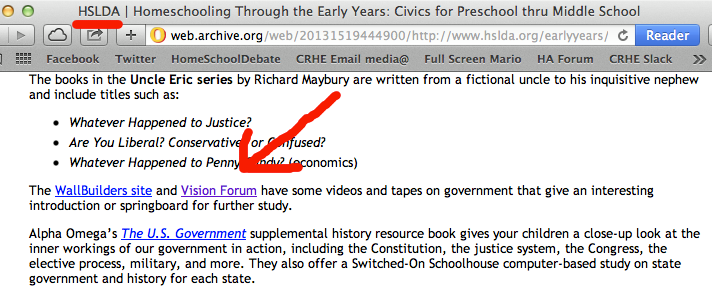
4. When HSLDA’s Early Years Coordinator — only 4 months ago, so 2 months after Doug Phillips resigned — made sure HSLDA’s opposition to Vision Forum was clear in their official curriculum suggestions…

patriarchy4
(The last available screen capture of the above was December 19, 2013. HSLDA has since quietly scrubbed this — and only this — particular reference to Vision Forum.)

.

*****

.

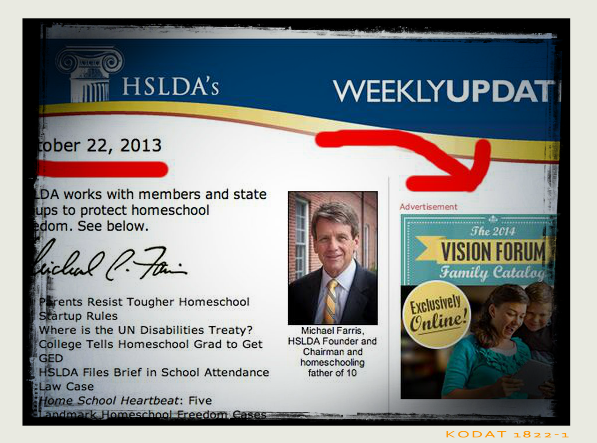
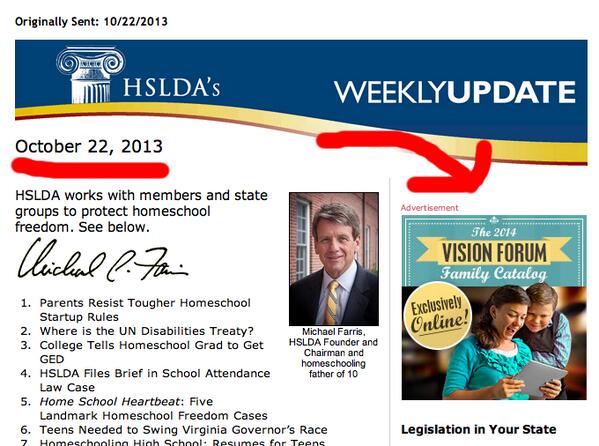
5. When, on October 22, 2013, HSLDA told Vision Forum, “We want to keep you out of the mainstream, so — no, we will not accept your advertising money, and we definitely will not display your catalog right next to Michael Farris’s face in Farris’s official HSLDA email newsletter”…

patriarchy5


.

*****

.

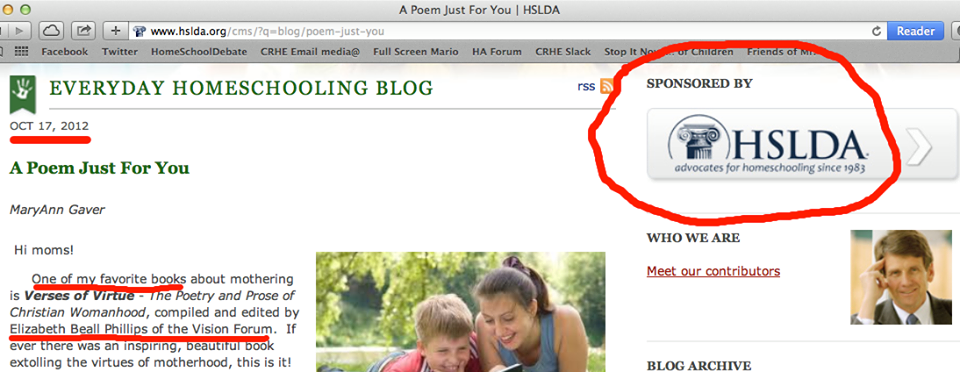
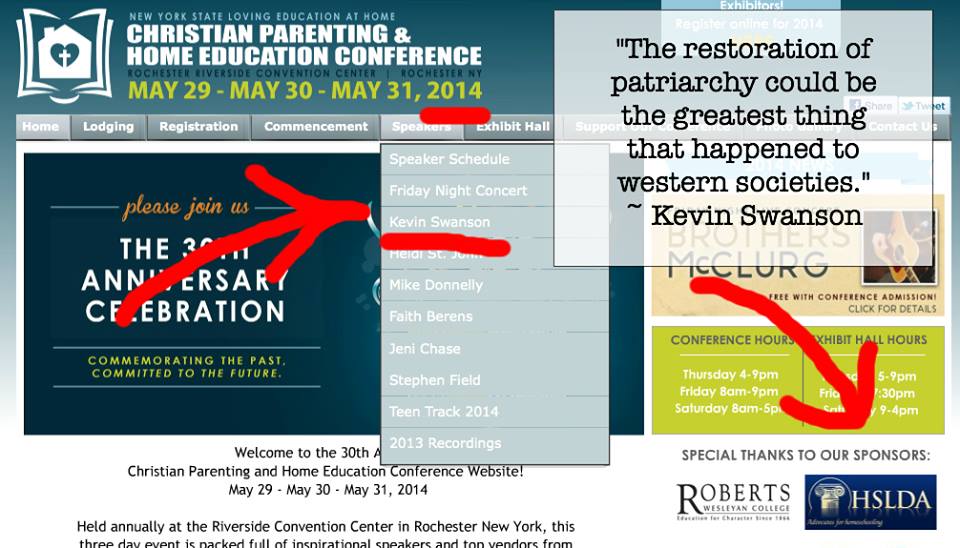
6. When HSLDA took a brave stand against sponsoring conventions headlined by patriarchy advocates…

patriarchy6


.

…With enemies like this, who needs friends?

Is the Christian Homeschool World Really Changing?

Screen Shot 2014-04-22 at 5.31.34 PM

HA note: The following is reprinted with permission from Libby Anne’s blog Love Joy Feminism. It was originally published on Patheos on April 22, 2014.

Things are changing in the Christian homeschooling world. Vision Forum has fallen and ATI is shaken. People are talking, really talking, and the narratives are shifting.

Some are still resisting this conversation.

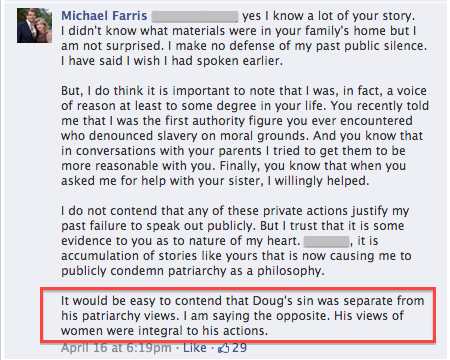
They claim that Doug Phillips’ fall had nothing to do with his patriarchal ideology. With both Phillips and Gothard, they argue, the problem was with the leader, not the belief system. These claims are dispiriting, because in some sense these leaders are interchangeable. Old ones will fall, new ones will rise, and if the ideology remains the same nothing will change.

But other leaders are being more honest. They, Michael Farris and Chris Jeub among them, are connecting the dots and calling out a problem deeper than an individual leader. In this facebook comment, Farris responds to a homeschool graduate’s reiteration of her story (I’ve marked the relevant bit):

m1

When I read these things, I am reminded of evangelical attempts to soften toxic ideas so that they become more palatable, and that concerns me. For example, I heard evangelical leaders at the megachurch I grew up attending walk the idea of male headship back to spiritual leadership and breaking the tie when husband and wife cannot come to an agreement. While I appreciate that there are evangelicals who have moved away from an emphasis on total wifely obedience and submission, the idea of male headship itself is a problem, and softening it doesn’t change that. Is the walked-back view better? Yes, but it’s still a problem.

I wonder how far Christian homeschooling will change over all of this, and whether that change will be deep or surface-level. All Doug Phillips did was take ideas already out there—the idea of the Joshua Generation, the emphasis on male headship and wifely submission, the idea that girls should be encouraged to be homemakers and discouraged from having careers—and deepen each, using direct language, until his words and dictates became an embarrassment.

If Christian homeschool leaders see Phillips’ direct language and strident emphasis as the problem and fail to realize that it is at the core the underlying ideas that they themselves have long held that is the problem, change will be shallow indeed.

The word “patriarchy” is not the problem. The ideas that underly that word are the problem.

If the Christian homeschool leaders who are speaking out today reject the word “patriarchy” but hold onto the idea that a wife must submit to her husband, what have we actually gained? What is actually different?

Israel Wayne of Family Renewal wrote that:

In September of 2013, Michael Farris, founder of the Home School Legal Defense Association (HSLDA) spoke to state convention coordinators and other national homeschooling leaders, at the annual leadership conference they sponsor. He warned against the dangers of the excesses of extreme child discipline and a low view of women that has taken hold in some corners of the homeschooling community. He warned that unless homeschooling leaders actively speak against abusive and unGodly approaches to child discipline and unBiblical views of Patriarchal authority (that demean and devalue women), we risk losing our very legal freedom to homeschool.

From Wayne’s description, it sounds like Farris told other homeschool leaders that they needed to speak against child abuse and the devaluing of women or else homeschool freedoms would be at risk. The emphasis here appears sorely misplaced. Shouldn’t the primary concern be for the children who are abused and the women who are devalued rather than for the possibility that people will react to these abuses by turning against the legal freedom to homeschool?

I should note that I very much question what Farris means by “our very legal freedom to homeschool.” I suspect what he actually means is our freedom to homeschool without oversight or accountability. And here is a very real issue—Farris is now speaking out against “patriarchy,” and it appears that he may begin speaking against child abuse (though that remains to be seen), but he is still against legal accountability for homeschooling, accountability that would support children’s right to an education and their right to an upbringing free from abuse or neglect.

HSLDA’s current president, Mike Smith, will be presenting this keynote address at an upcoming homeschool conference:

Remembering the Reason, Renewing the Vision A general overview of the challenges, burdens and benefits of homeschooling from a veteran homeschool father and leader. Addressing the potential homeschooler, the new homeschooler, the veteran homeschooler and all homeschoolers in between, Mike outlines the success of homeschooling in academics and socialization, describes legal and legislative advances,and concludes that homeschoolers have earned the right to be left alone. 

This last bit is a serious problem. Whether or not Farris indeed intends to speak out loudly and publicly against patriarchy and child abuse, his organization will continue to work against legal reforms that help fight these problems, reforms that would bring homeschooled children into contact with mandatory reporters or ensure that homeschooled girls are not passed over educationally because of their gender. A change in culture is needed, yes, but the unregulated nature of homeschooling in many states both contributes to and is a result of that culture.

We need more. Homeschooled children deserve more.

But this is only the start of the things that concern me as I watch this current moment. Israel Wayne followed up on his discussion of Farris comments with these unfortunate paragraphs:

Mr. Farris has sounded a much-needed warning. My concern, however, is that when we over-react and swing to the other ditch, we end up teaching only love, grace and mercy (with no boundaries for children). By rejecting “Patriarchy” (abusive or domineering tendencies of men towards their wives and families), we may revert to the Feminism of the 1960′s, and all the problems that came with it, that led many women to react 180 degrees in the other direction by staying home and homeschooling their children. By rejecting rigid step-by-step rules about issues like strict clothing mandates and courtship procedures, we may revert back to the kind of sexual permissiveness that led to the legalism in the first place.

Do we really want to go back to families where mom is trying to pull that whole family uphill all by herself, while dad is off playing golf, letting mom run the family all by herself? Do want three-year-olds who rule the parents with an iron fist and parents who jump at their every demand? Do we really want teens who are groping their girlfriends in the back seat of a car because we don’t want to impose a legalistic standard on them? Do we really want to encourage the kind of American narcissism that says children are a nuisance and O.8 children is the goal, because we want to avoid the imbalance of policing bedrooms and imposing doctrines not clearly spelled out in Scripture?

This is not change, this is more of the same. What we need is change, real change. I think we’re at a moment of contingency where we might see such change, but to be honest. I don’t feel all that hopeful at the moment. I worry that the change will be more in gloss than in substance.

I can promise you one thing—I’ll keep pushing.

Michael Farris, Patriarchy, and Doug Phillips: An Expose

HSLDA President J. Michael Smith, Doug and Jubilee Phillips, and HSLDA board member Dick Honnaker at HSLDA's 2004 National Leadership Conference in Spokane, Washington.
HSLDA President J. Michael Smith, Doug and Jubilee Phillips, and
HSLDA board member Dick Honnaker at HSLDA’s 2004 National Leadership Conference in Spokane, Washington.

HA note: The following is reprinted with permission from Libby Anne’s blog Love Joy Feminism. It was originally published in a slightly longer version on Patheos on April 15, 2014.

Yesterday’s WorldNetDaily article on Lourdes Torres’s lawsuit against Doug Phillips quotes at length from Michael Farris’s reaction to Doug Phillips downfall. I thought it was worth going over that section specifically, and placing it within the context of other things I have written about Michael Farris, HSLDA, and Patrick Henry College, both to clarify the issues here and to reveal the serious dishonesty of Farris’s statements.

I will begin by quoting the section, and will then respond.

Before Phillips founded Vision Forum, he spent six years as an attorney for the Home School Legal Defense Association, or HSLDA, a nonprofit advocacy organization that defends the right of American families to homeschool their children.

HSLDA Chairman Michael Farris told WND, “The reason Doug left HSLDA is because [President] Mike Smith and I, who were his bosses, were growing more and more uncomfortable as he started developing his patriarchy theory. We started limiting his ability to speak on those things while traveling on our behalf. We basically made it clear that he could not pursue those things with his HSLDA hat on. So he eventually chose to leave us so he could do those things because we were not comfortable with where he was headed.”

As for the patriarchy movement, Farris said the teachings are not widely accepted in the broader homeschool community.

“It’s a minority of homeschoolers that believe in it,” he said. “But unfortunately, until very recently, they were getting a lot of visibility in certain places. We have sought to avoid inviting any patriarchy speakers to speak at our national conference.”

While state homeschool organizations run their own events and may choose to have such speakers, Farris said HSLDA has never promoted them.

“Doug has never been invited to speak at our national conference since he left,” Farris said. “We have tried, by example, to keep this stuff outside the mainstream of the homeschooling movement.”

He added, “Frankly, we think it’s time for us to stand up and publicly say this is just wrong.”

Background

And here we need some explanation. Within the Christian homeschooling movement, and by that I mean those Christians who choose to homeschool for religious reasons, whether in part or in whole, there is a range of belief on gender roles. In general, beliefs about gender roles fall somewhere on a spectrum between the following two camps:

Complementarianism: Many of those in the Christian homeschooling movement, including both Farris and my own parents, hold fairly conventional conservative evangelical views on gender roles. The wife’s role is to obey her husband, nurture her children, and serve ask a keeper at home. The husband’s role is to be the head of the family, provide for the family, and protect the family. Men are to be masculine and manly, women are to be feminine and womanly. God has laid out different and complementary roles for each gender, but all are equal before God.

Biblical Patriarchy: Some of those in the Christian homeschooling movement go farther. They proudly use the word “patriarchy” and teach that daughters are to be under their father’s authority until marriage, serving as “stay-at-home daughters.” They argue that daughters should not go to college, or hold jobs outside the home, and that daughters must obey their fathers even as adults. Only when daughters marry (through a courtship process controlled by their father) do they leave their father’s authority and transfer to their husband’s authority.

I don’t have numbers on how many Christian homeschoolers adhere to complementarianism versus how many adhere to biblical patriarchy, but I also don’t think it’s completely clearcut. Even those solidly in the complementarian camp will have noticed promoters of patriarchy speaking at homeschool conferences, will have seen their literature, and will have met those in its folds. My own family was fairly solidly in the complentarian camp, and yet they adopted some of the beliefs of the biblical patriarchy camp even as they rejected others (they sent me off to college, but believed I was still to obey my father, as an adult daughter under his authority).

Biblical patriarchy differs little from complementarianism except in its open embrace of the term “patriarchy” and its teachings about the role of adult daughters.

Michael Farris

So where does Farris fall, particularly? From what I’ve read of his writings Farris very much believes that wives must obey their husbands and that a woman’s role is in the home nurturing her children. But what of the rest? Farris’s strong rejection of the patriarchy movement as quoted above and his recent strong words for the stay-at-home daughter movement in a facebook comment would seem to indicate that he falls in the complementarian camp rather than the biblical patriarchy camp.

There is also this from a statement written in response to February’s article on sexual assault at Patrick Henry College and read aloud during chapel at Farris’s Patrick Henry College.

Some readers have wondered if the overall aim of the article is to associate PHC with a set of anti-women attitudes that we do not hold, and to insinuate that we are connected with outside movements that we positively reject (like the “Quiverfull/Christian Patriarchy Movement”). This philosophy, incorrectly attributed in the article to Dr. Michael Farris, Chancellor, espouses that college is inappropriate for Christians in general, and especially women. As his own life at PHC and with his own children reflect, Chancellor Farris has never agreed with such an offensive philosophy.

Farris rejects the word “patriarchy” and is not against daughters going to church. In fact, this statement from Farris’s Patrick Henry College indicates that Farris views biblical patriarchy as “anti-woman” and “inappropriate for Christians.”

But even as he rejects biblical patriarchy, Farris believes that wives should obey their husbands to the extent of not attending church if her husband so commands, and he believes that daughters, even as they go to college, should be preparing ultimately for motherhood rather than for careers. I think maybe this is why Farris’s continued refrain of “no no no, I’m not like him, he believes crazy things!” strikes so many as so odd. Farris is not as far removed as he would like us to think.

But there’s something else going on here too.

The Entanglement

Farris insists that he has long gone to great lengths to publicly distance himself and HSLDA from Phillips in particular and biblical patriarchy in general. Unfortunately for him, this is simply not true.

A quick search of HSLDA’s website reveals that the company was openly advertising for Vision Forum. From a 2010 email alert to HSLDA members:

—[ 20% Off at Vision Forum! 5 days left! ]————————–

Extra 20% Off at Vision Forum! Code: HSLDA. Toys, Books, Movies, More. Everything on sale for 5 Days only!

http://www.hslda.org/alink.asp?ID=282

Indeed, this sort of advertisement for Vision Forum has been a bit of a trend for HSLDA, complemented by positive recommendations of various Vision Forum products.

It’s also worth noting that Farris was at the very least being grossly misleading when he said of HSLDA that “Doug has never been invited to speak at our national conference since he left” and that “We have tried, by example, to keep this stuff outside the mainstream of the homeschooling movement.”

As R.L. Stollar wrote a year ago, before Phillips’ downfall:

1996 seems to be the last year that Phillips appears as an HSLDA attorney. But since then, HSLDA has made zero efforts to distance themselves from his viewpoints. In fact, almost a decade after Phillips left HSLDA to run Vision Forum, he was still featured by HSLDA as a peer. In 2007, HSLDA referred to Phillips as one of “the nation’s top leaders.” Also in 2007, Chris Klicka received an award from Doug Phillips and Vision Forum for his homeschooling advocacy. In 2008, HSLDA says of him that he is “one of the most popular conference speakers in the nation today because of his ability to encourage, inform, and inspire.” In fact, HSLDA proudly sponsored a reception at an event where he was the keynote speaker. The official relationship between HSLDA and Doug Phillips is thus one of continued mutual admiration.

I’m unsure of how Farris expected people to understand that HSLDA disapproved of either Phillips or biblical patriarchy when continually wrote of Phillips and his abilities as a homeschool speaker with such accolades. And this wasn’t the only time. HSLDA advertised Doug Phillips as a speaker at event after event. HSLDA member families were urged to attend. They also allowed Doug Phillips to advertise in their publication, the Home School Court Report, as recently as 2012.

Beyond this, HSLDA has also promoted other leaders whose teachings center on biblical patriarchy, including Voddie Baucham and Geoffrey Botkin. And to the best of my knowledge, HSLDA as an organization and Farris as an individual have never denounced any one of these leaders.

There was more, too. In 2007 Vision Forum published Passionate Housewives Desperate for God, by Jennie Chancey and Stacy McDonald. Jennie Chancey founded Ladies Against Feminism and Stacy McDonald founded Steadfast Daughters. Both are not just complementarian but fully embrace biblical patriarchy. Farris’s wife Vickie wrote a review of the book, which can be viewed on Amazon:

Jennie Chancey and Stacy McDonald have spoken the Truth with a capital ‘T’ in their wonderful book Passionate Housewives Desperate for God. Totally grounded in Scripture, this book winsomely presents the true picture of a godly homemaker. Prepare to be stimulated, challenged, and encouraged as a woman. This book is a real gem!—Vickie Farris, wife of HSLDA founder, Michael Farris, Esq.

Now maybe Chancey and McDonald tone it down in Passionate Housewives Desperate for God, or maybe Farris and his wife disagree here. But Farris has to be aware how these sorts of endorsements will come across to Christian homeschoolers.

My Question

Now I want to turn back to the recent article I began with.

After insisting that HSLDA has never collaborated with a supporter of patriarchy—an assertion I have here called into question—Farris added that ”Frankly, we think it’s time for us to stand up and publicly say this is just wrong.” And that is where I have to wonder—why didn’t Farris stand up publicly and say this prior to Phillips’ resignation and disgrace? Because he didn’t.

Further, Farris wrote that “Doug has never been invited to speak at our national conference since he left” and that “We have tried, by example, to keep this stuff outside the mainstream of the homeschooling movement.” Was Farris unaware that, regardless of whether he invited Phillips to speak at HSLDA’s national conference, if he spoke nary a negative word about Phillips in public and HSLDA wrote of Phillips only to promote him, the message that would come across to the homeschool community would be one of approval?

My sources tell me that Farris views Bill Gothard and Michael Pearl in the same negative light that he has long viewed Doug Phillips. Why, then, does he not publicly warn homeschool families against them? Why does he remain silent?

I think I know the answer. HSLDA operates off of membership dues. If Farris or HSLDA come out and publicly denounce toxic homeschool leaders, they will lose members. Farris has felt that Phillips was in error and dangerous for years, but only when Phillips was already defrocked and dethroned did he feel comfortable saying that out loud. Farris would rather tolerate patriarchy in the Christian homeschool movement than lose money for denouncing it.

Farris, it seems, is only willing to shoot patriarchy when it’s down.

This Present Darkness: A Review of M Dolon Hickmon’s “13:24”

* Read our exclusive interview with M Dolon Hickmon and enter our 13:24 Giveaway. *

By R.L. Stollar, HA Community Coordinator

The highest praise I can give M Dolon Hickmon’s debut novel is a trigger warning: While I believe that everyone everywhere needs to read this book, I must urge those with a history of physical or sexual abuse to approach this title with care. I personally had a nervous breakdown after I finished it; I couldn’t breathe because it felt like someone had punched me in the gut. And I could not console myself by saying, “This is fiction.” It isn’t, as anyone who has experienced child abuse will recognize.

1324
Hickmon gives readers an uncommon gift: a brief look behind the curtain of tragedy, a fleeting chance to understand a little more than we did.

In his prologue, the author explains his intentional use of real-life parallels, based on his childhood experiences and research into religiously-motivated child abuse. Also examined are the intersections between child trafficking rings, physical and sexual abuse, and fundamentalist cults. Woven with fictional elements, these create the book’s complex, dark, and brutal narrative.

13:24 is the story of two young men: Josh, a rising rock star, and Chris, the neglected teenaged son of a drug addict. Their stories begin distinct and distant, but as the novel develops, their pasts—and futures—are revealed to be connected in ways that both shock and disturb.

The story opens on a gruesome murder. While the body count rises, questions multiply as a small-town detective chases Chris as a murder suspect. Along the way, readers encounter events and characters with uncanny real-life parallels: Josh has flashbacks of being abused by his minister father, who resembles Michael Pearl and advocates harsh physical punishment; in another thread, a controversial parenting manual is linked to a spate of discipline-related deaths, bringing to mind real-life cases, like those of Hana Williams and Lydia Schatz. Elsewhere, an imprisoned child abuser is freed through the efforts of a “homeschool legal defense fund”, reminiscent of the Home School Legal Defense Association. At the same time, an oily “Christian psychologist” heads a James Dobson-esque media empire, with tendrils in state and national politics.

13:24 may be fiction, but it describes the lives of any number of people I have known. In its imagery, I recognize moments that friends and colleagues have breathed and suffered through. That is what made this novel so hard for me to read.

The book exposes what many religious and homeschooled children experience every day. Readers witness their pain and hear their cries. We see their misery multiplied when it is justified in the name of God; we see their tragedies covered up to save face and preserve religious “freedom”. And unlike a Frank Peretti novel, there are no angels rushing in to the save the day. We must pick up the pieces and fight this present darkness.

Despite the darkness, 13:24 has a poetic beauty. That beauty is in the narrative symmetry: a murder begins it and a murder concludes it. While death marks where the story begins and ends, there is a profound shift in what those deaths mean. This is the power of Hickmon’s prose: he delves deep into pain, into what he has described in his subtitle as “faith and obsession,” and shows us the human faces behind news headlines’ “monsters.”

13:24 is not easy reading. It is neither uplifting nor redemptive. It will crack your heart open, set your blood on fire, and turn your screams into music. Most significantly, the characters’ actions are neither justified nor condemned by the author. He simply allows them to exist. In doing so, Hickmon gives readers an uncommon gift: a brief look behind the curtain of tragedy, a fleeting chance to understand a little more than we did.