Doug Wilson and the “Gaylag Archipelago”

Doug Wilson

HA note: The following is reprinted with permission from Libby Anne’s blog Love Joy Feminism. It was originally published on Patheos on May 19, 2014.

When a federal judge struck down Idaho’s gay marriage ban last week, fellow blogger Kathryn Elizabeth tweeted the news at Christian pastor and author Douglas Wilson. Wilson is well known for his anti-gay views, and he and Kathryn Elizabeth have sparred over the issue before. Wilson’s response won’t be a surprise to anyone familiar with his work, but it illustrates a problem among religious opponents of LGBTQ rights.

Tweet-Doug-Wilson

Yes, you read that right—Wilson is worried about being sent off to “Gaylag Archipelago.” But don’t let the obvious hyperbole lead you to miss the point—it is mainstream within evangelicalism today to speak of being “persecuted” or “hated” for being anti-gay. A WORLD magazine article titled “‘Haters’ and the Hated” made this point last year:

The word has come down a lot. Once it applied to Adolf Hitler; now to Chick-fil-A. The “haters” of today, as defined by popular rhetoric, are those who argue with current wisdom. . . . It’s easy to attach the hate label to opponents of the issue du jour, and only a slight stretch of the imagination to picture today’s haters stringing up the issue du jour to lampposts in the devilish light of bonfires. This is convenient: If all your opponents are haters, righteous indignation is a valid response. Haters barely deserve to live, much less shape public policy. They must be defeated, by any means necessary.

But let’s talk about the real thing. “If the world hates you, know that it has hated me before it hated you” (John 15:18). . . . To the extent that you abide in Christ, the world will hate you. It will even project its hatred on you.

Bryan Fischer of the American Family Association was even more clear:

We’re hearing a lot about the reinstatement of segregationist Jim Crow laws these days, as homosexual activists fling this accusation at the state of Arizona. They argue that SB1062, a bill which simply protects religious liberty in the Copper State, is tantamount to the reinstatement of discriminatory laws.

As so often is the case, the situation is actually the reverse. It is in fact the bullies and bigots of Big Gay who are reinstating Jim Crow laws, only this time the marginalized and segregated Americans are Christian businessmen. Faith-driven vendors are being told that unless they submit to the owners of the liberal plantation, they will be punished by their homosexualized overlords and sent to the margins of society.

Hence the “Gaylag Archipelago.” I was a child in the 1990s, before marriage equality took the center stage it has today, but even I remember hearing that with the direction the country was heading Christians would eventually be put in jail for believing that homosexuality is a sin. The “Gaylag Archipelago” fits this mentality perfectly—it imagines a world where gay people are the oppressors and evangelical Christians are being robbed of their rights and will ultimately be rounded up and put in internment camps.

Wilson has put it like this:

The same sex marriage crusade has nothing whatever to do with what people can do sexually in private, and it has everything to do with what you will be allowed to say about it in public. We are not talking about whether private homosexual behavior will be penalized, but whether public opposition to homosexual behavior will be penalized.

But you know what? I’ve been involved in the movement for marriage equality for some time now, and I have yet to hear a single person call for those who believe homosexuality is sin to be jailed or sent to work camps. I also haven’t heard anyone calling for banning people from stating that they believe homosexuality is a sin. In actuality, the belief that homosexuality is sinful will go the way of the belief that black people and other minorities are lesser than white people. No one is put in jail for being racist, or even for publicly airing their racist sentiments (unless those sentiments involve threatening physical harm). There are no gulags where racists are rounded up and imprisoned.

But let’s take a look at what these self-prescribed “victims” have in store for their “oppressors,” the LGBTQ community. This from the same Bryan Fischer I quoted above:

We do not believe that homosexual behavior out to be normalized. We don’t think—I don’t think it ought to be legalized. It should not be promoted, it should not be endorsed, it should not be sanctioned, it should not be subsidized. And, in fact, this is the way it was in America for the first 342 years of our existence, well the first 357 years of our existence, from Jamestown in 1607 until Illinois in 1962, the first state in the union to lift sanctions, criminal sanctions, against homosexual behavior. It was still sanctioned in 49 states until 1972, it was even sanctioned according to Antonin Scalia in about 24 states in 2003 when the Lawrence v. Texas ruling came down I counted up about 12 or 14 but somewhere in that neighborhood still had public policies that prohibited homosexual behavior, did not give it legal sanction, it was prohibited, it was against the law under their state code. And so, we believe, I believe, I’ll just speak for myself here, I believe that homosexual behavior should again be contrary to public policy, to put it bluntly it ought to be against the law.

So then the question comes in, what sort of sanctions are you prepared to impose? If it’s going to be against the law, and the law is going to be applied, somebody is apprehended in a way that calls into play this law, this public policy against homosexual behavior, what should be done? What should be done with those defenders? And that’s a legitimate question. Do you put them to death, like they did under the Mosaic law, do you lock them up, do you fine them, what do you do?

Well I want to suggest something, and this just absolutely ticks off homosexual activists, but it makes perfect sense to me. Remember, we’ve talked about this before, but according to the CDC . . . 91% of all of the males in the history of the [AIDS] epidemic either contracted HIV aids through having sex with other men or through injection with drug abuse. Now we have policies in our culture to deal with injection with drug abuse. . . . So here’s my suggestion, very simple, very straightforward, that our sanctions for homosexual conduct should be the same as they are for drug abuse. In other words, whatever we decide are appropriate public policies to deal with drug abuse, those ought to be the same policies that we use for dealing with homosexual behavior because the risks are the same. If we’re concerned about the health of people involved in injection drug abuse, we want to protect them, we want to liberate them from this, and we’re going to have certain policies in place to deal with that, it could involve fines, it could involve incarceration.

We’re seeing a real trend for people who deal in the drug issue to move away from incarceration for nonviolent drug offenders toward rehabilitation. Let’s put these people in therapy, let’s get them in a drug treatment center, rather than lock them up let’s get them help. Now frankly, I am sympathetic to that. . . . Here’s what I’m getting at. . . . What I’m talking about is taking the same policies that we use for drug offenders, because we know it destroys people, it hurts them, it damages them, and since the same health risks exist with homosexual behavior, then it seems to me that we ought to take the same policies and apply them to homosexual conduct, that we ought to direct people toward rehabilitation as an alternative to incarceration. Let’s not lock them up, let’s get them therapy, let’s get them help. I mentioned Nicolas Cummings, former president of the American Psychological Association, he says look, it works, conversion therapy, reparative theory, whatever you want to call it, if people are motivated, they can change, they can redirect their sexual energy. . . . This approach fits with conservative principles.

Sometimes I wonder if the reason people like Bryan Fischer are convinced that LGBTQ activists want them stripped of their rights and imprisoned is that they are projecting what they in fact want on their opponents. In other words, Bryan Fischer wants to make “homosexual behavior” against the law, and wants to give “offenders” a choice between prison and reparative therapy, so he assumes that his opponents want to make “true” Christianity against the law, and to imprison or “reeducate” offenders.

And what about Doug Wilson, of “Gaylag Archipelago”? Wilson has increasingly refused to fully nail down his position on what should be done with gay and lesbian individuals, among other. This may be in part because some of his earlier forays on the subject resulted in widespread outcry. For example, Wilson had this to say in a 2003 interview:

The Bible indicates the punishment for homosexuality is death. The Bible also indicates the punishment for homosexuality is exile. So death is not the minimal punishment for a homosexual. There are other alternatives.

Then in 2009 he put his position like this:

Wilson says he rejects the Reconstructionists’ political tactics and distances himself from the label, claiming that his view of Old Testament law is more subtle than theirs. But when I asked what he thought of the death penalty for homosexual acts suggested in Leviticus 20:13, he did not shy away from the theonomic hard line that disturbs many Christians. “You can’t apply Scripture woodenly,” he says. “You might exile some homosexuals, depending on the circumstances and the age of the victim. There are circumstances where I’d be in favor of execution for adultery.…I’m not proposing legislation. All I’m doing is refusing to apologize for certain parts of the Bible.”

There’s also the matter of Wilson’s magazine, Credenda/Agenda. Wilson is both founder and editor of the publication, and some years back he published an article titled Your Eye Shall Not Pity, by Greg Dickinson. This article is less ambiguous.

The civil magistrate is the minister of God to execute wrath on the wrongdoer (Rom. 13:4). God has not left his civil minister without guidance on how to exercise his office. The Scriptures set forth clear standards of judgment for many offenses. Capital crimes, for example, include premeditated killing (murder), kidnapping, sorcery, bestiality, adultery, homosexuality, and cursing one’s parents (Ex. 21:14; 21:16; 22:18; 22:19; Lev. 20:10; 20:13; Ex. 21:17).

In contemporary American jurisprudence, none of these offenses is punishable by death, with the occasional exception of murder. The magistrates have dispensed with God’s standards of justice. Some Christians believe this is an improvement. They would be horrified to think that the “harsh” penalties of the law should still be applied. Sometimes this is the result of the mistaken belief that the Old Testament has no further application after the advent of Christ. This is an exegetical problem. Too often, it is the result of a sinful view of the criminal. This sin is called pity.

. . .

Thus, the Bible teaches that pity is not an option where God has decided the matter.The magistrate, God’s minister, is to faithfully execute justice according to God’s standard, not man’s.

What the Bible does not teach is that the preaching of the gospel and repentance have no place on death row. Indeed, it is hard to imagine a place where there is a more immediate need of grace, and a presentation of the gospel should be the first response of Christians to those who are condemned. But condemnation still must come if we are to be obedient to God’s Word.

We must respond to the wrongdoer biblically in both judgment and grace. This means that we must return to an obedience which confines pity within the bounds which God has established for us.

It’s worth noting that no one has put either Doug Wilson or Greg Dickinson in jail for what they have said. Indeed, neither has been arrested for their comments, or fined. Just as there are no laws against racist comments, there are no laws against calling homosexuality sin—nor are there likely to be. Contrary to Wilson’s reference to a “Gaylag Archipelago,” Wilson and his friends are free to go on saying these things if they so choose. But while they are legally free to call down all the divine judgement they please, they do not get a free pass from popular outrage.

I suspect that Wilson’s references to a “Gaylag Archipelago” may stem from some of his recent experiences when speaking on college campuses. In 2012, Wilson was heckled and shouted over during a speaking engagement at Indiana University. I suspect Wilson blurs the line between popular anger over his views on homosexuality and legal oppression. Of course, that problem goes beyond Wilson. The WORLD magazine article I quoted above claimed that “The ‘haters’ of today, as defined by popular rhetoric, are those who argue with current wisdom.” In other words, the author is under the impression that evangelicals are “hated” simply because they disagree with the popular consensus. It’s as though she cannot see the very real pain and damage evangelicals cause by their opposition to LGBTQ rights and their belief that same-sex attraction is sinful, and the anger that pain might inspire.

I don’t want to give the impression that every evangelical Christian wants gay people to be executed, rounded up, exiled, or sentenced to reparative therapy. In 2013, 59% of white evangelicals said that homosexuality should be “discouraged” but 30% said it should be “accepted.”  Also in 2013, 49% of white evangelicals supported some form of civil union. But there seems to be a fairly high correlation between evangelicals who claim to be persecuted by the push for LGBTQ rights and evangelicals who believe homosexual behavior, as they term it, should come with legal sanction. And that correlation makes Wilson’s reference to the possibility of being sent to a “Gaylag Archipelago” incredibly disingenuous.

Peter Bradrick, Former Executive Assistant to Doug Phillips, Speaks Out on Being “Formally Disowned” and “Declared to be a Destroyer”

Peter Bradrick and Doug Phillips.

HA note: The following is reprinted with permission from Kathryn Brightbill’s blog The Life and Opinions of Kathryn Elizabeth, Person. It was originally published on November 30, 2013.

For those of you who aren’t entirely up to speed, Peter Bradrick is a Vision Forum intern turned executive assistant to Doug Phillips. He doesn’t work for Vision Forum any longer, but even after he left as an employee he was involved in their “Hazardous Journeys” trips, and was pretty much BFFs with Doug. He’s married to the daughter of Scott Brown (not the politician, the one who’s head of the National Center for Family Integrated Churches, an organization that Doug was on the board of until his scandal broke).

Anyway, everybody close to Doug and Vision Forum—Peter included—have been tight-lipped about Doug’s affair and the closing of Vision Forum Ministries. Tight-lipped until now, that is. As late as the end of Thanksgiving night, 11/28, Peter’s Facebook was locked down and all but a few random posts from months ago were private. That changed day after Thanksgiving when Peter made the following posts public on Facebook. I’ll post them chronologically below.

Tuesday, 26 November, 2013 (Facebook | Screenshot | PDF)

Dear friends, after a long and weary season of business failure and more recently significant shock and disappointment regarding a very tender matter close to me, I am planning on going off Facebook and other public platforms for a season. This is motivated solely because I want to focus on my private life. However, I know this will be misinterpreted by many, particularly since there has been a troubling silence regarding a recent difficult public situation. Before I go “offline” there are things that I need to share. In the coming days and weeks I will be sharing my heart with my friends regarding some difficult things that need to be said. After which, I hope to transition to a season of life focused on a new direction in business, focused on personal spiritual growth, and focused on my precious wife and children.

Tuesday, 26 November, 2013 (Facebook | Screenshot | PDF)

I apologize to many of you who have reached out and contacted me in the past days and weeks, and to whom I have not responded. I ask for mercy and understanding knowing many of you will realize this is a VERY difficult time for me and my family. I am attempting to exercise discretion, and to faithfully exercise my limited duties in this recent situation. In line with that, I have been leery of talking to many of you to whom I owe calls, emails, texts and FB messages back to, because I am committed to not “feed the gossip mill”, or pass on dainty morsels. And just not talking has been one way I have attempted to walk a very difficult line in a very messy situation.

Greater knowledge brings with it greater responsibility, particularly for those who have had close relationships with those involved. I’ve attempted to only communicate with people that have reason to know at this point. Please be patient with me. I promise I still love and care for each of you, and hope that you will understand.

Wednesday, 27 November, 2013 (Facebook | Screenshot | PDF)

The past decade of my life has been defined by my close relationship with my mentor and former spiritual father. Those who know me recognize my longstanding, fierce commitment to his family, his work, and his legacy. As soon as I caught wind of what was going on, I became very involved in working towards fulfilling the duties of friendship and brotherhood – to confront a man who has been like a father to me for a third of my life and plead with him to truthfully confess, and to genuinely take responsibility for longstanding betrayal of everything we had fought together for with the hope of ultimate restoration.

Friends… truth and justice are mercy. Covering sin is not mercy. (Proverbs 28:13, “He who covers his sins will not prosper, But whoever confesses and forsakes them will have mercy.”) This was the message of the men that joined me to go in person to plead with him. Men he’s called “bosom brothers”, son’s in the Lord, close friends, and a mentor of his. What for us was a tender, emotional, mission of mercy and plea for true repentance was met with something, and by someone I never could have imagined. Instead of being received as the “wounds of a friend” (Proverbs 27:6), I was formally disowned and declared to be a “destroyer” to my face.

There is no way to describe the soul crushing blow I was dealt that day and it’s overall impact on my life. It’s was like experiencing the scene from Braveheart… where William Wallace finds out he’s been betrayed by Robert the Bruce, over and over again. Walking away from that meeting, I couldn’t speak for hours I was so stunned. I am still physically, emotionally and spiritually broken and asking God to give me wisdom. I know many people are so very hurt and confused regarding what has transpired and my prayer for myself, my family, and everyone involved is that we look to Christ alone with hearts of love, mercy, and repentance seeking to root out the sin in our own lives. Galatians 6:1 Brethren, if a man is overtaken in any trespass, you who are spiritual restore such a one in a spirit of gentleness, considering yourself lest you also be tempted.

Particularly worth noting is the comment left by Joe Morecraft, himself a well-known figure in the Reformed part of the patriarchy world. The comment reinforces the idea that Doug Phillips still is not repentant and those in his circles are well aware of that reality.

morecraft

And finally:

Friday, 29 November, 2013 (Facebook | Screenshot | PDF)

“For one thousand years, this principle has guided Western civilization. Simply stated, that principle is this: the groom dies for the bride, the strong suffer for the weak, and the highest expression of love is to give one’s life for another. The men aboard the Titanic recognized their duty because they had been raised in a culture that implicitly embraced such notions. Only by returning to these foundations can we ever hope to live in a society in which men will make the self-conscious decision to die so that women and children may live. This is the true legacy of the Titanic.” Douglas Phillips

When those who champion “women and children first” hide behind smooth words instead of “suffering for the weak”… When the strong take advantage of the weak, and then turn them out like so much garbage… When the strong seize the lifeboats and leave the weak drowning in the icy water… it leaves no choice for men of God other than to rise up and oppose them when they discover the truth. Woe to those that do not.

Either Peter is positioning himself to take over and pick up the pieces, or this post looks like he’s completely had it and is fed up with being diplomatic about Doug Phillips. Even the third post where he talks about being “disowned” reads like something that had some thought put into it. This post looks like when I get royally fed up and go on a Facebook tirade.

Also of note is this comment by close Phillips associate Bob Renaud:

renaud

Again, this time from someone much closer to Phillips than Morecraft is, another comment from someone who believes that Doug Phillips is still in active sin and unrepentance.

The real question is why go public now? Has something changed such that people are breaking their silence as a result? Or did Peter Bradrick just finally hit his breaking point as he realized he spent the last decade idolizing this man only to discover that everything he thought he knew was based on a lie?

Here’s hoping that this gets him to realize that Doug Phillips’ patriarchal vision is a pack of lies and he and his family are able to move on to a normal life in the real world outside of the crazy of fundamentalist homeschooling.

Meanwhile, I’m waiting for the other shoe to drop when the Vision Forum Ministries board starts trying to untangle the finances between the non-profit and Doug’s personally-owned for-profit Vision Forum, Inc. side of things. I keep hearing suspicions that the finances are seriously sketch.

When Did Homeschooling and Parental Rights Mean Anti-Gay?

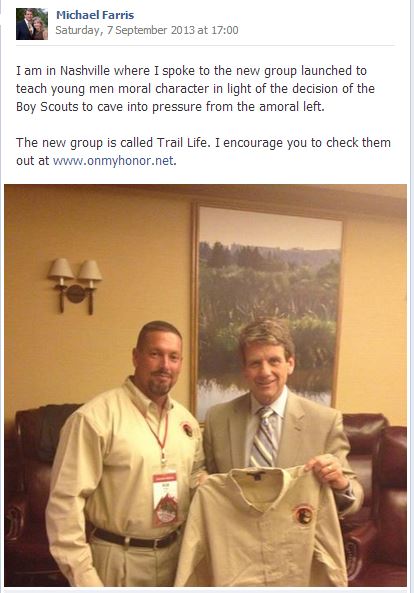
Original photo posted on Michael Farris' Facebook page here: https://www.facebook.com/photo.php?fbid=468390293258668&set=a.351585204939178.76024.351012244996474&type=1
Original photo posted on Michael Farris’ Facebook page here: https://www.facebook.com/photo.php?fbid=468390293258668&set=a.351585204939178.76024.351012244996474&type=1

HA note: The following is reprinted with permission from Kathryn Brightbill’s blog The Life and Opinions of Kathryn Elizabeth, Person. It was originally published on October 2, 2013.

Well, I guess it was too much to hope for that Farris et al. would speak out against the egregious threat to the rights of gay parents in Russia. When a concerned former homeschooler asked him about it on his Facebook page, he pretty much blew her off by saying that because it wasn’t a homeschooling issue he wouldn’t do anything.

Funny though, how he doesn’t have the time and isn’t willing to take the effort to speak out against the proposed legislation in Russia to take children away from gay parents, but he did find time to be at the launch of Trail Life. Trail Life, for the uninitiated, is the organization that just formed as an alternative to the Boy Scouts. To be precise, it was founded as an alternative by those who do not like it that the Boy Scouts is no longer kicking children out of the Scouts for being gay. Note, the Boy Scouts still does not allow anyone over 18 to be involved with scouting if they’re gay, but that’s not enough for the Trail Life folks.

If you’re not kicking kids to the curb if they come out, you’re caving into the pressures of the amoral left.

Source: https://www.facebook.com/photo.php?fbid=468390293258668&set=a.351585204939178.76024.351012244996474&type=1

Again, let me remind you, no time to speak out against Russia wanting to take gay parents’ children away since it’s not homeschooling related, but plenty of time to go help launch a group that differentiates itself from the Boy Scouts by targeting children in the culture war. Yes, that’s what they’re doing.

They’re putting kids in the cross hairs of the culture wars. It’s kids who are going to get booted out of Trail Life, it’s kids who they want to get booted out of the Boy Scouts. Kids.

Not surprisingly, Farris has a bit of a persecution complex about all of this. Here’s the relevant conversation from the comments on his post.

farris2

Two things here. The first is that as a K-12 homeschooler and homeschool graduate, I’m tired of the media treating Michael Farris as if he speaks for all homeschoolers. He doesn’t. He certainly does not speak for me.

The second is this. When Michael Farris talks about “the homosexual community and their elitist friends and the courts,” he’s painting this as an us versus them battle between his band of conservative Christians on one hand and the aforementioned homosexual community and their elitist friends and the court on the other. He is mistaken. There is no us versus them. There is only “we.”

Not just “we” in the abstract, “We the People,” sense either. “We” as in, the people his movement is fighting against aren’t some “other.”

Mr. Farris, we are you—

—your family members, the kids who sang in the church choir and went to AWANA every week, who were trusted to babysit for other homeschoolers because we were part of the community, the homeschool kids who listened when you said that we were the generation who would change America.

You’re fighting so hard, but you aren’t fighting for liberty, you are fighting to deny liberty to people who are not so different from you.

Mr. Farris, it was your con law book for homeschoolers that inspired me as a teenager to want to go to law school.

I listened to you when you said that homeschoolers were going to change the country and I believed it. If I’m some activist elite, Mr. Farris, it’s because you and the homeschool movement created me. When I worked on an amicus brief in Perry and Windsor, it was because of the seeds you planted in me to go to law school.

We are not others, this is not us versus them, and it never has been, no matter how much you try to make it that way.

A Quick and Dirty Primer on HSLDA

Screen Shot 2013-09-17 at 1.49.33 PM

A Quick and Dirty Primer on HSLDA, By Kathryn Brightbill

Kathryn Brightbill blogs at The Life and Opinions of Kathryn Elizabeth, Person.

Did you find your way to Homeschoolers Anonymous because of the press coverage of the Wunderlich and Twelve Tribes cases in Germany? Or did the Romeike case in the United States send you hunting for more info on this HSLDA group that keeps showing up in news stories?

Then this story is for you.

It is in no way meant to be exhaustive, just to provide basic information for people who did not grow up in the homeschooling world and are unfamiliar with HSLDA’s activism.

Early Days

HSLDA was founded by Michael Farris in 1983. At that time, homeschooling as a movement was in its infancy, and because parents were concerned about the legality, the idea of a legal defense and advocacy organization dedicated to homeschooling was an attractive one.

Throughout the 1980s and 1990s, HSLDA was involved in liberalizing the homeschooling laws in states across the US, mobilizing homeschoolers to bombard their legislators with phone calls, telegrams in the early days, faxes, and emails. During this time period most of the restrictions and regulations on homeschooling were removed so that in many states there is now minimal oversight of homeschooling families to ensure that children are receiving an education.

In 1991, HSLDA went international with the formation of HSLDA Canada.

A turning point came in 1994 when HSLDA used the power of its network of homeschooling parents to fight against H.R. 6, a federal bill that said that non-public schools applying for federal funds must have teachers certified in the subject matter in which they teach. For reasons that are not entirely clear since the bill was about non-public schools that received federal money—an issue completely unrelated to homeschooling, HSLDA decided that H.R. 6 meant that the federal government would require homeschoolers to be certified teachers. Although many other homeschool leaders disagreed with HSLDA’s analysis and did not see any threat to homeschooling in the bill, nevertheless, HSLDA mobilized tens of thousands of homeschoolers to contact congress and in the process discovered just how powerful a political network they had built.

HSLDA Branches Out: Non-homeschool-related activities

When you are an organization that is run by conservative members of the religious right (Farris was an attorney with Concerned Women for America who fought against the Equal Rights Amendment, former HSLDA attorney Doug Phillips is the son of Constitution Party presidential candidate and former Nixon administration member Howard Phillips, to give a few examples), and you have built a powerful grassroots network that will do your bidding, the temptation to limit your work to homeschooling is evidently too great to resist.

Coming on the heels of the H.R. 6 fight in 1994, HSLDA touts their involvement in killing the US ratification of the UN Convention on the Elimination of All Forms of Discrimination Against Women (CEDAW), a human rights treaty.

The only UN member states that have not ratified CEDAW are Iran, Palau, Somalia, South Sudan, Sudan, Tonga, and the United States.

In 1995, HSLDA took a case in Virginia, In re Brianna, where the parents were charged with neglect for refusing to vaccinate their child. HSLDA successfully argued that the parents should be given a religious exemption from providing childhood vaccinations to their child. HSLDA’s timeline of events does not indicate that this case had any connection to homeschooling.

In a case where the only relationship to homeschooling was that the party involved was a former homeschooler, HSLDA and Michael Farris took on the case of Michael New, a soldier who refused to wear a UN beret as part of United Nations peacekeeping actions. In a 1995 Court Report cover story, the case was described as, “Michael New v. the New World Order,” a reference to fundamentalist Christian beliefs about the End Times and the United Nations as ushering in a one world government that would lead to the rise of the antichrist.

In 1997, a constitutional amendment drafted by HSLDA, the “American Sovereignty Amendment, H.J.R. 83,” was introduced by Congresswoman Helen Chenoweth (R-ID). The amendment, which did not go anywhere, would have changed the Constitution so that treaties were no longer on the same level as the US Constitution. The text of the amendment is not available online, but it is evident from HSLDA’s own description that it would have had significant effects on the United States’ ability to meet its treaty obligations.

By 2003, HSLDA decided to organize young homeschool students into Generation Joshua to create a generation of young, politically active kids who could provide the manpower on the ground in conservative political campaigns. Generation Joshua was designed to build a second generation of kids to carry forth the culture war battles of their parents.

In 2004, despite the fact that it has not even the slimmest connection to homeschooling, HSLDA backed a constitutional amendment to ban both same-sex marriage and civil unions.

Another way that HSLDA expanded their reach beyond homeschooling was with the 2007 launch of ParentalRights.org, an advocacy organization devoted to expanding parental rights free from government interference. This includes advocating for a Parental Rights Amendment that would subject all laws relating to parental decisions on the upbringing, care, and education of their children to the highest level of judicial scrutiny, a standard that is extremely difficult to overcome, and which would remove almost all legal protections from children.

HSLDA was also instrumental in blocking United States ratification of the UN Convention on the Rights of Persons with Disabilities, despite the fact that the treaty mirrors the Americans with Disabilities Act.

On the treaty front, HSLDA has also led the fight against the ratification of the UN Convention on the Rights of the Child. Among their objections to the treaty is that it would prevent minors from being sentenced to life in prison—something that the international community agrees is unacceptable but that the US still practices. They also object to the fact that the convention uses the best interest of the child standard in determining matters involving children, even though the best interest of the child standard is the guiding standard in American family law already. Furthermore, they oppose the idea that children should have a right to be heard in decisions relating to their interests.

The only countries that have not ratified the UN Convention on the Rights of the Child are Somalia, South Sudan, and the United States. HSLDA bears much of the responsibility for America’s failure to ratify the treaty.

HSLDA and Abuse

Starting from 1992 on, HSLDA’s timeline lists their involvement in an increasing number of cases where homeschool families were accused of child abuse unrelated to homeschooling itself. Further, HSLDA’s timeline credits their work with member families in defeating Virginia Senate Bill 621, a bill that did not involve homeschooling but rather the standard of proof in child abuse investigations.

They also brag on their timeline about their role in killing a 1997 bill in New Hampshire that would have defined isolation of children as a form of abuse, because they believe it could apply to homeschoolers. This certainly suggests that HSLDA believes that some homeschool parents isolate their children to the point that a bill designed to protect children from abuse would apply, and thinks this is okay.

This is particularly relevant given the accusations against the Wunderlich family—HSLDA says that the family wasn’t abusive, but HSLDA doesn’t think that extreme isolation is abuse.

In his 1996 novel, Anonymous Tip, a story intended to dramatize the position that Child Protective Services are a threat to families, Michael Farris repeatedly has his protagonists insist that spankings that leave bruises are not necessarily evidence of abuse.

For more on HSLDA’s handling of child abuse cases, see Libby Anne’s extensive documentation on HSLDA and abuse, including their fight against child abuse reporting, the time they called a man who caged his children a “hero”, and their opposition to Florida’s proposed law that would have defined leaving bruises and welts on children as abuse.

This is not to say that HSLDA supports child abuse. As Libby Anne explains, it is entirely possible to abhor abuse while still taking actions that end up protecting abusers.

Michael Farris’ other non-homeschooling activism

An overview of HSLDA would be incomplete without noting at least some of Michael Farris’ other activism during his time with HSLDA. In addition to an unsuccessful 1994 run for Lt. Governor of Virginia, Farris was the founder of the Madison Project, a political action committee that bundles small donations in support of right wing candidates. Furthermore, his support of right wing candidates extended to backing John Ashcroft for President in 1998 and Mike Huckabee in 2008 (chastising other leaders of the right for not backing Huckabee sooner), and has mobilized Generation Joshua in support of Ken Cucinelli’s run for governor of Virginia.

As already mentioned, before founding HSLDA, Farris worked with Concerned Women For America in fighting against the Equal Rights Amendment that would have guaranteed equal constitutional rights for women. Also in the early 1980s, he worked with the Moral Majority in Washington state to try to get sex education materials removed from libraries.

Farris has also taken to fighting other broader culture war issues after the founding of HSLDA. Writing an amicus brief on behalf of Patrick Henry College in the Hollingsworth v. Perry (Prop. 8) United States Supreme Court case, he argued that if the government recognized marriage between two people of the same sex it would make it harder for Patrick Henry College to continue with their current (discriminatory) policies.

More recently, he spoke at the founding meeting of Trail Life, USA, the scouting group that was formed as an alternative to the Boy Scouts after the Boy Scouts stopped kicking gay kids out of the Scouts. The head of the Trail Life organization has gone on record stating that he believes that parents accepting their gay children is a form of child abuse. Farris, for his part, seems to agree with the head of Trail Life that gay children should be subjected to reparative therapy, a form of therapy condemned by every major psychiatric organization because it is psychologically harmful to the point of being abusive.

In Conclusion

While HSLDA may have started as a homeschooling advocacy organization, over time they have shifted and expanded their focus, fighting against international treaties, expanded child abuse legislation, and fighting for broader religious right causes. They are an organization founded and led by religious right activists who treat homeschooling as yet another front in the ongoing culture wars.

Alternative Narratives On Germany And Homeschooling: An Introduction

Screen Shot 2013-09-17 at 1.49.33 PM

By R.L. Stollar, HA Community Coordinator

So much of the “news” one hears these days about Germany and homeschooling comes from the same sources: Fox, The Blaze, World Net Daily, the Christian Post, and WORLD Magazine. Often times it seems like these sources merely copy and paste press releases from the Home School Legal Defense Association (HSLDA) rather than do their own research. I can also count on one hand how many times they did not bring up Adolf Hitler or the Nazi Party or the Gestapo, or encourage their readers to think in terms of xenophobic slurs.

When I wrote my essay about how American-based organizations like HSLDA and the Alliance for Defending Freedom (ADF) supported the Bavarian branch of the Twelve Tribes through the efforts and money of American Christians and homeschoolers, I was struck by the vast differences in coverage between American media and German media. I think, honestly, what I was most struck by was that — there has been an abundance of German media coverage on the homeschool question in Germany over the last decade. While that probably ought not be surprising, it was surprising for this reason: that coverage is almost universally absent in American coverage.

And here is why this is a problem: there are really, really important details in the German media coverage that get conveniently left out of the American media coverage.

Details that can make all the difference in the world in how one perceives individual situations.

I am hoping this week to provide the HA audience and a wider audience with some of this missing information. I also want to encourage Christians, homeschoolers, Americans, and so forth to think beyond the predominant narrative on what is going on in Germany — a narrative that is intimately and methodically constructed by HSLDA itself — and consider other narratives and points of view.

This week HA will not be presenting merely one narrative in opposition to HSLDA’s narrative. Rather, we will be sharing viewpoints from a diversity of sources. Some of us might actually believe Germany’s almost-ban on homeschooling is in fact silly, but at the same time believe homeschooling is not a human right. Or we might disapprove of excessive police force against German homeschoolers, but agree with Germany’s almost-ban on homeschooling. Or we might be 100% cool with homeschooling but think it is 100% not cool to use American immigration and asylum policy as a battleground for homeschool politics.

The point this week is not to force any one perspective down your throat. The point is to encourage you to consider more than HSLDA’s perspective — more than the perspective that is allowed to go unquestioned and parroted by Fox, The Blaze, WND, and so forth.

*****

Introducing Jennifer Stahl

As we begin this week on Germany and homeschooling, I am excited to introduce Jennifer Stahl to the Homeschoolers Anonymous audience. Jennifer was homeschooled from the sixth grade forward under the Home School Legal Defense Association umbrella — and she is currently residing in Germany. She has written a number of excellent posts about German homeschool controversies on her own blog.

As a former HSLDA kid currently living in Germany, Jennifer’s voice is a fascinating and important one to consider.

As a former HSLDA kid currently living in Germany,, Jennifer Stahl's voice is a fascinating and important one to consider.
As a former HSLDA kid currently living in Germany,, Jennifer Stahl’s voice is a fascinating and important one to consider.

Here is a little bit about her: Jennifer was raised in a US Military home where she lived in six different states and in two foreign countries before getting married and moving to Germany. She is the oldest of three children and her school background varied greatly, including six years of home-schooling. Jennifer’s faith took a different direction in the last decade, towards Messianic Judaism, which has been a source of contention with her family’s fundamentalist background. After moving overseas and having her first child, she began questioning the doctrine that children are inherently sinful beings who need to be beaten regularly, obey instantly with a happy heart and never question their religious and household authority. She has also been unpacking much of the harm of purity culture, spiritual abuse, and anti-feminism while navigating cross-cultural norms. In processing these issues, she came to realize how much doctrine had been passed off as “Gospel Truth” and began blogging about this late last year.

You can follow Jennifer on her blog at Yeshua, Hineni and on Twitter at @HadassahSukkot. She was recently interviewed about Christian feminism on From Two to One.

*****

Since the Bavarian Twelve Tribes were recently filmed committing child abuse and Dirk and Petra Wunderlich were recently reunited with their children, and HSLDA members have been flooding the Germany Embassy’s Facebook page, there are likely a lot of Germans wondering about this American organization called HSLDA and about homeschooling and the like. So to start this week, Kathryn Brightbill has written “a quick and dirty primer on HSLDA,” so that interested individuals can learn more.

The battle over homeschooling in Germany has raged for well over a decade. There have been many high profile cases, ranging from the Twelve Tribes (Zwölf Stämme) to the Paderborn Seven to Melissa Busekros to the Romeike, Wunderlich, and Dudek families. Most of these high profile cases involve some form of fundamentalist Christianity, with evolution and sex education as motivating factors for homeschooling. They also involve the hand of an American organization like HSLDA or ADF — or a German-based affiliate, like Schulunterricht zu Hause and Netzwerk Bildungsfreiheit.

Since it is unlikely this battle is going away any time soon, the least we can do is understand the situation and get our facts straight.

I hope that this week’s series will aid in that endeavor.

Nerdy Homeschooler: Kathryn Brightbill

positives

Nerdy Homeschooler: Kathryn Brightbill

Kathryn Brightbill blogs at The Life and Opinions of Kathryn Elizabeth, Person.

I’m a nerd, a geek, though I suppose not enough of one to get caught up in the arguments over which of those terms is positive and which one is the insult. I was a female computer geek back before there were enough of us for people to even start whining about “fake girl geeks” showing up at cons. When being a woman interested in tech meant you and a roomful of guys who didn’t quite know what to do with you.

I’ve read the studies, I know the statistics, and the reality is that even now in 2013, the majority of girls don’t make it out of junior high still feeling good about their abilities in math and the hard sciences. By the time they get to college, not many girls are still in the pipeline of women in technology. While the problem is multifaceted, we know that the combination of peer pressure and negative gender stereotypes makes it an uphill battle. No matter a person’s actual skill level, when the prevailing message is that people like them aren’t good at a particular subject area and there aren’t many role models, they start to internalize that message.

I missed that message.

Or rather, I should say that by the time I became aware of the idea that girls aren’t supposed to be good at math, I was sufficiently confident in my abilities that I concluded that something must be wrong with a society that says that girls can’t do math.

Being homeschooled by a former math teacher meant that it was expected that I learn enough math that the door was open to any path I might decide to pursue in college, and my sister and I were held to the same expectations as my brothers were.

I never got the message that my gender was in some way supposed to be correlated with lower math ability, or that it meant I should limit my dreams and goals for the future.

At its best, homeschooling can create a learning environment that helps to minimize the influence of societal pressures to conform to rigid gender roles and to live up (or down) to the expectations of society. That’s what homeschooling did for me. The prevailing message of my childhood was that I could be or do whatever I wanted and that no one could stop me. I didn’t internalize most of the negative gender stereotypes about women because the negative messages were drowned out by the positive. I’m convinced that one of the reasons why I was able to hold my own in the extremely male-dominated computer science major I ended up choosing in college was because I hadn’t internalized the message that I wasn’t supposed to be able to do it because I’m a girl.

It would be dishonest of me, though, to write about my positive personal experiences without also acknowledging the tension between the message I got in my own family and the messages I got from the broader homeschool world. When I was a teenager, I became acutely aware that the expectations that others had for my older brother were vastly different than what was expected for me. I was the one who wanted to go to law school, but I felt like everyone was busy encouraging my brother—who had no interest in law—to become a lawyer while not taking my interests seriously. When I changed my major to computer science in college, I got the distinct impression that it wasn’t taken seriously unless I gave the justification that programming was a career that could allow me to work from home while being a good wife and mother.

At its best, homeschooling can open up a broad range of options and free a child from the pressures of stereotypes, at its worst, it can reinforce those negative stereotypes and close off options.

For me, my homeschool experience meant that I was able to go off to college confident in my abilities and with my options open. It meant that while I was convinced that I was going to go major in history and then head directly to law school, when I discovered my freshman year that computer science interested me, I had the foundation to succeed. In the end, I discovered that studying computer science was far more interesting to me than actually doing it, and ended up with the original law school plan, but having that tech background gives me opportunities that a liberal arts major wouldn’t.

I’m not yet sure where my story ends, but it’s been an interesting ride and one that homeschooling helped make possible.

Let’s Talk About Christian Culture and Consent

we-need-to-talk

Note from R.L. Stollar, HA Community Coordinator: The following post does not mention “homeschooling” in any way. It is more about the Christian culture in which many of our homeschooling experiences occurred. But since many of our particular homeschooling experiences occurred within this culture, this post is very relevant. After reading Kathryn’s thoughts, I, too, tried to remember when any of the modesty or purity teachings I received about relationships — in both my church and homeschooling environments — included any discussion about consent. Like Kathryn, I was at a loss. In retrospect, I find this omission rather disturbing.

HA note: The following is reprinted with permission from Kathryn Brightbill’s blog The Life and Opinions of Kathryn Elizabeth, Person. It was originally published on August 1, 2013.

*****

Let’s Talk About Christian Culture and Consent

A friend made a comment on one of my Facebook posts today that got me thinking.

The comment was about how a lot of people in the Church don’t have any kind of sexual ethic, just a bunch rules that they follow. I think that’s a good description of how it is that people buy into slippery slope arguments—the old, “if we allow people to gay marry, then what’s to stop them from toaster marrying?” logic.

If you’ve got a sexual ethic based on consent, then the answer is obvious: because toasters are incapable of consent.

If you are just operating by rules, then it makes sense that you’d think that if one of your rules gets tossed then what’s to stop all your rules from going out the window.

The comment on my Facebook post made me realize that in all of the years of growing up in the Church, of getting lectures about abstinence in Sunday school and youth group and True Love Waits, I cannot remember a single mention of consent. I remember Dawson McAllister coming to town to a True Love Waits event and telling us that anal sex was still sex and not a way to remain a virgin (which is not a bad piece of information, incidentally, though really rather stupid if the only reason you’re telling them is to make sure they remain more than just technical virgins), but for all of the talk about what you couldn’t do, the only talk about saying “no” was about not sinning.

I’ve racked my brain trying to remember even a single time that I’ve ever heard consent mentioned in a church-related setting growing up and I can’t remember a single one. 

By not teaching about consent, you produce girls who don’t know that they can refuse consent for any other reason than “it’s a sin,” and you produce boys who have never been taught that no means no. That’s a recipe for disaster. Is conservative abstinence education turning boys into accidental rapists and girls into easy victims because neither one has been educated about consent being an inviolable element in a sexual encounter?

I put this question out there on Facebook and Twitter and I’ll ask it here as well. For those of you who grew up in the church and were lectured about abstinence in youth group/Sunday school/True Love Waits/etc.:

Do any of you remember being taught about consent?

How Bad Homeschool Research Hurts Homeschoolers

HA note: The following is reprinted with permission from Kathryn Brightbill’s blog The Life and Opinions of Kathryn Elizabeth, Person. It was originally published on July 24, 2013.

When I was in college, I was one of the participants who answered the NHERI/HSLDA/Brian Ray survey of homeschooling graduates. I don’t remember how I got the survey, probably via email forward from my mom, but what I do remember is sending an email to my family after taking it in which I said something about how I wouldn’t believe a thing from the eventual study results. Aside from the fact that an email forwarded among homeschool groups asking people to take an internet survey is a lousy way of getting a representative sample (especially when we’re talking more than a decade ago, when we were nowhere as close to ubiquitous computing as we are now and computer access was still largely along socioeconomic lines), the survey itself was rife with methodological problems.

My memory is of a survey where I could tell exactly what answer they were looking to find, based on both the questions asked and the possible answers given for those questions. It was a survey that, even as a college student who had a positive experience and didn’t have the criticisms of the system that I do now, was so bad that I wondered why anyone would design it the way they did unless the goal was not usable data but a certain set of predetermined results.

If I got anything out of being homeschooled for twelve years by a math teacher, it’s a healthy appreciation for numbers. Numbers explain the world, or at least they can explain the world if they’re used correctly. Without good numbers, you might as well be stumbling around in the dark bumping your shins into the furniture. Bad numbers are even worse than no numbers; they’re like spreading Legos on the carpet while stumbling around in the dark with bare feet.

The HSLDA/NHERI numbers on homeschooling are like stumbling around on that Lego-strewn carpet. Aside from the aforementioned homeschool graduate survey, they also have test scores that they trot out to prove that homeschoolers do better on standardized tests than other students.

Except that the numbers don’t show that. What they actually show is the results of those homeschooled children whose parents not only use achievement tests (which isn’t all of them), who were aware of the NHERI survey (again, not all of them), and who agreed to submit their children’s scores for a study that they were already told was intended to make homeschooling look good. We have no idea how representative that group is of homeschoolers as a whole because it was self-selected and we don’t know whether that self-selected group in any way mirrors homeschoolers as a whole.

The modern homeschool movement is more than 30 years old and we still don’t have a good idea of homeschooling demographics. We know that they’re predominantly white and might be mostly religious (but even the religious makeup is hard to guess because the religious and the secular homeschoolers seldom run in the same circles). We don’t know what the socioeconomic makeup of the homeschool population is, and we don’t know the average education level of parents or a breakdown of those parents’ degrees. Without that, we can only guess at whether the socioeconomic levels of homeschoolers in NHERI’s test score data in any way represent homeschoolers as a whole.

Homeschoolers are fiercely independent even without taking into consideration that the religious ones don’t trust outside researchers because they’ve been told by HSLDA for years that outsiders want to hurt homeschooling. As for the secular unschoolers, they aren’t exactly fans of the establishment, which makes it hard to pin them down as well. Compounding the problem, the people the religious ones do trust (aka, HSLDA and NHERI) aren’t interested in giving good data, they’re interested in giving a good sales pitch for homeschooling. And so, we’re stumbling around in the dark knocking our shins into furniture and stepping on stray Legos.

There are a handful of small studies about adult former homeschoolers, but the rest is guesswork. We don’t have a good picture of the socioeconomic status of homeschooling families. We don’t really know how homeschoolers as a population do on achievement tests because we don’t have any surveys that aren’t self-selected. We don’t even have a good idea of how many people are homeschooling. It might be a million and a half, it might be twice that. We need good data and we simply don’t have it.

Are the kids I knew in high school who were all upper middle class children, mostly of parents with degrees in STEM fields, an accurate representation? What about the kids I knew when I was younger whose blue collar parents had no college and were passing their non-standard English dialect on to the kids rather than standard English grammar? Was my dad right when he always said that math was a weakness that homeschoolers needed to watch out for because the kids were being taught primarily by mothers who had been put on the consumer math track in school? Was I right when I used to tell people that the reason they thought homeschoolers were weird was because the normal ones who are in the majority didn’t advertise that they were homeschooled?

I don’t know because no one does.

And yet the Brian Ray/NHERI research keeps getting repeated in conservative and mainstream media even though it doesn’t actually tell us anything.

I understand why homeschool parents want to like the NHERI numbers; they help reassure them that they’re on the right path and not totally screwing up their kids with the homeschool choice. That’s why what NHERI’s doing with self-selected, unscientific research methods is so messed up. Parents, good parents, are relying on data that’s given a veneer of science but that may well be leading them to make educational choices that aren’t the best possible for their children. If math education, for example, really is the weakness for homeschoolers that my dad thought it was, homeschoolers need to know that so they can compensate for the weakness. If more than a fringe number of homeschool kids are having trouble fitting in with mainstream society because of the homeschool bubble, parents need to know that to correct for it.

With nothing but bad data to rely on, parents are left stumbling around in the dark hoping that they aren’t going to bash their shin on the corner of the coffee table or step on a stray Lego. That’s not serving homeschool parents well, and it’s certainly not doing anything for the kids.

Let’s Talk About Tim Tebow For A Minute

Crosspost: Let’s Talk About Tim Tebow For A Minute

HA note: The following is reprinted with permission from Kathryn Brightbill’s blog The Life and Opinions of Kathryn Elizabeth, Person. It was originally published on June 9, 2013.

I don’t know Tim Tebow, never met the guy, though from what I’ve heard from people who knew him at UF, he’s a genuinely good guy. He’s definitely someone I’d rather have representing the University of Florida than some of the other famous alumni. What I can say for certain though, is that Tim Tebow is no saint.

Wait, wait, before you get the angry mob with pitchforks and torches to come after me, hear me out. Tim Tebow is no saint because nobody is. We’re all flawed human beings trying to figure out how to live our lives, and nobody is perfect. Nobody can be perfect. Even if Tebow is the nicest guy to ever walk the planet other than Jesus himself, he’s still not perfect. Perfection is impossible. Not only that, but we don’t all agree on what “perfect” even is. No one can possibly keep everyone happy.

I’ve alluded from time to time about the pressure that comes from being put on a pedestal in the homeschool world. Being a homeschool poster child who everyone in your homeschool community looks up to as an example isn’t exactly what I would call fun. It’s something I hated as a kid, and something that I couldn’t figure out how to escape. I eventually managed to gracefully get down off the pedestal by going away to college and drifting away from the homeschooling world.

Even after having been away from that community for as long as I was though, one of the nagging things in the back of my head as I was mentally preparing myself to come out was the knowledge that there was a non-zero chance that as the story made its way through the homeschool grapevine, people would talk about me in hushed tones and wonder what went wrong. It’s why I’ve referred to myself as a cautionary tale to the homeschool subculture (and also one of the reasons why I said I could never figure out a way to even rebel). All I know is that despite being small potatoes in the homeschool world, the pressure of the pedestal that others placed me on isn’t something I’d wish on others.

So what does this have to do with Tim Tebow? Easy. Tim Tebow is, by orders of magnitude, by far the most famous homeschooler on the planet. He’s been put on a bigger pedestal than any of us ever have been, all because he’s pretty decent at the game of football.

Maybe he likes being on the pedestal, perhaps he sees it as an opportunity to be a witness for God. That’s certainly what any good little evangelical missionary kid homeschooler has heard all of their life. Whatever the case may be though, staying perched on a pedestal as high as the one he’s on for as long as he’s been on it is not something that’s easy to keep up. One misstep and you come crashing down. And as much as the cynical sports and entertainment media love to tear a person down, the church world is even more brutal.

I cringe when I see how the homeschooling and conservative Christian world talk about Tebow. With the way they’ve built him up, he really can’t win. I don’t know how he can possibly be himself when the hopes of every homeschooler, or at least every religious homeschooler, are riding on his shoulders.

Can we please have a moratorium on homeschoolers and Christian culture treating Tim Tebow as a living saint? Let the guy just be another football player for once. Stop treating him as the homeschool poster boy and let him be an actual, real person, flaws and all.

Crosspost: Homeschooling’s Unwilling Boosters?

Crosspost: Homeschooling’s Unwilling Boosters?

HA note: The following is reprinted with permission from Kathryn Brightbill’s blog The Life and Opinions of Kathryn Elizabeth, Person. It was originally published on June 12, 2013.

Note from Kathryn: The following guest post is a follow-up to my posts, The One Thing You Should Never Ask a Homeschool Kid, and Well, That Was Certainly Not Something I Expected to be ControversialThe author wishes to remain anonymous.

***

Kathryn blogged [a few weeks ago] about homeschool children who are asked to defend homeschooling to strangers who want to know if they’re well educated and well-adjusted. What does it look and feel like when our parents and homeschooling community expect us to be apologists for homeschooling?

This kind of upbringing can lead to 2 results:

1. You grow haughty about your own superiority and stand at a distance from your peers

2. You don’t learn to be self-reflective, and you end up a crippled version of yourself because you don’t change the things you need to change to become a fully developed adult and.

I know this, because I’ve both seen it in others and lived it myself.  As a homeschool student from K-12, I too was asked by many strangers and friends to defend my experience as a homeschooler.  But the same expectation existed within my own community.

My homeschooling experience started in the early days of the homeschooling movement.  I was often asked by my parents to describe the benefits of my homeschooling experience because they were proud of me, but also because homeschooling still required defense in a lot of circles.  At my graduation, the unwritten expectation of my homeschool community was that I would speak about how my experience was superior to that of my peers.

This expectation exists for most homeschool graduations I’ve been to—parents expect their children to stand as apologists for their homeschool experience.  I once attended a graduation where the two speakers talked about the superiority of their educational upbringing—they were confident, articulate, and very convincing.  Except that I’ve known one of the two speakers since she’s a baby, and I can say quite confidently that she is poorly prepared for the world and hasn’t been given a foundation of independence or critical thinking about her experience or the experiences of other 18 year olds preparing to step into the world.

I went on to college, completed a master’s program, and am a successful young professional.  However, it was only when I was able to objectively look at my homeschool experience and see the good and the bad of it that I was able to grow into a mature adult and shake off the fears of others that kept me from growing into the most complete version of myself.

The problem with those 2 results of being a homeschool apologist?

1. When you’re haughty about the superiority of your homeschool education, you hold all others at arm’s length and rich relationships are impossible.

2. When you continue to insist on the perfection of your own experiences, you are blind to your imperfections and you stay in a static state.

No person is perfect, but inflexibility and a closed view of those who aren’t like you are often a byproduct of becoming a haughty homeschool apologist.  The opposite characteristics – flexibility and openness – are two characteristics that make good friends.  If you can’t be open and flexible in your understanding of the experiences of others, you won’t be a good friend.

Any parent who homeschools their children should give them the freedom to live within their homeschool experience without having to be a homeschool booster.  If you tell people that your children are intelligent and capable of having intelligent discussions, allow them to be a part of the dialogue about the educational choice you’ve made.  Let the discussion be real, and let them tell you why the homeschooling is or isn’t working for them.

If your children really do love and buy into the homeschooling choice – then – they will be the best booster.