When Love is Abuse

CC image courtesy of Flickr, Jackie.

HA note: The following is reprinted with permission from Libby Anne’s blog Love Joy Feminism. It was originally published on Patheos on July 16, 2015.

Love. Love. Love. It seems to be all I hear about.

I was raised in an evangelical home. Between five and ten years ago I went through a time of incredible pain at the hands of my parents. They believed I was bound by God to obey them even as an adult, they freaked out when my beliefs began diverging from theirs, and they cracked down, hard. Their efforts to control and manipulate me can be safely termed emotional abuse. I cried so much during that time. I was still so young, and out on my own for the first time. I needed their love and support, not their rejection and their anger.

But they loved me, you see! They did what they did because they loved me. Or so they told me. And so their church friends told me. Even my boyfriend and my future in-laws told me that my parents loved me, and that they did what they did (misguided as it was) out of love. In the years since then I have watched this same scenario play out in other families, and all with the same narrative. Always there is love.

What good is love if it is not accompanied with kind actions?

I have come to feel that love is a neutral thing, not an automatic good thing as most seem to assume. It is in and of itself neither good nor bad. There is a selfish love, there is a smothering love, there is a love that seeks to control, a love that does not let go. This is not a good love, it is not a kind love, it is an abusive love. And so I find that I care less about whether someone “loves” another person than I do about how they treat them.

Loving someone does not get a person off the hook for treating them horribly—nor does it soften the treatment. Indeed, it makes it worse.

There are many women who stay in abusive relationships because their abusers tell them they love them. Physically and emotionally abusive parents in the population at large usually say they love their children. Some might say that these people do not really love, because if they did they would treat those they love with kindness and respect, but that does not change the fact that many abuse victims stay when they technically could leave. Lovebecomes a prison key.

After all, what is love? No really, what is love?

If someone had told my mother that she did not love me, back during that time of trouble between us, she would have found the idea too ridiculous to countenance. After all, what was that feeling she felt for me but love? I, too, would have rejected the idea that my mother did not feel love for me. I knew her actions were wrong, I knew that it hurt and that I only wanted out and that at some point I didn’t care if I ever saw her again (or so I told myself), but to suggest that my mother did not feel something for me—no. She clearly did, else why go through all that trouble?

At some point I came to realize that my parents did not really love me, but rather the person they imagined me to be, or the person they wanted me to be. I came to this conclusion when I realized they did not really know me. Not only that, they did not care to know me. They refused to listen, truly listen, preferring only to lecture and to deny. And if I did not know me, and did not care to know me, how could they love me? No, what they loved was a mold they created in their own minds, and then sought to press me into.

Years ago my aunt told me that when she became engaged to my uncle her father asked her three questions: Do you love him? Does he love you? Does he treat you right? Note the inclusion of the third question. If love implied good treatment, that question would not be necessary. We make a mistake when we assume that love means right treatment. This is a mistake because too many people end up in abusive relationships, held their by the belief that their partner (or mother, or what have you) loves them. And love must mean right treatment, so if there is love, all must be okay—even when it’s not.

There is little that means less to me than a parent’s statement that they love their child. Do you have any idea how much abuse parents have justified in the name of love? Love serves as a sort of get out of jail free card, as though all that matters is that you love your child, and how you treat your child is irrelevant. I’m sorry, but no. Right treatment matters. There is little I have more anger for than a parent who says they love their child while treating them like shit. What does this do to the mind of a child? Here is this person who says they love you, and yet they’re hurting you. What does that tell the child about love?

Love is overrated. Kindness isn’t.

When Demons Are Real

CC image courtesy of Flickr, Ivailo Djilianov.

HA note: The following is reprinted with permission from Libby Anne’s blog Love Joy Feminism. It was originally published on Patheos on March 17, 2015.

I’m sure by now nearly every one of you has heard about Arkansas state representative Justin Harris’s decision to “rehome” his two adopted daughters with a man who then sexually abused them. Most of you have probably heard, too, about the impetus for Justin’s decision—that he believed the girls were possessed by demons. Justin called in specialists to conduct an exorcism and kept the girls separated because he believed they could communicate telepathically.

I might very well think this story to bizarre to be true if I didn’t know first hand how strongly entrenched demons and spiritual warfare are within evangelical and fundamentalist Christianity.

I grew up hearing stories about demons. A friend of my parents’ told a story at Bible study about confronting a demon in the hall in her home at night. She explained that her teenage daughter had been listening to secular music, and that that must have let the demon in. I checked out books by Frank Peretti at the church library, and read hair-raising stories about demonic activity. I went to a dramatic reading of C.S. Lewis’ Screwtape Letters with my parents.

My parents were very clear about demons. They told us that the world around us was locked in conflict between demons and angels. This conflict was going on everywhere around us, unseen.

I struggled with fear of demons my entire childhood. I would lay awake in bed with my eyes clenched shut, afraid that if I opened them I would see a demon at the foot of my bed—demons, after all, could make themselves visible to the human eye if they so chose. I was afraid I would invite a demon to attack me by thinking the wrong thoughts, and fearfully tried to keep my mind away from anything that might seem like an invitation.

My parents always told me that the name of Jesus would protect me from demons. All I had to do was evoke that name, and the demons would flee. But I read in the Bible about a case where a demon beat up some men even though they evoked the name of Jesus, because the men weren’t “true” believers. This frightened me, as I also suffered from salvation anxiety—I was so concerned that I might not actually be saved that I prayed the sinner’s prayer continually throughout much of my childhood.

On a recent visit home, my mother told a story about praying demons out of my youngest sister when she had a migraine. She said my sister vomited violently as the demons left, and then the migraine was gone.

But let’s bring this back around to Justin Harris. My parents believed demonic possession was real, and not just a thing of the past. I was taught that much of what we call mental illness today is in fact demonic possession. It seems Justin Harris believed this too, and interpreted his adopted daughters’ very normal adjustment troubles as demonic possession.

My daughter Sally has a friend who was adopted out of foster care when she was three and her sister was four. Both girls have had adjustment issues, but their adoptive parents expected that and have showered them with the love, attention, and careful guidance they need. It breaks my heart to think that natural adjustment issues—often the result of past trauma—could be interpreted as demonic possession.

I am reminded of this exchange from the Doctor Who episode Curse of the Black Spot:

Captain Avery: The ship is cursed!

The Doctor: Yeah, right. Cursed. It’s big with humans. It means bad things are happening but you can’t be bothered to find an explanation.

I’m honestly not sure what the solution is. Belief in demons as real and active entities is integral to fundamentalism and evangelicalism. But then, my mother once told me that she did believe some forms of depression could be caused by actual chemical imbalances, so perhaps there is some wiggle room—perhaps it is possible to educate individuals like Justin Harris on the psychological explanations behind behavior like that of his adopted daughters. Perhaps, returning to Doctor Who, having an explanation will dispel the need to invoke demons.

Although actually, I’m not sure much could have been done for Justin Harris himself. Anyone willing to threaten a department’s funding to push an adoption through and then give his adoptive children away under the table without so much as a background check is probably too far gone.

Picking Things Up from the Culture, Homeschool Edition

HA note: The following is reprinted with permission from Libby Anne’s blog Love Joy Feminism. It was originally published on Patheos on April 12, 2015.

If you’re a regular reader, you may have noticed that, when speaking of my conservative evangelical homeschool upbringing, I frequently say “I was told X” rather than “my parents told me X.” There is a reason for that—sometimes I can’t remember whether my parents actually taught me some specific aspect of purity culture or political conservatism or whether I just picked it up from the Christian homeschool culture around me. After all, I read the homeschool magazines we subscribed to, listened to the speakers at homeschool conventions, and socialized with the other homeschooled children.

My parents removed my siblings and I from public schools in order to remove us from external influences. But they didn’t remove us from external influences entirely, because, short of locking us in our rooms, they couldn’t. What they did was change the set of influences we were exposed to. But in their choice of a new set of influences—that of Christian homeschool culture—we were sometimes exposed to things they may not have agreed with in a way they never never thought about.

For example, when I was a senior in high school a friend of mine tried to talk me out of going to college. She said women were supposed to serve, and that college was entirely hedonistic and self-centered. She told me she planned to spend those years as a mother’s helper in other homeschooling families, before marrying and beginning her own family. I agreed with her premises, and was left unsettled. If my parents hadn’t had such a solidly upper middle class expectation that I would go to college, I might have been swayed.

For all of homeschooling parents’ rhetoric about how “peer dependent” public schooled children are, we homeschooled children could be quite influenced by our homeschooled peers. Part of me finds this ironic. But then, the point was not so much to remove us from peers entirely as to change the set of peers we were around. My parents opted to expose us to Christian homeschooling culture rather than to the culture of the local public schools.

Don’t get me wrong, I’m glad my parents didn’t subject other Christian homeschooling families to a detailed theological review before allowing me to socialize with their children. I mean yes, they did draw some lines, but they could have drawn those lines much more narrowly. By way of example, I recently came upon an article titled When Catholic Homeschool Kids Get Lonely that really made me cringe. Here’s an excerpt:

It’s easy to think that if Catholic parents put their children in the Catholic Youth Group at the local parish, all will be well and this will solve the ‘loneliness’ or the ‘socialization’ issue, but my husband and I have found that sometimes this can create other problems. Simply put, our experience with the Catholic Youth Group in our particular area has been mostly negative and counterproductive in helping us to raise our daughters for Christ. When we would bring our children to some of the youth activities, we were disheartened by what we experienced and witnessed.

Many of the children who attend these functions also attend the public school. They go to these functions because their parents make them, not because they really want to be there. While there, we would hear them using foul language and witness them picking on other children, bringing that whole “public school mentality/environment” with them into the youth group activities. The parents who were chaperoning these activities couldn’t be everywhere at once, so much of the cursing and mean-spiritedness took place when the chaperones weren’t watching.

Not only this, but my husband and I were appalled at the way in which the girls who attended these functions dressed. We decided not to sign our children up for any more youth group activities in this area.

One of the reasons why I made the decision to homeschool was because I didn’t want my children to be negatively influenced by bad peers. If I keep them out of the public schools for this reason, but then put them around those same children in a youth group activity, what have I accomplished? They’re still around the bad peers.

. . .

If there is a local homeschool support group in your area, this can be a good thing, especially when most of the parents whose children are in these groups are doing what they do for the same reasons as you. However, I do want to offer you a word of caution regarding some of these groups. Not every homeschool support group is Catholic.

If you are raising your children in the Catholic Faith, it is better to be a part of a Catholic homeschool support group than a Protestant one. Experience has taught me over and over again that when Catholics join a Protestant homeschool support group (especially an evangelical one) subtle attempts are made in order to “reach out to” and “save” the Catholic’s soul. Religious tracts are distributed, and invitations are given to attend this church service, that Bible study, this Children’s Kids’ Klub, or that Vacation Bible School.

Because of this, I refuse to allow my children to participate in any of these groups. If a group of kids and parents want to get together for the sake of picnicking and playing ball, that’s one thing. But when one group tries to impose its religious beliefs on another because it does not accept and respect the religious beliefs of others, a line has been crossed.

. . .

If there are no Catholic homeschool support groups in your area, you might consider starting one yourself. Please don’t make the mistake of thinking that in order for it to be successful, it has to be complex, time-consuming, and difficult. Just getting together once a week in a park for a game of kickball with hot chocolate and doughnuts could be a great way to start. Using a church fellowship hall in order to host these meetings is something that a lot of Catholic homeschool support groups pursue.

Although having companions can be fun, nothing can take the place of a close Catholic family.

If a parent chooses to homeschool to remove their children from the influence of public school children, and then chooses to opt out of both church activities and established homeschool groups again because the children involved are deemed bad companions . . . well, let’s just say that if a parent refuses to allow their children to socialize with any children who do not share their beliefs in exactitude, the children will be very lonely indeed.

But because my parents did expose us so fully to Christian homeschooling culture, I’m often unsure what my parents actually believed and what I simply picked up from that culture. Sometimes I know the answer without hesitation, because I remember this comment or that. But other times I don’t. And I find that fascinating.

Parenting Positively Means Much More Than Not Hitting

CC image courtesy of Flickr, Din Jimenez.

HA note: The following is reprinted with permission from Libby Anne’s blog Love Joy Feminism. It was originally published on Patheos on May 11, 2015.

Yesterday as Sally climbed into the car, she knocked over a can with flowers in it, something she’d brought home from school, and in the process spilled water on the seat. Sally began to fret about the water, but I didn’t have a towel or other rag in the car. Since we were about to head home home, I suggested that she sit on the wet spot, soaking up some of the water with her dress, and that she could change when we get home. Sally responded that the water was in a corner of the seat, so she couldn’t.

By this time I’d been out with the kids to the park and elsewhere an hour and a half, and we’d already had to go back to the park because Sally left her backpack there, and I was feeling overwhelmed and annoyed. So when Sally followed her fretting about the water up by saying she couldn’t soak it up with her dress, I was just done.

Fine,” I said. “But if the car rots—”

And there I stopped myself. I’d been about to say “if the car rots, it’s your fault!” But then the entire point of such a statement would be to make Sally feel bad—to use guilt and blame to manipulate her feelings. This is the kind of thing I’m trying very hard not to do! Sally already felt bad that she had spilled the water and was already worried about the car. Why make her feel worse? Why wield her own emotions and feelings as a weapon against her? That’s really not okay.

So when I actually finished the sentence, it looked like this:

Fine. But if the car rots—we’ll deal with it.”

Sally looked relieved as she buckled her seatbelt. “That’s right mom,” she said cheerfully. “We’ll deal with it!” And somehow, just like that, the mood shifted from antagonistic to cooperative.

Giving up corporal punishment was easy. It’s giving up the rest—the myriad ways parents can be punitive and negative in their parenting—that is difficult. Not physically abusing a child is so much easier than not emotionally abusing them.

While I was at the park, before Sally left her backpack and then spilled the water, I observed an interaction between a father and son. My own son Bobby was swinging, as I gave him pushes, when a little boy of about two came up and wanted to use the swing. His father tried to call him away, telling him he should come play on the playground equipment until the swing was open. The boy stepped back and stood by the swings. His father called to him again, from about fifteen feet away, but the boy didn’t move.

“I’m waiting!” the boy explained.

I could hear the boy’s words because he was standing only a few feet away, but his father could not. Instead, all he saw was a boy who wasn’t doing what he said. The father was growing increasingly upset and agitated, and began raise his voice.

Get over here and play like I told you to!” he yelled at his son.

I winced. Who would want to go play when told to do so in such a tone?

The boy’s father did not take the time to come over to his son, get down on his level, and have a conversation with him. If he had, he would have known that the boy understood he would have to wait his turn for the swing, and simply wanted to stand by the swings and wait patiently. If the father, for whatever reason, had still wanted the boy to go play on the playground equipment, he could have explained that to him, and they could have talked about it, and the boy probably would have listened. But he didn’t do any of this. Instead, he yelled at his son in the middle of a park outing.

The thing is, on some level I understood. The father was there alone, without the backup of a parenting partner, and he had a baby under his arm. I used to go to the park on my own with Sally and Bobby when Bobby was a baby too, and it could be very trying. The boy may have spent the drive to the park fretting about something or nagging his father for something, or the father may have had short nerves for other reasons—he may have had a hard day at work, or perhaps things were tight financially.

I know how easy it is to snap, to become frustrated and angry. Raising little people is hard work, and just being an adult in and of itself can be stressful. I’ve raised my voice on occasion too. But just because something is understandable does not make it justified. As parents, we need to call ourselves to extremely high standards, because we hold our children’s hearts in our hands.

We often talk about parenting as though there are abusive parents and good parents—a dichotomy of sorts—but real life isn’t this simple. It’s a continuum. Some abusive parents are more abusive than others, and plenty of parents we wouldn’t term abusive are sometimes unkind to their children or parent in suboptimal ways. For some, this dichotomy may make it easier for bad parenting to go unchecked, because being self-critical of our own parenting can be difficult when the only parenting categories out there are “good” and “abusive.”

In our society today there’s also much more recognition of the problem of physical abuse than there is of the problem of emotional abuse. Emotional abuse can be horrific. I know people whose parents never laid a hand to them who were nevertheless horribly abused. In fact, in my experience, the effects of emotional abuse can last longer and be more severe than the effects of physical abuse. Even parents who are not emotionally abusive overall may do things on the emotional abuse checklist at some point without even realizing it. We are in serious need of awareness raising regarding emotional abuse and children.

I find it helpful to think in terms of practicing healthy relationship skills with my children. Would I have snapped at a friend if she spilled some water in my car, angrily telling her that if the car rots, it’s her fault? No. Would that father in the park have yelled at a friend of his for not coming when called, rather than walking over to him to clarify the plan? No. Sure, adults and children are at different developmental levels and different developmental needs, I get that, but I think remembering that a friend could walk away but your child can’t is incredibly important. We need to get serious about how we treat our children.

While I understood the frustration the father in the park felt—as perhaps will anyone who has been to the park with an infant and toddler—I felt strongly for his son, who was trying to communicate and in response being ignored and yelled at. In the car with Sally, I was only able to stop myself and turn the conversation around because I paused for a moment to step out of my frustration and put myself in my daughter’s shoes. As parents, we need to do that more often.

Parental frustration should be a prompt to be careful about our actions toward our children, not an excuse for bad behavior. A boss taking out his frustration at his impending divorce and the collapse of his home life on his employees may be understandable, but no one would see it as justified. I think we as a society make more allowances for bad parenting than we realize. Because of their dependence—and because they cannot simply walk away—children are incredibly vulnerable, a sort of captive audience. We should see that as a reason to be only more careful about how we treat them.

If you’re a parent, there are probably times you’ve snapped at your children when you shouldn’t have, or times you vented your own frustrations onto your children. I know I have! Some mothers, especially those raised in abusive or dysfunctional families, beat themselves up over their mistakes and wonder whether they are “bad” mothers (there’s that dichotomy again!) or worry that they are becoming their parents. Other mothers glibly point out that “no parent is perfect” and then go on their merry way without a further thought or any intent to do better in the future.

I would call for a different response, one where past mistakes lead not to dwelling on guilt but rather to resolve to do better in the future, and where mistakes aren’t glibly justified as acceptable rather than merely understandable. We may not be able to control actions we took in the past, but we can control our actions in the present. We can also apologize when needed. Our children don’t need to think we’re perfect. There’s no facade we need to uphold—they can see right through it. Being honest and real with our children is important.

Parenting in a healthy and positive way means so much more than just not hitting your child. It’s not something I could achieve immediately or automatically by giving up spanking, though I had once hoped it would be. Instead it’s something I have to keep doing, over and over, every day. It takes intent and commitment, and it sometimes means stopping myself in mid-sentence or pausing to take a step back from a situation and reset my approach. But when my daughter throws her arms around my neck and declares “I love you, mommy,” when she is unafraid to be open with me, when she is comfortable in who she is and in her relationship with me, I know that it is so, so worth it.

Sexual Purity and the Pool Battle Plan

CC image courtesy of Flickr, Georges Marchand.

HA note: The following is reprinted with permission from Libby Anne’s blog Love Joy Feminism. It was originally published on Patheos on May 30, 2015.

A recent article by Heath Lambert, executive director of the Association of Certified Biblical Counselors, got me thinking about the way purity culture harms men. The article was titled Pursuing Purity at the Pool and aimed at preparing men for going to the beach or pool this summer. Take a look at this paragraph, for instance:

During this time of year many show up to swim wearing very immodest swimming gear.  Such immodesty creates a struggle for many seeking sexual purity.  We may choose to decry immodest swimming apparel, but the reality is that outside of our own homes and families there is not much we can do about it.  That means that we will have to take responsibility for our own eyes and hearts as we venture out to  swim this summer.  Here are five suggestions to help us stay pure while many are wearing provocative attire near the water.

In order to understand what the author, Heath Lambert, is getting at, you have to understand that evangelicals and fundamentalists who enforce strict modesty standards and subscribe to what I call “purity culture” believe that even thinking about sex is sinful. To be more precise, thinking about sex with someone you are not married to is held to be sinful. But what this really boils down to is seeing sexual attraction as sinful.

When Heath talks about the difficulty of staying “pure” at the pool, he is not talking about how difficult it is to avoid having sex with sexually attractive women in swimming attire, he’s talking about how difficult it is to avoid having feelings of sexual attraction for attractive women in swimming attire.

Have you ever tried not thinking about something? It’s really hard, isn’t it? An ordinary guy is going to go to the pool and think “mmm, sexy” from time to time, and that’s about it. A guy who believes sexual thoughts are sinful is instead going to spend the entire time obsessing over sex in an attempt not to think about it. How sad is that?

(As a side note, while Heath does say that men should take responsibility for their own eyes, he also describes women’s swimwear as “provocative,” which generally implies an intention to provoke. I for one do not evaluate my swimming attire based on whether or not it will cause the men around me to think sexual thoughts.)

Heath offers several suggestions to help men avoid feelings of sexual attraction to women at the pool or beach.

1.  Don’t Go

One suggestion is not to go to the pool, lake, or beach where others will be dressed immodestly.  For some, the temptation to lust will be too overpowering and should be avoided.  The suggestion to avoid such temptation may sound ridiculous to some.  What is summer without the water?  The beach?  But this suggestion is not mine.  Jesus thought of it long before I did.  If your eye causes you to sin, tear it out and throw it away.  it is better for you to enter life with one eye than with two eyes to be thrown into the hell of fire (Matt 18:9).  Jesus’ words here are very candid instruction indicating that it is better to be pure than to be by the pool.

And there it is—”the temptation to lust.” Evangelical author Josh Harris defines lust as “craving sexually what God has forbidden.” Evangelical theologian John Piper defines lust as “the realm of thought, imagination, and desire that leads to sexual misconduct,” and makes it very clear that he any sexual thought can lead to sexual misconduct and all of it is counts as lust.

2.  Pray

Many will not have to take such radical measures.  Such people will find it possible to be near the scantily-clad bodies of people near the water, but they will need to get ready before they do it.  This will at least mean that we need to pray.  Prayer should be part of our preparation of heading to the lake every bit as much as buying sunscreen.  We should pray for a heart of purity before we head out and we should be ready to depend on God in prayer while there.  The immediacy of prayer means that we can call out to God in the moment of temptation and receive his help right when we need it (Heb 4:16).

3.  Memorize and Meditate

In addition to prayer we can also prepare our hearts for the pool by memorizing and meditating on Scripture—I have hidden your Word in my heart that I might not sin against you (Pss 119:11).  The passages you select might be focused on purity, For this is the will of God, your sanctification: that you abstain from sexual immorality (1 Thess 4:3).  Or the passage may be focused on some other glorious truth of Scripture that redirects your heart towards the things of God, Christ is the image of the invisible God, the firstborn of all creation.  For by him all things were created, in heaven and on earth, visible and invisible (Col 1:15-16).  It really doesn’t matter as long as you are taking your thoughts captive to Christ (2 Cor 10:5).

Most people can get ready to head for the pool without creating a spiritual battle plan. And perhaps, to me, that is what is most sad here. Articles like this, with their conflation of sexual attraction with sin, make visits to the pool a Huge Freaking Deal and in doing so create elevated levels of sexual tension.

If Heath and other guys like him would stop trying so very hard not to think about sex, they might actually find themselves thinking about it less. Ironic, isn’t it?

4.  Stay Focused

While you’re out swimming stay focused.  For me, I never have an occasion to be swimming without my wife and children, and so staying focused means two things.  First, I keep my gaze fixed on my family.  I look at my wife or my kids.  I work to avoid looking around at other people.  Second, I stay focused on my work as a husband and father and work to serve my family.  I focus on trying to play with my kids, talk with my wife, keep everyone safe, and do what I can to help everyone enjoy their time.  I find this helps keeps my eyes and heart focused where they should be.

I’m a parent of young children myself, and I’m trying to think of the last time I had the time to think “mmm, sexy” while at the pool. Ordinarily I spend the bulk of my time trying to make sure my children don’t, you know, drown. My older child is transitioning to swimming without a floaties, which is freaking me out, and while my younger child still wears a flotation device, he doesn’t always stay as close to me as I would like. If I switch off with my husband and take a break from the kids, I usually go to the hot tub, close my eyes, and enjoy a moment of relaxation.

I guess what I’m getting at is that most people spend the bulk of their time at the pool focused on themselves or their friends or family members, not checking out sexy people. But because of Heath’s conflation of sexual attraction with sin, and because of his obsession with not thinking about sex, what is ordinarily normal becomes difficult and a challenging and part of a battle plan.

5.  Sing

When all else fails . . . sing.  So many people I know find that when they are really tempted they can break the back of sin and temptation by singing songs that redirect their attention to the Lord.  In God’s world he causes music to be one of the main ways we treasure Christ and the Word (Col 3:16).  Songs like Turn Your Eyes Upon JesusIt Is Well with My Soul, and Before the Throne of God Above are all songs that I sing to help orient my heart to Jesus.  You don’t have to be live in concert in front of everyone at the beach. You can sing silently and it will still work.

If someone wants to maintain an internal soundtrack, that’s fine by me, but again I would point out that this wouldn’t be such an issue without Heath’s obsessive focus on not thinking about sex. How is it not obvious that trying not to think about something is only going to make one think about it more?

I am praying for you this summer.  My prayer is that in God’s kindness you would spend as much energy this summer fighting for purity as you do having a blast by the water.  I pray that these suggestions help you do that very thing.

So basically, going to the pool is one part fighting lust and one part having fun in the water. That does not sound so fun. I mean, there’s the whole battle plan aspect of it—you have to be always on your guard, on the alert, etc. How can you actually relax?

Purity culture doesn’t just hurt women, it hurts men, too. I honestly and truly feel sorry for Heath. He is obsessing over sex to the point that he can’t simply enjoy a trip to the pool—and yet he thinks that in doing so he is being virtuous and honorable and that it is everyone else who is obsessed with sex.

Those No Good, Very Bad Homeschool Graduates

HA note: The following is reprinted with permission from Libby Anne’s blog Love Joy Feminism. It was originally published on Patheos on June 6, 2015.

Last weekend was the Illinois Christian Home Educators (ICHE) conference in Naperville. This afternoon homeschooling father and speaker Voddie Baucham, of Vision Forum fame, will be delivering the following keynote address:

TEACHING YOUR CHILDREN WITH YOUR GRANDCHILDREN IN MIND

I am surprised at how many homeschool kids aren’t sure whether or not they are going to educate their own children at home. I’m more surprised that some are sure they won’t. Usually, further examination reveals a complete lack of any theological/philosophical reflection on the topic. Their parents simply did what was best for them at the moment; not what was best, period.

Hi! I’m one of those terrible horrible very bad no good homeschool graduates who has decided not to homeschool their own children!

I was homeschooled from kindergarten through high school, but my firstborn just finished public kindergarten last week. The horror! She has an awesome teacher and made two years of progress in reading in just one school year. She’s ahead in just about every other subject as well. Socially, she’s thriving. She’s a social butterfly and exudes confidence. Her teacher told me recently that she has such a high level of self-confidence that she isn’t peer dependent at all. But who am I to think I have a better grasp of what is best for my child than Voddie Baucham? The nerve!

I guess I as a parent am more interested in looking for the educational method that works best for my child and my family than I am in adhering rigidly and dogmatically to a single educational method regardless of whether it fits me or my child. And I guess, according to Baucham, that makes me a bad person—and a failure as a homeschool graduate. Why? Here’s why:

In this session, we will examine key theological and philosophical motivations for home education, and how to pass these on to our children. Do your children know why you homeschool? Do you? Do they have a ‘big picture’ perspective on the impact home education can have on our culture for the sake of the Kingdom? Do they understand what government education has done to the culture at large (or that it has been intentional)? Are they thinking about ways their marriage, educational and career choices will impact the education and discipleship of their children? We will also look at the way our approach to educating our children figures into the scenario, and the kinds of things we need to encourage our children to invest in now so they can invest in their children in the future.

Okay, I’m going to go out on a limb and say that the vast vast majority of homeschool graduates from Christian homes who now have their children in public school got all this. I know I did! I fully believed that public schools were horrible and that homeschooling was absolutely essential. I fully intended to homeschool my children. I did not believe there was any other viable option.

The issue here is not a failure on the part of Baucham and others to teach homeschool kids like me the importance of homeschooling our own children. We got that, and then some. The issue here is that we grew up to disagree. The irony here is that we were told that public school kids were sardines who followed the crowds and that we were to be independent thinkers. But when we grew up to be just that—to form our own opinions about public schools and about homeschooling separate from those of our parents—we became a problem.

Apparently being an “independent thinker” and “charting your own path” means “thinking just like your parents” and “replicating their path.” Apparently as soon as I actually headed out to build my own life and make my own choices I became a problem. For all that we were told how mature we were, the moment we made our own decisions independent from our parents we were treated as children who didn’t know any better.

And that is perhaps the biggest irony of the Christian homeschooling movement. As children we were told we were mature independent thinkers, but the moment we actually became that we were treated as children. No, there is a greater irony even than that. We were told as children that we were not peer-dependent when in fact we were, and the moment we worked up the self confidence to break that dependency we were treated as though we had just become peer dependent.

The hardest thing about putting my daughter in public school was dealing with my mother’s response to this decision. There were tears. There was pain. It hurt. I reminded her that my grandparents had disagreed with her decision to homeschool, but that she did what she believed was best for her children anyway, and not out of spite or as an act of rejection. I told her I was doing the same thing. She told me it wasn’t the same, because Jesus. Fortunately, she seems to have accepted my decision and doesn’t push it, except to make a pointed hint now and then. (“We can’t come up that day, Sally has school.” “You could just take her out and homeschool her, you know.” “How about we come up the next day? Does that work for you too?”)

And so, when I read yesterday about Voddie’s keynote, I just felt frustrated. Again. Has Voddie thought about asking homeschooled students and homeschool graduates who don’t plan to homeschool why they don’t plan to homeschool? I sincerely doubt it, and do you know why? My mother never asked me why I had decided to send my daughter to public school. It’s like she couldn’t consider that maybe, just maybe, I had done my research and thought through this decision carefully. What mattered was that my decision was wrong, because it wasn’t hers. The same appears to be true for Voddie, for all of his talk of preparing a strong capable generation of young adults to reform this country morally and politically.

I spent my childhood being treated like an adult. It seems I’ll spend my adulthood being treated like a child.

Welcome to the world of a homeschool alumna.

HSLDA Opposes Anti-Bullying Bill

CC image courtesy of Flickr, Working Word.

HA note: The following is reprinted with permission from Libby Anne’s blog Love Joy Feminism. It was originally published on Patheos on May 12, 2015.

HSLDA Opposes Anti-Bullying Bill is actually the title of HSLDA’s own article on a bill currently before the Iowa legislature. At least they’re being honest about it, I suppose? We’ve talked before about the ways the Home School Legal Defense Association’s lobbying veers out into topics that have nothing to do with homeschooling, but honestly, this case is out there even for them. Let’s have a look, shall we?

HSLDA opposes the anti-bullying bill now pending in the Iowa Legislature, SF 345, because of the breathtakingly broad authority it gives school officials off school grounds.

If the bill were only about running the public schools, HSLDA would probably stay on the sidelines. However, the bill is not just about running the public schools. It gives power to public schools to call law enforcement agencies, social workers, etc., if they believe any person has bullied a public school student.

So let’s get this straight. The “breathtakingly broad authority” the bill gives school officials is the “power . . . to call law enforcement agencies, social workers, etc., if they believe any person has bullied a public school student.” The bill doesn’t add anything to the criminal code. The bill is about school discipline. Yes, it states that school officials may call law enforcement or social services about incidents that occur off of school property, but that’s literally it. That doesn’t sound either “breathtaking” or “broad.”

Legal Changes

Section 5 of the bill would create a new subsection of Iowa Code section 282.28. It would be labeled as subsection 9.

Paragraph (a), the first paragraph of subsection 9, only allows schools to punish public school students. Paragraph (a) is not uniquely problematic for homeschool families.

But the second paragraph of subsection 9, paragraph (b), operates completely independently of subsection (a). Paragraph (b) contains no limits whatsoever as to whom the school can punish for bullying. It could be a homeschool student, a private school student, or any adult.

Actually, as we’ll see in a moment, this is wrong. Subsection 9, paragraph (b) is in fact dependent on subsection 9, paragraph (a). They go together, and there are limits. But there’s something else weird going on here.

The punishment in that case would be the school “referring” the matter to law enforcement, social workers, and other vaguely defined agencies. If you don’t think being investigated, intimidated, accused, or pressured by law enforcement or social workers is “punishment,” you have probably never been through it.

So wait a minute. Our legal process is designed to determine who has transgressed the law and what punishment is necessary for those who are convicted. But here, HSLDA attorney Scott Woodruff is saying that the legal process itself is punishment. Look, I get that law enforcement can be corrupt or inept, and I get that disadvantaged populations may even find themselves exploited by the police, but the argument Woodruff is making is simply untenable.

But wait. Why would these individuals be reported to law enforcement to begin with?

Facing Allegations

And while paragraph (a) only gives the school power to mete out punishment if the bullying is “founded,” paragraph (b) allows the school to initiate punishment if the bullying is merely alleged. So based on nothing more than an allegation, someone with no connection with a public school could find a policeman, social worker, and others knocking at his door to investigate him.

SF 345 gives the public schools the power to punish every citizen in their district by causing them to be investigated. This is inappropriate and unwise. Therefore HSLDA opposes the bill.

HSLDA has veered into serious conspiracy territory here.

Let’s look at the bill text itself for a moment.

9. Authority off school grounds. 

a. A school official may investigate and impose school discipline in a founded case of harassment or bullying that occurs outside of school, off of school property, or away from a school function or school-sponsored activity if all of the following apply:

(1) An incident of harassment or bullying is reported pursuant to the school’s policy adopted under subsection 3, paragraph “e”.

(2) The alleged incident of harassment or bullying has an effect on a student on school grounds that creates an objectively hostile school environment that meets one or more of the conditions set out under subsection 2, paragraph “b”.

b. A school official’s investigation and response to an alleged incident of bullying or harassment that occurs outside of school, off of school property, or away from a school function or school-sponsored activity may include referring the matter to appropriate community-based agencies including but not limited to social services agencies, law enforcement agencies, and nonprofit organizations.

Paragraph (b) cannot operate independently of paragraph (a) because it is about the investigation process outlined in paragraph (a). Without paragraph (a), paragraph (b) cannot function. In other words, what this section says is that if an incident of harassment or bullying off of school property results in a hostile school environment for a student, the school has the authority to investigate the off-campus incident and impose school discipline accordingly—and that their investigation and response may involve contacting social services or law enforcement. That is quite literally it.

HSLDA points out that paragraph (a) specifies that school discipline can be imposed in “founded” cases of harassment or bullying, but that paragraph (b) does not use the word “founded.” But paragraph (b) is crystal clear that reporting such cases may be part of schools’ “investigation and response” to incidences of bullying and harassment that take place off of school property and create an objectively hostile school environment. This isn’t insidious, it’s smart policy. Sometimes law enforcement will be best equipped to investigate these situations.

I cannot for the life of me understand how HSLDA takes this benign provision and comes away with the conclusion that the bill “gives the public schools the power to punish every citizen in their district by causing them to be investigated.” Look, in order to create “an objectively hostile school environment,” an incident of harassment or bullying that occurs off of school property will likely involve another student. In other words, this isn’t about homeschooled students. It’s about kids bullied by fellow students off of school property.

But let’s imagine, for a moment, that a homeschooled child manages to bully and harass a public school student to the point that that student’s “school environment” becomes “objectively hostile. Wouldn’t it be a good idea for this situation to be reported to law enforcement or social services, if the circumstances warranted it? Is this seriously what HSLDA is opposing here? Are they honestly arguing that homeschooled students have a right to not be reported to law enforcement for harassment and bullying that trumps public schooled students’ right to not be harassed and bullied? For real?!

Let’s look at how the existing law defines “hostile school environment”:

b. “Harassment” and “bullying” shall be construed to mean any electronic, written, verbal, or physical act or conduct toward a student which is based on any actual or perceived trait or characteristic of the student and which creates an objectively hostile school environment that meets one or more of the following conditions:

(1) Places the student in reasonable fear of harm to the student’s person or property.

(2) Has a substantially detrimental effect on the student’s physical or mental health.

(3) Has the effect of substantially interfering with a student’s academic performance.

(4) Has the effect of substantially interfering with the student’s ability to participate in or benefit from the services, activities, or privileges provided by a school.

This is the section referred to in section 9, paragraph (a). It should be fairly clear at this point why the school making a report to law enforcement or social services might well be warranted if incidences of harassment or bullying off of school property were creating a hostile school environment for a child, as defined above. I mean good gracious, “an objectively hostile school environment” can mean an environment which “places the student in reasonable fear of harm to the student’s person or property.”

I have to say, I am really bothered by the idea that reporting an incident of bullying or harassment to law enforcement or social services is some sort of terrible unwarranted punishment. I have friends who got death threats this week, over the internet. They reported these threats to the relevant law enforcement—and they were right to do so. It’s as though HSLDA thinks it’s reporting someone for bullying or harassment that is the real bullying or harassment.

Let’s look at HSLDA’s last line again:

SF 345 gives the public schools the power to punish every citizen in their district by causing them to be investigated. This is inappropriate and unwise. Therefore HSLDA opposes the bill.

You know, HSLDA is against mandatory universal reporting of child abuse for the same reason—they see being reported for child abuse or neglect as such a horrific experience that they would prefer depressed rates of reporting to save innocent families from being investigated even if it means some cases of actual child abuse and neglect go unreported. This is not how our legal system is supposed to work! The entire point of our legal system is to determine who is innocent and who is guilty!

Do you know what’s worse than innocent people being investigated and then cleared of all allegations? Abusers and harassers going unreported because reporting abuse is seen as worse than abuse.

My daughter is in public school. I would like to know that if a student from school is harassing her off of school grounds, the school would step in and do something about it—including calling law enforcement or social services if necessary. How HSLDA can take such an important bill and turn it into a threat to homeschoolers is utterly beyond me. What it comes down to is this: HSLDA is upset that schools may report cases of bullying or harassment that occur off of school property to law enforcement or social services. This is utterly reprehensible.

When “Family Values” Means Covering for Child Sexual Assault

Matt Walsh (l) with Michelle and Jim Bob Duggar (r).

HA note: The following is reprinted with permission from Libby Anne’s blog Love Joy Feminism. It was originally published on Patheos on May 26, 2015.

In March 2002, Jim Bob Duggar found out that his fourteen-year-old son, Josh, was sexually molesting prepubescent girls. Jim Bob did not say anything about this to the authorities until July 2003, even as it continued to happen and the list of victims grew. And in the wake of these revelations, I have been absolutely horrified by the number of people who have said they would not have immediately reported their fourteen-year-old son for molesting prepubescent girls either.

I have a six-year-old daughter. The number of people who have said they wouldn’t report their teenage son for molesting girls either makes me worried for my own daughter. I look around at families with teenage sons and I wonder. If that boy molested children, would his parents turn him in, or would they cover for him? Whose safety and wellbeing would they prioritize—their son’s, or my daughter’s?

Here is Matt Walsh’s answer:

3) I know I’m opening myself up to serious criticism here, but let me be honest with you: If my own son, God forbid, came to me and admitted to doing what Josh Duggar did, I don’t know that I’d immediately run to the cops.

Would you? Is it really that simple? The decision to have your child arrested as a sex offender would be an automatic thing for you? Really?

I guess I’m just a horrible person then.

. . .

As a parent, you have to think whether your 14 year old son deserves to have his life ruined over his mistakes. Maybe you’d decide that he does. I can’t say I’d agree.

Mistakes?! That’s what we’re calling sexually assaulting a child now?!

Do you see what I mean about prioritizing the wellbeing of the abuser over that of his current and future victims? Walsh says a fourteen-year-old child molester doesn’t deserve “to have his life ruined over his mistakes,” because apparently ensuring that he is punished for his abuse and prevented from abusing in the future is just too much to ask for.

Did I mention that I have a six-year-old daughter?

I suspect Walsh would say that his hypothetical son’s abuse would be punished and future abuse prevented, it’s just that this would be carried out by him as father rather than by the authorities. But we have authorities and a process for dealing with child sexual abuse for a reason. Parents frequently make excuses for their own children, as we see Walsh doing in his hypothetical. Parents are less likely to play hardball and more likely to believe justifications or excuses.

I’m sure Jim Bob felt he appropriately punished Josh in March 2002, when he first learned of Josh’s behavior, but for a full year after that Josh went on to victimize more girls. Had Jim Bob immediately taken the matter to the authorities and sought professional help for his son, this might have been prevented.

I’m honestly not sure how it’s not painfully obvious that parents should not be the ones handling punishment and prevention if their child sexually assaults another child. It is very common for someone who has molested one child to molest other children. Josh Duggar, for his part, molested five girls from two different families. Parents should not be the ones dealing with this. We have authorities and professionals for a reason!

Well sure, Walsh would say, but what if you had a teenage son and found out he’d sexually fondled a young girl? Would you turn him in, and ruin his life? Yes I absolutely would, but I reject the framing of the question. Turning someone in for child sexual assault helps ensure that they will get help, that they will get treatment, and (hopefully) that they will turn their lives around and not victimize more children. And yes, I do have a son. He’s not fourteen yet, but he will be someday.

Turning someone in for child sexual assault can only be framed as “ruining their life” if you remove their victims, present and future, from the picture entirely. Does life as a registered sex offender truly weigh more on the scale than the life of a sexually abused child whose abuser walks the street with no record or legal consequences for his actions?

My daughter’s school does background checks not only for teachers and school staff but also for volunteers and chaperones. An increasing number of churches do background checks for their childcare workers and Sunday school teachers as well. The goal is to protect children by ensuring that they will not be placed in the care of someone with a history of molesting children. Denying child sex offenders this sort of access also helps ensure that they will not reoffend. If Josh Duggar wanted to volunteer at my daughter’s school, or work in the religious education program at our church, he would be permitted to do so, because a background check wouldn’t reveal anything out of the ordinary, even though he sexually molested five girls, some as young as five years old.

Background checks only do what they’re supposed to do if people report child sexual abuse, no matter who the perpetrator is.

Mostly, right now, I want Matt Walsh and all of the other conservatives saying that they, too, would not have reported their son to get off the moral high horse they ride so often when it comes to religion and family. How can they proclaim “family values” from the rooftops and yet openly state that they would cover for their fourteen-year-old son if they found out he was sexually assaulting children?

Matt Walsh is on record arguing that gay couples shouldn’t be allowed to adopt, because of the potential harm to children, and that transgender women shouldn’t be allowed to use the women’s bathroom because of concerns about women’s safety. But when it comes to the potential harm to children and threat to children’s safety posed by unreported child sexual abuse, suddenly what matters is protecting the abuser? For all Walsh’s claims of “progressive hypocrisy,” he really needs to look in mirror.

Josh Duggar and The Tale of Two Boxes

CC image “Magnifying Glass” courtesy of Flickr, Auntie P.

by Libby Anne. The following is reprinted with permission from Libby Anne’s blog, Love Joy Feminism.
It was originally published on Patheos on May 24th, 2015.

In the wake of revelations that Josh Duggar sexually molested five girls in two families as a teenager, I’ve seen some Duggar supporters argue that progressives and liberals don’t have any room to criticize Josh given that . . . well, let me just show you:

Screenshot 2015-05-22 01.05.51

Text as follows:

If this boy had been experimenting with girls in a non-Christian family, then he would have been encouraged. I know a family that were proudly showing photos of the their teenage son on a trip to Disneyland unchaperoned with his girlfriend. It’s “normal.”

Sexually molesting prepubescent girls is wrong whether the family is Christian or not. I know an awful lot of non-Christian families, and none of them are okay with preteen girls being sexually molested. Also, sexual molestation is not the same thing as two teens playing around. Yes, there are boys and girls who start dating and experimenting sexually as young very teens (though this is rare—a full 70% of high school students are virgins), but that is not what we’re talking about here. We’re talking about a teenage boy sexually molesting prepubescent girls while they are sleeping.

This isn’t the only place we’ve seen this, either:

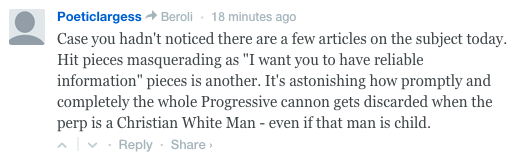
Screenshot 2015-05-22 01.08.25

Text as follows:

Case you hadn’t noticed there are a few articles on the subject today. Hit pieces masquerading as “I want you to have reliable information” pieces is another. It’s astonishing how promptly and completely the whole Progressive cannon gets discarded when the perp is a Christian White Man—even if that man is child.

This “progressive cannon,” presumably, is progressives’ acceptance of sex outside of marriage. In other words, this commenter appears to believe progressives take an “anything goes” approach to sex but hold white Christian men to a different standard. The assumption here is that progressives wouldn’t have a problem with, say, an atheist sexually molesting children—but that could not be further from the truth.

What is going on here, exactly?

In short, there seems to be an assumption among some social conservatives that because progressives do not see premarital sex as sinful and wrong, they aren’t in any position to criticize Josh Duggar’s actions. In other words, because (in their view) progressives take an “anything goes” approach to sex, they argue, progressives are being hypocrites when they condemn Josh Duggar. This assumption is based in a serious misunderstanding of progressive sexual ethics.

This goes back to my “tale of two boxes.”

Social conservatives tend to divide sexual acts into “marital sex” and “non-marital sex.” For social conservatives, child sexual molestation is in the same category as gay sex or consensual premarital sex. When divided in this way, sexual molestation doesn’t look all that different from consensual premarital sex—though both are considered sin. This is why the Duggars can talk about Josh’s “mistakes” the way they do—as though it were simply him going too far with a girlfriend, or viewing pornography. Because for them, they’re in the same category—sexual contact before marriage.

Progressives do not have ethical or moral problems with premarital sexual intercourse—but they very much have a problem with child molesting. To conservatives this can look like an inconsistency—even hypocrisy—but it’s not. Progressive sexual ethics center around consent. Sexual contact that is consensual is okay. Sexual contact that isn’t consensual is not okay. And because children below a certain age do not have the necessary understanding and lived experience to be able to consent, child molestation is de facto nonconsensual.

There are all sorts of problems with putting any sexual contact outside of marriage in the same category. For one thing, victims of sexual assault, including children, may end of feeling that they are in some way guilty of what happened—after all, sexual contact outside of marriage is considered sin. For another thing, a teenager sexually molesting children may be treated as a similar offense to a teenager having consensual sex with his girlfriend.

Over the last few days, I’ve seen numerous Duggar fans—primarily social conservatives—defending Josh Duggar. “Let him who has no sin cast the first stone.” “We all make mistakes sometimes.” “His sisters forgave him, so we should forgive him too.” “Christ’s blood covers a multitude of sins.” “This should have remained a private matter.” “Who are we to judge.” “But for the grace of God go I.” “We all have a past.”

It seems it’s social conservatives who are quick to make excuses when children are sexually molested—and yet somehow they think it’s progressives who don’t have a problem with child molesting.

Bob Adelmann’s Deceptive Use of Homeschooling Statistics

Bob Adelmann, YouTube screenshot.

HA note: The following is reprinted with permission from Libby Anne’s blog Love Joy Feminism. It was originally published on Patheos on May 13, 2015 with the title “Can You Be More Deceptive? Homeschool Edition.”

I just came upon an article by Bob Adelmann of the New American discussing U.S. test scores as compared to those in other nations, and then arguing that homeschooling is the solution to U.S. underperformance. I bring it up because it is a really good example of the way some homeschooling parents use bad data and outright lies to argue that homeschooling is academically superior to other methods of instruction.

I was homeschooled from kindergarten through 12th grade. While there were some gaps, I got a pretty good education overall and went on to excel in college. As a homeschool alumna, there is nothing that bothers me more today than people using bad stats and deception to argue that homeschooling is better than public or private schooling when in fact there is no data that actually says this. Accuracy matters, people! Do we really need to lie to make homeschooling look better? Really? 

Okay, end rant. Let’s look at what the piece said:

The recent flurry of test results on how American students are faring in school has resulted in much commentary decrying their dismal performance compared to their international peers.

. . .

This prompted George Nethercutt, a former member of the House of Representatives, to declare that “Americans get an F in civics” in his article in The Hill last week. He asserted, “The findings showed broad failures. If policymakers don’t soon pay attention to such failures, the perpetuation of citizen understanding of the basic concepts of the American system will continue to be at risk.”

. . .

Nethercutt’s conclusion, with himself and his performance in the House as a prime example, is correct: Students with little or no understanding of their history will have little ability to steer the ship of state in a constitutional direction in the future.

That’s why the home-schooling movement is so vital to keeping that ship afloat and away from the shoals of authoritarianism. In another study (that Nethercutt failed to mention) from the DOE’s Educational Resources Information Center, homeschoolers are learning precisely the skills needed:

Homeschool student achievement test scores were exceptionally high. The median scores for every subtest at every grade were well above those of public … school students.

On average, homeschool students in grades one to four performed one grade level above their age-level peers on achievement tests….

Even with a conservative analysis of the data, the achievement levels of the homeschool students in the study were exceptional. Within each grade level and each skill area, the median scores for homeschool students fell between the 70th and 80th percentile of students nationwide….

For younger students, this is a one year lead. By the time homeschool students are in 8th grade, they are four years ahead of their public/private school counterparts. [Emphasis added.]

Nethercutt is a product of the public schools and traditional universities, and so is severely limited in his ability to see what’s really needed in education in America. That’s why his solution misses the mark when he suggests that “all states should adopt basic requirements for graduation.” No, George. States and the federal government should remove themselves from the educational process altogether and allow the home schooling movement to flourish and grow even more rapidly.

At this point you may be curious to which study Adelmann is referring. I was too! Adelmann says the study is “from the DOE’s Educational Resources Information Center” but does not provide its name or link to it. One wonders why.

It turns out that the Department of Education’s Educational Resources Information Center does not conduct research itself, it merely archives digests of existing research conducted by a variety of scholars in a sort of library to make it easier for researchers or policymakers to find information. The study in question is The Scholastic Achievement of Homeschooled Students, by Lawrence Rudner, published in 1999 and funded by a grant from the Home School Legal Defense Association. You can see a digest on ERIC here.

Portraying a study conducted independently from the Department of Education with money from the largest homeschool lobbying group in the country as though it is in fact an official study conducted by the Department of Education is incredibly deceptive. Adelmann doesn’t even give the reader a link where they can go to find out more about how the study is conducted. Given that linking is standard procedure, especially when quoting, I can’t help but see this as intentional deception.

And what does the study itself say? How was it conducted? You can read an overview at the Coalition for Responsible Home Education. In sum, the study was conducted using a volunteer sample, and it does not correct for background factors. To quote the overview linked above:

Rudner’s study tells us essentially nothing about homeschooled high schoolers, children of color, poor children, unschoolers, children with poorly educated parents, children being raised by single parents or by parents who both work, abused or educationally neglected children, or disabled or special needs children. The higher-than-average standardized test scores earned by Rudner’s highly privileged group of homeschoolers are only what we would expect from a study where nearly all disadvantaged children are excluded.

Adelmann makes it sound like the study he is citing proves homeschooling superior to other methods of education, but in fact the study shows only that privileged homeschooled children tend to score well. That’s no surprise, but it’s also no solution for our education system, where the majority of U.S. schoolchildren now live in poverty.

But perhaps what’s most shocking about Adelmann’s use of the Rudner study is this statement by Rudner himself, at the end of his study:

These comparisons between home school students and students nationwide must be interpreted with a great deal of caution. This was not a controlled experiment. Students were not randomly assigned public, private or home schools. As a result, the reported achievement differences between groups do not control for background differences in the home school and general United States population and, more importantly, cannot be attributed to the type of school a child attends. This study does not demonstrate that home schooling is superior to public or private schools. It should not be cited as evidence that our public schools are failing. It does not indicate that children will perform better academically if they are home schooled. The design of this study and the data do not warrant such claims. All the comparisons of home school students with the general population and with the private school population in this report fail to consider a myriad of differences between home school and public school students. We have no information as to what the achievement levels of home school students would be had they been enrolled in public or private schools. This study simply shows that those parents choosing to make a commitment to home schooling are able to provide a very successful academic environment. [emphasis added]

In other words, even Rudner himself did not claim that his study showed that homeschooling was superior to public or private schooling! In fact he insisted that his study did not show that! Rudner argued only that his study shows that homeschooling can work, not that it always does or that it works better than other methods of instruction. Indeed he explicitly stated that his study does not show that children will preform better if they are homeschooled.

In other words, not only did Adelmann act deceptively by portraying Rudner’s HSLDA-funded study as a government study, he used the study’s findings in a way that Rudner explicitly said they should not be used and to mean things Rudner explicitly stated they did not mean. If this isn’t gross deception, I don’t know what is. I am utterly disgusted.