Gothard’s Sex Rules: Marital Consent? What’s That?

Screen Shot 2014-07-22 at 4.37.57 PM

HA note: The following is reprinted with permission from Libby Anne’s blog Love Joy Feminism. It was originally published on Patheos on May 13, 2014.

My family never attended one of Bill Gothard’s seminars, and we didn’t use Gothard’s curriculum. We children were, instead, raised on the outskirts of Gothardism. We knew people who were followers of Bill Gothard, and we imbibed a few of his teachings (umbrella of authority, anyone?), but that was the extent of it. As things began to snowball over the past months and Gothard was exposed as a sexual predator and ultimately relieved of his leadership position, I wanted to learn more about what Gothard actually taught, in his own words. So I purchased Gothard’s “Advanced Seminar Textbook,” which was published in 1986 and can be found used on Amazon. I’m not going to blog through it page by page, but I do plan to write some posts on various sections. Today I offer my first of these posts.

In his textbook, Gothard covers his rules for periodic abstinence during marriage, which centers on a woman’s menstrual cycle (pages 175—185). Of all of Gothard’s teachings, this may be the one I’m most unfamiliar with, as it is foreign to anything taught in the evangelical church my family attended. In this post, I will cover the first pages of this section and then finish with a letter Gothard received from a follower.

To start out, here are the rules Gothard lays out as “God’s laws on abstinence”:

What Are God’s Guidelines for Times of Abstinence? 

  1. During the menstrual cycle—Ezekiel 18:5-6
  2. Seven days after the menstrual cycle—Leviticus 15:28
  3. 40 days after the birth of a son—Leviticus 12:2-4
  4. 80 days after the birth of a daughter—Leviticus 12:5

Gothard’s critics tend to do two things: they call him a “legalist” and argue that his teachings in this area come from the Old Testament and are therefore invalid, as the Old Testament is superseded by the New Testament. Here, on the first page of this section, Gothard directly counters both of these arguments.

First, Gothard urges his readers to “distinguish between legalism and godly living” and states that: “(1) Legalism is trying to earn salvation; (2) Legalism is trying to live the Christian life with the energy of the soul; and (3) Legalism is following ‘the letter,’ not ‘the spirit.’” Gothard uses Bible verses to back all of this up, focusing especially on II Corinthians 3:6. Gothard argues that he is not teaching legalism but rather godly living.

Second, Gothard pulls up each time the New Testament references “uncleanness” and uses that to claim that the Old Testament teachings regarding a woman’s menstrual uncleanness is still valid. This is a fascinating attempt, but it does not actually work, as it’s pretty clear he’s proof texting and he comes across as being unaware that the New Testament was written in a different language from the Old Testament. Still, that he at least tried is fascinating.

Now I want to turn to the first of the “Benefits of Abstinence” Gothard lays out.

1. It builds self-control.

When sex drives are misused, they become self-consuming and can never be satisfied. Burned-out lusts call for new forms of perversion, which become even greater tyrants of unfulfillment.

Okay, so here’s the thing. If I’m overeating and I know I’m overeating, and it’s making me feel unhealthy, I can fix that by moderating what I eat. I don’t need to spend time fasting to do that. In fact, fasting in order to lose weight can easily lead to binge eating when the fast is over. I guess what I’m saying is that there are better ways to foster a healthy and balanced sex life than abstaining and then (presumably) binging.

But what’s actually going on here becomes more clear with the letter Gothard prints from one of his followers, and it’s not pretty.

How a Commitment to Abstinence Transformed a Marriage

I am writing to report what has happened in our marriage since our decision to follow God’s guidelines for abstinence. To be honest, I was waiting to see if the changes in our lives were short-lived or permanent. Now after a third of a year and five menstrual cycles, I am encouraged that our decision was correct, Biblically-based, and that the Lord is blessing our marriage more than ever before.

Let me start at the beginning. Our dating relationship was based on the physical, not on the spiritual. It ended in pregnancy and then marriage. She was sixteen, I was twenty.

Depending on the state, this might not have been legal.

After we married, our sex life became a shambles. My physical drives were impossible for her to satisfy, and even with a daily physical relationship, I became involved in pornography and other impure habits.

If you’re having sex daily and yet you’re not sexually satisfying, it’s probably worth seeing a doctor or a therapist.

After ten years of marriage we attended our first Basic Youth Seminar. When you went over the consequences of defrauding in dating, I suddenly realized my problem and our marriage problem.

And exactly how do we explain all of the couples who had sex before marriage and are currently in healthy, sexually fulfilling relationships?

I asked God to forgive me for defrauding her before marriage, and for the first time in my life, I began exercising self-control.

Also for the first time in ten years of married life, we began to experience true sexual intimacy. Our relationship continued to improve, but my wife still felt forced to submit to me, and she worried daily about whether or not she would have to ‘make love’ that night.

Wait. Wait wait wait. So the whole time this guy was having sex daily, his wife was only participating because she believed her role, as his wife, was to submit to him and be sexually available. You know, the fact that she felt she had to have sex with him whether she wanted to or not might just play some part in why their sexual relationship wasn’t fully satisfying him.

I began having difficulty exercising self-control.

I really want to know what this means. Was he raping her?

Then we attended your Corporate Leaders Seminar and learned about abstinence during the menstrual period and for seven days after the period. I knew immediately that this is what God wanted me to commit to, and it scared me to death! I couldn’t picture myself being committed to anything like that!

However, God gave me the strength and encouragement to talk to my wife. We discussed it and that day, with her permission, I made a commitment to follow that principle.

Now he’s concerned about getting his wife’s permission?

The relief within my wife was almost visible. The “fear” is gone from our marriage.

Well of course her relief was almost visible! His poor wife knew she would have have two weeks of blessed relief from her husband’s constant (and unreciprocated) sexual demands!

We now have a freedom we never experienced before. We are blessed to the point that we almost feel guilty when we are around our Christian friends who are completely loaded down with problems. Our lives have been transformed by applying this and other principles from God’s Word.

You replaced consent with biblically-mandated periodic abstinence, you asshole.

A Confirming Report from the Wife

I cannot tell you how much the material on abstinence has meant to me and our marriage. I have never experienced what has been happening in our marriage since we began following the principle of abstinence.

It is indeed a miracle!!!! Through the power of the Holy Spirit, my husband has exercised real self-control in the area of our sex life. I feel so loved, cherished, and protected! I have been able to respond to him as seldom before. The difference in our relationship is difficult to describe, but very wonderful to experience. Thank you again for motivating us to choose God’s best.

Someone tell this poor wife about consent and marital rape.

I didn’t expect to be this frustrated when I opened the volume to these pages, but I am. I am really, really frustrated. It appears that Gothard is using abstinence during the period and for seven days after the period as a replacement for consent within marriage. With these teachings, women who find themselves forced to submit to sex they do not want—forced by their believe that that is the wife’s biblical role—can find relief in two solid weeks of freedom from those demands.

This is sick.

Why I Don’t Trust the Homeschool Community to Self-Police

undertherug

HA note: The following is reprinted with permission from Libby Anne’s blog Love Joy Feminism. It was originally published on Patheos on September 8, 2013.

When I was a young teen I made some new friends, a couple of homeschooled girls like me, both right around my own age. They were the oldest in a large homeschooling family that in some ways was very much like mine own. In other ways, though, their family was very different.

As far as I could see, unlike my mother their mother never lesson planned, never sat down with her children to work on multiplication tables, and never pulled out the science supplies and a biology book. Their mother was very involved and active in an all-consuming interest of her own, and the children were pretty much left to their own devices. The children had interests, but they never really had the tools they needed to carry those interests out, and they certainly never had the basic education in a range of subjects like math, English, and science that we so often take for granted. And while I won’t get into specifics, the repercussions of missed opportunities have followed my friends and their younger siblings into adulthood.

What’s most baffling is that no one said anything.

To my knowledge, the other homeschool parents (including my own) not only didn’t report this family or intervene and try to help, they never even said that what was going on was wrong. It’s true that someone might have said something that I didn’t hear, but I was pretty up on the homeschool community gossip (homeschool moms do talk, or at least they did in my community), and I knew well who was disapproved of for having the wrong religious doctrine or being too submissive or not submissive enough. I’m pretty sure I would have heard something.

Anyway, this is why, when homeschool parents inveigh against outside oversight and say that the homeschool community provides its own sort of internal accountability and self-policing, I want to bang my head into a wall. It doesn’t work. The culture of the homeschool community in which I grew up was such that I’m really having a hard time imagining anyone ever reporting anyone, or even simply calling them out for what they are doing.

Why is this? There is a range of factors.

There is the idea that family always knows whats best and that the family unit should be sovereign. If a family decides not to educate their kids, then, that’s their business. Inviting the government into a family’s affairs, or even questioning how they run their family, is a violation of that family’s autonomy.

There is the idea that even going completely uneducated is better than being sent to “government” schools. We saw this in HSLDA’s response to Josh Powell’s story, a story that in many ways mirrors that of the family I knew growing up—except that unlike my childhood friends, Josh ultimately fought his way into getting an education.

There is the idea that failure to educate is simply “unschooling,” and therefore a perfectly legitimate way of homeschooling. John Holt would probably be horrified to know that his ideas are today being used by some to justify robbing children of an education. But then, maybe he would have agreed with HSLDA and argued that even no education at all is better than “government” schools.

There is the idea that the importance of education is overrated.—that it is life experience, family living, and the passing on of religious values that matters. It doesn’t matter whether a child knows algebra or can write an essay, the argument goes. If they love Jesus and have a heart dedicated to serving others, that’s enough.

There is this idea that government involvement in anything ever is always a bad thing. The highest value is the individual freedom of every adult citizen. To get the government involved would put people under the thumb of bureaucrats intent on telling people what to do and result in corruption, child-snatching, and worse.

I don’t trust the homeschool community to police itself—I just don’t.

It’s worth noting that some of the ideas listed above aren’t isolated to the Christian homeschool community—they’re more endemic than that. In other words, it’s not like this problem can be solved by telling the homeschool community to self-police better—they don’t self-police because they can’t self-police given the nature of their beliefs. As long as these ideas remain knit through the homeschool community, I will be an advocate for outside oversight. To be less would be a betrayal.

Because here’s the thing—my friends’ mother wasn’t a bad person. She just needed to actually be required to educate her children and to be held accountable for doing so (this isn’t the first time I’ve written about this need for accountability). If she’d lived in a state with required subjects and periodic assessments to verify that instruction and learning were taking place, things would almost certainly have been different. She would have pulled things together, and while the education she provided her children might not have been perfect, it would have been something.

“I’d Leave My Wife Sitting There”: Michael Pearl’s “Pearls of Wisdom”

Screen Shot 2014-07-14 at 10.53.36 AM

HA note: The following is reprinted with permission from Libby Anne’s blog Love Joy Feminism. It was originally published on Patheos on July 12, 2014.

So I recently came upon this video:

I transcribed it for you so you don’t have to watch it.

Debi: Hi, I’m Debi Pearl

Mike: And I’m the big boss Mike.

Debi: We’re here to day to read a question that came in in our mail and to answer it.

Oh goody, a letter! Are you ready?

Hi Mike,

I love my wife, but I find it hard to like her sometimes. Over the years she has gotten more and more competitive or at least I think of it as competitive. But this is an example of what she does. We’ll be in a restaurant and she sort of punishes the waitresses by not tipping them, if they do anything wrong at all. This embarrasses me. If the food is not exactly the way she wants it, she calls the manager out and complains and wants the meal free. She’s a good wife to me, but she is over assertive in many other areas. What should I do?

Talk to your wife. No really, talk to your wife about this.

Seriously, there is nothing in that letter to indicate that the guy has even tried telling his wife how her actions are making him feel. If I were in this situation—and who isn’t in a similar situation at some point?—I would let my wife know that the way she was acting in restaurants was embarrassing me. And then we could talk, and she could explain how she feels, and I could explain how I feel, and we could talk it out.

For instance, Sean used to do this self-deprecating thing about the state of our home. You know, this whole “it’s a bit of a mess, it usually is, sorry about that,” and such. Now first of all, he made our house out to be worse than it usually was. But more than that, because of the cultural idea that women are more responsible for the house cleaning, I knew that his deprecation in this area came back more on me than on him. It made me really uncomfortable and, yes, embarrassed. So guess what I did? I told him how I felt! And guess what? He stopped doing it! He hadn’t even realized how uncomfortable he was making me.

Now obviously, the situation in the letter isn’t completely identical. But still, if one spouse’s behavior is embarrassing the other, the two should talk it over. I mean, that’s kind of the first step. Now if this man’s wife continues to act this way in restaurants, he could tip the waitress on the sly, or he could stop eating out and just say he doesn’t want to go. And if one party doesn’t care about the other’s needs, or if they are fundamentally incompatible, it might be best to part ways. Or goodness, go to couple’s counseling if talking it out doesn’t work!

So now let’s turn to Michael’s advice.

Mike: I tell you what I’d do, I’d get up and walk out of the restaurant and leave my wife sitting there if she was asking in an embarrassing way, or when she treated the waiter or the manager unkindly I’d tip them twenty dollars and apologize in front of her for her actions. Sometimes people, you know, the way we all learn to be socially responsible is by being in social context and bouncing our actions off of other people. if we act in ways that are inappropriate and other people respond to it negatively, then we learn what the boundaries are socially. So I would become boundaries.

In other words I wouldn’t just sit there silently, I would speak my mind about it and try to curb that kind of action. It’s selfish, it’s not considerate of other people, it’s not loving, it’s not kind, it’s not generous, it’s not merciful, it’s not forgiving, it’s not the kind of things we as Christians are toward other people. It’s haughty, it’s arrogant, it’s elitist, it’s acting as if you are the one that matters and the establishment doesn’t, these are just human, these are just people. If you don’t like the cooking, just eat at home.

Shorter Michael Pearl: If your wife embarrasses you in a restaurant, embarrass her back.

But what I really can’t get over is that he goes on and on about how unkind and unloving the man’s wife is being by not tipping and by complaining to the manager, but he can’t see that apologizing for your wife’s actions to the manager, in front of your wife, might also be unkind and unloving.

And notice what he does not even think to suggest? Oh, I don’t know, talking it out privately. Is it really that hard for the man to go to his wife and tell her how embarrassed her actions make him feel?

Well, once Michael finished Debi weighed in as well:

Well I read all the letters the man wrote, some of the examples were on the line, I can see why the woman would think some of these things, but it wasn’t merciful. And how can a man curb his wife if he hasn’t got the kind of personality Mike has, if he’s a gentle, loving husband? You know, I don’t know how a man could do that that wouldn’t be aggressive like Mike except sit his wife down and say is this merciful, or maybe just have a bible study with his wife on mercy, and kindness, and gentleness. But a woman is supposed to be gentle first. And anyway, this is a hard thing for a man to go through.

Is it just me or did Debi just let it spill that Mike is not a gentle and loving husband? I mean I know she’s said things along these lines before, but this is so blatant!

Debi gets closer to saying that the two should talk it out than Michael does. Of course, she’s still seeing it in a dictating-type way, but that’s to be expected. I suppose, then, that in the Pearls’ world “aggressive” husbands are to publicly embarrass their wayward wives while “gentle, loving” husbands are to sit their wayward wives down and chide them.

It’s a pity the Pearls have to make things so complicated when a good, solid egalitarian marriage built on communication and compromise makes these things so simple.

Should Parents Be “Involved” in Their Children’s Love Lives?

Screen Shot 2014-07-03 at 1.50.01 PM

HA note: The following is reprinted with permission from Libby Anne’s blog Love Joy Feminism. It was originally published on Patheos on June 30, 2014.

Blogger That Mom (Karen Campbell) recently began a series on courtship. I don’t know where she will take the subject as she goes on through the series, but I did want to touch on the premise she begins with—that parents need to be involved.

The Necessary Parent

When we attended Bill Gothard’s IBLP Basic Seminar back in the mid-80s, one of the topics he covered was dating. This was before he had moved into his courtship teachings and even before anyone we knew of had started discussing things like courtship and betrothal. In fact, courtship, to us, was how our grandparents and sometimes even our parents would refer to meeting, getting to know, and preparing to marry each other. In fact, they didn’t often refer to relationships with the opposite sex outside of the goal of being married one day.

Our grandparents on both sides had been in “til-death-to-us-part” marriages and each of our parents were close to celebrating golden wedding anniversaries. We made the same commitment and we knew that, as parents, we wanted to encourage our own children to do the same. But we also knew we had not always chosen wisely along the way and hoped to see our children avoid some of the bumps in the road we had encountered.

Isn’t it interesting that often parents will do this with children when it comes to making career or educational choices, involvement in extracurricular activities, and financial decisions but it is hands off when it comes to dating and marriage?

So we began listening to the many voices of instruction and took away one really important truth that, I believe, is central to the whole discussion of dating, courtship, marriage, and our children.

Parents need to be involved.

In The Joy of Relationship Homeschooling ~ when the one anothers come home, a central theme I discussed is the importance of relationship building beginning before birth so that mentoring our children through the big decisions of life will be a natural, organic process. Too often we believe that once children reach a certain age, we are supposed to sit on the sidelines and watch them makes choices, for good or for bad, without giving them any input. This is folly. Scripture commands us to practice the one anothers of Scripture with our brothers and sisters in Christ, beginning with our precious children! As they become adults, we approach them just as we do other believers, admonishing, exhorting, bearing their burdens, forgiving, etc., all aspects of the dating, courting, and marriage years.

“Parents need to be involved,” That Mom says when speaking of dating, courtship, and marriage. What exactly does it mean for parents to be “involved”?

My landlady, Linda, once told me a story about her relationship with her own daughter. It seems when her daughter was a young adult she entered a relationship that soon became abusive. Linda wanted her daughter out of the situation, but her daughter was insistent that she loved her boyfriend and that the relationship was fine. Linda knew that trying to convince her daughter to leave the relationship would likely make her daughter pull away from her, so she simply voiced her concerns in a natural way and then dropped it. Then, instead of trying to extricate her daughter, Linda focused on being there for her daughter.

Linda told me that she wanted to make sure that when her daughter eventually realized that she needed to get out she would know she could come to her mother for help. No judgement, no guilt trips, no manipulation, no constant hinting. Just love and acceptance. And sure enough, after a few years her daughter realized that the relationship was broken and came to her mother, because she knew that her mother accepted her, and loved her, and would be there for her. No “I told you so,” no pointed looks, no judgement.

Was Linda “involved”?

When I was in college I met a young man named Sean. Sean was not homeschooled, but in other ways his background was similar to my own. Sean and I quickly gravitated toward each other, and eventually our friends took us aside separately and told us we were perfect for each other and really should try making a go of it. So Sean and I approached my father about beginning a “courtship,” given that that was what I had been raised to expect. My father spoke with Sean and then gave his permission to begin a courtship.

Sean was asking some big questions at the time, but my father believed he was what he called “an honest seeker,” and that everything would work out in the end. My father had always told me that it would take a particular kind of man to make me willing to submit, and he hoped Sean might be that man. But then I concluded, after some intensive research into the issue, that God had created through evolution rather than in six days. My father took this as a sign that Sean was leading me astray, and he ordered us to break up.

I couldn’t do it. My father was a stalwart young earth creationist, and I had just realized that he was fallible. I didn’t feel that I could obey my father in this when I knew Sean so much better than he did and his only problem with Sean was that Sean, too, believed that God had created through evolution—something I no longer saw as wrong or a problem. I told my father that I would not break up with Sean, and I took my love life into my own hands.

And here I sit, happily married to Sean for over half a decade. We have two children together. Sean is a wonderful father, partner, and provider. Even my parents have warmed up to him, and enjoy him when we come visit. But even as I made good relationship choices on my own and have a solid relationship with a wonderful man, my relationship with my parents was utterly and completely destroyed.

My parents believed they had a right to vet my partners and set the pace of my relationships, and when I told them no their response ruined our relationship. I stopped coming home because they made living there an utter torture of guilt and manipulation. My family almost didn’t come to my wedding, and when my parents decided to come at the last minute, they chose to sit in the back. My siblings were not allowed to be in the ceremony. What relationship we have today was built over the rubble of shattered dreams.

Were my parents “involved”?

When Sean and I first started “courting,” we spoke to his parents as well as mine. His parents were surprised that we had come to them, but when we asked for their advice they gave it. Some of their advice we followed, and some we did not, and they never gave us any trouble for the parts we did not follow. They accepted that we were adults capable of making our own decisions.

When Sean and I got engaged, his parents thought we were marrying a bit young. They told us that we were still young and that we would face hard times if we went ahead with our plans. But they didn’t tell us this with the expectation that we would do as they advised, and they didn’t make involvement in our wedding plans contingent on their timing. They simply offered advice, take it or leave it, no guilt, no manipulation, nothing. When we decided to go ahead and marry as planned Sean’s parents immediately pitched in however they could and helped with the planning of the rehearsal dinner, the wedding, and the reception.

Were Sean’s parents “involved”?

Do you see what I’m getting at here? At issue is how we define “involved.”

Parents should absolutely be there for their children, and they should absolutely offer advice, both solicited and (at times) unsolicited. But (adult) children have are not obligated to follow this advice, and their parents have no business calling the shots. 

When parents think their (adult) children are under some sort of obligation to follow their advice, or that they as the parents have a right to call the shots, the results are incredibly toxic. So if by “involved” we mean Linda, or Sean’s parents, I’m all for it. But if by “involved” we mean my parents, I couldn’t be more opposed.

Even today, thinking about everything that happened before Sean and I married brings up a whole host of painful feelings that swirl around in my chest and my gut. My relationship with my parents will never be fully restored. There was too much hurt between us. I have many friends today who had the same thing happen, and watched the courtship process destroy or severely damage their relationships with their parents.

I also have a problem with the way this culture approaches “mistakes.” 

You can’t keep your children from making mistakes, and frankly you probably shouldn’t. My parents embraced courtship because they believed that it would help us children avoid some of their own mistakes. Both of my parents dated before meeting each other, and neither was a virgin when they married. They felt that these things had had made things harder for them, and they wanted to spare us that. But sometimes children need to make their own mistakes. We learn from our mistakes, and sometimes things parents think are mistakes turn out to be growing experiences.

I can’t say whether Linda’s daughter wishes that her relationship with her abusive ex had never happened, but from Linda’s telling of the story it’s clear that her daughter learned and grew through the experience. More to the point, Linda could not have prevented her daughter from making her mistake, and trying to do so would only have damaged her relationship with her daughter. Sometimes we simply have to make mistakes for ourselves, as painful as it may be for our parents to watch.

As for Sean and I, marrying as young as we did did result in several years of economic hardship. I remember months when I had to decide between buying meat and buying ice cream. That may sound silly, but I agonized over decisions like that. But I wouldn’t give up those early, hard years for the world. Sean and I scraped by, and we grew together through that time. Sean’s parents were right that it wouldn’t be easy, but Sean and I were not wrong in choosing to give it a go anyway.

Yes, I parent differently from my parents. Yes, I want to give my children things I never had. But parenting that is at its heart reactionary can be dangerous—as can parenting that attempts to realize an impossible utopia. I once heard it said that we won’t repeat our parents’ mistakes, we’ll make new ones, and I see some truth to that. My parents might have been trying to save us from their mistakes, but they made a whole host of other mistakes while trying to protect us from those mistakes.

Oh and also? Parents don’t “need to be” involved in their children’s love lives.

My parents’ involvement in my relationship with Sean ended when they decided to devote all of their energies to ending our relationship, and you know what? Sean and I are happily married all on our own. Believe it or not, young adults are perfectly capable of making responsible and healthy relationship decisions on their own. Advice without strings or guilt or manipulation can be helpful (especially when solicited), but we really can make our own decisions without bringing down disaster, I promise.

I wish these parents would stop trying to butt in on their children’s love lives and instead simply focus on being there for their children. Without strings. Young adults need support and encouragement from their parents, not guilt trips and emotional manipulation. Their parents should be their children’s cheerleaders, not their referees.

I want to finish with a comment from reader MrPopularSentiment:

There’s another kind of involvement that I wanted to bring up. When my husband and I started dating, his parents treated our relationship seriously. Everyone else rolled their eyes and assumed that we’d break up within a short span of time, so there was no need to really get to know us as a couple, but his parents treated me like I was there to stay and worth getting to know.

And it was with no strings attached, too. When my sister-in-law had a stormy, abusive relationship, they treated her husband as a permanent fixture when he was there, and they just didn’t mention it when he wasn’t (the “punishment” phase of the abuse cycle). When she finally left him and found someone new, they treated the new guy as her permanent partner.

It was wonderful to feel like we were being taken seriously by adults, and it did so much to build up my relationship with my in-laws. Soon after I started dating my husband, I was going out on day trips alone with his parents and hanging out with his mother. And now, nearly 15 years later, we have a really good relationship with them.

It also meant that they were the ones we felt comfortable coming to when we needed help or advice, because we knew that it would be given without judgement. So not only is this style of involvement so much healthier for the parent-child relationship, it also meant that we were more open in talking to them, which meant that they knew more about our lives and had more opportunities to give us pointed advice that really has helped us avoid mistakes.

I couldn’t agree more.

Talking To Kids About Social Services, Part II

cps

HA note: The following is reprinted with permission from Libby Anne’s blog Love Joy Feminism. It was originally published on Patheos on June 12, 2014.

Part One

I wrote yesterday about the fear of social services I received from my parents and from the wider homeschooling community. Once I grew up I realized that this fear was both irrational and counterproductive. Social services was not the enemy, and social workers do important work protecting children from abuse and neglect. Sure, social services isn’t perfect, and they sometimes make mistakes. But what good does teaching children to be afraid of social services do? Absolutely none at all. When I had children of my own, then, I determined to do things differently.

I wanted Sally and Bobby to see social services not as an enemy but as a friend.

Several months ago we got from a store and Sally refused to get out of the car. She was tired and was comfortable where she was. She was four at the time, and I needed to take her inside and get on with my list of things to accomplish for the day. My options, as I saw them, were to either pick Sally up and carry her into the house or to convince her to come inside voluntarily. I decided to try the later and save the former for last resort.

“I can’t leave you out here,” I told her. “I’m your mom and it’s my job to take care of you.”

“I don’t care about that, mom!” Sally insisted. “I don’t mind if you leave me out here!”

“Okay, let me see if I can explain this,” I said, and I got down on her level. “Kids don’t know everything yet, and sometimes they can get hurt. Kids can get lost or hit by cars or stolen or drown or any manner of things. So parents’ job is to protect their kids and take care of them. That’s me—that’s my job.”

I took a deep breath and considered whether to go on.

I didn’t want to give her my childhood fear of social services, but I wanted her to understand that I really truly and honestly am required by law to take care of her, and that leaving her outside in the car alone is literally not an option. Sally likes understanding how the world works and having reasons for things, and she tends to be fairly mature for her age. So I went on.

“There are laws that require me to take good care of you,” I told her, “and if I don’t take good care of you I will get in trouble. There is an agency called social services that helps make sure children are taken care of. If parents do not take good care of their children, social services will come and tell them they have to take good care of their children. And if parents still do not take good care of their children, social services will find them a new mommy and daddy so that there is someone to take care of them.”

Sally considered for a moment.

“Okay, I’m coming inside, mommy,” she finally said, climbing out of the car. “You have to take good care of me, because that’s your job.” And she looked at me and smiled. “It’s your job to take good care of me!”

Sometime later we were at an outdoor event when Sally asked if it was fine if she go off on her own. I told her that I was okay with her moving around a little bit but that she had to stay close enough that I could see her and would know where she was. I reminded her that it’s my job to protect her and take care of her.

“That’s right mommy, it’s your job to protect me!” she said. “And you can’t protect me if you can’t see me!” And with that, she laughed as though she’d told a joke—and she stayed close enough for me to keep tabs on her throughout the event.

I was glad to see Sally being more understanding of times I had to tell her “no” because what she was asking was not safe. Sally had definitely taken to heart that it was my job to take care of her. But I still worried that she might take the bit about social services finding new mommies and daddies for kids who were not taken care of the wrong way, and end up feeling afraid.

Some time after this I was carrying a load of groceries from the car into the house, and Sally was dawdling and lagging behind.

“Come on Sally!” I called over my shoulder. “Hurry up!”

“I’m coming, mommy!” Sally called out as she picked up per pace and jogged to catch up. “Because you have to take care of me, mom, or they will find me a new mommy and daddy, and I don’t want a new mommy and daddy!”

And there it was. Had I messed up, I wondered?

Was I giving her the same fear I had had? After the groceries were safely on the counter and we were both in the house, I pulled Sally aside.

“Sally, daddy and I try very hard to take good care of you,” I told her. “If social services came here to check on you, they would see that we take good care of you. Social services only takes children away from their parents if their parents are not taking care of them at all, or if their parents are hurting them. Does that make sense?”

Sally paused to think. “Those kids need new mommies and daddies, because they need someone to take care of them!”

“That’s right,” I responded. “Social services comes to check things out if someone calls them and says, ‘that child’s mommy and daddy are not taking care of her, she needs help.’”

“And then they help?” Sally asked.

“Yes,” I told her. “They try to help the family, and they only find kids new mommies and daddies if their parents still refuse to take care of them. If social services ever comes to our house and a social worker wants to talk to you, don’t worry about it, they’re just trying to make sure you’re taken care of and happy. They’re nice people and they want to make sure kids are safe. If that ever happens you can just answer their questions, okay? It is their job to make sure children are taken good care of, and that’s a good thing, because it is good for children to be taken care of and not get hurt. Does that make sense?”

“Oh!” Sally exclaimed, “If they come to our house, they will say, ‘do your mommy and daddy take good care of you?’ And I will say, ‘yes, they do!’” And then they will say, ‘that is good, we like mommies and daddies to take care of their kids!’ Right mommy? Right?”

“Wow, um, yes, that’s absolutely right,” I responded. I’m telling you, you just never know with this kid. She does voices and everything. And with that, our conversation was over and Sally was off to play.

It has been some time now since this second conversation, and Sally has not expressed any fear of social services. Indeed, her comment as she ran to catch up with me—the comment that prompted our second conversation—was less one of fear than one of stating facts. Sally is a very logical and ordered child, and tends to be matter of fact like that.

I have to remind myself not to let my own childhood fear of social services determine my interpretation of Sally’s comments.

That it is my job to take care of her, and that I’m required by law to do so, has continued to help at moments when Sally would really like to be outside alone, or to wander around on her own at an event, and I can’t let her. It means that Sally understands that I don’t let her do those things because it is my job to take care of her and I’m required to do so, and not because I want to kill all of her fun.

Now I’m not saying any of this as a prescription. I don’t know for sure whether I’ve handled this topic correctly, or whether I should have held my tongue and found some other way to coax her out of the car that time several months ago—say, offering her a cookie once we got inside, or emphasizing all the things I had to get done in the house that evening. I do know that I just looked around the internet and couldn’t find a single guide to talking to your children about social services. Perhaps that means most people say nothing, and maybe that’s what I should have done too. But with my background of fear, and my parents in my children’s lives, I think part of me wanted to offer Sally a healthy perspective rather than leaving her with a vacuum.

End.

Talking To Kids About Social Services, Part I

Screen Shot 2014-06-15 at 6.36.09 PM
“I grew up afraid of social services.”

HA note: The following is reprinted with permission from Libby Anne’s blog Love Joy Feminism. It was originally published on Patheos on June 11, 2014.

I grew up afraid of social services.

Social workers were something of a bogeyman in the homeschooling community, and my parents bought into it completely. In fact, in a recent conversation on the topic with my mother, she insisted that social workers today do in fact take children away from their parents for nothing more than homeschooling. That she still says this today says a lot about just how high fear of social workers was in our home when I was a child.

In fact, my parents walked us children step by step through what we should do if a social worker came to the door when they were not home. We were not to let a social worker in the door under any circumstances, and we were to call the Home School Legal Defense Association and get a lawyer on the line immediately. My mom had the phone number on the inside of a cupboard by the phone.

I’ve spoke to others raised in the same background as me who actually had drills that involved them hiding in the attic, or in a basement. While we didn’t do this, I well remember hearing conversations about the horrible things social workers do—strip-searching children to search for bruises or interviewing children without their parents present. The homeschooling literature I read was full of references to the evils of social services.

When I was a teen, I read a novel by Michael Farris titled Anonymous Tip. In it the main character’s daughter is taken away from her based on a false tip called in by a malicious ex. When the social workers realize that the tip was false, they fake evidence to keep the little girl away from her mother. One of the social workers was a Wiccan, and her boyfriend worked for the ACLU.

The novel helped cement my fear and dread of social services.

I think to really get across what we’re talking about here I’m going to have to share a story of a terrifying event that took place when I was about fifteen. In fact, this moment may well be the most scared I’ve ever been in my life.

I was home alone with a few of my siblings while my mom and the others were at a friend’s house. I tried to call the weather phone number to get the forecast, but our phone was old and not all the buttons went through. I had dialed 911 without realizing it. As soon as the 911 operator came on, I hung up because it was a person rather than the weather recording I had expected. And then I realized too late that I had just hung up on the 911 operator.

I called my mother in an absolute panic. I was incredibly afraid. I knew that there was a strong likelihood that a police officer would come to our house to check if everything was alright, and there I was home alone with a few of my siblings. Looking back, my fear was entirely misplaced. My mother assured me that it would be fine, that I should simply tell the officer what had happened. I don’t think she realized the depth of my fear, or where it was coming from. The fear I was given of social services bled over into this experience.

As it happens, everything was fine. Two police cars did make their way up our driveway that morning, and a police officer got out and talked to me at the door. I told him what had happened—that I had dialed 911 on accident and hung up as soon as I realized I had the wrong number—and that was enough. But a police officer coming to the door to ask me questions and check the situation out while my parents were away was too similar to a social worker doing the same for me not to be terrified.

Fear—we’re talking real, visceral fear.

So far, this blog post could well be titled “How Not to Talk to Kids about Social Services.” My parents and the homeschooling community taught me to see social workers as the enemy and to fear social services in such a visceral way that it made my stomach hurt. This is how not to do it. Is social services perfect? No. But social services is set up to protect children from abuse and neglect, and it does a lot of good for a lot of kids. Social services should be seen as an ally, not an enemy, and teaching children to fear an agency set up to help protect them serves to prevent children who really need help from seeking it or speaking out—and result in a lot of unnecessarily frightened children.

Tomorrow I will write about how I talk about social services today with my own children. Is it necessarily to talk to children about social services? Maybe not, but given my background and the fact that my parents are a part of my children’s lives, I would rather give my children a positive foundation for understanding these things than leave them with a vacuum.

Part Two >

Christian Patriarchy Just Made WORLD Magazine $11,200 Richer

Screen Shot 2014-06-16 at 2.57.09 PM

By R.L. Stollar, HA Community Coordinator

WORLD Magazine, a biweekly conservative Christian news magazine, was and continues to be immensely popular among homeschooling families. As a kid, I remember eagerly anticipating each new edition of WORLD. I particularly loved the music reviews, since I used them to convince my parents that I should be allowed to buy new CDs. My family certainly was not alone in our admiration for WORLD: Libby Anne at Love Joy Feminism, for example, also “grew up in a family that read every single issue of WORLD magazine thoroughly.”

The popularity of WORLD among homeschoolers probably isn’t a coincidence. One factor here is staff overlap: WORLD’s longtime (now former) culture editor, Gene Edward Veith, is the Provost of the HSLDA-funded Patrick Henry College, founded by Michael Farris — who also founded HSLDA. WORLD’s editor-in-chief, Marvin Olasky, is the Distinguished Chair in Journalism and Public Policy at Patrick Henry College. And Les Sillars, the current Mailbag Editor at WORLD, is also (currently) Patrick Henry College’s Professor of Journalism.

Another factor is the content of WORLD. WORLD’s founder, Joel Belz, wrote back in 2003 about homeschoolers being the “Secret Weapon” for conservative Republicans — which HSLDA broadcast in their 2004 Court Report while promoting its Generation Joshua program. Furthermore, as Libby Anne has pointed out, a rather friendly relationship has existed between WORLD and Christian Patriarchy, especially Doug Phillips and Vision Forum:

At least a few WORLD magazine writers have been fans of Vision Forum, attending major Vision Forum events, etc. … WORLD magazine published an article by Doug Phillips in 1998. Also in 1998 WORLD magazine also praised one of Phillips’ books and spoke positively of Vision Forum’s publishing wing. … WORLD Magazine…promote[d] the recent patriarchal Vision Forum—related movie Courageous up and down. If WORLD magazine is serious about having nothing to do with the patriarchy movement, they need to be more proactive and less ambiguous.

If WORLD is serious about having nothing to do with the patriarchy movement, they need to be more proactive and less ambiguous. That’s the same criticism we’re hearing about Patrick Henry College’s chancellor, Michael Farris, who gave a tepid and responsibility-shirking criticism of “Christian Patriarchy” in World Net Daily and also recently “critiqued” it via insulting LGBT* and atheist homeschool alumni.

Of course, WORLD has started covering several of the recent scandals within Christian homeschooling — including Bill Gothard being placed on administrative leaveresigning, and the charges against him; as well as the fall of Vision Forum and the sexual assault lawsuit against Vision Forum’s Doug Phillips. Yet in their just-published “2014 Books Issue,” it appears that money speaks louder than principles. Because just like HSLDA continued to receive ad revenue from promoting Vision Forum in Michael Farris’s official HSLDA emails (while claiming it was trying “to keep this stuff outside the mainstream of the homeschooling movement”), WORLD Magazine covers the crumbling public face of Christian Patriarchy all while taking its money to promote it in full page ads.

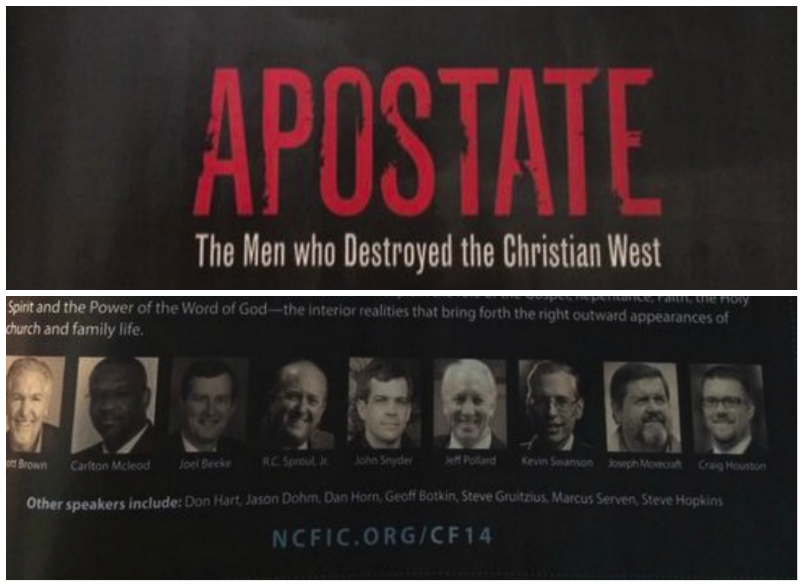
In WORLD’s most recent print edition, the magazine features two full page ads for the biggest names in Christian Patriarchy. The first is for Kevin Swanson’s new (and academically embarrassing) book “Apostate.” The second is for a NCFIC (National Center for Family Integrated Churches) conference featuring Christian Patarichy celebrities like Scott Brown, R.C. Sproul, Jr. Kevin Swanson, and Geoff Botkin.

You can check out the ads here, the photographs of which are courtesy of Chris Hutton at Liter8 Thoughts:

The NCFIC ad is for their upcoming “Church and Family” conference. You can see their speakers are a Who’s Who of Christian Patriarchy — and basically a list of everyone who previously walked in line with Doug Phillips: Scott Brown, Kevin Swanson, Don Hart (General Counsel for Vision Forum Ministries!), Geoffrey Botkin, R.C. Sproul, Jr., etc. You honestly can’t get much more Christian Patriarchical than this. As Julie Anne Smith at Spiritual Sounding Board has said, Scott Brown is “posed to fill the void left by Doug Phillips and Vision Forum to further the Christian Patriarchy Movement among homeschool families and family-integrated churches.”

And Kevin Swanson’s “Apostate”? Really, WORLD? You want the guy who talks about “feces eaters” and compares abused children to “dead little bunnies” advertising in your magazine? That’s a new low, especially since “Apostate” is a book that seriously proposes that “Charles Darwin’s farting at night (not kidding) is relevant to his philosophic and scientific influence.”

Not to mention that many WORLD subscribers are conservative Catholics and one of the “Apostates” that Kevin Swanson believes helped usher in the end of Christianity is Thomas Aquinas. Yes, like the classic Christian theologian Thomas Aquinas. But despite Aquinas being Evil Incarnate to Swanson, Aquinas’s face is absent from Swanson’s WORLD ad. Pretty convenient, right?

Ultimately, money makes the world go round, and that’s evidently no less true for Christian magazines. Considering that full page ads are $5,600 each, Christian Patriarchy just made WORLD $11,200 richer this month. And WORLD just brought Kevin Swanson and NCFIC into the homes of 100,000 families. Wink, nod, shhh.

Christian Patriarchy on Educating Daughters

girl-reading

HA note: The following is reprinted with permission from Libby Anne’s blog Love Joy Feminism. It was originally published on Patheos on May 12, 2014.

Okay, let’s take a few minutes to hash out Christian Patriarchy’s view towards women and education. I think this is necessary because I hear one side saying “you don’t believe in educating girls” and the other side saying “no no no, we do educate our daughters, your accusations are ridiculous.” So what is really going on here? I can’t necessarily get at what the ordinary family on the ground is doing, but what I can get at is what the leaders of the movement say. So let’s take a look, shall we?

In a nutshell, the leaders of the Christian Patriarchy movement teach that daughters should be educated for their role as wives, mothers, teachers-at-home, and Proverbs 31 women, but not educated for careers outside of the home. This is summed up in a quote by Michael Farris from his book, The Home Schooling Father:

I want my daughters to have business savvy like the woman honored in Proverbs 31. But I don’t want them chasing the feminist dream of the two-career marriage (or shall we say “living arrangement”). They can’t have it all, as many feminists are beginning to find out. I want to avoid the twin evils of neglecting the proper career training of my daughters, on the one hand, and pushing them to the feminist career mold, on the other. Proverbs 31 teaches a godly balance: A woman who possesses work skills and financial resources, but who uses those skills in a way that keeps her home with her children and husband. The woman in Proverbs 31 does not stay home barefoot and pregnant watching soap operas. She is busy with more than garden clubs and poetry societies. Yet, she is first and foremost at home with her children and husband.

In fact, home schooling offers women the best of both worlds. Home schooling is a job that society values–teaching academics to children. It provides serious intellectual stimulation. It provides many opportunities to be held in esteem by people outside your family. . . . The pay is low. But the ability to be home with your children while working is second to none.

My wife was a very good student in high school and college. Before we began home schooling she would sometimes complain about the lack of intellectual activity in her life of wiping spills, changing diapers, and doing laundry. A couple of times she even wondered out loud about the idea of going to work.

Since we have been home schooling, her need for intellectual challenged has been abundantly satisfied. She has always believed that a mother’s place is in the home. But home schooling turned this belief into an intellectually satisfying lifestyle which provides many tangible rewards. The career I will ‘push’ at my daughters is the same one practiced by their mother.

The leaders of this movement, in other words, want daughters to be taught skills beyond diaper changing and laundry, but they don’t want daughters’ education to orient them towards a career outside the home. Interestingly enough, I can see how these ideas played out in my own life. My sister Heidi and I both attended college but sought degrees that would allow us to bring in extra income by working on the side, out of the home, while filling our proper roles as homeschooling mothers. When we both decided that was not what we wanted, we faced the challenge of turning an education intended to bring in pocket money into one we could forge careers out of.

Anna Sophia and Elizabeth Botkin, daughters of Geoff Botkin and authors of So Much More, similarly endorsed educating women in a blog post last year:

We all want to equip ourselves to be godly women, but do we really know what that equipping should look like? A diet of books on modesty, courtship, and cake decorating will definitely fill the bill if the role we aspire to is simply one of wearing modest clothes, going through a courtship, and decorating cakes. But if we truly believe the biblical role of women is bigger and more significant than this, we need put our money where our mouths are and pursue education and training to match.

They went on to emphasize the importance of women studying law, economics, business, history, and the sciences, among other things. They argued that daughters at home should put their time and energies into becoming educated in a variety of fields, not simply into cooking or cleaning or childcare.

Farris and the Botkin sisters are not the only ones arguing that daughters should be educated, though not for careers outside of the home. Voddie Baucham had his daughter Jasmine, who lives in his home as an obedient “stay-at-home daughter,” obtain a bachelor’s degree and now a master’s degree. Doug Wilson emphasizes the importance of a strong classical education for both sons and daughters and takes a pride in his daughters being well educated and well spoken.

Even Doug Phillips has weighed in:

An encouragement for fathers with older daughters might be for them to be involved in directing “higher education” at home. Having daughters that have graduated from high school still at home is usually something parents have not prepared for. For some families the encouragement needed is for the young ladies to learn all the homemaking and mothering skills required to create an inviting, Christ—honoring home. But, many girls have worked on these skills for years and seem to lack inspiration and vision to study God’s Word in depth and become firmly grounded in theology, church history, world—view, child training, philosophy of education, etc. for themselves. We feel that these are crucial issues for fathers to take responsibility for and direct their daughters in.

In other words, the leaders of the Christian Patriarchy movement are not against educating daughters. What they are against is educating daughters for careers outside of the home. They also have concerns about how their daughters go about being educated—namely, they do not want their daughters educated at secular universities. There is a lot of fear of secular education in these circles, and daughters are often seen as even more in need of protection than sons. Sons are to grow up and enter the world and be accountable straight to God. Daughters, in contrast, are fathers’ responsibility until they hand them off in marriage. Secular education, these leaders believe, provides only a truncated and twisted education that is not a real education at all. In fact, they argue that secular education as currently manifested is explicitly designed to corrupt young believers and lead them to atheism or, at the very least, to a liberal faith that “denies the gospel.”

This is why Michael Farris sent his daughters to Christian colleges. This is why Voddie Baucham enrolled his daughter in College Plus. Christian colleges, and, increasingly, online Christian colleges, are considered a safe alternative—although, again, daughters enrolled in these programs should have being a properly prepared wife, mother, and teacher-at-home as their goal, not a career outside the home. Some, such as Geoff Botkin and Doug Phillips, have continued their adult daughters’ education at home themselves, often focusing on a classical education approach and emphasizing law, economics, and history. Daughters are to be educated, but they should receive an education that teaches “truth,” not a perverted corrupted secular education.

I should note that all of this focuses on the leaders and not on the followers. What do the ordinary families following this ideology do? I suspect that class plays a large role here. The ordinary family may be overwhelmed both financially and emotionally by an ever-growing flock of children, and unable to properly educate even their sons. In this context, daughters’ academic education may seem less important, especially given that the daughters may be kept busy helping with the children and keeping the house running. Most families cannot afford a live-in nanny/helper like the Phillips could, after all.

And the leaders of the Christian Patriarchy movement say things that play into the devaluing of daughters’ academic education in families that are overwhelmed already. For example, R. C. Sproul [Jr.] wrote the following of his exchange with a homeschooling mother:

The mother made a confession to me. She told me, “You know, my nine-year-old daughter doesn’t know how to read.” Now here is a good test to see how much baggage you are carrying around. Does that make you uncomfortable? Are you thinking, “Mercy, what would the school superintendent say if he knew?” My response was a cautious, “Really?” But my friend went on to explain, “She doesn’t know how to read, but every morning she gets up and gets ready for the day. Then takes care of her three youngest siblings. She takes them to the potty, she cleans and dresses them, makes their breakfasts, brushes their teeth, clears their dishes, and makes their beds.” Now I saw her rightly, as an overachiever. If she didn’t know how to read, but did know all the Looney Tunes characters, that would be a problem. But here is a young girl being trained to be a keeper at home. Do I want her to read? Of course I do, as does her mother. I want her to read to equip her to learn the Three Gs. [From earlier in the book, he notes the “Three Gs”: Who is God? What has God done? What does God require?] But this little girl was learning what God requires, to be a help in the family business, with a focus on tending the garden.

I’m not suggesting that the goal is to have ignorant daughters. I am, however, arguing that we are to train them to be keepers at home. These two are not equivalent. Though we aren’t given many details we know that both Priscilla and Aquila had a part in the education of Apollos. I’m impressed with Priscilla, as I am with my own wife. She is rather theologically astute… My point is that that brilliance isn’t what validates her as a person. It’s a good thing, a glorious thing, and an appropriate thing. But it’s like the general principle we’ve already covered. Would I rather be married to a godly woman who was comparatively ignorant, or a wicked person who was terribly bright? Who would make a better wife and mother, someone who doesn’t know infra- from supralapsarianism, but does know which side is up on a diaper, or a woman about to defend her dissertation on the eschatology of John Gill at Cambridge but one who thinks children are unpleasant? It’s no contest, is it? Naturally we want everything. We want all the virtues to the highest degree. But virtues come in different shades and colors in different circumstances.

In other words, educating daughters academically is good and important . . . but it’s more important that daughters learn to willingly and cheerfully change a diaper and make a bed. Doug Phillips has made similar statements:

The Bible actually has a great deal to say about what distinguishes a girl from a woman. For one thing, a mature Christian woman is one who has demonstrated that she has been trained and is ready for marriage. Historically, parents understood that it was their mission to raise their daughters to marriageable maturity so they could enjoy the husband “of their youth.”

To raise a daughter without thought to marriage, to instill in them a spirit of independence from the family, or to focus their training on a career outside the home, is actually to disqualify them for graduation and the next step in life. In contrast, a woman who meets the biblical requirements for graduation is one who is comfortable being under the jurisdiction of her father and seeks to make him successful in every way. She recognizes that God calls women to be under the authority of God-appointed men, first in the form of fathers, and later as husbands.

Note the similarity here to the Michael Farris quote I began with—”To raise a daughter without thought to marriage, to instill in them a spirit of independence from the family, or to focus their training on a career outside the home, is actually to disqualify them for graduation and the next step in life.” Daughters are to be educated, yes—but not for a career outside of the home.

The leaders of the Christian Patriarchy movement believe that preparation for being a wife, mother, and teacher-at-home involves more than simply learning to change diapers and do laundry. They believe that being a proper Proverbs 31 woman should involve learning business, economics, history, law, and education. But all of this is seen as preparation for life as a homemaker and homeschool mother—not for a career outside the home. Indeed, these leaders—from Michael Farris to Doug Phillips—argue that daughters should be actively discouraged from even considering a career outside the home, and should instead be “pushed” towards homemaking and homeschooling as their lifelong destiny.

I don’t have a problem with a woman choosing to be a homemaker and homeschool mother, but that should be a choice, not the only option available to them. And given how unstable the world can sometimes be, even women who choose to stay at home should make sure they have career options available in case of death, divorce, or economic downturn. Heidi and I were lucky. We attended college and received degrees. Even so, our choice of majors was so limited by our assumption that we were not preparing for careers outside the home that we had to make some tough choices when we decided careers outside the home were what we really wanted. How much worse it must be for those who do not receive a college degree, or even more, for those whose parents are so overwhelmed that their education goes on the back burner entirely.

If you tell someone involved in the Christian Patriarchy movement that they do not believe in educating their daughters, they will object to your portrayal and cease to listen to what you are saying. If you, in contrast, tell them that they do not believe in educating their daughters for careers outside the home, they will likely agree. Then, perhaps, you may be able to begin a conversation.

Farris: Patriarchy Makes Kids Gays and Atheists

Photo source: http://www.theproudatheist.com/products/gaytheist

HA note: The following is reprinted with permission from Libby Anne’s blog Love Joy Feminism. It was originally published on Patheos on June 4, 2014.

If you read my blog, you’re probably aware of the Christian homeschooling subculture’s patriarchy problem. A variety of prominent Christian homeschool leaders have been promoting patriarchal family structures at homeschool conventions and in homeschool publications for well over a decade, and two of those leaders—Bill Gothard and Doug Phillips—have recently fallen, engulfed in scandal. Michael Farris, another prominent Christian homeschool leader, has since come out criticizing these leaders and the “patriarchy” they taught. Now Farris has openly criticized “patriarchy” as part of a keynote address while keynoting at a homeschool convention in Florida.

Here is a clip from Farris’s speech, followed by a transcription. In this section of his speech, Farris speaks of homeschool graduates who grew up in patriarchal homes.

The majority, I think, are walking with God. A significant minority, however, have rejected God entirely. A significant number are way way out there. And the critics that we’re seeing arising from inside the homeschooling movement—from young people in their twenties, mid-twenties mostly are the oldest group that are loudly criticizing homeschooling on the internet and so on and in other venues—were almost all raised in these kinds of homes, almost all, and there is no pretense of christianity in most of their lives. There are open homosexuals involved, there are atheists involved, there are people that utterly reject everything that we believe in and make no pretense about it. And so the idea that people are going to create generational patriarchal legacies, that didn’t work out for them very well. We’re not seeing that. You erect a false view of god for your children, don’t be surprised if they reject god entirely. That ‘s what’s going to happen. So what do we do as a movement first I would suggest that we run as far away from patriarchy and legalism as we can.

Okay, wow. I have been excited about Farris condemning patriarchy because, regardless of his motives, his words may prevent at least some families from going down that toxic rabbit hole. But this? The patriarchy turns kids into gays and atheists? That is why he’s condemning it? Not, oh I don’t know, patriarchal homeschooling hurts people? Farris has read the stories on Homeschoolers Anonymous (or at least is aware of them), but his conclusion is not “patriarchal homeschooling is toxic” but rather “patriarchal homeschooling turns kids into gays and atheists”? For serious? 

Is Farris unaware that this is still formula parenting? Farris is saying homeschool parents should run away from patriarchy because it will turn their children gay and atheist. He’s acting as though you just have to find the right form of parenting and then, viola! Your children will not be gaytheists.

What Farris apparently does not realize is that for many of us our parents’ insistence on us adopting their exact religious beliefs was just as constricting and painful patriarchal aspects of our upbringing, if not more so. My troubles with my parents started not when I rejected patriarchy but rather when I determined that God had used evolution to create the world. Ardent young-earth creationists, my parents all but disowned me. That they could treat me like that, and that they could insist on young-earth creationism in the face of clear scientific evidence, made me realize I needed to think through everything they had taught me, because any bit of it could be wrong. That path didn’t lead straight to atheism, taking me first through some other flavors of Christianity.

If anything “made me” an atheist, it was not my parents’ belief in a patriarchal family structure but rather their insistence on blatantly unscientific beliefs and their decision to value their religion over their children, punishing me emotionally for any step I took away from their party line. But I sincerely doubt we will hear Farris speak out against any of this, because frankly, he’s the one who planted these seeds in my parents in the first place.

Farris told homeschool parents, including my parents, that they were the Moses generation, removing their children from Egypt (the public schools) and educating them in the wilderness of Sinai (homeschooling). We children, Farris said, were the Joshua generation, raised up to take back the promised land of Canaan (aka to “retake America for Christ”). But then some of us, myself included, rebelled against the entire purpose we were being raised for and decided Canaan was just fine the way it was and that slaughtering its inhabitants sounded like a very bad idea. That is what provoked our parents’ backlash against us, as they sought for something to blame for our utter failure. That is why we felt suffocated, as our parents blamed us for falling short of the lofty goals Farris had fed them.

But you know what? I don’t see Farris backtracking on any of that.

For more on Farris’s suggestion that patriarchal homeschooling turns kids gay, I’d point you to Kathryn Elizabeth’s excellent piece on the topic, “We’re Here, We’re Queer (and patriarchy had nothing to do with it).”

But I would be remiss if I didn’t mention another problem with Farris’s speech, and that is how he defined “patriarchy.” If Farris were telling his audience that they should give up their belief in male headship and female submission, even if he were saying it to prevent children from turning out as gaytheists, I would be honestly and truly impressed. Why? Because Farris has for years taught that wives must submit to their husbands even if their husbands tell them not to go to church, or not to listen to tapes of sermons at home. Farris rejecting the belief in wifely submission so common to the Christian homeschooling subculture could be game-changing. And his stern rejection of “patriarchy” ought to indicate that he’s doing just that, right? Wrong.

In his speech, Farris stated explicitly that wives are to submit to their husbands. Farris may be oblivious to this fact, but that is patriarchy. Farris made this statement to eschew what he apparently thought was patriarchy—the belief that every woman must submit to every man. But this idea was never taught by anypatriarchal Christian homeschool leaders. Think you that Doug Phillips would have had his daughters submit to the man they walk by in the grocery store? No. In fact, Phillips’ argued that if everyone woman remained in submission to her god-given male authority, he would protect her from the wiles of other men. Similarly, Gothard coined the term “umbrella of authority” and promised his followers that if they submitted to their god-given authority (singular), they would be safe from the storms of this world.

In other words, Farris set up and knocked down a straw patriarchy and endorsed actual patriarchy in a speech ostensibly condemning patriarchy. Can you tell I’m frustrated? This thing writes itself like a comedy sketch.

But by all means, Farris, make the real problem gay and atheist homeschool graduates (hi!), not the actual suffering caused by toxic ideologies. I should point people back to my post on Monday, because this is yet another example of a homeschooling parent making homeschool graduates like myself the problem rather than actually engaging our concerns. In other words, it isn’t that Farris has a problem with the toxic ideas we’re calling out, it’s that he has a problem with our existence.

But you know what? At least we have their attention now.

Christian Homeschooling and Child Abuse Denialism

Screen Shot 2014-06-03 at 3.18.35 PM

HA note: The following is reprinted with permission from Libby Anne’s blog Love Joy Feminism. It was originally published on Patheos on June 2, 2014.

If you’re a long-time reader, you’re likely aware my series on HSLDA and child abuse, which includes their fight against child abuse reportingtheir stonewalling of child abuse investigations, and their defense of child abuse. You’ve probably also read my viral “HSLDA: Man Who Kept Kids in Cages ‘a Hero.’” If you read Homeschoolers Anonymous, you probably know that Doug Phillips, former HSLDA attorney and founder of the now-defunct Vision Forum, stated in 2009 that “We understand that the core problem with Child Protective Services is its existence.”

What you may not be aware of is that in 1985 Mary Pride published a book titled The Child Abuse Industry: Outrageous Facts About Child Abuse & Everyday Rebellions Against a System that Threatens Every North American Family

Who is Mary Pride? If you’ve ever homeschooled, you’ve almost certainly heard of her. She has had so much influence in homeschooling circles that has been dubbed “the queen of the homeschool movement.” Historian Milton Gaither has dubbed Pride as one of homeschooling’s two most influential curriculum reviewers. Pride first published her Big Book of Home Learning in 1986 and has updated it regularly since. It now has four volumes. Pride is also the publisher of the “wildly popular” Practical Homeschooling magazine, with as many as 100,000 subscribers, and has published numerous other popular homeschooling how-to books. Pride is also the author of The Way Home, published in 1985 and credited with launching the Quiverfull movement (not to be confused with the Patriarchy movement).

And then, of course, there is The Child Abuse Industry. According to R.L. Stollar, the book is “a remarkable read that calls for a ‘Second North American Revolution’ — namely, having babies, abolishing no-fault divorce, going to church, eliminating foster care, homeschooling, re-instituting “biblical” executions of criminals, and getting rid of abuse hotlines.” Stollar is currently writing a multi-part review, which I will definitely promote when it comes out.

Here are ten quotes from Pride’s book, courtesy Stollar’s post on Homeschoolers Anonymous:

10. “The major problem is that the public has been convinced that child abuse is a major problem.”

9. “Are one out of four adult women (or one out of three, or two—the statistics keep getting wilder) really the victims of savage lust perpetrated in their youth?Isn’t it possible to organize a bridge party without staring at an abused woman across the table? Where do these wild statistics come from?”

8. “Never vote for a candidate whose campaign promises include ‘doing more for children.’”

7. “Child abuse hysteria is a self-righteous coverup for anti-child attitudes.”

6. “If [child abuse prevention programs] are allowed to proliferate, we will produce for the first time an entire generation of males who have been trained to consider raping their sons and daughters as passably normal behavior.”

5. “If sex has nothing to do with having babies, you can have sex with anyone or anything. Including children.”

4. “We need to stop allowing the unsupported testimony of childrenwho are of an age where they can barely distinguish fantasy and reality.”

3. “Don’t hotline anyone.”

2. “A retarded daughter told contradictory tales of sexual abuse by her step-brother and other male relatives… So here we have a girl who probably made up the story in the first place.”

1. “Age segregation increasingly alienates children and adults. Children are the ‘new n*****s.’” (not censored in Mary Pride’s version.)

My interest piqued by Stollar’s quotes, I cracked open my copy of HSLDA’s Chris Klicka’s 2006 book, Homeschool Heroes: The Struggle and Triumph of Homeschooling in America. I opened to the chapter on social workers.

At Risk from Social Workers

. . .  Homeschoolers are at risk. They are not at risk because they have big families or teach their children at home or neglect their children in any way. They are at risk because the child welfare system has lost control. Many social workers are trained in a philosophy that is antiparent, antifamily, and antireligious.

I can’t say I’m surprised, but here it is again. Look, I know that social services isn’t perfect, and that it’s badly in need of better funding. But that’s not what this sounds like it is about. According to Klicka, the issue isn’t that social services is underfunded and understaffed, but rather that social services is antifamily. This is the same sort of line Mary Pride was promoting in her book.

HSLDA is both a policy advocacy and legal defense group. HSLDA defends member families if they have any problems in their interaction with local public schools or social services. The organization’s website describes it like this:

Why does HSLDA help member families in the initial stage of a child abuse investigation?

HSLDA’s mission is primarily to advance homeschooling rights. Sometimes homeschooling parents get reported to CPS because people misunderstand homeschooling. They may see children playing outside during school hours and think that the parents are allowing them to be truant. Other times, families are reported for other types of suspected abuse or neglect. Investigations of all such allegations begin the same way: a social worker visits the family’s home, or contacts them requesting to set up a visit.

HSLDA advises our members in these initial contacts with social workers in order to ensure that their constitutional rights are protected. Once the allegations are revealed, we continue to represent our members if the allegations relate to homeschooling.

In other words, according to HSLDA’s website, they advise member families any time there is a social worker at the door, but only represent member families going forward if the allegations involve homeschooling. Along these same lines, an announcement on HSLDA’s facebook page last year asserted that “HSLDA does not and will not ever condone nor defend child abuse.” But some of the stories Klicka relates from his years working for HSLDA tell a different story.

There’s this one, for instance:

A homeschool father in Michigan picked up his two-year-old child by the arms, taking her into the house while she was crying and was reported for child abuse by a nosy neighbor. I set up a meeting with the social worker and counseled the family on what htey should say. I told themI told them to explain their religious convictions concerning raising their children from “a positive standpoint” avoiding Bible verses like if “you beat him with the rod, he will not die.” Or, if you “beat him with the rod,” you will “deliver his soul” from hell. Not a good idea. Social workers just don’t understand those verses.

Instead I told them to explain their beliefs by emphasizing verses such as Matthew 18:6 that states that if you harm or offend a child, it is better that a millstone be tied around your neck and you be thrown in the deepest part of the ocean. In other words, their religious convictions demand that they not do anything that will harm their children. When the family began presenting these religious beliefs to the agent, he became visibly uncomfortable, and suddenly announced that he would close the case.

And this one:

In Fairfax County, Virginia, a pastor gave a seminar on child discipline that included the requirement in the Bible to spank. A parishioner had to discipline her child while a neighbor was visiting a few days later. She spanked the child in the other room and then explained to the neighbor a little of what she had learned from the pastor.

The neighbor, who happened to be against spanking, reported the pastor to the child welfare agency for “bruising their children and for twenty-minute spanking sessions.”

To clarify, this suggests the pastor spoke in his sermon of bruising his children and carrying out twenty-minute spanking sessions.

The social worker who then initiated the investigation told me she thought she might have a religious cult on her hands that abuses children. I expressed my disbelief to the social worker that she was seriously investigating what an anonymous source claimed she heard from a person who heard it from another person. That is thrice removed hearsay. I told her that her evidence was flimsy and set the parameters for a meeting.

In preparation for the meeting, I told the homeschooling pastor and his wife not to recount any specific incidents of spanking since the social worker had nothing on the family that would stand up in court. I told them that they should emphasize again the positive verses such as Matthew 18:6. Since the social worker had no evidence, the only evidence she could acquire would be from what information she could gather from the pastor and his wife. Since the parents carefully avoided all specific examples and spoke in general terms, the social worker had nothing and had to close the case.

Perhaps those at HSLDA would argue that they never defended someone against child abuse in court. But in this layman’s eyes, this constitutes defending child abuse. I mean, did they even ask the pastor if it was true that he bruised his children and spanked them in twenty-minute sessions? Or did they de facto believe he was innocent and not bother checking, as seems to be their habit? I’ve expressed my frustration with this before.

And there is a similar distrust of children’s testimony with Klicka as with Pride:

Another family in Bradington, Florida, was visited by social workers. Allegations were made by one of their seven adopted children, who was the only one not being homeschooled. He had made up a story and told it to his science teacher, who had then passed the information to a social worker. I was able to talk to the social worker and keep them out of the home and away from the children. The case was finally listed as unfounded. The mom said, ‘This is why I spend twenty-six cents a day. People are crazy not to join HSLDA. I have an attorney ready to help me at a moment’s notice.’

There is also advice on how to hide abuse and avoid being reported:

Know Your Family Doctor

We have had numerous situations where doctors turned homeschoolers in to social workers because they found a bruise or mark on the child . . . I learned early on that each family needs to know their doctor well. If the doctor is familiar with the patients and trusts them, they do not have to turn them over to a child welfare agency, even if they have a mark or bruise. It is completely the doctor’s discretion.

The orientation toward social services is the same in Klicka’s book as in Pride’s—one of opposition. They are the enemy. In fact, Klicka began his chapter on social workers with I Peter 5:8-9—”Be sober; be vigilant; for your adversary the devil walks about like a roaring lion, seeking whom he may devour.” The assumptions about the veracity of the parents’ and children’s testimony is the same—parents’ word can be trusted, children’s cannot.

We need to be careful not to assume that all homeschoolers engage in this sort of denialism and defense of child abuse. I do not know whether the themes explored here extend beyond the leaders of the conservative Christian homeschooling subculture, and we should not assume that we do. But with that subculture, this is a problem. With these sorts of narratives, how can we expect those within this subculture to even self-police, much less report suspicions of abuse?

From Pride’s The Child Abuse Industry to Michael Farris’s thrill-horror novel Anonymous Tipthis is a problem. 

Oh, and also? If there are Christian homeschoolers out there who are upset by what I’ve said here, the correct response is to go about condemning the words of these Christian homeschool leaders and creating a new narrative, a narrative that affirms reporting suspicions of child abuse and doesn’t de facto trust parents’ word over that of their children. Condemning me for saying these things or arguing that I am anti-homeschooling would be the incorrect response.