Hurts Me More Than You: Warbler and Laralyn’s Stories

Screen Shot 2014-09-23 at 10.15.16 AM

*****

Trigger warning for Hurts Me More Than You series: posts in this series may include detailed descriptions of corporal punishment and physical abuse and violence towards children.

*****

Warbler’s Story

I was a “liar and a thief” growing up. AKA: I would take saltine crackers out of the cabinet and eat them between allowed meals and then I would lie when I was inevitably caught and told to fess up. I got spanked at least once per day for a couple years.

I don’t know were exactly my parents first learned about spanking, but they read and promoted the Pearls out the wazoo.

Over the years they spanked us with hands, paint stirrers, and lastly with 2-by-4s. My mom had a 2×4 custom made with a handle. If we tensed out butts, or put on extra layers we were spanked for avoiding the pain and made to take the layers off and be spanked over underwear. We were usually taken to another (private) room, but our walls were thin and every *thwack* echoed through the house, along with the eventual crying and the “I love you and this hurts me too.” Afterwards we were expected to say in explicit language exactly what we had done wrong, that we were sorry, and that we loved the parent who had just beaten us.

My mother was usually the one to do it, but she would spank us so often that her hands started hurting (blood vessels breaking, etc) that she had the 2×4 made, or she left us to wait in dread for daddy. His hands were tough and he hit hard. The paddle sometimes hit the tail bone as well, and that was the worst.

I usually cried.

As much as I tried I was “weak.” Sometimes if the boys didn’t cry they were spanked till they showed “proper” repentance. If we were stubborn, refused to say we loved them, or did not properly state our transgressions we were spanked again. 5 spanks was the bottom line, then ascending in number by units of 5.

As for me, I never got more than 40 in one sitting (that I remember) because I was (as stated) weak and timid and disliked getting spanked. My older brother was rebellious and would often get spanked for hours. I can still him yelling defiantly over the strikes, refusing to back down even when being punished.

As we got older (teens), our parents decided that spanking was not working and we were given leaf-raking jobs, cleaning jobs, or extra writing assignments. They thought that we were either so bad, or so old that spanking still hadn’t done well, and it was time to try something else. I once heard my mom say something about “decency” having something to do with it, but I have my personal doubts.

Our younger siblings were spanked much less because the “other” punishments on us older ones seemed to be working (or as we got older we didn’t take so much food and hid things better) so they got some similar punishments and spanking was reserved for serious, extra bad transgressions. With the sidelining of the spanking it got worse, though. They were reserved for daddy and he often beat far longer than needed because the younger siblings were not used to being contrite, crying enough to get out of it, and say the right things. I remember the 8th child had a problem at dinner and shouted at my mom or something. My dad had just gotten home from working and it seemed like the height of sin to be making noise and disturbing his dinner. My baby was taken to his room and hit for about 5 minutes long, screaming up until the last minute or so. He was either 4 or 5.

My mom also got more into slapping or hitting as we got older and talked back to her as older teenagers. It was like the ultimate shame because you could never hit back. Those were some of the times that I “saw red…” Brilliant shades of red color everything as you focus in on one person with all the hatred and anger in your tortured soul. Your body shakes and you blink, but still see the color. Nothing else is, or ever was. The only two things in the world are you and the face screaming at you in red waves…. and you wish you had a knife in your hand…. Sometime later you awake from your dissociation, you can’t remember the past 30 minutes, but you feel guilt for your feelings.

After all, you were the one in the wrong. You deserved punishment for your sins…

I don’t know how common spankings are now, as I “ran away” from home 4 years ago. I do know that if my mom had access to plumbing line or glue sticks one or more of us might have fared worse. The wood was solid and “just” bruised.

And we learned how to hide our transgressions in order to avoid it.

*****

Laralyn’s Story

Spanking. Even now I don’t know what to make of the term.

It feels so wrong to apply it to how our parents punished us. I initially assumed I would always spank my own children. After all, it was Biblical and right according to so many Christian parenting books. I didn’t want to have horrible children, so of course I would spank. As my first baby became a toddler, I found I couldn’t stomach the idea. I tried to spank her once and the attempt was half-hearted and I cried because I knew deep down it was horribly wrong. The moments I was tempted to spank were when I was angry or I didn’t know what else to do and that to me said more than any Christian parenting book ever could. I decided then and there that I would never physically punish her or future children in such a way.

I wish I couldn’t feel my stomach turn when I remember my parents disciplining us. The angrier they were, the worse it was. A belt was the most frequent tool and almost all spankings accompanied the remove of clothing below the waist. I still feel humiliation and shame when I remember it. We were spanked for nearly every infraction – my parents knew no other mode of discipline.

However, the moment I remember most vividly is when I was spanked for being afraid of the dark.

I had horrible fears as a child (of hell, of the house burning, of dying) and refused to sleep alone. One night, after repeated attempts to settle me, I was still crying uncontrollably. My parents, frustrated to the point of losing control, marched into the room. My dad ordered me to turn over and with my head buried in the pillow to muffle my crying, he hit me several times across my bottom. He yelled at me to shut up and then they left.

I was still crying. I was still afraid.

I started injuring myself when I was five in response to anger and overwhelming emotions. This behavior continued and worsened into my teens and young adulthood. My parents shamed me and blamed bad influences.

I blame their shaming and willful crushing of spirit.
Hurts Me More Than You: Victoria’s Story

Screen Shot 2014-09-23 at 10.15.16 AM

*****

Trigger warning for Hurts Me More Than You series: posts in this series may include detailed descriptions of corporal punishment and physical abuse and violence towards children.

*****

Victoria’s Story

The concept of spanking is something I have wrestled with for months now.  Trying to go back and understand what was happening during my growing-up years is confusing.  The cognitive dissonance threatens to overwhelm me completely, leaving me almost incapable of knowing anything.

But this I do know, now.  Any form of hitting a child – no matter what you call it – is wrong.

I have not always believed that.  As a teenager I read Shepherding a Child’s Heart and To Train up a Child and Withhold not Correction as though they were gospel truth.  I planned on following in my mother’s footsteps, only I would do even better.  My children would be even better-behaved, more respectful, more obedient.

It has been 2 years now of trying to grapple my way out of the cultures and mindsets that taught me hitting a child was not only okay, it was good … and even godly.

My Mother taught other moms how to spank ‘properly’.  She would tell these moms the importance of being calm, of making sure the children displayed the correct ‘emotional response’ (sin produces grief, not anger), of making sure the swats were hard enough to deter the child from further sin.  She would display the craft glue stick that she had chosen as ‘the rod’, laughing as she explained that it provided just the right amount of sting, plus, it was “flexible, so you can roll it up and put it in your pocket or purse – you can take it with you everywhere!”  Mom would always insert that you should pray with the child and help them ask for forgiveness, and end the session with a hug.

Mom told us, “I’m doing this because God commands me to.  It’s my job to help you learn the consequences for obedience.  Once you’re older, you won’t be getting consequences from me, you’ll be accountable directly to God – and his consequences are bigger than anything I could ever dream of!”

My parents did spanking ‘by the books’, so to speak.  Almost everyone we know would say I grew up in a loving, Godly family.  In fact, I can’t count all the times people have told me how wonderful my family was.  We were the community’s role models.

But.

My mother broke a hard plastic kitchen spoon on my bottom.

My little brother once put on multiple pairs of underwear to lessen the pain – and it became a family joke.

Some days there were so many offenses that we would be lined up outside of Mom’s “office” (her bedroom), and when she finished spanking one of us, we’d be told to “Send the next one in!”

If we rolled away or flinched, Mom would scold, “Hold still or you’re just going to get more swats!”

My Dad’s spankings, which were much worse, would leave angry red welts that lasted for hours, making it painful to sit.

When Dad was spanking the other kids, I would run upstairs and bury my head under a pillow, trying to hide from the sound of screaming.  He always told us that our screaming was just being dramatic … it wasn’t.

I would try and plead with my Dad to have mercy on my younger siblings, trying to explain what had happened, and he would walk past me and tell me to be quiet.

Dad stopped spanking me as I became a teenager, saying it ‘wasn’t appropriate’.  But whenever he thought I deserved one, he’d call my mom to “Come on in here and spank her.”

When I was a teenager, Mom and I would have long arguments, ending in me getting spanked and giving in.   I would cry out “You’re angry!  You even say you’re not supposed to spank when you’re angry!”  She would reply that she wasn’t angry – then hours later she would come back and apologize for spanking out of anger.

My last spanking was at age 16.  Mom and I had been fighting for hours, and she told me if I interrupted her again, she would spank me.  I interrupted her, and she made my lie down on the bed, pull down my pants, and she spanked me.  The pain was nothing compared to the humiliation.  I broke and said whatever she wanted to hear as an apology, and went through the motions of hugging and saying ‘I love you’ – before escaping to my room to cry.

When I brought up that incident to Mom recently, she declared indignantly that she never spanked any of us for interrupting – I was going to get spanked anyways, and interrupting just made it happen faster.  She didn’t see spanking at age 16 as a problem.  She used to say the rod was for the back of the fool, and as long as we were acting like a fool, we needed to be spanked.

My parents say I’m bitter because I’ve been reading all of the homeschool survivor blogs.  They tell me I’m re-interpreting history, making up accusations, and that they can’t even visit me because they don’t know what I’ll attack my mother with next.

When I’m around a family who spanks their children, I have a hard time not panicking when they take their children into another room, because I know what’s happening.  My friend tells me it’s okay because she always reconciles with her children afterwards.  I wanted to scream, because my mother did that, too.

When I visit with my niece and nephew, I feel physically ill watching them be subjected to the constant power struggles, spankings, and threats of spankings.

When I’m around these families, anxiety just builds and builds, and I inevitably break down with my husband later.

I was taught that my parents hurt me because they loved me, and that God would do the same.

I am unable to talk to my parents because I can’t sort out the love and care they gave me from the punishments, control, and manipulation.  I get sick wondering if they treat my younger siblings the same way.

I don’t know if I want to have kids because I’m afraid I’ll revert to my parent’s methods of training them, because that’s all I’ve ever known.

I’m terrified of God.  I physically can’t go to church, because it’s not worth the panic attack or the resulting depression.  I’m so scared that God will send me to hell, but I can’t trust him.  I long to believe he loves me, but if his love is the twisted definition my parents gave me, I don’t want it.

“He Couldn’t Breathe”: Old Schoolhouse Owners Accused of Waterboarding, Child Abuse

Screen Shot 2014-10-14 at 9.21.27 PM

This story is a modified version of a previous piece written by Hännah Ettinger (Wine & Marble) and R.L. Stollar (Homeschoolers Anonymous) on October 8, 2014.

Eric Novak grew up in Christian homeschooling circles.

He was employed from 2008-2011 by Paul and Gena Suarez, founders of The Old Schoolhouse (TOS) magazine, which boasts a readership of around 200,000. Paul and Gena speak at homeschool conventions and are seen within the homeschool community as advocates for the homeschool lifestyle. The Suarezes’ main business, TOS, is endorsed by the Great Homeschool Conventions and James Dobson as well as financially sponsored by HSLDA, the Home School Legal Defense Association.

TOS has a long history of adoration for and promotion of Michael and Debi Pearl’s No Greater Joy ministry. In 2005 TOS’s devotional editor Deborah Wuehler interviewed a member of the Pearl family for TOS, in which she wrote the Pearls were “the pioneers of homeschooling in the early 1970s” who “helped countless numbers of parents with their child training questions.” A year later the Suarezes “team[ed] up” with Michael and Debi Pearl in 2006 for a Christian homeschool conference in Germany. TOS even went so far as to give away free copies of the Pearls’ book To Train Up a Child in their “welcome packages” to new homeschoolers. After the death of homeschool kid Sean Paddock, whose mother used the Pearls’ recommended plumbing supply line for corporal punishment, Gena Suarez callously defended the Pearls, saying, “The only way you can kill a child with that is by shoving it down his throat.”

This, as well as other acts of promotion of the Pearls’ “child abuse materials,” led to a boycott of TOS in 2006 by gentle parenting bloggers

During Novak’s time as an employee of  TOS (and later, as he became a close friend to the Suarezes’ oldest son), he discovered that the Suarez and Igarashi families (the mothers of both families are sisters) are embroiled in an intense feud over physical and sexual abuse that has allegedly occurred in the family.

What Eric Novak learned about the Suarez family involved alleged physical abuse of their children as well as alleged sexual abuse within the family. According to various accounts, the Suarezes 22-year-old son, Luke, sexually abused two of his younger siblings and his young cousin, the son of Jenefer Igarashi. Luke currently has continued access to his siblings, as he lives at home with his parents. He is regularly in contact with children in the homeschool community, thanks to his family’s business. According to Novak, the Suarezes often get put up in the homes of other homeschool families when they travel. Novak relates:

“They continued going to conventions and such, and I know that for a fact that at conventions, they’ll like stay with homeschool families, and he’ll like, sleep in the younger kids’ rooms. And that’s what I’m most concerned about.”

The physical abuse allegations involve the abuse of all of the Suarez children, as well Gena’s youngest sister, “Megan.”

When Gena’s mom died, Paul and Gena took in Megan, Gena’s third sister. Megan was 13 years old and Gena was around 26. Megan claims that once she joined their family, Gena turned into a fairy-tale worthy evil surrogate mother, turning Megan into a servant and depending on her for her primary childcare support. It got to the point where even the neighbors jokingly called Megan “Cinderella,” according to a written statement by Megan (given to us by Eric Novak):

Even friends and neighbors of Gena and Paul would refer to me as “Cinderella.” It was evident to all who knew us what my role in the family was: babysitter, house cleaner and servant… and physically or mentally abused (instead of properly disciplined), when I would act childish or foolish. I was left in charge and instructed to care for and discipline the younger children in the home – even told to strike them in the face when ‘disobedient’ or ‘disrespectful’ (they’d give me ‘slapping privileges’), which still haunts me today.

Megan alleges that the Suarezes didn’t just use her for free labor. She says they physically abused her and their other children and claimed that the abuse was God’s will. It seems like they employed the Pearls’ “will-breaking” methods quite studiously. This is also from Megan’s written statement:

I witnessed and was a victim of physical and mental abuse while in the home. I watched Gena as she would strip her youngest son down (around 4 yrs old), put him in the bathtub and run cold water over his face so that he couldn’t breathe. They would have their second oldest son strip down naked and repeatedly douse him with cold water. Gena would brag that she “finally found a punishment that would get them to obey”. She would also have her children stand in the corner so long they were forced to wet their pants. I also remember seeing her boys be made to ‘make up from a fight’ by inappropriately kissing various parts of each other’s body to the point of everyone in the room feeling awkward and uncomfortable… except for Gena, who would laugh… Remembering back on these things makes me sick almost to the point of throwing up. 

…Close to the time I finally fled, it had gotten to the point that I didn’t want to live anymore. I would fantasize about dying. I couldn’t please them no matter how hard I tried. I was literally a slave in the home and punished as such when I couldn’t meet their impossible standards. What hurt the most after I fled was knowing the abuse that would continue in the lives of the children.

After Megan escaped, she found support in her other older sister, Jenefer Igarashi, and has thrived. She is now married and mentors in her community and is herself a homeschool mom. She remains a devout Christian.

For his part, Novak has decided to speak up about the allegations he learned about. He created a video explaining why he decided to speak up about the allegations against the Suarezes and his former employer The Old Schoolhouse. He also wrote an open letter to Heidi St. John, a popular homeschool speaker for the Great Homeschool Conventions, who is alleged to have participated in covering up these situations of abuse.

Other parties alleged to be involved include the National Center for Life and Liberty’s David Gibbs III, HSLDA president Michael Smith, and the Great Homeschool Conventions’ Brennan Dean.

For the full story about the allegations of the Old Schoolhouse cover-up, see HA’s original news piece here.

Hurts Me More Than You: Alexandria’s Story

Screen Shot 2014-09-23 at 10.15.16 AM

*****

Trigger warning for Hurts Me More Than You series: posts in this series may include detailed descriptions of corporal punishment and physical abuse and violence towards children.

*****

Alexandria’s Story

I was never told the words, “This hurts me more than you.” But I did hear, “This grieves my soul, but more importantly, it grieves God,” “Spare the rod; spoil the child,” “This is for your own good,” or my personal favorite from Mom, “I’m yelling – that must mean I’m not spanking enough,” many times.

As the fifth of seven, my parents were set in their disciplining ways by the time I came along. The Pearls’ books were scattered throughout our house. While my parents did not take all of their recommendations, there were enough implemented. I was spanked from the time I was a year old until the age of 17; with a threat of spanking even after I started college at 18. “You know, you’re not too old to spank,” was said more times than I would like to admit during the summer I was home after my freshman year.

Needless to say, I did everything in my power to not spend another summer at home until I finished college.

Some of my earliest memories are of being spanked. We could distinguish the distinct squeal of the spoon drawer from the furthest parts of the house and we knew we had to scatter, or at least distance ourselves from the offender or risk being painted with that infamous “broad brush.” I was not a bad child. But I was a child. I was sometimes willful. I made mistakes. I was clumsy. I didn’t understand math. All of these things could earn you a trip to Mom and Dad’s bedroom or the laundry room.

They were always terrifyingly calm when they spanked us. They would wait the necessary 10 minutes to cool down (while making me wait cowering and scared shitless in the laundry room or their bedroom) so they weren’t “spanking out of anger.” They may not have been visibly angry, but they were seething inside. The force that was applied and the length of the spanking correlated, not with what we had done, but with how angry it made them.

There was one spanking Dad gave me when I was about 8 that went on for 87 swats – one for each answer I had gotten wrong as I was trying to memorize my times tables. I was required to count them out as they rained down on my bent-over backside. I was immensely grateful for the skirts I had to wear because I could hide the fact that I wasn’t locking my knees out and therefore could clench as I heard the rod whistling toward me. The pause between swats was the worst – the anticipation killed me, and I’m fairly certain his timing was inconsistent on purpose so I wouldn’t know when it was coming. This particular spanking was earned because I couldn’t understand math; because no one had the patience to actually explain it to me, and because a third grader should not be teaching herself any of her own subjects.

This was also during a three day period in which I was not allowed to eat for the same reason I was earning the nightly marathon spankings.

That was not the only time they took away food as a form of punishment. There were several occasions when I and usually two of my brothers would have food taken away while also being spanked repeatedly until one of us confessed to whatever heinous act our 12, 9, and 6 year old selves had done – like leaving a door open, or turning the heat up.

My parents used wooden spoons (that were constantly breaking) when we were small, but when we got to be about 5 or 6, we graduated to the rod. The rod was a wooden paddle that was about 2’ long, 3” wide, and about ¾” thick.

Mom had carved “in love” into it.

I still snort when I think of that.

That thing packed quite a wallop! The first few times it was used on me, I wasn’t prepared for how much power it had and it knocked me over. I learned to brace for it so I didn’t lose my balance. It must have made a satisfying sound as it smacked into our backsides… until my older brother took it into the back yard and broke it when he was about 14 and sick of everything. I remember hearing it from across the house as my older siblings were in the laundry room with the door shut. After that, we went through a series of objects, such as arrows with the tips taken off (those shattered too easily and weren’t cost-effective) until they settled on a fiberglass rod that one of my brothers found somewhere that was about 30” long and 1/2” in diameter. That thing stung so bad! As it started to splinter, it would leave tiny cuts on my hips and butt. Mom and Dad didn’t believe me until I showed one of my sisters the welts and scabs after one particularly long spanking when I was about 12. Dad apologized and said he would be more careful next time. Then he duct taped that end, started using it as the handle end, and didn’t hold back. It was much more ergonomic that way! The better grip must have made it easier to get a good back-swing.

Spankings became less frequent as I began to reach puberty, but then they picked up as I moved into adolescence because I started to have my own ideas. The shame I felt every time I was spanked over the age of 11 was terrible. I was very proud of the fact that it had been weeks since I was last deserving of a spanking, but then something would happen and I would have a visit to the laundry room with Mom or Dad and my world and self-worth would come crashing down.

I am not a proponent of spanking.

I am fine in spite of my spankings; not because of them.

Hurts Me More Than You: Kendra’s Story

Screen Shot 2014-09-23 at 10.15.16 AM

*****

Trigger warning for Hurts Me More Than You series: posts in this series may include detailed descriptions of corporal punishment and physical abuse and violence towards children.

*****

Kendra’s Story

My first memory is of being spanked.

For real, I can remember my parents lining my older brothers up for one at a time spankings and then debating whether or not I was old enough be spanked as well. They finally decided that yes I was and I was subsequently lifted me out of my crib (yes, my crib) and spanked me with a leather belt. I remember crying so hard I couldn’t breathe, and then being told that if I didn’t quit I would be spanked again.

To be honest that is one of the better memories I have of “spankings.” In our house any object could be used for discipline, a particular favorite one was the wooden spoon, but my mother broke so many of those on us that she had to upgrade to a thick soup spoon. She also broke several of those on us.  For a while she kept a horse whip in the house and pulled it out for behaviours she considered particularly offensive.

The spankings usually came from my mother and usually had a predictable pattern.

1. Something would enrage her, I’m not talking normal parental upset or disappointment. I’m talking 0 to 60 in .2 seconds rage.  There was never any rhyme or reason to her anger. It could be something as small as the dishes not being done, even if we hadn’t been told to do them.

2. She would begin the search for something to spank us with, anything at all, a wooden spoon, a belt, a fly swatter.

3. If something wasn’t immediately available she would throw things at us in the interim, once again anything would do, erasers, tape dispenser, kitchen implements, newspapers etc.

4. Once she located something she would spank random areas of your body until her anger subsided.

We lived in a constant state of fear, never knowing what was going to set her anger off.  These beatings persisted into adult hood and only stopped when she finally passed away.

One particular instance I can recall she was sleeping in a recliner, snoring for about an hour with the radio blaring in the background. My older brother decided to turn the radio beside her off and she woke up in a rage.  She threw the radio at him, then ripped the electric cord of the back and began to beat him with it.  That instance stuck out in my mind because by then he was old enough to fight back and I very nearly called the police to stop the ensuing brawl. I wish now that I had called them.  I also wish that I would have fought back when I became old enough, but I was too brain washed by the “good girl” image of femininity and submissiveness propagated at our local cult/church.

I remember another particularly brutal beating that my other brother received. He hadn’t paid enough attention during the two hour devotional that was forced on us that morning.  When my mother reported this to my father he was taken to my parents’ bedroom and my father produced a belt and my mother produced her famous wooden soup spoon. The sounds that came from that room were atrocious, I walked down the hall and cracked the door open to see what was happening, he was sitting in the middle of their queen sized bed curled up in a ball crying with a parent and a discipline instrument on either side.  I was told to “get out or I’d be next.”  About fifteen minutes later my father emerged for water, he looked at me (about age 9) and asked “Does he really deserve this?”  I was too scared to even talk to either parent so I shrugged my shoulders and made myself scarce.

For years I felt guilty because I hadn’t said “no, nobody deserves this.”

Until one day I realized that I was right, Nobody deserves this. No child deserves both his parents ganging up on him with a belt and a wooden soup spoon, and no nine year old child should be made responsible for such a beating, and no father should have to use his nine year old daughter’s opinion for a moral compass. No, nobody ever, ever, ever deserves that.

In the nineteen years that I lived with this behavior I was beaten with more things than I could ever name, including a metal dog leash and an iron rod and a horse whip.  I can remember wearing thick black stockings to church to hide the bruises, I can remember hearing my parents say “I love you” and silently choking back sobs because there was no way I could ever believe them.

I was in my mid-twenties before I ever realized that my parents had physically abused me. I was spoon fed Focus on the Family episodes and the Pearls’ teachings on how parents who love their children beat them.  As a child I looked with pity on children who were “spoiled brats” because they had thoughts and opinions all of their own and who “just needed a good spanking.” In fact I was married and telling my husband a story from my childhood when he pointed out to me that the story I was telling depicted abuse.

The funny thing is, I don’t really remember misbehaving as a child. I’m sure I was not perfect, but I was polite, respectful, and hard working.  I virtually home schooled myself while simultaneously doing the bulk of the cooking, the laundry, the cleaning, volunteering in our church and over achieving at whatever extracurricular activity my parents chose for me.  To some extent their abuse worked in that I was a “good girl,” the model daughter in fact.

I often wonder how my life would have been different if I would have gone to school. 

Would someone have noticed the bruises?  Would someone have told me the definition of abuse?  Would I have had a friend to confide in?  I remember at about the age of fifteen wanting to run away, but I couldn’t. I had no friends outside of our church/cult and no money to support myself with.  Maybe the abuse would have stopped at fifteen.

As an adult my father frequently tries to guilt trip me into stopping by and calling more often, but I don’t think I ever will.  Even though the bulk of the lashings came from my mother there were definitely some inappropriate episodes of discipline from him too.   I still can’t believe that any loving parent would stand by and allow their child to be treated like that, even one time, let alone systematically.  The only conclusion that a reasonable person can draw is plain and simple, they didn’t love me, they never will, for all practical purposes I consider myself an orphan.

As an adult I’m scared to turn into the monster that my mother was.

But mainly I’m just angry, angry that the people who were supposed to love me beat me and treated me like a slave, angry that anyone would treat any child in that way.  I want to go spit on my mother’s grave; I want to stand over her wielding an iron rod and screaming in her face.  I’m tempted to self-destroy my life just to show my parents how badly the messed up raising me (Although that would be pointless because my brothers are doing that for me.)    I struggle with relationships, I reached my late twenties before I ever asserted myself, and I’m scared of conflict, scared of authority, scared of everything.  I struggle with depression and guilt and anxiety, and occasionally have suicidal thoughts.

But at least I’m not a spoiled brat, right? At least I was a “good girl.”

Why Mom Never Told Us: Cynthia Jeub’s Story, Part Four

Screen Shot 2014-10-08 at 8.22.42 PM

HA note: The following is reprinted with permission from Cynthia Jeub’s blog CynthiaJeub.com. It was originally published on October 8, 2014. 

< Part Three

Trigger warning: physical abuse, self-harm

“We are thrown away in the house you made of every stolen moment.
Don’t pretend, I know how this ends, and who you are in secret.” –Blue Stahli

When I read Libby Anne’s article, “Then why didn’t you tell us that, mom?” it resonated with me. My parents had been doing the exact same thing with me for years.

“I want you to know that I never believed everything in Created to be His Help Meet.” My mom told me recently, after having taught Bible studies from it for years.

I was 18, and in my super-senior year of high school for another season of debate. Throughout my teens, I wasn’t allowed to read the Harry Potter books. I was okay with that, though, because I knew why. I argued with everybody because I’d done my research: Harry Potter had real spells in it and kids had gotten into witchcraft because it made devil worship attractive.

One of my friends said I should read the books for myself. I thought that was a reasonable request, so I went to my parents for permission. I was careful in presenting my case: I was just going to read the series critically, so I could tell my friends that I’d read them when I had arguments.

When I’d finished, my dad said, “Harry Potter was never not allowed.”

I replied, “Oh. I thought it was.”

My parents were both offended. “We would never be so controlling as SOME parents!”

I felt guilty for assuming, so I quickly apologized for my oversight. My parents were forgiving, and I went on to read and enjoy the series of children’s books, and my mom and siblings also read and enjoyed Harry Potter. It wasn’t a set of instruction books for devil worship; it was an intriguing, well-written, and powerful story.

The problem is, I remember the books being prohibited. My older sister read the first Harry Potter book in the early 2000s, and my mom read an article talking about how evil they were. She proceeded to tell us countless stories of people who’d gotten into the occult through Harry Potter. We had friends who hosted book burnings at their churches for anyone who, as my mom put it, wanted to repent of their sin: reading Harry Potter.

It would take me a few more years to realize that my parents made a habit of denying any unfavorable memories I had of them. They also denied anything that made them look uncool by the standards of whatever crowd they wanted to blend with.

I have a good memory. I was only four when Michael and Debi Pearl stayed at our house, but I remember what changed.

The Pearls were treated like royalty. My mom was pregnant with her fifth child, and all the kids believed, because our parents taught us to, that the Pearls were magnificent people.

My older sister, perhaps ten at the time, was terribly afraid of hell. She told Debi that she wanted to make sure she was saved, and Debi prayed the sinner’s prayer with her to make sure.

When my parents found out, they did two things: they forced my ten-year-old sister to write an apology letter to the Pearls, saying she’d lied about her salvation.

Then they started beating her with a belt every day, no matter what she did. She got additional “spankings” if she did something wrong.

This physical punishment was never predictable. Sometimes she’d endure five swats, other times forty. Sometimes she was allowed to keep her pants on, other times she was not. I was also spanked, but not with a belt, and I could expect punishment for specific disobedience. It frightened me to see my big sister suffering, but I didn’t have the words to identify my own emotional reaction at the time.

If any of us had known what anxiety attacks and survivor’s guilt were, it might have partially explained why my sister jumped and lost her breath every time my parents called her name, and why I started self-harming at age four.

Five years ago, while my sister was living in another country, she tried to ask my parents why they beat her every day for some part of her childhood. They said it had never happened. She thought it was a problem with her own memory until I mentioned that I remembered it, too.

Abusers deny and minimize what they’ve done, and if they can’t deny it, they’re so sorry, and once you’ve expressed forgiveness, you can never bring it up again.

Because bringing it up again is keeping a record of wrongs. That’s not love, according to the Bible, and we’re all about love around here.

Only when I started researching patterns of abusive people, did I recognize this pattern in my parents. They didn’t give explanations at the time, because they could deny it later:

“Your sister was never physically abused.”

“You were always allowed to read whatever you wanted.”

“You’re not being fair to us when you say otherwise.”

So Libby Anne, about your post: “Then why didn’t you tell us that, mom?”

For a long time, I didn’t know why our moms never told us that things were different than we remembered them. I think it’s because they didn’t disagree with what we were taught. It’s easier to make your kids believe every new version of the narrative than to see the problem and change it.

Part Five >

Hurts Me More Than You: Rachel’s Story

Screen Shot 2014-09-23 at 10.15.16 AM

*****

Trigger warning for Hurts Me More Than You series: posts in this series may include detailed descriptions of corporal punishment and physical abuse and violence towards children.

Additional trigger warning for Rachel’s story: descriptions of self-injury.

*****

Rachel’s Story

Maybe I’m the oddball, but, I was reading some articles on the lifelong effects that spanking children has on their emotional and mental development when it hit me.

Being spanked as a child is a large part of why I started self-harming as a teenager.

Let me unpack this statement a little bit.

From a child, I had been taught through example that physical punishment was the Biblically advocated way of training your children. To be fair, my mother absolutely hated spanking us, and would cry at night because she believed it was wrong, but according to Mike and Debi Pearl, corporal punishment until actual pain was achieved is the only way to properly “train up a child”. And, indeed, Proverbs supports this methodology to a degree. We were spanked for back talking, direct disobedience, rebellion, tattling…and the list goes on. Being spanked teaches a child that physical pain is the only appropriate atonement for his/her misdemeanors. While my parents truly loved us and believed that spanking was the Biblical way to train their children, I have come to question the subconscious impact which this ideology has had on the way I personally relate to punishment.

When I was 15, I reached a particularly low point in my life. My parents had just found out about a young man who I was involved with, and were extremely displeased with the content of some of our conversations (eg. swearing, his expressing a desire to kiss me, etc..) among other things. Feeling that a relationship was not in my best interest at this point, they grounded me for a week and lectured me extensively.

But, for me, this punishment wasn’t enough.

Although I didn’t realize it at the time, I had become subconsciously convinced that punishment which did not cause physical pain was not adequate punishment.

Because, after all, a lecture was never good enough when I had sinned as child. Spanking was always in order. Therefore, as soon as I found myself alone in my room, I, almost instinctively, physically lashed out against myself, taking a disposable razor to my wrist until it was dripping blood. I felt instantly better. After which, I cleaned it up, bandaged it, and fell asleep.

Dad commented the next day that I seemed happier. I was even smiling!

It became a vicious cycle. Whereas when I was a child, if I did something wrong, I was immediately spanked and then the incident was forgotten, as I got older the spanking became less frequent, and lectures replaced corporal punishment. What I didn’t realize was that I had unwittingly adopted the notion that physical punishment is the only adequate punishment. So, if I did something wrong, or my parents were displeased with me, hurting myself became second nature.

I cannot tell you how harmful this mentality is.

When Christ died, HE took the physical pain punishment for ALL my sins. Knowing that my parents are displeased, natural consequences, or rebuke, should be punishment enough for me. Of course, there are consequences, but these should be natural consequences. For instance, if you eat twenty pieces of cake, you’re going to make yourself sick. This doesn’t mean that wrong should be condoned. If my brother hits me, he’s going to be told why that’s wrong and if he persists in wrongdoing, should be punished by a timeout or something similar.

Obviously, circumstances are different for every family, but for me, at least, being spanked unwittingly implanted the idea in my head that physical pain is the only valid form of punishment.

I’ve wondered for months why it was that, when I reached that point where my parents were so upset at me, hurting myself was an almost instinctive reaction. I didn’t even think about it. It felt natural. It felt…right. There was no question in my mind that I completely deserved the physical pain for disappointing my parents, allowing myself to have romantic feelings for a boy, and using bad language. I believe a large part of it is that when I was young, I knew I was in the doghouse if I had acted wrongly. Apologizing didn’t fix things. Being lectured didn’t change things. BUT, as soon as I had gotten the appropriate amount of spankings, everything was forgiven and I was reminded again of how loved I was. How does one make the mental transition from “I need to be physically punished for any transgression” to “Now that I’ve reached a certain age, a lecture or being grounded is adequate punishment”?

And for those who argue that Proverbs commands parents to spank their children (Mike and Debi Pearl, I’m looking right at you!), my response is that Proverbs is in the Old Testament, and although I don’t believe we should discount it merely because it happens to be before the birth of Christ, please show me a passage anywhere in the New Testament under the New Covenant which commands spanking children as a form of punishment! The verses in the New Testament on child rearing say to not provoke your children to wrath but rather bring them up in the nurture and admonition of the Lord. Admonition is NOT the same as spanking.

And, while I’ll readily admit that my ideas on child raising aren’t completely developed yet, I agree far more with those who advocate not spanking your children, or only using spanking as a very last resort, than those who spank their children constantly for any real or imagined misdemeanor.

Of Children and Horses and Spirit-Breaking

Screen Shot 2014-09-20 at 1.14.42 PM

HA note: The following is reprinted with permission from Darcy’s blog Darcy’s Heart-Stirrings. It was originally published on September 19, 2014.

My husband and I were talking and he mentioned picking up one of the Pearl’s child-training books years ago. He read the chapter on teaching a child to come to you. He thought it was the most ridiculous thing he’d ever read. He shared this with me about his thoughts on the matter:

“I kept thinking about training horses to come to you. You don’t set up the horse to fail then punish it when it does to teach it to come. You make it easy for them to listen and follow, then you continually reinforce the good behavior with positive rewards that could be anything from a scratch on the ear to a sugar cube. Mostly you just reward them. You do this over and over again until they learn to come at just a word because they want to come to you to be with you, to go for a ride, to have fun with you, to get a handful of grain.”

“Some people use punishment and negative situations and even cruelty to train a horse. There was one trainer popular years ago who did this. For example, to teach a horse to neck-rein, he’d tie the horse’s head cocked to it’s side so it couldn’t move, then leave it there for hours. The pressure of the rope would create a reaction and the horse would forever ever turn it’s head to the side every time it felt even a small pressure on it’s neck from the rein. It was conditioned through negative reinforcement. It works and it takes far less time than using positive means to train a horse. That’s why many people found it ideal. I always just thought it was cruel and unnecessary. Why use cruelty when you can train a horse through connection and kindness, making it easy for them to listen and follow you? Well, because it takes a whole lot longer. More time and effort and patience. A lot more. But I think it produces a much better relationship with the horse than using physically negative methods. The negative method does break the horse, but that’s all it does….break them.”

I’ve watched him spend all day just teaching a horse to lift its foot to be cleaned. Or to come, walk forward, or back up. He’s about to start breaking our 2-yr-old filly. It’s a process I love to watch but lose patience with after a while. I’m in awe of the man who can get such a huge, powerful creature to follow him around like a happy puppy, not by “showing who’s boss”, but by connection, relationship, setting limits, and upholding them.

The man is only recently familiar with children, but he’s known horses most of his life. He has much respect and love for the majestic creatures. His horse was a troubled gelding when we got him, high-strung and out of control. The horse had been through a lot of previous owners who had no idea what to do with him and he had a reputation for bucking people off, not following any directions, and being wild. When my husband got him, there was a quiet determination that dominated the interactions between them; the head-butting sessions where each tried to out-stubborn the other. My husband was firm like a rock and patient like I have never been for anything. He respected and honored the spirit of the horse while teaching him how not to kill someone with that same spirit, setting limits on the creature’s behavior that would be profitable for both horse and rider. They were quite the pair when we were teenagers. They won every race down the dirt roads with friends, climbed every mountain in their path, and had a relationship and connection that was undeniable. And when the horse pushed the limits, the man would start all over again, working with him, pushing him, teaching him.

I saw the man angry at the horse a few times. But it never came out in his behavior or changed his actions toward the errant horse (though there certainly was some quiet cussing happening under breath a few times). Today, we still have this high-spirited horse. There really is no other human for this horse than my husband. Til death do them part. The horse is almost 20 years old but he doesn’t seem to know it. He still follows my man around like a puppy and pushes the limits if he’s bored, just to stir up a little fun. A friend once said “Your husband is the only one in the world that loves that crazy horse and the only one that horse respects.”

Maybe this is why the man is naturally more patient with our children than I am. Maybe it’s just his nature or maybe it’s because he understands wild things. Whichever it is, I am overwhelmingly grateful. He’s been made fun of for his gentle approach with training horses. He’s been mocked for his respectful way of parenting. He’s even been put down for having an equal partnership with me, his wife. But he knows something those people don’t.

He knows the reward of a relationship based on respect and kindness, and the value of honoring the spirit and freedom of another being, be they horse or human.

Michael Farris Recommends Child Training Manual That Promotes Beating Dogs and Spanking Infants

Screen Shot 2014-08-29 at 11.32.19 AM

By Nicholas Ducote, HA Community Coordinator

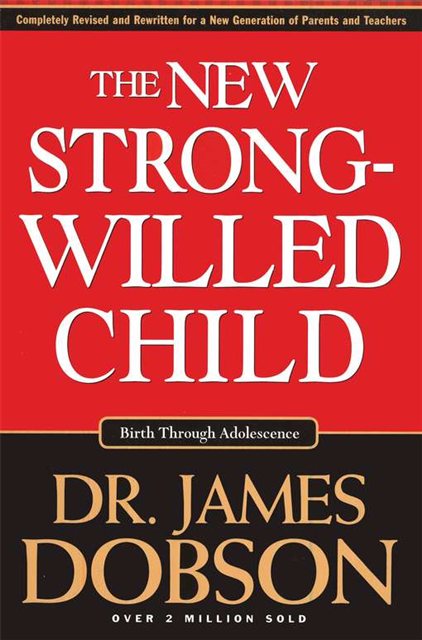
At the end of Michael Farris, Sr.’s recent white paper, he recommended James Dobson’s The New Strong-Willed Child (2003).

Unlike the works of the Ezzos, the Pearls, and Bill Gothard, this Dobson volume was not a foundational piece of my childhood. So I decided it was time to give it a read-through. Saving Victoria Strong has reviewed the beginning of the book in great detail here. This critique is not intended to be comprehensive, rather a cursory look at Dobson’s child-reading philosophies.

I have to admit: I expected better content considering Michael Farris ended his essay by recommending this. I was shocked by the dehumanizing themes of control and projection of power as well as the animal-like dominance by fathers. “Love and control” were Dobson’s guiding principles. Yet there was a disturbing amount of violence justified throughout the volume. Dobson seemed to model his training methods after a wolf-pack and a wolf-pack’s “Alpha Male.”

dobsonThe introduction set up the book with an analogy about Dobson beating obedience into his “confirmed revolutionary” dachshund. Dobson admitted that “Siggie” wasn’t “vicious or mean,” but Dobson nonetheless demanded absolute obedience from the animal. One night, when Siggie obstinately refused to retire to his doggy-bed, Dobson knew the “only way to make Siggie obey was to threaten him with destruction. Nothing else worked.” He “turned and went to my closet and got a small belt to help me ‘reason’ with ‘ol Sig.”

While the dog angrily stood its ground, Dobson began beating it with his belt (trigger warning for animal cruelty):

“I gave him a firm swat across the rear end, and he tried to bite the belt. I popped him again and he tried to bite me.”

“What developed next is impossible to describe. The tiny dog and I had the most vicious fight ever staged between man and beast. I fought him up one wall and down the other, with both of us scratching and clawing and growling. I am still embarrassed by the memory of the entire scene. Inch by inch I moved him toward the family room and his bed. As a final desperate maneuver, Siggie jumped on the couch and backed into the corner for one last snarling stand. I eventually got him into his bed, but only because I outweighed him two hundred to twelve” (3).

In order to avoid any confusion between people and animals, Dobson explained exactly what he means:

“Just as surely as a dog will occasionally challenge the authority of his leaders, a child is inclined to do the same thing, only more so. This is no minor observation, for it represents a characteristic of human nature that has escaped the awareness of many experts who write books on the subject of discipline.”

Unconcerned by the way he dehumanized children, Dobson offered a quick counter, “perhaps I seem to be humanizing the behavior of a dog, but I think not.”

You read that right: just as he had to have a pitched battle, beating his tiny dog with a belt, you should be prepared to control and exert your dominance over your “strong-willed” children.

Dobson followed his dog-beating story with sage advice on the “Hierarchy of Strength and Courage,” which sounds curiously like something Ron Swanson would invent in an episode of Parks and Recreation. Apparently, the only way for children to sort out their relative social position is to fight:

“Whenever a youngster movies into a new neighborhood or a new school district, he usually has to fight (either verbally or physically) to establish himself in the hierarchy of strength. This respect for power and courage also makes children want to know how tough their leaders are… I can guarantee that sooner or later, one of the children under your authority will clench his little fist an take you on. Like Siggie at bedtime, he will say with his manner: ‘I don’t think you are tough enough to make me obey.’ You had better be prepared to prove him wrong in that moment, or the challenge will happen again and again” (4).

What a model of peace-making and cooperation, Dr. Dobson! His explanation of why children defy and look for boundaries sounds like something straight from the Pearls’ toxic teachings:

“Perhaps this tendency toward self-will is the essence of original sin that has infiltrated the human family. It certainly explains why I place such stress on the proper response to willful defiance during childhood, for that rebellion can plant seeds of personal disaster. The weed that grows from it may become a tangled briar patch during the troubled days of adolescence” (5).

At the end of the introduction, Dobson described another dog they owned. “Mindy,” he wrote “[was the] most beautiful, noble dog I’ve ever owned. She simply had no will of her own, except to do the bidding of her masters. Probably because of the unknown horrors of her puppyhood” (11). Oh, you mean like being chased around the room by a man beating you with a belt because you don’t want to go to your doggy-bed? Dobson did explain that his two dogs fell on opposite ends of the compliant-defiant spectrum (just like a minority of children are compliant), but he seems far too happy that Mindy acted like an abused, traumatized animal.

Clearly, it’s vitally important to discipline all the defiance out of your children so they can grow up to well-adjusted members of society. To make this abundantly clear, Dobson described Franklin Roosevelt as a “strong-willed child” who became a “strong-willed man” (8). There is no value judgment of Roosevelt as a person, or President, so one is left to assume that you should dominate your children, lest they become President of the United States. Dobson made it clear that being strong-willed is not a good quality and must be driven out of children (and dogs).

This is virtually identical to the teachings of Michael and Debi Pearl, except the Pearls use Amish horse training as a model.

Dobson wanted a compliant, docile dog (child) that obeys his every command without question. Somehow, that will prepare children for adulthood. To get this result, he advocated parents engage in physical violence and wolf-pack domination to prove how Strong and Courageous they are. The fact that he does not recognize that beating your children and animals can eliminate all their internal desires and wishes is a bad thing should alarm everyone reading him.

I personally owned an abused animal. He was a dog named Freddy. Like Mindy, he was traumatized and we got him from someone who found him on the side of the interstate. I was only five years old when we got Freddy, so I didn’t understand why he acted differently from most dogs. He was deathly afraid of water and loud voices. Looking back, he had all the hallmarks of a traumatized puppy. At times, in my  frustration I lashed out in physical anger. I can remember being confused and somewhat heart-broken by his reactions.

Ironically, around the same time, my parents began reading James Dobson, Michael Pearl, and other Evangelical/fundamentalist homeschooling child abuse advocates. I distinctly remember my early childhood suddenly punctuated by violence against animals – our cat Puddy was an early victim – and Freddy. I was merely modeling the same behavior my parents were using to train me and I saw the impact my cruelty had on my happy dog.

Modern studies of children and spanking show that young children who are spanked are more likely to lash out physically against animals and people.

I learned my lessons and Freddy and I grew to be fast friends over the next decade. Traumatized kids and traumatized animals have a special connection. Unfortunately, part of that is the shared experience of trying to escape the violence of our masters modeled after James Dobson. It disturbs me greatly that Michael Farris thinks this is a good book to recommend, given the giant controversy and deaths associated with the Pearls’ methods.

Even more disturbing: I hoped, somewhere in The  New Strong-Willed Child, I would see Dobson make it clear that spanking infants was a bad idea, but the conclusion to his volume left me almost in tears. A woman, “Mrs. W.W.,” wrote to him complaining about their very young, and very strong-willed child:

“Our third (and last) daughter is “strong-willed!” She is twenty-one months old now, and there have been times I thought she must be abnormal. If she had been my firstborn child there would have been no more in this family. She had colic day and night for six months, then we just quit calling it that. She was simply unhappy all the time. She began walking at eight months and she became a merciless bully with her sisters. She pulled hair, bit, hit, pinched, and pushed with all her might. She yanked out a handful of her sister’s long black hair” (209).

Dobson explained that she “[closed her letter by] advising me to give greater emphasis to the importance of corporeal punishment for this kind of youngster.” His reply consisted of general encouragement and offering hope for the future – nothing of consequence. I can only assume Mrs. W.W. began beating her infant before she was twenty-one months.

Five years later, this mother wrote to Dobson praising his wonderful methods. Mrs. W.W. outlined the two things that improved her daughter: spanking, sometimes creating “an hour of tantrums,” and “allow[ing] her other daughters to fight back with the younger daughter.” Within two days of her older sister “giv[ing] her a good smack on the leg… the attacks ceased.” Mrs. W.W. went on and claimed that “without [the spankings] our Sally would have become at best a holy terror, and at worst, mentally ill. Tell your listeners that discipline does pay off, when administered according to the World of God… I don’t think you went far enough in your book, loving discipline is the key. With perseverance!” (210)

There you have it. I expected, after these letters, James Dobson would offer some sort of “there is a limit to the spankings,” but no. Instead he doubled-down and wrote, “If Mrs. W. reads this revised edition of The New Strong-Willed Child, I want her to know that I had her in mind when I set out to rewrite it.” Because, we must all remember, as Dobson concludes his volume:

“If you fail to understand [your strong-willed child’s] lust for power and independence, you can exhaust your resources and bog down in guilt” (211).

The Reluctant Rebel: Gemma’s Story, Part Three

Homeschoolers U

HA note: The author’s name has been changed to ensure anonymity. “Gemma” is a pseudonym specifically chosen by the author.

< Part Two

Part Three: Sophomore Year

I had apparently made enough “progress” by the following fall semester, my sophomore year, that I was allowed to return to a wing with my friends and my old RA. However, it wasn’t long before I came to the definitive conclusion that Dean Wilson was an evil man by watching how he “counseled” one of my roommates who was dealing with a serious personal issue. He engaged in some of the most blatant, disgusting, misogynistic victim-blaming I have ever heard come out of a man’s mouth, and left my roommate even more grief-stricken and overwhelmed than she had been before.

Somehow it was easier to see the evil clearly when it was being inflicted on someone else.

That year, my RA and another popular student wrote a petition to the administration for the loosening of some of the more restrictive rules, especially regarding the interaction of male and female students. This petition was actually relatively successful, and in the aftermath it seemed like people could breathe again. I remember going to an off-campus basketball game shortly after this and seeing girls and guys in the bleachers, rubbing shoulders and leaning back against each other’s knees—just like normal college kids would do. It made me happy—my friends and I acted like this in high school. It seemed normal and familiar.

I also remember, in the time between the delivery of the petition and the administration’s positive response, my RA hiding—literally hiding—in her dorm room, ducking from the view of the window, or sitting in the hallway trying to breathe and slow her rapid heart beat. She had done the right thing, but she was terrified of Dean Wilson, and of the nameless atmosphere of fear we were all drowning in. She laughed at the absurdity of her “hiding,” but the feeling was real and we all knew it.

Academically, the school was living up to its reputation. In fact, I think one of the reasons the student life issues were so important to everyone is that we had so little chance to socialize as it was. Most of our time was spent studying, trying to conquer the unconquerable mountain of work we were assigned. My classes were extremely difficult, but very rewarding. Most of the professors seemed genuinely to enjoy their students. Some would routinely hold court in the dining hall between and after classes, answering questions, doling out advice, mostly just joking around or facilitating lighthearted debates.

But there was a growing split between the administration and the Office of Student Life, on the one hand, and the academic side of the school, on the other. We started to articulate it even then to outsiders who asked: the education here is great, but the culture is oppressive. Dean Wilson took it personally that the professors—and let’s face it, many of the students—were smarter than he was. He and his favored students started ruminating on the pride of intellectualism, the vanity of worldly philosophy, and the greater goodness of purity of heart and devotion to Scripture. It was spoken of as an either/or dilemma—smart, prideful, sinful people vs. lowly, humble, pure people.

It was around this time that several friends and I had started a campus group called the Alexis de Tocqueville Society. We semi-regularly published a journal of academic writing, book, music, and movie reviews, and opinion pieces. We also hosted guest lecturers on a variety of topics, from international relations to medieval literature to film criticism. Our stated mission was to further intellectual dialogue on campus. It was definitely an intellectually-focused club, but our mission was to serve the campus as a whole, not to show off. But ATS attracted the “wrong” kind of students, and it wasn’t long before “ATS” became a byword for “troublemakers.” We embodied that “intellectual elitism” Dean Wilson hated so much, and the administration began to view us with suspicion.

I now recognize this anti-intellectualism and many other of Dean Wilson’s teachings in what has been written recently about Bill Gothard and other authoritarian homeschool leaders.

For instance, Dean Wilson repeatedly admonished us not to take up another person’s offense—a teaching so bizarre and idiosyncratic I recognized it immediately when it appeared recently on the Recovering Grace website. Another example is this page from the ATI Basic Seminar textbook. Again, I discovered this only recently, but was shocked to see how neatly it summed up so much of what the students branded as “rebels” endured from our fellow students and from Student Life and the administration:

Basic Seminar Page

I know these teachings seem commonplace to those who grew up in systems like these. You have to imagine how bewildering and alienating these judgmental attitudes seemed to those of us who literally had no context to understand how we were being perceived, or why. I didn’t go into college wanting to be a rebel. I was a good, homeschooled, Christian girl. I memorized Scripture by the chapter, volunteered at AWANA, and played praise songs on the piano. I’d never even had a boyfriend before college. But at PHC, just by living my (good) life and being myself, I was branded a “rebel.” It was like there was this invisible line I was constantly crossing, which everyone could see except me. The only people who made sense to me were the other “rebels.” After a while, it just got psychologically demoralizing. I don’t even know what you people want from me, so fine, I’m a “rebel.”

Dean Wilson was a strong adherent of Doug Wilson and the Pearls. In our weekly small-group wing chapels, we were given writings from Wilson and the Pearls to study and discuss.

Here, for example, is the actual handout we studied in one wing chapel, probably during the 2003-2004 school year. The name and book title are mysteriously missing, but anyone familiar with the material can recognize it as a page straight out of Debi Pearl’s Created To Be His Help Meet.

ctbhhm

From what I’ve heard, the men were indoctrinated with these materials even more than the women. It wasn’t like everyone on campus necessarily accepted these things at face value—in my wing of relatively fashion-forward women, I remember us all kind of giggling at one piece of Doug Wilson’s that condemned high heels. But even if everyone didn’t accept them, the presence of these writings and teachings added to the overall atmosphere. Now, it entered the minds of everyone that girls who wore high heels were sluttier than girls who didn’t. Now, wearing heels meant something it hadn’t meant before.

Mike Farris has recently distanced himself from people like Gothard, Phillips, Wilson, and other extremists and has claimed that he rejects their teachings. I think it is true that he, personally, does not hold to many of their more extreme beliefs.

But he allowed these extreme views to circulate on his campus with a stamp of official approval.

He allowed his hand-picked Dean of Student Life and this dean’s favorite, very conservative students to dominate the campus culture with their extremism. He should have known this was going on. If he knew, he never said anything.

And Mike Farris had no qualms about saying something when he thought something needed to be said! Once, a student wrote an article for the student newspaper with the Slate-esque headline of “Why Bono Is A Better Christian Than You.” This piece prompted Farris to respond with an entire chapel sermon on why cursing is bad and demonstrates that one is not a true Christian. Afterward, he spoke jovially with the author of the article, slapping him on the back in a “no harm, no foul” kind of way. But not surprisingly, this response had a chilling effect on the further publication of controversial pieces in campus newspapers.

Another time, Farris got wind that some students had been dabbling in libertarianism. This prompted another chapel sermon, a fiery one in which he denounced libertarians as no better than child molesters.

So it’s not like he ever hesitated to address campus trends that bothered him, publicly and personally.

My best guess is that Mike Farris and Paul Wilson personally benefitted from a campus culture of total submission to authority. Many ultra-conservative students came from backgrounds that said parents, pastors, and government must be obeyed without question and respected without complaint. Questions and complaints were no better than defiance, and defiance of authority was an unforgivable sin. It was very easy for these students to add “college administrators” to that list of unquestionable authorities.

Knowing what I know now, I can see where that mindset comes from. At the time, I thought I was surrounded by a bizarre species of human who spoke some kind of foreign code. At least, I never could seem to get through to them with normal English words, or logic, or questions like Where in the Bible does it say it is evil to question a college administrator? And many of them—especially the young men—didn’t even seem capable of looking me in the face when I talked, or acknowledging anything I had to say. I think Farris tacitly (and Wilson explicitly) approved of this state of affairs, because it gave them power and control over the student body.

That, or he just didn’t know that his students were being forced to study patriarchalist writers and imbibe cultic teachings under the guise of not only administrative, but religious authority—but he really, really should have known.

One final example of the split between the academic and student-life cultures on campus came towards the end of my sophomore year. A reporter from the New York Times, David Kirkpatrick, came to visit the campus for a story he was writing. Reporters were on campus all the time. PHC was huge media bait during its first few years in existence, and the administration was only too happy to show us off to the world. At first, it was kind of fun to interact with reporters, but after a while, you just feel like a specimen being examined. I guess it never occurred to the administrators that it’s actually really hard to pay attention in class when there’s a massive camera in your face. The students joked about campus being a “fishbowl,” a double reference to the utter lack of privacy within and the constant prying eyes from without.

At any rate, when David Kirkpatrick arrived, he came to visit my class. I was taking a course called “Modernity, Post-modernity, and Society,” a political theory elective intentionally modeled on a graduate-level, seminar-style course. We were reading and discussing Hannah Arendt’s The Human Condition on the day Mr. Kirkpatrick sat in on our class. At the end of the class, he complimented the students and the professor on the level of engagement with text we had displayed. He himself had read The Human Condition—in graduate school—and he noted that we had handled the text as well as any of his graduate classmates had.

I was, of course, pleased with the compliment—but even more pleased that this reporter from the New York Times had seen the good side of PHC, the academic side, before encountering whatever weirdness he was sure to find if he hung around long enough.

And it didn’t take long at all. By the time I got to lunch, he was in the dining hall, surrounded by a table full of girls in long prairie skirts. The article led with a photo of students walking on campus, noting that students “may show affection publicly only by holding hands while walking”—one of the more arcane rules from the rulebook.

There was no mention of Arendt or graduate-style seminar courses.

Part Four >