
Danica is a MK and homeschool alumni. She blogs at Ramblings of an Undercover TCK.
I came across an article about Joe and Nichole Naugler on my newsfeed today and clicked on it out of curiosity. As a quasi-homesteader myself (we live on ten acres, have chickens, and aim towards a self-sufficient lifestyle), who was also homeschooled and has homeschooled my own kids, I was interested to see for myself the ‘horrible living conditions’ mentioned in the article.
I was highly skeptical that the conditions were really all that bad.
See, my personal definition of ‘livable’ is very different from the average American’s definition of ‘livable’. This is because I grew up, not in America, but on a small Pacific island called Luaniua, in the Ontong Java atoll. Do a search for it on Google Earth, and you’ll find my family’s little house still standing, just behind the church at the center of the village.
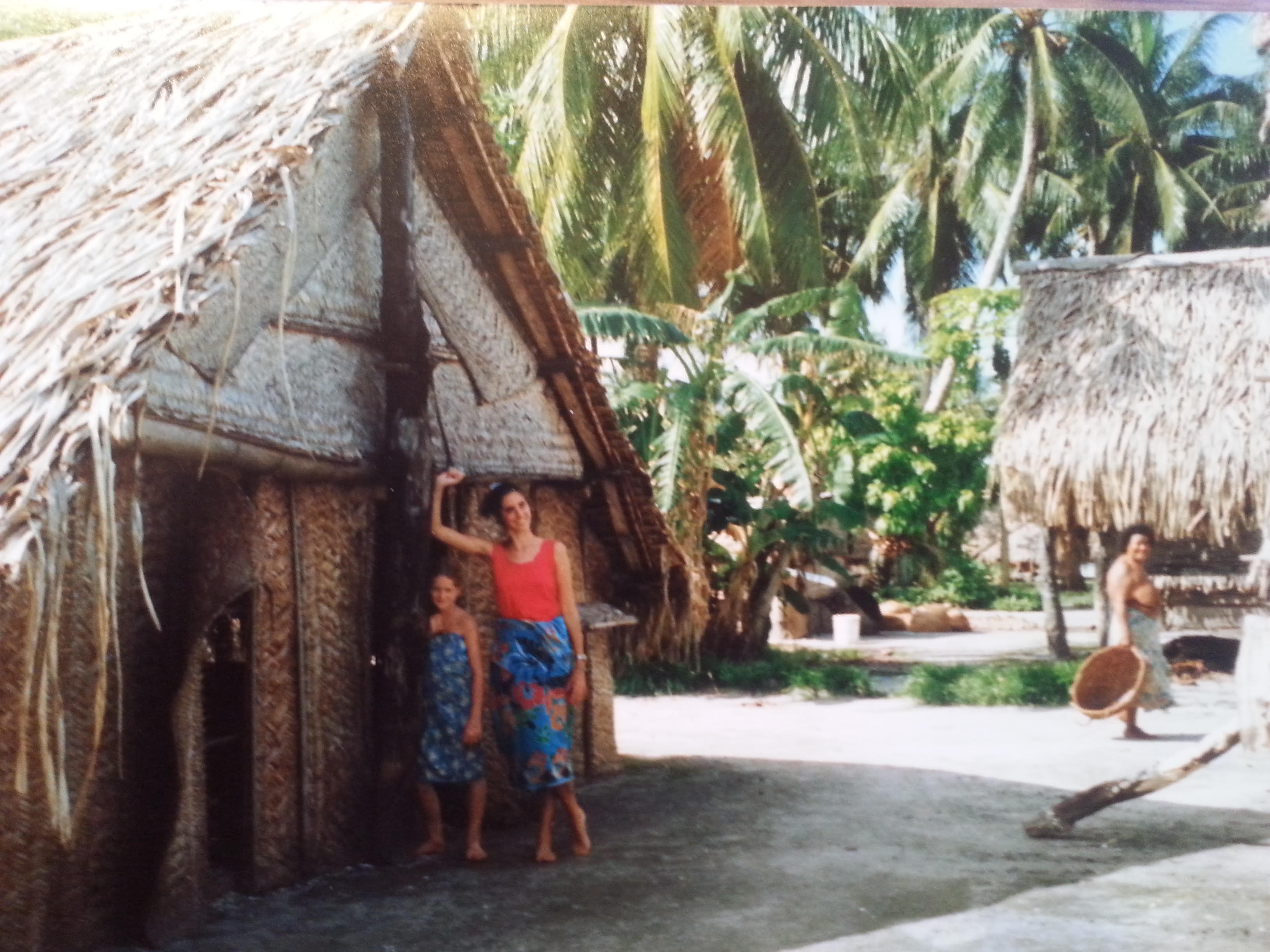
The house was tiny, only 900 square feet. It stood five feet off of the ground on stilts, had mat walls woven from coconut fronds, and a corrugated tin roof which both housed our solar panels, and also funneled drinking water into our rain tank. The floor was 2×4 timbers, each spaced about a centimeter apart. This was helpful when sweeping, because food would fall through the cracks to the chickens waiting below, but also provided the village kids hours of entertainment by way of poking little sticks up through the cracks into our bare feet above. The cracks also allowed mosquitos to come up into the house when the monsoon rains left puddles for them to propagate by the millions, so Dad used to pay us 25 cents a ‘line’ to Elmer’s glue strips of cardboard into the cracks.
The front door, accessible by steps made of more 2×4’s (everything in the house was built of 2×4’s, plywood, or mats), was rigged with a rope that stretched to a pulley under the eaves, then down to a heavy conch shell that pulled it shut with a slam whenever anyone went in or out. The locals were convinced that we had affixed that conch shell as a tribute to our ancestors (it was at the front door of the house, and anyone who entered had to pass by it, so logically speaking it was there to protect the family, obviously), and wouldn’t be dissuaded no matter how many times we tried to tell them otherwise. The front door opened into the veranda, which stretched across the entire front of the house. Here is where we ate our meals together as a family, and also entertained people who stopped by. It was a long but narrow room, so Dad rigged up the dinner table by attaching it to hinges to the wall. At meal times, we’d lower it down.
After we were done eating, we’d raise it back up like a drawbridge, and you could access the whole room again. We had two folding captain’s chairs and took turns sitting in those, while everyone else sat on 5 gallon buckets of rice or flour. Mom cut squares out of plywood, padded them with some foam egg crate, then covered them with cloth. These we used to lean against the wall, or put on the buckets as seats (5 gallon buckets can get really uncomfortable if you sit on just the lids for extended periods of time – plus, the lids wear out and the seats protected the lids from all that use).

Our little 900 square foot house was divided into thirds. The front third was the veranda. The middle third housed the kitchen and the girls’ room, side by side. From the kitchen you could access the back third, which was the boys’ room and my parents’ room. My sister’s and my room was barely wide enough to accommodate our two beds, which my dad built against opposite walls on lofts, with about three feet between them. At the foot of my bed, was the wall of fiction books. At the foot of my sister’s was the food safe. Under our beds were our desks (built from more 2×4’s and plywood), and our ‘closets’, which were the shipping crates we had used to move all our stuff from America, to the island.
My two brothers slept in a bunk bed, with their clothes stored underneath in plastic containers. One wall of their room was dedicated to our nonfiction books, including an entire set of encyclopedias and all of our school books. Both of their desks were also in that room, and there was just enough room in their back corner for our solar powered fridge. My parents’ room was mostly taken up with their bed (all of our beds consisted of 2 inch thick foam mattresses), with a desk on one side and another shipping-crate-turned-closet on the other. The space under their bed was for storing boxes of canned goods, other supplies, and more buckets of flour, rice, oats, sugar, and powdered milk.
The kitchen had laminate counter-tops, made from the lids of the shipping crates that my mom had the foresight to have laminated back in America. She cooked all our family meals on a single Bunsen burner. We had a sink that was connected to the rain tank outside, which we didn’t use for washing dishes (that would have been a waste of precious drinking water). The kitchen also had more storage for more 5 gallon buckets. There was a chalk board taking up one entire wall. Our ham radio was also in the kitchen.
No space was left unused. The rafters above were lined with shelves, which housed more boxes of canned goods. We came out to the village for several months at a time, and we had to bring enough food for our entire village stay, out with us. Extra school supplies, toiletries, birthday presents, tampons, batteries, first aid supplies … whatever we’d need were stored up in those rafters. Under the house, we had clothes lines, clothes washing station, and a dish washing station, as well as several more buckets for carrying water from the well, and a couple tubs for washing.
This was the house I grew up in, my home for seven years. This was normal for me.
This is why I really don’t fret about cobwebs in my house here in America, or the sink faucet that doesn’t work unless you twist it just so, or my perpetually dirty floors, or the moths that dive bomb my light when I read at night. It’s also why I was skeptical when I first read the article about the Nauglers.
Surely this was just a bunch of first world Americans complaining about first world problems.
Surely the Nauglers’ living conditions weren’t that bad.

Then I clicked on the link to their Facebook page, showing pictures of their house.
The ‘house’ that the Nauglers live in with their ten children is worse than any house I saw on my little island. It was even dirtier and more poorly kept than the grass huts most of the Islanders lived in.
And the Island huts had dirt floors!
I have lived in what I feel are the sparsest of living conditions, but even a grass hut with an earthen floor can be kept clean. And this was in the third world, on an island that had a ship visiting it only every four months or so, where there was little electricity and no vehicles, and everything had to be built literally by hand.
There is absolutely no excuse for a family who lives in America, where there is a Home Depot or Walmart within even a day’s driving distance, to live in such conditions.
The Nauglers are deliberately depriving their children of running water, a warm home in the winter, and even their own beds to sleep in. More than that, they are depriving their children of an understanding of how to function in the world they will eventually inhabit. I had to learn how to use a microwave, how to cook on an electric stove, how to operate a washing machine, skills that most American kids learn young, I learned as a teenager. I know from personal experience that the Naugler kids will have to learn all of this, not to mention the ‘hidden curriculum’ of how to relate to their peers who grew up in typical American homes. Their parents are depriving them of physical comforts now and key skills they need for when they are adults.
This isn’t an issue of civil liberties.
It’s an issue of stubborn, close minded adherence to a way of living even our forefathers were working to rise out of.
 Homeschoolers Anonymous