The Homeschool Lobby Now Has Public School Children in Its Crosshairs, Too

safe2tell

By R.L. Stollar, HA Community Coordinator

I am getting tired of all the parentsplaining.

I am getting tired of those homeschool parents who, when presented with case after case of abuse in homeschool settings, go to Default Response #1 and say, “If you care about abuse so much, why don’t you focus on public schools instead?”

For example:
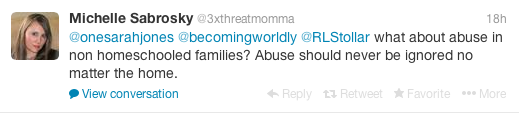
Screen Shot 2014-01-26 at 3.04.12 PM

It’s time we all called bull@#$% on this response.

I’m sorry, but parentsplainers and abuse denialists no longer get to control this narrative. These people not only are unmotivated to stop homeschool abuse, they are also unmotivated to stop public school abuse. Their pointing to public schools serves as a red herring. But even more than that, it is disingenuous — because the moment we try to focus on public school abuse, spoiler alert: they’re still standing right in our way. Because these are the same people joining the homeschool lobby in calling for the end of child protective services as we know it. These are the people actively trying to prevent public schools from addressing abuse.

Why do I say this?
The homeschool lobby is coming after Safe2Tell, a program critical to your kids' ability to safely report violence in the public schools.
The homeschool lobby is coming after Safe2Tell, a program inspired by Columbine, that has saved over 1,000 lives, and is critical to your kids’ ability to safely report violence in the public schools.

Because last Friday, January 24, HSLDA — the mouthpiece of the homeschool lobby — issued a legislative alert about Mississippi House Bill 480. HB 480, proposed by Mississippi Representative Bobby Moak, establishes the Safe2Tell program to allow public school students to “anonymously report threatening behavior or endangering activities.” (You can read a summary of the bill here; you can read the bill’s full text here.)

HSLDA is opposing this bill.

Some background: The Safe2Tell program began as a non-profit organization in Colorado. The program was based on

the Columbine Commission Report’s recommendation that students need a safe and anonymous way to keep lines of communication open.  They realized that tragedies could be prevented if young people had a way to tell someone what they knew without fearing retaliation.

Since 2004, Safe2Tell has “prevented 1,000 suicides and 31 school attacks… It has already received reports of 16 planned attacks since the beginning of the 2013-14 school year.” The program has since partnered with state governments, beginning with Colorado in 2007. The movement is “spreading across the country with momentum building for a national Safe2Tell hotline.” Mississippi is next to recognize that violence in public schools needs to be addressed and that allowing students a way to report bullying and violence anonymously is crucial. HB 480’s text acknowledges this fact:

In eighty-one percent (81%) of dangerous or violent incidents in schools, someone other than the attacker knew the incident was going to happen but did not report or act on that knowledge… The ability to anonymously report information about unsafe, potentially harmful, dangerous, violent or criminal activities before or after they have occurred is critical in reducing, responding to and recovering from these types of events in schools.

This has nothing to do with homeschooling. As Libby Anne has pointed out, “This bill is explicitly not about homeschooling in any way, shape or form. This bill is about protecting public school children from school violence.”

Yet the homeschool lobby is aiming to destroy this effort to protect public school children. In their paranoid mindset, “Broadly applied, this legislation would permit anyone to make such a report against a homeschooling family.” They are using a hypothetical slippery slope — without a single example to point to since Safe2Tell began in 2004 — to roadblock a chance to solve actual violence.

Said another way: The homeschool lobby is coming after Safe2Tell, a program inspired by Columbine, that has saved over 1,000 lives, and is critical to your kids’ ability to safely report violence in the public schools.

If you are a non-homeschooler, this is exactly why you should care about the homeschool lobby. This is so much bigger than homeschooling at this point.

The mentality advanced by HSLDA and the homeschool lobby is one of unquestioned dominion of parents over children. It is the mentality expressed by Rosanna Ward (“the government [has] no right to hold me accountable”), Matt Walsh (“we [should] have the unquestioned and absolute right to teach and raise our own children”), and HSLDA’s Scott Woodruff (“a child’s right to an education is held by his parents as custodian until he attains majority”). It is the mentality spoken of with no apologies by Doug Phillips and Kevin Swanson at the 2009 Men’s Leadership Summit (“the core problem with Child Protective Services is its existence”), where HSLDA’s Chris Klicka and NHERI’s Brian Ray also spoke.

And now that mentality is coming after non-homeschooled children, too.

This is not a conspiracy theory.

This is an explicit belief system that is spoken of casually and publicly. I witnessed this first-hand last week in Virginia: when a Virginian Republican delegate unabashedly said, “Parents have a right to screw up their kids,” merely a day after Rita Dunaway (Board Member of the Virginia Christian Alliance) said — in the context of joining HSLDA in opposition to HJ 92 — that children do not have any rights.

This should be alarming to every segment of society that has a vested interest in protecting children.  I said this last May, and I will keep saying it: “This is no longer about homeschooling and child abuse in homeschooling communities. This is about protecting every child in this country.”

When your only concern is protecting “parental rights,” when you have no qualms sacrificing children’s rights and wellbeing on an altar of parental dominion, then you are going to see all children — not only homeschooled children — at risk. You are going to see HSLDA and the homeschool lobby slowly (but not silently) chipping away at the cornerstones of the child protective system — a system that is a safety net to public school and private school children as well.

If you do not want to see homeschooling regulated more (or even if you do), if you want see better child protection laws, then get off your Freedom High Horse and do the work of actually protecting children. Stop paying dues to an organization that called a child abuser a “hero”. Stop defending a lobby that is actively working to not only dismantle child protection laws, but is actively opposing opportunities to make public school children safer.

The homeschool lobby will not content itself with making homeschooled children less safe. They aim high and public school children are now in their crosshairs, too.

In Which HSLDA Conducts a Child Abuse “Investigation”

HSLDA's Scott Woodruff. Source: http://homeschooliowa.org/2009dayatthecapitol.html
HSLDA’s Scott Woodruff. Source: http://homeschooliowa.org/2009dayatthecapitol.html

HA note: The following is reprinted with permission from Libby Anne’s blog Love Joy Feminism. It was originally published on Patheos on January 6, 2013.

I recently came upon something posted on HSLDA’s site some years ago that I found interesting, in light of what I have written about HSLDA in the past. HSLDA releases stories of the cases it handles in various states, partly to keep its members apprised of what it does and partly to encourage people to stay members. Anyway, this incident happened in Kentucky. Here is how it starts:

Coming home at 8:30 p.m. on Saturday this summer, the Wall family were puzzled to see a sheriff’s car and another car parked in their driveway. As they exited their car, a social worker asked, “Are you James Wall?” After the father acknowledged he was, the social worker said, “We have received a call about possible child abuse in your family.”

The shocked parents gathered their family together immediately and prayed. Afterwards, they had their 15 year-old son take their 5 year-old daughter into their home.

The parents asked the social worker about the allegations. She refused to reveal them. The parents decided it was time to call HSLDA.

The family called our after hours phone number, and moments later HSLDA attorney Scott Woodruff was on the phone. Though she had refused to tell the family the allegations, she told Woodruff that the hotline said the son had bruises on his neck and arms and was being locked in his room.

This is how this sort of thing usually works: Someone sees suspicious bruises or other cause for concerns and calls child protective services.

Child protective services determines whether the report sounds credible and then sends someone to investigate. What Woodruff should have done at this point is simple. He should have said, “Thank you, I wanted to ensure that it was not a homeschooling issue, and it appears that it is not. You may proceed with your investigation, we will not interfere. Have a good day!” Is that what he said? Let’s take a look!

Woodruff then spoke privately to the family and found there was absolutely no truth to the allegations.

I’m less bothered by the fact that HSLDA stayed involved even when they learned that the allegations had nothing to do with homeschooling than I am by the fact that Woodruff felt that, with no training whatsoever, he could determine, over the phone, almost certainly speaking only with the parents, whether or not there was abuse occurring.

I imagine the conversation went something like this:

Woodruff: “Is there any truth in the allegations?” 

Wall: “No.” 

Woodruff: “Okay, I thought I’d ask.

If this is all HSLDA thinks is involved in determining whether or not child abuse allegations are true, just imagine what life would be like for abused kids if HSLDA were in charge of child protective services. A social worker would show up at the door, knock, and then say “We have a report that Johnny has suspicious bruises and are worried that you are beating him. Is there any truth to this?” Then the parent would say “No, that’s not true,” and the social worker would say “Okay, thanks! Have a nice day!” and leave.

But you’re probably wondering what happened next in the saga of the Wall family of Kentucky. And so, now that HSLDA has conducted its own “child abuse investigation” and determined that the charges are false, let’s move on.

He [Woodruff] advised the family to not permit the social worker to come into their home and not permit her to question their daughter. Instead, the family should allow the social worker to see their daughter and to ask the parents questions, and the son questions, in their presence, but only questions relating to the two allegations.

The family accepted this advice, and the social worker was soon convinced the allegations were groundless. Woodruff stayed on the phone until the social worker and sheriff had left the premises.

How do circumstances like this actually allow a social worker to conduct an effective investigation? 

Children very rarely disclose abuse in the presence of their parents, and in this case the family did not even permit the little girl who was the subject of the report speak with the social workers, even in their presence. It is of course completely possible that there was nothing to the charges, but bruises on the neck are not something that generally occur by accident. These charges involved a thorough investigation, and that is not what they got, thanks to HSLDA’s interference.

Do you all remember this?

Scott Somerville, an attorney with the Home School Legal Defense Association in Virginia, said he talked with Michael Gravelle before the story broke in the media, and he believes this is a family trying to help special children.

When a social worker visited the house last week, there was no resistance to an inspection, said Somerville, whose organization represents home-schooling families on legal matters.

“They had nothing to hide,” Somerville said. “He told me why they adopted these children and told me the problems they were trying to solve.

“I think he is a hero.”

Here is another case where an HSLDA attorney deduced from a phone conversation that allegations were false and there was no abuse. And guess what? There wasabuse, and lots of it. The children were kept in cages rigged with alarms at night, and had their heads held under water in the toilet as punishment. There was additional physical abuse, too.

Interestingly, these two cases took place in the same year—2005. The odd thing is that Somerville here uses the fact that the family let social workers into their home as evidence of their innocence, even as Woodruff told the other family to bar social workers from their home, never considering that by his colleagues on criteria this might indicate that they had something to hide. It’s interesting to note that while HSLDA urges parents not to let social workers into their home, they also interpret a family’s willingness to let social workers in as a sign of innocence.

That seems rather contradictory.

Now, Somerville didn’t talk to Gravelle until after social workers had investigated and gained entrance. What would have happened if Gravelle had talked to Somerville when the social workers arrived at his door, and Somerville had given Gravelle the same advice Woodruff was dispensing? Gravelle would have barred the social workers from coming inside and would have refused to allow social workers to speak with his children, the subjects of the report. If Gravelle had talked to an HSLDA attorney, that attorney would very likely have sent the social worker away without allowing him or her to effectively investigate the charges. In other words, if HSLDA had been involved at the beginning rather than after the fact those children might still be living in cages.

HSLDA claims they don’t defend abusers.

But given the way they conduct their own “child abuse investigations,” how would they even know if they did defend an abuser?

Where Is Your Sense of Compassion, HSDLA?

Screen Shot 2013-07-31 at 2.48.45 PM

HA note: The following is reprinted with permission from Libby Anne’s blog Love Joy Feminism. It was originally published on Patheos on July 31, 2013.

*****

Josh Powell wanted to go to school so badly that he pleaded with local officials to let him enroll. He didn’t know exactly what students were learning at Buckingham County High School, in rural central Virginia, but he had the sense that he was missing something fundamental.

By the time he was 16, he had never written an essay. He didn’t know South Africa was a country. He couldn’t solve basic algebra problems.

So starts a recent Washington Post article about Virginia’s religious exemption.

Powell was taught at home, his parents using a religious exemption that allows families to entirely opt out of public education, a Virginia law that is unlike any other in the country. That means that not only are their children excused from attending school — as those educated under the state’s home-school statute are — but they also are exempt from all government oversight.

School officials don’t ever ask them for transcripts, test scores or proof of education of any kind: Parents have total control.

. . .

Josh Powell eventually found a way to get several years of remedial classes and other courses at a community college.

Now he’s studying at Georgetown University.

. . .

Josh Powell, now 21, wonders how much more he could have accomplished if he hadn’t spent so much time and effort catching up.

“I think people should definitely have the freedom to home-school as long as it’s being done well and observed,” he said. “I don’t see any reason for there not to be accountability.”

Most of all, he worries about his siblings: There are 11. One, old enough to be well into middle school, can’t read, Josh Powell said.

Now he’s trying to get his brothers and sisters into school, to ensure that they don’t have to work as hard as he did to catch up — or get left behind.

Go read the whole thing—the article is excellent. The long and short of it is that Josh’s parents used Virginia’s religious exemption clause to get out of any requirement to teach him anything, and then proceeded to give him what he knew was a substandard education, despite his desire to learn more than they were teaching him. In the end, Josh overcame all of that and managed to obtain remedial classes at a community college (without his parents’ help, I should add) and then gain admission to Georgetown. And now, he wants to see the law changed so that other children will not find themselves in his situation.

What I want to turn to now is HSLDA’s response. Before I do that, I should mention that the article includes a quote from Michael Farris. It’s not long:

The law is completely clear, said Michael Farris, chairman of the Home School Legal Defense Association, who has claimed the exemption for his family. It doesn’t make sense to have the public school system regulate home schools, he said, because he thinks home schools are far more successful.

As to whether there could be children getting an inadequate education, he said: “Well sure, it’s possible. But there are whole public school districts that are slipping through the cracks.”

Dear Mr. Farris: What you said is called “tu quoque.” It is a logical fallacy. You are a lawyer, you should know that.

Now with that out of the way, what I really want to look at is the official response HSLDA issued the day after the Washington Post article came out.

“Oh, my God, I have a chance to learn!” The Washington Post’s recent article about Virginia’s religious exemption statute includes this fascinating quote from Josh Powell, the young man who never attended public school because his parents obtained an exemption on religious grounds.

The article criticizes the law that allows the exemption and lobbies for its change. But let’s slow down and think this through.

How many public school teachers ever hear their students say, “Oh, my God, I have a chance to learn”? Very few. Because sadly, public schools crush many kids’ desire to ever learn again. And this has been documented.

The largest study comparing homeschool students to others (by Dr. Lawrence M. Rudner, University of Maryland) amazingly revealed that homeschool 8th grade students score the same as 12th grade public school students!

Why do homeschool students score an almost unbelievable four grade levels ahead of others by 8th grade? It’s very simple. It’s not that homeschool kids or their parents have higher IQs—I suspect they don’t. It’s simply that homeschools don’t crush a kid’s inborn desire to learn.

What is HSLDA’s evidence that public schools crush children’s “inborn desire to learn” while homeschooling doesn’t? The Rudner study.

Let’s review, shall we?

Somehow I feel like we’ve been over this before. (Also, if you haven’t, you should read this excellent article as well.) What did Rudner’s study say and how does he feel about the way HSLDA uses it?

Rudner’s study was funded and sponsored by the Home School Legal Defense Assocation.  It analyzed the test results of more than 20,000 home schooled students using the Iowa Test of Basic Skills, and it was interpreted by many to find that the average home schooled student outperformed his or her public school peer.  But Rudner’s study reaches no such conclusion, and Rudner himself issued multiple cautionary notes in the report, including the following: “Because this was not a controlled experiment, the study does not demonstrate that home schooling is superior to public or private schools and the results must be interpreted with caution.” Rudner used a select and unrepresentative sample, culling all of his participants from families who had purchased curricular and assessment materials from Bob Jones University.  Because Bob Jones University is an evangelical Christian university (a university which gained a national reputation in the 1980s for its policy of forbidding interracial dating), the sample of participating families in Rudner’s study is highly skewed toward Christian home schoolers.  Extrapolations from this data to the entire population of home schoolers are consequently highly unreliable.  Moreover, all the participants in Rudner’s study had volunteered their participation.  According to Rudner, more than 39,000 contracted to take the Iowa Basic Skills Test through Bob Jones, but only 20,760 agreed to participate in his study.  This further biases Rudner’s sample, for parents who doubt the capacity of their child to do well on the test are precisely the parents we might expect not to volunteer their participation.  A careful social scientific comparison of test score data would also try to take account of the problem that public school students take the Iowa Basic Skills Test in a controlled environment; many in Rudner’s study tested their own children.

Rudner himself has been frustrated by the misrepresentation of his work. In an interview with the Akron Beacon Journal, which published a pioneering week-long investigative series of articles on home schooling in 2004, Rudner claimed that his only conclusion was that if a home schooling parent “is willing to put the time and energy and effort into it – and you have to be a rare person who is willing to do this – then in all likelihood you’re going to have enormous success.”  Rudner also said, “I made the case in the paper that if you took the same kids and the same parents and put them in the public schools, these kids would probably do exceptionally well.”

In other words, the Rudner study doesn’t say what HSLDA says it says, and Rudner himself is frustrated about how HSLDA is misusing and misinterpreting his study. In other words, HSLDA’s supposed “proof” that public school stifles a child’s “inborn desire to learn” while homeschooling does not is proof of no such thing.

Back to HSLDA’s response to the Washington Post article:

When he hit community college, Josh attended remedial classes designed to serve public high school graduates, then zoomed ahead. Now he attends one of the nation’s top 25 universities, earning good grades while working part time and carrying a heavy academic load. Not too bad for a kid who thought he had a bad secondary education!

If Josh had attended public schools, he would have statistically had a 1-in-5 chance of growing into an illiterate adult. The National Assessment of Educational Progress revealed that 21.7% of adults in Josh’s native Buckingham County are illiterate. This is the wreckage of thousands of young people whose desire to learn has been crushed in the public schools.

I wonder if any of the other kids in Josh’s remedial classes went on to attend one of the nation’s top 25 universities. I doubt it.

Maybe Josh didn’t learn that South Africa was a country while he was being homeschooled. But he arrived at the gates of young adulthood with his inborn desire to learn fully intact, and that has served him very well indeed. The Virginia religious exemption statute deserves its place of respect.

The HSLDA response is, in essence, “your bad homeschool experience is nothing to complain about, because you could have a fate worse than receiving an incompetent homeschool education while begging to learn—you could go to public school!” Is HSLDA completely incapable of saying “we’re sorry your situation was so bad, we feel that it is a terrible thing for any child to slip through the cracks”? Are they incapable of hearing “that hurt me” and responding with “we’re sorry”?

All I have to say is this: Where is your sense of compassion, HSLDA?