Apostate: Lillia Munsell’s Story

Homeschoolers U

My first year at college involved no drinking, a lot of prayer circles, and five hour exams. This is not an experience I recommend to others.

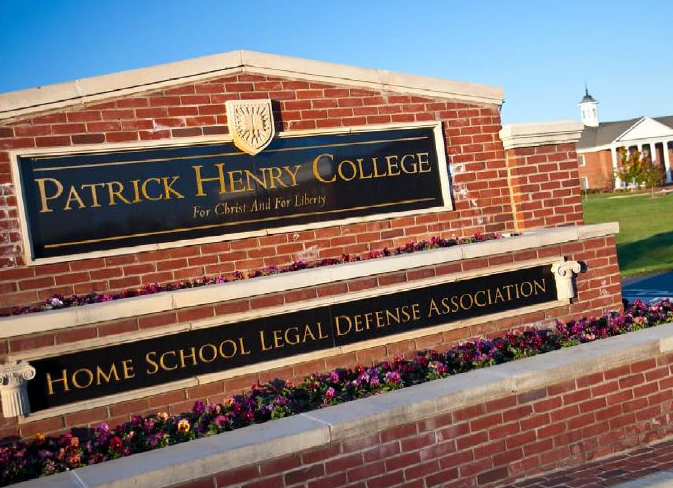
I paid dearly for the privilege of a year at Patrick Henry College, the conservative Christian school frequently called God’s Harvard. PHC was founded in 2000 by Moral Majority darling Michael Farris, a constitutional lawyer who also began the Home School Legal Defense Association. Homeschooling is both an educational model and a lifestyle, growing from 800,000 in 1999 to over 2 million in 2012. As a homeschooler born at the end of an era of legal oppression, I owed a debt to Mr. Farris. I was taught I must continue his work by challenging the liberals and conquering the culture for Christ. At homeschooling conventions, young men in suits extolled the virtues of PHC, calling it a haven for homeschoolers, a place that would understand my lack of a GED and provide me with the Ivy League experience without the East Coast liberalism. My mother was immediately sold and began pushing for PHC in 2002, while the first class were still sophomores. Ten years later, I was in a Subaru Outback crammed between a printer and a mattress protector, making the drive to my shiny new fundamentalist future.

There are 1,318 miles between my childhood home and my gender-segregated PHC dorm, and I cried for at least 600 of them, but for all the wrong reasons. I should have been questioning the wisdom of leaving behind family, friends, and a newly acquired boyfriend for a school that isn’t accredited. I wish I could blame my mother for this decision—parents are the best scapegoats. But it was me who decided to embrace my childhood religion and sign a statement of faith that promised I would never have premarital sex and always deny the lie of evolution.

Depending how you count, there are five to eight passages in the Bible that refer to homosexuality, and Patrick Henry College made sure I knew each one. Midway through my first semester, a fellow freshman insisted that soy milk turned people gay. Trying not to choke on the ridiculously expensive dining hall food, I asked what he meant. “It’s the estrogen,” he explained to me with all the confidence that came from studying high school biology at the kitchen table. “It turns people gay. How else do you explain California?” I don’t know how to explain California, but this did explain the rumors about my lactose-intolerant Cuban friend who poured soy milk over his cereal and said deviant phrases like “what the hell.”

Another student refused to say the word “naked” because it was too profane. She carried around a stuffed bunny and sang opera at all hours and locations.

To many, PHC is an idyllic sanctuary of innocence nestled in the green Virginia farmland. Set back from Highway 7 on the edge of Purcellville, a small town with southern charm, terrible restaurants, and undertones of racism, the college was close enough to DC to funnel interns to work under the Bush Administration and far enough away to shield us from the liberal rallies. When Loudon County suggested extending the metro line out towards Purcellville, Mr. Farris objected because too much secularism could travel over the metal rails. The 24 hour Harris Teeter grocery store across the street was the most fun PHC students had, especially before they banned kick scooters in the isles.

To drum up numbers, free Chick-fil-a was offered to students who attended an anti-abortion rally. These were the pictures that appeared on my classmates’ instagrams with hashtag phrases like “God is good,” “protect the innocent,” and “Aslan is on the move.”

Student clubs littered stairwell bulletin boards with posters advertising their platforms. I was asked to join the Wilberforce society, a group devoted to moral reform, especially a local government ban on porn. To the best of my knowledge, they pursued this goal by picketing the one adult store near town and drafting legislation proposing a parental control that could be placed on all Loudon county internet.

“How can you tell these stories with a straight face?” My incredulous (and public schooled) friend asked me one night after I mentioned how a senior professor used the term “honey-trap” when referring to a vagina. “Because they’re true,” I shrugged. Later that year, the same professor was the keynote speaker on Faith and Reason Day, the most important event of the semester. Three hundred and fifty students sat in rapt attention as this doctor argued that divorce is a state conspiracy to destroy the family by emasculating the father. He claimed campus rape was over-reported and not a real problem, but rather a feminist ploy of crying “wolf!” and destroying godly young men. Although I heard from faculty members and students who insisted he didn’t speak for the whole school, the speech was edited and approved by the administration.

Of course, this is the same administration that interrogated journalism students, accused them of slander, and threatened to expel them after they circulated an independent article that criticised a professor.*** This is the same administration that ignored accusations that one of their blonde PHC poster boys had blackmailed and sexually abused two female students.

He was later elected class president and his sins conveniently swept under the rug.

One of the most disturbing things about an insulated community is the echo-chamber effect. I’ve met a lot of Christians who don’t believe in Reaganomics or distinct gender roles, but at PHC, they were considered the suspicious fringe believers. In US History, I heard arguments defending the Trail of Tears. In Economics, students leaped to condemn workplace safety laws. To be fair, many of the professors walked the narrow line of challenging these views without telling the students they were wrong. One female professor confided in me that plagiarism was an epidemic in her class, but she feared that if she reported it, the administration would fire her for being a woman and stirring up trouble.

Detachment became a coping mechanism. I realized I was in a nest of crazy, and there was nothing I could do about it. I tried to skip the mandatory daily chapel hour, but my RA caught on and confronted me, so I began sitting in the back and sneaking homework between the pages of my Bible. The cafeteria was a hive of debates about free will vs. predestination and whether slavery had anything to do with the civil war, so I never sat down to eat. The library, built in a basement and stocked with a few rows of carefully selected books, was functionally useless. With only two academic buildings and five dorms—two of which I couldn’t go in, because they were men-only—PHC lacked hiding spots. I holed up in my room and found solstice in the internet, especially when I purchased a virtual private network that shielded me from the nanny software that sent every url I visited to my RD and blocked me from buying a new bra because the product pictures were deemed “pornographic.”

I was raised to believe the Bible is completely inerrant. Although I had struggled with my faith growing up, I always came back to this idea because I thought it gave me a solid, consistent worldview. Worldview is a term fundamentalists love, thanks largely to the work of 20th century theologian Francis Schaeffer, who famously wrote, “Most people catch their presuppositions from their family and surrounding society the way a child catches measles. But people with more understanding realize that their presuppositions should be chosen after a careful consideration of what worldview is true.” I know this quote by heart because I used it over and over in academic papers. PHC made me reconsider my worldview by showing me its conclusion. I entered the school hopeful and convinced I was not a racist and maybe even a feminist, and I fled disillusioned with my own prejudice but also with a better knowledge of ancient Greek.

After two semesters, I left my friends and religion behind. I wrote a letter trying to explain the former, but I resisted publicly admitting the latter. To admit a lack of faith is to lose the soapbox. I will become secular, a honey-trap, a feminazi, a wolf in sheep’s clothing—a homeschool apostate, to use the term recently coined to describe the kids who have grown up and aged out of dogma. When I moved to Austin, one of the few liberal areas of Texas, one student proclaimed “that explains it,” and refused to elaborate.

I wish I could explain things that easily, but a year spent living in black and white opened my eyes to the shades in between.

*** UPDATE 2 pm Pacific, 07/28/14: A previous version of this story incorrectly stated that (1) journalism students were threatened with expulsion for writing a critical piece about a professor and (2) the professor whom the critical piece was about was the same aforementioned professor who gave the Faith and Reason Day presentation.

I Hope That No One Will Send You Lies About Our School: Adriel’s Story

Homeschoolers U

HA note: The author’s name has been changed to ensure anonymity. “Adriel” is a pseudonym.

I’m a current student at PHC (about to start my junior year) and I happened across your call for stories. I’m very interested in sharing my experience thus far! I’ve shared your call to a few other PHC students as well. Hopefully many of them will e-mail you. (I also hope that many of them will think to e-mail you from their student e-mail accounts. That serves to prove that this e-mail is actually coming from a PHC student.)

While I know that some people have had a negative experience at PHC, mine has been mostly positive, although there has been a bit of both.  I’ll provide you with a sampling of events from my time at PHC, in the hopes that some of them will prove informative.

My school experience.

Like many PHC students, I was homeschooled through high school. Like quite a few PHC students, I also spent a year at a local community college before attending PHC.

Homeschooling, while an overall positive experience, left me very socially awkward (part of that was simply my introverted personality) and sheltered. Community college, while also an overall positive experience, left me independent in a way that was more like isolation.

When I arrived at PHC, I was distant from others, depressed for my future, and angry at God. I was nervous and unable to make decisions on my own.  If PHC were the hyper-conservative ‘Homeschoolers University’ that it is made out to be, all of those problems would be exacerbated, with more besides. Rather, PHC has repaired me. I am strong, confident, capable. While still occasionally angry at God, I am learning to trust. I have friends, and I love people. I have hope.

PHC is not a perfect school. No school is a perfect school. But PHC has been good for me.

I rather like my school and my fellow students.

If I had only read about PHC online, and not actually been there, I might have a negative opinion of the school. But, having been here, I see a beauty and life in the school that I hadn’t seen anywhere else.

I do not agree with everything that has been said by my fellow students. I do not agree with everything that has been said from the podium. I do not agree with everything that has been said from the podium and agreed with by the student body. (Those two sentences are very distinct, PHC is good about bringing in challenging speakers.) But I love my fellow students, respect the professors, and have grown significantly as a person in my time at PHC.

We grow at PHC. 

A lot of PHC students, in my experience, enter PHC with a lot of growing up left to do. We’re sheltered in our understanding of the world, awkward in our interactions with others, and untempered in our views. Occasionally students will say or do things that reflect badly on the school. But that’s because we’re all growing, and PHC is a major part of that growth. PHC was a very healthy place for me at a time when I needed it, and it continues to be so. I’ve mellowed out, normalized. I’ve become more confident. I’ve decided that I disagree with my parents and PHC on some issues. I don’t feel ‘immodest’ in form-fitting clothing. Thanks to classes, readings, RAs, fellow students, work, professors, and many other aspects of life here, I’ve grown for the better.

I’ll give you an example of what this looks like on a larger scale: When the freshman classes come in, for the first several days, they seem to, of their own volition, sit at gender-segregated tables. Boys at this table, girls at that table. Sophomores and upperclassmen disapprove of this behavior. My class apparently desegregated quite quickly, and the upperclassmen were proud of us, as we are proud of the now-sophomore class for desegregating as quickly as they did.

I remember reading about the allegations of the mishandling of the sexual assault cases.

It sounded like it was about a completely different school. There was no moment in my readings about the allegations that made me say, “Yep, that’s my school.” For such an idiosyncratic place, I found it strange that that didn’t happen.

For example, the first thing that stood out to me was the depiction of Dean Corbitt.*** I could not reconcile the woman in those articles with the woman who spoke kindly and understandingly to me and ~4 other girls on why it is okay not to be perfect. I see her on campus frequently, and she is a real person, not the monster that the articles made her seem to be.

Regarding those cases, I trust my personal experience more than the writings of someone on the internet. I strongly doubt that the case was handled in the way that it was portrayed.

A note on PHC before my time there.

PHC has changed. The structure of rules for the students to follow has changed. In the past, there were some crazy rules, I’ve heard. But the current system is one I highly respect. We put virtue before legalism.

One specific example that I know about: There used to be a rule that students could not watch R-rated movies on campus. So, students would sit across the street from campus and watch whatever movies they chose. Now, we are simply told to exercise good judgement. If we believe that an R-rated movie would be edifying, we are free to watch it. If we think that a more mildly-rated movie would not be a good movie to watch, we can exercise our own judgement. It’s up to us to decide what we will watch, and we are encouraged to learn the skill of deciding for ourselves what is and is not beneficial.

Other rules have changed along similar lines. So if you hear, “PHC has a rule that the students can’t…” be aware that that statement may no longer be true.

We respond healthily to criticism. 

There was a student in my class who left after freshman year. She was unique and interesting, and I respected her. She helped me pull a prank on another student and it was hilarious. After leaving, she posted her reasons on Facebook, and many of us read them. While some of what she’d seen at PHC took me by surprise, much of it rang true and pointed out flaws in the student body and the way we interacted.

At the beginning of sophomore year, my class held a student-organized prayer time in front of Founder’s Hall. We prayed for our class and for the incoming freshmen. One of the students delivered a brief prepared ‘sermon’. He quoted directly from that FB post, with his point being that we need to be more careful not to be the sort of people that she felt that we were.

A student criticized our school, and we read the criticism aloud with a determination not to be what she saw in us. I was proud of my fellow students for doing that.

In conclusion…

I hope that this e-mail has been helpful, and that the e-mails that you receive will help you to better understand PHC.

I hope that the article which you write will be accurate to the stories that you have been told, as well as accurate to the reality of PHC.

I hope that you will tell others things that they may not expect to hear; that there is a healthy place full of homeschoolers who are growing and learning together.

I hope that you will tell us PHCers things that we didn’t expect to hear, that the anonymous format will allow my fellow students to deliver timely and accurate criticism, like that of the student I mentioned earlier.

I hope that no one will send you lies about our school. (Of course, knowing the internet, that is certain to happen.)

*** UPDATE 2 pm Pacific, 07/28/14: A previous version of this story incorrectly stated the dean’s name as Thornhill.

Getting My Wings Back

wings

HA note: The following is reprinted with permission from Kay Fabe’s blog Post-Fundamentalist Fashion. It was originally published on June 9, 2014.

Trigger warning: discussion of sexual assault.

So I saw Maleficent over the weekend. And for me and many other sexual assault survivors, that gut-wrenching scene where Stefan cuts off Maleficent’s wings instantly read as rape. I just sat there staring in shock, like…. “No. He took HER WINGS. This is way worse than if he just stabbed her.”

Maleficent’s wings are her source of power. Stefan takes that power away from her, but in the end SHE GETS IT BACK. I was so, so happy about that. (I love that the idea of rape is so clearly tied to power, rather than sex, throughout the whole film, too. It’s not like “her wings are her virginity, and she lost that, so now she’s broken.” It’s like “Her wings are her power, and he stole them, but she can get them back.” YES, YES, YES.)

But in that scene where she’s slowly limping down the hill afterwards, stunned, leaning on her staff and trying to process what just happened, my heart bled. I know pretty much exactly what she felt like at that moment.

This story is for later, but the guy who assaulted me was much older and he was constantly pushing my boundaries and trying to get me to do things I felt uncomfortable with. (It says something that I thought marrying this dude would be better than living with my parents.) The actual assault was one of those pesky gray areas: it started out as a sort-of-consensual encounter, and then he told me to do something I was uncomfortable with and I said “No,” and then he grabbed me and made me do it anyway. We broke up soon after.

I was really angry at him for a long time, but the older I get and the farther away from it I get, I’ve started to feel like my anger was sort of misdirected. That dude only took up about four months of my life, tops. The homeschool culture spent 20+ years systematically stripping me of my privacy, dignity and autonomy as a human being.

I came to realize I was raised in a culture that stole my wings before I really knew I had them. My No didn’t matter. My Yes didn’t matter. Basically, nothing I said really mattered – so I quit trying to say anything. When Mr. Grîma Wormtongue first met me, he knew I would be a REALLY easy person to abuse, so he took advantage of that.

I don’t have a good way to end this, exactly, but I think it’s sobering that so much of the homeschool subculture is a massive power play. The people in control are determined to stay in control, even if that means systematically destroying the individual souls of individual kids. They’re basically like, “We don’t care about you as a person, about what you think or feel or say. We’re just going to do our thing and be in charge, and we don’t care if you get broken. In fact, it’s easier for us if we can break you.”

Honestly, if rape is about power, homeschooling sometimes looks very, very similar.

I was homeschooled, but I am getting my wings back. Feather by beautiful feather.

Sobbin’ Women and a Rubber Duck: Ellynn’s Story

Screen Shot 2014-02-23 at 3.50.31 PM

HA note: The author’s name has been changed to ensure anonymity. “Ellynn” is a pseudonym.

I didn’t intend to write this.

When the prompt went out about Media Memories I didn’t feel like I had anything to add. Like most homeschool kids, I wasn’t allowed to watch Teenage Mutant Ninja Turtles, Mighty Morphin Power Rangers, or a decent chunk of Disney. This was in an era of little to no internet access, so I have old art projects where I tried to draw the things from the shows my public school friends told me about with no basic idea of what they were talking about (my idea of a megazord was apparently multi colored ninjas making a pyramid). My media was Nanny Bird and Psalty (the blue fro’d singing psalm book). My younger, non-fundie cousins had Barney. Comparatively, when my youngest siblings came along, Veggie Tales were amazingly watchable.

And you know, it wasn’t great, but it wasn’t really terrible. I wasn’t scarred for life because I wasn’t allowed to watch Aladdin. Yeah, as an adult I had a lot of cultural catching up to do, but I’m not upset about it.

So, yeah, I didn’t think I had anything to say about my own Media Memories.

Do you know how much of your thinking occurs on a subconscious level? Little background things collate as you go about your day and then smack you in the face when you least expect it.

I’m one of those people, I’ve always got a song in my head.

While I love it, it’s also quite frustrating because I have no control over the selection. Monty Python, Rocky Horror Picture Show, and various greatest hits of YouTube pop in at the most inappropriate times. More annoyingly, I often revert to songs I grew up with. My Aunt’s favorite country songs, Stephen Curtis Chapman, the Donut Man — I find myself absently singing things I haven’t heard in well over a decade, things I could happily never hear again.

I’m pretty sure I still know all the lyrics to Achy Breaky Heart. Thanks for nothing Billy Ray Cyrus.

So one day last week I was at work and I caught myself absently singing “Sobbin’ Women” from Seven Brides for Seven Brothers and nearly threw up. Literally, and let me tell you it was unexpected.

Seven Brides for Seven Brothers is a retelling of the Rape of the Sabine.

Seven Brides for Seven Brothers is something that even the most conservative families I knew had watched. It’s a 1950’s musical, with attractive guys and fun dance numbers and it all ends in a mass wedding. Wholesome, right?

The thing is, it’s a retelling of the Rape of the Sabine, where a group of men came upon the young women of a village at the Sabine river, bathing and doing laundry, and took them by force to be their wives.

Did you know the English word rape rooted in the Latin raptio, which also translates as “abduction”? The reason we root sexual assault within a word that generally translates to abduction is because of this story. It’s also considered one of the foundational moments in Roman history.

Here’s a few of the lyrics from the lesson the elder brother taught his younger brothers about wooing:

Them a woman was sobbin’, sobbin’, sobbin’ fit to be tied.

Ev’ry muscle was throbbin’, throbbin’ from that riotous ride.

Oh they cried and kissed and kissed and cried

All over that Roman countryside

So don’t forget that when you’re takin’ a bride.

Sobbin’ fit to be tied! From that riotous ride!

…Them a women was sobbin’, sobbin’, passin’ them nights.

Now let this be because it’s true, a lesson to the likes of you,

Treat ’em rough like them there Romans do, Or else they’ll think you’re tetched.

And the reply:

Oh yes! Them a women was sobbin’, sobbin’,

Sobbin’ buckets of tears

…Oh they acted angry and annoyed, but secretly they was overjoyed!

(Click at your own risk, because damn is it catchy)

So don’t forget that when you’re taking your bride! Sobbin fit to be tied!

And you know, it’s very 1950’s, there’s something like four kisses in the movie, they all seem like lovely kidnappers, and of course the women loved them and they got married, so it was romantic!

As a kid I didn’t really have a concept of what rape was, much less rape culture. I just loved the dresses and the dance numbers.

As an adult I catch myself singing “Them a woman was sobbin’, sobbin’, sobbin’ fit to be tied. / Ev’ry muscle was throbbin’, throbbin’ from that riotous ride,” at work and go from zero to physically ill almost instantly.

So I had something to say, but I still wasn’t sure what -—other than “don’t let your kids watch Seven Brides for Seven Brothers. Trust me, they’ll be glad to have missed out on that when they’re older.” But the thing is, in my experience homeschoolers never need to be told not to let their kids interact with media. The slightest hint that someone disapproves is generally enough to get further restriction, and that’s really not  a message I endorse. So yeah, I wasn’t sure where my brain was going with this.

And then, while I was thinking over what to write, a small voice in my head sang “because I love my duck,” and I just knew.

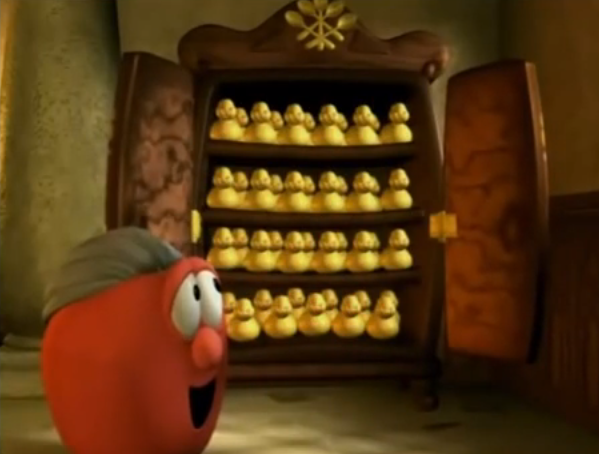
Have you ever seen King George & The Ducky? It is by far my favorite Veggie Tales tape. The songs are catchy, the mini skits are great, THE FRENCH PEAS! Really, what’s not to love. And they managed to tell the story of David and Bathsheba in a way that would be acceptable to children.

Except I’ve never wondered, but why are we telling the story of David and Bathsheba to children?

It’s essentially a story of rape (yes, there are no explicit scenes in the text, but if a king orders a woman he’s never met brought to him for the purpose of having sex, struggle or not, it is totally rape) and murder. What are we going to tell them next? The story of Lot and his daughters, teaching a tale of incest and/or date rape with carrots and peas? Just because it’s in the bible doesn’t mean it’s really appropriate material for children.

But there’s something more than that.

You are not the author of your own story, you’re not even a character, but if you’re really lucky we’ll put you in it as a rubber toy.

In conservative culture, be it from the 50’s or 2015, women are generally objects with no agency. Even when they’re main characters, i.e. Elsie Dinsmore, their greatest virtue is in their absolute submission to the men in their lives, their unquestioning obedience and absolute love for these men, no matter how wrong they many be (i.e. Seven Brides style kidnapping plots). If you love and obey your father/man in all things you will have a happy ending – unless God is testing you, then after several years of lovingly submitting through hell you will have a happy ending, probably with the person who was tormenting you through all those years.

Moving beyond the minimal representation women often have in media, there are very few examples of women who are strong, smart, and make their own choices, for good or for ill, in christian media. Heck, a girl making her own choices and having a happy ending was one of the reasons people hated The Little Mermaid when it came out. A man can choose to kidnap a group of women and get a happy ending, a woman can only be good when she is submitting.

Because I love my duck.

Veggie Tales didn’t really have any female characters for the first several installments. They tried to remedy that later on with Esther, Shelby, and Madame Blueberry, who each showed up very sporadically and never really made it into the core character set. I’m not even sure Junior’s mom has any lines.

Bathsheba, the woman who was pulled out of her house, forcibly made consort to the king, and who had her husband murdered, is a rubber ducky. She is literally an object. And that’s a lesson for little girls.

You are not the author of your own story, you’re not even a character, but if you’re really lucky we’ll put you in it as a rubber toy.

King George was my favorite Veggie Tales installment, and now, when I think about it I want to cry.

And that is the trouble with growing up, it’s not the things you weren’t allowed, it’s the things you realize you can never enjoy again because what seemed harmless, cute, and wholesome in actuality makes you ill when you start to think about it.

That, and paying for your own insurance.

And The Music Was There: glor’s Story

Screen Shot 2014-02-23 at 3.50.31 PM

“Rock” music. Simultaneously my oppressor and my escape, we have an unusual relationship. Going from “anything with a strong beat will fill you with demons” to “oh hey, I just bought the newest VNV Nation album!” may seem extreme, and I admit that I sometimes suffer from whiplash, but at the same time it’s been a very freeing evolution and something that mirrors my general escape from my childhood/immediate family.

The first memories I really have about specific music was trying to defend myself at a camp-out.

I’d been found crying in a dark place by myself, and my fellow campers [all the same general age as myself, 9-12ish] didn’t believe me that the song made me cry because it reminded me of a friend who’d died. The song was played at his funeral. It was the first example of exactly how strongly music hits my emotional centers – and for that song, having to “prove” it made it hit me all the stronger in the following years.

Following that, the next set of memories is about music being “awesome” – or rather, not. The cult we were in at the time were very adept at using the “Sunday morning worship” to twist us this way and that, and I can distinctly remember how you could tell what the sermon would be about by the first half of the very first song of the day. I remember dirge-like music playing as we lined up in a school’s gymnasium to “repent of our sins.” I remember the slightly happier songs that the children danced to. I remember everyone in the room being scathingly rebuked because one of the singers had dared to say that a song was “awesome” – because, you know, only God is awesome. Never anything else, even a song literally praising his name.

The music collection at home wasn’t too much better. Michael Card. Sandi Patti [maybe… if we were lucky]. Some random Maranantha song tapes. Plenty of classical. That was about it, that I remember. I had very little interest in music outside of that, for the most part, simply because I didn’t know anything about it. There was the usual hush-hush about KISS and Marilyn Manson, stuff like that, but it was all mostly above my head. Then, I was introduced to DC Talk and Michael W Smith and Steven Curtis Chapman. My brain just about exploded from glee – finally, something that fit me!

I could put my emotions onto these songs and I could finally understand things about what I felt that I never could before.

See, I have bipolar disorder. I have rapid and multiple mood swings, from seriously depressed to extremely manic, and until that point, none of the music could encompass either end of the curve. Everything was beautiful and nothing hurt [because Jesus!] – to steal from Vonnegut. Any emotion other than happiness and joy was Wrong. You were a bad Christian – nay, a bad person, if you weren’t always basking in the love and companionship of Jesus. Being human, though, that wasn’t possible. So I struggled along in my lonely childhood self, trying to deal with these big emotions and not having anywhere to turn.

And then lo, DC Talk and “Jesus Freak.” They were my introduction to a larger world, and were, in fact, the very beginning of my long and slow departure from the church.

Teenagerhood hit. I was “rebellious,” according to my parents, and it was all because of my music. They had it backwards, of course. I was in an abusive home situation and I had found an escape in the music that expressed all the emotions I was feeling and allowed me to survive day after day, because there was nowhere else to go. Once again I was stifled under the “no emotions except happiness” expectation – which became more and more difficult the worse my bipolar got. It’s very hard to be “blissfully happy in Jesus” when one day you’re suicidal and the next you’re on a cloud and can do ANYTHING! that you could think of. I hid my music and snuck it as often as I could [or dared… woe betide me if I was found listening to [oh my!] Superchic[k] or the Newsboys or [quadruple gasp here, people] the Cruxshadows.] All of the songs that I listened to held deep emotion and symbolism for me, and allowed me to blindly feel my way through the disaster that was my home life.

There were fights about the music. My mother tried to convince me that rock music was of the devil. She emailed me all these “studies” about plants and rats [and since those have been addressed elsewhere on HA, I’ll refrain from doing so here], talked about the “demon beat,” and tried to take my CDs away. Fortunately, by that point, there was the internet and it was easily accessible. When it got really bad and my parents tried to take that too, I was attending the local community college and could use their computer lab to retrieve what I needed.

Eventually, I escaped. Barely.

When I got out of their home, I stopped attending church, I stopped seeing them, and I fairly quickly stopped identifying as Christian. My music needs changed – from the “life sucks and God’s still there for you” of the Christian rock world to the “you’re alive, you’ve survived some awful shit, and you’re still here” of VNV Nation, the Cruxshadows, Linkin Park, movie soundtracks, and so many other artists I can’t even list them. For the longest time, my playlists were nothing but loud anger and rage. I had to purge that from within myself eventually, I knew, but at the time all I could do was cope.

*****

I was sexually assaulted at work. More rage and bitterness. And the music was there.

I was extremely sick and almost lost my job. And the music was there.

I moved halfway across the country. And the music was there.

I was raped. And the music was there.

I had a psychotic break… and the music was there.

*****

Four years later, I had enough, and said “this anger, this bitterness, this rage and hate and harm will not be a part of me any more.”

And the music was there.

*****

It was there as I burned out the bitterness, screaming my tears of pain to the heavens. It was there as I sobbed in my friend’s arms. It was there the nights that I woke up screaming from the nightmares of the pain and the terror.

And the music was there when I finally broke through and let the love out.

Maybe it’s about the time
To let all of the love
Back in the light
Maybe it’s about the perfect place
To let go and forget
About the hate

Love into the light.

Kesha, “Love Into the Light”

PHC Alumni Association Issues Statement to PHC Board on Sexual Assault Cases

PHCAA

By R.L. Stollar, HA Community

Patrick Henry College’s Alumni Association (PHCAA), a volunteer-led self-governed membership organization that provides service to PHC alumni, issued an official statement over the weekend to the college’s Board, Faculty, and Staff concerning the college’s handling of sexual cases on its campus. PHCAA said it condemned all acts of sexual abuse and harassment and “categorically rejected” any form of victim-blaming. Without commenting on the particulars of the recently publicized sexual assault cases in Kiera Feldman’s piece in the New Republic, PHCAA stated that (1) it is a fact that students have experienced sexual mistreatment and (2) the college needs to provide better victim care.

PHCAA urged the college to take three steps:

1. Maintain transparency in every part of the independent audit process

2. Provide more avenues for victim care

3. Educate current students regarding sexual offenses

According to PHCAA’s statement, the college has “already hired an independent firm to audit its policies and practices toward sexual harassment and sexual assault.” However, the alumni association is requesting the college be “far beyond reproach” by also doing “an independent review of the New Republic incidents, and those propounded by any other past allegations of sexual assault, either in this audit or a separate one.”

PHCAA made no request for the resignation of Sandra Corbitt (an action urged by SNAP Network), the college’s dean who was the focus of much of the New Republic piece and recent public outrage due to allegations about victim-blaming and obstruction of justice.

You can view the full text of the Patrick Henry College Alumni Association’s statement as a PDF here.

Patrick Henry College Releases Statement on Sexual Assault Cases

Screen Shot 2014-02-18 at 11.16.59 PM

By R.L. Stollar, HA Community Coordinator

On Monday, Kiera Feldman — a member of the Ochberg Society for Trauma Journalism  — published a story in the New Republic about how Patrick Henry College (PHC) has handled sexual assault cases on its campus. The story, entitled “Sexual Assault at Patrick Henry College, God’s Harvard”, has caused an uproar among homeschool alumni, PHC graduates, and others. The story got picked up by Salon and other news agencies.

Yesterday, PHC’s Office of Communications released a “Statement by Patrick Henry College to concerned alumni and students about article in The New Republic.” It was disseminated yesterday to alumni and today to PHC’s general student body (and was met with student applause).

You can view the statement in full as a PDF here. An excerpt follows:

Many of you may be aware of an article just published in The New Republic magazine (and picked up by several websites/blogs) concerning allegations of sexual assault now being made in connection with events that occurred off campus some years ago – especially about one situation more than seven years ago, and another about four years ago.

…Patrick Henry College is absolutely committed to the protection and care of our students, male and female equally…

…The fact is that the information provided by the key individuals at the time differs from the allegations now related in the New Republic article. The College acted on the basis of the information made available at the time. Moreover, at no time did anyone suggest to any female student that she was somehow responsible, or more at fault for the situation…

…Where possible, we provided the reporter and the magazine with clarification of some of these allegations contained in her article, but she either chose to disregard the information or simply lumped the information into a single paragraph toward the article’s end…

…Any fair observer would conclude that a review of the entire evidence demonstrates that PHC earnestly sought to do the right thing in each instance, did not attempt to cover-up any sexual crimes, and did not seek to blame women for the improper behavior of male students…

…We are glad that the number of such situations involving PHC students is far below American campus averages…

(PHC Professor of Biblical Studies Darrel Cox also wrote his own statement, arguing that the New Republic piece was “a very angry (and honestly, shoddy) attempt at a hit-piece” and that the actual victim in all of this is Sandra Corbitt, PHC’s Dean of Student Affairs.)

Rachel Leon, who was cited in the New Republic article, gave the following response to PHC’s statement:

As Sarah’s friend and former roommate, it’s been deeply distressing to watch some of the direct and indirect attacks on her testimony and character from both the Patrick Henry College administration and the wider PHC community. Sarah is a humble, truthful, and brave friend who only came forward because she wanted to do something to help other victims of sexual assault at PHC. In the hellish days right after the assault, Sarah painstakingly drew up a detailed account of her assault to turn in to Dean Corbitt. This is the same account she turned in to the journalist who wrote the New Republic article. Sarah honestly believed that the administration would handle her case appropriately, and we both felt a sense of betrayal when the administration instead chose to discipline both her and her attacker as though her sexual assault had actually been a consensual encounter. Her account of the assault and her attacker’s account of the assault really only differed on one point: her attacker said it had all been consensual. That Corbitt chose to discipline her by having her read materials about purity shows that Corbitt believed Sarah’s attacker’s version of events from the start. This gives the lie to any notion that the college handled this investigation in a fair and impartial manner. I still vividly remember sitting in Corbitt’s office holding Sarah’s hand as she violently trembled while explaining the details of her assault and responding to Corbitt’s harsh cross-examination. I still vividly remember the way she sometimes screamed at night because of her nightmares. I still vividly remember walking her across campus after dark because she was afraid to walk alone. As I reflect upon some of the worst memories I have of my time at PHC, I challenge the PHC community to step up to the plate as a Christian community and demand greater support for victims and accountability for all who would choose to harm them.

Further reading:

** Note Sessions’s comment, made in September of 2013, months before the New Republic piece:

Girls have been raped while attending Patrick Henry College: girls who I sat next to in class, by men who I sat next to in class. Other women I know were at different times mercilessly harassed, stalked and frightened—all on the campus of Patrick Henry College. Often it was the “nice boys” no one in a million years would imagine could do something like that until they saw it with their own eyes.

Dear Michael Farris, Sexual Abuse Isn’t a “Basic Strength” That “Can Get Out of Control”

Screen Shot 2014-02-17 at 3.50.36 PM

By R.L. Stollar, HA Community Coordinator

*****

“You have planted wickedness and harvested a thriving crop of sins. You have eaten the fruit of lies — trusting in your own way, believing that your great armies could make your nation safe.”
~ Hosea 10:13

*****

On Sunday, HSLDA’s Michael Farris made his first public statement on the recent controversies surrounding Doug Phillips’s clergy sexual abuse and Bill Gothard’s sexual child abuse.

Take a look:

I continue to hear distressing news about the moral conduct of Christian leaders and speakers some of whom were/are popular in the homeschooling movement. Of course, anyone can sin–including me. But I cannot be so gracious about protracted patterns of sin that reveal a deep hypocrisy.

From my own observation there is a central problem that often accompanies these kinds of failures. All leaders have to have a certain amount of ego strength to be able to withstand the slings and arrows of the naysayers who attack anyone who attempts to lead. But, that basic strength can get out of control. Consider it a danger sign when the leader never shares the spotlight with other leaders in the organization. Consider it another danger sign when the leader does not have anyone in his organization with both the power and the character to tell him “no” at times.

Mike Smith has been at my side at HSLDA from the beginning and he now leads the organization day to day. Chris Klicka was a significant part of our leadership team for many years as well. And I guarantee you that both Mike Smith and the HSLDA board tell me “no” on semi-regular occasions.

I am also reminded of the statement of Dick Armey when he was asked what his wife would say if he was caught in an affair like Bill Clinton. He said, “She would say ‘how do I reload this thing?’ as I lay there in a pool of blood.”

Having a wife who is a good shot is also a great asset.

(Farris’s statement is archived on HA as a PDF here and a PNG here.)

Just so we’re all on the same page, let’s review what exactly the “distressing news” is concerning individuals who “were/are popular in the homeschooling movement”:

While in a position of hegemonic spiritual leadership, Doug Phillips pursued a sexual relationship with a young woman who worked for him and was under his authority. This is clergy sexual abuse.

Bill Gothard has sexually harassed and molested over 30 young woman, including children, for decades. He personally admitted “defrauding” young women decades ago. This is child sexual abuse.

Taking advantage of, harassing, and/or molesting children and young adult women isn’t simply “sin” or “hypocrisy” which “anyone” can fall into. Taking advantage of, harassing, and/or molesting children and young adult women is criminal behavior. It is sexual abuse, plain and simply. This isn’t a question of people’s fallibility; it isn’t a question of “ego strength,” unless you somehow believe leaders are innately abusers.

And it sure as hell isn’t a question of “basic strengths.” Sexual abuse isn’t a “basic strength” that “can get out of control.” It’s not something that comes from “too much of a good thing.” Michael Farris’s attempts to spin these situations away from criminal activity and into the realm of “we’ve all fallen short” is self-serving, inexcusable, and horrifying. It is yet another example that he is in denial about abuse within the movement he himself helped to build.

Making this statement of his even more ironic and tragic is that a mere day later after Farris praised himself for accountability and looked down on other leaders for not taking “protected patterns of sin” seriously — just one day later — the New Republic released a devastating look at how Patrick Henry College has handled sexual assault cases on its campus, entitled “Sexual Assault at Patrick Henry College, God’s Harvard.”

The basic premise?

Patrick Henry College, which Michael Farris founded and is currently the Chancellor of, does not take protracted patterns of sexual assault seriously.

Patrick Henry College has ignored, minimized, and threatened abuse survivors and people standing up for them. Just like Doug Phillips and Vision Forum. Just like Bill Gothard and IBLP.

And yet Farris still has the gall to praise himself for treating “protracted patterns” differently.

The hypocrisy did not go unnoticed. Homeschool alumni took to Farris’s page to call him out for making such a statement about Phillips and Gothard right when the story about PHC was coming out. Farris’s response was predictable, considering it was completely deja vu from HSLDA’s handling of the #HSLDAMustCampaign: he quickly deleted the evidence of his original statement (which, again, HA archived as a PDF here and a PNG here), deleted comment after comment after comment after comment by homeschool alumni, and blocked homeschool alumni from his public page.

Honestly, Michael Farris has run out of time to play these games.

He has spent decades ignoring the growing, obvious, and publicly verified problems — and what did he do? He remained silent. He has never publicly condemned the abusive teachings of Doug Phillips. He has never publicly condemned the soul-crushing system of Bill Gothard’s ATI. (In fact, he himself brought Inge ATI’s Inge Cannon to HSLDA and HSLDA continues to feature Gothard’s homeschool curriculum on its website.) He has refused to this day to acknowledge the concerns of homeschool alumni and parents that homeschool communities need to take abuse more seriously specifically because of reasons like this.

And when when he finally breaks his silence, it is with this? Yet another attempt to sweep everything under the rug by saying these abusers were just “too strong” for their own good, that praise God he has two (?) people at HSLDA who stand up to him (but one is deceased?), and then he closes with a joke about domestic homicide?

Not once, not even once, does he say, “What these men did was abuse, and it was wrong, and we as a community need to take abuse seriously.”

Not. Once.

Not once does he say, “I am sorry that I gave platforms to and partnered with these individuals that have caused so much pain for so many people.” Instead it’s “basic strengths” that “got out of control” and basically people should be more like him or lol their wives will shoot them.

Even with this short-lived statement, Michael Farris still refused to call these men out by name. He was still afraid to directly criticize Bill Gothard. He is still hiding.

Homeschooled children deserve better from you, Michael.

If you continue to refuse to call abuse abuse, you’re contributing to the exact same culture of silence from which Phillips and Gothard fed — the exact same culture of silence that you intimately built and continue to defend.