Homeschooled and Kept Ignorant, But Still Queer: Melissa

Homeschooled and Kept Ignorant, But Still Queer: Melissa

HA note: Haley, Melissa’s spouse, shared her thoughts yesterday. Their courtship and coming out stories have been shared by Melissa on Patheos.

I was homeschooled from kindergarten through adulthood. I was the oldest in a large family, and very sheltered. We had the patriarchal beliefs common in the Christian homeschooling movement, so my role in life was very defined. I liked a lot of things about being a girl, but I sometimes wished I was a boy so I would have more freedom to go places, study something in college etc.

At the same time, I was fine with dressing modestly. The idea of getting male attention wasn’t really that appealing to me. I had a hard time imagining a guy I would feel comfortable submitting to and living with, and yet I had been told from early childhood that someday I would grow up and marry a good Christian man who would protect me from the world and support us financially while I stayed at home and had lots of babies to homeschool.

I wanted to be “right”. I wanted to be approved of. I wanted to fit in with my community and become that older Proverbs 31 Woman that all the younger girls asked for advice. I did the best I could to pay attention and please my parents by being who they wanted me to be. By age 17 I was very depressed, and thought about suicide often. I wanted to get out of my parents’ house and away from the expectations and restrictions so badly. As a female, the only way that was going to happen was when I got married. So whenever we were in places where I could potentially meet eligible young men such as homeschool conferences or homeschool gatherings I would anxiously watch and hope that someone would notice me.

I had no idea gay people existed until I was 14 and reading World Magazine and came across a negative reference to the dangers of “homosexuals”. I asked my mom what homosexual meant, she said it was when two men thought they could be together in the same way a husband and wife are together. It seemed like she thought it was a big deal, a bad thing. Of course at the time I didn’t have any real understanding of sex either. I knew that babies grew in a mothers belly, and I had attended the births of several siblings, so I knew how they got out, but I was still under the impression that sex was a magical transference of seeds needed to start a baby, that happened while you slept in the same bed. I started to suspect there was something more to it when I was reading all the purity books about how amazing sex was after you were married, and how hard it was to stay pure before you were married. If sex was supposedly this amazing, there had to be more to it than just sleeping. I tried looking up sex in the dictionary, but “act of copulation” didn’t help me very much. Eventually when I was almost 17 I found a book in the library that I did not dare to check out, but read as much as I could as fast I could in the corner until it was time to go home. It was here that I first learned about penetrative sex and what an erection was. It didn’t dawn on me that if men could be together, then there was such a thing as gay women as well until a year later.

I may not have known what sex was, or what being gay actually meant, but I knew I had a hard time imagining being with any of the guys I encountered. I hoped that my mom was right, and that god really was going to help locate he perfect guy for me. I did not have friends my age, most of the homeschooling families we knew had much younger children, and we didn’t go to church.

By the time I was 18 I had had enough sexually arousing dreams about women and enough urges to kiss or touch the breasts of friends I hardly knew to start to question if this was normal. My sisters or cousins would talk about celebrity guys who were attractive in their opinion and I didn’t know what to say, so I picked whoever was the most stereotypically masculine to hide the fact that I thought Catherine Zeta Jones was way sexier. I asked my mom what had attracted her to my dad, and when she said his broad shoulders that became what I would say I found attractive when people asked what my “type” was.

Eventually I got up the courage to ask my dad what our beliefs about gay people were supposed to be, I didn’t say I was asking for myself. He told me that homosexuality was caused by an especially disgusting demon, he almost seemed to shudder just thinking about it. My dad claimed to have heard and seen both demons and angels, so I felt that he must know what he was talking about. I was pretty sure I had never encountered a demon, and I had been very careful to follow the rules of the house so as to stay under the “spiritual umbrella of protection” my father provided, so I did not understand how I could have allowed demonic influence into my life. Maybe I wasn’t gay. So I asked about bisexuals, what did we believe regarding them? My dad said they did not really exist, that the only true bisexuals were demonically influenced witches. I knew I wasn’t a witch, and I was too scared to inquire further and give myself away.

So I told myself I was imagining things. This wasn’t really true about me. The only reason I was attracted to women, was because I had zero sexual experience, and the only body I had access to was my own, as soon as I got safely married and had sex, I would be attracted to men like I was supposed to be. I had never read anything that portrayed gay people in a positive light. I had never met a openly gay person, or even seen one to my knowledge. I didn’t know what was wrong with me, but I was sure that getting married would fix it.

The amazing thing is, that only a year after we began going to church, I met someone who I thought was a boy and fell in love. He was tall and had beautiful blue eyes and soft full lips that I so wanted to touch even though we were not allowed. We could talk for hours and he actually listened to and thought about the things I said. I had never had anyone treat me so kindly and respectfully. We had a parent supervised and controlled courtship, and got married after 10 weeks, and only 8 days after kissing for the first time. Basically, I went from having never held hands to having sex in a little over 2 months.

As you can imagine, sex was still an awkward topic. The attractions I thought would magically disappear after marriage, didn’t. I didn’t dare talk too openly about it, but sometimes it worried me. I was happily married, I was attracted to my spouse, but I was still very attracted to women and worried that I was a bad person for feeling the way I did. I had many other detrimental beliefs related to sex as well. I had an understanding that I was obligated to be there to service my husband’s sexual requests whether I felt like it or not. I had always been told that god had designed men with very active sex drives, and that if they were rejected by their wives, men would turn to pornography, or even another woman, and I would have no one to blame but myself. I had no concept of consent. In fact when I was first married I had made a promise to myself that I would never say no to a sexual advance from my husband, even if I was sick or exhausted. I also had a lot of anxiety about my worth being tied to how often my spouse wanted to have sex. When my spouse was too tired or just not really interested in having sex, I worried that I wasn’t attractive enough or wasn’t performing adequately. Sex was often one big ball of worries fear and second guessing.

Five years later I had the surprise of my life when my husband came out to me as transgender. What happened next was a 2 year journey that inspired more growth both in our relationship and as individuals than ever before. We discovered just how much each of us had been hiding from the other for our entire marriage. Shedding that fear of rejection and judgment and being honest is one of the most powerful transformations I have ever experienced. When Haley told me that she needed to transition to female and live as she truly was, I wasn’t really phased, and that fact led me to face my sexuality head on for the first time in my life. Haley was patient, and waited while I read and read and asked her question after question. Eventually when Haley felt ready to transition, we came out publicly to our families and started our marriage over again as a lesbian couple. I couldn’t ask for a better partner or co-parent, and the respect we have for each other has only continued to grow. Reactions were about what we expected, and we were reminded many times over why we had hidden for so long. Some people cut us out of their life and refused to speak to us. People who hadn’t communicated with us for years sent us long emails detailing how wrong and evil we were for making this “choice”. It was exhausting and draining, and I was so grateful that we were adults and financially independent before we had dared to come out.

Sometimes I wish that I hadn’t had to spend so much of my life living someone else’s idea of who I needed to be. It has been quite the task to learn how to relax and just be rather than second guessing every single thing I think, do or say. I also wish I had known how many wonderful supportive people were out there, just waiting to embrace us for exactly who we were. Coming from such an isolating, restrictive and judgmental community growing up, it has been a new experience to meet people from all backgrounds, religions and sexual orientations who are accepting and loving. I have also been surprised by how many people from our old life have come around in some way. My parents in particular come to mind, after a rocky start and 3 months of silent censure, my parents have found the ability to be tolerant. Even though they do not understand or affirm our sexuality or the journey our marriage has taken, they have chosen to try to love us and be with us.

It’s been almost 8 years since we got married, 3 years since Haley came out to me, and 1 year since we came out to the world. I thought we had a unique story, but since telling our story on my blog we have been contacted by so many other couples who married in the closet and stayed together after coming out. There are so many years that we lived in shame, sometimes we can get frustrated with all that time wasted, and pain endured. Only one year in, sometimes it feels like the new goals and dreams will never happen. It’s been a lot of work starting over from ground zero, some days we fall into bed too exhausted to even say goodnight. Sometimes old messages haunt us, telling us that we are not good enough, that we are failures, that who we are is somehow less than. But overall there is something about the honesty of this life that feels really good. We have the story that we do. We came from the background we did, and it took as long as it did for us to overcome the shaming messages and be ok with who we are.

There really is nothing to regret, only a life to live, fully.
I Am Trans, And I Am Beautiful: Haley

I Am Trans, And I Am Beautiful: Haley

HA note: Melissa, Haley’s spouse, will be sharing her thoughts tomorrow. Their courtship and coming out stories have been shared by Melissa on Patheos.

I grew up homeschooled from age 8-16 when I started taking classes at community college. I am the oldest of five with four sisters younger than me. My dad was a pastor and my mom stayed home to homeschool all of us. We were very conservative politically and religiously. Almost all of our friends went to the church pastored by my dad and another pastor homeschool dad. Almost every child in the congregation was homeschooled. It was a very conformist place. Diversity was measured in curriculum of choice, whether Abeka, Bob Jones, Sonlight, etc. Almost all of my social outlets happened at church under the control and observation of the homeschool parents. If you didn’t like that control, tough luck, you didn’t have access to anything else.

As a means of survival growing up, I figured out that agreement with the system was the only way to survive. I watched some other kids try to buck the system and suddenly they had no homes or they lost the ability to drive a car, or their parents stopped supporting their education. I also observed families where kids were given very little academic education in favor of gender role based education for girls to become wives and mothers while the boys were taught how to learn handy practical physical labor skills. I lived in a family that tolerated higher education as long as you kept saying the right thoughts. I was part of a forensics class in community college that I enjoyed but my parents seemed to dislike the gay professor who coached the team and they worried about influences over my life. I quit forensics after only one semester because of their worries.

The gender bias towards men becoming big earners with power while women were supposed to tend home and hearth and be a man’s helpmeet was kinda weird to observe for me. You see, ever since I was a child I’d wished I was a girl (at birth I was assigned male and raised by my folks that way). When I was 11 I read a history book (a secular one that sneaked into the home) about Christine Jorgenson the first American to publically transition from male to female and I immediately thought, “Someone else like me.” But I already had heard the denouncements of gay people. I had been hearing the strict, strict, strict conceptions of gender all my life. I knew that this awareness was something I should never ever talk about. In fact, I spent my adolescence on a roller coaster of simply hating myself for my sin and perversion. I accepted the lie that there was something seriously wrong with me. I plowed myself into my religious faith in an attempt to save me from my “sinful” desires to be female. No amount of repressing would put it out of my mind for long. I’d look in the mirror and wonder what I’d look like as a woman. I’d sneak moments of untraceable internet access to look up transgender people and information about them. I’d secretly hide elements of women’s clothing in my room, and then often feel super guilty and throw them out only to buy more later. As I considered a career, I felt that the ministry was the highest calling, it was all that I knew growing up as a preacher’s kid, and it was a career that I could never gender transition in because that wouldn’t be possible. I needed to protect myself from myself or so I thought.

Oddly, homeschooling in some ways had a couple of upsides to being transgender. And here is why. It was easier keeping up appearances around your peers when you only saw them at most a few times a week. I didn’t suffer some of the bullying that my trans sisters experienced in public school settings. Also the exclusive homeschool setting gave me opportunities to day dream and imagine. During these times I would often image myself as a woman. However, the homeschool setting was a terrible place to be transgender overall. You couldn’t meet other people like you and if they started giving clues they might be like you, they’d be kicked out of the church and the community. It has been fascinating as an adult to meet other queer homeschooled adults. We were there the whole time, it was just we all knew that saying anything about our identity would get us thumped and humiliated. I feared my parents somehow figuring out I was trans, I had read in Christian publications like World about therapies to try to make people straight. I knew these therapies sounded awful and I didn’t want to ever be subjected to them.

Basically, growing up homeschooled I had had no access to life on the outside. I didn’t know anything about jobs, taxes, how the government actually worked, basically nothing. The closet was an act of self preservation while homeschooled. You couldn’t let that get known. There were times when I got very mad about not being able to change my feelings so that I wanted to be a male. I would get depressed and contemplate suicide over feeling frustrated that I couldn’t change and not wake up wanting to be female. I also had severe anxiety about everything. I developed an ulcer when I was 17 and a college student. My parents were very focused on my grades. I performed well gaining magna cum laude in community college, and summa cum laude for my undergraduate degree at a local Christian College. When I went off to seminary, working for my dad’s ministry, and with him holding the purse strings, I poured my life into school and work. When I was excessively busy it would reduce the amount of thoughts about being a woman. But it would never go away or even let up for whole days. I could maybe have an afternoon of work where I didn’t think about trans people and being a woman but never more than that.

And for those who might argue being trans is a choice that isn’t the case because women in the homeschooling community are less than men. I understand that now as a liberal participant of society today. There is no reason for a homeschool “boy” to want to be a “girl.” And I knew it even back then. If I was a girl, my options in life would be reduced by the community. If I got married and had a baby, I would never have a career, I would have to obey my husband. I would have very little autonomy. Being a guy which felt all wrong to me had so many benefits compared to the women I’d known growing up that it kinda made it a little bit easier at that time pretending to be a guy to retain that level of control over my life. As I started meeting women outside the homeschooling community and saw how they could live their own lives, I realized that I could be a woman and live a good life and have personal autonomy. Patriarchy is a terrible teaching and it degrades women. It was oozing everywhere in the homeschooling community I grew up in.

But when I was hiding who I was, I was still steeped in the homeschooling community and I started courting this other homeschooled girl named Melissa from a family that then numbered nine siblings and today numbers 11. I was almost 20 and she had just turned 20 when we married. After a quick supervised courtship I proposed to her and we married. Within a few months of our marriage we had already suffered a miscarriage and were just waiting for children to be given to us. I went to seminary the summer I was married and plowed myself into my studies. We tried to live up to the ideology we’d been raised in. Melissa had been denied higher educational opportunities and due to my dad’s “job” for me which taxed me heavily working 80+ hours a week of school and his projects, she didn’t work and was my stay at home wife until our first baby was born. She got pregnant and had our first baby when we were 21.

When I was twenty-three I was burned out working for my dad, trying to start another homeschooler church in the city I’d gone to seminary in, finishing seminary, and becoming a parent to two. I was in crisis. My gender issues were still raging, I was getting disillusioned by the ideology I’d grown up with but didn’t know any alternatives. After a tumultuous summer, I took a call to serve a church in Canada over 1000 miles away from both of our families in Illinois. I served that congregation for three years and it was during that time that I finally was far enough away from the craziness of the Christian Homeschooling Movement to live my own life. We had two children born in Canada. I started reading things I never had before. I started meeting more normal people where women worked jobs. I discovered some of the stuff I’d heard in the U.S didn’t seem all that relevant in Canada. Finally, I came out to my wife as transgender when I was 24 and we started a two year journey to acceptance.

During that journey Melissa realized she was more lesbian than straight and I had always known I was attracted to both sexes and our relationship deepened and grew more intimate than ever before. Instead of being play actors doing our “roles”; we were two people living our lives together. During that time period our marriage became a real partnership. When I was 26 I started the process of gender transition and left the ministry. I was so proud of that day when I legally became Haley. In the 18 months since then, I went back to school to be a cosmetologist and am now employed as a stylist. Melissa entered the workforce for really the first time and she has thrived. Our parents took things badly but really they controlled our lives for long enough. Homeschooling is the ultimate tactic to retain control of children who should be developing into autonomous adults. I am very proud that my oldest child attends public school and will be joined by her sister next year.

Being transgender and homeschooled wasn’t cool. I think everyone deserves to have teachers and people other than their parents who invest in them. I gained so much from the teachers I’ve had in higher education and it was huge that these people were outside of my family system. I also believe that experiencing diversity is awesome. I didn’t knowingly meet in person another trans person than myself until after I was already in the process of gender transition. That is how isolated and homogenous my circle of contact was. I had very little exposure during homeschooling to the outside world. Even ethnic minorities were quite mysterious. This is not okay!

I am so glad that I have met so many vibrant LGBT homeschooled young people who got out.  We are okay just the way we are. Growing up homeschooled we had every reason to hide our identity but now that we are adults, we can be ourselves finally. I am the happiest I’ve ever been. I love being me. I no longer feel like an actor in my own life. I am glad to be a woman, wife, mother, friend, and cosmetologist! I love raising my four kids and having them know me for who I really am. I am glad to have the truth out there.

I am trans, and I am beautiful.

LGBT, Queer, And Other Things That Make Us Say, “What Does That Mean?”: Deborah

LGBT, Queer, And Other Things That Make Us Say, “What Does That Mean?”: Deborah 

HA note: The author’s name has been changed to ensure anonymity. “Deborah” is a pseudonym.

I grew up hearing a great deal about how evil gay people were and how the whole world was going to be destroyed either directly by them or by God because “the righteous” didn’t murder all of “the gays”.  So I thought I knew what it meant to be gay and really didn’t care if that was different from transgender, queer, or any number of other terms I heard.  In fact, none of these terms mattered all that much to me because (forgive my even using the term) I just lumped them all together and called them “sodomites” and figured that they were all pedophiles as well.

Then one day I began to realize that these were real, live people I was talking about in such hateful terms and would have treated like trash if I had met them.  These same people with hopes and dreams and feelings were really just as human as straight people were.  At that point, I decided to meet some of these people, do some research, and see what was really going on with them.  It was very awkward at first.  I knew I had to put away the offensive words, but I really didn’t know what was or wasn’t offensive or what the non-offensive words meant.  Thankfully, I had some patient friends who walked me through all of that.

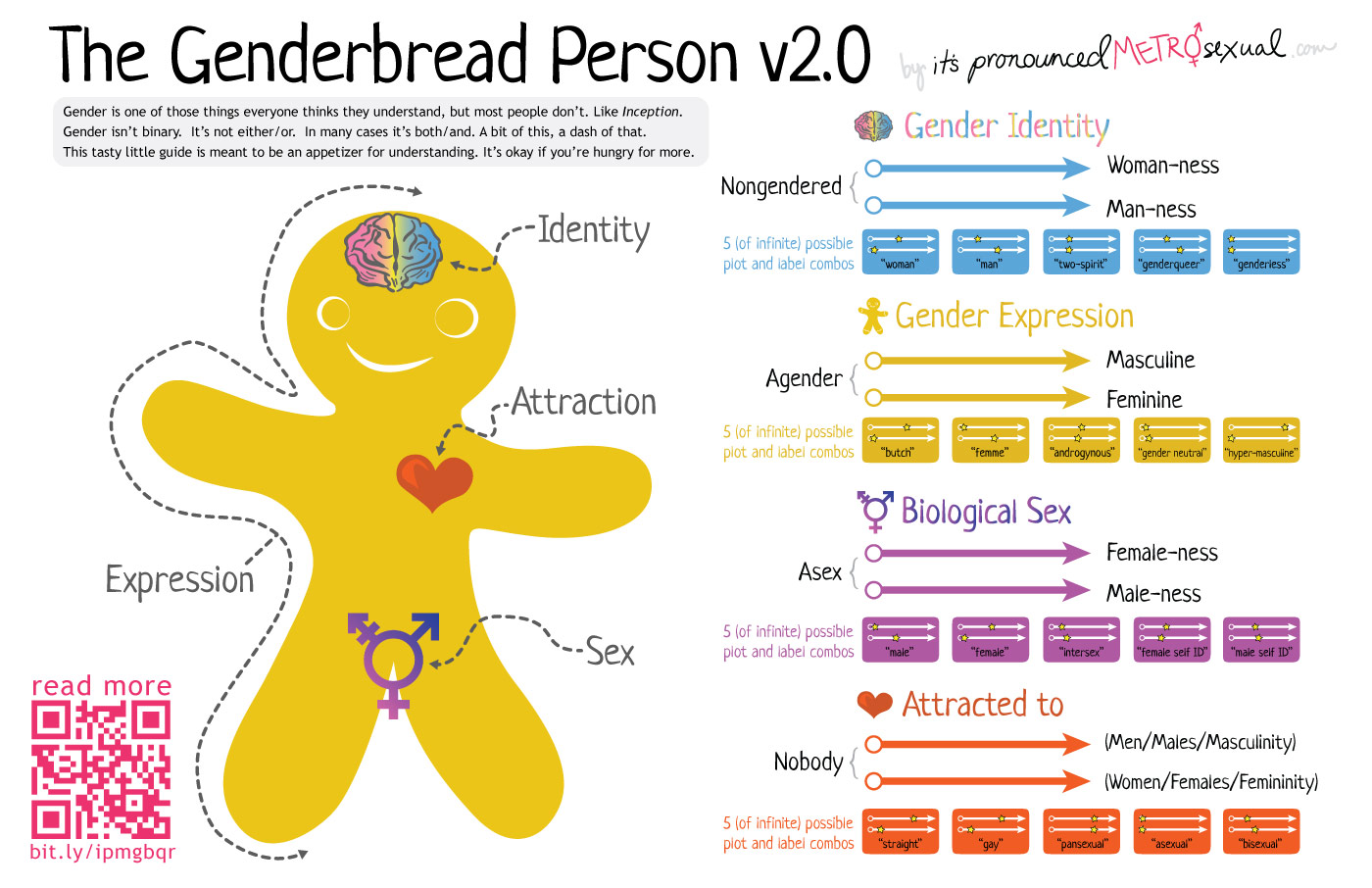
If you relate to this dilemma, let me help you out.  Here is my little friend, The Genderbread Person 2.0

Genderbread-2.1

I know it is confusing at first.  You may notice that each category is on a continuum.  That is because these things are not completely black and white.

Gender Identity: Here we have the most commonly known terms “male” and “female” as well as other possibilities.  This is a person’s truest gender and can only be determined by that person.  Always, when referring to people, use words that line up with their gender identity. If that is unknown or they identify as something like “genderqueer” or “genderless” then gender neutral pronouns  such as “ze” or “zir” may be appropriate.  It is never ok to call a person “it”.

Gender Expression: Not to be confused with biological gender or gender identity, gender expression refers to outward things such as clothing, hairstyle, and mannerisms.

Butch: gender expression that is toward the masculine side

Femme: gender expression that is toward the feminine side

Androgynous: gender expression that has characteristics of both the masculine and the feminine

Gender Neutral: gender expression that is neither characteristically masculine nor feminine

Biological Gender: This is a person’s physical gender. While we generally refer to people in terms of male and female, some people don’t fit very well into either category.   We are not all born with clearly male or female genitalia.  Those who have both male and female physical characteristics at birth are said to be “intersex”.   (Here is where I discourage use of the term “hermaphrodite”, which is no longer appropriate.)

Attracted to: (Also often referred to as “sexual orientation”) Just like the heading says, it really is all about who you are attracted to.   Please don’t question someone’s sexual orientation.  If you say you are hungry for tacos, it would just be silly to tell you that you really want lasagna.

Straight: a person who is generally attracted to people of the “opposite” gender.

Lesbian: a woman who is generally attracted to women.

Gay: a man who is generally attracted to men.  (“Gay” is also used when referring to lesbians.  Lesbians are gay, but gay men are not lesbians.)

Bisexual: a person who is attracted to both men and women.

Pansexual: someone who can be attracted to people of any biological gender or gender identity.

Asexual: someone who has little to no sexual attraction to anyone.  Again, please do not question this.  If you say you are not hungry, it would be rude of me to say that you have just never tried good food or don’t know what you like or want.  Also, do not say that most women are asexual.  This is untrue and offensive.

And now for some other terms that you may be wondering about.

LGBTQ: This refers to the subset of humans who do not fit the mold of  “cisgender person who is only attracted to persons of the opposite gender”. The letters stand for Lesbian, Gay, Bisexual, Transgender, and Queer or Questioning. There are other acronyms such as QUILTBAG, and sometimes people will leave out a letter or two that they don’t like. I hate to say it but there are some in the LGBTQ community who, in spite of everything they have experienced, have a hard time accepting those unlike themselves. Personally, I think the entire culture is becoming more accepting and that includes the queer community. GLBT is the same as LGBT, just with a couple letters switched. I’m sorry I can’t cover the whole queer alphabet soup, so if you hear something and wonder about it, there is always Google.

Cisgendered: a person whose biological gender and gender identity match from birth.

Transgender: a person whose biological gender at birth is different from their gender identity. Transgender persons may be Male to Female (MTF) meaning that their biological gender at birth was male, but their gender identity and therefore true gender is female; or Female to Male (FTM) meaning that their biological gender at birth was female, but their gender identity and therefore true gender is male.  “Gender dysphoria” is the term for the negative feelings a transgender person has toward their biological gender before transitioning.  This feels much the same way a cisgendered person would if they woke up one day and found that their gender had changed while they slept.  The difference would be that the transgender individual would be expecting to wake up in the wrong body – so there might be somewhat less screaming from shock involved.

When referring to a transgender person, always use terms associated with their gender identity, not their biological gender.  Terms like “he-she” or “shemale” are completely unacceptable in this context.  They tend to imply that the person is a sex-worker.  Transgender persons often dress based on their gender identity, take hormone replacement therapy (HRT), and have surgery so that their body matches their gender identity.  It is impolite to ask them where they are at in the process or for details on how these things work.  If you want information on what transgender individuals go through physically, look it up.  Would it be appropriate if I asked you what your genitals look like and what hormones you have in your body?

Queer: used as an umbrella term to cover anyone who is not exactly straight and cisgendered.  Some people still feel negative vibes are associated with this word, so I personally would not use it to refer to an individual unless they first used it to refer to themselves.   It can be used to refer to the whole community when alphabet soup gets tedious.

A: This is another letter that is sometimes added to the alphabet soup.  It stands for Allies.  If you are straight and cisgendered, but support equal rights for all, you are an Ally.  Wear the title proudly.  (Just please don’t try to make yourself sound cool by using this title if you don’t actually support anti-discrimination laws and gay marriage. Many in the community can respect you for being on the fence or even not wanting these laws, but don’t try to pretend you are doing us favors simply because you don’t use cruel language or don’t tell people we should be killed.  It shows that you have no idea what it is like to be us.) If you are an ally, we welcome you to the community and thank you for your support.

If you are still a little worried that you will use the wrong word at the wrong time, take heart.  The important thing is that people know you are trying to choose kind and appropriate words. Don’t be afraid to apologize if you make a mistake or ask if you are not sure about something. If you don’t insist on using offensive language, most people are more than willing to overlook a few mistakes.

Ok, wow! If you made it through all of that, you deserve a little fun.  A friend showed me this. Maybe you will like it.  If you have an iphone, take it out, press and hold the button, then ask, “Siri, are you a boy or a girl?”  Siri will likely say something along the lines of, “Animals and nouns have genders.  I do not.”  It is easy to imagine Siri as a woman because ze has a “woman’s voice”  in English (American).  If, however, you  switch to English (United Kingdom) ze suddenly has a “man’s voice”.  While I have a tendency to prefer thinking of zir as a woman, ze is genderless. I now respect Siri’s gender identity and use gender neutral pronouns.