Reflections on Malala, Patriarchy, and Homeschool Advocacy

Malala

By Nicholas Ducote, HA Community Coordinator

There are too many homeschooled girls who need help overcoming the legal obstacles their parents put in their path to a college education. It also bothers me that the leaders of the Christian homeschooling movement preach that young girls shouldn’t get a “regular” education – that they should only be trained in domestic arts and “female” tasks.

Some choice quotes from the Men’s Leadership Summit:

…It is the fathers who have a duty of lovingly leading their family, and fathers, not moms, will be overseeing the home education discipleship of their family.

…the movement within home education circles of creating an androgynous educational system where we view boys and girls as having the very same outcomes of careerism and world independence is contrary to the principles of the Word of God, which teaches that we should be training our daughters, ultimately to prepare themselves for the assumption . . . –and the assumption is, they will be married, they will be keepers at home.

…We will lose this movement and this work of God, men, if we do not govern our households. And that means lovingly shepherding our wives. The less you love your wife and the less you shepherd your wife, the more you create an open door for the female sin of the internet. The male sin of the internet is pornography. The female sin of the internet is gossip-mongering… They spend their day going from blog to blog gossiping. And some of you are letting them.

…The world is watching. When the lesbian, feminist, transgender publishing house Beacon Press decided to release their exposé this month on families that believe in large households, they knew exactly who to go for. Go to the internet assassins. Go to the blogosphere gossips and get the information to denounce and divide the homeschool movement directly from the wives who live on the internet, gossiping 24/7.

What is especially disturbing is when you hear Malala Yousafzai talk about how the Taliban in the Swat Valley of Pakistan wants to take education away from girls. You would hope, in the 21st century, young women would have basic access to education.

I will be loud and proud about my homeschooling advocacy because my heart is broken on a regular basis when homeschooled teenagers trapped in fundamentalism contact me trapped, struggling to assert themselves and pursue the future they want. Sometimes parents deny FAFSA signatures, or they edit their transcript if they apply to an “unapproved” school. I have talked to homeschooled girls who were literally trafficked (for sex and for labor).

Enough is enough.

“Biblical” Parenting, Part Three: An Extremely Controlling Parent

Screen Shot 2013-10-04 at 3.03.00 PM

HA note: The following is reprinted with permission from Latebloomer’s blog Past Tense Present Progressive. It was originally published on August 30, 2012.

*****

Also in this series: Part One: Introduction | Part Two: A Parent Who Assumes The Worst | Part Three: An Extremely Controlling Parent | Part Four: A Parent Who Tries to Change Minds and Hearts through Spanking | Part Five: A Parent Who Isolates In Order to Control | Part Six: Concluding Thoughts

*****

Part Three: An Extremely Controlling Parent

To briefly review, my first criticism of Reb Bradley’s book “Child Training Tips” discussed the way his advice pushed parents toward the worst possible interpretation of their child’s behavior at the expense of mercy and understanding. Now here is my second criticism.

Criticism #2:   Parents are urged to exercise an extreme level of control of their child’s mind and body, which prevents the child from preparing for adulthood.

Reb Bradley is very straightforward about what he considers the primary task of a parent.  Several times throughout the book, he reminds parents that their goal is to subdue their child’s will: “keep your objective in mind – subjection of their will” (p. 44); “since the goal of child training is to help a child learn to subdue his self-will, parents must take every opportunity to subdue it when it manifests itself” (p. 60); “the child whose will is not subdued in the first few years of life is hampered in the maturing process” (p. 29).

Why do parents need to take control of their child’s will? Reb Bradley explains his reasoning this way: “maturity is rooted primarily in self-control which, in turn, facilitates growth in wisdom and responsibility.  The most basic objective of training children, therefore, is the subduing of their self-will.  From the time children are born, parents must develop in them the ability to say ‘NO’ to their own desires and ‘YES’ to their parents” (p. 28).  In other words, he sees self control is a basic component of maturity and thinks self-control is achieved through imposing external controls upon the child.

I certainly don’t dispute the importance of developing good self-control, especially in light of the “marshmallow challenge” research conducted at Stanford University.

In this experiment, the researchers left young children alone in a room with a large fluffy marshmallow, telling them that they could choose between eating that one marshmallow right away, or getting two marshmallows if they waited for the researcher to return to the room (adorable video here). The researchers discovered that the kids who had the ability to exercise self-control at age 4 went on to experience more success in academics and in adulthood.  So why were some children more able to exercise self-control than others?  After hundreds of hours of observation, researchers determined that “the crucial skill was the strategic allocation of attention. Instead of getting obsessed with the marshmallow…the patient children distracted themselves by covering their eyes, pretending to play hide-and-seek underneath the desk, or singing songs from Sesame Street.  Their desire wasn’t defeated–it was merely forgotten.”  Dr. Walter Mischel, the Stanford professor who headed the experiment, explains, “If you’re thinking about the marshmallow and how delicious it is, then you’re going to eat it….The key is to avoid thinking about it in the first place.”

So Reb Bradley and I agree that self-control is important; what we disagree on is how to help a child develop self-control.

I think that parents who rely on excessively authoritarian parenting techniques are actually hampering their child’s development of self-control; a “subdued” child who simply follows orders to avoid spankings will likely be unprepared for the freedom of adulthood.  

Going back to the marshmallow challenge, Mischel found that when he “taught children a simple set of mental tricks—such as pretending that the candy is only a picture, surrounded by an imaginary frame—he dramatically improved their self-control. The kids who hadn’t been able to wait sixty seconds could now wait fifteen minutes.”  Mischel explained, “Once you realize that will power is just a matter of learning how to control your attention and thoughts, you can really begin to increase it.”

The parents’ task, then, is to give their child the tools to increase their child’s chances of success.  Parents can help their child identify natural rewards and natural consequences of decisions, and parents can help their child develop helpful mental patterns such as how to pay attention and how to distract themselves.  These tools, along with the determination of a strong will, will better prepare the child for the realities of adulthood.  Reb Bradley’s approach of spanking the child for disobediently eating the marshmallow doesn’t give the child any tools that will last into adulthood.

A potentially more harmful aspect of the total control that Reb Bradley promotes involves bodily ownership.  It appears the he considers parents to be the owners of their child’s body; to him, a child attempting to establish personal space is actually rebelling against the parents.  In his book, he lists the following actions as examples of “active rebellion”: “a child moves their shoulder away from a parent reaching out to touch or embrace him” (p. 76); and “walking along, a parent reaches down and takes their child’s hand and the child attempts to pull it away (If the child is in pain because the blood in their hand has drained to their shoulder, and gangrene is setting in, they should be able to respectfully ask to have their hand back.)” (p. 77); also “after being placed on their parent’s lap, they attempt to get off.  They should be permitted to respectfully ask to get down, but only after the parent is satisfied that they are willing to remain” (p. 77); finally, “while being held in their parent’s arms a toddler struggles to get down” (p. 77).

In other words, a child is not allowed to refuse a hug or touch, refuse to hold hands, or exit a lap or arms without verbal permission.  

This type of training–overriding a child’s sense of bodily ownership and personal space–could be extremely dangerous for the child, making them an especially easy target for a predator because the child has fewer personal boundaries to overcome.

This danger becomes even greater when combined with Reb Bradley’s other advice to parents.  He tells parents to require their children to show an excessive amount of respect to people in leadership and people who are older than them.  He explains, “The Bible commands…that children respect…a church leader, or just someone older” (p. 119).  He continues by explaining what the word respect means to him: “Respect: to treat those in authority with the realization that they have power in your life.  It means that when they speak, you listen and obey them, fearing the consequences they could bring for disrespect” (p. 120).

Once again, we see that something positive, like treating people with respect, has been taken to an unhealthy extreme in this book due to Reb Bradley’s obsession with obedience and authority.  A child who regards every adult as an authority, who has no practice saying no to an adult, who has no sense of bodily ownership or personal space–that is an incredibly vulnerable child!

But there’s more: Reb Bradley also takes away the child’s only remaining defense against predators: parents who are open for communication.  “Unless it is an emergency,” he says, “children should never be permitted to criticize those over them in authority” (p. 124).

Growing up should be a process of learning how to take care of your needs, make good decisions, and keep yourself safe.  That is what maturity looks like, and the ability to follow orders has very little to do with that.

Reb Bradley seems to think otherwise; he claims that “learning to honor adult authority when young prepares a child for future adult relationships in areas of work, social relationships, and citizenship” (p. 119).  Perhaps it has been too long since he participated in the culture outside of church events.  Regarding work: with some exceptions, most employers today value qualities that authoritarian parents unknowingly suppress, such as the ability to innovate, show initiative, and solve problems.  Adult social relationships are about communication, understanding, and cooperation, which are also skills that authoritarian parenting does not allow children to practice.  Citizenship, besides the usual payment of taxes and such, is about looking out for the best interests of the country and your neighbors, which sometimes involves activism against leaders who are abusing their power.  And for those who join the military and other similar professions, where unquestioning obedience to authority is valued–joining was an adult decision, and it comes with appropriate training, such as boot camp.  For most of society, life is certainly is not all about obedience to authority; I’m sure I’m not the only one who felt like a  confused and vulnerable little kid inside for years after entering independent adulthood, struggling to get the tools I needed to operate in the world as an adult.

However, the concept of absolute authority and total submission is so important to Reb Bradley that he even gives special instructions to parents who want to start this type of parenting approach when their children are older.  “Give them a time period (perhaps 6-8 weeks), during which all parental commands will be given without reasons, and no appeals will be considered” (p. 48).

How did Reb Bradley choose that 6-8 week amount of time, you ask?

Well, he admits to being inspired by the length of boot camp, and it seems clear that he sees this as a type of boot camp experience for the unsuspecting child.  

He continues: “explain to them that if at the end of the time period, they consistently obey quickly and respectfully, then you will begin to give wisdom behind your commands…..The reasons you give will be brief and may not be discussed at the moment of instruction” (p. 49).  Oh wow, what a great reward for the totally obedient child!  Allowing them to hear a brief explanation later–really, it’s so generous of the parent.  Yes, that was sarcasm, but this book certainly gives parents the impression that children ought to sit around eagerly waiting for the crumbs to fall from their parents’ table of wisdom, and that the parents are very generous to share at all.

In urging parents to withhold information from their children, Reb Bradley seems to put parents in the role of God in their children’s lives.  Or, at the very least, he sees parents as siding with God against their children.  Discussing the Biblical story of Job–the righteous man who suddenly lost all his children, wealth, and health for no discernable reason–Reb Bradley focuses in on the unresolved ‘why’ of the story.  “Although God could have explained to Job His reasons for allowing the trial, He never did tell Job ‘why.’  He would not honor Job’s disrespectful insistence on an answer.  Even after Job finally humbled himself and repented of his pride, he received no answer from God” (p. 51).  Although the obvious application of the story is that sometimes good people suffer, and we can’t always know the reason why, Reb Bradley decided to put a different spin on it: “as parents we must follow God’s example and not reward our children’s disrespect” (p. 51).

Holding so much power over another person is not something that humans handle well.

This is famously illustrated by the Stanford Prison Experiment run by psychology professor Philip Zimbardo.  In this experiment, a group of seemingly normal college students were randomly assigned to play the role of either prison guard or prisoner.  The prisoners were given new identities and placed in a mock prison, and the prison guards were told to keep order.  According to the Wikipedia article, “the participants adapted to their roles well beyond Zimbardo’s expectations, as the guards enforced authoritarian measures and ultimately subjected some of the prisoners to psychological torture. Many of the prisoners passively accepted psychological abuse and, at the request of the guards, readily harassed other prisoners who attempted to prevent it. The experiment even affected Zimbardo himself, who, in his role as the superintendent, permitted the abuse to continue.”

How long did it take for things to get out of hand?  The entire experiment had to be stopped early, at the insistence of Zimbardo’s girlfriend, after only 6 days.

 In my opinion, there are far too many similarities between the mentality of the prison experiment and the mentality of this version of “Biblical” parenting.  

The parents, like the prison guards, are told that they are managing bad people; in addition, like the prison guards, the parents are also told that they have absolute power over those people.  It shouldn’t be surprising that in many cases, the parent-child dynamic gets completely out of hand and becomes abusive.  After all, haven’t we learned by now that “power corrupts; absolute power corrupts absolutely”?

In summary, Reb Bradley’s extreme emphasis on authority and obedience hinder children’s ability to develop the skills they need for adulthood.  The child, as a result, is likely to be more vulnerable, while the parent is at risk of developing abusive habits from holding so much power.

*****

To be continued.

It’s Not Always Rainbows and Roses Now, But: Eloah’s Story

rose

HA notes: The author’s name has been changed to ensure anonymity. “Eloah” is a pseudonym.

I promised a long time ago that I would write something for Homeschoolers Anonymous, but it has been hard to put these feelings to words to pixels.

I wanted so badly to contribute something positive, constructive, maybe even hopeful, to what I feared could well turn into a chaotic frenzy of confessions and self-justifications.

But I also wanted to tell the truth. Honesty, if I learned nothing else from my mistakes, is I believe the paramount virtue. I value it above—well, practically all else.

Honesty is what has brought miraculous healing to some very broken relationships, including those with my parents.

Relationships that were broken as a result of the culture fostered in the homeschooling circle I grew up in.

You see: My parents raised me to know good from bad, right from wrong, and to see things in black and white. And if there was ever confusion about which was which, the adults surrounding me had strong opinions about it that they forcefully fed to their young.

At a very early age, I learned to parrot what I heard, even if I didn’t understand or agree with it. I could passionately espouse a strong opinion in public that was either ill-formed with virtually little thought, or precisely the opposite of what I really felt.

Because I sensed that there was no room for error, I quickly became an expert liar. Even now looking back, I don’t think I realized I was doing it. My outward expressions I believe were genuine attempts to force myself to “be good” and to meet the judgmental approval of my friends’ parents and my parents’ friends.

I thought maybe if I said something long enough, and adopted a self-righteous attitude about it, I could come to believe it, accept it and maybe even agree with it.

Never, ever underestimate a child’s need for approval from adults, especially her parents.

Why would I strive so hard for approval from people who gossiped hours on end about others, their mistakes and their “sins”? (If you can call listening to rock music, going on dates with boys, wearing pants and going to college as a female “sins.”)

Because I knew they would eat me alive if I didn’t meet their expectations—in a figurative sense, of course. But the last thing I wanted was to be a topic of hypocritical and self-righteous conversation. I dreaded the punishments—the intense, oppressive groundings that were meant to treat the aforementioned sins.

This is why it’s remarkable that I did what I did, at that Master’s Conference in 2003. It was in Birmingham, my hometown, and a boy I flirted with sometimes was on guest staff with Communicators for Christ, which puts on the communications conference/tournament.

I was almost 18. I kissed him in a stairwell between rounds one day. Or he kissed me. Who ever knows? It was my first kiss, and I was giddy and excited and happy and all of those emotions that come with your first.

Except somebody saw or found out, as they inevitably do in those circles, and it got back to my parents. And before I knew it, the family staying with us that week had learned of it. And the mother called me a slut, in front of my family and hers, and said she would not trust me alone with her son (who happened to be quite a few years younger than I).

If I had committed murder, I might have met more sympathy.

I resigned from the Master’s worship team, not because I was forced to but because I knew I was expected to.

The emotional roller coaster after all of that doesn’t even need describing. You can imagine for yourselves.

On the one hand I felt liberated at last – “the adults” knew me for what I was: an imperfect human being. No need to go on pretending anymore. But on the other hand, I felt more trapped than ever. I remember one other girl—one considered among homeschoolers as “notorious,” if you know what I mean—reaching out to offer me sympathy and support. “We bad girls need to stick together,” she said.

I was horrified, because I realized I was now a “bad girl.”

I had been branded with the Scarlet A, and there was no living it down. Decent parents would never allow their sons and daughters around me again.

It wasn’t until years later that I realized she probably wasn’t all that bad. She probably wore a short skirt once, or talked back at a condescending parent. Or kissed a boy.

I can’t tell this story without sharing the redemption. Yes, it was ugly for many years, yes my relationships (romantic and otherwise) got progressively dysfunctional. I became a liar about everything—things that didn’t even matter. I hurt people just to hurt them. I rebelled just to rebel. I felt. Trapped.

Until I started speaking up about it.

Until I started talking to my parents, and sharing with them my feelings. Yes, we had many a loud argument with slamming of doors. Yes, they kicked me out, numerous times, but always let me come back. Yes, we disagreed, and there was much weeping and gnashing of teeth, but you know what?

We were hashing things out. We were challenging each other, and learning from one another. And eventually I realized they weren’t wrong about everything, they didn’t hate me and they genuinely did not realize the pressure their behaviors had put on me.

Because I never told them.

And I think maybe they realized that not everyone was formed from the same mold, and that regardless, people are entitled to learn from their own mistakes. And that maybe self-righteousness, judgment, hypocrisy and gossip are also sins.

It’s not always rainbows and roses now, but what I so love and appreciate about my parents (and I think many others from that circle have come to this place now, too) is that they love, respect and see me as a person now – not a parrot. I appreciate that they have been humble, teachable and eager to change their ways so as not to repeat the mistakes with my little brothers. There is a closeness we have now that we never experienced when I was simply walked through life agreeing with them on the outside but confused and trapped on the inside.

And who knows if we ever would have come to this place if I had not spoken up?

I only hope this story gives others the courage to speak up now, if they haven’t already.

“Biblical” Parenting, Part Two: A Parent Who Assumes The Worst

Screen Shot 2013-10-04 at 3.03.00 PM

HA note: The following is reprinted with permission from Latebloomer’s blog Past Tense Present Progressive. It was originally published on August 26, 2012.

*****

Also in this series: Part One: Introduction | Part Two: A Parent Who Assumes The Worst | Part Three: An Extremely Controlling Parent | Part Four: A Parent Who Tries to Change Minds and Hearts through Spanking | Part Five: A Parent Who Isolates In Order to Control | Part Six: Concluding Thoughts

*****

Part Two: A Parent Who Assumes The Worst

The task of reviewing Reb Bradley’s book “Child Training Tips” has been a lot more challenging than I expected.  First of all, where do I start when I disagree with almost every sentence that this book contains?  I can find almost no common ground on which to begin.  And how can I explain my reasons for disagreement when the very things that I see as horrifying are held up as admirable goals by the author?

Because of these difficulties, I have decided that these posts will simply be a way for Present Me to explain to Past Me that this so-called “Biblical” parenting is damaging to individuals and relationships because it sacrifices all other virtues for the sake of authority and submission.

Those quotation marks are around “Biblical” for a reason, and it’s not because of my changed opinions about the Bible.  Instead, it’s because the type of child and the type of parent that this book promotes are not found in the Bible.

It appears that Reb Bradley’s “Biblical research” may have gone like this:

Step 1:  Hmmm, what is my ideal godly child like?  *scribbles some notes*

Step 2:  Ok, now I’ll dig up some random Bible verses that seem to support my idea of a godly child, regardless of whether those verses are about children or parenting. *Adds a few Bible verses here and there*

Step 3:  *Reads notes*  Wow, what a high standard–it must be from God!  Obviously, children who are left to themselves will never become that way.  I guess that means parents have to take charge.  What are some control tactics?  *Finishes book*

To be fair to the author, I do believe that Reb Bradley is a good-hearted and caring person, despite everything that he has written in his book.   However, I think he doesn’t realize that he and his wife, very busy with their pastoral responsibilities and not at all detail-oriented, probably implemented these parenting techniques very differently than many other parents.  Many fundamentalist homeschooling parents, who are the primary audience of the book, spend far more time supervising their children and are much more focused on details.  With those parents, these parenting techniques can quickly escalate from bad to abusive.

With all of that in mind, here is my first criticism of Reb Bradley’s “Child Training Tips.”

Criticism #1: Parents are pushed to assume the worst about their children instead of being encouraged to demonstrate the virtues of mercy and understanding.

The evil nature of children is one of the premises of the book, and parents are actively cautioned against thinking otherwise: “One dangerous, humanistic idea…is that children are basically good” (p. 18).  The role of parents, therefore, is to work against their children’s natural badness, to “bring them up to maturity by twisting them against their nature.  Twisting requires firm effort, sustained throughout their childhood.” (p. 17).

This belief in the depravity of children is unfortunately not unusual in Christian circles; however, this book takes that belief to a whole new level by continually pushing parents toward the worst interpretation of their children’s behavior.   Some of the more horrifying examples of this negative and suspicious parental attitude are in regards to the discipline of young children.  As the mother of a toddler myself, I found myself absolutely speechless and heartbroken numerous times as I read.

Many attentive parents will notice that in the first few months of life, their babies develop an important skill–the ability to turn their heads toward a sound.  This skill is important not only to help keep the babies safe, but also to help them notice what is going on around them so they can learn about the world.  This inclination to look towards sounds, especially unexpected sounds, is reliable enough that medical professionals have historically used it to test for hearing loss in infants and toddlers.   However, to Reb Bradley, a baby’s inclination to look towards a sound means something completely different.

To him, it means that the baby is capable of understanding and rebelling against a parental command.  

He explains it this way: “If your crawler reaches for the stereo, walk over, offer a firm ‘No’ and clap your hands once.  If they respond to your voice and the sharp sound of the clap and turn away, they got the message and should be held accountable from then on.  You may even want to skip the clap” (p. 134).  In this example, we see that the parent must not only assume that the infant understood the reason for the sudden noise at that time, but also that the infant will remember the meaning of that particular clap forever.  The parent is pushed to see a confused or forgetful infant as rebellious instead.

A second example can be found in Reb Bradley’s abysmal understanding of language development: “To test a toddler’s understanding of your vocabulary, without showing him anything, offer him a familiar treat, like ice cream or a bottle.  Does he respond?  If he does, then he is old enough to understand a simple direction such as, “Come here, son,” and should be chastised each time that he chooses to defy your authority” (p. 134).  Admittedly, I do have an advantage here because of my linguistic background and my experience in teaching a foreign language, but I’m sure that I’m not the only one whose jaw dropped from reading those lines.  Even for adults who are learning a second language, who have far more life and language experience, it doesn’t work this way.  For instance, an adult language student who understands the question “how are you?” does not automatically understand even a variation of that same question, such as “how’s it going?”

If the small difference between “how are you” and “how’s it going” is not automatically understood by an adult, how can a toddler be expected to make an even greater leap of understanding?  

Knowing the name of a favorite object like “bottle” is a relatively simple language task; recognizing a string of multiple words and realizing that an action is required in response is an entirely different skill.  Even worse, there are many different forms that a so-called simple command can take, such as the negative commands “no hitting,” “don’t hit,” “I told you not to hit,” “stop hitting,” “you must not hit,” “we don’t hit,” etc., and the positive commands “eat your carrots,” “please finish the carrots”, or “you need to eat those carrots.”  Adding to the complexity, parents often verbalize observations or make suggestions that sound a lot like commands to the language learner, but aren’t.  For instance, my toddler often hears “turn the page” while we are reading books together, even though I am simply letting him know that he can turn the page if he wants to (if he’s not too busy sucking his thumb, that is).   Once again in this book, we see the toddler is held to impossible expectations, and the parents are pushed to assume defiance rather than enjoying the beauty of newly blossoming language ability.

A third example is Reb Bradley’s troubling assumption that toddlers naturally cry when they see their parents coming, and that their crying is due to guilt.  He explains it this way: “Although some rules are never spelled out, and some behaviors are never specifically prohibited, our children still know better.  They intentionally disregard what they know will please you.  What gives them away when they are caught, is behavior which suggests a violated conscience….The toddler who is caught in the bathroom unrolling the toilet paper, may not have been specifically forbidden to unroll the tissue, but the tears he sheds, and the haste with which he continue his deed as he sees his mother approaching, verify that he knows he is doing wrong” (p. 80-81).   The world must be an irresistible place to toddlers, whose new mobility allows them to access a constant stream of new experiences.  Each object is like a small physics lesson: what does it feel like?  How heavy is it?  Does it taste good?  What happens when I drop it?  Can I put it inside of another thing?  Does it come apart?  With so many things to learn in such a short time, a baby needs a healthy curiosity and a drive to discover.

Sadly, it never seems to cross Reb Bradley’s mind that the exploring toddler with the toilet paper could be crying out of fear of the parent, not from guilt.  

Perhaps too many times the toddler, engaged in a fascinating new discovery, had been stunned and confused by a sudden punishment; perhaps now the toddler fears a similar response from the parent, and cries accordingly.  Is there really something so obviously bad about unrolling toilet paper that even a baby can recognize it as “sinful” and feel guilty???  In my own experience with my very curious toddler and his little toddler friends, I have absolutely never seen this reaction.  Instead, my toddler beams at me and tries to show me what he found.   Of course, if I have to take it away from him for his own good, he is upset, but that doesn’t stop him from beaming at me over his next discovery.  His reaction is a positive one because he has no reason to be afraid of me.

Infants, crawlers, and toddlers are not the only victims of the suspicious parental attitude and impossible expectations that this book promotes.   Parents are also actively encouraged to assume the worse of their older children, and to act accordingly.

Parents are told, “Never give instructions more than once” (p. 53), with no acknowledgement that a child could have a legitimate need for repetition.  I know from personal experience and observation that even adults can fail to hear a person speaking to them when distracted or absorbed in a task.

Surely a child is worth the same consideration that we give to an adult in such situations.

In fact, children should deserve even more benefit of the doubt, since their hearing sensitivity develops slowly throughout childhood.  According to “What’s Going On In There?”, an excellent book about cognitive development written by a neuroscientist mother of three, “newborns are virtually deaf to quiet sounds, and…babies remain hard-of-hearing at six months, when their auditory threshold is still some 20 to 25 decibels higher than adults.  Thereafter, it gradually improves until puberty.  Thus, toddlers and pre-school-aged children still have hearing thresholds about 10 decibels higher than adults” (Eliot p. 245).

Also relevant is the time that it takes for children to learn to identify important sounds from background noise, something that most adults take for granted: “children’s ability to distinguish signal from background noise does not fully mature until about the age of ten” (Eliot p. 246).

Yet according to Reb Bradley, children not only shouldn’t receive instructions more than once, they also should not receive any warnings before punishment: “Warnings make you an accomplice to their crimes.  By not bringing immediate consequences, you are aiding and abetting them in their disobedience…..never threaten to spank” (p. 55-56).

This guilty-until-proven-innocent attitude is maddeningly combined with a refusal to allow the child to communicate at the relevant time.  

A child who attempts to explain himself is simply trying to avoid responsibility: “there are no good reasons for disobedience (Except in case of emergency, of course.)  When confronted with their defiance they should not be permitted to offer an excuse.  If trained well, it might not even enter their minds to offer a justification…..A parent should first establish a child’s guilt and have him accept responsibility, and then find out the reason why” (p. 58-59).

Why should parents refuse to listen to their child’s perspective before assigning guilt?  Because, Reb Bradley says, they might be tempted to show mercy when they hear their child’s point of view: “Parents accept excuses because…they put themselves in their children’s place, and know they would want mercy if it were them” (p. 60).

So, to be clear, Reb Bradley thinks that accepting any excuse and showing mercy would be a bad thing because it weakens parental authority.

One has to wonder when reading this if Reb Bradley sees Jesus’ mercy and acceptance as a sign of God’s weakness as well.

Tragically, parents are even discouraged from showing mercy to their children in special circumstances.  Reb Bradley cautions parents against adapting their approach or changing their standards for any reason.  He says, “every child is different from all others, but that does not mean they can be held to different standards.  God’s standards are the same for everyone” (p. 135), and he specifically includes special needs children in that statement: “Yes they are harder to train than a ‘normal’ child, but God’s standards are the same.  In fact, the parent must apply the same principle of child training to the special needs child as to any child” (p. 137-138).

It would certainly be convenient if we could judge every person by the same standards, but even Bible-believing Christians can’t agree about what those standards are or how to apply them.  There are too many variables and too many unknowns, even within the same cultural context.  Adding to the complexity is the fact that people often fail to understand themselves properly, so how can we accurately judge another person reliably?

It certainly isn’t as simple as Reb Bradley seems to believe.

These verses from the Gospel of Matthew do a much better job at acknowledging the complexity of life when they warn against over-confidence in our own perspective: “Do not judge, or you too will be judged. For in the same way you judge others, you will be judged, and with the measure you use, it will be measured to you. Why do you look at the speck of sawdust in your brother’s eye and pay no attention to the plank in your own eye? How can you say to your brother, ‘Let me take the speck out of your eye,’ when all the time there is a plank in your own eye? You hypocrite, first take the plank out of your own eye, and then you will see clearly to remove the speck from your brother’s eye” (Matthew 7:1-5).

But, you ask, what if your children are sick, sleep-deprived, or under extra stress?  Is a parent allowed to be more tolerant and merciful then?

Reb Bradley believes the answer is no.  

Regarding sickness, Reb Bradley says parents must not change their standards because “some children find such solace in the tolerance shown them during an illness that they convince themselves they are sick much of the time” (p. 113).  In other words, showing mercy to your sick child will cause them to act sick even when they aren’t.  Regarding hunger, fatigue, and irritability, he adds that “many parents excuse their child’s misbehavior if the hour is late or if they have missed a nap.  This reinforces to the child that they needn’t always exercise self-control” (p. 113).   Thus we see that parents are encouraged to be be suspicious that a sick child is simply trying to avoid responsibility, and that a sleep-deprived child is simply taking advantage of the opportunity to act out.

Reb Bradley occasionally stops to warn parents against excessive harshness, or advises them to discipline themselves to show love to their children, but frankly those few sentences don’t mean much after reading page after page, chapter after chapter of advice that pushes parents in the opposite direction. And even more telling is the lack of a single positive sentence about children in the entire book; even the few warnings against harshness don’t speak positively of children.

In summary, the parenting style modeled in Reb Bradley’s book is excessively focused on parental authority, to the point of specifically urging parents to sacrifice understanding and mercy anytime that those virtues might interfere with establishing or maintaining their authority.

*****

To be continued.

“Biblical” Parenting: A Review of Reb Bradley’s “Child Training Tips”

Screen Shot 2013-10-04 at 3.03.00 PM

HA note: The following is reprinted with permission from Latebloomer’s blog Past Tense Present Progressive. It was originally published on August 22, 2012.

*****

Also in this series: Part One: Introduction | Part Two: A Parent Who Assumes The Worst | Part Three: An Extremely Controlling Parent | Part Four: A Parent Who Tries to Change Minds and Hearts through Spanking | Part Five: A Parent Who Isolates In Order to Control | Part Six: Concluding Thoughts

*****

Part One: Introduction

Every once in a while, I realize something shockingly obvious, something that confronts yet another false assumption that has managed to cling to my mind even as I’ve moved further and further away from my fundamentalist Christian roots.

In the whole Bible, there is not a single verse that credits parents for having raised a good child.

Nothing from God, nothing from any adult sons or daughters in the Bible.  Not one word of thanks, not one word of credit.

It would be easy to insert a few parental credit verses into the Bible.  Maybe we could add a little phrase here or there in the Old Testament, such as “King David, because of his godly parents,” or “Moses, thanks to his childhood training;” or maybe we could stick something in the New Testament epistles: “The fruit of the Spirit and of spanking is self-control.” No? Perhaps the Gospels then?  Maybe Jesus on the cross could say something like, “I couldn’t have gotten where I am today without the support of my godly mother Mary.  There she is, people.  Let’s give her a round of applause!

But those verses are not there.

So why do fundamentalist Christian parents today feel they have so much control over their children’s destinies?  

Why do they think that they can help their child get closer to God by getting in the middle?  Why do they put so much pressure on themselves, considering themselves failures if their children grow up to take a different path?

In the homeschooling circles that I was raised in, many of these unhealthy ideas about parenting came from several books that claimed to be about true “Biblical” parenting.   First on the market was a 1979 book by Richard Fugate, called “What the Bible Says About Child Training.”  Fugate’s book appears to have inspired two other books that surpassed his own book in popularity: Michael Pearl’s 1994 “To Train Up A Child” and Reb Bradley’s 1995 “Child Training Tips.”

Based on these books, the small collection of homeschooling families who attended Reb Bradley’s church Hope Chapel along with my family had high hopes for their children.  Yet in the dozen years since, many sincere and dedicated parents have seen all their work fall apart before their very eyes as their children reached adulthood, or even earlier.

I am one of many who didn’t “turn out right,” yet another disappointment to the former parents and leadership of Hope Chapel.

Everyone responds a little differently to poor results.  Some, like Michael Pearl, laugh at the critics and refuse to self-reflect at all.  Others, like Kevin and Elizabeth Schatz, who were just young parents when we attended Hope Chapel together in the late 1990s, apparently felt that they could avoid poor results by doubling down in intensity on poor little Lydia Schatz, who was disciplined to death in 2010 at age 7.

Of all these responses, I find Reb Bradley’s 2006 blind spots article, “Solving the Crisis in Homeschooling”, to be the most promising because it represents a very small step in the right direction.  Here is a quote from the introduction to the article, in which Reb Bradley acknowledges the unexpectedly poor results:

“In the last couple of years, I have heard from multitudes of troubled homeschool parents around the country, a good many of whom were leaders. These parents have graduated their first batch of kids, only to discover that their children didn’t turn out the way they thought they would. Many of these children were model homeschoolers while growing up, but sometime after their 18th birthday they began to reveal that they didn’t hold to their parents’ values.

Some of these young people grew up and left home in defiance of their parents. Others got married against their parents’ wishes, and still others got involved with drugs, alcohol, and immorality. I have even heard of several exemplary young men who no longer even believe in God. My own adult children have gone through struggles I never guessed they would have faced.

Most of these parents remain stunned by their children’s choices, because they were fully confident their approach to parenting was going to prevent any such rebellion. Some were especially confident, because as teens these kids were only obedient.  Needless to say, the dreams of these homeschool parents have crashed, and many other parents want to know what they can do to prevent their own children from following the same course.”

When I first scanned over many of his points in that article, I was encouraged by the things I saw; acknowledgement that parents don’t have total control over their children’s destinies, a de-emphasis on authority, and a much-needed emphasis on relationship and acceptance.

If only there weren’t this little paragraph at the end of the introduction [emphasis mine]:

“After several years of examining what went wrong in our own home and in the homes of so many conscientious parents, God has opened our eyes to a number of critical blind spots common to homeschoolers and other family-minded people. Bev and I still stand behind what we have taught on parenting in the past. However, we urgently add to it the following insights.”

It is because of that sentence, and because of my own desire as a new mother to deliberately throw out the unhealthy ideas of parenting that I was raised with and around, that I have decided to write a critical review of Reb Bradley’s book “Child Training Tips: What I Wish I Knew When My Children Were Young.”

My critique will be posted in several installments online for the purposes of discussion, and I welcome any comments or feedback from the authors, from parents who have used this parenting approach, from now-grown children who experienced these techniques, from parents who are considering using it, or from horrified online bystanders.

*****

To be continued.

Crosspost: Dear Sister, On Your Thirteenth Birthday

Screen Shot 2013-10-03 at 6.08.50 PM

HA note: The following is reprinted with permission from Libby Anne’s blog Love Joy Feminism. It was originally published on Patheos on October 1, 2013.

I can’t believe you are almost thirteen. 

I remember holding you in my arms when you were a baby. I remember rocking you, smiling at you, cooing to you. I remember your tiny fingers and your dark, soft hair. I remember dressing you, bathing you, cuddling you close. I was always the first to jump up and volunteer to get you up when that sweet plaintive wail came from your cradle.

Thirteen. Wow. You’ve grown so big, so tall and clever. I know what thirteen means. Dad will take you out to dinner and give you a ring. You will put it on your finger and promise him that you will not have sex until the day you marry. I know you will because I did too. And when you say it, you will mean it. I know that. So did I.

But I want you to know something, my sweet little sister. You are worth so much more. Your worth is not defined by what has or has not been in your vagina. Yes I know, hearing that word spoken so openly embarrasses you. I remember. But what I’m saying is important. You have so much to offer the world. You are smart. You have interests. You have talents. Those things matter. In fact, those things matter a whole lot more than the state of your vagina. Yes I know, awkward. But it’s true, and I want you to remember that. You matter.

There’s more, too. It is wrong, what they are telling you. Should you choose not to have sex until your wedding day, your virginity is not the most precious gift you will ever give your husband. In fact, depending on whether or not your husband will come from the same religious and cultural background as you, he may not even see your virginity as a gift at all. And if he doesn’t, don’t hold that against him, okay? The idea that virginity is something of value is “culturally constructed.”

That’s just a fancy way of saying “made up.”

There’s something else I want to tell you as well. You probably think that I didn’t have sex until my wedding night. Well, that’s not true. We almost waited until the wedding, but not quite. Yes I know, telling you that is awkward.

But I want you to know that they are wrong when they saying that having sex before you get married will damage your relationship.

It hasn’t.

I don’t regret doing it, and I don’t think it messed up anything at all. In fact, I wish I hadn’t waited as long as I did. I tell you this not to tell you which way of doing things is right and which way is wrong, because that is up to you and is yours to decide, but simply to give you another perspective.

But the most important thing I want you to know, little sister, is that your body is yours

You get to choose what you want to do with it. You will have people telling you what you can and can’t do with your body, when, and how much, and how far. But you don’t have to listen to them. Your body is yours, and don’t let anyone make you forget that. What you do with it is up to you.  It’s your choice. Own that, and don’t let anyone else make your choices for you.

I’m not going to send this letter to you, little sister, because mom and dad wouldn’t like it. Putting it here is the best I can do. Perhaps someday you will find it, and read it, and then you will know how frequently you are on my mind.

I love you, little sister.

Libby

Courting a Stranger: Samantha Field’s Thoughts

Ben Seewald and Jessa Duggar.

Samantha Field blogs at Defeating the Dragons. This piece was originally published on her own blog on September 19, 2013, and is reprinted with her permission. Also by Samantha on HA: “We Had To Be So Much More Amazing”“The Supposed Myth of Teenaged Adolescence”, “(Not) An Open Letter To The Pearls”, and “The Bikini and the Chocolate Cake”.

This week, the Duggars announced that their daughter, Jessa, had begun a “courtship” with Ben Seewald. News articles have been floating around in my facebook feed about this, and as I read a few of them . . . my heart sank. Many people are mocking the family, Jessa, Ben, her parents, for how they’ve chosen to handle this.

I can’t get behind the mocking.

All I can feel right now is compassion for Jessa and Ben.

It’s an emotion they might dismiss as completely unwarranted– from all appearances, they’re blissfully happy, and this courtship is what they’ve always envisioned for themselves. I don’t know about Ben, but everything I’ve seen from Jessa is familiar territory– she’s carefully “guarded her heart” so one day she could date with “intent and purpose.” The way she’s been taught to respond to romantic relationships probably feels very mature and sensible. It’s designed to be safe. Everything about it is carefully vetted, monitored, and controlled. There won’t be any unexpected surprises for them. This process will help ensure a happy, Spirit-filled marriage.

But, if I could sit down with Jessa over a cup of tea and talk with her, there’s a few stories I would share.

*****

The eldest daughter of my “pastor,” Leah*, was in her early twenties when an evangelist that came to our church every year suggested a young man, Steve*, to her father. Over the next month or so, her father carefully vetted this young man. The first time Steve came to visit, he didn’t even meet Leah. Her father took him out to dinner, then they sat in his truck for hours while he grilled him from pages of notes and questions. Barely any stone was left unturned– but I remember my father commenting offhand that it’s not likely that Steve was really honest about most of those questions.

The next time Steve came, he and Leah were never given a moment’s privacy. They were never allowed to be more than a few feet away from another member of the family. When he left, they were not allowed to talk on the phone, and could only communicate through letters that were read, out loud, in front of the entire family.

They did, eventually, get married. The next thing I heard about her was that she and Steve had not yet consummated their marriage, not even after being married for months. They were complete strangers when they got married. They didn’t know anything about the other– the only person they had gotten to know had been the person her parents expected to see. Without any private moments, without the ability to talk without being constantly monitored, they didn’t really know anything real.

They’d “courted” a performance, not a person.

*****

When I was in college, one of my best friends got married.

Their courtship story was perfect– charming, adorable, romantic in a Victorian sense. Her parents called him her “suitor” and his visits were “calls.” They had no physical contact– her father put the engagement ring on her finger when he proposed on the beach, in the moonlight– in front of their families. When they went through the wedding rehearsal, they held a handkerchief instead of holding hands. Their first kiss was at the altar, and Charity* looked like she was about to burst with happiness for the rest of the day.

It’s been a few years now, since they got married, and they’ve experienced some significant marital “bumps” in that time. There were a few moments when no one was sure if their marriage would make it. My mother was trying to give hers some comfort and advice during one of those hard times, and I remember hearing her start crying:

“I don’t understand, I just don’t understand. We did everything right. None of this was supposed to happen.”

*****

My own courtship experience was . . . ugly.

We “talked,” getting to know each other strictly in group settings, just like we were supposed to. I asked my parents to come meet him, and we all went out to dinner. I made sure that my father had plenty of time to talk with him, to get to know him. John* asked their permission to “court” me, and we did under the supervision of both our parents. By the end of the summer, he laid out his plan for them, what he planned to do and how he planned to accomplish it, and asked their permission to marry me. When he proposed at a fancy restaurant, my parents were sitting at a table directly across the aisle. For the first six months, everything seemed perfect. It was all going exactly how I’d been taught it should.

But, after I had that ring on my finger and I was in the middle of planning a wedding, and after all our families were on board and we’d announced it to everyone we knew… that was when the abuse began in earnest. It was abuse he kept carefully concealed from anyone– abuse I was promised I was protected from, because, after all, we were courting. We’d done everything exactly how we were supposed to.

And I was trapped.

Because I’d been told to guard my heart, that once I give my heart away, I won’t have my whole heart to give to my husband.

Because I’d been taught that it was my duty, my responsibility, to make sure our relationship was perfectly chaste. He knew that– he sexually assaulted me, he raped me, and he used what I’d been taught against me. I was a cup full of spit. I was a half-eaten candybar. I was that rose with all the petals torn off.

No one would want me, I wasn’t good enough for any other man.

*****

That’s what I’d tell you, Jessa, if I could talk to you.

I’d tell you that courtship doesn’t guarantee that you’ll actually get to know that person. I’d tell you that yes, you have to know how a person interacts with people who aren’t you, but you also have to know how he’ll interact with you when no one is watching.

I’d tell you that courtship doesn’t guarantee a happy marriage. There’s no magical promise that is impossible for either one of you to break. Following all the courtship procedures and rules means nothing when you realize that life has changed around you, and you might not believe everything you always did– and he hasn’t changed with you. Courtship doesn’t automatically grant you the ability to communicate without fighting or to have patience with each other. Most of the things you need for a healthy marriage you don’t get through having your parents monitor all your texts and never touching each other longer than a 30-second side hug.

I’d tell you that courtship doesn’t guarantee you won’t get hurt.

People are very capable of hiding. People can be very good at cloaking everything about themselves– especially when they are given an insanely precise checklist to follow. The roadmap, the rules, the procedure– they’re not going to shield you from a man using those rules to get close to you so that he can hurt you.

You might be getting to know this person on an honest, deep level– I don’t know. It’s possible that he’s a genuinely wonderful man and both of you are being completely, bluntly honest. It’s probable that you were raised with the understanding that you never hide anything from your parents– and up to this point, why should you? But, it’s also just as possible that you’re both innocently unaware that you’re not really getting to know each other.

Courtship, you’ve been told, promises a safe adolescent experience, free from the trauma and heartache of a thousand “crushes.” Courtship holds the sweet sanctuary of your parents’ blessing and God’s promises. Courtship is about commitment, and honor, and responsibility, and those are the things that will keep your marriage strong.

And maybe– maybe it will.

But, in the end, if you make it, it won’t be because you courted. It won’t be because of all the questions your father asked him or all the times you wanted to be alone but suppressed the desire. It won’t be because you kissed for the first time after the pastor said “you may.”

It’ll be because of who you are, Jessa, and who he is.

Results of HA Basic Survey, Part Five: Fundamentalism as a Factor in Educational Quality, Abuse, and Other Areas

Screen Shot 2013-09-28 at 9.19.55 PM

Results of HA Basic Survey, Part Five: Fundamentalism as a Factor in Educational Quality, Abuse, and Other Areas

Whether or not respondents were homeschooled in a fundamentalist Christian environment made the most dramatic differences in both educational quality and abuse. The results are fascinating. There are also interesting differences between fundamentalist environments and non-fundamentalist environments concerning HSLDA membership, parental education, and the current level of respondent education.

Before continuing, it is important to note once again that this survey is self-selected and should not be construed as representative of anything other than the 242 respondents that took this survey.

Fundamentalism and HSLDA Membership

While the Home School Legal Defense Association claims to defend any and all homeschoolers, it has a reputation as a conservative fundamentalist organization. There is a plethora of documentation concerning HSLDA’s projects that fall outside mere advocacy for the legality of homeschooling. Those projects are traditional, conservative fundamentalist projects, such as opposition to same-sex marriage and UN treaties as well as support for candidates like Mike Huckabee and Rick Santorum.

Considering that context, it is interesting to note that — for respondents — membership in HSLDA did not rise or fall according to whether a family was fundamentalist or non-fundamentalist.

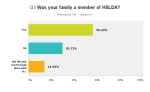
For respondents who grew up in fundamentalist Christian families, the following was true:

  1. 56.22% said their families were directly members of HSLDA.
  2. 14.05% said their families were indirectly members of HSLDA through dues paid to a homeschool organization.
  3. 29.75% said their families were not members of HSLDA.

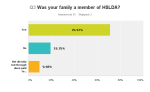
For respondents who grew up in non-fundamentalist Christian families, the following was true:

  1. 70.97% said their families were directly members of HSLDA.
  2. 9.68% said their families were indirectly members of HSLDA through dues paid to a homeschool organization.
  3. 19.35% said their families were not members of HSLDA.

In our pool of respondents, therefore, there was not that much of a difference in HSLDA membership (approximately only 5%) between fundamentalist and non-fundamentalist families. Furthermore, the percentage of HSLDA members among non-fundamentalist families was slightly higher. 

Fundamentalism and Parental Education

The level of education achieved by the primary teachers of respondents was slightly higher among non-fundamentalist Christian families compared to fundamentalist ones.

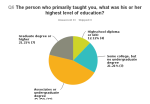
For respondents who grew up in fundamentalist Christian families, the following was true concerning the highest level of education of their primary teacher:

  1. 4.32% had no high school diploma or GED.
  2. 15.14% had a high school diploma or GED.
  3. 23.78% had some college but no degree.
  4. 41.62% had an associates or undergraduate degree.
  5. 15.14% had a graduate degree or higher.

For respondents who grew up in non-fundamentalist Christian families, the following was true concerning the highest level of education of their primary teacher:

  1. 12.12% had a high school diploma or GED.
  2. 21.21% had some college but no degree.
  3. 45.45% had an associates or undergraduate degree.
  4. 21.21% had a graduate degree or higher.

Whether respondents grew up in fundamentalist or non-fundamentalist families, that did not seem to significantly increase the highest level of parental education of the primary teachers.

There are a few differences — for example, all respondents that grew up in non-fundamentalist families had a teacher that at least had a high school diploma or GED (compared to 4.32% without them in fundamentalist families). Also, the level of education did increase slightly: there were more teachers with college or graduate degrees in non-fundamentalist families, but only by a few percentage points.

Fundamentalism and Respondent Education

Whereas the level of parental education did not change much between non-fundamentalist and fundamentalist Christian families, the highest level of education that respondents personally achieved did change in noticeable ways.

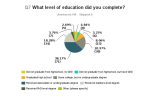
For respondents who grew up in fundamentalist Christian families, the following was true concerning the highest level of education they personally achieved:

  1. 4.84% have no high school diploma or GED.
  2. 3.23% have a GED but no high school diploma.
  3. 8.06% have a high school diploma.
  4. 23.66% have some college but no degree (this includes the 2.69%, or “Other,” which fit the “some college” category).
  5. 38.17% have an associates or undergraduate degree.
  6. 18.28% have a masters-level degree.
  7. 3.76% have a PhD-level degree.

For respondents who grew up in non-fundamentalist Christian families, the following was true concerning the highest level of education they personally achieved:

  1. 18.18% have some college but no degree (this includes the 3.03%, or “Other,” which fit the “some college” category).
  2. 54.55% have an associates or undergraduate degree.
  3. 12.12% have a masters-level degree.
  4. 15.15% have a PhD-level degree.

This means that 100% of respondents from non-fundamentalist families have some level of college education, compared to 83.87% of respondents from fundamentalist ones.

Indeed, among respondents from non-fundamentalist families, the first three categories — (1) no high school diploma or GED, (2) GED but no high school diploma, and (3) high school diploma — disappeared. All numbers began with at least “some college.”

This also means that 81.82% of respondents from non-fundamentalist families have a college degree or higher, compared to only 60.21% of respondents from fundamentalist ones.

Fundamentalism and Educational Quality

How respondents rated the quality of their educational experiences  dramatically changed when results were filtered by fundamentalist versus non-fundamentalist environments. Indeed, the changes are striking.

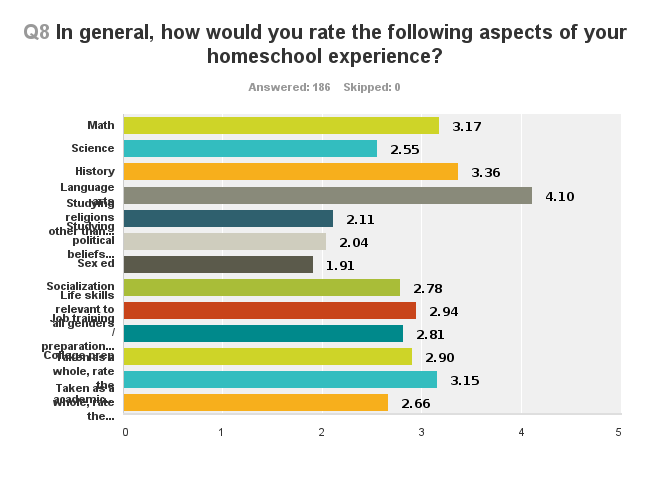
Respondents from fundamentalist Christian families gave their homeschool experiences — in totality — an average score of 2.81, less than the median score of “So-so”:

Filtered by fundamentalist. 2013 Homeschoolers Anonymous Basic Survey.

Respondents from non-fundamentalist Christian families their homeschool experiences — in totality — an average score of 4.2, higher than the base score for “Adequate.” The visual difference here is striking:

Filtered by non-fundamentalist. 2013 Homeschoolers Anonymous Basic Survey.

This is an increase of almost one and half points between fundamentalist and non-fundamentalist respondent groups. This is one of the most significant increases seen in this survey yet.

Fundamentalism and Abuse

While the difference in educational quality between respondents from fundamentalist families and non-fundamentalist families was striking, the difference in experiences of abuse is even more so. Indeed, the difference in experiences of abuse is the most glaring of all of the results from this survey.

The majority of respondents from fundamentalist Christian families (71.2%) experienced one or more forms of abuse.

The most common forms were emotional abuse (61.41% experienced this), verbal abuse (52.72%), religious abuse (46.74%), and physical abuse (33.70%). This means that the majority of respondents from fundamentalist Christian families experienced emotional and verbal abuse.

Filtered by fundamentalist. 2013 Homeschoolers Anonymous Basic Survey.

The overwhelming majority of respondents from non-fundamentalist Christian families (93.55%) did not experience abuse. 

Whereas 61.41% of respondents from fundamentalist Christian families experienced emotional abuse, only 6.45% of respondents from non-fundamentalist families did. Whereas 46.74% of respondents from fundamentalist Christian families experienced religious abuse, only 3.23% of respondents from non-fundamentalist families did. Whereas 33.7% of respondents from fundamentalist Christian families experienced physical abuse, only 3.23% of respondents from non-fundamentalist families did.

Filtered by non-fundamentalist. 2013 Homeschoolers Anonymous Basic Survey.

As this is — once again — a self-selected survey, these results do not accurately represent the frequency of educational quality and abuse in fundamentalist or non-fundamentalist Christian homeschool families. The results do suggest, however, that fundamentalism is a highly significant factor in the quality of education and the experiences of abuse for the adult graduates of the Christian homeschool movement that took this survey.

In fact, fundamentalism is the most significant factor thus far.

*****

< Part Four: Parental Education as a Factor | Part Six: HSLDA Membership as a Factor >

2013 HA Basic Survey: Main Page

Have I Forgiven Them?: Katharine Diehl’s Story

Screen Shot 2013-10-02 at 9.12.37 PM

HA note: The following is reprinted with permission from Caleigh Royer’s blog, Profligate TruthIt was a guest post by Katharine Diehl for Caleigh’s “I Have a Voice” series and originally published on September 16, 2013.

About the author: Katharine Diehl is 22 and lives in Brooklyn, NY. She has a BA in psychology and her poetry has been published in Squalorly and Fickle Muses. She works part-time but she needs more money, so if anyone would like to pay her to write or be a professional poet, she is available. She blogs about writing and writes about other stuff at frozenseawriting.tumblr.com.

*****

I can never tell if I have forgiven my parents.

Not for spanking my baby brother, who was crippled from neuroblastoma and died at the age of 5. The spankings were rare, compared to other families; my dad had a sort of business going, creating “spankers” out of conveyer belt. My sister and I laughed at the children we knew whose parents hit them with spoons or pieces of wood. I was tough. I could take it. But I hid and shivered when I knew they were doing it to my sick brother.

Later my dad held my brother, after the coma, after he was gone, and sobbed.

Once I put a few acorns in my winter coat pocket and zipped it up; when I opened it months later, there were tiny dead worms. I was a little girl and squeamish and terrified, and my dad yelled at me for not knowing that the worms would hatch, and he put the worms in his hand and chased me in a circle around the living room, trying to get me to touch them and clean out my coat. Later I had a nightmare he was chasing me with a WWII Japanese sword his grandfather had given him.

When I told him about it, he cried because he did not know I was afraid of him.

That is the essence of my childhood. I think that my parents loved us but were disappointed that they did not have good children, and blamed themselves, and read too many books by Dobson and the Pearls. I was not good. I had a rebellious attitude. I asked too many questions. My sensory integration problems made me afraid to touch terrycloth or crumbs or let others brush me lightly, and loud noises made me feel ill, and my parents worried that they were signs of rebellion. The other children in our church were so well behaved.

My friends’ parents told them not to tolerate my behavior.

Things got better after the black years of early adolescence — nights when even God would not listen to my pleas to take the burden from my heart and cleanse it. I prayed to him every day and read the Bible, especially the Psalms, but the peace that passes all understanding would not come. But I began college on a scholarship, found new friends, and took long, lonely walks for hours where I was able to inhabit my body instead of dissociating constantly.

I learned to soothe myself with reading and walking instead of food.

My parents, grown more liberal, allowed me to visit a therapist after some panic attacks, and when I got on medication it was as if the dirty pane of glass blocking me from the world had finally lifted and there I was, naked and standing in the singing air.

Last fall my progress shattered, that delicate glass framework that held me up, when my little sister overdosed on ibuprofen. I had seen her, homeschooled, isolated, only one friend who lived a state away, spending more and more time in bed during the day. She woke, ate breakfast, and retreated to wrap herself in a blanket and sleep again. She looked like a sad burrito, I joked, and she looked at me blankly. I found her thinspiration blog, and saw the cuts in her arms. I was afraid to tell my parents, though they were concerned, because I felt homeschooling caused her isolation and I could not say that to their face. After all, I’d turned out okay. Maybe it was a phase. I am ashamed to say that I did not advocate for her, did not tell another adult.

I was afraid like a little girl instead of the woman that I was. That I am.

I was about to present my proposal for my senior honors thesis before a group of professors when she called my cell and hung up. I called back and left a message. Finally she picked up — she was home alone — and asked me what happened when you took too many pills. I said she should go to the hospital, and she started to cry. So I did the only thing I could do. I called 911 and they swooped in and took my skinny little sister, cuts all over her arms, to a hospital and kept here there for a week.

She told the doctors she was trying to kill herself, and then she changed her story.

My parents believed the second story.

She, too, has gotten better — it was the catalyst allowing her to receive therapy. She also has Celiac, and her moods have improved since changing her diet. She went through an out-patient eating disorder program and she is a healthy weight now. She is dealing with other problems now that I don’t feel comfortable sharing, but all together, she is healing herself. She is making herself whole and it has ripped me apart and put me back together, I think, being able to see her do that.

My boyfriend has helped me. He has been my rock and my shelter, as blasphemous as it is to say that- because he is not a god, but a friend and a lover. I met him when I was 20 (I’m 22 now), and he is not a Christian. My mother has suggested I marry him (a law student) and “be very poor” with him. I think she doesn’t want us to live in sin any longer, because when I visit him, I stay overnight. Whenever I return home, my dad says he hopes I had fun — but not too much fun.

My sister says I am wounding my family by dating an agnostic. My aunts asked me if he loved Jesus with all his heart.

The answer is no.

But I love him with all of my heart.

And that is that. My parents have apologized for things that never bothered me — criticizing me too much, fighting too much. I know they love me, but they will never see that their insistence on those rigid Christian values and their insular homeschooling, their need to shelter us, are the things that have harmed.

They did not cause my little sister to become suicidal, but like a mushroom grows best in moisture and the dark, the conditions were there.

I had a dream once that my dad’s mother — an alcoholic in his childhood — came to me and told me that she was the mother of all our sorrows. I have always tried to place my troubles (and triumphs) in a narrative, in archetypes, because it makes them easier to bear; but I have rarely had dreams with such truth in them.

Trouble and sadness are generational. My grandmother’s mother, a strict Spanish Pentecostal, made her kneel on rice and pray for hours until her knees were embedded and encrusted with the raw grains. My dad’s father died in his childhood. My mother told me once that she felt she lived her life in a dark room with no windows. My parents have never forgiven themselves, though I have made halting progress toward forgiving them.

I say this to say that placing blame, no matter how it helps, can also hurt.

My blood has sadness in it from generations of mental illness and cruel religion. I don’t know who to blame. Myself most of all and least of all, perhaps. The blame is dispersed and I hope and pray and tremble that the sadness will leave us — that my children, if I have them, will never be taught about an angry God or fear that they are not scrupulous, pleasing, or pretty enough.

My precious children, I will say, you exist. That is beautiful and I know that is enough.

I pray that God, whoever or wherever He is, feels the same.