Is the Christian Homeschool World Really Changing?

Screen Shot 2014-04-22 at 5.31.34 PM

HA note: The following is reprinted with permission from Libby Anne’s blog Love Joy Feminism. It was originally published on Patheos on April 22, 2014.

Things are changing in the Christian homeschooling world. Vision Forum has fallen and ATI is shaken. People are talking, really talking, and the narratives are shifting.

Some are still resisting this conversation.

They claim that Doug Phillips’ fall had nothing to do with his patriarchal ideology. With both Phillips and Gothard, they argue, the problem was with the leader, not the belief system. These claims are dispiriting, because in some sense these leaders are interchangeable. Old ones will fall, new ones will rise, and if the ideology remains the same nothing will change.

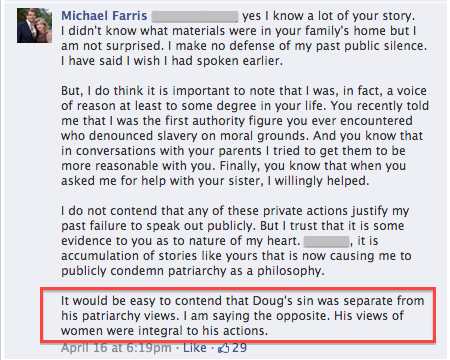
But other leaders are being more honest. They, Michael Farris and Chris Jeub among them, are connecting the dots and calling out a problem deeper than an individual leader. In this facebook comment, Farris responds to a homeschool graduate’s reiteration of her story (I’ve marked the relevant bit):

m1

When I read these things, I am reminded of evangelical attempts to soften toxic ideas so that they become more palatable, and that concerns me. For example, I heard evangelical leaders at the megachurch I grew up attending walk the idea of male headship back to spiritual leadership and breaking the tie when husband and wife cannot come to an agreement. While I appreciate that there are evangelicals who have moved away from an emphasis on total wifely obedience and submission, the idea of male headship itself is a problem, and softening it doesn’t change that. Is the walked-back view better? Yes, but it’s still a problem.

I wonder how far Christian homeschooling will change over all of this, and whether that change will be deep or surface-level. All Doug Phillips did was take ideas already out there—the idea of the Joshua Generation, the emphasis on male headship and wifely submission, the idea that girls should be encouraged to be homemakers and discouraged from having careers—and deepen each, using direct language, until his words and dictates became an embarrassment.

If Christian homeschool leaders see Phillips’ direct language and strident emphasis as the problem and fail to realize that it is at the core the underlying ideas that they themselves have long held that is the problem, change will be shallow indeed.

The word “patriarchy” is not the problem. The ideas that underly that word are the problem.

If the Christian homeschool leaders who are speaking out today reject the word “patriarchy” but hold onto the idea that a wife must submit to her husband, what have we actually gained? What is actually different?

Israel Wayne of Family Renewal wrote that:

In September of 2013, Michael Farris, founder of the Home School Legal Defense Association (HSLDA) spoke to state convention coordinators and other national homeschooling leaders, at the annual leadership conference they sponsor. He warned against the dangers of the excesses of extreme child discipline and a low view of women that has taken hold in some corners of the homeschooling community. He warned that unless homeschooling leaders actively speak against abusive and unGodly approaches to child discipline and unBiblical views of Patriarchal authority (that demean and devalue women), we risk losing our very legal freedom to homeschool.

From Wayne’s description, it sounds like Farris told other homeschool leaders that they needed to speak against child abuse and the devaluing of women or else homeschool freedoms would be at risk. The emphasis here appears sorely misplaced. Shouldn’t the primary concern be for the children who are abused and the women who are devalued rather than for the possibility that people will react to these abuses by turning against the legal freedom to homeschool?

I should note that I very much question what Farris means by “our very legal freedom to homeschool.” I suspect what he actually means is our freedom to homeschool without oversight or accountability. And here is a very real issue—Farris is now speaking out against “patriarchy,” and it appears that he may begin speaking against child abuse (though that remains to be seen), but he is still against legal accountability for homeschooling, accountability that would support children’s right to an education and their right to an upbringing free from abuse or neglect.

HSLDA’s current president, Mike Smith, will be presenting this keynote address at an upcoming homeschool conference:

Remembering the Reason, Renewing the Vision A general overview of the challenges, burdens and benefits of homeschooling from a veteran homeschool father and leader. Addressing the potential homeschooler, the new homeschooler, the veteran homeschooler and all homeschoolers in between, Mike outlines the success of homeschooling in academics and socialization, describes legal and legislative advances,and concludes that homeschoolers have earned the right to be left alone. 

This last bit is a serious problem. Whether or not Farris indeed intends to speak out loudly and publicly against patriarchy and child abuse, his organization will continue to work against legal reforms that help fight these problems, reforms that would bring homeschooled children into contact with mandatory reporters or ensure that homeschooled girls are not passed over educationally because of their gender. A change in culture is needed, yes, but the unregulated nature of homeschooling in many states both contributes to and is a result of that culture.

We need more. Homeschooled children deserve more.

But this is only the start of the things that concern me as I watch this current moment. Israel Wayne followed up on his discussion of Farris comments with these unfortunate paragraphs:

Mr. Farris has sounded a much-needed warning. My concern, however, is that when we over-react and swing to the other ditch, we end up teaching only love, grace and mercy (with no boundaries for children). By rejecting “Patriarchy” (abusive or domineering tendencies of men towards their wives and families), we may revert to the Feminism of the 1960′s, and all the problems that came with it, that led many women to react 180 degrees in the other direction by staying home and homeschooling their children. By rejecting rigid step-by-step rules about issues like strict clothing mandates and courtship procedures, we may revert back to the kind of sexual permissiveness that led to the legalism in the first place.

Do we really want to go back to families where mom is trying to pull that whole family uphill all by herself, while dad is off playing golf, letting mom run the family all by herself? Do want three-year-olds who rule the parents with an iron fist and parents who jump at their every demand? Do we really want teens who are groping their girlfriends in the back seat of a car because we don’t want to impose a legalistic standard on them? Do we really want to encourage the kind of American narcissism that says children are a nuisance and O.8 children is the goal, because we want to avoid the imbalance of policing bedrooms and imposing doctrines not clearly spelled out in Scripture?

This is not change, this is more of the same. What we need is change, real change. I think we’re at a moment of contingency where we might see such change, but to be honest. I don’t feel all that hopeful at the moment. I worry that the change will be more in gloss than in substance.

I can promise you one thing—I’ll keep pushing.

Tylenol is Evil. Because Witchcraft.

Screen Shot 2014-04-22 at 2.16.20 PM

HA note: The following is reprinted with permission from Kierstyn King’s blog Bridging the Gap.  It was originally published on February 20, 2014 with the title, “I don’t know what to call this.”

I was going through the files on my laptop looking for something specific and I ran across a picture that I saved from 2007. I won’t post it here, because it makes my stomach turn, but content note: graphic descriptions of infections and medical neglect.

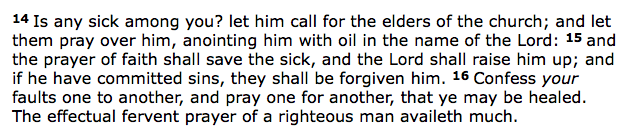
My parents stopped taking us to doctors before I was 10. They believed that god told them doctors were evil, to go to doctors was to not have faith in god’s ability and will to heal the sick. Along with that, came the belief that if you were sick, it likely had something to do with sin in your life. Both of these came from James 5.

k1

So, anytime we got sick, we did that. We’d have dad pray for us, literally anoint us with extra virgin olive oil, and then make sure we didn’t have any unconfessed sins. Ex: a cancer sore we could have because we “talked back”.

Because my parents didn’t believe in doctors, they also didn’t believe in medicine, because there is a greek word called Pharmakeia which is where the word pharmacy is derived from, but also means witchcraft. My parents made the jump to then decide that any medication, including ibuprofen and tylenol is evil, because witchcraft.

(side note: just writing this all out now is making me feel sick. First, I can’t believe I remember these arguments so well, and secondly, I just, I can’t, it’s so stupid)

We had one bottle of children’s chewable aspirin on hand, they reasoned THAT was okay because it’s from bark, not chemicals, and because one of my sisters was prone to migraines that resulted in vomiting – but that was only for dire emergencies.

My mom had “natural” remedies, like tea tree oil, oil of oregano, and Werther’s hard candies (for sore throats  << that one I’m not complaining about, actually, it was candy). Stuff that 1) doesn’t actually make sense and 2) is not located anywhere near the pharmacy area in the grocery store.

(side note: it took Alex so long to get me to take ibuprofen for migraines because of this.)

So, when I was 16 and a half, I had this horrible horrible infection on my leg. I could not move. It was swollen and oozing and painful, any movement at all was excruciating (and no painkillers), it swelled so much that my thigh didn’t look like part of my leg anymore, it was some weird mutated…thing.

My parents believed it was boils, like Job had (Job 2:7)

k2

So, they prayed for me, anointed me with oil, asked about my sins, which I couldn’t think of and then….the fun started.

Remember: no medicine, no doctors, nothing. My mom decided we had to keep the infection clean (makes sense), so, she would push and squeeze the abscess until puss came out of it (so. fucking. painful.), then she would put oil of oregano in and around the wound because it was a “topical pain reliever” and “antiseptic”, I’m pretty sure hydrogen peroxide happened too. Basically I just remember my siblings complaining that I smelled like spaghetti (maybe that’s why I hate it so much).

It was deep, and there was a good bit of blood – it was blue and swollen around the..head? I still have a visible scar from that first one. And the second one.

This went on from the time I was 16 and a half until I was 18 – it didn’t start fully clearing up until I left home, though it had gone down in intensity.

The second one, was right below the first, had two heads (which I think had more to do with my mom PHYSICALLY SQUEEZING THE ABSCESS than anything else) each wound was big enough you could put a pencil eraser in (I still have that scar too), and there was like, a flesh bridge between the two holes, so they were connected /open at the bottom/inside the wound, but on the top there was a little bit of skin that kept it from being a fucking gash.

After the first one though, my parents were less concerned, and I managed to move – while still in excruciating amounts of pain with no recourse – and do chores and go places and manage.

As time passed and I continued to get these and they continued to leave scars and I continued to function in large amounts of pain, my mom started commenting on how my legs looked.

Because, due to the scars – and random abscesses, they looked polka-dotted. So, I wore only jeans or ankle-length skirts (or tights) so as to hide the hideousness of my infected legs. (This continued well into my marriage, in fact I think it was around a year before I stopped wearing exclusively jeans and wore skirts/dresses that were above my knee, because of that reason.)

I walked for 10 hours in boots with an abscess on my knee (it was not fun and towards the end of the day I was having a really hard time walking/keeping up with the group, but being carried was not Teenpact Appropriate). Some of my skirts had stains from them.

I passed up an opportunity to intern with Teenpact after that trip because of my legs and knowing I wouldn’t have the stamina required to wear heels and walk all day.

They were frequent but became smaller – I started to be able to get to them before they developed into something bigger.

This whole time though, over a year and a half  – no one thought anything of it, no one thought to maybe get it checked out, this infection that didn’t go away – this thing that we’re calling boils and figure it has something to do with god, and not providing any kind of relief from the pain, I just had to suck it up and deal with it, and I did.

Our second year together, my legs and scars were healing and I was wearing shorts and short skirts and my parents would always comment on my legs – “oh, it looks like they’re clearing up!” which actually just reminded me that my legs might still be unseemly and polka dotted.

I realized, yesterday, after digging up that picture on accident, that my infection, much like my teeth, was something that they had the power to stop and chose not to. Instead they chose to shame me about it and give me the bare minimum of help (if oregano oil and being made fun of because of it counts as help) because of their religion.

The first two scars are shiny and feel weirdly smooth, but are fading.

k3

A Homeschooling Adventure: Homeschooling on the Open Seas, Harmony’s Story

Screen Shot 2014-04-22 at 1.33.09 PM

I have been following Homeschoolers Anonymous for quite a while, after searching for a social group I could be part of that reflects some social issues I’ll expound upon below. I was really not expecting to find what was posted here — stories of abuse, religious restriction, brainwashing, even death. It has been an enlightening experience, and I would like to extend my heartfelt sympathies and support to everyone whose stories I’ve read.

It is because of the harshness and true struggle of these stories that I have refrained from trying to tell my story. How can it compare? How can I hold myself to the same standard as these brave men and women sharing their suffering? But I think it is important to share my story, as it illustrates a detrimental effect homeschooling can have on your later life, even if it is well-meant, non-religious, free-form, and even in a setting that still amazes people to this day.

I had grown up in Colorado until I was 10, and up to that point I had been going to public school, brought up by my Dad after my mother divorced him when I was three or four. I began by going to the local basic elementary school, but I didn’t like it, so the last few years I had been going to a normal charter school. I was not an exceptionally smart kid, but I had a great imagination, and no problems making friends and keeping social with my little group. But in 2000, when I was turning 11, my dad remarried, and retired from his job to sweep us all away on an adventure of a lifetime.

His plan was to sail down the Caribbean, in a 40-ft boat, and go through the Panama Canal, across the Pacific, and finally settle in New Zealand.

Even at 11, I was no stranger to travel, having been to Tahiti, the Bahamas, Venezuela, and New Zealand itself, as well as yearly camping trips to Utah or Grand Mesa in Colorado. So the idea excited me, as it would any young boy, and it was only with a faint inkling of what I was really losing that we hauled our way to Florida to begin the journey.

So, obviously, since we would be moving so much and so quickly, homeschooling was the only real option for our continuing education. Our education largely came from textbooks and workbooks, and some educational computer programs. There was no religious undercurrent — my dad had disliked going to church, and had not wanted to foist that on us as well. So we were free to read the Bible if we wanted and make our own decisions on that front. We largely taught ourselves, going through the books and doing assignments for about four or five hours a day (year round, no winter or summer breaks), going to our parents if we needed help understanding something. For extra-curricular activities, my new step-mother was teaching us Russian and art, and of course we had all the swimming we wanted.

In exchange, however, my social world had shrunk enormously.

People had been voicing their concerns to my dad (who was in charge of everything) about our social development, and he had simply voiced confidence that we would be stronger, because we would be free of peer pressure, drugs, alcohol, violence, all the dangers he had begun seeing grow in our world. I believed and accepted that rationale, and prided myself on skipping the rebellious teenager phase, and being a teetotaler until I was 23.

But the reality was that, without outside input, my development had simply been short-circuited.

There were indeed other children on other boats down in the Caribbean, and we would try to make friends with them. For the most part this worked out great, although in some cases we were forced to try to interact with people we didn’t like. But each and every one of us were going our own routes, and most friendships would only last a few months before our paths split again. So for the majority of those 5 or 6 years on the boat, we had a very inward-focused social world, and depended on the family almost entirely.

Eventually, though, our homeschool supplies became inadequate for continuing education, and it was starting to become time to think about higher education. We were about at Grenada, near the southernmost tip of the Lesser Antilles, one island away from the mainland of South America, when we decided to head back to the states. We stayed in Miami, Florida for a few years, usually at a marina or a dry dock as we restocked on educational supplies and tried to get a new, bigger boat ready for our next foray to try to get back on track.

The reality was that Dad had been growing older too, and he didn’t feel like he was in condition with growing medical concerns to risk sailing across the Pacific. If he didn’t feel like he had to be in charge, and train us and trust us to run the ship if he had to be helicoptered to a hospital, things might have been different, and I might be in New Zealand now.

But the point is to show how Dad, even if he wasn’t overtly religious, had still absorbed a lot of the patriarchal ideas from his parent’s church and his upbringing.

He had been passing that down to us as well, though we didn’t know it.

In Florida, things slowly got worse for our family. We stopped homeschooling, on hiatus while we tried to work things out, but we were more restricted than ever, because Miami was a hotbed for the peer pressure, drugs, and violence we had been warned about all of our lives. So going to normal school there was out of the question. My older sister and I got our GED’s, where I had my first glimpse of college and wanting to really feel like I wanted to go there. But we were stuck in limbo while Dad tried to work things out.

Long story short, we made a last ditch effort to make an art gallery in Eureka Springs, Arkansas, and it failed. My family split apart with another divorce, with my older sister and my step-mother and her daughter remaining in Eureka Springs. I went to Tulsa with my Dad, because he had a friend there and it was a good place to continue my education.

In Eureka Springs, ostensibly I had more freedom than ever. I had a car I could drive, and a whole town of people I could socialize with, if I wanted. I had nothing but time on my hands, and nothing to do except go to town and help with the gallery every now and then. But I was more isolated than I’d ever been before- I was forced to stay in a camper in the back of a pick-up truck, because my mother and sisters had rented an apartment that didn’t allow pets, so I had to stay there with the dogs and the cats. But I hardly ever went out- I kept myself confined, worrying about the dogs, not having any motivation to leave. I was by myself most of the time- Dad was hired as a trucker to supplement the gallery’s income and keep it afloat, so he was away for weeks at a time, and my sisters lived in town. But I just couldn’t leave the camper except to get food.

When Dad and I moved to Tulsa, it was actually worse.I stayed in the trailer for a year while we waited for residency to get into college, too afraid of that peer pressure/drugs/violence world out there. When I finally enrolled for classes, at first I could not even talk to the teachers- though the homeschooling now apparently paid off, as I was literally steam-rolling through the classes, only getting B’s in Composition because I had never heard of and didn’t know how to use MLA format. But even though I was doing great academically, I was still suffering socially. I didn’t make a single friend, as I just didn’t have the courage to talk to anyone, and I had no connection to them.

I often felt like I was a time traveler, as I had missed so much of what was integral to everyone else’s development and frame of reference.

And I was dismissive of them too- it seemed like all the girls were dressing like sluts, all the guys were idiots, the teachers were liberal scum. I even refused to write a paper for a sociology class about the gender/orientation spectrum, protesting that it was complete nonsense.

From these last few sentences, you can see that I had pretty much unthinkingly adopted my dad’s point of view. Growing up in that homeschooling environment, so inwardly and family focused, had denied all other points of view. And even though Dad wasn’t aware of it, he was one of the only guiding points we had available. He was unconsciously passing along his parent’s strict, conservative religious teachings to us. It was only after I finally decided on archaeology over paleontology, and studying anthropology, that I began getting a global perspective.

I had dismissed sociology as just liberal propaganda dressed up to look scientific to push their agenda- but anthropology gave me the tool of cultural relativism to realize that Western notions of right or wrong weren’t necessarily the right one. I learned about how other cultures express sexuality, religion, and family relations. I learned more about how people worked, in a sense of all of humanity, not just Americans.

Slowly, I began to change my accepted views. I saw how ethnocentric right-wing politicians really were, pursuing an agenda focused solely within their Christian-political world-view. I explored my own sexuality, coming to terms with it and even completely changing my gender identity.

I also began seeing the need for my own independence. I needed to get out from my dad’s apron strings, and begin learning how to do things on my own. So I moved from Tulsa to Norman to attend OU, to attempt to make it on my own. But I still find myself secluded- I stay in my room, lacking the incentive or energy to go out, even to see my other room-mates. I have gone to several campus organization meetings, but most of the time I find some excuse not to go. Like before, even though my intellectual development expanded again, my social development still lags far behind.

So many homeschool parents intend the best for their children. They want them prepared for the world that they see, to be good, upright people, or to protect them from the evils of the world. But, as hopefully my story illustrated, even homeschooling in the amazing setting of the Caribbean can give much different results than you could imagine, and how parents can rarely foresee the outcome of what they are really doing.

Chaste Courtship and Ethics

Screen Shot 2014-04-17 at 4.06.07 PM

HA note: The following is reprinted with permission from Lana Hobbs’ blog Lana Hobbs the Brave. It was originally published on March 12, 2014.

I read this post yesterday, and it made me mad: “Jessa Duggar Will Have a Chaste Courtship — and My Kids Will, Too” by Kacy Faulconer.

Luke and I had a “perfect” courtship. No holding hands even, until the wedding.

After several year’s retrospect, I don’t really think it set us up any better for marriage than dating would have. In fact, dating would probably have been a lot simpler. We would have dated earlier, with less pressure, and more of a feeling of choice (it was by choice but also under intense pressure of ‘purity’). We wouldn’t have gained some of the baggage we did by having a complex, parent-involved relationship. I, especially, would have been my own agent, instead of my wishes being submitted to everyone else’s (and the triangulation in our families during that time was mind-boggling).

Had we dated, Luke and I would have been able to let physical closeness progress more naturally, and I don’t necessarily even mean sex before marriage — but just leaning on his shoulder when I was sad, that kind of thing. I can’t tell you how much it hurt not to be able to do that. Because I have negative touch in my past, it would have been really nice to have gradual healing touch. And sex before marriage? Had we done it, I’m sure we would have survived. The only difficulty would probably have been the shame, and that was something we were taught.

Chaste courtship, the writer of the piece claims, won’t repress her children:

I’m not repressing them. I’m freeing them. I have sons who need to learn restraint and respect. I have daughters who will be empowered by abstinence because they can simply sidestep the issues, pressures, problems, and pitfalls of promiscuity.

Look, just because you claim something is freeing, doesn’t make it so. Her ‘empowered’ daughters, like myself, won’t be able to safely learn about consent or their own bodies until marriage, at which point they’ll be expected to have sex every time their husband wants it. My big advice from my mom was ‘don’t say no too often’ (my dad did a better job with ‘the premarriage talk’). They’ll never feel like they own their bodies, because before marriage their bodies are owned by their parents, who feel it is their duty to keep their children pure, and after marriage they’ll feel like they belong to their husbands.

Parents who raise their children this way are trying to do what they think is best.

The problem is, they are motivated by fear to control their children. Fear that their kids will have sex, fear that their kids will ruin their lives somehow. They raise them to get an end result, it seems, because the end (a promised good marriage) justifies the means (intense control and denying their children bodily autonomy). I’m studying Ethics in my Philosophy class, and realized that many fundamentalists probably operate under a consequentialist system of ethics. (See also, spanking children to get godly offspring, or to not be embarrassed by fussing kids in public. I think it’s consequentialism.)

I operate under a more deontological view (also called ‘duty ethics’), there are acceptable actions, and unacceptable actions, and you should do what is right because it is right, and not because of the end result. One big rule of deontological ethics is that humans should never be treated as a means to an end.

And regarding the subject at hand, I believe it is wrong for a parent to control their adult child, no matter how good an end they hope to achieve for them. I think women should be able to own their own bodies and be touched only on their own terms, not their significant other’s terms, and certainly not their parents’ terms.

For another takedown of Mrs. Faulconer’s post, see Libby Anne’s post.

P.S. I’ve heard people saying that ‘parents can’t control their adult children’. Well actually, I think they can, especially when they’ve raised their children to mindlessly obey, and have kept them from taking steps towards independence like having a real job. It’s hard to go against your parents when they are the only way you have food and a place to eat. It’s also hard when you know that independence, or ‘disobedience’ could get you cut off from your family and everything you know. Would my parents have done this? I don’t know, and they didn’t when my brother dated against their approval. But I was still trying to please them and never would have tested it.

Oh Daughters of Fundamentalism, Take Upon Yourselves the Cloak of Self-Deception

Screen Shot 2014-04-16 at 10.28.56 PM

HA note: The following is reprinted with permission from Sarah Henderson’s blog Feminist in Spite of Them. It was originally published on her blog on August 28, 2013.

I recently witnessed a young girl who is struggling a bit who expressed that she was a bit unhappy with her life, being told that she just needs to take it one day at a time, and be happy with it. To me it is shameful to express to a child or a teenager that their discomfort or unhappiness with a difficult situation stems from their own inability to cope. What message is being given to girls when they are told that although they are not the creators of the bad situation, they must be the authors of the solution, but the solution must only be to swallow their feelings and smile.

This is a relatively common comment made to daughters in conservative families. The basic idea stems from the idea if you are unhappy with your life, it is important to change your attitude about your life. Girls are not taught that they can cause change in their own lives. Of course this serves the purpose of preventing girls from making plans to get out. If they are responsible for their own happiness, and they do not get to make their own choices, fundamentalism is able to produce a new generation of women who not only do not fight back and fall in line with whatever rules and tasks are assigned to them, in the ideal scenario they will actually start to enjoy the fact that they are fulfilling their purpose, and own their own oppression.

This is a very difficult concept to understand if you did not grow up in patriarchy. How can women not only agree and allow themselves to be oppressed, but also seem to be happy and flourish in their own oppression? How can women become party to their own oppression, and in fact add their own restrictions to their own activities and assign themselves even more responsibility for the physical and mental well-being of the men around them? Because they are taught to believe it.

They believe that women are created to complement their husbands. They believe that any unhappiness they experience is selfish and sinful. They in fact quench their own desires and resentment at being treated as chattel, and tell themselves they enjoy it. Today I had the misfortune of reading the story of a young woman who was picked up from work by her husband with an entourage of other people to celebrate her last day of work. There was a banner on the car stating that she was free at 27, but her exit interview read that her new employer was her husband, and she would be a house wife from then on.

Teenaged girls in quiverfull families are taught that their purpose it to serve as a daughter, and then as a wife and mother. They try to fulfill their purpose in life by working hard, taking care of younger siblings, and generally not trying to rock the boat. They do not ask for things that they want or need, they do not tell their parents if they are pain, and they do not ask questions about their futures or their bodies. I can tell you that there are probably many teenaged girls right now that are suffering from severe menstrual cramps or low energy due to health problems, that will not say anything because they do not want to cause shame to their families by not being a strong contributor to the family.

These girls are trotted out at family and church gatherings to showcase their homemaking and child-rearing skills. To fail at cooking a dish or to not be able to handle several children at a time would be an unbearable humiliation. No self-respecting girl would allow that happen, and after a girl has put all of her time and effort into being a homemaker and mother for a few years, she is taught to take pride in it, and also starts to take pride on her own. After all, how many girls of 13 are capable of running a household of 8 or 10 or more on their own. How many girls can feed a dozen people with very few ingredients? How many can juggle a house cleaning and cooking a dinner and calming a crying infant and changing a toddler at the same time?

Untold numbers of innocent teenagers are living this life every day, and they take pride in their ability. They put their own desires away and learn to run a family that isn’t even theirs to keep. They are encouraged to compare their accomplishments with other girls, and on a church day they will go to their mothers and offer to take care of the babies for their mothers. They plan for their own happy families and wash laundry and cook meals and put band aids on babies. They change diapers and administer assembly line baths to dirty children. They make beds and clean up toys and wipe noses and do not go to school. They teach phonics and math and sewing and read the Bible to little children and make sure they listen to the parts about obeying your parents and making sure you do not think bad thoughts.

They tell themselves that this is what they want and that they can’t wait to have their own families and carry on god’s plan. And now they will grow up and teach their own baby girls to serve men and god. To deceive themselves.

Michael Farris, Patriarchy, and Doug Phillips: An Expose

HSLDA President J. Michael Smith, Doug and Jubilee Phillips, and HSLDA board member Dick Honnaker at HSLDA's 2004 National Leadership Conference in Spokane, Washington.
HSLDA President J. Michael Smith, Doug and Jubilee Phillips, and
HSLDA board member Dick Honnaker at HSLDA’s 2004 National Leadership Conference in Spokane, Washington.

HA note: The following is reprinted with permission from Libby Anne’s blog Love Joy Feminism. It was originally published in a slightly longer version on Patheos on April 15, 2014.

Yesterday’s WorldNetDaily article on Lourdes Torres’s lawsuit against Doug Phillips quotes at length from Michael Farris’s reaction to Doug Phillips downfall. I thought it was worth going over that section specifically, and placing it within the context of other things I have written about Michael Farris, HSLDA, and Patrick Henry College, both to clarify the issues here and to reveal the serious dishonesty of Farris’s statements.

I will begin by quoting the section, and will then respond.

Before Phillips founded Vision Forum, he spent six years as an attorney for the Home School Legal Defense Association, or HSLDA, a nonprofit advocacy organization that defends the right of American families to homeschool their children.

HSLDA Chairman Michael Farris told WND, “The reason Doug left HSLDA is because [President] Mike Smith and I, who were his bosses, were growing more and more uncomfortable as he started developing his patriarchy theory. We started limiting his ability to speak on those things while traveling on our behalf. We basically made it clear that he could not pursue those things with his HSLDA hat on. So he eventually chose to leave us so he could do those things because we were not comfortable with where he was headed.”

As for the patriarchy movement, Farris said the teachings are not widely accepted in the broader homeschool community.

“It’s a minority of homeschoolers that believe in it,” he said. “But unfortunately, until very recently, they were getting a lot of visibility in certain places. We have sought to avoid inviting any patriarchy speakers to speak at our national conference.”

While state homeschool organizations run their own events and may choose to have such speakers, Farris said HSLDA has never promoted them.

“Doug has never been invited to speak at our national conference since he left,” Farris said. “We have tried, by example, to keep this stuff outside the mainstream of the homeschooling movement.”

He added, “Frankly, we think it’s time for us to stand up and publicly say this is just wrong.”

Background

And here we need some explanation. Within the Christian homeschooling movement, and by that I mean those Christians who choose to homeschool for religious reasons, whether in part or in whole, there is a range of belief on gender roles. In general, beliefs about gender roles fall somewhere on a spectrum between the following two camps:

Complementarianism: Many of those in the Christian homeschooling movement, including both Farris and my own parents, hold fairly conventional conservative evangelical views on gender roles. The wife’s role is to obey her husband, nurture her children, and serve ask a keeper at home. The husband’s role is to be the head of the family, provide for the family, and protect the family. Men are to be masculine and manly, women are to be feminine and womanly. God has laid out different and complementary roles for each gender, but all are equal before God.

Biblical Patriarchy: Some of those in the Christian homeschooling movement go farther. They proudly use the word “patriarchy” and teach that daughters are to be under their father’s authority until marriage, serving as “stay-at-home daughters.” They argue that daughters should not go to college, or hold jobs outside the home, and that daughters must obey their fathers even as adults. Only when daughters marry (through a courtship process controlled by their father) do they leave their father’s authority and transfer to their husband’s authority.

I don’t have numbers on how many Christian homeschoolers adhere to complementarianism versus how many adhere to biblical patriarchy, but I also don’t think it’s completely clearcut. Even those solidly in the complementarian camp will have noticed promoters of patriarchy speaking at homeschool conferences, will have seen their literature, and will have met those in its folds. My own family was fairly solidly in the complentarian camp, and yet they adopted some of the beliefs of the biblical patriarchy camp even as they rejected others (they sent me off to college, but believed I was still to obey my father, as an adult daughter under his authority).

Biblical patriarchy differs little from complementarianism except in its open embrace of the term “patriarchy” and its teachings about the role of adult daughters.

Michael Farris

So where does Farris fall, particularly? From what I’ve read of his writings Farris very much believes that wives must obey their husbands and that a woman’s role is in the home nurturing her children. But what of the rest? Farris’s strong rejection of the patriarchy movement as quoted above and his recent strong words for the stay-at-home daughter movement in a facebook comment would seem to indicate that he falls in the complementarian camp rather than the biblical patriarchy camp.

There is also this from a statement written in response to February’s article on sexual assault at Patrick Henry College and read aloud during chapel at Farris’s Patrick Henry College.

Some readers have wondered if the overall aim of the article is to associate PHC with a set of anti-women attitudes that we do not hold, and to insinuate that we are connected with outside movements that we positively reject (like the “Quiverfull/Christian Patriarchy Movement”). This philosophy, incorrectly attributed in the article to Dr. Michael Farris, Chancellor, espouses that college is inappropriate for Christians in general, and especially women. As his own life at PHC and with his own children reflect, Chancellor Farris has never agreed with such an offensive philosophy.

Farris rejects the word “patriarchy” and is not against daughters going to church. In fact, this statement from Farris’s Patrick Henry College indicates that Farris views biblical patriarchy as “anti-woman” and “inappropriate for Christians.”

But even as he rejects biblical patriarchy, Farris believes that wives should obey their husbands to the extent of not attending church if her husband so commands, and he believes that daughters, even as they go to college, should be preparing ultimately for motherhood rather than for careers. I think maybe this is why Farris’s continued refrain of “no no no, I’m not like him, he believes crazy things!” strikes so many as so odd. Farris is not as far removed as he would like us to think.

But there’s something else going on here too.

The Entanglement

Farris insists that he has long gone to great lengths to publicly distance himself and HSLDA from Phillips in particular and biblical patriarchy in general. Unfortunately for him, this is simply not true.

A quick search of HSLDA’s website reveals that the company was openly advertising for Vision Forum. From a 2010 email alert to HSLDA members:

—[ 20% Off at Vision Forum! 5 days left! ]————————–

Extra 20% Off at Vision Forum! Code: HSLDA. Toys, Books, Movies, More. Everything on sale for 5 Days only!

http://www.hslda.org/alink.asp?ID=282

Indeed, this sort of advertisement for Vision Forum has been a bit of a trend for HSLDA, complemented by positive recommendations of various Vision Forum products.

It’s also worth noting that Farris was at the very least being grossly misleading when he said of HSLDA that “Doug has never been invited to speak at our national conference since he left” and that “We have tried, by example, to keep this stuff outside the mainstream of the homeschooling movement.”

As R.L. Stollar wrote a year ago, before Phillips’ downfall:

1996 seems to be the last year that Phillips appears as an HSLDA attorney. But since then, HSLDA has made zero efforts to distance themselves from his viewpoints. In fact, almost a decade after Phillips left HSLDA to run Vision Forum, he was still featured by HSLDA as a peer. In 2007, HSLDA referred to Phillips as one of “the nation’s top leaders.” Also in 2007, Chris Klicka received an award from Doug Phillips and Vision Forum for his homeschooling advocacy. In 2008, HSLDA says of him that he is “one of the most popular conference speakers in the nation today because of his ability to encourage, inform, and inspire.” In fact, HSLDA proudly sponsored a reception at an event where he was the keynote speaker. The official relationship between HSLDA and Doug Phillips is thus one of continued mutual admiration.

I’m unsure of how Farris expected people to understand that HSLDA disapproved of either Phillips or biblical patriarchy when continually wrote of Phillips and his abilities as a homeschool speaker with such accolades. And this wasn’t the only time. HSLDA advertised Doug Phillips as a speaker at event after event. HSLDA member families were urged to attend. They also allowed Doug Phillips to advertise in their publication, the Home School Court Report, as recently as 2012.

Beyond this, HSLDA has also promoted other leaders whose teachings center on biblical patriarchy, including Voddie Baucham and Geoffrey Botkin. And to the best of my knowledge, HSLDA as an organization and Farris as an individual have never denounced any one of these leaders.

There was more, too. In 2007 Vision Forum published Passionate Housewives Desperate for God, by Jennie Chancey and Stacy McDonald. Jennie Chancey founded Ladies Against Feminism and Stacy McDonald founded Steadfast Daughters. Both are not just complementarian but fully embrace biblical patriarchy. Farris’s wife Vickie wrote a review of the book, which can be viewed on Amazon:

Jennie Chancey and Stacy McDonald have spoken the Truth with a capital ‘T’ in their wonderful book Passionate Housewives Desperate for God. Totally grounded in Scripture, this book winsomely presents the true picture of a godly homemaker. Prepare to be stimulated, challenged, and encouraged as a woman. This book is a real gem!—Vickie Farris, wife of HSLDA founder, Michael Farris, Esq.

Now maybe Chancey and McDonald tone it down in Passionate Housewives Desperate for God, or maybe Farris and his wife disagree here. But Farris has to be aware how these sorts of endorsements will come across to Christian homeschoolers.

My Question

Now I want to turn back to the recent article I began with.

After insisting that HSLDA has never collaborated with a supporter of patriarchy—an assertion I have here called into question—Farris added that ”Frankly, we think it’s time for us to stand up and publicly say this is just wrong.” And that is where I have to wonder—why didn’t Farris stand up publicly and say this prior to Phillips’ resignation and disgrace? Because he didn’t.

Further, Farris wrote that “Doug has never been invited to speak at our national conference since he left” and that “We have tried, by example, to keep this stuff outside the mainstream of the homeschooling movement.” Was Farris unaware that, regardless of whether he invited Phillips to speak at HSLDA’s national conference, if he spoke nary a negative word about Phillips in public and HSLDA wrote of Phillips only to promote him, the message that would come across to the homeschool community would be one of approval?

My sources tell me that Farris views Bill Gothard and Michael Pearl in the same negative light that he has long viewed Doug Phillips. Why, then, does he not publicly warn homeschool families against them? Why does he remain silent?

I think I know the answer. HSLDA operates off of membership dues. If Farris or HSLDA come out and publicly denounce toxic homeschool leaders, they will lose members. Farris has felt that Phillips was in error and dangerous for years, but only when Phillips was already defrocked and dethroned did he feel comfortable saying that out loud. Farris would rather tolerate patriarchy in the Christian homeschool movement than lose money for denouncing it.

Farris, it seems, is only willing to shoot patriarchy when it’s down.

Sobbin’ Women and a Rubber Duck: Ellynn’s Story

Screen Shot 2014-02-23 at 3.50.31 PM

HA note: The author’s name has been changed to ensure anonymity. “Ellynn” is a pseudonym.

I didn’t intend to write this.

When the prompt went out about Media Memories I didn’t feel like I had anything to add. Like most homeschool kids, I wasn’t allowed to watch Teenage Mutant Ninja Turtles, Mighty Morphin Power Rangers, or a decent chunk of Disney. This was in an era of little to no internet access, so I have old art projects where I tried to draw the things from the shows my public school friends told me about with no basic idea of what they were talking about (my idea of a megazord was apparently multi colored ninjas making a pyramid). My media was Nanny Bird and Psalty (the blue fro’d singing psalm book). My younger, non-fundie cousins had Barney. Comparatively, when my youngest siblings came along, Veggie Tales were amazingly watchable.

And you know, it wasn’t great, but it wasn’t really terrible. I wasn’t scarred for life because I wasn’t allowed to watch Aladdin. Yeah, as an adult I had a lot of cultural catching up to do, but I’m not upset about it.

So, yeah, I didn’t think I had anything to say about my own Media Memories.

Do you know how much of your thinking occurs on a subconscious level? Little background things collate as you go about your day and then smack you in the face when you least expect it.

I’m one of those people, I’ve always got a song in my head.

While I love it, it’s also quite frustrating because I have no control over the selection. Monty Python, Rocky Horror Picture Show, and various greatest hits of YouTube pop in at the most inappropriate times. More annoyingly, I often revert to songs I grew up with. My Aunt’s favorite country songs, Stephen Curtis Chapman, the Donut Man — I find myself absently singing things I haven’t heard in well over a decade, things I could happily never hear again.

I’m pretty sure I still know all the lyrics to Achy Breaky Heart. Thanks for nothing Billy Ray Cyrus.

So one day last week I was at work and I caught myself absently singing “Sobbin’ Women” from Seven Brides for Seven Brothers and nearly threw up. Literally, and let me tell you it was unexpected.

Seven Brides for Seven Brothers is a retelling of the Rape of the Sabine.

Seven Brides for Seven Brothers is something that even the most conservative families I knew had watched. It’s a 1950’s musical, with attractive guys and fun dance numbers and it all ends in a mass wedding. Wholesome, right?

The thing is, it’s a retelling of the Rape of the Sabine, where a group of men came upon the young women of a village at the Sabine river, bathing and doing laundry, and took them by force to be their wives.

Did you know the English word rape rooted in the Latin raptio, which also translates as “abduction”? The reason we root sexual assault within a word that generally translates to abduction is because of this story. It’s also considered one of the foundational moments in Roman history.

Here’s a few of the lyrics from the lesson the elder brother taught his younger brothers about wooing:

Them a woman was sobbin’, sobbin’, sobbin’ fit to be tied.

Ev’ry muscle was throbbin’, throbbin’ from that riotous ride.

Oh they cried and kissed and kissed and cried

All over that Roman countryside

So don’t forget that when you’re takin’ a bride.

Sobbin’ fit to be tied! From that riotous ride!

…Them a women was sobbin’, sobbin’, passin’ them nights.

Now let this be because it’s true, a lesson to the likes of you,

Treat ’em rough like them there Romans do, Or else they’ll think you’re tetched.

And the reply:

Oh yes! Them a women was sobbin’, sobbin’,

Sobbin’ buckets of tears

…Oh they acted angry and annoyed, but secretly they was overjoyed!

(Click at your own risk, because damn is it catchy)

So don’t forget that when you’re taking your bride! Sobbin fit to be tied!

And you know, it’s very 1950’s, there’s something like four kisses in the movie, they all seem like lovely kidnappers, and of course the women loved them and they got married, so it was romantic!

As a kid I didn’t really have a concept of what rape was, much less rape culture. I just loved the dresses and the dance numbers.

As an adult I catch myself singing “Them a woman was sobbin’, sobbin’, sobbin’ fit to be tied. / Ev’ry muscle was throbbin’, throbbin’ from that riotous ride,” at work and go from zero to physically ill almost instantly.

So I had something to say, but I still wasn’t sure what -—other than “don’t let your kids watch Seven Brides for Seven Brothers. Trust me, they’ll be glad to have missed out on that when they’re older.” But the thing is, in my experience homeschoolers never need to be told not to let their kids interact with media. The slightest hint that someone disapproves is generally enough to get further restriction, and that’s really not  a message I endorse. So yeah, I wasn’t sure where my brain was going with this.

And then, while I was thinking over what to write, a small voice in my head sang “because I love my duck,” and I just knew.

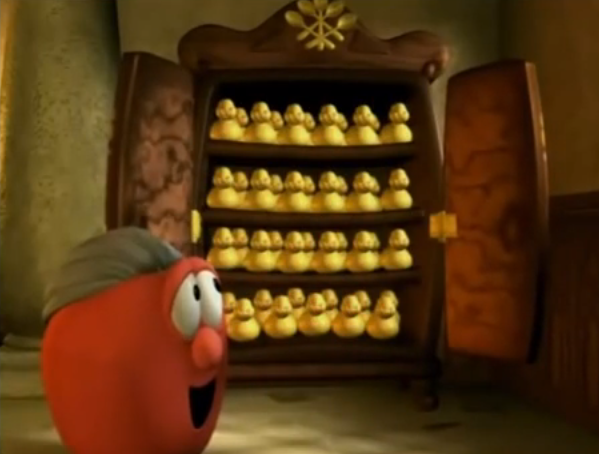
Have you ever seen King George & The Ducky? It is by far my favorite Veggie Tales tape. The songs are catchy, the mini skits are great, THE FRENCH PEAS! Really, what’s not to love. And they managed to tell the story of David and Bathsheba in a way that would be acceptable to children.

Except I’ve never wondered, but why are we telling the story of David and Bathsheba to children?

It’s essentially a story of rape (yes, there are no explicit scenes in the text, but if a king orders a woman he’s never met brought to him for the purpose of having sex, struggle or not, it is totally rape) and murder. What are we going to tell them next? The story of Lot and his daughters, teaching a tale of incest and/or date rape with carrots and peas? Just because it’s in the bible doesn’t mean it’s really appropriate material for children.

But there’s something more than that.

You are not the author of your own story, you’re not even a character, but if you’re really lucky we’ll put you in it as a rubber toy.

In conservative culture, be it from the 50’s or 2015, women are generally objects with no agency. Even when they’re main characters, i.e. Elsie Dinsmore, their greatest virtue is in their absolute submission to the men in their lives, their unquestioning obedience and absolute love for these men, no matter how wrong they many be (i.e. Seven Brides style kidnapping plots). If you love and obey your father/man in all things you will have a happy ending – unless God is testing you, then after several years of lovingly submitting through hell you will have a happy ending, probably with the person who was tormenting you through all those years.

Moving beyond the minimal representation women often have in media, there are very few examples of women who are strong, smart, and make their own choices, for good or for ill, in christian media. Heck, a girl making her own choices and having a happy ending was one of the reasons people hated The Little Mermaid when it came out. A man can choose to kidnap a group of women and get a happy ending, a woman can only be good when she is submitting.

Because I love my duck.

Veggie Tales didn’t really have any female characters for the first several installments. They tried to remedy that later on with Esther, Shelby, and Madame Blueberry, who each showed up very sporadically and never really made it into the core character set. I’m not even sure Junior’s mom has any lines.

Bathsheba, the woman who was pulled out of her house, forcibly made consort to the king, and who had her husband murdered, is a rubber ducky. She is literally an object. And that’s a lesson for little girls.

You are not the author of your own story, you’re not even a character, but if you’re really lucky we’ll put you in it as a rubber toy.

King George was my favorite Veggie Tales installment, and now, when I think about it I want to cry.

And that is the trouble with growing up, it’s not the things you weren’t allowed, it’s the things you realize you can never enjoy again because what seemed harmless, cute, and wholesome in actuality makes you ill when you start to think about it.

That, and paying for your own insurance.

Kevin Swanson, Child Abuse, and Dead Little Bunnies: Kathi’s Thoughts

Screen Shot 2014-04-14 at 2.36.28 PM

HA note: Kathi is a Bible-belt midwest transplant to the beautiful Pacific northwest. After homeschooling her kids for 10 years (she decided that high school math and science were not her strongest subjects), both kids are in public school. She is a former church goer and finds herself in that unstudied demographic of middle-aged Nones. She has a B.A. in Urban Ministry and a M.S.W. Her goal is to work with children who have been abused or are in foster care. She loves to knit, cook and read (not in any particular order). The following was originally published on Kathi’s blog Moving Beyond Absolutes on April 5, 2014 and is reprinted with permission. 

I had never heard of Kevin Swason until after I got done homeschooling. That’s how out of touch with the Christian homeschool movement I was during my homeschooling period.

When he did a show on March 18th titled, How to Recover from Sexual Abuse, I had to listen. This program included guest Keith Dorscht from Biblical Concepts in Counseling. Here’s an interesting point to make note of – at the end of the program, Keith Dorscht tells listeners how to get in touch with Biblical Concepts (www.biblicalconcepts.org — this is the URL he provides). However, when you go to that URL, it shows up through Sedo’s Domain Parking and it gives someone the option to purchase that domain name. Because of this, I’m not sure how anyone who listened to Swanson’s program would be able to follow up with Biblical Concepts in Counseling.

I became interested in this particular program because of my social work focus in child abuse, my past work with children who had been sexually abused, and because of my own personal experience with abuse.

I admit that when I saw the title of the program I sighed and thought myself to be a glutton of punishment. (Swason’s voice tends to grate on me a little — okay, a lot. But, there’s nothing that a glass — or two — of wine can’t cure!) I tell you this because I am passionate about helping people who have been abused.

Unexpectedly, and thankfully, there were some good ideas and thoughts on dealing with sexual abuse. What did not surprise me were some of important things that were left out and the prevailing attitude toward victims that creeps in. I transcribed** the show and am here to offer my opinions on the good and the not so good of what I heard.

The Good

1. Keith Dorscht acknowledges the fact that sexual pleasure can be experienced at any age. At the 7 minute mark he says,

“What that means is that from birth, there can be sexual stimulation, excitement, that feels good. And, you can’t stop that as a child of any age, you can’t turn that off. God wants you to have that.”

That is true. It has been shown that babies are able to experience genital stimulation. Our bodies are hard wired to be that way.

2. Right after this remark, he continues saying,

“When some perpetrator comes in, takes advantage of that, but they also overwhelm you and you feel guilty because you know something is going on wrong. So one of the main damages is that someone at any age is experiencing something that feels pleasurable, but they’re feeling guilt. And there’s a knitting together, a marrying together, of those two emotions.”

Very true, too. Abusers will manipulate a victim for their own pleasure. Threats, fear or simple words such as telling the victim that this is something “special” shared between them and that no one else should know about it, are tactics used to keep them in their grasp. The victim, realizing that what this person is doing is wrong, may feel pleasure in the act. Thus, the feelings of guilt may become overwhelming.

3. As far as responding to a child who tells you that they have been sexually abused, Dorscht says the following after the 10 minute mark:

“You can pretty much trust that they’re telling truth. Only half a percent of children actually make up a story of this. So if you’re getting signs and statements being made and strange behaviors in your child, you want to definitely consider the idea that perhaps someone has sexually abused them and get talking about that.”

While there have been times when a child will lie about sexual abuse, it is very rare. If a child tells you that they have been sexually abused, always believe them.

4. Dorscht offers hope to victims of sexual abuse. Just before the 9:30 mark he says,

“There is so much hope for people who have been sexually abused. If I can say one thing on this program today and leave people with something, is that there is hope. That God can restore. He can finish the work.”

There is hope for a survivor of sexual abuse. A person can be made whole again. It takes a lot of time, patience and hard work with a therapist to get there. I do believe that God can help in that healing process. However, if the person does not have a faith in God, healing can also be accomplished.

The Not So Good

1. Kevin Swanson seems to think that sexual abuse did not happen as often in the 1800’s compared to today. In the opening of his show, just before the 1 minuted mark he says,

“See, we have social sins now that were almost unheard of in the 1800’s. And they are common place today. The 1 in 10,000 occurrences we saw in the 1800’s, now 1 in 100, the 1 in 100 now 3 in 10.  The free sex movement of the 1960’s has resulted in people thinking they can get any kind of sex they want for free. And they’re doing it all the time. They’re doing it with kids. It’s hard to get accurate numbers of sexual abuse. But accounts have it as high as 20, 30, 40%

“The stories abound. Priests abusing kids. School teachers abusing kids. Babysitters abusing kids. Everywhere. Part it is the absence of parental oversight in the training of children. And, part of it is the whole sale raw eros sex on MTV and the whole music culture. Part of it is the lack of phileo love, agape love, and all that is left is animalistic physical copulation. Whatever the cause, the consequences of this free sex, this fornicating sexual abuse culture, the consequences of this stuff is just devastating. The purity has been stripped away.”

And, just after the 5:30 mark he says,

“Just horrific to see what is happening. And of course I believe this has been increasing over the last 30-40 years. This kind of thing was not happening as much 100 years ago.”

Dorscht follows this statement by saying,

“No, and you can blame the internet for that. Blame media influences and parents letting their guards down with their children and not protecting them the way they need to be.”

Does Swanson realize that, while avenues for reporting sexual abuse existed in the 1800’s, the response to those reports were very different than today’s response? Also, means of storing numbers for statistical analysis did not exist in the 1800’s.

How about the fact that there really was not a clear definition of child abuse in the 1800’s or child abuse reporting laws or laws set in place to help protect victims?

My only other note to Swanson is that if you are going to supply a fact in the form of a percentage of something happening, please make sure you do your homework and make it very clear to the listener. This “20, 30, 40%” of reported abuse does your listener no good. Let them know the facts up front.

2. Swanson wants to deal with the problem of guilt. Rightfully so. Children who have been sexually abused may feel guilty about their participation in the act, or in their lack of ability to stop the abuse from happening. Just after the 13 minute mark he says,

“You know, some Christian perspectives of psychology will tell us that man suffers from guilt and often he will resort to masochism or sadism, that is hurting themselves or hurting others, as a means of atonement. Because, of course, guilt cries out for atonement. And when people try to self atone for that guilt, by mean of masochism or sadism, they are denying the atonement of the son of God who came to atone for those sins. And that in itself is a sin, right Keith? If we don’t go to Christ and say, ‘Hey, your atonement is sufficient for me,’ you’re denying his offering.”

So Swanson wants to heap on more guilt for a person who is trying to deal with their abuse. (Shaking my head) In essence, he is saying, “If you don’t rely on Christ, you are sinning.” I’m sure this extra layer of guilt will be helpful for the victim.

3. Bitterness — one of my least favorite words. Swanson wants to deal with it though. Just after the 14:30 minute mark he says,

“Well, Keith, there’s also the issue of bitterness. Perhaps we should talk about this as well. This is, of course, carrying other people’s sins and holding them against them. How often do you see this problem of bitterness where they hold this bitterness against the violator?”

Dorscht responded at the 15 minute mark with,

“They’re holding that bitterness. Every single week in the counseling office those people are holding on to that bitterness. The problem is too often that the perpetrator is out of their reach and not receiving any of that bitterness. And, again, it can turn back on them. Or turn back on a spouse, or to parents. A girl will have anger issues with a father or a brother, and they may wonder where that’s coming from. And those people are paying.”

Swanson continues the thought after the 16 minute mark,

“And, you know, as we bring the guilt and the bitterness together, this is precisely what Jesus puts in the Lord’s prayer when he says, ‘Forgive us our debts, our sins, as we forgive those who sin against us.’ So, Keith, I think that these things come together in the counseling situation where we go to the cross of Christ. Yes, we drop our sins there, but while we’re there, we drop everybody else’s sins too. It’s almost as if the bitter person, the guilty person, is holding two burdens. He’s got his own sins, and then he’s got everybody else’s sins. I don’t think anybody can carry that much.”

It is important to note that Dorscht is identified as a “Biblical” counselor.

I don’t have any training in Biblical counseling, so I’m not exactly sure how a Biblical counselor works in a therapy session. What I have heard, though, is that Biblical counselors stress the need for a victim to forgive a perpetrator. Dorscht confirms this at the 17:30 mark:

“When they forgive that person, I’ve seen people instantly, when they pray, ‘God I forgive that person.’ And they open their eyes, they look at me, and they say, ‘Can I pray for that person?’ And I say, ‘Why would you want to do that?’ Just to kind of test them. They say, ‘Because I know how much I’ve been forgiven. And I know now how hurting that person must have been for them to hurt me.’ And not in every case does this happen. But, I think people can get to that point where they can say, ‘I want to pray for them because they are hurting also.’ And that is a sign of genuine heart-level forgiveness. They have compassion. If that person needed a meal or needed a cup of water, that person is free to give that to them. That’s a minimum requirement.”

KS: “Wow! That’s true deliverance. And, that’s walking in Jesus’ ways when he says, ‘Pray for those who despitefully [sic] use you.’ And, if there is anybody who would despitefully [sic] use somebody, that would certainly be one who sexually abuses. And, to pray for that person is exactly what Jesus wants to see happen there.”

I’m not downplaying anyone who says that they are able to forgive someone who has victimized them. If they are able to say and do that, then more power to them. However, some people may never be able to forgive the person who abused them. I would never consider that person bitter, and I would never question their faith. I would also never say a person needs to forgive their abuser because they were hurting too. There is never a good excuse for someone to sexually abuse another person.

Saying that a victim is bitter because they are unable to forgive the perpetrator is another way of placing guilt and shame on a victim.

4. Going back up to point #1, did anyone else realize that Swanson never states that parents may be the ones who are sexually abusing their kids? He mentions priests, school teachers and babysitters, but not once in this radio show does he admit that a parent may abuse their child.

Just after the 18:30 mark, Swanson asks Dorscht what a parent should do when a child tells them that they have been sexually abused. Dorscht’s advice is to first allow their child to talk openly about what happened; to hold them and cry with them. Then at the 20 minute mark he says,

“You’ll want to report something to authorities if that’s appropriate and necessary. You want to warn anyone else who may be in danger. Again, I said there’s a 90% chance that you know the person who abused your child, so you might know other people that could be in danger.”

Of course it’s “appropriate” to report sexual abuse to the authorities! Along with being there for your child, this should be the first thing a parent should do — even if it means that your spouse is the perpetrator of the abuse.

5. Toward the end of the program, Swanson talks about the cold, hard reality of sin in the world. Honestly, at this point in the program I started getting an uneasy feeling and here is where Swanson’s voice starts to grate on me. Just after the 20:30 minute mark he says,

“And, Keith, I think the cold, hard reality of sin and this sinful world comes home to us. Not just in the case of sexual abuse, but when the family has been robbed. You know, when somebody has broken into our house or into our car and stolen our things. Or, even when we have a horrible disease or when somebody dies in the family. I mean, you know, it’s not as if these people who have been sexually abused are the only ones who have suffered the consequences of sin.”

Okay, “these people”? How condescending are those words toward a victim of sexual abuse? I would never refer anyone to Swanson for counseling. I do not think he has the ability to feel empathy or compassion toward someone who is suffering.

He brings in another illustration to emphasize his “cold, hard facts” about sin in the world. This is just after the 21 minute mark:

“And the cold, hard reality of that sinful world comes home at certain times in our children’s lives. In fact, just yesterday, two little bunnies died that we were trying to take care of that we found in the wild all by themselves. And my little daughters were crying. Oh, it was such a hard thing to see the little bunnies die. And they’re still recovering this morning.  You know, we had to tell them, this is what happened when man sinned against God. This is what sin has brought into the world. Little bunnies die. This is the real facts of the matter. But, the hope is in Jesus. We’ve got to give them hope, don’t we Keith?”

Creepy. Dead little bunnies.

And to suggest sexual abuse is one of the the cold, hard realities of a sinful world that enters our children’s lives is horrendous.

*** Please note:: In my transcription I may have missed some words, and I intentionally did not include “filler” words (ummm…, and, or any repetitive words). Even though I left out the filler words, I maintained the cohesive thought of the speaker.
The Official Homeschoolers Anonymous “13:24” Giveaway!

Homeschoolers Anonymous is pleased to announce that we are teaming up with M Dolon Hickmon to give away free copies of his powerful new novel, 13:24.

10248919_240082649530314_175848700_nCalled “a strange and effective debut novel about the powerful dynamics of father-son relationships and the casual violence of amoral subcultures” by Kirkus Reviews, 13:24 is of particular relevance to those interested in how abuse can arise within and hide behind the Christian Homeschool Movement. You can read our review of the novel here and our interview with Hickmon here. (We also featured a post from Hickmon during our “To Break Down a Child” series, which you can view here.)

We are giving away a total of 10 books, 4 via Facebook, 3 via Twitter, and 3 via Pinterest. We are also giving away one “grand prize” package, consisting of a special print edition (with a unique cover and limited edition artwork) and a “Rehoboam” t-shirt.

You can enter the giveaway 3 ways (and you are welcome to enter in all 3 ways):

1. Facebook

To enter the Facebook giveaway, you must do two things:

a. “Like” our Facebook giveaway post here.

b. After liking our Facebook giveaway post here, leave a comment on the same post about why you’d like to read 13:24.

2. Twitter

To enter the Twitter giveaway, you must do one thing: Retweet our giveaway tweet here.

3. Pinterest

To enter the Pinterest giveaway, you must do one thing: Re-pin any one of our 13:24 pins: this one or this one.

If you enter all three of our giveaways, you will be eligible for the “grand prize” drawing as well.

*****

 Official rules are as follows:

1) You must be at least 18 years old to enter.

2) You must be a resident of the United States.

3) You are welcome to enter all 3 of the giveaways (Facebook, Twitter, and Pinterest), HOWEVER…

4) You can win only one giveaway prize total.

5) Winners will be randomly selected from all entries.

6) To be eligible to win the “grand prize” package, you must enter all 3 of the giveaways.

The giveaway opens immediately and will close this Friday, April 18, at 12 pm PST. Winners will be announced via Facebook, Twitter, and Pinterest shortly thereafter.

Legal disclaimer: This giveaway is coordinated by Homeschoolers Anonymous and M Dolon Hickmon. Facebook, Twitter, and Pinterest neither endorse nor are sponsoring the promotion. No purchase is necessary to participate in this giveaway. All promotional material and images from 13:24 are shared with permission by Rehoboam Press. Homeschoolers Anonymous is receiving no compensation for promoting 13:24. If you lack access to Facebook, Twitter, and Pinterest and would like to nonetheless participate in the giveaway, please email us at homeschoolersanonymous@gmail.com for entry.