Giving Too Much

Screen Shot 2014-06-01 at 7.21.22 PM

HA note: The following is reprinted with permission from Kierstyn King’s blog Bridging the Gap.  It was originally published on May 20, 2014.

Ever since my family became devout, they became regular tithers and givers. Before I go further, I should point out there is nothing wrong with giving as long as that giving isn’t negatively affecting your life (or that of your kids/family).

Which, I realized somewhat recently, is the case with my own family.

They started out giving 10% (the actual biblical definition of a tithe) all the time. Then, they realized that wasn’t enough, and “god told them” to give more and more and more until the last time I remember was them “tithing” 50-60% of their income and waffling with giving more, because their faith, at one point, wasn’t strong enough to give 70% because they had hungry mouths to feed.

When I was 10, my family chose to allow our house to be foreclosed on because “god told them” to pay another families’ mortgage, and when my parents couldn’t financially afford to pay both, they decided (knowing full-well the consequences) to stop paying their mortgage instead, trusting that “god would provide” a way to keep our house, or a new place for us to live.

“god’s provision” happened at the hand of my grandparents who noticed the building next door was for rent and the landlords weren’t picky about having a family who’s house had just been foreclosed on (every other place my parents looked turned them down), renting from him. This happened the day we had to be out of our foreclosed-on house and we were looking at being homeless.

My parents refused to pay their mortgage and take care of their family because “god told them” to do that for someone else. 

Not to mention, at this time, we had another family living with us because my parents believed god brought them into our lives so this woman could get her children back from CPS.

Because my large family + this additional family who my parents payed to live with us, so she could homeschool her kids but still say she “had a job” were moving in to this house, my brother’s room was a closet, literally, he lived in a closet. My sister’s all roomed in a portion of the master suite my dad partitioned off from their room, and I shared a room with the other families’ eldest daughter, and the rest of her family had the separated off room/bathroom combination. At one point their cousin came to live with us too, and he slept on the floor outside my room, in the dining room.

My parents didn’t really mind the fact that this mother was taking as much advantage of me as my mother until I had a breakdown one day and they decided everyone should do chores and cooking, not just me. Eventually, my family had to ask the family they invited to live with us for free to leave, because the mother had started abusing pharmaceuticals again after regaining custody (which was part of the reason she lost custody of her kids initially).

At some point between these two events my parents did stop paying the other families’ mortgage, I think because they found out and asked them to stop (how they didn’t know, I don’t know, I was a kid,  this was all foreign to me).

This whole time my parents have been tithing more and more – by the time we moved to GA to live in the house my grandparents bought for their retirement, my parents were tithing close to 50% of their income. After my dad found a job that payed significantly less than the one he had previously, they tithed 50-60% of their income, fully believing that “god would provide” and by refusing to acknowledge that my grandparents are the reason we had a house, food, and shoes that fit, “god” did provide.

There were multiple times, aside from being forced out of our house, that I was worried if we’d even be able to eat, and I remember my mom talking to my grandma, and at one point, there was a series of weeks where my grandparents paid for an Angel Food subscription for us because we couldn’t afford groceries.

At birthdays, and even in-between them my grandparents would buy us new shoes and clothes (which was always really nice because most of what we wore was hand-me-downs from pitying church folk, or old clothes of mine passed down to my sisters) because, really, we couldn’t afford a lot of that either – at least not at the rate that 8 kids grow. I think it was a relief to them when I stopped growing at 15, and had only grown an inch or two between then and age 12 (stunted at the I-can-still-technically-shop-in-the-kids-section size – I’ve since grown curves, so, yay?).

But you know what we could afford? buying and donating a shit ton of everything to the Crisis Pregnancy Center, throwing extravagant donation-only christmas parties, putting together lavish packages for the Shoebox/Samaritan’s Purse group, making a ton of cookies and buying presents for everyone in church (and only keeping the cookies that didn’t come out right for ourselves after slaving in the kitchen for a week), putting together care packages for nursing homes, buying presents and making gift baskets for the entire neighborhood, and since I’ve left: creating the most elaborate easter baskets for all of the church kids (but my siblings only get the $1 chocolate and whatever is cheap and on sale or left over).

My family gets the short end of the stick because they have to support 6 kids-at-home on 40-50% of whatever my dad makes. Everything else goes to churches, people (projects), and random “ministries”, in the name of “god”.

I remember having long devotions about tithing and how you have to tithe to be a good christian (also, the more you give the better christian you are), and how if you don’t tithe, your life will be horrible and “god won’t bless it”.

I’d heard so often that if things aren’t done X way, then your life will be bad. Given my already hellish childhood, when I was a teenager I was actually scared of what would happen when I left home.

I was afraid that I would have to live my childhood all over again, on my own, but worse, because god would be after me, specifically.

Part of the reason I didn’t want to get married for so long was because I couldn’t imagine having to go back and make all the decisions my parents made and live through that all over again.

When Alex and I were getting serious I tried to get him to promise me that we would always tithe. Because if we didn’t, I knew that there would be horrible consequences – because my family was “so blessed” and doing everything right, I couldn’t imagine what it would be like if we didn’t. 

I couldn’t imagine how dire the consequences of not tithing would be, after living my entire life in a house that was so other-centric it neglected their own children’s needs. I thought it would be a nightmare. I was just so so afraid of what would happen if I left home, if I didn’t tithe, if I didn’t live exactly the way my parents did, because I knew what that was like and I hoped that eventually it would get better – that they would get their 100 fold, and everything wouldn’t be so scary.

I was terrified at the thought of having to walk that path again, myself, starting from square one.

As an adult now, and learning how the world works…I was lied to so much, and so much fear was ingrained that was completely baseless. Never once have I had any cause to be legitimately worried about food (not to say that I haven’t, because an empty fridge is a huge trigger even if it just because we ate out all week instead of shopping), never once has my life been anywhere near as hellish and scary as it was in my childhood.

“god” has not come after me like the mafia for “his money”, and I have a lot more satisfaction giving what I can to who I want, than giving more than is financially wise to whatever church I’m in that day.

My family could have, at any time, started paying their mortgage, or maybe cut-back on tithe for a month so we could eat. Instead, my family decided to bring financial crises upon themselves because they thought “god told them” and it made them better christians. 

And that’s really all that it’s about, isn’t it?

Expatriates: A Poem by ElenaLee

expatriates

HA note: ElenaLee was homeschooled PK-12th grade and blogs at Pin Feather Pen.

*****

We are

the children of green pastures,

our hearts’ deep waters roiling

with questions we

are not allowed to have,

with difficulties we

were raised to escape.

We are ripe

with frustrated longing,

trying to untangle from

“benevolent”–or, at least–

“well-intentioned” crooks

that catch us still

when our broken legs heal

enough to stumble away.

We are

“blaming” and “bitter”

and “irresponsible”

and angry–so angry

because sometimes

it wasn’t the Lord

who was our shepherd–

at all.

Farris: Patriarchy Makes Kids Gays and Atheists

Photo source: http://www.theproudatheist.com/products/gaytheist

HA note: The following is reprinted with permission from Libby Anne’s blog Love Joy Feminism. It was originally published on Patheos on June 4, 2014.

If you read my blog, you’re probably aware of the Christian homeschooling subculture’s patriarchy problem. A variety of prominent Christian homeschool leaders have been promoting patriarchal family structures at homeschool conventions and in homeschool publications for well over a decade, and two of those leaders—Bill Gothard and Doug Phillips—have recently fallen, engulfed in scandal. Michael Farris, another prominent Christian homeschool leader, has since come out criticizing these leaders and the “patriarchy” they taught. Now Farris has openly criticized “patriarchy” as part of a keynote address while keynoting at a homeschool convention in Florida.

Here is a clip from Farris’s speech, followed by a transcription. In this section of his speech, Farris speaks of homeschool graduates who grew up in patriarchal homes.

The majority, I think, are walking with God. A significant minority, however, have rejected God entirely. A significant number are way way out there. And the critics that we’re seeing arising from inside the homeschooling movement—from young people in their twenties, mid-twenties mostly are the oldest group that are loudly criticizing homeschooling on the internet and so on and in other venues—were almost all raised in these kinds of homes, almost all, and there is no pretense of christianity in most of their lives. There are open homosexuals involved, there are atheists involved, there are people that utterly reject everything that we believe in and make no pretense about it. And so the idea that people are going to create generational patriarchal legacies, that didn’t work out for them very well. We’re not seeing that. You erect a false view of god for your children, don’t be surprised if they reject god entirely. That ‘s what’s going to happen. So what do we do as a movement first I would suggest that we run as far away from patriarchy and legalism as we can.

Okay, wow. I have been excited about Farris condemning patriarchy because, regardless of his motives, his words may prevent at least some families from going down that toxic rabbit hole. But this? The patriarchy turns kids into gays and atheists? That is why he’s condemning it? Not, oh I don’t know, patriarchal homeschooling hurts people? Farris has read the stories on Homeschoolers Anonymous (or at least is aware of them), but his conclusion is not “patriarchal homeschooling is toxic” but rather “patriarchal homeschooling turns kids into gays and atheists”? For serious? 

Is Farris unaware that this is still formula parenting? Farris is saying homeschool parents should run away from patriarchy because it will turn their children gay and atheist. He’s acting as though you just have to find the right form of parenting and then, viola! Your children will not be gaytheists.

What Farris apparently does not realize is that for many of us our parents’ insistence on us adopting their exact religious beliefs was just as constricting and painful patriarchal aspects of our upbringing, if not more so. My troubles with my parents started not when I rejected patriarchy but rather when I determined that God had used evolution to create the world. Ardent young-earth creationists, my parents all but disowned me. That they could treat me like that, and that they could insist on young-earth creationism in the face of clear scientific evidence, made me realize I needed to think through everything they had taught me, because any bit of it could be wrong. That path didn’t lead straight to atheism, taking me first through some other flavors of Christianity.

If anything “made me” an atheist, it was not my parents’ belief in a patriarchal family structure but rather their insistence on blatantly unscientific beliefs and their decision to value their religion over their children, punishing me emotionally for any step I took away from their party line. But I sincerely doubt we will hear Farris speak out against any of this, because frankly, he’s the one who planted these seeds in my parents in the first place.

Farris told homeschool parents, including my parents, that they were the Moses generation, removing their children from Egypt (the public schools) and educating them in the wilderness of Sinai (homeschooling). We children, Farris said, were the Joshua generation, raised up to take back the promised land of Canaan (aka to “retake America for Christ”). But then some of us, myself included, rebelled against the entire purpose we were being raised for and decided Canaan was just fine the way it was and that slaughtering its inhabitants sounded like a very bad idea. That is what provoked our parents’ backlash against us, as they sought for something to blame for our utter failure. That is why we felt suffocated, as our parents blamed us for falling short of the lofty goals Farris had fed them.

But you know what? I don’t see Farris backtracking on any of that.

For more on Farris’s suggestion that patriarchal homeschooling turns kids gay, I’d point you to Kathryn Elizabeth’s excellent piece on the topic, “We’re Here, We’re Queer (and patriarchy had nothing to do with it).”

But I would be remiss if I didn’t mention another problem with Farris’s speech, and that is how he defined “patriarchy.” If Farris were telling his audience that they should give up their belief in male headship and female submission, even if he were saying it to prevent children from turning out as gaytheists, I would be honestly and truly impressed. Why? Because Farris has for years taught that wives must submit to their husbands even if their husbands tell them not to go to church, or not to listen to tapes of sermons at home. Farris rejecting the belief in wifely submission so common to the Christian homeschooling subculture could be game-changing. And his stern rejection of “patriarchy” ought to indicate that he’s doing just that, right? Wrong.

In his speech, Farris stated explicitly that wives are to submit to their husbands. Farris may be oblivious to this fact, but that is patriarchy. Farris made this statement to eschew what he apparently thought was patriarchy—the belief that every woman must submit to every man. But this idea was never taught by anypatriarchal Christian homeschool leaders. Think you that Doug Phillips would have had his daughters submit to the man they walk by in the grocery store? No. In fact, Phillips’ argued that if everyone woman remained in submission to her god-given male authority, he would protect her from the wiles of other men. Similarly, Gothard coined the term “umbrella of authority” and promised his followers that if they submitted to their god-given authority (singular), they would be safe from the storms of this world.

In other words, Farris set up and knocked down a straw patriarchy and endorsed actual patriarchy in a speech ostensibly condemning patriarchy. Can you tell I’m frustrated? This thing writes itself like a comedy sketch.

But by all means, Farris, make the real problem gay and atheist homeschool graduates (hi!), not the actual suffering caused by toxic ideologies. I should point people back to my post on Monday, because this is yet another example of a homeschooling parent making homeschool graduates like myself the problem rather than actually engaging our concerns. In other words, it isn’t that Farris has a problem with the toxic ideas we’re calling out, it’s that he has a problem with our existence.

But you know what? At least we have their attention now.

We’re Here, We’re Queer (and patriarchy had nothing to do with it)

Screen Shot 2014-06-04 at 11.08.04 PM

HA note: The following is reprinted with permission from Kathryn Brightbill’s blog The Life and Opinions of Kathryn Elizabeth, Person. It was originally published on June 4, 2014.

I’m not sure if two examples counts as a trend, but over the last few weeks both HSLDA founder and Patrick Henry College chancellor Michael Farris and well-known homeschool mommy blogger Karen “that mom” Campbell have both suggested that the blame, as it were, for LGBT homeschoolers lies at the feet of patriarchy.

Under this narrative, patriarchy has so harmed and broken us that we have not only rejected patriarchy itself, but have fallen off into a morass of sin and depravity.

Farris’ version of the story, as given in his May 2014 keynote address at the Florida Parent-Educators Association (FPEA) Leaders Forum, is that homeschool alumni critics of homeschooling are almost all victims of patriarchy, and in rejecting that we’ve also rejected God and some of us have become “open homosexuals.” It’s all very Romans 1 of him.

Transcript:

“But the majority, I think, are walking with God. A significant minority, however, have rejected God entirely. A significant number are way, way out there. And the— and the critics that we’re seeing arise from— in the homeschooling movement from young people who are in their twenties and— twenty— mid-twenties, mostly, is kind of the oldest group— that are loudly criticizing homeschooling on the internet and so on and in other venues— were almost all raised in these kinds of homes. And there is no pretense of Christianity in most of their lives. There are openly homosexuals involved, there are atheists involved, there are people that utterly reject everything that we believe in and make no pretense about it, that are— but they came. And so the idea that people are going to create generational, patriarchal family legacies, and we’re counting for them very well, you’re not seeing that. You erect a false view of God for your children, don’t be surprised if they reject God entirely. That’s what’s going to happen.

So what do we do as a movement? First, I would suggest we run as fast and as far away from patriarchy and legalism as we possibly can.”

Full audio can be found here.

Now, aside from the fact that Farris has painted all former homeschoolers who are critical of the homeschool movement as gaytheists who reject everything they’ve been taught, completely ignoring the significant number of critiques from committed Christians (myself included—”gay” and “Christian” are not mutually exclusive), and ignoring that gaytheists deserve a say too, this is balderdash.

While I will grant him the assertion that creating a hateful, vengeful image of God isn’t exactly conducive to producing children who believe in God, blaming our queerness on patriarchy, or at least the fact that we’re open about it, isn’t going to fly.

For one, patriarchy can’t turn anybody LGBT, sexual orientation and gender identity have zilch to do with the kind of environment you grew up in. What is particularly silly though, is the idea that being raised in an environment of fear, isolation, and repression where the odds are good that you heard at least one person suggesting that people like you should be stoned, somehow makes it more likely that Christian homeschool kids will become, “openly homosexuals.”

Although my own coming out experience was uneventful, at least in part because the days of my family’s dabbling in patriarchy by way of the courtship movement were long since passed, the kids raised in the kind of hardcore patriarchy that Farris condemns go through hell to come out. If only it were so easy as to just rage quit patriarchy and become “openly homosexual” in the process.

And well, I feel for the queer kid whose parents heard that talk and assume that by ditching patriarchy they’ll produce good little heterosexual children. Patriarchy doesn’t make a kid queer, and not following patriarchy doesn’t make a kid straight. The only relation that patriarchy has to sexual orientation or gender identity is to make the life of kids growing up queer a living hell. That’s not going to change in Farris’ ideal world since, as I have already documented, he advocates the same ideas that make life miserable for LGBT kids growing up in patriarchy.

My second data point for this whole patriarchy-turns-kids-gay trend is Karen Campbell’s post last week, “Patriarchy on Trial, part 4.”

I don’t particularly feel like getting into the bit in her post where she conflates Homeschoolers Anonymous/HARO with the organization that I’m part of, the Coalition for Responsible Home Education (CRHE), suggests that we’re some sort of gay rights advocacy organization (we’re not, and we have a grand total of zero mentions of anything LGBT-related anywhere in our policy positions), and then in the comments implies that our end game is to define being anti-gay as abuse (it’s not, and the idea literally never crossed my mind until she wrote it).

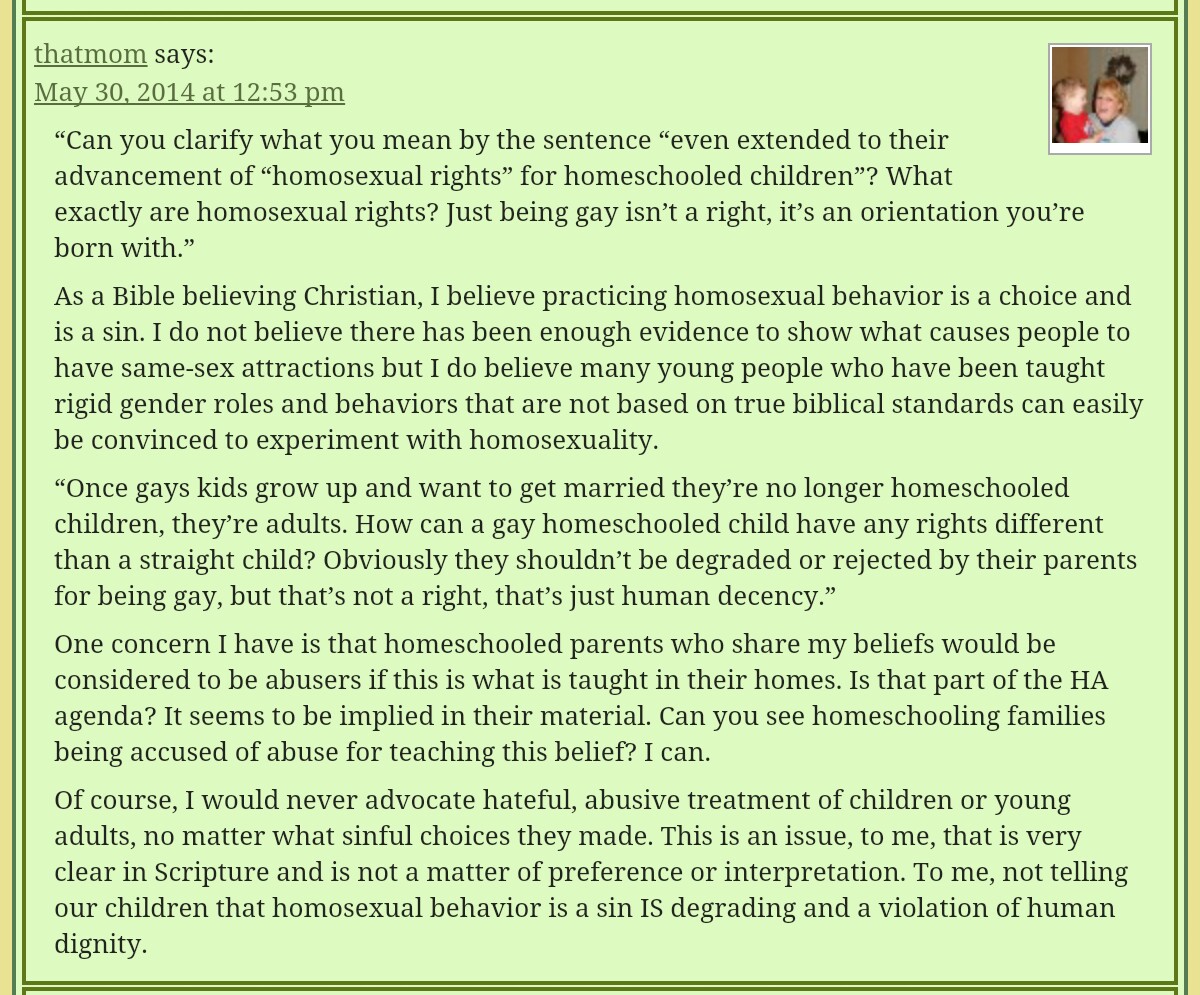
What I would rather talk about is the comment she left on her post, where Campbell suggests that young people raised in patriarchy, “can easily be convinced to experiment with homosexuality.”

karen

Ms. Campbell really doesn’t understand how this whole gay thing works if she thinks that being taught rigid gender roles is going to confuse someone into homosexuality. Also, while we’re at it, bisexuality is a thing too, though I doubt Campbell thinks it exists.

Rigid gender roles are bad, and should be rejected outright, but forcing a kid into a rigid gender role has nothing to do with who they’re attracted to. For that matter, there are kids who fit quite happily into rigidly defined gender roles but are still attracted to the same sex, and kids who don’t fit at all but who are entirely straight.

Homosexuality is about who you’re attracted to, and whether or not a kid fits into a rigid gender role is about gender identity and expression, another issue entirely. For a kid who is gender non-conforming, being forced into a rigid box isn’t going to confuse them into gayness, it’s just going to make their life unpleasant.

Besides, I didn’t grow up forced into rigid gender roles and I’m still queer. In fact, I’d wager that my parents’ version of homeschooling is one that would get the Karen Campbell seal of approval, but hey, here I am and no one convinced me into anything.

Are we so weak that she thinks we can easily be misled into gayness? I graduated from high school at 17, got a degree in computer science as the only female student in all but one class, moved overseas by myself to teach in Asia, and have my JD. That I could “easily be convinced” of anything, much less of something that makes my life harder, is insulting.

There are many things that I will lay at the feet of patriarchy, but nope, you’re not going to be able to write off LGBT homeschoolers this easily. Patriarchy did not make us, this is who we are, and there is nothing wrong with that.

We’re here, we’re queer, patriarchy had nothing to do with it, and it’s high time you get used to it.

Christian Homeschooling and Child Abuse Denialism

Screen Shot 2014-06-03 at 3.18.35 PM

HA note: The following is reprinted with permission from Libby Anne’s blog Love Joy Feminism. It was originally published on Patheos on June 2, 2014.

If you’re a long-time reader, you’re likely aware my series on HSLDA and child abuse, which includes their fight against child abuse reportingtheir stonewalling of child abuse investigations, and their defense of child abuse. You’ve probably also read my viral “HSLDA: Man Who Kept Kids in Cages ‘a Hero.’” If you read Homeschoolers Anonymous, you probably know that Doug Phillips, former HSLDA attorney and founder of the now-defunct Vision Forum, stated in 2009 that “We understand that the core problem with Child Protective Services is its existence.”

What you may not be aware of is that in 1985 Mary Pride published a book titled The Child Abuse Industry: Outrageous Facts About Child Abuse & Everyday Rebellions Against a System that Threatens Every North American Family

Who is Mary Pride? If you’ve ever homeschooled, you’ve almost certainly heard of her. She has had so much influence in homeschooling circles that has been dubbed “the queen of the homeschool movement.” Historian Milton Gaither has dubbed Pride as one of homeschooling’s two most influential curriculum reviewers. Pride first published her Big Book of Home Learning in 1986 and has updated it regularly since. It now has four volumes. Pride is also the publisher of the “wildly popular” Practical Homeschooling magazine, with as many as 100,000 subscribers, and has published numerous other popular homeschooling how-to books. Pride is also the author of The Way Home, published in 1985 and credited with launching the Quiverfull movement (not to be confused with the Patriarchy movement).

And then, of course, there is The Child Abuse Industry. According to R.L. Stollar, the book is “a remarkable read that calls for a ‘Second North American Revolution’ — namely, having babies, abolishing no-fault divorce, going to church, eliminating foster care, homeschooling, re-instituting “biblical” executions of criminals, and getting rid of abuse hotlines.” Stollar is currently writing a multi-part review, which I will definitely promote when it comes out.

Here are ten quotes from Pride’s book, courtesy Stollar’s post on Homeschoolers Anonymous:

10. “The major problem is that the public has been convinced that child abuse is a major problem.”

9. “Are one out of four adult women (or one out of three, or two—the statistics keep getting wilder) really the victims of savage lust perpetrated in their youth?Isn’t it possible to organize a bridge party without staring at an abused woman across the table? Where do these wild statistics come from?”

8. “Never vote for a candidate whose campaign promises include ‘doing more for children.’”

7. “Child abuse hysteria is a self-righteous coverup for anti-child attitudes.”

6. “If [child abuse prevention programs] are allowed to proliferate, we will produce for the first time an entire generation of males who have been trained to consider raping their sons and daughters as passably normal behavior.”

5. “If sex has nothing to do with having babies, you can have sex with anyone or anything. Including children.”

4. “We need to stop allowing the unsupported testimony of childrenwho are of an age where they can barely distinguish fantasy and reality.”

3. “Don’t hotline anyone.”

2. “A retarded daughter told contradictory tales of sexual abuse by her step-brother and other male relatives… So here we have a girl who probably made up the story in the first place.”

1. “Age segregation increasingly alienates children and adults. Children are the ‘new n*****s.’” (not censored in Mary Pride’s version.)

My interest piqued by Stollar’s quotes, I cracked open my copy of HSLDA’s Chris Klicka’s 2006 book, Homeschool Heroes: The Struggle and Triumph of Homeschooling in America. I opened to the chapter on social workers.

At Risk from Social Workers

. . .  Homeschoolers are at risk. They are not at risk because they have big families or teach their children at home or neglect their children in any way. They are at risk because the child welfare system has lost control. Many social workers are trained in a philosophy that is antiparent, antifamily, and antireligious.

I can’t say I’m surprised, but here it is again. Look, I know that social services isn’t perfect, and that it’s badly in need of better funding. But that’s not what this sounds like it is about. According to Klicka, the issue isn’t that social services is underfunded and understaffed, but rather that social services is antifamily. This is the same sort of line Mary Pride was promoting in her book.

HSLDA is both a policy advocacy and legal defense group. HSLDA defends member families if they have any problems in their interaction with local public schools or social services. The organization’s website describes it like this:

Why does HSLDA help member families in the initial stage of a child abuse investigation?

HSLDA’s mission is primarily to advance homeschooling rights. Sometimes homeschooling parents get reported to CPS because people misunderstand homeschooling. They may see children playing outside during school hours and think that the parents are allowing them to be truant. Other times, families are reported for other types of suspected abuse or neglect. Investigations of all such allegations begin the same way: a social worker visits the family’s home, or contacts them requesting to set up a visit.

HSLDA advises our members in these initial contacts with social workers in order to ensure that their constitutional rights are protected. Once the allegations are revealed, we continue to represent our members if the allegations relate to homeschooling.

In other words, according to HSLDA’s website, they advise member families any time there is a social worker at the door, but only represent member families going forward if the allegations involve homeschooling. Along these same lines, an announcement on HSLDA’s facebook page last year asserted that “HSLDA does not and will not ever condone nor defend child abuse.” But some of the stories Klicka relates from his years working for HSLDA tell a different story.

There’s this one, for instance:

A homeschool father in Michigan picked up his two-year-old child by the arms, taking her into the house while she was crying and was reported for child abuse by a nosy neighbor. I set up a meeting with the social worker and counseled the family on what htey should say. I told themI told them to explain their religious convictions concerning raising their children from “a positive standpoint” avoiding Bible verses like if “you beat him with the rod, he will not die.” Or, if you “beat him with the rod,” you will “deliver his soul” from hell. Not a good idea. Social workers just don’t understand those verses.

Instead I told them to explain their beliefs by emphasizing verses such as Matthew 18:6 that states that if you harm or offend a child, it is better that a millstone be tied around your neck and you be thrown in the deepest part of the ocean. In other words, their religious convictions demand that they not do anything that will harm their children. When the family began presenting these religious beliefs to the agent, he became visibly uncomfortable, and suddenly announced that he would close the case.

And this one:

In Fairfax County, Virginia, a pastor gave a seminar on child discipline that included the requirement in the Bible to spank. A parishioner had to discipline her child while a neighbor was visiting a few days later. She spanked the child in the other room and then explained to the neighbor a little of what she had learned from the pastor.

The neighbor, who happened to be against spanking, reported the pastor to the child welfare agency for “bruising their children and for twenty-minute spanking sessions.”

To clarify, this suggests the pastor spoke in his sermon of bruising his children and carrying out twenty-minute spanking sessions.

The social worker who then initiated the investigation told me she thought she might have a religious cult on her hands that abuses children. I expressed my disbelief to the social worker that she was seriously investigating what an anonymous source claimed she heard from a person who heard it from another person. That is thrice removed hearsay. I told her that her evidence was flimsy and set the parameters for a meeting.

In preparation for the meeting, I told the homeschooling pastor and his wife not to recount any specific incidents of spanking since the social worker had nothing on the family that would stand up in court. I told them that they should emphasize again the positive verses such as Matthew 18:6. Since the social worker had no evidence, the only evidence she could acquire would be from what information she could gather from the pastor and his wife. Since the parents carefully avoided all specific examples and spoke in general terms, the social worker had nothing and had to close the case.

Perhaps those at HSLDA would argue that they never defended someone against child abuse in court. But in this layman’s eyes, this constitutes defending child abuse. I mean, did they even ask the pastor if it was true that he bruised his children and spanked them in twenty-minute sessions? Or did they de facto believe he was innocent and not bother checking, as seems to be their habit? I’ve expressed my frustration with this before.

And there is a similar distrust of children’s testimony with Klicka as with Pride:

Another family in Bradington, Florida, was visited by social workers. Allegations were made by one of their seven adopted children, who was the only one not being homeschooled. He had made up a story and told it to his science teacher, who had then passed the information to a social worker. I was able to talk to the social worker and keep them out of the home and away from the children. The case was finally listed as unfounded. The mom said, ‘This is why I spend twenty-six cents a day. People are crazy not to join HSLDA. I have an attorney ready to help me at a moment’s notice.’

There is also advice on how to hide abuse and avoid being reported:

Know Your Family Doctor

We have had numerous situations where doctors turned homeschoolers in to social workers because they found a bruise or mark on the child . . . I learned early on that each family needs to know their doctor well. If the doctor is familiar with the patients and trusts them, they do not have to turn them over to a child welfare agency, even if they have a mark or bruise. It is completely the doctor’s discretion.

The orientation toward social services is the same in Klicka’s book as in Pride’s—one of opposition. They are the enemy. In fact, Klicka began his chapter on social workers with I Peter 5:8-9—”Be sober; be vigilant; for your adversary the devil walks about like a roaring lion, seeking whom he may devour.” The assumptions about the veracity of the parents’ and children’s testimony is the same—parents’ word can be trusted, children’s cannot.

We need to be careful not to assume that all homeschoolers engage in this sort of denialism and defense of child abuse. I do not know whether the themes explored here extend beyond the leaders of the conservative Christian homeschooling subculture, and we should not assume that we do. But with that subculture, this is a problem. With these sorts of narratives, how can we expect those within this subculture to even self-police, much less report suspicions of abuse?

From Pride’s The Child Abuse Industry to Michael Farris’s thrill-horror novel Anonymous Tipthis is a problem. 

Oh, and also? If there are Christian homeschoolers out there who are upset by what I’ve said here, the correct response is to go about condemning the words of these Christian homeschool leaders and creating a new narrative, a narrative that affirms reporting suspicions of child abuse and doesn’t de facto trust parents’ word over that of their children. Condemning me for saying these things or arguing that I am anti-homeschooling would be the incorrect response.

Feeling Like A Girl: Femininity After Homeschooling, By Kay Fabe

Image source: http://kerbear88.deviantart.com/art/Femininity-207270064

HA note: The following is reprinted with permission from Kay Fabe’s blog Post-Fundamentalist Fashion. It was originally published on May 31, 2014.

Pearl’s story the other day really resonated with me, and I know I’m not alone. I’m sure lots of you have had the same experience I had: after years of getting told that the “girly” outfits you wanted to wear were “immodest,” “revealing,” and “inappropriate”, you just gave up and went butch, with lots of baggy boy shorts and shapeless sweatsuits. (Which is fine if that’s what you’re into – but I know that look wasn’t me.) Wireless cloth bras, hand-me-down underwear and a ban on perfume, makeup and hair products probably played a part in your systematic de-feminization. Eventually – if your experience was like mine – you became so disconnected from your body that you hardly felt like a person anymore, let alone a girl. And that’s a tragedy.

It took some cataclysmic life events – a failed courtship, starting a business, moving out of my parents’ house and eventually out of state, and meeting a supportive partner – to give me some distance and perspective on my homeschool years. Along the way, by trial and error, I’ve slowly been figuring out how to become a girl again. At 26, I finally feel more at home in my skin. Here are some of the things that helped me – maybe they’ll help somebody else, too.

Read drag websites. I’m not even kidding. They’re full of helpful information on how to walk, talk, dress and act in order to “pass” as a female. Granted, some of it’s a little over the top – skip their make-up tips, for instance. But I remember how astonished I was when I discovered that somebody had actually written reams of detailed instructions for presenting as a lady. It felt like Christmas.

Reclaim the skirt. It took me the longest time to figure out that dresses are not a badge of shame! Big jean jumpers and long khaki skirts are not the only option. Skirts are supposed to make you feel pretty and sexy, and if they’re not doing that, then they’re not doing their job. Swishy maxi dresses, cute cocktail dresses and tailored pencil skirts are incredibly fun to wear. So are heels. They are designed to make your legs longer and that’s a GOOD thing!

Have some little signature “girly” thing that you do or wear all the time. Or more than one! For me, it was getting my ears pierced and always wearing earrings. Having a little pair of sparkly studs in your ears all the time really does make you feel more feminine. I gradually added in other things and now I always have on earrings, toenail polish, a silver ankle bracelet and a little bit of perfume. It makes me feel pretty.

Practice showing a different bit of skin at a time. I remember the first time I tried to walk outside my apartment in shorts and a tank top, “cold turkey.” Bad idea  – I felt completely naked. After a while, I figured out that I could ease into it if I only uncovered one area at a time. If I had on shorts, I wore a big, loose t-shirt. I paired tank tops with long cargo shorts or capris. Eventually, I just got used to having various parts of me out in the sunshine and I didn’t mind anymore. (Shocker – nobody ogled me and drooled with lust, either.)

Go and get an actual bra fitting at Victoria’s Secret. And then get some lovely lingerie that fits. I am ashamed to say that I could not actually make myself do this until I was 25 years old. They’re totally nice. All you do is lift your arms, and they run a tape around your bust and tell you what size you are, and then give you some sample bras to go try on in the fitting room. It’s not embarrassing at all… nothing like bra shopping for “appropriate” underwear with your mother. (P.S.: You may be surprised by your bra size! For years and years, I assumed I was an A or a B cup, and figured bras were supposed to squash me in and feel uncomfortable. Guess what? I’m a D.)

Have bottles of nice stuff in your shower, and use them. I wish someone had told me that I needed to put SHAMPOO and CONDITIONER in my hair, and use SHOWER GEL and BODY BUTTER on the rest of me. (When I was a kid, we used this weird organic shampoo/soap called “Dr. Bronner’s Magic Soap” where every square inch of the label was covered with manic stream-of-consciousness meanderings in TINY print. It was an entertaining reading experience but as far as soap went, it wasn’t awesome.) The Warm Vanilla Sugar stuff from Bath and Body Works is awesome, though. So is the Moonlight Path (lavender) and the Japanese Cherry Blossom.

Drink wine in the bathtub and listen to jazz. It completely makes you feel like a movie star.

Dance all by yourself. Put on your favorite music and move with it. Learn to feel the evil jungle beat that kills all the plants. Feel how your body is all connected together, how it’s a physical, material being, how it moves through space, how it responds so beautifully to touch and sound. You are designed to be a beautiful, corporeal person, not a disconnected intelligence trapped in a useless body.

That’s really the most important thing: You are beautiful. You just need to know it, and feel it, and own it.

11 Homeschool Celebrities Explained With GIFs

By R.L. Stollar, HA Community Coordinator

Homeschool celebrities.

They run our lobbying organizations, write our books, and garner all our blog views. Our parents thought they were God’s messengers and we thought we should keep our thoughts to ourselves. Now that we’re grown, our perspectives have changed a bit. So we think it’s worthwhile to look at 11 current and former homeschool celebrities — and explain them using gifs.

.

1. Michael and Debi Pearl

The Pearls have a unique approach to communicating the love of Jesus to children. It goes something like this:

love

.

2. Doug Phillips

Last year Doug Phillips realized his most Hazardous Journey wasn’t a vacation. It was the public backlash against revelations that he had an extramarital relationship with a woman that involved — well, we weren’t sure exactly what it involved.

When Phillips first admitted infidelity, he spun it as just some species of “emotional fornication” or something:

phillipspre

But then it came out that, no, the relationship wasn’t just “inappropriately romantic and affectionate,” as he originally stated. The “relationship” was Doug Phillips repeatedly sexually abusing a young woman. As far as his original statement went, Phillips was suddenly like:

phillips

.

3. Bill Gothard

Bill Gothard, like Doug Phillips, has discovered that sexually abusing young people doesn’t make you popular. However, unlike Phillips, Gothard faces over 30 individuals accusing him of abuse. At this point his attempts to explain his situation are sounding like this:

jennifer-lawrence-gif-2

.

4. James and Stacy McDonald

As the media and homeschoolers are circling the wagons around Bill Gothard and Doug Phillips, their former fans with crushes on Patriarchy are doing everything possible to now hide that fact. People like James and Stacy McDonald are pulling previously written posts and urging Patriarchy advocates to change the words they use. The McDonalds’ response here boils down to:

“No Patriarchy to see here. Move along!”

1d38007b_tumblr_lh52r8FFry1qhwx3io1_500

.

5. Doug Wilson

Then of course there’s Doug Wilson. When he’s not too busy with obsessing over the latest blog post by Rachel Held Evans, Wilson is fighting the biggest threat Western Civilization has ever faced: women playing unladylike basketball.

tumblr_mov3fh44uE1qe3cxyo1_250

.

6. Jim Bob and Michelle Duggar

Jim Bob and Michelle Duggar have a TV show. The plot of that TV show can be described by staring at this gif for approximately 19 seconds… and counting…

duggar

.

7. Ken Ham

No homeschool celebrity list would be complete without a shout-out to Ken Ham. If you find it somewhat difficult to believe Adam and Eve enjoyed candlelight dinners on the backs of dinosaurs while trying to avoid talking snakes, well, Ken Ham has one message for you:

tumblr_lum894SeOv1qb1zcjo1_500

.

8. Kevin Swanson

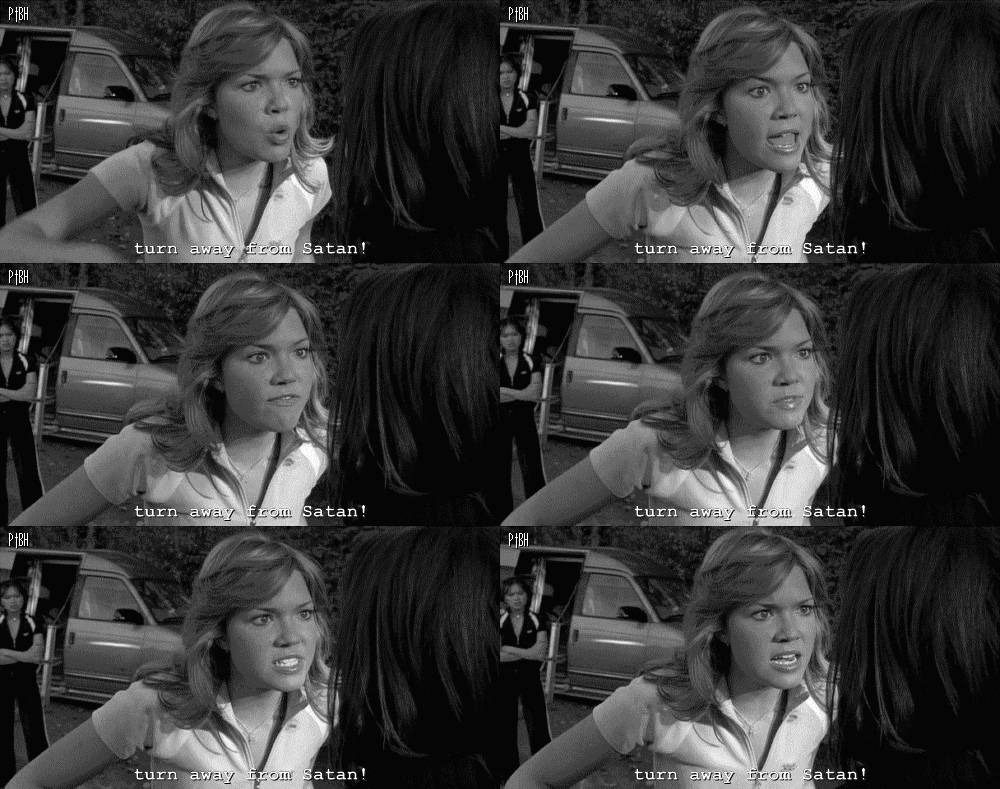
Kevin Swanson is like the Drunk Uncle of Christian homeschooling. From defending child marriage, comparing child abuse to “dead little bunnies,” warning people Frozen is Satan’s attempt to indoctrinate children into “the lifestyle of sodomy,” to his actual statement that “There’s a contrast between the feces-eaters and the church,” sometimes we wonder if he rocks himself to sleep at night screaming,

swanson

.

9. Mary Pride

Mary Pride found her way home in 1985. It involved outbreeding non-Christians and calling children “the new n*****s.” When it comes to people and organizations working tirelessly to protect children from abuse, Pride is all,

pride

.

10. Michael Farris

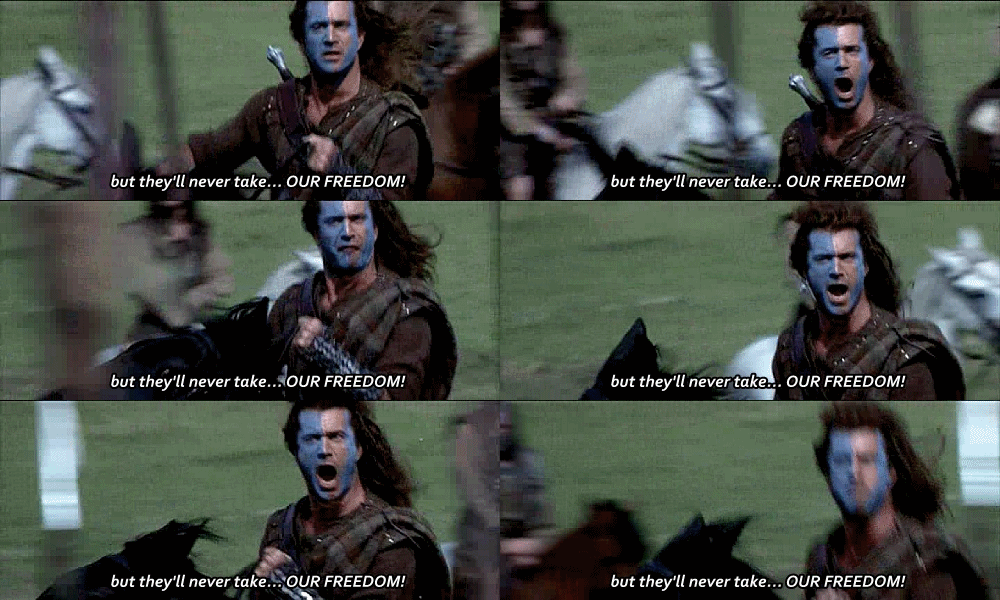
In the midst of all the drama in the homeschooling world, Michael Farris stands in the foreground leading the charge against Obama, Common Core, and the not-Nazi Germans who hate homeschooling as much as he loves freedom. And Michael Farris loves his freedom:

freedom

.

11. Matt Walsh

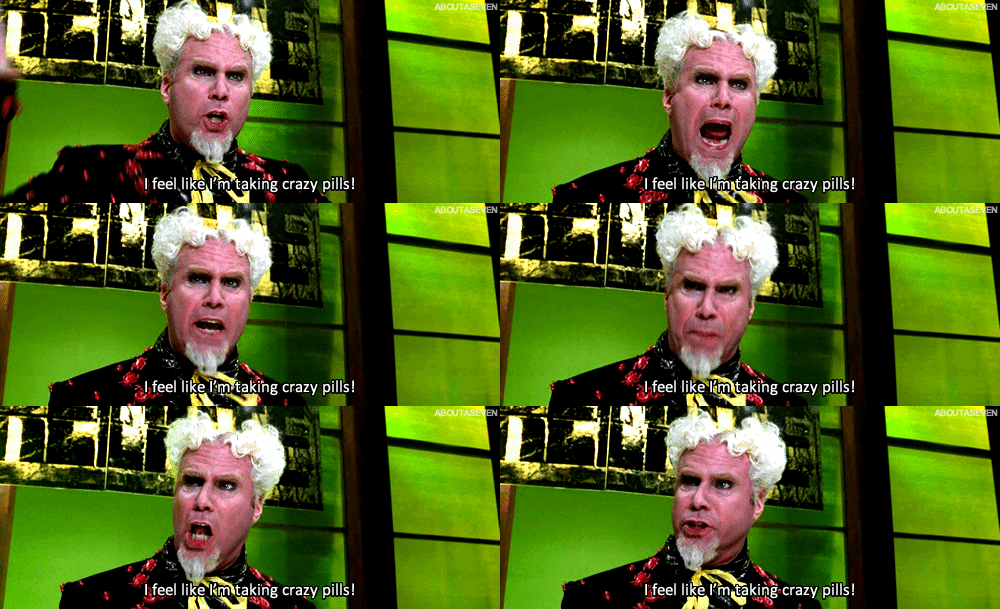
Ah yes. Finally, there’s Matt Walsh:

loud-noises

Forgiveness and Power

Screen Shot 2014-06-01 at 7.29.36 PM

HA note: The following is reprinted with permission from Sarah Henderson’s blog Feminist in Spite of Them. It was originally published on her blog on July 29, 2013.

Over the course of my life I have been instructed to forgive so many times. Ironically, the people who were telling me to forgive were also the people who spent a good deal of time telling me that in reality there was nothing to forgive, or that no wrong doing had occurred. Technically I think this means I am off the hook anyways. But in reality, there was wrong doing from people in my life who were supposed to protect me.

I now believe that forgiveness is a religious concept. I believe it was created to control people who have been wronged, by investing them with an equal amount of responsibility for the relationship, so that if they do not choose to forgive and rebuild, they have at least half the blame. After all, if you are a person in power, you can do anything. All you need to do is make sure the recipient of wrong doing feels guilt if they do not choose to trust you again.

I think this can come in so handy for rogue religious leaders and fathers in isolated families. A fear can be fostered over decades that the recipient needs to be open to the idea of allowing similar offences over and over again in the name of forgiveness. The recipient can be handled as many times as needed to allow the cycle to continue.

There is definitely something to gain if you are already in a position of power. The person in power is already in a position to justify their own actions based on whatever act of god or man put them in power in the first place. I am speaking of power in the small scale, but when a person is in this type of power position, it is easy for them to lose sight of their own place in the world. They can become the king of their own little castle, as it were. They need the concept of forgiveness to exist, so that when they violate the rights of those they control, they can keep that control by inflicting guilt on the recipient.

I do think that there is some freedom in moving forward, which is often confused with forgiveness. It is a totally different concept in my opinion. In my opinion, moving forward is more about recognizing that those who violate your rights are choosing to do so, and have no reason to change in a vacuum. A recipient of wrong doing does not incur responsibility, but if they are going to take any kind of action, ending the ability of the person in power to retain the cycle of control is not a bad idea.

Sometimes the only way to break the cycle is to end the relationship. People often seem so horrified by this idea, but why should someone stick around and allow their rights to be violated over and over again in the name of a religious concept that only benefits the wrong-doer? If someone has been traumatized by their own parents, the options are not simply to stick around and try to maintain the relationship or else live in a cess-pool of bitterness and hurt. There is a whole other option out there. You can walk away. You can choose to surround yourself with people who are not interested in violating your rights. When you walk away, you can leave the hurt there too, because you are leaving the source. It isn’t as easy as it sounds, but everyone has a right to live their own lives, regardless of wrong doing in the past. This takes time but no one has to submit themselves to a proven risk.

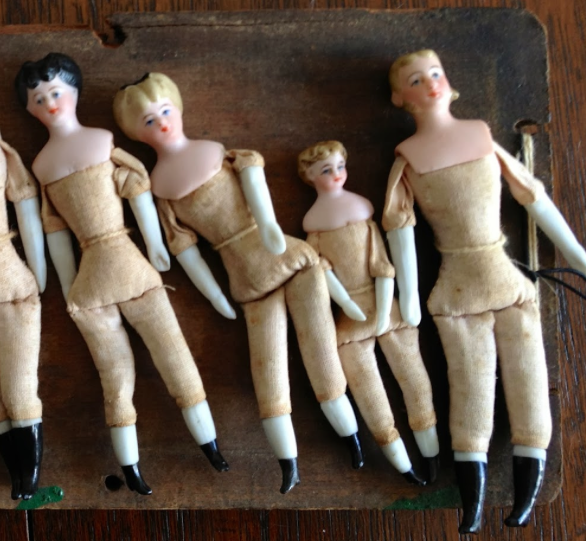
Life in the Dollhouse: Stay At Home Daughters, by Lea

Screen Shot 2014-06-01 at 7.04.26 PM

HA note: The following is reprinted with permission from Lea’s blog Emancipated Atlas. It was originally published on May 31, 2014.

As little girls play with dolls in dollhouses, so Christian fundamentalist parents play house with their daughters, teaching them from a young age that women are to be homemakers- any college degree or job outside the house being considered prideful or sinful. Worse, college degrees for women are not God’s design. This isn’t your average “homemaker in training” evangelical culture, this is an agenda that reaches far beyond training daughters to know traditional life skills. This takes everything you know about conservative Christian womanhood to an extremist level.

*****

I’d like you to meet several people I have met through the years and was in contact with during my time as a stay-at-home-daughter.

“Wendy”, a late 20-something from Idaho, considers her work to be Pinteresting. She tries to pin 400 things each day. When I talked with her, she said she felt called to “inspire” others and give them a hobby of repinning her pins. When we were friends on Facebook, she listed her work as “Editor of Pins at “Wendy’s” Pinterest.” She takes direction from her parents, from getting her father’s approval every morning on what she wears, to waiting for her mother to choose the meal Wendy will make for dinner. Wendy’s mother still ‘screens’ books and movies to make sure they are wholesome before Wendy and her older sister can read or watch them. Wendy does not make many decisions for herself, without first getting an answer or at least plenty of information from her parents about something. Wendy hopes that a man will come along and marry her- a man who would first have to be interviewed with a several hundred question form and approved by her father before she knew anything about his interest in her, typical of courtship culture ingrained in the stay-at-home daughter movement. Last I knew, she claimed her father’s vision was for her to “refrain from work outside the home” -yet she offered no other clue as to what her father said she should do instead.

“Wendy” seems perfectly happy with her life and being happy and content is important. Yet, she does seem to be oblivious to any other choices available to her. She claims that “deep Bible study” for a few minutes each morning is better than any college degree; that her parents are her shelter from the “evil world” and that if she becomes too educated, she may end up choosing a sinful lifestyle – which she defines as “living outside her father’s home as an unmarried woman.”

“If I become too independent,” “Wendy” said once, “I will not only be disobedient to my parents, but to God who desires all unmarried women to remain at home. I don’t want to live in sin.”

Where did this idea of sin come from?

Doug Phillips, former leader of the now-collapsed Vision Forum empire in the dominionist branch of homeschooling, says in a documentary called “Return of the Daughters” 

“Daughters, by no means, are not to be independent. They’re not to act outside the scope of their father, and then later, their husbands. As long as they’re under the authority of their fathers, fathers have the ability to nullify or not the oaths and the vows. Daughters can’t just go out independently and say, ‘I’m going to do this or marry whoever I want.’ No. The father has the ability to say, ‘No, I’m sorry, that all has to be approved by me.”

You’ve guessed it, stay at home daughters live under the roof of their parents until they marry- even if they never get married because their father couldn’t approve those who asked! Those who follow this lifestyle believe it is sin for a woman to do anything else, thanks to the teachings of Doug Phillips. It should be noted that Doug, an advocate for “strong, godly families” within the conservative homeschooling community was recently exposed for having an affair with a young girl who worked without pay in his home as a nanny. The girl appeared in an interview in the same documentary mentioned above. While his actions do not automatically “nullify” his teachings – sound doctrine does- it does show the rampant hypocrisy and cover-up that occurs in the every day of dominionist and neo-reformed sects.

Generally, stay at home daughters can volunteer outside of the home, as long as they do not go far, work in a family or Christian setting, and are not paid for their work. You will even find them volunteering in local hospitals with siblings or like-minded friends- again without pay and in context and “accountability” of a family.

Steve and Teri Maxwell, fundamentalist homeschooling parents with a number of adult daughters at home, recently posted an article on their family “Titus 2″ blog detailing the ‘benefits’ of adult stay at home daughters. Though they make it clear their daughters stay at home by their own “choice” – I am left wondering if the women know there are other options, and if those options have been presented in an objective manner.

Teri says “Sometimes our girls are asked about their plans for the future. Right now they are 17, 22, and 31. They are all unmarried and living at home.” She does not address the possibility of how she would respond should one of the daughters want a job or desire to attend college. Teri claims her daughters desire the protection and safety of home and will remain there until marriage. This means that they will likely remain at home until they die since Steve and Teri have apparently made legal provisions that the house remains for their use upon their death. Also, the women and their marriages hinge entirely on Steve’s consent and his interviewing an interested young man- of which he has been rumored to have already turned away several. Nicknamed “Stevehovah” by his “homeschool apostate” critics, Steve Maxwell is known for shadowing his daughters wherever they go- from church to speaking at homeschool events and being a middle man between his children and all incoming contact.

Another argument the Maxwells make on their website is that they enjoy having a strong family unit that is inseparable, citing the Ecclesiastical verse “a threefold cord is not easily broken” using the mother and father as 2 cords and the daughters as a single cord. They enjoy seeing their daughters delight and work in their family’s home, making meals together for their parents and enjoying reading out loud to them in the evenings.

“Our culture typically says for young people to leave home when they are eighteen, and often the parents are happy to be free of them,”  says Teri in an article.  “We love conversations with our adult children. We like doing things with them. We like them to… ask for counsel. They are Steve and I’s best friends, and we are delighted that they want to live in our home! Allowing our adult, unmarried children to live in our home provides accountability for them. Our daughters are not isolated, they have opportunities to attend church and attend ministry events outside of our home with us.”

However, what exactly is this “protection” they are talking about? Is it not possible for Christian adults of age to handle their own lives, while remaining accountable to God? Where does personal responsibility come in? Why does a 31 year old woman need a fatherly chaperone? In Wendy’s case, why must her father approve her outfit each day to make sure it is modest when Wendy is nearing 30? What is so dangerous and unsafe about the natural maturing of your children? And, within the Maxwell family, who or whom  exactly made this decision to keep their daughters at home?

The language used by Steve and Teri is loaded with much authoritarian heavy-handedness, making it seem like the family is all about mom and dad’s wishes for the children- and a quick study of the Maxwell family’s belief shows this is explicitly their intent! From parent-centered curriculum for new parents like controversial Ezzo’s “Babywise” to Bill Gothard’s ATI homeschooling curriculum, many Christian homeschoolers, like the Maxwells, believe that children’s lives should be ordered around their parents’ schedules, plans, and wishes.

The voices missing from this discussion, at least in the Maxwell family- are the daughters’ – who have been raised in an isolated sect of the conservative homeschooling community with few social opportunities outside of Christian homeschool conferences where they speak.

Continue reading this piece on Emancipated Atlas.

Letter to Our Parents

Photo by Darcy: http://www.darcysheartstirrings.blogspot.com

HA note: The following is reprinted with permission from Darcy’s blog Darcy’s Heart-Stirrings. It was originally published on Patheos on May 9, 2014.

Dear parents,

I’m in several online groups consisting of thousands of the homeschool alumni of my generation, the “Joshua Generation”, the products of the Christian homeschooling pioneers. And one major theme going on in our conversations right now is an overwhelming frustration that we cannot talk to our parents. We cannot be real with you.We want a relationship but don’t know how to get past the mental and emotional walls you have put up to protect yourself, the denial that your choices for us caused pain. Your disapproval of our choices and rejection of how you raised us is thick enough to be cut with a knife, and weighs very heavy on our shoulders. Can we just for a moment sit here together, walls and guards down, and be honest with each other? There’s so much we want to say to you, to help you understand. So much WE want to understand. So this is my attempt to give voice to so many, including myself.

Unless you’re never on the internet, I’m sure you know by now that your kids’ generation isn’t turning out how you’d hoped and planned. How you were assured we would if you only followed the rules. Dissatisfaction, pain, anger, and disillusionment are plastered all over the internet by your children and their cohorts. Story after story written by the adult alumni of the homeschool movement, honest and real and painful. Stories of dysfunction and inability to cope in the real world because of the choices you made for them. Stories of pain suffered, feelings of betrayal, and honest, raw emotions that are probably hard for you to see and hear. Words like “spiritual abuse” everywhere, directed at you and the people you trusted to teach your children how to be godly. “Survivor blogs” are popping up, being written by your adult offspring. That’s gotta hurt. We are walking away from so much that you held dear. We are raising our own kids so differently than you raised us. Even the leaders you followed have turned out to be frauds.

I’ve seen your reactions. Denial. Anger. Verbal lashings. Tears. Disbelief. Shunning. Excuses and justifications. Feelings of betrayal. Guilt. So much pain.

“How dare they!”

“We were just doing what we thought was best.”

“We only wanted to protect you.”

“We were trying to follow God the best way we knew how.”

“We gave you the best we could and you repay us by rejecting it all and plastering your discontent all over the internet?!”

“You are dishonoring us by focusing on the bad!”

“You’re just bitter and need to move on.”

“We loved you and this is how you repay us?”

“It wasn’t that bad.”

I understand the sheer amount of unexpected consequences and the reactions of your children must be overwhelming. You didn’t expect this. You did everything “right” and followed the people who had all the answers, who made promises about how your family would turn out if you did what they told you was “God’s will”. And when it didn’t work, those teachers and their followers blamed you and your “rebellious” children. “You must not have followed the rules correctly.” The broken relationships are like a knife in your heart.

Our rejection of your ways is not personal. It’s not a “reaction”, as we have been accused of ad nauseam. Many of us were taught to “stand alone”, to figure out what was right and then go do it regardless of what everyone else was doing.

Well….that’s what we’re doing.

We have weighed the teachings of our past and found them wanting. We have chosen different paths for our own families, much like you did for yours. We have taken what was good and thrown out what was not, some of us throwing out everything because, honestly, there wasn’t much good left to hold on to. Many of us are lost and dysfunctional, trying to put together pieces of a puzzle, trying to live in a world we were not prepared for because we were told we weren’t part of it. Many of you have taken this as ungratefulness toward what you did for us, but this is not about you. This is about us….our lives, our choices, our own children who we must now make choices for.

Can you please stop making this about our rejection of you and instead see it as our embracing of our own lives?

We are your children yet we are not children anymore, many of us older than you were when you set out to raise your family the way you saw fit. We want to have relationship with you, but not as your children. As your equals. As friends. As fellow human beings. Please stop treating us as rebellious children. Think back to when you chose differently than your parents and remember what that was like before you treat us with the same disdain and disappointment.

For those of you invalidating our stories, saying “it wasn’t that bad”, can I ask you to take a step back for a moment? To gain a broader perspective? Because what may have been only a small part of your life, was our ENTIRE lives. You were adults when you chose to attend that Basic Seminar, when you picked up your first courtship books, when you decided to promote the modesty culture, when you chose to become part of a patriarchal system, when you made the choice to spend your kids’ childhoods sheltered from the world in your own little reality and the culture you created. But us? We were born into it. We were raised our whole lives immersed in it.

We spent the most formative years of our cognitive and emotional development in an alternate religious culture ruled by fear, shame, legalism, and authoritarianism. We had no choice. We knew nothing else. We had no other experience and knowledge and discernment to ground us like you did, to give us perspective, to compare anything to.

For you, this was 10-20 years of your life. For us, it was our whole lives. It was all we knew. Our entire lives have been built upon a time period that was just a small part of your own life. So, yes, it was “that bad”. Our experiences were nothing like yours and you’ll have to see them through our eyes if you want to understand.

You had a different life before this, and a different one after. This homeschooling movement and the resulting culture is all we know. It made us who we are, for better or for worse. Our stories cannot be separated from it. We are the products of that movement. You were the facilitators who got to choose what affected you and what didn’t. We didn’t have the capacity as children to even begin to make that choice. What you only observed and instigated and perpetuated, we lived, felt, internalized, and became. 

You keep telling us we’re overreacting. You’re offended because we “don’t appreciate” what you did for us. But this is not about you. How we tell our stories and work through the consequences of your choices for us is not about you. It’s about us. Our lives. Our hearts, souls, minds, marriages, relationships, spiritual journeys, and futures. The things we write about how teachings like emotional purity, the umbrella of authority, modesty, and courtship affected us, how they hurt us, messed us up, how we’re working through the messages we received and internalize….these things are not about you. We aren’t telling our stories to “dishonor” you. We’re telling them because truth sets free and light banishes darkness. Because wounds fester in silence and heal in openness. We can love you, forgive you, and have a relationship with you and still tell our stories. We HAVE to tell them and tell them truthfully. Because sometimes it’s the only way to wade through the muck and the crap and the dysfunction that you inflicted on us and we are leaving behind.

Some of you have regrets. You look back and say “What were we thinking?!” You know you made mistakes, big ones, and you know it hurt us, hurt our relationship with you. Some of you are watching your children struggle to overcome the consequences of your choices for them and hurt for them and are angry at yourself. Can you please just say it? Be as open and honest as we are. You know what I don’t hear in the reactions of our parents that I listed above? “We are so sorry.” Why is that so difficult to say? I know it’s scary to think that the choices you made damaged your children. I’m a parent. I have the same fears that my choices will hurt my kids. But as a parent, I cannot imagine NOT telling them “I’m sorry” when they come to me and lay bare their souls, and explain how I’ve hurt them and how they’re healing. Yes, it hurts. But I guarantee that holding it inside and bearing that burden alone will hurt you and your children far more than being honest with them about your regret.

So many of us get it. We get that you were duped. That you were victims of spiritual abuse yourself, who went on to unwittingly inflict that abuse on your kids. Give us a chance to express that. To openly forgive and to honestly work through the anger and the pain with you. Many of us have forgiven you, but we cannot talk about it with you because you refuse to go there. It’s easier for you to just deny the past, our pain, and your part in it. Keep that up, and the denial and facade will eat out your soul til there’s nothing left, while we move on with our lives without you. We want to have a real relationship with you, to repair what was broken, but you are holding so tightly to your elephants in the room, and we have to stay on the surface and walk on eggshells around you, playing your game of pretending that everything was peachy, trying to live well in the present while denying the past. Meanwhile we are frustrated and wonder how much longer we can keep up your charade.

Please stop.

As scary as it is to face pain you caused, it’s much worse to pretend it never happened. So many of us are ready to start building a real relationship with you, to include you in this conversation. But it’s your move. I can’t promise it’ll be easy or good, that’ everything will turn out the way it is supposed to, but it will be worth it, for yourself and for your family. Honest and human is the only way to live.

I asked some of my friends…your children who are now grown…what they would say to their parents if they could. I’d like to end with their words. Listen to their hearts.

“Can you please stop focusing on the extremely few truly good things there were about the way you raised me and just admit, “I was wrong” with no conditions, qualifiers, buts or brakes? Can you please just admit that you were far too strict on standards which had nothing to do with my relationship with God and only hurt my relationships with others, without inserting qualifiers about how your extremism was justified because ‘there was so much evil in the world?”

“The scars from our past are not the fruit of bitterness, but part of the healing process for us. It would help if you acknowledged our feelings and apologized for the pain you caused us instead of passing the blame to us. We don’t demand any retribution for the hurt in the past, but for our relationship to be fully whole we need to be able to talk through what happened without being made out to be the bad guys.”

“If what you did was perfectly right, why did you change with my younger siblings? And if you were wrong… why don’t you acknowledge it??”

“You rejected how you were brought up, how is it wrong of me to do the same?”

“I know you’ve changed, I know you’re trying to love us as best you can. But can you stop pretending the past was perfect? Can you please just say ‘our choices hurt you and we’re sorry’? I’ve forgiven you. But I’m tired of playing your charade, walking on eggshells, pretending that I wasn’t hurt that I’m not still trying to wade through the mess of my past. Can we just talk about it, really, truly, honestly? You want me to ‘move on’ and I will, with or without you. I’d prefer with you. But we have to go back in order to go forward.”

“You disagree with some of my life choices, but I disagree with some of your life choices as well. That is just everyday life: there are very few people with whom you will ever truly agree 100%. We’re both mature adults and need to learn to respect one another’s choices and learn to have a relationship despite our differences.”

“I would like for my Mom to stop whitewashing the past. Instead I’d like her to acknowledge that she and my dad were controlling and manipulative, that they were abusive and authoritarian, that they didn’t trust me (instead treating me as guilty until proven innocent) and they demanded things from me (like my heart) that was not theirs to demand. A lot of what I’d like to hear them say could be summed up as “I’m sorry”. That would go a long, long way for me. But they can’t even say that, not without 60,000 disclaimers like “We were doing our best” and “We were following God”, or worse “YOU DID x, y, z”. If they could ever acknowledge that they did something wrong without attempting to share blame with me… I’d really, really like that.”

“There are parts of me I hide from you because even though you say you love me, I know they would break your heart and make you want to scream. I know because you’ve told me how you felt about my siblings. Since I can’t share these vital parts of myself without disappointing you, I feel like an adult relationship between us is impossible.”

“Please don’t write off my opposition to Christian patriarchy as ‘an ax to grind’ and attribute all my adult decisions to a reactionary attitude or desire to flip off people who haven’t been a part of my life for years. I make decisions based on what’s best for my mental health. And you have to admit, I’m a lot more balanced and cool-headed than you were at my age. Did you get involved in the fringe movements you did as a reaction against your parents? If you did, please consider that I’ve learned from your mistakes and am not repeating them.”

“Why do you act like I’ve turned my back on my upbringing and my faith, just because I don’t agree completely with you? I still love you very much, and it kills me to avoid so many topics with you because you get upset and sad if I’m not parroting you perfectly. You made completely different life choices from your parents and yet you still love and respect them. Why can’t you see that I’m in exactly the same place?”

“Even if you don’t see anything as wrong in the way you raised me or treated me, please recognize and acknowledge I had a very different experience than you perceive. Acknowledge that I was hurt, deeply, and don’t invalidate my childhood.”

“I feel like I don’t need any retribution for the pain of the past, but it would really help to have our feelings acknowledged. That would make a huge difference in moving forward.”

Please, let us have these difficult, but so necessary, conversations with you.