Crosspost: My Advice on How to Cope with the Outside World Post-Fundamentalism

Screen Shot 2013-09-12 at 2.32.43 PM

HA note: The following is reprinted with permission from Sheldon, who blogs at Ramblings of Sheldon. It was originally published on September 6, 2013.

Recently, I ran across a post from Lana Hope of Wide Open Ground about her struggles in trying to deal with the outside world. Here’s an excerpt:

When I write about cultural disconnect or socialization problems, I am not just talking about some short painful period after high school, where I went to college, experienced intense culture shock, and then got over myself and became a regular adult. If only that were true.

I am bombarded weekly with mainstream cultural references and ideas, and 90 times out of 100, it’s met with a blank “What The Heck Are You Saying?” from me. In other words, my childhood stabs me in the back, constantly.

She then goes on to talk about an incident with a neighbor where the neighbor mentioned the fact that the 70’s band, the Eagles, grew up in a town not far from her hometown, and the neighbor’s astonishment at the fact that she didn’t realize who the Eagles were.

Reading the entire post, I just wanted to reach through the computer screen and hug her (though I don’t know if she would be comfortable with that, lol). I’ve been there, it makes you feel like an idiot sometimes when you don’t know what someone else is talking about, or makes you feel so disconnected and out of touch from everything around you. I’ve had a double dose of that feeling, both because of my fundamentalist upbringing, and the way that my mind works, it can make communication with people in person difficult enough, then to throw in the cultural disconnect makes it far worse.

There is so much that you miss out on being so isolated from the outside world. It can be embarrassing sometimes to not know what someone is talking about. My biggest problem was the lack of proper sexual education in an environment like that.

It’s embarrassing to say that I wasn’t even familiar with what masturbation was until I was 18 years old.

I’m sure that are more people out there who are dealing with this right now.

Though I’m definitely not the shining example of fitting into society, here are a few things that I have learned, and maybe, I hope that it will be able to help others who are dealing with this same problem.

Here are my biggest tips on trying to adjust:

When trying to learn about modern music, to better understand its influence on culture, YouTube is your best friend.

Just immerse yourself into music, dive into it. It’s especially important to familiarize yourself with classic rock, because it has had quite a bit of influence on American culture, especially among people from the baby boomer generation. YouTube now has entire albums and full concert recordings up on the site. Get familiar with groups like AC/DC, the Rolling Stones, and yes, even the Eagles. You will be surprised just how much their music influences various cultural references.

Learn more about sex and sexual health from reliable, sex-positive sources.

I can’t stress this enough, this is one thing you will need to catch up on. I suggest for a start, the Sex + Show with Laci Green on YouTube, and the Loveline radio show with Dr. Drew Pinsky.

Familiarize yourself with good comedy.

This may not seem very important, but it is. It will help you to understand people a little better in conversations, not necessarily because of cultural references, (though that does help), but it will help you understand speech patterns that people often have, and the way they try to joke around. Growing up in a closed fundamentalist environment, you were likely not made very familiar with things like intentional double meanings, sarcasm, etc.

Fundamentalists tend to not use such mannerisms; they tend to be very literal about most everything that they say. I suggest for a start, sarcastic comedians like George Carlin, the rather deadpan humor of David Sedaris, and watching a lot of sitcoms like The Big Bang Theory, Two and a Half Men, How I Met Your Mother, etc. Sitcoms tend to use a lot of humor with double meanings, in a more conversational style.

Realize that many aspects of mainstream culture will make you uncomfortable at first.

Rock music will sound like senseless noise to you at first, a racy line from a comedian may make you cringe (especially if it’s something sexual, or poking fun at Christianity), it will be hard for you to handle, but you will get used to it, and even enjoy some aspects of it, some of it you may feel awkward about, but then grow to love.

Also, it may happen that you may actually feel some guilt over watching/listening to all of this. Voices of disapproval may echo in your head, the old guilt machine embedded into you by parents, your minister, and even just the fundamentalist culture in general may spring up to haunt you. Ignore them as best as you can, and keep going.

Immerse yourself in the culture, but give yourself a break at times, take time to be alone.

There will be times it will feel too overwhelming, and that’s OK, it’s normal, allow yourself time once in a while to shut it all out to keep from becoming completely unraveled.

Take a cue from my namesake, the character Sheldon from The Big Bang Theory. This clip is from the episode “The 43 Peculiarity”  Howard and Raj were desperately trying to figure out what exactly Sheldon was doing in a storage room during his lunch break at the university that they all work at.

Communicating with people primarily online may be easier, but you have to practice in person as well.

It maybe easier, and more comfortable to only communicate online, because it is so much easier to understand simple text without reading tone of voice, body language etc, but you need the practice of speaking to people in person.

I’ve gotten this practice because of my job, getting out in the workplace forces you to interact with people in person constantly. Dealing with 80-150 truckers in a 12 hour period several days a week was uncomfortable, and frustrating, but it sharpened what little ability I had to carry on basic conversations.

Realize that you may understand the outside culture intellectually, but it will never fully feel like home to you.

This may seem like a depressing piece of advice, but once you learn to accept it, you will have more peace of mind. You will often feel like a foreign in a strange land, or a cultural anthropologist studying a native culture somewhere, and that’s OK.

To use the example of the anthropologist, you can learn the habits and practices of the culture around you, learn plenty about the behavior of people around you, understand what they are doing, maybe a little of why they do it, but you will not understand everything about the culture, because it is not truly your home culture. There will always be gaps in what you understand about it, even if you can advance to the point to where you can blend in and become rather accepted by the outside culture.

Trying to hard to understand everything will result in plenty of unneeded frustration, and will end up with you stressing yourself out trying to overanalyze everything and everyone. Here’s a secret: Most people don’t understand themselves why they do the things that they do, or why they act a certain way.

Like Winston Smith in 1984, you may understand how but not why. You may learn how our culture works, but not why it operates that way.

Reach out to fellow former fundamentalists.

It’s essential, they are the only people that can understand what you have been through, and can tell you what they have done to help get them through these struggles, learn from them, reach out for support from them.

The Twelve Tribes, Child Abuse, and Michael Farris

The village of Klosterzimmern near Deiningen, Germany is home to the "Zwoelf Staemme" (or, "Twelve Tribes").
The village of Klosterzimmern near Deiningen, Germany is home to the “Zwoelf Staemme” (or, “Twelve Tribes”).

HA note: The following is reprinted with permission from Libby Anne’s blog Love Joy Feminism. It was originally published on Patheos on September 11, 2013.

Last week, German authorities removed 40 children from the Twelve Tribes sect.

Police raided a Christian sect in southern Germany, taking 40 children into foster care on suspicion they were physically abused and seizing sticks allegedly used to hit them, authorities said Friday.

Members of the so-called “Twelve Tribes” sect acknowledged that they believe in spanking their children, but denied wrongdoing.

The Twelve Tribes sect, founded in Tennessee in the 1970s, boasts 2,000 to 3,000 members and has faced child abuse complaints and the removal of their children in the past. In Germany, they have run up against both the country’s ban on spanking and its ban on homeschooling. Last year, the Twelve Tribes community there, which resides in its own compound separated from the surrounding community, founded its own private school to get around the ban on homeschooling; within the last couple of weeks, that school was shut down when it was found that it did not employ the required certified teachers. Accusations of abuse cropped up at the same time, and last week Germany authorities removed the children.

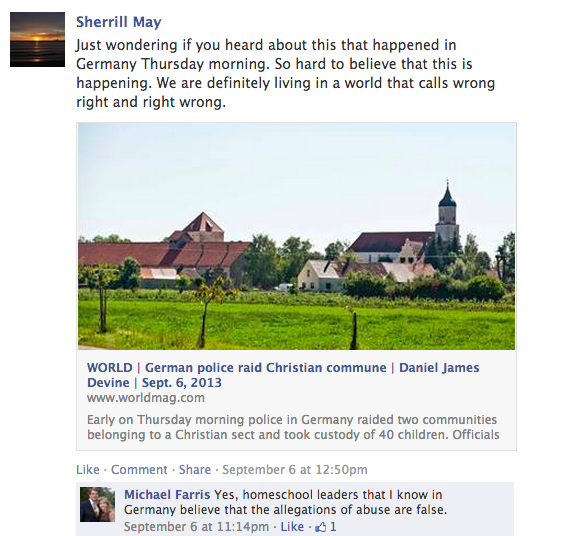
Several days ago Jörg Großelümern, who runs Netzwerk Bildungsfreiheit (Education Freedom Network) in Germany and is listed on HSLDA’s Germany page as one of two contacts for German homeschoolers, posted a link to the story on Michael Farris’s facebook wall along with some explanatory text. Michael Farris responded (for those who don’t know, Farris is the founder of the Home School Legal Defense Association—HSLDA—and is probably the most prominent spokesperson for homeschooling in the United States). You can see the exchange as follows:

germany1

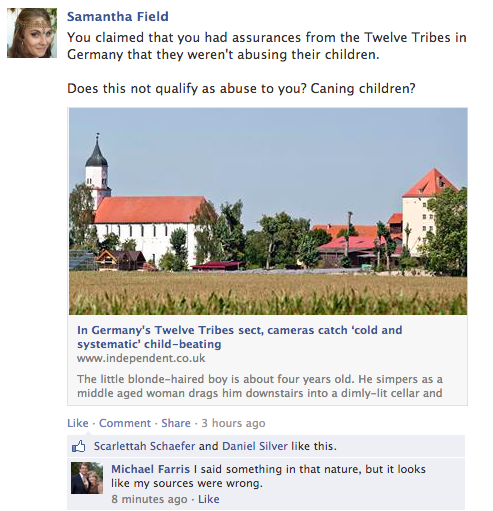
Later that day, one of Farris’s followers posted another link, voicing her dismay, and Farris again responded. You can see the exchange below:

germany2

Today, the full extent of the charges against the Twelve Tribes group have come to light. And guess what? They have it all on film. [Trigger warning for abuse.]

The little blonde-haired boy is about four years old. He simpers as a middle aged woman drags him downstairs into a dimly-lit cellar and orders the child to bend over and touch the stone floor with his hands. Another little boy watches as the woman pulls down the first boy’s pants and then draws out a willow cane.

“Say you are tired!” commands the woman in an emotionless voice. The swoosh of the willow cane is audible as it strikes the screaming child’s bottom three times. The little boy refuses to say he is tired so he is hit again and again – a total of ten times – until, in floods of tears, he finally says “I am tired.”

Within the space of a few hours, six adults are filmed in the cellar and in an underground school central heating room beating six children with a total of 83 strokes of the cane. The graphic and disturbing scenes were shown on Germany’s RTL television channel last night.

They were filmed by Wolfram Kuhnigk, an RTL journalist equipped with hidden video cameras and microphones, who infiltrated a 100-strong religious community run by the fundamentalist “Twelve Tribes” sect in Bavaria earlier this year. Kuhnigk claimed to be a lost soul to gain entry. “Seeing this systematic beatings made me want to weep, it made me think of my own two children,” he said. He collected 50 beating scenes on camera.

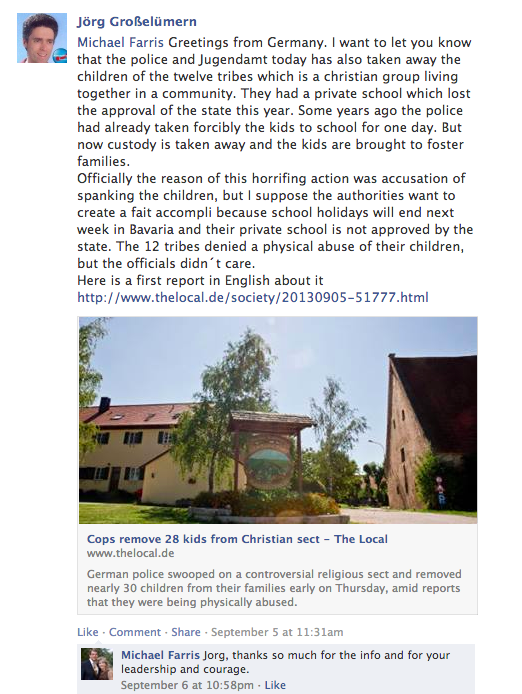
Samantha, a fellow homeschool graduate, posted the link to the article detailing the filmed abuse to Farris’s facebook wall, and again he replied. Here is the exchange:

germany3

Farris should have waited for the facts before speaking—and he really needs to find more reliable sources.

To be honest, one of my biggest concerns about Farris is that he seems to always give the parents the benefit of the doubt and to assume that abuse allegations are false (invented by vengeful authorities with corrupt motives, of course). Assuming that parents are innocent before even looking at the evidence means that abused children go unnoticed and ignored. (Not coincidentally, speaking before having the facts is how HSLDA attorney Scott Sommerville ended up calling child abuser Michael Gravelle a hero. Oops.)

The default should not be to assume that the parents are innocent and the charges drummed up by vengeful authorities and lying children. The default position should be to take immediate steps to protect the children and then remain cautious and wait for the facts to come in. Somehow I don’t find it surprising that Farris places the interests of the moment above its children.

To Break Down a Child: A Call for Stories about Pearl-Style Discipline

Screen Shot 2013-09-10 at 7.44.43 PM

To Break Down a Child: A Call for Stories about Pearl-Style Discipline

By Shaney Lee, HARO Board Member

*****

Hana Williams.

Sean Paddock.

Lydia Schatz.

What do these three children have in common? All of their deaths were linked to the abusive teachings of Michael and Debi Pearl in their book To Train Up A Child.

If you weren’t homeschooled growing up, it’s possible, even probable, that you’ve never heard the names Michael and Debi Pearl before. Their success with their publishing efforts are largely due to word-of-mouth through fundamentalist Christian churches and homeschooling communities.

It is estimated that over 670,000 copies of To Train Up A Child are in circulation. That’s at least 670,000 too many. Much of that word of mouth has largely been enabled through homeschooling communities. Their books have been prominently featured in the homeschool editions of Christian Book Distributor’s catalogues, been recommended on homeschooling forums, and handed from parent to parent at homeschooling conventions (not to mention sold in some of the booths).

The Pearls don’t just advocate spanking as a method of child discipline. They advocate a method of discipline that puts the child’s will in direct defiance of God’s will and of the parents’ will, that makes the breaking of a child’s will the ultimate goal of child discipline, and that puts parents in a position to believe that if they are not 100% successful in their discipline, they risk their child’s very soul.

And yet, when these teachings are linked to the death of multiple children, there are thousands who speak up in defense of the Pearls’ teachings.

Enough is enough.

It is time for those of us familiar with the teachings of Michael and Debi Pearl to speak up and speak against these abusive methods. It’s time to show that the damage of the Pearls’ method goes beyond just a few parents who got out of control. It’s time to show that it’s justifiable for the Pearls’ teachings to be linked to these horrible outcomes.

If you were raised with the Pearls’ methods, it’s your time to speak. If you’ve read the Pearls’ books and are against what they teach, it’s your time to speak. If you are a parent who previously used the Pearls’ methods, it’s your time to speak.

Even if you’re not normally a fan of what Homeschoolers Anonymous does, I ask you to join us for this series.

Because this issue is bigger than any disagreements we might have about homeschooling. It’s about preventing another Lydia, or Hana, or Sean.

This is not about whether spanking is a legitimate form of discipline (that’s a whole ‘nother discussion in and of itself!). This is about taking a public stand against a method of teaching that is extremely harmful towards children. Any system of childrearing that views children as rebellious little souls whose wills needs to be broken — rather than as small humans who are learning to live and thrive in the world — dehumanizes children and will always be harmful in the end.

Hana, Sean, and Lydia can’t speak up for themselves. It’s up to us to do it for them, to stand up for children who still have a chance. While it is the homeschooling community that has largely enabled the Pearls, I strongly believe it is the homeschooling community that is most equipped to fight against their abusive teaching.

So let’s stand up for our children. They deserve better.

*****

To contribute your story or thoughts:

As always, you can contribute anonymously or publicly.

If you interested in participating in this, please email us at homeschoolersanonymous@gmail.com.

The deadline for submission is September 15, 2013.

Bill Gothard on Education: Jeri Lofland’s Thoughts

advanced_seminar_0

Jeri’s post was originally published on her blog Heresy in the Heartland  on September 8, 2013. It is reprinted with her permission. Also by Jeri on HA: “Generational Observations”, “Of Isolation and Community”“His Quiver Full of Them”, “David Noebel, Summit Ministries, and the Evil of Rock”, and “The Political Reach of Bill Gothard”.

My parents began homeschooling me in third grade, and enrolled in Gothard’s Advanced Training Institute, a curriculum exclusively for alumni of his Advanced Seminar, before I started seventh grade. Our family was part of ATI until I reached my mid-twenties.

The following statements are the main points from a session of Bill Gothard’s Advanced Seminar. They can be found on pages 88-91 of the accompanying workbook and on his website. Looking back, these “principles” explain so much of my educational experience.

Advanced Seminar Session 16: Successful Education

(Bill Gothard)

  • The ultimate goal of education is not to produce a degree, but to produce many godly generations.
  • God charges parents and grandparents, not teachers, with the responsibility to train their sons and daughters.
  • God established the home, not the school, as the primary learning center; the school and church must be recognized as extensions of it.
  • The most destructive force in school is peer dependence, and parents must constantly work to protect their children from it.
  • God wants the priorities of every family to be built around daily engrafting of Scripture, rather than accumulating man’s knowledge.
  • The ability of sons and daughters to stand alone is the result not of rules, but of principles that assure a superior way of life.
  • When knowledge is learned before godly character, it produces pride and arrogance.
  • Parents who teach sons and daughters at home must be accountable to a local church (Christian school and the government).
  • Sons and daughters thrive with appropriate responsibility, and it is God’s goal that they be mature in their youth.
  • God gave boys and girls differing aptitudes; when children are taught together, boys are programmed for failure.
  • When schools group children by ages, older examples are cut off and rebels usually rise to leadership.
  • When the Bible is separated from courses, the contents come under the control of human reasoning.
  • True socializing takes place not in the arbitrary groupings of school, but in the real world of children-to-adult relationships.
  • Valuable learning time is lost in school; two hours of home teaching is equivalent to six hours of school teaching.
  • The key to effective education is not just a trained teacher and a professional curriculum, but a concerned parent and a motivated child.

God has set a limitation on learning; thus, academic freedom is no justification for studying the details of evil.

Inge Cannon (pictured here with her husband) helped Gothard develop the ATI curriculum in the early 1980's. She later directed HSLDA's National Center for Home Education.
Inge Cannon (pictured here with her husband) helped Gothard develop the ATI curriculum in the early 1980’s. She later directed HSLDA’s National Center for Home Education.

As an ATI student, I attended numerous conferences that became pep rallies for volunteerism with the Institute or urged us to study our favorite topics from the safety of our homes. (I even spent eighteen months enrolled in IBLP’s unaccredited correspondence law school!)

Inge Cannon was one familiar conference speaker. Cannon holds a master’s degree in education and helped Gothard develop the ATI curriculum in the early 1980’s. She later directed the National Center for Home Education, a division of HSLDA.

At an opening session of the 1990 ATI training conference held at the University of Tennesee in Knoxville, Inge Cannon warned us against the dangerous “High Places” of education. As she talked, I took careful and enthusiastic notes. I was just fourteen, and excited about this chance to sit with the adults.

In the Bible, God repeatedly told the ancient Israelites to tear down the idolatrous “high places”. Cannon thus defined a high place as:

“any goal or objective so commonly accepted that it is validated and esteemed as good, even though it violates the will and word of God”.

According to Cannon, the following “high places” are educational myths for home-educating parents to avoid.

The High Places of Education

(Inge Cannon–June 23, 1990)

  • Comparison–i.e., SAT tests and bell-shaped curves, parents should not base their curriculum on these; also pluralism that pressures those with strong beliefs to “give in to those who believe nothing”
  • Grading–earning a teacher’s certificate, for example, merely means one has passed the right courses, not that one is “qualified to produce results”
  • Completion–filling in all the blanks or answering all the questions or taking the final exam does not mean the educational task is complete; the object is to “know” the material, not merely to “cover” it
  • Equivalency–“believing that a curriculum is proper and right when it matches the academic sequence and requirements of traditional, formal education”
  • Tangibility–“believing only what I can see or touch is real, thereby de-emphasizing those elements that require faith or minister to the spirit of my child”
  • Self-expression–“believing that the arts are too personal to be governed by absolute standards”; the arts can never be amoral
  • Methodology–“believing there is only one right way to teach a lesson”
  • Socialization–“Children don’t learn anything good from one another!”
  • Exposure–exposing children to all kinds of knowledge is unnecessary for a well-rounded education; children should be ignorant of evil, they shouldn’t understand dirty jokes, they shouldn’t study false religions; “There are some things God doesn’t want us to know.”
  • Statistical Verification–believing [the Bible] “needs to be verified  by scientific measurements before choosing to obey its instructions”

During my time in ATI, I was just one of thousands of young people who were told that we didn’t need college credits, that college would corrupt our minds with “vain philosophies” and threaten our faith, that there are some things “God doesn’t want us to know”, and that employers would come looking for us because of our diligence, obedience, and virtue. So, many of us dutifully eschewed degrees in favor of home-based study.

Gothard, incidentally, later changed his mind and now even touts the Ph.D. degree Lousiana Baptist University conferred on him in 2004, much to the chagrin of those of us for whom the new dispensation came too late. Hundreds of former ATI students live today with the socioeconomic consequences of what we were taught, even as we struggle to catch up to our college-educated peers.

They’ve Got The Fear

Screen Shot 2013-09-10 at 11.48.18 AM

HA note: The following is reprinted with permission from Sarah Jones’ blog Anthony B. Susan.  It was originally published on September 10, 2013.

These girls. These so-called “teenage exorcists.”

You’ve probably heard of them by now. Enabled by their parents (and I use ‘enabled’ deliberately here) they’ve travelled the world battling the forces of evil. They’ve taken culture war to a supernatural extreme. Adult me pities them. Adolescent me would have rolled her eyes–and probably envied them just a bit.

It sounds ludicrous. And it is ludicrous. The Harry Potter phobia and the conviction that the United Kingdom is a seething hotbed of demonic activity aren’t rational reactions. Nevertheless, I’m going to argue for a certain degree of leniency for these girls.

If you can, step inside my former world for a moment.

In that world, demons are real. And they are terrifying. I spent nights awake, soaked in  sweat, because I had been told that demons can possess people, even people who think they’re Christians. I’d been told that if you aren’t right with God, you’ve left a window open for the devil. So I prayed. I prayed until I fell asleep, and when I fell asleep, I had nightmares about witches and devils who would seek me out and take me over.

The dreams would routinely frighten me awake. One night, I ran for my parents, because I was a child and that’s what children do.

My father then told me that I was actually correct to be frightened, because Satan is a roaring lion seeking whom he may devour.

I didn’t go back to sleep that night.

And then there were the Rapture movies, with their gory martyrs. I secretly loved them, because for a long time Revelation was as close as I could get to science fiction. But at the same time they too filled me with fear, fear that I wasn’t really saved, that I was out of favor with God and would therefore fail to be Raptured upon Jesus’ imminent return. I spent so much of my early life effectively paralyzed by fear.

When you’re a child, and you’ve been told from your earliest days that evil isn’t just real, but that it’s an active force currently engaged in a war against you, it makes sense to go on the offensive. If you’re a girl, of course, your options are limited. You’re not allowed to hold a position of spiritual authority. You can be a ‘prayer warrior.’ You can share the gospel. But you certainly can’t lead an offensive against the devil. That’s men’s work.

Unless you’re Brynne Larsen or her friends, Tess and Savannah Scherkenback.

These girls are the fundamentalist Scooby Doo gang. They’re almost certainly being controlled by Larsen’s father, a failed televangelist, but they’re doing something. They’ve seen the world. When I was a teenager, demonic possession seemed far more plausible than freedom.

People change as they grow. I lay the blame at Bob Larsen’s feet, and at the Scherkenbacks’ feet, for choosing to raise their children in a manner that has emotionally crippled them. Brynne, Tess and Savannah most likely believe they’re helping people.

I was 20 when someone tried to exorcise me.

Specifically, she intended to set me free from depression, and somehow she thought laying her hands on my head in public, without prior warning, and praying the “depressed spirit” out of me would improve my outlook on life.

My exorcism wasn’t particularly violent. I’m grateful for this, because self-proclaimed exorcists have been known to carry things to a dangerous extreme. But it was invasive and humiliating. A year later, I left the church altogether–for a variety of reasons, of which the exorcism was only one.

It turns out that leaving the church did far more for my depression than exorcism ever did.

Brynne, Tess and Savannah have never been on the receiving end of exorcism. ** I suspect that if they underwent what they’re dishing out to others, their perspectives on the matter would change rather drastically.  But that’s my point, really: they’ve never been faced with any real to challenge to their indoctrination. They’ll be adults soon (and since Savannah’s 21, she’s really already there) and personal responsibility does play a role. But believe me, fundamentalists know how to brainwash. They’re terrifically successful at it.

They saturate your every encounter with the world with such a blinding fear that it feels impossible to move or think, and waging culture war is the only proactive measure you can take.

It’s so pervasive that even now, as a secular adult, the occasional sleepless night is still ever so slightly tinged with fear.

If I’m going to be honest with myself, I don’t know that I’d have left the church if it weren’t for experiences like that exorcism. Perhaps I might have eventually, because the doubts were certainly present. But my departure might not have been so early, or so drastic. When I had cause to fear Christians and not the devil, it became much more difficult for me to convince myself that Christianity was worth the effort.

If we’re fortunate, Brynne, Tess and Savannah will learn from their travels. Maybe they’ll even join me and my friends among the ranks of the prodigals.

I hope for their sake their journey is less frightening than mine.

** Update: So it seems that Savannah Scherkenback has received an exorcism. Also for depression. I suppose becoming an exorcist yourself is certainly one way to prove to your fundamentalist community that you’re really “healed.” Maybe I’ve underestimated the level of fear (or arrogance) at work here. Thanks to Kathryn Brightbill for pointing this out.

A Few Leave, But Others Stay

Screen Shot 2013-09-09 at 1.43.33 PM

HA note: The following is reprinted with permission from Libby Anne’s blog Love Joy Feminism. It was originally published on Patheos on August 29, 2013.

I recently read a post by Lana that made me think about everyone I left behind when I left my conservative evangelical patriarchal homeschool upbringing.

With all the [ex] conservative homeschooler blogs out there nowadays, people may be under the impression that homeschool fundamentalism has virtually disappeared among homeschool alumni. To be sure, this Christian movement among homeschool graduates is dying a very slow and painful death. But it is so far from over, and I have so many friends still trapped in the ideology that I constantly feel the tension with old friends and old hangouts.

I don’t spend as much time in my old hangouts as Lana, so I don’t feel quite as much of the tension that she feels, but I’d like to echo what she says about not assuming that the thriving ex-conservative-homeschooler blogosphere means there’s some sort of mass exodus going on.

Sure, there’s an exodus — but in my experience most stay.

Out of the half dozen girls I was closest to in high school, only one has left. You know her as Kate. Two others are still living at home, under the authority of their father, having never left home even as they are now in their mid- to late twenties. One married young, going straight from her father’s home to her husband’s and has begun to fill her husband’s quiver with arrows. The final two left home with their fathers’ blessings and attended college in traditionally feminine pursuits, only to return home to live once again under their fathers’ authority afterwards.

Both were Gothard girls.

One now attends Vision Forum conferences with her family.

When I widen the net to the dozen or so girls I knew as acquaintances and saw only from time to time, the numbers don’t get any better.

Of the four girls who were in a Gothard Bible study with me, only one has questioned and left. Others I don’t know about—they just drifted away after I left. Two girls I knew are divorced, having married early to men who turned out to be abusive. Others, I really can’t say.

When I widen the net still further, to the teens I participated in debate with or saw at homeschool camps, I can point to a few more. One girl I met at a homeschool camp left home and wound up pregnant. Things were hard with her family for a time, but she made it through and questioned some things along the way. Another girl I met at a homeschool camp also questioned and left. One guy I knew through debate turned out to be gay. He came out and headed for the big city. But of the dozens and dozens others I knew through these venues? I have very little idea.

Of the guys, it’s really hard to say, and for a very interesting reason.

It’s easy to tell when a girl leaves. There are angry sparks and an extremely visible rift is torn. When a guy leaves? In my experience, the process is generally not quite so fraught with trouble, and is sometimes invisible on the outside. No one is going to be telling that guy that he is supposed to submit to his father, or that it’s his role to follow, or that he shouldn’t be pursuing a career. The family expects him to go off on his way and forge his own way, even if they also expect him to maintain a specific ideological viewpoint.

When a guy leaves, 4 times out of 5, it just looks like he’s doing what he’s supposed to do—leaving home, going to college, getting a job, and starting his own life. When a girl does those things, she’s often seen as stepping outside of the box she was supposed to contentedly inhabit.

There really isn’t any way to get at exact numbers, but Lana is right.

We left plenty of people behind when they didn’t walk the same path we did, and some of them are now repeating our parents’ patterns.

Homeschooling, A Means to an End: R’s Story

tools

HA note: The author’s name has been changed to ensure anonymity. “R” is a pseudonym.

I’ve been following Homeschoolers Anonymous almost from its creation when I first learned about it from Lewis Wells’ blog, CommandmentsofMen. Many of the stories written here have resonated with me, and I’ve shared quite a few on Facebook, especially those regarding HSLDA.

But a comment one of my friends left on one of my Facebook posts got me thinking.

I was homeschooled all the way through high school. When I would ask my parents why I was homeschooled, the answer they gave never involved religious reasons. I was a hyperactive child, and the preschool teacher I would have made it clear that she did not want any parental help with the 15+ little children in her class. Thus my parents decided it was in my best interest for them to teach me at home, at least for the first few years of school to ensure that I had good preparation. I think my parents planned to enroll me in public school at some point, probably once they felt the school subjects were above their reach, but that day never came. I remember asking a couple times throughout my young life when I’d go to public school, and my parents always had a different reason to delay.

To be fair, the quality of education I received was very good.

Both my parents have 4 year degrees; my father even has a science-based PhD from Stanford. I think the real concern for them was choosing a curriculum, building lessons plans, and being responsible for my younger brother’s and my education. I think as the years went by, they became more comfortable with the mechanics of homeschooling.

I’m not sure when it started, but religious fundamentalism started to creep into our house.

I know both my parents were Catholic growing up, but in college they found evangelicalism. Their faith, however, wasn’t rooted in a specific denomination; whenever we’d move to a new city they would find a church that agreed with their dogma. In one state we were Baptist, in another Presbyterian. I think they grappled with how to best instill their values in their children. I can’t recall what age I was, but I remember sitting through one of Bill Gothard’s seminars and also participating in a Growing Kids God’s Way workshop. Naturally, with these influences my parents gravitated towards a very authoritarian style of discipline.

It was several years into college before I could even entertain the thought that I may have been abused as a child.

Because of my parents’ involvement with HSLDA, they had carefully built the following mental roadblocks for me:

  • DHS is bad. Completely normal disciplinary actions are considered abuse by them, and if DHS even suspects my brother or I have been abused, they will swoop in, kidnap us, and stick us with a family that doesn’t want or care about us because we’re an inconvenience.
  • Psychologists only care about money; they will try to blame every problem on the parents and write scripts for imaginary issues.

But it all worked out.

Random people would always compliment my mother on how well behaved my brother and I were. People that knew us from church or other places were always impressed by how talented we were. I was a national merit scholar, went to university on a full scholarship, majored in engineering, and now work for a global leader in the oil and gas industry. I have a talented wife and a beautiful daughter.

It seems homeschooling did an excellent job.

Except it is a lie, just like the cake.

I mentioned earlier that my parents first decided to homeschool me because of hyperactivity; I was diagnosed with ADHD as a child and took medication for it until I was around 12. My father was an excessive perfectionist, and both parents embraced an authoritarian style of parenting. By the time I got to university, I was struggling with depression and low self-esteem that oftentimes left me paralyzed with feelings of hopelessness and uselessness. While I graduated as an engineer, my grades were far from exemplary, and my current position is the result of years of work and preparation overcoming the hurdles I had graduating from high school.

Because of my lack of freedom growing up, I still have problems deciding what I want, and I am plagued with uncertainty and doubt every time I make a major decision. In short, I could not function in the real world and still have difficulty even today.

So I blamed homeschooling.

But as I began to think about my friend’s comment, I realized something: homeschooling is just a tool, a method of instruction, a means to an end. All the positive homeschooling stories combine with the negative stories to show that.

Like any tool, homeschooling can be misused and abused.

It is important to remember this as we chronicle the stories of our youth: that responsibility does not lie with the method of instruction but with the instructors themselves, whether they be our parents or those our parents look to for guidance.

The Political Reach of Bill Gothard: Jeri Lofland’s Thoughts

Bill Gothard, Mike Huckabee, and the Leiningers at a 2007 Huckabee for President fundraiser.

Jeri’s post was originally published on her blog Heresy in the Heartland  on September 5, 2013. It is reprinted with her permission. Also by Jeri on HA: “Generational Observations”, “Of Isolation and Community”, “His Quiver Full of Them”, and “David Noebel, Summit Ministries, and the Evil of Rock”.

With Bill Gothard’s ceaseless emphasis on authority, obedience, and chain-of-command, it should be no surprise that he is compulsively attracted to men (and more rarely, women) whom he perceives to be in a position of power. He believes without question that his organization has answers that can solve the problems faced by any public official, if they can only work together to promote Gothard’s vision.

This characteristic has resulted in an extensive mycelial network whereby Gothard silently influences public policy across the country.

Its reach is difficult to measure, however. While Gothard loves to privately advertise his latest affiliations, he always exaggerates their scope or significance. And he frequently drops an old project when something shinier comes along.

Below I list some of Gothard’s better-known political alliances*. Since I left the organization in 1999, there are undoubtedly more fibers of connection now than I am able to trace here. As time passes, however, we can also see more clearly whether his “new approach” has yielded “lasting solutions” for those who have advocated them.

*There is no doubt that Gothard favors conservative political causes. I once heard him describe Rush Limbaugh as “our man on the radio”.

INDIANA

During his two terms as mayor of Indianapolis, Stephen Goldsmith partnered with Gothard to create the Indianapolis Training Center, selling a city-owned building to IBLP for a token $1 around 1993. During Goldsmith’s unsuccessful bid for Governor, ITC staff (many of them minors, most from other states, some salaried by the non-profit IBLP and others paying for the educational opportunity of working there) assisted the mayor’s campaign, running a mailing center from the top floor of the hotel and handing out campaign literature at polling places on Election Day. Some even registered to vote in Marion County to support him.

George W. Bush later made Goldsmith his chief domestic policy adviser. 

Goldsmith “helped formulate the president’s ‘faith-based initiatives’, which give tax dollars to churches.” In 2010, New York City Mayor Michael Bloomberg chose Goldsmith to be his deputy mayor of operations, a position which included oversight of law enforcement agencies.

Goldsmith’s domestic policy came into question when he was arrested for assaulting his wife, Margaret in their home. Though Margaret later recanted her story, Goldsmith was pressured to resign. According to Mr. Bloomberg, “I think that domestic violence is a phenomenally serious scourge on our society. We work very hard to attack the problem of domestic violence and the implication — the accusation — unfortunately made it untenable for him to continue to work for the city.” Stephen Goldsmith filed for divorce earlier this year.

Back in Indianapolis, Margaret Goldsmith had worked for juvenile court judge James Payne, who used his court to send delinquent Marion County youth to the Indianapolis Training Center as an alternative juvenile detention facility. Despite investigations into allegations of child abuse at the ITC, Judge Payne was made Director of Indiana Department of Child Services, a post from which he resigned last year after charges of interference with a DCS neglect case involving his grandchildren.

FLORIDA

With support from followers Rep. Steven Wise (R-Jacksonville) and now-Congressman Dan Webster (R-Orlando), Gothard considered opening a similar youth training center in Jacksonville, Florida in 1997. Though that never materialized, Jacksonville children were sent by the court system to the correctional residential program at ITC.

Delinquent youths were designated “Leaders-In-Training” and spent their days studying the Bible, watching Bill Gothard lecture videos, doing the chores necessary to run a hotel, filling in homeschooling workbooks from Accelerated Christian Education, memorizing character qualities, and dressing up for dinner. Denim, television, and rock music were strictly forbidden. Discipline reportedly included solitary confinement in “prayer rooms” and spanking without parental notification.

According to The Cult Education Institute, former Florida governor Jeb Bush “implemented Gothard’s controversial character education program, Character First!, at his charter school in Liberty City.

The governor also publicly encouraged the Palm Beach County School Board to approve Character First!, which is also listed as a model program in state law.”  (Watch for more on the Character Training Institute in a future post.)

ARKANSAS

Gothard touts former governor of Arkansas Mike Huckabee‘s name on materials promoting his “Character Cities” initiative. The two were photographed together at a private campaign luncheon in Houston in late 2007.

For years, Gothard cultivated close ties to Huckabee, an alumnus of Gothard’s “Basic Seminar”, and to Jim Dailey, mayor of Little Rock. With encouragement from Mayor Dailey, Gothard opened his Little Rock Training Center in an empty VA hospital purchased by Hobby Lobby and donated to Gothard’s Institute.

Despite Gothard’s grandiose vision, the enormous structure was in poor repair and was never utilized as fully as the Indianapolis facility. Still, it served as a base for the Institute’s prison ministry. Gothard quotes Governor Huckabee’s support for conducting his seminars for Arkansas inmates: “I am confident that these are some of the best programs available for instilling character into the lives of people.”

Having gotten his foot in the door in Arkansas, Gothard combined forces with CCA, the nation’s largest operator of privatized correctional institutions, to promote his intense lecture-based seminars inside more prisons.

Gothard was enthusiastic about character education being made mandatory in Arkansas schools and visualized schools restructured into age-integrated “learning teams” instead of age-segregated classrooms. The Institute also operated a secretive character-building Eagle Springs program for youth in rural Altheimer, Arkansas. (The Eagle Springs program was later moved to Skiatook, Oklahoma. Many allegations of corruption and abuse have been made by girls who participated in the program involuntarily.)

Another Gothard devotee is Jim Bob Duggar, a Springdale Republican who served two terms in the State House, now best known for the reality show “Nineteen Kids & Counting“. Not only are the Duggars enrolled in Gothard’s homeschooling program, the Advanced Training Institute, their family website links to at least twenty Institute programs and calls Gothard’s organization their “#1 Recommended Resource“. Jim Bob and wife Michelle are featured speakers at ATI national conferences.

Though Duggar lost his last two election bids, he hasn’t abandoned politics. During the 2012 presidential primary, Jim Bob and his well-known family campaigned for candidate Rick Santorum. Duggar’s oldest daughter has worked closely with the current IBLP indoctrination program for girls, while his oldest son now directs political lobbying for the conservative Family Research Council.

OKLAHOMA

The Family Research Council was founded by Jerry Regier* in 1983. He was succeeded as president by Gary Bauer and eventually became a versatile member of Oklahoma Governor Frank Keating’s administration. Regier was Keating’s Cabinet Secretary of Health and Human Services as well as Acting Director of the State Department of Health, tasked with reinventing “the scandal-ridden” agency. Like Mayor Goldsmith in Indianapolis, he is a proponent of partnerships between government departments and the faith community. Under his leadership, Oklahoma became inundated with materials from the Institute’s character training program, which was largely created at Gothard’s training center campus in the heart of Oklahoma City.

According to an article in the St. Petersburg Times, “Regier brought Character First! management training to the Department of Juvenile Justice [in Oklahoma]. In this program, employees are recognized on their anniversaries and birthdays for certain character traits they exhibit. He encouraged the use of several of Gothard’s programs with juvenile offenders before a U.S. Senate subcommittee in 1996, including a “log cabin ministry” that places juvenile offenders in cabins in the wilderness with peers who are trained by Gothard’s Advanced Training Institute.”

Like the Indianapolis Training Center, the Oklahoma building was formerly a hotel. It was purchased by Kimray, Inc. and leased to IBLP for $1 a year. Kimray is run by Tom Hill, who served on Gothard’s Board of Directors for over a decade and piloted the secular adaptation of Gothard’s “character qualities” in his company.

Gothard gathered support from numerous state and local officials prior to establishing operations in Oklahoma. A 1994 news article lists several:

Several local officials wrote letters to Mayor Ron Norick supporting Gothard’s program, including state Rep. Carolyn Coleman, R-Moore, and Sen.Howard Hendrick, R-Bethany. Both joined other local officials in a visit to Gothard’s juvenile education center in a renovated Indianapolis hotel last spring.

With them were Richard DeLaughter, assistant Oklahoma City police chief, and John Foley, director of Oklahoma County’s juvenile division.

DeLaughter said… the facility emphasizes the Bible “so it obviously is not for every kid and every family. ” “I don’t think anybody thought it was the end all and be all answer for every one of our juvenile problems,” he said. “As an option, it was pretty good. “

Rep. Joan Greenwood (R-Moore) was a homeschooling mom who used Gothard’s curriculum. Howard Hendrick later served as Director of Oklahoma’s Department of Human Services. At Hendrick’s retirement, he was replaced by former Oklahoma City prosecutor Wes Lane, who has been a speaker at Gothard’s “Character Cities” conferences. On the DHS Commission, Lane was responsible for investigations into cases of child abuse and neglect.

Congresswoman Mary Fallin (now Governor of Oklahoma) joined Tom Hill and Oklahoma City Mayor Mick Cornett in welcoming attendees at a Character First! conference. That 2009 conference was held at the refurbished hotel where I served as an ATI student volunteer in 1999. I remember the character posters on the walls in the lobby, and reciting Bible passages to one of the “adults” (I was in my twenties) before dinner–the only meal offered on Sundays–was served in the dining room.* (Governor Keating later recommended Jerry Regier for a post in Florida Governor Jeb Bush’s administration. When Bush made Regier his Secretary of Children and Families, Regier quickly implemented the CharacterFirst! program within the department. Regier now works in the U.S. Dept. of Health and Human Services.)

GEORGIA

Sonny Perdue, former governor of Georgia, has spoken at national IBLP conferences. The Insurance Commissioner for the State of Georgia, Ralph Hudgens, is not only an ATI homeschooling dad but also sits on the Institute’s mostly harmless Board of Directors.

TEXAS

Another “advisory board” member whose name no longer appears on the IBLP website is San Antonio billionaire Dr. James Leininger, a shrewd investor described as “one of the most powerful people in Texas politics”. Leininger and Rick Perry have had a rewarding symbiotic relationship for many years as Perry rose through Texas state politics. See a photo of Bill Gothard and Mike Huckabee with Dr. Leininger at his Houston home on Flickr.

Congressman Sam Johnson (R-TX) formerly chaired the IBLP board and has recognized Gothard’s Institute from the House floor.

Then Why Didn’t You Tell Us That, Mom?

HA note: The following is reprinted with permission from Libby Anne’s blog Love Joy Feminism. It was originally published on Patheos on September 1, 2013.

"My mother subscribed to Above Rubies and read each issue thoroughly."
“My mother subscribed to Above Rubies and read each issue thoroughly.”

“I want you to know that I never actually believed everything in those Above Rubies magazines,” my mom told me when I was visiting home a while back.

“Then why didn’t you tell us that, mom?” I asked. “I read every issue of that magazine cover to cover, and I always thought it was completely approved material.”

I don’t know why my mother made that admission to me when she did.

It was before the Mother Jones article about Kathryn Joyce’s new book on evangelical adoption, which sheds light on the Above Rubies/Liberian adoption scandal. My mother knows I identify as a feminist and that I’m critical of at least some aspects of the culture of the Christian homeschool movement, but that’s about it. Beyond that, we have a strict Don’t Ask Don’t Tell policy. Except, I suppose, for the Pearls child training methods—that we’ve discussed on more than one occasion. But the Pearls don’t run Above Rubies magazine. Nancy Campbell does.

Regardless of what prompted my mother’s admission, I think there is something incredibly important to be learned here.

Kate and I were talking a few months ago, and she told me she doesn’t think her parents realized quite how many extreme patriarchal/purity ideas she picked up and took to heart through Christian homeschooling culture. Her parents, she said, were always quick to condemn reading material, organizations, and leaders they believed promoted ungodly ideas or false doctrine. Because of this, she always assumed that materials that entered the house under the banner of Christianity and without condemnation were things they approved and endorsed.

My experience was very much the same.

My mother subscribed to Above Rubies and read each issue thoroughly. The ideas contained within the magazine aligned at least generally with beliefs I heard my mother espouse. When my parents disagreed with a religious leader, they were quick to say so. In fact, I grew up hearing James Dobson described as too wishy-washy and soft. Yet, I never heard my mother call Nancy Campbell or her magazine into question, so I assumed that the messages contained therein were approved, and that it was something I should read, take to heart, and learn from. And read, take to heart, and learn I did.

I’ve talked to many homeschool graduates—some I knew growing up, some I’ve met in person since, and others I’ve connected with over the internet or through facebook. This thing I’m talking about? This thing is important. Once homeschool parents enter the Christian homeschool subculture, if they don’t vocally and openly condemn, question, or contradict what that subculture teaches, their children will assume that the ideas and ideals of that subculture are approved—something they should listen to, take seriously, and imbibe.

I’ve talked to more than my fair share of homeschool graduates who grew up in this culture and took to heart things they later found out their parents never even realized they were learning.

Christian parents who choose to homeschool their children but do not ascribe to the ideals of the Christian homeschool subculture, especially things like Christian Patriarchy or Quiverfull, need to be on guard against this. It’s not uncommon for homeschool parents who happen to be Christian to find themselves in the same homeschool circles with Christian parents who homeschool out of religious conviction. And it’s also not uncommon for their children to find themselves in those circles whether their parents actively frequent them or not. In this kind of situation, parents may not realize the toxic ideologies their children taking in through osmosis from the Christian homeschooling culture around them.

In my mother’s case, it’s not that she disagreed entirely with the Above Rubies magazine. My mother was more mainstream than many, but she definitely ascribed to the outer circles of Christian Patriarchy and Quiverfull ideology. To be honest, I don’t actually know what parts of what Above Rubies she takes issue with—I was too surprised by her admission to think to ask.

There is one thing I was not too shocked to make sure to tell her, though:

“You need to tell the girls, mom,” I said. “They read Above Rubies just as I did at their age. You need to tell them you don’t agree with all of it, because if you don’t, they’ll think you do.”

A Week of Joy: An Index

positives

A Week of Joy: An Index

*****

By Attackfish: I Was Born With A Severe Immune Disease

By Apollos: The Freedom From a One-Size-Fits-All Approach to Education

By Chloe Anderson: Ninja Training

By DoaHF: Reading Voraciously in a Land of Books

By Emily: Learning Together

By Lana Hope:

Rural Homeschooling and the “Good ‘Ol Life”

The Positive Side of My Homeschool Years

By Libby Anne: Can’t You Say Anything Good About Homeschooling?

By Kathryn Brightbill: Nerdy Homeschooler

By R.L. Stollar:

A Week of Joy: Call for Contributions to HA’s Upcoming Positives Series

I Am A Testament To Homeschooling’s Power

By Sean-Allen Parfitt:

Not Well-Rounded, But Excellent

Becoming A Person I Can Be Proud Of

By Shaney Lee: Homeschooling, The Tool My Parents Used Well

By Skjaere: From Bullying to As You Like It