Sex Abuse Victim Allegedly Filing Lawsuit Against Josh Duggar

By R.L. Stollar, HA Community Coordinator

By now, nearly everyone with access to the Internet has likely heard of the Duggar family tragedy. At least five young girls were allegedly molested by Josh Duggar, the oldest son of Jim Bob and Michelle Duggar, stars of TLC’s 19 Kids and Counting. The family waited several years to report the crimes. When they finally did so, they only told a police officer who was a family friend, who himself was later convicted of child pornography.

A new report today by InTouch Weekly reveals that one of Josh Duggar’s alleged victims is preparing to file a lawsuit against him. The report says,

A non-Duggar family molestation victim is preparing to file a civil suit against Josh Duggar, sources tell In Touch magazine exclusively in the new issue on newsstands today.

The shocking development means that Josh and his parents Jim Bob and Michelle could be forced to give depositions and testify about Josh’s molestation scandal. The Duggars likely will have to answer every question as they will not be able to invoke their Fifth Amendment right against self-incrimination because the criminal statute of limitations has expired.

While I would not normally feel comfortable citing from a gossip magazine, InTouch Weekly has led the investigative journalism charge on the Duggar tragedy. The information they have uncovered on this issue has thus far been credible.

For further reading:

Humane Child Training: Sarah’s Story

CC image courtesy of Flickr, Thomas Hawk.

HA notes: All names have been changed to ensure anonymity. “Sarah” is a pseudonym.

CW: Physical Abuse and Infant Abuse

How Horse Whisperers and Dog Lovers Freed me from Michael Pearl

I have a distinct memory of when I first opened up Michael Pearl’s “To Train Up a Child.” I was about 10 years old when I discovered the book in our library. My parents had recently introduced the switch (a roughly 2-3 foot long supple tree branch) as a “disciplinary tool”. I’m not sure if I started at the beginning or opened it at random, but I remember feeling deeply disturbed and attempting to hide the book after I put it down.

While my parents didn’t follow Pearl’s advice to the letter, I was raised in a household with a strong emphasis on obedience.

There was love, yes, and bonding and laughter, but I also knew that outright disobedience would be met with consequences, often painful consequences. If I was told to do something I strongly disliked or even feared – and if my (polite) protests were ignored – I knew I had only two “choices”, if you could call them that. Deal with it or face the punishment. Our first puppy started training with the Koehler dog training method, roughly dragged on a choke chain so that she would “know” to ignore distractions. We stopped shortly thereafter when she grew so terrified of “training” that she’d just freeze; but I’m convinced we started with that method in the first place because the principle of “obey or else” resonated with my family.

I was mostly a bookish kid, with few reasons to conflict with my parents, so I wasn’t spanked (beaten?) very often. But as a pre-teen I became increasingly upset about how “discipline” worked out for my younger siblings. My bull-headed, hot-tempered sister Tabitha often got in screaming fights with my mom, which then turned to violent spankings until Tabitha would at least make a show of submission. (To this day she has a horrible relationship with my mom.) The discipline didn’t help Tabitha learn to control herself. Instead, she learned to lie as easily as speak, and she took her anger out on our even younger siblings whenever she felt she could get away with it.

My family used the buddy system – each older child caring for a younger child – and at the time my “buddy” was my two year old brother Noah. Noah was smart but opinionated, and notorious for throwing high-intensity fits when he couldn’t get his way. I still get a sick feeling to my stomach when I remember one afternoon when Noah’s fire truck broke and he couldn’t get the ladder to go down.

He lost it, screaming and throwing things and rolling on the ground, and my Mom decided he needed to stop “rebelling.”

She found the wooden spoon and started a cycle that went on for nearly 30 minutes: spank spank spank, “Noah, stop screaming!”, pause. Spank spank spank, “Noah, stop screaming!”, pause. For a long time, Noah’s screams and flails only grew louder and more desperate. I tried to keep cleaning nearby, but as his diaper came off for harsher swats and he became hoarse from screaming, I couldn’t do anything but watch in horror. Eventually his screams became a little quieter, and she decided that was good enough. She put him to bed for a nap and left to help some siblings with school in another part of the house. I remember cradling his quivering body as he whimpered and telling him that Mom was wrong and she shouldn’t have done that.

Despite how upset I was with these situations, I didn’t yet have the experience or broader context to identify an alternative.

I was homeschooled, in a Christian fundamentalist / patriarchy / quiverful family, and was already indoctrinated with a very deep distrust of the secular “system” that I was told would try to take us away through CPS and brainwash us with secular (aka satanic) content in public schools. I had many young siblings, and I knew that it was necessary at times to control and change their behavior – one had to do SOMETHING if the toddler was trying to play with the electrical outlet, or the five-year-old was hitting a younger sibling. Physical, painful punishment for disobedience was the only way I knew how. I occasionally perused secular parenting books through the library, but I dismissed their “permissive” advice on child-rearing as non-Christian without any real reflection.

Instead, I found a different perspective from a slightly unusual source: animal trainers. I loved animals, and my preteen and early teen years were right in the middle of a revolution in humane, non-coercive training methods for animals. I was mesmerized by watching a video of Monty Roberts taming and training a wild mustang gently, without force or coercion. I eagerly read Jean Donaldson’s dog training book “Culture Clash”. She dismissed techniques that used pain and fear to train a dog as cruel and – just as importantly – unnecessary. Instead, she made a strong argument that you could get excellent obedience, robust and resilient behavioral change, using the basic principles of the science of operant conditioning: get the behavior you want and reward it. Make the things that the dog wants contingent on the behaviors that you want. From there, I went on to Karen Pryor’s “Don’t Shoot the Dog” and internet forums on clicker training and positive dog training. I refrained from putting a pinch collar on my next puppy and instead trained him – very successfully – using treats and toys and praise, with a rare time-out as the ultimate punishment.

As I came to understand that you could change behavior without pain or fear, I began to apply that to how I interacted with my younger siblings.

Unlike the secular child-rearing books, I wasn’t afraid of a “satanic” or non-Christian influence from these animal trainers: how could it be un-Christian to give your dog a treat, or train your horse gently? And unlike many child-focused sources that emphasized the child’s self-esteem and psyche above all, these books gave me tools for what I needed: how to get my “buddy” to go take a nap, or put on his socks, or not put that rock in his mouth. At this point, I was a fourteen year old girl with most of my time filled with caring for my younger siblings. I didn’t have the resources to use advice on how to improve my little sister’s confidence or problem-solving abilities so she could grow up to be a strong, compassionate adult. I needed something that would help me control multiple toddlers and young children so that they wouldn’t fall down the stairs or color on the walls while I tried to cook lunch. I suspect many “quiverful” mothers and big sisters end up in this situation, and this is part of the appeal of Michael Pearl’s advice.

I want to clarify here that I am NOT advocating a parenting style that treats children as animals. Instead, I am arguing that there are lessons in humane animal training that can improve human relationships, especially when those relationships involve children – individuals who often don’t recognize danger, have challenges to communicating, don’t understand adult human rules and priorities, and most of all are vulnerable to abuse from their caregivers. Humane animal training involves a commitment to avoid the use of fear and pain as a “training tool”; respect for the animal as an individual being with feelings and fears; and knowledge of both the science of behavioral change and the animal’s instincts, wants, and needs. These are all important principles in dealing with young children.

Moreover, the success of such methods is a direct counter-point to Michael Pearl’s argument that obedience or behavioral change can only be gained by punishing disobedience.

While they shouldn’t be prioritized above other things like encouraging exploration and developing healthy independence, knowing things like coming when called can improve a toddler’s safety (and a mother’s sanity). Young children often need to learn things like not throwing food and to put toys back in the appropriate box. Humane animal training taught me that if you must change someone’s behavior, there are better and kinder ways to do so than pain and fear.

As a young teen, I was very close to my Mom. I was the oldest girl and her right hand. We spent almost all of our time together and had a “best friend”-like relationship. As I explored kinder ways of dealing with my young siblings, I talked with my Mom about those successes and even sometimes confronted her about how I thought she should change her parenting. Shortly after the incident with the fire truck, we tried a simple alternative: we responded to Noah yelling with a gentle, “I’m sorry, I can’t understand your yelling. Can you speak softly?” Speaking normally was rewarded with our best efforts to help him, and yelling (except in cases of an emergency) was ignored or gently prompted to bring the volume down. This worked beautifully without any need to get out the switch. I’m very happy to say that my Mom did make some changes over time, and as an adult with several young siblings still at home, I’m no longer afraid that they might be living through the kinds of physical abuse that occurred when I was younger.

Now? I’m living away from home, and left the quiverful / patriarchy / fundamentalist Christian mindset a long time ago. I have a dog of my own now. This dog comes when called and leaves shoes alone and lets me clip her nails. I don’t need fear or pain to find ways to help her conform to my weird human rules. I want kids someday. I know the old trope that you’re not supposed to know what you’ll do with kids until you actually have them.

Given my background, though, I’m very comfortable stating this: my children will never be beaten into submission or trained to be obedient through fear.

If I find myself in a situation where I must change their behavior – whether because my toddler wants to run into the road or handles frustration by biting people – I know there are ways to accomplish that change that don’t involve switches or wooden spoons.

How I Survived Homeschooling in Bill Gothard’s Cult: Part One

CC image courtesy of Flickr, Norbert Posselt.

HA Note: The following is reprinted with permission from Alexa Meyer’s blog Life of Grace and Peace. It was originally published on June 26, 2015 and has been slightly modified for HA.

****

In this series: Part One | Part Two | Part Three | Part Four | Conclusion

****

Part One

With much encouragement from my husband I’m sharing my experiences with Bill Gothard and the ugly influence of Gothard’s Institute for Basic Life Principles (IBLP) and Advanced Training Institute (ATI – his homeschool program) teachings on my life. After reading many of the experiences of others, I felt that my story would just be redundant since we all seem to share similarities. My husband assures me that what I learned and how I dealt with Gothard would help someone – and so I hope.

The beginnings of what I think of as my personal “Dark Ages” started in my 13th year (Aug. 1988), a year after being pulled out of public school to home educate. There’s nothing like being told the day 7th grade started, and after taking all the trouble to get ready that morning – clothes on, check; hair done, check; makeup, check; pep talk, check – to “never mind going to school, you’ll be doing that at home from now on.” With my foot out the door and my bag over my shoulder, I thought it was a joke. When I realized they were serious and asked why, I was told that I was “out of control and rebellious, so to bring you into line you’re being taught at home.” That inspires cooperation!

From what I could tell, being rebellious meant that I wasn’t open to them, sharing my every thought, dream, etc., I was physically pulling away from them, not wanting to hug my dad frequently, spending time by myself, asking questions (which evidently meant I didn’t agree with them).

Basically, I wanted privacy and for my dad to stop paying attention to me (attention that made me uncomfortable), and they wanted to control everything about me. They had already tried Josh McDowall’s stuff with me the previous year, which I thought was a little overboard since more rules and guilt trips don’t help anyone. I’m sure that I was a little sullen and mouthy since by my understanding all my crying out for help to my mom, and sometimes my dad, didn’t get any results. My dad continued to sit too close, tickle my knees or ribs at will, make me hug him frequently, sit alone with me and pry into my deepest thoughts, humiliate me in front of my peers and adults by sharing my personal habits or spiritual revelations I had, make jokes about me, twist and turn my words (manipulate) back onto me when I would sit down and express my concerns about them – I could go on, but I don’t want to bore you. In addition to asking my mom to talk with dad about giving me some space, I asked my youth pastor to just come sit with me during a talk with my parents and help me make sure that my point got across to them. Nothing, of course, came of that. I tried several times at many “family devotions” during and after dinner, to confront my dad (like I had been taught to do-Matt.18) about this strangeness I felt between us. I was always “wrong (i.e. don’t know what you’re talking about), confused, misguided, so you should spend more time searching your heart and the Bible to see what Jesus wants you to work on.” I tried this approach from the age of 11 to about 15, and then gave up since everything I said was always turned back on me (it still is to this day).

After my “rebellious” first year home schooling, my parents decided that I needed Character Building. I guess I wasn’t enough of a character already! So after talking to a friend who knew a friend who had a similar “problem”, my parents were introduced to Bill Gothard’s Institute in Basic Life Principles (IBLP) – or Basic Training – through the Character Sketches. (These character sketch books were full of character words, their meanings, stories taken from the Bible, and an animal assigned per character word to teach the how to demonstrate the particular character, i.e. faithfulness.) I remember the first time I looked through that book thinking “Seriously?! I’m supposed to learn how my parents want me to behave by reading how animals behave? We’re going to spiritualize animal behavior?” It seemed really kooky to me, but I wanted to keep the peace, so I cooperated. Boy was I in for a treat at the IBLP seminar we went to that spring (1989)!

At that first Basic seminar (I was 12), my dad made sure we all met Gothard. It was very brief, but I didn’t like him and thought it strange how like my dad he was – same first name, hair and eye color, body build, voice tones, manner of speaking and hand gestures.

The most unnerving trait they shared, which became apparent about 2 years later when I met him again, was the sexual undercurrent.

I recognized that particular type of tension because I dodged that sitting-too-close, inappropriate-tickling, alone-at-night-deep-probing-questions, forcing-affection and being-called-girlfriend tension from my father my whole life.

Another thing that seemed strange, yet obvious, to me was how odd it was for people who are married and probably have kids to listen and take to heart a man’s interpretation of the Bible, who has never left home or married let alone courted anyone (to my knowledge at 13) and had no experience whatsoever of raising kids. Wow! Really?! The rules he was spouting seemed endless and silly, focusing on only physical things that we should do, never the true Grace and Peace that Jesus brought us all after the cross.

So after attending Basic and learning all the things we must do to receive God’s favor (Wait a minute! I thought that was un-merited because of Jesus!), and, apparently, to fit in with this club, life became a burden.

It was already rocky enough, what with being the only child who was blessed with her father’s laser beam of religiosity, demanding my every thought, confession, loyalty but never my questions or concerns about anything to do with my parent’s authority. I call that blind loyalty, and ironically my parents taught me, no required me, to be a deep thinker and self-analyzer, to always question things, especially establishments and authority.

Did anyone else’s parents require complete transparency (even if nothing was there), daily Bible study at the ungodly hour of 6am (okay, I’m so Not a morning person!), regular self-analysis to see where you’re wrong and how you can be more like Christ? Or the room raids and confiscations when you’re gone, public humiliations by talking about your private struggles or personal habits? Or have the limits on youth group involvement and the focus on staying pure, pointing out that I’m inherently a sinner, so I have to keep myself pure and modest so I don’t tempt anyone and become a stumbling block? The way my dad talked he had me believing that every guy over the age of 12 had one thing on their mind most of the time, so it was my job not to encourage them. Later I would wonder how to turn him off! After witnessing my father come home from work one day (when I was about 14) and thank us for praying for him that day, because he’d been tempted by a beautiful red haired woman in a suit, I knew for sure that my dad was one of those males he’d been warning me about. It took years of being married to my wonderful, non-ATIA, Godly husband before I released my prejudice against most men.

A lot of the teachings from IBLP my parents had already been teaching me for a while. Some of the new things were the Patriarch stuff, women wearing only dresses, no make-up, long hair, stay at home, having babies (no birth control) and the courtship idea. The teaching that people are supposed to follow all these rules (most of which are made by man), which are “backed up” by Bible verses used out of context, to be “right” with and blessed by God, weren’t new to me. It was, however something that I was finding oppressive and didn’t think was right. What I saw through my parents and the numerous churches we attended was those in positions of “authority” (power, really) abusing their position saying, “Jesus died for you because He loves you and wants to save you. (His blood wasn’t powerful enough? I have the power to make Jesus my Redeemer or Savior?) But He accepts you as you are. Accept Him so you won’t burn in hell (Didn’t Jesus take the judgement of the world and bring Peace between man and God?).” Then after you accept Him – really, who wants to burn in hell? – they teach all the things you have to do to continue to stay “right” with God. The backstabbing, ostracizing, cruelness comes the minute you questioned anything or didn’t agree exactly the same way. Aside from studying how Jesus behaved after the cross (as well as before!) and noticing that He certainly never acted that heartless way, it just didn’t feel right.

It’s what Jesus wants from us, to be hateful towards someone who doesn’t think, act or dress like us?

Really?! That shows Love?

Well, after contemplating suicide three times my 13th year, shortly after turning 14 I raised my fist to God and told Him to take this “Christianity” and shove it! If this was Him I didn’t want to have anything to do with it. He was going to have to show me who He really was for me to have anything to do with Him. He, thankfully, didn’t disappoint me! About five months later He encouraged me to read Song of Solomon. He showed me His Love, He wooed me and became my best friend, confidant, lover, teacher, most especially my Hope. I know to the core of me that He was the only way I made it to 18 reasonably sane and alive.

The Power of False History: Nicholas’ Story

CC image courtesy of Flickr, Ryan Hyde.

HA Note: This is a preview of our upcoming Lightbulb Moments series. We would love for you to contribute your story as well.

By Nicholas Ducote, HA Community Coordinator

My “lightbulb” moment in my youth, which convinced me of the lies that my upbringing was filled with, centered around the study of history. I was interested in history from a very young age, and my parents made sure to purchase fundamentalist American history for me to study. The Light and the Glory and From Sea to Shining Sea by Peter Manual and David Marshall, alongside Foxes Book of Martyrs, David Barton and Little Bear Wheeler’s histories, made up most of my historical and political education. But the history written by these men are filled with fallacies, false history, cherry-picked examples, and gross misinterpretation of historical events.

The main thesis of all these histories was that the Christian God was responsible for the prosperity experienced by the United States. From Christopher Columbus, to the Conquistadors, Plymouth Rock, and the American Revolution, the European conquest of the Americas was portrayed as Christians harvesting souls for the Lord and the Lord blessing them. Columbus was a pious missionary – no mention of him riding on the backs of natives for sport and exacting untold violence on innocents. The genocide against native tribes was “mission work” and “fixing them.”

Constructing this false history was vital to mobilizing Evangelicals and fundamentalists into contemporary political action.

The most important goal was to influence American politics “back to Jesus/Christianity.” The establishment of theocratic laws depends on convincing people that the US Constitution means whatever the Founding Fathers, in their eminent foresight and wisdom, meant it to mean. Supreme Court be damned.

My parents pushed me into the Christian homeschool debate league (NCFCA) at 15, and I began developing critical thinking skills. I remember my first big political debate with my dad (where I believed differently) was over whether we should drill for oil in the Arctic National Wildlife Refuge – it was a topic during energy policy year. By the time I was 18, I began to read scholars and historians that disagreed about the foundation of the United States.

I originally intended to only educate myself about the enemy so I could better defeat those damn socialists in an argument, but my research demonstrated that so many “experts” in the homeschooling world were frauds.

They cherry-picked facts and characters, while ignoring all nuance and complexity for their over-simplified, overly-political narratives. It took me four years in a political science bachelors and another 18 months in a graduate program for history to feel like I finally had a firm, realistic grasp of American and world history.

In my final graduate term, I studied Islamic nationalism in communist Eastern Europe and central Asia. Just like the Christian fundamentalists, the militant religious-nationalist factions (Orthodox Serbs, Muslim Kosovars, Bulgarians, and Bosnians, and Catholic Croats), invented history and conflict to motivate their constituents to fight with each other. Everything became clear. People who wanted power created a false history to rally homeschooling parents to a fight what really didn’t exist. Our government has always striven to be secular, and just because a few Founders were Christians doesn’t mean they wanted the United States to be a Theocracy.

The Christian homeschooling movement encourages an intrinsic cognitive dissonance about history.

They praise and almost worship the American Revolution, individualism, liberty and freedom, but then turn around and wish for more theocratic laws that favor their flavor of religion. Fundamentalism of all religions is typically anti-democratic.

The best example of this would be the patriarchal ideas found in the Homeschooling Movement. The spectrum of religiously-motivated sexism, from Complementarianism to outright-Patriarchy, is founded in anti-democratic ideals that women should not have the same civil rights as men. My mom actually believes that the United States started going astray when women were given the right to vote.

By consigning women to the domestic sphere, fundamentalists want to restrict or completely deny women access to the public sphere and civil engagement.

I could not reconcile the sexist, Patriarchal ideas with the stark liberalism of the Founders. I decided that to advocate for laws based on my views of religion would be no better than implementing Shari’a law. I became an outspoken liberal feminist in college, but not because I was “brainwashed,” as my parents would have my family believe. But, for the first time in my life, I had access to an array of scholars, knowledge, and philosophies.

No one brainwashes me, I make up my own damn mind.

Picking Things Up from the Culture, Homeschool Edition

HA note: The following is reprinted with permission from Libby Anne’s blog Love Joy Feminism. It was originally published on Patheos on April 12, 2015.

If you’re a regular reader, you may have noticed that, when speaking of my conservative evangelical homeschool upbringing, I frequently say “I was told X” rather than “my parents told me X.” There is a reason for that—sometimes I can’t remember whether my parents actually taught me some specific aspect of purity culture or political conservatism or whether I just picked it up from the Christian homeschool culture around me. After all, I read the homeschool magazines we subscribed to, listened to the speakers at homeschool conventions, and socialized with the other homeschooled children.

My parents removed my siblings and I from public schools in order to remove us from external influences. But they didn’t remove us from external influences entirely, because, short of locking us in our rooms, they couldn’t. What they did was change the set of influences we were exposed to. But in their choice of a new set of influences—that of Christian homeschool culture—we were sometimes exposed to things they may not have agreed with in a way they never never thought about.

For example, when I was a senior in high school a friend of mine tried to talk me out of going to college. She said women were supposed to serve, and that college was entirely hedonistic and self-centered. She told me she planned to spend those years as a mother’s helper in other homeschooling families, before marrying and beginning her own family. I agreed with her premises, and was left unsettled. If my parents hadn’t had such a solidly upper middle class expectation that I would go to college, I might have been swayed.

For all of homeschooling parents’ rhetoric about how “peer dependent” public schooled children are, we homeschooled children could be quite influenced by our homeschooled peers. Part of me finds this ironic. But then, the point was not so much to remove us from peers entirely as to change the set of peers we were around. My parents opted to expose us to Christian homeschooling culture rather than to the culture of the local public schools.

Don’t get me wrong, I’m glad my parents didn’t subject other Christian homeschooling families to a detailed theological review before allowing me to socialize with their children. I mean yes, they did draw some lines, but they could have drawn those lines much more narrowly. By way of example, I recently came upon an article titled When Catholic Homeschool Kids Get Lonely that really made me cringe. Here’s an excerpt:

It’s easy to think that if Catholic parents put their children in the Catholic Youth Group at the local parish, all will be well and this will solve the ‘loneliness’ or the ‘socialization’ issue, but my husband and I have found that sometimes this can create other problems. Simply put, our experience with the Catholic Youth Group in our particular area has been mostly negative and counterproductive in helping us to raise our daughters for Christ. When we would bring our children to some of the youth activities, we were disheartened by what we experienced and witnessed.

Many of the children who attend these functions also attend the public school. They go to these functions because their parents make them, not because they really want to be there. While there, we would hear them using foul language and witness them picking on other children, bringing that whole “public school mentality/environment” with them into the youth group activities. The parents who were chaperoning these activities couldn’t be everywhere at once, so much of the cursing and mean-spiritedness took place when the chaperones weren’t watching.

Not only this, but my husband and I were appalled at the way in which the girls who attended these functions dressed. We decided not to sign our children up for any more youth group activities in this area.

One of the reasons why I made the decision to homeschool was because I didn’t want my children to be negatively influenced by bad peers. If I keep them out of the public schools for this reason, but then put them around those same children in a youth group activity, what have I accomplished? They’re still around the bad peers.

. . .

If there is a local homeschool support group in your area, this can be a good thing, especially when most of the parents whose children are in these groups are doing what they do for the same reasons as you. However, I do want to offer you a word of caution regarding some of these groups. Not every homeschool support group is Catholic.

If you are raising your children in the Catholic Faith, it is better to be a part of a Catholic homeschool support group than a Protestant one. Experience has taught me over and over again that when Catholics join a Protestant homeschool support group (especially an evangelical one) subtle attempts are made in order to “reach out to” and “save” the Catholic’s soul. Religious tracts are distributed, and invitations are given to attend this church service, that Bible study, this Children’s Kids’ Klub, or that Vacation Bible School.

Because of this, I refuse to allow my children to participate in any of these groups. If a group of kids and parents want to get together for the sake of picnicking and playing ball, that’s one thing. But when one group tries to impose its religious beliefs on another because it does not accept and respect the religious beliefs of others, a line has been crossed.

. . .

If there are no Catholic homeschool support groups in your area, you might consider starting one yourself. Please don’t make the mistake of thinking that in order for it to be successful, it has to be complex, time-consuming, and difficult. Just getting together once a week in a park for a game of kickball with hot chocolate and doughnuts could be a great way to start. Using a church fellowship hall in order to host these meetings is something that a lot of Catholic homeschool support groups pursue.

Although having companions can be fun, nothing can take the place of a close Catholic family.

If a parent chooses to homeschool to remove their children from the influence of public school children, and then chooses to opt out of both church activities and established homeschool groups again because the children involved are deemed bad companions . . . well, let’s just say that if a parent refuses to allow their children to socialize with any children who do not share their beliefs in exactitude, the children will be very lonely indeed.

But because my parents did expose us so fully to Christian homeschooling culture, I’m often unsure what my parents actually believed and what I simply picked up from that culture. Sometimes I know the answer without hesitation, because I remember this comment or that. But other times I don’t. And I find that fascinating.

Lisa Cherry and Frontline Family Ministries: “‘Gay’ Marriage is the New Roe v Wade”

Image from YouTube: Lisa Cherry and her son Lucas Cherry, authors of Not Open.

By R.L. Stollar, HA Community Coordinator

Today, on the heels of Obergefell v. Hodges, the Supreme Court ruling in favor of marriage equality, Lisa Cherry and her organization Frontline Family Ministries sent an “OFFICIAL STATEMENT” to their email list. The statement begins with a large image comparing yesterday’s marriage equality decision with the infamous 1972 Supreme Court case Roe v. Wade legalizing abortion:

unnamed-2

The statement (which you can view in full as a PDF here) begins with declaring full opposition to the Supreme Court ruling:

It is with heavy hearts we write to you today. For the public record, Frontline Family Ministries strongly opposes the ruling on “gay marriage” and stands for biblical marriage between 1 man and 1 woman. This is a critical moment in our history and how we respond could alter our grandchildren’s future.

Lisa claims that those celebrating the ruling are celebrating no less than “the demise of our nation”:

We are sure you are like us watching your news feeds for commentaries ….and sorting out which Facebook friends are sharing congratulatory posts and which are grieving the demise of our nation.

Now, you might be wondering how Obergefell v. Hodges could possibly compare to Roe v. Wade, especially since in the minds of conservative, pro-life Christians the latter has literally led to the genocidal massacre of millions of innocent children. Jurisprudential comparisons aside, how on earth does allowing same-sex couples to marry (even if you think that is immoral) reach the terrifying heights of million of babies being slaughtered? Remember, to people like Lisa Cherry, abortion can be compared to the Holocaust. So this is no small comparison.

What is important to remember here is that, to Lisa Cherry and Frontline Family Ministries, LGBT* people are not simply immoral. They are, literally, sexual predators that threaten your children. Last year, during Cherry’s “National Sexual Abuse Prevention Week for Homeschoolers,” I systematically reviewed her books and website materials because I believed that her and Frontline Family Ministries’s approach to abuse prevention missed the mark. And part of that involved her redefining of what a sexual predator is.

Since Cherry has now returned with comparing marriage equality to Roe v. Wade, I figured it would be a good time to reprint my examination of and response to her earlier comparison of LGBT* people to sexual predators. This is from Why I Cannot Support Frontline Family Ministries’ Abuse Prevention Week: Part Five, Unmask the Predators.

*****

b. Redefining sexual predators

The most irresponsible aspect of Unmask the Predators is that Lisa Cherry redefines the meaning of “sexual predator” in the context of teaching sexual abuse prevention. The following image (which Libby Anne discussed yesterday) from page 2 demonstrates this:
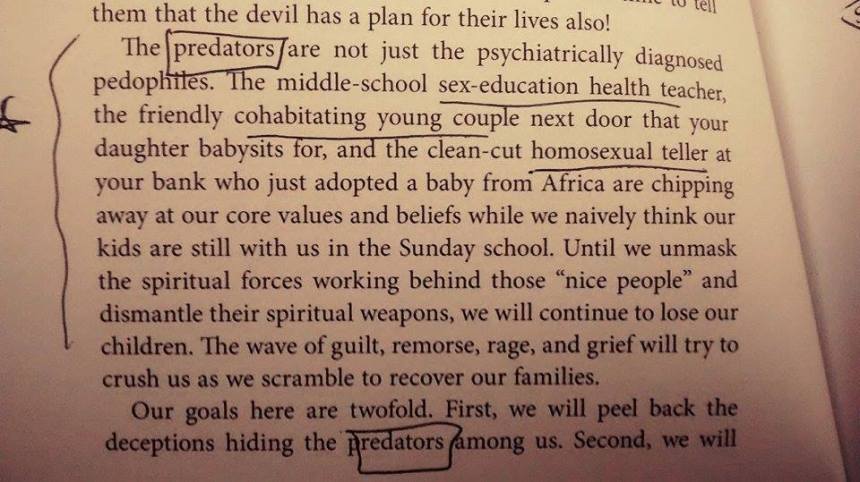
10726376_10152390801832761_1034032676_n

Text is,

The predators are not just the psychiatrically diagnosed pedophiles. The middle-school sex-education health teacher, the friendly cohabitating young couple next door that your daughter babysits for, and the clean-cut homosexual teller at your bank who just adopted a baby from Africa are chipping away at our core values and beliefs while we naively think our kids are still with us in the Sunday school. Until we mask the spiritual forces working behind those “nice people” and dismantle their spiritual weapons, we will continue to lose our children. 

What is vital to note here is that Lisa is not saying that these people could be predators — in the sense that anyone can be a predator because predators transcend any particular demographic group. If that was the message, I would agree. Predators can be heterosexual, homosexual, bisexual, white, black, young, old, Christian, atheist, Buddhist, and so forth. But that’s not what Lisa is saying.

On the first page of the book, Lisa says a “sexual predator” nearly destroyed their daughter’s life. She warns there are other predators threatening children as well. She then gives the examples above. The predators “are” (not “could be”):

  • The middle-school sex-education health teacher
  • The friendly cohabitating young couple next door
  • The clean-cut homosexual teller at your bank

Now you might wonder, how on earth are these people categorically defined as “predators”?

The answer is, disturbingly, that Lisa is redefining what “sexual predator” means. You can see the beginnings of this in the above citation, where Lisa says they are predators because they are “chipping away at our core values and beliefs.” On page 3, she elaborates on this:

“Sexual predators are not new. Their stories fill chapters of our Old Testament history books; their names were called harlot and adulterer in Proverbs” (3).

“Harlots” and “adulterers” are “sexual predators”? We clearly are no longer talking about what normal society means by sexual predator, i.e., “People who commit sex crimes, such as rape or child sexual abuse”, or “A person…convicted of a first-degree felony sex crime, or two second-degree felony sex crimes”. You know, the actual definition of “sexual predator.”

But still, you might ask, how are these people “predators”? The answer is that Lisa has redefined “sexual predator” by spiritualizing the concept. In her worldview, predators are anyone and everyone who (1) act in a way that Lisa believes is sexually immoral and/or (2) teaches people sexual morality in a way Lisa believes is sexually immoral. Thus anything or anyone hinting of non-Christian “culture war” is predatory. As Lisa explains, “Predator forces can attack our children through sexual molesters or through a host of cultural invaders” (13, emphasis added).

Lisa makes this most clear in two online articles found on Frontline Family Ministries’s website. Those articles are entitled “Predator Calling Cards, Part 1: Found One in My Mailbox” (archived PDF) and “Predator Calling Cards, Part 2: What is a Predator Anyway?” (archived PDF). In the first article, Lisa expresses some of the most horrid anti-gay sentiments I’ve ever read. These sentiments really shine a light on Lisa’s statements in Not Open where she said LGBT* people often receive “icy stares” in church and that’s a bad thing. I mean, if this isn’t the equivalent of an icy stare, I’m not sure what is:

“I sat down the other day for a rare moment of relaxation with my new issue of Country Living. It’s the one women’s magazine I subscribe to.

I looked forward to dreaming up some unachievable new interior design as I flipped my mind over to unwind mode.

Featured on page 92 and 93 was a quaint 19th century house in upstate New York.  But I had trouble figuring out the heading…

My mind did a double take as I re-read the article’s opening line… Jesse and Gus have forged a surprisingly modern home…. I turned the page to find a picture of this “couple”—two men and their five-year-old daughter.

What?!  I was accidentally taking a tour of a homosexual couple’s house? I dropped the issue on the floor in disgust.”

Yes, Lisa dropped an issue of Country Living on the ground “in disgust” because it featured a gay couple. Now, ignoring for the time being the message communicated to LGBT* people by this, note again the title of the article: “Predator Calling Cards, Part 1: Found One in My Mailbox.” In other words, just the image of a gay couple is a “predator calling card” to Lisa.

She received pushback on this article from people saying that it’s irresponsible to say this because not all LGBT* people are child molesters (e.g., the actual definition of sexual predator!). Lisa responds to this in the second article:

“In the world today we have Micro-predators (actual persons) and Macro-predators (global thoughts and forces). They are very much inter-related. Think about it. A child “macro-groomed” may more easily be “micro-groomed.””

In other words, LGBT* people — simply by being LGBT* — are predators in Lisa’s worldview. Their very existence is a perpetual state of “macro-grooming” children for abuse. In fact, anything and anyone that is sexually immoral is a “macro-predator.” This is why the list from page 3 of Unmask the Predators says that: people living together before marriage are predators, sex education teachers are predators, and LGBT* couples are predators. They aren’t necessarily child molesters; they’re spiritual sexual predators. So, I guess, they kind of are child molesters, but rather spiritual child molesters.

In fact, nearly every single passage in Kalyn’s Secret that referred to something like “spiritual forces of darkness” is changed in Unmask the Predators to be called “predators.”

Which just blows my mind.

We live in a world where 1 in 3 girls and 1 in 7 boys will sexually abused. We also live in a world where sexual abuse prevention is sorely lacking. The last thing we need, when teaching about prevention, is someone redefining the word and teaching families to fear the wrong people. Teaching families to fear non-predators — in the context of teaching about predators — is the most irresponsible thing I’ve seen in a long time. There is no excuse for Lisa’s dangerous and sloppy irresponsibility here.

c. Throwing LGBT* people under the bus

As I just pointed out, Lisa calls gay people “sexual predators” on the very second page of Unmask the Predators. She continues to do this throughout the book — as well as in Not Open, where she refers to LGBT* people as “sexual offenders.” She even pulls out the tired trope of LGBT* people wanting to legalize child rape, saying “the homosexual lobby want[s] to see the age [of consent] lowered” (161) — which is particularly ironic in this context, considering that conservative Christian leaders have been the ones most recently advocating for child marriage. In fact, at one point in the book Lisa herself mentions that Kalyn throws this fact in her face (184-5) by pointing out that popular homeschool fiction character Elsie Dinsmore was a young bride married to a much older man:

10451164_10152355915837761_6094743718607288731_n


Remember the problem with this sort of language? I mentioned this yesterday, but it’s worth reviewing the facts:

• First, and most importantly, children who will later identify as LGBT* are at a higher risk for sexual abuse: “Children who grow up later to identify as LGBT are more at risk of sexual abuse as children… LGBT adults report that their behavior and interaction with others was often atypical in childhood when compared to their peers. Being or feeling ‘different’ can result in social isolation / exclusion, which in turn can lead to a child being more vulnerable to the instigation and continuation of abuse.”

• Second, feelings of social isolation and rejection are statistically linked with experiences of abuse. In fact, abusers specifically use isolation as a tool of abuseand target people vulnerable to isolation.

• Third, LGBT* youth are far more likely to be rejected by their families: “Highly religious parents are significantly more likely than their less-religious counterparts to reject their children for being gay – a finding that social-service workers believe goes a long way toward explaining why LGBT people make up roughly five percent of the youth population overall, but an estimated 40 percent of the homeless-youth population. The Center for American Progress has reported that there are between 320,000 and 400,000 homeless LGBT youths in the United States.”

• Fourth,  numerous studies indicate that LGBT* individuals “are likely to be at higher risk for depression, anxiety, and substance use disorders. One study found that GLB groups are about two-and-one-half times more likely than heterosexual men and women to have had a mental health disorder.”

• Fifth, supporting LGBT* individuals reduces the risk of mental illness. According to the Journal of Child and Adolescent Psychiatric Nursing, “Specific parental behaviors, such as advocating for their children when they are mistreated due to their LGBT identity and supporting their teen’s gender expression, were linked to a lower likelihood of depression, substance abuse, suicidal thoughts and suicide attempts.”

Now let’s add a few more facts:

• Sixth, people who sexually abuse children are more likely to be fixated on children than any given gender identity: “Many child molesters cannot be characterized as having an adult sexual orientation at all; they are fixated on children.”

• Seventh, people who sexually abuse children not only fixate on children, but specific children: those in their personal networks. The Child Molestation Research and Prevention Institute has noted that, “90% of child molesters target children in their network of family and friends.”

• Eighth, among child sexual abusers who do appear to have an adult sexual orientation, heterosexuality is far more common: “A child’s risk of being molested by his or her relative’s heterosexual partner is 100 times greater than by someone who might be identified as homosexual.”

So let’s put these above points together:

By teaching homeschool parents and families that LGBT* people are inherently predators, Lisa Cherry is isolating and targeting the group more at risk of being the target of abusers and ignoring groups of people who are more likely to be abusers. This is completely backwards. This is fundamentally flawed sexual abuse prevention.

New York Times columnist Charles Blow gives a helpful and important synopsis of what all the above points ought to suggest for us:

“What the data shows us indisputably is that people who will later identify as LGBT have disproportionate rates of having been victims of child sexual abuse. So there are two ways to think of that — one of which I completely disagree with and one I agree more with.

“On the one end, the abuse is making these young people LGBT. The science for that is completely flimsy. I completely disagree with that idea. On the other side … children who will eventually identify as LGBT are more likely to be targets of sexual predators. If you think of it that way, it changes our concept of how we need to nurture and care for children who are different.”

 “It changes our concept of how we need to nurture and care for children we are different.” This is true, and some Christian homeschooling communities must begin to understand.

We are setting children up for abuse by how we are treating LGBT* people — and we are ignoring the actual abusers in our midst.

Farris and Co. Declare War on SCOTUS; Members Erupt Over HSLDA’s Statement on Same-Sex Marriage

By Nicholas Ducote, HA Community Coordinator

Editors note 1: Story updated to include more information on HSLDA’s advocacy.

Editors note 2: Edited to include Michael Farris’ additional commentary on the Supreme Court published through Patrick Henry College.

Ed note 3: Added Farris’ question about tribal annexation.  


Today, the Homeschool Legal Defense Association made a press release regarding the Supreme Court’s decision legalizing same-sex marriage nationwide. As they have consistently asserted, they believe homeschooling will be negatively impacted by the court’s ruling. HSLDA has even advocated their anti-LGBTQ agenda in Russia, at the Kremlin, after many conservative organizations pulled out of a “family” conference. In 2006 , the group lobbied for a constitutional amendment to ban same-sex marriage. HSLDA’s website claimed that “[s]ame-sex marriage attacks the traditions of the family in western civilization,” and is an “attack on parental rights.” You might also remember when Michael Farris threatened to sue QueerPHC, a blog run by queer students of Patrick Henry College, using his personal Facebook account.

Despite this record of public advocacy, HSLDA’s Director of Federal Relations Will Estrada told ThinkProgress in August 2014 that HSLDA no longer lobbies on the issue of same sex marriage and he did not know why HSLDA had done so in the past. Mike Donnelly spoke at the Kremlin Conference in September 2014 – a month after Estrada denied HSLDA’s advocacy on the issue. Michael Farris set the doubt aside this afternoon when he adapted a Facebook post from his personal page and released it through HSLDA’s official PR channels.

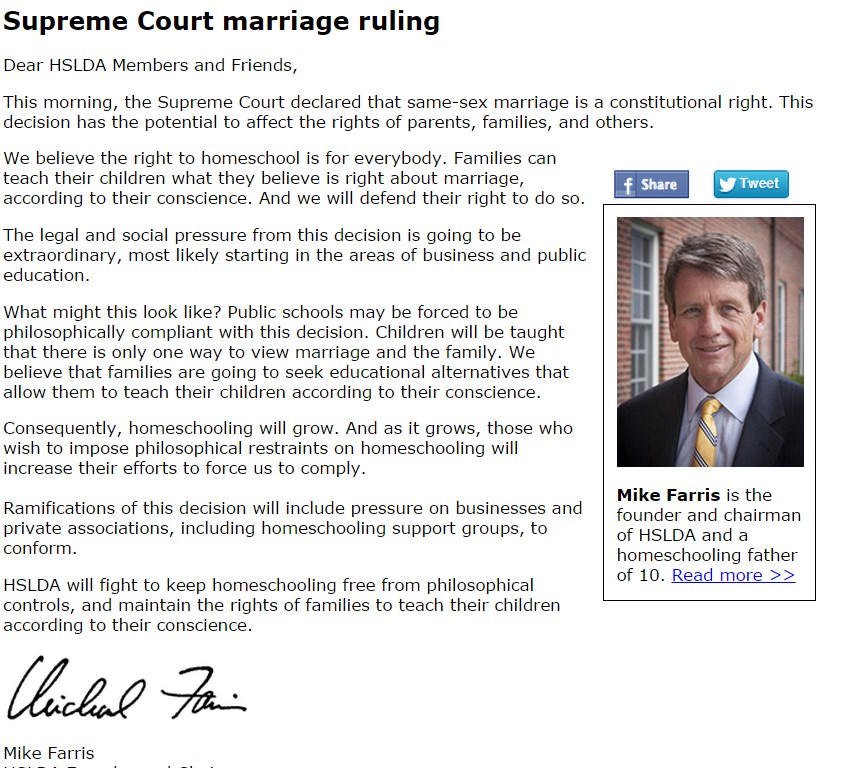
Text of statement [image]:

Supreme Court marriage ruling

Dear HSLDA Members and Friends,

This morning, the Supreme Court declared that same-sex marriage is a constitutional right. This decision has the potential to affect the rights of parents, families, and others. 

We believe the right to homeschool is for everybody.

Families can teach their children what they believe is right about marriage, according to their conscience. And we will defend their right to do so.

The legal and social pressure from this decision is going to be extraordinary, most likely starting in the areas of business and public education. 

What might this look like? Public schools may be forced to be philosophically compliant with this decision. Children will be taught that there is only one way to view marriage and the family. We believe that families are going to seek educational alternatives that allow them to teach their children according to their conscience.

Consequently, homeschooling will grow. And as it grows, those who wish to impose philosophical restraints on homeschooling will increase their efforts to force us to comply.

Ramifications of this decision will include pressure on businesses and private associations, including homeschooling support groups, to conform.

HSLDA will fight to keep homeschooling free from philosophical controls, and maintain the rights of families to teach their children according to their conscience.
Mike Farris

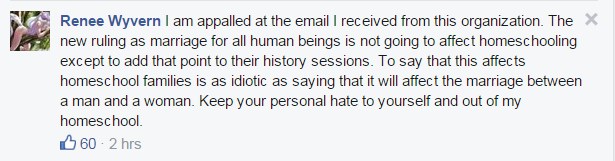
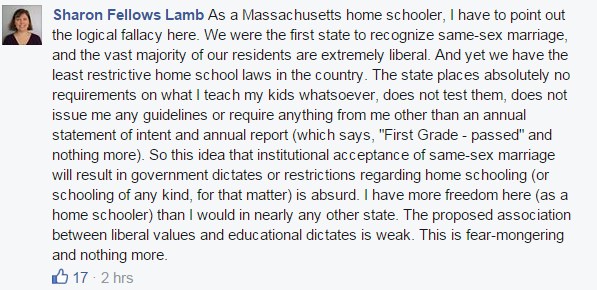
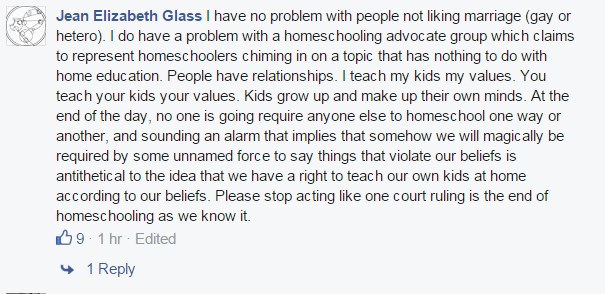
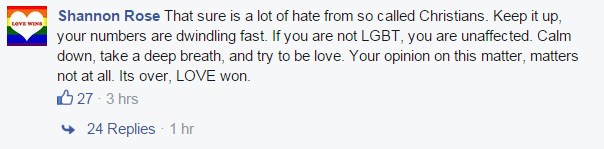
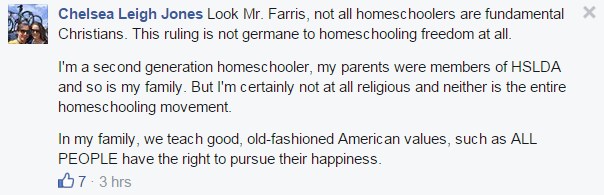
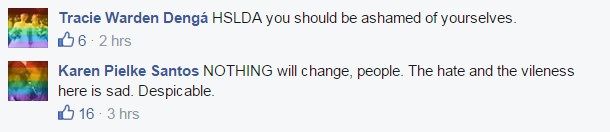
Many HSLDA members responded in an admirable fashion. Many of the top comments on HSLDA’s Facebook post with this statement are criticizing them and pointing out the logical fallacies.

In response to the decision, many conservative politicians are attacking the institution of the Supreme Court. Michael Farris led the pack this morning on his personal Facebook [image]:

My response to today’s ruling in a nutshell… We must stop letting the Supreme Court exercise legislative power.

..We must fight judicial politics with grassroots politics. The only solution is the Convention of States. Four states have voted to call a Convention that can address this issue.

If we want to preserve American self-government, we have to push harder to overcome the naysayers and leftists who want to stop us…

All other alternatives are spitting in the wind. We have lost big time. The only solution is a big time reversal of judicial power.

Farris expounded on his Facebook post and HSLDA press release on Friday afternoon with an additional press release through Patrick Henry College that evening. [full text] The morning of the the ruling on ACA, Farris called John Roberts Judas through a “30 pieces of silver” illusion. Farris continues to hammer on the illegitimacy of the court’s decision and adds the Affordable Care Act (ACA) ruling to his argument:

The Court—not the Constitution—has legalized same sex marriage. No one can legitimately contend to the contrary. This occurs one day after the Court rewrote the Obamacare legislation to save it from a pragmatic death.

In the marriage case, the Court rewrote the Constitution. In the health care case, the Court rewrote a federal statute…


Our solution today requires this same general approach [that FDR used when he threatened to pack the bench]. We have to figure out a way to beat the judicial politicians with superior political tactics.

The core reason that the Supreme Court has this much power is revealed by the Court itself. In multiple opinions, usually in dissents, the members of the Court have acknowledged that there is no realistic check on the power of the Court other than its own internal sense of self-restraint.

If we want to preserve American self-government, we must impose additional restrictions on the power of the Supreme Court. Checks and balances need to be real, not merely theoretical.

Of course, Farris’ policy answer will determine your corresponding level of outrage. Everything he proposes would fundamentally change the nature of the Supreme Court because he disagrees about their decisions on abortion, same-sex marriage, and ACA. His Convention of the States project is his best chance to codify his interpretation of Christianity into the Constitution.

There are many ideas in circulation on how to do this. Term limits could be imposed on the justices. We could add “deliberate failure to follow the original meaning of the Constitution” as grounds for impeachment.

We could give the power of impeachment to state legislatures.

My favorite is to follow FDR’s court-packing idea but with vigor.Every state should be allowed to appoint a member of the Supreme Court. They could serve for a brief term, perhaps eight years. Removing Supreme Court appointments and confirmations from Washington, DC, is the only realistic way to ensure true judicial independence. Otherwise, you get the power cabal that we have in place which was clearly in play in this week’s Obamacare decision.

Continuing his theme of separation from US Federal Government power, Farris posed an open-ended question about having a tribe annex a state – presumably for him and others to escape certain federal laws.

11659884_666852401750_598227258_o


Presidential candidates Mike Huckabee and Bobby Jindal echoed Farris’ institutional distrust of the Supreme Court as they position themselves to court the religious right. Apparently, they think the religious right desires Theocracy.

New presidential candidate Bobby Jindal, linked to Michael Farris and his ideology directly through his chief of staff, strategist, and confidante Farris’ protegee Timmy Teepall, will make “religious liberty a cornerstone” of his campaign. Jindal balked at the court’s decision on marriage and claimed “[t]he next step on this is the left and (Democratic front-runner) Hillary Clinton are going to be waging an all-out assault on our religious liberty rights.” In the same vein as Farris, Jindal advocated abolishing the entire court:

Marriage between a man and a woman was established by God, and no earthly court can alter that… If we want to save some money lets [sic] just get rid of the court.

Huckabee and Gothard at a presidential luncheon Mike Huckabee, linked closely with the Duggars, Bill Gothard, and theocratic dominionism, took the most aggressive tone today:

I will not acquiesce to an imperial court any more than our Founders acquiesced to an imperial British monarch. We must resist and reject judicial tyranny, not retreat. 

Why is homeschooling linked with the same-sex marriage decision? I suggest reading about Michael Farris’ central role in crafting the Religious Freedom Restoration Act and HSLDA’s strenuous advocacy for Virginia’s religious exemption rule. The fear of homeschooling parents is a weapon wielded by Michael Farris, HSLDA, and now an increasing roster of politicians who are threatening the United States’ democratic institutions because the Supreme Court has ruled their religious views cannot overrule marriage equality.

Homeschooling, and homeschoolers, deserve better than to be co-opted into resistance against the Supreme Court. And I’m glad many of HSLDA’s members have spoken out boldly today. Pulling their membership from HSLDA and defunding their efforts is the best way to send a message to HSLDA that homeschooling should not be about attacking our democratic institutions to further “religious liberty.”

Thoughts on Christian Marriage Teachings, Part Three

Image courtesy of Darcy’s Heart-Stirrings.

HA note: The following is reprinted with permission from Darcy’s blog Darcy’s Heart-Stirrings. It was originally published on March 20, 2015.

Part Two

I can’t talk about bad Christian marriage teachings without addressing one of the most common ones that tends to lead to all the rest of them. It goes something like this:

“The husband is the head of the family. He is the spiritual leader. He is responsible for the spiritual life and growth of his wife and children. God’s blessings to the family come through the husband and father who is connected to God. A man out of sync with God can take down his family. A woman submits to God by submitting to her husband’s leadership. A woman cannot usurp her husband’s spiritual leadership or God will not bless the family. “

There’s variations of those sentiments, but that’s about the gist of it. A family cannot be a godly family, or a successful family, without the spiritual leadership of a godly man. The requirements for such a man are numerous and many words have been written and spoken and debated about them. Everything from “must lead family worship every day” to “must be active in the church” to “must lead his wife with the Word of God”.

It is clear from most Christian marriage books, conferences, and counseling material that when the man fails in his duty of spiritual leader, the family will also fail. Failure to lead spiritually is the root of all manner of dysfunction and sin in a family. This has caused a lot of women much heartache as they call into Christian radio programs or sit crying with their pastors over their husband’s behavior and character flaws. His sin? “Not being a spiritual leader.” Consider this article from Family Life Today, a program that is considered solid Christian family material, whose founders do marriage conferences around the U.S.:

“How can I motivate my husband to get right with God and become the spiritual leader of our family? This question represents the longing of many wives who are growing in their faith but are married to men whose Christian growth seems stagnant or who seem unwilling to take the spiritual lead in the family. If one of these represents your situation, realize that you are not alone.”

The article goes on to showcase the various popular teachings on what a husband is expected to do and what happens when he isn’t following through. It also goes into the expectations of a wife whose husband is failing at leading. And, in a very predictable manner, blames the wife for her husband’s shortcomings. Because that’s how it always ends up in this paradigm: the wife wasn’t submissive enough, or godly enough, or giving enough sex, or being spiritual enough, or being quiet and meek enough, or she usurped his authority and dared to lead for a bit, and THAT’S why her husband isn’t doing her job. “…carefully evaluate if you are inhibiting your husband’s spiritual leadership by taking the lead yourself….[if] he is instinctively looking to you to set the spiritual atmosphere in the home because of your experience or your spiritual maturity, you may actually be robbing him of the opportunity to become the leader God desires.”Oh noes. Men’s leadership abilites are apparently so fragile as to disappear altogether if the wife doesn’t submit properly. It doesn’t matter if she is actually better equipped than he is, it’s his job and she better not do it, for the sake of their family’s spiritual status.

In another article by Focus on the Family, entitled “How Do I Spiritually Lead My Family?”, the author explains:

“Naturally, there is a great deal of controversy in the church today surrounding the precise meaning of these words. Some husbands wonder, “What am I supposed to do – act like a preacher?” Some wives ask, “Why is he supposed to be the only spiritual leader? Why can’t we both do it?” In the end, it all comes down to a very simple and fundamental truth: families need leaders. The buck has to stop somewhere if the household is to function smoothly and efficiently.”

He then goes on to give out some basic qualifications on what this looks like practically, such as  “he must have a strong connection with his Heavenly Father, finding his happiness in Christ first, realizing that he can lead effectively only if he maintains an intimate relationship with the Lord.”

When you get into popular theologians like John Piper and John MacArthur, you get even more specific and deeper into the murk of the teachings on male spiritual leadership. Piper says,

“I define spiritual leadership as knowing where God wants people to be and taking the initiative to use God’s methods to get them there in reliance on God’s power…If we would be the kind of leaders we ought to be, we must make it our aim to develop persons rather than dictate plans. You can get people to do what you want, but if they don’t change in their heart you have not led them spiritually. You have not taken them to where God wants them to be.”

His following list of how to benevolently dictate the lives of everyone under him in the name of God is very long and tedious and I would imagine looks a bit overwhleming to your average husband, father, and church-leader

I once shared this:

“What I didn’t realize until recently was just how much my husband was hurting from these teachings. I remember going to church without him one week years ago and listening to a guest speaker rail on the men for not being better leaders, better husbands, and better fathers. (This was his usual sermon when he visited.) How I wished my husband had been there! I confess I thought he could use a good ass-whipping to be the man he wasn’t being (and since I was trying to be the perfect submissive wife, I certainly couldn’t give it to him). When I told him later who spoke, he muttered under his breath “Another guilt-trip for not being a good enough man. Oh yay.” That hit me hard.”

I was so convinced that our marriage wasn’t working, our family was falling apart, and I was being stunted spiritually all because my husband wasn’t interested in spiritual matters. At least, not to the extent that everyone said he should be. I was the woman in the article I posted first, from Family Life Today, wringing my hands because the man who was supposed to be in control of not only my physical life, but my spiritual growth, wasn’t doing his job. I was stuck. I felt hopeless. I had no concept at all that I could be in control of my own spiritual growth or that of my children, no concept of autonomy or agency. 

And this brings me to one of the biggest problems with these teachings. They cause women to be stuck. If your man is supposed to be your leader but he’s not leading, and if blessings from God are supposed to come through your man but he’s not doing his job to get the blessings, and if you are told that you must always submit and always respect and never usurp his authority by leading your family yourself because that’s Satan tempting Eve, then what is a woman to do? Well, she manipulatesShe jumps through hoops to grovel to her husband’s position over her while still passive-aggressively manipulating her man to do what she wants him to. The much-revered book on marriage, Created to Be His Helpmeet, is an entire book on how a woman can manipulate her man to do what she and God wants while still being a submissive “godly woman”.  It becomes the only option left. Real communication cannot happen in such an atmosphere.

Women are inferior in this paradigm because they cannot lead themselves but must depend on a man — a man who is naturally superior in position and spirituality. Though no complementarian teacher will admit this and many protest against the idea, there is no way to operate within this worldview without spiritual and physical inequality between the sexes. They say things like “equal in value but not equal in role”. They can try to redefine “value” all they want but it doesn’t change the practicality that women are inferior in this teaching. 

The fact of the matter is, no one is responsible for me except me. No one is my “spiritual leader”. I am my own person with my own beliefs and my own journey and NONE of that is dependent on my husband. Because he is his own person with his own journey too and that’s not dependent on me. We walk our own paths even as we have chosen to walk together. To say that a marriage can only work if the husband is the spiritual leader is ridiculous. Look outside this narrow worldview for one moment and see all the marriages that have worked and are working splendidly without a male leader. Or with the wife leading. Or with one or both of them atheists and no spirituality whatsoever. Or with equal partnerships. Or in Egalitarian Christian marriages. Or in any number of variables and beliefs and situations. Look outside the confines of the cages built by the Complementarian leadership of the American Church and breathe free air for a minute. Then tell me I should go back to a system that says I can’t be anything without my husband’s leadership. That my children will go to hell because he doesn’t go to church or lead prayer or ever talk about God with them, regardless of whether he is a good husband and good father. That it’s probably all my fault the formula isn’t working because it’s always the wife’s fault in this paradigm when her husband isn’t doing his job.

I watch as conservative religious friends go to various marriage seminars where they are instructed on how to have a good marriage within the confines of complementarian teachings. They come back all fired up and high off repenting for not being submissive enough and not being loving enough. But it never lasts. And after a while, back they go to another conference to have it instilled yet again how to operate their relationship in forced, gendered, hierarchical ways. Some manage to last, many don’t. It’s no wonder to me that marriages in these confines need so much encouragement, so many books, yet another conference. Because this type of relationship is not sustainable. Not in a healthy way, not for very long.

Now contrast everything I wrote above with how my marriage is now, years after giving up the teachings of male spiritual leadership. We are equal partners. We are free to use our strengths for the growth of our family without worrying that I’m not being submissive enough or he’s not being leaderly enough. I can call him out when he’s being unreasonable and he can tell me when I’m being a butthead and we can set up boundaries to ensure healthy communication and actions without some weird hierarchical paradigm within which we to try to manipulate each other. We are individual, separate, independent people who adore doing life together and are free to do that in a way that works best for us. I am strong and free to operate my own life and he is free from the burden of treating me as child that needs his direction. We offer each other support, wisdom, criticism, trust, respect, and love. We are not bound by gender roles that force us into unnatural ways of being. We are free. So very free, to be ourselves for each other and for our children. And it is a beautiful thing to behold. Because where freedom lives, love can grow in leaps and bounds.

Once again, giving up saved our marriage. And we didn’t even need a marriage conference to do it.

End of series.

Thoughts on Christian Marriage Teachings, Part Two

Image courtesy of Darcy’s Heart-Stirrings.

HA note: The following is reprinted with permission from Darcy’s blog Darcy’s Heart-Stirrings. It was originally published on March 17, 2015.

< Part One

So with my story in mind from Part 1, let’s talk about the teachings that claim that without the Christian god, marriage cannot work.

It doesn’t take a genius to see the problems with that belief. But it does take objectivity and willingness to look outside the confines of your world and paradigm. The fact is that marriages, all relationships really, work just fine (or don’t) across all religious and ethnic and historic boundaries.Atheists, Catholics, Protestants of every flavor, Muslims, Hindus, Buddhists, New Age folks, Pagans, Wiccans, Mormons, Jews, and every combination of these have had great, life-long, healthy marriages throughout history (they’ve also all fucked up a lot of relationships). So what is the constant there? Because it obviously isn’t the Christian God.

Christians think that if their marriage goes wrong, it’s because they aren’t doing Christianity well enough. But even the casual observer can see that that has nothing to do with it. That people without any god at all can manage to do relationships well. God, anyone’s version of it, is not what holds relationships together. Those that say they are only together because of God make me pause and wonder what will happen when their idea of god changes, or if one spouse’s journey leads away from Christianity.

If belief in Jesus causes you to treat one another better and therefore have a more fulfilling relationship, then that’s great! I’m not knocking that at all. But there’s some concerns with that line of thought. To say that belief in your god is *the only thing* that can hold together a marriage is not only false, it’s dismissing of every good marriage outside your paradigm. And it’s concerning to watch people go through highs and lows and to constantly blame the way they treat their spouse on whether they are doing religion correctly or not. Human beings have managed to be respectful, loving, and empathetic, be they Christian or not, and if one cannot be compelled to treat another person in those ways without allegiance to one’s god, then I have to ask why, because non-Christians manage it every single day.

I see my husband as deserving of my respect and empathy, not because a deity declared him so, but because he’s a human being and valued. He values me purely because he loves me and I am worth it as another human being, not because he has to “see Jesus in me” in order to see my worth or because he can’t love me without first loving God.

So while I do think that faith can enhance one’s life and relationship, I can also see where it has been used as a crutch and a get-out-of-jail free card that people use to blame their problems on.

But when you’ve been used to blaming your actions on God, lack of Him, flesh nature, Satan, Eve, and everything else *but* your own self, it’s tough to start admitting personal responsibility.

No, my flesh nature is not responsible for me yelling at my husband. *I* did that, I chose that action, *I* am responsible to make it right. No, my lack of empathy toward my wife is not because I didn’t pray enough this week, but because *I* chose to act in that way and *I* alone am responsible to fix it. God isn’t going to fix it for me. That’s on me. And it’s on you.

Thankfully, I know now by both reason and experience that I can do good without anyone’s version of god. I can have a great marriage with myself and my spouse at the center of it and without a god in the equation. That many people, the world over, throughout history, have managed to do much good and have fulfilling relationships with others with and without God (anyone’s version of him/her). The traits that make us human, that cause us to have healthy relationships with other humans, are not exclusive to Christianity.

We all have access to them, we all have the opportunity for amazing relationships, god or no god.

Part Three >

Thoughts on Christian Marriage Teachings, Part One

Image courtesy of Darcy’s Heart-Stirrings.

HA note: The following is reprinted with permission from Darcy’s blog Darcy’s Heart-Stirrings. It was originally published on March 17, 2015.

“God needs to be the center of your marriage or it will fall apart.

“Marriage takes three to work well.”

“A good husband is one who helps his wife fall more in love with God than with him.”

“The most important thing in marriage is for both to have faith in God.”

“Without God, marriage cannot work well. We are two selfish to accomplish a good marriage on our own without his sanctification and redemption.”

“A husband must be completely surrendered to God in order for his wife to completely surrender to him.”

“The closer you move toward God, the closer you move toward each other.”

“God ordained marriage and God sustains marriage.”

If you look up “Christian marriage quotes”, you’ll find thousands of pages and tens of thousands of quotes like the ones above. Some of us don’t have to Google, these things were drilled into us from babyhood. We heard them from our parents, the pulpit, pre-marital pastoral counseling, Christian marriage books, our own wedding ceremonies, and marriage seminars and conferences.

This type of thinking is a type of religious-centrism, or the idea that your perspective based on your religion is a universal truth. In reality the world around you is a much bigger place with broader views that don’t follow your rules or operate within your paradigm.

I’d like to talk a little more thoughtfully about the idea that “having a relationship with God and God as the center” is not necessary for having a wonderful marriage and how dependence on this concept can be damaging.

But first, a story. My story, and what led to the broadening of my own views on healthy marriage.

These teachings about having God at the center of your marriage, almost tanked my own marriage. Along with the erroneous teachings of Complementarianism, the idea that God had to be the center of my marriage, and all that entails, was disastrous for my marriage.

I came into marriage with a lot of funny ideas on what a Godly marriage was supposed to look like. I’d been raised a good little female homeschooler and read all the right books, including Created to Be His Helpmeet. I knew that in order to have a godly marriage that lasts a lifetime, I had to learn submission to my husband, he had to be in tune with God in order to lead correctly, we had to both be in daily communication with God, prayer together daily, discuss our faith, be part of Bible studies that would encourage us in our personal faith and our godly marriage, and be sure to “keep God at the center” of our marriage. We could only love each other well if we loved God more. Every church we were part of reinforced these teachings. Every couple we talked to in the church declared them to be true.

But nothing worked out like it was supposed to. As my husband said to me just last night, “Doing marriage the Christian way almost killed our marriage”. The more I tried to respectfully get him to lead prayer with me, or to go to men’s retreats where he’d learn to be a more godly leader, the more he resisted and the more distant he got. He’d cave and go to a retreat where, in his words, “they’d spend the whole time telling us how we weren’t good enough men and needed to repent and get closer to God and we’d come home feeling both dejected and on a repentance high.” (He likes to refer to the emotional upswing that happens after a spiritual encounter as a “spiritual high”.) We had quite a few of those experiences in the first 5 years of trying to be a godly couple. There seemed to always be something to repent of, something we weren’t doing quite right, something we needed to do better in order to obtain what we were supposedly missing: connection with God and therefore each other and therefore God’s blessing on our marriage.

Somewhere along the line, we both gave up. We loved each other, had great chemistry, were committed for life. But we were tired. So tired of trying to fit into boxes we didn’t fit in. Trying to pursue the elusive spiritual connection that would finally help us obtain “godly marriage”. We never fought, we just disconnected. I was sure it was over because we never prayed together and he was sullen because I lived in fear that we’d messed up, that God wasn’t the center of our marriage, that we could never have what all those smiling couples on the marriage books had. And we were both miserable.

Giving up saved our marriage. 

When we were both able to give up on expectations of each other and ourselves, expectations we were told came straight from God, we were finally able to see the people we were and the relationship we had. We were able to appreciate the uniqueness that was us instead of forcing something that wasn’t us and was killing our hearts and souls and relationship. We gave up the idea that either of us had to be close to God to be close to each other and started connecting based on who we were as people, not as Christians. We stopped sharing our personal faith journeys with each other in a forced “we have to share because it’s what we’re supposed to do” way, which was really me trying to pry his thoughts out of his head in order to feel some sort of spiritual connection to him. We stopped trying to model the male headship structure and decided that Egalitarianism was more true to who we were and made more sense for a healthy relationship between adults. I started to blossom as my own person, an independent individual, something I had never done before as a conservative homeschooled female. I no longer needed him to shape up spiritually in order to lead me. I didn’t need a leader, I needed a partner, a companion. He didn’t need me to be another child that needed leading, he needed and wanted a partner in life.

We stopped asking “what are we supposed to do? What are we supposed to get out of this relationship? How can we glorify God with our marriage?” and started asking “what do we want to do? What do we want from this relationship? How can we live a fulfilled, healthy life within our marriage?” We threw out the books, stopped going to conferences, and completely gave up any spiritual and religious aspect of our marriage. We didn’t talk about God with each other for *years* and just let the other person have their own faith and do whatever they liked with it. We stripped it all down to two people, madly in love, who like each other and want to do life together, and now what? 

That was the first 5 years of our marriage. The last 5 years have been truly phenomenal. Real connection, mutual respect, freeing each other to be individuals, talking til 2 AM about everything and nothing, sexual fulfillment, laughter, partners in crime, best friends, each on our own spiritual journey and not threatened by the others’, doing life together in an easy, non-forced way. According to every sermon, every book, every conference, every meme and internet quote passed around Facebook, our marriage should be falling apart without God. But without God and the expectations that came with the idea of him, our marriage is thriving, as are many others in the same place as we are. I am sometimes angered by the fact that something that started out so good was almost destroyed because we submitted to teachings of men in the name of their god. I’ll talk a little more about those teachings and the problems inherent in them in Part 2.

Part Two >