By R.L. Stollar, HA Community Coordinator
*****
In this series: Part One, Introduction | Part Two, Kalyn’s Secret | Part Three, Kalyn’s Secret (Continued) | Part Four, Not Open | Part Five, Unmask the Predators | Part Six, Recommended Resources | Part Seven, Conclusion
*****
Part Three, Kalyn’s Secret (Continued)
In the first half of today’s analysis of Kalyn’s Secret, I gave some context for understanding the Cherry family and then looked at where the book took steps in the right direction.
3. The Bad
Unfortunately, the book also takes many, many steps in wrong directions. In fact, I could dedicate an entire five-day-long series to just this book and its ideas. However, that would be a tedious read and could sidetrack us into debates over theology and ideology. So I am going to focus this section less on the actual ideas and more on the consequences of those ideas when it comes to abuse prevention and mental health advocacy. I grew up hearing the mantra, “Ideas have consequences,” and I still find that mantra to hold true. So as I examine the ideas contained within Kalyn’s Secret, I will be filtering them through the lens of the following question: Does this help or harm abuse survivors and individuals with mental illness?
The ideas I will be examining are:
a. Poor biblical exegesis
b. Damaging theology
c. Perspective on mental health
d. Demonology
e. Authoritarianism and Patriarchy
f. Suggesting physical abuse and first-time obedience
g. Bad advice regarding counseling and abuse reporting
h. Recommended resources
a. Poor biblical exegesis
One of the root problems in Kalyn’s Secret is Lisa Cherry’s poor grasp of biblical exegesis. This might seem strange considering that she is a pastor at Victory Christian Center (a church she and her husband founded), but Lisa’s higher education consists only of a BS in Nursing.
I know some of you reading might not be Christians, so discussing biblical exegesis might seem meaningless. However, basic reading comprehension is a skill everyone can benefit from. And a poor grasp of biblical exegesis — whether or not you believe the Bible is true in the first place — can lead people to believe some awfully damaging ideas. So whether or not you believe the Bible is true, it behooves all of us to encourage those who do to read the Bible accurately and in a way that promotes healing (and not harmful) ideas.
There are numerous ways that Lisa engages in flawed biblical exegesis in Kalyn’s Secret: pulling verses out of context, playing fast and loose with definitions, inserting her own words into passages, switching one Bible translation for another mid-passage to justify an idea she’s trying to proof-text, etc. But I want to focus on one specific exegetical problem in particular: personalizing passages that aren’t meant to be personal. Time and time again, Lisa strips verses out of their historical and literary contexts and argues that they magically transcend those contexts and are direct messages from God to us in 2014. I know a lot of people do that. But that’s just not how reading and writing works. That’s a failure in Exegesis 101.
The most important example of Lisa doing this is her treatment of Luke 10:19: “Behold, I have given you authority to tread on serpents and scorpions, and over all the power of the enemy, and nothing will injure you.” Lisa uses this verse on two separate occasions: (1) to claim that “when we saw strange demonic activity happening in our home, we had to remind ourselves of the truth that we have been given ‘authority to tread on [snakes] and scorpions, and over all the power of the enemy, and nothing will injure [us]” (133); and (2) to claim that “speaking God’s promises” “out loud” “allows God’s Word to defeat the powers of darkness,” proof-texted with Luke 10:19 (189).
The problem is, Luke 10:19 proves nothing of the sort. Here’s the context: Jesus appointed 70 people and “sent them in pairs ahead of Him to every city and place where He Himself was going to come.” The 70 people then “returned with joy, saying, ‘Lord, even the demons are subject to us in Your name.’” Jesus responds to those 70 people and says, “Behold, I have given you authority to tread on serpents and scorpions, and over all the power of the enemy, and nothing will injure you.” This passage is directed to 70 people specifically appointed by Jesus to do a particular task during a precise moment in history, not any and every Christian living in 2014. In fact, you’ll notice that when Lisa quotes it in the first example, she actually changes the verse, replacing the word “you” with “[us].” She’s literally rewriting the Bible to make it say something it doesn’t.
This point about exegesis is significant because Lisa’s exegetical failures directly lead to the next problem: damaging theology.
b. Damaging theology
As I said earlier, Lisa and her husband are self-described “Holy Rollers” (57). The Cherry family falls squarely into the Charismatic, Word of Faith, Holiness, and Prosperity Gospel movements. Lisa talks about the necessity of true believers having “an encounter with the third person of the Trinity named the Holy Spirit” (56) — and that not having that special encounter jeopardizes one’s relationship with God.
One can see this in the strong charismatic language used by Lisa in statements like, “We must learn to avoid spirit failure and employ Spirit power” (93), “Spirit failure was causing me to be pulled into the pit with Kalyn, and I desperately needed an emergency supply of God’s supernatural power!” (96), and “Through Jesus our ‘power hook up’ was restored” (113). In fact, Chapter 7 of the book is tellingly called, “Hooked Up to the Power.”
Lisa describes two of these so-called “power hook-ups” as (1) exousia and (2) dunamis. Exousia, she says, “refers to force, superhuman mastery, and delegated influence, which reflects authority. This Greek word…holds the answer for every problem anyone is facing now or in the future…Jesus gave His authority back to His children… Jesus had the exousia, and He transferred the exousia to His true followers” (115-6). This power promises success and victory: “Because of our exousia we can stand up and proclaim, “In Jesus’ name, I command every force of darkness to leave my home” (117).
Dunamis means “a mighty working miracle power,” Lisa says. It refers to the power to heal the sick and cast out demons, and Christians have this power, too: “Jesus Himself operated in this Holy Spirit power anointing when He healed the sick, walked on water, and cast out unclean spirits…That same dunamis is available to all believers by being filled with the Spirit” (119).
Lisa takes these “power hook-ups” seriously. In fact, she states with all seriousness that the 1904 Azusa Street Revival in Los Angeles was a true working of the Holy Spirit (118). For those unfamiliar with this revival, suffice it to say that it was the beginning point of the Pentecostal and Holiness movements in the U.S. and has been directly linked to child abuse and deaths due to its emphasis on faith healing.
While I desire to respect people’s diverse theological belief systems, I do think that each and every system of human belief has weaknesses — and those weakness are particularly amplified in certain circumstances. For example, while we could argue about the validity of Calvinism’s tenet of predestination, I hope we all can agree that raising the tenet of predestination at a loved one’s funeral is counter-productive and damaging. That’s not the time and place. Similarly, raising the charismatic tenets of the Cherry family’s theological system — whether you think they are valid or not — within the context of abuse prevention is counter-productive and damaging. Here’s why:
First, it offers false hope.
The “victorious Christian living” message from these movements offers false hope to families facing the devastations of child abuse. It promises supernatural power when it should be offering accurate, concrete, and professional assistance for abuse recovery and mental illness. Examples of the promises Lisa makes include:
- “To those who understand His ways, who respond to His incredible offer of a covenant relationship, who obey His principles, and who can believe His incredible mercies, He will make His supernatural power available” (123).
- “God is ready to give us the fullness of His power—He’s promised to in His Word. We just need to plug in!” (125).
- “As parents we can say no! Our prayers and our authority have power in the spirit realm” (164).
- “When you are prepared for the day of battle, your victory is sure!” (175).
Second, it emphasizes prayer over real recovery assistance.
This is the problem with any worldview that advocates faith healing. These worldviews declare that simply saying words out loud can transform circumstances. This is mysticism, not accurate science or even biblical Christianity. Examples of Lisa’s Word-of-Faith ideology includes:
- “Pray the prayer below for whichever spiritual condition you may be in right now, and expect God to rescue you and help you to find your own path out!” (106).
- “By some counts it is estimated that there are over 6,000 statements of promise contained in the Word that are available to the child of God… Speaking God’s promises is how we declare our place of authority over our own lives… It allows…the release of the power of faith [and] God’s Word to defeat the power of darkness… This scriptural declaration not only transforms my mind and heals my emotions, it also transforms circumstances” (188-90).
- “Just keep speaking those promises aloud until faith supernaturally begins to rise up in your spirit” (192).
Third, it heaps guilt upon survivors of abuse and their families.
There’s no way around the fact that recovering from child abuse and/or mental illness is a complicated and grueling process. In fact, an entire lifetime might very well be required. There will be relapses, dark moments, and times when people will just want to give up. It doesn’t matter if you are a Christian or an atheist or a Buddhist — this is just how recovery works.
To suggest to survivors of abuse and their families that there are easy answers or that they just need to tap into a supernatural source of power is devastating. Because ultimately, the realities of recovery will surface no matter what. The feelings of failure are difficult enough, but the worldview of the Cherry family only adds guilt on top of guilt. Because now survivors not only feel like failures in terms of recovery, but also failures in terms of their relationships with God. Wasn’t faith supposed to supernaturally rise up? It didn’t. So does that mean I am not a Christian? Does God hate me? Must I pray harder? What is wrong with me?
This is an insidious form of religious abuse and has no place in legitimate education about abuse prevention or recovery.
c. Perspective on mental health
Both Lisa and Kalyn Cherry (though primarily Lisa) minimize, spiritualize, and stigmatize mental health health issues through Kalyn’s Secret. They minimize by discussing mental illnesses as if they are stereotypical teenage “issues” (like smoking cigarettes) that can be easily avoided or vanquished. They spiritualize by repeatedly classifying mental illness as a tool of Satan and demons, rather than an actual illness. And they stigmatize mental illness by speaking of it as something wrong on a moral and/or spiritual level.
These problems begin at the very beginning of the book when Lisa tells a morality tale about a Parent and Child traveling on a Boat (representing life). The Parent is obsessed (and in Lisa’s mind, rightly so) with avoiding various “Islands” (the aforementioned, stereotypical teenage “issues”) and has to help the Child stay safe. In Lisa’s mind, the Parent can successfully navigate the Child’s boat and not run aground on any of the islands. And one of these Islands — amongst things like Drugs and Violence — is “Depression”: “Parent had studied the names of the other ‘islands’ their boat needed to avoid—Depression, Drugs, Sexual Abuse, Rebellion, Violence, Teen Pregnancy—and he certainly didn’t intend to get their boat caught up on any of them!” (24)
Mental illness is not something that can be “avoided” necessarily any more than any physical illness. So not only does classifying it alongside things like drugs obfuscate its roots, it also makes it appear like it’s something easily avoided or fixed. This minimizing continues throughout the book. Lisa makes it sound like God won’t let “real” Christian remain mentally ill, saying, “When God would remind us that He sent forth His Word and healed all our diseases (Ps. 107:20), we had to remind ourselves that depression would not be able to stay in Kalyn’s body. When we saw strange demonic activity happening in our home, we had to remind ourselves of the truth that we have been given ‘authority to tread on [snakes] and scorpions” (132-3). She also insinuates that parents can solve mental illness simply by praying: “When attacks come against your home, take a stand by faith and pray like this: ‘No devil…I disallow tormentors such as depression, oppression, anxiety, and stress…’ As parents, we can say no! Our prayers and our authority have power in the spirit realm” (132-3).
This, of course, is not surprising in light of the fact that the Cherry family adheres to and promotes various religious movements noted for faith hearings.
As you can see from the last quotation, Lisa also spiritualizes mental illness. She describes depression as a “tormentor” from the “devil.” Other spiritualizing language that the book uses to describe mental illness includes “weapons at the devil’s disposal” (92) and “dark forces” and “ugly monsters” (226-7). This is not a coincidence. As we will discuss in the next section, demonology is a significant factor in the Cherry family’s worldview.
The last point necessary to make about Kalyn’s Secret and mental health is that the book stigmatizes mental illness by describing it — and those who suffer from it — in intensely negative terms. Kalyn describes mental illness as a “weakness” (227) and a sign of “our perverted, godless society” (239). Lisa describes it as part of a “pit” belonging to Satan. She compares mental illness to alcohol, saying that depressed individuals use their mental illness as a “coping mechanism” that “allows the mind to shut down and temporarily give up the task of reasoning.” She also says that it’s “politically correct” to describe mental illness as an “involuntary response,” when in fact it’s “the enemy’s ultimate strategy against all God built and created” (81).
All of this is not ok. It is completely irresponsible for people claiming to be sexual abuse prevention educators to minimize, spiritualize, and stigmatize the mentally ill. Mental illness is real, it is not the result of personal failure or satanic influence, and it deserves to be treated carefully, scientifically, and compassionately. Especially considering that child abuse primes the brain for mental illness, the mental health language used in Kalyn’s Secret — a book directed towards people with child abuse experiences — is 100% inappropriate.
d. Demonology
The fact that the Cherry family repeatedly discuss mental illness in spiritual terms is not a coincidence. Demonology is a significant factor in their worldview — and it’s probably one of the most disturbing and damaging aspects of it. In their worldview, there is an intense, Frank Peretti-like world of spiritual warfare occurring underneath the surface of the physical realm: “The spiritual realm is a very real world charged with the activity of both God and His angelic ministering forces and the devil and his demonic tormenting forces” (85). Lisa makes multiple, exclamatory references to warfare, such as “This life is not like a war, it is a war!” and “This is not a symbolic war, this is a real war!” (90).
While one could make arguments for or against the concept of spiritual warfare, I want to stay focused on — as I said previously — the issues of abuse and mental health. In reference to her own family’s struggle with child abuse, Lisa employs language that is a mixture of Bill Gothard and Frank Peretti: “I underestimated the strategic cunning of the spiritual forces of darkness to develop fortresses in our homes” (13-4). Lisa also insinuates, when Kalyn was lashing out at her and her husband due to feelings of abandonment and betrayal, that her daughter was possessed: “I looked at this shell of my daughter sitting before me and was convinced it was not really her speaking to us anymore. The daughter I knew would never say such horrible things” (104).
This emphasis on “the spiritual forces of darkness” carries over into how Kalyn discusses her own abuse. Kalyn ends up seeing her relationship with her abuser as a spiritual one: “My desire to please him, impress him, and be loyal to him dominated my life. I know that this devastating connection must been constructed on a spiritual level because the tie was so strange and strong it could not have simply occurred in the natural realm” (39-40). Kalyn comes to believe this “devastating connection,” or the “so strange and strong tie,” is the result of demonic forces: “Was it only a man controlling me? No, the force that held me no man could establish or break in his own strength. I had opened the door for principalities and powers of darkness [see Eph. 6:12], and I would pay dearly” (44).
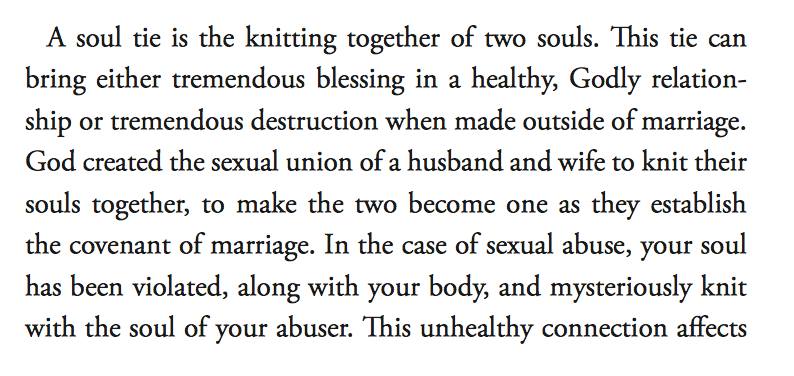
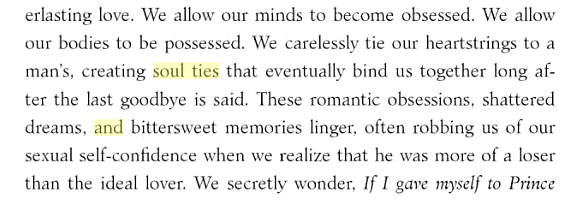
While Kalyn’s Secret references this “connection” or “tie” between Kalyn and her abuser, it does not specifically reference the concept of “soul ties,” whereby abuse victims supposedly become demonically “mind-melded” with their abusers. However, in Unmask the Predators, Lisa does specifically reference soul ties (and we’ll look at that in Part Five of this series).
There are many problems with this use of demonology in the context of abuse. The foremost one I want to mention is that that it only amplifies a victim or survivor’s feelings of terror and guilt over abuse. To suggest to a victim or survivor that their intense emotions – their feelings of anger, pain, betrayal, abandonment, and so forth — is not physically real (but rather the result of a demonic possession) is psychologically damaging. It makes them distant and distrustful of their emotions. This is damaging because (1) emotions are important indicators about reality and (2) acknowledging one’s emotions is a crucial part of healing and recovery.
Another reason why demonology is problematic in this context is that it shifts the responsibility for criminal actions away from the actual abusers and towards supernatural forces.
When discussing “our family’s crisis,” Lisa Cherry does this: “The enemies in this battle are really not the people involved in the dark acts, but the forces of evil which have taken them captive to do their will for this season” (67-8). While this could remain an abstract spiritual point, she later applies it naively and dangerously to the man who abused her own daughter. Lisa says, “I do not believe this man intentionally set out to hurt our daughter’ (137). She then blames the spiritual forces of darkness instead. While there is a time and place for empathy and forgiveness for abusers, language that in any way excuses or minimizes the actions of abusers is inappropriate here. This is especially important considering that the evangelical church today is facing an abuse crisis. We desperately need to focus on accountability, justice, and transparency, not excuses and minimizing. The latter has gone on long enough.
e. Authoritarianism and Patriarchy
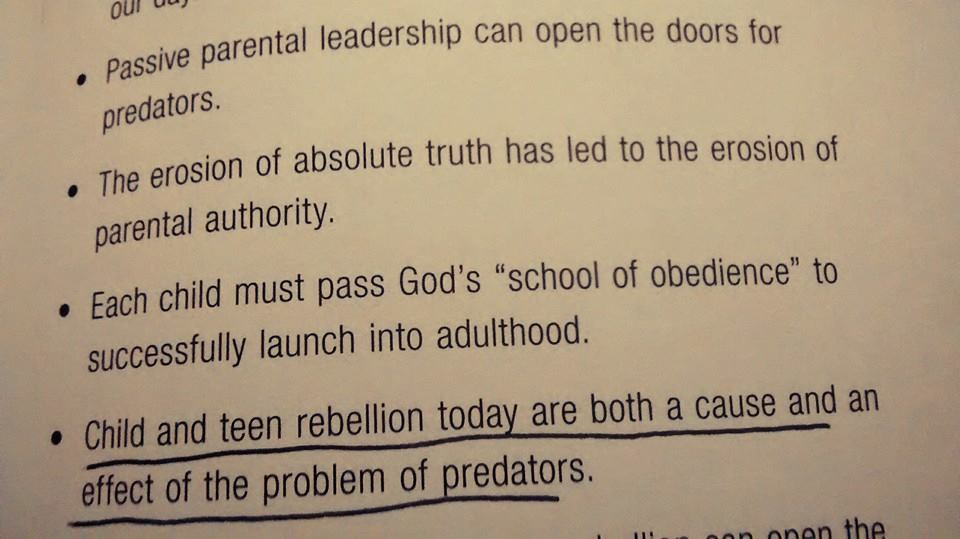
Instituting a firm system of authority is a key aspect of the Cherry family’s abuse prevention strategy. In fact, I honestly can’t help but admire the perceptiveness of Kalyn even in the midst of her abuse, for she seems to have recognized the “oppressive parenting” (143) her parents were using. (It is shame this perception was silenced and cast aside as somehow demonic in origin.)
While the authority system Lisa advocates for is spoken of vaguely, one can deduce from resources she recommends (most notably, Bill Gothard and his Institute for Basic Life Principles) and the language she uses (Gothard-like language) that she envisions a top-down authoritarianism. While Lisa does not specifically reference Gothard’s notion of the “umbrella of protection” (where obedience to authority structures is necessary to be protected by God), she does use similar-sounding language, describing her family’s failure to protect Kalyn as “drop[ping] our shield of moral protection over our own children” (150). Lisa also describes the cascading effect of being out from under that protective umbrella/shield: “The point is that ultimately the enemy’s attack over Kalyn’s life became an attack over her parents, which became an attack over her whole family, which became an attack against anyone and everyone who God had preordained for her family to reach with the good news of Jesus Christ” (83). To counter this, she insists that learn to submit to all authority figures is essential to Christian families: “Obedience is God’s way, so this lifelong obedience-to-authority training course begins by learning to obey our parents and eventually obeying other authority figures” (155).
There are 3 problems with the umbrella/shield of protection concept I want to highlight:
First, this concept can be confusing or harmful to an abuse victim or survivor. As Recovering Grace has explained, “Central to the concept is the fact that under the umbrella, ‘nothing can happen to us that God did not design for his glory and our ultimate good,’ while out from under the umbrella, ‘we expose ourselves to the realm and power of Satan’s control.’ So, is a child or young person to interpret sexual abuse from an authority figure as designed by God for glory, or the result of having strayed into the realm of Satan’s control?”
Second, it exacerbates anxiety and/or panic for children, young adults, abuse survivors, and the mentally ill.
And third, authoritarian systems protect abusers, not the abused: “The umbrella of protection…ends up protecting abusers better than it protects those vulnerable to abuse…The chain-of-command dictates a worldview in which leadership is not earned, but given by divine right. This means if the leadership errs, you are not to correct him or her, or get yourself to safety, but to continue to submit.”
Patriarchy
It must also be mentioned that Lisa Cherry advocates for a specific type of authoritarianism within Christian families: patriarchy.
She explains that she used to believe in equality between husband and wife, but that was part of a “liberal mindset” (53) that blocked God’s blessings in her family’s lives. (She even insinuates that a factor leading to Kalyn’s abuse could be her family’s original lack of patriarchy, because Kalyn was not properly controlled and disciplined.) Lisa says, “My modern philosophies about many things including my marriage and my parenting were directly impacting my children” (152), and she’ll clarify in Unmask the Predators that “modern philosophies” means “feministic and humanistic philosophies.” After a true commitment to Jesus, Lisa explains she gave all that up: “I no longer fought for my equal rights. I just wanted to give my rights away” (58). So she gave up her “feminist driven point of view” and embraced male “headship” and “submission” (153). She then challenges other wives to similarly submit to patriarchy, asking “If you are a wife, are you submitted to your husband’s leadership?” (157) She implies that if the answer is, “No,” your children could be at risk.
This advocacy of patriarchy is troubling considering that patriarchy creates environments conducive to abuse, especially sexual abuse. In The Cry of Tamar: Violence Against Women and the Church’s Response, Pamela Cooper-White explains that, “Patriarchy sets the stage in general for more abuse of girls and women of every kind at the hands of men, and conditions men to view women as objects for their gratification rather than fellow human beings worthy of empathy and care.”
This is seen clearly in conservative Christian subcultures. Homeschooling mom Julie Anne Smith has observed how patriarchy is “setting up…young ladies for abuse”. And homeschool alum Sarah Jones concurs, explaining that, “The Christian patriarchy movement grooms young women for abuse, consciously or not, by brainwashing them into compliance and encouraging them to forgo developing skills necessary for independent lives.” Even conservative Christian homeschool leader Michael Farris recently admitted that “families, children, women, and even fathers…have been harmed” by patriarchy.
f. Suggesting physical abuse and first-time obedience
In addition to promoting Gothard-like authoritarian parenting as one prevention strategy against sexual abuse threats, Lisa also recommends certain types of discipline. These recommendations are made in passing comments, so I should be upfront that the following observations are based more on extrapolation than direct statements by Lisa. But the hints Lisa drops regarding her discipline recommendations are enough to concern me.
The first observation is that Lisa criticizes “gentle mothering” (151). For those unfamiliar with this buzzword, “gentle” parenting eschews corporal punishment and first-time obedience. Lisa slams gentle parenting for being one of several “modern philosophies” that are “blocking God’s blessing” in families’ lives (152).
The second observation is that Lisa sets forth first-time obedience as a litmus test for whether you are being faithful to “God’s School of Obedience.” Lisa asks, “If you have younger children, can you give them a direction the first time without complaining or delaying?” (157) For those unfamiliar with the term, “first-time obedience” is a staple of Christian discipline books advocating the physical abuse of children, such as Gary and Anne Marie Ezzos’ Growing Kids God’s Way and Michael and Debi Pearl’s To Train Up A Child.
It has been criticized by many Christian parents because it “neglects the child’s basic well being”, cripples “the development of critical thinking”, and is based on “works-based salvation” and a “gross lack of grace.”
While advocating corporal punishment and first-time obedience may not necessarily imply to you that Lisa promotes physical abuse of children, it is important to note what resources she does recommend for child training: Reb Bradley and James Dobson. Lisa encourages people to buy Dobson’s “helpful resources” (167), even though Dobson’s book on discipline, The Strong-Willed Child, compares child training with cruelly beating a dog. And in the “recommended resources” section at the end of the book, she specifically recommends using Reb Bradley’s book Child Training Tips, a book noted for its excessive emphasis on harsh corporal punishment and authoritarian parenting.
Even more troubling — considering the context of sexual abuse prevention that we’re discussing — is the fact that Bradley’s methods actively discourage abuse prevention: “Reb Bradley also takes away the child’s only remaining defense against predators: parents who are open for communication. ‘Unless it is an emergency,’ he says, ‘children should never be permitted to criticize those over them in authority’ (p. 124).”
All of these pieces, added together with Lisa’s statement in Not Open (the book we’ll discuss in the next part of this series) that it’s “healthy” for children to experience “fear and dread” of their fathers, seem to suggest that Lisa is encouraging parents to “discipline” their children according to books that advocate physically abusing children. While this would be bad enough, it’s even more inappropriate considering she masks it as somehow preventing another type of abuse. Which, as pointed out, it actually doesn’t. Creating a authoritarian home filled with “fear and dread” actually makes it harder for children to speak out about abuse — whether that abuse is physical or sexual.
This is counter-productive and damaging advice.
g. Bad advice regarding counseling and abuse reporting
The whole process the Cherry family went through regarding counseling for Kalyn — as well as the conclusions and recommendations they came to afterwards — are troubling. I commend their willingness to try different methods to find something that helped them, but I cannot commend their destination point.
Regarding counseling, Lisa declares it must be Christian-only. She does not specify what that means to her, but considering their use of Focus on the Family’s counselors as well as their book’s recommended resources, I assume she means nouthetic or “biblical” counseling. This is a troubling method, well-documented to cause significant problems and also not particularly biblical. Lisa also argues not just for “Christian-only” counseling, but that counseling for sexual abuse isn’t always important. She says, “Counseling has to be from a Christian perspective and should only be used as it lines up with God’s specific battle strategy for your particular battle” (218). This “should only be used” line is a dangerous suggestion considering how reticent many Christian churches already feel about addressing mental health issues. Lisa is only throwing fuel on the fire of mental health stigma by saying this. Stigma like that will not help abuse victims and survivors and will only make their lives worse.
Regarding abuse reporting, it isn’t what Lisa says that’s the problem. Rather, it’s what she doesn’t say. Here is the passage from Kalyn’s Secret that mentions reporting:
Doug had spent many hours praying about whether a police report was really necessary for us to do. Would we just needlessly increase our family’s pain if we reported the abuse? Shouldn’t we just practice “kindness” and all try to “forgive and forget” what had happened? But what about our responsibility to other families and churches who could be affected by this man’s unethical behavior? As Doug listened for the Lord’s direction in this matter, he became convinced it was necessary for us to make that report to our authorities. (141-2)
Lisa and her husband did make the right call in reporting the abuse. Matthew 18, the biblical passage often used to claim abuse should be handled “in-house” by churches, does not apply to criminal actions. GRACE’s Boz Tchividjian points out that, “Child sexual abuse is not a private matter but rather a public and civic one, rightly under the sword of the civil authority.”
The problem is that at no point does Lisa encourage families to report abuse. Rather, she leaves it open-ended about whether or not they should do so because she focuses on her husband praying about it. What if “the Lord’s direction” had been otherwise? Furthermore, as I will discuss later in this week when we look at Unmask the Predators, Lisa actually discourages families from reporting abuse in certain circumstances.
This is neither sufficient nor appropriate abuse prevention advice.
h. Recommended resources
I will discuss FFM’s list of recommended resources from Kalyn’s Secret at length during Part 6 of this series when I examine their online resources. This is because (1) the book’s recommendations are the same as the online ones and (2) the recommendations deserve a thorough analysis in themselves. Today’s analysis is long enough as it is.
However, I want to at least list for you what the most troubling recommended resources are (and in Part 7 I will explain why they are troubling):
- Bill Gothard
- Eric and Leslie Ludy
- Institute in Basic Life Principles
- James Dobson
- John Bevere
- Lou Priolo
- Reb Bradley
- Ron Luce
- Teen Mania
- Shannon Etheridge
- S.M. Davis
- Watchman Nee
4. Final Thoughts
Based on Kalyn’s Secret alone, I would highly discourage people from consulting Lisa Cherry and Frontline Family Ministries for advice on sexual abuse prevention. From their advocacy of unbiblical theology to their perspective on mental health, from their obsession with demonology to their shockingly bad recommendations of people like Bill Gothard and Reb Bradley and organizations like IBLP and Teen Mania, they are pointing abuse victims, survivors, and their families in all the wrong directions. Those directions have proven time and time again to lead to immense pain for the abused.
Unfortunately, this is just the first book. We have only begun to scratch the surface of Lisa Cherry and FFM’s troubling worldview. Tomorrow I will discuss their second book, Not Open, where we learn about the culture war underpinnings driving the Cherry family and FFM.






 Homeschoolers Anonymous