ATI’s “Sex Ed” Curriculum: Silencing Victims and Excusing Sex Crime

By Nicholas Ducote, HA Community Coordinator

I recently received a set of first edition Advanced Training Institute Wisdom Booklets – thanks to the generous scrounging of an HA community member. I distinctly remembered a volume of the WBs (Wisdom Booklets) that dealt with sexuality, lust, and immoral sexual activity. At the time, it left me more confused than anything. I thought married couples literally could not catch or spread a venereal disease. My sexual education from the WBs did not include anything on consent or rape, and it placed much of the burden of lustful thoughts on the seductive powers of scantily clad women. While I cannot say with any certainty that the Duggars received the same sexual education I did, our shared curriculum in the WBs and Bill Gothard’s teachings were at least our shared base line for “sexual education.” Ironically, it was the coverage of President Clinton’s affair with Monica Lewinsky that prompted me to ask “what is rape?” and not a concept I learned from my sexual education.

A foundational point in ATI and Gothard’s sexual ethic is a lack of agency for men and women as a powerful temptation.Women were saddled with the majority of the responsibly for men’s “lustful” thoughts. Gothard’s characterization of women meant that their immodesty compelled men to sexualize, harass, or assault them.

One of Gothard’s big things was for families to have “bible time” in the mornings, which consisted of reading a Proverb each day of the month, then a handful of Psalms. Proverbs 7 (KJV was what ATI mandated) was always emphasized by my parents, and it describes a young man being tempted and literally led down a dark alley to have sex with a woman of the night. The woman is described as wearing “the attire of an harlot.” Her participation in the public sphere is key to her function as a temptation, and “her feet abide not in her house: Now is she without, now in the streets, and lieth in wait at every corner.”  The chapter constantly emphasizes the woman “catching” the man, convincing him to “take our fill of love… with her fair speech.” Despite the highly sensual details provided by the author, the consequences of participating in such actions are clear:

He goeth after her straightway, as an ox goeth to the slaughter… Many strong men have been slain by her. Her house is the way to hell, going down to the chambers of death.

Let not thine heart decline to her ways, go not astray in her paths.

C ox slaughter
Intro section of WB24 echoing Proverbs 7

The message of Proverbs 7 is echoed by ATI’s Wisdom Booklet #24, which focuses on lust, temptation, and provided the basics for sexual education for thousands of ATI students.

A full copy of the volume is included at the bottom of this post, and I will discuss excerpts. ATI and Gothard always encouraged families to apply their WB lessons to everyday life. My parents decided the teachings of this volume meant I shouldn’t play rec-league soccer on a team with girls (I was 16). Wisdom Booklet 24 focused on Matthew 5:27-28, which reads:

“Ye have heard that it was said by them of old time, Thou shalt not commit adultery: but I say unto you, That whosoever looketh on a woman to lust after her hath committed adultery with her already in his heart.”
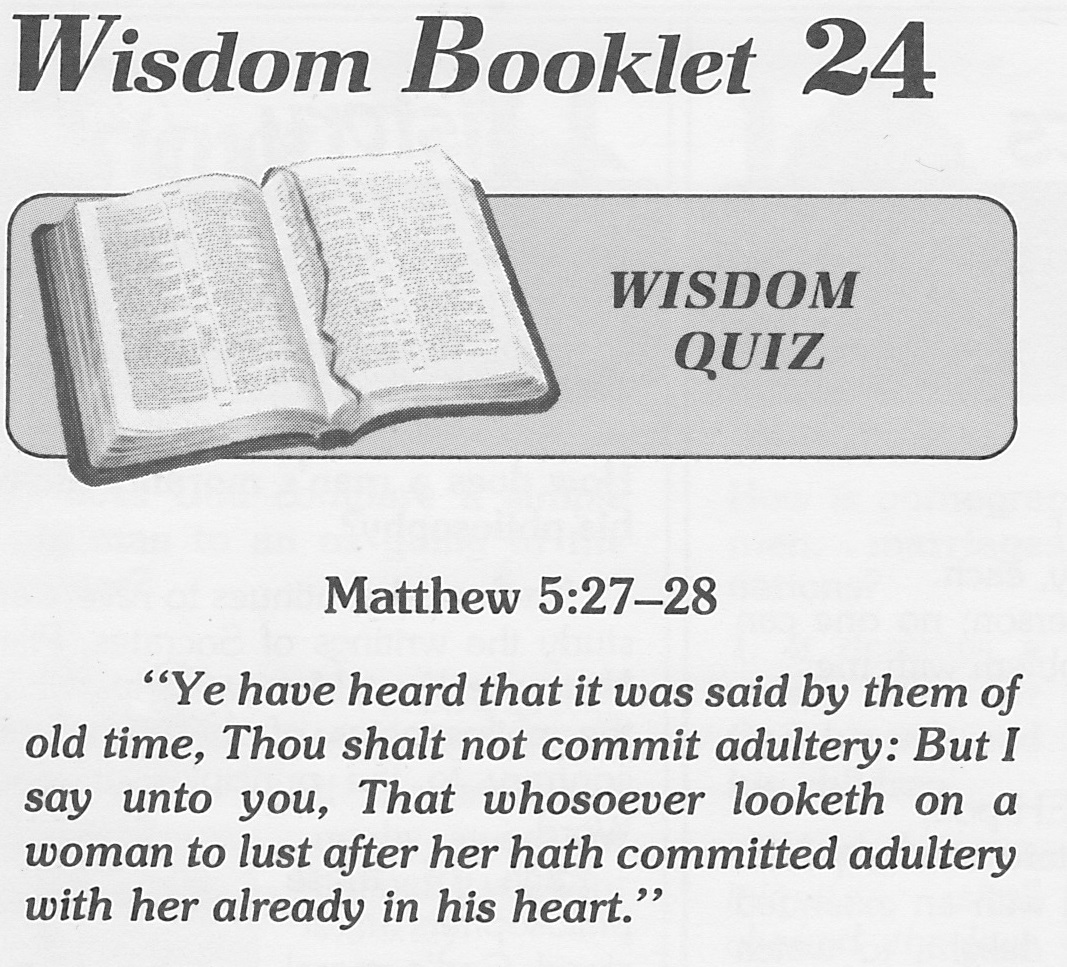
bible verse

B lust conquer

Much like Proverbs 7, this WB wanted to emphasize theC lust three times physical dangers that can come from lusting. However, in typical Gothard fashion, the WB claimed that envisioning an act three times had the same effect on your body and soul as doing the action. Not only can imaginative lusting equal fornication, but the WB claims that lusting can actually make you a violent criminal. “As a result [of lusting], the glands and other bodily functions are activated, and the level of testosterone increases. Recent studies revealed a significant correlation between high testosterone levels and those who commit violent crimes.” I’m not here to say I know what was going on in Josh Duggar’s mind all those years ago, but I can tell you what I felt when I was taught these things as a teenager.

This teaching really messed me up. I assumed I was no better than a sex criminal because I had sexual thoughts. If I wanted to be with a girl, I was no better than a violent rapist. Sexual thoughts are natural for pubescent teens, and making them feel their life and soul are in literal danger by even thinking these thoughts fucks you up. How is it productive sex education to tell young people that they might as well commit the act if they are going to think about it three times?

Another glaring error in the text is the lack of any discussion of consent. In the chapter where we translated the original Greek and made all sorts of assumptions about God, called “How Does the Greek Confirm the Dangers of Partners’ Defiling Their Marriage By Lust?,” there are a number of terms defined, including: honorable, undefiled, fornicator, adulterer, judge, lewdness, lechery, lust, prolifigacy, abandonment, depravity, perversion, dissipation, dissolution, vice, and profanity (all terms defined in the context of marriage). But where is consent? Where is “marital rape” in this list of terms? Michelle Duggar is outspoken about her beliefs on a wife’s subservient role and need to be sexually available to her husband. ATI’s curriculum would have taught no different.

SCN_0009 SCN_0010

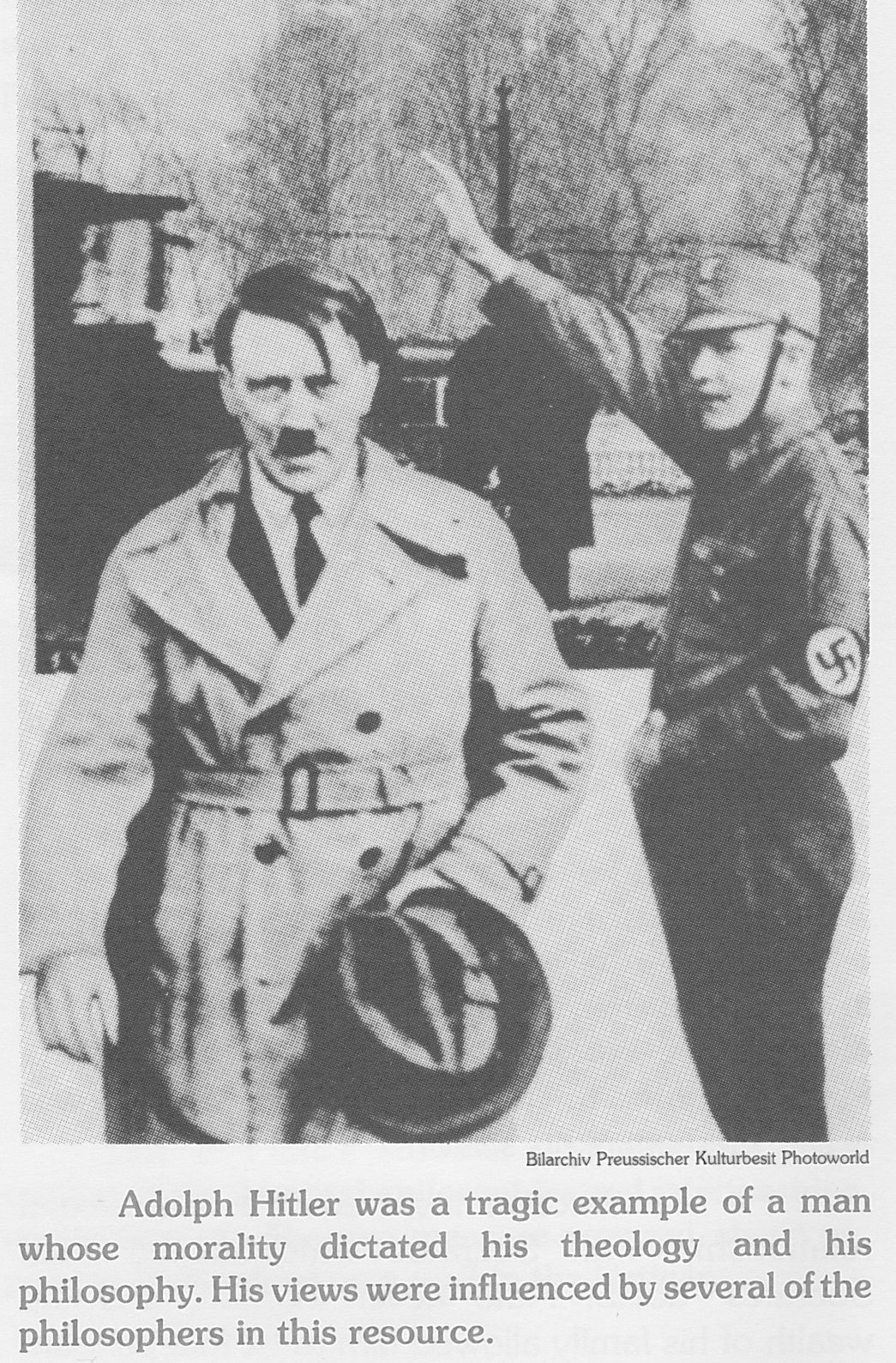
And just to make sure you are grasping the slippery slope put forth by the text – pg 17 hitlerthinking about immorality three times is just as bad as doing it. Immorality is entirely defined by scripture verses and does not address things like consent or marital rape. The Wisdom Booklet’s “History Resource” profiled Hilter, Socrates, Plato, Aristotle, Karl Marx, and Nietzsche. You guessed it, each one of these people were characterized by how their immorality led them astray or ended up with genocide. Next in history, we learned about how immorality led to the collapse of the Maya, Incas, Ancient Greece, and the Roman Empire. In the Math section, we learned how to “visualize the consequences of lust” with visual graphs.
The “Science Resource” chapter further emphasized the role of women as active “trappers.” The chapter is entirely on different kinds of traps used animal trappers and it begins with “How Do Trappers Illustrate the Enticements Which Satan Uses to Appeal to our Lusts?” This language is borrowed directly from Proverbs 7, which says the seductress “perfumed [her] bed with myrrh, aloes, and cinnamon.” Throughout this volume, men are the presumed focus of the lust and women are the dangerous seducing forces that can lead to the collapse of civilizations.

45 traps

As Wende discussed yesterday, many of Gothard’s teachings explain that victims of sexual abuse may be at fault for being abused. This image has been making the rounds through mainstream media. Its horribly offensive and damaging message are reiterated in other information like this that redirects responsibility for assault to “immodest” victims. Wisdom Book 24 covers this very topic on page 1130. “God’s Laws on Nakedness Begin with Modesty in the Home” begins the section:

The requirement for modesty among family members is given in Leviticus 18. Twenty-four times in this chapter, God’s people are commanded not to “uncover their nakedness” to those near of kin. Whether this refers to an incestuous relationship or nakedness alone, the fact is clear that indecency as well as immorality is forbidden.

Gothard’s insistence on a literal interpretation of Levitical law informs his sexual ethic. Deuteronomy 22:23-24 also advocates stoning raped women “because she cried not.”

If a damsel that is a virgin be betrothed unto an husband, and a man find her in the city, and lie with her; Then ye shall bring them both out unto the gate of that city, and ye shall stone them with stones that they die; the damsel, because she cried not, being in the city; and the man, because he hath humbled his neighbour’s wife: so thou shalt put away evil from among you

Right on queue, WB24 throws in a graphic image of s56 incest stoningomeone being stoned “for incestuous relationships.” It’s no stretch to say that ATI and Gothard continually pushed the idea that victims were, at least partially, at fault for their abuse.

The closest WB24 gets to actual sex education is the medical section on venereal diseases. However, even this led to very basic confusion about how one can acquire a VD.

Venereal diseases are transmitted primarily by a corruption of God’s design for love. When man violates God’s design for marriage and follows his own lustful desires, he suffers grave consequences to his own health.

The section, and WB24, ends with an admonition to “identify the medical consequences of lust,” once again equating mental fantasies with physical consequences. The supposed impacts are VDs, and each sub-heading of the chapter is matched to the appropriate Bible verse.

The distortions of the idea of appropriate sexual relations and consent by WB24 are inexcusable. Men are characterized as dominated by fleeting lust, which are irresistibly stoked by the dress of girls or women. Even family members not excused from discussion by ATI, thus family members are subsumed into the “seductress” category. If a father molests his children, perhaps they are to blame. Such is the thinking proposed by Gothard. Looking back, it’s easy to see how this philosophy can lead to serial sexual abuse because men are relieved of much of their responsibility for their actions, while just lusting is as bad as actually doing the act. Leading many men to think they are beyond help, consumed by their desires. So instead of dealing with them, they repress them, and it only makes it more difficult to deal with what may have begun as natural sexual urges.

I can see just in my own life how this thinking impacted my sexual ethic and ideas of consent at a young age. It made me think that masturbating made me as perverse as sex criminals. I talked with a friend of mine and we would confess our “sins of lust”, and I saw us as struggling with similar burdens. His burden meant he took advantage of underage girls, mine was masturbating in my bed. ATI and Bill Gothard taught me those things were just as bad.

In my many conversations with ATI survivors, sexual abuse is too often a topic of discussion. One woman I talked with was abused as a child, and her family not only blamed her for it, but held exorcisms. They convinced her the demons inside her were “making” men abuse her. Agency and responsibility are replaced by pseudoscience and utterly incomprehensible logic about sex and sexual desire. Gothard used this system to groom his victims, to shame them into silence, to make them afraid to speak up. Why? Because they might have been responsible for the abuse.

Full copy of Wisdom Booklet #24:

This slideshow requires JavaScript.

Gothard’s ATI and the Duggar Family’s Secrets

Jim Bob Duggar and Bill Gothard at an ATI conference. Source: http://www.duggarfamily.com/.

By Wende Benner, HA Editorial Team

Content Warning: Spiritual Victim Blaming

The recent revelation that Josh Duggar admittedly molested five young girls as a teenager has taken over social media for the last two days. There has been a wide array of reactions and speculations. But, for many who were raised in the same quiverfull and patriarchal homeschool world, this has been a time of reliving their own traumas brought about by that dysfunctional culture. Those who lived it know all too well how the teachings and attitudes that are part of the Duggar family’s life affect families, victims, and even offenders.

The Duggar family’s involvement in Bill Gothard’s Advanced Training Institute (ATI) homeschool program adds complexities to this story which are unknown to the average person. The underlying principles and beliefs the Duggars have built their lives around actually help groom and shame victims, help hide grievous abuse, and even keep offenders from receiving needed help.

The lessons learned from birth in homes like the Duggar’s strip children of their voice and agency. Starting with blanket training babies and toddlers understand quickly that disappointing a parent leads to swift and painful consequences. As they grow, it becomes clear that simply doing what is expected is not enough. It must be done instantly and cheerfully. Children are even forbidden to seek out the logic behind the request, as kids are prone to do, because that is seen a making excuses or delaying obedience. The consequences of failing to meet these expectations are severe. Gothard and the Duggars believe that spankings are necessary to save a child from their inborn nature to do evil, and these are not just any spankings. The Duggars endorse the child abuse methods taught by the Pearls. Growing up in an environment of fear, where questions are seen as rebellious, eventually makes children unable to speak up for themselves. They become unable to trust their own judgment of what is right and wrong. These children are the perfect targets for abuse; they do not know how to advocate for themselves.

Also, from a young age the children are instructed in God’s plan for their gender. Strict gender roles are the foundation of a patriarchal system. Girls learn their role is to be wives, mothers, and keepers at home. Most people know that for the Duggar family this includes the expectation of having as many children as possible.  Michelle Duggar is also outspoken about her beliefs on a wife’s subservient role and need to be sexually available to her husband. Children learn by watching their parents that men hold the power. This is detrimental for both boys and girls. Neither learns to have a healthy relationship without the power differential already in place.

All of this is accompanied by one of Bill Gothard’s 7 Basic Principles, Authority (these principles are the foundation to his Institute in Basic Life Principles seminar). This concept is taught with a diagram of umbrellas, which represent protection.

Umbrella of ProtectionNotice the man has authority over the entire household. The teaching claims that as long as the father has no holes in his umbrella-sin in his life, then nothing bad can happen to the rest of the family. However, any member of the family can step out from under the father’s protection if they sin. Then all manner of evil can happen to that person. Therefore, if something bad, like a sexual assault, happens to you and your father hasn’t done anything wrong, it must be your fault. Knowledge of this fact keeps many from even disclosing their abuse. They are aware that questions about sin in their life are likely to follow any revelation of their violation.

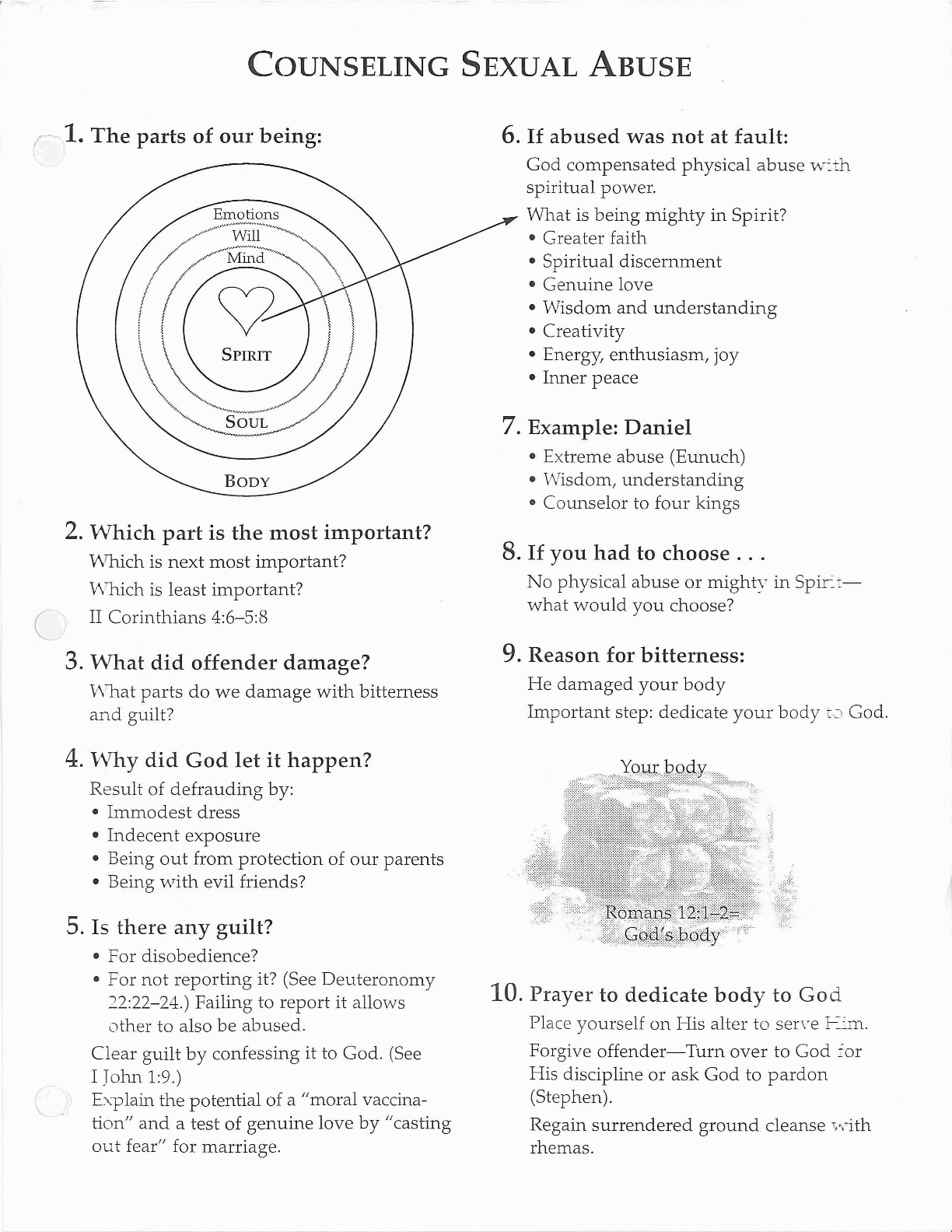
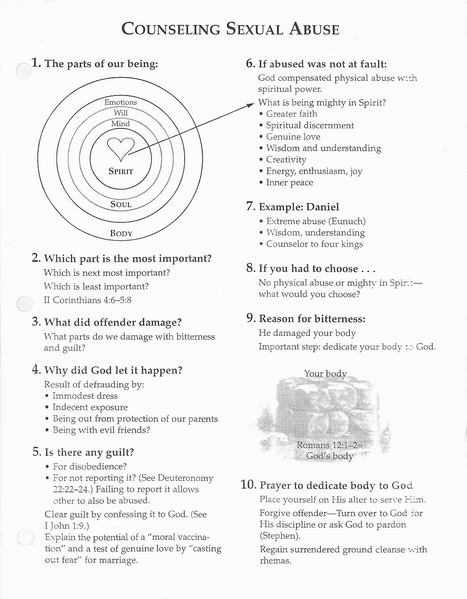
In Gothard’s world there are many other ways in which sexual abuse can be the victim’s fault. At the ATI student’s Counseling Seminar students are taught Gothard’s method of helping victims of sexual assault. The handout pictured here is part of the teaching material. Counseling SAStudents are taught to question the victim if they had any fault in the assault. The most obvious way they would be at fault is if they defrauded their attacker. Defraud is Gothard’s favorite word for any dress, actions, or manners that cause someone to lust. This teaching is further backed up by a handout on moral failure released in the 90s after an ATI boy was caught molesting his sisters.

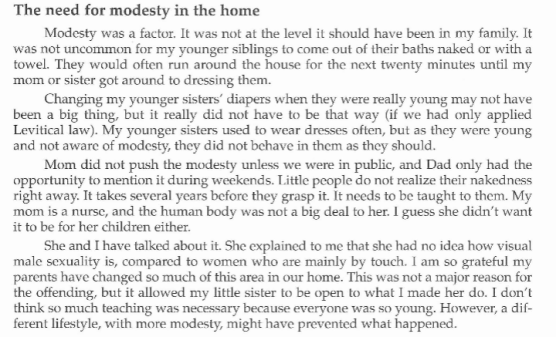
ModestyWith this teaching a case can easily be made to blame the victim in some way. The feelings of arousal the offender felt must have been caused by some fault of the victim.

Defrauding is not the only way a victim can be at fault. Gothard also teaches that if a victim fails to “cry out” or be alert (one of the 49 required character traits everyone should have) enough to have anticipated the assault, then the victim bears responsibility. The story of Tamar, daughter of King David, is used to illustrate this point. It is easy to see how these teaching have set up a system where the victim bears the blame. Anyone raised with these beliefs is set up to struggle with a lifetime of shame and guilt while still bearing the scars of their abuse.

Before the victim has a chance to make sense of what has happened to them or deal with the chaos of emotions, they will also be reminded of another one of Gothard’s 7 Basic Principles-Suffering. This principle emphasizes the necessity of forgiveness and has dire warnings about the consequences of unforgiveness. If a victim fails to forgive, bitterness will take root in their heart, and bitterness causes pieces of your soul to be given to Satan. Satan will then build strongholds on this piece of your soul.

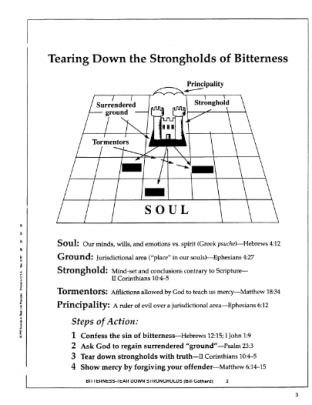
BitternessThis teaching is also echoed in the handout from the Counseling Seminar. Victims are to be reminded that their soul has more value than their bodies, so forgiving the offender must be the priority. Any suffering caused by the assault is then brushed aside.

The Duggars assured the public Josh’s victims have received counseling. Yet, the type of counseling taught in their world does not promote healing. It teaches shame. How can these young people be expected to heal from such a violation with these principles guiding the process?

The Duggars also claim that Josh received counseling. It is reported this counseling was done over three months at an old VA hospital in Little Rock, AK. While there he did construction work. The old hospital was donated to Bill Gothard for use as a training center. The Integrity Construction Institute was at that time a part of this facility. Evidence that manual labor is an effective treatment for sex offenders is hard to come by. Construction work alone would be a disservice to someone seeking help.

It is important to note that any counseling received from someone associated with ATI would be driven by the belief that mental disorders do not exist. This approach to counseling would be ineffective to address the very nature and needs of a serial molester.

Any counsel Josh did receive would probably be similar to the counsel noted earlier, in the handout on moral failure from the 90s.

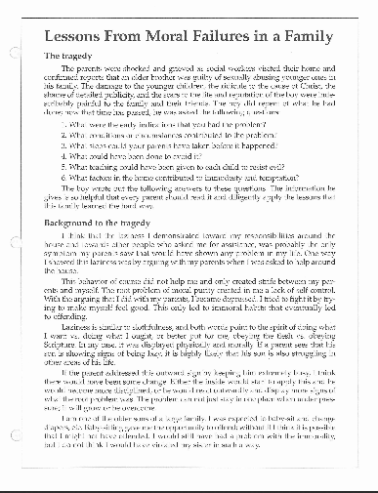
Moral FailureWith close examination it becomes clear that the boy referenced learned a lesson on shifting blame. The victims were blamed for their lack of modesty. The parents were blamed for their lack of teaching. The offender learned to see how others have failed and have caused his problems. This approach would not bring any lasting change in someone needing serious help.

Josh Duggar’s situation as a teen was critical. Studies show that young offenders who are able to get the right kind of help reduce their probability of reoffending by more than 50%. Yet, as far as we can tell, that kind of help was not available to him. The ATI system of counseling not only fails the victims but the offenders as well.

This toxic system of beliefs originated with Bill Gothard, a man who had to resign from his own ministry last year when faced with dozens of allegations of sexual harassment and abuse. Even though Michelle and Jim Bob were aware of this, they still continued to use these teaching in their home and promote them using their fame. They also continued to speak and teach at the annual ATI family conferences. They have failed to see how their own system of belief has contributed to the devastation in their own family and in the ministry they promote.

The secrets the Duggar family hid all these years have tragic and devastating effects. The lives of five victims will be permanently altered. ATI only helped cover their abuse. ATI also was unable to provide the necessary counseling that Josh Duggar desperately needed at that time. The consequences of that failure could have changed to course of his life.

Bill Gothard’s cult creates a world in which abuse thrives in secret, and those that need help the most are silenced and shamed.

What You Need to Know about the Josh Duggar Police Report

HA note: The following is reprinted with permission from Libby Anne’s blog Love Joy Feminism. It was originally published on Patheos on May 21, 2015.

When I first saw rumors circulating yesterday I didn’t pay any attention, because the accusations were vague and felt rehashed. Remember when the tabloids reported that Jessa Duggar had sex at the church immediately after her wedding, based on a word of an obviously satirical blogger who claimed to have been there? Yeah, I remember that too. There have been rumors circulating for years about Jim Bob blaming Josh for the loss of a political campaign, based on “sin in the camp,” so I thought it was probably just those rumors being rehashed in the way tabloids do.

But now there’s a police report. And now People Magazine has posted Josh’s confession. And now Josh has resigned from Family Research Council.

What happened exactly? Answering this question is sensitive because of the need to protect the identity Josh’s victims. According to TMZ, one of Josh’s victims has asked to have the unredacted police documents destroyed to protect her identity—and even the redacted police report gives more than enough information to guess at the victims’ identities. This is a problem.

I’ve gone back and forth about whether I should blog about this. This is not a gossip blog. I blog about weighty issues, and when I do blog about scandals like this I try to do so in a way that makes larger points, rather than just scoring cheap shots. That said, I’ve decided to go ahead and blog about this for several reasons. For one thing, I want you to have a reliable place to get good information (there’s still incorrect information circling out there). For another thing, I do think there are larger points to be made here. I’ll start by summarizing the police report.

See more at Libby Anne’s blog: Love, Joy, Feminism

What ATI Taught Me About Love: Sarai’s Story

HA note: The author’s name has been changed to ensure anonymity. “Sarai” is a pseudonym.

Though she can quote entire books of the bible and finds hidden pearls in every wisdom search, but does not know God’s enduring and unchanging love, it is worthless —

And though she knows her spiritual gift and receives rhemas and knows all 49 commands of Christ and spends hours working on her faith journals —

Though she knows 3/4 + 3/4 = 1 1/2 cups so that she can easily double recipes for her large family (this is where her education will end because there is no need for her to know more in order for her to care for her family one day. She has been told that an education could even tempt her in to the terrible sin of perusing a career! She knows she should be grateful to her parents for protecting her from the possibility of this temptation), but knows not the freely given love of God, all her knowledge is worthless —

And though she joyfully rises at 5 A.M., to make homemade bread and spends so many hours faithfully serving her family —

And though her body has been violated countless times by a sex offender, she joyfully bears and surrenders her personal rights, knowing it is part of a gods plan for her life… Or maybe it was not that bad to start with… Or maybe it was punishment for some unknown sin… Or maybe she did not cry out loud enough… And though she cheerfully receives her spankings and humbly bares her purple and blue stripes as a reminder of her parents love yet she feels no love….  Well it is sad. So very sad —

And though she never wears pants or listens to rock music and avoids all friendships with other foolish children (foolishness is bond in the heart of a child after all) and though she made a commitment to courtship and her father holds the “key to her heart” and though her cabbage patch doll has been burned and every sin confessed —

And though she stays under her umbrella, it does her no good. She does not know God’s love —

Love quietly obeys; love never questions authority; is not vain (let’s not forget Jezebel who was eaten by dog for her vanity. Let’s avoid purple nail polish and flashy jewelry and heavens forbid you ever wear a low cut shirt); Love summits personal rights and always forgives and forgets; love deliverers no bad reports; love bares all pain, sorrow and suffering knowing it is a gift from god to save her from her sinfulness… Or so her mama told her —

When she was a child she saw God through a Gothard tainted screen from inside her little box. She believed the lies. They where all she knew. She trusted a sin filled man named Gothard who promised a better way.

But now she is grown and has throw away the Gothard tainted screen.

She has come out of her little box and into the brightness of God’s unearned, unending, free, abiding, enduring love. She now places her faith in God alone knowing his grace, that is, his unmerited favor, is all sufficient.

Now abideth her faith, her hope and the Love of Christ in her life and the greatest of these is the love of Christ.

Michael Farris Admits RFRA’s Discriminatory Intent

Michael Farris on the Hannity Show, YouTube screenshot.

HA note: The following is reprinted with permission from Kathryn Brightbill’s blog The Life and Opinions of Kathryn Elizabeth, Person. It was originally published in April 2015.

Like a lot of other people, I’ve been following the controversy surrounding Indiana’s SB 101, their state level RFRA bill that’s designed to allow businesses to discriminate against LGBT people on religious grounds.

Indiana’s RFRA has been compared frequently to the federal RFRA, both by supporters of Indiana’s law who claim that it’s no different thanwhat President Clinton signed into law in 1993, and opponents who point out that it’s much broader than the federal RFRA. What most people don’t realize about RFRA, however, is that while it was a popular piece of legislation that passed with bipartisan support, the religious right had their fingerprints on it from the beginning and always intended it to be used for much broader purposes than most of the bill’s supporters realized.

The coalition that drafted the original RFRA was either chaired or co-chaired (alternate accounts on HSLDA’s website say both) by HSLDA founder and then-president Michael Farris. Farris was one of the drafters of the bill, and takes credit for organizing the broad coalition that supported its passage.

HSLDA’s magazine The Home School Court Report describes it thus:

“After the signing, President Clinton spoke with [HSLDA’s representative at the signing Doug] Phillips and extended his gratitude for the role Farris played in the RFRA drafting and coalition-building process. “Tell Mike, I really appreciate the work he did drafting [the RFRA],” President Clinton told Phillips.”
(emphasis added)

At the time Clinton signed RFRA into law, the Court Report quoted HSLDA staff attorney Jordan Lorence as saying that,

“[A]s American culture and public policy grow more and more hostile to Biblical concepts and practices, the RFRA will help shield Christian families, and all other peoples of faith, from having to choose between surrendering their religious beliefs or suffering loss for standing true to their beliefs.”

My astute readers should be able to recognize that language as a culture war dog-whistle from a mile away. Indeed, Jordan Lorence now works for the Alliance Defending Freedom, where he’s spearheaded the string of cases from photographers, bakers, and florists all arguing that they have a religious freedom right to discriminate against LGBT people.

We don’t need to rely on dog-whistles, however. HSLDA has repeatedly stated that one of the purposes of the federal RFRA was to allow religious-based discrimination against LGBT people.

Describing what RFRA means to the average homeschooler:

“But consider what it means for religious people in other contexts: The government wants to say you can’t have a church policy that says you can only have male pastors. Or maybe your church doesn’t want to hire homosexuals. Or your support group doesn’t want to hire homosexuals. Then it would have an impact because the rights of organizations including churches are going to be judged on religious liberty principles alone.”
–Michael Farris, Marking the Milestones: The Good, the Bad, the Inspiring

Explaining why a proposed Religious Liberty Protection Act (RLPA) was an insufficient substitute for RFRA because it would not protect:

“Christian landlords who are told by local law that they may not “discriminate” against unmarried couples or homosexual couples in renting out an apartment in their home,” or,
“Small Christian-owned businesses that are forbidden by local law from firing employees for openly immoral behavior.”
–Home School Court Report: Religious Liberty Protection Act: Does the End Justify the Means, May/June 1998

That brings us to yesterday, when, writing specifically about the Indiana law and his intent in drafting the federal RFRA, Michael Farris posted the following to his Facebook page. (screenshotted because his posts have a way of disappearing after I blog about them).

image

Oh noes, how dare the homosexuals ask to be left alone! Look at them there eating crackers like they own the place, don’t they know they’re supposed to be cowering in a closet in fear of the cops busting in and hauling them off to jail?

When Michael Farris talks disparagingly about LGBT people asking to be left alone, he’s talking about LGBT people wanting the police to stop raiding gay bars and arresting everyone inside. About not wanting to be forced to endure chemical castration like Alan Turing or prison like Oscar Wilde. About wanting to walk around in public without fear of being beaten, tied to a fence and left for dead only to have your funeral picketed by people with “God Hates Fags” signs. About not wanting to be subjected to “corrective rape.”

That, Michael Farris, is what asking to be left alone means.

In that one line he trivializes centuries of indignities, abuses, and torture that no human being should have to endure. As if asking for even the most bare minimum of basic human rights is too much to ask of society.

And no, Michael Farris, it’s not about “demanding the right to punish anyone who refuses to join their celebration.” It’s asking for equal protection under law. One of the bedrock principles of American law, and protection enjoyed by all other American citizens under our civil rights laws.

But Michael Farris already knows that, that’s why nearly two decades ago, before any state had marriage equality, HSLDA specifically stated that RFRA was needed in order to overcome nondiscrimination laws.

The smoking gun, though, is in the second half of his post.

image

See that last paragraph? Read it again.

“The state and federal RFRA would not allow a state or local antidiscrimination law (e.g. a gay rights law) to be applied to a religious person or entity without prevailing over a very high legal standard.”

Saying that RFRA would “not allow a state or local antidiscrimination law … to be applied to a religious person or entity without prevailing over a very high legal standard,” is another way of saying that religious people and entities are allowed to discriminate. More specifically, to discriminate against LGBT people.

Cloak it in religious language all you want, but the religious freedom that RFRA is intended to protect is the freedom to discriminate. And not just the freedom to discriminate in baking wedding cakes, making floral arrangements, or taking photos either. As was made clear in the quotes above, that freedom to discriminate was always intended to extend to denying LGBT people a place to live and allowing businesses to fire them.

I don’t know how you can get any clearer. This is one of the drafters of the original federal RFRA flat out saying that RFRA had discriminatory intent.

Discrimination in the name of religion is still still discrimination and it’s still wrong.

*****

My followup post, complete with video of Farris’ appearance on Hannity, can be found here.

What About Toxic Parents?

HA Note: The following is reprinted with permission from Michelle Hill’s blog Notes From A Homeschooler. It was originally published on April 10, 2015 and has been slightly modified for HA.

From my research and own personal experience with homeschoolers, I’ve come to realize that there’s a link between homeschooling and toxic, or over-controlling, parents. This control is all too apparent in the homeschool community, especially in conservative Christians and conservative Christian textbooks. With conservative Christians, all too often we hear about how children need to be obedient at all times to their parents. This is good for children learning how to stay safe, such as a parent telling a child not to touch a hot stove or to not cross a busy street (Galli, 2013). However, when the control starts to be too much that is when it is most harmful.

There are many negative impacts of having overly controlling parents in your life. Even throughout adulthood there still may be negative effects. Dan Neuharth, Ph.D. lists:

“Ten Signs Early Unhealthy Control May Still Affect You:

• Feel perfectionistic, driven, or rarely satisfied
• Feel intimidated or easily angered around controlling people
• Lose yourself in relationships by automatically putting others’ needs first
• Find it hard to relax, laugh, or be spontaneous
• Feel as if you are under scrutiny even when no one else is around
• Have an eating disorder or addictive behaviors
• Have trouble finding a spiritual belief that feels right
• Expect others to hurt, judge, or take advantage of you
• Have harsh “inner critics”
• Have trouble asserting yourself or feeling proud of your accomplishments” (Neuharth, 1999)

…just to name a few. A couple of other signs that you may have controlling parents or toxic parents is if you suffer from depression, anxiety, and self-harm yourself. So what if you meet many of these signs? More lists!

“Ten Signs You May Have Had Controlling Parents, when growing up, your parent:

• Over scrutinized your eating, appearance, hobbies, or social life
• Pressured you with perfectionistic expectations or unattainable standards
• Forbade you from questing or disagreeing with them
• Discouraged you from expressing anger, fear, or sadness around them
• Violated your privacy
• Intimidated, manipulated, or overpowered you
• Discouraged your efforts to experiment and think for yourself
• Gave you no say in household rules and responsibilities
• Seemed unaware of the pain they caused you or others
• Seemed unwilling to admit they were wrong” (Neuharth, 1999)

The last list that I identify most with as a child who grew up with controlling parents is Neuharth’s list:

“Ten Signs Your Parents May Still Control You: Even today as an adult, you:

• Feel disloyal when acting or feeling differently than your parents
• Feel easily annoyed or impatient with your parents without knowing why
• Feel confused by parental mixed messages
• Are afraid to express your true feeling around your parents
• Feel intimidated or belittled by your parents
• Worry more about pleasing your parents than being yourself
• Find it hard to emotionally separate from your parents
• Talk to your parents more out of obligation than choice
• Get tense when you think about being around your parents
• Want to temporarily reduce or sever contact with a parent” (Neuharth, 1999)

So maybe you identify with all of these signs and lists or just enough that you now may be thinking, “what if my parents have been controlling me all this time?” Great! Realizing that all this pain you may have might just not be your fault. No one should have to live with a toxic parent, and the best thing you can do for yourself if get some help.

I’m currently going through a journey of realizing that my mother may have been and still is today an over-controlling parent. I’ve talked with my loved ones, friends, my group therapy, and my therapist about my controlling mother and have come to realize that all these negative effects I have had may have stemmed from having such a controlling mother. But what do you do after you know that you have a controlling parent? Being emotionally enmeshed with your parent makes it hard to break free even though you know that’s what you want to do. I know that when I tell my mother I don’t want to come home for whatever reason it’s going to be met with her pushing overwhelming guilt on me and her saying how I must not love them. These are actually some of the ways a controlling parent may keep control over you, not by physical means but by emotionally pulling at your strings to get you to do what they want you to.

I don’t have the answer to everything. I certainly am no expert at homeschool families and parents. However, I do know that if you feel threatened by your parents, that it’s time to get help. Besides having a good support group of friends and a therapist, you can also research controlling and toxic parents. A book I’ve found helpful in this process is: Toxic Parents: Overcoming Their Hurtful Legacy and Reclaiming Your Life by Dr. Susan Forward. Some other resources can come from books and online articles.

Sources:

Galli, M. “Christian Families Should Focus on Grace, Not Control”. The New York Times. Jan. 14, 2013. Web. http://www.nytimes.com/roomfordebate/2013/01/08/with-children-when-does-religion-go-too-far/christian-families-should-focus-on-grace-not-control

Neuharth, D. 1999. If You Had Controlling Parents: How to Make Peace with Your Past and Take Your Place in the World. Harper Perennial. New York, NY.

For More Information:

Website of If You Had Controlling Parents with more resources and links:

http://www.controllingparents.com/Signs.htm

A short article to get you started:

http://savannahnow.com/accent/2013-02-01/family-relationships-find-ways-cope-controlling-parents

Blanket Training is About Adults, Not Children

By R.L. Stollar, HA Community Coordinator

Blanket training is a child training method advocated by Gary and Anne Marie Ezzo and popularized by the Duggar family through their TLC show. It has its own Wikipedia page and has its own featured page on the Duggar Family Blog. Parents have adopted this child training method specifically because of the Duggars.

In its simplest form, blanket training consists of 3 actions: (1) place a young child (usually an infant or toddler) on a small blanket, (2) tell that child not to move off the blanket, and (3) strike that child if they move off the blanket. Rinse, repeat.

The training can be more elaborate than this. Some advocates may describe it more gently, poetically, or less fearsome-sounding. Others prefer corporal punishment to be a last resort if a child moves off the blanket. But despite linguistic dress-up, at its core it remains the same: you punish a young, still-developing child for wanting to indulge its natural curiosity and crawl off a blanket.

Blanket training is essentially a specific manifestation of “first-time obedience” training, also popularized by the Ezzos as well as Michael and Debi Pearl. The Pearls use this same technique but instead of a blanket they use an object the infant or toddler will find attractive:

Place an appealing object where they can reach it …. when they spy it and make a dive for it, in a calm voice say, ‘No, don’t touch that.’ Since they are already familiar with the word ‘No,’ they will likely pause, look at you in wonder, and then turn around grab it. Switch their hand once and simultaneously say, No.

While the forms differ, the technique and message is the same: Set up boundaries for the child that impinge of the child’s natural curiosity and development and then punish them for acting on that nature. Ultimately, this technique (and its message) rest upon an idea that children’s nature is hell-bent rather than innocently curious. Voddie Baucham would express this idea by saying children are “vipers in diapers” and thus require significant restraint.

Families that grew up in Bill Gothard’s IBLP or ATI programs are likely familiar with blanket training. Gothard and his cohorts advocated it. A former IBLP attendee remembers Lori Voeller, wife of former ATI President Jim Voeller, teaching blanket training in the following way:

I remember Lori Voeller in her message on blanket training telling us that her child was so “trained” to stay on a blanket that she had been calling the child and she would not dare get off the blanket. The child knew this was a baiting technique. Lori thought this was admirable. I was horrified. I was thinking, “Yeah Lori, what if the house is burning down and your child can’t think for him or herself about getting off of a stupid blanket because they are so fearful of doing the wrong thing.”

Here is another example of what blanket training consists of, from Sarah Rose at Make Something Beautiful, a self-proclaimed advocate of the training:

The first thing you need to do is put the blanket on the floor. You can use a heavier “fleecy” blanket or fold a big blanket to a reasonable size. Both of our girls have been trained to sit on a 2’x3′ blanket. You just want to make sure that the blanket doesn’t move around too much because trust me, your child is going to test the limits anyway and you don’t need the added frustration a thin blanket will cause. Place your child on the blanket with their toy and book, and tell them to stay there. Set your timer (I suggest starting very small…five minutes is a long time, especially for younger babies) and get busy with your busy work. 

But watch that baby with at least one eye, because I guarantee that baby is going to find out if you mean what you say. When your baby ventures off the blanket (be it a finger or their entire body), gently remind them that Mommy said to stay on the blanket. Follow up with your preferred method of discipline…I think you know what I mean here…let’s just say that “time out” won’t work in this situation. Your baby will probably cry, and you might want to as well. Just stay the course. Repeat this process until time is up.

Note what Sarah Rose says about the “fruits” of this method:

The boundaries of the blanket have brought us tremendous freedom. We can take her to meetings and expect her to sit quietly.

Rose minces no words here. The best part of this training method is not what it teaches the child but rather that “we can take her to meetings and expect her to sit quietly.” In other words, it trains children to be seen not heard, that old adage which expresses nothing but contempt for children and the beautiful chaos they bring into our lives.

Reb Bradley, another popular child training “expert” in Christian homeschooling circles, advocates a similar method (and with a similar goal, that of children’s silent stillness) in his 1996 book Child Training Tips:

Rather than waiting until Sunday morning and using a church worship service to teach a child to sit still, it is helpful to have them practice at home…Pull up a chair, and have them sit quietly for increasing increments of time. Try 5 minutes the first day, 10 the second, 15 the third, and so on. Chastise them each time they get down without permission. Start when they are toddlers and you will be amazed at what they are capable. This is a very simple means of teaching them first-time obedience (p. 141-2, emphasis added).

Stillness. Silence. Control. Broken will. These are the fruits of such “discipline.” Yet Theologian Janet Pais provides an excellent reminder concerning these fruits in her 1991 book Suffer the Children: A Theology of Liberation by a Victim of Child Abuse:

Adults, often unconsciously, act toward children out of an attitude that the child is a possession properly subject to their control. Because adults have power over children, too often they use it, not for the true good of the child, but just to ‘show who is the boss.’… ‘Christian discipline,’ calmly and calculatedly administered, may abuse the child both physically, in the use of the rod (or ‘spanking’), and emotionally, in humiliating the child, in breaking the child’s will, in forcing submission to the adult’s greater power, and in refusing to accept the child’s natural reactive feelings (rage, anger), while requiring the expression of other supposedly repentant feelings. Such ‘discipline’ manifests adult contempt for the child and resulting overt forms of abuse. A slave too will be submissive after physical and emotional abuse and humiliation… 

God creates the child who brings chaos into our lives and into our worship. And Jesus says if we receive the child in his name, we receive him, we receive God the Child incarnate. In fact, doesn’t Jesus himself, God the Child, bring chaos into our lives? We would like for conversion to be nice and neat and under control—our control, that is. But often conversion, faith in Christ, turns our lives upside down… Receiving children in Christ’s name, accepting the chaos, even embracing it, can be a sort of spiritual discipline. It means yielding one’s life to greater necessities than keeping things tidy and rational. It means letting life itself, new life in the child, come first. It means having faith in the child, and in God, the child’s Creator. The child truly does bring God’s truth to us. (p. 10, 43, 146-7)

Welcoming children into our midst should bring the opposite of blanket training’s fruits. Welcoming children means embracing the loud, wild, reveling child. It means understanding, as Joyce Mercer says in her 2005 book Welcoming Children: A Practical Theology of Childhood, that, “The very idea of associating Christ with the silencing of children appears preposterous to anyone even vaguely familiar with New Testament stories about Jesus’ interactions with children” (p. 2). And we do indeed see, in Matthew 21:14-16, Jesus embracing the reveling children:

The blind and the lame came to him in the temple, and he healed them. But when the chief priests and the scribes saw the wonderful things that he did, and the children crying out in the temple, “Hosanna to the Son of David!” they were indignant, and they said to him, “Do you hear what these are saying?” And Jesus said to them, “Yes; have you never read, ‘Out of the mouth of infants and nursing babies you have prepared praise’?”

At its core, blanket training is not for children. It is for parents who desire their children’s spirits broken and their voices silenced. It is for parents who have contempt for the essence of what childhood is: noisy, raucous, and a handful. It is for parents who want to quiet the children crying out in the temple.

I Guess It Was Love: Andy’s Story

CC image courtesy of Flickr, John Perivolaris.

Content warning: descriptions of self-injury, homophobia.

All of the strong memories I have of my mother include yelling. When I was eight, I was outside watching our bunny, and got distracted. I couldn’t find him. She screamed at me at the top of her lungs. He was fine, just a hop down the street, but I couldn’t forget her voice screaming my name in absolute fury over two pounds of fur.

When I was 14, I began to discover myself. But this led to a lot of bullying.

My real life friends thought I was a “disgusting homosexual.” My “fake” internet friends thought everything I did was for attention. Maybe it was. It’s not like I got any from anyone else.

We left on a trip to Texas, and I remember very clearly that I propped my only mirror up on a rather unstable surface for the week, thinking it would stay. During that week, my codependent best friend and I had a huge fight. I was heartbroken. When we got home, the mirror had fallen. Shards of glass were all over my carpet. I broke. I scrawled “bitch” into my leg in fire and glass and pain. I did it over and over, until it was deep and bleeding and full of glass pieces I dug out for months. A few days later, I realized it wouldn’t heal right. And so I went running to Mom. I guess I’ve always trusted her a bit more than I realized. I don’t know what I thought she would do, I just needed Mommy. I was broken and desperate.

She screamed at me. She screamed questions, why did I do this to myself, what was wrong with me, what kind of person was I. Didn’t I know I was created in God’s image? Why would I ever do that to myself?

All I remember is screaming.

After that, things only got worse. I tried over and over to kill myself, getting more and more frustrated when it didn’t work. Mom and Dad sent me to a therapist to pray the gay away, and a skin specialist to make the scars fade. Not that I really wanted them to.

Then they found out that I had put off my schoolwork for an entire year. Mom screamed at me.

All of the memories after that involve crying. I cried when I came out to some of my homeschool friends, Mom cried when she found out about my girlfriend. Mom cried when she learned that all of my college papers were signed “Andy.” Mom cried when she found out about my testosterone supplements. I guess I started getting better around then. I got my computer back, I started going to college classes, I got away from the “homeschool bubble” that perpetuated the Christianity around me.

Now I’m very comfortable with myself, and about to go off to college. I’m planning to become financially independent and begin HRT alongside my transgender boyfriend.

She’s probably going to scream at me.

I guess she thinks it’s the loving thing to do.

Parenting Beyond Our Past: A Resource Guide

Simple Things

Photo Credit: Darcy Anne

“Train up a child in the way he should go……”

I have yet to meet a religious homeschooler who can’t finish that scripture from memory. If you’re like me, you grew up in a very authoritarian, punitive family environment. Punishment and pain, both physical and emotional, were believed to be the best means to teach a child “the way he should go”. Spanking and instant, cheerful obedience to authority were the norm, with many other kinds of punishments used as retribution for a child’s wrong-doing. Parents were the ultimate authority, and children had no choice but to obey or be punished, sometimes very harshly. I honestly didn’t know there were any other ways to parent. Either you spanked and “trained” your children, or you let them run wild and that meant you didn’t love them.

We were the generation influenced by “child training” teachers like the Pearls, Reb Bradley, Charity Christian Fellowship Churches, James Dobson, and myriads of other Christian authors, all providing materials from within a hierarchical, authoritarian family paradigm. “Break their will”, was a common tenet of “Biblical Parenting”. Spanking was said to be ordained by God. Never let your child win a battle, parents were told. Failure to conform to these tenets would produce perverts and criminals and unbelievers.

But what if they were wrong? What if that’s not the only way to raise strong and wise and good children?

I’ve written elsewhere about my journey from that authoritarian parenting paradigm into non-punitive, or peaceful parenting. Non-punitive parenting is defined as “a style of parenting that breaks the punitive mold by avoiding physical punishment, treating children with respect, and focusing on developing a strong parent-child relationship. It is a method that raises children without spanking, shaming, or yelling, and avoids the punishment-reward cycle of traditional punitive parenting.” Peaceful or gentle parenting is often defined as parenting by connection, relationship, and respect for children as human beings with the innate right to be treated as such. Treated as you would want to be treated. Christian proponents of gentle parenting sometimes call it “Golden Rule Parenting” for this reason.

But no matter the label, the root is the idea that children are people too, and that as people, they can grow and learn and develop best in an atmosphere of peace and connection, not punishment or coercion. We seek to validate our children’s emotions while teaching them how to appropriately express them. Traits that define how peaceful parents interact with their children include empathy, compassion, respect, boundaries, and unconditional love. This philosophy is based in the most recent findings of science, psychology, human development, and sociology. Contrary to popular belief, non-punitive parenting is not permissive parenting. We still set limits and uphold them, we let natural consequences teach life lessons, and above all, we keep a healthy emotional connection with our kids that will be the foundation of everything we do. This is not a “parenting method” with formulas and rules, but more of a philosophy and value set that different parents put into practice in many different ways.

I know that many of us are breaking new ground in parenting our own children. We know that we don’t want to have the antagonistic relationship with them that we we had with our own parents. But often, while we know what not to do, we are lost when it comes to knowing what to do instead. Some of us have yet to find an alternative to punitive parenting. Some of us have discovered the world of non-punitive parenting, yet have no support and are often ridiculed by people that don’t understand our reasons or our methods. Some of us perhaps have never been told “did you know you can raise good kids without spanking them?” and we are longing to hear that we can do differently and succeed.

So I thought I’d put together a resource for those of you who, like me, want to do differently for our kids.

Those of us raised in Homeschool Land have a lot of the same issues, same foundation, and were raised similarly under “Biblical Parenting” rules. I understand the nuances of coming from a parenting framework riddled with fear and control and authoritarianism; the emotional turbulence we have as we try to parent our children and find we are parenting ourselves. This list is by no means exhaustive, and I hope to add to it as more good materials are brought to my attention. I hope it can help in the journeys of those who, like me, just need a little direction and encouragement.

Peace and health to you and your family.

~Darcy

Parenting books:

How To Talk So Kids Will Listen and Listen so Kids Will Talk, Adele Faber and Elaine Mazlish
The Whole-Brain Child, Daniel J. Siegel and Tina Payne Bryson
The Child-Whisperer, Carol Tuttle
Siblings Without Rivalry, Adele Faber and Elaine Mazlish
Liberated Parents, Liberated Children: Your Guide to a Happier Family, Adele Faber and Elaine Mazlish
Parenting From the Inside Out, Daniel Siegel and Mary Hartzell
No Drama Discipline, Daniel Siegel
No Bad Kids: Toddler Discipline Without Shame, Janet Lansbury
Peaceful Parent, Happy Siblings, Laura Markham
The Explosive Child, Dr. Ross Greene (specifically for non-neuro-typical kids, but helpful for everyone)

Websites:

Aha! Parenting
Little Hearts (For Christian parents)
Elevating Childcare- Janet Lansbury
Positive Parents

Individual articles:

The Road to Non-Punitive Parenting
Parenting Without Punishment
Raising Humans
I Was That Parent
Natural Discipline for the Early Years
10 Steps to Guide Children Without Punishment 
Non-Punitive Discipline Does Not Equal Lazy Parenting
Thy Rod and Thy Staff, They Comfort Me, Samuel Martin (from a Christian perspective)

Articles on Spanking and Punishment:

The Case Against Spanking – APA
The Long-Term Effects of Spanking
How Spanking Harms the Brain
Is Corporal Punishment an Effective Means of Discipline?
Study on Physical Punishment and Mental Disorders
Should You Spank Your Child?

Bob Adelmann’s Deceptive Use of Homeschooling Statistics

Bob Adelmann, YouTube screenshot.

HA note: The following is reprinted with permission from Libby Anne’s blog Love Joy Feminism. It was originally published on Patheos on May 13, 2015 with the title “Can You Be More Deceptive? Homeschool Edition.”

I just came upon an article by Bob Adelmann of the New American discussing U.S. test scores as compared to those in other nations, and then arguing that homeschooling is the solution to U.S. underperformance. I bring it up because it is a really good example of the way some homeschooling parents use bad data and outright lies to argue that homeschooling is academically superior to other methods of instruction.

I was homeschooled from kindergarten through 12th grade. While there were some gaps, I got a pretty good education overall and went on to excel in college. As a homeschool alumna, there is nothing that bothers me more today than people using bad stats and deception to argue that homeschooling is better than public or private schooling when in fact there is no data that actually says this. Accuracy matters, people! Do we really need to lie to make homeschooling look better? Really? 

Okay, end rant. Let’s look at what the piece said:

The recent flurry of test results on how American students are faring in school has resulted in much commentary decrying their dismal performance compared to their international peers.

. . .

This prompted George Nethercutt, a former member of the House of Representatives, to declare that “Americans get an F in civics” in his article in The Hill last week. He asserted, “The findings showed broad failures. If policymakers don’t soon pay attention to such failures, the perpetuation of citizen understanding of the basic concepts of the American system will continue to be at risk.”

. . .

Nethercutt’s conclusion, with himself and his performance in the House as a prime example, is correct: Students with little or no understanding of their history will have little ability to steer the ship of state in a constitutional direction in the future.

That’s why the home-schooling movement is so vital to keeping that ship afloat and away from the shoals of authoritarianism. In another study (that Nethercutt failed to mention) from the DOE’s Educational Resources Information Center, homeschoolers are learning precisely the skills needed:

Homeschool student achievement test scores were exceptionally high. The median scores for every subtest at every grade were well above those of public … school students.

On average, homeschool students in grades one to four performed one grade level above their age-level peers on achievement tests….

Even with a conservative analysis of the data, the achievement levels of the homeschool students in the study were exceptional. Within each grade level and each skill area, the median scores for homeschool students fell between the 70th and 80th percentile of students nationwide….

For younger students, this is a one year lead. By the time homeschool students are in 8th grade, they are four years ahead of their public/private school counterparts. [Emphasis added.]

Nethercutt is a product of the public schools and traditional universities, and so is severely limited in his ability to see what’s really needed in education in America. That’s why his solution misses the mark when he suggests that “all states should adopt basic requirements for graduation.” No, George. States and the federal government should remove themselves from the educational process altogether and allow the home schooling movement to flourish and grow even more rapidly.

At this point you may be curious to which study Adelmann is referring. I was too! Adelmann says the study is “from the DOE’s Educational Resources Information Center” but does not provide its name or link to it. One wonders why.

It turns out that the Department of Education’s Educational Resources Information Center does not conduct research itself, it merely archives digests of existing research conducted by a variety of scholars in a sort of library to make it easier for researchers or policymakers to find information. The study in question is The Scholastic Achievement of Homeschooled Students, by Lawrence Rudner, published in 1999 and funded by a grant from the Home School Legal Defense Association. You can see a digest on ERIC here.

Portraying a study conducted independently from the Department of Education with money from the largest homeschool lobbying group in the country as though it is in fact an official study conducted by the Department of Education is incredibly deceptive. Adelmann doesn’t even give the reader a link where they can go to find out more about how the study is conducted. Given that linking is standard procedure, especially when quoting, I can’t help but see this as intentional deception.

And what does the study itself say? How was it conducted? You can read an overview at the Coalition for Responsible Home Education. In sum, the study was conducted using a volunteer sample, and it does not correct for background factors. To quote the overview linked above:

Rudner’s study tells us essentially nothing about homeschooled high schoolers, children of color, poor children, unschoolers, children with poorly educated parents, children being raised by single parents or by parents who both work, abused or educationally neglected children, or disabled or special needs children. The higher-than-average standardized test scores earned by Rudner’s highly privileged group of homeschoolers are only what we would expect from a study where nearly all disadvantaged children are excluded.

Adelmann makes it sound like the study he is citing proves homeschooling superior to other methods of education, but in fact the study shows only that privileged homeschooled children tend to score well. That’s no surprise, but it’s also no solution for our education system, where the majority of U.S. schoolchildren now live in poverty.

But perhaps what’s most shocking about Adelmann’s use of the Rudner study is this statement by Rudner himself, at the end of his study:

These comparisons between home school students and students nationwide must be interpreted with a great deal of caution. This was not a controlled experiment. Students were not randomly assigned public, private or home schools. As a result, the reported achievement differences between groups do not control for background differences in the home school and general United States population and, more importantly, cannot be attributed to the type of school a child attends. This study does not demonstrate that home schooling is superior to public or private schools. It should not be cited as evidence that our public schools are failing. It does not indicate that children will perform better academically if they are home schooled. The design of this study and the data do not warrant such claims. All the comparisons of home school students with the general population and with the private school population in this report fail to consider a myriad of differences between home school and public school students. We have no information as to what the achievement levels of home school students would be had they been enrolled in public or private schools. This study simply shows that those parents choosing to make a commitment to home schooling are able to provide a very successful academic environment. [emphasis added]

In other words, even Rudner himself did not claim that his study showed that homeschooling was superior to public or private schooling! In fact he insisted that his study did not show that! Rudner argued only that his study shows that homeschooling can work, not that it always does or that it works better than other methods of instruction. Indeed he explicitly stated that his study does not show that children will preform better if they are homeschooled.

In other words, not only did Adelmann act deceptively by portraying Rudner’s HSLDA-funded study as a government study, he used the study’s findings in a way that Rudner explicitly said they should not be used and to mean things Rudner explicitly stated they did not mean. If this isn’t gross deception, I don’t know what is. I am utterly disgusted.