We would scoff at the idea that people wanted to have well-rounded educated children. I was meant to be an arrow to pierce the darkness and pop all the well-rounded bubbles. << actually a thing that was said.
I watched the news nightly from the time I was 8, I listened to Rush Limbaugh and Laura Ingram and Sean Hannity religiously as a teenager. I saw Bill O’reilly speak, Ralph Reed recognized me and said hello at TeenPact. I went to a video conference that Newt Gingrich did, I attend the FRC Action convention with TeenPact twice, I met Bobby Jindal, Zell Miller, and Sonny Perdue knew who I was. I had a name in the Republican circles in GA. I campaigned for countless religious right candidates. My first sign waving venture was during the 2004 election and I caught the bug. I spent time in local campaign offices putting together phone banking scrips that worked really well, I traveled and campaigned for people in Alabama, Florida, Virginia, and New Hampshire – as well as being thoroughly involved in the political scene in Georgia.
My blog was relatively well known – as well known as a teenager’s commentary on politics can be, anyway. I lived and breathed political activism from the time I was 13 until I was just shy of 18 when the burnout set in.
Politics is interesting where it overlaps with religion – and sexism, and gender roles. I’ve talked a bit about TeenPact and the sexism and queerphobia there is just as rampant in the republican party. My political involvement was a bit of a paradox. On one hand it was the only thing that was encouraged besides being a homemaker and I latched on to it for dear life. On the other, we acknowledged that a woman’s place was not in politics unless it was under a man in some way, so my activity was limited to ensure I was always under some kind of male authority – training to be a political helpmeet (my husband or son(s) could be the president someday, after all).
I am keenly aware of the amount of hate and fear of others that runs rampant in the christian conservative-republican communities. I was inundated by messages from all sides that being queer, liberal, compassionate, and seeing The Others as just as human as we are was wrong. Damning, even.
I was told by every authority figure to fear anyone who was different from what I was, what we were. The lack of compassion never set well with me, but I had nothing to compare it to. It was all I knew. I was warned of being too learned, too knowledgeable, too educated lest I become one of those man-hating feminazis. We shunned education in favor of the blissful ignorance paraded as enlightenment by right-wing pundits and preachers.
There wasn’t really a dramatic turning point. The burnout happened when I was close to 18 while my legs were infected and I couldn’t keep up physically or emotionally because life in general was taking it’s toll. I dropped out of politics and into relative obscurity – I was married, so it was expected. Quietly re-evaluating the things that were important to me while working really hard to be the kind of wife I was supposed to be (until self-acceptance became a thing and our relationship was healthier for it).
I wasn’t raised to be an independent person. My mother literally said, of my independence and desire for it “what do you think God thinks of that?!” I was 17 and a half and just stared at her blankly, and quietly mumbled something along the lines of “I think he’s probably okay with it?”. I was raised to obey whoever is above me, it’s something I’m still trying to un-learn.
While campaigning, I wasn’t campaigning for things I truly believed in because I wasn’t allowed to have my own beliefs, I was campaigning along the Paulino Party Lines – because that was accepted and encouraged. As long as I followed the rules, campaigned for those my parents approved of, and didn’t get any independent thoughts in my head, I was free to travel for short periods of time and feel like I was making a difference.
Toxic religion and conservatism permeated every fiber of my existence and my very confused and hyper closeted self. Being told day in and day out that you’re wrong for not being X or Y enough, burying all the thoughts and feelings that don’t line up with what you’re supposed to be…ignoring the things that feel wrong because technically they’re right. I learned that politics is corrupt as fuck and the GOP isn’t better than anyone else, and the reason they can organize and come out in droves is because they use hate and fear as their motivators.
Over time I reclaimed my independence, and I couldn’t let fear and hate dictate my actions anymore. I accepted that the person I am and the person I am becoming is the opposite of the person I was supposed to be. I am everything I was supposed to be fighting against.
Here I am, 2016, actively working to make the world better, to be an arrow to pierce the darkness, to bring light and compassion and empathy into the world any way that I can.
They succeeded, I suppose, just not in the way they meant to.
I grew up in a conservative homeschool family and religious community firmly ensconced in the Christian Right. I was raised to be a culture warrior. I was raised to create change, to be a mover and a shaker. But only for the conservative side of things, of course, and there’s the rub, because I’m no longer conservative. My mother recently told me she thinks I should write historical children’s books—she’s always suggesting careers that she thinks would allow me to work from home and homeschool my children—but she had a caveat. “Just so long as you leave religion and politics out of them,” she said. I almost laughed out loud.
As a young teenager, I enjoyed writing fiction, including historical fiction. The story I developed most fully was set in the present. It was about a teenage boy who finds an island off the coast of the United States. In my story, this island is inhabited—I’m not even kidding—by a community of large conservative Christian homeschooling families that fled the wickedness of the United States to establish a secret colony of sorts on an island that had somehow never landed on people’s maps. I cringe when I think of the book, because its content consists primarily of painfully obvious religious and political platitudes.
Still, there was a reason the book looked like that. I was raised to change the world. I was explicitly taught that I, and my fellow Christian homeschoolers, had a mission to “retake” the United States for Christ. I was taught (by Michael Farris of the Home School Legal Defense Association, among others) that our parents were the Moses generation, taking us out of Egypt and homeschooling us in the wilderness, and that we were the Joshua generation, tasked with retaking the promised land. When Farris founded Patrick Henry College, he strategically chose the majors he did so that we, the products of the Christian homeschool movement, could infiltrate and target key areas of government and culture in our battle to remake the country in a Christian image.
My parents were political as far back as I can remember. I walked in more parades than I can count, put up yard signs, worked the polls, attended rallies, and staffed phone banks. I spoke with reporters and we ran campaigns out of our home. My parents counted my work on various political campaigns for high school government credit on my homeschool transcript. One year, I was a delegate at our state convention for the Republican Party. Conservative officials at the state capital started referring to us as their local welcoming committee, because we were always there ready to show our support when they visited our area. I assumed I would always be in politics, most likely as the wife of a political candidate.
This was not accidental. My mother sometimes told me that the reason she and my father weren’t out changing the world as missionaries, pastors, or politicians was that they were instead investing their time and energies in raising me and my burgeoning collection of younger siblings to do those things. We were to go out and change the world as missionaries, pastors, and politicians, with multiplied impact. But we had to be trained and prepared first, and that, of course, was why we were being homeschooled. Some of my siblings grumbled at this expectation, and checked out at an early age—though they were still required to attend functions and participate in political activism. Me? I was excited. I was motivated. I was passionate.
As a teen, I attended a number of conservative summer camps that touched on politics. I went to one anti-government summer camp that consisted primarily of lectures on the evils of environmentalism (a trumped up plot to control the world) and the failed socialism of programs like Social Security. We used pebbles to form slogans like “Get the U.S. out of the U.N.” on the ground outside of our cabins to gain cabin inspection points. I also attended Constitutional Law Camp at Patrick Henry College. At one point during a session, Farris pointed to various sections of the room, waving his hands over us, and declared that those students over there would be Congressmen, someday, and those up in the front would be Supreme Court Justices, and so on. The messianic vision was strong and our mission was clear.
It does something to you, when the weight of the world is put on your shoulders. You can no longer just stand back and let things happen. You feel responsible to fix injustice and actively work to make the world a better place.
At this point, you can probably see why I almost laughed out loud when my mother suggested that I write historical children’s books, but only if I included no mention of religion or politics. She would never have suggested such a thing to me when I was a teen, nor would I have considered it if she had. I did think about writing, sometimes, even about writing historical fiction, but my writing would have been religious and political of necessity. I was taught, after all, that I was to use my talents and skills to change the world—to win converts and to sway the public, to restore the United States to its (at least partially fictional) Christian, small-government past. To write a piece of fiction, especially historical fiction, without any mention of religion or politics would have been almost blasphemous.
In 2008, the Obama campaign somehow ended up with my parents’ home phone number. I was no longer living at home, but it’s theoretically possible that I may have put that phone number on a form I filled out with them. I got a cell phone comparatively late, and was still in college at the time. And so it happened that the Obama campaign called my parents’ home and asked for me. And that is how my parents learned that my politics had changed. In the eight years since then I’ve become increasingly willing to voice my progressive politics on social media, and, sometimes, in conversations with my parents. I’ve also informed my parents that I attend a Unitarian Universalist Church (I wouldn’t have told them, except that they had to keep asking about church attendance).
It seems my parents’ desire that I be a culture changer was conditional on my sharing their view of what our culture should be. I’m not surprised, really. Still, it’s fascinating to see it laid out that way—we know we raised you to be a culture changer, but now that you’re all progressive and such, we’d prefer that you stay silent on religious and political issues,thanks. I’m sorry, but it doesn’t work that way.
I still have the weight of the world on my shoulders. I still feel responsible to fix injustice and actively work to make the world a better place. I can’t just turn that off.
TW: Religious/Political Indoctrination, Religious Trauma, Fundamentalist Politics, Cults, Slut-Shaming, Abortion.
HA note: The author’s name has been changed to ensure anonymity. “Savannah” is a pseudonym.
“A liberal Christian is an oxymoron.” The sentence garnered applause and amens from Baptist churchgoers in suburban Georgia. Like many Southern Baptist churches, mine was primarily composed of staunch Tea Party conservatives, people whose pastime was gossiping about Obama’s birth certificate, the liberal media’s war on Christians, and homosexuals shoving their lifestyle down our throats. Whatever the preacher said the Bible said about a particular issue was what our beliefs must align to. Forget thinking it through for yourself if the conclusion you’d come to differed from the platforms of McCain in 2008 or Romney in 2012.
Here, political conservatism and true Christianity were inseparable—indistinguishable.
I can’t remember the preacher going more than two sermons without bringing up some hot conservative topic. The liberals want to kill unborn babies. The liberals want to jail men for acting on their natural desires when a slut prances around them with her tits out. The liberals want to squash Christians’ free speech and arrest us for calling out sin. He pointed to cases like lawsuits brought forth by same-sex couples that were refused services. How the media and internet vilified the poor business owner just trying to practice her beliefs in peace. How she could go to jail for her faith.
All of it proof that the era in which we’d enjoyed the luxury of a persecution-free life in America was coming to a terrifying close.
I remember being taken to a walk-through drama in sixth grade. The theme, “End Times.” It wasn’t particularly political, which, looking back on it now, was rather unusual for the denomination—and the topic. I don’t remember much about this drama (it was traumatic for a number of reasons), but I do recall that in this near-future, fictional but supposedly soon to be non-fiction setting, Christians were being slaughtered. I saw one actress play a young woman who stole bread from a garbage can because Christians were not allowed to buy food. She was discovered, and given a choice, just like all the others: abandon her faith—conform—or die. The stage lights went out as we heard a gunshot and her scream.
This was where we were headed, my pastor said. If we continued to let the liberal world win, it would come sooner—but if we resisted, we might be able to push it off long enough for us, and our children, to live in peace.
This was our culture war, and our side of the fight was not only divinely sanctioned, but vital to our own survival. The trademark of a cult is an aversion to the outside world. We and only we are your friends. We keep you safe.
Everyone else is the enemy. Everyone else will kill you.
Many places foster this mentality, but this church’s (and I have no doubt that many churches share this idea) was doubly potent. While failing to comply with the liberal world could result in being declared a bigot—or, if the world kept going to shit, death—rejection of conservative Christian principles had a much more serious consequence. The strong stance of anti-abortion, anti-LGBT rights, and pro-everything Republican was much more than a political alignment or a voting guideline.
It was delivered to us by God’s spokespeople, the pastors and spiritual leaders of our time, and to disagree with it was to disagree with God himself.
Over the span of many years, I heard more messages than I can count about what constituted a “true” Christian. Most of the characteristics on the list involved some kind of community service, particularly volunteer work with Christian non-profits or within the church itself. However, the one thing that was always consistent—and perhaps most important—was an adherence to conservative values. One could not be a “true” Christian if one did not hold to these.
A person who called themselves a Christian and held even one liberal political view was misguided at best, but more likely a fraud.
Oft-repeated passages that referred to false believers as “goats” or “tares,” and phrases like “going through the motions,” served to further cement the idea that failure to conform to the conservative ideal was a prime indicator of one’s placement on the path to Hell.
As I grew up and branched out of the sheltered homeschool world, I was met with things that challenged the political views that were beaten into me as a requirement for Heaven—and this experience terrified me. At times it made me suicidal.
I was not only worried about maintaining my acceptance by the cult (when a group convinces you that everyone outside the group wants to kill you, you believe that acceptance by the group is essential to survival), but also about the fact that I now was drifting down the road to damnation.
The more progressive the world gets, the fiercer conservatism-worshiping Christianity lashes out. The cults grow tighter. The bigots come out in full force, and become leaders within the pack.
Some adults may genuinely believe that the rest of the world is out to persecute them, and the rest may just be bigots, but children—children are oblivious. Innocent. Children are told what to believe and they believe it until they learn to question when they are older, if at all. When you tell a young child that a certain kind of person wants to kill them, they do not have the ability to think it through and weigh the evidence. They simply trust you.
I cannot speak for all people raised in such an environment. While I learned to abandon my conservative ideas in favor of what I thought was right (which will never include discriminating against any kind of person), I’ve mostly kept my faith—and reconciling these two things is nigh impossible. I still have panic attacks. I’m still afraid.
It’s been three years since I left the cult, but I’m still suffering.
HA note: The author’s name has been changed to ensure anonymity. “Nastia” is a pseudonym.
I often tell people that the three most important subjects to study are math, physics, economics. Math gives you a logical mindset. Physics allows you to understand the natural world. Economics allows you to understand people and the social fabric that makes up a human civilization. All other academic topics – perhaps with the exception of basic language and literacy – stem from these. Physicists are keen to point out that chemistry, biology, and engineering are applications of physics. Likewise, history and other social sciences are largely founded on economics.
While this was never an assertion made by my parents, it is unsurprising that I have developed this point of view.
Throughout my homeschooling years, economic principles served as the basis for in-depth studies of history, government, politics, and current events, just as physics and math were the foundation for our science curriculum. In middle school, my brother and I – with supplemental explanations from our mother – worked through Teaching Company courses on basic economics, the great economists, and the economic history of the 20th century during long car rides to ballet classes. We argued about the Invisible Hand and Keynesianism, parsing difficult language slowly and gradually building a repertoire of arguments and scenarios. It was an invaluable lesson in cause and effect. My mother would often stop the cassette and we would analyze case studies, working out problems verbally and then resuming the course to see if we had come to the same conclusions as our professor.
It makes me laugh now to remember my sibling and me, at ten and twelve, carpooling with friends who had no idea what GDP was or why we were so passionately discussing it.
This approach to learning was a cornerstone of my education and the aspect I am most excited to talk about now. I want to stress how extremely privileged I was to grow up in this environment; at the same time, I feel that this is a successful homeschooling model that should be encouraged in our community.
My parents both have multiple higher degrees – my mother a Bachelor’s in economics and an M.B.A; my father, a Master’s in engineering and an M.D. Thus, critical thinking and building evidence-based arguments were highly stressed from an early age. At no point did my education feel like indoctrination. There were times we disagreed with our course materials, and times we disagreed with each other. Intellectual honesty was paramount and lively debate was encouraged.
This was reflected in our approach to politics.
Of course, my views were shaped by those of my parents, but they worked hard to provide evidence for why these views were credible. Of my own volition, I read extensively from a wide variety of sources – everything from Saul Alinksy’s Rules for Radicals to the Federalist Papers. An enthusiast of both Russian music and anything related to space travel, the Soviet Union was particularly fascinating to me; it is largely because of my studies of that regime, which my grandfather escaped, that led me to lean more towards libertarianism than my conservative homeschooling peers (or even my parents).
While I remember both the 2000 and 2004 elections (I was five and nine, respectively), the 2008 election was the first in which I understood the issues at hand. Naturally, we were conservative Republicans, though not particularly active in politics. However, many of our homeschooled friends were. It was one of them (whose father was involved in the campaign of a local candidate) who invited us to join them at one of the first Tea Party rallies in our area. We attended a few of them, waving signs and marching with thousands of others. At no point did my parents compel me or my sibling to participate; rather, we were more likely to petition for a day off school to explore this new and exciting world of politics.
Whatever controversy surrounded them, I have only pleasant memories of the Tea Party rallies I attended.
It was an excellent way for me to voice my opinions and try out my somewhat newfound political savvy. I think it pleased my parents to hear me discuss and debate with fellow Tea Partiers as well as the counterprotesters that inevitably showed up; my sibling and I had vehemently turned down their suggestion that we join the homeschool debate team, so this was a rare opportunity for exposure to differing views. These events also gave us all a sense of belonging – in my very left-wing city, conservatives tend to lay low, and it was comforting to feel that there were others who held the same principles that we did. Furthermore, as a young teenager far from voting age, it gave me a way to be involved and feel like I was making a difference in events. It was of great frustration to me that I couldn’t actively participate in the process I had studied so much about, but at least I could make my voice heard.
In August of 2010, my family attended the Restoring Honor rally on the steps of the Lincoln Memorial – perhaps the pinnacle event of the Tea Party movement. It was exhilarating. We had traveled cross-country to Washington, D.C. with two other homeschooling families whose children were close friends of mine. We camped out overnight on the National Mall, where in the morning, tens (perhaps hundreds – the number is highly disputed) of thousands gathered to listen to Tea Party leaders talk about politics, values, and faith. It felt like we were a part of history, and besides that, everyone we talked with felt like an instant friend. Coming from an environment where politics was not discussed outside the family simply because it would inevitably lead to conflict, this was profoundly affirming.
Looking back now, I can’t help feeling somewhat ambivalent. It was all a very emotionally-driven experience. While I still agree with most of the principles that we fought for – I remain a constitutionalist and favor laissez-faire economic policies – I realize now that most issues are not as black-and-white as they seemed back then. When reading my old journals, I cringe at how awkward, underdeveloped, and often painfully naïve my views were. (Then again, so was I – a quirky teen trying to fit into a world that I wasn’t old enough to fully contribute to.)
Since then, my experiences in community college and university have also caused my views to shift significantly towards social libertarianism, a “live and let live” philosophy that would make many of my fellow evangelicals uncomfortable. I have made close friends with people of different ethnicities, religions, sexual orientations, and gender identities. As a bioengineer, the improved health of marginalized groups and developing nations has been a focus of my higher education, and female representation in science has been a goal of my volunteer activities. These developments have lead me to be more aware of the people I align myself with. Especially as many of the people involved with the Tea Party have recently gone in directions that I can’t support, I have felt disillusioned with the Republican party and significant aspects of the conservative movement.
Despite my current position as an outsider to movement politics, I still credit my involvement in the Tea Party as a beneficial experience that imparted in me an interest in politics and commitment to values. It’s something I’ve learned from and outgrown, rather than discarded. Perhaps in contrast to many homeschoolers, the most important thing I took away from my political involvement was the importance of critical thinking, summed up aptly be Thomas Jefferson:
“Question with boldness even the existence of a God; because, if there be one, he must more approve of the homage of reason than that of blind-folded fear.”
It’s a lesson that has served me well as a researcher and as a citizen. It’s become my personal mission, to sort fact from fiction and seek the truth, even when it’s complex and goes against my presumptions. It’s caused me to constantly reevaluate my knowledge, my faith, and my relationships, and back up my conclusions with reputable evidence. In the meantime, debates with my mother about the future of the GOP and late-night discussions of economics with my father remain grounding pieces of my life. In an education style that often results in indoctrination and control, it is a massive credit to my parents that both my sibling and I came away with a scientist’s obsession with logical reasoning.
HA note: The author’s name has been changed to ensure anonymity. “Lauren Woods” is a pseudonym.
When I saw the call for stories about homeschool families and politics, I immediately thought of the article “I Lost My Dad to Fox News.” As a person who likes to stay politically informed as a result of my upbringing, I don’t often trust Salon, but that article echoed many of my feelings towards my own father.
Before I can continue, it’s helpful to understand that, as a kid, I had a lot of anxiety, which follows me to this day. While I attribute some of my anxiety to my deep-seated fears about the wooden rod with which my parents spanked us, I’m not a psychologist and can’t say for sure if that was the cause. I did attend a small, fundamentalist high school because my mom recognized that she couldn’t teach things like chemistry and algebra, but my parents still held many of the homeschooling circle’s beliefs, such as courtship.
The first time I can remember an awareness of politics in my family was the pro-life march that our Southern Baptist church organized every October.
Perhaps it was called the Mile for Life, but I believe my first appearance was as a seven-year- old.
Basically, we formed a long line down the main street in my hometown with signs with slogans like ABORTION KILLS CHILDREN, ABORTION KILLS WOMEN, and I can’t recall the others. It scared me deeply to think that thousands of people in my own hometown were killing babies. I didn’t know about sex until at least nine or ten, and considering that there was no abortion clinic in my county (and I believe there’s only one in my state), this fostered a deep paranoia that millions of babies were being killed all around me for some inexplicable reason. I also didn’t understand why women were supposedly dying too. So even though I didn’t want to go, I was very scared about all this death, and I did hope that maybe my sign might convince someone not to kill a woman or child. Refusing to attend the Mile for Life would have absolutely warranted a spanking, because defiance was the quickest way to the rod.
My dad often listened to Rush Limbaugh in the car, and watched the usual cast of FOX and co. When the Gore/Bush election happened, I heard a lot about a conspiracy called global warming, and how Gore would destroy America. Again, I was terrified. I didn’t want my whole country to be devastated. The nail-biting voter counts in Florida were all I heard about, and I sat on the edge of my seat hearing about it, petrified that a single vote would destroy the nation.
A few years later, I also learned that a few states were allowing men to marry men, and women to marry women. I didn’t have the vocabulary for the word “lesbian” or “bisexual”, but I did hear about homosexuals, and my only exposure to that “lifestyle” was from the pulpit of First Baptist. My pastor taught that homosexuals hated God, the nuclear family, and America.
I had no idea why, and I didn’t consider myself “homosexual” because I was not an adult, I didn’t hate God, and I didn’t America.
The thought that I was gay never crossed my mind. Rush Limbaugh said that homosexuals would lead to America’s destruction just like the fall of Rome, as Rush Limbaugh said, and it scared me. Slowly, I began to realize in middle school that it was not in fact acceptable for me to want to hold a girl’s hand or kiss her.
While homeschooled, I learned that evolution and global warming were liberal conspiracies. I learned to fear liberals and how they wanted to destroy my family.
I learned that even though racism didn’t exist, except possibly reverse racism, I was probably not ever supposed to date a black man.
I spent a long time on message boards (probably due to my lack of interaction with other kids) arguing for conservative politics so that they wouldn’t become liberal leaders and run the country into the ground, similarly to how many former fundies express a need to witness to everyone so that they don’t go to Hell. In some areas, that wasn’t too difficult due to the amount of sheer racism and misogyny on the internet. It was always nice to meet other people who agreed that reverse racism was definitely a huge issue and feminists were evil.
Like many homeschool children, I repeatedly heard the phrase “Honor your father and mother, and your days will be long.” They often told me that if I dishonored them with disagreement, I would not have a happy life, and they tell me that to this day. My father made it clear that he was God’s representative to us on earth, and as such, it was his job to let us know right and wrong.
Throughout high school, although I was not homeschooled then, I quashed any budding “liberal” ideas. This included any acceptance of my “homosexuality”, a word I have come to hate. My father’s bookshelf was peppered with Dr. Dobson’s and Charles Colson’s latest, and I read all of it at his suggestion. Both have a lot to say on political issues, and I knew that since my father agreed, I would too. In an effort to change myself so that I might not accidentally end up an atheist at a pride parade, I watched straight or male-male sex scenes in the hopes that I could rewire my brain to associate men with pleasurable feelings. It never worked.
We ate dinner together every night, a blessing and a curse. While my father didn’t rail about politics on a nightly basis, he did bring it up often, complaining about how an anti-American Muslim was now president of the United States. We saw D’nesh D’souza’s conservative propaganda films about how Obama wanted to let immigrants take over this fine nation.
It was a heartbreaking thing to finally realize in college that I could like women, just like those Fat, Ugly Man-Hating Feminist Lesbians who were all going to hell.
I’m not sure why their appearance mattered, but it was usually included in a criticism of lesbians.
I still struggle with my weight, even though I am naturally tall and skinny, out of fear that I might resemble the caricature my parents despise.
They found out a year and a half ago that I am gay, in my senior year of college, my father threatened to pull me out of university. He only didn’t because my major is very uncommon and can’t be found at any more conservative schools. I attend a Southern Baptist university, now in graduate school, although it’s a moderate one that doesn’t care (too much) that I have a girlfriend. My parents now consider it an evil, liberal institution for not somehow stopping me, and now say they don’t care whether my little sister attends a Christian university or not, “because it didn’t help Lauren.” In political discussions, they are often interested in my brother’s thoughts, because they consider him “on the same page” while I am “rebellious”.
My parents also expressed great paranoia throughout my life about what they were certain I told my friends about them. When my father found out I was gay, he said, “I know that you’ve told all your friends and teachers that I’m a close-minded bigot.” I didn’t think I had, but he shook my confidence, so I called my best friend asked if I’d ever spoken disrespectfully of my parents. “No,” he said. “You’ve only ever spoken highly of them.”
Again, defiance is the number one way to get on the wrong side of my parents, and they tell me that my identification as a Democrat/liberal has dishonored them.
On their anniversary, my father tweeted, “25 years together—THIS is ‘love wins’.” He also tweets things such as a girl with a shirt saying, “I’m not going to let Muslims rape me to prove how tolerant I am.” My roommate has encouraged me not to look at his Twitter anymore so that I don’t get outraged; my father tells me he doesn’t have Facebook because he is afraid he will get in too many political debates. I said, “But you don’t have any Democrat friends, do you?” He replied, “Oh yeah, you’re right.”
I can tell for sure that my mother believes I am simply rebellious and want to be a Democrat because I resent my strict upbringing. I don’t think she will ever be able to get over from the fact that a liberal lesbian could have come out of her home—ironic because I am the only one of my three siblings that attends church regularly. My father sees me with a few more dimensions, I think, because he still often tries to engage in political discussion with me, but still holds that anyone with my political views is either willfully defiant or simply ignorant. My sister tells me that my parents wish I wasn’t “so political,” but really, I feel like my upbringing has forced me to stay aware so that I can back up every belief.
The last time I visited home, he asked what news sites I read. He downloaded The Atlantic app at my suggestion, because it seems to be a fairly moderate source, much more moderate than his usual outlets. It’s the biggest accomplishment I’ve made towards nudging him away from the Matt Walsh types that tell him I hate God, I hate men, I am stupid.
I laughed at hearing how my parents think I am too political, because they raised me to be so involved in current events.
Except as a kid, I was raised to be a Culture Warrior for the Religious Right. Of course I am still politically active, because I am still defending myself against what I believe to be dangerous ideology. It’s just that it’s theirs.
Recently, Bill Gothard was hosted by Total Outreach for Christ Ministries in Little Rock, AR for the 2016 Overcomer’s Conference. Based on the knowledge that he is an alleged sexual predator, someone contacted the church’s bishop, Bishop Robert E. Smith, with their concerns that they were having someone like Gothard speak at their church.
The response from the bishop was telling. Referencing 1 Timothy 5:19, which is a companion to Matthew 18:15-17‘s directives to always confront privately first, and then with witnesses. But the question remains ‘Should we be confronting those who have committed crimes as though they are just sins and offenses?’.
The text reads:
Brother Brandon, I am at somewhat of a disadvantage, not knowing you personally, nor being privy to your first-hand knowledge of an Elder’s (Bill Gothard’s) sin(s). I am instructed, ‘Against an elder receive not an accusation, but before two or three witnesses’ (1 Timothy 5:19). If you are a witness against this elder, please gather one or two others who are first hand witnesses and schedule an appointment to sit down with me, and do according to God’s word. Until such time, where I am concerned, you stand in violation both of scripture, where Brother Gothard is concerned, and having not pointed out any discrepancies in my teachings, etc. your judgement of my character, discernment, and ministry is faulty at best. I await your biblical response; no other type of correspondences are necessary.
In Christ Jesus,
Bishop Robert E. Smith, Sr.
The patriarchal nature of the Bill Gothard/ATI/IBLP cult is such that leaders are unassailable in their directives, their actions, their lives. There is a tendency to dismiss accusations such as these as merely ‘offenses’. This allows the leader who is being confronted to make it appear as though the accuser is mentally unstable, unable to parse the differences between good and evil. It paints the accuser as petty, overly emotional, unbelievable.
It leaves us with no recourse.
We are not believed, because we either have no witnesses, or all the witnesses in question are ‘offended’. Being offended brings into question the Umbrella of Authority, in which men are the ultimate leaders and voices for God. According to this umbrella idea, there are 3 levels of ‘protection’. The first is God’s role in our lives. He is the ultimate controlling power.
The second is the man’s role, as father/husband to the family. His authority comes directly from God. The third is that of the wife/mother’s umbrella. It is nestled completely underneath the man’s umbrella. She is to be subordinate, submissive completely to the husband. He is God’s voice to her at all times.
Underneath these umbrellas are the children. They are completely covered by both the mother’s and father’s umbrellas, and then by God. The authority of the mother is over them, but her authority is always trumped by the father’s authority. To question the father is to question God. God’s umbrella and the father’s umbrella are often seen as the same thing.
This same umbrella is applied to authority structures within the church.
Everything is a cascading layer of how God talks to one man, and that is to trickle down into complete abject obedience by those underneath. There is no freedom, no sense of self.
It is within this structure that Matthew 18:15-17, and I Timothy 5:19 come into play. With the focus being on ‘sin’ and ‘offense’, the diminishing language leaves those of us who have accusations with little ground to stand upon. Boz Tchividjian has quite a lot to say about this in his article “If your brother sins against you”….and he’s a sex offender.
In it, he delineates the difference between a sin and a crime, and says,
Such offenses are rightly under the jurisdiction of the governing authorities. In the New Testament book of Romans, the Apostle Paul writes that Christ followers are to be subject to the civil authorities. He writes, Let every person be subject to the governing authorities. For there is no authority except from God, and those that exist have been instituted by God. He even mentions that the role of government is to punish evildoers. Child sexual abuse is an evil that has been rightly deemed to be criminal by the civil authorities. Therefore, those who profess to follow Jesus have the responsibility to make sure that a person accused of committing such a crime is subjected to those governing authorities – which includes making a police report and cooperating throughout the criminal justice process.
Based on this, one would assume that the first step would be calling the authorities with information about a crime committed, but I think this first goes back to language.
First, they need to admit that this is a crime, not an offense, not a sin. With this revelation, more responsibility is laid upon the authority in question to listen to those accusing another member of a crime. It brings into play the mandatory reporting laws. It requires them to ‘render unto Caesar’ their trust and confidences in bringing the person accused to justice.
The verses that were used here to hide behind are not being used in their entirety. I Timothy 5:19 has companion verses that make this a complete thought. I Timothy 5: 20-21 says:
But those elders who are sinning you are to reprove before everyone, so that the others may take warning. 21 I charge you, in the sight of God and Christ Jesus and the elect angels, to keep these instructions without partiality, and to do nothing out of favoritism.
The first verse (20) referenced from I Timothy 5 clearly instructs believers to make public the accusations that are being brought against an elder, so that all will know. In the case of abuse, the only way to make sure the abuse is stopped is to make it public. The more people that know, the less likely it is that it could continue. Knowledge is power. In order to burn down the systems that perpetuate abuse, it needs to be made public.
The second verse (21) makes it clear that no favoritism should be employed when dealing with an elder, or authority figure, that has abused. By invoking the Umbrella of Authority, favoritism is being used. Because to question or accuse a male authority figure is to question God Himself. This is expressly forbidden within this patriarchal structure.
Matthew 18 also contains this passage in verses 6-9:
6 “If anyone causes one of these little ones—those who believe in me—to stumble, it would be better for them to have a large millstone hung around their neck and to be drowned in the depths of the sea. 7 Woe to the world because of the things that cause people to stumble! Such things must come, but woe to the person through whom they come! 8 If your hand or your foot causes you to stumble, cut it off and throw it away. It is better for you to enter life maimed or crippled than to have two hands or two feet and be thrown into eternal fire. 9 And if your eye causes you to stumble, gouge it out and throw it away. It is better for you to enter life with one eye than to have two eyes and be thrown into the fire of hell.
Surely it cannot be anymore plain, that committing abuse of any kind against a child is an offense that angers the God of the Bible. Not only does it say that it is better if these people would die, it goes further to state that removal of the offending part of the body is necessary to protect the rest of the soul.
Based on these two passages, it is plain to see that there is far more responsibility on the listener to hear and believe the accused. In attempting to hide behind the Bible’s directives about confrontation, they expose their own biases.
They are not reading, nor following, their own Bible’s commands.
Their own Bible commands that no favoring of elders is to be shown, especially when being confronted with ‘sin’. And by ‘sin’ in this case, we mean crime. Abuse is a crime committed against those who are vulnerable. They are made even more so by the very authority structures put into place by things like the Umbrella of Authority.
This umbrella means it is nearly impossible for us to confront our abusers.
They enjoy impunity, complete power over our lives. In order to confront, we would need to have unquestionable sources, and the only ones who are not questionable are the ones who are in authority in the first place. And within that system, the ones who have power are greatly unwilling to be either questioned, or to have their authority in any way diminished.
They stick together, they believe each other over victims. Even though their own Bible commands that they listen to victims, that committing abuse against children especially is abhorrent. Fundamentalism such as this is unkind to victims, flaying them with the very verses that should support, protect, defend them. Fundamentalism such as this supports the authority in power, upholding, favoring, preserving it.
The following article is an excerpt from an upcoming long-form piece on homeschooling and human trafficking.
“I see homeschooling as a tool. Like a gardening hoe, when used correctly it can help bring life and vitality to living things….But used incorrectly, a tool can harm the very things or people it’s meant to help thrive.”
~ Shaney Swift[i]
Homeschooling is “an educational option that allows parents to teach their children at home instead of sending them to school.”[ii] As of 2011, the National Center for Education Statistics determined that 1,770,000 students, or 3.4% of all school aged children, were being homeschooled.[iii] It has been stereotyped as an educational option primarily chosen by conservative Christian evangelicals in the United States. This stereotype is understandable given that the so-called “four pillars of homeschooling”[iv] are all conservative Christian evangelicals who had the specific intention to direct the homeschooling movement.
Homeschooling as a Pedagogical Tool
While conservative Christian evangelicals dominate homeschooling, parents homeschool their children for a diverse number of reasons. While conservative Muslim families, for example, homeschool for many of the same reasons as conservative Christian families,[v] many others homeschool not for ideological but rather pedagogical reasons.[vi] One of the fastest growing segments of the homeschooling population is African-African families, which is notable because for a long time the homeschooling population was “more white than the student population as a whole.” Nonetheless, African-American families are increasingly homeschooling — in fact, “African Americans now make up about 10 percent of all homeschooled children.”[vii] And these families are often homeschooling not for ideological reasons but to escape white supremacy and racism in the curricula, unfair discipline methods, and low standards of achievement within the public school system.
Homeschooling is thus no more or no less than a pedagogical tool — an instrument by which children are educated, in the same way that public and private schools are instruments. How homeschooling is conducted — and whether it is both successful and nurturing on behalf of children — depends on those wielding the instrument, just as success and safety of public and private schools varies depending on their principals, teachers, and staff.
This is an important distinction because claiming a link between homeschooling and any number of negative experiences (for example, child abuse) often meets widespread resistance by homeschooling leaders, organizations, and parents. Such individuals and groups assume that claiming a link exists between, say, homeschooling and child abuse must mean that link is inherent — that homeschooling qua homeschooling leads to abuse. But to claim a link exists is not necessarily to claim that link is inherent. Rather, it is simply to claim there is a link, however inherent or circumstantial the link may be. That homeschooling can play a role in a child abuse case should not be a cause to unilaterally condemn homeschooling. Rather, the fact should give rise to serious reflection as to how this link between homeschooling and abuse can be severed for both the sake of abused children as well as the health and vibrancy of the homeschooling movement itself.
Homeschooling as a Totalistic Tool
Tools can be used for multiple purposes. A hammer can be utilized to hit a nail into a board (and thus become a construction tool) or it can be used to kill a human being (and thus become a murder weapon). In the same way, homeschooling — as an instrument that allows parents to teach their children at home instead of sending them to school — can be wielded as not only a pedagogical tool (to teach children) but also as a totalistic tool (to control children). And just as homeschooling can be highly successful in teaching children, it also can be highly successful in controlling children.
It is the circumstances in which homeschooling is used for the latter purposes (totalistically, to control children) that are of interest to our current examination. By allowing individuals to determine what children are and are not exposed to, homeschooling can become the perfect method for individuals who desire to stratify and consolidate power.
That “perfect method” that homeschooling can become will be notated in this investigation with the term totalism. Totalism is a concept most significantly developed by psychiatrist Robert Jay Lifton in his 1961 book Thought Reform and the Psychology of Totalism. Totalism as a word is related to totalitarianism, and signifies a psychological form of totalitarianism — the totalitarian monitoring and control of another individual’s behaviors and thoughts. Lifton uses the term to describe the attributes of ideological movements and organizations that aim for total control over people’s behaviors and thoughts. While these movements and organizations may vary in design and goals, they follow common patterns and cause predicable types of psychological damage to those within them.
Defining Totalism and Thought Reform
Totalistic movements and organizations desire total control usually for two reasons: (1) because of a fear and denial of the reality of death and/or (2) a reactionary fear of change. Certain people also personally have totalistic tendencies (selfish desires to control other people), and these people “are particularly attracted to movements, governments, and ideologies which manifest a characteristically totalitarian ideological and persuasive style.”[viii]
Totalistic people, movements, and organizations follow predictable patterns in their attempts to achieve control over others. One area where this is especially manifested is in child-rearing practices. In fact, “child-rearing practices that foster a polarized, black or white, all or nothing emotional and cognitive style (i.e., ‘intolerance of ambiguity’) are the primary cause of the development of Totalism.”[ix]
As one might imagine, parents and communities that foster such black and white, all or nothing atmospheres are often described as “fundamentalist” because of their valuation of fundamental doctrines over and against the humanity and self-worth of individuals. In fact, in the years since he wrote Thought Reform and the Psychology of Totalism, Lifton has begun to directly equate totalism and fundamentalism:
More recently Lifton has identified Totalism as synonymous with ‘political and religious fundamentalism’ because of fundamentalism’s tendency to define the world in absolute, i.e., dualistic, terms. Lifton has stated that ‘the quest for absolute or “totalistic” belief systems…has produced nothing short of a worldwide epidemic of political and religious fundamentalism’… ‘Fundamental,’ in Lifton’s view, ‘can create the most extreme expressions of totalism, of the self’s immersion in all-or-nothing ideological and behavior patterns.’ The core element of ideological totalism, in our view, is the radical, absolute division of humanity into dual evaluative categories such as saved/damned, real persons/false persons, human/subhuman, God’s people/’mud people,’ etc.[x]
Because totalistic people are attracted to totalistic communities, movements, and organizations, they often join together and put their totalistic aims into practice through total institutions: places of living and working where large numbers of similar people associate together, cut off from the wider world to lead an enclosed existence as dictated by the totalistic administration in charge. Philosopher Michel Foucault used the phrase complete and austere institutions to describe such places. Foucault noted that, within totalistic institutions (Foucault gave the example of the prison-state), “procedures were being elaborated for distributing individuals; fixing them in space; classifying them; extracting from them the maximum in time and forces; training their bodies; coding their continuous behavior; maintaining them in perfect visibility; forming around them an apparatus of observation, registration, and recording; constituting on them a body of knowledge that is accumulated and centralized. The general form of an apparatus intended to render individuals docile and useful…”[xi] As we shall see, this description aptly captures all sorts of totalistic communities, especially fundamentalist new religious movements.
Lifton labels these procedures — by which individuals are rendered docile and useful — thought reform. Thought reform is the goal of totalism. Totalism aims to mold the behaviors and thoughts of the individuals within its movements and organizations, and thought reform is how that molding happens. It is “the systematic application of psychological and social influence techniques in an organized programmatic way within a constructed and managed environment.” The goal of thought reform is “to produce specific attitudinal and behavior changes” and these changes “occur incrementally without it being patently visible to those undergoing the process.”[xii]
It is important to note that efforts to produce specific attitudinal and behavior changes are not necessarily inappropriate nor are they necessarily totalistic thought reform. Totalistic thought reform is different from regular attempts at change in that they involve “sequenced phases aimed at destabilizing participants’ sense of self, sense of reality, and values.” This destabilization comes from “organized peer pressure, the development of bonds between the leader or (trainer) and the followers, the control of communication, and the use of a variety of influence techniques. The aim of all of this is to promote conformity, compliance, and the adoption of specific attitudes and behaviors desired by the group.”[xiii] In other words, totalistic thought reform hopes for total control of individuals and it accomplishes that through a complex network of peer pressure, top-down management, and careful environment manipulation.
The Eight Criteria
Lifton identifies eight criteria that make up that complex network: (1) Milieu Control, (2) Mystical Manipulation, (3) Demand for Purity, (4) Cult of Confession, (5) Sacred Science, (6), Loaded Language, (7) Doctrine Over Person, and (8) Dispensing of Existence. Lifton says that “the more clearly an environment exercises these eight psychological themes, the greater its resemblance to ideological Totalism; and the more it utilizes such totalist devices to change people, the greater its resemblance to thought reform [or ‘brainwashing’].”[xiv] And in the same way that we noted that totalism often is the same of fundamentalism, it is important to observe that “most of Lifton’s eight motifs of ideological totalism can be derived from a conception of close-knit, authoritarian movements with intense solidarity and adherence to a distinctly apocalyptic and dualistic worldview.”[xv]
We shall briefly examine each of the eight criteria:
(1) Milieu Control
Milieu control means the thought reform environment controls all (or as much as possible) of the human communication within it — both the information coming in and the information coming out. Lifton explains that, “Through this milieu control the totalist environment seeks to establish domain over not only the individual’s communication with the outside (all that he sees and hears, reads or writes, experiences, and expresses), but also – in its penetration of his inner life – over what we may speak of as his communication with himself.”[xvi]
(2) Mystical Manipulation
Mystical manipulation is the manipulation of the individuals by the totalist administration. This manipulation is done in such a way so that members feel as if their behaviors and thoughts spontaneously arose (rather than were forced by the administration). Mystical manipulation is, essentially, “the man behind the curtain” that no one knows exists. Lifton points out that this manipulation is not done simply for the sake of power. Rather, it is done because the values of the totalist environment render it “necessary.” Lifton notes that, “They create a mystical aura around the manipulating institutions – the Party, the Government, the Organization. They are the agents ‘chosen’ (by history, by God, or by some other supernatural force) to carry out the ‘mystical imperative,’ the pursuit of which must supersede all considerations of decency or of immediate human welfare.”[xvii]
(3) Demand for Purity
The demand for purity is a demand to divide the world into what is “pure” and “impure” and avoid and reject everything considered the latter. Lifton describes totalist purity as “those ideas, feelings, and actions which are consistent with the totalist ideology and policy; anything else is apt to be relegated to the bad and the impure.” Dividing the world in this way creates both guilt and shame in individuals when they fail to perfectly avoid and reject what is considered “impure.” That guilt and shame then become tools of control that the totalist administration uses to manipulate people to do what the administration desires.[xviii]
(4) Cult of Confession
The cult of confession is connected to the demand for purity. The inevitable result of the demand for purity is that people will fail, hence the resulting feelings of guilt and shame. And when people do fail, they must confess those failings. A totalist administration will take advantage of this and manipulate people into all sorts of confessions both to enhance the feelings of guilt and shame as well as to gather information about individuals that can be used against them or to exploit them in the future. Lifton describes the cult of confession as confession that is “carried beyond its ordinary religious, legal, and therapeutic expressions to the point of becoming a cult in itself. There is the demand that one confess to crimes one has not committed, to sinfulness that is artificially induced, in the name of a cure that is arbitrarily imposed.” In a totalist environment, “confession becomes a means of exploiting, rather than offering solace for, these vulnerabilities.” It also becomes “a means of maintaining an ethos of total exposure – a policy of making public (or at least known to the Organization) everything possible about the life experiences, thoughts, and passions of each individual, and especially those elements which might be regarded as derogatory.” This total exposure adds a dire sense of gravity to “the environment’s claim to total ownership of each individual self within it. Private ownership of the mind and its products – of imagination or of memory – becomes highly immoral.”[xix]
(5) Sacred Science
Sacred science is created when a totalist environment elevates its basic doctrines or ideologies to the level of sacredness, or the ultimate vision for how human existence should be. Once sacred, those doctrines or ideologies are not allowed to be questioned. To question them would be to make oneself “impure.” Indeed, Lifton points out, “if one begins to feel himself attracted to ideas which either contradict or ignore [the sacred doctrines or ideologies], he may become guilty and afraid.” The guilt is from the potential violation of the demand for purity. Lifton says, “Sacredness is evident in the prohibition (whether or not explicit) against the questioning of basic assumptions, and in the reverence which is demanded for the originators of the Word, the present bearers of the Word, and the Word itself.”[xx]
(6) Loaded Language
Loaded language occurs when a totalist environment use words or phrases in new or different ways such that people outside the environment do not know what they mean. This new jargon is used over and over and they become catch phrases, mental short-cuts or what Lifton calls “thought-terminating clichés.” The phrases are pat answers that shut down inquiry. A neutral example would be employing a catch phrase like “God works in mysterious ways” in response to a serious and legitimate question about why bad things happen to good people. “God works in mysterious ways” does not adequately answer the question but it is such a common phrase that one is tempted to just shrug and say, “Well, all right then.” Lifton describes this phenomenon as compressing “the most far-reaching and complex of human problems” into “brief, highly reductive, definitive-sounding phrases, easily memorized and easily expressed. These become the start and finish of any ideological analysis.” An individual who is not allowed to think outside the totalist environment’s sacred science, who is taught only to rely upon this loaded language, “is, so to speak, linguistically deprived; and since language is so central to all human experience, his capacities for thinking and feeling are immensely narrowed.”[xxi]
(7) Doctrine Over Person
This criterion of thought reform is self-explanatory: the elevation of a totalist environment’s sacred science (its doctrines and/or ideologies) over and against individuals and their experiences within the environment. Individual feelings, thoughts, or experiences that seem to contradict the validity of the sacred science must be subjugated and reinterpreted in accordance with the sacred science, rather than be used as the foundation for it. Lifton describes this as “the subordination of human experience to the claims of doctrine.” He says that, “Doctrinal primacy prevails in the totalist approach to changing people: the demand that character and identity be reshaped, not in accordance with one’s special nature or potentialities, but rather to fit the rigid contours of the doctrinal mold.” Thus abstract ideas become more valuable than the diversity of human life itself because “doctrine – including its mythological elements – is ultimately more valid, true, and real than is any aspect of actual human character or human experience.”[xxii]
(8) Dispensing of Existence
The final criterion for thought reform is dispensing of existence — when a totalist environment “draws a sharp line between those whose right to existence can be recognized, and those who possess no such right.” This does not always mean actual physical life and death. Rather, a totalist environment might declare, for example, that only its members are “truly human” or “truly alive.” Or it might declare that only those who follow its sacred science will be blessed in the afterlife. This is, of course, a rather audacious claim; indeed, Lifton calls it “arrogance,” but a “mandatory” arrogance because of “the conviction that there is just one path to true existence, just one valid mode of being, and that all others are perforce invalid and false.”[xxiii]
As individuals or groups close themselves off to the outside world and begin using any number of these criteria, thought reform happens. This is the goal of totalism: changing the behaviors and thoughts of people so as to gain control.
Homeschooling and Totalism
Homeschooling is, as previously stated, a pedagogical tool. It is simply one of many instruments by which parents or communities can educate children. Other instruments would be public school, private school, online school, or mixed school. However, homeschooling can also be transformed into much more than a pedagogical tool. As a tool, it can have multiple types of utility. As a hammer can be both a construction tool or a tool by which one commits murder, so too can homeschooling be both a tool to teach as well as a tool to control. Indeed, when a totalist environment employs homeschooling, it can become one of the most powerful weapons in the totalist’s arsenal.
When a totalist environment is large — say, encompassing nearly every single individual in a city — other pedagogical tools can become weapons of totalism. For example, if a new religious movement makes up almost the entirety of a small, rural town, movement adherents can fill most of the influential roles in that town — public school principal, public school teachers, public school staff, law enforcement, and so forth. If that is the case, a public school can be transformed into something it is not supposed to be — a weapon to advance the desired thought reform of the new religious movement. This is rare, but it can happen (and has happened). But it also is more complicated and difficult to execute. If one desires to fuse together a child’s education with the desired thought reform of a totalist environment, homeschooling is a particularly simple and effective method.
To better understand this, let us examine four examples of homeschooling in action.
Example One:
A Muslim parent homeschools their children. This parent uses homeschooling to introduce their children to a vast diversity of information, authors, religious traditions, and political viewpoints. This parent also incorporates into their children’s education many different activities to help their children socialize: park days, science fairs, sports leagues, church events, and so forth. The children are exposed to people from many different walks of life.
Example Two:
A Muslim parent homeschools their children. This parent uses homeschooling to make sure their children are exposed to only Islam. The parent believes the Koran is the only book worth knowing, and thus the Koran is used by that parent as their children’s only curriculum. This parent believes anyone who is not Muslim is dangerous and can lead their children away from the Truth, and thus does not let their children socialize with anyone outside their faith. The children never interact with people who believe differently from their parent.
Example Three:
A Christian parent homeschools their children. This parent uses homeschooling to introduce their children to a vast diversity of information, authors, religious traditions, and political viewpoints. This parent also incorporates into their children’s education many different activities to help their children socialize: park days, science fairs, sports leagues, church events, and so forth. The children are exposed to people from many different walks of life.
Example Four:
A Christian parent homeschools their children. This parent uses homeschooling to make sure their children are exposed to only Christianity. The parent believes the Bible is the only book worth knowing, and thus the Bible is used by that parent as their children’s only curriculum. This parent believes anyone who is not Christian is dangerous and can lead their children away from the Truth, and thus does not let their children socialize with anyone outside their faith. The children never interact with people who believe differently from their parent.
Examples One and Three are nearly identical to each other, as are Examples Two and Four. The only difference is the religion to which the parent adheres. If you are a Muslim, you might see no problem with Example Two but you might bristle at Example Four. If you are a Christian, you might see no problem with Example Four but you might bristle at Example Two. If you, regardless of your own religious beliefs, believe children should have the freedom to discover themselves and what they believe on their own terms, you likely will find both Examples One and Three appropriate and Examples Two and Four inappropriate.
Regardless of your feelings about each, we must realize that Examples One and Three are instances of homeschooling being used pedagogically — that is, to teach children about the world and empower them to learn (and love learning). Whereas Examples Two and Four are instances of homeschooling also being used for another purpose aside from pedagogy. Examples Two and Four are instances of homeschooling being used to fulfill Lifton’s first criteria of thought reform: milieu control. In these instances, homeschooling is employed to control all (or as much as possible) of the human communication children experience — which is the very definition of milieu control. In other words, Examples Two and Four are examples of homeschooling being used totalistically — to control the child’s environment (specifically, the communication within the environment) so as to achieve a desired outcome, namely, thought reform. The homeschooling itself becomes the means by which the parent hopes to mold the children’s behaviors and thoughts in accordance with the parent’s behaviors and thoughts — rather than to encourage the children to be independent and to differentiate themselves from their parent. The parent is essentially aiming to create a mini-me out of each child.
The implication of this fact, that a single parent can use homeschooling as a totalistic tool, is that thought reform can be accomplished not only within a group — like a new religious movement with a close-knit, authoritarian system — but also within an individual family. Most examinations of totalism have involved the former — namely, group totalism. But it is important to realize that individual totalism is also a phenomenon. Individual families can become a world unto themselves, where one parent — usually the father, assuming the role of Family Patriarch — rules supreme. That parent becomes the dictator of the family unit and controls every aspect of their children’s lives. The parent sets himself or herself up as God of the Universe and uses homeschooling to make sure the children are molded to his or her will and properly fearful of the consequences of straying from that will.
Regardless of whether totalism develops in an individual family or a communal group, homeschooling thus can become an all-encompassing weapon by which thought reform is achieved. Of course, homeschooling is nonetheless only one tool among many used in the service of a totalistic environment. There are other tools such as physical violence or a religious text or betrothal and marriage. Basically, anything that can keep the members of a family or group in line with that family or group’s ultimate vision for reality can be a totalist tool. But homeschooling in particular stands out because it can absorb many other tools into its folds. When homeschooling becomes a “way of life” (as opposed to simply a pedagogical tool) often these other tools are simple extensions of that way of life. Certain discipline methods, religious texts, and relationship models can become yet one more attribute of the homeschooling itself.
When homeschooling is used in this way, the wielder of the tool can be either an individual (e.g., the Family Patriarch) or a group (e.g., a new religious movement). To be most effective, it can even be wielded by both. A new religious movement may demand that all families within it use homeschooling and each family can also use homeschooling to achieve the family’s desired thought reform — which will be the exact same thought reform desired by the movement. This doubling-down ensures that if a child interacts with people outside their family — say, with the children of other movement members — the socialization will only reinforce the sacred science of the movement. The socialization occurs between children being taught the same things, and thus new viewpoints are not experienced. Peer pressure between children can even help reinforce the movement’s demand for purity, and children themselves can use guilt and shame against each other to keep other children in check. This only enhances the thought reform, as children not only have to please and be subjugated to their parents and movement leaders but also each other.
To help us better understanding how homeschooling can be a totalist tool, let us explore an example connection between homeschooling and certain instances of human trafficking. If a child grows up in a new religious movement that has effectively mastered thought reform techniques like milieu control via homeschooling, that child will have no understanding of how the outside world differs from his or her experience of the totalist world. If that child also grows up memorizing nothing but the loaded language of that new religious movement, then he or she will not even know how to develop a different language by which to question the movement — and if the child ever did learn to question, he or she would feel immense guilt and shame from thinking “impure” thoughts. And if the pressure from the child’s parent(s) to stop thinking such thoughts was not enough, the child’s very own peers would step up to the task, thinking that they were saving their friend from being not “truly human.”
A nearly perfect system of control, then, would be in place. All it would take is for the leader of the movement to declare a new vision from the movement’s deity came to him or her — say, a vision of young girls being married at the age of 12 to much older men. This leader’s vision would likely be couched in religious justifications — that we are living in apocalyptic times and must fill the earth with as many followers of the movement’s deity as possible. And if young girls are not married early, they might be led astray by the world’s wickedness.
If you were a young girl in this movement, you would now be stuck. Having grown up only knowing people in the movement, you would have no way to know that being married off at the age of 12 is something unusual. You would not know it was something illegal. Even if you learned it was allegedly “a violation of international human rights,” you probably would have been taught that “human rights” are tricks of the Devil and nothing more than sophistic language invented by the United Nations, an organization your parents taught you is a devil-worshipping, New World Order institution. So you would obey your elders and submissively accept your role as a child bride to a balding, sweaty, gray-haired man with 10 other young wives. It is, after all, what God commanded, right?
You may think that the above situation would never occur — that it is an exaggeration. But this situation has occurred many times in the last two decades, right here in the United States (as well as in other countries). Time and time again, totalist individuals and groups have intentionally and methodically used homeschooling to create an environment where severe and disturbing violations of human rights are considered not only normal, but desperately necessary. Children have grown up not knowing that they were living in nothing less than a prison, both physically and mentally — and not knowing they had the right to escape and breathe the fresh air of freedom.
Conclusion
The totalist use of homeschooling is not what homeschooling’s originators intended. John Holt, the liberal anti-Marxist proponent of homeschooling in the 1970’s, envisioned the exact opposite of this scenario. Holt aimed to liberate children from social and political shackles, even nuclear family structures.[xxiv] He wanted children to have the freedom to learn what and as they pleased. To Holt, homeschooling should be “a natural, organic, central, fundamental human institution” that “isn’t a school at all” but rather is “the process by which children grow and learn in the world without going, or going very much, to schools.”[xxv]
Even early religious advocates of homeschooling, such as Raymond Moore, a Seventh Day Adventist, aimed for an “ecumenical vision of homeschooling”[xxvi] that put children first. Moore believed that “homeschooling cultivated children’s natural curiosity and allowed them to learn at an individual pace, an argument that appealed to parents across religious lines.”[xxvii]
But due to later, “parental sovereignty” efforts by the conservative evangelical homeschooling lobby (led first and foremost by Michael Farris and his parental rights organization, the Home School Legal Defense Association), many states have no concrete criteria by which they can distinguish between pedagogical and totalistic homeschooling.[xxviii] For example, 48 states have no protections for at-risk homeschooled children.[xxix] These states have fallen into line with HSLDA’s goal of “total parental sovereignty,” choosing to believe “parents’ rights supersede any relationship a child has with society.”[xxx]
The consequence of this has now become evident: a road has been paved for new religious movements to take full advantage of homeschooling for their own totalistic ends, up to and including child abuse and trafficking.
Citations
[i] Shaney Swift, Homeschoolers Anonymous, “Homeschooling, The Tool My Parents Used Well,” August 26, 2013, link, accessed on April 16, 2015.
[ii] Coalition for Responsible Home Education, “An Introduction to Homeschooling,” link, accessed on April 16, 2015.
[iii] Coalition for Responsible Home Education, “Homeschooling Numbers,” link, accessed on April 16, 2015.
[iv] Helen Cordes, Salon, “Battling for the heart and soul of home-schoolers,” October 2, 2000, link, accessed on April 16, 2015.
[v] Neil MacFarquhar, New York Times, “Many Muslims Turn to Home Schooling,” March 26, 2008, link, accessed on April 16, 2015.
[vi] Coalition for Responsible Home Education, “Reasons Parents Homeschool,” link, accessed on April 16, 2015.
[vii] Ama Mazama, The Washington Post, “Racism in schools is pushing more black families to homeschool their children,” April 10, 2015, link, accessed on April 16, 2015.
[viii] Dick Anthony, “Tactical Ambiguity and Brainwashing Formulations: Science or Pseudo-Science?”, Misunderstanding Cults: Searching for Objectivity in a Controversial Field, ed. Benjamin Zablocki and Thomas Robbins, University of Toronto Press, 2001, p. 243-4.
[ix] Ibid, p. 247.
[x] Dick Anthony, Thomas Robbins, and Steven Barrie-Anthony, “Cult and Anticult Totalism: Reciprocal Escalation and Violence,” Millennial Violence: Past, Present and Future, ed. Jeffrey Kaplan, Routledge, 2002, p. 214.
[xi] Michel Foucault, “Complete and Austere Institutions,” The Foucault Reader, ed. Paul Rabinow, Pantheon Books, 1984, p. 214.
[xii] Margaret Thaler Singer, “Thought Reform Today,” Trauma and Self, ed. Charles B. Strozier and Michael Flynn, Rowman & Littlefield Publishers, 1996, p. 70.
[xiii] Ibid.
[xiv] Robert Jay Lifton, Thought Reform and the Psychology of Totalism: A Study of “Brainwashing” in China, reprint edition, University of North Carolina Press, 1989.
[xv] Anthony, Robbins, and Barrie-Anthony, 2002, p. 214.
[xvi] Lifton, 1989.
[xvii] Ibid.
[xviii] Ibid.
[xix] Ibid.
[xx] Ibid.
[xxi] Ibid.
[xxii] Ibid.
[xxiii] Ibid.
[xxiv] “We need to allow, encourage, and help young people create extended families of their own.” From John Holt, Psychology Today, “Free the Children; They Need Room to Grow,” October 1974.
[xxv] John Holt and Pat Farenga, “Common Objections to Homeschooling,” Teach Your Own: The John Holt Book of Homeschooling, revised edition, Perseus Books, 2003.
[xxvi] Mitchell Stevens, “Politics,” Kingdom of Children: Culture and Controversy in the Homeschooling Movement, Princeton University Press, 2009, p. 173.
[xxvii] Caitlin G. Townsend, Religion & Politics, “The Troubling Push to Deregulate Homeschooling,” February 17, 2015, link, accessed on April 19, 2015.
[xxviii] Coalition for Responsible Home Education, “Current Homeschool Law,” link, accessed on April 19, 2015.
[xxix] Coalition for Responsible Home Education, “The Case for Oversight,” link, accessed on April 19, 2015.
Political rallies, large families, these are things that often seem to go together.
The homeschooling movement has been one that has been involved in politics from almost the beginning. From Reconstructionism to Calvinism, and other ideologies, politics find a home amongst homeschoolers. Even homeschooling itself has been seen as a political statement. Many homeschooling families see the state as their enemy, bent on taking away their rights. Homeschooling conventions are frequently filled with Reconstructionist, Calvinist, or other politically active speakers, so that even the politically neutral families are exposed to rhetoric.
So it is a natural step that parents move from homeschooling as a political commentary to supporting candidates and political platforms as a family, organizing and attending rallies or protests, or taking part in other forms of political activism. As children, we had little to no say in our involvement in these political activities.
Was your family active politically? What types of political activities did your family participate in? How did it impact you personally and politically? Did you agree with your parents politically? Were you an active participant? How did you feel about what you were told to do? Then? Now?
We would like to hear your stories.
As always, you can contribute anonymously or publicly. Please let us know your preference when you contact us.
*Deadline for “Political Families” submissions: Monday, July 11, 2016.*
If you are interested in participating in this series, please email us atHA.EdTeam@gmail.com.
“Her face was ghostly white… There was nothing left to her.”
By R.L. Stollar, HA Community Coordinator
“Her face was ghostly white… There was nothing left to her.”[i]
When Jeannie Marie picked up her daughter Roxy from New Beginnings Girls Academy, her daughter was a shadow of her former self. Three months at the academy destroyed her. She endured food deprivation, medical neglect, and severe emotional and physical abuse. Despite urinary tract infections and menstrual complications from a recent gang rape, she was routinely denied toilet paper and sanitary pads, locked in isolation cells, and forced to say she was “the daughter of the devil.”[ii] In desperation, the 17-year old attempted suicide.[iii]
Roxy is not a unique case. Many girls at New Beginnings attempted suicide, hoping that a trip to the hospital would allow them to escape the horrors of the academy.[iv]
New Beginnings Girls Academy is a part of a massive, complicated network of homes for “troubled children.” The homes date back to the 1970’s, when an Independent Fundamental Baptist preacher by the name of Lester Roloff had the idea to create homes to reform children considered sinful or wayward by their parents. Roloff described such children as “parent-hating, Satan-worshiping, dope-taking immoral boys and girls.”[v] Often times the children sent were, like Roxy, “troubled” simply because they were victims of child abuse.[vi]
Abuse allegations have plagued the homes since their beginnings. A plethora of lawsuits were successfully brought against them. Yet the homes keep popping up: closed in one state then re-opened in a less regulated state. The regulatory terrain of this network is, for the most part, just like that of homeschooling: intentionally unregulated.
That unregulated network owes its continuing existence to one man in particular: David C. Gibbs III.
David C. Gibbs III’s career for the Christian Law Association began in 1993.
Since 2014, Gibbs III has appeared to many in the Christian homeschooling movement as a champion for abuse survivors. He became the attorney for Lourdes Torres in her sexual assault lawsuit against Vision Forum’s disgraced founder Doug Phillips.[vii] When five brave women decided to sue IBLP and ATI’s founder Bill Gothard for sexual assault as well, Gibbs III was there, filing the lawsuit.[viii] The lawsuit against IBLP and Gothard has now grown to include eighteen plaintiffs.[ix]
Through his National Center for Life and Liberty (NCLL), Gibbs III has positioned himself as an advocate for the abused as well as an individual sensitive and empathetic to those injured by Christian fundamentalism. As Gibbs III told HA’s Ryan Stollar in January of this year, “I vehemently oppose child abuse and those that cover it up with a passion, and I believe that organizations that emotionally, psychologically, physically, or sexually abuse children should be prosecuted and shut down.” Now that he has become one of the primary business partners of the Great Homeschool Conventions, the largest for-profit homeschool convention company in the United States, Gibbs III’s platform and reach is spreading.[x]
Yet some have questioned this positive image of Gibbs III. Despite his current advocacy for survivors, he spent decades doing the exact opposite: serving as a fixer for abusers and defending leaders who spread Christian fundamentalism. Through his work and leadership with his father David C. Gibbs Jr.’s organization, the Christian Law Association (CLA), Gibbs III built a career out of defending accused child abusers. And as recently as last year, Gibbs presented sermons at churches arguing that not only parents, but schools, churches, and even complete strangers have a “fundamental right” to child corporal punishment—which he referred to as “child-beating.”[xi]
This discrepancy has raised concerns. Gibbs III’s current NCLL website makes no mention of his involvement with the CLA, including the fact that he was their general counsel. In his interview with HA blog partner Julie Anne Smith on May 26, 2014, he completely separated his father and the CLA’s work from his own work, making it seem that he was not involved with the former.[xii] However, when pressed on this matter, Gibbs III told HA, “I worked with my father and did legal work for CLA from 1993-2012.”
The discrepancies do not end there. Gibbs III indicated to Smith that he was happily married. However, public records show that his wife filed divorce papers against him later that year. The divorce was finalized in July 2015. Furthermore, Gibbs III indicated to Smith that he was never involved in any domestic disputes. However, public records show a dispute in 2013 between him and Texas Child Protective Services.
The Roloff Homes
To better understand Gibbs III’s story, we need to go back to 1956, when fiery fundamentalist Lester Roloff founded his first home for troubled individuals, the City of Refuge Home for Men, in Lee County, Texas.[xiii] Over the next two decades, Roloff founded a slew of other homes, including the Lighthouse Home for Young Men in 1958[xiv], the Rebekah Home for Girls[xv] and the Anchor Home for Boys in 1967[xvi], and the Bethesda Home for Girls in 1968.[xvii] He also founded the People’s Baptist Church in 1969[xviii], to which he passed ownership of the homes in order to make them “church-based”—and thus garnering of religious legal protections. Beginning in 1972, the CLA represented the Roloff homes, with Gibbs Jr. at the helm.[xix]
The founder of many “troubled children” homes, Lester Roloff operated under the principle, “Better a pink bottom than a black soul!”
The CLA began defending the homes at a convenient time, as it was only a year later when the homes were first charged with abuse. Parents visiting the Rebekah Home for Girls in 1973 were horrified when they witnessed staff members whipping a young girl. Local authorities in Texas launched an investigation. This culminated in the Texas legislature hearing testimonies from sixteen girls who alleged they were whipped with leather straps, beaten with paddles, handcuffed to drainpipes, and locked in isolation cells.[xx] Roloff openly admitted these actions, infamously declaring during the court hearing, “Better a pink bottom than a black soul!”[xxi] The revelations led the Texas State Legislature to pass the Child Care Licensing Act, which required the state to license all child-care facilities.[xxii]
Throughout the 1970’s and 80’s, child abuse and corruption continued to plague the Rebekah Home and other homes created or inspired by Roloff. Homes repeatedly shut down and popped up in other states to avoid licensing or prosecution. The most significant lawsuit came in 1982, when Morris Dees, the famous civil rights lawyer and founder of the Southern Poverty Law Center, helped multiple women bring a lawsuit against the Bethesda Home for Girls (and another home created by Bethesda directors Bob and Betty Wills, Reclamation Ranch) for physical abuse, torture, and food deprivation.[xxiii] The lawsuit demanded that Bob Wills and other staffers stop spanking pregnant girls.[xxiv] Gibbs Jr. defended the Bethesda Home and Reclamation Ranch.[xxv] The last year of Roloff’s involvement was 1982, as he died in a plane crash in November. His longtime associate Wiley Cameron took over the network.
In 1993, only a few years after the Rebekah and Anchor Homes were closed for a second time due to abuse, Gibbs III joined his father as an attorney for the Christian Law Association.[xxvi] Meanwhile, a string of more grievous incidents occurred: A seventeen-year-old girl, Carrie Louise Nutt, was emotionally and physically abused and forced by staffers to strip at Mountain Park Baptist Academy, run by Bob and Betty Wills.[xxvii] A murder also took place.[xxviii]
Through his work and leadership with his father David C. Gibbs Jr.’s organization, the Christian Law Association (CLA), Gibbs III built a career out of defending accused child abusers.
In the midst of this, with the hope that deregulating faith-based programs would increase their efficacy, then-Texas governor George W. Bush pushed for a legislative package that would allow church-run child-care institutions to opt out of state licensing.[xxix] This was an exemption to the requirement established in 1975 by the Child Care Licensing Act because of child abuse at the Roloff homes. The primary witness to speak in favor of the bill before the House Human Services Committee was Gibbs III, who was employed by the CLA at the time.[xxx]
According to the American Bar Association Journal, Gibbs III intentionally misled the committee to give the impression he was not connected to the Roloff Homes through the CLA.[xxxi] However, he denounced this depiction to HA, saying that his appearance during the hearing was not on behalf of the Roloff Homes. He said, “I appeared in Texas as general counsel to a number of churches for the Gibbs Law Firm,” adding that his statements during the trial were “focused on the faith-based community helping meet community needs under an alternative accreditation model that met and exceeded state minimum standards.”
In 1982, Morris Dees of the Southern Poverty Law Center helped multiple women bring a lawsuit against the Bethseda Home for Girls and Reclamation Ranch.
According to the American Bar Association Journal, Gibbs III intentionally misled the committee to give the impression he was not connected to the Roloff Homes through the CLA.[xxxi] However, he denounced this depiction to HA, saying that his appearance during the hearing was not on behalf of the Roloff Homes. He said, “I appeared in Texas as general counsel to a number of churches for the Gibbs Law Firm,” adding that his statements during the trial were “focused on the faith-based community helping meet community needs under an alternative accreditation model that met and exceeded state minimum standards.”
Regardless of whom he represented, Gibbs III’s efforts on behalf of the legislation paid off. The legislation passed, allowing the troubled children’s network to return to Texas, once again without state supervision or licensing. When asked during this time about the three-decades-long history of abuses in the industry, Gibbs III described it as “a glitch alleged with one ministry.”[xxxii] When HA asked Gibbs if he still stands by that description today, he spoke affirmatively, saying, “I do not believe if you have one bad actor that you throw everyone in jail.”
The abuse continued. In 1997, a sixteen-year-old homeschooled boy named Aaron Anderson was physically abused and beaten at the Anchor Home, resulting in broken ribs.[xxxiii] In 1998, sixteen-year-old DeAnne Dawsey was forced into solitary confinement at the Rebekah Home, where she had a nervous breakdown. Faye Cameron (Wiley Cameron’s wife) and three male guards pinned DeAnne to the ground, bound her with duct tape, and kicked her in the ribs. They then neglected to provide her with medical attention.[xxxiv] Child Protection Services investigated and banned Faye Cameron from ever again working with children in the State of Texas.[xxxv]
Once again it was Gibbs III who defended the child abusers. He served as Faye Cameron’s attorney and diminished the seriousness of the charges. He praised her, saying she “served faithfully in that ministry in excess of thirty years.”[xxxvi] When first asked by HA about his representation of Cameron, Gibbs III denied any memory of the account, saying, “I do not recall representing Mrs. Cameron.” After HA provided him with evidence showing his involvement, he stated, “The details escape me.” However, when asked if he stands today by his comments back then regarding Cameron, Gibbs III said, “She did faithfully work there for 30 years.” HA reached out to the Texas Child Protective Services for comment, but they did not respond.
When asked by the ABA Journal in 2001 about the 3-decades-long history of abuses at the Roloff Homes, David C. Gibbs III described the history as “a glitch alleged with one ministry.”
Once again it was Gibbs III who defended the child abusers. He served as Faye Cameron’s attorney and diminished the seriousness of the charges. He praised her, saying she “served faithfully in that ministry in excess of thirty years.”[xxxvi] When first asked by HA about his representation of Cameron, Gibbs III denied any memory of the account, saying, “I do not recall representing Mrs. Cameron.” After HA provided him with evidence showing his involvement, he stated, “The details escape me.” However, when asked if he stands today by his comments back then regarding Cameron, Gibbs III said, “She did faithfully work there for 30 years.” HA reached out to the Texas Child Protective Services for comment, but they did not respond.
The abuse continued. In 2000, two teenagers, eighteen-year-old Justin Simons and seventeen-year-old Aaron James Cavallin, were physically abused[xxxvii] and urinated on by Lighthouse supervisors.[xxxviii] As a result, four Roloff staffers were arrested[xxxix] and Allen Smith, one of the Lighthouse supervisors, was convicted for unlawful restraint and prohibited from ever again working with youth.[xl] Wiley Cameron was arrested for failing to turn over records to the sheriff.[xli]
Yet again, Gibbs III defended the child abusers. As attorney for the CLA, he said People’s Baptist Church was conducting an internal investigation. He determined the abuse allegations were “highly exaggerated” and consequently defended Lighthouse and their discipline practices, saying they were not “overly harsh.”[xlii] When HA first asked about this investigation, Gibbs III denied knowledge of it, saying, “I have no recollection of any internal investigation at People’s Baptist Church.” After HA provided him with evidence showing his comments at the time, Gibbs III changed course and said he still believes the investigation discerned the allegations were exaggerated.
As recently as 2012, on his own organization NCLL’s website, David C. Gibbs III proudly declared his “twenty years of faithful service with the Christian Law Association.”
The next year found Gibbs III as the general counsel for the CLA.[xliii] As general counsel, he was directly involved in advocacy to roll back state oversight and licensing of youth homes through Religious Freedom Restoration Acts.[xliv] Through his involvement, homes established privacy policies requiring parents to relinquish parental rights and agree to not let child welfare workers interview their children.[xlv]
Gibbs III’s career as an advocate for child abusers is not limited to the troubled children industry.
The abuse continued. From 2001 to 2005, fifteen-year-old Brittany Campbell was psychologically and physically abused at the Rebekah Home (which was renamed New Beginnings Girls Academy in 2001).[xlvi] Michael Quinn, who attended the Anchor Home for Boys from 2002 to 2004, alleged verbal and physical abuse.[xlvii] In 2002, more than two-dozen former residents of Mountain Park Baptist Boarding Academy alleged experiences of abuse.[xlviii] Seventeen-year-old Jordan Blair filed a lawsuit against Mountain Park, accusing the school of abuse and imprisonment.[xlix] He eventually lost his imprisonment complaint because the judge determined that “his parents had a right to keep him there against his will.”[l]
Once again, Gibbs III provided a defense. After Mountain Park Baptist Boarding Academy was accused of abuse, the St. Louis Post-Dispatch interviewed him. He defended the homes, saying, “The media tend to fixate on a few unfortunate incidents.”[li] Furthermore, he specifically defended the right of parents to send children (like Jordan Blair) against their will to youth homes.[lii] When asked by HA if he still believes parents have the right to make such decisions, Gibbs III evaded, saying, “Parents cannot legally send children to a place that is abusive” (emphasis added).
Top: In the CLA’s 2011 990 form filed with the IRS, the Florida branch of David C. Gibbs III’s personal law firm, Gibbs Law Firm, is listed as an independent contractor for the CLA and the recipient of nearly $2.5 million from the CLA. Bottom: In the CLA’s 2012 990 form filed with the IRS, the Texas branch of David C. Gibbs III’s personal law firm, Gibbs Law Firm, is listed as an independent contractor for the CLA and the recipient of over $1.5 million from the CLA.
The abuse continued. In 2003, at New Beginnings, sixteen-year-old Jamie Lee Schmude was beaten until bruised and forced to urinate on herself.[liii] Two other children at New Beginnings testified they were forced to hold Schmude down while she was beaten.[liv] In 2004, a supervisor at the Anchor Home for Boys (now renamed Anchor Academy), Justin Peterson, sexually assaulted a fifteen-year-old boy.[lv]
In 2005, the Mountain Park Baptist Boarding Academy faced a twenty-count complaint for violations of the Americans with Disabilities Act and the Fair Labor Standards Act, assault, battery, false imprisonment, negligence, negligence in providing medical treatment, intentional infliction of emotional distress, conversion, and fraud.[lvi] With Gibbs III as general counsel, the Christian Law Association defended the academy.[lvii]
Tragically, the child abuse continues, even to this day. Roxy’s story, with which this story began, occurred only a few years ago in 2011. Many of these homes continue to exist, renamed or moved to other states where they are exempt from state licensing or oversight.
Trinity Baptist Church
Gibbs III’s career as an advocate for child abusers is not limited to the troubled children industry. Gibbs III told HA that, on behalf of the CLA, he served as an attorney for Chuck Phelps. Phelps is a pastor who repeatedly aided and abetted child abusers at the church he pastored, Trinity Baptist Church. According to several sources, Gibbs III also provided legal assistance to Christine Leaf, a mother who abandoned her daughter after her daughter was raped by a member of Trinity Baptist. However, Gibbs III declined to provide HA with details of his involvement with Leaf, saying, “Whether or not I legally spoke with Mrs. Leaf is confidential under attorney-client privilege.”
In 1997, 15-year-old Tina Anderson was raped and impregnated by a member of Chuck Phelps’ Trinity Baptist Church. Image: Tina Anderson.
The stories from Trinity Baptist date back to 1994, when seventeen-year-old Cheryl’s stepfather began sexually assaulting her.[lviii] Cheryl’s family attended Trinity Baptist Church, pastored by Chuck Phelps. Cheryl told her mother but her mother did nothing. Cheryl then told her pastor, Phelps, who called the family into his office and told the stepfather he needed “to stop it.” [lix] The stepfather did not stop. He continued to molest Cheryl until she moved to California to live with her uncle two years later. Cheryl was told to “forgive and forget.”[lx] Phelps did not report the abuse.[lxi]
In 1996, Cheryl’s uncle, Robert Sheffield, became aware of Cheryl’s abuse. Sheffield called Chuck Phelps to talk about it. Sheffield was told by Phelps that Cheryl, again, “just needed to forgive and forget.”[lxii]
In a parallel event, beginning in 1996, fourteen-year-old Tina Anderson began babysitting for Ernest Willis, also a member of Phelps’ Trinity Baptist Church.[lxiii] The following year, Willis raped Anderson twice. Months later, Anderson was pregnant. Willis offered to either take her to an abortion clinic or punch her in the stomach to cause a miscarriage.[lxiv]
After telling her mother about the pregnancy, and her mother alerting Phelps, Tina was forced by her pastor to undergo “church discipline.” This involved Tina standing in front of the congregation and apologizing for her “sins.” Tina was told she should be happy she did not live in ancient Israel or she would be stoned. [lxv]
Tina was convinced not to press charges. At the urging of Tina’s mom Christine Leaf (but against Tina’s wishes), Phelps coordinated to have Tina moved across state lines.[lxvi] Phelps had Tina put the child up for adoption.[lxvii] To hide her, Tina was homeschooled and forced to have no contact with children her own age.[lxviii] While Phelps reported the rape to police,[lxix] his and Leaf’s action of moving Tina out of state prevented an investigation.[lxx]
Willis continued to be a member of Trinity Baptist Church “in good standing.” He also continued to have young girls babysit for him.[lxxi]
More than a decade passed. In February 2010, after hearing about similar abuse cases, Tina came forward with her story.[lxxii] Three months later, police arrested Ernest Willis and charged him with four felonies: two counts of rape and two counts of having sex with a minor.[lxxiii]
On May 20, 2016, Judge Kenneth L. Popejoy disqualified Gibbs III from the Bill Gothard sex abuse case, Gretchen Wilkinson v. IBLP.
Top: On behalf of the Christian Law Association, David C. Gibbs III (left) awards Dr. Earl Jessup (front, right) the Jack Hyles Memorial Award at First Baptist Church Hammond in 2010. Bottom: David C. Gibbs III and David C. Gibbs Jr. look on as Jack Hyles’ son-in-law Jack Schaap congratulates Dr. Jessup for the Christian Law Association award. Two years later Schaap pleads guilty for trafficking a girl across state lines and raping her. Despite personal relationships with church leadership, the Christian Law Association is hired by the church to conduct an internal investigation. Image: YouTube.
The next year, Chuck Phelps issued a statement claiming that Willis’s rape of Anderson was consensual and “an ongoing sexual relationship.”[lxxiv] Phelps defended his allowing Willis to continue to be in the church, saying he “didn’t know that he had impregnated a fifteen-year-old girl” because “it was an accusation made, an accusation is not a conviction.”[lxxv]
It was Gibbs III who served as an attorney to both Chuck Phelps and Christine Leaf (Tina Anderson’s mom) during the trial of Willis.[lxxvi] Gibbs III told HA that, “I attended part of the trial and helped coordinate with government officials so Pastor Phelps could voluntarily come in from out-of-state to testify at trial on behalf of the prosecution.” However, several court witnesses—one of whom spoke directly to HA—contest Gibbs III’s account. According to them, he engaged in strange, manipulative courtroom behavior around Anderson[lxxvii] and tried to argue “pastoral privilege”/”clergy-congregant privilege” to keep Phelps from having to testify against Willis. Judge Larry Shumkler ruled against Gibbs III’s motion.[lxxviii] Willis was convicted of raping and impregnating Tina Anderson.[lxxix]
Inspired by Tina’s bravery, Cheryl—now 34 years old—went public in 2011 with her report of being sexually abused by her stepfather.[lxxx] Phelps attempted to portray her rape as a consensual act. Nonetheless, Gibbs III defended Phelps. He justified Phelps’ actions by saying Cheryl’s family told Phelps that CPS was already involved and the abuse was already reported.[lxxxi]
When HA asked Gibbs III about the Anderson trial, he said, “I am deeply saddened that Tina Anderson was abused by many trusted people in her life. I admire her and her courage to speak out for victims.”
The Old Schoolhouse
Gibbs III’s advocacy for child abusers continued into 2014. In the spring of 2007, Geoff and Jenefer Igarashi discovered that the then-teenage son of Paul and Gena Suarez, owners of the popular homeschool magazine The Old Schoolhouse, “repeatedly molested” their six-year-old son.[lxxxii] Gena and Jenefer are sisters. Gena and Jenefer’s younger sister, “Megan,” accused the Suarezes of physically abusing their own children as well as physically abusing and sexually harassing her.[lxxxiii]
Roxy (right), whose 3 months at New Beginnings Girls Academy reduced her to a ghost of her former self, continues to struggle to this day. Image: ABC News.
In 2014, Gibbs III approached the Igarashis when they threatened to go public with this history of abuse. At the time, The Old Schoolhouse was, like Gibbs III, a primary business partner for the Great Homeschool Conventions, and Gibbs III was a columnist for the magazine.[lxxxiv] According to a written report given to HA about the situation, “Gibbs eventually pushed Jenefer and Geoff to sign a mediation agreement he drafted. The agreement declared that the Suarezes agreed to stop ‘shunning’ the Igarashis but on the condition that Jenefer was to cease talking about all the potentially damning information they had. It was also insinuated that they could be sued if they chose to speak up.”[lxxxv] This closely resembled how New Beginnings explicitly prohibited “bringing civil lawsuits against other Christians or the church to resolve personal disputes.”[lxxxvi]
Gothard/IBLP Lawsuit
On May 20, 2016, Judge Kenneth L. Popejoy disqualified Gibbs III from the Bill Gothard sex abuse case, Gretchen Wilkinson v. IBLP. Gothard and IBLP had filed motions the previous February claiming that Gibbs was “playing both sides of the street” in the case. One of the motions contained an affidavit from Roger Blair, who was present when Gibbs first approached Gothard to talk about the abuse allegations. Blair alleged that Gibbs III offered to help Gothard derail the allegations against him. Blair testified that, “Mr. Gibbs spoke as if he were connected to the individuals behind Recovering Grace and had inside knowledge that would be valuable to Bill. I recall Mr. Gibbs saying, ‘I know how to handle it.’ He stated that Bill ‘was wronged’ and that it was unfair that ‘people are trying to destroy your ministry as well as other ministries.’ Mr. Gibbs stated that he read allegations on the Recovering Grace website and he knew that they were false. He said that he knew how to adequately respond to ‘get rid of it.’”[lxxxvii]
Gibbs III vociferously denied the allegations of misconduct, saying they were “a desperate attempt to attack the law firm that is publicly and legally holding [Gothard] accountable for years of child abuse.”[lxxxviii] But Judge Popejoy ruled against him. The judge declared that, “There is clearly a clouded, convoluted and inappropriate set of interactions that attorney Gibbs had among the entire set of circumstances and parties pertaining to the litigation.” As a result, the judge ruled, “It is completely and utterly inappropriate for attorney Gibbs to continue as legal counsel for the plaintiffs.”[lxxxix]
*****
For years, David C. Gibbs III and his organizations pulled in millions of dollars[xc] while advocating on behalf of child abusers. When HA asked Gibbs if he stands today by his advocacy on behalf of the troubled children industry, he deflected, saying, “I am not perfect by any stretch but I do try to be principled.” While he added that he “do[es] not support the culture of the 1970’s that lacked transparency, abused, and covered up abuse,” he had no comment on his own decades-long role in creating that culture.
That culture directly enabled the troubled children industry to advance and thrive, shattering countless of children’s lives in its wake. The individuals whose childhoods were destroyed can never get them back. Their adulthoods are often similarly devastated. Roxy, whose three months at New Beginnings reduced her to a ghost of her former self, continues to struggle. She suffers from post-traumatic stress disorder. Despite counseling, Roxy is “doing terrible,” her mom says. “She has no self-worth.”[xci]
Her mom also worries for all the other young girls subjected to New Beginnings: “Many of these little girls will be terribly challenged to remember who God is after this experience.”[xcii]
Citations
[i] Susan Donaldson James, “Biblical Reform School Discipline: Tough Love or Abuse?,” ABC News, April 12, 2011, link, accessed on December 10, 2015.
[ii] Ibid.
[iii] Kathryn Joyce, “Horror Stories From Tough-Love Teen Homes,” Mother Jones, July/August 2011, link, accessed on December 10, 2015.
[iv] Ibid.
[v] Pamela Colloff, “Remember the Christian Alamo,” Texas Monthly, December 2001, link, accessed on December 10, 2015.
[vi] James.
[vii] Chelsea Schilling, “Christian Giant Sued For ‘Using Nanny as Sex Object,’” WorldNetDaily, April 15, 2014, link, accessed on December 17, 2015.
[viii] William McCleery, “IBLP sued for its handling of alleged abuse and harassment,” WORLD Magazine, October 27, 2015, link, accessed on December 17, 2015.
[ix] Ryan Stollar, “’Desperate Attempt’: David C. Gibbs III Fires Back Against Bill Gothard, IBLP,” Homeschoolers Anonymous, link, accessed on May 5, 2016.
[x] Great Homeschool Conventions, “Sponsor: National Center for Life and Liberty,” link, accessed on December 17, 2015.
[xi] See, for example, David C. Gibbs III’s sermon on August 23, 2015 at Metropolitan Baptist Church in Fort Worth, Texas, “Acts 4:29,” link, accessed on May 5, 2016.
[xii] Julie Anne Smith, “Which ‘Attorney David Gibbs’ Leads the Lawsuit of Lourdes Torres-Manteufel vs Douglas Phillips – the Father, or the Son?,” Spiritual Sounding Board, May 26, 2014, link, accessed on December 17, 2015.
[xiii] John Gibeaut, “Welcome to Hell,” ABA Journal, August 2001, p. 47.
[xiv] Roloff Evangelistic Enterprises, Inc., “About Our Ministry,” link, accessed on December 10, 2015.
[xv] Colloff.
[xvi] Maurice Chammah, “Tough Love or Abuse? Inside the Anchor Home for Boys,” Juvenile Justice Information Exchange, June 30, 2014, link, accessed on December 10, 2015.
[xvii] Mike Pare, “Authorities Ponder Course of Action; Status Unknown on Religious Colony,” Rome News-Tribune, October 3, 1980.
[xviii] Mike Pare, “Roloff would ‘delight’ in testing church issue,” Rome News-Tribune, October 31, 1980.
[xix] Colloff.
[xx] Ibid.
[xxi] Joyce.
[xxii] Colloff.
[xxiii] Reginald Stuart, “Home’s Ex-Inmates Tell of Beatings,” New York Times, March 5, 1982, link, accessed on December 9, 2015.
[xxiv] Kim Bell, “Insiders Tell of Boarding School Past and Present; Slaying in Missouri Follows Some Troubles in Mississippi,” St. Louis Post-Dispatch, March 31, 1996, link, accessed on December 10, 2015.
[xxv] Ibid.
[xxvi] Great Homeschool Conventions, “Attorney David Gibbs,” link, accessed on May 6, 2016.
[xxvii] [xxvii] John Chadwick, “An abusive ordeal at boarding school fuels a haunting play,” Rutgers Focus, May 27, 2009, link, accessed on December 10, 2015.
[xxviii] Matthew Franck, “Reform schools find a haven here,” St. Louis Post-Dispatch, November 17, 2002, link, accessed on December 10, 2015.
[xxix] Colloff.
[xxx] Ibid.
[xxxi] Gibeaut, p. 47-48.
[xxxii] Ibid.
[xxxiii] Chammah.
[xxxiv] Colloff.
[xxxv] Ibid.
[xxxvi] Dan Parker, “State forever bans Roloff home leader’s wife from working at facility; Faye Cameron, who was girls’ dorm mother, drops appeal of allegations,” Corpus Christi Caller Times, April 28, 2000, link, accessed on December 10, 2015.
[xxxvii] Hanna Rosin, “Two Arrested in Texas Child Abuse Case,” Washington Post, April 11, 2000, link, accessed on December 10, 2015.
[xxxviii] Dan Parker, “Youths find structure at church homes; Lawyer calls some allegations of abuse ‘highly exaggerated’,” Corpus Christi Caller Times, April 16, 2000, link, accessed on December 10, 2015.
[xxxix] Gibeaut, p. 45.
[xl] Guy H. Lawrence, “Former Roloff supervisor gets probation; Unlawful restraint conviction also carries fine, public service,” Corpus Christi Caller Times, June 11, 2014, link, accessed on December 10, 2015.
[xli] Rosin.
[xlii] Parker, “Youths find.”
[xliii] Pam Belluck, “Many States Ceding Regulations to Church Groups,” New York Times, July 27, 2001, link, accessed on December 10, 2015.
[xliv] Belluck.
[xlv] Gibeaut, p. 48.
[xlvi] James.
[xlvii] Chammah.
[xlviii] Franck, “Reform schools.”
[xlix] Matthew Franck, “Suit Says Mountain Park Religious School Uses Barbaric Discipline; Founder Calls Ex-Student’s Allegations Ridiculous,” St. Louis Post-Dispatch, July 9, 2002, link, accessed on December 10, 2015.
[l] Associated Press, “Federal Judge rules for Baptist boarding school in Missouri,” Nevada Daily Mail, April 9, 2004.
[li] Franck, “Schools hail.”
[lii] Franck, “Reform schools.”
[liii] Alexandra Zayas, “Religious exemption at some Florida children’s homes shields prying eyes,” Tampa Bay Times, October 26, 2012, link, accessed on December 10, 2015.
[liv] Zayas.
[lv] Associated Press, “School worker accused of assault,” Billings Gazette, July 9, 2004, link, accessed on December 10, 2015.
[lvi] Jamie Kaufmann WOODS, et al., Plaintiffs, v. Bob WILLS, et al., Defendants, United States District Court, E.D. Missouri, Southeastern Division, November 18, 2005.
[lvii] Woods vs. Wills.
[lviii] Maddie Hanna, “New sex case tied to church congregation: Woman says she was molested,” Concord Monitor, June 10, 2011, link, accessed on December 9, 2015.
[lix] Ibid.
[lx] Ibid.
[lxi] Associated Press, “2nd woman says pastor ignored assault,” Boston Globe, June 10, 2011, link, accessed on December 9, 2015.
[lxii] Hanna, June 10.
[lxiii] Trent Spiner, “Police: girl raped, then relocated,” Concord Monitor, May 25, 2010, link, accessed on December 9, 2015.
[lxiv] Spiner.
[lxv] Ibid.
[lxvi] Ibid.
[lxvii] Lynne Tuohy, Associated Press, “Ernest Willis, Convicted Of Raping 15-Year-Old Church Member, Won’t Get New Trial,” Huffington Post, August 21, 2013, link, accessed on December 9, 2015.
[lxviii] Spiner.
[lxix] Ibid.
[lxx] Maddie Hanna, “Pastor fires back in new abuse case; Ex-Trinity leader says police knew,” Concord Monitor, June 11, 2011, link, accessed on December 9, 2015.
[lxxi] Alan B. Goldberg, Gail Deutsch, Susan James, Sean Dooley, “Compassion or Cover-Up? Teen Victim Claims Rape; Forced Confession in Church,” ABC News, April 8, 2011, link, accessed on December 9, 2015.
[lxxii] Spiner.
[lxxiii] Ibid.
[lxxiv] Goldberg, Deutsch, James, Dooley.
[lxxv] Ibid.
[lxxvi] Chuckles Travels, “Under the Wheels of the Chuck Phelps Bus,” May 25, 2011, link, accessed on December 9, 2015.
[lxxvii] Amy Coveno, “Trial of Ernest Willis Continues,” WMUR 9 ABC, May 24, 2011, link, accessed on December 9, 2015.
[lxxviii] Ibid. Also, Chuckles Travels, “Ernie Willis Sentenced~Chuck Phelps Lies Again,” September 13, 2011, link, accessed on December 9, 2015.
[lxxix] Tuohy.
[lxxx] Hanna, June 10.
[lxxxi] Ibid.
[lxxxii] Hännah Ettinger and R.L. Stollar, “When Homeschool Leaders Looked Away: The Old Schoolhouse Cover-Up,” Homeschoolers Anonymous, October 8, 2014, link, accessed on December 10, 2015.
[lxxxiii] Ibid.
[lxxxiv] Ibid.
[lxxxv] Ibid.
[lxxxvi] James.
[lxxxvii] Ryan Stollar, Homeschoolers Anonymous, “Bill Gothard and IBLP File Motions to Disqualify David C. Gibbs III,” February 20, 2016, link, accessed on May 23, 2016.
[lxxxviii] Ryan Stollar, Homeschoolers Anonymous, “’Desperate Attempt’: David C. Gibbs III Fires Back Against Bill Gothard, IBLP,” February 20, 2016, link, accessed on May 23, 2016.
[lxxxix] Ryan Stollar, Homeschoolers Anonymous, “Lead Attorney for Plaintiffs Disqualified from Bill Gothard Sex Abuse Case,” May 23, 2016, link, accessed on May 23, 2016.
[xc] In 2002, the CLA drew nearly $3 million in donations. See David Karp, “Schindlers’ attorney is used to tough cases,” St. Petersburg Times, March 31, 2005, link, accessed on December 10, 2015. The most recent numbers for the CLA show that it received more than $3 million in 2013. See Guidestar, “Christian Law Association,” link, accessed on December 18, 2015. Similarly, the National Center for Life and Liberty received more than $1.2 million in 2013. See GuideStar, “National Center for Life and Liberty,” link, accessed on December 18, 2015.
On May 20, the judge in the court case Gretchen Wilkinson vs. Institute in Basic Life Principles disqualified David C. Gibbs III from representing his clients.
Attorneys for Bill Gothard and the Institute for Basic Life Principles (IBLP) filed motions in February with the Circuit Court of DuPage County, Illinois. These motions were to disqualify Gibbs III from the court case Gretchen Wilkinson vs. Institute in Basic Life Principles, in which eighteen former employees and students are suing Gothard and IBLP over sexual abuse.
The motions featured two exhibits: sworn affidavits and documents that Gothard and IBLP believe show that Gibbs personally violated the Illinois Rules for Professional Conduct in his interactions with Gothard. Gibbs issued a statement in response to these motions on February 20. Gibbs alleged that, “Gothard was fully aware that I was the attorney for Lourdes Torres against Gothard’s protégé, Douglas Phillips, and Gothard was mentioned by name in that Texas lawsuit in April 2014.” While Gibbs admitted he is “guilty of aggressively representing my clients,” he denounced the motions as “a desperate attempt to attack the law firm that is publicly and legally holding [Gothard] accountable for years of child abuse.”
On Tuesday, May 3, Judge Kenneth L. Popejoy held a hearing on the motion to disqualify. During the hearing, IBLP’s attorneys condemned Gibbs for allegedly mishandling the case. Gibbs, in turn, argued that his involvement with Gothard was strictly on behalf of his plaintiffs. While Gibbs admitted that his goal was to get Gothard reinstated on the IBLP board, he claimed this was in order to better aid his clients.
Three days ago on May 20, Judge Popejoy ruled in favor of the motion to disqualify. In the ruling, the judge stated that,
Attorney Gibbs had intimate, professional and personal interactions with all of the parties to this case at various times within the calendar year of 2015! He discussed issues of dispute between defendants IBLP and Gothard and prepared bullet points on behalf of one of the trustees for IBLP as it pertained to Gothard. He met with Gothard and had various communications with Gothard in May 2015 and thereafter. In November 2015, he prepared an affidavit for Gothard to sign and clearly obtained information from that affidavit directly from Gothard. He also clearly knew that Mr. Gothard’s interest were in conflict with those of his individual clients as is referenced by the allegations against Gothard, although not a party in the original complaint filed in October 2015. Then, after preparing and forwarding that affidavit to Gothard, attorney Gibbs obviously knew that Gothard was going to be an additional defendant in an amended complaint filed in January 2016. Whether the actions of attorney Gibbs are “strict” ethical violations of the Illinois Code of Professional Responsibility or not, there is clearly a clouded, convoluted and inappropriate set of interactions that attorney Gibbs had among the entire set of circumstances and parties pertaining to the litigation now pending before this Court. Therefore, it is completely and utterly inappropriate for attorney Gibbs to continue as legal counsel for the plaintiffs.


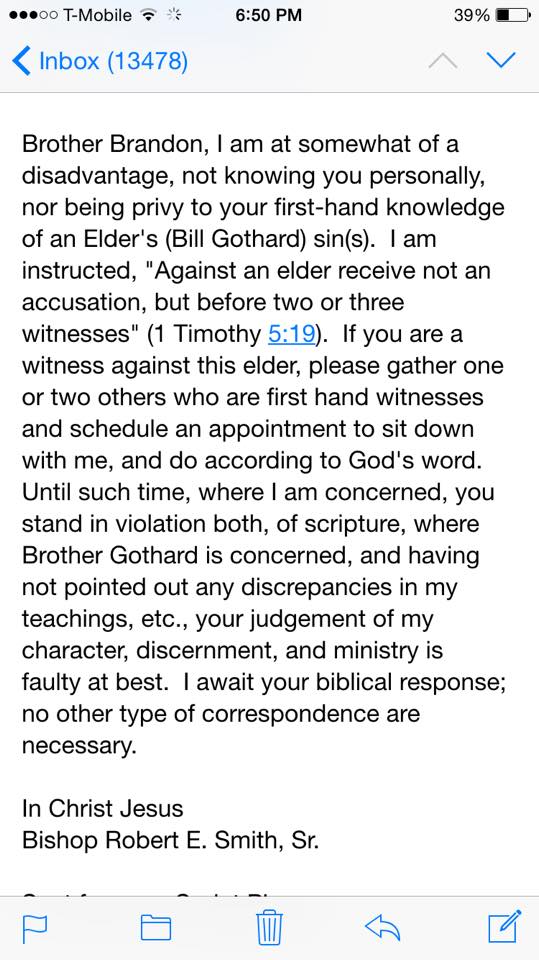






 Homeschoolers Anonymous


