White Supremacist Homeschooling

race

HA note: The following is reprinted with permission from Jonny Scaramanga’s blog, Leaving Fundamentalism. It was originally published on August 26 2014, and has been modified for publication on HA.

So here’s the most horrible thing I’ve found in a while: White Pride Homeschooling.

I don’t even want to give their page the extra traffic, so I’m linking to an archived version of their website (from August 2014).

From their website (Warning: you are about to read racist propaganda):

The biggest increase in intermarriage has occurred in recent years, due to the social interaction of children of different races in the school room and subsequently the board room and then bedroom. In the year 2000 – 9 percent of married men and women below age 30 were intermarried, compared with 7 percent of those ages 30 to 44, 5 percent for those ages 45 to 59, and about 3 percent among those age 60 and older. Obviously school busing, the promotion of interracial marriages by “Christian” preachers, visible images in all types of media, and 12 (plus) years of social conditioning in the schools for each and every child has had a devastating effect on the racial integrity of white America.

Gotta love the use of square quotes around “Christian” in the above paragraph, because obviously true Christians are racist Christians.

Yup, this is a Christian organisation. No doubt you are wondering which curriculums they suggest parents can use without polluting the minds of their pure Aryan offspring.

In no particular order:

Bob Jones University Press

Alpha Omega (pretty much a clone of ACE, but reputedly more academically challenging)

CLASS (the Christian Liberty Academy School System, which produces a custom curriculum based on a mixture of texts from publishers including A Beka and Bob Jones)

And, of course, Lighthouse Christian Academy, which is the homeschool wing of Accelerated Christian Education.

*****

You may be surprised. You should not be.

Now, I am not saying that Accelerated Christian Education is a white supremacist organisation. I’m sure ACE would prefer to distance itself from such racism (Side note: Dear ACE, if you publicly condemn this organisation, I will write one blog post in which I say nothing but nice things about you). But it is telling that the bigots at White Christian Homeschool find ACE’s materials entirely compatible with their aims.

The fact that ACE’s cartoons depict segregated classrooms means that Mrs White Supremacist Homeschool Mom can rest assured that the materials will reinforce what she is already telling her children: White kids should be separated from the other kids. After all, these white supremacists don’t hate black people. They even link to the National Black Home Educators Resource Association, explaining: “As we encourage a Christian lifestyle for all races and do not believe in integrated classrooms – we are providing this link.” See, they’re thoughtful really.

Bob Jones University’s presence in this company is even less of a surprise, given that organisation’s history of white supremacism. It’s not entirely clear when BJU would have abandoned its discriminatory entrance policy if the political climate had not forced it to do so by 1975.

If all this is shocking you, clearly you need to bone up on your history.

Biblical literalism lends itself quite comfortably to racism. “Slaves obey your masters” is a clear-cut instruction. Although my Christian teachers loved to remind me that the British Abolitionist William Wilberforce was a Christian, they tended to gloss over the fact that most of those opposing him were Christians too.

As Mark Noll noted of the US Civil War, and Carolyn Renee Dupont argued about American segregation, racists have always found ammunition in the pages of the Bible. And this is partly because of the way they read it.

Today fundamentalists condemn racism (and they find Bible verses to support that, too). But the way they encourage children to read the Bible has not changed. As a non-believer, of course, I don’t hold the Bible sacred at all, but it seems clear to me that if you’re going to study it, you need to pay attention to the context in which things were written. The Bible is a compilation of books by different authors who made different points, so you cannot conclude “what the Bible says about X” from any single passage.

It’s funny, isn’t it, that Christians suddenly started noticing that the Bible was opposed to racism shortly after it became culturally unacceptable to be racist.

I don’t care whether you can find more verses in the Bible to support racism or to condemn it. All that matters is that it’s possible to support both positions quite well from the text. And this proves that the way ACE (and its ilk) teach children to read the Bible in fact does nothing to prepare them for the real world.

When You’re Raised by Racists: Junia’s Story

race

Pseudonym note: The author’s name has been changed to ensure anonymity. “Junia” is a pseudonym.

I was raised by a mother who was intensely racist.

I didn’t realize it for years, but she was, and is. My father is as well, but less obviously, more in an oblivious sort of way.

As far as education went, I always thought that we received above average education. My mother was committed to good education, erudition was a trait that my parents prized highly, to the point that friends of the family would comment on how intelligent we were and note it as a family thing. I will always be grateful for the education I received from her and from the other teachers, both in co-ops and online, that she arranged. But one area that I completely missed was race.

We’re white, with one distant Native American ancestor. But otherwise we’re Western and Northern European through and through. I never realized until the past year how much this has colored, no pun intended, my life and worldviews.

With history we were raised on the motto, “The South was Right.”

Slavery was justified because of Bible passages about how to treat slaves. If slavery was inherently wrong God would have banned it, wouldn’t He? We listened to speeches from the group The League of the South and read its literature. It’s still hard for me to admit that this group promotes racial inequality by justifying slavery. I was really into the Civil War, or as I called it, the War Between the States, in high school. I spent hours reading about it, but almost nothing from the perspective of anyone in the Union or the perspective of people like Harriet Tubman or Frederick Douglass. I even had a livejournal account about the War. Mostly copy/paste of historical documents or letters etc. Inspirational stories about specific individuals.

I had only friend growing up who wasn’t white. She was mixed race, her dad was black and her mom was white. She and I used to play together a lot. I’m not sure why my mother was okay with us, why she was friends with the family, but I guess the whiteness of the mom made the family safe as far as my mother was concerned. I know my friend was really sensitive about being mixed race. She didn’t feel like she fit in anywhere, she was too dark for whites and too white for blacks. At one point in high school she saw my livejournal account and asked me to take it down because she was offended.

I’m ashamed to say that I didn’t.

I told her that she shouldn’t be offended, I was just posting historical things. We drifted apart, for a lot of different reasons.

None of this is to say that I believed in white superiority or hated blacks or anything like that. I just obliviously dismissed stories of racism as playing the race card. I was uneducated about the true story of racial inequality and hate and the continuing structural racism that exists today. I was never allowed to read To Kill a Mockingbird as a child because my mother said it was racial propaganda designed to stir up race hate. I thought Nelson Mandela was a terrorist because the only times I heard my parents mention him were in negative contexts. A friend asked me within the last year if I knew who Jackie Robinson was and I had no idea. My boyfriend, now my husband, was the first person to tell me about the LA Race Riots. That they even took place.

Even this year I still clung to the idea that Southerners weren’t racist, they had slaves, but they weren’t really racists. There must be some misunderstanding. There’s just misunderstood regional pride. White people have moved on now anyway, we don’t allow slavery any more. People just play the race card when they don’t want to face that they didn’t get a job because they weren’t as qualified, etc. That minorities use their race as a weapon to get ahead.

I was blind to my privilege because I was born with the skin tone I have.

Then there was the murder of Trayvon Martin. I was angry and sad. I saw it as a crime that was at the very least made more likely because of Martin’s race, and at worst as racially motivated. But my awareness was still embryonic. It was after that that I decided that I should read To Kill a Mockingbird and find out what it was all about. I was shocked. I thought it was an exaggeration for monetary profit on the part of the author. I wish that had been true.

A few months later I read a newspaper article about the conviction of the ringleader in the murders in 1964 of the civil rights workers James Earl Chaney, Andrew Goodman, and Michael Schwerner. I was horrified. I read the comments on the article and I didn’t know what one of the commentators was talking about when he referenced Emmett Till, murdered in 1955 at the age of 14. I felt sick to my stomach as I read accounts of what happened to him. A 14 year old boy was beaten and murdered for daring to flirt with a white woman, at worst for being obscene (if you were to believe what local white people said of him).

I now realized that To Kill a Mockingbird really wasn’t exaggerating.

It was all to true to reality. Then I followed more links and saw the records of more deaths, schoolgirls blown up in a church, men and women murdered sometimes just on the side of the road because of their race, men and women both white and black murdered because they were peacefully protesting inequality.

There was a whole world of pain that I was utterly unaware of.

When I was in middle school and high school I vaguely remember that my older sister who had married at 18 and left our home say things about racial inequality. My parents would say that she was just full of white guilt, and that it wasn’t right for us to feel guilty about the crimes that some white people committed against those of other races. I had never investigated for myself, to my shame.

I was perpetuating racism without being aware of it. And I would have been more in tune with reality if I had been taught about racism and black people with any depth. If my knowledge of blacks in American history hadn’t been limited to knowing a lot about George Washington Carver and that Rosa Parks was tired and said no. If I hadn’t been told that Harriet Tubman was making the problems worse by encouraging runaways, which was clearly in violation of things like the book of Philemon.

But I was taught a white centric view of American history and life.

I feel deeply handicapped in dealing with life today because there was so much racism in my family of origin and I am so far behind in what I should know about what minorities, especially blacks, have been facing at the hands of a white dominated society.

I’m grateful in so many ways that I was educated at home. But because of the issue of race, I would never be a homeschooling parent.

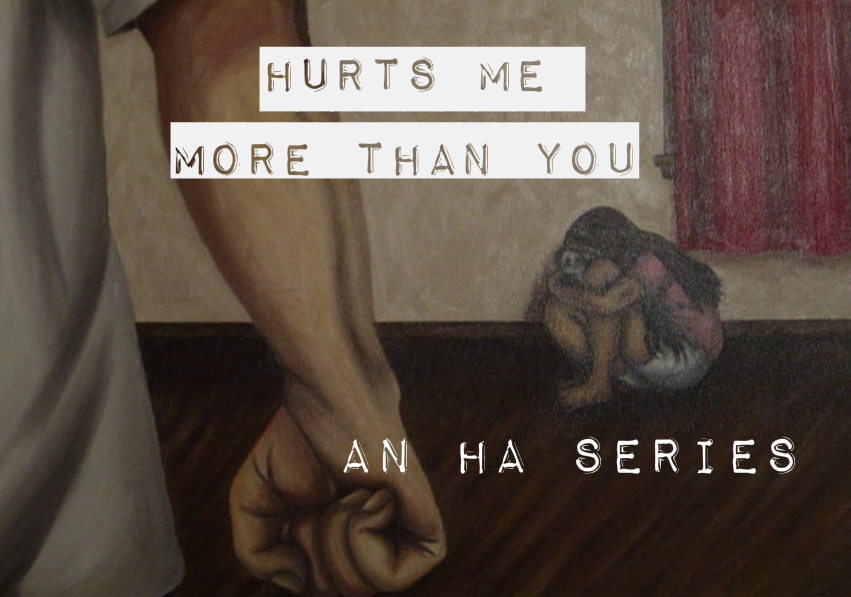
Hurts Me More Than You: A Poem by Jessica

Screen Shot 2014-09-23 at 10.15.16 AM

*****

Trigger warning for Hurts Me More Than You series: posts in this series may include detailed descriptions of corporal punishment and physical abuse and violence towards children.

Additional content warning for Jessica’s poem: intense descriptions of emotional and verbal abuse towards a child.

*****

“Daddy Loves You,” a poem by Jessica

“Bless us, Oh Lord…” we all sit to pray,
But you neglected to do it well.
She scratched her nose and you opened your eyes.
Children like you two are going to hell.

Now you may eat, but just as I say.
Don’t take a bite so big!
If you stuff your face you’ll end up like mommy,
A nasty, big, fat pig.

Don’t clack your fork. Don’t smack your lips.
Don’t finish your dinner too fast.
But don’t still be eating by the time I am through!
You’re a fat, ugly cow if you’re last.

You are mean. You are nasty. And so full of hate.
You are retarded and dumb.
None of your friends actually wants to be near you.
Nope. Not a single one.

You make stupid choices, and I know you’ll end up,
Marrying a loser who will bail.
Oh, you’re going to be a horrible mother,
And your children will end up in jail.

You are rude. You are mean, and a horrible person.
So full of anger and hate.
You should be ashamed of all that you are.
I don’t care that you’re only just eight.

You’re retarded.
You’re lazy.
You’re going to hell.
You’re a liar.
You’re a loser.
You’re going to fail.

You just disappoint me and make me recoil.
I don’t even want you in sight.
Now come here and give me a kiss on the cheek.
Remember, Daddy loves you.
Goodnight.

Adult Children of the Quiverfull Movement on Race

race

HA note: The following is reprinted with permission from Libby Anne’s blog Love Joy Feminism. It was originally published on Patheos on May 10, 2012. This post is part of Libby Anne’s “Raised Quiverfull” interview series, where young adults from families influenced by the Christian Patriarchy and Quiverfull movements answer questions about their upbringing. 

Q: What role did race play in the Christian Patriarchy/Quiverfull community in which you grew up? Were there any black or hispanic families? Were they treated differently?

Joe:

In the church I grew up in, there was never a non-white member – ever.  The church was not overtly racist, though they had issues with illegal immigration, but the services were very boring and would not have fit into a culture different from a bunch of white dudes and one off key old lady singing How Great Thou Art from a hymnal, accompanied by a piano, then sitting through a two hour sermon that sounded the same every Sunday.  But I attended a public grade school and high school where it was proudly noted that we had over 57 different nationalities represented.  My best friends throughout my school years were all African America, Asian, and American Indian.

Latebloomer:

The homeschooling community was extremely white, but we did know several black and Hispanic homeschooling families, with varying levels of involvement in CP/Q.  I don’t remember noticing any racism at the time.  The cold-shoulder treatment seemed to be saved for families that were not fully committed to homeschooling, regardless of race.

Libby Anne:

The families we associated with were all white. I honestly can’t think of any minority Christian Patriarchy/Quiverfull families – or even any minority families in our homeschool groups (which included ordinary conservative Christian families in addition to those who followed the teachings of Christian Patriarchy/Quiverfull). That said, my parents were emphatically anti-racist, and if a black Christian Patriarchy/Quiverfull family had come into our community I don’t think it would have been a problem for them at all.

Lisa:

While my parents said that all human beings were perfectly made by God and equal, my Dad didn’t like us mixing with the black families. There were two families we had closer contact with, and my parents were very friendly, but we weren’t allowed to play with them. I think that was because my Dad didn’t want us to consider one of them as a possible spouse. He was against interracial marriage. I remember a nice lady who was married to a Mexican, she was treated differently, as were their son. Not that anybody said anything, but she was never invited and people avoided talking to her too much.

Mattie:

Where we lived in CA was a very rural area, so there were mostly white, blue-collar folks in our homeschool group. There were a lot of Hispanics in our church, but we were the only homeschoolers.

When we moved to VA, there was a lot more diversity in the homeschooling community, but those adhering to the ideas of the Quiverfull movement were primarily white and upper-middle class. People didn’t treat each other differently and race was pretty much irrelevant.

Melissa:

I do not remember knowing anyone who was black. I met a few mixed white/Hispanic families in the community. I don’t think race was a huge issue in my family in particular, my dad had attended many black gospel churches as a child, and had a sort of nostalgic affection for black spirituality. We were around people in the homeschool movement who felt that the confederacy should have won the civil war and that the loss of that war had led to a major downslide in Christianity in America. I was never 100% clear on what my parents’ position was in that regard.

Sarah:

I had no racially diverse acquaintances in my childhood, but to be fair, I didn’t really have many acquaintances at all. For a brief time I was friends with a Hispanic girl down the street, but I wasn’t allowed to go to her house, so she soon got bored of me. My dad went to an African American Baptist church in Chicago when he was a kid, and he always spoke fondly of his memories there. We never really discussed race, but I remember my dad telling me that interracial marriage was not a sin. It wasn’t until my late teens that I had any interaction with people outside my race or religion. It took me a long time to learn how to interact comfortably with diverse groups of people. I’ve always felt that that was one of the major flaws in my upbringing.

Sierra:

My church was solidly multiracial. Black families were not treated any differently from white families, as far as I could tell. The church did fetishize the Spanish language and would commonly ask Hispanic men to sing praise songs in Spanish before the service. We also attracted a Korean mother and daughter. The main difference between white and nonwhite believers in my church was homeschooling. Racial minorities did not homeschool, probably for economic reasons. My church regarded racial diversity as a positive sign that God’s Word was universal, but maintained a strict policy against interracial marriage.

Tricia:

White, middle class Protestants were we all. It was a very segregated world. I never even had a black or Hispanic friend growing up, and there were no opportunities to cultivate such a friendship.  I definitely feel like I missed out in that regard. Exposure to other groups and cultures can be so enriching, and I had very little of that. The church I attend now is racially and culturally diverse, and coincidentally so is the neighborhood I currently live in, and this exposure to a wider world has been like a breath of fresh air, even though I can have a difficult time connecting– mostly because I don’t know how. It’s getting easier with time, though.

Hurts Me More Than You: A Poem by Merritt

Screen Shot 2014-09-23 at 10.15.16 AM

*****

Trigger warning for Hurts Me More Than You series: posts in this series may include detailed descriptions of corporal punishment and physical abuse and violence towards children.

*****

“Disagreement,” a poem by Merritt

Our eyes do not meet
As eyes seldom do in disagreement
You choose to revisit an old argument
I merely listen

There can be no discussion
Since you start out by ending it
“We have to stand on the Bible,” you said.
And that, as they say, is that.

Frustration wraps its strangle hold around my tongue
As words like “context,” “history” and “interpretation”
Die before they can be spoken
Because I know they cannot be heard.

“We have to stand on the Bible,” you said,
And nothing I can say will convince you
That the words you stand by were penned by an evil king
Whose wisdom turned to rot.

“If you beat them with a rod, they will not die,” said the king.
I wonder what the dying thought of that.

And I wonder why we revere this king
Whose evil counsel would have us beat our children
Until their skin splits and their spirits crumble
This is not the voice of God.

But,
“We have to stand on the Bible,” you said.
And there is nothing more to say.

Doug Phillips Excommunicated From Boerne Christian Assembly

Screen Shot 2014-11-17 at 12.50.25 PM
Kirk Cameron and Doug Phillips.

By R.L. Stollar, HA Community Coordinator

Doug Phillips, the former president of Vision Forum and one of the leading advocates of Christian Patriarchy within the Christian Homeschool Movement, was publicly excommunicated today from his former church, Boerne Christian Assembly (BCA). In a statement released today on BCA’s website, BCA elders Jeff Horn and David Fry declared the following:

“After much prayer and careful deliberation, and having fully communicated to Doug Phillips his Biblical responsibilities and our concerns, regarding sins, arising out of his public confession, there has not been a response we deem satisfactory. Therefore, the Elders of Boerne Christian Assembly have moved to excommunicate Doug Phillips from the Body of Christ. In doing so, we have sought in good faith to follow diligently the process set forth by our Lord Jesus Christ in Matthew 18:15-17. This has been a process in which BCA has demonstrated great longsuffering and patience, has offered many and earnest appeals, and has sought much counsel from men of other churches.”

This statement comes several months after BCA revealed in July of this year that Doug Phillips had left Boerne Christian Assembly and had become a member of another Church “without a letter of transfer from Boerne Christian Assembly” — a requirement affirmed by Phillips himself while he was an elder at BCA. Phillips left after BCA “sought to exercise oversight and accountability” on account of allegations that Phillips had groomed and sexually assaulted a young woman.

You can read Boerne Christian Assembly’s full statement here (or archived as a PDF here).

** Update: The Phillips family has fired back against the BCA. In a statement posted on Doug Phillips’s wife’s Facebook page, Beall Phillips alleged that,

“Today, Boerne Christian Assembly, a church with no jurisdiction over any member of my family, and with about six remaining active member families which includes the three recently elected leaders, (some of whom are personally entangled in controversies and conflicts of interest related to a highly publicized lawsuit) has chosen to dismiss BCA’s historic principles of church government, ignore the Scriptures, and reject their duties to honor civil jurisdictions.”

Read the Phillips’s statement here as a PDF.

Accelerated Christian Education’s Ugly History of Racism

race

About the author: Jonny Scaramanga blogs on Accelerated Christian Education and leaving fundamentalism at his blog, Leaving Fundamentalism. He is building a resource on ACE here, and collects survivor stories from students with experience of ACE. Also by Jonny on HA: “How I (Barely) Survived Home Schooling.”

I remember staring at the text:

Economics is the major reason that apartheid exists. Some people want to abolish apartheid immediately. That action would certainly alter the situation in South Africa, but would not improve it.

It was 1996; I was 11. Nelson Mandela had been president of South Africa for two years, and apartheid had been officially abolished in South Africa for five. I was not exactly well informed about the situation. I knew it was complicated, and that the country was not exactly without problems. But I also knew that apartheid had been an evil thing that had treated black people as less than human. I suspected my book was written by a racist. I didn’t say anything about it to my parents though. That wasn’t how ACE worked. You just got on with it in silence.

ACE (Accelerated Christian Education) was at one time the leading curriculum for Christian day schools and home schools. It’s still big; ACE doesn’t publish numbers of home schoolers using it, but a claimed 6,000 schools worldwide are on the ACE program. I wasn’t the first person to notice that the curriculum had some ugly things to say about apartheid. In 1993, David J. Dent (writing for the New York Times news service) quoted an ACE book that said:

Although apartheid appears to allow the unfair treatment of blacks, the system has worked well in South Africa … Although white businessmen and developers are guilty of some unfair treatment of blacks, they turned South Africa into a modern industrialized nation, which the poor, uneducated blacks couldn’t have accomplished in several more decades. If more blacks were suddenly given control of the nation, its economy and business, as Mandela wished, they could have destroyed what they have waited and worked so hard for.

This quotation came to light when a black student, Priscila Dickerson, complained about it. Her school’s principal claimed that ACE’s racism was part of the reason the school used it. Dent quotes him as saying, “Racism still exists, and that’s one advantage of using a curriculum like this because we can show students that.”

Not long after I finished the lesson on apartheid, I struck up an email friendship with a disgruntled employee of ACE in Texas. I told him I’d noticed one or two things in my books which seemed kinda racist, and asked him what things were like where he worked. “Put it this way,” the ACE employee replied. “The only black guys working here are the janitors.”

In 1998, the book I’d used was finally updated. Now it said, “God’s Word teaches that no people should ever be wrongfully treated because of their race, since all people are created in God’s image.” That’s a lot better. But it also says this:

Apartheid was excused for several decades because of the advanced industrialization of the nation. However, due to the carnal nature of man, apartheid was also used to exploit the nonvoting black majority.

ACE, Social Studies 1086 (1998 revision)

I’ll let you judge whether I’m being biased about this, but I’m still not happy with that wording. The second sentence says apartheid was “used to exploit” black people because of “the carnal nature of man”. To me this sounds like they’re saying apartheid is not intrinsically exploitative; it was just used that way because men are sinful. In a perfect, non-sinful world, it seems to imply, you could have a system of apartheid were people were kept officially separated but not exploited, and this would be fine. That’s no world I want to live in.

In 2009, ACE again hit the headlines for defending apartheid.

Actually, ACE had worked hard to avoid allegations of racism. In his 1980 book Under Tutors and Governors, ACE’s VP Ronald Johnson devoted an entire chapter to denying that the schools were for whites only. According to Paul F. Parsons’ book Inside America’s Christian Schools, by 1987 ACE had a policy of refusing to sell its curriculum to schools with discriminatory admissions policies. There are one or two explicitly anti-racist statements in the curriculum, too. They hailed Martin Luther King as a Christian hero, and praised the Supreme Court decision that outlawed segregation in American schools (although these blips are not enough to stop ACE from being endorsed by white supremacists).

There had always been a suspicion that private Christian schools in America were associated with racism, fuelled by the fact that their explosion in popularity happened shortly after segregation was outlawed in public schools. In ACE’s case, the suspicion was intensified by the fact that ACE’s founder, Donald Howard, had attended Bob Jones University, at that time a notoriously white supremacist institution. BJU’s chancellor had long preached about how God intended for the races to be separate, and BJU did not accept black students until 1971—as Wikipedia notes, this was eight years after the University of South Carolina and Clemson University were integrated by court order—and even then only if those black students were married. In 1970, institutions with racially discriminatory admissions policies were barred from receiving tax exemptions. BJU filed suit to stop the IRS from removing its tax exemption. Ultimately BJU changed its policy and allowed all black students to enroll, just moments before the Supreme Court decision that made it illegal for colleges to discriminate based on race. Still, BJU didn’t allow students of different ethnicities to date until the year 2000.

I can find no record of Donald Howard or anyone else from ACE ever speaking out against BJU’s racism. Instead, Howard wrote (in his 1979 book, Rebirth of Our Nation):

Regardless of the reactions of the media, the Christian school movement is not racist. Schools are opening in white and black communities alike. Schools are segregated, integrated, multiracial, and as cross-sectioned as any program that’s all-American.

So the schools are integrated and segregated, huh? He seems to be saying that the schools can choose whether to be segregated or not. I wonder if he also thought slavery was a states’ rights issue.

It wasn’t until years after I escaped my ACE ordeal that someone pointed out what had been staring me in the face: ACE’s books depict segregated schools. Most ACE books have cartoons set in a fictional city called Highland. There are two Christian schools (and adjoining churches) in Highland: Highland Christian School, and Harmony Christian School. The students and the staff at Highland are all white. The students and staff at Harmony are all black. According to one of ACE’s books, Social Studies 1029 (page 7), “Harmony is a part of the larger community of Highland.” So it’s a ghetto, then.

In the last five years, ACE has been revising its curriculum entirely, and the new editions feature new cartoons. You’d think that in this new era, when even BJU has publicly apologised for its racist past, ACE would redraw the cartoons with integrated communities.

That is not what they’ve done.

Instead, they’ve added a new, third church-school, called Heartsville. The ethnicity of those in Heartsville is best described as “other”: Some appear to be Asian, and some Latino. Rather than abolishing segregation, ACE has reinforced ethnic divides by splitting its fictional universe into “white”, “black”, and “somewhere in between”.

I feel lucky that I noticed ACE’s stance on apartheid was ugly. Because I recognised it was racist, I could choose to reject it, although I worried about other students who might not. I’m much more bothered about the page-and-a-half of casual racism that introduces ACE’s study of Asia, because I only noticed it when I re-read it last year. I never noticed at the time, which means I thought this was OK (or I just didn’t bother reading it, which is completely possible given that you can complete ACE work just by skimming the text to find the missing word to write on the blank):

Michael tried to fight his panic as he raced from place to place, searching vainly for something familiar.

In desperation, Michael watched the people passing him on the street, but their physical appearance provided him no comfort. Their skin was light brown, their hair was dark and straight, and the inner fold of their eyelids made their eyes seem to slant.

If you were suddenly transported to a village like the one in which Michael found himself, how would you react? Far Eastern cultures, languages, and religions seem alien to most Europeans and Americans. Oriental people appear mysterious and inscrutable, and their religions seem strange. Do these people have anything in common with European or American Judeo-Christian heritage and beliefs?

ACE, Social Studies 1106 (Geography), 2002 revision.

People I trusted gave me this as a schoolbook, and none of them ever commented on it to me. Either they too thought it was OK, or they didn’t read it. And whichever one it is, it’s inexcusable coming from people whose job was to teach me.

I don’t think ACE would accept that their books are racist, and I don’t think they intend to be. The newest books have pictures of a more ethnically diverse group of people than the old ones, and I even found two cartoons (TWO!) where black children are pictured in the same classroom as white ones. I don’t think ACE’s authors are hateful; they’re just ignorant. But when education is your business, ignorance is no excuse.

Every year, ACE holds regional and international student conventions. Students from ACE schools and home schools around the world come together to compete in various events, from athletics to preaching. As you’d expect from a fundamentalist organisation, the dress code is very strict.

And it has different acceptable hairstyles for black boys and white boys.

If you’re a white boy, you can have hair any length as long as it is off your collar and above your ears. If you’re black, though, your hair can’t be longer than one inch.

Oh, it doesn’t say this is a racially discriminatory policy. The exact wording is “Extra curly or afro hair is not to exceed one inch in length”. But the fact that this is also going to affect a small minority of white students doesn’t change the fact that this policy discriminates against black boys. While most white boys’ hair is neat and appropriate at three inches, a black boy’s natural hair at the same length is somehow offensive and indecent. And if you turn up with hair that doesn’t fit the dress code, you’ll be turned away: “Those who require a haircut will not be permitted to register until they have located a barber and complied with the Student Convention standards.”

ACE’s ugly history of racism seems to still be alive and well.

Hurts Me More Than You: Charis’s Story

Screen Shot 2014-09-23 at 10.15.16 AM

*****

Trigger warning for Hurts Me More Than You series: posts in this series may include detailed descriptions of corporal punishment and physical abuse and violence towards children.

*****

Charis’s Story

Our physical abuse was defined as love.

I used to think that there was only one thing that was not ideal during my childhood. What I remember as isolated incidents, the times that my mom was not ok with my dad’s behavior. I’m now seeing with different eyes the methods of ‘discipline’ and ‘training’ that my parents used. Realizing that what was abusive, I considered normal.

When it came to “training” or “discipline” there was no doubt my parents believed it was for our ultimate good. That it was an expression of their love for us. They “chastised” us because they wanted to keep our souls out of an “eternal lake of fire.” We were told many things about how this abuse was actually love, and demanded by God:

“I do this because I love you.” “This hurts me more than it hurts you.” “God disciplines those he loves.” “Parents who don’t discipline their children hate them.”

When I was younger, spankings and time alone were the main methods of “discipline” that I remember. It didn’t really matter how old you were. A first time for one of us, I remember my sibling being around maybe eighteen months. My mom and I came home from the grocery store and my younger sibling was very… subdued? Dad said they had had their first training session, or something like that. No idea what, if anything, had been done wrong.

I know there was some statement by dad on how he had done it while my mom was gone because she would have been too soft.

I don’t even know how to describe what they used to strike us with. It was made of something like leather, very thick and smooth, too big to be from a belt.

There was always a pronouncement of how many times we would be hit. “That’s eight!” or the like. My mom had a penchant for counting, like some parents do when they want you to do something “one, two, three…” In our case each count represented another “spanking”. Before you could be punished, or “chastised”, you had to express absolute submission. This meant not crying, removing your pants and underwear, and bending over the bed.

Afterwards you had to hug them, and usually there was a drawn out discussion about what you had done wrong.

I remember being maybe five years old. It was after my dad had spanked me, and I was crying. I didn’t want to touch him, so I was backed up towards the wall away from him, and really didn’t want to hug. He was explaining to me that just like I was backing away from him, my sin separates me from him, and hurts our relationship.

Conditional affection, love defined as chastisement, and the blame laid to me for problems in our relationship.

I distinctly remember a “training” moment when I was a small person, at whatever potty training age was. I remember being given specific instruction to go in the toilet and not my underwear, or else. It seems like mom and dad left me alone to play for awhile, because I remember the moment when they came to my door and discovered I had gone in my pants. It seems like the reasoning was that I was rebellious or lazy, but I couldn’t say.  “Sins of omission” and all that. I was in big trouble, was given a lecture and spanked. I also remember that I was wearing orange.

I have a memory of playing in my room with a doll that cried if you turned it over. I was spanking the doll with the leather instrument my parents used on me and making my doll cry. My parents discovered me and I was in big trouble. To this day I have no idea what was so wrong, I was a child emulating my parents.

*****

There is one term my dad uses to this day that concisely defines the picture of God I was painted.

“God’ll help you with that.”

Seemingly sanguine, it was used as a threat or condemnation. It meant something along the lines of: “If you don’t get your act together God will make your life living hell until you shape up.”

Similarly, if dad said “I can help you with that” it was meant as a threat. Figure out how to obey on your own, or the consequences would be severe.

Around eight I have fewer and fewer memories. The bottom dropped out of life and everything was hard, for all of us. Never got easier after that. From age eight until I moved out life was a constant stress. You never knew when something was going to happen, when someone was going to get hurt. Sundays were the worst because dad was home all day. There was plenty of ‘discipline’. I have no idea what was deserved and what wasn’t.

Something must have happened to the leather thing, because my mom adopted a sturdy wooden spoon. She broke a few of those with use. Dad, I think, used his hand for a bit because I remember his graduation to a board due to the strain on his hand.

I was around ten or eleven years old when dad made a board with a handle and put work into sanding and finishing it. I remember it being 2+ feet long and five or six inches wide. I only have the memory, nothing exact, and of course everything is bigger when you’re a child.

There was a big to-do about the whole thing. Dad talked about a board from his childhood that had holes in it and two separate layers along with a handle. One of those -you’re so lucky I had to walk to school uphill both ways- kind of things. I don’t even know if the story was true.

The existence of this new form of punishment was a big threat. I had no doubt dad would use it on us. At this point I was already afraid of hearing his truck in the driveway. I remember cleaning my section of the room immaculately. The hangers in our closet were so straight that looking at then made me dizzy.

The very first time dad pronounced punishment with the new board it was for me. We were getting groceries as a family. My younger sibling started to walk away to go be with dad. We got in trouble for being between parents alone in the store, so I grabbed my sibling’s sweatshirt and told him to stay. He went to dad and told him what I had done. Dad got in my face and said he was going to punish me with the board. I fell apart right there in the grocery store, absolutely hysterical. My parents herded us out of the store, I was screaming and crying the whole way home. My dad told me to shut up, no more noise on the way home. I couldn’t stop crying. Mom suggested to my sibling that we take the punishment together, split it or something. He would have been around five ears old. To this day I don’t understand why she said that. I don’t remember any more of what happened. It seems like mom and dad started dickering (maybe about her suggestion that I get less) and then dad left angry, for a long time. I don’t know for sure.

I figured out that if something mattered to you, they’d use it to punish you. If you did something wrong, they’d take it away. If you didn’t do something right, they’d tell you that you might have gotten what you wanted back, but now you wouldn’t.

I made it my mission in life to care about absolutely nothing.

If I didn’t want it they couldn’t use it against me. I didn’t care about eating. I didn’t care about spending time with them. I didn’t care about being alone. I had no friends after eleven, so they couldn’t keep me from seeing anyone. One sibling was particularly hard to use the method of removing “privileges” on. I remember my mom saying in exasperation that there was nothing that mattered to him, how was she going to take it away? Removing meals or no food for a day was an oft used punishment.

I remember distinctly the moment when I realized I could never be good enough. It was never going to stop.

I had made dinner for the entire family, cleared up and was just finishing washing every dish. My dad came into the kitchen and screamed at me. I remember dad saying that if I thought that was good enough I was crazy. I don’t remember anything after that.

I figured out there was nothing I could do to protect myself or my siblings. All I wanted was to find a way to prove that we didn’t deserve it. That we had done the right thing. We had obeyed even if dad didn’t think so. I became increasingly depressed and suicidal as I faced the reality that there wasn’t a standard of perfect that christians agreed to. Even if I were capable of perfection, we couldn’t even decide what it was.

The years from early grade school and all through my teens are a blur. I have very few isolated incidents that I remember. Screaming and cursing, unpredictable enough to completely catch you off guard.

My brothers definitely got the worst of the punishments. I don’t know why this is. Maybe they thought boys were sturdier or more rebellious and needed more force to make an impression. Maybe my parents had a harder time breaking their spirit. Maybe because they were younger than me and got the worst of my dad’s anger as his stability waned.

My dad beat my brothers. I have no difficulty calling it a beating. If you hit your child with a board using all your force countless times on a regular basis, that is a beating.

I know there was punishment that I never knew of, and sometimes there were things I heard about later. Dad would go into a room with one of us and I had no idea what happened. Most of the time I would intentionally go outside in the yard so I didn’t have to hear the screaming of my sibling.

Every day it shatters my heart to know that I was there, and there was nothing I could do about any of this. I wanted to do something, I wanted to protect my siblings. But I was helpless. I wished I could take it all for them, find a way to teach them how to avoid all of it, to be good enough. In hindsight I know it was fruitless.

This ‘training’ is not what love is, but I was raised to believe that it was.

How We Removed Anything That Might Make America Look Less Godly: Liz’s Story

race

Pseudonym note: The author’s name has been changed to ensure anonymity. “Liz” is a pseudonym.

I don’t know if my story about race is what you are looking for. I am a white southerner and have never had a close friend of another race.

In my small circle of homeschoolers and other like-minded, ultra-conservative Christians, I don’t think I ever saw a person of another race.  

Oh, except for adopted children. They were the only exception. I distinctly remember a family coming to our church and two of the children were biracial.  I can’t remember if anything specific was said, but I had the impression that this was somehow shameful.  They weren’t adopted, I guess that makes a difference.

What I distinctly remember is my dad giving us talks about the problems with interracial dating/marriage.  He would say that he didn’t have a problem with it and had even dated a black girl once, but that the cultural differences were so large that he felt it did not make for a good marriage.  Now that I think about it, I find it odd and slightly laughable that the only racial conversations we ever had were focused on the civil war or marriage. I’m not even sure why he discussed this with us since he had to “approve” anyone who wanted to date us anyway. He could have easily weeded out anyone of an “inappropriate race.”

The idea of having just a friendship with someone of a different race was never even discussed.

My schooling was very clear on a few key facts about race.  Let me preface this by saying, this is not what I now believe at all, but it is what I was taught:

  • One, the civil war was not about slavery, it was only about states’ rights.

Slaves were actually treated very well and many were not capable of caring for themselves anyway so their white masters were just benevolent care takers.  Slavery would have slowly ended on its own if Abraham Lincoln had just respected the states and stayed out of it.  I remember reading one of the American Girl books about Abby (a black slave girl) and being disgusted that it was so “historically inaccurate” in its portrayal of her life as a slave.

Needless to say, I am ashamed of many things I believed as a child/teenager but I was only believing what I was taught.  

  • The other key point that was drilled into my head about race was that even though slavery was wrong, the civil war was a long time ago and it was high time that black people just let it go.

Of course us calling everyone North of the Mason Dixon line a Yankee wasn’t something we should all let go of. I did not know anything about the civil rights movement.  It was not until I was an adult in college that I realized many of the horrible things that had happened had occurred in the lifetimes of my classmates’ parents and grandparents, not over a 100 years before. Other things had occurred in my own lifetime.

I was shocked and horrified.

No wonder these things hadn’t just been “let go” (as if even the years of slavery should be “let go” anyway no matter how many years have passed). I had been taught for years that black people were entitled and unforgiving (again the irony of southerners still holding quite the grudge against the entire northern half of the country is not lost on me).

It only took a semester of history in college for me to realize how biased and simply wrong my education had been. I had never read a real history book (The Light and the Glory anyone?)  I soaked in every bit of my history classes and went on my own research binges.  I found that there had been terrible race riots in my own rather small hometown–they even made my college textbook.

This was not the first time I was disillusioned with my homeschool education, but it is probably the deficiency I am most ashamed of.  

  • The other race issue that was often discussed in my border state, was all of the “illegals”.

It was made clear that it had nothing to do with their race, only that they were coming into the country illegally.  However, when a white woman came to our church who had also fled her country into the U.S. illegally, the church gave her financial support to continue her fight to stay in the country.  Any person who looked hispanic was considered an illegal alien until proven otherwise.  Not to say this was or is a homeschooling phenomenon. I am a public school teacher and heard a conference between middle school girls about another girl they were purposefully ostracizing because they believed her family was “illegal”.  I have had more than one class discussion about the use of racial slurs in my classroom.

One thing that continues to baffle me is that my parents are very intelligent people.

They both had a public education, which regardless of how good or bad at the very least covered the Jim Crow era. They lived through the civil rights movement. My dad has a college degree and my mom attended 3 years of college.

Where in all of that did they become so brainwashed by the religious and homeschool leaders to think it was okay to simply ignore that part of our history?

Why was it considered right and okay to gloss over or completely remove anything that might make America look less godly or right?  

I also realize that it is likely they were also taught a different but highly biased version of that point in our history (they graduated in the early 70s). But then again, isn’t it the obligation of an educator to overcome their biases, learn, and teach the truth?

I certainly consider it so as a teacher myself — and I am not claiming or trying to be the god-ordained teacher of every subject my children will study.

Re:Siblings — HA’s Next Series

siblings

By R.L. Stollar, HA Community Coordinator

For our next open series, Homeschoolers Anonymous invites homeschool alumni to share about their experiences with their siblings – whether positive, negative, or outright abusive.

For some of us, the bonds we made with our siblings were relationships we’ll cherish for life. For others, our siblings were our lifelines — the people that helped us stay sane while our parents rained down the fire and brimstone of “biblical discipline.” And yet for others, a sibling might have been our first abuser, someone who violated our body and mind and forced us into the shadows of secrecy and shame.

Regardless of where on this spectrum your relationship with your sibling(s) fall, we welcome you to share your stories. Since we’re approaching the busy holiday season, we are making the submission deadline for this series a ways out:

* Deadline for “Re:Siblings” submissions: Friday, January 2, 2015. *

If you interested in participating in this series, please email us at homeschoolersanonymous@gmail.com.

Please put “Re:Siblings” as the title of the email.

As always, you can contribute anonymously or publicly. Let us know your preference when you email us.