Hurts Me More Than You: The Stories of Five Sisters

Screen Shot 2014-09-23 at 10.15.16 AM

*****

Trigger warning for Hurts Me More Than You series: posts in this series may include detailed descriptions of corporal punishment and physical abuse and violence towards children.

*****

HA note: These five stories are the perspectives of five sisters, with psuedonyms taken from the seven sisters from greek mythology. They have previously guest-blogged at Becoming Worldly.

Maia’s Story

My parents were very zealous about raising us right.

They read the Bible, joined the groups, read the books. When I was very young, I was punished in a way that I think was very typical of the late 80’s (and still common now): a slap on the hand, a swat on the bottom. But after the books and the groups, it became more violent, and included hitting us on a handy body part, pinching and squeezing handy body parts, and formal spanking.

My father accumulated spanking implements, and he enjoyed hearing about new materials that could be used to spank his children.

He insisted that it be called the rod, as a matter of respect to him. His favourite stick was a think branch from our woods. He cut it off the tree himself, trimmed off the little branches with a knife, and sanded the nubs down.

It still had most of the brown bark on it, and over time, the sanded nubs started to look shiny and polished from use. It seemed to me that my parents thought that spanking had magical properties. They thought it could be used for anything from attitude adjustments to ensuring instant obedience to helping the memory when we had a hard time reciting the Bible verses we were supposed to memorize.

When my father thought we had a rebellious attitude, he would spank us, and then talk to us about having a better attitude, which was difficult to process, especially on those occasions when we weren’t having rebellious thoughts to begin with. If we failed to respond to a command immediately, or did it with the wrong attitude, or not thoroughly enough, we were spanked. We were spanked until we cried, because they felt that resisting tears was a rebellion of its own (it was). But we became disconnected from our own reaction of crying, so sometimes we would start crying right away, trying to do what was expected, and we were spanked until we stopped the rebellion of crying.

They told us that they didn’t want to hit us, but they had no choice because the Bible made it clear that they would be punished if they didn’t spank us.

Being spanked and hit and pinched made me flinch around sudden movements from my parents, but, you guessed it, I was punished for flinching. I became very fearful, and tried to completely control my behaviour and reactions to avoid being punished. I became a very silent and somber child, trying to show respect and obedience all the time, even though inside I was extremely angry. I learned to try to avoid punishment, not to do things well from any internal motivation, and this was something I have had to learn to overcome as an adult.

I do not support spanking as a discipline method.

Electra’s Story

I was spanked when I was a kid.

The spankings went on from when I was about 2 to when I was 12. Sometimes the sessions would go on for hours, and they usually took place at least once a day. Even the slightest offense, such as taking an extra piece of fruit, or “having a bad attitude”.

I remember one event, when I was about 8, when my parents decided I was possessed.

This was at bedtime and the beating and praying went on till the early morning hours. Usually I would get a forced hug after a spanking session, along with a prayer and a guilt trip for “causing them this pain”.

I feel that a lot of my social skills were hindered by this abuse, and I think that spanking is an unnecessary and brutal use of force that should never be used.

Alcyone’s Story

As a child, I was spanked by my dad and my mom. Most of the time it was for pointless and unimportant things. My dad would spank me until I cried. I don’t mean whimper; he would spank me till I cried loud and in pain. He would spank me with a rod that had the diameter of a quarter.

My dad justified his spanking methods by saying that God showed him that it was time to spank. He once spanked all of my siblings and myself, with the reason that he had to test out his new spanking implements. I got spanked because I baked cookies for my dad as a surprise, but I burned them. I got spanked for climbing out my bedroom window. I got spanked for dropping a watermelon because it smashed on the ground.

The actual spanking didn’t hurt me psychologically. It was the reason and the criticism that the spankings were served under. I was scarred by my dad’s spanking physically; more emotionally though. My dad once beat my sister with a broomstick in front of me because she missed a spot on the floor. That scarred me.

Spanking is wrong in many circumstances. When a spanking is meaningless for no reason, then it is wrong. I don’t know if it’s wrong all the time, so in my children’s lives, I have chosen not to. I can’t justify hitting child, no matter what they did.

Taygete’s Story

I was spanked when I was growing up. And it definitely affected me permanently. I was spanked for everything; it was extremely inconsistent and never for the same things. I  was spanked and it hurt. I was spanked anytime my father wanted too. He spanked me so often that I thought it was just the normal way of life.

My parents instilled fear in me at a young age. As a child the one thing I feared the most was my parents; no matter what I was doing ( playing the piano, playing lego, or even playing in the yard ) because anything could set my dad off.

This not only hurt me as a child but followed me into adulthood as I went on to parent my own child.

I developed bipolar as a result of this and multiple other mental issues. It made it hard in relationships because I couldn’t even tell I was being abused for the longest time.

This is only a very brief description of how child abuse affected me forever.

Celaeno’s Story

I was spanked by my parents when I was younger. Each spanking wasn’t very long (as I can remember), but it is hard to remember how often I was spanked. I was often spanked with grey patterned tent rods, and I was never spanked for a reason (as far as I know). Each Sunday, we were taught at “church” that spanking was normal and a fine way of discipline so I didn’t realize that the living situation I was in was a horrible one.

Later on in life I got counselling which I probably had needed much earlier but from counseling, I learned so much more about spanking, how wrong it was, and how illegal and inexcusable it was. There are many wrong things about spanking especially when you aren’t given a reason for it. It hurt me physically and psychologically. I will never spank my kids when I have them, hurting them physically won’t be the answer. Kids don’t realize when they’re doing something wrong unless you tell them.

There are alternatives to hurting them.

How a Logical Girl Talked Herself into Fundamentalism, Part 2

screen-shot-2014-10-26-at-12-39-29-pm

HA note: The following is reprinted with permission from Cynthia Jeub’s blog CynthiaJeub.com. It was originally published on October 15, 2014. 

< Part One

Trigger warnings: child abuse

“I could fight this, but I may die.
And all I want is be the apple in your eye
Well I could stay here, strap on my face
Listen to the words that put me in my place.” –Pendulum

I was a curious child. I wanted to know how everything worked and why we did certain tasks, and if the explanation wasn’t satisfactory, I refused to participate.

One day when I was nine, I questioned the reasoning behind sweeping the floor. It was always dirty again within hours. Why not just leave it, or find something more efficient? In a fit of frustration, my mom pulled my ear and yelled in my face, then threw me into the pile I’d partially swept. My head rang from hitting the wood floor and my mom kept yelling about how I needed to finish my chores and stop asking questions, and do it as she said to do it. I finally obliged.

The next day, I felt weak. I struggled with low energy and being underweight, so this happened pretty often. I didn’t have the strength for my chores, and fell asleep again soon after breakfast. My mom brought me a snack and gently offered comfort and care, and she said that I could always trust her. When I felt safe, she asked about why I had such a strong aversion to chores. I remember this phrase from her: “Jesus wouldn’t be happy that you won’t listen.”

I didn’t recognize my own use of humor as a defense mechanism. “I don’t want to follow Jesus, mom.” I laughed at her alarm and joked, “I want to be a follower of Garfield. He’s okay with himself how he is, and he lays around, and he’s not skinny as a rail like me.”

The next day my mom told me, “Your dad and I have talked it over, and we decided you can’t read comics for a year.”

I wanted to cry. I already knew what it felt like to lose something I loved for a whole year, because they grounded me off of watching Star Wars when I was seven and eight. I loved reading, and I loved comics. I loved reading Garfield, Spider-man, Calvin and Hobbes, Foxtrot, and always got the newspaper and read the comics before reading some of the news. It was wit and humor and information and philosophical thought and character development.

My favorite movies, and now comics, took precedence over my parents’ religion and expectations, and that made them an idol. My crime for losing what I loved was that I loved it too much.

But like I’ve said before, I knew to suppress my feelings. I took pride in the fact that I did not cry.

For years afterward, I checked myself: never let your obsessions with fantasy and science fiction and stories get in the way of God. Better yet, convince yourself that you want to love God more than anything else.

I started to enjoy housework after my last spanking, at age eleven. I was fighting with my mom about chores again, and she called my dad’s office. He was a web designer for Focus on the Family. I was afraid of talking to him on the phone, so I hid. I was told I’d be spanked with a belt, and I was terrified.

Now, again, I didn’t make these connections at the time – but now I know that the threat of a belt was a trigger for me because my older sister was beaten with a belt years earlier. It was the first and only time the belt was used on me. I cried, and what I hated about spankings was that I always had trouble catching my breath after I started crying. That moment of fighting to breathe was agony, worse than the initial pain of the spanking itself.

Within a week, I decided I loved housework. I took pride in doing it well. I did my chores on time, then I was allowed to disappear and read. I couldn’t read comic books anymore, so I read more chapter books. As I grew into my teen years, I learned to bury my emotions and put on a smile. By the time I was an adult, I had mastered the art of self-deception.

I could either resent what I was expected to do and be, or I could embrace it. I chose to embrace it, and spent countless hours cooking, cleaning, babysitting children, and encouraging other girls like myself, so they could enjoy my lifestyle as much as I did.

As a teenager, I remember thanking my parents for spanking me. I thought it had been effective, and I thought I’d spank my own kids. Now that I’ve researched emotional and physical abuse, I see my memories in a new light:

My parents broke me into embracing the identity they demanded of me.

Part Three >

Hurts Me More Than You: Sabina’s Story

Screen Shot 2014-09-23 at 10.15.16 AM

*****

Trigger warning for Hurts Me More Than You series: posts in this series may include detailed descriptions of corporal punishment and physical abuse and violence towards children.

Additional trigger warning for Sabina’s story: brief description of sexual assault.

*****

Sabina’s Story

I remember the spanking I was proud of: the spanking when I closed the door on my emotions and became a blank page. I was probably 7 or 8, and two or three strokes in, bent over my parents’ bed, when my rigid body finally went limp.

Afterwards I was so proud of myself, and never again did I cry during a spanking.

For years I had been trying to “receive my discipline correctly”. I had a chart, and every time I received my discipline (didn’t scream angrily, didn’t cower or cover my bottom, didn’t lash out before, during or after) I would get a sticker and my mom would be proud of me. After I filled the chart, I got to get a pet of my very own. If I didn’t receive my discipline correctly, it was ok, my mom was good enough to give me another chance to receive my discipline right then, with another spanking. Another 10-15 swats with the paddle my dad made in the garage and sanded down smooth so it wouldn’t cause any damage, perfectly flat so that it wouldn’t hit unevenly. Made with love, not even as thick as a wooden stirring spoon, it had a hole at the top to hang it next to the phone in the kitchen.

I say this with no malice. My parents love me and I love them.

They wanted me to receive my loving discipline correctly as training for when I would need to accept the loving discipline of the Lord as an adult. They would get angry when we sinned, but they never made us receive discipline when they were angry. We would get sent to their room, to wait until they calmed down enough to do what the Lord required them to do.

Today I’m almost 27. You know how when people are angry, they say they see red? If you were to hit me right now, I know I’d see white.

I remember that white being peaceful, like I was finally not responsive to the impulses of my sinful brain that so often used to make me instinctively cover my butt.

I stopped getting spankings when I was 11 or 12, I believe. But that white numbness came again when I was 19.

A kid my age trapped me in a room and sexually assaulted me after I told him I was a virgin. I couldn’t push him off me, I wouldn’t defend myself, because something told me it would be over soon and I probably deserved it for talking with a boy about sex. Just like my spankings, I wanted everything to be over as soon as possible, so I could receive forgiveness and be able to forget about it.

So I did.

I shoved the experience away and didn’t talk about it for years, until I heard the term “sexual assault” in a sociology class and the memories came rushing back.

When I told my mom about the assault, she cried and asked why I hadn’t told her. I didn’t have an answer then, but now I know:

When you receive your discipline, you are supposed to be quiet, teachable. And the slate will be clean and your sins will trouble you no more.

Hurts Me More Than You: Lynn’s Story

Screen Shot 2014-09-23 at 10.15.16 AM

*****

Trigger warning for Hurts Me More Than You series: posts in this series may include detailed descriptions of corporal punishment and physical abuse and violence towards children.

Additional trigger warning for Lynn’s story: descriptions of sexual arousal due to corporal punishment.

*****

Lynn’s Story

“Whoever spares the rod hates his son” Proverbs 13:24

 “For those whom the Lord loves he disciplines, and he scourges every son whom he receives.” Hebrews 12:6

From my earliest memories, love and pain have been inter-mingled.  Hugs, kisses, painful blows, and stinging words blur one into the other.  As a child I was taught both explicitly and implicitly that love and pain are opposite sides of a single coin.

One cannot exist without the other, because, children are so very, very bad.

In our Christian, homeschool family, multiple spankings a day were a normal part of life for me and my four siblings.  Dowels, wooden spoons, belts and those slender, flexible, rods used to open and close mini blinds were all instruments of punishment.  Our pastor taught a lot about “biblical discipline”: the spanking should hurt (a lot); you should never hit your child in anger; you should not hit them anywhere but the buttocks; your child should feel loved and reconciled afterward.

He also taught that “biblical discipline” sometimes leaves “little marks” even hours after the punishment is inflicted.  He assured his congregation that this does not amount to abuse.

However, even these harsh teachings failed to line up with what I experienced at home.

My dad almost always spanked us in anger, often smacked us in the face (giving me a bloody lip on a few occasions) and occasionally used his large carpenter’s fingers to flick us repeatedly on the head until we screamed.  Sometimes the spankings would go on for what seemed like forever.  The one time my mom tried to intervene, my dad screamed at her to leave.  She later apologized to the whole family for being an unsubmissive wife.

The worst part of the abuse was not the physical pain, but the constant anxiety.  I couldn’t protect my siblings, and I couldn’t be perfect enough to avoid deserving punishment, so I lived in fear of the next mistake.  My dad loved the fact that he could produce such fear.  He would sometimes stomp up the stairs shouting, “Let the beatings begin!” carrying a heavy wooden mallet from my great grandfather’s farm.  He never hit us with it, but he enjoyed seeing the terror in our eyes. He delighted in telling stories of how he had hurt or scared other children. I believe my father is a sadist.[i]  Perhaps it shouldn’t be at all surprising that he raised a masochist.

It’s hard for me to remember a time when I wasn’t aroused by images, descriptions or fantasies of being spanked, hit, or beaten.  However, it wasn’t until I was an adult that I realized that the physical sensations I had been experiencing since I was a small child had anything to do with sex.

I was very young when the fantasies began—no older than six or seven.  I lived in a world full of pain (but not pain worthy of anyone’s attention), so I dreamed of the only different worlds I could imagine.  In one, I was in an orphanage, or had been kidnapped, or was a slave.  I was terribly mistreated.  Unlike what I experienced at home, the abuse in my fantasies was obviously bad enough to justifying running away or someone else coming to my rescue.  I wanted desperately to be rescued.

In the other fantasies, there was finally someone who punished me out of love, the way my pastor said they should—someone who genuinely hated causing me pain, but did it because they loved me so very deeply.  This was always a man whom I admired, trusted, and desired to please (unlike my father).  I always felt deeply ashamed of my need to be punished, but willingly subjected myself to his loving blows.  In these fantasies I felt safer, happier, and more loved than I ever did in real life.  This was the closest thing to emotional intimacy that fit into my worldview.

I thought I was imagining the way my father was supposed to treat me.

When I entertained these fantasies, my body always reacted to the images of being beaten or shamed.  I thought this is how everyone’s body responded to fear and shame.  Both of my fantasy worlds seemed so much better than my reality that I loved them.  But I also felt guilty for experiencing pleasure from scenarios that were so similar to what I hated most about my own life.  Real life spankings were terrifying, painful and humiliating.  Why did I willingly relive them over and over and over again? Still, it never entered my mind to think that my physical reaction was not a normal response to fear, guilt and shame.  My family never talked about sex.  My mom gave me the barest of details when I was 14, but I had never even heard of sexual arousal, much less had any idea of what it might feel like.

My first clue that my reaction was abnormal came when I was a sophomore in college.  The first time my boyfriend put his arm around my shoulders, I felt the same physical sensation I had always experienced when thinking about being punished.  I was surprised, but I chalked it up to being slightly afraid and feeling incredibly guilty for letting him “go too far.”

Later, I experienced my first orgasm while having a nightmare about being spanked.  I wasn’t entirely sure that what I had felt was sexual, since I was still almost completely clueless about sex, and there was nothing overtly sexual about my dream as far as I understood at the time. However, I began to suspect that something was wrong.

After I got married and became sexually active, my suspicions were confirmed.  I became incredibly conflicted about sex.  I loved the physical sensations and feeling so close to my husband, but the only way to climax was to allow the images of abuse to flood through my mind whenever I started to feel aroused.  I could fight them off, but doing so took so much mental energy that it distracted me.  When I did allow them to come, the enjoyment was always mixed with revulsion at the imagines in my head.  By this time, I had come to believe that my parents’ “discipline” was actually abusive and that the idea that someone must hurt me to truly love me was a lie.

I hated feeling aroused by those images.  I had no idea how to maintain a healthy sex life. 

Today, six years into marriage, I still struggle.  I already deal with nightmares about not being able to protect myself and my siblings from my dad.  I don’t want to have daydreams of the same.  However, I have been in therapy for the past nine months, and I hold on to hope that perhaps one day I will be free of the chains.

I strongly believe that frequent spankings and the message that love requires causing pain to the object of one’s love—both of which are so prevalent in conservative homeschooling circles—played a significant role in the development of this disorder.[ii]  After all, who could ever think that repeatedly hitting a child on an erogenous zone of the body would not have a sexual impact?

I cannot be sure that I would have had the same reaction if the spanking in my family had not been as abusive as it was, or if I had not tried to imagine the “loving spanking” that my pastor promised.  Personally, I don’t think any of the supposed benefits of are worth the risk.[iii]  However, even if it isn’t interpreted sexually, the message that “someone who doesn’t hurt me doesn’t love me” is an extremely toxic.

It prepares young victims who already believe the lies that every abuser is waiting to tell them.

Notes:

[i] I am using the term “sadist” loosely.  I know that my dad enjoys causing fear and pain to children, but I don’t know the nature of that pleasure.  While I suspect that it is sexual, I have no direct proof of this.

[ii] When arousal from physical pain or humiliation, or fantasies of such things, causes significant distress to the individual, it is considered a paraphilic disorder.

[iii] I personally think that hitting any person of any age on any part of their body is wrong unless it is in self-defense or the defense of someone else.

How a Logical Girl Talked Herself into Fundamentalism, Part 1

Screen Shot 2014-10-26 at 12.39.29 PM

HA note: The following is reprinted with permission from Cynthia Jeub’s blog CynthiaJeub.com. It was originally published on October 13, 2014. 

“Do not look down
Or the abysmal beast of non-conformity
Might stare some unpleasant truth
Into your desensitized mind.” –Meshuggah

It was in April 2014 that I read an article on Homeschoolers Anonymous by Sarah Henderson entitled, “Oh daughters of fundamentalism, take upon yourselves the cloak of self-deception.”

I read it, and for the first time, I recognized how I’d survived my teenage years.

There’s a huge myth I run into on a regular basis – that people raised in fundamentalism are stupid.

It’s too simple an explanation for the many types of people involved in it. There are the stupid ones, of course. There are also those who love power, and they control those less intelligent than themselves. Some are willfully ignorant, checking their brains at the door, as it’s been so eloquently said elsewhere. Then there are those who are both smart and ignorant, and, having been presented with no alternative, survive with self-deception.

I was in the last category. I prided myself in logical thinking, and had quite a few radical ideas of my own. I read all the time, and I wasn’t afraid to reject what I thought seemed unreasonable. Predestination, for instance, was something I enjoyed arguing against.

To give you some idea of what it was like to do what Sarah Henderson describes, here’s a segment of a letter I wrote to my best friend when I was eighteen:

“About setting the tone in the house…I know exactly what you mean. It’s in the difference between the bright ‘Oh, I’ll clean up the cinnamon all over the floor’ vs. the blame-leaden ‘It’s Noah’s job to clean the kitchen in the afternoon’. I think the problem with attempting to brighten our family’s faces is that, at least for me, I feel like nobody cares if I’m really trying to be an encourager. So one thing I do is to remind myself what I hear from people who work in minor departments on films: ‘The best compliment is no comment at all.’ Especially for animated films, there are people who work as hard as the rest in order to get the lighting just right to make the scene vibrant, but the audience doesn’t notice. The only thing the audience sees are the characters talking, the clever dialogue and movement. That’s rather how it is at home: the goal is not to make my siblings and parents realize how hard it is for me, but to do my best, and the results will brighten the mood of the house, not necessarily the task itself. I guess what I’m trying to say is that others don’t think of my actions in terms of isolated incidents, they look at my attitude’s consistency as a whole. What goes on inside my head is not what my family sees, hopefully. What they see is a cheerful servant.”

See, I was informed and could command words. I gave good examples. I was not unreasonable. Looking at that letter now, I see denial and buried emotions. I had no idea that I was in survival mode. It would take three more years for me to realize that I was depressed, and that my depression was perpetuated by forced smiles and taking pride in the fact that I never cried.

I was great at it. In my final years of living with my family, my parents and siblings nicknamed me “The Happy Fairy.” I was known for my skill in lifting spirits. I could make everyone laugh away any frustration. I could lighten any mood. I embraced my Happy Fairy nickname. After all, I love fairies, and my ever-bettering skill as the one who could keep the house happy was a sign of accomplishment. When I started college and spent more time away from home, my family complained that they missed the sound of my cheerful singing.

This took years to develop. My adult self was the product, but I didn’t stop fighting until I was eleven.

Part Two >

Why I Cannot Support Frontline Family Ministries’ Abuse Prevention Week: Part Seven, Conclusion

Screen Shot 2014-10-26 at 12.50.47 AM

By R.L. Stollar, HA Community Coordinator

*****

In this series: Part One, Introduction | Part Two, Kalyn’s Secret | Part Three, Kalyn’s Secret (Continued) | Part Four, Not Open | Part Five, Unmask the Predators | Part Six, Recommended Resources | Part Seven, Conclusion

*****

Part Seven, Conclusion

When it comes to educating people about issues like child abuse and mental health, I truly do not care if you are Christian, atheist, Muslim, conservative, liberal, moderate, gay, straight, bi, or whatever you may be. What I care about is that you actually understand child abuse and mental health. If you’re going to set yourself as an educator and leader about a topic, I expect you to do your homework.

That’s what I care about.

I understand that we live in a diverse world. And I understand that many Christian homeschool communities and organizations are politically and religiously conservative. That’s life. I haven’t even found someone in the HA community that I agree with on everything. I am willing to support and work with people I disagree with on many issues provided that on the issues we all care about — like child abuse and mental health — we are moving forward in productive and helpful ways.

Honestly, I was looking forward to supporting Frontline Family Ministries’s National Sexual Abuse Prevention Week. A national ministry creating a week of awareness for an issue I have cared deeply about for over a decade? What is not to like?

Turns out, a lot.

But I didn’t start from a place of antagonism. In fact, it has made me sick to my stomach over the last few months as I realized just how counter-productive and damaging this ministry’s teachings are. This isn’t what I hoped for. It’s the exact opposite.

Throughout this last week I have explained in great detail why I ended up deciding I couldn’t support Frontline Family Ministries. Some of you may thought it was overkill. But I went into that much detail because I take seriously the decision that I cannot support a National Sexual Abuse Prevention Week for Homeschoolers. And I needed to make as clear as possible why I made that decision. It wasn’t made because Lisa Cherry is a Christian, or conservative, or charismatic, or because she’s a homeschool mom, or any personal reasons. As I said in the very beginning of this series, my heart goes out to her and her family and I wish them nothing but continued hope and healing.

I made the decision because I believe homeschooling communities desperately need to educate themselves about child abuse and mental health — and I believe that education must be done correctly. Not perfectly. But at least correctly. All my life energy, nearly every waking hour, has been invested for over a year and a half to homeschooling issues because I care about homeschooling. I want to see it flourish. I want to see it be a safe and nurturing movement for children everywhere. But until we come to our senses and start taking seriously the tears and cries of the alumni and children of homeschooling, the movement is going to suffer.

The question I wrestled most with, after doing all this research, was this: Can I declare a lack of support for Frontline Family Ministries but still declare support for the National Sexual Abuse Prevention Week?

Ultimately, I decided no. I decided this for two reasons:

First, Frontline Family Ministries is not simply presenting insufficient information. The information they are promoting is actively damaging. It encourages victim-blaming, it sanctions fear-based authoritarian parenting, it sets up abusers’ most vulnerable targets as abusers themselves, it distracts people from who abusers usually are, and it teaches people to guilt and shame those who suffer from abuse and mental illness.

It’s one thing if I simply disagreed with the ministry on political and religious doctrines.

It’s a whole different situation when I know from firsthand experience that the “awareness” they promote are the exact same messages that got the Christian Homeschool Movement into the mess we are in today.

Second, I simply cannot separate supporting the week itself from supporting the ministry. Frontline Family Ministries has been steadily positioning themselves as the new authority on sexual abuse prevention within homeschooling — and some of the most important gatekeepers in Christian homeschooling have fallen for it — hook, line, and sinker. You see the Great Homeschool Conventions, the National Center for Life and Liberty, HEDUA, even an anti-Bill Gothard person like Karen Campbell, all rushing to heap praise upon them.

Yet apparently none of these people or organizations either (1) bothered to read the ministry’s books or (2) find such damaging teachings to be a problem.

This is flagrantly irresponsible. This is, again, exactly the sort of attitude that got the Christian Homeschool Movement into the mess we are in today.

To support this week would be a stamp of approval on the ministry’s positioning as educators and leaders in homeschool sexual abuse prevention. I cannot give that stamp of approval with a good conscience, and it saddens me that others have so quickly decided to give that stamp themselves.

We’re at a moment in the history of the Christian Homeschool Movement where we need to wake up and treat these issues with urgency and sobriety. We do not need any more snake oil. We need to start listening to children and alumni and centering their voices in these conversations.

Until we do that, we’ll just be traveling in circles.

It’s for all these reasons that I cannot support Frontline Family Ministries’ Abuse Prevention Week.

Why I Cannot Support Frontline Family Ministries’ Abuse Prevention Week: Part Six, Recommended Resources

front

By R.L. Stollar, HA Community Coordinator

*****

In this series: Part One, Introduction | Part Two, Kalyn’s Secret | Part Three, Kalyn’s Secret (Continued) | Part Four, Not Open | Part Five, Unmask the Predators | Part Six, Recommended Resources | Part Seven, Conclusion

*****

Part Six, Recommended Resources

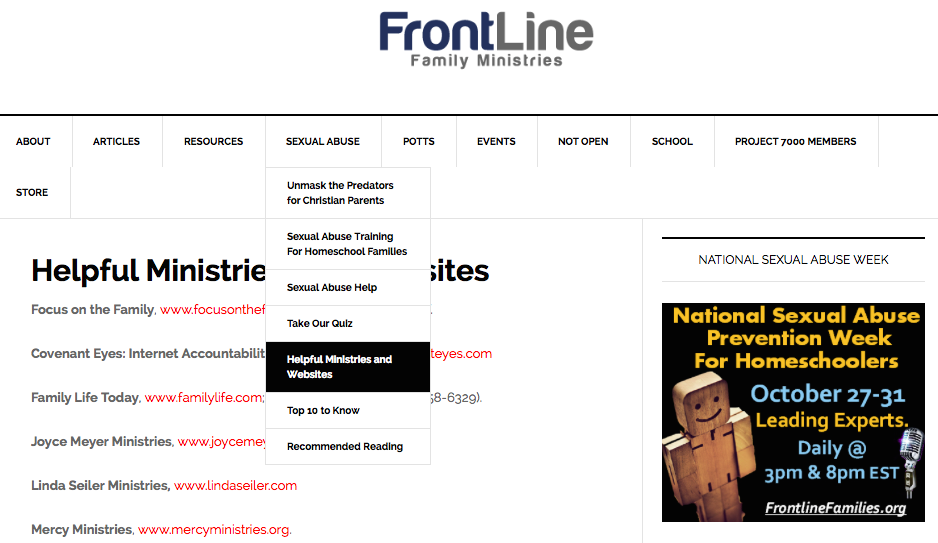
Today I am going to examine the “Recommended Reading” and “Helpful Ministries and Websites” contained both at the end of Kalyn’s Secret and online at Frontline Family Ministries’s website. A few things to note: (1) Both sets of resources have been identical up until several months ago; the resources listed at the end of Kalyn’s Secret were the exact same resources on the website. (2) These resources, ministries, and websites are specifically intended for sexual abuse prevention. Kalyn’s Secret, of course, is about sexual abuse prevention. And on FFM’s website, these resources — as you can see in the images below — are listed under the “sexual abuse” tab:

Before getting into my analysis, I should also mention that — in Part One of this series — I said I had “poured over the Cherry family’s ministry website, including all of its manifestations from the last few years via the Wayback Machine.”  In fact, I had been using the Wayback Machine up until the release of Part One (this last Monday).

Curiously, as of yesterday, FFM is now blocking the Wayback Machine from archiving their website:

Screen Shot 2014-10-24 at 5.16.55 PM

Fortunately, I made archived copies of everything. So I can commence with today’s analysis despite the removal of all the source material. Without further ado, here are Lisa Cherry and Frontline Family Ministries’s “recommended resources” and “helpful ministries and websites” (and why they are troubling):

1. Bill Gothard and the Institute in Basic Life Principles

Despite the fact that Bill Gothard and his Institute in Basic Life Principles have been (1) covering up sexual abuse since the 1980’s, (2) accused by over 30 women in the last few years (since 2012) of continuing to cover-up sexual harassment and abuse, and (3) promoting horribly abusive teachings regarding counseling survivors of abuse, Lisa and FFM encouraged abuse victims, survivors, and their families to consult Gothard and IBLP. And note that this was not just encouragement; it was encouragement in the context of sexual abuse prevention.

Lisa and FFM’s recommendations of Gothard and IBLP date back to at least 2009 when Kalyn’s Secret was published. And then continued — and this important — all the way into this year, 2014. Yes, FFM was recommending Gothard and IBLP as recently as this year. This is one of the pieces of information no longer accessible via the Wayback Machine since FFM blocked Wayback’s archiving robots. However, you can view a February 2014 screenshot of FFM’s “recommended reading” that I saved here as well as a February 2014 screenshot of FFM’s “helpful resources and websites” that I saved here. Note in the former they recommend Bill Gothard’s book The Secret Power of Crying Out and IBLP’s How to Win the Heart of a Rebel by S.M. Davis. And in the latter they recommend IBLP itself.

If you’re up on your homeschool news, you will know that it was in February that news about IBLP putting Bill Gothard on administrative leave went national. So it makes perfect sense that Lisa and FFM would finally distance themselves. To do otherwise would be a PR disaster. In fact, Lisa even wrote an article for WorldNetDaily in April denouncing Gothard for exhibiting the warning signs of abusive grooming tactics. However, she never mentions in that article that she was promoting him a mere 2 months prior. Nor has she ever publicly denounced his teachings. Rather, she “grant[s] his request for forgiveness” (even though it’s not hers to give) and bemoans not his abusive teachings but rather that his actions conflicted with his teachings.

It’s good that she came out against his alleged actions; however, his teachings are just as abusive. And Lisa was directing abuse victims, survivors, and their families towards his and his ministry’s teachings just a few months ago.

Those are the teachings that enabled the abuse in the first place.

2. Nancy Alcorn and Mercy Ministries

Unlike Bill Gothard and IBLP, Nancy Alcorn and her organization Mercy Ministries continue to be recommend by FFM to this day. On the current “Recommended Reading” list, you will find numerous books by Alcorn, including Violated: Mercy for Sexual Abuse. And on the “Helpful Ministries and Websites” list, you will find Mercy Ministries.

So let’s talk about Nancy Alcorn and Mercy Ministries.

Founded in 1983 by Nancy Alcorn, the FFM-recommended Mercy Ministries is a fundamentalist, charismatic Christian organization that offers 6-month residential programs to young women dealing with abuse and mental health issues. Their programs in Australia were closed several years ago after reports that they prevented residents, “many of whom had serious psychiatric conditions,” from “gaining access to psychiatric care,” and instead used “exorcisms to ‘expel demons’ from the young women.” The ministry also engaged in welfare fraud. Those programs were sponsored and led by Hillsong Church, the very same church organization that Boz Tchividjian wrote about last week due to their failure to report child sexual abuse.

Women that enrolled in Mercy’s Australia program said they “left the Mercy centre suicidal, after being told they were possessed by demons.” A woman that attended a U.S. program called it a “cult” and said, “When I first got out I was very depressed and thought about suicide which I hadn’t done in 9 months prior to the program.” These are common complaints by attendees, who have formed websites to expose alleged abuses, including Mercy Survivors and Mercy Ministries Exposed.

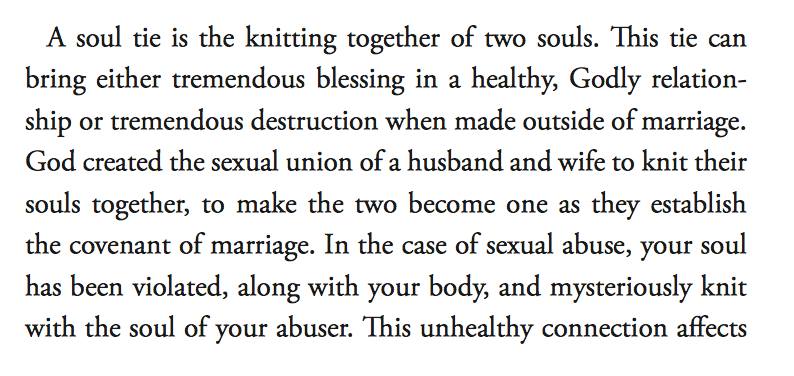
These complaints are also fully understandable in light of Nancy Alcorn’s belief in demonology and soul ties, which I briefly mentioned in the last part of this series. The following image is from Alcorn’s book Violated: Mercy for Sexual Abuse, one of the books Lisa Cherry specifically recommends to abuse survivors:

1800212_10152356730222761_5400484375941294380_n

This is the exact same message Mercy residents hear. Residents are given “a binder called Restoring the Foundations (RTF), a scripture-based doctrine associated with charismatic Pentecostalism… According to RTF, a lapse in conduct, such as premarital sex, could invite in an evil spirit that might curse a bloodline for generations.” This is an extraordinarily dangerous and damaging message to send to abuse survivors.

As seen above, both Nancy Alcorn’s teachings as well as Mercy Ministries are well-documented to exacerbate abuse, mental illness, and victim-shaming. Yet they continue to be recommended by Lisa Cherry and FFM.

3. Eric and Leslie Ludy

Like Nancy Alcorn and Mercy Ministries, the teachings of Eric and Leslie Ludy continue to be recommend by FFM in the context of sexual abuse prevention. I discussed one problem with this recommendation in my last post, but it is worth reviewing:

“In one of the final chapters of [Eric and Leslie Ludy’s book ‘When God Writes Your Love Story’], entitled ‘Too Late?’, Leslie Ludy discusses ‘sexual sin’ and ‘moral compromise’ — in other words, ‘lost virginity.’ …Leslie tells about a 12-year-old girl named Rebecca. Leslie says that Rebecca — again, a 12-year-old — was lured by a 16-year-old boy from a church youth group into his house one day. Leslie says that Rebecca ‘left as a used and defiled sex toy’ and was ‘forced from childhood into womanhood.’

“From Leslie’s description alone, Rebecca’s story reads as a straightforward account of a 12-year-old girl being raped. The words ‘used’ and ‘forced’ indicate a lack of consent. Yet Leslie puts Rebecca’s story in the same chapter as stories of willing sexual encounters of individuals who chose to have sex before marriage. All these stories are then discussed as ‘sexual sin’ and ‘moral compromise.’ At no point does Leslie identify Rebecca’s story as a story of child sexual abuse, sexual assault, and/or rape — and at no point does Leslie then relate it to the importance of children and teenagers learning sexual consent and safety. The message to young women reading this would be and has been clear: you being ‘forced from childhood into womanhood’ is you sexually sinning, even if you were ‘forced.’”

This is the very last book you should recommend to abuse survivors. Yet this is the book Lisa recommends to young people to learn about purity in the context of sexual abuse prevention.

The Ludys’ equivocation between “sexual sin” and sexual abuse continues to this day. In the September/October 2013 edition of Leslie Ludy’s magazine Set Apart Girl, Leslie wrote an article entitled, “White As Snow: Experiencing God’s Restoration from Sexual Sin and Abuse”:

Screen Shot 2014-10-25 at 6.37.12 PM

Note that the very title of the article is this “sin and abuse” equivocation. Nowhere in the article does Leslie address sexual abuse as a criminal action for which the victim has no responsibility. Rather, the entire article just addresses how girls “could be set free” if only they were “willing to repent” from “sexual sin.” If you’re going to say your article addresses “sexual abuse” and then only talk about the necessity of repentance, you are communicating nothing but guilt and shame to the abused.

4. Ron Luce and Teen Mania

The Cherry family absolutely loves Ron Luce and Teen Mania. Their family “travels on Teen Mania Ministry’s Acquire the Fire tour,” they recommend both Luce and his organization in the context of sexual abuse prevention, and Lisa frequently cites from Luce’s books.

I already mentioned that Luce and Teen Mania teach the concept of soul ties. Beyond that there are many other deeply concerning elements of Luce and Teen Mania. They have been featured in an MSNBC documentary where their high control, cult-like tactics resulted in immense emotional, physical, and spiritual damage to attendees. Teen Mania alumni have banded together and created a website called “Recovering Alumni,” where they detail accusations including: labor violations, hazardous working conditions, pushing people with serious mental health problems to quit medication, using exorcisms to “cure” attendee problems, covering up sexual harassment, and knowingly employing sexual predators. Several of their programs have been disbanded recently due to attendees’ serious injuries and abuse and financial corruption.

That Lisa Cherry and FFM would continue to partner with and recommend this organization, not to mention recommend such an organization to abuse victims and survivors, is inexcusable.

5. Family Life

Family Life was founded through Bill Bright’s Campus Crusade in 1976. Their mission is “To effectively develop godly marriages and families who change the world one home at a time.” They provide resources “that help people build stronger homes and communities.” FFM recommends Family Life to abuse survivors and their families.

Why is this troubling? Well, because Family Life does not take domestic violence seriously. In an article on their website entitled, “Does a Good God Want Me in a Bad Marriage?”, Family Life states that the only reasons justifying a woman leaving her husband are “unrepentant adultery, abandonment, or repeated physical abuse” (emphasis added). So apparently some physical abuse is tolerable in a marriage. In fact, Family Life says that suffering such things in marriage can be good:

“God also calls us to righteousness, and often that requires giving up our personal happiness for the greater good. This is referred to as sacrifice, and it’s never easy, fun, or ‘happy.’ The apostle Paul reminds us that part of the Christian life is suffering for the sake of the cross.”

Family Life later issued an editorial statement that reiterated repeated physical abuse justifies divorce. And by later, I mean much later. As in, the original piece was published in 2006 and their editorial statement was released in 2014. The problem, though, is that (1) this organization that is counseling individuals about marriage and family issues took nearly a decade to realize how damaging their advice could be and (2) they still are tolerating some physical abuse in a marriage by continuing to emphasize “repeated.”

6. Neil Anderson

One of the resources FFM recommends on the “spiritual warfare” front of sexual abuse prevention is Neil Anderson and his book The Bondage Breaker. This book has long been a staple of Bill Gothard and the Institute in Basic Life Principles. It is also fundamentally flawed and includes heretical teachings such as the idea that saved believers can be possessed by demonic forces. Midwest Christian Outreach, which has long been critical of the unbiblical teachings of Gothard and IBLP, has also harshly criticized Anderson. They declared that, “If the average pastor claimed to believe these things he would be looking for a job or given medication.” Ironically, Anderson’s work relies heavily on secular positivism and Freudian psychology.

One can see the influence of Anderson on Lisa Cherry when, in both Kalyn’s Secret and Unmask the Predators, Lisa describes her daughter — supposedly a model Christian — in demon-possessed terminology and suggests the “soul tie” with her abuser is responsible. As I have said before, this is the best way to terrorize an abuse survivor, not help a survivor.

7. Shannon Etheridge

Shannon Etheridge is a popular author and speaker on the subject of women’s purity. She is most known for her book Every Young Woman’s Battle: Guarding Your Mind, Heart, and Body in a Sex-Saturated World — one of the books Lisa and FFM recommend. This book promotes ideas that are harmful to people of all genders, including the idea that men are sex-driven robots and women are emotion-hungry machines. It also blames “homosexual desires and tendencies” on “dysfunctional family relationships” or because “maybe Dad wasn’t there for you” — which is not helpful language in the least.

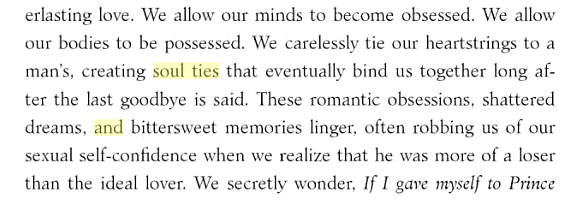
Etheridge, like many of the other people on this list, also believes in soul ties, and has repeatedly told women that they must cut their soul ties or face drastic consequences. 2 examples include:

“Over and over I failed to sever the soul ties that connected me to every man that I had had sex with” (source).

“As I entered counseling several years into our marriage, my main goals were to get the scarlet letter off my sweater, cut the soul ties that had bound me for too long, and rid my mind of the relational ghosts that continued to haunt me” (source).

In her book The Sexually Confident Wife, Etheridge goes so far as to say soul ties “bind” you to the other person and “allow [your] bodies to be possessed”:

Screen Shot 2014-10-25 at 7.59.03 PM

8. James Dobson and Reb Bradley

FFM highly recommends child training as a part of sexual abuse prevention. And the resources they point abuse survivors and their families to for child training are Reb Bradley and James Dobson. Lisa Cherry encourages people to buy Dobson’s “helpful resources” (167), even though Dobson’s book on discipline, The Strong-Willed Child, compares child training with cruelly beating a dog. HA’s Nicholas Ducote recently reviewed Dobson’s book and was “shocked by the dehumanizing themes of control and projection of power as well as the animal-like dominance by fathers.” Ducote said,

“There was a disturbing amount of violence justified throughout the volume. Dobson seemed to model his training methods after a wolf-pack and a wolf-pack’s ‘Alpha Male.’ …Dobson made it clear that being strong-willed is not a good quality and must be driven out of children (and dogs). This is virtually identical to the teachings of Michael and Debi Pearl, except the Pearls use Amish horse training as a model.”

Lisa also specifically recommends using Reb Bradley’s book Child Training Tips, a book noted for its excessive emphasis on harsh corporal punishment and authoritarian parenting. According to Latebloomer, a homeschool alum and former attendee of Bradley’s church,

“Reb Bradley views spanking not as one of many parenting tools, but as the only tool…  If the child doesn’t appear broken, doesn’t want to be hugged right after being hit, cries in the wrong way, or doesn’t seem sorry enough in prayer to God, then ‘the chastisement obviously did not work, and should be repeated a second time,’ or perhaps even a third time… Reb Bradley also seems to believe that a parent can and should beat their child into demonstrating love through a hug, which is an absolutely disgusting attitude for a parent to have.”

Furthermore, considering the context of sexual abuse prevention that we’re discussing, it is even more troubling that Bradley’s methods actively discourage abuse prevention: “Reb Bradley also takes away the child’s only remaining defense against predators: parents who are open for communication.  ‘Unless it is an emergency,’ he says, ‘children should never be permitted to criticize those over them in authority’ (p. 124).” Fear- and authoritarian-based discipline systems like this a recipe for abuse, not abuse prevention.

9. Final Thoughts

There are many, many other individuals and organizations recommended by Lisa Cherry and FFM that are similarly troubling. These include: spiritual authoritarians like Watchman Nee and John Bevere, nouthetic counselors like Lou Priolo, and other harsh disciplinarians like Ted Tripp and IBLP’s S.M. Davis. However, if I detailed everyone, this post would go on far too long.

I understand that no one is perfect and sometimes people make the wrong recommendations because of ignorance or not doing sufficient research (or not having time to do sufficient research). However, the fact that the majority of the authors and ministries recommended by Lisa Cherry and Frontline Family Ministries are peddling inaccurate information about abuse and mental health sets off too many alarms. That fact tells me that they do not truly understand the dynamics and nature of abuse and mental health nor how to help those who suffer.

And the fact that many of their recommendations — such as IBLP, Mercy Ministries, and Teen Mania — have been documented as emotionally, physically, sexually, and spiritually abusive is the biggest red flag of all.

In the next and final part of this series I will present some concluding remarks.

Why I Cannot Support Frontline Family Ministries’ Abuse Prevention Week: Part Five, Unmask the Predators

Screen Shot 2014-10-23 at 6.51.54 PM

By R.L. Stollar, HA Community Coordinator

*****

In this series: Part One, Introduction | Part Two, Kalyn’s Secret | Part Three, Kalyn’s Secret (Continued) | Part Four, Not Open | Part Five, Unmask the Predators | Part Six, Recommended Resources | Part Seven, Conclusion

*****

Part Five, Unmask the Predators

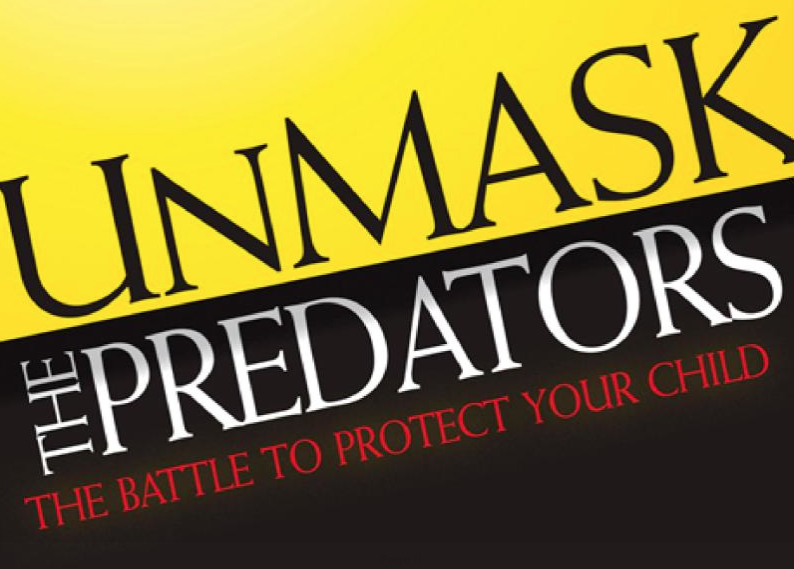
Unmask the Predators is the sexual abuse prevention manual from Lisa Cherry and Frontline Family Ministries. This is the book they are promoting through the Great Homeschool Conventions; it is the basis of FFM’s “Sexual Abuse Training for Homeschool Families”; it has its own “Home Security System Workbook”; and it is the foundation of their National Sexual Abuse Prevention Week for Homeschoolers.

I need to note at the outset that Unmask the Predators, published in 2012, is simply an updated version of 2009’s Kalyn’s Secret. The Cherry family never mentions this online, so at first I felt this was deceptive. However, I am glad I purchased both books because how Lisa updated Kalyn’s Secret to become Unmask the Predators is very telling.

Most elements of Kalyn’s Secret remain the same in Unmask the Predators: there is still the advocacy of first-time obedience, patriarchy, demonology, Word of Faith theology, distrust of non-Christian counseling, and so forth. A few things are toned down, probably since FFM wants to reach a more mainstream audience. For example, they removed any reference to believing in the Azusa Street Revival. They also removed all the “Tools” and “Recommended Resources” (they moved the latter to their website) and replaced them with sections on “Sexual Abuse 101” and “Twenty-Six Keys for Protecting Your Child from Sexual Predators” (both of which, for the most part, have legitimate advice). I already provided analysis of the elements that remain the same, so I will today focus on problems unique to Unmask the Predators.

a. Blaming children for their own abuse

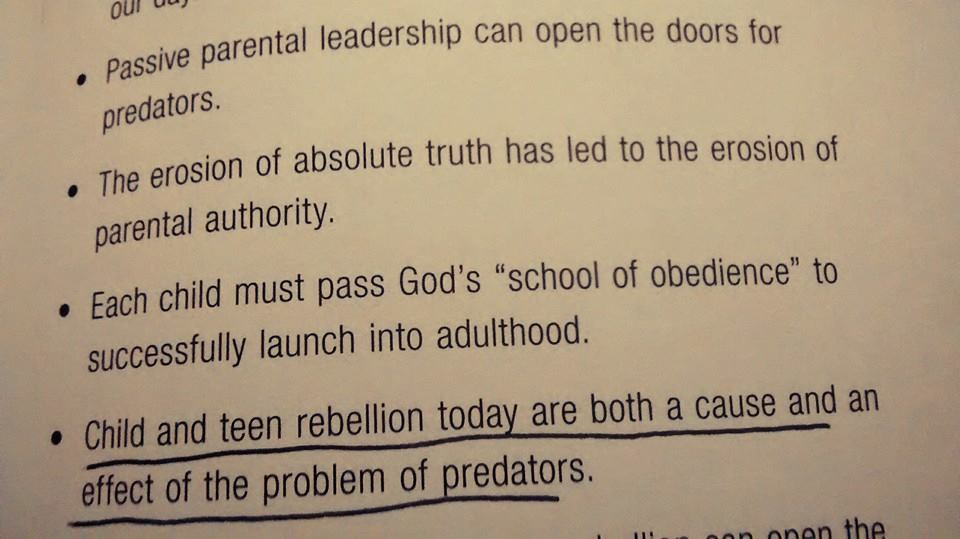
At the end of Unmask the Predators is a “Sexual Abuse 101” chapter. Most of this chapter has helpful advice. Lisa Cherry rightly points out that, “Abuse is never the fault of the victim.” But then in the very next sentence she says, “Victims put themselves in a position of risk due to wrong choices” (160). This is the equivalent of saying, “A woman never deserves to be raped while drunk, but if she’s drunkI mean, she bears some responsibility.” But the worst part is that, despite saying victims are never at fault, Lisa directly blames children for their own abuse earlier in the book. In Chapter 6, “The Parent’s Place of Authority,” Lisa says that if children leave their parents’ “shield of protection” (a concept remarkably similar to Bill Gothard’s umbrella of protection), they cause predators to exist. In case you think I am exaggerating (or think I cannot be trusted to simply review a book), here is an image from page 91:

1966880_10152393016522761_8617204168424371641_n

There you have it: Lisa Cherry believes that rebellious children cause predators to abuse them.

This is absolutely not the person who should be leading a National Sexual Abuse Prevention Week for homeschoolers.

b. Redefining sexual predators

The most irresponsible aspect of Unmask the Predators is that Lisa Cherry redefines the meaning of “sexual predator” in the context of teaching sexual abuse prevention. The following image (which Libby Anne discussed yesterday) from page 2 demonstrates this:

10726376_10152390801832761_1034032676_n

Text is,

The predators are not just the psychiatrically diagnosed pedophiles. The middle-school sex-education health teacher, the friendly cohabitating young couple next door that your daughter babysits for, and the clean-cut homosexual teller at your bank who just adopted a baby from Africa are chipping away at our core values and beliefs while we naively think our kids are still with us in the Sunday school. Until we mask the spiritual forces working behind those “nice people” and dismantle their spiritual weapons, we will continue to lose our children. 

What is vital to note here is that Lisa is not saying that these people could be predators — in the sense that anyone can be a predator because predators transcend any particular demographic group. If that was the message, I would agree. Predators can be heterosexual, homosexual, bisexual, white, black, young, old, Christian, atheist, Buddhist, and so forth. But that’s not what Lisa is saying.

On the first page of the book, Lisa says a “sexual predator” nearly destroyed their daughter’s life. She warns there are other predators threatening children as well. She then gives the examples above. The predators “are” (not “could be”):

  • The middle-school sex-education health teacher
  • The friendly cohabitating young couple next door
  • The clean-cut homosexual teller at your bank

Now you might wonder, how on earth are these people categorically defined as “predators”?

The answer is, disturbingly, that Lisa is redefining what “sexual predator” means. You can see the beginnings of this in the above citation, where Lisa says they are predators because they are “chipping away at our core values and beliefs.” On page 3, she elaborates on this:

“Sexual predators are not new. Their stories fill chapters of our Old Testament history books; their names were called harlot and adulterer in Proverbs” (3).

“Harlots” and “adulterers” are “sexual predators”? We clearly are no longer talking about what normal society means by sexual predator, i.e., “People who commit sex crimes, such as rape or child sexual abuse”, or “A person…convicted of a first-degree felony sex crime, or two second-degree felony sex crimes”. You know, the actual definition of “sexual predator.”

But still, you might ask, how are these people “predators”? The answer is that Lisa has redefined “sexual predator” by spiritualizing the concept. In her worldview, predators are anyone and everyone who (1) act in a way that Lisa believes is sexually immoral and/or (2) teaches people sexual morality in a way Lisa believes is sexually immoral. Thus anything or anyone hinting of non-Christian “culture war” is predatory. As Lisa explains, “Predator forces can attack our children through sexual molesters or through a host of cultural invaders” (13, emphasis added).

Lisa makes this most clear in two online articles found on Frontline Family Ministries’s website. Those articles are entitled “Predator Calling Cards, Part 1: Found One in My Mailbox” (archived PDF) and “Predator Calling Cards, Part 2: What is a Predator Anyway?” (archived PDF). In the first article, Lisa expresses some of the most horrid anti-gay sentiments I’ve ever read. These sentiments really shine a light on Lisa’s statements in Not Open where she said LGBT* people often receive “icy stares” in church and that’s a bad thing. I mean, if this isn’t the equivalent of an icy stare, I’m not sure what is:

“I sat down the other day for a rare moment of relaxation with my new issue of Country Living. It’s the one women’s magazine I subscribe to.

I looked forward to dreaming up some unachievable new interior design as I flipped my mind over to unwind mode.

Featured on page 92 and 93 was a quaint 19th century house in upstate New York.  But I had trouble figuring out the heading…

My mind did a double take as I re-read the article’s opening line… Jesse and Gus have forged a surprisingly modern home…. I turned the page to find a picture of this “couple”—two men and their five-year-old daughter.

What?!  I was accidentally taking a tour of a homosexual couple’s house? I dropped the issue on the floor in disgust.”

Yes, Lisa dropped an issue of Country Living on the ground “in disgust” because it featured a gay couple. Now, ignoring for the time being the message communicated to LGBT* people by this, note again the title of the article: “Predator Calling Cards, Part 1: Found One in My Mailbox.” In other words, just the image of a gay couple is a “predator calling card” to Lisa.

She received pushback on this article from people saying that it’s irresponsible to say this because not all LGBT* people are child molesters (e.g., the actual definition of sexual predator!). Lisa responds to this in the second article:

“In the world today we have Micro-predators (actual persons) and Macro-predators (global thoughts and forces). They are very much inter-related. Think about it. A child “macro-groomed” may more easily be “micro-groomed.””

In other words, LGBT* people — simply by being LGBT* — are predators in Lisa’s worldview. Their very existence is a perpetual state of “macro-grooming” children for abuse. In fact, anything and anyone that is sexually immoral is a “macro-predator.” This is why the list from page 3 of Unmask the Predators says that: people living together before marriage are predators, sex education teachers are predators, and LGBT* couples are predators. They aren’t necessarily child molesters; they’re spiritual sexual predators. So, I guess, they kind of are child molesters, but rather spiritual child molesters.

In fact, nearly every single passage in Kalyn’s Secret that referred to something like “spiritual forces of darkness” is changed in Unmask the Predators to be called “predators.”

Which just blows my mind.

We live in a world where 1 in 3 girls and 1 in 7 boys will sexually abused. We also live in a world where sexual abuse prevention is sorely lacking. The last thing we need, when teaching about prevention, is someone redefining the word and teaching families to fear the wrong people. Teaching families to fear non-predators — in the context of teaching about predators — is the most irresponsible thing I’ve seen in a long time. There is no excuse for Lisa’s dangerous and sloppy irresponsibility here.

c. Throwing LGBT* people under the bus

As I just pointed out, Lisa calls gay people “sexual predators” on the very second page of Unmask the Predators. She continues to do this throughout the book — as well as in Not Open, where she refers to LGBT* people as “sexual offenders.” She even pulls out the tired trope of LGBT* people wanting to legalize child rape, saying “the homosexual lobby want[s] to see the age [of consent] lowered” (161) — which is particularly ironic in this context, considering that conservative Christian leaders have been the ones most recently advocating for child marriage. In fact, at one point in the book Lisa herself mentions that Kalyn throws this fact in her face (184-5) by pointing out that popular homeschool fiction character Elsie Dinsmore was a young bride married to a much older man:

10451164_10152355915837761_6094743718607288731_n

Remember the problem with this sort of language? I mentioned this yesterday, but it’s worth reviewing the facts:

• First, and most importantly, children who will later identify as LGBT* are at a higher risk for sexual abuse: “Children who grow up later to identify as LGBT are more at risk of sexual abuse as children… LGBT adults report that their behavior and interaction with others was often atypical in childhood when compared to their peers. Being or feeling ‘different’ can result in social isolation / exclusion, which in turn can lead to a child being more vulnerable to the instigation and continuation of abuse.”

• Second, feelings of social isolation and rejection are statistically linked with experiences of abuse. In fact, abusers specifically use isolation as a tool of abuseand target people vulnerable to isolation.

• Third, LGBT* youth are far more likely to be rejected by their families: “Highly religious parents are significantly more likely than their less-religious counterparts to reject their children for being gay – a finding that social-service workers believe goes a long way toward explaining why LGBT people make up roughly five percent of the youth population overall, but an estimated 40 percent of the homeless-youth population. The Center for American Progress has reported that there are between 320,000 and 400,000 homeless LGBT youths in the United States.”

• Fourth,  numerous studies indicate that LGBT* individuals “are likely to be at higher risk for depression, anxiety, and substance use disorders. One study found that GLB groups are about two-and-one-half times more likely than heterosexual men and women to have had a mental health disorder.”

• Fifth, supporting LGBT* individuals reduces the risk of mental illness. According to the Journal of Child and Adolescent Psychiatric Nursing, “Specific parental behaviors, such as advocating for their children when they are mistreated due to their LGBT identity and supporting their teen’s gender expression, were linked to a lower likelihood of depression, substance abuse, suicidal thoughts and suicide attempts.”

Now let’s add a few more facts:

• Sixth, people who sexually abuse children are more likely to be fixated on children than any given gender identity: “Many child molesters cannot be characterized as having an adult sexual orientation at all; they are fixated on children.”

• Seventh, people who sexually abuse children not only fixate on children, but specific children: those in their personal networks. The Child Molestation Research and Prevention Institute has noted that, “90% of child molesters target children in their network of family and friends.”

• Eighth, among child sexual abusers who do appear to have an adult sexual orientation, heterosexuality is far more common: “A child’s risk of being molested by his or her relative’s heterosexual partner is 100 times greater than by someone who might be identified as homosexual.”

So let’s put these above points together:

By teaching homeschool parents and families that LGBT* people are inherently predators, Lisa Cherry is isolating and targeting the group more at risk of being the target of abusers and ignoring groups of people who are more likely to be abusers. This is completely backwards. This is fundamentally flawed sexual abuse prevention.

New York Times columnist Charles Blow gives a helpful and important synopsis of what all the above points ought to suggest for us:

“What the data shows us indisputably is that people who will later identify as LGBT have disproportionate rates of having been victims of child sexual abuse. So there are two ways to think of that — one of which I completely disagree with and one I agree more with.

“On the one end, the abuse is making these young people LGBT. The science for that is completely flimsy. I completely disagree with that idea. On the other side … children who will eventually identify as LGBT are more likely to be targets of sexual predators. If you think of it that way, it changes our concept of how we need to nurture and care for children who are different.”

 “It changes our concept of how we need to nurture and care for children we are different.” This is true, and some Christian homeschooling communities must begin to understand. We are setting children up for abuse by how we are treating LGBT* people — and we are ignoring the actual abusers in our midst.

c. Soul ties

I mentioned in Part 3 of this series that Kalyn discusses her own abuse in Kalyn’s Secret in demonological terms. She sees her relationship with her abuser as a spiritual one: “My desire to please him, impress him, and be loyal to him dominated my life. I know that this devastating connection must been constructed on a spiritual level because the tie was so strange and strong it could not have simply occurred in the natural realm” (39-40). Kalyn comes to believe this “devastating connection,” or the “so strange and strong tie,” is the result of demonic forces: “Was it only a man controlling me? No, the force that held me no man could establish or break in his own strength. I had opened the door for principalities and powers of darkness [see Eph. 6:12], and I would pay dearly” (44).

In Unmask the Predators, it is clear why Kalyn has this belief: Lisa believes in the concept of soul ties. She argues that Kalyn became “soul tied” to her abuser:

1382090_10152353749452761_1783050733574283440_n

Text is,

“Kalyn had been ‘soul tied’ to a man steeped in the dark world of pornography and perversion. The battle for her life was a battle in the heavenlies. My busy bluster of motherly activity highlighted by my angry yells of correction did no good” (60).

The concept of soul ties is one of the most damaging messages given to abuse victims and survivors. It is the idea that abusers infest their abuse victims with their sexual demons. Not only does Lisa promote this concept, but so do many of her “recommended resources.” For example:

  • Nancy Alcorn (the following is from Alcorn’s book Violated: Mercy for Sexual Abuse, which is one of the books Lisa Cherry recommends to abuse survivors); note the phrase “your soul has been…mysteriously knit with the soul of your abuser”:
1800212_10152356730222761_5400484375941294380_n
  • Ron Luce and Teen Mania (who even throw in a “half-eaten candy bar” analogy just to make abuse survivors feel even worse):
1796573_10152356950407761_6302917900226065627_n

“Over and over I failed to sever the soul ties that connected me to every man that I had had sex with.”

“If the sins were sensual or sexual, we asked God to break any soul ties that we had created with another person.”

I cannot even begin to describe how emotionally and spiritually abusive this teaching is. So I’d rather just let an abuse survivor explain it with firsthand knowledge:

“Personally this is one of the most damaging lies I was ever told by the church. Ungodly sex included any sexual act outside marriage. Therefore rape and sexual abuse counted. In fact I even heard it taught that because of the demon activity in an abused person they will attract abuse again and again as like (as in demons in an abused person) attracts like (as in the demons in an abuser). Believing that I had this spiritual tie to the man who raped me was for me absolutely terrifying. It added to the guilt, shame, fear and sense of being dirty that I already had and caused me a great deal of anxiety. During the course of several ministry sessions I had to take part in they were ‘cut’ through prayer but this did little to diminish my anxiety and as I was still suffering from symptoms of PTSD this was seen as proof that I Was still choosing to live with demons in my life. It took a long time to shake the sense that the church gave me of being connected to my abuser in this way but through therapy I slowly managed to see this doctrine for the terrible nonsense that it was.”

I am horrified that Lisa Cherry would teach this in the first place. But I am even more horrified that she is teaching this to Christian homeschool communities under the guise of sexual abuse prevention.

d. Bad reporting advice

In my critique of Kalyn’s Secret, I said that regarding abuse reporting, it isn’t what Lisa says that’s the problem. Rather, it’s what she doesn’t say. At no point in that book did Lisa encourage families to report abuse. Rather, she leaves it open-ended about whether or not they should do so because she focuses on her husband praying about it. What if “the Lord’s direction” had been otherwise?

In Unmask the Predators, Lisa actually discourages families from reporting abuse in certain circumstances. First, in the “Sexual Abuse 101” chapter, Lisa says that — while “reporting illegal activity is our civil responsibility” — “how, when, and where to report predatory behaviors requires the wisdom of the Lord” (168).

In other words, Lisa believes there are circumstances where you should not report predatory behaviors. What circumstances are these? Well, in the next chapter (“Twenty-Six Keys for Protecting Your Child from Sexual Predators”), Lisa claims that, “because of the modern ‘liberation’ views of children and the international discussions on the rights of the child,” “our legal rights as parents are in question.” She then cautions parents that, “The very agencies and government departments designed to protect our children may not, in fact, protect your parental role!” (188).

So basically, despite first seeming like Lisa Cherry is a breath of fresh air from the CPS paranoia that has gripped homeschooling communities for decades and kept child abuse covered-up, she actually is promoting the exact same paranoia. In fact, she even says she “would never call a hotline or agency for help” unless she knew “the exact ramifications.” She warns families that calling such hotlines or agencies “leave incredible room for false accusation” (189).

If you keep in mind just how anti-CPS Lisa’s audience is, you must realize that this is all the encouragement to not report abuse that audience needs. 

e. Dangerous “purity” teachings

One of Lisa’s “Twenty-Six Keys for Protecting Your Child from Sexual Predators” is to “install a dating/courtship model” to “help our kids to guard and defend their purity as something of high value and worth” (182). Emphasizing the “high value and worth” of purity is essential to Lisa’s abuse prevention program, which is why in Kalyn’s Secret she recommended purity books by Shannon Etheridge, Joshua Harris, and Eric and Leslie Ludy.

The problem here is not an individual wanting to save sex for marriage. I completely respect such decisions.  The problem is the relationship between purity teachings (especially in the books Lisa recommends) and sexual abuse (see the “Modesty and Purity” section here). This relationship is particularly amplified because Lisa directly recommends that abuse survivors and their families read Eric and Leslie Ludy’s When God Writes Your Love Story. In my recent presentation “Facing Our Fears,” I explained how troubling the Ludy book is:

“In one of the final chapters of the book, entitled ‘Too Late?’, Leslie Ludy discusses ‘sexual sin’ and ‘moral compromise’ — in other words, ‘lost virginity.’ …Leslie tells about a 12-year-old girl named Rebecca. Leslie says that Rebecca — again, a 12-year-old — was lured by a 16-year-old boy from a church youth group into his house one day. Leslie says that Rebecca ‘left as a used and defiled sex toy’ and was ‘forced from childhood into womanhood.’

“From Leslie’s description alone, Rebecca’s story reads as a straightforward account of a 12-year-old girl being raped. The words ‘used’ and ‘forced’ indicate a lack of consent. Yet Leslie puts Rebecca’s story in the same chapter as stories of willing sexual encounters of individuals who chose to have sex before marriage. All these stories are then discussed as ‘sexual sin’ and ‘moral compromise.’ At no point does Leslie identify Rebecca’s story as a story of child sexual abuse, sexual assault, and/or rape — and at no point does Leslie then relate it to the importance of children and teenagers learning sexual consent and safety. The message to young women reading this would be and has been clear: you being ‘forced from childhood into womanhood’ is you sexually sinning, even if you were ‘forced.'”

This is the very last book you should recommend to abuse survivors. Yet this is the book Lisa recommends to young people to learn about purity in the context of sexual abuse prevention.

Final Thoughts

I said previously that, based on Kalyn’s Secret alone, I would highly discourage people from consulting Lisa Cherry and Frontline Family Ministries for advice on sexual abuse prevention.

But based on Unmask the Predators (which is the newer version of Kalyn’s Secret), I would argue that the teachings of Lisa Cherry and Frontline Family Ministries are a direct threat to children’s safety. The above passages disturb me to my core and make me feel nauseous. These teachings are putting children at risk. They are alienating the very people who are most at risk of abuse. They are teaching families to be scared of those people most at risk. And they are distracting families from understanding who the real predators are.

In the next part of this series I will examine the recommended resources on Frontline Family Ministries’s website, both past and present.

Why I Cannot Support Frontline Family Ministries’ Abuse Prevention Week: Part Four, Not Open

Screen Shot 2014-10-21 at 4.59.48 PM

By R.L. Stollar, HA Community Coordinator

*****

In this series: Part One, Introduction | Part Two, Kalyn’s Secret | Part Three, Kalyn’s Secret (Continued) | Part Four, Not Open | Part Five, Unmask the Predators | Part Six, Recommended Resources | Part Seven, Conclusion

*****

Part Four, Not Open

“SOMETHING IS TERRIBLY WRONG HERE! THE PAIN AROUND US IS NOT DECREASING!”

~ Lisa Cherry, Not Open, p. 19, capitalization in original

On Tuesday I examined Kalyn’s Secret, written in 2009 by Lisa Cherry and her daughter Kalyn, which tells the story of how then-14-year-old Kalyn was groomed for sexual abuse via phone and online interactions with a 46-year-old male parishioner from their church. That examination was in two parts (here and here). I argued that based on Kalyn’s Secret alone, I would highly discourage people from consulting Lisa Cherry and Frontline Family Ministries for advice on sexual abuse prevention. This is due to multiple factors ranging from their advocacy of unbiblical theology, their perspective on mental health, their obsession with demonology, to their shockingly bad recommendations of people like Bill Gothard and Reb Bradley and organizations like IBLP and Teen Mania.

Today I will be looking at Not Open. This book was written in 2013 by Lisa and her son Lucas. Every chapter is almost entirely Lisa’s voice; however, at the end of each chapter Lucas writes a “Millennial Moment,” where he explains why he as a Millennial agrees with what his mom said in that chapter. The book comes highly recommended by individuals most of you are probably familiar with: WallBuilders’ David Barton, American Family Association’s Don Wildmon, and Teen Mania’s Katie Luce.

Not Open is the one book I am examining that is not specifically about sexual abuse prevention. I believe it is nonetheless important for understanding the Cherry family’s worldview. The book argues that Christians in 2014 face a uniquely apocalyptic moment in history because, as the back cover declares, “Only 1% of the Millennial generation have a biblical world view.” Basically, the American Christian sky is falling. No generation has faced the intensity of spiritual warfare and cultural decay that we do, it is argued, and thus those parenting the current generation face a do-or-die situation. Lisa argues that we must be “Not Open” to the current culture because “Open” is the position of Satan. To be “Not Open” means to take stereotypical American conservative Christian positions: biblical literalism, a return to Platonic absolutism, patriarchy, traditional gender roles, corporal punishment, anti-homosexuality, and so forth. (Note: I say “stereotypical” because I think it’s overgeneralizing and/or unfair to say those positions are necessarily “conservative” or “Christian.”) Christians today need to follow Noah’s example and become a “remnant,” building metaphorical “arks” (homes/families, see p. 221) to withstand the cultural and spiritual storms to come.

Honestly, this is Lisa’s weakest book in terms of analysis. The biblical exegesis is particularly shoddy, the historical and philosophical claims are almost always inaccurate, and the statistics she uses are often misquoted or misunderstood. While I do not agree with most of the book, I have read plenty of books that say these same things but in far more accurate and nuanced ways. (I was homeschooled in a conservative Christian environment until high school graduate, after all. I have heard all this stuff a million times before.) So I almost did not review it. But I do think there are a few observations to be made to help with understanding Frontline Family Ministries.

I should first note that many of the problems seen in Kalyn’s Secret are also evident in Not Open: poor biblical exegesis (126)positively referencing abusive people (e.g., authoritarian John Bevere, accused rapist Jim Bakker, domestic terrorist Rollen Stewart), encouraging fear-based child discipline (115), and an excessive amount of demonology (151-3). However, since I already addressed those previously, I want to focus specifically on the problems unique to Not Open.

a. Misquoting citations

The clearest example of this is when Lisa claims potential persecution for Christians in the workplace because “silence on the issue of homosexuality [could] still be interpreted as disapproval.” She backs up this claim by saying this very sentiment was declared “in a recent Department of Justice memo to employees” (125). I looked up the citation (from a Justice Department brochure entitled “LGBT Inclusion at Work”), and it says nothing of the sort. The only item that resembles what Lisa says is a quotation from a department employee expressing a personal opinion, not any part of the department’s official memo. Here, you can look at the brochure yourself.

Lisa does this repeatedly, most egregiously when she says “modern science” now “explains all the history book stories of the rise and fall of nations based on the rise and fall of sexual passions” (162) — citing nothing more than a Charisma News article and a no-longer-existent Psychology Today article, neither of which says a single word about the rise and fall of nations.

This makes me distrustful in general of her ability to verify the factuality of any of her claims.

b. Faulty statistical foundation

The whole premise of Not Open rests on this statement of Lisa’s:

Something is wrong when 83 percent of Americans identify themselves as Christians while only 9 percent of adults and less than 1 percent of young people have a true biblical worldview. (6)

This statement is so significant to the book’s premise that Lisa adds a section at the end of the book explaining where she got those claims. If you grew up in a conservative Christian home, you are probably entirely familiar with such doomsday proclamations. You also are probably not surprised to know that these claims come from George Barna and his Christian statistics organization the Barna Group. Barna’s declarations about eminent cultural emergencies drove much of the worldview curriculums and camps that I and many other church-raised Millennials used or attended.

Barna seems to have not backed down over the last decade. The above statistic that Lisa bases her book on comes from Barna’s 2011 book FutureCast, and it’s understandable that Christian parents would be alarmed by a statement like, “Less than 1 percent of young people have a true biblical worldview.” However, one must keep in mind that Barna has been repeatedly and harshly criticized by fellow Christians for propagating “false alarms”, “questionable methods”, and “myths”.

These criticisms are all applicable to the claim that, “Less than 1 percent of young people have a true biblical worldview.” To understand why, consider Lisa says the Barna Group

“has defined as biblical worldview as one that includes the following six points: 1. Absolute moral truth exists. 2. The Bible is totally accurate in all of the principles it teaches. 3. Satan is a real being or force, not merely symbolic. 4. People cannot earn their way into heaven by trying to be good or by doing good works. 5. Jesus Christ lived a sinless life on earth. 6. God is the all-knowing, all-powerful creator of the world and still rules the universe today” (242).

I want you to do something. Go pick up a Bible and find me the passage that says the above six points are what pure and genuine religion is.

Go for it. I’ll wait.

Didn’t find the passage?

That’s because it’s not in the Bible.

But you know what is in the Bible? James 1:27:

Pure and genuine religion in the sight of God the Father means caring for orphans and widows in their distress and refusing to let the world corrupt you.

Now I ask you: if pure and genuine religion according to the Bible is (1) caring for orphans, (2) caring for widows, and (3) refusing to let the world corrupt you, why are none of these points included in the Barna Group’s definition of a biblical worldview?

The answer is simple: the Barna Group’s definition of a biblical worldview is not based on the Bible but on a 20th century, modernist, regressive, and distinctively American Protestant understanding of the Bible. Consider the fact, for example, that none of the early Church fathers would agree with all 6 of Barna’s worldview requirements. Or consider the most ironic fact that Not Open’s role model for following a biblical worldview, Noah, existed before “the Bible” even existed. The fact is, this definition — because it is based on a 20th century, modernist, regressive, and distinctively American Protestant understanding of the Bible — is naturally going to create numbers that do not accurately portray the true religious state of people today. As people move into the 21st century and away from modernism (whether to postmodernism or anti-modernism), this definition’s functionality will cease. That doesn’t mean we are facing a historical moment more apocalyptic than any other moment in history. It means there’s a cultural shift occurring, on par with the shift from Catholicism to Protestantism.

Why does this matter? It matters because of the next point.

c. Alarmism

Most everyone is familiar with the imagery of Henny Penny (or Chicken Little), the chicken who ran around claiming the sky was falling (when in reality an acorn from a tree had dropped on its head). We usually use this imagery to mock people who have doomsday proclamations. However, fewer people are familiar with the fact that the story of Henny Penny is a morality tale. The end of the story is that Foxy Loxy the fox, observing how distraught Henny Penny and the other animals are, promises safety from the “falling sky” in its den. Foxy Loxy then eats all the animals. The moral of the story is thus not simply to avoid believing doomsday proclamations but to be on the lookout for people who take advantage of other people’s fears. Fear, after all, is one of the foremost forces in the creation of high control, totalist environments (aka “cults”).

Now think about fear in the context of what Lisa says based on the Barna Group’s statistics: less than 1 percent of young people have a true biblical worldview. I mean, this is even worse of a number than when I was a kid 20 years ago — back when we thought we were this country’s only hope! Us, the Millennials, were the Joshua Generation. That’s exactly why we went through all these worldview curriculums and camps, that’s why our parents homeschooled us, that’s why all those Quiverfull families had enormously large families — and things got worse? The message being conveyed to families and parents is clear: you are failing, you must try even harder. You must double-down. This could be the end of the world. 

That foists an enormous amount of pressure on this generation’s families to be exceptional — even more than all the pressure foisted upon my parents’ generation, the generation that was tricked into believing formulas could guarantee the perfect home. We know now that those formulas were snake oil peddled by merchants like Bill Gothard and Reb Bradley. My parents’ generation didn’t end up with perfect families (after all, that’s impossible), but people like Gothard and Bradley sure made money from their manipulative promises. And my parents’ generation was left with the job of picking up the broken pieces — the relationships bruised or lost due the effects of fear and control. This was the point of my concluding remarks from my “Facing Our Fears” presentation:

“Despite our best efforts, children still scrape their knees. And we get mad at them for it. We get furious. We feel like our best efforts went unappreciated, or thrown out the window, or stomped on in a tantrum. Our kids get hurt — and then we get mad at them for getting hurt. Which only hurts them more.”

This is why I care about inaccurate statistics like the one Lisa promotes from the Barna Group: it leads to very real hurt and sometimes broken families. When Lisa begins her book with the sentence…

“SOMETHING. IS TERRIBLY. WRONG” (1).

…and then repeats the phrase “something is terribly wrong” four times in just the first chapter, it communicates the necessity of alarmism. When Lisa repeatedly issues warnings in all-capitalized sentences like…

“DO NOT SWIM IN THE “OPEN LAKE!” IT IS NOT WHAT IT APPEARS TO BE!” (8).

…it communicates the necessity of alarmism.

This alarmism drives families into the foxes’ dens: into people peddling formulas leading to attempts at exceptionalism and perfectionism. And I have seen, year after year, person after person, that a combination of exceptionalism, perfectionism, and alarmism leads to toxic environments. Most ironically, those toxic environments — through placing high demands and pressure on children — often results in forced, age-inappropriate maturation of children (see, for example, Lisa’s daughter’s self-described “rapid maturation”)… the very age-inappropriate maturation that makes such children prime targets for sexual predators.

d. Emotional abuse

During the “Millennial Moment” in Chapter 17 (“I Will Fight the Right Enemy”), Lucas tries to make the point that our real enemies are not people but rather “the devil” (155). While making that point, Lucas relates a disturbing anecdote:

“During the young seasons of our lives we are still trying to figure out who is for us, who is against us… For instance, have you ever yelled at a little kid who opposed you by doing something wrong and then, as they burst into tears, you immediately realized they weren’t a real enemy and yelling probably wasn’t the best solution to the problem? With nine siblings and six of them younger than me, I can assure this has happened to me on many occasions (155, emphasis added).

…no…

…no, I have not yelled at little children.

And yes, I have siblings and I have worked in numerous children’s ministries. Yelling at little kids to the point of making them cry is emotional and psychological abuse. It is sibling abuse and it has the same mental health effects as peer aggression. The fact that Lucas would so nonchalantly bring up this example, say that he’s done this to his siblings “on many occasions,” and then pass it off as “not the best solution” is damning. It’s damning to him because he’s admitting emotional abuse and not seeing how problematic it is. But it’s even more damning to his parents, Lisa and Doug, because they created a home environment where siblings frequently yelled at each to the point of tears and don’t see that as a serious problem. 

This is yet another reason I cannot trust the Cherry family to truly understand — and thus teach about — the dynamics of abuse. They don’t see some of the most basic forces that create environments ripe for abuse.

e. Faulty sex education

In Chapter 18, titled “Defeating the God of Sex,” Lisa discusses sexuality and various facts about it. There are numerous problems with this chapter, including the fact that a lot of the facts are wrong. The most glaring example of this is when Lisa describes the benefits of abstinent-until-monogamously-married sex. Those benefits include the following: “No strange diseases” and married individuals can have sex “Any day they want it.” Let’s talk about the former first.

The context for this whole series is of course child sexual abuse — and that’s the most common topic for the Cherry family as well. So let’s talk about the relationship between child sexual abuse and these “strange diseases,” AKA sexually transmitted infections (STIs).

First, how frequent is child abuse? Well, as many as 1 in 3 girls and 1 in 7 boys will be sexually abused at some point in their childhood.

Next, what are some other facts we know about child abuse? According to statistics from the U.S. Department of Justice, (1) “most sexual abuse in childhood escapes detection,” (2) “multiple episodes of abuse increase the risk of STD infection,” and (3) “the majority of children who are sexually abused will have no physical complaints related either to trauma or STD infection. Most sexually abused children do not indicate that they have genital pain or problems.”

So as many as 1 in 3 girls and 1 in 7 boys will be sexually abused — and most of that abuse will escape detection. And those who are abused are at risk for these “strange diseases” — yet “most sexually abused children do not indicate that they have genital pain or problems.” Furthermore, consider that — apart from delivery-caused ones — all gonorrhea infections in children under the age of 9 are caused by “molestation by relatives.”

The take-away here is that a person can desire to be pure their entire life but that doesn’t guarantee sexual safety. A chance encounter of abuse (one that a person might even block out of their memory) could infect your partner (married or monogamous or otherwise) with an STD. The conservative Christian ideal of marriage, therefore, is no guarantee — nor should it be presented as such — that your partner will be disease-free. We live in a cruel world where abuse and rape run rampant. Thus accurate and healthy sex education will make zero promises about diseases. This is especially important in conservative Christian homeschool environments where strict notions about courtship and betrothal still hold sway. The average courtship process would never allow for the sort of conversational intimacy where a partner with a history of abuse would have the opportunity to feel comfortable disclosing that abuse to the other partner. But that is absolutely necessary prior to one’s first sexual encounter (even if that encounter is on one’s church-blessed wedding night).

The other “benefit” I want to examine is the promise of partners having sex “Any day they want it.” Yes, people in relationships have the opportunity to have sex whenever they want to provided that the other partner in the relationship is consenting. However, Lisa never mentions consent. For someone presenting herself as an educator on abuse prevention, this silence is extraordinarily disconcerting. And mind you, the silence is deafening —

The concept of consent does not appear a single time in any of Lisa Cherry’s books. 

This is vital because marital rape exists and is a serious problem through society, including many conservative Christian homes. In fact, this problem is particularly pronounced because many conservative Christian leaders have taught that marital rape is a fiction and/or appear to condone marital rape. Furthermore, conservative Christian sex education has been sorely lacking in discussing consent. As homeschool alum Kathryn Brightbill has pointed out,

“I’ve racked my brain trying to remember even a single time that I’ve ever heard consent mentioned in a church-related setting growing up and I can’t remember a single one. By not teaching about consent, you produce girls who don’t know that they can refuse consent for any other reason than ‘it’s a sin,’ and you produce boys who have never been taught that no means no. That’s a recipe for disaster. Is conservative abstinence education turning boys into accidental rapists and girls into easy victims because neither one has been educated about consent being an inviolable element in a sexual encounter?”

Accurate and empowering sex education is an essential tool in fighting abuse. If the sex education you are teaching includes inaccurate information and does not mention consent, you need to go back to the drawing board. You are hurting, not helping, the cause of fighting abuse.

f. Marginalizing LGBT* individuals

I am fully aware that as I examine how Lisa discusses and treats LBGT* individuals (both in this post and tomorrow’s) it’s unfortunately going to be controversial. The community that Lisa teaches to — and the community I hope will learn from what I am writing here — is a conservative Christian one. Having grown up in that community, I have seen firsthand how it tends to be marginalizing towards LGBT* individuals. This is due to deeply held religious beliefs about what the Bible says concerning gender and sexuality. In light of that fact, I am going to put into brackets (for the sake of this post) any conversation about the morality of various sexualities. That’s an absolutely important conversation (and I certainly have my opinions) but I want to continue to focus on the efficacy of prevention techniques related to child abuse and mental health.

Where I want to start is by laying out a few facts:

• First, and most importantly, children who will later identify as LGBT* are at a higher risk for sexual abuse: “Children who grow up later to identify as LGBT are more at risk of sexual abuse as children… LGBT adults report that their behavior and interaction with others was often atypical in childhood when compared to their peers. Being or feeling ‘different’ can result in social isolation / exclusion, which in turn can lead to a child being more vulnerable to the instigation and continuation of abuse.”

• Second, feelings of social isolation and rejection are statistically linked with experiences of abuse. In fact, abusers specifically use isolation as a tool of abuse and target people vulnerable to isolation.

• Third, LGBT* youth are far more likely to be rejected by their families: “Highly religious parents are significantly more likely than their less-religious counterparts to reject their children for being gay – a finding that social-service workers believe goes a long way toward explaining why LGBT people make up roughly five percent of the youth population overall, but an estimated 40 percent of the homeless-youth population. The Center for American Progress has reported that there are between 320,000 and 400,000 homeless LGBT youths in the United States.”

• Fourth,  numerous studies indicate that LGBT* individuals “are likely to be at higher risk for depression, anxiety, and substance use disorders. One study found that GLB groups are about two-and-one-half times more likely than heterosexual men and women to have had a mental health disorder.”

• Fifth, supporting LGBT* individuals reduces the risk of mental illness. According to the Journal of Child and Adolescent Psychiatric Nursing, “Specific parental behaviors, such as advocating for their children when they are mistreated due to their LGBT identity and supporting their teen’s gender expression, were linked to a lower likelihood of depression, substance abuse, suicidal thoughts and suicide attempts.”

The above five facts form the framework in which I will be discussing LGBT* individuals and child abuse for the rest of this series. It is my belief that, without even touching the issues of morality and sexuality, we can drastically reconsider how we as the Church (and religious homeschooling communities) approach LGBT* children and youth. Because when we realize that (1) LGBT* kids are more vulnerable to abuse, (2) isolation and rejection also make kids more vulnerable to abuse, (3) LGBT* kids are more likely to be isolated and rejected, (4) LGBT* kids are more vulnerable to mental illness, and (5) isolation and rejection increases vulnerability to mental illness, we need to wake up.

How LGBT* kids have been treated by conservative Christian homes is itself grooming for child abuse.

This is frightening and should be a bucket of cold water on everyone’s heads. We are putting LGBT* kids at risk for child abuse by the messages we are sending.

In light of that, consider the following passages from Not Open that mention LGBT* individuals:

  • Lucas saying “I am horrified” when a Christian friend of his revealed she was bisexual (10).
  • Lisa including “Homosexual” in a list of “bad people” that includes “Sex offender” and “Murderer” (26).
  • Lisa claiming the existence of LGBT* people “threatens to destroy our kids’ relationships with and faith in God” (59).
  • Lisa calling a gay person a “sexual offender” (62).
  • Lisa’s daughter complaining about how she “has” to treat a gay colleague with kindness: “What do I do? I have to have a working relationship. I need to treat him kindly. It is messing with my head.” To this, Lisa responds, “What can I say? I AM NOT SURPRISED” (65).
  • Lisa encouraging her aforementioned daughter to “pull that man aside” and declare to him, “Homosexuality is not an appropriate lifestyle” (103); Lisa then exclaiming, “Someone is going to have to shut the open doors!” (104).
  • Lisa declaring that LGBT* people are “no longer identifying with Christ” and are thus “out of heaven” (162).
  • Lisa describing the mob in Sodom at Lot’s door (wanting to gang-rape his visitors) not as rapists but as “the homosexual men” (207).

Put yourself in the shoes of an LGBT* individual. Would any of the above statements make you feel welcomed or loved? No. All these passages would make LGBT* individuals feel isolated or rejected. It’s not even because of a declaration of morality; it’s because this language is hurtful.

I should point out that Lisa says, in Chapter 3, that she knows the church has unfairly hurt LGBT* individuals:

“When anyone walked into one of our Christian churches with their lesbian partner on their arm or with their tongue-ringed gothic son in tow and were turned away without receiving the love of our Lord from us, then we were clearly and unequivocally wrong. If anyone has ever been the recipient of an icy stare or has been hidden in the back seat of a balcony by one of our ushers, we have clearly violated Jesus’s example” (23-4).

Unfortunately, this observation immediately gets lost as Lisa then proceeds to (as I pointed out above) unfairly hurt LGBT* individuals. If anyone is giving LGBT* people an “icy stare,” it’s Lisa in Not Open (and especially in Unmask the Predators, as we shall see tomorrow). In fact, she is actively encouraging people to give them icy stares. When you call a group of people “sexual offenders,” that doesn’t exactly encourage warmness.

Clearly, therefore, life isn’t as simple as being “Open” to people but “Not Open” to ideas. Sometimes people and ideas are inherently intertwined and knowing how to love someone you disagree with isn’t reducible to bumper sticker-like mantras.

Tomorrow I will examine Unmask the Predators, which is Lisa’s updated version of Kalyn’s Secret and the book she is promoting the most now through Frontline Family Ministries. It is also the book that most concerns me.
Hurts Me More Than You: Victoria’s Story

Screen Shot 2014-09-23 at 10.15.16 AM

*****

Trigger warning for Hurts Me More Than You series: posts in this series may include detailed descriptions of corporal punishment and physical abuse and violence towards children.

*****

Victoria’s Story

The concept of spanking is something I have wrestled with for months now.  Trying to go back and understand what was happening during my growing-up years is confusing.  The cognitive dissonance threatens to overwhelm me completely, leaving me almost incapable of knowing anything.

But this I do know, now.  Any form of hitting a child – no matter what you call it – is wrong.

I have not always believed that.  As a teenager I read Shepherding a Child’s Heart and To Train up a Child and Withhold not Correction as though they were gospel truth.  I planned on following in my mother’s footsteps, only I would do even better.  My children would be even better-behaved, more respectful, more obedient.

It has been 2 years now of trying to grapple my way out of the cultures and mindsets that taught me hitting a child was not only okay, it was good … and even godly.

My Mother taught other moms how to spank ‘properly’.  She would tell these moms the importance of being calm, of making sure the children displayed the correct ‘emotional response’ (sin produces grief, not anger), of making sure the swats were hard enough to deter the child from further sin.  She would display the craft glue stick that she had chosen as ‘the rod’, laughing as she explained that it provided just the right amount of sting, plus, it was “flexible, so you can roll it up and put it in your pocket or purse – you can take it with you everywhere!”  Mom would always insert that you should pray with the child and help them ask for forgiveness, and end the session with a hug.

Mom told us, “I’m doing this because God commands me to.  It’s my job to help you learn the consequences for obedience.  Once you’re older, you won’t be getting consequences from me, you’ll be accountable directly to God – and his consequences are bigger than anything I could ever dream of!”

My parents did spanking ‘by the books’, so to speak.  Almost everyone we know would say I grew up in a loving, Godly family.  In fact, I can’t count all the times people have told me how wonderful my family was.  We were the community’s role models.

But.

My mother broke a hard plastic kitchen spoon on my bottom.

My little brother once put on multiple pairs of underwear to lessen the pain – and it became a family joke.

Some days there were so many offenses that we would be lined up outside of Mom’s “office” (her bedroom), and when she finished spanking one of us, we’d be told to “Send the next one in!”

If we rolled away or flinched, Mom would scold, “Hold still or you’re just going to get more swats!”

My Dad’s spankings, which were much worse, would leave angry red welts that lasted for hours, making it painful to sit.

When Dad was spanking the other kids, I would run upstairs and bury my head under a pillow, trying to hide from the sound of screaming.  He always told us that our screaming was just being dramatic … it wasn’t.

I would try and plead with my Dad to have mercy on my younger siblings, trying to explain what had happened, and he would walk past me and tell me to be quiet.

Dad stopped spanking me as I became a teenager, saying it ‘wasn’t appropriate’.  But whenever he thought I deserved one, he’d call my mom to “Come on in here and spank her.”

When I was a teenager, Mom and I would have long arguments, ending in me getting spanked and giving in.   I would cry out “You’re angry!  You even say you’re not supposed to spank when you’re angry!”  She would reply that she wasn’t angry – then hours later she would come back and apologize for spanking out of anger.

My last spanking was at age 16.  Mom and I had been fighting for hours, and she told me if I interrupted her again, she would spank me.  I interrupted her, and she made my lie down on the bed, pull down my pants, and she spanked me.  The pain was nothing compared to the humiliation.  I broke and said whatever she wanted to hear as an apology, and went through the motions of hugging and saying ‘I love you’ – before escaping to my room to cry.

When I brought up that incident to Mom recently, she declared indignantly that she never spanked any of us for interrupting – I was going to get spanked anyways, and interrupting just made it happen faster.  She didn’t see spanking at age 16 as a problem.  She used to say the rod was for the back of the fool, and as long as we were acting like a fool, we needed to be spanked.

My parents say I’m bitter because I’ve been reading all of the homeschool survivor blogs.  They tell me I’m re-interpreting history, making up accusations, and that they can’t even visit me because they don’t know what I’ll attack my mother with next.

When I’m around a family who spanks their children, I have a hard time not panicking when they take their children into another room, because I know what’s happening.  My friend tells me it’s okay because she always reconciles with her children afterwards.  I wanted to scream, because my mother did that, too.

When I visit with my niece and nephew, I feel physically ill watching them be subjected to the constant power struggles, spankings, and threats of spankings.

When I’m around these families, anxiety just builds and builds, and I inevitably break down with my husband later.

I was taught that my parents hurt me because they loved me, and that God would do the same.

I am unable to talk to my parents because I can’t sort out the love and care they gave me from the punishments, control, and manipulation.  I get sick wondering if they treat my younger siblings the same way.

I don’t know if I want to have kids because I’m afraid I’ll revert to my parent’s methods of training them, because that’s all I’ve ever known.

I’m terrified of God.  I physically can’t go to church, because it’s not worth the panic attack or the resulting depression.  I’m so scared that God will send me to hell, but I can’t trust him.  I long to believe he loves me, but if his love is the twisted definition my parents gave me, I don’t want it.