For Matthew

CC image courtesy of Flickr, Sally Crossthwaite.

Content Warning: gun violence, mass shooting

Laurie Works is a homeschool alum, community organizer, and spoken word poet. She is also a mass shooting survivor. In December 2007, two of her sisters, Rachel and Stephanie Works, died during the New Life Church shooting in Colorado Springs. This poem is her reply to the shooter, Matthew Murray, who was also homeschooled. 

Sometimes I feel like we are two sides of the same coin
some people call you the bad penny
just because it landed tails up
they say it’s bad luck.
We could have had the same parents
we were homeschooled, using the same books
from the same publishers
we both learned that evolution was a lie
that the earth was created 6,000 years ago
maybe that’s why we both had such a hard time progressing
100 miles apart, we did the same training
they told us God loved us
I heard voices and gave prophecies
they said you heard voices too
but those voices were the different ones
same coin other side
we both had demons haunting us
mine just were clothed in angel’s skin
at least you knew yours clearly
it took our lives colliding for me to fully see mine.
We collided in one moment
somehow that moment always felt like it would happen
I wonder if you must have felt that too
I wonder if you were pulled by the same invisible thread
the world knows you as the man who murdered my sisters
I know you as someone across the gulf of the same canyon
both of us were just trying to figure out how to get across
you sprayed bullets trying to build a bridge of mettle
and when the bridge wouldn’t hold
you built it instead to the other side.
I have been trying to build a bridge of mettle ever since
trying to finish the job you started without using violence as tool
but it’s hard when I’ve always been shooting myself in the foot
what good is a bridge when you can’t walk across it
what good is a bridge that you constantly tear down.
Matthew.
Your name means gift of God
sometimes I think that’s true while other days I want to run
from the darkness I see behind your imagined eyes
on the day the voices we heard collided
I want you to know I saw them too
the demons you were so acquainted with
i’ve been living with them for almost 8 years now
maybe they don’t erupt the same
I never turned my violence outward
always loaded my gun and turned it on myself
This year, I’m learning
that just because a coin isn’t lucky doesn’t mean it’s a bad penny
that some bridges aren’t built out of mettle
what bridges heaven and earth
is made of our most vital organ
my sister’s hearts that your metal bullets ripped through
is the bridge I now cross over
it’s not so much a bridge but a surrender
to the air between the chasm
If I’m the side of the coin that’s heads up
it’s because you were my heads up
it’s because you showed me
that strength isn’t built from violence
and the ways in which I’ve assaulted myself
Strength is made of heart melting into void
coming out the other side
like a black hole makes new stars
I’m coming out the other side
I’ll take you with me.
Maybe these new voices will sing back
and tell you what you were made of
even pennies were made strong by copper melting in a fire.

About My Homeschool Success Story . . .

CC image courtesy of Flickr, Illinois Springfield.

Editorial note: The following is reprinted with permission from Libby Anne’s blog, Love, Joy, Feminism. It was originally published on February 24, 2016.

I posted earlier this week about David McGrath, a college professor who used to be anti-homeschooling but became avidly and uncritically pro-homeschooling after having a homeschool graduate in his class who impressed him with her academic work and interest. Here is the relevant quote from his article:

All that changed when I started teaching at the college level, on an evening when I came home from work, slipped off my shoes, collapsed into the recliner and announced to my wife that the best student in my college composition class had been home-schooled.

An 18-year-old only child, who had been educated by her parents for all 12 grades, chose a seat in the front row on the first day of class.

The following 16 weeks, she maintained eye contact throughout lectures and discussions, listened intently to me and her classmates, raised her hand to offer an observation, an answer or to ask a question when no one else would, followed instructions to the letter, communicated verbally and in writing more clearly than everyone else and received the highest grade on every assignment.

She was the first student to arrive, had perfect attendance the entire semester and was a catalyst for every lesson I ventured.

In his piece McGrath goes on to praise homeschooling up and down, and to argue that homeschooling de facto provides a better education. In my response, I noted that the student he is describing could have been me as an undergraduate ten years ago, and that I am not okay with homeschool success stories like mine being used to erase the many stories of homeschool educational neglect that I saw growing up or have heard from other homeschool alumni since.

Homeschooling does not de facto provide a better education. Homeschooling is only as good as the parents who use it and the resources they have access to.

But there’s another point that needs to be made as well. The comment section on my post filled up with statements like this:

It’s also possible to be a “homeschool success story” while having experienced educational neglect. I had great SAT scores, was offered lots of scholarships, and graduated college with a perfect GPA. I got used to presenting myself as a poster child for the homeschooling movement. But now, looking back, I think my success was in spite of my home education, not because of it.

I was expected to teach myself most subjects – with absolutely no guidance, little supervision, and inadequate materials. As in, my parents handed me an outdated college-level science textbook when I was 15 and expected me to teach myself the material.

But if a homeschooler is successful in her studies and in her future career, that must mean that her parents did an amazing job and that homeschooling is the best educational option, right? I mean, what other explanation could there possibly be?

In comment after comment after comment after comment, other homeschool alumni who had also been “homeschool success stories” shared tales of educational neglect or the inability to fit in socially. “I didn’t take the subjects I was under prepared in,” explained one while another described her college experience as “so crushingly lonely that at times I couldn’t breathe.” I had left this side of things out of my post because I was focusing on the problem of using homeschool success stories to erase stories of debilitating homeschool neglect, but this too—the frequent surface-level nature of many homeschool success stories—is a tale that needs to be told.

One thing I wondered when reading McGrath’s piece was whether he ever asked the girl he described whether she had liked being homeschooled, or whether she considered herself better off for having been homeschooled, or whether in her estimation there were any inadequacies in her education. I have seen so many people go on and on about how wonderful homeschooling is without ever asking a single homeschool alumni for their thoughts. But then I remembered that, given that many if not most homeschooled students are raised to defend homeschooling to the teeth, asking is unlikely to get a straight answer.

I spent my entire college experience praising my homeschool upbringing. I was a model student with a perfect GPA. I believed homeschooling had gotten me there and fully intended to homeschool my children too. I believed that homeschooling was a better educational method than any other (and also that sending your children to school every day was akin to abandoning them and handing them over to teachers to be raised, of course). But then, one day, Sean (my then-boyfriend, now-husband) put a question to me that stopped me up short.

“Well yes, Libby, but don’t you think, given your parents’ educational backgrounds, the value they put on education, and your drive and motivation level, that you’d have done just as well academically if you’d attended public school?”

I had never once considered that, but in that moment I realized that he was right. I succeeded not because I was homeschooled but rather because I had parents who cared about education, who promoted academic learning, and who expected me to succeed. I excelled academically not because I was homeschooled but rather because I was a motivated and driven learner, ready to consume any knowledge I could put my hands on. And if I’d attended public school, I’d have had actual math teachers during high school, rather than be left struggling through textbooks teaching myself, alone.

For all that I was a model student, there were some important things missing from my homeschool experience. I have no criticism of my early years—my mother worked hard to teach me and siblings and I learned reading, grammar, math, history, and science thoroughly and in ways that were interactive and fun. But my high school years I was mostly on my own. I had an instructor I met with once a week for languages—Latin and Greek—and I attended a weekly homeschool co-op that covered choir, band, and art. I also attended speech and debate club, and two homeschool moms served as our coaches. But other than that, I taught myself. I was self-motivated and driven, so this wasn’t entirely a bad thing, but there are a number of areas where I would benefited from having an instructor or a more structured class.

Government? My parents counted my volunteer work on various political campaigns as government, along with reading the Federalist Papers on my own. Economics? My parents had me read Whatever Happened to Penny Candy and complete some consumer economics workbooks, once again on my own. Actually, I’m pretty sure my parents counted the anti-government summer camp I attended as government and economics credit as well. History? My mom counted my independent reading as history, which she figured was okay because I was a bit of a history nut. In college I lapped up the history survey courses like I’d never tasted water before, even as most of the students around me were bored because they’d already had history survey courses in high school. I hadn’t. Much (if not most) of what I was learning was new.

Once in college I avoided the subjects I wasn’t good at (as another commenter noted), and that meant staying the hell away from math. In high school, I had been expected to teach myself out of math textbooks. Because I’m a quick learner, this worked for a while, but then I hit calculus. I finished the book and we put it on my transcript, but I had completely lost track of what was going on. If I had majored in math, I would have started out behind. I’m a quick learner, and hadn’t had an instructor for math since grade school, so it’s possible I might have caught up quickly, but I preferred not to try. I chose to stick with subjects I knew I could handle.

But actually, we need to talk about English too. I never had an English class the way you would in a public high school. Most of the books everyone read because they were required for high school English classes I never even touched. I never analyzed themes in literature or studied the history of literature. And critically, I never learned how to do footnotes or write a research paper. My freshman year, I had my college friends read every single one of my papers before I turned them in, and I found myself at the writing center asking desperately for someone to please show me how to do footnotes. Do you know how confusing it is to have to figure out how to write a research paper for the first time ever, completely by yourself? I’d done timed essays, sure, and I knew basic grammar. But this? Nope. This was new.

Let me tell you a dirty little secret: Some homeschool graduates excel in college because they are intelligent and driven and college is the first time they’ve had access to instructors and education. They drink up education because they’re starved for it.

And then there’s the social element. Early on in college I formed a sort of community for myself with a number of other highly motivated and academically inclined students who shared my evangelical beliefs—everyone else thought I was weird, and I had trouble fitting in with other groups socially. Going to college felt like moving to another country. I didn’t understand the culture, but I also didn’t know the language. It wasn’t just that the other students were different from me—though they were—it was also that I literally did not know how to behave in social situations. I mean I could be in those situations, I just didn’t know any of the rules. And so I would sit in class surrounded by strangers I didn’t know how to interact with—and was in some sense afraid to interact with—and then return to the safety of my small circle of friends to study or hang out. If I hadn’t made these close friends quickly, my social experience would have been completely different.

But let’s talk about those friends for a moment. My friends were, like me, model students. And yet, they had graduated from public schools. It wasn’t until after Sean’s question about how well I thought I would have done in public school that I really thought about this. My college friends were just as driven and prepared as I was—if not more so—and they had attended public school. And if I’m honest with myself, a number of them were more prepared and more well-rounded than I was. Indeed, their high school education was objectively better than mine.

And yet, I would never once have criticized homeschooling during my college years. I was raised on such a strong strong dose of homeschool supremacism (I’m honestly not sure what else to call it) that I could not easily shake my belief that homeschooling was superior and public schooling was always sub-par. It’s all to easy for a homeschooling parent to see any criticism of homeschooling as criticism of them, but it was more than that. Having been homeschooled was part of my identity, too, and to admit flaws in that experience was simply out of the question. It was years—years—before I was able to reach a place where I didn’t feel like I had to homeschool my own future children. Actually, my oldest was two or three before I was able to reach that point—the point where it felt like an option, not a mandate.

When I put my oldest in public school, my mother cried. Wept. Please, next time you talk about homeschool graduates, remember that many if not most of us are in a position where our parents will see any criticism we may have of homeschooling as a direct attack on them. And I didn’t even criticize homeschooling, I simply put my kids in public school—but that was enough. Even now, I think carefully before mentioning any of my children’s school activities or accomplishments to my mother, because I never know how she’ll react—or whether such mentions will cause her further pain.  Those who use successful homeschool graduates as evidence of how awesome homeschooling is never stop to think about the tightrope we must walk.

I was homeschooled from kindergarten through high school, and I went on to excel in college and now graduate school. I am to all accounts a homeschool success story. But that is not all of my story. My story is also one of flaws and struggles. Would I have been better off if I had attended public school? I don’t know. Homeschooling gave me some opportunities I would not have had had I attended public school, even as it removed others. Do I wish I had not been homeschooled? At this point, no. I have walked through a lot of crap, but having been homeschooled is part of what makes me me, and I like where I am today, and who I am.

But I can say that there were things about my homeschool experience that were subpar, and that while I must have seemed like a model student to every one of my professors, there was something about that that was only skin-deep.

Stop Using My Homeschool Success Story to Erase Others’ Educational Neglect

CC image courtesy of Flickr, CollegeDegrees360.

Editorial note: The following is reprinted with permission from Libby Anne’s blog, Love, Joy, Feminism. It was originally published on February 22, 2016.

In a commentary piece in the Chicago Tribune, David McGrath, a college professor, explains his transition from believing that homeschooling deprives children of their right to an education to believing that homeschooling is superior to other forms of education. Here’s the bit that stopped this homeschool graduate up short:

All that changed when I started teaching at the college level, on an evening when I came home from work, slipped off my shoes, collapsed into the recliner and announced to my wife that the best student in my college composition class had been home-schooled.

An 18-year-old only child, who had been educated by her parents for all 12 grades, chose a seat in the front row on the first day of class.

The following 16 weeks, she maintained eye contact throughout lectures and discussions, listened intently to me and her classmates, raised her hand to offer an observation, an answer or to ask a question when no one else would, followed instructions to the letter, communicated verbally and in writing more clearly than everyone else and received the highest grade on every assignment.

She was the first student to arrive, had perfect attendance the entire semester and was a catalyst for every lesson I ventured.

McGrath could be describing me as an undergraduate a decade ago. I, too, had perfect attendance, sat in the front, listened carefully, followed instructions perfectly, raised my hand constantly, and got the highest grades on every assignment. I was every professor’s dream student. I graduated college with a stellar GPA and went on to graduate school at a research university. But you know what? I am not at all okay with the way McGrath is using my story and that of other homeschool graduates like me.

Take a look at this bit, for example:

In the past 15 years, I’ve known of over a dozen home-schooled students in my college freshman and sophomore classes. All were competent in social interaction, and all had already developed their own methods of inquiry for independent learning.

Do you know who McGrath didn’t meet? Homeschool graduates so severely educationally neglected that college was completely out of the question.

According to the Coalition for Responsible Home Education, there are actually a number of reasons to believe that homeschooling depresses college attendance rates—potentially by a lot. The number of homeschooled students who take the SAT and ACT is surprisingly low, and the only extant random-sample study of homeschool graduates found that having been homeschooled decreased the amount of higher education respondents went on to receive. But McGrath wouldn’t have any way to know about the educational wellbeing of those other students, because, as a college instructor, he’s only seeing the ones who attend college.

Let me put it more personally. McGrath didn’t met the kids I grew up with who were not educated, and for whom college was simply not an option. McGrath isn’t meeting educationally neglected homeschooled children because they’re not going to college. In a study published in 2010, researcher Michael Cogan found that the homeschool graduates at the private university he studied had higher GPAs than their public or private school graduate peers, but you know what he left unexamined? The question of why only 1% of the students at that university were homeschool graduates when a full 3.4% of students were homeschooled in 2011. In other words, Cogan was looking at the cream of the crop, and the other students were simply missing.

I’m also wondering how McGrath knows that every homeschooled student he has encountered was a good student. I’m a college instructor too, and you know what? I don’t usually know whether my students were homeschooled, public schooled, or private schooled. That’s because I don’t generally have any reason to ask that. I’ve taught roughly 250 students over the past year and a half, and I’m sure at least some of them were homeschooled, but I wouldn’t know because I’ve never asked. I suspect that McGrath has also met homeschool graduates who were underprepared for college—and I know plenty such individuals personally—but doesn’t realize it because he assumed they weren’t homeschooled because they didn’t meet his stereotype.

I’m also put off by McGrath’s insistence that homeschooled students are automatically independent critical thinkers who love learning and drink up knowledge. Sure, that describes me and others like me, but what about the homeschool graduates I know whose homeschooling consisted of nothing more than being made to fill out worksheets at the kitchen table for years on end? I know situations where homeschooling killed students’ love for learning. McGrath talks about the benefits of receiving one-on-one instruction, but what of homeschooled children who were one of six, eight, or ten children, who clamored for attention but got lost in the mix because there were too many diapers to change and meals to fix? What of them?

Anyway, McGrath goes on as follows:

While my experiences are anecdotal, clinical studies have arrived at similar conclusions, such as the one conducted by Dr. Brian Ray of the National Home Education Research Institute. His study of 11,000 home-schooled students found they scored higher, on average, than public school students on national standardized tests by a whopping 37 percentile points.

McGrath is a college professor. He should know better than to fall for shitty statistics. The study he cites used a volunteer sample of students from highly motivated highly educated non-poor families. To match the effect of homeschooling you need to compare these students with demographically matched peers, not the public school average. The results of studies that use from a more comprehensive data set (see the data covered here) or pair students with demographically matched peers (see Martin-Chang here) look far different from those released by Ray, whose National Home Education Research Institute is for all intents and purposes an arm of the Home School Legal Defense Association.

There’s another point worth noting here. McGrath is an English professor. Why does that matter? Because homeschooling appears to decrease students’ math scores while either having no effect or a modest positive effect on their reading scores. And it’s not just me saying that, either. Allow me to quote from an exhaustive research review published by professors Milton Gaither and Robert Kunzman:

Given this persistent corroboration across two decades we might conclude, tentatively, that there may be at least a modest homeschooling effect on academic achievement—namely that it tends to improve students’ verbal and weaken their math capacities.

In other words, McGrath’s experience would likely have been very different had he been a math professor rather than an English professor. The Coalition for Responsible Home Education draws on a variety of different data sources to outline this discrepancy in their post, The Homeschool Math Gap. In fact, there is research to suggest that having been homeschooled even affects students’ choice of major, making them less likely to major in STEM fields. McGrath probably doesn’t know this, but then, has he ever thought to even ask, or to look into it? It sounds as though he did a quick google search, fell for the first statistic that confirmed his anecdotal experience, and determined that there was no need to research further.

McGrath began his essay talking about his doubts about homeschooling and his concern about there being “little oversight of home-schooled students in half of all states” including his own. He finishes his essay with this statement:

An estimated 1.8 million students are home-schooled in the United States, often for religious reasons, or for insulation from schoolyard problems such as bullying. But the best reason may be that they get a better education.

Yes, that’s right, he flat-out states that homeschooled students “get a better education.” Don’t get me wrong, I’m glad McGrath has learned that homeschooled students can receive a good education! I am just as unhappy with stereotypes that posit all homeschoolers as backward and uneducated as I am with stereotypes that posit all homeschoolers as innovative and well educated. Both stereotypes are wrong. But while McGrath may have decided that there’s nothing at all to be concerned about with regards to homeschooling, I know that this is not the case.

The lack of oversight for homeschooling in most states is a very serious problem, and leaves too many children without an education. I saw it growing up, and I see it today in networks of homeschool alumni such as Homeschoolers Anonymous. Some children thrive being homeschooled while others fall on their faces with no way to pick themselves up. I know homeschool graduates whose parents gave up teaching them algebra because it was too difficult. I know homeschool graduates who had to teach themselves to read at 16. I know homeschool graduates whose education was so spotty that they can’t pull together a high school transcript. And don’t even get me started on child labor law violations, because what I’ve seen is completely egregious. We desperately need accountability for homeschooling parents.

I am not okay with McGrath using homeschool graduates like me as an excuse to display an utter lack of regard for my less-fortunate friends. I am not okay watching my friends and their pain erased in a paean to an educational method that is only as good as the parents who facilitate it. I am not okay with being part of an argument for maintaining a status quo that deprives children of their right to an education.

Count me out.

Not a Nice Story

Image copyright 2016, Darcy.

HA note: The following is reprinted with permission from Darcy’s blog Darcy’s Heart-Stirrings. It was originally published on February 19, 2016.

From babyhood they said “You are a dirty sinner, there is nothing good in you, you are destined for hell because of your nature.”

So we, small humans, awoke to a world where toddlers need the sin and foolishness beaten out of them with switches and wooden spoons and belts.

They said “Only with Jesus are you worth anything.”

So as small children we begged Jesus to come into our hearts and make the dirty clean.

They said “Because of your sin, God cannot look at you, Jesus had to die. You killed him.”

So we mourned that we were so sinful that God couldn’t look at us without someone else standing in our place.

They said “You are human, a sinner, you cannot help it, only Jesus can make you worth anything.”

So we felt that we were worthless, that no matter how hard we try, we will never be good enough, while some kept trying anyway and some completely gave up.

They said “If you fall in love with a boy, you are committing emotional fornication.”

So we guarded our hearts lest sin defile us with merely a thought, and when our hearts betrayed us and we fell in love with a boy, we hated ourselves and knew we were worth less than before, we had lost a piece of our hearts we would never get back.

They said “Your body needs to be hidden because it is dangerous and if a man lusts after you because of your clothing or movements, it is your fault”.

So we covered our bodies from head to toe, swathed our femininity in fabric hoping no one would notice the curves, and spent years of our life worrying that we may cause a man to stumble and thus defile our own hearts and his.

They said “Boys only want one thing, so be sure you don’t do anything that makes them think they can take it from you. They can’t help it, this is how God made them, we must help them.”

So we lived in fear of men who God made pigs then placed the responsibility for their pig-ness on us.

They said “If you kiss a boy, you’re like a lolly-pop that’s been licked, a paper heart that’s been torn, you are worth less than before, and you’ve given away a part of you that you can never get back.”

So we spent our days afraid, terrified we would lose our worth and have nothing to give a future spouse.

They said “Virginity and purity give you value, don’t give that away.”

So whether virginity was taken forcefully or given lovingly, we were left worthless, used goods, and told no godly man would want us now.

They said “You cannot hear God for yourself, you must obey your authorities. They know what is best for you.”

So we submitted to things that no human being deserves to suffer, because otherwise God would be angry and not bless our lives. Submitting to unjust treatment was what Jesus did, after all.

They said “You are rebellious. Rebellion is as the sin of witchcraft.”

So we begged God’s forgiveness for the ways we wanted something different than they wanted.

They said “You are a woman, emotional, incapable of leading, easily deceived. You must stay in your place, submit, and only then God will bless you.”

So we felt loathing for our womanhood, wondering why God would make us inferior, and feeling guilty that we dare question the Almighty’s plan, that we are not happy with his decree.

And now…..now we are told “Why are you depressed? Why do you have anxiety? Why the addictions, the anger, the rage, the self-loathing? Why can’t you just be happy and normal?”

As if no one can connect the dots. As if their actions did not have consequences. As if a child can be raised to hate themselves in the Name of God and suddenly grow into an adult that is healthy. As if a lifetime of emotional trauma and spiritual abuse suddenly vanishes because a person changes their mind about who they are and their place in the world.

That’s not how it works. That is only the beginning of a journey that could take the rest of our lives. A journey we are told not to speak of because it makes people uncomfortable, because they’d rather call us names like “bitter” and “unforgiving” than to look deep into the darkness of our hearts and hear tales of pain and see the rawness of souls taught to hate themselves. Because those stories aren’t nice ones. But we will not change them in order to make others comfortable.

Do not tell us to “forgive”. Forgiveness has nothing to do with it. Do not tell us to “get over it”. One does not “get over” years of trauma and brainwashing and brain-wiring from babyhood just by making a single choice. We do not choose the nightmares. We do not choose the triggers and the gut-level reactions and the panic attacks. We had 18+ years of being taught that we are worthless, that God cannot stand to look at us, that we killed Jesus, that our worth is in our virginity or how well we obey our parents, that who we are is dirty and sinful. Give us at least 18+ years to re-wire our brains and heal those festering wounds and to learn to love ourselves where before there was only self-loathing. Some wounds cannot be healed. They can only be lived with. And scars do not disappear on a whim. But they can tell our stories and make us strong.

And tell our stories we will, and get stronger for the telling. We heal a little more every time we speak out loud what was hidden and decide that we are worth loving and our stories worth the telling.

How Answers in Genesis Shattered My Faith in Creationism

CC image courtesy of Flickr, Tim Evanson.

Editorial note: The following is reprinted with permission from Libby Anne’s blog, Love, Joy, Feminism. It was originally published on February 17, 2016.

Earlier today, Answers in Genesis posted an article titled There Is Hope for Atheists! In this article, Ken Ham writes about witnessing to atheists. He explains that when he reads the “blasphemous and vitriolic” comments of atheists he understands that most of them have never heard sound apologetics arguments.

At Answers in Genesis, through our resources, conferences, and other outreaches, we do our best to defend the Christian faith using apologetics against the secular attacks of our day. But in doing so, we need to also point people to the truth of God’s Word and challenge them concerning the saving gospel. We use apologetics to answer questions and direct people to God’s Word and its message of salvation.

There’s no greater thrill in this ministry than to hear how God has used what has been taught by AiG to touch someone’s life—for eternity. Last week, I was introduced to one of our new volunteers, Donna, who is helping sew some of the costumes for the figures that will be placed inside our full-size Ark. She had responded to my Facebook post asking for seamstresses.

I discovered that she became a Christian in 1993 after attending one of my seminars (called “Back to Genesis” with the Institute for Creation Research ministry) at Cedarville University in Ohio. The Bible-upholding seminar was such an eye-opener to her about the reliability of the Bible that she became a Christian.

We asked if she would share her testimony.

Donna begins her testimony as follows:

The Lord opened up this atheistic evolutionist’s eyes decades ago, through exposure to Ken’s ministry.

I was a die-hard evolutionist, completely convinced that the fossil finds in Olduvai Gorge supported the “evidence” that we evolved from less-complicated, early hominid creatures, like the so-called “Lucy”.

To keep a long story short: I attended a Creation Seminar at Cedarville College [now Cedarville University], sat in rapt attention as Ken Ham told me “the rest of the story,” and I realized that all of the fossil finds I believed supported evolution were, in all cases, misinterpreted. I was blown away! So, learning the truth about evolution preceded my realizing that God was real (after all!) and that the Bible was His Word. I became a creationist before I became a believer in Christ.

Ken Ham goes on to write that atheists are “walking dead people” and that he likes to remember, when witnessing to atheists, that Jesus raised Lazarus from the dead, and that even so God’s Word can convert atheists. He finishes with this:

If the Lord has used AiG, including our Creation Museum, in your life to bring you to salvation, would you please let me know? Thank you.

So, here’s the problem. I actually credit an Answers in Genesis conference with letting the air out of the last of my young earth creationism. Yes, that’s right, in a sense you could argue that an Answers in Genesis conference led me to give up my creationism. 

I was in college. It was there that I first truly came into contact with individuals who accepted evolution. The only time before this that I’d engaged a defender of evolution in debate was the time I was stuck in a car with my aunt for ten straight hours, and I’m pretty sure she was humoring me. I grew up in a large evangelical homeschool family. I read creationist literature from my church library starting when I was very young. I attended Answers in Genesis conferences as a teen and bought Answers in Genesis literature at homeschool conventions with my own money. I knew my stuff.

The problem was that when I was in college I came in contact with individuals who deconstructed my arguments without any trouble.

It was uncanny. I returned time and again to my creationist literature—the Answers in Genesis website received a lot of traffic from me during those months—and came back with new arguments and information to throw at my opponents, only to have those arguments soundly deconstructed as well.

There was one young man in particular—Sean. I later married him, as my regular readers will know. Sean and I spent hours debating the fine points of creationism and evolution. Sean had been a creationist himself some years before, but high school—and arguing on the internet—had changed his mind. But even as he pointed out flaws in every argument I could come up with, I had hope. I had an incredible amount of respect for Ken Ham and Answers in Genesis, and I was sure that if I could just get Sean to an Answers in Genesis conference that would do the trick. You may imagine my excitement when I learned that an Answers in Genesis conference was coming to a church in our area! Sean agreed to come, and I was sure our arguments were coming to an end.

That conference was an utter failure for me on more fronts than I’d realized going in. For one thing, Sean was unconvinced—and it wasn’t because he wasn’t listening, he was. But the real problem was that I was unconvinced. I hadn’t realized that hours of listening to Sean deconstruct creationist arguments would change the way those same arguments sounded to me when I heard going forward, but it did. I sat there in that church sanctuary with an instant rebuttal springing to mind for each point the speaker made, and I knew some of what he said was simply factually false.

I spent some time perusing the creationist literature they had for sale at the conference and kept running into the same problem—I knew rebuttals to everything I saw printed there.

I realized with growing horror that much of the material there was either flat-out lying or skillfully misleading people.

As we drove away from the church, I was quiet—shaken. I had seen this conference as a way of finally convincing Sean that I’d been right while at the same time reinvigorating my own beliefs, and it had failed on both accounts. Not only did this conference not give me new arguments and rebuttals, it shattered my trust in Answers in Genesis in particular and creationist literature more widely.

I spent a few weeks reading and researching, looking beyond Answers in Genesis’ materials to wider scientific resources. Answers in Genesis may have shattered my faith in creationism, but I still had a few questions about evolution that needed answering. After several weeks of study, I was satisfied. I left aside young earth creationism for good and became a theistic evolutionist. It was difficult, at first, because I was afraid my entire faith would fall apart after accepting evolution. After all, I’d heard Ken Ham repeat time and again that Genesis was the foundation of the Bible, and that without Genesis, the gospel story would collapse.

I’m no longer a Christian today, but evolution isn’t to blame there, strictly speaking. I spent some years as a progressive Christian, and even converted to Catholicism. I loved Catholicism’s embrace of the natural world and science, and its willingness to accept historical scholarship on the Bible. It was ultimately the fallout from a near-cult experience that led my faith to collapse. but in a sense, it was the collapse of my faith in young earth creationism that made me willing to see the beliefs I’d been taught as fallible, and open to asking questions.

I can’t speak for Donna, whose testimony is quite above—her journey is her own. Still, I find Ken Ham’s request to hear from his readers about the way “the Lord has used AiG . . . in your life to bring you salvation” highly ironic given my own experience.

“Desperate Attempt”: David C. Gibbs III Fires Back Against Bill Gothard, IBLP

By R.L. Stollar, HA Community Coordinator

Earlier today HA reported that Bill Gothard and the Institute for Basic Life Principles (IBLP) filed motions with the Circuit Court of DuPage County, Illinois. Those motions aim to disqualify David C. Gibbs III and the Gibbs Law Firm from representing the eighteen plaintiffs in Gretchen Wilkinson vs. Institute in Basic Life Principles, the court case in which eighteen former employees and students are suing Gothard and IBLP for sexual harassment and assault and mishandling those crimes.

Gibbs issued a statement today to HA in response to these motions. Concerning Gothard’s allegations that Gibbs misled him regarding his role in the lawsuit, Gibbs claims that, “Gothard was fully aware that I was the attorney for Lourdes Torres against Gothard’s protégé, Douglas Phillips, and Gothard was mentioned by name in that Texas lawsuit in April 2014.” Gibbs cites directly from the Torres v. Phillips lawsuit, in which he wrote, “Others who espoused this teaching [patriarchy], such as Bill Gothard or Jack Schaap, have stepped down or are incarcerated for crimes against children.”

Gibbs states that that Gothard and IBLP’s motions “will be fully opposed in court and are full of misstatements and lies.” While Gibbs says he is “guilty of aggressively representing my clients,” he denounces these latest actions as “a desperate attempt to attack the law firm that is publicly and legally holding [Gothard] accountable for years of child abuse.”

Relevant materials can be viewed below:

Full text of David C. Gibbs III’s statement against the motions

• Bill Gothard’s Motion to Disqualify and Sanction

• IBLP’s Motion to Disqualify and Sanction

• Exhibit A: Bill Gothard’s Affidavit

• Exhibit B: Roger Blair’s Affidavit

• IBLP’s press release on February 18, 2016: “Motion to Disqualify Attorney David Gibbs III”

• Second Amended Complaint in Gretchen Wilkinson vs. Institute in Basic Life Principles

Bill Gothard and IBLP File Motions to Disqualify David C. Gibbs III

By R.L. Stollar, HA Community Coordinator

On February 5, 2016, Bill Gothard’s attorney Glenn Gaffney and the Institute for Basic Life Principles’ (IBLP) attorneys at the Collins Law Firm filed similar motions with the Circuit Court of DuPage County, Illinois. These actions relate to the court case Gretchen Wilkinson vs. Institute in Basic Life Principles, in which eighteen former employees and students are suing Gothard and IBLP for sexual harassment and assault and mishandling those crimes.

HA obtained copies of the motions and related exhibits. Both Gothard and IBLP’s motions aim to disqualify David C. Gibbs III and the Gibbs Law Firm from representing the eighteen plaintiffs. They include two exhibits: sworn affidavits (testimonies under oath) and documents that Gothard and IBLP believe prove that Gibbs violated the Illinois Rules for Professional Conduct (IRPC) in his interactions with them.

The sworn affidavits come from both Gothard as well as Roger Blair, who was present when Gibbs first approached Gothard to talk about the abuse allegations. Gothard’s affidavit includes a number of personal emails between him and Gibbs that Gothard believes amount to legal advice and/or representation. In Blair’s affidavit, he claims that he witnessed Gibbs communicate to Gothard that he would help reinstate him on the IBLP Board. Blair additionally alleges that Gibbs offered to help Gothard derail the allegations against him. Blair testifies,

Mr. Gibbs spoke as if he were connected to the individuals behind Recovering Grace and had inside knowledge that would be valuable to Bill. I recall Mr. Gibbs saying, “I know how to handle it.” He stated that Bill “was wronged” and that it was unfair that “people are trying to destroy your ministry as well as other ministries.” Mr. Gibbs stated that he read allegations on the Recovering Grace website and he knew that they were false. He said that he knew how to adequately respond to “get rid of it.”

Gothard and IBLP’s motions differ in a few regards. Gothard’s motion seeks to bar the eighteen plaintiffs from using any information (including “any statements, correspondence, emails, communications, records, reports, or other documents”) collected from Gothard by Gibbs in alleged violation of the IRPC. Gothard bases this request on the legal precedent that evidence improperly obtained can be deemed inadmissible in court.

IBLP’s motion does not seek to bar the plaintiffs from using such information. However, it does contain an additional insinuation: that Gibbs did not include Gothard as a defendant in the original lawsuit in order to obtain evidence from him through deceptive means. IBLP points to an email Gothard sent Gibbs on May 30, 2015 in which Gothard wrote, “God will honor you for your generous spirit.” IBLP believes this indicates Gibbs was providing him with “support and counsel” in order to get information from him. As Gibbs is not generally licensed to practice law in Illinois, but rather is working pro hac vice, IBLP is moving to terminate his temporary license to practice law in the state due to this alleged misconduct. IBLP’s motion also specifically requests that the eighteen plaintiffs be given “an appropriate period of time to secure new representation.”

The motions, exhibits, and other relevant documents can be viewed below:

Bill Gothard’s Motion to Disqualify and Sanction

IBLP’s Motion to Disqualify and Sanction

Exhibit A: Bill Gothard’s Affidavit

Exhibit B: Roger Blair’s Affidavit

IBLP’s press release on February 18, 2016: “Motion to Disqualify Attorney David Gibbs III”

• Second Amended Complaint in Gretchen Wilkinson vs. Institute in Basic Life Principles

Updates:

It should be emphasized that these motions have neither been granted or denied by a judge or court at this time. Colorado CLE Legal Connection notes that, “Motions to disqualify are far from rare occurrences” and sometimes “are nothing more than a litigation tactic, forcing attorneys to scramble to protect valued client relationships.”

HA reached out to David C. Gibbs III this morning for comment. This afternoon he issued a full statement to us denouncing the latest motions as “a desperate attempt to attack the law firm that is publicly and legally holding [Gothard] accountable for years of child abuse.” You can read a summary of Gibbs’ statement and its full text here.

Bill Gothard Threatens Recovering Grace with a $1,000,000 Lawsuit

By R.L. Stollar, HA Community Coordinator

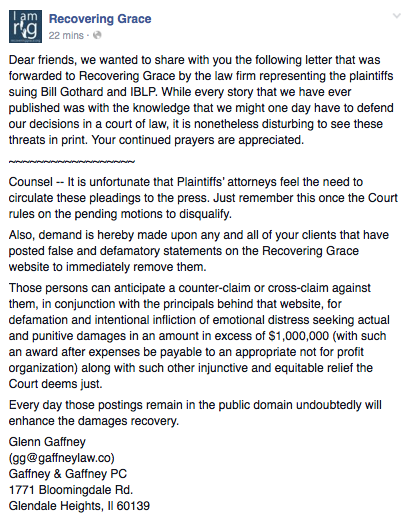
Earlier today, Recovering Grace reported on their Facebook page that Bill Gothard is threatening the whistleblowing organization with a lawsuit. Glenn Gaffney of Gaffney & Gaffney PC, who is representing Gothard against the now-eighteen former employees and students suing him and the Institute in Basic Life Principles (IBLP) for sexual harassment and assault, issued a letter to RG, declaring that, “Demand is hereby made upon any and all of your clients that have posted false and defamatory statements on the Recovering Grace website to immediately remove them.” If RG does not oblige, Gaffney threatens that “those persons can anticipate a counter-claim or cross-claim against them” for the purposes of seeking $1,000,000 or more in damages.

Recovering Grace responded to the legal threats on their Facebook page, saying, “While every story that we have ever published was with the knowledge that we might one day have to defend our decisions in a court of law, it is nonetheless disturbing to see these threats in print.”

The full texts of Recovering Grace’s post and Gaffney’s letter follow, along with a screenshot of them:


Dear friends, we wanted to share with you the following letter that was forwarded to Recovering Grace by the law firm representing the plaintiffs suing Bill Gothard and IBLP. While every story that we have ever published was with the knowledge that we might one day have to defend our decisions in a court of law, it is nonetheless disturbing to see these threats in print. Your continued prayers are appreciated.

~~~~~~~~~~~~~~~~~~

Screen Shot 2016-02-19 at 12.51.15 PMCounsel — It is unfortunate that Plaintiffs’ attorneys feel the need to circulate these pleadings to the press. Just remember this once the Court rules on the pending motions to disqualify.

Also, demand is hereby made upon any and all of your clients that have posted false and defamatory statements on the Recovering Grace website to immediately remove them.

Those persons can anticipate a counter-claim or cross-claim against them, in conjunction with the principals behind that website, for defamation and intentional infliction of emotional distress seeking actual and punitive damages in an amount in excess of $1,000,000 (with such an award after expenses be payable to an appropriate not for profit organization) along with such other injunctive and equitable relief the Court deems just.

Every day those postings remain in the public domain undoubtedly will enhance the damages recovery.

Glenn Gaffney
(gg@gaffneylaw.co)
Gaffney & Gaffney PC
1771 Bloomingdale Rd.
Glendale Heights, Il 60139

Socialization isn’t a freaking joke

CC image courtesy of Flickr, Michael Scott.

Editorial note: The following is reprinted with permission from Samantha Field’s blog. It was originally published on February 11, 2016.

If you’ve been around homeschooling culture for any length of time, you’re probably familiar with how they tend to make fun of “socialization.” When I was growing up as a homeschooled kid, I had “20 Snappy Comebacks” prepared in case I overheard someone asking “b-but but what about socialization?!” I’d been taught– and was firmly convinced– that when people asked about socialization it sprang from a place of ignorance about homeschooling. When you homeschool, I believed, you’re not just limited to interact with people from your grade level, but with children and adults of all ages. Through church (and, theoretically, co-ops, although I only attended one in 2nd grade), we got all the social interaction we could possibly want.

It’s ironic to me now that while I thought that other people were ignorant if they asked me about socialization (which, honest moment, they never did, probably because of how incredibly isolated I was), the fact of the matter is that most homeschoolers who dismiss socialization as a legitimate question are also being ignorant.

Socialization isn’t just “learning to talk to people like a regular human.” It’s not “having friends.” It’s not “engage in social activities.” Socialization is “the process whereby an individual learns to adjust to a group (or society) and behave in a manner approved by the group (or society).” I’ve talked about my own experience with socialization before, and one thing I can confidently say is that if we’re talking about fundamentalism, then I am socialized extremely well. I know how to walk the walk and talk the talk. I know what the acceptable behaviors and language are. I was taught to be extremely well-suited to that environment.

However, now that I’m not in fundamentalism anymore, I am not well socialized. I struggle understanding what the group parameters are, and one of the biggest struggles I face is that I have no metric whatsoever for analyzing my behavior. Was I polite? No idea. Did I hurt someones’ feelings? Not a clue. Did I do or say something weird or awkward? Can’t say. I’m slowly learning how to operate in casual social settings, but there is always a sliver of me that’s panicking the entire time that I’m going to blow it and expose myself as the weird homeschool kid.

But there’s another aspect to this “socialization” question that I’ve yet to see addressed.

Above I noted that I am extremely well socialized to operate in fundamentalist spaces, so I am intimately familiar with what’s required to achieve that and it bothers me.

Every once in a while, I’ll bump into someone commenting on how “well-behaved your children are!” Sometimes it’s people talking about how polite and happy and well-mannered all the Duggar children appear to be. A few years ago I overheard it at a not-fundamentalist church, and it was directed at a mom in a denim jumper with six kids and– no joke– No Greater Joy sticking out of her diaper bag for some reason. “Well-mannered children” is part and parcel of fundamentalist socialization, and there’s a fairly uniform code for what that means:

  • instant obedience
  • obedience with a “good attitude”
  • joyfulness
  • respectful of elders
  • lack of rebellion (individuation)
  • are faithful, diligent members of the religion

The main problem I have with the above is all those people complimenting fundamentalist parents on “well-mannered” children have no freaking idea what it takes to achieve children who behave like that. Children are supposed to be imaginative and express their identity and be unruly and rambunctious and explore and be curious and filled with wonder and sometimes be grumpy and unhappy and annoying.

The methods used to create children who are always smiling, who always obey instantly, who never go through individuation, who never talk back– they should horrify us because they are nightmarish. In order to achieve this, you have to beat infants. You have to strike your children multiple times a day with a switch or a board or a belt. Age-appropriate exploration must be prevented at all costs– either through things like blanket training or slapping a baby every time they reach for a necklace or your hair. You must subject your infant or toddler to brutal physical punishment every single time they show a disavowed form of curiosity about their environment.

For older children and teenagers, you have to completely disallow any form of individuality. They must agree with everything you teach them. Doubts and questions are forbidden. If they attempt to express their own identity, they must be bullied by other members of the fundamentalist community to immediately stamp it out.

Being socialized as a fundamentalist child means being horribly abused. It means being denied any natural part of growing up. So, yes, fundamentalist homeschool families are socializing their children– socialization, really, is inevitable– it’s just what they’re socializing them to. Fundamentalist homeschoolers are largely incapable of socializing their children to be capable, competent, contributing members of society because socializing them in fundamentalism precludes that.

Remember that next time you hear someone comment how cute and quaint and charming the Duggar family is.

Second Amended Complaint Filed in Bill Gothard & IBLP Sex Abuse Lawsuit: 18 Victims in Lawsuit

HA note: The following is reprinted with permission from Julie Anne Smith’s blog Spiritual Sounding Board. It was originally published on February 18, 2016.

Content Warning: Details of sexual abuse and harassment

Yesterday, I received the following summary from the office of Attorney David Gibbs III. While it would have been easy to pull only specific highlights, the reality is that for each individual named, either by their real name or a pseudonym, their lives have been greatly harmed by Bill Gothard and/or the leaders at Institute in Basic Life Principles (IBLP).  I would rather let each survivor’s story be acknowledged and read. This is their voice now speaking out. These are true heroes!  Please pray for them. This is an emotional time for them as they finally get their day in court after years of suffering in silence. ~Julie Anne


Atty. David Gibbs III asked me to forward you the attached copy of the Second Amended Complaint in Wilkinson, et al v. IBLP & Bill Gothard. The Complaint was filed within the last hour and is currently pending review. Below is a summary of the case, and a brief synopsis of the facts stated in the Second Amended Complaint for each client.

Our clients are telling the same story that happened over and over again. There was repeated abuse – re-victimizing women and men for being raped. Psychological abuse and sexual harassment of rape victims. Manipulating and torturing people – including criminal activity – over and over again for decades. The Board knew about it time and time again. Ultimately, they did nothing but after Internet pressure sent Gothard out to further harass victims and cover up the abuse.

The Board states that they are looking forward to the order and structure of the legal process to find the truth. That means they hope they can hide behind a legal technicality to get the case dismissed. What the IBLP won’t do is sit down with these 18 victims, and the others that are out there – like Christians – and open their checkbook and do what is right for these people. IBLP built a 100 Million Dollar organization on the backs of people that they required to work 70 hours per week without paying them over time or in some cases not paying them at all – it was slave labor – but they won’t consider using the assets of that empire that was built on the backs of its victims to do what is right to help these people get counseling and to compensate them for what they helped Bill Gothard and others do to them.

Many of these victims have lost their health, their opportunity to be educated, and had their faith traumatized by a man and his organization. It is heartbreaking that IBLP will not do the right thing by those they have hurt. Instead, the re-victimization continues.

For each Plaintiff, in the NIED count (counts I,V,IX, XIII, XVII, etc.), you will find a description of the facts of that Plaintiff’s case – their story – what happened to them. Those facts are then used as the basis of each of the counts for that Plaintiff.

The following is a brief synopsis of the facts stated in the Second Amended Complaint for each Plaintiff:

1. Gretchen Wilkinson – the Second Amended Complaint states: she was sexually molested and harassed by Bill Gothard. (See paragraphs 123 – 129.)

2. Jane Doe – the Second Amended Complaint states: she was a victim of incest and severe physical and psychological abuse at home. Despite the fact that she repeatedly came to Bill Gothard and IBLP for help, she was told to “let go of her bitterness, “to let go of her rights,” and to “stop being rebellious.” Because she was adopted, Bill Gothard advised her family to disowner her, which they did. Because she was medically fragile, this had a devastating effect on her health. (See paragraphs 155 – 173.)

3. Melody Fedoriw – the Second Amended Complaint states: she was sexually molested by Bill Gothard at IBLP headquarters in 2012 at the age of 15. She made a report to the Hinsdale, Illinois Police Department. The conduct was classified as a misdemeanor and was not prosecuted, because the criminal statute of limitations had passed by the time the report was made and the matter was investigated. An associate of Bill Gothard’s had made a FOIA request for the police report back in 2014. (See paragraphs 200 – 211.

4. Charis Barker – the Second Amended Complaint states: she was sexually harassed by Bill Gothard at IBLP headquarter for an 18 month period, beginning when she was 18 years old. The details of his behavior toward Ms. Barker a very similar to the ways he sexually harassed many of his other victims. (See paragraphs 237 – 258.)

5. Rachel Frost – the Second Amended Complaint states: she was sexually harassed by Bill Gothard at IBLP headquarters while she was a minor and then while she was an adult. This continued over approximately a three-year period. (See paragraphs 282 – 314.)

6. Rachel Lees – the Second Amended Complaint states: she was sexually harassed by Bill Gothard at IBLP headquarters when she was twenty years old for approximately one year. (Paragraphs 339 – 360.)

7. Jane Doe III – the Second Amended Complaint states: she was sexually harassed by Bill Gothard at IBLP headquarters when she was 18 years old. Gothard had invited Jane Doe III to come to headquarters for counseling due to difficulties in her relationship with her father. He really had no interest in counseling Jane Doe III. He used this opportunity to try to separate her from her mother, so he could have her at headquarters alone. When Jane Doe III posted her experiences to the Recovering Grace website, Gothard verbally assaulted her for three weeks, until she agree to take the posts down. Jane Doe III made a number of attempts to bring Gothard’s conduct to the IBLP Board’s attention. She even went to CLA directly, to make sure they were aware of Gothard’s conduct for purposes of their “investigation,” but she was ignored. (Paragraphs 385 – 408.)

8. Jamie Deering – the Second Amended Complaint states that she was one of the younger victims. The Amended Complaint states: Gothard invited her to come to headquarters – alone – at the age of 14. Gothard sexually abused Ms. Deering, including inappropriate touching while she was a minor. Gothard also refused to help Ms. Deering when she attempted to contact him, as a result of physical abuse that she was suffering at home. (See paragraphs 432 – 453.)

9. Ruth Copley Burger – the Second Amended Complaint states that she is the adopted daughter of former IBLP “Biblical Counselor” Kenneth Copley. The Amended Complaint states: Copley repeatedly sexually molested and abused Ms. Burger. This occurred while Ms. Burger was living at the IBLP Indianapolis Training Center. Copley would use Training Center rooms – outside his residence – as the site of some of Ms. Burger’s abuse. He had a history of sexual misconduct before he was hired by IBLP and was ultimately terminated by IBLP due to sexual misconduct. Copley also raped Jane Doe II. (See paragraphs 477 – 494.)

10. Joy Simmons – the Second Amended Complaint states that she was sexually assaulted on her 24th birthday. When Ms. Simmons’ parents and her pastor, Pastor York (who is also an IBLP Board member), learned of the sexual assault, they determined that she was partly to blame for the sexual assault and determined that the appropriate course of action would be to send Ms. Simmons to Bill Gothard for counseling at IBLP headquarters. There, Gothard would press her for details of her sexual assault, sexually harass her while counseling her for her sexual assail,t and require her – on occasion – to work 100 hours a week for little to no money. IBLP refused to pay overtime. (See paragraphs 518 – 547.)

11. JANE DOE IV – the Second Amended Complaint states that she was raped at the age of eleven years old. She was sent to IBLP headquarters for rape counseling. There Gothard flipped a coin and decided that they should not report the First Degree Rape, as it would have been classified under North Carolina law. Gothard advised JANE DOE IV that he was the only one who knew how to counsel rape victims, denied her the opportunity to obtain professional counseling, and sexually harassed her while he was counseling her regarding the rape that she suffered at age 11. JANE DOE IV had to go hungry because of the minimal amount of money IBLP paid her, while requiring her to help take care of disadvantaged young girls. She is the only Plaintiff in this lawsuit who was interviewed for IBLP’s sham investigation. (See paragraphs 572 – 602.)

12. Carmen Okhmatovski – the Second Amended Complaint states that she was 17 when she went to work at IBLP. Although she was scheduled to have ankle tendon surgery when Bill Gothard began to pursue her – to bring her to IBLP headquarters, Gothard advised her parents that he knew a doctor who could cure her ankle problem by injecting her ankles with sugar water. When she arrived at headquarters, no medical care was provided for her ankles. Rather, Ms. Okhmatovski was sexually harassed by Gothard when he would frequently call her to his office, before hours, after hours, during the day, and in an IBLP van during trips. Gothard also sexually harassed Ms. Okhmatovski on a trip to Russia. Ms. Okhmatovski was also aware of the rape of another Plaintiff, JANE DOE V. Although the rape by an IBLP staff person had been reported to Gothard and the IBLP staff, it was never reported to the appropriate state child welfare agency or law enforcement. (See paragraphs 626 – 656.)

13. Jennifer Spurlock – the Second Amended Complaint states that she went to the IBLP Indianapolis Training Center (“ITC”) at the age of 15. Once she arrived, despite only having an 8th grade education, Ms. Spurlock was denied any further education by IBLP. While she was at the ITC, a juvenile delinquent by the name of “Jarvis” attempted to rape her. Fortunately, she was able to fight him off. The attempted rape was never reported to the state child welfare agency or law enforcement out of concern that it would discredit IBLP and the ITC. Ms. Spurlock was then transferred to IBLP headquarters and was assigned the job of keeping Bill Gothard company by sitting outside of his door and being at his “beck and call.” Still, Ms. Spurlock was denied any education beyond the 8th grade education with which she arrived. Gothard would regularly sexually molest Ms. Spurlock by rubbing her upper thighs, near her vaginal area and by rubbing her breasts by hugging her and rubbing his chest back and forth on her breasts, while he made disgusting noises. (See paragraph 680 – 718.)

14. Megan Lind – the Second Amended Complaint states that she was forced, by her parents, into the Indianapolis Training Center at the age of seventeen years old. Both before and after her eighteen birthday, Ms. Lind was illegally confined to her room at the ITC. Frequently, the only opportunity Ms. Lind would have to leave her room was for a counseling session with Bill Gothard. During these sessions, Bill Gothard would sexually harass Ms. Lind. After her eighteenth birthday, Ms. Lind was transferred to another IBLP facility where she was illegally confined and required to make meals for the people in the facility. (See paragraphs 742 – 761.)

15. JANE DOE V – the Second Amended Complaint states that Bill Gothard convinced JANE DOE V’s parents to send her to headquarters when she was fifteen years old. When she arrived, JANE DOE V spent a significant amount of time in Bill Gotahrd’s office in counseling sessions and running errands for Gothard. During the counseling sessions, Gothard would sexually harass JANE DOE V. Because a young man on the headquarters lawn crew took an interest in her, JANE DOE V was sent to the Indianapolis Training Center (“ITC”) in 1997. During an IBLP conference in Knoxville, Tennessee, JANE DOE V was raped by a 22 year-old IBLP staff person by the name of Matthew Heard. Although the rape was reported to the IBLP staff and Bill Gothard, the rape was never reported to the state child welfare agency or law enforcement. When JANE DOE V returned to the ITC, Mr. McWah, director of the leaders in training program, whipped her for being raped. JANE DOE V was regularly locked in the ITC “prayer room” for weeks on end. Sometimes the ITC staff would forget that JANE DOE V was locked in the prayer room and would forget to feed her. At one point ,JANE DOE V had an opportunity to run away. The only place she knew to run was IBLP headquarters. When she arrived, Bill Gothard ordered her back to the ITC. (See paragraphs 786 – 816.)

16. Daniel Dorsett – the Second Amended Complaint states that he began working at IBLP in 1993. From 1994 though 1996 he was Bill Gothard’s primary driver. During this time, Mr. Dorsett saw Bill Gothard sexually harass or molest over one hundred fifty young ladies. Gothard told him that if he told anyone about what he saw he would go “straight to hell.” In 1996, while a participant in IBLP’s ALERT program, Mr. Dorsett was illegally locked in a room for admitting that he had committed a sin. During his brief stay in the ALERT program Mr. Dorsett was exposed to unbearable torture when he was required to perform a mock rescue in the freezing cold in his underwear with no shirt or shoes. (See paragraph 841 – 858.)

17. JANE DOE VI – the Second Amended Complaint states that she went to work for IBLP when she was sixteen years old. She worked for IBLP from 1991 through 1998. From 1992 through 1997, she was Bill Gothard’s assistant. During this time period, Gothard constantly touched JANE DOE VI. He would play “footsie” with her (against her will), hold her hands, rub her legs, and fall asleep on her. JANE DOE VI eventually approached two IBLP Board member’s wives about Gothard’s behavior and the Board apparently implemented a policy in 1997 that prevented Gothard from having female assistants because of the sexual harassment. Apparently that policy was never enforced and the abuse continued. (See paragraph 883 – 896.)

18. JOHN DOE I – the Second Amended Complaint states that he was initially a volunteer and was later employed by the Indianapolis Training Center (“ITC”) from 1993 through 1994 and later from 1996 trough 1997. While he will still a minor at the age of seventeen in 1994, JOHN DOE I was sexually molested by an IBLP employee by the name of William Tollett. JOHN DOE I immediately reported the molestation to his father and ITC staff. Although Tollett resigned from the ITC the next day, the molestation was never reported to state child welfare officials or law enforcement. (See paragraphs 920 – 938.)

Here is the pdf file to the 213-page Second Amended Complaint. Be forewarned, it is very disturbing and details sexual abuse.  Second Amended Complaint