Over the course of my life I have been instructed to forgive so many times. Ironically, the people who were telling me to forgive were also the people who spent a good deal of time telling me that in reality there was nothing to forgive, or that no wrong doing had occurred. Technically I think this means I am off the hook anyways. But in reality, there was wrong doing from people in my life who were supposed to protect me.
I now believe that forgiveness is a religious concept. I believe it was created to control people who have been wronged, by investing them with an equal amount of responsibility for the relationship, so that if they do not choose to forgive and rebuild, they have at least half the blame. After all, if you are a person in power, you can do anything. All you need to do is make sure the recipient of wrong doing feels guilt if they do not choose to trust you again.
I think this can come in so handy for rogue religious leaders and fathers in isolated families. A fear can be fostered over decades that the recipient needs to be open to the idea of allowing similar offences over and over again in the name of forgiveness. The recipient can be handled as many times as needed to allow the cycle to continue.
There is definitely something to gain if you are already in a position of power. The person in power is already in a position to justify their own actions based on whatever act of god or man put them in power in the first place. I am speaking of power in the small scale, but when a person is in this type of power position, it is easy for them to lose sight of their own place in the world. They can become the king of their own little castle, as it were. They need the concept of forgiveness to exist, so that when they violate the rights of those they control, they can keep that control by inflicting guilt on the recipient.
I do think that there is some freedom in moving forward, which is often confused with forgiveness. It is a totally different concept in my opinion. In my opinion, moving forward is more about recognizing that those who violate your rights are choosing to do so, and have no reason to change in a vacuum. A recipient of wrong doing does not incur responsibility, but if they are going to take any kind of action, ending the ability of the person in power to retain the cycle of control is not a bad idea.
Sometimes the only way to break the cycle is to end the relationship. People often seem so horrified by this idea, but why should someone stick around and allow their rights to be violated over and over again in the name of a religious concept that only benefits the wrong-doer? If someone has been traumatized by their own parents, the options are not simply to stick around and try to maintain the relationship or else live in a cess-pool of bitterness and hurt. There is a whole other option out there. You can walk away. You can choose to surround yourself with people who are not interested in violating your rights. When you walk away, you can leave the hurt there too, because you are leaving the source. It isn’t as easy as it sounds, but everyone has a right to live their own lives, regardless of wrong doing in the past. This takes time but no one has to submit themselves to a proven risk.
As little girls play with dolls in dollhouses, so Christian fundamentalist parents play house with their daughters, teaching them from a young age that women are to be homemakers- any college degree or job outside the house being considered prideful or sinful. Worse, college degrees for women are not God’s design. This isn’t your average “homemaker in training” evangelical culture, this is an agenda that reaches far beyond training daughters to know traditional life skills. This takes everything you know about conservative Christian womanhood to an extremist level.
*****
I’d like you to meet several people I have met through the years and was in contact with during my time as a stay-at-home-daughter.
“Wendy”, a late 20-something from Idaho, considers her work to be Pinteresting. She tries to pin 400 things each day. When I talked with her, she said she felt called to “inspire” others and give them a hobby of repinning her pins. When we were friends on Facebook, she listed her work as “Editor of Pins at “Wendy’s” Pinterest.” She takes direction from her parents, from getting her father’s approval every morning on what she wears, to waiting for her mother to choose the meal Wendy will make for dinner. Wendy’s mother still ‘screens’ books and movies to make sure they are wholesome before Wendy and her older sister can read or watch them. Wendy does not make many decisions for herself, without first getting an answer or at least plenty of information from her parents about something. Wendy hopes that a man will come along and marry her- a man who would first have to be interviewed with a several hundred question form and approved by her father before she knew anything about his interest in her, typical of courtship culture ingrained in the stay-at-home daughter movement. Last I knew, she claimed her father’s vision was for her to “refrain from work outside the home” -yet she offered no other clue as to what her father said she should do instead.
“Wendy” seems perfectly happy with her life and being happy and content is important. Yet, she does seem to be oblivious to any other choices available to her. She claims that “deep Bible study” for a few minutes each morning is better than any college degree; that her parents are her shelter from the “evil world” and that if she becomes too educated, she may end up choosing a sinful lifestyle – which she defines as “living outside her father’s home as an unmarried woman.”
“If I become too independent,” “Wendy” said once, “I will not only be disobedient to my parents, but to God who desires all unmarried women to remain at home. I don’t want to live in sin.”
“Daughters, by no means, are not to be independent. They’re not to act outside the scope of their father, and then later, their husbands. As long as they’re under the authority of their fathers, fathers have the ability to nullify or not the oaths and the vows. Daughters can’t just go out independently and say, ‘I’m going to do this or marry whoever I want.’ No. The father has the ability to say, ‘No, I’m sorry, that all has to be approved by me.”
You’ve guessed it, stay at home daughters live under the roof of their parents until they marry- even if they never get married because their father couldn’t approve those who asked! Those who follow this lifestyle believe it is sin for a woman to do anything else, thanks to the teachings of Doug Phillips. It should be noted that Doug, an advocate for “strong, godly families” within the conservative homeschooling community was recently exposed for having an affair with a young girl who worked without pay in his home as a nanny. The girl appeared in an interview in the same documentary mentioned above. While his actions do not automatically “nullify” his teachings – sound doctrine does- it does show the rampant hypocrisy and cover-up that occurs in the every day of dominionist and neo-reformed sects.
Generally, stay at home daughters can volunteer outside of the home, as long as they do not go far, work in a family or Christian setting, and are not paid for their work. You will even find them volunteering in local hospitals with siblings or like-minded friends- again without pay and in context and “accountability” of a family.
Steve and Teri Maxwell, fundamentalist homeschooling parents with a number of adult daughters at home, recently posted an article on their family “Titus 2″ blog detailing the ‘benefits’ of adult stay at home daughters. Though they make it clear their daughters stay at home by their own “choice” – I am left wondering if the women know there are other options, and if those options have been presented in an objective manner.
Teri says “Sometimes our girls are asked about their plans for the future. Right now they are 17, 22, and 31. They are all unmarried and living at home.” She does not address the possibility of how she would respond should one of the daughters want a job or desire to attend college. Teri claims her daughters desire the protection and safety of home and will remain there until marriage. This means that they will likely remain at home until they die since Steve and Teri have apparently made legal provisions that the house remains for their use upon their death. Also, the women and their marriages hinge entirely on Steve’s consent and his interviewing an interested young man- of which he has been rumored to have already turned away several. Nicknamed “Stevehovah” by his “homeschool apostate” critics, Steve Maxwell is known for shadowing his daughters wherever they go- from church to speaking at homeschool events and being a middle man between his children and all incoming contact.
Another argument the Maxwells make on their website is that they enjoy having a strong family unit that is inseparable, citing the Ecclesiastical verse “a threefold cord is not easily broken” using the mother and father as 2 cords and the daughters as a single cord. They enjoy seeing their daughters delight and work in their family’s home, making meals together for their parents and enjoying reading out loud to them in the evenings.
“Our culture typically says for young people to leave home when they are eighteen, and often the parents are happy to be free of them,” says Teri in an article. “We love conversations with our adult children. We like doing things with them. We like them to… ask for counsel. They are Steve and I’s best friends, and we are delighted that they want to live in our home! Allowing our adult, unmarried children to live in our home provides accountability for them. Our daughters are not isolated, they have opportunities to attend church and attend ministry events outside of our home with us.”
However, what exactly is this “protection” they are talking about? Is it not possible for Christian adults of age to handle their own lives, while remaining accountable to God? Where does personal responsibility come in? Why does a 31 year old woman need a fatherly chaperone? In Wendy’s case, why must her father approve her outfit each day to make sure it is modest when Wendy is nearing 30? What is so dangerous and unsafe about the natural maturing of your children? And, within the Maxwell family, who or whom exactly made this decision to keep their daughters at home?
The language used by Steve and Teri is loaded with much authoritarian heavy-handedness, making it seem like the family is all about mom and dad’s wishes for the children- and a quick study of the Maxwell family’s belief shows this is explicitly their intent! From parent-centered curriculum for new parents like controversial Ezzo’s “Babywise” to Bill Gothard’s ATI homeschooling curriculum, many Christian homeschoolers, like the Maxwells, believe that children’s lives should be ordered around their parents’ schedules, plans, and wishes.
The voices missing from this discussion, at least in the Maxwell family- are the daughters’ – who have been raised in an isolated sect of the conservative homeschooling community with few social opportunities outside of Christian homeschool conferences where they speak.
I’m in several online groups consisting of thousands of the homeschool alumni of my generation, the “Joshua Generation”, the products of the Christian homeschooling pioneers. And one major theme going on in our conversations right now is an overwhelming frustration that we cannot talk to our parents. We cannot be real with you.We want a relationship but don’t know how to get past the mental and emotional walls you have put up to protect yourself, the denial that your choices for us caused pain. Your disapproval of our choices and rejection of how you raised us is thick enough to be cut with a knife, and weighs very heavy on our shoulders. Can we just for a moment sit here together, walls and guards down, and be honest with each other? There’s so much we want to say to you, to help you understand. So much WE want to understand. So this is my attempt to give voice to so many, including myself.
Unless you’re never on the internet, I’m sure you know by now that your kids’ generation isn’t turning out how you’d hoped and planned. How you were assured we would if you only followed the rules. Dissatisfaction, pain, anger, and disillusionment are plastered all over the internet by your children and their cohorts. Story after story written by the adult alumni of the homeschool movement, honest and real and painful. Stories of dysfunction and inability to cope in the real world because of the choices you made for them. Stories of pain suffered, feelings of betrayal, and honest, raw emotions that are probably hard for you to see and hear. Words like “spiritual abuse” everywhere, directed at you and the people you trusted to teach your children how to be godly. “Survivor blogs” are popping up, being written by your adult offspring. That’s gotta hurt. We are walking away from so much that you held dear. We are raising our own kids so differently than you raised us. Even the leaders you followed have turned out to be frauds.
I’ve seen your reactions. Denial. Anger. Verbal lashings. Tears. Disbelief. Shunning. Excuses and justifications. Feelings of betrayal. Guilt. So much pain.
“How dare they!”
“We were just doing what we thought was best.”
“We only wanted to protect you.”
“We were trying to follow God the best way we knew how.”
“We gave you the best we could and you repay us by rejecting it all and plastering your discontent all over the internet?!”
“You are dishonoring us by focusing on the bad!”
“You’re just bitter and need to move on.”
“We loved you and this is how you repay us?”
“It wasn’t that bad.”
I understand the sheer amount of unexpected consequences and the reactions of your children must be overwhelming. You didn’t expect this. You did everything “right” and followed the people who had all the answers, who made promises about how your family would turn out if you did what they told you was “God’s will”. And when it didn’t work, those teachers and their followers blamed you and your “rebellious” children. “You must not have followed the rules correctly.” The broken relationships are like a knife in your heart.
Our rejection of your ways is not personal. It’s not a “reaction”, as we have been accused of ad nauseam. Many of us were taught to “stand alone”, to figure out what was right and then go do it regardless of what everyone else was doing.
Well….that’s what we’re doing.
We have weighed the teachings of our past and found them wanting. We have chosen different paths for our own families, much like you did for yours. We have taken what was good and thrown out what was not, some of us throwing out everything because, honestly, there wasn’t much good left to hold on to. Many of us are lost and dysfunctional, trying to put together pieces of a puzzle, trying to live in a world we were not prepared for because we were told we weren’t part of it. Many of you have taken this as ungratefulness toward what you did for us, but this is not about you. This is about us….our lives, our choices, our own children who we must now make choices for.
Can you please stop making this about our rejection of you and instead see it as our embracing of our own lives?
We are your children yet we are not children anymore, many of us older than you were when you set out to raise your family the way you saw fit. We want to have relationship with you, but not as your children. As your equals. As friends. As fellow human beings. Please stop treating us as rebellious children. Think back to when you chose differently than your parents and remember what that was like before you treat us with the same disdain and disappointment.
For those of you invalidating our stories, saying “it wasn’t that bad”, can I ask you to take a step back for a moment? To gain a broader perspective? Because what may have been only a small part of your life, was our ENTIRE lives. You were adults when you chose to attend that Basic Seminar, when you picked up your first courtship books, when you decided to promote the modesty culture, when you chose to become part of a patriarchal system, when you made the choice to spend your kids’ childhoods sheltered from the world in your own little reality and the culture you created. But us? We were born into it. We were raised our whole lives immersed in it.
We spent the most formative years of our cognitive and emotional development in an alternate religious culture ruled by fear, shame, legalism, and authoritarianism. We had no choice. We knew nothing else. We had no other experience and knowledge and discernment to ground us like you did, to give us perspective, to compare anything to.
For you, this was 10-20 years of your life. For us, it was our whole lives. It was all we knew. Our entire lives have been built upon a time period that was just a small part of your own life. So, yes, it was “that bad”. Our experiences were nothing like yours and you’ll have to see them through our eyes if you want to understand.
You had a different life before this, and a different one after. This homeschooling movement and the resulting culture is all we know. It made us who we are, for better or for worse. Our stories cannot be separated from it. We are the products of that movement. You were the facilitators who got to choose what affected you and what didn’t. We didn’t have the capacity as children to even begin to make that choice. What you only observed and instigated and perpetuated, we lived, felt, internalized, and became.
You keep telling us we’re overreacting. You’re offended because we “don’t appreciate” what you did for us. But this is not about you. How we tell our stories and work through the consequences of your choices for us is not about you. It’s about us. Our lives. Our hearts, souls, minds, marriages, relationships, spiritual journeys, and futures. The things we write about how teachings like emotional purity, the umbrella of authority,modesty, and courtship affected us, how they hurt us, messed us up, how we’re working through the messages we received and internalize….these things are not about you. We aren’t telling our stories to “dishonor” you. We’re telling them because truth sets free and light banishes darkness. Because wounds fester in silence and heal in openness. We can love you, forgive you, and have a relationship with you and still tell our stories. We HAVE to tell them and tell them truthfully. Because sometimes it’s the only way to wade through the muck and the crap and the dysfunction that you inflicted on us and we are leaving behind.
Some of you have regrets. You look back and say “What were we thinking?!” You know you made mistakes, big ones, and you know it hurt us, hurt our relationship with you. Some of you are watching your children struggle to overcome the consequences of your choices for them and hurt for them and are angry at yourself. Can you please just say it? Be as open and honest as we are. You know what I don’t hear in the reactions of our parents that I listed above? “We are so sorry.” Why is that so difficult to say? I know it’s scary to think that the choices you made damaged your children. I’m a parent. I have the same fears that my choices will hurt my kids. But as a parent, I cannot imagine NOT telling them “I’m sorry” when they come to me and lay bare their souls, and explain how I’ve hurt them and how they’re healing. Yes, it hurts. But I guarantee that holding it inside and bearing that burden alone will hurt you and your children far more than being honest with them about your regret.
So many of us get it. We get that you were duped. That you were victims of spiritual abuse yourself, who went on to unwittingly inflict that abuse on your kids. Give us a chance to express that. To openly forgive and to honestly work through the anger and the pain with you. Many of us have forgiven you, but we cannot talk about it with you because you refuse to go there. It’s easier for you to just deny the past, our pain, and your part in it. Keep that up, and the denial and facade will eat out your soul til there’s nothing left, while we move on with our lives without you. We want to have a real relationship with you, to repair what was broken, but you are holding so tightly to your elephants in the room, and we have to stay on the surface and walk on eggshells around you, playing your game of pretending that everything was peachy, trying to live well in the present while denying the past. Meanwhile we are frustrated and wonder how much longer we can keep up your charade.
Please stop.
As scary as it is to face pain you caused, it’s much worse to pretend it never happened. So many of us are ready to start building a real relationship with you, to include you in this conversation. But it’s your move. I can’t promise it’ll be easy or good, that’ everything will turn out the way it is supposed to, but it will be worth it, for yourself and for your family. Honest and human is the only way to live.
I asked some of my friends…your children who are now grown…what they would say to their parents if they could. I’d like to end with their words. Listen to their hearts.
“Can you please stop focusing on the extremely few truly good things there were about the way you raised me and just admit, “I was wrong” with no conditions, qualifiers, buts or brakes? Can you please just admit that you were far too strict on standards which had nothing to do with my relationship with God and only hurt my relationships with others, without inserting qualifiers about how your extremism was justified because ‘there was so much evil in the world?”
“The scars from our past are not the fruit of bitterness, but part of the healing process for us. It would help if you acknowledged our feelings and apologized for the pain you caused us instead of passing the blame to us. We don’t demand any retribution for the hurt in the past, but for our relationship to be fully whole we need to be able to talk through what happened without being made out to be the bad guys.”
“If what you did was perfectly right, why did you change with my younger siblings? And if you were wrong… why don’t you acknowledge it??”
“You rejected how you were brought up, how is it wrong of me to do the same?”
“I know you’ve changed, I know you’re trying to love us as best you can. But can you stop pretending the past was perfect? Can you please just say ‘our choices hurt you and we’re sorry’? I’ve forgiven you. But I’m tired of playing your charade, walking on eggshells, pretending that I wasn’t hurt that I’m not still trying to wade through the mess of my past. Can we just talk about it, really, truly, honestly? You want me to ‘move on’ and I will, with or without you. I’d prefer with you. But we have to go back in order to go forward.”
“You disagree with some of my life choices, but I disagree with some of your life choices as well. That is just everyday life: there are very few people with whom you will ever truly agree 100%. We’re both mature adults and need to learn to respect one another’s choices and learn to have a relationship despite our differences.”
“I would like for my Mom to stop whitewashing the past. Instead I’d like her to acknowledge that she and my dad were controlling and manipulative, that they were abusive and authoritarian, that they didn’t trust me (instead treating me as guilty until proven innocent) and they demanded things from me (like my heart) that was not theirs to demand. A lot of what I’d like to hear them say could be summed up as “I’m sorry”. That would go a long, long way for me. But they can’t even say that, not without 60,000 disclaimers like “We were doing our best” and “We were following God”, or worse “YOU DID x, y, z”. If they could ever acknowledge that they did something wrong without attempting to share blame with me… I’d really, really like that.”
“There are parts of me I hide from you because even though you say you love me, I know they would break your heart and make you want to scream. I know because you’ve told me how you felt about my siblings. Since I can’t share these vital parts of myself without disappointing you, I feel like an adult relationship between us is impossible.”
“Please don’t write off my opposition to Christian patriarchy as ‘an ax to grind’ and attribute all my adult decisions to a reactionary attitude or desire to flip off people who haven’t been a part of my life for years. I make decisions based on what’s best for my mental health. And you have to admit, I’m a lot more balanced and cool-headed than you were at my age. Did you get involved in the fringe movements you did as a reaction against your parents? If you did, please consider that I’ve learned from your mistakes and am not repeating them.”
“Why do you act like I’ve turned my back on my upbringing and my faith, just because I don’t agree completely with you? I still love you very much, and it kills me to avoid so many topics with you because you get upset and sad if I’m not parroting you perfectly. You made completely different life choices from your parents and yet you still love and respect them. Why can’t you see that I’m in exactly the same place?”
“Even if you don’t see anything as wrong in the way you raised me or treated me, please recognize and acknowledge I had a very different experience than you perceive. Acknowledge that I was hurt, deeply, and don’t invalidate my childhood.”
“I feel like I don’t need any retribution for the pain of the past, but it would really help to have our feelings acknowledged. That would make a huge difference in moving forward.”
Please, let us have these difficult, but so necessary, conversations with you.
Most Christian homeschoolers know Mary Pride as “the queen of homeschooling,” one of the founders of the Quiverfull movement, the anti-feminism author of The Way Home, or the publisher of the wildly popular magazine “Practical Homeschooling.” But she also wrote a lesser known book in 1985 entitled The Child Abuse Industry: Outrageous Facts About Child Abuse & Everyday Rebellions Against a System that Threatens Every North American Family. It is a remarkable read that calls for a “Second North American Revolution” — namely, having babies, abolishing no-fault divorce, going to church, eliminating foster care, homeschooling, re-instituting “biblical” executions of criminals, and getting rid of abuse hotlines.
And that’s just scratching the surface.
I am currently writing an in-depth, multi-part review and analysis of The Child Abuse Industry, which I will publish on Homeschoolers Anonymous as soon as it is finished. But in the meantime, I want to share with you the 10 best — and by “best,” I mean most disturbing — quotations from this book. (And just to make this more tolerable, I added some gifs.)
Trigger warnings for abuse apologism, abuse denialism, and a racial slur.
Also: As a child abuse survivor myself, I find the gifs make reading these ideas more tolerable. However, another child abuse survivor told that, for him, the gifs make the ideas feel more intense. I want to respect everyone’s different ways of processing, so: if you’d like a gif-free version of this list, click here.
And now, without further ado, I will let Mary Pride speak for herself…
.
*****
.
10. “The major problem is that the public has been convinced that child abuse is a major problem.”
.
.
*****
.
9. “Are one out of four adult women (or one out of three, or two—the statistics keep getting wilder) really the victims of savage lust perpetrated in their youth? Isn’t it possible to organize a bridge party without staring at an abused woman across the table? Where do these wild statistics come from?”
.
.
*****
.
8. “Never vote for a candidate whose campaign promises include ‘doing more for children.'”
.
.
*****
.
7. “Child abuse hysteria is a self-righteous coverup for anti-child attitudes.”
.
*****
.
6. “If [child abuse prevention programs] are allowed to proliferate, we will produce for the first time an entire generation of males who have been trained to consider raping their sons and daughters as passably normal behavior.”
.
.
*****
.
5. “If sex has nothing to do with having babies, you can have sex with anyone or anything. Including children.”
.
.
*****
.
4. “We need to stop allowing the unsupported testimony of children who are of an age where they can barely distinguish fantasy and reality.”
.
.
*****
.
3. “Don’t hotline anyone.”
.
.
*****
.
2. “A retarded daughter told contradictory tales of sexual abuse by her step-brother and other male relatives… So here we have a girl who probably made up the story in the first place.”
.
.
*****
.
1. “Age segregation increasingly alienates children and adults. Children are the ‘new n*****s.'”
Sometimes, as my toddler and I cuddle together to read books on the couch, I can’t help but imagine what our relationship might be like when he becomes a teenager. On some days, I dread it like a slowly-approaching disaster. On other days, I feel a sense of hope that, as I deal with my own issues, I’ll be able to give him something better than I experienced. I’m confronting my old ideas about teenagers head on, and replacing them with healthier and more accurate ideas.
Growing up in fundamentalist homeschooling circles, I heard a lot about “Biblical” parenting–extreme parental authority enforced through potentially abusive levels of spanking. Because it was “Biblical”, this parenting approach was thought to be the only correct way to parent in any culture and in any time period. In short, it was supposed to be universal. I was constantly reminded that the increasing teen rebellion in America and elsewhere was the direct result of parents abandoning these “Biblical” child training principles.
Imagine my surprise to discover that there are entire cultures of people who use exactly the opposite of “Biblical” parenting, yet produce teenagers who are cooperative and contributing members of society.
One fascinating example of this is in the book “Don’t Sleep, There Are Snakes,” which is the autobiography of Daniel Everett, a Bible translator who de-converted after spending nearly 30 years living with a remote Amazonian tribe called the Pirahas. About the Pirahas, Everett writes, “It is interesting to me that in spite of a strong sense of community, there is almost no community-approved coercion of village members. It is unusual for a Piraha to order another Piraha about, even for a parent to order about a child. This happens occasionally, but it is generally frowned upon or discouraged, as indicated by the remarks, expressions, and gestures of others watching” (p. 100). So in the Piraha community, parental authority is not a major part of the child’s experience. Instead, “Piraha children roam about the village and are considered to be related to and partially the responsibility of everyone in the village. But on a day-to-day basis, most Pirahas have nuclear families that include the stable presence of a father, a mother, and siblings (full, half, and adopted). Parents treat their children with much affection, talk to them respectfully and frequently, and rarely discipline them” (p. 98).
Also in contrast to proper “Biblical” parenting, Piraha parents do not use any form of spanking with their children. Everett explains, “Piraha parenting involves no violence, at least in principle. But my model of parenting did” (p. 99). He then describes how his attempts to “Biblically” discipline his child by spanking her led to a huge embarrassing scene in the Piraha village. Spanking a child is a shocking foreign concept to the Pirahas. Instead of using physical discipline to achieve obedience, Piraha parents allow their children to make their own choices and learn from their mistakes. According to Everett, “Piraha children are noisy and rambunctious and can be as stubborn as they choose to be. They have to decide for themselves to do or not to do what their society expects of them. Eventually they learn that it is in their best interests to listen to their parents a bit” (p. 97).
So, growing up without strong parental authority or physical discipline what are Piraha teens like? Everett explains: “Piraha teenagers, like all teenagers, are giggly and can be very squirrelly and rude. They commented that my ass was wide. They farted close to the table as soon as we were sitting down to eat, then laughed like Jerry Lewis. Apparently the profound weirdness of teenagers is universal. But I did not see Piraha teenagers moping, sleeping in late, refusing to accept responsibility for their own actions, or trying out what they considered to be radically new approaches to life. They in fact are highly productive and conformist members of their community in the Piraha sense of productivity…One gets no sense of teenage angst, depression, or insecurity among the Piraha youth” (p. 99-100).
Clearly, this type of parenting approach, even though it is the opposite of “Biblical” parenting, is working out well for the Pirahas in their culture. Piraha culture, however, is very different from American culture, and there are many aspects of their lives that would be unacceptable in the cultural setting of the US. It would be foolish to blindly imitate Piraha parenting and expect similar results in a very different culture.
It is also foolish and simplistic to say that the American problem with teen rebellion is due to the abandonment of “Biblical” parenting principles. In America, the increase in teen rebellion appeared at the same time as American youth culture did; therefore, to find the real answers, it’s necessary to look at the cultural shifts that led to the emergence of the American youth culture almost one hundred years ago.
A very thoroughly-researched and interesting history textbook by Paula Fass, recommended by Libby Anne, covers the major cultural changes in the US in the 1920s. The book, called “The Damned and the Beautiful: American Youth in the 1920s”, focuses on how these cultural changes led to the new influential youth culture during that time. Here are some of the key ideas:
1. For most of history, and even in many third-world countries today, the family had a very specific purpose: to work together to ensure the survival of all of the members. Family members’ time and energy were spent on basic survival, with little time for deep conversation or affection. However, leading up to the 1920s, huge improvements in technology drastically improved the quality of life for many American families. As Fass explains, “advances in industry and the effects of technological progress in labor-saving procedures made this conservation of youthful energy socially feasible. The labors of the young were not immediately needed for social survival or progress” (Kindle location 619). In other words, child labor was no longer necessary for most families in American culture.
2. The decrease in youth work requirements was replaced by anincrease in educational expectations. Because of the technological advancement of society, the youth suddenly needed more education in order to successfully enter society. High schools and colleges at the time saw an shockingly huge and sudden increase in enrollment.
3. Extended education meant that the youth had to remain dependent on their parents for much longer, as Fass explains: “Both parents and children must be willing to accept the parent-child bond for longer periods of time and not to chafe under the terms. Parents must accept the burden of costs, but children must bear the constrictions of continued dependency” (Kindle location 906). Although they were biologically ready for independence, the youth were not mentally ready for the complex and technologically-advanced culture, and thus had to continue living as dependents for far longer than was comfortable. This created the opportunity for far more parent-teen conflict than in previous generations.
4. To adapt to the new educational and vocational reality, many people at the time moved away from small communities to larger urban centers. This urbanization had unexpected effects. The social role of the small friendly community, where everyone knew everyone, was replaced by the impersonal anonymity of the bigger city. In this new impersonal urbanized setting, family dynamics had to change to fit the new needs. Family relationships became much more affectionate, deep, and personal, qualities which had been lacking in previously rural family life. Fass says: “In a rationalized and depersonalized society, the family became an agency of individual nurture and an environment for the development of intimate personal relationships” (Kindle location 1026).
5. Additionally, the increased school enrollment and extended educational time meant that youth spent increasing amounts of time with their peers. Peer influence began to play an important role in the lives of the youth, a role that had previously been played by the tightly-knit community. According to Fass, “the impersonality of the city made families autonomous and anonymous, cut off from the eyes and ears of community control. No longer could community pressures ensure conformity and order” (Kindle location 1176). In this new setting, youthpeer culture provided a transitional middle ground from the affectionate and personalized family life to the depersonalized and performance-based adult society. Fass explains, “the effect of peer activity within the expanded student population was to promote wholesale conformity among ever increasing numbers of adolescents and young adults. Peer pressures and peer groups thus counteracted the individualizing and personalizing trend that had become marked in the family” (Kindle location 1362).
Since the 1920s, the pace of social and technological change has been even more rapid, and in many ways, it is the ever-flexible and adapting youth culture that has enabled so many changes in such a short time. Youth today are more connected to each other than ever before, thanks to social media, smart phones, and entertainment; and they have access to far more information through television and the internet. Is it better for a parent to try to reverse all of this social change, or is it better to learn to work with it?
Perhaps a better model of parenting is to realize that total control in this new cultural context is impossible. Maybe what teens really need from their parents is a few protective boundaries and a lot of openness, approachability, and affirmation. Maybe they need unconditional love from their parents as they experience both social success and social failure with their peers. Maybe they need a deeper relational connection with their parents as they experience the anonymity of life in our urban culture today.
Luckily, I have a lot of time before I’ll have my own teenager to deal with–a lot more time to process this information; a lot more time to hear from others about their positive and negative teen experiences with their parents; a lot more time to hear from parents about their positive and negative experiences with their teens; and best of all, a lot more time to cuddle and read with my toddler.
I’m only certain about one thing: “Biblical” parenting is not for me.
HA note: The following is reprinted with permission from Libby Anne’s blog Love Joy Feminism. It was originally published on Patheos on May 26, 2014.
Some months ago I stated in a blog post that I was becoming increasingly convinced that Christian homeschooling culture is not a safe space for young women and girls. A reader objected in the comments section, misunderstanding I think both what I meant by “Christian homeschooling culture” and “safe space.” Regardless, reading various figures’ responses to the Doug Phillips scandal, and how they discuss Lourdes Torres, Phillips’ victim, has made my assessment only more firm.
But if his attentions were entirely unwelcome to her, and she was freaked out by the creepster, then we have to ask why she wasn’t down the road at the first opportunity — that night or the next morning — with Doug Phillips receiving notification of her opinion of what transpired via the sound of sirens. That’s not what happened, on anyone’s account, and so I don’t think we should identify her as a victim.
For someone who makes his livelihood counseling his parishioners, Wilson shows a stunning lack of understanding of any of the dynamics of abuse. He reiterates his statement in the comments section:
In other words, according to Wilson, if an abuse victim does not get out of the situation at the very first opportunity, she (or he) cannot be identified as a victim. We might as well ask this of every case where a male partner is abusive: “If his abuse was not welcomed by her, then we have to ask why she didn’t leave at the first opportunity, say the first night or the very next morning.” But of course, this is ridiculous. There are a million reasons abused women do not leave the moment their abuse starts. For one thing, it usually begins little by little, and not all at once. But beyond that are plenty of reasons both physical and psychological.
If someone who is a leader and an influential figure in this culture is so clueless as to the dynamics of abuse, how much hope is there that more local leaders will be any less ignorant?
But let’s stop and ask ourselves a question Wilson doesn’t think to ask—what would have happened if Lourdes had come forward about Phillips’ actions? What if she had told other leaders in Phillips’ church, as Wilson would probably prefer, given his propensity for preferring the Matthew 18 approach over civil courts?
First of all, if Lourdes had gone to her church elders they likely would have suspected her of lying. After all, Phillips was a very well respected leader. When the scandal broke several months ago, there were many that had trouble believing it even then. How much more unbelievable would it have been without a paper trail of sorts stretching back for years? Further, Phillips was one of the church elders. These would have been his friends Torres would have been going to. In all likelihood, they would have called him in and asked him what happened, he would have explained it away as nothing, they would have believed him, and that would have been the end of it.
After all, that’s exactly what Gothard did over and over and over again. Someone would say something, some rumor would surface, and Gothard’s board of directors would talk to him about it. He would assure them it was nothing, and they would tell him to be more careful in the future, and everything would go on just as before.
Second, even if Lourdes had gone to her church elders and they had believed that some level of impropriety was going on, they likely would have placed some of the blame on her—even if she went to them immediately. They would have asked her what she had done to lead him on, what she had said or worn or done. They would have asked her if she had fought him off, or if she actually wanted his overtures, and so on. And they very likely would have seen her as tainted herself.
After all, that’s exactly what has happened when female victims have gone to the authorities at Bob Jones University, and Patrick Henry College, and Pensacola Christian College. They’ve been told they must have been asking for it, they’ve been questioned about their clothing or their behavior, and so on.
I also have very little faith in the local church authorities Lourdes would have approached had she followed Matthew 18.
After all, we know that the other leaders in Doug Phillips church knew full well what was going on over six months before Phillips issued his public apology, and over six months before the Vision Forum board of directors decided to shut the ministry down. In February of 2013 Phillips was removed from his position as elder at his church because of his actions, but he was allowed to go on speaking and serving as an influential public figure, even though he had in his personal life made a lie of everything he said from his public platform.
In this culture, the criteria for being a victim is very narrow. If you are among the few who fit the criteria, you receive all the support they can give you, and your abuser alone is condemned as guilty. However, if you don’t fit the criteria you stand guilty and implicated in what happened alongside your abuser. What, you didn’t leave him the first time he raped you? And you say you’re a victim?
It is because of these sorts of narratives and beliefs that I said what I did about Christian homeschooling culture not being a safe space for girls and young women. Yes, this very culture claims to care very much about protecting girls and young women, and many leaders find justification for patriarchy in just that. But while their words say one thing, the systems they create and beliefs they embrace create something very different altogether.
And if my saying this upsets readers, they should focus their energies on combatting these narratives, not on expressing their shock that I could say such a thing.
HA note: The author’s name has been changed to ensure anonymity. “Pearl” is a pseudonym.
I’ve been loosely following Clare’s viral blog post about getting kicked out of her homeschool prom. The story resonated with me because it was similar to things I’ve experienced growing up in conservative homeschool/purity culture. Unfortunately, some homeschool parents gave a really ugly response to her story. They felt that, since she had used bad language, and put purity culture in a bad light, that it would be OK to publicly share unsubstantiated claims about her behavior the night of prom. They didn’t like her individual narrative, so they replaced it with another individual narrative they did like, because, well, any girl who would use curse words must also be a liar and a slut.
I thought they were supposed to be adults, but all bets are off when you step out of line in their eyes.
Fine, if they won’t believe Clare’s story I’ll share my own.
Growing up, my mom put a lot of importance in how I appeared to others. We had a lot of conflicts about her wanting me to dress in a way that would look good to her friends. For example, wearing a dress to Thanksgiving dinner at a friends house even though I knew I’d be playing outside all day. When I started wearing bras she bought me a really uncomfortable bra that she would make me wear on Sunday. I hated it because, besides being uncomfortable, it had thick seams through the cups that showed through every top and made me very self-conscious.
I still don’t understand how breasts can have a Sunday-appropriate look.
There was such fuss about bras and how they made my breasts look that I started slouching badly to try and hide my breasts entirely. At 17, she bought me a hideous dress that didn’t fit for a special occasion at church. I didn’t have a choice, I had to wear it because it made me look “nice”.
The emphasis on modesty really began around 11 or 12 when I began puberty. Whenever we went shopping my mom would examine clothes on me in the dressing room to make sure they were modest enough before purchasing. (Or have me come out and model for pre-approval in the case of hand-me-downs.) I would see clothes other girls were wearing, and naturally wanted to dress in a way that made me feel cute and like I fit in with other girls my age. Around age 13 I would try choosing clothes at the store, but when mom gave them the once over in the dressing room they rarely passed the modesty test. Shorts had to go pretty much to my knees, shirts had to be loose enough to create a straight line down my sides. If clothes I chose didn’t pass the test I had to stand in front of the mirror and look at myself while my mom pointed out all of my undesirable body parts the clothes were supposedly drawing attention to.
It was so humiliating I eventually took the easy route and started dressing like a boy.
The grunge era was only about 5 years past, so you could still buy flannel shirts and baggy jeans for girls. I stopped wearing shorts entirely around age 14.
My mom would always tell me that I just couldn’t understand because I didn’t understand how boys think. Boys, she said, think about sex all the time, and I could cause them to stumble (lust after me) by dressing immodestly. I couldn’t possibly understand, she said, because girls don’t care that much about sex, they really only want love. I became very ashamed of my body and for the most part tried to hide it. If I ever felt a burst of confidence and wanted to wear something cute and feminine I would usually have it pointed out to me that someone would see the shape of my breasts, or the curve of my waist, or that my bra was showing, or that these shorts or skirt were too short and any thing more than an inch or so above the knee was too tempting.
By the time I was 19 years old I had a job and had saved up some money and started going shopping for my own clothes for the first time. The clothes I chose were kind of tacky, because I didn’t have any practice dressing myself. But by nearly anyone’s standards they were very modest. I didn’t even wear shorts, I was still too ashamed of my legs, but I did wear skirts to church. The skirts I chose always went below my knees. I didn’t wear tank tops, most of my shirts actually had collars. The shirts were fitted, and except for one not tight.
The first fitted, collared T-shirt that I brought home made my mom cry.
She said she could see the curves of my waste and the shape of my breasts. I felt cute and feminine for the first time in my life, so I didn’t allow myself to be guilted into giving it up. I started standing up straight. I also bought bras for myself, and chose some with some amount of padding because I felt more covered in case of cold weather. My mom saw one out drying after I did laundry, and brought it to me to show me how the padding made my breasts look bigger, and that was immodest. I had a pair of shoes I’d wear to church that had one and half inch heels. My parents expressed concerns that they were too sexy.
A few months after buying my own wardrobe, my parents came to me to tell me that an elder in our church had approached my dad to tell him the way I was dressing was causing his sons to stumble.
My parents made me show them each piece of the clothing I had bought so they could decide whether it was modest enough. Very few pieces passed their test. The rest they ordered me to put up in my closet until I was married and it was my husband’s job to decide how I dressed. (Fortunately my wedding was only a few months after that.) In the meantime, I bought a few baggy T-shirts to get by on; it would’ve been too humiliating to go back to the flour sacks I had to wear before.
Modesty/purity doctrines and body shaming are an unfortunate realty of conservative Christian culture. They may or may not be directly related to homeschooling, but I have yet to find anyone who believed these things that wasn’t a homeschooling parent. There is nothing girls in these situations can do. Once someone has told you you are causing them to stumble you have to change your clothes, no matter how humiliating or unreasonable it may be. To do otherwise would be tempting someone on purpose, because now you know that you’re causing them to sin.
Growing up hearing these things made me very ashamed of my body. It took years after getting married before I was even comfortable wearing shorts. Making a girl ashamed of her body is a horribly cruel thing to do. It’s not like there isn’t enough pressure to look and dress certain ways from mainstream culture.
So that’s my story. It won’t be a viral success, but if enough girls tell their stories there is no way that homeschool parents can say they are exaggerating, or that they have some kind of malicious vendetta, or that they deserve to have their reputations damaged.
So here’s to girls who have been made ashamed of their bodies.
You are a person, body and soul, your body is you. And you don’t have to be ashamed of having a female body. It is beautiful, don’t hide it.
In my last post, I made a brief mention of how living in a state of survival affected my mental health. I thought it would be a good idea to expand on this issue, because in my opinion it is the crux of why having quiverfull families and homeschooling in chaos is abusive to the children involved.
As I have mentioned before, doing something that causes harm to your child is abusive regardless of your intentions or religious justification. Children are do not become raised in a vacuum. Children do not have the ability to protect their own interests, and as I have shown in a previous post, in fact unfortunately do not have the right to do so. Therefore it is a parent’s job to try to protect their children from harm as much as possible – no perfection required – and to introduce good things and reduce negative influences as much as possible. It is my belief that that most parents would not argue with this assertion, because most parents have their children’s best interests in mind.
When a child is raised a quiverfull family, there is a core belief involved that stipulates that older children should help raise their younger siblings.
This is commonly known to those outside the quiverfull movement as the “buddy system”, but survivors sometimes call this “sister-moms”. The use of older siblings to care for younger siblings can cause various levels of neglect depending on how organized the family is and whether there is homeschooling involved. It is typically simply impossible for a mother of 6 or more children to recover from childbirth and unending pregnancies at the same time as being able to provide adequate care to that many children, provide adequate schooling for that many different grades, cook nutritious meals, do laundry, and keep house. Don’t get me wrong, I do not object to children having chores. I do object to a ten year old child being responsible for a whole department of parenting or housekeeping, such as all cooking, or all laundry or all cleaning or all child care.
This is the difference between a child helping with chores, and “the use” of children to help raise other children or “take over” certain aspects of being a housekeeping mother. When there is a high level of chaos, the older children can become invested in running the household. Indeed, that is the goal of quiverfull families: to pass on the ideals of raising a big family and having women stay in the home and replicate the family values as soon as they are old enough. However, this emotional investment will have one of two outcomes: either the sister-mom will succeed in pulling off an inappropriate amount of responsibility in the home and move on to their own submissive marriage and many children without ever experiencing her own life, or she will fail at the vast amount of work required to raise a family as a young teen. If she succeeds, it is a tragedy.
If she fails – and many fail – she will be subject to shame by others inside and outside the family. The problem is, in order for a daughter to participate in the investment I described above, there is a certain amount of self-deception required. The girl must become oblivious to her own needs and desires, ignore her own sexuality, and truly believe in the moral obligation to participate, to the exclusion of all other life paths. Otherwise she will object to what is being taken from her.
The other important factor apart from self-deception is self-preservation.
In a chaotic situation, there is difficulty in maintaining discipline, and some parents do not have the skills to do so with a few children, let alone over half a dozen. Child abuse and “squeaky wheel” parenting is very common, where children are punished for being loud and only receive help when they are insistent enough to get it but not loud enough to warrant punishment. In this type of environment, there is not enough parental supervision to guarantee good behavior, so they may depend on older children to help supervise the younger children. Sometimes this means that if younger children misbehave, the child responsible for watching them may also be punished for not preventing the infraction. When this happens, the goal becomes less about moral behavior and more about each child protecting themselves from punishment.
A sister-mom who has juggled age-inappropriate levels of chores and child care for years, and is responsible for the behavior of others, lives in a haze of survival. They do not let themselves fully absorb what is going on around them, and do not allow themselves to experience the unfairness in their lives. When a failure takes place, the entire facade crumbles down. The girl will realize that the very parts of herself, the very skills she takes pride in, are what makes her different and scarred compared to others the same age. She will realize other girls have something she does not have: an identity outside of someone else’s children and ideology. If a girl fails at being a sister-mom, there is nothing left unless she makes something happen. If you have no other identity and no social skills, building these from scratch as a teenager seems like an insurmountable task.
The process of disillusionment that takes place is terrifying and horrifying.
Imagine spending several years working on something you really believed in, and investing every moment of every day in it, and believing that it was your life purpose, and one day it simply falls away. Teenaged girls in this situation are typically quite sheltered as well, and tend to not know much about depression and self-harm, which means that they are exposed to the life-changing effects without understanding what is going on, and believing that they are deficient in some way and are the only one in the world going through those feelings.
Quiverfull families are not open to exploring such issues and seeking help, and such help would be counter-productive to the goals of the ideology. Sometimes such girls retreat from their moment of clarity back into the haze and try again. Others are given help within the ideological circle, and the girls are encouraged to suppress their feelings. Others leave.
For the ones who leave and start their lives over outside the quiverfull community, it can take years to start to feel normal. It is difficult to feel normal when you are not living the purpose you have been taught, and are no longer pursuing those goals. Another important aspect is that as a sister-mom, a girl will raise children who are not hers. When she leaves, she walks away from small children who she loves and they know her as the source of food and comfort. It is impossible to fully describe the loss this causes, and the unselfish teachings from childhood can make it difficult to move forward with one’s own life when there is a huge part of the soul that is still attached to the raising and protecting of younger siblings.
When a girl starts to open up to her own life, she will start to realize how much of her life has been used up to pursue the goals of someone else. There is resentment towards both the parents and the siblings, which brings with it the conflict of not wanting to resent siblings for what they had no control over. Sister-moms are taught to not pursue their own goals and to malign typical ‘worldly’ goals, and it can be painful to process what is right and wrong and pick a moral code to live by. Sister-moms who leave will often also simply miss their families and feel rejection because they cannot stay and live their lives. They will feel confusion and shame, and be afraid of going to hell for their actions.
They experience the conflict of self-preservation both while living in the haze and while getting out. All these experiences can trigger depression, self-harm, and self-destructive behavior, and when a girl is used to living in a haze of denial, it is very difficult to get out of the new haze of depression if she falls into it.
A parent risking a girl’s mental health to get help with child raising other children is abuse.
HA note: The following is reprinted with permission from Libby Anne’s blog Love Joy Feminism. It was originally published on Patheos on May 19, 2014.
When a federal judge struck down Idaho’s gay marriage ban last week, fellow blogger Kathryn Elizabeth tweeted the news at Christian pastor and author Douglas Wilson. Wilson is well known for his anti-gay views, and he and Kathryn Elizabeth have sparred over the issue before. Wilson’s response won’t be a surprise to anyone familiar with his work, but it illustrates a problem among religious opponents of LGBTQ rights.
Yes, you read that right—Wilson is worried about being sent off to “Gaylag Archipelago.” But don’t let the obvious hyperbole lead you to miss the point—it is mainstream within evangelicalism today to speak of being “persecuted” or “hated” for being anti-gay. A WORLD magazine article titled “‘Haters’ and the Hated” made this point last year:
The word has come down a lot. Once it applied to Adolf Hitler; now to Chick-fil-A. The “haters” of today, as defined by popular rhetoric, are those who argue with current wisdom. . . . It’s easy to attach the hate label to opponents of the issue du jour, and only a slight stretch of the imagination to picture today’s haters stringing up the issue du jour to lampposts in the devilish light of bonfires. This is convenient: If all your opponents are haters, righteous indignation is a valid response. Haters barely deserve to live, much less shape public policy. They must be defeated, by any means necessary.
But let’s talk about the real thing. “If the world hates you, know that it has hated me before it hated you” (John 15:18). . . . To the extent that you abide in Christ, the world will hate you. It will even project its hatred on you.
Bryan Fischer of the American Family Association was even more clear:
We’re hearing a lot about the reinstatement of segregationist Jim Crow laws these days, as homosexual activists fling this accusation at the state of Arizona. They argue that SB1062, a bill which simply protects religious liberty in the Copper State, is tantamount to the reinstatement of discriminatory laws.
As so often is the case, the situation is actually the reverse. It is in fact the bullies and bigots of Big Gay who are reinstating Jim Crow laws, only this time the marginalized and segregated Americans are Christian businessmen. Faith-driven vendors are being told that unless they submit to the owners of the liberal plantation, they will be punished by their homosexualized overlords and sent to the margins of society.
Hence the “Gaylag Archipelago.” I was a child in the 1990s, before marriage equality took the center stage it has today, but even I remember hearing that with the direction the country was heading Christians would eventually be put in jail for believing that homosexuality is a sin. The “Gaylag Archipelago” fits this mentality perfectly—it imagines a world where gay people are the oppressors and evangelical Christians are being robbed of their rights and will ultimately be rounded up and put in internment camps.
The same sex marriage crusade has nothing whatever to do with what people can do sexually in private, and it has everything to do with what you will be allowed to say about it in public. We are not talking about whether private homosexual behavior will be penalized, but whether public opposition to homosexual behavior will be penalized.
But you know what? I’ve been involved in the movement for marriage equality for some time now, and I have yet to hear a single person call for those who believe homosexuality is sin to be jailed or sent to work camps. I also haven’t heard anyone calling for banning people from stating that they believe homosexuality is a sin. In actuality, the belief that homosexuality is sinful will go the way of the belief that black people and other minorities are lesser than white people. No one is put in jail for being racist, or even for publicly airing their racist sentiments (unless those sentiments involve threatening physical harm). There are no gulags where racists are rounded up and imprisoned.
We do not believe that homosexual behavior out to be normalized. We don’t think—I don’t think it ought to be legalized. It should not be promoted, it should not be endorsed, it should not be sanctioned, it should not be subsidized. And, in fact, this is the way it was in America for the first 342 years of our existence, well the first 357 years of our existence, from Jamestown in 1607 until Illinois in 1962, the first state in the union to lift sanctions, criminal sanctions, against homosexual behavior. It was still sanctioned in 49 states until 1972, it was even sanctioned according to Antonin Scalia in about 24 states in 2003 when the Lawrence v. Texas ruling came down I counted up about 12 or 14 but somewhere in that neighborhood still had public policies that prohibited homosexual behavior, did not give it legal sanction, it was prohibited, it was against the law under their state code. And so, we believe, I believe, I’ll just speak for myself here, I believe that homosexual behavior should again be contrary to public policy, to put it bluntly it ought to be against the law.
So then the question comes in, what sort of sanctions are you prepared to impose? If it’s going to be against the law, and the law is going to be applied, somebody is apprehended in a way that calls into play this law, this public policy against homosexual behavior, what should be done? What should be done with those defenders? And that’s a legitimate question. Do you put them to death, like they did under the Mosaic law, do you lock them up, do you fine them, what do you do?
Well I want to suggest something, and this just absolutely ticks off homosexual activists, but it makes perfect sense to me. Remember, we’ve talked about this before, but according to the CDC . . . 91% of all of the males in the history of the [AIDS] epidemic either contracted HIV aids through having sex with other men or through injection with drug abuse. Now we have policies in our culture to deal with injection with drug abuse. . . . So here’s my suggestion, very simple, very straightforward, that our sanctions for homosexual conduct should be the same as they are for drug abuse. In other words, whatever we decide are appropriate public policies to deal with drug abuse, those ought to be the same policies that we use for dealing with homosexual behavior because the risks are the same. If we’re concerned about the health of people involved in injection drug abuse, we want to protect them, we want to liberate them from this, and we’re going to have certain policies in place to deal with that, it could involve fines, it could involve incarceration.
We’re seeing a real trend for people who deal in the drug issue to move away from incarceration for nonviolent drug offenders toward rehabilitation. Let’s put these people in therapy, let’s get them in a drug treatment center, rather than lock them up let’s get them help. Now frankly, I am sympathetic to that. . . . Here’s what I’m getting at. . . . What I’m talking about is taking the same policies that we use for drug offenders, because we know it destroys people, it hurts them, it damages them, and since the same health risks exist with homosexual behavior, then it seems to me that we ought to take the same policies and apply them to homosexual conduct, that we ought to direct people toward rehabilitation as an alternative to incarceration. Let’s not lock them up, let’s get them therapy, let’s get them help. I mentioned Nicolas Cummings, former president of the American Psychological Association, he says look, it works, conversion therapy, reparative theory, whatever you want to call it, if people are motivated, they can change, they can redirect their sexual energy. . . . This approach fits with conservative principles.
Sometimes I wonder if the reason people like Bryan Fischer are convinced that LGBTQ activists want them stripped of their rights and imprisoned is that they are projecting what they in fact want on their opponents. In other words, Bryan Fischer wants to make “homosexual behavior” against the law, and wants to give “offenders” a choice between prison and reparative therapy, so he assumes that his opponents want to make “true” Christianity against the law, and to imprison or “reeducate” offenders.
And what about Doug Wilson, of “Gaylag Archipelago”? Wilson has increasingly refused to fully nail down his position on what should be done with gay and lesbian individuals, among other. This may be in part because some of his earlier forays on the subject resulted in widespread outcry. For example, Wilson had this to say in a 2003 interview:
The Bible indicates the punishment for homosexuality is death. The Bible also indicates the punishment for homosexuality is exile. So death is not the minimal punishment for a homosexual. There are other alternatives.
Wilson says he rejects the Reconstructionists’ political tactics and distances himself from the label, claiming that his view of Old Testament law is more subtle than theirs. But when I asked what he thought of the death penalty for homosexual acts suggested in Leviticus 20:13, he did not shy away from the theonomic hard line that disturbs many Christians. “You can’t apply Scripture woodenly,” he says. “You might exile some homosexuals, depending on the circumstances and the age of the victim. There are circumstances where I’d be in favor of execution for adultery.…I’m not proposing legislation. All I’m doing is refusing to apologize for certain parts of the Bible.”
There’s also the matter of Wilson’s magazine, Credenda/Agenda. Wilson is both founder and editor of the publication, and some years back he published an article titled Your Eye Shall Not Pity, by Greg Dickinson. This article is less ambiguous.
The civil magistrate is the minister of God to execute wrath on the wrongdoer (Rom. 13:4). God has not left his civil minister without guidance on how to exercise his office. The Scriptures set forth clear standards of judgment for many offenses. Capital crimes, for example, include premeditated killing (murder), kidnapping, sorcery, bestiality, adultery, homosexuality, and cursing one’s parents (Ex. 21:14; 21:16; 22:18; 22:19; Lev. 20:10; 20:13; Ex. 21:17).
In contemporary American jurisprudence, none of these offenses is punishable by death, with the occasional exception of murder. The magistrates have dispensed with God’s standards of justice. Some Christians believe this is an improvement. They would be horrified to think that the “harsh” penalties of the law should still be applied. Sometimes this is the result of the mistaken belief that the Old Testament has no further application after the advent of Christ. This is an exegetical problem. Too often, it is the result of a sinful view of the criminal. This sin is called pity.
. . .
Thus, the Bible teaches that pity is not an option where God has decided the matter.The magistrate, God’s minister, is to faithfully execute justice according to God’s standard, not man’s.
What the Bible does not teach is that the preaching of the gospel and repentance have no place on death row. Indeed, it is hard to imagine a place where there is a more immediate need of grace, and a presentation of the gospel should be the first response of Christians to those who are condemned. But condemnation still must come if we are to be obedient to God’s Word.
We must respond to the wrongdoer biblically in both judgment and grace. This means that we must return to an obedience which confines pity within the bounds which God has established for us.
It’s worth noting that no one has put either Doug Wilson or Greg Dickinson in jail for what they have said. Indeed, neither has been arrested for their comments, or fined. Just as there are no laws against racist comments, there are no laws against calling homosexuality sin—nor are there likely to be. Contrary to Wilson’s reference to a “Gaylag Archipelago,” Wilson and his friends are free to go on saying these things if they so choose. But while they are legally free to call down all the divine judgement they please, they do not get a free pass from popular outrage.
I suspect that Wilson’s references to a “Gaylag Archipelago” may stem from some of his recent experiences when speaking on college campuses. In 2012, Wilson was heckled and shouted over during a speaking engagement at Indiana University. I suspect Wilson blurs the line between popular anger over his views on homosexuality and legal oppression. Of course, that problem goes beyond Wilson. The WORLD magazine article I quoted above claimed that “The ‘haters’ of today, as defined by popular rhetoric, are those who argue with current wisdom.” In other words, the author is under the impression that evangelicals are “hated” simply because they disagree with the popular consensus. It’s as though she cannot see the very real pain and damage evangelicals cause by their opposition to LGBTQ rights and their belief that same-sex attraction is sinful, and the anger that pain might inspire.
I don’t want to give the impression that every evangelical Christian wants gay people to be executed, rounded up, exiled, or sentenced to reparative therapy. In 2013, 59% of white evangelicals said that homosexuality should be “discouraged” but 30% said it should be “accepted.” Also in 2013, 49% of white evangelicals supported some form of civil union. But there seems to be a fairly high correlation between evangelicals who claim to be persecuted by the push for LGBTQ rights and evangelicals who believe homosexual behavior, as they term it, should come with legal sanction. And that correlation makes Wilson’s reference to the possibility of being sent to a “Gaylag Archipelago” incredibly disingenuous.
HA note: The following is reprinted with permission from Julie Anne Smith’s blog Spiritual Sounding Board. It was originally published on May 8, 2014 and has been slightly modified for HA.
*****
Suppose you see a bird walking around in a farm yard. This bird has no label that says ‘duck’. But the bird certainly looks like a duck. Also, he goes to the pond and you notice that he swims like a duck. Then he opens his beak and quacks like a duck. Well, by this time you have probably reached the conclusion that the bird is a duck, whether he’s wearing a label or not.
~Richard Cunningham Patterson Jr., United States ambassador to Guatemala during the Cold War in 1950
*****
Are you familiar with the Duck Test? It’s an inductive reasoning test. This familiar expression is an example of inductive reasoning:
If it looks like a duck, swims like a duck, and quacks like a duck, then it probably is a duck.
I think it’s important to document what happened so that people can see for themselves and discern. Do the behaviors match the message? What is the fruit that we see? Is this the kind of teaching we want to stand behind and pay good money to hear at conferences? Do we want these foundational teachings to influence our families for decades?
Last week, R.L. Stollar, co-founder of Homeschoolers Anonymous, informed me that Kelly Crawford had written a blog article in 2008 entitled, “Tired of Patriarchy’s Bad Rap.”
Crawford’s article comes up here on a Google search:
Homeschoolers Anonymous shared Crawford’s 2008 article on their Facebook page recently (on April 29) and noticed the article was removed between 4/29 and 5/2. Stollar also quoted Crawford in his comment:
For a clear definition of biblical patriarchy,” she said, you should “go here” — here being a link to the now-defunct Vision Forum’s “Tenets of Biblical Patriarchy.”
The “Tenants of Biblical Patriarchy” has been long scrubbed from the Vision Forum website, but here is the cached copy.
Homeschoolers Anonymous has a copy of Kelly Crawford’s article on file here. When will people learn that if they post articles on the internet and remove them, it makes them look like a fool? Take a look at the first two paragraphs of her article, the article she scrubbed:
I guess I’ll be rehashing the same topics with new names until I die, but they won’t let me go.
There is something I’m so tired of. The word “patriarchy” is practically synonymous with an explicative in this culture. I’m tired of that. Patriarchy is not a new concept, but one as old as the world itself. It is biblical and if you don’t like it, and you’re a Christian, perhaps a new religion would suit you better.
So, did Kelly Crawford change her views on Patriarchy?
She said she would rehash the same topics until she dies. Why would she remove that article from 2008? What is she trying to hide?
Quack, quack.
After posting the “Queen Bees” article, both Stacy McDonald and Kelly Crawford came to my blog to comment, having never participated at Spiritual Sounding Board before. We saw their true colors:
Yes, Stacy McDonald, publicly made a low blow about the mental stability of one of my commenters.
Stacy has had a couple of weeks to think about that comment, a couple of weeks to e-mail me and say that perhaps she was out of line with that wording, but she has not. That was a rude comment. People pay to hear this woman speak, they read her blog articles. They look to her for guidance in how to raise their families. Enough said.I also want to point out another incident that occurred on the same day the article was being discussed here. Spiritual Sounding Board reader Taunya reported that Kelly Crawford privately emailed her after 6 years of silence between the two saying,“Can’t you see what kind of people you’re running with now? The evidence, the fruit, is so clear.”
Did you notice the 6-years-of-silence part?
Although Crawford doesn’t mention the silence, it’s important to the whole story. Obviously this hit a nerve for Crawford and is not something to be dismissed lightly. Imagine Taunya’s surprise in receiving such an e-mail after so many years of silence. Let me put in my own words my interpretation of what Crawford is saying: This information I am sending you is so important that I am breaking 6 years of silence to send it to you. Listen to me! If you don’t believe the way Stacy and I believe, you’re one of those bad-fruit people.
What was the rotten fruit Taunya was talking about? Things like this:
Furthermore it is not “God’s will” for adult daughters to live in the homes of their fathers until marriage. There is nothing biblically wrong with young women attending college, working or living on their own. This is wrong and any woman falling for this as “God’s Word” is deceived. These are cult-like teachings must like the idea that women need to wear skirts and dresses for the sake of modesty or that it is wrong to limit the number of children one has.
And:
The definition of priest says it all Kelly! No women needs a priest! A man goes directly to God through Jesus and a woman does as well. She does not need her husband to be her mediator nor does she need him to be her prophet. She can read Scripture and the Holy Spirit resides in her just as He does her husband, no need for a husband to be her prophet! And KING? Wasn’t that addressed in the Old Testament. None of us need a king, we have that in Christ.
Doesn’t that 6-year silence also say a lot? It reminds me of junior high. “I’m not going to be your friend if you don’t like Suzy Q.” Do you see what this is? It’s my-way-or-the-highway mentality. You have to go along with my beliefs in order to be part of my group. It creates an us vs. them mentality. You are either in, or your are out.
*****
If it looks like a duck, and quacks like a duck, we have at least to consider the possibility that we have a small aquatic bird of the family Anatidae on our hands.
~Douglas Adams
*****
Quack, quack.
Stacy and Kelly left the conversation, but the conversation continued to over 400 comments, but look what happened within 24 hours on Stacy and James McDonald’s Facebook page. The first is a rant from James McDonald:
Attitude much, James?
On the same day, April 23, Stacy posted a note on her Facebook wall endorsing her husband’s article, “The ‘P’ Word,” which is about Patriarchy. Her husband, in his article on Patriarchy discusses words and their meanings and how sometimes the meanings change. He tries to paint a beautiful picture of Patriarchy.
But check this out, is she really saying she is going to have to disguise that P (patriarchy) word from her vocabulary?
Stacy McDonald: All that being said, I personally believe that, for the sake of clarity, and knowing that the word has been so ravaged in the eyes of so many, it’s best to not to use the word. Because the term is not as important as the principle. “A rose by any other name would smell as sweet.” Biblical order is important, but we don’t have to use a word that provokes people or causes them to misunderstand us.
Ok, so let’s just act like that word doesn’t exist. Is that what she’s saying? We’re going to continue doing the talk, and walking the walk, but we’re just not going to let anyone know what we’re really doing is Patriarchy.
*****
When I see a bird that walks like a duck and swims like a duck and quacks like a duck, I call that bird a duck.
~James Whitcomb Riley
*****
What we see is a very familiar pattern of behavior:
anyone who disagrees is labeled in a negative way: mentally disabled, rotten fruit, divisive, some might even question the salvation of one who disagrees
instead of addressing conflict or misunderstandings: remove article entirely with no explanation
completely mischaracterize a critic, claiming criticisms they never made like a “strawman,” then talk only about the strawman instead of the matter at hand
publicly air a “woe is me” rant of martyrdom on own forum to garner support and “attaboys”
black/white thinking: you are for us or against us
Folks, the above patterns are the rotten fruit.
It’s rotten fruit in attempt to defend more stinking, rotten fruit: Patriarchy.Stacy and Kelly have been promoting “Biblical Patriarchy” for years. Now Stacy wants to quack about it, without using the P word. It’s time to call this heretical teaching out now. It is destroying families. It is keeping young ladies held captive in their own homes, not giving them choices to further their education, to be critical thinkers, to use the creative minds God created for them.
Removing blog articles and not saying the P word is not going to change the fact that Patriarchy = Duck.












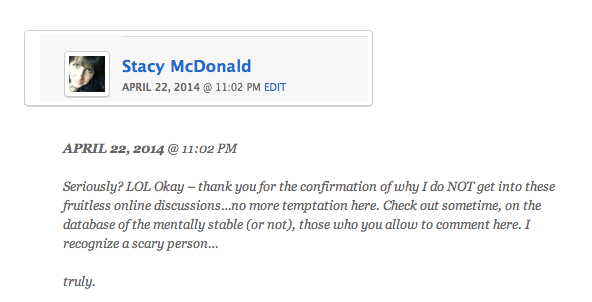
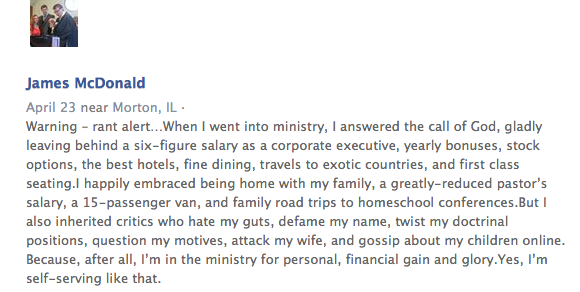
 Homeschoolers Anonymous