Not All Homeschoolers Are Religious (But Many Are)

Screen Shot 2014-05-15 at 4.23.15 PM

HA note: The following is reprinted with permission from Libby Anne’s blog Love Joy Feminism. It was originally published on Patheos on May 14, 2014.

Sometimes I feel like I have to play this thing from both sides.

When I and other bloggers talk about some of the problems in the conservative Christian homeschooling subculture, we are informed by secular homeschool parents that not all homeschoolers are religious, and in fact that religious homeschoolers are just a minority today and not really a problem to be worried about. Well yes, we know that not all homeschoolers are religious. However, it’s a simple fact that many—perhaps even the majority—are.

When I read comments on mainstream news articles about things like Clare being kicked out of her homeschool prom for her dress, I see individuals who assume that all homeschoolers are religious, that all homeschooling is about religious indoctrination, and that homeschooling should therefore be shut down plain and simple. This is not helpful and certainly not true. There are secular homeschool leaders, textbooks, support groups, and conventions. A significant and growing percentage of homeschoolers are not religious homeschoolers.

And here I am, caught in the middle of misperceptions on both sides.

There is a lot I could say here, but I think it might just be simplest to quote from information put out by the Coalition for Responsible Home Education. This passage comes from “Reasons Parents Homeschool,” a page on the organization’s website.

Sociological research on homeschool families and their motivations, practices, and characteristics suggests that, going back as far as the late 1970s and early 1980s, there have been two main groups of homeschooling parents. First are evangelical and fundamentalist Christians who want to give their children a Christian education, and second are progressives who believe that formal schooling stifles children’s natural creativity and that education takes place best outside of the classroom. Throughout the past three decades, these two groups have coexisted in what sociologists and historians have described as an often uneasy tension. While the two groups at times cooperated, they also each created their own local, state, and national homeschool groups, conferences, and organizations. Research suggests that those with religious motivations have been the larger group by far since the 1980s, and that this group has also been the more successful at networking and building organizations and infrastructure.

Recent work suggests that these two groups continue to exist with very similar motivations and characteristics as in the past. Many parents today continue to homeschool for religious reasons, and religious homeschool curriculum is common. Conservative evangelical speakers teaching the supreme importance of the family and the scientific reality of creationism make their rounds speaking at homeschool conventions and before homeschool audiences across the country. At the same time, progressive educational reformers such as John Taylor Gatto speak at “unschooling” conferences and gatherings, encouraging parents to forgo classrooms and textbooks and engage in radically child-led learning.

Even as many parents continue to homeschool for religious or pedagogical reasons, recent sociological work suggests that an increasing number of parents are choosing homeschooling for purely pragmatic reasons: because the academic quality of the local schools leaves something to be desired, or because of bullying or health problems. Some families homeschool in order to be closer as a family, or simply so that children may have access to an individualized education. While homeschooling in the past has often been an act of religious or pedagogical protest, homeschooling has today become mainstream and accepted as a valid educational option. In an era of increasing school choice, parents turn to homeschooling for a variety of practical reasons that are often very family-specific.

I also want to quote briefly from “How Have Scholars Divided Homeschoolers into Groups?“, which adds another dimension to this.

The most recent addition to scholarly literature on homeschooling is Jennifer Lois’ 2012 Home Is Where the School Is (Lois, 2012). In contrast to earlier scholars, Lois focuses specifically on homeschooling mothers. Perhaps the most notable thing about her work is that she categorizes these mothers slightly differently than previous scholars. Rather than dividing them into ideologues and pedagogues or believers and inclusives, she divides them into “first choice” and “second choice” homeschoolers. First choice homeschoolers, she says, are mothers who feel that they are called to homeschool, whether for conservative religious reasons or progressive pedagogical reasons. In fact, Lois’ work seems to suggest that both types of mothers similarly find root for their choice to homeschool in their common identities as mothers. Second choice homeschoolers, in contrast, are those who come to homeschooling after other educational methods fail their children. For these mothers, homeschooling is not an identity but rather a temporary educational options. Lois finds that first choice homeschooling mothers report higher levels of satisfaction and that second choice homeschooling mothers are likely to look forward to the day when their children are grown or back in school.

Feel free to read these entire pages if the excerpts interest you. The basic point I want to make is that, yes, religious homeschoolers make up a significant percentage of both the homeschool population and the infrastructure of the homeschooling world, and that, at the same time, there are many who homeschool for pedagogical or pragmatic reasons that have nothing to do with religion. It is wrong to assume that all homeschoolers are religious (or that all religious homeschoolers are extremists) and it is wrong to assume that religious homeschooling is a marginal or insignificant part of homeschooling as a whole. 

I want to finish with a chart from the National Center for Education Statistics. The data displayed was collected in 2011.

nces

When reading the chart, bear in mind that many scholars feel that sociological work may get at parents’ motivations more accurately than a survey of this sort. I tend to agree, as my parents might put academics down as their number one reason for homeschooling on a survey like this even though they are very clearly and solidly religious homeschoolers. Further, “a concern about environment of other schools” may mean a variety of things, religious or secular. Finally, some scholars question whether religious homeschoolers may be less likely to participate in a government survey of this sort, and whether that may skew the results.

If you want to read more, you may also find “A Brief History of Homeschooling” and “Homeschool Demographics” of interest.

My Elaborate Plan

Screen Shot 2014-05-15 at 11.52.19 AM

HA note: The following is reprinted with permission from Kierstyn King’s blog Bridging the Gap.  It was originally published on March 8, 2014.

Five years ago, on my birthday, I left home.

Obviously, there’s a lot of backstory to this, and, I guess, this is that story.

I didn’t say goodbye – I couldn’t say goodbye. I was terrified that if I did, if I told them I was leaving, that they would shut me in my room, and jam the door and not let me out. That they wouldn’t let me out of their eyesight ever again, despite my having reached legal age where they couldn’t do anything – and I would have fought, you bet your ass I would have fought. I would have called whoever I could, police included, if they locked me up when I was 18 – but I didn’t want that to happen, I didn’t need that delay, I didn’t need that pressure or the guilt trips that would then ensue and cause me to acquiesce.

My mom was 9 months pregnant with the last child, due any day – I prayed that my mom would have the baby before my birthday, so I didn’t have that weight on my shoulders. I talked about how praying never really worked for me, this wasn’t any different.

I had spent the last three months planning my party, working on my parents to let me go to the mall by myself without a sibling. I told them of my plans many times – how I was going to hangout and eat dinner with friends and then we’d go to a movie and they could pick me up at like 10 or 11 when the movie let out.

I started carrying a messenger bag with me everywhere I went months ahead of time too, so when I packed what I was bringing with me, and brought it to the mall, they wouldn’t notice anything different. I always had a jacket in there to keep it looking full, no one thought anything of it. On my birthday, I packed my vital records that I had kept/hidden after getting my driver’s license the month prior, my HSLDA diploma, my laptop, a pair of clothes, and my conveniently travel sized birthday presents.

I convinced my family to celebrate my birthday early, before I left for the mall because I would be home after the kids went to bed and we had church in the morning. They didn’t really like it, but they went along with it.

I had bought all of my siblings presents with some leftover amazon money from christmas or something, and put them in my backpack by my bed with a note dividing up my stuff and saying I love them.

I got to the mall, and my closest friends met me and we had an early dinner and that was as far as the plan I told my parents about went, because after that, my actual plan came into play.

This plan, the escaping part, had been in the works for over six months.

In August of 2008, right before the olympic opening ceremonies, Alex and I woke up to an email in our inboxes from my parents saying “we have decided to end the relationship between Alex and Kierstyn and are forbidding them from speaking to each other.”

This happened conveniently after my mother had yet another positive pregnancy test (or whatever it was that indicated to her that she was pregnant and had every reason to control my entire existence again). Things had started going downhill since that May, and the last time Alex and I had seen each other in person(June), we created this plan.

If my parents broke us up (because they had been acting like they were about to and causing a lot of drama and being suddenly very negative and pushy and ridiculous) that on my birthday Alex would come get me, and we would run away.  If it was on my birthday, there would be nothing legally my parents could do, since I was legally an adult – we would be free to do whatever. We hoped it wouldn’t come to that.

July happens, Alex is asking about a proposal (the earliness, yeah, okay, they were pushy) twice is what sent them over the edge – twice because they didn’t respond the first time and the vacation he was planning on proposing to me on was coming up soon and he needed to buy tickets.

Interestingly, when Alex asked my dad in general about proposing, my dad gave a whole-hearted yes that lasted until the next morning when my mom took me aside and told me that my dad had changed his mind. This wasn’t the only time this had happened – dad endorsing something, then going to bed and “changing his mind” I knew it was bullshit, I knew my mom was actually behind it and the subsequent announcement of the pregnancy sent me over the edge. I was livid that my mom was having yet another baby, I cried on the phone to Alex telling him that my life was over – because in many ways, it was, this was the one that was going to do me in, if there was one that was going to do that. I realized I couldn’t keep living as my parents slave but I also had no choice. At this point I didn’t realize that what was happening was abusive and wrong, I thought I was wrong. This pregnancy is when the shit hit the fan.

So August, the email happened. The email obviously created an email fight and I was too emotionally distraught to deal with it, so I told people to stop CCing me. I screamed and cried uncontrollably, I went outside where I was alone and there was room only to have my mom come out and tell me to get back inside or someone will think something is wrong (ya think? asshole). I went in, and she sat on my bed and deigned to tell me she understood what I was going through (um, she has no idea what it’s like for parents to decide they can retract your adulthood, control every move of your life, and break you up with your boyfriend just by being parents – her parents didn’t do that). I glared at her through streaming tears, and managed to muster “only for six months”, she said “no” shook her head and left, as I watched her, still glaring.

This triggered a borderline suicidal depression, or whatever it is that results in suicidal ideation – because I did that a lot. I was already depressed (but I didn’t know it until I started meds and realized what not depressed felt like, and realized that was not what I had ever experienced), but this was just, every time I thought I hit bottom, the bottom caved in and I fell deeper deeper deeper into an increasingly dark abyss, of confusion and self loathing and numbness. I was always waiting for another shoe to fall because they kept hitting my head, it was unbearable, and the entire six months, that went unnoticed. No one said anything. In fact, I barely talked to my parents at all except to go over my birthday plan and be demanded of. I felt so alone and uncared for and every day I felt like I was dying inside, and every day I was reminded just how much my parents really didn’t give a shit about me as myself, only in relation to my service to them.

Interestingly enough, I had told my parents, after my trip in June, that Alex and I were planning on running away together should they break us up, because they were all like “we feel like maybe if things keep going this way we’ll have to stop it” and I was like “yeah, well, if you do, I’m leaving” and they didn’t believe me, or remember this conversation. I remembered it because I thought I was screwed – turns out my parents don’t have much of a memory for things I say, unless it makes them angry and/or bent on punishing me. And before anyone dares get into “but parents are wiser” territory, this was about stuff that had been completely resolved, stuff that happened because I was projecting things (my parents) onto people, and stuff that was cleared up because I was apologized to. And also about petty theological disagreements my parents had with his parents. Nothing that had anything at all to do with the relationship or the relationship dynamics between Alex and I – just them and his parents (again. my parents destroyed so many of my friendships because of their disagreements with parents).

So, I bode my time, I flew under the radar, I became what felt like invisible – I made plans to get my driver’s license in January, started carrying my messenger bag around in October or November, and started birthday planning in November, and was beyond that, never noticed.

I told some people I trusted about my plan, and was supported, mostly – except for one person who was supportive at first, and then was like, you have to tell your parents because youth pastor said and I was like “…” but all my close friends, all the ones who’d been with Alex and I from the start, knew sort of what was going on and were super supportive – which meant the world (and still does <3). Then I left, I left on my birthday without saying goodbye, before my mom had the baby. My grandparents had come up for the baby/to be around to help, so I wasn’t leaving them hanging. I don’t know what it says about me that I still, five years later, have to justify my escape with but my grandparents were there, so I knew the kids would be taken care of, and I wasn’t abandoning them altogether.  I think I feel like people will still be like, but you left your siblings! Which, I’m pretty sure is not the reaction people should have, because I shouldn’t have had to have been my siblings’ (essentially) primary caretaker in the first place. Strangely enough, I’ve never had that reaction, but it could be because I always pre-emptively answer it.

It killed me though. Leaving without saying goodbye killed me. I mean, I said goodbye, but not with the “I’ll never see you again probably” ending, but I hugged and kissed them before I left, because I needed to. Because, I was leaving everything. Leaving didn’t trigger a change of heart on my parents, it just enraged them. I didn’t know if I’d ever see them again, honestly, I still don’t know if I’ll ever see my siblings again. My grandparents paid for our plane ticket to see my family in the December of 2009, and that’s the last I’ve seen of them.

My parents have spent the last five years telling my siblings not to be like me.

In 2010 my parents decided they wanted nothing to do with me until I apologized to them for the hurt I caused. It destroyed me. I didn’t leave my room for two weeks.

I don’t know how to say this emphatically enough, leaving was hard, it was brutal, it wasn’t something I did willy-nilly, it destroyed me, there were times I re-thought leaving at all because I knew it meant leaving my siblings and believe it or not I do give a shit about them. Ultimately I left, because it was a life or death choice. I could stay, and wither and die – internally, definitely, and with a daily increasing possibility of physically – or I could leave, and have a chance at life and then be there on the other side for my siblings when they get older – or at least have that chance. So I left. I left on my birthday five years ago, and it was the hardest thing I’ve ever done (to. this. day.).

I just wish that maybe people really understood what that meant – means – feels like.

Something Is Wrong With Me: Jane’s Story

Screen Shot 2014-05-15 at 11.18.44 AM

HA note: The author’s name has been changed to ensure anonymity. “Jane” is a pseudonym.

I grew up with the Pearl books surrounding me.

My dad had cases of their “To Train up a Child.” The church moms and young married women were constantly talking about Debi’s book “Created to be his Help Meet.” This book was given to every young lady either getting married or recently married. However, in my teenage years my mom thought that the book was not age appropriate to me (I might start asking what sex was!), so I was not allowed to read it.

Despite not being allowed to read it, I picked up on many of the themes in the book from listening to the other ladies in the church talking about it. I remember many times hearing the women talking about what “type” of husband they had. I heard enough of that that I could even figure out what “type” my father and brothers were and especially what type I wanted my husband to be (or not to be – my dad was a “steady” and honestly I couldn’t stand his methodic ways most of the time).

Despite not being allowed to read many books when I was a teenager, I was great at reading books on the sly. When I was 16, I managed to pick up “Created to be his Help Meet” for a few minutes while visiting my recently married sister. Of all the pages to open up to, my highly hormonal, sexually awakening yet so innocent teenage self opened the book to the “Bad Bob” story. I found the story on another website (which also has a great commentary on this story), and reprinted it here (trigger warning for misogynistic language):

*****

Bad Bob

In the following story, the characters, Bob and Lydia, are composites drawn from counseling sessions of two different couples. We have heard the same basic story many times over while ministering to countless married people. 

Bob had an upset stomach and was not hungry, so his family dropped him off at the motel where they would be staying, and then they went to get something to eat. His dad never let them watch the motel TV, but Bob knew they would be gone for at least an hour, and he was bored. The first scene that he saw held him riveted. The music was sensual. Bob stared, trapped in his own shocked silence. There before him in slow motion was a woman walking up steps. All he could see was the woman’s behind encased in a short leather skirt that was slit up the backside. The camera slowly shifted down her long slender thighs until he could see the backless high heels. Then it traveled slowly up her long legs focusing on the open slit as she climbed. He watched as she reached the top of the stairs and stepped into a room; still the camera stayed on her legs. Bob’s heart pounded in anticipation. The soft music began to swell as the camera climbed. A sound on the outside of the motel door jerked Bob back to the present. He hit the off button with such force as to crack the remote and then flung it across the room as if it were a poisonous spider. False alarm, no one was there, but after only two minutes of a mere introduction to soft porn, Bob would never be the same. That day was the first day that Bob masturbated. He was 13 years old.

Two years later, Bob was sitting in church when Lydia, the youth director’s wife, stood up directly in front of him to take her youngest child to the bathroom. His mouth got terribly dry as he stared at her round behind encased in a tight leather skirt with a slit up the back. It is true that Lydia’s skirt was several inches longer than the one that was no part of his daydreams, but when Lydia bent over to pick up the child, several of the young men sitting behind her slowly covered their laps with their songbooks. Bob almost hated Lydia after that day. She was responsible for his torment and temptation. The force of those few seconds of soft porn 2 years earlier, along with the stretched material pulled dangerously high as Lydia leaned over, caused him to empty his semen into his pants, right there in church, resulting in a large wet spot. He found a use for his Bible that day after church. It covered his shame as he rushed out to the van to take the back seat. A week later Bob dropped out of the youth group. His sudden departure puzzled and saddened the earnest youth director. He went to Bob to ask him if there was anything Bob wanted to talk about. Bitter bile filled Bob’s mouth at the memory of the youth director’s wife slowly walking up the church steps with her tight skirt and high-heeled shoes, just like the woman on the TV. Lydia, with her sanctimonious smile, did not deceive him; how could she be so dumb as to not know exactly what she was doing to him? No, he had nothing to talk about, he told Lydia’s stupid husband.

Lydia never knew she had shamed her husband, hurt his ministry, and caused a young man to smolder with bitter hatred and almost falter on the edge of quitting the faith. She would not have believed me (or perhaps she would have been secretly pleased at what she thought was her beauty) if I had pulled her aside and explained how the young men at church were reacting to her and why several treated her with such distain. She would have explained to me that her style was just “her style,” and they needed to get a grip. I know this because I have talked to many Lydias.

Bob had not looked at porn since that first night, but his mind was in a constant struggle, and his battle with masturbation was never-ending. Opened or low-cut shirts were a misery to him. Bare midriffs were bad too, but a girl who had long slender thighs coming to the meetings in mid-length shorts or skirts made him miserable beyond belief.

When Bob was 22 years old, he met a sweet, little peach of a girl with soft, warm eyes and a good, clean heart. They married, and Bob was relieved that his miseries were finally over. For the first three years she was sexually exciting, and he was able to fully enjoy what before had shamed and frustrated him in his youth. He known knew blessed relief from his old enemy, lust, which was finally brought under control in his pure marriage relationship.

Life never seems to roll out easy, and after Bob’s wife had her second child, she stopped being so responsive to Bob in the bedroom. Her excuses were exhaustion, sickness, didn’t want to get pregnant, didn’t feel like it, it hurt because “something seems wrong inside me now,” etc. She knew she had to give him sex once a week, but she came to him half-heartedly, which caused him to never really get total satisfaction. The women at work always dressed sexy and had tried to provoke Bob, but he saw them as a bunch of diseased animals, so although they provoked him, he resented it.

Church was different. Church ladies seemed clean and wholesome. At 25 years old, Bob was in his prime, and he needed his woman. God had designed his body with a sensitive trigger that needed release at least 2 or 3 times a week. He had developed certain habits in order to avoid unexpected temptations. His wife had no idea why he had such strange habits, like picking the spot where they would sit in the church, but she just sat where he led her. Lydia was not a problem anymore. Thankfully, the few years that had passed had played havoc on her beautiful behind and thighs. Bob smiled and said “hi” when he saw her walk by. She still tried to pull on that stupid “what did I do” look, like she really didn’t know why he had always disliked her. It was true, he still did not like her and found a certain sense of gratification at the demise of her beauty. Seeing her made Bob remember when her husband, the youth director, was teaching a small group meeting of young married men, explaining to them that all women go through times of total disinterest in sex, including his own wife, and how important it was to be vigilant against lust during those times. He had felt sorry for him at the time, but now Bob’s own little honey had turned off her water spigot of sweet loving.

“Vigilant, I must be vigilant.” Bob was scanning the church building looking for a safe place to sit when he felt his wife pulling on his arm. “I want to sit over behind the Chandler family.” Bob’s alarm went off. Three tall, long-legged, beautiful teenage girls, who liked tighter, shorter skirts, were members of the Chandler family. He groaned with irritation. His wife caught the groan and took offense. He wished he could explain all this complicated mess to his wife, but she would only get jealous and spend the rest of his life watching where and who he was looking at…. He allowed her to lead him into the row of temptation. If anyone could see his mind while he sat behind the Chandler girls, they would have had him arrested. He knew he was Bad Bob, full of lust, anger, frustration, and defeat. Somehow he always thought bitterly of Lydia when he was feeling defeated: “What a fat cow, no, not a cow, she’s a pig.”

*****

I know this story has so many things wrong with it on so many levels, but I will leave that to others to discuss.

Today I want to talk about what that story did to me and my idea of sexuality. You could probably say I grew up without sex education. My mom went to great extent to not discuss sex with me. In fact, at the age of 16, I was still terrified to sleep in the same bed that my brothers had slept in without changing the sheets because I thought I would get pregnant by my brothers – and that would be the ultimate sin and shame!

When I read Debi’s story, I thought I was given a great secret into the mind of a man.

Between this story and also sneak reading “For Women Only” by Shaunti Feldhahn, I formed the idea that men were sex robots that could be completely turned on and ready to hammer me from just glancing at my butt in tight jeans. Despite rejecting many of the teachings of my fundamental upbringing, I didn’t realize these views on men’s sexuality were so wrong. I hadn’t connected these ideas to the religion because I had never been exposed to how men really were (after all, I could never openly talk about this!). I found these teachings haunted my sexual life years after I had left everything resembling fundamentalism behind. Here I was, thinking that it was a fact of life that men could ejaculate in their pants by just seeing my butt through a tight skirt.

When I became sexually active and eventually married, I thought there was something wrong, ugly, and not womanly about me. Why? Because these men were not aroused the way Debi said they would be by my body. My husband can see me butt naked and may not necessarily be aroused just by the fact that he can see my naked body. This was extremely hurtful for me when all my life I had been taught that the slightest peek of my body could have a man ready to tear my clothes off.

I thought something was extremely wrong with me.

After time and time again of not seeing men aroused the way I was taught they should be by my body, I started to get obsessed with it. I think somewhere deep inside I knew that I wasn’t a defective woman and I wanted to prove that to myself. I turned to man after man to see if I could find one man that reacted to me the way Debi said they should. After all, I thought something was wrong with me, not Debi’s idea of men. I wreaked havoc on my young life with this obsession and felt an immense amount of shame for the extent I went to try to prove that I was actually womanly the way Debi said I should be.

Thankfully, I met my wonderful husband and slowly healed. It wasn’t easy, but over time I think I have gained a more healthy view of men’s sexuality. Or at least realized that I am a normal woman and my husband is a normal man. There’s nothing wrong with either of us, even though he does not react the way Debi says he should. On a side note, he doesn’t even need that release 2 to 3 times a week just to remain faithful to me. I am grateful to say there’s so much more to him than that.

I think one thing Debi (and many other fundamental Christian authors) has done is she writes thinking that the younger, homeschooled, sheltered generation will have many the same experiences as she has. After all, most parents first got a healthy view on men’s sexuality before they are exposed to radical ideas such as Debi’s. By having some exposure to the real world, the parents are able to balance it out more than the sheltered kids are.

I don’t think Debi realizes how much these young, innocent girls truly believe her.

After all, she’s married and she knows what a man is actually like. She knows that her story isn’t entirely the real world. But these sheltered girls don’t know. These sheltered girls spend their entire lives making sure to not have men ejaculating in their pants only to reach the marriage bed and be extremely disappointed when they meet a real man. No one ever told them that sometimes they might be met with a soft dong. If no one ever told them that, they will think something is wrong with them. I don’t know how many of these disappointed young girls took the same route as me.

I don’t know how many of these poor girls may have destructively turned from man to man just trying to prove they are as womanly as Debi says they are.

When Home Is Worse Than Rape: Cora’s Story

Screen Shot 2014-05-13 at 11.25.39 AM

HA note: The title of this piece is the title chosen by the author. The author’s name has been changed to ensure anonymity. “Cora” is a pseudonym.

Trigger warning: abusive parenting, rape.

My first memories are from when I was 3 or 4. We were living in Little Rock, Arkansas. I remember every detail about that house. We had a cocker spaniel named Lacey. She was the only person/animal that I was ever emotionally attached to for many, many years.

My memories from that time are very vague. I remember the place, and then flashes of ghosts uttering words and phrases. Feelings. Small snippets of events. I had a clown for my birthday party. I was locked in my room screaming for hours. I rode my tricycle outside. My mother yelled at my father for not hitting me enough. I became a master at hiding. Under the bed. In the top shelf of a closet. Behind a bush. I would stay in my spot for what seemed like hours. My feelings were a constant mix of fear, anger, frustration, and a strong desire to leave. From the very beginning, I wanted to be nowhere near her.

It was my fault, I was told. I was a “difficult child”. Or maybe just a child. Still, it must have been my fault just for being there, right? The grown up has “authority” so it couldn’t possibly be them, right?

We moved to New Zealand. My next memory is being chased around the living room of our house with a switch because I wasn’t cleaning up fast enough. I was 4 or 5. I screamed and picked things up and it seemed like it never stopped. I would sit in my room for hours alone, and lose myself in my own made up world. This world was misery every day. I would make up a different world.

Something fabulous happened in New Zealand though. I was allowed to go to school. I remember how happy I was to leave home every morning. I had friends who would cry and miss their parents when they were gone. I could never understand why. The good memories of my childhood were all away from home.

I don’t remember much of my father from that time. He was a ghost in the background. Not saying much. I remember calling him “Daddy-doo” and trying to spend time with him when she wasn’t around.

I was a “rebellious” child.

I was spanked constantly. My memories of early childhood are essentially a long sequence of being hit, with intermittent memories of other people. All of whom knew something was wrong. All of whom would talk about my crazy mother behind her back. None of whom did anything. I learned early that my father wouldn’t stand up for me.

I remember having to re-write school assignments for hours until they were approved. I remember all of my “infractions” being counted throughout the day to determine the number of hits I would get every night. I remember some of the sessions feeling as though it must have lasted at least an hour. I remember hearing everyday how bad I was. I believed her. And so I never tried to be “good”. I knew it would be useless anyway. The rules always changed. She was always mad. She was always yelling. Always. I never imagined that I had any power to change anything based on my behavior. So I didn’t try. I just found my hiding spots and made up my own stories.

We returned to the US for a while, before going back. I asked about Lacey. I had been thinking about her and missing her the entire time we were gone. The only time I experienced the sensation of missing someone until much later in life. My dad told me that they family who had been watching her decided they didn’t want to give her back, so he said they could keep her. I felt again, that he wouldn’t stand up for me.

In our second house in New Zealand I would climb down the hill behind the house and be gone for hours. No one ever noticed. Not until I took my brother with me one day. I was a nuisance, so the only way to avoid punishment was to disappear.

When we came back to the US things got worse. In the US you had to be vaccinated to go to school. You also had to be surrounded by ungodliness. So I was homeschooled. I was at home. All day. With her. They also suddenly became even more religiously conservative. I was no longer allowed to go anywhere with friends. For a while our neighbors could come over to play, until one of the boys kissed me. After that it was just me and my siblings. At home. With her.

We all got assigned the household work. I had the kitchen, the dusting, the mopping, my room and bathroom, my laundry, and occasionally her room and laundry. My brother had the vacuuming, feeding the pets, and his room and laundry. My little sister had her room and laundry. But we were all so lazy. She would nap, drive us to homeschool events, go to the store, and “organize”. We were the lazy ones. We were bad. We were lazy. We were rebellious. It was all our fault.

I started getting grounded from the few things I was allowed to do. Watch G rated movies, talk on the phone, go to church events. Didn’t lift your blinds this morning? Grounded for a month. Didn’t wash the dishes in time? Another month. And another. I just assumed it was a permanent situation, so again, I never tried. I did try speaking up though. My dad would always tell me, “your mother does so much for you, why don’t you appreciate her?” I remember writing my dad a letter describing the situation. I could tell it shook him. He said he would talk to her. She yelled at him. That was the end of it. I continued to learn that he wouldn’t stand up for me.

I told a relative when I was around ten years old that I wished she would leave and never come back.

No mother at all is better than a whirling mass of violence and anger impenetrable to reason.

In a strange turn of events she started comparing my siblings to me as they got older. Your sister got these grades and your sister wasn’t as bad as you, etc. I can only imagine how the must have felt being told that they were worse that their bad, rebellious, lazy sister.

The fear of the outside world grew. Daring to have a friend that didn’t attend our 100 person church was out of the question. Dating was out of the question. Even our relatives of the same religion weren’t conservative enough and were therefore suspect. We were warned about them. We were warned about everyone. Everything and anything happening outside of the bubble was to be feared. So we stayed at home.

By some miracle I made a friend at the age of 16 or 17. She went to church with me. Then another girl moved into town and starting going to our church. I was finally allowed to go somewhere with someone outside of the home. I started secretly dating the second girl’s cousin. Having been told all of my life that my worth was in eventually being someone’s wife, serving him, and having children and that my virginity essential to attracting a husband, I naturally informed my suitor that I wanted to wait until marriage. He agreed. Then he started pushing. And pushing. Until he held me down in the bathroom one day, and forced himself on me. I don’t remember how, but I pushed him off of me and ran to the other room. Bleeding. I told my friend. She told me it was because I was teasing him. I believed her. We both lived in a world that demanded that women be responsible for a man’s desire. The mere fact of existing and causing a man to want you means you should expect to be violated. She has grown up now, and we are both different. She is still my friend. I can’t blame her, because I hadn’t learned yet either. I would have said the same.

I never told anyone else for a long, long time. I knew my parents would also tell me that it was my fault. Dating. Being alone with a boy. Kissing a boy. Growing boobs. And I would be locked up, at home, for good. To me, the threat of being forced to be home was worse than rape. And the threat of losing what little freedom I had gained was worse to me than letting a rapist go free.

What they didn’t know and what I didn’t realize then was that rape isn’t caused by dating, or being alone with a boy, or wearing tight jeans, or any of those things.

Rape flourishes when a girl is told marriage is how she obtains worth, and virginity is how she gets married. When her virginity is stolen, she will never tell. Rape flourishes when women are told that they are at fault, and face dire consequences if they reveal their rapist. Rape flourishes when women aren’t taught about their bodies, told that they aren’t able to make their own choices, and how to identify predatory behavior or even that it is wrong. Rape flourishes when it’s always a woman’s fault when a man has desire. Rape flourishes when you teach your boys that they own and control women.

I moved out of state when I turned 18. I hit a breaking point when I realized that it wasn’t just my parents and the people at my church who were this way. I went to a small Christian college, and realized that these attitudes were the norm. This time I bucked against it all that I could.

To this day I cannot enter a church building without intense feelings of anger and mistrust. I will never allow myself to be held down again. I started talking about it little by little. With each memory another surfaced. Sometimes they hit me in waves. It’s too much, and I get physically ill. Some memories I still can’t bear to relive. So I push them back every time they come up. Someday, maybe. But not yet. I have found a man who loves me, and cares deeply for my well-being. They told me I was “brainwashed”. She told me I was “addicted to him”. I suppose, if you define unconditional love and acceptance as addiction. If you define peace, comfort, and trust as being brainwashed.

They have never accepted any personal responsibility. I have tried to bring up many of these instances. I’m told it was my fault. I was a difficult child. That an adult, who intrinsically has the power and knowledge, would physically and emotionally abuse a four year old and then blame the four year old is sick.

They have told me my departure is “heartbreaking”. I wouldn’t know.

My heart was broken by the very first memory.

Christian Homeschool Dads Lust After 17-Year-Old Girl, Get Her Kicked Out of Prom

Clare on the way to homeschool prom. Photo source: http://www.hannahettinger.com/fuck-the-patriarchy-guest-post-by-clare/

By R.L. Stollar, HA Community Coordinator

A 17-year-old homeschool girl, wearing code-appropriate clothing to her homeschool prom, got slut-shamed and kicked out because some middle-aged homeschool dads couldn’t stop ogling her from a balcony.

Hännah Ettinger at Wine and Marble reports today that her sister Clare was recently attending the Richmond Homeschool Prom. The prom has a specific dress code, which you can view here (click image for full-size version):

Screen Shot 2014-05-12 at 9


Clare was excited for this evening. She searched over 6 stores for the perfect dress, eventually finding it at Macy’s. She spent her own money on the dress — money she had been saving up from tip money from work. Not only was it “gorgeous, silver, and sparkly,” it was carefully vetted: “Like a good little homeschooler,” Clare writes, “I made sure that the dress was fingertip length on me; I even tried it on with my shoes, just to be sure.”

Unfortunately for Clare, the night of her much-anticipated homeschool prom didn’t go as planned. She didn’t expect — and understandably so! — that there would be “dads on the balcony above the dance floor, ogling and talking amongst themselves.” These dads were ogling to the point that Clare and her friends felt “grossed out.”

As it turns out, these dads couldn’t be bothered to exercise self-control to keep their eyes and minds off of Clare’s 17-year-old homeschool body. They told one of the prom assistants that Clare’s “dancing was too provocative,” even though Clare hadn’t been dancing, and that she “was going to cause the young men at the prom to think impure thoughts.” The prom assistant then tried to make a different excuse, saying Clare’s outfit wasn’t up to dress code — even though Clare immediately proved it was. After being challenged, the prom assistant called security and refused to let Clare speak to a higher-up.

Security then kicked Clare and her friends out of their own prom, and all because — as Clare puts it — “I was told that the way I dressed and moved my body was causing men to think inappropriately about me, implying that it is my responsibility to control other people’s thoughts and drives.”

Clare’s closing remarks are spot-on:

“Enough with the slut shaming. Please. Goddamn I’m not responsible for some perverted 45 year old dad lusting after me because I have a sparkly dress on and a big ass for a teenager. And if you think I am, then maybe you’re part of the problem.”

Be sure to read Clare’s entire post at Wine and Marble here.

Also: visit Richmond Homeschool Prom’s Facebook page here. Tell them that, maybe next they should be more concerned about grown men creeping on underage homeschool girls than homeschool girls just trying to enjoy their hard-earned prom celebration.

UPDATE, 7:45 pm Pacific Time:

The Richmond Homeschool Prom’s Facebook page has deleted a bunch of comments from people protesting their treatment of Clare. Here are two pages of comments they deleted.

UPDATE, 8:45 pm Pacific Time:

The Richmond Homeschool Prom appears to have deleted their Facebook page entirely.

UPDATE, May 13, 1:25 pm Pacific Time:

Hännah Ettinger has posted an update on Clare on Wine and Marble. View it here.

What is Quiverfull?

Screen Shot 2014-05-11 at 7.35.42 PM

HA note: The following is reprinted with permission from Libby Anne’s blog Love Joy Feminism. It was originally published on Patheos on February 18, 2012. It has been slightly modified for HA.

Quiverfull: The Basics

The Quiverfull movement takes its name from this verse:

Psalm 127:3-5 – Children are a heritage from the LORD, offspring a reward from him. Like arrows in the hands of a warrior are children born in one’s youth. Blessed is the man whose quiver is full of them. They will not be put to shame when they contend with their opponents in court.

First is the idea that children are a blessing and always something to be welcomed. The more children a man has, the more blessed he is. Children should never been seen as a burden, but always welcomed with open arms.

Second is the whole arrow part. What do you do with arrows? You shoot them at your prey. The Quiverfull movement holds that these arrows, or children, are to be shot out into the world to win converts and make the world more Christian.

So, have many children because they are a blessing, and because you can shoot them out into the world to influence it for Christ. 

The Military Rhetoric

Now there’s quite a bit of military rhetoric involved here. Don’t let you throw that off. The whole “army for Christ” thing isn’t literal. The Quiverfull movement isn’t arming its children or sending them to jihad camps. It’s called a metaphor.

As an example, Prominent Christian homeschool leader and Quiverfull advocate Michael Farris likes to tell homeschool parents that they are the “Moses generation,” taking their children out of “Egypt” and training them up in “the wilderness,” and that their children will be the “Joshua generation,” who will go out and conquer the land of Canaan. (Or as he also phrases it, “retake America for Christ.”)

Now Farris doesn’t mean these children will retake America for Christ with guns and tanks. What he means is that they will retake it for Christ by winning converts and influencing the politics, law, education, and culture of our nation. And yes, there is dominionist influence at work here.

Ideological Uniformity

It should be obvious that implicit in all of this is the idea that Quiverfull children will share their parents’ beliefs, ideas, and values. After all, what good would it be to have arrows that go astray when you shoot them? Part of this metaphor is the idea that arrows are shaped carefully, whittled to the perfect size and balanced just so – and that parents are to do the same with children. If a child is raised properly, the Quiverfull movement holds, that child will become the ideological and lifestyle clone of his or her parents.

It should be obvious that this creates problems for children in Quiverfull families. It’s not just young people like me growing up in Quiverfull homes feeling stifled by the expectations of conformity who have noticed that there’s a problem. There are articles by Quiverfull leaders who talk about the problems of children “jumping ship” or children who “went wrong.” Of course, their solution is not to change their ideology, but to try different tactics to shape their children.

Birth Control

There’s one more thing to be mentioned, and that’s birth control. Hardcore Quiverfull families reject birth control entirely, believing that it subverts God’s plan for the family. They believe that if they follow God and go without birth control entirely, God will provide for them. God controls the womb, after all, and going without birth control allows God to choose a family’s size and timing.

But a family doesn’t have to go all the way and reject birth control to be influenced by Quiverfull ideas. There are lots of families who, influenced by these ideas, have much higher than average numbers of children and raise them to be “arrows shot out into the world” even as they use birth control to space the children out a little bit or to call it quits when they feel they can’t handle any more.

Conclusion

When I speak of the “Quiverfull movement” I really mean all of those who are influenced by Quiverfull ideas, not simply those who go all the way and reject birth control entirely. For me, the idea of raising children to be arrows shot into the world is a more important part of Quiverfull than is a complete rejection of birth control.

When people look at families like the Duggars, all they see is the “we don’t use birth control” and “we think every child is a blessing” part. Would that that were all. It’s the idea of raising up children to be a metaphorical army for Christ, miming their parents’ beliefs and lifestyle while winning converts and influencing America’s political and legal systems and its culture, that is more problematic.

Note: Remember that most Christians think this stuff is loony.

GHC Retracts Invitation to HARO

Official Statement by the Homeschool Alumni Reaching Out Board

May 9, 2014

We regret to inform the HARO/HA community that the Great Homeschool Conventions (GHC) board has — without any explanation — reneged on the offer for R.L. Stollar, Executive Director of HARO, to speak at the June 2014 GHC convention in Ontario, California. The HARO board has made repeated efforts to communicate with the GHC board and ask them to reconsider this reversal of their original invitation. However, the GHC board has not reconsidered. When they did respond after several days, they failed to give any reasoning for the decision beyond simply stating that they did not approve the application.

We know many of you were excited about this opportunity for HARO. The board members were beside ourselves with joy. Speaking at homeschool conventions is one of our most pressing goals for this organization, and we were grateful and humbled that GHC originally offered us a session. We are also overwhelmed with the love and support our community showed us by donating not only what we needed to make HARO’s presentation happen, but also donating above and beyond that need. We raised the full $1,250 necessary in 48 hours, and as of yesterday donations have continued to pour in, reaching $1,500 — 120% of our stated goal!

To everyone who shared and/or donated to our fundraiser: Thank you for the support. It is greatly appreciated. It is a blessing to know that so many people stand behind our vision and mission as much as we do.

It is with a heavy heart, therefore, we’ve had to face GHC’s reversal. We have to figure out how to handle the funds we already raised and what to do with Stollar’s almost completed 10,000-word speech. While we are not interested in speaking negatively of GHC at this time, we do owe it to you — our community and backers — to give you a basic timeline and details of the communications that occurred between HARO and GHC. That timeline and those details are as follows:

Timeline of HARO/GHC Interactions

On April 19, 2014, Kim McMillan — GHC’s Exhibitor Coordinator — received HARO’s application to speak at the Ontario convention. She responded by email that, “We will review your application the week of April 28th immediately following our Midwest Homeschool Convention – April 24 – 26th.”

On May 2, 2014, during the “week of April 28th” she previously mentioned, Kim McMillan told HARO that, due to another speaker’s cancellation, she could in fact “add a session for [HARO] on our schedule.” A screenshot of Kim’s offer follows below:

Screen Shot 2014-05-09 at 1.58.45 PM

Later on the same day of May 2, HARO gratefully accepted Kim’s adding of a session for us, began filling out the paperwork she sent, and informed her that we are “going to need to raise money” because we are a “brand-new non-profit.” We asked Kim for financial deadlines.

On Sunday, May 4, HARO finished the paperwork Kim sent on Friday, May 2. We reiterated the need for information about payment, stating our fundraiser started the following day: “We are launching a fundraiser first thing in the morning (Monday). So please let me know what deadline we’d need to get you the money or deposit to you by. [We are] grateful for the opportunity to be part of the Ontario GHC!”

On Tuesday, May 6, HARO had yet to hear anything from Kim. We emailed her yet again, informing her of the fundraiser’s success: “We now have money through our fundraiser to pay for the exhibitor booth. So let [us] know if we should just get you a deposit for the time being or the full $500.”

Several hours after our final email on Tuesday, Kim McMillan left a phone message with HARO that the GHC board was denying HARO both a speaking and exhibiting spot at the convention. No additional information was given, and she never responded to our emails.

On Wednesday, May 7, the HARO board sent an official statement to the GHC board, asking them to reconsider this reversal of their promise. You can read HARO’s statement to GHC here.

24 hours after sending our official statement, we had not heard back from either Kim or the GHC board. We sent a follow-up email asking for a response within another 24-hour cycle. We emphasized the importance of being transparent with our backers and needing to inform them of any new developments as soon as possible.

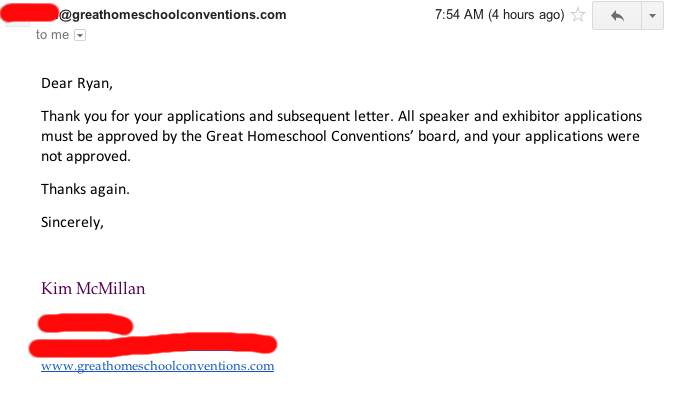
Finally, today — Friday, May 9, 2014 — we received a response from Kim (but no response from the GHC board). Kim’s email contained no mention of the GHC board reconsidering their retraction, no reason for that retraction, and no willingness to dialogue. The extent of her email is as follows:

Screen Shot 2014-05-09 at 12

This “extra step” of approval was: (1) never mentioned in any correspondence between Kim and HARO, (2) never stated as an extra step in the email Kim sent when she said she could add a session for HARO, (3) never explicitly stated in the GHC speaker application itself, and (4) never explicitly stated on the GHC website.

Where We Go From Here

As much as we are reeling with disappointment from this decision, HARO’s number one priority at the moment is being transparent in our next few steps as we figure out what to do with the money we have raised. If it were up to us, we’d click a button and have our fundraising server — Indiegogo — cancel our campaign and refund everyone immediately. Unfortunately, Indiegogo will let us neither cancel our campaign nor refund anyone any amount.

HARO believes the best course of action is as follows:

1) Either explicitly earmark what we have raised for a future convention opportunity, or

2) Figure out how to refund our donors (which cannot happen until after our campaign ends, and may involve less than 100% refunds due to Indiegogo fees)

HARO would like to honor and respect each and every one of our donors’ individual wishes. So if you donated to our GHC campaign, we will be sending you an e-mail through Indiegogo. Please respond to that e-mail letting us know how you would prefer us to handle your donation. We also will update our Indiegogo campaign with this information, in light of the fact that we cannot manually cancel the campaign. Please note that we will need to figure out how to make each refund happen (PayPal donations will be the easiest to refund).

The Speech

HARO Executive Director R.L. Stollar had nearly completed writing his hour-long speech for the Ontario convention. About 8,000 of the necessary 10,000 words were written before we received word that GHC was reneging on its offer. Regardless of whether each donor would like us to refund or save each donation, HARO as an organization values following through on its commitments. So every single one of our donors will still receive a digital download of Stollar’s presentation, “Facing Our Fears.” This presentation will be completed, formatted into an e-book, and possibly even recorded as an audio file as well — and then the presentation will be sent ASAP to our donors.

We will also make a copy of the presentation available to the general public within a month from now.

Final Thoughts

Thank you for your patience and understanding as we figure out how to proceed with everything in the next few weeks. If you have any questions or concerns, please do not hesitate to ask. We look forward to continuing our vision of “Renewing and transforming homeschooling from within.” While we are disappointed with this development, it does not faze us in the long-term.

On to the next one!

Sincerely,

The HARO board

Andrew Roblyer
Lauren Dueck
Nicholas Ducote
R.L. Stollar
Shaney Lee

Parents

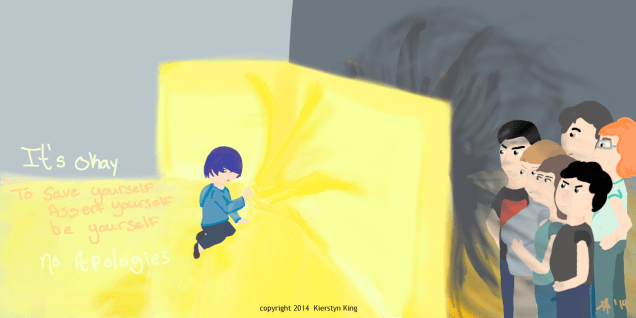
Source: http://comic.kieryking.com/comic/assertion/

HA note: The following is reprinted with permission from Kierstyn King’s blog Bridging the Gap.  It was originally published on April 28, 2014.

I’ve had really vivid dreams lately, probably due to getting over the lingering effects of a cold (it was a horrible cold, and I’m mostly better but still dealing with minor sinus issues). My dreams have been weirdly stressful and tend to feature my family and I wake up feeling like I haven’t slept, but last night…last night I dreamt that my dad was shooting at me. A lot, constantly, I was trying to leave and he was just shooting and shooting and following me and shooting, and that’s the first time that’s happened. The last time I had a similar dream, my dad was a bear trying to eat Alex and me…

…This is the first time there were guns.

Which makes sense, my family has at least 3.

A few weeks ago I sent my family an open letter, addressing the things I knew they were upset about (my hair, my sexuality, my lack of pregnancy, telling them once and for all that I’m an agnostic), and telling them things about me that they probably didn’t care to know, and ending it by telling them to stop using me as a bat on my siblings, and to leave me alone (with the caveat of, if they ever get over themselves and decide to accept me as a human and get to know me and not just spy for creating-drama purposes, to talk to me instead of going through other people). Considering all my family really cares about is using me to create drama, I think that my letter shut everyone up about me like I thought it would.

My theory was that by giving everyone the same information about me they wouldn’t have anything to gossip or speculate about or reason to use whatever means necessary to spy – since I answered all their questions/issues and took the interestingness out of it.

It’s been radio silence and I hope it keeps. It’s weird, you know…my parents said they wanted nothing to do with me until I apologized to them in 2010, but then conveniently forgot that when it suited their purposes (I’m assuming, to make them look good in front of church people – it’s what they do). I unfriended everyone on my mom’s side in November and the family freaked out when they realized it, but I’ve never once been asked, genuinely, how I am, no one has tried to get to know me in five years, they’ve only been intent on spying and using me as a tool to inflict guilt on my siblings and that’s just wrong. Every contact I’ve had with them has been silently self-serving, done of obligation, or not-so-subtly implied that they wished I was who they wanted me to be and approved of and not who I am. I don’t have time for that.

I will never live up to what they want me to be, and sometimes that hurts a lot more than I want to admit.

I put up a strong face – I throw up brick walls the way Elsa made her Ice Castle, bury the pain inside the mortar.

 kiery

It’s easier to be callous and cold and numb, than angry, and vulnerable, and hurt. So I act like it doesn’t bother me, Fuck them all is my mantra, but it does bother me and I wish that it wouldn’t.

I wish that I didn’t feel as though the most abusive people in my life mean something. Because I feel like they shouldn’t. I wish I didn’t feel sad because I know that by merely existing  I’m letting down the people who spent my entire childhood neglecting me and usingme.

Sometimes I feel like the Hulk and my secret is that I’m always angry.

Because I am angry.I’m angry at how they get off scot-free, I’m angry at how the world thinks we need to revere parents even when our parents are the bullies we couldn’t escape. I’m angry that they can keep on manipulating people and lying and living with no guilt or remorse, with aid from family, and keep people on their side and looking up to them – as people with Narcissism and Borderline are really good at doing.

My family is looked up to in churches, cited as examples, people seek out my parents to ask them advice about homeschooling and child-rearing (and other things), they think the fact that my mom has destroyed her body having kids is awesome and noble.

No one sees the dark underbelly of what it looks like to grow up with them and their life choices, no one registers the fake smiles, no one sees past the masks.

And I get to pick up the pieces.

I can’t look at an infant or pregnant person without feeling ill and stressed out. I panic every time I see a stroller, or an entitled parent at a restaurant. I get to be condemned for not having or wanting kids, for not doing anything for mother’s day, for doing what I need to do for my sanity and quality of life that involves cutting out the toxicity that is my family. I can’t leave my apartment without being bombarded by triggers, I can’t talk to any nosey old person without being patronized about my existence, the general consensus of the world does everything in it’s power to tell me that everything about me is wrong and flies in the face of what is approved of and wouldn’t it just be easier if I killed everything-that-is-me and conformed?

I’m planning out how to help my siblings after they reach adulthood because my parents thought it was unnecessary for half of my sisters to have identification, and everyone born after 1999 is unvaccinated.

This is the aftermath of growing up with abusive and neglectful parents and extended family who enable them. You bet your ass I’m angry.

And also crying.

Because no one fucking deserves this.

The Deliberate Spread of Misinformation

Screen Shot 2014-05-04 at 3.57.26 PM

HA note: The following is reprinted with permission from Sarah Henderson’s blog Feminist in Spite of Them. It was originally published on her blog on August 14, 2013.

When my siblings and I were children, my parents deliberately misinformed us about the world.

I am still not sure what the overall goal was. Some of it makes sense. The ideological nonsense that contributed to psychological control makes sense, such as the misinformation about lust, reproduction, and consequences, but some of it really doesn’t make sense.

Why were we misinformed about the healthiness of foods? Why were we misinformed about women’s periods? Why were we misinformed about the lactose content of butter? My parents also gave us this information in a way that made us afraid to double check, and there was certainly no ability to find out correct information and take it back to our parents. As isolated as we already were, there was always the fear that we could be isolated further if our lifestyle allowed for too much knowledge seeking.

My parents taught us some strange theories about food, which I believe contributed to a lot of food and weight issues in our family. They told us that calories were a lie, and that potatoes and rice were vegetables. They didn’t teach us to have a treat or two and then healthy food, to make choices. They didn’t teach us that you could have a certain amount and maintain, lose or gain weight. They taught us that when food was available to eat it. There was always food, but sometimes it was just rice, for breakfast lunch and supper. So when there was tasty food available, we really wanted it. We weren’t taught moderation and we were taught that there was only ever starvation or overindulgence.

For the purpose of this writing I finally did some quick googling about lactose in milk. It doesn’t matter now and it didn’t matter then, no one in my family is lactose intolerant. But my parents told us that butter didn’t have any lactose but margarine does. This, as I learned today, is very outdated (50 years or more), because margarine is now normally prepared to be lactose free, and butter is often ‘enhanced’ with other dairy products. Pure butterfat is lactose free, but that is very difficult to achieve.

My mother had the female reproductive talk with me when I was younger than nine years old. I think I was eight, but she denies this, but I remember the house. I then promptly forgot until I thought I was bleeding to death when I was 11. She then reminded me what it was but didn’t give any more information so I thought I would bleed forever. Miraculously it stopped, so I thought I was gone forever. Then it came back and I had to ask again, and she was annoyed and made fun of me. I decided then not to ask any more questions. I learned about human anatomy from a health textbook, which my parents provided on the grounds that I wouldn’t look at that section. I did.

My parents taught us that everyone outside our circle wanted to harm us.

They taught us that foster parents are bad people and that social workers want to hurt children. They taught us that non-religious children are mean and selfish and would steal our stuff. It was only after going to high school that I learned that non-fundamentalist teens are great people. Sure they aren’t perfect, but they really don’t judge other non-perfect teens either.

My parents taught us that strangers are dangerous. Not like most parents do, but to the extent that I have to catch myself to not view all other drivers on the road as evil people who will hit me if they want to, for example. They taught us that if there is a way for other people to hurt us, they will.

They taught us that we were a lower tier of person than others. This is a complex issue, because they also taught that we were better than others because of the fundamental beliefs. I think this was more about guiding us to have low self-esteems. They taught us to let others walk first and butt ahead of us and choose last and give in, in all areas of life. It was hard to change this mindset and take my right of way and walk boldly through a grocery store.

They taught us that spending money on something that you do not need to the point of failing health or death is wrong. This extended from food to shoes to glasses. I was given a pair of glasses when I was nine, at which point I learned that stars are real (I thought people were lying about seeing stars in the sky) and stores in the mall have signs above them so you know which store it is – I thought people guessed and I couldn’t see in, and I never had the courage to ask what I was missing. My next pair of glasses came when I was 15. After there were about six of us I don’t think my parents ever bought shoes or clothes, not even from second hand, instead depending on other families to give us their cast off underwear and shoes and other items.

These are just some of the ways we were misled about daily life, not to mention the religion-based untruths. Further to the idea of not buying items that weren’t life preserving, we were taught that desiring things was wrong, and that god would judge us for jealousy if we wished for more of anything or asked for what we saw other children receive.

My parents taught us that girls were able to evoke some kind of sinful feeling in men, and so we needed to be very careful about how we dressed, stood, walked, and sat, or we would answer before god one day about what thoughts went through the minds of men in our lives.

My parents taught us that girls weren’t as valuable to parents as boys were, because boys could grow up to be powerful successful people one day, unlike girls. They taught us that the women’s role was to support the men in whatever the men wanted to do, and we weren’t supposed to have any dreams of our own because it would hinder the goals of our future husbands.

I know that at this point I have been able to gather knowledge and counteract the misinformation I received, but I still have siblings in that home that are receiving a similar level of false information.

I took it upon myself to give some information to my siblings, especially regarding female health, because there was a real worry that misinformation could cause harm. And I thought my sisters should know that tampons didn’t take your virginity. Lying to your children like this should be criminal.

5 Reasons Conflating Mental Illness with Demon Possession Hurts People

Screen Shot 2014-05-04 at 3.49.07 PM

HA note: The following is reprinted with permission from Lana Hobbs’ blog Lana Hobbs the Brave. It was originally published on April 18, 2014.

Conflating demon possession with ‘madness’ hurts people.

That may sound harsh, but this is a real problem. I have been hurt by this in the past, and in the present, and others have too. When people talk about an (apparently) mentally ill person and say ‘He was definitely demon possessed’ that hurts me as a person with a mental illness. When people tell the Bible story about the ‘madman’ with demons, when they use that word ‘mad’, they are saying that the mentally ill person has demons. I have never heard this Bible story told with a caveat that mental illness often has a biological cause. I have, however, heard it told to prove that mental illness is caused by demons.

Here are five reasons you shouldn’t use the word ‘madness’ when talking about demon possession, or imply or say that mental illness is caused by demon possession.

Reason 1) It keeps people from getting help.

Who, especially a Christian, would seek help for mental issues if they know it will be attributed to demons? I was in denial about my depression for years because of the teaching that mental illness is caused by demons. Further, I didn’t get help for my panic attacks because I believed they were caused by demonic presence and would go away if I prayed enough.

Reason 2) It ‘others’ and dehumanizes mentally ill people.

It makes them out to be possessed by absolute evil, instead of treating them as regular humans who happen to have a sickness.

Reason 3) It ignores the physical reasons for mental illness, and the social reasons, such as past trauma or abuse.

Reason 4) It takes stigma to a whole new level.

Again, we’re confusing a chemical imbalance in the brain, or a misfiring of neural pathways, with the person being possessed by entirely evil beings. Anything bad you can say about stigmatizing mental illness, you can say about this concept.

Reason 5) It prevents us from trying to understand the person.

It’s a conversation ender that keeps us from looking further into the person and why they think and act the way they do.

I want people to stop using words that mean mental illness to mean demon possession.

I want people to stop assuming demon possession when the far likelier explanation is mental illness. I want people to be more careful how they talk about mental illness. I want people to be aware that 1/5 americans suffer from mental illness, and 1 in 20 of americans suffer so much that it adversely affects their lives at work, at school, and at home. I want people to realize that they need to be careful how they talk about it, because chances are good that a mentally ill person is listening. In a room with 100 people, it is statistically likely that 20 of those are dealing with some form of mental illness, and that 5 people have a severe case of it. Those people need to feel safe and like they will be treated as humans, they need to be listened to, they need to be loved, they need to feel safe enough to seek treatment.

They do not need to be made to feel as though they are infected with utter evil.