Why the Distance Between “Christian Patriarchy” and “Complementarianism” Is A Sleight Of Hand: Rebecca Irene Gorman’s Thoughts


Screen Shot 2014-04-27 at 4.48.18 PM

Also by Rebecca on HA: “The No True Homeschooler Argument,” “I Was Beaten, But That’s Not My Primary Issue With Homeschooling” and “‘Fake Someone Happy’: A Book Review.” 

My pastor was the director of the Chalcedon Foundation and the other teachers I studied under were Mark Rushdooney, President of the Chalcedon Foundation, Doug Wilson, Howard Phillips (father of Doug Phillips) etc. Ground zero of the ‘Christian Patriarchy’ movement.

The context in which they use the word ‘patriarchy’: It’s not always capitalized. It’s not always typed as ‘Christian Patriarchy’. They don’t think of ‘Christian Patriarchy’ as the name of their movement. Yes, they do think that patriarchy is a good thing, and say so explicitly. They love to talk about the Biblical patriarchy, and are often happy to capitalize Patriarchy as a value essential to Biblical Christianity.

If you ask them what their movement is called, they’ll probably tell you ‘Biblical Christianity’. They might go on to mention the Reformers or covenentalism or Reconstructionism or postmillenialism or paedobaptism, because all of these things are central to their identity. Which ones they mention is purely personal preference. If you ask them what they believe about gender roles, they’ll say: ‘complementarianism’. NOT ‘Christian Patriarchy’.

For these people at ground zero of the ‘Christian Patriarchy’ movement, they talk about ‘Patriarchy’ as a positive thing, method behind taking dominion, the reason for quiverful beliefs, beliefs around baptism, communion, etc. While their promotion of this word is very telling about their objectification of women, it’s not what immediately comes to mind for them when they’re thinking about gender roles. What immediately comes to mind for them when thinking about gender roles are various Bible verses and stories that make up the culture’s dialogue about gender roles, and when they have to boil their gender role perspective down to a term, they think of it and talk of it as ‘complementarianism’.

It’s disingenuous to say ‘I’m not a Christian-Patriarchalist, I’m a Complementarian.’ Show me a person who claims to be a Christian Patriarchalist, or a Christian-Patriarchalist who doesn’t define their gender beliefs as ‘Complementarian’, and I’ll show you a fairy. NOBODY claims to be a Christian-Patriarchalist. Claiming to be a Complementarian ‘because that’s what the Bible teaches’ IS the definition of what we now-outsiders call Christian Patriarchy, end stop.

Saying ‘I’m not a Christian Patriarchalist, I’m a Complementarian’ is like saying ‘I’m not a giraffe, I’m a large African mammal with a very long neck and forelegs and a coat patterned with brown patches separated by lighter lines.’

What “Christian Patriarchy” Is Not

Screen Shot 2014-04-26 at 5.45.19 PM

By R.L. Stollar, HA Community Coordinator

“Patriarchy” has suddenly become a dirty word in the homeschooling movement. Whereas a short while ago it was a badge of honor, a symbol of pure righteous manliness, now leaders are scrambling to distance themselves from this word. They are swearing left and right that they aren’t “it” and they never were “it” and gosh, why are people saying they are? They have been so gracious about “allowing” their daughters the privilege of wearing pants — or the privilege to go to college — they, the men with the divine authority, have allowed this. How could anyone think poorly of them?

The sudden energy exerted by these leaders to claim they oppose Patriarchy has reached corners that are so actually patriarchical it has become almost humorous to observe. Kevin Swanson recently wrote a post on April 18 where he matter-of-factly declares, “I am not a patriarchal-ist. I have never been a patriarchal-ist, and I’ve never called myself a patriarchal-ist.” As evidence he offers the following statement: “It is no sin for a woman to take college level classes.”

Well, gee, that settles that. I eagerly await Bill Gothard’s declaration that he’s not a legalism-ist.

As news about the predatory conduct of Doug Phillips — one of the key figures in the Christian Patriarchy movement — and Bill Gothard — one of the most ardent advocates of Legalism — spreads into the mainstream media, this will become a more common occurrence. The problems plaguing the Christian Homeschooling Movement will be chalked up to “Christian Patriarchy” and “Legalism.” Leaders will swear they aren’t those things and therefore they’re safe. We will be tempted to become fixated on labels and forget that labels aren’t the problem. The problem, as Libby Anne points out, are “the beliefs [they’re] promoting.”

Furthermore, while I agree with Libby Anne that the beliefs should take central stage, I am mystified because few people seem to understand the words themselves. And I wonder whether that’s why the beliefs are getting the short end of the stick. We’ve turned “Christian Patriarchy” into this bizarre caricature — i.e., “not letting your daughters go to college” — that’s completely untrue. Go look at Vision Forum’s “Tenets of Biblical Patriarchy.” Not letting your daughters go to college is not on the list. We’re collapsing so many different categories — Quiverfull, Christian Patriarchy, general Patriarchy, Stay-At-Home-Daughter Movement, Complementarianism, etc. — that these words are becoming powerless.

A fundamental rule of communication is this: “The One Who Defines the Terms Controls the Argument.”

This is true.

But there is another fundamental rule of communication: “The One Who Employs the Definitions Sloppily Loses Control of the Argument.”

We’re at a point now where someone has claimed that Patrick Henry College is not patriarchical and “proved” it by describing the college in blatantly patriarchical terms. And the reason for that is simple: we’ve exchanged the phrase “Christian Patriarchy” for “Patriarchy,” when the former is simply a particularly extreme version of the latter. Patriarchy is any and every system based on male authority and dominance, one manifestation of which is Christian Patriarchy. We’re also at a point where Michael Farris is confusingly equating “Quiverfull” with “Patriarchy”: not only did he think “not sending your daughters to college” had something to do with “Quiverfull,” he also thought that “not sending your daughters to college” (a caricature of Christian Patriarchy) was the definition of Patriarchy (which is has nothing to do with whether or not your daughters go to college).

So I’d like to dispel a few myths about what Christian Patriarchy is. I’d like to emphasize that, by saying Christian Patriarchy isn’t these things, I’m not saying it cannot be. I am saying it is so much bigger than these things. To limit it to these things enables misdirection.

Myth #1: Christian Patriarchy is Patriarchy.

Christian Patriarchy is Patriarchy in one sense: insofar as Christian Patriarchy is a system based on male authority and dominance, it is a subset of Patriarchy. But as I stated previously, Patriarchy — being a system based on male authority and dominance — is huge. Any system grounded in male authority and dominance is Patriarchy. Thus even Complementarianism — however mild or extreme — is still Patriarchy because it still rests upon the foundational idea that males have a unique authority or right to dominance.

When we say that, “Oh, ____ isn’t into Patriarchy” — when we what we mean is, “Oh, ____ isn’t into Christian Patriarchy” — we are giving someone an opportunity to downplay the fact that they are still into Patriarchy. And the problem with the subset of Christian Patriarchy isn’t that its an extreme version of Patriarchy. The problem is that it is Patriarchy. Period.

So for example, Michael Farris does believe in and advocate for Patriarchy. Just observe any of the politicians he endorses or, simpler yet, read his 2004 book What A Daughter Needs From her Dad. Sure, Farris doesn’t believe in and advocate for the limited caricature of Christian Patriarchy where daughters can’t go to college. But again, as stated earlier, even that’s a caricature of Christian Patriarchy (as we’ll discuss shortly). Michael Farris agrees with Christian Patriarchy far more than he disagrees with it.

Myth #2: Christian Patriarchy is Quiverfull.

Quiverfull and Christian Patriarchy are often confused as the same thing. In fact, Michael Farris himself has confused these categories, when he said that he does “believe women should go to college.” Whether or not you let your daughters go to college has nothing to do with Quiverfull. Quiverfull is, more or less, a specifically Christian form of natalism — the idea of employing procreation as a tool of sociopolitical dominion and categorizing birth control as rebellion against God. Michael Pearl gave us a perfect embodiment of Quiverfull’s dominionist streak, when he recently stated,

“If you can’t out-vote them today, out-breed them for tomorrow.”

That is Quiverfull (albeit a distilled, intense version of it). And see, that sentiment could exist in a matriarchicial society. (In fact, Mary Pride — often considered “the Queen of Quiverfull” — personally insinuated that she believes in Matriarchy more than Patriarchy. Though she has a nonsensical definition of Matriarchy, she has harsh words for Christian Patriarchy advocates.)

Yes, there are many advocates of Christian Patriarchy who are Quiverfull. And by all means, speak out against the dehumanizing and toxic idea that your children are your weapons, and a woman’s vagina is a weapons-building factory.

But remember these are distinct, especially considering there are many advocates of Christian Patriarchy who are not Quiverfull. Take Doug Wilson, for example. Doug Wilson is considered one of the pillars of Christian Patriarchy but believes birth control can be useful to ensure you’re actually taking care of your current children. That’s outright heresy to the Quiverfull crowd.

Myth #3: Christian Patriarchy is Opposed to Daughters Going to College.

The Stay-At-Home-Daughter Movement rose out of Christian Patriarchy. Indeed, many of this movement’s advocates — for example, Voddie Baucham, Doug Phillips, and Geoff Botkin, who promoted or were featured in the film, “Return of the Daughters” — are giants in the Christian Patriarchy movement. But — and this is crucial — not all advocates of Christian Patriarchy believe daughters cannot go to college. In fact, the majority of them are okay with it, provided their daughters (1) are still at home while attending college, (2) do not go to a secular college, and (3) study something relevant to “domestic affairs.” There is plenty to critique about that criteria, but using this “can daughters can go to college” litmus test is a red herring. Case in point: Baucham’s daughter Jasmine — while still living at home — not only has a Bachelors degree but is currently pursuing a Masters degree.

And this isn’t a “new” development in Christian Patriarchy. John Thompson, writing in Patriarch Magazine (a cornerstone publication of the Christian Patriarchy movement during the 90’s), articulated over a decade ago that it was tolerable to let your daughter get college-educated provided that education is gender-oriented and via home study.

So, again — this college litmus test is a red herring.

Myth #4: Christian Patriarchy is two steps away from wearing a burka.

This myth was articulated a few days ago, and I couldn’t help but laugh. Seriously, let’s look at two images of the daughters of popular proponents of Christian Patriarchy:

Geoff Botkin’s daughters, Anna-Sofia and Elizabeth:

anna-sofia-and-elizabeth-botkin

Voddie Baucham’s daughter, Jasmine:

jasmine

Burkas? Seriously?

Look, there are many, many parallels and connections between Christian fundamentalism and Islamic fundamentalism that one can make. Likewise, there are many, many parallels and connections between Christian Patriarchy and Islamic Patriarchy that one can make. The parallels exist because fundamentalism and patriarchy as systems transcend people groups and cultures. Identifying and speaking out against those parallels and connections is important; it should be done frequently, passionately, and loudly.

However, to say that, “Christian Patriarchy is two steps away from wearing a burka” is an asinine argument. Christian Patriarchy is not defined by clothing. Yes, there are many people within the Christian Patriarchy movement who have swallowed Modesty Culture. In fact, the above two images do not disprove this. (“Modesty Culture,” like Christian Patriarchy, is not defined by how many “steps” it is away from wearing a burka.) But they do demonstrate that slapping Christian Patriarchy with “burka” confuses the issue.

Myth #5: Christian Patriarchy is Limited to Homeschooling.

This is the weirdest myth. Rumor has it that Christian Patriarchy advocates are only into homeschooling, whereas Christian Patriarchy opponents tolerate other forms of education — for example, classical education in a private Christian school.

This is pure nonsense. Doug Wilson adamantly and vocally prefers private classical Christian education to homeschooling. He personally founded a private school and did not homeschool his kids. In his 1991 book Recovering the Lost Tools of Learning, Wilson makes clear that he believes “classical private schools to be superior to classical homeschooling.” He states his case so strongly, in fact, that some say “he condemns home school as a viable option,” and one homeschooling parent demanded he “stop being asked to speak at homeschool events.” In his own words, though, it’s not so much homeschooling itself that he objects as much as it is “a radical home-centeredness” that “[insists] that the home can not only replace the school, but also the church and the civil magistrate.”

An appreciation of private Christian education among Christian Patriarchy advocates is not limited to Wilson. R.C. Sproul, Jr. — who co-wrote Vision Forum’s “Tenets of Biblical Patriarchy” with Doug Phillips — agrees to some extent with Wilson. In October 2011, Sproul Jr. said that, ultimately, what’s important is Christian education that teaches “day in and day out the Lordship of Christ over all things,” and thus “the real issue is the secular perspective of the public schools, more than the methodology of homeschooling versus Christian schooling.”

Similarly, Patriarch Magazine argued over a decade ago that, while homeschooling is “ideal,” “Christian schools are a commendable alternative to the degenerate state schools.”

*****

It is pretty amazing that “Christian Patriarchy” as a specific concept — and Patriarchy as a general system — is finally being widely discussed among Christian homeschoolers. Seriously. It is amazing. This is the first step towards wider awareness and change: our vocabulary is being adopted and we can point to that vocabulary to facilitate conversation.

However, we take a step backwards if we start equivocating between terms and diminish those terms’ potency. If you are new to this conversation, please take the time to educate yourself about what these words mean. Libby Anne has a great breakdown of what “Christian Patriarchy” is that she wrote in 2012. Read it. Think about it. Also read about what Patriarchy is and how it differs from the specific subset of Christian/Biblical Patriarchy. Educate yourself about how similar Christian Patriarchy and Complementarianism are (and arguably even identical), and why both are Patriarchy. (And while you’re at it, look up Kyriarchy, too.)

Then reassess this mass hysteria among homeschool leaders who are begging us to consider them anti-Patriarchy. Because they are not.

Sugar-coated Patriarchy is still Patriarchy.

What “Christian Patriarchy” Is

Screen Shot 2014-04-26 at 3.42.51 PM

HA note: The following is reprinted with permission from Libby Anne’s blog Love Joy Feminism. It was originally published on Patheos on February 19, 2012.

In a nutshell, Christian Patriarchy is the belief that God has ordained a specific family order, and that this family order must be followed. The husband leads, the wife submits, and the children obey.

There are two important aspects about Christian Patriarchy. The first is the belief in the importance of male headship or authority, and the second is the belief that men and women have vastly different roles to play. A third issue involves the role of children.

Male Authority

Christian Patriarchy holds that women must always be under male authority (or headship). A woman is never to be independent of male authority. First, she is under her father’s authority, and then under her husband’s authority.

(A widow would be under her son’s authority, or, if she had no sons or her sons were young, she would return to her father’s authority. If is not possibles possible, some argue that widow should place herself under the authority of a church elder or pastor.)

Many evangelicals use the rhetoric of “male headship” but see it as merely spiritual or figurative. For Christian Patriarchy, though, being under male authority includes obedience. This obedience is absolute; a woman is only excused from obeying if her male authority orders her to do something illegal and immoral (some dispute this, and argue that she is still required to obey, but that God won’t hold her accountable for any sins she commits at the order of her male authority).

I Corinthians 11:3 – But I want you to understand that the head of every man is Christ, the head of a wife is her husband, and the head of Christ is God.

Under Christian Patriarchy, the framework in this verse is extended to women in general. Every woman has a male authority, and that male authority looks to Christ as his authority. A woman is to obey her male authority, whether it is her father, husband, brother, or son, and he in turn is to obey Christ. By obeying her male authority, a woman is obeying God. This is seen as the natural and God-given order. 

Separate Roles

Christian Patriarchy holds that men are to provide and protect and women are to care for the home and the children. This is seen as the divine order for the family. The idea is that the two sexes are equal, but that they have different roles to play. Both roles are highly important, and neither sex can fulfill the role of the other. Men and women are simply different.

The man’s role is to hold a career and provide for his family, to protect his family, and to represent his family to the world in politics and in the church. The woman’s role is to bear children and raise them, to cook and keep house, and to support her husband, building him up as a man through her affirmation and obedience.

Hard core followers of Christian Patriarchy hold that women are never to work outside of the home in any capacity – even if their families desperately need the money. Yet just as with Quiverfull, there are plenty of families who are influenced by the ideas of Christian Patriarchy without being completely hard core. These families most often hold that married women, or married women with children, should not hold jobs outside of the home, and that it’s not women’s place to have “careers.”

Children 

Under Christian Patriarchy, all children are expected to offer their parents absolute obedience while they are minors. No disobedience is accepted, and children are taught that obeying their parents is obeying God, because God has placed them under their parents’ authority.

Daughters remain under their father’s authority until married to a man he approves of, generally through a parent-guided courtship. While under her father’s authority, it is the daughter’s duty to obey him and accept his will for her as God’s will. Many in the Christian Patriarchy movement reject college for girls, and the Stay At Home Daughter movement is growing.

Sons are under their father’s authority until they become men. The point at which this occurs isn’t so clear, but it definitely occurs sometime between when they turn eighteen and when they marry. Once he becomes a man, a son no longer need to be under male authority, and he becomes the male authority for his wife and children.

Some families in Christian Patriarchy have trouble completely letting go of their sons, however, and there is in some circles the idea that even an adult son should be obedient to, or at least highly respective of, his father’s desire. This is where you get Geoff Botkin’s 200 Year Plan (also known as Multigenerational Faithfulness).

Conclusion

The most important thing to remember about Christian Patriarchy is its emphasis on a hierarchical family order, which it regards as the natural order ordained by God. Men and women have different roles to play, the man as protector and provider and the woman as nurturer and homemaker. Women are always under male authority; daughters are to obey their fathers and wives are to obey their husbands. When everyone fulfills the role God has created for them, the family prospers.

The things I find most troubling about Christian Patriarchy are its emphasis on women offering absolute obedience to their male authorities – when you think about it, there is nothing really to differentiate this from slavery – and its emphasis on strict gender roles, which classes people by their sex rather than by their talents, interests, or abilities. Christian Patriarchy fails to recognize the huge diversity within each gender, and pushes people into prescribed slots based on their genitals rather than seeing people as individuals first.

The vast, vast majority of Christians do not hold to the teachings of Christian Patriarchy. In fact, many Christians actively fight against these ideas, arguing that they represent a fallen order of mankind and that Christ has ordained equality between the genders. However, it should be noted that even as some Christians fight these ideas others are unknowingly influenced by them, and that is what makes understanding the ideas behind Christian Patriarchy all the more important.

Homeschoolers U: A Call for Stories about PHC

Screen Shot 2014-04-26 at 1.10.58 PM

By R.L. Stollar, HA Community Coordinator

It’s been called “God’s Harvard” by some, “Homeschool Harvard” by others. Still others find those nicknames either laughable, insulting, or downright silly.

Whatever you want to call it, Patrick Henry College is arguably the finishing touch to the culture wars waged by many movers and shakers within the Christian Homeschooling Movement. However, with the recent allegations of the administration’s mishandling of sexual assault cases and an ongoing definitional debate about whether or not the college supports “Patriarchy,” it is obvious that even those who have attended the college have widely different perspectives about their alma mater and its impact.

For our next open series, Homeschoolers Anonymous is inviting current and former students of Patrick Henry College to speak for themselves about their experiences and stories at their school. We are open to hearing about all of it: the good, the bad, and the ugly. Our one parameter is that you speak to your experience, rather than speaking in universal commentary about popular (mis?)conceptions about the school. Help others get a more nuanced understanding of the campus culture and ideology — whether that commentary be positive or negative.

* Deadline for “Homeschoolers U” submission: Friday, July 25, 2014. *

Please put “For Homeschoolers U” as the title of the email.

As always, you can contribute anonymously or publicly.

If you interested in participating in this, please email us at homeschoolersanonymous@gmail.com.

You Can’t Lace Geography Lessons with Jesus: A Response to Israel Wayne


Screen Shot 2014-04-23 at 11.31.14 PM

By R.L. Stollar, HA Community Coordinator

For Israel Wayne, homeschooling is not about education. It’s about discipleship. His recently viral blogpost, “A Shift in the Homeschooling Movement,” testifies to this fact. In it, he suggests that we “shift” homeschooling towards the “lordship of Jesus.” In order to understand the post, one must understand that, for him, homeschooling must be religious or spiritual in its essence — education, academics, those are disposable accouterments to the goal of evangelizing your children.

Israel Wayne is the son of Home School Digest‘s Skeet Savage and a repeat speaker at the Homeschool Alumni National Reunion. He runs BiblicalBetrothal.com, which features writings from betrothal advocate Jonathan Lindvall and child marriage apologist Matthew Chapman. He himself has written for Above Rubies, Brannon Howse’s WorldviewWeekend.com, and Answers in Genesis, and has authored a number of books, most notably Homeschooling from a Biblical Worldview. You can read his bio at his organization Family Renewal here.

In Homeschooling from a Biblical Worldview, we get a basic picture of Wayne’s perspective on homeschooling and education. Essentially, all education is religious and — as the book’s own summary so neatly states — “Beginning with proper biblical presuppositions will enable students to make sense of the world around them.”

Fail to have the proper biblical presuppositions, and students fail to make sense of the world.

This is reiterated in Wayne’s recent post. The post itself is long and meandering. It addresses a variety of topics, including the history of the modern homeschooling movement and how different “camps” within the Christian Homeschooling Movement have competed and/or cooperated with one another. His post also proposes “new” paths for Christian homeschoolers to consider (though, as I will articulate here, these paths are anything but new). The post has been quite popular and many people have been taken in by Wayne’s rhetoric. (In my mind, however, it should give everyone pause that Kelly Crawford — an outspoken advocate of Patriarchy — thought his article was “very well done”, considering that his article was prompted by the Doug Phillips-inspired “Patriarchy” controversy as of late.)

There is so much one could say about Wayne’s post. But for this response, I want to focus on one particular passage of his. And heads up: I am going to approach this solution of his from a Christian theological perspective. I feel it is important to engage Israel Wayne on his own turf in this instance because it is necessary to show that this turf is incorrectly grounded.

The relevant passage from Wayne’s post is as follows (emphasis added):

If we ever forget that the homeschooling movement is NOT about academics at the end of the day (they are a means, not an end), then Jesus will abandon us to our own devices. The homeschooling movement must NOT become ultimately about methods and tools (curriculum). It must be about Jesus, and His Lordship over our families.

…We need to pick a few hills that are worth dying on, and be willing to allow a few others to fall by the wayside. In my view, the authority of Scripture is a hill to die on… The Lordship of Jesus Christ over every sphere of our existence is another. We cannot merely marginalize the Lord Jesus Christ as an optional plugin to our homeschooling endeavors. He demands supremacy over His people and demands to be recognized as our rightful head.

The leaders of this movement…must continue to hold up these banners as supreme, or else our Lord will leave us to our own devices, and the homeschooling movement will denigrate into another expression of humanism.

To put it simply, Israel Wayne has constructed a false dilemma. A false dilemma is when you present as an either/or a problem that can actually be resolved in more than two ways. Here Wayne presents “academics” and “the lordship of Jesus” as distinct entities (and either we uphold the latter over the former, or the whole world will burn). Why do I say this? Well, because if they are not distinct, then pursuing academics as the end of homeschooling would not necessarily exclude pursuing the lordship of Jesus in one’s life. But in Wayne’s mind, pursuing the former as an end means one is — to one extent or another — not pursuing the latter.

This is a crucial point — Wayne rejects education as a legitimate end in itself. It is so crucial because the Christian Homeschooling Movement’s similar rejection has led to many of the problems we are seeing today. The fact that Israel Wayne continues this rejection, just as his elders did, means that he will not be able to promote any significant change in homeschooling.

This solution — eloquent though it may be — is all sound and fury, signifying nothing.

Lana Hope has already articulated one reason why this point is key:

The fact that homeschooling was seen as a Christian method is, in my opinion, what went wrong with baby boomer homeschool parents. It started out as an education model, but when it became about religion and the preservation of a Joshua generation, it went [sour]… The Christian homeschool movement, because it was all about religion and not academics, became about censoring certain information and stuffing Christ into other information.

Lana is spot-on here: the Christian Homeschooling Movement, as a movement, has used education to indoctrinate, not to empower. And when education becomes a tool of indoctrination, rather than being valued as an inherently empowering process, it gives rise to exactly what we at Homeschoolers Anonymous have called out for the last year: twisting homeschooling into an ideology-first movement, rather than a children-first movement.

I am not interested in debating a definition of “indoctrination” here. That’s not the point. What I conceive of as indoctrination is not limited to Christian education, Buddhist education, or even “secular” education. It is simply when education is used to pass on an ossified set of ideologies (a closed system) as opposed to being an embraced process whereby all children freely, enthusiastically, and wisely discover life on their own terms and at their own pace (an open system).

Israel Wayne clearly has no interest in education as an open system. This is evident in his “you must start from ‘proper biblical presuppositions’ or you have no chance ever of understanding the world” mindset; these so-called presuppositions automatically ensure a closed system. Yet in order to reject the concept of open system, notice what he has to do: he has to argue that education is not in itself an end. In other words, to Israel Wayne, education is not inherently valuable. It is only valuable insofar as it furthers “the lordship of Jesus” (whatever that means).

Wayne does this — and so have many others in the past and so do many others today — because everything is supposed to be subsumed under his idea of a “Christian Worldview.” Wayne’s Christian Worldview is a giant sucking sound, a Total Institution under which everything must be subjugated. It therefore sets up all other ends — in this particular case, the end of education — in diametric opposition to his end, the end of the Christian Worldview, e.g., lordship of Jesus.

Here’s the irony: the whole concept of “Christian Worldview” originated primarily with Francis Schaeffer, who wrote in Escape From Reason that this dualism — the very species of dualism Wayne advocates for, while saying he advocates against it — was causing the downfall of Christianity in the West. Schaeffer’s project — indeed, what the whole project of the “Christian Worldview” movement was supposed to be — was to cast aside the dualism and opposition between “faith” and “reason.” But whereas Wayne and others think this means “sell reason as a slave to faith,” Schaeffer meant it as embrace the entirety of the world as inherently valuable, informative, and empowering. This is why Schaeffer could boldly declare that, “Man is something wonderful.” Obviously that’s not what the Worldview Studies Movement has become within American evangelicalism or homeschooling curriculums. But that was Schaeffer’s goal.

When you begin with this closed system of presuppositions, you lose the very idea that human beings are made in God’s image.

You lose the fact that, no, you don’t have to start from any presuppositions at all because God gave each and every individual the same insatiable curiosity, rational thinking processes, emotional receptors, and desire to figure out life. You deny this fact and you deny a cornerstone of the biblical narrative. And doing so leads to (as Lana Hope pointed out) the stilted, articially “religious” environment that the Christian Homeschooling Movement was and continues to be, which denigrates the importance of academics and thus fails at responsible stewardship of children’s education.

There’s another way here, people. Academics can be the end of the homeschooling movement when we conceive of academics as inherently valuable, an end in themselves. Dedicating what resources you have to educate your child as best you can what if this is very definition of making Jesus lord of your life?

There is no need to conceive of “academics” and “lordship of Jesus” as distinct or opposed. In fact, I am just going to call out Israel Wayne as preaching a false gospel here. The Gospel is not about the totalitarian, totalistic imposition of Jesus on every aspect of our lives. The Gospel — as preached by Jesus — is a transformation, a process that becomes radically relevant, informing, and empowering to each individual in each individual’s unique context. In the context of a parent who has the resources to teach a child, that parent has a responsibility — call it God-given if you want — to give that child the very best education possible in the most nurturing and loving environment imaginable.

That is making Jesus lord.

And if that parent hides those educational resources out of fear of what that child may do with them, that is a rejection of Jesus as lord.

To conceive of homeschooling as “discipleship,” and education as inherently “religious,” is to reinstate the dualism whereby you can teach something like geography in a “Christian” way but also in a “non-Christian” way. No. That is pure nonsense. You either teach your child geography or you don’t. There’s no “Christian” way to teach geography, any more than there is a “Christian” way to change a tire. To say so ignores the fact that the simple act of teaching your child geography — in the context of homeschooling parenthood — is the definition of discipleship. You don’t have to artificially force “religion” into a geography lesson, like Kevin Swanson’s bizarre suggestion at the 2009 Men’s Leadership Summit that, “We’ll shock everybody when we begin confessing our sins in the geography class.” And note that Swanson gives the exact same reasoning as Wayne, that education isn’t an end in itself:

We need to call [Christians] to use words like discipleship and nurture. Stop talking schools with me. Don’t talk about education with me. Let’s not talk about home education and Christian education, Christian schools. Let’s talk about discipleship. Let’s talk about a focus on faith and character. Let’s focus on the discipling of a child.

Sorry, but you can’t lace geography lessons with Jesus in the hopes of drugging your kids into Heaven.

Teach them geography well, as well as science, math, sex education, and so forth. Show them the world and do not instill fear in them.

That is making Jesus lord.

When you equip your child for life — when you teach them academics as a valuable end in itself — when you empower your child to face the storms that life will present, to wrestle with ideas, to master reasoning and humility — when you protect your child from abuse, and show your child you will protect other children from abuse as well — when you become Jesus to your homeschooling community by standing up for the abused and the marginalized — when you, like Jesus, say “Let the little children come to me,” to be safe, to be educated, to be empowered to succeed —

— that is making Jesus lord.

Homeschool parents who are afraid to educate their children thoroughly, who withhold from their children information about the world out of fear that it might “lead them astray,” need to imagine a bigger God.

When we start imagining a bigger God, when we start prioritizing children over ideology and children’s lives over our so-called “freedoms” — that’s when we’ll actually see a shift in the homeschooling movement.

Sorry, Michael Pearl, But These Fireworks Are Calling You Out: Lisa Joy’s Thoughts

Screen Shot 2014-04-23 at 9.46.00 PM

HA note: The author’s name has been changed to ensure anonymity. “Lisa Joy” is a pseudonym.

Disclaimer: I have been reading Libby Anne’s reviews of the Pearls’ materials on her “Love, Joy, Feminism” blog as they’re published each week. When I read Michael Pearl’s recent article, “Homeschooling: Success or Failure,” I started wondering what she would say to tear it apart. Then I realized I couldn’t wait to see if/when she’d cover it, so I started writing my version of a rebuttal! So if it sounds like I’m parroting her in some way, I’m not trying to… but I might end up doing so to some extent because I love what she has to say in her book reviews. Imitation is the sincerest form of flattery, or something like that!

“It is such a marvelous pleasure to observe the many young couples coming out of the homeschooling community. They are bright as spring flowers, full of hope and good cheer. Children are springing up like dandelions, without a care in the world, secure in their parents’ love.”

Dandelions… a weed that many people try to kill

Michael Pearl has a nasty habit of dehumanizing people, especially women and children. He compares them to dogs, horses, pick-up trucks (yes, really!), etc. Now we can add weeds to that list.

“There has never been a movement in America that has so consistently produced godly young people and holy marriages.”

Oh, really? Are these marriages “holy,” or are they simply trapped & trying to put on a good face? The latter is my story — married for 13 years to a man I knew was cheating on me and lying to me. But I didn’t dare leave because that wouldn’t be the “godly” thing to do. <sigh> (Don’t worry, when it finally dawned on me that my children were in danger of being molested, I worked up the courage to face all the judgment and criticism from my church and my family, and I left him.)

“These kids—they are in their 20s and 30s but to me they are kids—”

I am 36. I am not a kid. I’ve been a legal adult for 18 years, so I should be an adult twice by now!

My parents still treat me like I’m a rebellious teen-ager, including trying to correct me when I have what they consider a bad attitude, tell me where I should attend church, what I should wear, whom I may date and marry now that I’m divorced, (or as they would prefer, that I am to never marry again, except to my abusive ex!) and even punish me when I stray from their desires for my life. (And no, I’m not currently on speaking terms with them. Enough is enough! When they learn to treat me like the adult I am – twice over – then maybe we can be friends again.)

“are the most emotionally balanced, mentally positive, and hopeful human beings in the world;”

Either that, or they’re really good at faking it and putting on a happy face so that they aren’t a bad testimony. After all, if they and their lives aren’t perfect, they know that it’s their fault because they aren’t spiritual enough.

“and let me tell you something: Even at 68 years old I can see that among them are the prettiest girls ever. There is something about a genuine joyful smile and an inquisitive, positive expression that lights up a healthy female face like sun, moon, stars, and fireworks at the same time.”

Stop and really read this again. Let it sink in. This. Is. Sick. I hope all of you are holding your mouths to keep the vomit from hitting your keyboard or tablet or phone. I know Debi Pearl has her issues, but I feel sorry for her right now. I would be horrified if my 68-year-old husband publicly admitted to admiring women 1/2 or 1/3 his age. Maybe I just have a dirty mind, but for an old man to admit that a pretty face reminds him of “fireworks” is beyond gross. Sick. Sick. Sick.

Michael Pearl says in his “Created to Need a Help Meet” book that when he’s at church luncheons, he wants to be surrounded by pretty ladies! What a sick, dirty-old-man vibe I’m getting from him. <shudder> Even if you’re okay with a 68-year-old having these kinds of thoughts about a 20-year-old “girl,” (really a woman but always a “girl” to Michael Pearl!) remember that he’s married. And he just published this on the Internet and in print. His wife is presumably reading this. Just. Yuck. Nasty. Must. Stop. Thinking. About. This.

“I see young mamas and daddies producing a whole new generation of godly, wholesome kids.”

Or producing a whole new generation of abused, trapped kids who must put on a happy face or they’ll be beaten when they get home for making Mama and Daddy look bad in front of other people?

“If we can’t beat the progressives today, we will beat them tomorrow in the numbers game. While they kill their children and stuff them in a green refuse container bound for the city dump, two of our kids multiply to become eight, ten, or nineteen in about 20 years. Think about that—two million homeschoolers today, ten to sixteen million in twenty years. If you can’t out-vote them today, out-breed them for tomorrow.”

I heard this kind of thing when I was a kid. Homeschooling has been more-or-less legal in America since 1985, when my family started homeschooling. That’s awfully close to 30 years – a generation and a half. So – where are all the thousands and thousands of homeschool graduates who, like me, now have children of their own that are school-age? Oh, wait, that’s the whole reason for this article.

Because these thousands and thousands of homeschool graduates who were going to take over the world haven’t done so yet.

Also, not everyone can have 8, 10, or 19 kids. There’s infertility, serial miscarriages, dangerous pregnancies, painful/uncomfortable pregnancies, financial and practical considerations such as housing and food and clothing, “kids” who are close to 40 and haven’t married yet (thank you, courtship!), and couples who choose not to have kids even though they probably could. And – assuming 2,000,000 is an accurate number, which I kinda doubt coming from Michael Pearl – how many of those 2,000,000 are homeschooling for non-patriarchal reasons? Dad’s (or mom’s) work schedule, convenience of other pursuits (did you know that Ross Lynch of the Disney Channel & the “R5” band is homeschooled? Also the Jonas Brothers?), peanut allergies, disabilities requiring frequent hospital stays and/or constant monitoring, learning disabilities, etc. I don’t think Michael should be counting on a great army of straight (mostly) white Christian conservatives just like him rising up from the ranks of homeschooling to rescue America!

Another point – doesn’t it irk you that if you aren’t following Michael Pearl and similar patriarchal teachers, then of course you’re killing your children & throwing them in dumpsters?! There’s no middle ground. I’ve seen this over and over as I read Libby Anne’s reviews of the Pearl materials. The Pearls see people as all being in one of two extremes – their way, or the way of absolutely horrifyingly evil.

“I know there are a few highly-publicized stories from time to time of homeschooling failures. There is an online militant group of ex-homeschoolers who hate the experience and are actively trying to denigrate us; but anything that grows large will accumulate detractors and dissenters—great enemies even.”

News flash, Michael Pearl – we are the homeschool graduates that were going to take over the world!

Remember us? From your last paragraph? Sure we’re 20 and 30 years older than the generation that you say will end up out-breeding them, but we were told that we would be the ones that would be the mighty army raised up to overwhelm the enemy with our godliness!

I am curious as to which “online militant group of ex-homeschoolers” he’s referring to, because last I checked, there are quite a few of them. There’s the Homeschoolers Anonymous blog. There’s the Recovering Grace blog. There are dozens and dozens of personal blogs that address everything from page-by-page reviews of the Pearl books to personal experiences of de-programming from the cult-like environments (or actual cults!) in which we were raised.

“Satan hates goodness and will find broken people who want everything to be as broken as they are. But we are not moved by their bitterness; we have too much joy and hope to be brought down by someone already way down near the bottom.”

Good thing that you, Michael Pearl, are so godly and perfect that you can so easily ignore the pain that has brought someone “down near the bottom.” What an arrogant – okay, I’ll stop there but you finish it up with your choice of words!

“Not every homeschool experience will be a great success. Some will be total failures; others will be good but not altogether good. In some cases, out of six children a family may lose one or two to the world, but they will have two or three that are exceptional human beings. The Devil is after us. The flesh is still weak. The world has not lost its luster. So there will be casualties. We are saddened by every failure, but we are not daunted or discouraged. The large number of beautiful successes keeps us charging ahead with confidence.”

Again – I heard when I was a kid that I was in the generation that would rise up and change America – and the world – back to godliness. Now Michael is admitting that only about 1/3 or maybe 1/2 of homeschool graduates will be “exceptional human beings.” Another 1/3 to 1/6 will be lost “to the world.” I guess the other 1/3 to 1/2 is just mediocre so they don’t count for either camp? Very convenient, too, that Michael and similar leaders get to designate what is “exceptional” and what is “worldly.” What is good to Michael Pearl may be considered carnal to the Bill Gothard camp. The Doug Phillips followers have yet another definition of what is good and godly. The Amish and the Mennonites and the Independent Fundamental Bible-Believing Baptists have their own definitions. It must be so nice to be a Michael Pearl or a Bill Gothard or a Doug Phillips and get to decide what is godly and what isn’t… that would make life so much easier on me, because I would be the godly one and all of you had better do what I say or you won’t be godly like me!

“It has been our ministry to help parents raise godly children from birth to grandkids. We have addressed every conceivable subject several times from different angles, written over twenty books and thousands of articles, read your letters and answered many of them. We have heard your stories and sought to understand problem areas and the things that make for consistent success. So one more time, I will address the reasons for the few who fail.”

“The few who fail”? I guess if he repeats it often enough, he can convince his followers that the “online militant group of ex-homeschoolers” he mentioned before is in fact just a couple of hotheads. Except that he just said that approximately 1/3 of homeschooled kids go “to the world,” and 1/3 apparently just disappear. That doesn’t sound like “a few” to me. That sounds like 2/3. That’s the majority. Like, 2 out of every 3 homeschooled kids is considered a failure.

If a friend recommended a restaurant that was so delicious and so wonderful and only 2 out of every 3 people got food poisoning… do you think I’d want to eat there?

“How many times have you heard me say, “More is caught than taught,” or, “Your attitude speaks louder than your words”? I have often said, “Children are rooted in the soil of their parents,” and, “You must model what you want your children to become.””

So if Johnny or Susie ends up going bad, it’s your fault, not Michael Pearl’s. Shame on you for being so imperfect.

“It is not enough to teach morals, good character, the Constitution, Creationism, and modesty. Goodness without God is humanism at its finest.”

This is exactly one of my big complaints about the ATI curriculum. It’s a bunch of rules, but with very little to no teaching on having a relationship with Jesus. In fact, Jesus is barely mentioned. The only major teaching I can remember about Jesus was “The Commands of Christ.” Emphasis on the commands. Still no relationship. Most of the Pearl family-related books, such as “To Train Up a Child,” and the “Help Meet” books, throw a few out-of-context Bible verses at you, interpret them for you, then tell you what you need to do in order to raise kids properly, or be a good wife, or keep your wife in line. Again, there is very little emphasis on a relationship with God.

To be fair, I have not read/listened to any of Michael Pearl’s doctrinal teachings, but the family books are by far the most popular of their materials, so that’s what I’m basing my complaint on. They’re just another manual, another to-do list, of what you must do so that you and your family will be godly, as defined by Michael and Debi Pearl.

“Right living without worship is the arrogance of Cain, unacceptable for its lack of faith. Satan can tolerate us being good as long as God does not receive the praise and worship. The world can appreciate and even praise our morals (it makes for good citizenship), but they despise us giving glory to the God of creation, who is the judge of all men.

“Good kids without God are just bait for the sharks of this world. Sometimes the bait in its naïveté wants to be eaten. We can control the family and our environment so as to protect our children from the world—until they get old enough to seek it out, and then the only protection they have is that which is within. If God is not within, they are empty vessels waiting to be filled with folly and fornication. Those who fall from the highest moral standards fall further and land harder, doing more damage.”

Or – maybe those kids grow up, get a taste of the “real world” at their jobs, in their communities, or in their marriages, and realize that the big bad world wasn’t really as awful as our parents thought it was.

“I have observed that most of the failures come from families who did not raise their children in a community of believers.”

Ah, here it is again! The failures aren’t the Pearls’ fault. Nope. Definitely not. The failures aren’t Bill Gothard’s fault. Or Doug Phillips’ fault. Or patriarchy itself’s fault.

It’s because you didn’t take your kids to church.

Except there’s this little thing called “home church,” that the ultra-conservative homeschoolers and/or ultra-controlling homeschoolers like because then there’s no Sunday School, no friends, no youth group to steal the teens’ hearts away, no rock music to invite demons into their souls, no teachers or pastors to offer a different opinion… if another family or two joins your home church, then they’re carefully screened and carefully controlled to make sure that they don’t bring in any worldly influences.

“Few families are completely balanced, able to supply all the needs of their kids.”

Shock – there’s one line in this article that I actually agree with? Kinda. I disagree with the word “few,” because all families are imperfect, because all parents are imperfect, because all people are imperfect. Still, I come within 3 letters of agreeing with this statement. Don’t worry, it won’t last long.

“But in a church of like-minded saints there is balance. The church of Jesus Christ is God’s supply line of ministry to the family. If your family is not part of a Bible-believing congregation of saints, your children are being deprived of God’s method of sanctification and ministry. If there is no church or community of believers within comfortable driving distance, then move to where you can hear the preaching of the word and participate in ministry, and your kids can socialize with other godly youth.”

My parents changed churches 5 times in my growing-up years, and a 6th time since I got married. Yes, that’s 7 different churches within my first 25 years of life. If you’re going to change churches every time you disagree with a church policy (not doctrine, *policy*) or every time they play a taped accompaniment with <gasp> drums with a soloist, then that’s not a very stable environment for your kids to grow up in. Remember that because you follow Michael Pearl, and/or Bill Gothard, and/or Doug Phillips, your family is one of the spiritually superior ones, so chances are, you’re more spiritual than your pastor or fellow church members. It’s difficult for a kid or teen with that mindset to be able to fully engage in and learn from church. Been there, done that.

Also, it’s very easy for Michael Pearl to tell families to “move to where you can hear the preaching of the word.” He’s never had to do that, because he is the preacher of the word. (Whose word, I’m not 100% sure, but I suspect he’s preaching Michael Pearl’s word more than God’s Word. Again, my only exposure to the Pearl philosophy has been through their parenting books, but there’s precious little true Bible in there!) It’s not exactly easy for a family, especially a large family, to just pack up & move to a new place and find a new job for dad that will allow mom to still stay home with the dozen kids, plus how about a house that they can afford debt-free that will fit all those people?

“But when everything else is right, if the husband and wife relationship is not a thing to be envied by the children, you can be sure that you are going to lose some if not all of your children to the world. The last you will hear of them as they look back over their shoulder is, “Hypocrite.” I have heard many say, “If that is what a Christian is, I don’t want anything to do with it.””

Nope. That’s not what turned me away from my parents’ brand of Christianity.

It was actually reading the Bible for myself (gasp… a WOMAN reading the Bible FOR HERSELF?!) and realizing that most of what they taught me IS NOT IN THE BIBLE.

“You need to have a family Proverbs time.”

Conveniently enough, one of the other articles in this newsletter just so happens to be about Proverbs Time! The Pearls are very good at self-promoting their other publications, as you’ll see in a minute.

“You need to “go to church.””

Why is “go to church” in quotes in the original article? You either go to church or you don’t. He doesn’t seem to using a quotation from another source. So these quotes just don’t make sense. Weird.

“You need to involve your family in ministering to others. You need to teach morals, character, and the Bible stories; but most of all, you need to look at your children and smile with delight, and they need to see you looking at your spouse and smiling with appreciation and thanksgiving. It is the difference between success and failure.”

Anyone else notice what this is? IT’S A TO-DO LIST.

If you can check off all these things – Proverbs Time, “go to church,” minister to others, and so on… then your kids will be a success. You can beat them within an inch of their lives (or beyond, as tragically has happened several times) and they will still grow up to love you and admire you and want to be just like you and raise their kids to also be just like you.

“Read again Created to Be His Help Meet and Created to Need a Help Meet. Listen to my FREE Romans messages online, and my series Sin No More, available through the NGJ web store.”

There it is – more self-promotion. Just in case you haven’t bought the “Help Meet” books, or the “Sin No More” series, then hurry your little self over to the No Greater Joy web store and send us money, stat! At least Romans is free… but it still seems a little tacky to be promoting his own materials as the solutions to all your problems! This also reminds me of Bill Gothard, Doug Phillips, and the like. Excellent sales technique – create a problem, then conveniently offer a solution the customer can buy to solve that problem. When that doesn’t work, encourage them to buy more solutions.

This is what I think Michael is saying:

“Yes, some homeschooled kids are failures. It wasn’t my fault, and it wasn’t the system’s fault – it was their parents’ fault because they didn’t follow my checklist! Here, buy more of my stuff & listen to me preach & at least your kids will be successful!”

Is the Christian Homeschool World Really Changing?

Screen Shot 2014-04-22 at 5.31.34 PM

HA note: The following is reprinted with permission from Libby Anne’s blog Love Joy Feminism. It was originally published on Patheos on April 22, 2014.

Things are changing in the Christian homeschooling world. Vision Forum has fallen and ATI is shaken. People are talking, really talking, and the narratives are shifting.

Some are still resisting this conversation.

They claim that Doug Phillips’ fall had nothing to do with his patriarchal ideology. With both Phillips and Gothard, they argue, the problem was with the leader, not the belief system. These claims are dispiriting, because in some sense these leaders are interchangeable. Old ones will fall, new ones will rise, and if the ideology remains the same nothing will change.

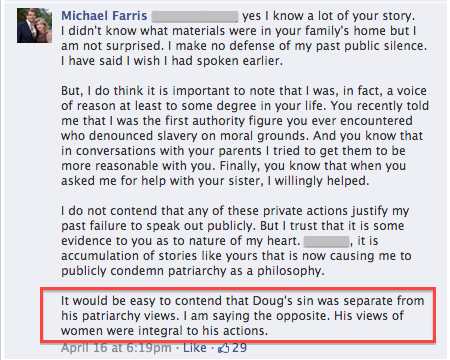
But other leaders are being more honest. They, Michael Farris and Chris Jeub among them, are connecting the dots and calling out a problem deeper than an individual leader. In this facebook comment, Farris responds to a homeschool graduate’s reiteration of her story (I’ve marked the relevant bit):

m1

When I read these things, I am reminded of evangelical attempts to soften toxic ideas so that they become more palatable, and that concerns me. For example, I heard evangelical leaders at the megachurch I grew up attending walk the idea of male headship back to spiritual leadership and breaking the tie when husband and wife cannot come to an agreement. While I appreciate that there are evangelicals who have moved away from an emphasis on total wifely obedience and submission, the idea of male headship itself is a problem, and softening it doesn’t change that. Is the walked-back view better? Yes, but it’s still a problem.

I wonder how far Christian homeschooling will change over all of this, and whether that change will be deep or surface-level. All Doug Phillips did was take ideas already out there—the idea of the Joshua Generation, the emphasis on male headship and wifely submission, the idea that girls should be encouraged to be homemakers and discouraged from having careers—and deepen each, using direct language, until his words and dictates became an embarrassment.

If Christian homeschool leaders see Phillips’ direct language and strident emphasis as the problem and fail to realize that it is at the core the underlying ideas that they themselves have long held that is the problem, change will be shallow indeed.

The word “patriarchy” is not the problem. The ideas that underly that word are the problem.

If the Christian homeschool leaders who are speaking out today reject the word “patriarchy” but hold onto the idea that a wife must submit to her husband, what have we actually gained? What is actually different?

Israel Wayne of Family Renewal wrote that:

In September of 2013, Michael Farris, founder of the Home School Legal Defense Association (HSLDA) spoke to state convention coordinators and other national homeschooling leaders, at the annual leadership conference they sponsor. He warned against the dangers of the excesses of extreme child discipline and a low view of women that has taken hold in some corners of the homeschooling community. He warned that unless homeschooling leaders actively speak against abusive and unGodly approaches to child discipline and unBiblical views of Patriarchal authority (that demean and devalue women), we risk losing our very legal freedom to homeschool.

From Wayne’s description, it sounds like Farris told other homeschool leaders that they needed to speak against child abuse and the devaluing of women or else homeschool freedoms would be at risk. The emphasis here appears sorely misplaced. Shouldn’t the primary concern be for the children who are abused and the women who are devalued rather than for the possibility that people will react to these abuses by turning against the legal freedom to homeschool?

I should note that I very much question what Farris means by “our very legal freedom to homeschool.” I suspect what he actually means is our freedom to homeschool without oversight or accountability. And here is a very real issue—Farris is now speaking out against “patriarchy,” and it appears that he may begin speaking against child abuse (though that remains to be seen), but he is still against legal accountability for homeschooling, accountability that would support children’s right to an education and their right to an upbringing free from abuse or neglect.

HSLDA’s current president, Mike Smith, will be presenting this keynote address at an upcoming homeschool conference:

Remembering the Reason, Renewing the Vision A general overview of the challenges, burdens and benefits of homeschooling from a veteran homeschool father and leader. Addressing the potential homeschooler, the new homeschooler, the veteran homeschooler and all homeschoolers in between, Mike outlines the success of homeschooling in academics and socialization, describes legal and legislative advances,and concludes that homeschoolers have earned the right to be left alone. 

This last bit is a serious problem. Whether or not Farris indeed intends to speak out loudly and publicly against patriarchy and child abuse, his organization will continue to work against legal reforms that help fight these problems, reforms that would bring homeschooled children into contact with mandatory reporters or ensure that homeschooled girls are not passed over educationally because of their gender. A change in culture is needed, yes, but the unregulated nature of homeschooling in many states both contributes to and is a result of that culture.

We need more. Homeschooled children deserve more.

But this is only the start of the things that concern me as I watch this current moment. Israel Wayne followed up on his discussion of Farris comments with these unfortunate paragraphs:

Mr. Farris has sounded a much-needed warning. My concern, however, is that when we over-react and swing to the other ditch, we end up teaching only love, grace and mercy (with no boundaries for children). By rejecting “Patriarchy” (abusive or domineering tendencies of men towards their wives and families), we may revert to the Feminism of the 1960′s, and all the problems that came with it, that led many women to react 180 degrees in the other direction by staying home and homeschooling their children. By rejecting rigid step-by-step rules about issues like strict clothing mandates and courtship procedures, we may revert back to the kind of sexual permissiveness that led to the legalism in the first place.

Do we really want to go back to families where mom is trying to pull that whole family uphill all by herself, while dad is off playing golf, letting mom run the family all by herself? Do want three-year-olds who rule the parents with an iron fist and parents who jump at their every demand? Do we really want teens who are groping their girlfriends in the back seat of a car because we don’t want to impose a legalistic standard on them? Do we really want to encourage the kind of American narcissism that says children are a nuisance and O.8 children is the goal, because we want to avoid the imbalance of policing bedrooms and imposing doctrines not clearly spelled out in Scripture?

This is not change, this is more of the same. What we need is change, real change. I think we’re at a moment of contingency where we might see such change, but to be honest. I don’t feel all that hopeful at the moment. I worry that the change will be more in gloss than in substance.

I can promise you one thing—I’ll keep pushing.

Tylenol is Evil. Because Witchcraft.

Screen Shot 2014-04-22 at 2.16.20 PM

HA note: The following is reprinted with permission from Kierstyn King’s blog Bridging the Gap.  It was originally published on February 20, 2014 with the title, “I don’t know what to call this.”

I was going through the files on my laptop looking for something specific and I ran across a picture that I saved from 2007. I won’t post it here, because it makes my stomach turn, but content note: graphic descriptions of infections and medical neglect.

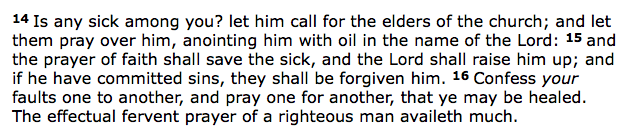
My parents stopped taking us to doctors before I was 10. They believed that god told them doctors were evil, to go to doctors was to not have faith in god’s ability and will to heal the sick. Along with that, came the belief that if you were sick, it likely had something to do with sin in your life. Both of these came from James 5.

k1

So, anytime we got sick, we did that. We’d have dad pray for us, literally anoint us with extra virgin olive oil, and then make sure we didn’t have any unconfessed sins. Ex: a cancer sore we could have because we “talked back”.

Because my parents didn’t believe in doctors, they also didn’t believe in medicine, because there is a greek word called Pharmakeia which is where the word pharmacy is derived from, but also means witchcraft. My parents made the jump to then decide that any medication, including ibuprofen and tylenol is evil, because witchcraft.

(side note: just writing this all out now is making me feel sick. First, I can’t believe I remember these arguments so well, and secondly, I just, I can’t, it’s so stupid)

We had one bottle of children’s chewable aspirin on hand, they reasoned THAT was okay because it’s from bark, not chemicals, and because one of my sisters was prone to migraines that resulted in vomiting – but that was only for dire emergencies.

My mom had “natural” remedies, like tea tree oil, oil of oregano, and Werther’s hard candies (for sore throats  << that one I’m not complaining about, actually, it was candy). Stuff that 1) doesn’t actually make sense and 2) is not located anywhere near the pharmacy area in the grocery store.

(side note: it took Alex so long to get me to take ibuprofen for migraines because of this.)

So, when I was 16 and a half, I had this horrible horrible infection on my leg. I could not move. It was swollen and oozing and painful, any movement at all was excruciating (and no painkillers), it swelled so much that my thigh didn’t look like part of my leg anymore, it was some weird mutated…thing.

My parents believed it was boils, like Job had (Job 2:7)

k2

So, they prayed for me, anointed me with oil, asked about my sins, which I couldn’t think of and then….the fun started.

Remember: no medicine, no doctors, nothing. My mom decided we had to keep the infection clean (makes sense), so, she would push and squeeze the abscess until puss came out of it (so. fucking. painful.), then she would put oil of oregano in and around the wound because it was a “topical pain reliever” and “antiseptic”, I’m pretty sure hydrogen peroxide happened too. Basically I just remember my siblings complaining that I smelled like spaghetti (maybe that’s why I hate it so much).

It was deep, and there was a good bit of blood – it was blue and swollen around the..head? I still have a visible scar from that first one. And the second one.

This went on from the time I was 16 and a half until I was 18 – it didn’t start fully clearing up until I left home, though it had gone down in intensity.

The second one, was right below the first, had two heads (which I think had more to do with my mom PHYSICALLY SQUEEZING THE ABSCESS than anything else) each wound was big enough you could put a pencil eraser in (I still have that scar too), and there was like, a flesh bridge between the two holes, so they were connected /open at the bottom/inside the wound, but on the top there was a little bit of skin that kept it from being a fucking gash.

After the first one though, my parents were less concerned, and I managed to move – while still in excruciating amounts of pain with no recourse – and do chores and go places and manage.

As time passed and I continued to get these and they continued to leave scars and I continued to function in large amounts of pain, my mom started commenting on how my legs looked.

Because, due to the scars – and random abscesses, they looked polka-dotted. So, I wore only jeans or ankle-length skirts (or tights) so as to hide the hideousness of my infected legs. (This continued well into my marriage, in fact I think it was around a year before I stopped wearing exclusively jeans and wore skirts/dresses that were above my knee, because of that reason.)

I walked for 10 hours in boots with an abscess on my knee (it was not fun and towards the end of the day I was having a really hard time walking/keeping up with the group, but being carried was not Teenpact Appropriate). Some of my skirts had stains from them.

I passed up an opportunity to intern with Teenpact after that trip because of my legs and knowing I wouldn’t have the stamina required to wear heels and walk all day.

They were frequent but became smaller – I started to be able to get to them before they developed into something bigger.

This whole time though, over a year and a half  – no one thought anything of it, no one thought to maybe get it checked out, this infection that didn’t go away – this thing that we’re calling boils and figure it has something to do with god, and not providing any kind of relief from the pain, I just had to suck it up and deal with it, and I did.

Our second year together, my legs and scars were healing and I was wearing shorts and short skirts and my parents would always comment on my legs – “oh, it looks like they’re clearing up!” which actually just reminded me that my legs might still be unseemly and polka dotted.

I realized, yesterday, after digging up that picture on accident, that my infection, much like my teeth, was something that they had the power to stop and chose not to. Instead they chose to shame me about it and give me the bare minimum of help (if oregano oil and being made fun of because of it counts as help) because of their religion.

The first two scars are shiny and feel weirdly smooth, but are fading.

k3

A Homeschooling Adventure: Homeschooling on the Open Seas, Harmony’s Story

Screen Shot 2014-04-22 at 1.33.09 PM

I have been following Homeschoolers Anonymous for quite a while, after searching for a social group I could be part of that reflects some social issues I’ll expound upon below. I was really not expecting to find what was posted here — stories of abuse, religious restriction, brainwashing, even death. It has been an enlightening experience, and I would like to extend my heartfelt sympathies and support to everyone whose stories I’ve read.

It is because of the harshness and true struggle of these stories that I have refrained from trying to tell my story. How can it compare? How can I hold myself to the same standard as these brave men and women sharing their suffering? But I think it is important to share my story, as it illustrates a detrimental effect homeschooling can have on your later life, even if it is well-meant, non-religious, free-form, and even in a setting that still amazes people to this day.

I had grown up in Colorado until I was 10, and up to that point I had been going to public school, brought up by my Dad after my mother divorced him when I was three or four. I began by going to the local basic elementary school, but I didn’t like it, so the last few years I had been going to a normal charter school. I was not an exceptionally smart kid, but I had a great imagination, and no problems making friends and keeping social with my little group. But in 2000, when I was turning 11, my dad remarried, and retired from his job to sweep us all away on an adventure of a lifetime.

His plan was to sail down the Caribbean, in a 40-ft boat, and go through the Panama Canal, across the Pacific, and finally settle in New Zealand.

Even at 11, I was no stranger to travel, having been to Tahiti, the Bahamas, Venezuela, and New Zealand itself, as well as yearly camping trips to Utah or Grand Mesa in Colorado. So the idea excited me, as it would any young boy, and it was only with a faint inkling of what I was really losing that we hauled our way to Florida to begin the journey.

So, obviously, since we would be moving so much and so quickly, homeschooling was the only real option for our continuing education. Our education largely came from textbooks and workbooks, and some educational computer programs. There was no religious undercurrent — my dad had disliked going to church, and had not wanted to foist that on us as well. So we were free to read the Bible if we wanted and make our own decisions on that front. We largely taught ourselves, going through the books and doing assignments for about four or five hours a day (year round, no winter or summer breaks), going to our parents if we needed help understanding something. For extra-curricular activities, my new step-mother was teaching us Russian and art, and of course we had all the swimming we wanted.

In exchange, however, my social world had shrunk enormously.

People had been voicing their concerns to my dad (who was in charge of everything) about our social development, and he had simply voiced confidence that we would be stronger, because we would be free of peer pressure, drugs, alcohol, violence, all the dangers he had begun seeing grow in our world. I believed and accepted that rationale, and prided myself on skipping the rebellious teenager phase, and being a teetotaler until I was 23.

But the reality was that, without outside input, my development had simply been short-circuited.

There were indeed other children on other boats down in the Caribbean, and we would try to make friends with them. For the most part this worked out great, although in some cases we were forced to try to interact with people we didn’t like. But each and every one of us were going our own routes, and most friendships would only last a few months before our paths split again. So for the majority of those 5 or 6 years on the boat, we had a very inward-focused social world, and depended on the family almost entirely.

Eventually, though, our homeschool supplies became inadequate for continuing education, and it was starting to become time to think about higher education. We were about at Grenada, near the southernmost tip of the Lesser Antilles, one island away from the mainland of South America, when we decided to head back to the states. We stayed in Miami, Florida for a few years, usually at a marina or a dry dock as we restocked on educational supplies and tried to get a new, bigger boat ready for our next foray to try to get back on track.

The reality was that Dad had been growing older too, and he didn’t feel like he was in condition with growing medical concerns to risk sailing across the Pacific. If he didn’t feel like he had to be in charge, and train us and trust us to run the ship if he had to be helicoptered to a hospital, things might have been different, and I might be in New Zealand now.

But the point is to show how Dad, even if he wasn’t overtly religious, had still absorbed a lot of the patriarchal ideas from his parent’s church and his upbringing.

He had been passing that down to us as well, though we didn’t know it.

In Florida, things slowly got worse for our family. We stopped homeschooling, on hiatus while we tried to work things out, but we were more restricted than ever, because Miami was a hotbed for the peer pressure, drugs, and violence we had been warned about all of our lives. So going to normal school there was out of the question. My older sister and I got our GED’s, where I had my first glimpse of college and wanting to really feel like I wanted to go there. But we were stuck in limbo while Dad tried to work things out.

Long story short, we made a last ditch effort to make an art gallery in Eureka Springs, Arkansas, and it failed. My family split apart with another divorce, with my older sister and my step-mother and her daughter remaining in Eureka Springs. I went to Tulsa with my Dad, because he had a friend there and it was a good place to continue my education.

In Eureka Springs, ostensibly I had more freedom than ever. I had a car I could drive, and a whole town of people I could socialize with, if I wanted. I had nothing but time on my hands, and nothing to do except go to town and help with the gallery every now and then. But I was more isolated than I’d ever been before- I was forced to stay in a camper in the back of a pick-up truck, because my mother and sisters had rented an apartment that didn’t allow pets, so I had to stay there with the dogs and the cats. But I hardly ever went out- I kept myself confined, worrying about the dogs, not having any motivation to leave. I was by myself most of the time- Dad was hired as a trucker to supplement the gallery’s income and keep it afloat, so he was away for weeks at a time, and my sisters lived in town. But I just couldn’t leave the camper except to get food.

When Dad and I moved to Tulsa, it was actually worse.I stayed in the trailer for a year while we waited for residency to get into college, too afraid of that peer pressure/drugs/violence world out there. When I finally enrolled for classes, at first I could not even talk to the teachers- though the homeschooling now apparently paid off, as I was literally steam-rolling through the classes, only getting B’s in Composition because I had never heard of and didn’t know how to use MLA format. But even though I was doing great academically, I was still suffering socially. I didn’t make a single friend, as I just didn’t have the courage to talk to anyone, and I had no connection to them.

I often felt like I was a time traveler, as I had missed so much of what was integral to everyone else’s development and frame of reference.

And I was dismissive of them too- it seemed like all the girls were dressing like sluts, all the guys were idiots, the teachers were liberal scum. I even refused to write a paper for a sociology class about the gender/orientation spectrum, protesting that it was complete nonsense.

From these last few sentences, you can see that I had pretty much unthinkingly adopted my dad’s point of view. Growing up in that homeschooling environment, so inwardly and family focused, had denied all other points of view. And even though Dad wasn’t aware of it, he was one of the only guiding points we had available. He was unconsciously passing along his parent’s strict, conservative religious teachings to us. It was only after I finally decided on archaeology over paleontology, and studying anthropology, that I began getting a global perspective.

I had dismissed sociology as just liberal propaganda dressed up to look scientific to push their agenda- but anthropology gave me the tool of cultural relativism to realize that Western notions of right or wrong weren’t necessarily the right one. I learned about how other cultures express sexuality, religion, and family relations. I learned more about how people worked, in a sense of all of humanity, not just Americans.

Slowly, I began to change my accepted views. I saw how ethnocentric right-wing politicians really were, pursuing an agenda focused solely within their Christian-political world-view. I explored my own sexuality, coming to terms with it and even completely changing my gender identity.

I also began seeing the need for my own independence. I needed to get out from my dad’s apron strings, and begin learning how to do things on my own. So I moved from Tulsa to Norman to attend OU, to attempt to make it on my own. But I still find myself secluded- I stay in my room, lacking the incentive or energy to go out, even to see my other room-mates. I have gone to several campus organization meetings, but most of the time I find some excuse not to go. Like before, even though my intellectual development expanded again, my social development still lags far behind.

So many homeschool parents intend the best for their children. They want them prepared for the world that they see, to be good, upright people, or to protect them from the evils of the world. But, as hopefully my story illustrated, even homeschooling in the amazing setting of the Caribbean can give much different results than you could imagine, and how parents can rarely foresee the outcome of what they are really doing.

Chaste Courtship and Ethics

Screen Shot 2014-04-17 at 4.06.07 PM

HA note: The following is reprinted with permission from Lana Hobbs’ blog Lana Hobbs the Brave. It was originally published on March 12, 2014.

I read this post yesterday, and it made me mad: “Jessa Duggar Will Have a Chaste Courtship — and My Kids Will, Too” by Kacy Faulconer.

Luke and I had a “perfect” courtship. No holding hands even, until the wedding.

After several year’s retrospect, I don’t really think it set us up any better for marriage than dating would have. In fact, dating would probably have been a lot simpler. We would have dated earlier, with less pressure, and more of a feeling of choice (it was by choice but also under intense pressure of ‘purity’). We wouldn’t have gained some of the baggage we did by having a complex, parent-involved relationship. I, especially, would have been my own agent, instead of my wishes being submitted to everyone else’s (and the triangulation in our families during that time was mind-boggling).

Had we dated, Luke and I would have been able to let physical closeness progress more naturally, and I don’t necessarily even mean sex before marriage — but just leaning on his shoulder when I was sad, that kind of thing. I can’t tell you how much it hurt not to be able to do that. Because I have negative touch in my past, it would have been really nice to have gradual healing touch. And sex before marriage? Had we done it, I’m sure we would have survived. The only difficulty would probably have been the shame, and that was something we were taught.

Chaste courtship, the writer of the piece claims, won’t repress her children:

I’m not repressing them. I’m freeing them. I have sons who need to learn restraint and respect. I have daughters who will be empowered by abstinence because they can simply sidestep the issues, pressures, problems, and pitfalls of promiscuity.

Look, just because you claim something is freeing, doesn’t make it so. Her ‘empowered’ daughters, like myself, won’t be able to safely learn about consent or their own bodies until marriage, at which point they’ll be expected to have sex every time their husband wants it. My big advice from my mom was ‘don’t say no too often’ (my dad did a better job with ‘the premarriage talk’). They’ll never feel like they own their bodies, because before marriage their bodies are owned by their parents, who feel it is their duty to keep their children pure, and after marriage they’ll feel like they belong to their husbands.

Parents who raise their children this way are trying to do what they think is best.

The problem is, they are motivated by fear to control their children. Fear that their kids will have sex, fear that their kids will ruin their lives somehow. They raise them to get an end result, it seems, because the end (a promised good marriage) justifies the means (intense control and denying their children bodily autonomy). I’m studying Ethics in my Philosophy class, and realized that many fundamentalists probably operate under a consequentialist system of ethics. (See also, spanking children to get godly offspring, or to not be embarrassed by fussing kids in public. I think it’s consequentialism.)

I operate under a more deontological view (also called ‘duty ethics’), there are acceptable actions, and unacceptable actions, and you should do what is right because it is right, and not because of the end result. One big rule of deontological ethics is that humans should never be treated as a means to an end.

And regarding the subject at hand, I believe it is wrong for a parent to control their adult child, no matter how good an end they hope to achieve for them. I think women should be able to own their own bodies and be touched only on their own terms, not their significant other’s terms, and certainly not their parents’ terms.

For another takedown of Mrs. Faulconer’s post, see Libby Anne’s post.

P.S. I’ve heard people saying that ‘parents can’t control their adult children’. Well actually, I think they can, especially when they’ve raised their children to mindlessly obey, and have kept them from taking steps towards independence like having a real job. It’s hard to go against your parents when they are the only way you have food and a place to eat. It’s also hard when you know that independence, or ‘disobedience’ could get you cut off from your family and everything you know. Would my parents have done this? I don’t know, and they didn’t when my brother dated against their approval. But I was still trying to please them and never would have tested it.