New Age Neglect: Rabbit’s Story

CC image courtesy of Flickr, andrew and hobbes.

HA note: The author’s name has been changed to ensure anonymity. “Rabbit” is a pseudonym.

I don’t… I don’t know if I’m ready to really talk about all of what happened to me. But I feel like maybe I should say something about my experience with homeschool because it had zero to do with Christianity and I feel alone, and maybe the reason I can’t find any other secular neglect homeschooling stories is because I need to write one. So this is, in brief, my story. Maybe I will write more someday, but I don’t know if I’ll ever be okay talking about it in a language anyone but me and my husband understand.

Now, in 2016, I have discovered the following things about myself, things that I feel should be known, in order to give context to this account: I am an intersex woman with PCOS. I have EDS, a collagen mutation that causes chronic pain. I have been homeless and because of those experiences became a communist. I am a bisexual pagan witch. I am severely disordered, impacted by schizophrenia, autism, and two personality disorders (borderline and dependent) as well as extensive PTSD and anorexia, both of these latter from my childhood abuse and neglect, and the further abuse and neglect they set me up to face.

My mother neglected and emotionally abused me, as did literally every other member of my extended and immediate family, including my younger sister, who was also homeschooled for a time.

When I graduated from a very good and positive Montessori school at the age of eleven (5th grade) my mother put me in yet another private school for 6th grade and then, in the summer after, quit her job and pulled me and my sister out of school. She got a license to homeschool us (or… whatever that is, the registration that keeps the truancy officers showing up).

She bought all the sparkly accessories for homeschooling, made a few desultory efforts, and then got bored (she always got bored) and just started… ignoring our education.

She said, she always told people, that ‘oh, she’s so smart, she reads all the time. I can just leave her alone and she learns by herself!’

When I said I wanted to go to high school, she said ‘ok but you have to be in charge of that’ and then did absolutely nothing, forcing me to ask my friend, another 13yo girl, about how to enroll in her school. We were thirteen!! I had to go through this other friend of mine, on the phone, not even given the internet or anything, and print out the applications on my grandmother’s computer during Christmas.

She continued her sterling record of doing absolutely nothing, not even feeding me adequately or taking me to see a competent doctor when I was very clearly having severe medical problems (other than my orthodontia, because heaven forbid her child have crooked teeth), through the one and a half years I managed to limp along with zero parental help or support in a public (well, charter/magnet) school–the first time I’d ever been to public school.

And then, when I failed out of that school, she acted like I didn’t exist.

Again, she reasoned that she didn’t have to pay attention to me, because I could read and ‘read all the time’. She seemed to dutifully ignore the fact that what I was reading was fiction.

Anyway, later on, when I started talking about homeschooling with other people, I got very confused when they assumed I was Christian, and fundamentalist at that. I simply had never been around that kind of homeschooler–I’d only briefly been around any other homeschoolers, but the ones I’d met were all New Age. Scientologists, Pagans, etc. And all abusive in the same way, similar way to what I’ve read about from Christian survivors, but with that New Age ‘rebel’ twist that makes it hard to… well, rebel against it visibly (how are you supposed to rebel against an atheist or pagan? Go Christian??).

I still feel alone. Whenever I hear about survivors, or meet them (I live with two others–my husband and our roommate), they’re from horrific Christian cults. I feel like the only one that was from a secular or New Age philosophy or cult.

I guess this isn’t a full story so much as a call to others.

Where are my fellow secular survivors, where are they? Please speak up, please let me know I’m not alone. I’m here. You’re not alone.

I found out all of my conditions and illnesses in my adult life–most of them in the past year–and am learning more about how to live with them. My husband and I have been together for 9 years this April. I have been in recovery from anorexia for nine years. I am no longer homeless. I am able to buy items that ease the pain and lack of mobility from my EDS. I have some support cats. I am at a point where I can laugh derisively at my mother and my relatives and their abuse and neglect of me. I am recovering. There is hope.

You–and me–we’re not alone.

I love you. You can do it. We can do it together.

How the Daughter of a Focus on the Family Executive Came Out as Gay

Editorial note: Amber Cantorna’s story is reprinted with permission. It was originally published as a Facebook note on December 26, 2015. 

I was 27 when I had finally mustered every last bit of courage to have “the talk” with my family. I had been pondering, planning and praying for months. My heart weighed heavy and anxiety took my mind down every possible outcome. I knew, as the daughter of a Focus on the Family executive, the results of my truth could be devastating. But I had reached the point where living a lie was worse than whatever lay on the other side of truth. After much counsel, preparation and prayer, I felt the time had come to tell my truth. So on April 14th, 2012 I invited both my parents and brother over and we all took a seat in the living room of my split-level apartment. I told them the journey I had been on over the past several years and then, spoke the 3 short words that would forever alter my future…

* * * * *

Though I was born in Kalispell, Montana, by my third birthday we had moved to Glendora, California where my dad had accepted a job offer at Focus on the Family. When the company then relocated to Colorado Springs in 1991, my family did as well and that is the town where I grew up.

With the values and teachings of Dr. Dobson at the core of our family’s foundation, my parents decided to home-school both my brother and I from start to finish. They made daily devotions and cultivating a relationship with God a priority from a very young age. With programs like AWANA, we memorized Scripture frequently both in the program and as a family. A typical girl, I grew up playing with American Girl dolls and having frequent tea parties. I believed that my knight in shining armor would come for me, if only I would wait for him. At my thirteenth birthday, I even had a “Purity Ceremony” in which I signed a vow to stay chaste until marriage and was given a ring that was to be worn on my finger until it was someday replaced by a wedding band. I had been taught all these grandiose ideas of what love and traditional marriage were supposed to look like and innocently embraced them all as truths.

My mom came from a musical family, so (almost from the womb) she trained us as well, investing a lot of time into fostering our musical talents. We frequently sang at retirement homes and for Christian schools; we did full concerts at smaller churches and were always ready to perform for visiting family and guests. I was very blessed to be given 13 years of classical piano training as well. By the time I was 14, I was touring Europe with a youth choir and soon after, with the Young Continentals. Performing was a huge part of my life, and I thrived on it. As a very high-achieving perfectionist, I constantly put pressure on myself to rise to the top.

However, not all of that pressure came from within. As I moved more into my teen years, I began to feel the outside pressure of upholding my family’s reputation as well. As the daughter of a man who held a high profile position at Focus and whose work was known and loved around the world, being his daughter caused me to feel the weight of maintaining the appearance of that “perfect Focus family.” Friends would often comment to me how lucky I was, but behind the mask of perfection, I found myself struggling with depression and anxiety coupled with a need to keep all those struggles hidden behind a facade.

By the time I reached my early 20s, I still had never dated a guy. I admit at times I thought maybe there was something wrong with me, but mostly I just believed what I had been taught: if you prepared yourself spiritually and wait sexually, the right man will come along at the right time. The fact that I might be gay really never crossed my radar. I truly believed that God was just shielding me from the heartache of high school romances like the ones my friends were having, and that somehow the first man I would meet and seriously date would just magically be “the one.”

But at the age of 23, things in my life took a drastic turn when I suddenly found myself falling in love with my roommate…who was a woman. What started as a simple friendship, over time morphed into what was clearly becoming more than friends. I was so aghast the first time we kissed, I wasn’t even sure what was happening. My head was spinning, in more ways than one as I tried to figure out this mysterious attraction. Though I didn’t know it at the time, that experience ended up being the beginning of a deeper wrestling, the beginning of searching and eventually, the beginning of coming out.

I knew I couldn’t just sweep this “problem” under the rug, but I was terrified. I was terrified that in studying and digging deeper, I might find what I had been taught all my life to be true: God disapproved of homosexuality and, therefore, He disapproved of me. Focus on the Family teaches that marriage is strictly between one man and one woman and I was equally as terrified that in digging deeper I might find that belief to be false. Because if God did indeed make me this way, I would become part of a minority that is stigmatized, especially in Christian circles, and that too would be life-altering. So either way, my life would never be the same.

But, as I sat one night with my journal in hand, heartbroken over the loss of my first love and all together confused as to how and why it all happened to begin with, I gathered my courage and told God I was ready to start walking the difficult road ahead. I prayed, studied and researched for months allowing everything I had believed up to that point to be re-examined. I talked to people on similar journeys and, in doing so, found those who were both completely in love with their same-sex spouse and also completely in love with God, without any conflict between the two. That was when I began to realize that there didn’t have to be a dichotomy between my faith and sexuality, as I had been led to believe. Finally, after a long and difficult climb, the Scriptures in question settled in my heart, I found the answers I needed and knew that in God’s eyes, I was not only accepted but also loved for exactly how He made me.

The odds were high, however, that my family would not feel the same. Anxiety, panic attacks and nightmares swelled as I approached the day where telling them my truth would disappoint and break the illusion of that “perfect Focus family”. As I mustered every ounce of strength I had on that chilly April day, I looked my family in the eyes and said those three small, but life-altering words, “I am gay.” With my exposed heart hanging in the air, I awaited their response. To my deep dismay, the only response that came out of my dad’s mouth was, “I have nothing to say to you right now,” and he walked out the door.

From that moment on, things went from bad to worse. In a follow up conversation we had at my parent’s house several weeks later, they compared me to murderers and pedophiles, told me I was selfish for doing this to the family without thinking about the impact it would have on them and asked me to turn in my keys to my childhood home. Over time, because of their unwavering belief in Focus on the Family’s teaching and interpretation of the Scriptures on this issue, I was quietly pushed aside and shunned from the family. Only in my worst nightmares were the consequences as drastic as what they proved to be in real life. I lost not only my immediate family, but also my relatives, my church, many of my friends, and essentially, even my hometown. Because of the toxicity I felt living in a city where it seemed my every move was being watched by some degrading eye, I ended up moving to Denver. Even though almost four years have passed, I still feel anxiety every time I drive to Colorado Springs. Unfortunately, though many of my loved ones claimed to have unconditional love, what I discovered is that their love actually came with strings attached.

My world felt as though it were spiraling out of control. I’d never felt so lost or alone in all my life. Consistent nightmares and self injury reared its ugly head in my life once again and for the first time ever, I truly could not see the light at the end of the tunnel. Suicide became a viable option in my mind.

Over the coming months, there were several key people who invested in me and added value to my life and in turn, rescued me from that dark place I was in. I don’t remember an exact turning point when I decided I wanted to live, but about 10 months after coming out, the tides had turned and I was sharing my life story at community hour at the Denver church I was attending. Though I didn’t know it at the time, that day was the day I met the woman who would one day become my wife.

I didn’t pay her much attention at first, but she noticed me from the start. After several months of intentional pursuit on her part, we started dating. We both quickly knew that each other was “the one” and about a year and a half after we met, we were married.

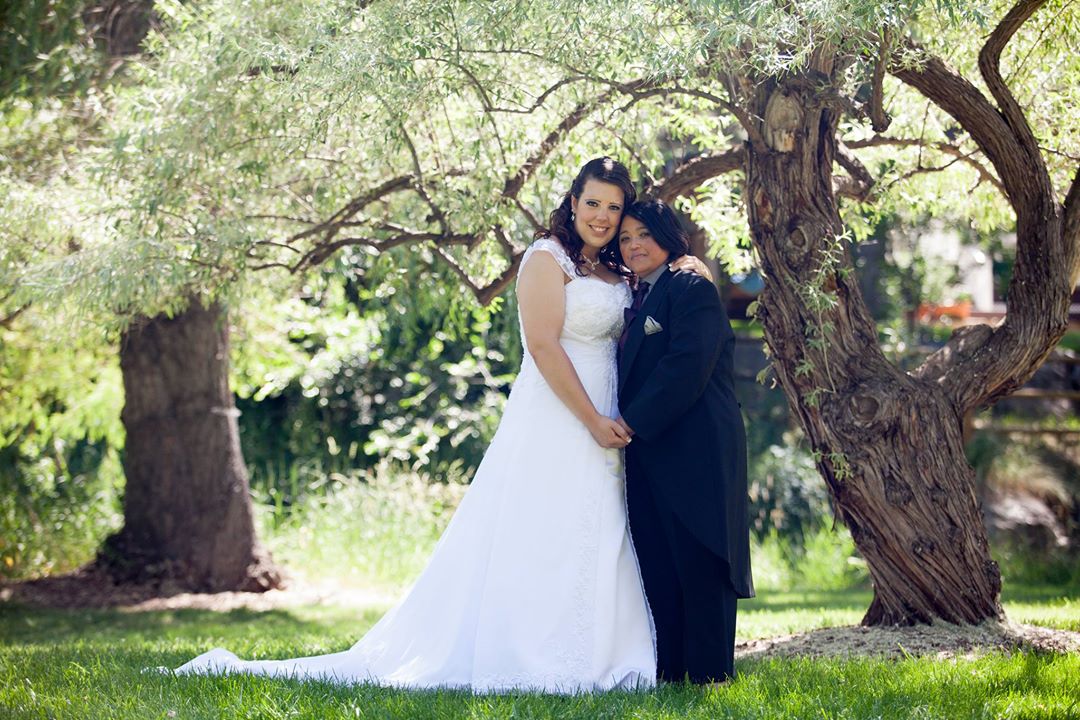
Amber and her wife, Clara on their wedding day.

Somehow along the way as my relationship with her solidified, my relationship with my parents became even more bleak. When we got engaged, my parents realized this wasn’t just a phase that would pass and the gavel came down. We cut all ties.

Not having any family at my wedding was one of the hardest things I’ve ever had to go through, and yet, it was still the best day of my life. In front of the people who stood by me when it mattered the most, I got to consecrate my love to my wife in a sacred covenant before God. In that moment, all the labels washed away and I was able to be fully myself, completely in love with my wife and also completely in love with God. It was the perfect day.

We’ve been married a year and a half now and our journey continues forward. There are still bumps in the road and hard days where I miss my family. The truth is, I still cherish my family values just as much today as I did growing up, but I’ve just had to learn to re-focus my family. I truly have so much to be grateful for. God has given me beauty for ashes and is continuing to be true to His promise and make all things new and beautiful in His time.

In their free time, Amber and her wife, Clara enjoy traveling as well as spending time in the Rocky Mountains with their two furry babies.

By Amber Cantorna
Speaker/Writer
Beyond: Renew Your Faith, Restore Your Hope, Reclaim Your Love

To learn more about Amber and follow what she’s doing or to book her for an upcoming speaking event, please visit her website at AmberCantorna.com and “Like” her on Facebook at http://www.facebook.com/Beyond.AmberCantorna.

Amber now speaks and writes, sharing her story to help bridge the gap between LGBT and faith communities.

Why “Not All Homeschoolers” and “No True Christians” Silence Dialogue

Editorial note: The following is reprinted with permission from Eleanor Skelton’s blog, The Girl Who Once Lived in a Box. It was originally published on November 1, 2015.

So I’m active in several online communities that discuss homeschooling and spiritual abuse. I also read a lot. Almost daily, I post articles and blog posts that I find interesting.

I’m also Facebook friends with people I met during each of the four times I moved cross-country between Texas and Colorado, people from every church I went to growing up, every place I’ve worked, people who are my fellow homeschool alumni and college classmates. This means that everything I share is being viewed by people all over the human spectrum. 

I value this diversity, that my community is no echo chamber. I welcome the opportunity to be challenged and corrected and grow, and I hope my friends do, too.

Yes, there are periodic flame wars in the comments, but I’ve also seen successful dialogue. This is why I want to foster debates and discussion, because I believe that if I limit myself to only people who agree with me, change will never happen.

But a couple of arguments surface over and over.

“Not all homeschoolers were raised in cults.”

“What does abuse in these churches have to do with true Christianity?”

And these rebuttals are killing our discussions. Here’s why. This week, I read an article posted by Relevant magazine on why there’s a problem with saying All Lives Matter. The subtitle read: “There’s a difference between ‘true’ and ‘helpful.’”

Responses like this usually demonstrate a failure to listen. Conversations usually go:

Person 1: “This is what my experience with homeschooling / purity culture was like.”
Person 2: “Good point, but remember, not all homeschoolers were abused / raised in cults.”
Person 1: *awkward silence* (thinks) But I wasn’t talking about all homeschoolers. I was talking about me.

And they feel like you don’t think their story is important.

It’s hard to have these conversations, I think. If you say, “Hey, this happened and it was bad,” or express criticism, you get a lot of “not all homeschoolers” responses. Which is technically true.

But the one doesn’t invalidate the other. Sure, not all homeschoolers were raised in cults. But some were, and problematic and harmful things happened as a result. I’m not against homeschooling as a form of education, and I don’t think it should be banned, but I do think the problems within the movement must be addressed.

“No True Christian” is basically another version of the No True Scotsman fallacy.

Person 1: “This really awful thing happened in my church / to Amish girls / to Pentecostals.”
Angry Defensive Person 1: “Not all Apostolic Pentecostals are like this!”
Angry Defensive Person 2: “What does this have to do with true Christianity?”

These comments are missing the point. Orthodoxy isn’t the issue here, abuse is. And if you’re more concerned with heresy than hurting people, you are contributing to the problem.

And almost every group thinks they are the true believers, the genuine thing. So asking whether or not the Amish are truly Christians is irrelevant. They believe they are. That’s why they live in isolation, making sure they aren’t corrupted by deviating opinions. Other high control religious groups operate similarly.

Just because you might not believe cult members or other denominations are actually Christians doesn’t stop them from identifying as believers. But shouldn’t Christians be more concerned about people who claim to follow their savior perpetrating abuse than whether or not the abusers are heretics?

Let’s be honest here. We use these arguments to protect ourselves. We don’t want to be associated with sexual abuse and hypocrisy, we don’t want our image threatened. So we cry “not all homeschoolers” to defend our educations, and “not true Christians” to defend our core beliefs. We don’t want to think that our community might be wrong, we hide our faces from the wounds, cover our ears and refuse to listen.

And we need to stop.

A Homeschooled Son’s Letter to His Father: Ethan’s Story

CC image courtesy of Flickr, Kevin Dooley.

HA note: The author’s name has been changed to ensure anonymity. “Ethan” is a pseudonym.

I grew up in a homeschooled Christian family, oldest of eight children. For the past several years, conversations with my mother indicated her weariness of homeschool education and a belief that public education was no longer the great evil she once considered it to be. Despite her view, her expression of this exhaustion to my father was limited to periodic bouts of frustration that were dismissed by my father as ‘evidence that Satan doesn’t want our family to keep homeschooling’. I was, to exaggerate by understatement, mildly angered by his cavalier dismissal. Given my financial dependence on my father throughout college, though, I wasn’t in a position to risk his anger by addressing the strain homeschooling was placing on Mom. Now that I am in my last semester with a six-figure job lined up after graduation, I elected to voice my thoughts (in a much cooler voice than would have been likely in person) to my father in an e-mail, included below.


Dad,

This is a long e-mail that was supposed to be a conversation in person, but I didn’t realize y’all were leaving for the wedding and timing just kind of didn’t work out.

I want to preface this with two notes. First, please understand that this is not written from some resentful / I-hate-my-childhood perspective, because it’s not. Second, I beg you to realize that my opinions are not automatically invalid because I haven’t procreated and raised offspring myself.

Section 1: On The Theory of Homeschooling
Homeschooling has highly variable outcomes – some families end up on prime-time news for abuse and incest, some families send all their children to Harvard / Princeton / Yale. I have no problem with homeschooling per se.

To the contrary, growing up in that community gives me a unique view on its pros and cons.

To the extent that Christian parents have a duty to guide the moral development of their children, parents may (ought, even) elect to control the influences, environments, and material available to a young child. Homeschooling in the religious right originated because of a belief that public schools were dangerous, anti-moral institutions that threatened the development of Christian beliefs, and that belief is not unfounded. Public schools are not religious, and are often anti-religious.

It’s important to understand, though, that any child will inevitably be exposed to these ‘great evils’. Homeschooling does not allow a child to enjoy life sans secular influences. In some cases, it delays exposure to said influences. In some cases, those secular influences reach a homeschooled child through different channels. In many cases, though, homeschooling simply creates a unique set of ‘secular’ problems.

Homeschooling doesn’t solve the sin nature – as ideal as that would be.

In a homeschooled environment, some sins will bubble to the surface. In a public school environment, some of the same sins will arise, but it’s likely a different set will be primary concerns. The point here is that homeschooling does not eliminate the need to address human failure, it just changes the topics being addressed.

In economics, there’s a concept of diminishing marginal returns (DMR). DMR basically says that doing something for a certain amount of time has high value for each incremental action, but beyond a certain threshold, very little value is added. I think this is models the homeschool environment quite well. In early years, there is immense value from a Christian environment to build a foundation for moral thinking and behavior, but as the age timeline and the ability for self-reasoning progresses, you [generic you] reap very little incremental value from environmental restrictions.

[As an aside, I always found the quiver and arrows argument about shooting children out into the world very interesting. It was used to justify homeschooling and protecting children from the outside world until adulthood, but the process of making arrows is very different. Arrows are made from greenwood, then allowed to “season” / “mature” in an outdoor environment (while still under care of the archer) until they are ready to be shot out. Protection is not always good].

With one exception, all my Christian friends at [university name] were public schooled from day 1, and it’s arguable that their faith is more sincere than mine. This is perhaps a criticism of my focus on things of God in recent months, but is stronger evidence that the method of education is not the determinant of faith. Morals, godliness, and Christian belief stem from a God-given desire to follow those things.

As a summary: homeschooling has value, but it is not an intrinsic good. Beyond a certain point, it may be detrimental to the rigor of one’s faith and one’s ability to thrive in the outside world.

Section 2: On Finances
This is a somewhat short section, but merely exists because I think it’s important to recall one thing: the thousands of dollars the family pays in taxes every year fund, in part, a school system recognized as one of the best in the nation. From a financial stewardship perspective, electing to not utilize public resources is an unmitigated waste of those dollars. Given that family finances are increasingly stressed, prudent management of available dollars seems important.

Section 3: On Patriarchy
I am attempting to word this section very carefully to avoid giving offense. I apologize in advance if I fail to achieve this goal.

Fathers are recognized generally as ‘head of household’ within Christian tradition. Unfortunately, this tradition systematically has taught that fathers are the only heads of the household, that their decisions are final, and they are endowed with a ‘divine right’ to teach and train members of their family as they see fit.

At a very basic level, this is extra-biblical at best and abusive at worst.

It is especially pernicious because Mothers have been taught to accept the aforementioned patriarchal role without question.

[As an aside, mom knows nothing about this e-mail and i have not solicited her feedback in composing it. Any anger you have should be directed at me, not at her]

Over the years, the concept of ‘[Family Surname] Team’ and ‘family vision’ [quotes are not used ironically, merely to indicate specific phrasing used] have come to be despised by at least [second born sibling], [third born sibling], and myself because they didn’t represent a family vision – they represented your vision, which was to be accepted without question or argument, unless we wanted to face the consequences. While this is as much the fault of our immaturity as any other factor, I think it’s problematically indicative of a family trend – anything that happens must have your seal of approval, regardless of how trivial it is. And any choices that ’the family’ makes are, ultimately, just choices that you have made for us.

You have made some stellar decisions, please don’t get me wrong. This is not a blanket critique of everything that has ever happened. But the family is driven by a centralized power, and it’s abundantly evident whenever a unit of the family attempts to make an autonomous decision that you will brook no autonomy.

The ATI ‘umbrella of authority’ is transformed all too often into a suffocating blanket of my-way-or-the-highway.

Why am I talking about this? In all fairness, it’s often true that attempts at autonomous decisions by children are misguided and in need of parental ‘editing’, but the same should not, and in the case of our family, cannot be said of Motherly autonomous decisions.

I’ve seen the quality of your marriage deteriorate meaningfully for the past few years, and while that may be due to other factors, I’m convinced the largest contributor is the choke-hold you have on Mom’s ability to say, do, allow, or think anything related to the family. [second born] / [third born] and I often comment on the legitimate fear we see in her eyes whenever she allows a younger child to do anything without running it by you first – frightened anticipation of your anger at her for not fulfilling your vision for how the family ought to be.

Any marriage will have differences of opinions, that’s life. But communication, grace, and willingness to not always get your way are how marriages survive. I may not be married, but it’s not rocket science to figure that much out.

Where am I going with all this? Homeschooling is your vision for the children. I may be wrong, but I’m confident Mom no longer has a desire to homeschool. She continues her days in the car, her nights up to 2am managing different children’s classes, her constant fights with children over turning in homework and proctoring exams, in some desperate attempt to fulfill a vision that you have required her to implement. This is not healthy.

As a summary: The power dynamic in the family is driven by your fear, fear that you will lose control. If you made a genuine effort to give Mom freedom to be an independent entity, I think you would discover your vision for family education is sub-optimal.

Section 4: On College, aka, Finances (Again), Choice, and Resources
This is about college. College is expensive, as we’ve all found out.

And homeschooling can [it doesn’t have to] severely limit leadership opportunities / transcript development relative to a public school.

This has a direct financial impact on scholarships, college acceptances [different colleges have very different aid packages], and, consequently, the affordability of higher education. Presuming that blue-collar work is not the optimal adult life track for all the children, doing all that is possible to minimize college tuition is important.

Every child is different. Homeschooling through high school was great for me and I’m sure if I went to public school I wouldn’t be where I am today. But that doesn’t mean homeschooling is optimal for everyone. At the very least, children should be given the option of going to public school for high school, so that they can best position themselves for college applications.

Additionally, public schools have offices designed to educate students on college options, administer standardized tests, prepare transcripts, guide students through the application process, etc. These are professionals, people we’re already paying [via tax dollars], in the richest county in America, to send students to optimal colleges for each family.

Section 5: Action Items and Everything That Didn’t Fit in Earlier Sections
Will public schools open up a new set of problems? Probably. Will continued homeschooling kill Mom? Probably.

Will continued homeschooling eliminate the conflicts that current exist at home? Probably not. Will continued homeschooling ensure that all children love Jesus forever and ever? Probably not. [That was a bit snarkily phrased, I apologize].

Maybe no one wants to go to public school. That’s entirely possible.

But I suspect there is an interest, and I more strongly believe that certain children would massively benefit from it.

[fourth born child], [fifth born child], and [sixth born child] are all IMMENSELY intelligent, and young enough that they have years ahead to shape their high school and college opportunities. If other children went to public school, that would likely allow finances for them to play travel soccer and develop advanced skills there. [fifth born] is fascinated by computer science – if that can be fostered, he would love [elite science / tech high school nearby] as an intense scientific high school. There’s immense potential here.

I 100% support continued homeschooling up to middle school, maybe even through middle school, or perhaps through high school [again depending on individual children’s preferences].

But please, have the humility and intellectual honesty to engage with Mom in a genuine conversation about what she wants, and then implement what she wants.

The world will not end and we will not all become heathens if public schools are opened up as an option.

Who knows, maybe the reduced financial stress and replacement of “mom & dad” with “professor x” as academic task-masters will improve family relations.

Above all, this is about creating a truly family driven vision and contributing to a healthy, high functioning, family unit.

Love,

[Oldest Child]
HSLDA-Sponsored Magazine Promotes Bill Gothard’s ALERT Academy

By R.L. Stollar, HA Community Coordinator

The last time Homeschoolers Anonymous covered The Old Schoolhouse (TOS) magazine, it was because TOS owners Paul and Gena Suarez were accused of covering up allegations of sexual abuse and as well as perpetrating child abuse themselves (including waterboarding children). TOS  boasts a readership of around 200,000 and is endorsed by James Dobson. Back when the allegations of abuse arose, both the Home School Legal Defense Association (HSLDA) and the Great Homeschool Conventions (GHC) were financial sponsors of the magazine. While GHC dropped their sponsorship last year, HSLDA continues their financial support of TOS.

In the most recent edition of the HSLDA-sponsored magazine (Winter 2016), TOS features a full-spread piece promoting ALERT Academy. ALERT is a self-described “military-style Christian school” that trains young men in crisis-intervention techniques. It was created by Bill Gothard’s Institute in Basic Life Principles (IBLP). Gothard is the now-disgraced founder of IBLP. He resigned in 2014 on account of allegations that he sexually harassed and molested over 30 young women, including children, for decades. He and IBLP now face a lawsuit from 17 people seeking damages for alleged sexual assault and rape.

The TOS article is featured prominently on the magazine’s front cover with the line, “ALERT Academy: Cultivating Integrity in Your Son!” The author, John Boulden, describes the history of ALERT while making no mention of its relationship with Bill Gothard, IBLP, and the Advanced Training Institute (ATI, Gothard’s homeschool program). He simply describes it as “an outgrowth of a homeschool program.” Boulden also describes numerous homeschool conferences in Knoxville, Tennessee and Big Sandy, Texas, similarly neglecting to mention these conferences are Gothard’s IBLP conferences. Furthermore, while Boulden talks up the benefits of ALERT’s Basic Training, he does not mention that the training involves Bill Gothard’s Basic Seminar principles, especially Gothard’s “principle of authority.”

A homeschool alumnus who attended ALERT Academy, which is still an IBLP programdescribed it as “really nothing more than a glorified boy scout troop; often referred to by some as ‘Gothard’s boy scouts’.” ALERT stands for Air Land Emergency Resource Team. The academy engages in highly controversial training techniques, much like Teen Mania’s suspended Emotionally Stretching Opportunity of a Lifetime (ESOAL) program. Also like ESOAL, ALERT has faced a plethora of abuse allegations. Jeri Lofland details, among other charges, the program’s alleged “refusal to contact parents regarding medical emergencies” and practice of forcing “under-dressed teen boys to stand outdoors in sub-freezing temperatures at night” to elicit confessions. A contributor at Homeschoolers Anonymous describes abusive physical training. And a contributor at Recovering Grace describes emotional and physical abuse as well as medical neglect during his time at ALERT.

Images of TOS’s ALERT article are below:

HA has archived a PDF of the article here.

Isn’t This Why We Don’t Send Them to Public School?

CC image courtesy of Flickr, Quinn Dombrowski.

Editorial note: The following is reprinted with permission from Eleanor Skelton’s blog, The Girl Who Once Lived in a Box. It was originally published on December 14, 2015.

I was four years old.

We were visiting my dad’s childhood home in New York, and we went to the house of an elderly lady who used to be his neighbor. She had a caretaker, a single mom homeschooling her son, who was around my age.

My favorite TV show was Barney the Dinosaur, my only 30 minutes of live television once a week. I also played my Barney’s Favorites cassette tape every day and I knew all of the songs by heart.

The little boy and I started chattering and playing on the floor, and I sang “Do Your Ears Hang Low?” for him and his mom, very enthusiastically, with all of the hand motions and marching.

“Do your ears hang low?
Do they wobble to and fro?
Can you tie ’em in a knot?
Can you tie ’em in a bow?
Can you throw ’em o’er your shoulder
Like a continental soldier
Do your ears hang low?”

His mother turned to my mom and said, “Isn’t this why we don’t send them to public school, so they won’t be exposed to garbage like this?”

I remember this deep sense of shame and wanting to crawl under the carpet. I felt like I’d humiliated my mom and I wondered what was so terrible about my song. I think the little boy’s mom called him to come sit on the couch next to her, away from me, and we weren’t allowed to play together the rest of the visit.

This was the first time that I was that child, the bad influence.

Usually it was my parents keeping me away from other children that could lead me astray. This time, they hid their children from me. My mom didn’t understand at all why the other mother objected to the song.

The fear would follow me for years.

Later on in my teens, we ended up in a church with mostly other homeschooling families, some of them Quiverfull. All the other churches we’d gone to before were mainline denominations, and their children went to public school. But homeschooling was becoming more common by 2004.

I’d hear stories from the other families, pick up things in snatches of conversation.

My sister got a craft book for her 8th birthday party, the only party she ever invited friends to since we stayed to ourselves. The other children said, “Oh, look there’s a witch on this page! We’ll have to cover that up.” Their mom glanced over and said, “Oh yeah, you can just cut out black construction paper and glue it over those pages like we do at our house.”

I called my Bible Buddies partner during the week, we got into a theological discussion, and I asked, “Well, have you ever read Narnia?” “No,” she answered. “My parents don’t like that they talk about magic, and they think it’s too confusing for children to read about Jesus as a lion.” I explained that magic is like a substitute for divine power both in creation and redemption, and I read her some dialogue between Aslan and the Pevensie children. She said she thinks it’s probably safer not to read it and seemed uncomfortable, and I dropped the subject.

A homeschool mom traded some used A Beka textbooks with our family. The pages of the only Greek myth in the 8th grade literature book were stapled together. “Why should they learn about pagan literature when they could be reading the Bible?”

My dad bought clearance books and films from the Focus on the Family bookstore. He sent the kids Ten Commandments VHS series to a Quiverfull family we knew with 13 kids. My mom explained to their parents that the only time there is music with a beat in the series is the scene where the characters worship false idols.

I was always watchful around the other families, struggling to balance being honest about the books and movies I enjoyed but with the fear of not being allowed to talk to the other teens if I’m considered a “bad influence.”

In this patriarchal world, if one of the parents decided I’m not spiritual enough or too worldly, I might not be given space to defend myself.

I know because it happened to others. Teens and young adults were called into the pastor’s office and questioned about their music preferences, asked to stop hanging out with their children.

Because, you know. This is why we don’t send our kids to public school.

public school pearls

Puncturing Declension Narratives

CC image courtesy of Flickr, Elena.

Editorial note: The following is reprinted with permission from Libby Anne’s blog, Love, Joy, Feminism. It was originally published on February 8, 2016.

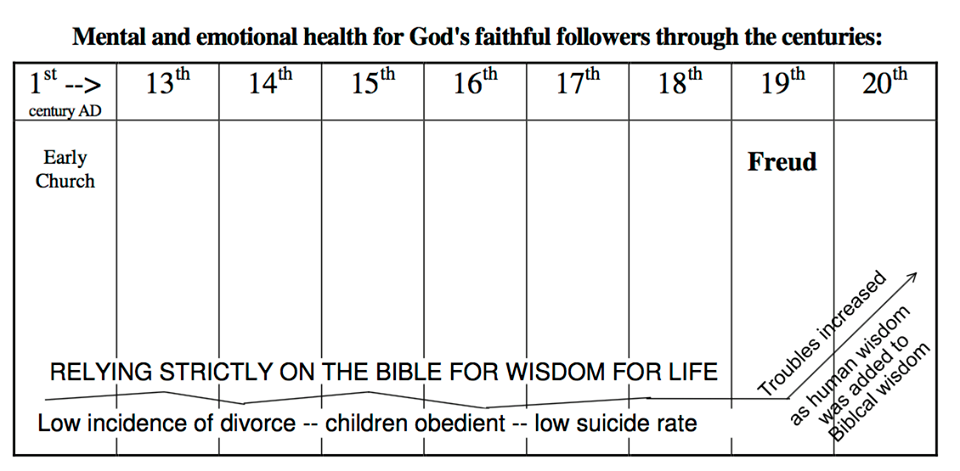
Last week Homeschoolers Anonymous posted this photo, “an actual graph Reb Bradley created for his mental health curriculum.” You can see it here:

12654126_1015168265205956_327130378208914015_n

So you know what’s strange? A lot of Protestants argue that before the Protestant Reformation, most people were duped by the Catholic Church into believing they could work their way to heaven. These individuals weren’t really saved and weren’t really following the Bible, the argument goes, and the priests and monks—the ones who did read the Bible—were corrupt wolves who took advantage of the people. I’m wondering how this sort of chronology—which I imagine Bradley himself holds, given his other writings—squares with the graph in the image above.

There’s something else I find most people don’t know. During the middle ages, most Europeans were much more pagan and much less Christian than people today realize. People used charms, spells, and old folklore and ideas that the Catholic Church had never been able to fully root out, and that Protestant Reformers weren’t able to root out either. In fact, some historians have argued that early European settlers to the U.S. were more pagan than they were Christian, and more apathetic than they were churchgoers, and that it took until the mid-1800s for the American people to be fully “Christianized.” In other words, the idea that people before the mid-1800s were “relying strictly on the Bible for wisdom for life” is utter bullshit.

As for the idea that children were obedient before the mid-1800s, I’d say two things. First, there were disobedient children. Anyone who has read Romeo and Juliet knows that. It was also wasn’t that uncommon for children to run away from home during adolescence. But second, before the mid-1800s it was both legal and socially acceptable to beat one’s children if they didn’t obey. In fact, child abuse was not recognized as a thing until the mid-1800s. It’s not that it didn’t happen—it did—it’s just that before this, it was considered normative. So maybe we can stop saying how awesome it was back then, because children obeyed their parents in fear of a beating?

As for the divorce rate, it’s worth noting during the middle ages priests struggled a great deal to prevent spousal desertion and bigamy, things that did happen and were in fact surprisingly common. Many people practiced “common law” marriages, and the church was often hard put as to how to regulate marriage. I mean gracious, priests spent centuries working to eliminate concubinage, and initially allowed it (provided a man did not also have a wife) because of its prevalence. Similarly, the church was so concerned by the amount of sex taking place outside of wedlock that they ultimately decided that a verbal promise to marry at some point in the future (no witnesses required), when followed by sexual intercourse, instantaneously created a binding marriage. That in itself created problems, because there were plenty of cases where a pregnant woman a man had promised to marry her before they had sex, and he said he hadn’t—in those cases, the courts had to figure out whether or not the couple was already married. This didn’t change until the Council of Trent in the mid-1500s.

In other words, marriage and sexual relations during the middle ages were complicated, and the church didn’t have near as firm a grasp on the issue as people like Bradley appear to think. Domestic violence or other disturbances were common, and in some cases wife-beating was legally sanctioned. Even where divorce was banned, and couples were typically allowed to legally separate if they did not remarry, and they could also seek annulments in some circumstances. In many cases couples simply moved out and moved in with new partners, the church be damned. In a way, the middle ages is the story of the Catholic Church attempting to control and regulate an unruly mass of people who were more interested in simply living their lives than in following a list of rules.

The suicide rate is a bit more difficult to speak to, as statistics are nearly impossible to find. We do know, however, that murder rates were extraordinarily high, and that the common people consumed alcohol in rates that would be considered excessive to the extreme today. And that’s not even touching child mortality.

History is complicated, and fascinating, and profoundly messy. The narrative Reb Bradley tells in his graph above could hardly be more ahistorical. The same is true about just about every declension narrative I hear today. Did you know that one study of marriage and birth records in the colonial Americans found that one in three women who married was pregnant at the altar? Listening to conservatives, you’d think having sex before marriage was just invented yesterday. For their part, narratives about increasing crime rates after removing prayer from school ignore the reality that crime rates today are at a historical low. I am extremely skeptical of declension narratives as a genre, because history isn’t this simple, one-dimensional story just waiting to be plugged into your talking point. This shit’s complicated.

Child Abuse Prevention in the Church is Not Big Government

HA note: The following is reprinted with permission from Eleanor Skelton’s blog The Girl Who Once Lived in a Box.  It was originally published on January 3, 2016.

Back in high school I used to love Andrée Seu Peterson’s column. I read her pieces first when our copy of World magazine arrived in the mail every week. She always made me think because she was less conservative than my homeschool textbooks, and I admired her writing style.

I haven’t read World magazine since I moved out–the subscription is expensive and I’ve had too much reading for college. Last year, though, I read about her problematic column on bisexuality in posts from Libby Anne and Samantha Field.

But in her article “Houses Taken Over” in the Nov. 14, 2015 issue, Peterson argues government oversight like food safety guidelines and background checks for child care are intrusive. She even suggests following such protocol is equivalent to Nazi Germany’s laws against Jewish people. Here we go again with Godwin’s law.

It was not long ago that the state cracked down on church homemade desserts here in Pennsylvania. The year was 2009, and as an elderly parishioner of St. Cecilia’s began unwrapping wares baked by fellow church members, a state inspector on the premises noticed that they were not store-bought and forbade their sale. It was the end of Mary Pratte’s coconut cream pie, Louise Humbert’s raisin pie, and Marge Murtha’s “farm apple” pie, as well as a tradition as old as church socials.

We Christians are a good lot, by and large. We know Romans 13 and desire to be model citizens. Would we have been sad but obedient when the 1933 “Law for the Restoration of the Professional Civil Service” barred people of Jewish descent from employment in government? Would we have had searchings of heart but complied with the 1935 “Law for the Protection of German Blood and Honor” that interdicted marriage between Jew and German? Would we have sighed but acquiesced in 1938, when government contracts could no longer be awarded to Jewish businesses, and in October of that year when Jews were required to have a “J” stamped on their passports?

If the local church cannot be trusted to know its people well enough to decide who is fit for nursery duty, there is nothing much to say, except that we had better get back to a New Testament model where pastors knew their flock. If bakers of coconut cream pies are notoriously dangerous people, then we have brought these statist regulations on ourselves, and more’s the pity. 

The woman sitting to my right at the ESL meeting said (not disapprovingly) that from now on if a junior high event takes place at someone’s house, a person must be present who has state clearance. I hazarded at that point that it looked like government intrusion, and no one said a word, as if I had passed gas and everyone pretended I had not. As if I were the kind of person who did not care about the children.

Peterson’s article fails to differentiate between Hitler’s laws, which discriminated against Jews based off propaganda, and laws to prevent child abuse, which only restrict people convicted of a heinous crime. She also sounds defensive, as if she finds regulations burdensome and cannot understand why no one else at her church agrees with her.

American Christianity protests the removal of religious symbols from public parks, but pleads for separation of church and state when any government regulation affects church functioning. This is hypocritical. This attitude also ignores the very real problem of child abuse in both Catholic and Protestant circles.

When I know that a church is following state and national guidelines, I feel safer being with that group of people. The church I recently joined requires a background check and a child protection training course for any volunteers, and I did not protest. I actually told the nursery workers, “I’m really glad you do this.”childprotectiontraining1

The 12 page booklet provides extensive definitions and examples of sex offender patterns and contrasts it with cultural stereotypes, as well as defining what is and is not appropriate protocol when working with children. childprotectiontraining3

Peterson says in her column that background checks would mean less available childcare at her church.

The far-seeing ESL director realized the implications and judged that it would be prudent to scrap the baby-sitting: Fewer people would be willing to take the extra step of filling out the necessary forms. The resulting smaller pool of workers would mean that our ESL cadre would be in competition with the Women’s Bible Study ministry and the Sunday nursery ministry for manpower.

But the quiz at the end of my church’s child protection course is clear that the intent is not to prevent people from volunteering. Protecting children is the first priority.
childprotectiontraining2

Christians believe that Jesus said “If anyone causes one of these little ones–those who believe in me–to stumble, it would be better for them to have a large millstone hung around their neck and to be drowned in the depths of the sea.” (Matthew 18:6) If the church wants to follow this teaching, we need to be preventing child abuse through the best methods currently known.

Homeschool parents often argue that government involvement is a bad thing, and HSLDA actively encourages this. Slate magazine, the New York Times, and the Daily Beast have all reported on the lack of regulation. No accountability enables child abuse and educational neglect. This past Thanksgiving, KGOU’s article about homeschool regulation in Oklahoma was met with so much backlash from the homeschool lobby that an entire interview was withdrawn.

Societies have rules, at least in theory, so that their people can live in peace and be treated justly. Every community needs to protect the children and disadvantaged.

The Civil War Wasn’t Your Fault (And Other Things I Wish I’d Known)

CC image courtesy of Flickr, Britt Reints.

Editorial note: The following is reprinted with permission from Micah J. Murray’s blog. It was originally published on January 29, 2016.

I’m in this stretch of my life called “deprogramming”.

It’s the part that comes after brainwashing, and after disillusionment, and after despair. Deprogramming is the long, difficult process of unlearning all the ways my mind was bent by bad religion, rearranging a hundred tangled wires criss-crossing my mind.

Today I came across another pile of bullshit from the cult leader whose teachings were part of my brainwashing for the first twenty years of my life.

So today we are going to deconstruct some bullshit, as we’ve done here once or twice before.

This might not be of particular interest to you, unless you were in the cult I was in (which, sadly, many of us were) or unless you have a morbid interest in dissecting us from a distance like a freakshow (which, sadly, is not an unlikely scenario.)

First, a moment of backstory: Bill Gothard, an old man who has never been married or had children, resigned a few years ago from the cult he built by telling other people how to be married and have children. His resignation came in the midst of a sexual harassment investigation which has recently become a sexual abuse lawsuit. Like any good cult leader, Gothard has not let the utter collapse of his empire or the dozens of serious allegations against him deter him from doing the Lord’s work. Instead, he has simply rebooted the franchise with yet another vaguely named religious undertaking: Life Purpose Power Teams. Though this new project prudently avoids using Gothard’s increasingly infamous name and face, it is saturated with his pseudo-inspirational buzzwords, bullshit spiritual performance checklists, bizarrely specific obsession with multiples of the number seven, and grandiose promises of guaranteed success.

It was from this new venture that today’s fresh hot pile of bullshit emerges, enlightening with a bit of wistful revisionist history.

Screen Shot 2016-01-29 at 6.47.46 PM

(Go ahead and read it. I’ll wait.)

At first, the premise seems benign (if somewhat optimistic, anachronistic, and irrelevant):

If everyone in America circa 1860 had followed the steps outlined in Gothard’s new Bullshit Magic Power Squad books (spoiler: reading and memorizing Bible verses, basically), everyone would have been prosperous and successful (including the slaves), the slave owners would have been nicer to the slaves, and God would have blessed everybody. 

“Now hold up, Mr. Cynical Disillusioned Liberal Heretic,” you’re saying. “Why all the profanity? What’s wrong with suggesting that it’s a good idea to read the Bible and pray regularly?”

Nothing except…

GOD’S BLESSING IS NOT CONTINGENT ON OUR RELIGIOUS PERFORMANCE

The underlying economy of Gothard’s Bullshit Magic Power Squad is that God’s economy is a simple machine powered by religious performance.

“If every believer had established the daily disciplines of getting a Rhema* in the morning and quoting it to God while going to sleep, God would have fulfilled his promise of giving them prosperity and success.”

*for the uninitiated, “Rhema” is Gothard’s fancy Greek word than means “a Bible verse taken out of context and arbitrarily appropriated for personal use like a magic fortune cookie quote”

Do you see what he’s selling here? Follow these simple steps, and you can manipulate God into giving you prosperity and success. That’s just not how it works.

GOD’S BLESSING CAN’T BE EASILY ASCERTAINED BASED ON CIRCUMSTANCES

The same idea is also used to imply that the position of the slaves could have been improved — not through the ending of systemic injustice or the repentance of white slave-owners — but by the slaves themselves following the same religious rituals:

If all the slaves would have been trained how to follow these same disciplines of finding and meditating on daily Rhemas, God would have also given them the same prosperity and success.

This raises a few questions for me.

Specifically, what the fuck sort of god have you constructed that’s sitting up there in heaven, looking down on humans made in his image, watching them suffering slavery and torture at the hands of their fellow humans, and this god is saying, “Well, I would totes give you prosperity and success, but it will be another century before a slick salesman with a bad combover from Chicago unlocks the magic formula to my blessing, so I guess you just have to suck it up and keep sweating it out in the cotton fields.”

THE CIVIL WAR WASN’T YOUR FAULT.

This is the most insidious part of Gothard’s if/then approach to religious discipline. Ultimately, his particular brand of spirituality doesn’t lead to further freedom and enlightenment, but to self-doubt, cynicism, and despair.

You see, any good cult is carefully engineered with layers of extra chainsto keep its adherents trapped inside.

I remember, from when I lived in the red-carpeted cult center in Indianapolis a decade ago. I remember thinking, “The system isn’t working for me. I’m following the rules. I’m checking the boxes. I’m doing all the religious shit. And I’m not happy. I’m not successful. I’m not free. I’m empty. I’m broken. I’m hurting.”

But the problem was never with the system. The system was infallible. Hell, it could have prevented the bloodiest conflict the United States had ever witnessed, if only they had known to follow these five easy steps. If only they’d had access to these special insights from Bill Gothard himself (a $100 value, now only $49 when you join a Bullshit Magic Power Squad!)

Don’t you see?

“My system could have prevented the Civil War” is more than just laughable hubris. It carries the implicit suggestion that if we had only tried harder, done more, and followed the rules better, we could have prevented our own civil wars.

We are left wandering the gutted fields of the war-torn South, surrounded by rotting corpses and smoldering homes and generations of racial injustice, and there standing like a smug Lorax in the middle of the devastation is Bill Gothard with his dyed hair and navy suit telling us that all of this could have been avoided if we’d just tried harder, done more, memorized a few more Bible verses, said a few more prayers, attended a few more conferences, made a few more impossible commitments.

We are left wandering our own war-torn battlefields, surrounded by collapsing marriages and dying faith and screaming anxiety and lingering depression — and all he has to offer to our broken hearts is literally a book full of fucking checklists and the arrogant suggestion that God would have blessed us if we had only tried harder, done more, been more.

Dear God, am a fucking good enough for you yet? Will I ever be good enough for you?

THERE IS NO BULLSHIT MAGIC FORMULA

Forget Mr. Gothard’s “5 Essential Steps to Guaranteed Success”. There are no formulas, there are no guarantees, and anyone who tells you otherwise is selling you something, or trying to steal your soul. Probably both.

Let me offer, as alternative, these five suggestions instead:

  1. Fuck that shit.
  2. Know that you are infinitely, unconditionally loved by the God of the universe.
  3. (skip this one)
  4. (skip this one too)
  5. (Seriously, why are you still here? You are free.)

Announcing HARO’s 2016 Scholarships for Homeschool Alumni

Homeschool Alumni Reaching Out (HARO) is excited to announce our 2016 scholarship opportunities for homeschool alumni!

In 2015, HARO gave out the first scholarship of its kind–a scholarship funded by homeschool alumni, for homeschool alumni. Thanks to two members of our community, we awarded a $500 scholarship to a homeschool alumna pursuing a degree in a STEM (Science, Technology, Engineering, Math) field. Our 2015 scholarship winner was Mary Menges, and you can read her winning essays here.

Thanks to multiple donations from our community, in 2016 we are offering two $500 scholarships to homeschool alumni. We will be awarding another $500 scholarship to a homeschool alumna pursuing a STEM degree. We will also be awarding a $500 scholarship to an LGBT+ homeschool alum.

Click here to learn more about the scholarships and apply!