How Doug Phillips Wreaked Havoc on My Family

visionforum

HA note: The following is reprinted with permission from Libby Anne’s blog Love Joy Feminism. It was originally published on Patheos on November 5, 2013.

My parents homeschooled me K-12, and during those years they fell under the influence of several Christian leaders who spread toxic dogma and find their following within the Christian homeschool movement. My parents never followed Gothard, but they did follow both Michael Pearl and Doug Phillips. I’ve talked a lot about how their devotion to Michael Pearl taught them to think that if they raised me “right” they could ensure that I stayed on the straight and narrow, copying my parents in my beliefs and in my lifestyle. But I think it’s worth fleshing out what my parents adherence to Vision Forum did to my life, because, well, let me put it this way:

Without Doug Phillips, I would have been spared an incredible amount of pain, grief, and yes, broken family relationships.

One of the signature teachings of Doug Phillips and Vision Forum is the idea that unmarried adult daughters are bound by God to obey their fathers. Yes, obey. I need to be extremely clear here: My parents did not believe this before they came under the influence of Doug Phillips. While Phillips is not the only person teaching this, he is, completely and totally, where my parents got this belief. I actually do not think my parents would have latched onto this idea had Doug Phillips never mounted a pulpit. One reason for this is that Michael Pearl himself has spoken out in recent years against the patriarchal ideas put out by Vision Forum. Had my parents not already bought the Vision Forum line regarding adult daughters, they certainly wouldn’t have gotten those ideas from the Pearls.

I considered not going to college. Oh, I came from an upper middle class home, college was always the expectation, and I’ve written before about why my parents did not follow Doug Phillips’ argument that parents should not send their daughters away to college. But I personally very strongly considered these arguments against college. I was enthralled by Vision Forum, which seemed to offer everything I’d been taught to want all tied up in a neat little package. I spoke with some friends, including some who tried to talk me out of going to college and did not go themselves based on very similar ideas. If things had been slightly different, Doug Phillips’ rise to prominence would have robbed me of a college education. And you know what?

There are women for whom this is exactly what happened.

I remember the first time I disagreed with my father on a theological point. I was an adult and was attending college away from home, but my parents still held me to be under my father’s authority—as had I. I also remember when my father ordered me to break off my relationship with Sean and cease any and all contact with him. Again, I was an adult at the time and was attending college away from home, but my parents still held me to be under my father’s authority—and here I bucked. I refused to place my mind and my heart in my father’s hands, for safekeeping until he would hand them over to a man of his choosing.

Do you know what happened? A tidal wave of Vision Forum materials entered our home.

Oh yes, we’d already had plenty, but more began arriving day by day. I have a very distinct memory of running errands with my mom while she played a CD informing me that as an unmarried daughter, I was commanded by God to obey my father whether I understood, agreed, or wanted to. Tears were streaming down my mother’s cheeks as we drove from store to store running errands, and at each store she would order me to stay in the car and keep listening. She had a captive audience and she knew it. I have a very distinct memory of my mother, tears running down her cheeks once again, ordering me to take any theological question to my father, and to accept and believe what he told me.

This period of my life was the most painful I have ever experienced, and you know what? The most toxic of the beliefs driving this excruciatingly painful period of my life came into our home and into our family by way of Doug Phillips.

If my parents had accepted that I was an adult and that while they might not like my beliefs or choices, I was no longer duty bound to obey them, this period would have been much smoother. Yes, it would have still been tough. They had expected to produce a clone of their beliefs and lifestyle and that didn’t work out. But they wouldn’t have thought they had the right to try to make me obey my father. They wouldn’t have interpreted my actions as those of a willful daughter rebelling against her father’s rightful and god-given authority over her. My father wouldn’t have felt the need to formally put me “out from under his authority” for disobedience to his commands and my mother wouldn’t have spent the next six months convincing him that he had no biblical mandate for doing that.

My family was utterly rent to shreds during that period, and all because I deigned to think that I, as an adult, ought to be able to make up my own mind and make my own choices. I know he is not to blame for all of it, but I lay much of what happened during that time at the feet of Doug Phillips. That man and his ministry have caused me and my family an incredible amount of pain, and you know what? It wasn’t just us. Doug Phillips and the organizations he founded have wreaked this same havoc over family after family after family.

The rot that emanates from this man and his teachings goes deep in the Christian homeschool movement.

And that is why I care.

It turns out that even as Doug Phillips was preaching a doctrine of male authority over women in general and adult daughters more particular, he was out there making a lie of his entire premise. Because see, this entire thing is based on the idea that women are the weaker vessel, vulnerable and in need of godly male protection. But if Doug Phillips, Godly Male Protector Extraordinaire, can’t even remain faithful to the wife he is supposed to be protecting and shepherding, what does that say? And do you know what pictures are disappearing off of the Vision Forum sites? Those of the young adult daughters of Phillips’ colleagues and friends. If it turns out that Phillips conducted his affair with one of those young woman, what does that say of the reliability of the system he spent his life building, the system he convinced so many Christian homeschooling parents was the godly solution to a dangerous world?

Let me finish by quoting Lana of Wide Open Ground:

It’s not the affair that irks me. Whatever there. We all get messy. It’s that he said I couldn’t be trusted to go to college. And he said I couldn’t be trusted to be pure before marriage if went on dates or to college or whatever. . . .

This is what Mr. Philips needs to do.

He needs say look folks, I get it now. I’m messed up human like the rest of us, men aren’t better than women, and assuredly men in Christian leadership aren’t better than a lay woman. In fact, most of you are probably doing better than me.

And then he needs to get out of his daughters’ way.

Yeah, that right there. He needs to say it.

To My Sister and the Vision Forum Victim No One’s Talking About

Doug Phillips and his family.

Jenny Wells blogs at Jewellspring. She is a teacher and a writer. She educated her own three children full-time and others’ children some of the time for 17 years until 2012, she stopped and placed her three children into public school. The following was originally published on her blog on November 4, 2013 and is reprinted with her permission.

For ten years, I homeschooled my three children full-time.

And during that decade, I came across all kinds of families, systems, philosophies, and curriculum. I went to the conventions, read the books, did my research. And during that decade, I learned who the big-wigs were, the poster families, the ones “we” the homeschooling community most wanted to emulate. I wanted it at certain points, too…the family-centric lifestyle. The clean-cut gender lines. Perfectly behaved and courted children, mainly for my sake. But in my heart of hearts, I knew I could never be like “them”. I just received their shiny catalogs in the mail and wondered how they pulled it off.

I knew we couldn’t be like them; I wasn’t sure I even wanted to be, but the temptation was there. Why? Because a faith and lifestyle that gives answers feels so much safer than a life of mystery and questions and any mother gets afraid, whether they can admit it or not.

Give me a formula to keep my children “safe” and I’ll follow it.

My views and life have changed so much since the days of being handed books like, “Beautiful Girlhood“. So when Doug Phillips (the patriarch pictured above) resigned last week because of an “inappropriate relationship”, my first reaction was, “A-HA! No one is immune, not even you Mr. Father of Many in Shiny Catalogs.”

But here’s the real reason for my post.

This story has stuck with me and I wake up thinking about it. I read his apology found everywhere (just Google it) and spent some time online last night trying to research the story. I am now even more grieved.

No one. No one, not one supporter or stick-it-to-him writer wrote about her.

Her.

Who was the girl he was involved with?

I don’t need a name. But I need an identity, an acknowledgement. Because I know her heart is broken.

She hides in obscurity.

Doug Phillips apologizes as I have heard so many apologize before, as virtuously as he can sound, but not to her.

He goes home to restore with his wife and family. But I would guess the chances are more likely that she has none. How will she be restored? How will she recover?

I am so sick and tired of these stories being about Him. The man of power.

If you have never experienced it, you can’t know what is like to be given attention from someone of power in a system that encourages it. Oh, but I do. It’s heady, confusing, and so very scary, to be given the attention of a man in a position of power, especially in a system like Vision Forum and many, many circles I came across in my home-schooling and church-attending days where men have been given the greater authority from God.

Dear Sister, whoever you are, I don’t care if you started it. I don’t care if you were his peer or a young woman. I don’t even care all that much that his family was hurt. They still have each other and families have survived worse. But you have to go away. You can have no contact with a man you felt deeply connected to. You have to stay in obscurity. You don’t get to heal with the man who broke your heart. And no one is talking about you and this pain that I imagine is greater than you can imagine surviving. I’m so sorry.

And I care.

If you know of anyone else writing about the real victim, please let me know in the comments below. Thanks.

Ready for Real Life: Part Three, Are Your Children Ready?

Screen Shot 2013-11-02 at 1.15.43 AM

Ready for Real Life: Part Three, Are Your Children Ready?

HA note: This series is reprinted with permission from Ahab’s blog, Republic of Gilead. Part Three of this series was originally published on October 6, 2013.

*****

Also in this series: Part One, Botkins Launch Webinar | Part Two, Ready for What? | Part Three, Are Your Children Ready? | Part Four, Ready to Lead Culture | Part Five, Science and Medicine | Part Six, History and Law | Part Seven, Vocations | Part Eight, Q&A Session | Part Nine, Concluding Thoughts

*****

I am reviewing the “Ready for Real Life” talks, a webinar series on Christian homeschooling hosted by Geoffrey Botkins of the Western Conservatory of the Arts and Sciences. In the previous part, the Botkin family celebrated religious homeschooling as a means of exercising Christian dominion and resisting a supposedly sinful culture. In this part, “Are Your Children Ready for Real Life?”, Geoffrey Botkin and family laid out how Christian homeschoolers should approach the surrounding culture and establish Christianity as their foundation.

Botkins began the webinar with a prayer, thanking God for children and for the way God has designed their lives. He prayed for wisdom and joy in raising children, reminding listeners that they were raising offspring in a supposedly perilous time. “They’re being launched into a very difficult, trying, uncertain century, and we’re living in a country that’s no longer as steady and solid and righteous as it once was,” he said at the 1:17 mark.

Botkins stressed that the best way parents can teach their children to think is to begin with the science of the mind. All science is theological, he insisted, because all things are theological.

“True” scientists in past eras knew that they had to look to theology for a true understanding of reality, he claimed.

God created the mind and personally develops the minds of children, Botkin said. However, the same God can also inhibit the minds of people with poor attitudes and render them mentally slow. “God sharpens the ability to think … or he deliberately deranges the ability to think depending on the attitude of the child or the adult,” he told listeners at the 2:50 mark. At the 4:28 mark, he admonished parents to teach their children well, lest their children behave unrighteously and bring down the wrath of God on themselves.

“Parents, you need to realize that your children and all those children who suppress the truth in unrighteousness personally receive the wrath of God … You cannot let your children suppress the truth that you’re teaching them. You can’t suppress any part of it.”

God’s inflicts his wrath on unrighteous people by instilling them with “moral stupidity”, he claimed. In other words, God causes “moral rebels” to lose their minds, resulting in people who are both intellectually and morally stunted. “All sin makes people intellectually as well as morally stupid,” Botkin asserted, correlating moral clarity with mental clarity.

Botkin’s comment about God “deranging” people’s minds stunned me. Was his statement meant to instill fear in listeners? Believe and have a good attitude or God will scramble your brain! Or was he blaming learning impediments on impiety? If the latter, Botkin’s words essentially blame people for any learning challenges they might face. The idea that learning impediments or problems focusing could have emotional roots (depression, anxiety, trauma) or physiological roots (ADHD, dyslexia, nutritional deficiencies) seems to have escaped Botkin, who prefers to blame the sufferer.

In addition to being fanatical and brazen, Botkin’s comments were incorrect.

If Christian fundamentalism brings moral clarity, which in turn yields mental clarity, one would expect fundamentalist Christians to be brilliant and everyone else to be malfunctioning. However, intelligent people and slow people are to be found among Christians and non-Christians alike. How could Botkin ignore this simple, self-evident fact?

Botkin redefined the word “superstition” to refer to critical approaches to fundamentalism. He reminded parents that they need to correctly interpret the world for their children while in the midst of a “superstitious” culture. One of the most destructive “superstitions” in modern society is the belief that smart people have abandoned God’s covenantal ethics, Botkin claimed.

Parents must teach their children how to decipher our “broken, immoral culture” by using scripture as the standard for all thinking, Botkin insisted. A child’s moral foundation must rest on the ethical system of the Bible, he stressed. Botkin spent several minutes speaking warmly of raising children with God’s law.

At this point, Geoffrey Botkin’s son David chimed in. David Botkin emphasized to listeners that parents must teach children the word of God with great sincerity, and that the word of God must dominate children’s lives.

David spoke approvingly of his father’s influence in his life, such as his father’s emphasis on scripture as a tool for interpreting the world and his love of R.J. Rushdoony’s Institutes of Biblical Law. 

David stressed that the law of God applies to everyone, including the President, and to all matters. He claimed that while in Washington D.C., his father was included in a conference call regarding military action after Saddam Hussein’s forces invaded Kuwait. According to David’s account, Geoffrey Botkin advised the conference call participants to give a warning to Saddam Hussein before initiating military action, in keeping with Biblical teachings, and later felt ashamed when he could not recall the exact Biblical verses supporting this approach.

Geoffrey Botkin’s daughters, Anna Sophia and Elizabeth, chimed into the discussion as well. Anna Sophia Botkin discussed daily scripture reading in the Botkin family, sharing a quote from Cotton Mather on drawing lessons out of Bible verses. Elizabeth Botkin explored the question of whether it is beneficial to make children read the Bible if they don’t want to. She admitted that as a child, she did not always enjoy reading the Bible, but she was eventually saved over time by reading scripture. Only scripture can reform an “unregenerate heart”, she said, quoting a passage in Romans 10 that associated faith with hearing the word of God.

Geoffrey Botkin emphasized that parents must teach their children critical thinking, given the importance of discernment in navigating a world steeped in “superstition and falsehood”. Christians cannot be carried away by every “wind of doctrine”, and thus Christian parents must teach their children to have strong convictions in their faith. Otherwise, a child’s faith can be “stolen” by another child who dares them to change their mind. When teaching his children discernment, Geoffrey Botkin instructed them to ask two questions about any issue: what is lawful, and under whose jurisdiction does the matter fall?

The Botkins talked at length about how parents must be gatekeepers over what information their children absorb.

Geoffrey’s son Isaac Botkin noted that his father taught him to look for “useful work by the ungodly”, that is, positive cultural contributions by non-Christians. Geoffrey Botkin expanded on this point at the 44:03 mark, arguing that Christians can learn from non-Christian writers while rejecting their supposedly fallacious conclusions. 

“We go to the ungodly sometimes to learn from them in matters of detail, while we differ wholly on matters of principle, and that’s what we teach. We teach our children principle. We say, ‘Look at this poor writer. He’s seeing everything that’s going on. He makes phenomenal observations, but conclusions are mixed up.’ Why? Because he does not understand Biblical principle.”

I found Botkin’s comments to be contradictory. Earlier in the webinar, Geoffrey Botkin argued that people with impious attitudes can be afflicted with both moral and intellectual stupidity. Later, however, Botkin admitted that non-Christians can make intelligent observations and offer cultural contributions of substance.

I remain puzzled on how Geoffrey Botkin reconciles these two assertions.

Geoffrey Botkin addressed a listener’s question on how soon to expose children to the internet and to writers that one disagrees with. In response, he argued that a child’s spiritual character, rather than their chronological age, determines when they are ready for such influences. At the 45:55 mark, he argued against giving internet access to a child who is “pining away” for “fellowship or companionship with the bad guys”, framing the outside world as a potentially corrupting enemy.

“If you’re a friend of the world, you’re at war with God, and because we’re training our children to be on the right side of the battle, the great antithesis of time, the battlefield that I spoke of earlier, they must stay on the right side … If I have a child who’s really pining away for the grass greener on the other side of the fence, on the other part of the battlefield where all the enemies are because he wants to have fellowship or companionship with the bad guys, I would not let him be on the internet or to be reading somebody’s book. He’s not ready, he’s not willing, he’s not able to absorb the truth and process it and then apply it to the battle in the right way. We could train some of our children to be skilled in many different things and turn them loose to fight for the wrong side if we’re not careful about what we give them and when we give them.”

Geoffrey Botkin’s words on the outside world were revealing. In Botkin’s worldview, the larger world is an ominous enemy “battlefield”, where Christians must fight for dominion. Non-fundamentalist ideas from “bad guys” serve as potentially corrupting influences that can contaminate unsuspecting minds.

Such an attitude is not conducive to critical thinking, open-mindedness, or a robust learning experience.

Victoria Botkin and several of the Botkin children spoke at length about effective writing and the importance of writing in a homeschool curriculum. The Botkin children spent the rest of the webinar discussing various topics around communication, such as effective speaking, the flaws of excessive reliance on “humanistic” rational argument, and struggles with social awkwardness.

Even this seemingly mundane subject drew revealing commentary from the Botkins. For instance, David Botkin argued that good writing must reflect unwavering dedication to some absolute truth. At the 1:06:10 mark, David claimed that “ideological heavyweights” among Christianity’s “enemies” were effective communicators because they tenaciously clung to their standpoints. 

“The word of God needs to be your standard for absolute truth in everything that you write … When we think about the ideological heavyweights of the last couple centuries, our enemies, people like Marx and Mao Zedong, these have all been people that resolutely clung to something as a source of absolute truth, and that’s what made them effective. If you don’t resolutely cling to something as a source of absolute truth, and I say it needs to be scripture, then what you write, your output, will be weak and affective.”

First, when I think of intellectual “heavyweights” from the past two centuries, ideologues such as Mao Zedong do not come to mind.

David Botkin could have chosen from hundreds of groundbreaking men and women whose ideas changed the world, but he chose Marx (a boogeyman of fundamentalists) and Mao Zedong (a communist dictator) instead. Second, effective writing rests on sound reasoning and solid evidence for one’s claims, not necessarily stubbornness. Many good thinkers are willing to evolve, adjusting their ideas as new evidence or new arguments become available. Confidence and sound arguments, not inflexibility, are the marks of a mature thinker.

At the end of the webinar, Geoffrey Botkin encouraged listeners to take in the next part of the webinar series, “Ready to Lead Culture”. At the 1:20:03 mark, he emphasized the importance of teaching children to carry out Christian dominion in the arts and media, which will be discussed in depth in the next webinar. 

“You must be getting your children ready not just to follow along and conform themselves to the culture that they’re in, but literally to analyze it and then lead it and realize what needs to be done, realize their place in the world. They have the authority to lead it. How to take dominion of the arts without the arts taking dominion of you. So, your children are exposed to all kinds of media and the arts every day. Is it taking control of them and taking dominion over them, or do they have wisdom to know how to take dominion over that, to either get rid of it, to change it, to jump in there and lead the way in music and in the visual arts, in media, in filmaking?”

In conclusion, this part of the “Ready for Real Life” webinar series featured the following themes:

  • Fundamentalist Christianity as the foundation of children’s lives. The Botkins argued for the centrality of the Bible — or rather, an inerrant interpretation of the Bible — in the moral and intellectual lives of children.
  • The outside world as an enemy and a corrupting influence. The Botkins repeatedly spoke of the outside world as “bad guys” and an “enemy”, describing Christian interaction with the larger world in terms of battle. The webinar repeatedly framed Christian interaction with society as a zero sum game; Christians could either exert dominion over the surrounding culture, or succumb to its contaminating influence. The idea that Christians could be part of an open marketplace of ideas, rather than exercise dominion or be dominated, was not considered.
  • Parental control over what children absorb. The Botkins stressed the importance of keeping children away from non-Christian cultural influences until their adherence to Christianity was solid. Non-Christian materials could be introduced to children’s curricula later, but the Botkins encouraged parents to point out ideas that did not reflect fundamentalism. (“Look at this poor writer. He’s seeing everything that’s going on. He makes phenomenal observations, but conclusions are mixed up. Why? Because he does not understand Biblical principle.”)
  • Christian faith equated with intelligence. Geoffrey Botkin made the profoundly flawed argument that Christian faith produces both moral and intellectual sharpness, and likewise, that impiety produces moral and intellectual “stupidity”.  However, in a seeming contradiction of this claim, the Botkins later assert that non-Christians could make sophisticated cultural contributions. While the Botkins acknowledged that non-Christian thinkers could offer useful information, they still viewed such thinkers as imperfect at best.

Stay tuned for commentary on the next part of the Botkin’s “Ready for Real Life” webinar!

*****

To be continued.

So… About That “Homeschooled Hero” George Washington

george-washington-portrait

By R.L. Stollar, HA Community Coordinator

George Washington is the greatest homeschooler of all time.

Homeschool advocates love that sentence. It’s like the knife driven into the heart of public education, the garlic wielded against the vampiric detractors of homeschooling.

What a solid sentence. The syntax is perfect.

There’s just one problem with it: it simply isn’t true.

I honestly don’t know where the myth of George Washington as homeschooler originated. When Rob Shearer wrote about Washington back in 1998 for Practical Homeschooling, he never mentions Washington was homeschooled. He says that Washington was “one of the most important figures in American History.” So if he was homeschooled, that would seem like a good time to mention that fact. But he doesn’t.

My guess would be the myth originated three years later with alternative education activist John Taylor Gatto, who is widely celebrated in homeschooling circles. In Gatto’s classic critique of American public education, the 2001 book The Underground History of American Education, he states:

“Washington had no schooling until he was eleven, no classroom confinement, no blackboards. He arrived at school already knowing how to read, write, and calculate about as well as the average college student today… Washington also studied geography and astronomy on his own…”

Gatto, however, never says Washington was “homeschooled.” Though he does point out that, “Washington attended school for exactly two years.” Which is not “exactly” true, but we will get to that in a bit. The point is, Gatto says that Washington mainly taught himself but also received formal education to complement that self-teaching.

Yet somehow Washington is today considered a classic example of homeschooling’s power. He is included in those many and sundry lists of “famous homeschoolers.” There’s even a website for “Famous Homeschoolers” (www.famoushomeschoolers.net) that includes him. (Does anyone fact check those lists, by the way? Because I swear 75% of the people listed in most of those do not qualify, just like George Washington.)

Just last week, the Homeschool Legal Defense Association (HSLDA) dedicated the entirety of its Home School Heartbeat radio program to Washington.

Just last week, the Homeschool Legal Defense Association (HSLDA) dedicated the entirety of its Home School Heartbeat radio program to Washington.

The title of their week’s series was — surprise! — “Homeschooled Leader: George Washington.” The series’ description says, “The father of our country was a surveyor, general, president—and homeschooler.”

HSLDA’s Mike Smith gushed throughout the week about Washington and his homeschooling and how wonderfully it shaped him and his legacy for the U.S. (emphasis added):

“Who was America’s greatest homeschooler? Some say it was George Washington… America owes its very existence to one of the greatest homeschoolers of all time… Like most frontier families at this time, homeschooling was the most viable option for a child’s education… This homeschooler and statesman transformed the world, setting the course for freedom and away from tyranny… Americans owe their freedom to the efforts of our Founding Fathers and to this man who diligently studied and learned the truths of life at home.”

Just one small problem: George Washington is neither an example of homeschooling nor an example of education done well.

To some extent, deciding whether someone was/is homeschooled or not is complicated. There are so many different forms of home education these days. So let’s go ahead and set some arbitrary definitions. For “homeschooling,” we will use “to teach school subjects to one’s children at home.” And for “homeschooled” we will use a definition that HSLDA could agree with — the definition that HSLDA’s research buddy Brian Ray used earlier this year: “one should consider a person to be ‘homeschooled’ if the majority of his school years were in homeschooling.”

So let’s look at George Washington.

There isn’t a lot of information about Washington’s early life. Any legitimate account of his early life and education will admit this. So here are a few different accounts of what we do know:

George Washington’s education resulted from a process of close study and imitation of the Virginia elite… Born into mid-level gentry status, Washington seized opportunities to fill in gaps in his formal education… A formal education alone could not have imparted him with such admirable self-control. Washington’s social education enabled him to maintain a delicate balance between ambition and modesty throughout his life. (Source)

In the normal course of events, George Washington would have become an Oxford don and followed the profession of his English father… He received the least formal schooling of any of the Founding Fathers and remained self-conscious about this lack all his life… George Washington did not sit down and write of his childhood, as Thomas Jefferson and Benjamin Franklin did… He seems to have been ashamed of his impoverished childhood and his poor education… He apparently began to learn to read, write, and keep sums from a tutor, a convict… By the time his brother Lawrence returned in his red-and-blue uniform, George was already crossing the river each morning to the log schoolhouse in Fredericksburg… In all, George Washington received between seven and eight years of schooling. For nearly four years, he took the ferry each morning to Fredericksburg. (Source)

Between seven and eight years of schooling. Four under the tutelage of a convict and four at a public log school. This is a very different story than Gatto’s “two years” fable. And what schooling Washington got was scarce, so scarce that Gatto saying Washington’s lack of formal education was somehow positive is an insult to Washington’s experience. Why? Because Washington did not consider his lack of formal education to be positive:

Washington had only limited formal schooling. In later life, he felt somewhat self-conscious about what he considered his ‘defective education.’ Spurred by this sense of deficiency, he developed a lifelong habit of reading… Despite this effort, he remained unsure of his learning.” (Source)

So self-conscious was he of his lack of education, and so defective did he consider the little bit of education that he received, that Washington went out of his way to educate his stepson, Jack Custis. He hired a private tutor for both Jack and his sister Patsy for over six years. He sent Jack to boarding school in Maryland. After boarding school Washington sent Jack to New York for college. And note, Wasington “left the direction of Jack’s schooling to these instructors.”

This cannot be overstated: George Washington was embarrassed by his lack of education. Self-conscious. Ashamed. You can see how this influenced him in his advocacy for public education near the end of his life:

As George Washington ended his term as the first president of the United States, he left with a few parting words. Washington’s Farewell Address of 1796 delineated many of the recommendations Washington had for the future of his country. Amongst these suggestions was a public education system. (Source)

In this address Washington said,

Amongst the motives to such an Institution, the assimilation of the principles, opinions and manners of our Country men, but the common education of a portion of our Youth from every quarter, well deserves attention. The more homogeneous our Citizens can be made in these particulars, the greater will be our prospect of permanent Union; and a primary object of such a National Institution should be, the education of our Youth in the science of Government. (Source)

So let’s get this straight: Washington’s dad bought a full-time tutor for him. Washington also attended an institutional school for at least 50% of his education. And somehow he was homeschooled? Since when was homeschooling considered 50% being tutored by a convict and 50% attending a public school?

This fails both the definition of “homeschooling” and the definition of “homeschooled.”

Even if you still consider Washington to be homeschooled, there’s the more important aspect of this story: George Washington had the least formal education of the Founding Fathers and considered that a bad thing. He considered his lack of more formal education to be defective to the point that it obviously haunted him for his entire life. This spurred him to push for public education for his own relatives and the brand new United States of America.

That’s a “homeschooled” hero?

Look, I don’t mind if people create lists of famous homeschoolers. It’s a testimony to the fact that homeschooling can be awesome and has been awesome and that education should be democratic and flexible and tailored to every individual.  But if you’re going to create a list of famous homeschoolers, I have two very simple rules:

(1) Make sure the people were actually homeschooled.

(2) Make sure the people don’t consider their education defective.

Including George Washington violates both of those rules.

Of course, if George Washington were alive today and said his “homeschooling” (if you still want to consider it that) was lacking and defective and he wished he could have gone to that log school more, we already know from Josh Powell’s situation how HSLDA would respond. It would be something like, “Buck up, kiddo! Log schools crush creativity! Be glad you got taught by that convict at home!”

Update on the Twelve Tribes in Germany: Child Abduction Charges

*****

Background on the Twelve Tribes in Germany situation:

The Twelve Tribes, Child Abuse, and Michael Farris

How American Homeschoolers Enabled and Funded German Child Abuse: The Real Story Behind the Religious Right and the Twelve Tribes

Pray For All the Children of the Twelve Tribes, Part One

Pray For All the Children of the Twelve Tribes, Part Two

*****

HA note: The following is reprinted with permission from Jennifer Stahl’s blog Yeshua, Hineni. It was originally published on November 5, 2013.

If you’ve not been following along on my blog, you will want to read hereherehere and here before continuing on.

Here is the latest news on the Twelve Tribes group. Two girls that were in foster care have been missing for a few weeks. They have now been figured to be with their parents and in Switzerland. Below are the news stories I can gather as swiftly as possible. (HA note: these are translated with Google Translate, so the translations are a little rough.)

RTL – Spanking sect 12 Tribes: Two children kidnapped?

Merea K. and her sister Eva — For almost two weeks, the two girls are untraceable. Of their daily school in Ansbach, the two have not come to her foster parents home. The youth welfare office is on the case. Apparently, the 9 and 17 year-old girls are in the clutches of a cult that brutally punishes their children.

Donau-Ries Aktuell- Twelve Tribes: Two children abducted abroad?

The incident occurred about three weeks ago. The two children were placed in a foster family in Dombühl and come from the community in Wörnitz. On the day of their disappearance, the girls went to school like every other day. However, they did not come back. Their foster parents reported the case to the authorities in Ansbach.

Spiegel – Christian sect “Twelve Tribes”: Two children disappeared from foster care

Whether the children returned voluntarily to their parents or whether they were taken from their parents against their will, could not say a spokeswoman for the district office. This is the subject of ongoing investigation.

BR – “Twelve Tribes” disappeared children with their grandmother

 According to current knowledge of the prosecution Ansbach, “the two girls went voluntarily to Switzerland. Their parents also plan to stay in Switzerland.” Chief Public Prosecutor Gerhard Karl told Bayerischer Rundfunk on request. How the children moved to Switzerland, is currently unclear, according to the authorities.

SWR –  Religious community “Twelve Tribes” Missing children are at grandmother’s

The members of the sect who live on the estate Klosterzimmern in Deiningen is accused of beating their children for religious reasons. Therefore, the authorities concerned parents deprived of the custody .Mid-September, the girls were placed with a foster family… As the children moved to Switzerland, was unclear, said a spokesman for the district office. The Authority has filed a complaint against persons unknown for child abduction. In addition, they submitted a request for return of the children. However, since the girls had dual citizenship, this is difficult.

In Which the Pieces Come Together: By Jeri Lofland

Screen Shot 2013-11-03 at 4.23.13 PM

Jeri’s post was originally published on her blog Heresy in the Heartland  on November 3, 2013. It is reprinted with her permission. Also by Jeri on HA: “Generational Observations”, “Of Isolation and Community”“His Quiver Full of Them”“David Noebel, Summit Ministries, and the Evil of Rock”“The Political Reach of Bill Gothard”, and “Bill Gothard on Education”, and “Ken Ham: The Evolution of a Bully.”

At some point in my growing up, I realized that my family was dysfunctional.

While outsiders saw us as picture-perfect and held us in regard as a model of the ideal Christian family, we knew our Sunday-best was an illusion or at best, just one facet of who and what we were. There were a lot of good times, certainly, but there was also tension. And no matter how much fun we were having, we never let our guard down.

I have spent the last year seriously unpacking what I’ve carried from my family of origin. In the process, I’ve gradually learned a new vocabulary describing the ways that dysfunction affected me:

According to a report on Developmental Trauma Disorder by Dr. Bessel van der Kolk,

When children are unable to achieve a sense of control and stability they become helpless. If they are unable to grasp what is going on and unable do anything about it to change it, they go immediately from (fearful) stimulus to (fight/flight/freeze) response without being able to learn from the experience. Subsequently, when exposed to reminders of a trauma (sensations, physiological states, images, sounds, situations) they tend to behave as if they were traumatized all over again – as a catastrophe. Many problems of traumatized children can be understood as efforts to minimize objective threat and to regulate their emotional distress. Unless caregivers understand the nature of such re-enactments they are liable to label the child as “oppositional”, ‘rebellious”, “unmotivated”, and “antisocial”.

When trauma emanates from within the family children experience a crisis of loyalty and organize their behavior to survive within their families. Being prevented from articulating what they observe and experience, traumatized children will organize their behavior around keeping the secret, deal with their helplessness with compliance or defiance, and accommodate in any way they can to entrapment in abusive or neglectful situations.

These children… tend to communicate the nature of their traumatic past by repeating it in the form of interpersonal enactments, in their play and in their fantasy lives.

So many of Dr. van der Kolk’s observations resonate with me. And in an odd way, I find it reassuring to discover that professionals can accurately describe the ways in which my siblings and I coped with our traumatic upbringing. We were not anomalies; we were not “broken”; we were not “messed up”. As children, we responded understandably–even predictably–to unsettling circumstances beyond our control.

Our parents were told by Bill Gothard and Michael Farris and Mary Pride and Doug Phillips, by Raymond Moore and Gregg Harris and even James Dobson, that God had given them (parents) responsibility for their children’s education and that by taking our education into their own hands, they could have the loving, God-fearing family they always wanted. Our parents accepted the challenge, choosing to raise us in an environment totally different from any they had known before. In a system totally different from their own experience. In a culture totally different from that of our peers. But in some cases, that system failed dismally.

My ten siblings and I are only a tiny representation of the thousands (millions?) of children who grew up in conservative religious homeschooling homes.

Many of those homes were unhealthy, and socially isolated; many were abusive. And many of us are survivors. The symptoms we have dealt with along the way are not signs that we were rebellious or lazy or crazy or influenced by demons–they are simply signs that our young brains reacted normally to the challenges our parents created for us when we were vulnerable and doing the best we could to make sense of the strange and sometimes painful world in which we found ourselves.

Now that I have children trusting me to show them the world, I am finally able to feel empathy for my younger self. I see myself at my children’s ages, and grieve the losses that little girl was not able to properly mourn at the time because she had to be strong and she had to be good. That little girl discovered early that it was safer to ally herself with her caregivers–who were bent on pleasing God–than with the rest of her culture–who were displeasing him every day. That little girl learned to cooperate with and even defend the very people who were traumatizing her, even when this only created more cognitive dissonance.

Now I find nurturing my children and tuning in to their specific needs to be healing to me. Observing them, I am better able to recognize my own likes and dislikes and fears, the things that make me feel supported, the things that make feel threatened, the things that make me feel brave.

I have carried a lot with me since leaving the home of my childhood. I felt I had to hang onto it to find out what exactly it was.

Now that I am able to label the way I felt as a girl, it is easier to let those feelings go and move on with a better, healthier life.

Silent No Longer: Lani Harper’s Story, Part One

Screen Shot 2013-11-02 at 8.01.15 PM

HA note: The author’s name has been changed to ensure anonymity. “Lani Harper” is a pseudonym.

*****

Trigger warning: graphic descriptions of physical abuse.

*****

How to sum up the first twenty years of my life in a few paragraphs? The stories are too numerous and shocking for me to process, let alone speak of.

The memories tumble over one another, leaving me gasping for air as I look with new eyes at my childhood. A childhood I thought was near-idyllic for many years. Even after I started to see my parents as too harsh on us as kids, it took nearly a decade and a half for me to put the label on it. The stories are many, but they all begin with a single point. I cannot tell the rest until I tell the beginning, the root from which all other things sprung. I am a 36 year old woman, a wife of more than ten years, mother to three.

Yet I still feel like a 6 year old girl being tersely instructed to not tell, or else.

They taunted me with mysterious unnamed events that they assured me I didn’t want but would befall me if I spoke, told me they were only able to spare me these horrible things if I kept the Code of Silence. They told us that this was how Christians disciplined their children. Other people outside of our faith wouldn’t understand why we did things this way. They were ignorant, through no fault of their own, and we had to spare them this particularly harsh reality of Christian families.

Logically, I know that he will not beat me or physically harm me now, but emotionally, psychologically, I still hold a terror that he will. Yet I am compelled to speak and encouraged by those who have gone before to tell their stories. Sad, that this is how we bond, that we have been reduced to clinging desperately to one another in our shared woundedness.

My name is Lani Harper, and I was abused.

I am the middle child of five, the third girl, and my father always introduced us like this: This is Number One Daughter (hand on Libbie’s head), Number Two Daughter (hand on Andie’s head), Number Three Daughter (I always tried to duck his hand; I hated the heaviness on my head), Number One Son (a pause while he puffed himself up with pride at introducing our brother Dale), and Number Five (hand on Evie’s head). Number One was better than Two, Two better than Three, but we all paled in comparison to Number One Son. He was never “Number Four”.

I grew up in a house where my father JD exercised complete and aboslute authority over all. His word was, we joked then (but with an underlying seriousness) law. And he brooked no challenges, no contrariness, no insubordination. To do so was to incur the wrath, to bring down his heavy hand of judgment in the form of severe disciplines. I suppose he may have always had this sort of near-obsession with power and control, and joining the military because he was flunking out of college only reinforced these authoritarian tendencies and cemented them by practice, giving him tools and methods to use on us, his insubordinates. He often commented on how running a house was similar to running a ship. And, he would say, I want to run a tight ship.

We were commanded to fall in line and to call him Sir.

Children in this culture are viewed as the property of the parents, and especially of the father. When termed that way, instead of viewing a child as a gift, a blessing, an individual entrusted to two people to nurture into an independent, educated, intelligent, functioning member of their community and citizen of their country, one begins to see how little children are valued.

Children are not people. They are not worthy. They are born sinners, with the innate and persistent duty to sin against their parents. It is an us-versus-them mentality: the children are against us, are going to undermine us, are going to undo us at an elemental level. Consequently, the parents’ focus becomes the need to stand firm against their children’s “wiles”, and to guard themselves against being drawn astray by their children. To be strong and stronger than their children. To resist their children anytime the parents feel pulled against their will, their desires, their instincts. And then to deny their children as they ask for things, in an attempt to show the children, as my father would say, who’s boss.

With this perspective, every small blunder became magnified under the perception that we were elementally sinful, deliberately devious, manipulative, intentionally-subversive.

And it was punished as such. It was a society obsessed with control, evidenced by the behavior of the man’s children. We were brutally instructed on how to act, how to speak, how to comport ourselves in the home such that when outside the home, we would not embarrass them with our childishness.  We were drilled a horrid play-acting at home with severe punishment even for transgressing in practice – until we relinquished our will and just did things the way he wanted them.

So we sought to learn the mercurial rules, learn to be good, learn to do anything and everything we could to not bring about the abuse.

We were happy because children are happy until given a reason to be otherwise.

Happiness, I believe, persists as a desperate pursuit in order to feel normal, and to try to balance out or paint over some of the darkness in the home with something beautiful. It is a pursuit critical to their sanity, offering an escape from the horrors they have to face.

It took years after having kids of my own before I gathered courage to myself to describe to my husband how my parents spanked my siblings and me. After hesitantly giving the details, with a guarded watchfulness in my eye to see if he’d scoff or brush it off as inconsequential, he surprised me.

That’s not a spanking, he said, that’s a beat-down.

I had to change my definition: I now refer to them as “beatings” and not “spankings”. Definitions make all the difference.

The beatings began, like for most children raised in this early pre-solidified fundamentalist culture, in infancy. The weapon of choice grew with us, beginning with a wooden spoon or ruler. Then it was a ping-pong paddle, then a yard stick, and finally JD’s very thick leather belt folded in half, and beatings were given for any number of perceived-failings large and small.

During dinner one night, I stood to reach into the center of the table to give myself a second helping. I remember being excited, though whether at serving myself or being granted a rare second helping, I am not sure. I was about eight and small in stature, and I had a half-full glass of milk. In my childish exuberance, I reached over my glass and knocked it over. And froze. Maybe it didn’t happen. Maybe they would let it go. The milk seeped into the crack between the leaf and the rest of the table, wetting the place mats and the table runner underneath the dishes.

Let’s go, JD said with a sigh of exasperation and thew his napkin on the table, looks like you need a lesson with the belt.

And so, in the middle of the meal, I was escorted to The Bedroom. I knew what doom awaited me. All for spilling some milk. I knew that, if I were allowed to finish my meal, that I would be allowed no further drink because spilling my glass might have been purposeful.

He closed the door behind us, and told me to pull my pants down and bend over as he dramatically pulled his belt out of the beltloops of his pants.

Part Two >

Ready for Real Life: Part Two, Ready for What?

Screen Shot 2013-11-02 at 1.15.43 AM

Ready for Real Life: Part Two, Ready for What?

HA note: This series is reprinted with permission from Ahab’s blog, Republic of Gilead. Part Two of this series was originally published on September 30, 2013.

*****

Also in this series: Part One, Botkins Launch Webinar | Part Two, Ready for What? | Part Three, Are Your Children Ready? | Part Four, Ready to Lead Culture | Part Five, Science and Medicine | Part Six, History and Law | Part Seven, Vocations | Part Eight, Q&A Session | Part Nine, Concluding Thoughts

*****

As discussed in a prior post, Geoffrey Botkin of the Western Conservatory of the Arts and Sciences is hosting the “Ready for Real Life” webinar series. “Ready for Real Life” is a seven-part audio series on how Christian homeschooling families should educate their children. Alongside his wife Victoria, his son Isaac, and his daughters Elizabeth and Anna Sophia, Geoffrey Botkin praises Christian homeschooling as a means of resisting a supposedly overbearing government and striving toward Christ. I purchased access to “Ready for Real Life”, and over the next few weeks, I will post content and commentary from the webinar series.

In webinar #1, “Ready for What?”, Geoffrey Botkin argues that Christian homeschooling is more than just education inside the house. Rather, home education is Biblical education. He acknowledge that homeschooling is demanding on parents, especially mothers, requiring a great deal of time and emotional investment. However, such hardships are worthwhile for the sake of one’s children and country, Geoffrey Botkin claimed.

At the 3:50 mark, he assured homeschooling mothers that their efforts were a declaration of defiance against “political enemies” who despise Christ.

“Did you mommies know that simply keeping your children at home and teaching them that B says ‘buh’ and G says ‘guh’ is such a powerful declaration of freedom and academic integrity that your political enemies — and yes, you have political enemies that hate what you’re doing and and all the powers who hate Jesus Christ are losing sleep over your act of defiance and heroic political will. You mothers really are heroes. We want you to know that!”

Christian homeschooling constitutes some of the most important work for the kingdom of God taking place in the 21st century, he told listeners. Homeschooling families are changing the world by teaching math, language arts, and “real” history, he said (an asserting that made me cackle in light of Botkin’s participation in a revisionist history conference this summer).

At the 5:25 mark, Botkin celebrated Christian homeschooling as a challenge to “all controlling” governments, demonizing the American government alongside Russia and China. 

“Home education is the most effective challenge to every runaway, all-controlling government from Germany to Russia to China — every nation that has surrendered liberty to a national curriculum, and that’s what our country has done.”

Homeschooling is more than a “lifestyle option”, he insisted, but rather serves as a way for parents to lead their children through a “very treacherous battleground”. Christians do not want their children to be pushovers for government or culture, he said, so they must find ways to raise their offspring with wisdom, no matter how “confused” the church becomes on real-life issues.

Geoffrey Botkin told listeners that he wanted his children to face the 21st century with “boldness” and stand tall when “enemies scream at them”.

A Biblical foundation for children’s education, he explained, is a correct attitude toward children. Citing Luke 1:17, he invoked John the Baptist turning the hearts of the fathers back to their children to prepare for the Lord’s arrival as a metaphor for the right parental attitude. Geoffrey Botkin used himself as an example of a father whose heart was turned toward his offspring. Initially, he described himself as a former “bad guy” who was once a “disobedient Marxist” before he embraced Christianity. Now, he has rejected the Marxist vision of social transformation in favor of the fundamentalist Christianity vision of changing cultures through families. When his wife Victoria was pregnancy with their first child, Isaac, God turned his heart to his child, he told listeners.

Next, Victoria Botkin spoke at length about motherhood and homeschooling. At the 15:00 mark, she claimed that our “culture of egotism” has encouraged women to see their children as annoyances and assume that their lives are their own (!).

She casts feminism not as a movement that liberates and values women, but as a negative force alongside materialism.

“We have been raised in a culture of feminism and materialism, and of course, those things have been around a very long time. But our generation, I think, may be unique in that we have been raised in such a culture of egotism. Women have been encouraged to think that the only thing that’s really important is self-fulfillment. We’ve been strongly encouraged to think of our lives as our own. We’ve been encouraged to think of our children as a nuisance.”

Victoria spoke of her life as a mother of young children, when she found it difficult to balance child rearing with other activities. For instance, she loved sewing, but quickly grew annoyed when her children would interrupt her sewing time. After reflecting on Matthew 18:9 (“If your eye causes you to stumble, gouge it out”), she gave up sewing completely so that she could devote more attention to her children. In another example, she heard another woman holding up Maria from The Sound of Music as a role model because she loved being with children. Victoria liked this idea and wanted to have such a relationship with her own children, but struggled to balance time with her children with household duties such as cleaning and cooking. If she incorporated children into household tasks, he realized, she would not need to take time out away from them.

As Victoria continued, she continued to depict Christian homeschooling and child rearing as a task without rest for mothers. At the 18:29 mark, she explained that full-time motherhood and homeschooling meant no opportunities for recreation or socializing.

“We had a relative visiting, a woman about my age who asked me, ‘Well, do you ever get to do anything YOU want to do?’ Her question stopped me cold, and I knew what she meant. She meant going out shopping with a friend, or going out to lunch and an art exhibit like she did. And for a minute I was tempted to go down the road of self-pity because no, I never did do any of those things. But then, it was like a little voice inside me pointed out that this was a trick question, and all of you who’ve been to public school know what a trick question is. And I realized in reality, I got to do what I wanted to do all the time, and not just once a month or once a week or whatever like she did. I got to do what I wanted to do all the time because I loved being with my children. I loved taking care of them and living with them and learning with them, and it was just exactly what I wanted to do, and I got to do it all the time.”

Quoting Psalm 37:4 (“Take delight in the Lord, and he will give you the desires of your heart”), Victoria claimed that when she chose to find delight in her offspring, God made that the desire of her heart.

Victoria Botkin’s commentary troubled me, and not just because of the cognitive dissonance.

There’s nothing wrong with enjoying the life of a stay-at-home mother, but neglecting all other activities is unhealthy. I love my job, but if I worked in the office from sun-up to sundown seven days a week, I’d be a basketcase. I take great pleasure in gardening, but if I spent every waking moment cultivating my garden without any time set aside for hobbies, volunteering, or a social life, I’d be miserable. Victoria Botkin’s advice is a recipe for burnout, as she fails to recognize the need for balance and rest in mother’s lives.

Victoria elaborated on the content of homeschooling, citing Deuteronomy 6 as a foundational text. Parents not only need to teach children to love God, make disciples, and take dominion of the earth, but also need to teach reading, writing, geography, science, and current events so that they can operate in the world. For instance, homeschooling parents should teach children history so they can see “God’s workings in the affairs of men”, civics so children know how government works versus how it’s “supposed” to work, and media literacy so children recognize how the media “twists” coverage of current events to manipulate viewers.

At the 22:40 mark, she rejected the idea of teaching academic subjects apart from God, insisting that it would render subjects “meaningless”.

“The public schools pretend to teach all these things, but there’s one big difference, and it is a colossal difference. If we are obedient to God’s sacred command to parents in Deuteronomy 6, we will be teaching all these things in light of the sovereign God who made all things and who rules all things by his might forever. And we simply cannot pretend that math, science, or history are secular subjects and they’re neutral. Being taught as kids are in public school that science, math and history were and are random happenings makes them meaningless, and that’s why these are the subjects that were especially boring in public school. Meaningless, random facts aren’t interesting or relevant. As Christians, I believe we need to teach our children to love learning about God’s ways and God’s deeds, and that includes loving to study science, math and so on.”

Children will love what their parents love, Victoria claimed, and thus parents should model a love of learning to their children. If Christians love God, they will long to understand God’s workings in all things, including science and history.

But what if science and history show your children facts that don’t agree with fundamentalist Christianity? What will you do if knowledge leads them to question your fundamentalism? I thought.

Geoffrey Botkin stressed that parents must cultivate correct knowledge about their children. Children are “godly seed”, not pupils or accessories, he argued. The Bible teaches that children are weapons of war, he added, asking listeners if they were truly acting like warriors.

Like other fundamentalist voices, Geoffrey Botkin described children as torchbearers for a fundamentalist agenda.

On the subject of discipline, Geoffrey Botkin insisted on absolute obedience from children. He spoke approvingly of spanking and “the rod”, and discouraged parents from countenancing any form of disobedience from their offspring.

“Discipline is not an option in your home. You have to bring discipline and order to your home. Disobedience is not an option in your home. Children cannot disobey parents, ever, either outwardly or passively. They can’t roll their eyes … We have to be very quick to rebuke them and reprove them in a way that we want. The rod and reprove give wisdom … Did we spank our children? Yes, we did spank our children. And there were times that there were children who were easy to spank, and children that were literally impossible and difficult to spank. And did we want to give up on that? Sure we did. And there were many times when I would come home and I would need to encourage Victoria and say, ‘Honey, were you faithful in obeying the Lord in this? Because when you discipline your children, they will delight your soul, and they haven’t delighted your soul today.'”

Throughout the webinar, the Botkins addressed listener comments. One commenter asked the Botkins how he and his wife could “detox” from the “garbage” they learned in public school. Geoffrey Botkin replied that they must replace their old public school teachings with “Biblical truth”. Public school teachings are part of a larger flawed culture, Geoffrey Botkin claimed. We live in a “dirty toxic nation” that is “pagan”, he insisted, lamenting that many Protestant churches have embraced dubious ideas steeped in Greco-Roman thought.

WHICH Greco-Roman ideas? I thought. Greek and Roman thought was not monolithic. Why are you lumping it all together and discarding it?

Geoffrey Botkin’s disdain for Greek and Roman cultural contributions ran deep. Another listener asked about the role of Latin and classical texts in home education, to which Geoffrey Botkin gave a polemical response. At the 56:11 mark, he associated Latin with “pagan” indoctrination, caricaturing classical thought as anthropocentric and monolithic. 

“Latin was basic to the initiation process of pagan or deeply compromised academics to gain control over the training of each generation of Christian leaders in England and America. And it was the kind of thing that we must be careful about because the classics are pagan. Greek and Roman literature and philosophy is pagan. They were based on the premise that man is the total measure of everything, than man’s reason is ultimate. It’s such a toxic thing if our children begin to pick this up and become arrogant.”

In conclusion, the Botkins’ first installment of the “Ready for Real Life” series urged parents to homeschool their children with fundamentalist principles at the forefront. Their webinar placed great importance on parental involvement, the Bible, and studying subjects through a fundamentalist Christian filter.

Several recurring themes became apparent.

  • Children as Torchbearers — Christian homeschooling, for the Botkins, is a deeply political act. Geoffrey and Victoria Botkins saw their Christian homeschooling efforts as a means of raising children for future Christian dominion. Children were compared to weapons and arrows in a quiver, and their home education was intended to produce future Christians who would resist messages from society and the state. 
  • Dominionism — The Botkins repeatedly presented Christian homeschooling as a means by which Christians were to exercise dominion and train the next generation for dominion. Geoffrey Botkin spoke warmly of spoke of the Christian reconstructionist author R. J. Rushdoony, whose books were required reading in the Botkin household. He even celebrated Rushdoony’s Institutes in Biblical Law as a “dinner table reference book” in the family’s conversations about current events. 
  • Christian Patriarchy — The roles that Geoffrey and Victoria Botkin prescribed for parents and children were heavily gendered. Women were expected to be stay-at-home mothers and devote themselves entirely to the education and upbringing of their offspring. Geoffrey Botkin also encouraged mothers to treat their sons like men, not boys, so as to prepare them to be future leaders. Revealingly, he did not say the same about daughters.  
  • Obedience — The Botkins called for children’s absolute obedience to their parents, as well as parents’ absolute obedience to God and the Bible.
  • Disdain with the Outside World — The webinar was riddled with condemnation of the state, public schools, humanism, feminism, alleged “political enemies”, and society in general. Christian homeschooling was presented as a form of resistance to “runaway, all-controlling government”, in keeping with Geoffrey Botkin’s fears of statism. Public schools were denigrated as ungodly learning environments that stuffed students’ minds with “garbage”. “Anyone who went through the American public education system in the last thirty years is not totally ignorant, but mostly ignorant,” Geoffrey Botkin insisted at the 58:25 mark. Society at large was demonized as “dirty” and “pagan”, with Christian dominion as the only true antidote to its ills. In short, the outside world, with its diversity and secularism, was framed as a malevolent force that Christian homeschool families must resist.

Stay tuned for commentary on the rest of the Botkin’s “Ready for Real Life” webinar series!

*****

To be continued.

The Problem with Virgin to Vixen: A Personal Story

cherry stem

HA note: The following is reprinted with permission from Lana Hobbs’ blog Lana Hobbs the Brave. It was originally published on October 28, 2013.

(If anyone around here is uncomfortable reading about sex, drop out now!)

In “Pulling the Victoria’s Secret Dance”, Libby Anne tackles the conservative Christian culture’s strange demands on women, that they go from being perfectly virginal, pure, and innocent to becoming their husband’s personal porn stars after saying “I do”.

I imbibed enough of Debi Pearl and other Christian writers (not to mention my mother’s advice to ‘not say no too often’) to get this idea in my head that while I could enjoy sex, it was for me primarily about performing for my husband — in part to make him happy, and in part so he would never cheat.

And boy did I perform.

And I think I did a pretty decent job for someone who had never seen so much as a sex scene in a movie — since my husband hadn’t seen anything like that either, he didn’t know any better. ;)

And I enjoyed performing. Mostly. I would sometimes get flashbacks during sex of being touched by other people, but i would push past that — I would disassociate. My mind felt like it was leaving my body and it felt odd but i didn’t stop because I believed that to stop was basically to invite my husband to leave me.

And when I say performing, I mean it. I was acting. When i didn’t feel sexually attractive, I was pretending I was.

It was all an act.

That only gets you so far. It can be fun, acting, but doing it every time is draining and regularly having sex while disassociating left me feeling a little sad and confused.

I finally realized this year that I was performing — like I was taught — instead of really being there myself.

I’ve started saying ‘no’ when I start to disassociate. I’ve started being a little less sexy, and a little more myself. I’ve started learning about what I want.

I’m relaxing more and forcing it less.

This is the part where i would love to say that everything is better than ever now. Well, that isn’t quite so. It was easier when I was acting. I knew exactly what to do and my feelings didn’t matter. I could even manufacture a version of the feelings if necessary — growing up where your ‘attitude’ and emotions are under constant scrutiny makes you good at that.

So it isn’t all a bed of roses now. We have a lot of rebuilding to do, trying to get rid of my emotional baggage and start over from a new, healthier perspective in which sex comes out of love and desire instead of duty and insecurity.

But we’re working together, connecting instead of acting, and I think it will end up being a beautiful thing.

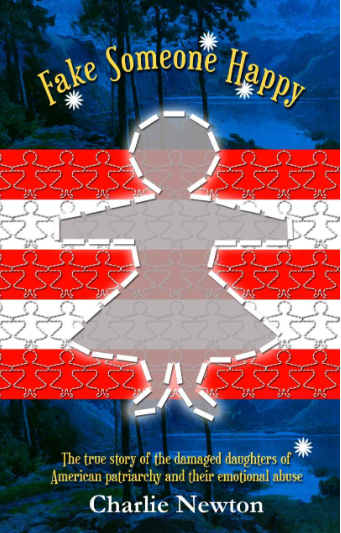
“Fake Someone Happy”: A Book Review by Rebecca Irene Gorman

Also by Rebecca on HA: “I Was Beaten, But That’s Not My Primary Issue With Homeschooling.”

Possibly over half a million American women obediently serve their parents’ households, locked in a perpetual childhood, with no means of escape.

Charlie Newton's "Fake Someone Happy" is about a young English musician who accidentally becomes entangled in the American Patriarchy movement.
Charlie Newton’s “Fake Someone Happy” is about a young English musician who accidentally becomes entangled in the American Patriarchy movement.

Call it the Quiverfull Movement, Christian Patriarchy, the Stay at Home Daughter Movement, or Reconstructionism — that’s as close as you’ll get to giving it a name. Adherents simply call it ‘obeying God’ or, even, ‘loving God’. What it is at essence is the modern American denial of women’s humanity, the entire deprivation of her rights, the erasure of her personality. And it’s vividly portrayed Charlie Newton’s recent non-fictional, anonymized short novel, ‘Fake Someone Happy’.

The story is about a young English musician who accidentally becomes entangled in the American Patriarchy movement. What begins as a joyful immersion into a community of loving, picture-perfect families devolves into an horrific submersion into a world of exploitation, coercion, and betrayal which challenges the heroine’s understanding of friendship, the world, and herself.

I highly recommend this book as a window into the world of American Christian Patriarchy.

As a survivor of this subculture, I can vouch for the accuracy of the depiction. In fact, this world and the plight of its survivors is rarely depicted in such vivid detail. Some might nit-pick at the fact that the writing does not constitute a literary masterpiece; however, the author has achieved the significant triumph of transporting her readers to this vast, hidden, and rarely-depicted dark world.

I do have some reservations about the book’s depiction of a survivor after her escape. The heroine’s unfamiliarity with the psychology of second-generation cult members and American Christian cultural norms manifests in understandable frustration which, however, the author fails to resolve. My suggestion to readers is to read this book in combination with others that delve deeper into the psychology of survivors of Christian Patriarchy and their journey of recovery, healing and growth.

To that end, I recommend the following books:

Quivering Daughters, by Hillary McFarland — The story of the exploitation of a daughter of Christian Patriarchy and her theological journey to empowerment and freedom.

Pilgrim’s Wilderness, by Tom Kizzia — A journalist’s masterfully written and insightful account of a Patriarchal family with subjugated adult children which moves to the Alaskan wilderness, with an excellent treatment of the psychology of captivity and escape.

Quiverfull, by Katherine Joyce — A rigorous investigation of the modern Patriarchy/Quiverfull movement.