Results of HA Basic Survey, Part Two: Summary of Findings

Screen Shot 2013-09-28 at 9.19.55 PM

Results of HA Basic Survey, Part Two: Summary of Findings

Summary of Educational Findings

Survey respondents were asked to rate the following aspects of their homeschool experience: Math, Science, History, Language Arts, Studying Religions Other Than Your Family’s, Studying Political Beliefs Other Than Your Family’s, Sex Education, Socialization, Life Skills Relevant To All Genders, Job Training/Preparation For The Work Place, College Preparation, Academic Experience (As A Whole), and Intangible Experience (Everything Other Than Academics). Respondents were asked to rate these aspects on a scale from 1 to 5, 1 being “Horrible” and 5 being “Excellent.”

Averaging the scores for all aspects, respondents gave their experience a score of 3.06, barely above the median score category of “So-so.”

2013 Homeschoolers Anonymous Basic Survey.

Respondents consistently and overwhelmingly consider language arts their strong suit. The average score for language arts was 4.22, which makes it the only average score above 4, or “Adequate.”  No score’s average reached past 4.5, putting it in the “Excellent” category.

Respondents consistently and overwhelmingly consider the quality of all other aspects of their home school experience (other than language arts) to be less than “excellent” and also less than “adequate,” averaging around “so-so.” Sex education, world religions, and comparative political science are the weakest points.

There was a tie for the aspect that received the most amount of “Horrible” votes between “Studying Political Beliefs Other Than Your Family’s” and “Sex Education.” 106 of the 242 respondents gave each of these categories a 1.

The aspect that received the most amount of “Excellent” votes was “Language Arts,” with 136 respondents (56.43%) giving it a 5. Coming in second to “Language Arts” was “History,” with 80 respondents (33.47%) giving it a 5.

Among core subjects (math, science, history, and language arts), math had the lowest score, with 2.82. Only 28.22% (68) of respondents considered their math education to be “Adequate,” and only 8.3% (20) considered it “Excellent.”

Summary of Abuse Findings

The majority of respondents (60.92%) experienced one or more forms of abuse in their homes or homeschooling environments. 

2013 Homeschoolers Anonymous Basic Survey.

Emotional abuse was the most common (52.10%), followed by verbal abuse (44.96%); sexual abuse was the least common (5.46%).

Identification abuse was not common (8.82%, or 21 individuals out of 242), though that number ought to be concerning regardless. It means approximately 1 out of every 10 respondents experienced an environment in which their parent(s) did not provide or withheld/destroyed their identification documents (driver’s license, Social Security card, etc.). Similarly, more than 1 out of every 10 respondents (13.03%) were prevented while growing up from seeking medical care or denied medical care by their parent(s).

Approximately 1 out of every 4 respondents experienced the following forms of abuse in their home or homeschooling environment: economic abuse, educational abuse, and physical abuse.

Summary of Findings on the Relationship Between Christian Homeschooling and Current Religious Beliefs

The overwhelming majority of respondents believe that their homeschool experience influenced what they believe today about religion.

2013 Homeschoolers Anonymous Basic Survey.

*****

(Since the above categories are difficult to read, here is a text version:)

Answer Choices
Responses
My homeschooling experience had no influence on what I believe today about religion.
7.47%
18
My homeschooling experience was fundamentalist Christian, and strengthened my religious beliefs in fundamentalist Christianity.
5.81%
14
My homeschooling experience was fundamentalist Christian, and influenced me towards non-fundamentalist Christianity.
37.34%
90
My homeschooling experience was *not* fundamentalist Christian, and influenced me towards fundamentalist Christianity.
0.41%
1
My homeschooling experience was *not* fundamentalist Christian, and strengthened my religious beliefs in non-fundamentalist Christianity.
12.86%
31
My homeschooling experience was *not* fundamentalist Christian, and influenced me to leave Christianity for another religion.
0%
0
My homeschooling experience was *not* fundamentalist Christian, and influenced me to leave religion altogether.
0.41%
1
My homeschooling experience was fundamentalist Christian, and influenced me towards agnosticism.
19.09%
46
My homeschooling experience was fundamentalist Christian, and influenced me towards atheism.
14.94%
36
My homeschooling experience was fundamentalist Christian, and influenced me towards a religion other than Christianity:
1.66%
4

*****

Only 7.47% (18) said their homeschool experience did not influence their current religious beliefs. This means homeschool experiences influenced the current religious beliefs of 92.53% (224) of respondents.

78.84% of respondents had fundamentalist Christian homeschool experiences; 13.68% had non-fundamentalist Christian homeschool experiences.

The plurality (37.34%) of respondents had fundamentalist Christian homeschool experiences, and these experiences influenced them away from fundamentalism towards non-fundamentalist Christianity.

The second most common category (19.09%) was graduates whose fundamentalist Christian homeschool experiences influenced them towards agnosticism.

The highest retention value was within the non-fundamentalist Christian category: 33 respondents had non-fundamentalist Christian homeschool experiences, and among these 33 respondents 31 of them felt that experience strengthened their religious beliefs in non-fundamentalist Christianity.

Only 5.81% (14) of the respondents said they had a fundamentalist Christian homeschool experience that strengthened their own beliefs in fundamentalism.

*****

< Part One: Demographic Considerations | Part Three: Economics as a Factor >
2013 HA Basic Survey: Main Page

A Call for Stories for HA’s Upcoming Mental Health Awareness Series

Screen Shot 2013-09-06 at 4.18.02 PM

A Call for Stories for HA’s Upcoming Mental Health Awareness Series

By R.L. Stollar, HA Community Coordinator

Mental health is a fundamentally important part of our daily lives. It is as important — and as natural — as any other type of health like dental or physical health.

But when we are mentally unhealthy, we are often afraid to talk about it.

We can feel ashamed. Embarrassed. Terrified of what others might think. Alienated. “Crazy.”

Mental illnesses are real, live medical conditions that mess with a person’s feelings, mood, thoughts, ability to relate to other people, and other aspects of daily functioning that everyone else takes for granted. They can be very serious conditions: ranging from major depression to bipolar disorder, from obsessive compulsive disorder (OCD) to panic attacks; from severe anxiety to post traumatic stress disorder (PTSD).

Here are some facts about mental illness and recovery from NAMI (National Alliance on Mental Illness): 

  • Mental illnesses are serious medical illnesses. They cannot be overcome through “will power” and are not related to a person’s “character” or intelligence.
  • 1 in 17 Americans live with a serious mental illness.
  • One in four adults experience a mental health disorder in a given year.
  • 10 percent of children and adolescents in the United States suffer from serious emotional and mental disorders that cause significant functional impairment in their day-to-day lives at home, in school and with peers.
  • The World Health Organization has reported that four of the 10 leading causes of disability in the US and other developed countries are mental disorders.
  • By 2020, Major Depressive illness will be the leading cause of disability in the world for women and children.
  • Mental illness usually strike individuals in the prime of their lives, often during adolescence and young adulthood.
  • Without treatment the consequences of mental illness for the individual and society are staggering: unnecessary disability, unemployment, substance abuse, homelessness, inappropriate incarceration, suicide and wasted lives.
  • The economic cost of untreated mental illness is more than 100 billion dollars each year in the United States.
  • With appropriate effective medication and a wide range of services tailored to their needs, most people who live with serious mental illnesses can significantly reduce the impact of their illness and find a satisfying measure of achievement and independence.
  • Early identification and treatment is of vital importance.
  • Stigma erodes confidence that mental disorders are real, treatable health conditions.

Children of Christian homeschool families are not immune to mental illnesses or disorders. Just like any other human beings, we can struggle with depression, anxiety, suicidal thoughts, and any other number of issues. In fact, the highly controlling and toxic environments that some of us grew up in can exacerbate or even create mental illness. Experiencing abuse as a child can actually prime one’s brain for future mental illness, prompting a writer for TIME Magazine to observe the following:

Child maltreatment has been called the tobacco industry of mental health. Much the way smoking directly causes or triggers predispositions for physical disease, early abuse may contribute to virtually all types of mental illness.

While there is a stigma around taking about mental health in our larger culture, that stigma is even more pronounced within the Christian homeschool movement. There can even be scientifically invalid information being propagated, labeling mental illness as something strictly spiritual (or worse, “demonic”) that does not necessitate medical or therapeutic treatments.

We need to break this stigma around mental illness. We need to speak out, both as adult graduates of the Christian homeschool movement and as human beings.

If you are interested in contributing, here are some ideas for what you could write about:

1) Your personal story of struggling with mental illness

2) Your personal story of being a friend to someone struggling

3) Your thoughts on the relationship between your homeschooling experience and mental health and/or illness

4) Your advice, as someone who personally struggles with mental illness, to other homeschool kids who are currently struggling

5) Practices, techniques, etc. that you have found helpful for managing your mental illness

6) Your advice, as a parent to a kid who personally struggles with self-injury, to other parents who have a kid currently struggling

You do not have to pick just one topic. You could combine several of these ideas, or bring your own ideas to the table, or — if you have a lot to say — contribute several pieces on a variety of these topics. The deadline for submission is Sunday, October 13.

As always, you can contribute anonymously or publicly.

If you interested in participating in this, please email us at homeschoolersanonymous@gmail.com.

How Not To Homeschool Your Children: Judith’s Story, Part One

Screen Shot 2013-09-29 at 9.08.25 PM

HA note: The author’s name has been changed to ensure anonymity. “Judith” is a pseudonym.

My parents started homeschooling me in the mid-90’s.

Recently I asked about the factors involved that led them to homeschool, something I never thought to ask about previously because I always assumed it was for the stereotypical reasons. Turns out, they were not ever “anti-public school”, nor was it a matter of “we can better educate them at home”– in fact, one of the reasons why they chose the home they bought was because it was in the “good” school district.

They were also not afraid of secular thought and stated clearly to me that their decision was not influenced by religious-based fears like evolution vs. creation or “liberal brainwashing” or any sort of dominionist thinking. Apparently they simply were exposed to the idea, gave it some serious thought, and decided to go for it. At one point in the conversation, the comment was made that they are glad they made that choice and are pleased with how things have turned out—and by that I assume they refer to the fact that at the time of writing this, one child has a master’s degree, two have bachelor’s degrees, and two more have associate’s degrees.

All of us are under 25, and there are still a few children at home, still being taught by both of my parents. They frequently receive comments about how smart and well-educated we all are and how proud they must be.

But in the process of “turning out” there was, for me, a lot of pain.

There were lots of tears. Nightmares. Crushing of dreams. A un-feeling stretch of depression. [cue creepy dramatic music]

I had lots of dreams and ideas when I was a small child. I wasn’t scared of anything (except large predatory cats). I assumed that when I grew up, I would be a mom, because that was the only adult woman role model I had in my life at the time—my mom. As I got older and was exposed to teachings about daughters staying at home until marriage and motherhood being a woman’s highest calling, this assumption was given even more ground to stand on. But I also had dreams of outdoor adventuring, sleuthing, going to a prestigious music college, becoming a famous novelist, creating stunning pieces of art. Being a successful business woman who got to wear fabulous office clothes. Being a ballerina. A Christian vocalist. Going into politics and “fixing” everything.

Aside from the music, which became my emotional release, I never pursued any of these dreams for a couple reasons.

The first was that I quickly became withdrawn and shy. My mom got swept up in the quiverfull/patriarchy fad that was making its rounds in the homeschool community, despite the fact my dad thought it was cultish (thoughts that apparently he never shared with her at the time), and as the babies kept coming she became more stressed and irritable. You never knew what would set her off, and you sure as anything could count on the fact that whatever you were doing, you weren’t doing right. And there was a chance that if it wasn’t done right, obviously it was because you were lazy and rebellious.

While only very, very rarely physical (not counting incidents of “non-abusive spanking”), my mom was quite verbally abusive and we would be made to sit and listen to long lectures and screaming tirades about how awful we were, complete with many shame and horror-inducing threats mixed with half-given, half-taken back apologies made in annoyed tones.

Obviously, this sort of environment does not prompt one to be open about their dreams and live without fear of mistakes.

The second reason was that my schoolwork got in the way of everything. I have never been officially diagnosed, but I am pretty sure that I had ADD (or something with like effect) as a child. I would continually swing from hyper-focusing on something that was insanely fascinating to me to being completely unable to focus on anything at all no matter how hard I tried to harness my crazy livewire thoughts and daydreams.

Schoolwork was not usually interesting, and there was a lot of it (we were the “bringing school to the home” type), but I was pretty smart and most of it didn’t require much thought or deep concentration of any kind. I could breeze right through everything except math– my brain would move on to something else within five minutes because as a whole, math was simply manipulating meaningless numbers into meaningless answers for no real reason at all, except, you know, college was in my future and I would need it for that. It was not difficult to learn how to solve certain problems or formulas, but I never learned why math worked the way it did, or what use it would be to me in real life, and so much concentration was required to get through thirty plus problems without making several stupid mistakes.

I couldn’t concentrate that hard for that long on something that boring.

At least in the other subjects, we used words instead of numbers, and words conveyed meanings and ideas that were much more likely to be interesting. So more often than not I would do my easy subjects during the morning and then sit down after lunch with my math book and a sinking feeling of impending boredom. And that one math lesson, that supposedly only took 45 minutes to finish, would take me the entire rest of the day.

This, of course, was not a good thing. The mantra in our household was “work before play” and work included school work. As it became more and more common for me to be sitting at the dining table staring blankly out the window all day long, one of the first casualties was my closest sibling, who tearfully confided to my mom that it wasn’t fair that I wasn’t available to play anymore.

Cue lectures on what a selfish big sister I was being.

My grades suffered. Cue lectures on how I should be getting excellent grades considering how long it took me to do things, and bonus lecture! Here’s a comparison of your poor grades and another sibling’s excellent grades (and academic drive)! Feel guilty, but don’t worry, we know that you two are not the same and we are not comparing you at all. But while we’re (not) at it, don’t forget that even your less intelligent sibling is getting better grades than you. Ah, now we will move you to a location where you cannot stare out the window, that will help you not be distracted. Erm, look, this is not a convenient place for you to be, we will move you to a desk in your poorly-lit room where you will spend the rest of your teenage-hood prior to college. A dark, dusty existence where we will occasionally come to yell at you for being rebellious and refusing to do your work. Wait! You are 16 now! You will learn to drive and I will spend the entire time that I am sitting next to you as opportunity to lecture you not only on every little driving error you may make, but also on how poorly you are doing on your schoolwork and how bad of a person you must be. Why are you this way? Why? Why? You don’t know? Let me tell you why! It is because you are a bad, selfish, miserable excuse for a human and your adult life will suck if you don’t get it together! By the way, you will also be fat when you are forty, because you are sitting around too much.

Part Two >

Results of HA Basic Survey, Part One: Demographic Considerations

Screen Shot 2013-09-28 at 9.19.55 PM

Results of HA Basic Survey, Part One: Demographic Considerations

Disclaimer About Survey Results

The Homeschoolers Anonymous (HA) Basic Survey was conducted for adult graduates of the Christian homeschool movement. Throughout this survey, “respondents” will signify the 242 individuals from 42 U.S. states and 8 foreign countries that participated in the survey.

These respondents do not necessarily reflect all adult homeschool graduates, nor is it claimed that these 242 individuals are a representative sample. Three important considerations are to be considered:

  1. This survey was conducted for graduates of the Christian homeschool movement specifically.
  2. This survey was open for anyone who desired to participate, thus it is self-selected.
  3. Effort was made to solicit diverse responses from this specific subculture of adult homeschool graduates, whether their experiences were positive or negative. At the same time, the primary methods for promoting the survey came from the social media channels and blog partners of HA.

The survey was designed by HA with the explicit purpose of helping to identify experiential and qualitative patterns as well as learning what the HA community’s needs are.

Geographical Considerations

242 adult graduates of the Christian homeschool movement took the HA Basic Survey.

Those 242 individuals represented 42 U.S. states and 8 foreign countries.

U.S. states represented in this survey include: Alabama, Arizona, Arkansas, California, Colorado, Connecticut, Florida, Georgia, Hawaii, Idaho, Illinois, Indiana, Kansas, Kentucky, Louisiana, Maryland, Massachusetts, Michigan, Minnesota, Mississippi, Missouri, Montana, Nebraska, Nevada, New Jersey, New Mexico, New York, North Carolina, North Dakota, Ohio, Oklahoma, Oregon, Pennsylvania, South Carolina, Tennessee, Texas, Utah, Vermont, Virginia, Washington, West Virginia, and Wisconsin.

The average response per state was 5.45 survey responses.

States with one survey respondent only included: Connecticut, Minnesota, Montana, Nevada, North Dakota, South Carolina, Utah, Vermont, and West Virginia.

States with high numbers of survey respondents included: Florida (13 survey respondents), Georgia (13), Oregon (13), Texas (21), Virginia (10), and Washington (14).

California had the highest number of survey respondents for a U.S. state with 42.

Foreign countries represented in this survey included: Canada, Australia, Philippines, Eastern Europe, South Korea, Mexico, England, and Iceland. Canada had the highest number of survey respondents for a foreign country with 4.

HSLDA Considerations

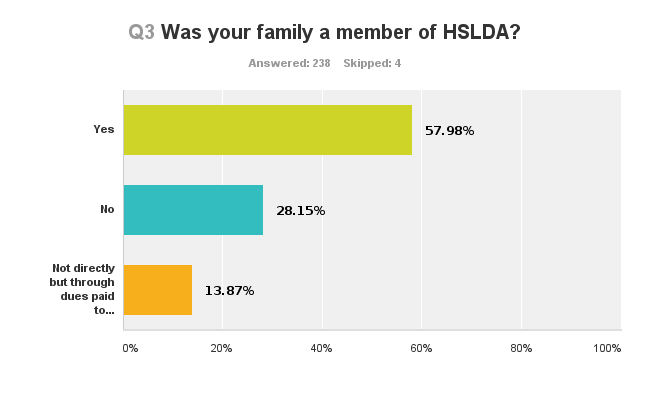
The majority of respondents are from families which were members of the Home School Legal Defense Association (HSLDA). 

2013 Homeschoolers Anonymous Basic Survey.

57.98% (138) of the graduates’ families were directly members of HSLDA.

13.87% (33) of the graduates’ families were indirectly members of HSLDA, through dues paid to a local or state homeschool organization.

28.15% (67) of the graduates’ families were not members of HSLDA.

Economic Considerations

The majority of respondents are from middle class families.

2013 Homeschoolers Anonymous Basic Survey.

70.95% (171) of the graduates’ families were in the middle class (with incomes between $32,500 and $100,000 a year).

17.43% (42) of the graduates’ families were in the lower class or below the poverty line (with incomes lower than $32,500 a year).

11.62% (28) of the graduates’ families were in the upper class (with incomes above $100,000 a year).

Educational Considerations

235 individuals stated the length of their homeschool experience, with a cumulative total of 2641 years. Thus the average length of each individual’s homeschool experience was 11 years.

This means that this survey represents individuals whose primary educational experience from K-12 was almost entirely through homeschooling.

2013 Homeschoolers Anonymous Basic Survey.

The primary teachers of the overwhelming majority of respondents were their mothers. Mothers were the primary teachers of 80.91% (195) of the graduates.

The second most common primary teacher of the graduates (at 13.28%, or 32) was “other” than mother, father, other relative, co-op teacher, or tutor. When asked to specify, the majority of these graduates specified “myself’ or “no one,” with personalized answers such as:

  • “From first grade on, I did everything by myself but my parents would help sometimes if I got stuck.”
  • “I attended classes once a week, but ‘taught myself’ at home otherwise.”
  • “Basics were taught by oldest sister. 6-9 (I took from 13-18 to get through these grades) were done on my own…”
  • “Myself. I also was responsible for teaching my brothers.”
  • “No one. We read our text books alone.”
  • “No real effort was made in my homeschooling. I was run around to activities but other than that largely self taught and given the answer keys to check my own answers after I completed the booklet.”

3.73% (9) of respondents said their primary teacher was both their mother and their father evenly.

1.24% (3) of respondents said their primary teacher was a non-family member such as a teacher at a co-op or a tutor.

0.83% (2) of respondents said their primary teacher was their father.

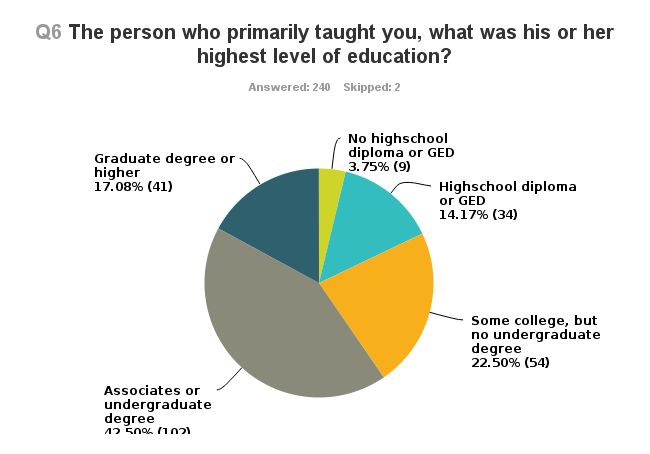
The highest level of education of the primary teacher of each respondent is most commonly an associates or undergraduate degree.

2013 Homeschoolers Anonymous Basic Survey.

42.50% (102) of the primary teachers had associates or undergraduate degrees. 22.50% (54) had some college education but no degree. 14.17% (34) had a high school diploma or GED. 3.75% (9) had neither a high school diploma nor GED. 17.08% (41) had a graduate degree or higher.

This means 59.58% of the primary teachers had an associates degree or higher.

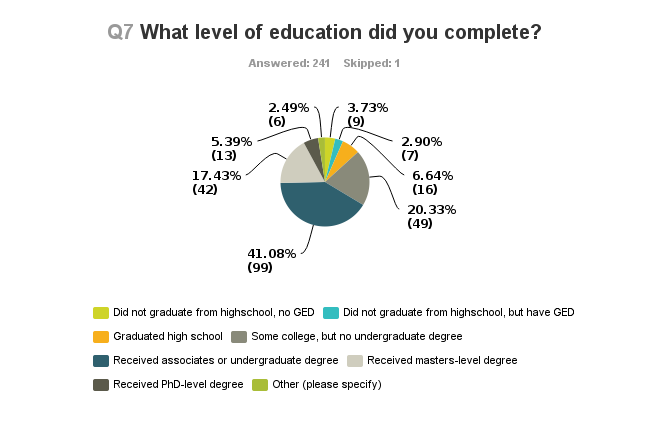
The highest level of completed education for the plurality of respondents is an associates or undergraduate degree.

2013 Homeschoolers Anonymous Basic Survey.

The highest level of completed education for 41.08% (99) of adult homeschool graduates is an associates or undergraduate degree; for 17.43% (42), a masters-level degree; for 5.39% (13), a PhD-level degree; for 20.33% (49), some college education, but no college degree; for 6.64% (16), a high school diploma; for 2.90% (7), GED but no high school diploma; and  for 3.73% (9), no GED and no high school diploma.

This means 63.9% of respondents have an associates degree or higher. This is an improvement of exactly 4.32% over the percentage of the graduates’ primary teachers with associates degrees or higher. 

Religious Considerations

The majority of respondents said their homeschool experience was fundamentalist Christian. 

190 individuals, or 78.84%, said their homeschool experience was fundamentalist Christian.

33 individuals, or 13.68%, said their homeschool experience was non-fundamentalist Christian.

18 individuals, or 7.47%, declined to provide information relevant to this question.

*****

< 2013 HA Basic Survey: Main Page | Part Two: Summary of Findings >

Homeschooling Is A Human Right, But That Doesn’t Make It Immune To Regulation

Screen Shot 2013-09-17 at 1.49.33 PM

Homeschooling Is A Human Right, But That Doesn’t Make It Immune To Regulation, By Nicholas Bolzman

HA note: Nicholas Bolzman blogs at Looking for Overland, a joint blog project “authored by three friends who met at Patrick Henry College and then worked together at the Home School Legal Defense Association.” Nicholas Bolzman received his JD from Michigan State University College of Law last spring and is a graduate of Patrick Henry College.

In a recent post, Ryan made the case that homeschooling is not a human right and, as a result, state regulation of homeschooling (or even outright prohibition, as in Germany), does not amount to a violation of human rights. As much as I have been appreciating his examination of homeschooling culture, in this instance I disagree with his analysis. When I posted a truncated version of this on Facebook, he asked if I could expand it.

Ryan uses the example of the right to travel, which is a basic right, and contrasts that with the right to travel by horse, which is not a basic human right. He then equates homeschooling as the right to travel by horse, which is different, he argues, than the basic recognized right. In his argument, the former does not include the latter.

This analogy requires further examination. If the right to travel is a human right, then the exercise of that right (such as by horse, or by boat, or by car) would be likewise protected. Or, to use a parallel argument from American law, Ryan’s argument is like saying that since the First Amendment doesn’t mention blogging, government censorship would not violate the First Amendment.

Absent protections of specific methods of exercising rights, the abstract right does no one any good.

Ryan also included a discussion of Article 26 of the Universal Declaration of Human Rights, which he cited as authority for the child’s right to an education. However, his analysis only lightly brushed on part 3 of Article 26, which explicitly endorses the right of parents to direct their child’s education. Article 26 in its entirety reads:

(1) Everyone has the right to education. Education shall be free, at least in the elementary and fundamental stages. Elementary education shall be compulsory. Technical and professional education shall be made generally available and higher education shall be equally accessible to all on the basis of merit.

(2) Education shall be directed to the full development of the human personality and to the strengthening of respect for human rights and fundamental freedoms. It shall promote understanding, tolerance and friendship among all nations, racial or religious groups, and shall further the activities of the United Nations for the maintenance of peace.

(3) Parents have a prior right to choose the kind of education that shall be given to their children.

The context for this third provision is particularly interesting, especially given the question of homeschooling in Germany. Johannes Morsink, professor or of Political Philosophy at Drew University, explains the history of that very provision in his book The Universal Declaration of Human Rights: Origins, Drafting, and Intent:

Article 26 (on education) is one of the articles most clearly shaped by the experience of [WWII]. This article has three paragraphs, a nuts-and-bolts paragraph that is a standard constitutional item, a goal-and-purpose paragraph, and a paragraph that gives parents a prior right in deciding what kind of education their children shall have. The second and third paragraphs were put in the article as a way of condemning what Hitler had done to Germany’s youth and of making sure that it would never happen again….

The War Crimes Report that the Secretariat had drawn up for the Human Rights Commission explained to the delegates, as if they needed to be told, that “‘in order to make the German people amenable to their will and to prepare them psychologically for war,’ the Nazis reshaped the educational system and particularly the education and training of German youth, imposed a supervision of all cultural activities, and controlled dissemination of information and the expression of opinion within Germany as well as the movement of Intelligence of all kinds from and into Germany.” The second and third paragraphs of Article 26 were written in direct reaction and opposition to this Nazi abuse of state power. Paragraph 2 of the article states: “Education shall be directed to the full development of human personality and to the strengthening of respect for human rights and fundamental freedoms. It shall promote understanding, tolerance and friendship among all nations, racial or religious groups, and shall further the activities of the United Nations for the maintenance of peace.”

The first draft of Article 26, paragraph 2 was placed on the drafting table by Bienenfeld of the World Jewish Congress because his organization felt that there was a need to spell out both the goals and the spirit of educational institutions so as to avoid all kind of brainwashing the Nazi state had engaged in. Article 26’s third paragraph was added for the same reasons. Both the Dutch and the Lebanese delegations submitted amendments about parental rights. It being the shortest one, the Lebanese amendment was adopted after a vigorous discussion. The defense again was that the Nazis had usurped the prerogative of parents when they demanded that all children enroll in poisoned state-controlled schools, the paragraph was especially necessary because the word “compulsory” had been used in the first paragraph. [internal citations omitted]

Citing Morsink, Harvard Law professor Mary Ann Glendon also made the same point in her book on the Universal Declaration.

Given this explicit wording and direct context to compulsory attendance laws, it is difficult to say that Article 26 does not permit parents to opt out of said compulsory attendance laws and seek alternative forms of providing for their children’s education.

Those alternative methods would include homeschooling.

Furthermore, similar wording identifying this prior right of parents appears in other human rights treaties. For example, the International Covenant on Civil and Political Rights, art 18(4), states that “The States Parties to the present Covenant undertake to have respect for the liberty of parents and, when applicable, legal guardians to ensure the religious and moral education of their children in conformity with their own convictions.” The International Covenant on Economic, Social and Cultural Rights, art. 13(3) declares “The States Parties to the present Covenant undertake to have respect for the liberty of parents and, when applicable, legal guardians to choose for their children schools, other than those established by the public authorities, which conform to such minimum educational standards as may be laid down or approved by the State and to ensure the religious and moral education of their children in conformity with their own convictions.”

Even the oft-criticized Convention on the Rights of the Child, art. 29(2) cautions that no educational goals “shall be construed so as to interfere with the liberty of individuals and bodies to establish and direct educational institutions, subject always to the observance of the principle set forth in paragraph 1 of the present article and to the requirements that the education given in such institutions shall conform to such minimum standards as may be laid down by the State.”

All of these, while recognizing the authority of the state to set minimum standards, protect the rights of parents, either individually or collectively, to determine the methods of education for their children.

The government’s role is secondary—to ensure that the parents fulfill their obligation to the children; but the obligation (and corresponding ability) is first and foremost on the parents. In this sense, they resemble Blackstone’s description of parental responsibilities and rights in education.

The last duty of parents to their children is that of giving them an education suitable to their station in life: a duty pointed out by reason, and of far the greatest importance of any. For, as Puffendorf very well observes, it is not easy to imagine or allow, that a parent has conferred any considerable benefit upon his child by bringing him into the world, if he afterwards entirely neglects his culture and education, and suffers him to grow up like a mere beast, to lead a life useless to others, and shameful to himself. Yet the municipal laws of most countries seem to be defective in this point, by not constraining the parent to bestow a proper education upon his children.

* * *

The power of parents over their children is derived from the former consideration, their duty: this authority being given them, partly to enable the parent more effectually to perform his duty, and partly as a recompense for his care and trouble in the faithful discharge of it. And upon this score the municipal laws of some nations have given a much larger authority to the parents than others. The ancient Roman laws gave the father a power of life and death over his children; upon this principle, that he who gave had also the power of taking away. But the rigour of these laws was softened by subsequent constitutions; so that we find a father banished by the emperor Hadrian for killing his son, though he had committed a very heinous crime, upon this maxim, that “patria potestas in pietate debet, non in atrocitate, consistere.” But still they maintained to the last a very large and absolute authority: for a son could not acquire any property of his own during the life of his father; but all his acquisitions belonged to the father, or at least the profits of them, for his life.

Notice how both Blackstone and the human rights documents connect the parental power to parental responsibility, placing responsibility first. A failure of the responsibility can certainly lead to a forfeiture of the power, but that failure must be demonstrated before the forfeiture takes place.

Consequently, even though the right to select the education for one’s child is a human right inherent in parenthood, it is not absolute (a point parental rights advocates often miss, and I suspect, the larger point Ryan was trying to make in his original article).

No human right is absolute.

Free speech does not include libel, and it subject to neutral time, place, and manner restrictions. The consensus is that even life itself can be taken under the right circumstances, as demonstrated by the permission of the death penalty and abortion. Likewise, this parental right does not include the right to deprive a child of education (which should be self-evident, since the parental right stems from and is related to the child’s right to an education.).

As with other rights, it can be subjected to reasonable minimal regulation, as well as forfeited under certain circumstances.

But in those instances, the burden of proof is on the state to show why the interference with the parent-child relationship is necessary.

Absent that, the parental right wins.

Pirates, Bible Abiders, and The German Tea Party: What Germans Think

Screen Shot 2013-09-17 at 1.49.33 PM

Pirates, Bible Abiders, and The German Tea Party: What Germans Think, By Jennifer Stahl

HA note: The following is reprinted with permission from Jennifer Stahl’s blog Yeshua, Hineni. It was originally published on September 28, 2013 with the title, “German Homeschooling Cases – What do Germans think? What sort of political lobbying is going on?”

One of the things I get asked quite frequently is “What do those living in Germany think about parents who want to teach their children at home?” Also, “Is there as much hype in Germany about these cases like what we’re hearing in the US?” which is quickly followed by, “Is it just not in your news?

I’d like to try to share some of what I have seen and heard in response to those questions.

Germany has a completely different tradition:  compulsory education – which was introduced in Prussia almost 300 years ago, and applies to all children from the age of six forwards. Parents who disagree with the curriculum, may establish a private school if need be, as the state requirements for this are quite strict. Those who choose to teach their children at home do so illegally.
Spiegel:  Homeschooling: Bibel-Lehre statt Sexualkunde
[Homeschooling: Teaching the Bible instead of sex education]

 The German laws mandating public-school attendance date back to Germany’s first experiment with democracy in 1919, according to Hans Bruegelmann, an education professor at the University of Siegen.
…previously private education was only available to the elite, and that the public-school mandate was a clear political choice.
“…school is an embryonic democracy and will help to integrate children and young people coming from different backgrounds into the democratic culture,” …
US judge grants German homeschooling family asylum

 “At home, children only experience one segment of society, where they live, learn and grow up. They don’t get to see the broad spectrum, which our young citizens need to be exposed to,” said Bunselmeister-Lohr.
 More Families in Rural Areas Opting for Illegal Home Schooling

 I do not think that Germany should allow homeschooling. We already have a huge problem here with immigrants …especially women and children — being kept at home by their male relatives due to religion and cultures that they have brought with them and therefore those women and children cannot speak basic German and know virtually nothing of their rights or obligations in Germany.
Anti-Americanism, Homeschooling and Happy Housewives

 We are a family from Germany now living in New Zealand because we had to leave our country because of homeschooling…
In Germany we felt …persecuted …as the German government is not interested in Christian education anymore. We did homeschooling in Germany in a bilingual way so the children had no difficulties to move into an English speaking country. They passed the tests at a homeschool cooperated school very well, as well as all other native speakers. ..here in New Zealand …children are far more accepted in the society than in Germany. — Laurien Family, NZ
Readers’ Mixed Feelings About Germany’s Homeschooling Ban

 Parents have to take care that their children attend classes. If the parents fail to push their children to participate in the lessons,they are actively violating compulsory education laws…
Sohn schwänzte Schule: Mutter muss sechs Monate ins Gefängnis
[Son skipped school: mother has six months in jail]

Home-schooling fuels a heated debate in Germany. Families in favour of home-schooling say they are persecuted without cause. Critics point to the extreme religious views of some home-schoolers and question the safety of allowing children be educated without state oversight.
‘We have the power to take your kids away’

 “What I could imagine is for homeschooling to be allowed within narrow parameters, with students being frequently tested by authorities,” said Heinz-Peter Meidinger, head of the Deutsche Philologenverband, an association of German high school teachers. “What I would not welcome is when such students are the rule and not the exception.”
German Parents Wanting to Homeschool Turn to EU Court

Patrick Meinhardt, education speaker for the FDP notes, “I don’t want to start writing up a lot of new rules for homeschooling. I imagine that as long as some state control over the curriculum and teacher training remains, home schooling should not be restricted any more.”
In short, the FDP advocates using the laws on the books for private schools, in order to finally open the door to home-schooling in Germany. The other German parties, however, generally oppose homeschooling more out of…fear that the teachers and their materials will be substandard…
HOMESCHOOLING: VERBOTEN IN GERMANY STILL IN 2009

 Patrick Meinhardt also said: “Parents have a fundamental interest to be able to decide on what sort of education their children have.”
Erstmals Globale Konferenz zur Bildungsfreiheit – Homeschooling bald erlaubt? 
[First Global Conference on Freedom of Education –  Will Homeschooling be allowed soon?]

At the meeting talk education experts and practitioners of homeschooling from many countries, including the USA, Russia and Finland. Even the FDP Bundestag member Patrick Meinhardt , educational policy spokesman of the FDP will hold a keynote speech.
Berliner Konferenz zur Bildungsfreiheit 
[Berlin Conference on the Freedom of Education]

Perhaps the most significant formal accomplishment of the summit was the signing of the Berlin Declaration by home education leaders and human rights advocates from all over the planet.
The document outlines various human rights conventions and treaties protecting the fundamental right to choose home education while calling on rogue governments to end persecution and repression.
WND EXCLUSIVE Parents shed tears over homeschool-crackdown horrors

As far as political lobbying goes; it looks like there was some hope when the Piraten Partei (Pirate Party) was founded, that they would help legalize home education. This was voted down by 76% vote in the party. (source 1, source 2)

So, Hausunterricht.org (HA note: run by Jörg Großelümern, board member of HSLDA-affiliate Netzwerk Bildungsfreiheit) put together a note for German home educators to say who was the best choice to vote for just prior to the elections. The basics were that none of the available ruling parties with majority in Parliament could be worked with for various reasons.

Instead, we’re referred to vote for the PBC.

(Which, actually, I’d never heard of. I feel slightly embarrassed by this fact.) (HA note: PBC is “The Party of Bible-abiding Christians,” or “Partei Bibeltreuer Christen, PBC),” a conservative evangelical minor political party in Germany.) They flat out said the CDU/CSU (“Christian Democratic Union of Germany” / “Christian Social Union of Bavaria”) were not workable.

For what it is worth, I didn’t even see the PBC being given a listing when votes were counted. Maybe they were listed under the all-encompassing “other”. I’m not certain.

A German home-schooling page on Facebook went another direction, suggesting the Alternative für Deutschland party.

Below is a screen capture from a German pro-homeschooling group, pushing for its supporters to vote for the AfD — Alternative für Deutschland — in this year’s election:

“Tomorrow is election day in Germany. The Alternative für Deutschland is the only party we can trust to give us any hope of a legal decision on homeschooling in Germany. In terms of training and education, we can expect them not to mindlessly parrot the sick collectivist consensus (on the legality of home education).”

A screen capture from a German pro-homeschooling group, pushing for its supporters to vote for the AfD — Alternative für Deutschland — in this year's election.
A screen capture from a German pro-homeschooling group, pushing for its supporters to vote for the AfD — Alternative für Deutschland — in this year’s election.

Now, I had been following some of the news on the AfD.

I had noted that they are quite similar to The Tea Party in the US, with the exception of being an actual political party, rather than a movement.

Apparently, I was not the only one who noticed this, as it was being discussed in almost every German newspaper that I perused. There were some other things that stood out to me, that caused the recommendation above, to cause me to have quite raised eyebrows and wide eyes. My hope was that they would not make the 5% threshold to get into Parliament, not because of their policy towards home-schooling, but due to their other political aims and leanings.

(For those who absolutely must know, I cannot vote in any of these elections. I can only express much interest and research as much as I like about these things.)

Its openly anti-euro message has prompted a debate in the governing Christian Democrat (CDU) party, for example – is silence the best policy or should the party’s pro-Deutschmark message be addressed head-on?
…The AfD usually gets 2-3% support in the opinion polls. If it can raise that to 5%, under the electoral laws of Germany it gets seats in the Bundestag (lower house), and in a coalition system, small parties then have power.
Germany’s new anti-euro AfD party causes political stir

Who reduces the AFD on their right-wing populism ignores the real ideological threat posed by that party…

The paleolibertarian calls for the submission of all areas of life to the market ideology. Social authorities such as the family and the church are there to protect the individual from the state, which is the enemy of paleolibertarian. The EU opposition of the AFD fits seamlessly into the philosophical ideas of fundamentalists. Anyone who wants to reduce the state to a minimum, of course, also rejects any form of a strong central government.
 Die Gefahr der neuen Partei ist nicht der Rechtspopulismus – Die deutsche Tea Party
[The danger of the new party is not the right-wing populism – The German Tea Party]

 Behind the scenes, a power struggle is raging between a liberal wing, to which many former members are from the FDP, and a conservative part, where the boundaries are quite fluently leaning towards right-wing populism. Questions over of whether gay marriage is right, whether the nuclear power making a comeback or whether individuals should have a right to “homeschooling.”..
Alternative für Deutschland – Wie die Wähler die AfD zur Protestpartei machen [The Alternative for Germany – How the voters make the AFD into protest party]

For those who do not know, there is a Fünf-Prozent-Hürde, or a Five Percent Hurdle that each political party must reach to enter into the German Parliament.  The AfD will have participated for the first time in federal elections this September. Emotions were high and everyone wondered how much wind would be in their sails. In the end, they won 4.7% of the vote. This doesn’t mean much in the way of Parliament, but it can mean something for some local elections.

I don’t really understand all of this, since my husband is extremely pacifist and isn’t big on history, politics or political parties. I haven’t seen enough of our friends or extended family to discuss politics in ages, and the last political book I have about German political parties (in English, mind you) was published in 2003. We have a few new parties since then and some of that information is quite outdated.

What I do know, though, from my experience in the United States, is that you always follow where people are saying to vote and examine that as far as you can to better understand where they fall politically and what sorts of other beliefs they hold.

All of this really leaves me scratching my head.

The more I find out about the people willing to suffer heavy fines or jail and what political parties they’re pushing, the more I feel like I’ve fallen down Alice’s rabbit hole.

The Fundamental Reality of The Family Is Not Just Amorphous “Rights” Language

Screen Shot 2013-09-17 at 1.49.33 PM

The Fundamental Reality of The Family Is Not Just Amorphous “Rights” Language, By Virgil T. Morant

Virgil T. Morant is a lawyer in northeastern Ohio. He practices civil litigation and criminal defense, as well as corporate law, and his work includes representation of clients in disputes over education and child custody. He is also a member of the International Law Section of the Cleveland Metropolitan Bar Association. His personal blog is Lasseter’s Lost Reef.

*****

“The family is the natural and fundamental group unit of society and is entitled to protection by society and the State.”  

That’s article 16(3) of the Universal Declaration of Human Rights, one part of the International Bill of Rights from the United Nations.  While one does not need an especially fertile imagination to think of a good many people whose disdain for the U.N. (or suspicion at the least) would give little consideration to the authority, and while ordinary people don’t typically go around citing U.N. resolutions, that statement transcends legal controversy or political debate: it states a principle that is widely shared.

It is not just a statement about the organization of society: it is an affirmation of how people generally feel about the dignity and centrality of home and family.  Indeed even many of those who likely would have no truck with the United Nations and no love for International Law virtually quote that article word for word every day when they’re arguing about matters of home and family, and probably most of them scarcely even realize it.  When we talk about rights, however precisely or imprecisely, we are talking about things that people feel very deeply about, things that give their lives meaning and purpose.

That quote right there about the family says it.

Now, in ordinary speech as well as the commonplace discourse of journalists and editorialists (“bloggers” too of course), any talk of rights is inevitably amorphous and indicative more of feelings and desires than it is of well-defined or cognizable rights.  So, frequently when someone says that a right has been violated, what he really means is that he has been offended in some way.  In everyday speech, and even in garden-variety “professional” commentary, that is fine—people who are talking casually or writing frequently will resort to such boilerplate, and there is little sense in crying about it—but, if we wish to step away from casual usage, we are likely best served by using the language of rights in two ways: (1) if the right is legally cognizable, then by reference to the authority that defines it or (2) if we are making a case for a right, then by setting out our definitions, argument, and authority.

In his recent article, R.L. Stollar—who graciously invited me to write my reply to him as a guest post—actually used precisely these methods in order to make the case that homeschooling was not a right.  Turning, however, to the authority he used and considering his argument, I have to disagree with his conclusion.

The chief authority Mr. Stollar uses is Article 26 of the Universal Declaration of Human Rights (UDHR).  After the prior sections of that article deal with an individual’s right to an education, what level of education should be mandatory, and some discussion of the social purposes of education, UDHR art. 26(3) states, “Parents have a prior right to choose the kind of education that shall be given to their children.”

As I noted in my comment to Mr. Stollar’s post, this language both gives a priority to parents in the determination of their children’s education and states it in terms of an act that is compelled: the children shall be educated, and the parents have the prior right to choose the kind of education.  Some portion of Mr.Stollar’s post got bound up in the notion that a human right cannot be controlling over another person, but the very language he quoted seems to dispel that by granting parents what it unambiguously calls a right to make determinations for other human beings (parents choosing for their children).

On top of this, it is not difficult to think of a number of other rights that involve and even require the cooperation, restraint, or compulsion of other human beings.  

I noted the right to counsel in criminal proceedings in my comment on his post.  How about also the right to reasonable working hours (UDHR art. 24), which places limits on how much an employer can demand of his employees and requires him to provide reasonable leave, or the right to one’s reputation (UDHR art. 12), which limits freedom of speech from, say, defamation?  These are just two examples.

Rights place obligations upon the state to vindicate them, but they also often entail a restraint on individual human beings as well as granting the capacity for one human being to impose restraint upon another (as in parents making decisions for their children) or to seek redress for a violation (as when one sues for defamation).

If we want to look to concrete authority to argue whether homeschooling is a right, by the way, why stop with the UDHR?

Both the International Covenant on Civil and Political Rights (ICCPR) and the International Covenant on Economic, Social, and Cultural Rights (ICESC) make favorable reference to the “liberty of parents.”

They, together with the UDHR, belong to that International Bill of Human Rights mentioned above.  Consider the full language of ICESC art. 13 ¶ ¶ 3-4:

3. The States Parties to the present Covenant undertake to have respect for the liberty of parents and, when applicable, legal guardians to choose for their children schools, other than those established by the public authorities, which conform to such minimum educational standards as may be laid down or approved by the State and to ensure the religious and moral education of their children in conformity with their own convictions.

4. No part of this article shall be construed so as to interfere with the liberty of individuals and bodies to establish and direct educational institutions, subject always to the observance of the principles set forth in paragraph I of this article and to the requirement that the education given in such institutions shall conform to such minimum standards as may be laid down by the State.

Paragraph 3 states its “respect” for parental liberty in school choice—even choices besides public school—and paragraph 4 puts some teeth to this by forbidding the instrument from being interpreted to interfere with the individual’s liberty to establish educational institutions.  Make of that what you will.

If, then, what remains of the argument against homeschooling being a right comes down to the travel by horse analogy (see Mr. Stollar’s essay for this), then my response is:

Traveling by horse, if you have one, actually is a right, and it falls within the right to freedom of movement.  

Of course it is not a right to take someone else’s horse or to be given a horse, but the right to travel is one primarily cognizable in not being restrained from travel, and surely no state should have the right to stop you, under normal circumstances, from hopping on your horse and going where you will.  Just the same, if a parent has a right to determine his child’s type of education, and, if we are agreed that whatever form of homeschooling we are talking about is a legitimate type of education, then surely the parental right includes the right to school the child at home.

Of course, at some point in narrowing rights down to specific examples, it would become absurd to insist that they all be found in a United Nations convention. But a good many of the things we value as rights (in some proper sense of the word) are actually spelled out in writing in statutes and case law, which constitute an overwhelming number of words and pages.  If there is any uncertainty about whether something should be legally protected—such as the right to school one’s children at home—then off to court one goes, where lawyers will find the citations and make the arguments.

It’s all quite entertaining for pundits and ordinary people to complain about “rights” being violated, but rights don’t mean much of anything in a society of laws until their existence is tested and proven through law. 

Sometimes too, by the way, the universality of a norm is well demonstrated by the states that violate the norm against the greater consensus.  So, however the current business in Germany, for instance, shakes out, and whatever may be adjudicated in the Unites States or anywhere else, for my own part, I just cannot fathom educating one’s children at home as not being a right—or, if you prefer (but I think this is hair-splitting), as squarely fitting within the right to choose the education of one’s children.

We get emotional about our rights.  We get emotional about these homeschooling rights in particular, because, as with any human liberty, they are subject to abuse, and by “abuse” I mean to say the kinds of acts that take us squarely outside the realm of rights.  The abuses of homeschooling are famous in the portion of the blogosphere where I am writing now.  And then there is the hazy realm of, let’s call it, “indoctrination”: why, with some of the more scandalous examples of homeschooling, what sorts of things are they teaching those children!  A false history or poor science or just a pathological contempt for this segment of society or that or for society on the whole, perhaps?

Let’s don’t forget, though, even when children go to public schools, their primary role models remain their parents.  Even when children go through their rebellious phases, reckon themselves independent and free-thinking as adolescents will do, if they live in a home with parents, their parents are their principal models of how life is.  Their chief guides, even if the parents don’t know it or don’t want it.  No one can jack you up worse early in life than mom and dad, and nobody can guide and protect you better either.

The family is the natural and fundamental group unit of society.  

That’s not just legal jargon, and it’s not just amorphous “rights” language.  It’s the fundamental reality of parents and their children.

The Mutterpass: Motherhood, Healthcare, and Homeschooling in Germany

Screen Shot 2013-09-17 at 1.49.33 PM

The Mutterpass: Motherhood, Healthcare, and Homeschooling in Germany, By Jennifer Stahl

HA note: The following is reprinted with permission from Jennifer Stahl’s blog Yeshua, Hineni. It was originally published on September 26, 2013 with the title, “German Homeschooling Cases – Things to consider.”

One of the arguments that I keep hearing from family, friends and acquaintances in North America and other English-speaking areas of the world about home-schooling in Germany is: “Homeschooling should not be regulated! Parents have the right to educate their children as they see fit! Should officials be doing welfare checks on babies and toddlers to make sure that they are well cared for?”

I usually stammer a bit and try to explain that things are just so different here with German culture vs. American or Canadian culture. With the healthcare system that we have, women who are prenatal and postnatal are well cared for and children are seen as an investment and something that the entire “village” should protect.

It all starts when you get your first positive pregnancy test.

No, really. It does.

First, you get your pregnancy test at the apothecary. It will not be available elsewhere, because that is strictly behind-the-counter stuff. You’ll be advised by the nice people at the apothecary that if it is positive, to contact your OB/GYN, and if you don’t have one, to contact your Hausarzt (The General Practitioner that you’re seeing), and get a referral to a good OB/GYN.

You pop out the pregnancy test and without a doubt, it’s positive. You might take another, but it too is positive. “Well, we’re having a baby!”  Or, whatever variation of that which was said in your home.

The next step is simple.

You contact your Hausarzt for the referral to an OB/GYN, or, you contact your friends really quickly and find out who is the best in the area. Then, you call and say “(Appropriate time of day greeting here)! My name is ________ from __________; and I just took a pregnancy test and it’s positive. Last missed period was on ________.” And before you can say “OK,” they’ve already hauled out the appointment book and are squeezing you in right away.

When the appointment date arrives, you will be given the almighty “Mutterpass“.

This is a mother’s passport and will remain with you your entire pregnancy and through to your postnatal checkups. This is your copy of your medical records. All appointments will be logged here, your test results on any blood tests or other tests that need to be done, how you’re measuring, and all ultrasounds.

 The Mutterpass has information that contains all relevant data on the health of the mother, such as blood group; iron content in the blood, test results for hereditary – and infectious diseases (hepatitis B , HIV , rubella); the condition of the child — such as position, weight, size, etc. up to the birth;  and the expected date of birth. Even after the child is born, some important facts about the child, and the postpartum follow-up of the mother, (6-8 weeks after birth), is recorded in the Mutterpass. In an emergency, Doctors have all this information and are able to respond faster.
Wikipedia

The mother passport has 16 pages. Each (double) page deals with various aspects of the health of mother and child.
Familienplannung.de [Tons of information here, including what is found in the Mutterpass] See also: Rund ums Baby and this PDF, which have example pages of what is in the Mutterpass.

Due to the length of my post today, I did want to share TheLocal.de‘s wonderful series “Motherhood in the Fatherland”. I know that sharing these posts seems like a lot of reading. I tend to over-share in this area, so I’d rather spare those details and let Sabine walk you through the process. Sabine has a tendency to walk one through all the fun steps of culture shock while maintaining an “Oh, right, this is how this works.”

Prior to choosing where you will give birth, your next choice is what midwife will be attending you for all your postnatal and breastfeeding needs.

Once you’ve secured her (usually a her, or so I’ve been told), you will have a visit or two to get to know each other, fill out medical information and share who your doctor is so that they can work together. You’ll also hand over your insurance card so that s/he can be paid on time for all the hard work that will be done.

Usually the midwife visits only a few times over the course of a couple of months to assess whether or not your child is growing adequately, you’re bonding well, or if you have PPD or other complications. She will also work with your OB/GYN on doing examinations at home, at a time that things are still very delicate, and you won’t be wanting to sit in the car or on waiting room chairs. She’ll ensure that your uterus is, indeed, going back to normal size, that it is functioning as it should, and that things are healing nicely.

After giving birth, you’ll spend some time recuperating. Birth is hard, messy business and it takes a while to bounce back. Most mothers will be off of work for at least a few months, but usually an entire year, or longer.

Mothers in Germany will receive “Elterngeld“, which will basically help with those extra needs that crop up when you have a little one join your life.

Parental leave is rather generous, allowing fathers to even take as many as fourteen weeks off from work to help his wife or partner out. There have been a few recent news articles discussing the generous leave and stipends to stay at home that are given to new mothers:

“We have this expression, ‘rabenmutter’, which doesn’t even exist in other languages. ‘Ravenmother’. It means a bad mother and a woman who works is often considered a ‘rabenmutter’ in Germany.”
Is the German insult ‘Raven mothers’ holding back women at work?

The federal government passed a law late last year introducing a monthly childcare supplement of €100 to €150… which translates roughly to “money with which to care for someone.” It’s expected to cost the government €1.2 billion each year.
As of August, this supplement will be paid to parents of children aged three and under who are not in a state-subsidized daycare.
German childcare allowance raises questions about working moms

…women who are both underemployed and underpaid. German women work fewer hours than women in most other OECD countries (see chart). The gap in median pay is the third-widest in the club, after South Korea’s and Japan’s. That is partly because mothers stay at home. In 2008 just 18% of children under the age of three were in formal child care, against an OECD average of 30%.
German family policy – Pay to stay at home

…On average, a mother of one takes three years off, a mother of two up to seven years off and even then only goes back to work part-time…
With child care this good and affordable, what is it that’s keeping German mothers out of the workplace? …School often finishes at midday, it’s hard to find any job that fits this schedule.” … “There’s also a culture of mothers not working,” another mother added, “and those who do might get called a Rabenmutter.” That’s a raven mother – one who doesn’t care about her children.
The reluctant hausfrau: being a German mother

After having our first check-up with the pediatrician at the hospital of our choice, we learned rather quickly, that your children also get a copy of their medical records in an “U-heft” (Untersuchungsheft: children’s examination folder) which is also known as a “Gelbes Heft” (Yellow folder). This will house all copies of medical data from the child’s birth, through their eighteenth year. Like the Mutterpass, it is advised you take it and the Impfpass  [vaccination passport] along if you go on a trip anywhere, especially out of the country.

Prior to moving to Germany, in 2005, a law was passed in several Länder (German states) that made these check-ups legally binding, and prosecutable if you miss them.

Originally, there were ten checkups mandated, but this has changed in the last year or so with several additional check-ups added to the folder and us being told we will have additional appointments.

Children’s preventative checkups are to ensure that defects and diseases… especially those which endanger the normal physical and mental development of the child … are recognized quickly by a pediatrician, early enough to initiate appropriate therapy. At the same time studies are carried out to document cases of neglect , abandonment , child abuse or sexual abuse…
Wikipedia

Since the early seventies there were, in the Federal Republic of Germany, ten statutory checkups for children and adolescents, but not all parents were taking their children to these voluntary health checks.
Due to the appalling cases of child neglect – and child abuse…  Experts in child and youth services, child protection, physicians, doctors and many politicians began demanding federally regulated, legally mandatory, screenings for all German children.
Vorsorgeuntersuchungen

  “We have revised all mandatory checkups from the U1 to J2,” Hartmann said. The questionnaires that doctors will fill out with feedback from the parents, will in future, explore various risk factors [for example in the areas of exercise, nutrition, media consumption and parent-child interaction.]
Barmer und Kinderärzte starten neue Kindervorsorge­untersuchungen

We received the following letter in 2008:

Ladies and gentlemen, dear parents,
On the 1st of January 2008, the Hessian Child Health Protection Act came into force in Hessen. The pediatric check-ups (U1, U2, U3, U4, U5, U6, U7, U7a, U8, U9) have become mandatory by this law. To ensure that all check-ups, beginning with U4 have been conducted to U9, the …Hessian children’s care center based at the University Hospital of Frankfurt is responsible. . .
Hessisches Kindervorsorgezentrum

We ended up with three or four additional check-ups, leaving us with about fifteen or so before our children will be 18. So, double that, and we’ll be in the doctor’s office at least thirty-odd times in twenty years of being parents, barring illnesses that have us in more frequently.

One of the more frequent arguments I hear from my friends and acquaintances in the US are summed up very well by Hermana Linda at Why Not Train a Child?

My opinion is that parents are responsible for their children, the state is not. I do not believe that the state should take charge of children unless there is a dire circumstance such as obvious abuse. I do not believe that the state should be checking on children in order to make sure that they are not being abused. . .
It is just as easy, if not easier, to abuse a child before they reach school age. So, if we’re going to worry about school aged children being abused, why not worry about pre-school aged children being abused..?
Why Not Regulate Homeschoolers?

Well, as you can see, Germany doesn’t work like the United States or Canada. Nope, not at all.

Children are not only part of their family, but part of a wider, well-networked village.

Also unlike the United States, Germany has outlawed punitive discipline — you get the picture. Some areas are more granola than others, but, for the most part, Germany is very protective of mothers and children. It is also very proactive with health issues, and looking to stamp out and educate parents on how to prevent child abuse.

Germany has no separation of church and state like the United States, so it is expected that you will likely be religious, and additionally have the support network of your local church, synagogue or mosque.

If you do not, groups like CaritasDiakonie, and such are available to you, and you will be informed by your midwife about something like MOPS that is available from your local church, as well as about 100 different types of “Mommy and me” activities.

With the check-ups in place, there has been a decrease in reported abuse cases. Sadly, I cannot find these numbers at the moment, but I trust one of my German readers will know where I can find that again. I’d lost my laptop at the beginning of the year, which means I lost a vast mess of data from my old favorites, which included all of this.

I’ve had friends who argue, “With all these precautions, how could anyone educate at home?” — People do it all the time. Generally speaking, those people are either celebrities, government officials, parents who move frequently or parents of children with illnesses that necessitate schooling at home or in a hospital. It’s done every day.

I believe, if we could take care of the issue of curriculum and ensuring that parents are well supported, that education at home could be possible. My line of thinking is quite similar to what was blogged at Homeschooling’s Invisible Children today:

We do not want to do away with homeschooling… We would simply like to see convicted child abusers or sex offenders barred from homeschooling, light monitoring when families with a previous history of neglect or abuse begin homeschooling, and yearly academic assessments (via standardized test or portfolio review) to ensure that families who claim to be homeschooling are not doing so to hide abuse rather than to educate their children.

I believe that if the government could work with the families who are already schooling at home, they could come to some sort of agreement.

Well, that is my hope. We’ll see what is decided as more proceedings go through the court system, what is decided for the future of the German educational system.

I Love Homeschooling, But Homeschooling Is Not A Human Right

Screen Shot 2013-09-17 at 1.49.33 PM

I Love Homeschooling, But Homeschooling Is Not A Human Right, By R.L. Stollar

*****

Let’s get a few things out of the way first.

First, I generally enjoyed being homeschooled from K-12. Homeschooling is no panacea, but it was a generally positive experience for me personally. Second, I am all about human rights. Since studying human rights theories in high school and college for academic debate, I have desired to understand human rights, understand how to promote them, and defend others when their rights are being attacked.

Third and finally, I am not a fan of Germany’s almost-ban on homeschooling. (“Almost-ban” because Germany does, in fact, allow homeschooling for families of sick children or families that travel significantly.) As an American and a former homeschooler, it rubs me the wrong way.

But.

But Germany’s almost-ban on homeschooling is not a violation of the fundamental, human right to homeschool. Because there is no such human right. It does not exist.

There is no fundamental, human right to homeschool, peoples.

Now before you raise the pitchforks, throw the stones, and shout “Kill the beast!,” hear me out. And while you hear me out, re-read the three things I started with. When I say there is no fundamental, human right to homeschool, I say that as (1) a fan of homeschooling, (2) a human rights advocate, and (3) a critic of their almost-ban on homeschooling.

So put down those pitchforks and stones and save “Kill the beast” for a Disney movie and let’s talk about some basic human rights theory.

Defining Human Rights

Human rights are things — usually freedoms — that are guaranteed to you simply because you are a human. 

These rights assume that every human being — whether male, female, adult, child, gay, straight, black, white, and so forth — is a moral and rational being who deserves dignity and respect. Because of this, these rights are universal. Whether or not the government that you live under chooses to respect these rights, you still have them. They are indivisible.

There have been many articulations of rights people have — ranging from the Magna Carta to the Bill of Rights. Each of these articulations have dealt with different types of rights — natural, civil, and so forth. The concept of human rights arose after World War II and the Holocaust. When the United Nations was created in 1945, governments wanted to create a contract between each other to avoid similar international horrors in the future. The result of this was the UN’s Universal Declaration of Human Rights (UDHR) in 1948. It delineated thirty fundamental rights that people everywhere should be guaranteed.

You can read a simplified version of the thirty rights from the UDHR here, or the full text of the UDHR here. What you will observe in the declaration are universal concepts of ethics: no slavery, no torture, no unfair detainment, the right to privacy, freedom to move, freedom of expression, right to education, and so forth.

Classifying Human Rights

Now you might wonder, What qualifies a right to be a “human” right?

This is a highly debatable matter, and people everywhere — including human rights theorists — disagree on this all the time. But most people agree with either one of the following two key frameworks:

(1) International, high priority, and require robust justification

Human rights are both international and high-priority norms that require robust justifications that apply everywhere and support their high priority. They need to be so international and so high-priority so that they can actually be justified as binding on every nation everywhere in relationship to every single human being. They need to transcend cultural diversity and national sovereignty.

This is why in most human rights treaties and declarations you see abstract and universal concepts rather than precise particulars. We can all — theoretically — agree that freedom of speech is a human right. But what about the freedom to make porn? That is a very specific freedom that will not hold up against the standard of cultural diversity and national sovereignty. The more specific you get in defining a human right, the less binding it is.

(2) Universal, indivisible, interdependent, and interrelated

The four main standards for what are human rights are (1) universality (applies to all human beings), (2) indivisibility (inherent to human beings qua human beings), (3) interdependency (each right depends on the others), and (4) interrelatedness (each right enhances the other rights). Put together, this means that “all rights are equally important and necessary in creating a strong and healthy society.”

If a particular right is not as equally important and necessary as other rights in creating a strong and healthy society, then it is not a human right. It can be a civil right or a political good or a privilege, but it is not a human right.

Freedom of Movement Versus Freedom to Move By Horse

Let us look at a particular example: freedom of movement.

Freedom of movement is a human right.

What are some ways in which one could move? You could move by foot, by car, by train, by boat, by plane, by horse, and so many other ways.

Is travel by horse a human right?

No. Freedom of movement is a human right. But movement by horse is not a human right. Protecting the former is an international high priority. Protecting the latter is not. Furthermore, protecting movement by horse would be protecting a particular vehicle for achieving a general right, but not the general right itself.

It is the same with homeschooling.

The right to education and the right to educational freedom are both human rights, according to Article 26 of the UDHR:

Everyone has a right to education… Elementary education shall be compulsory… It shall promote understanding, tolerance and friendship among all nations, racial or religious groups… Parents have a prior right to choose the kind of education that shall be given to their children.

What are some ways in which one could educate or be educated? You could be educated by public schools, private schools, home schools, tutors, co-ops, and so many other ways.

Is education by homeschooling a human right?

Like travel by horse, homeschooling is not a human right. But like freedom of movement, educational freedom is.

Furthermore, you must keep in mind that human rights are inherent to individuals as individuals.

You cannot have a human right to another individual.

So while one can argue that homeschooling should be considered a parental right, it cannot be a human right because no individual has human rights to another person. You have the human right of movement, but not the human right to make another person move.

This is the inherent balance contained within Article 26: the right of a child to an education, and the right of a parent to follow his or her conscience regarding their child’s education. These need to be balanced. So if homeschooling has a potential to interfere with the human right to an education (of the child), then it cannot itself be a human right.

One can certainly argue that homeschooling is such an important vehicle for preserving the human right of educational freedom, that banning homeschooling is a violation of educational freedom. But educational freedom is the human right, not homeschooling.

Human Rights Inflation

To say homeschooling is the human right confuses and conflates categories.

But it does more than confuse and conflate. It also inflates. A vital aspect of human rights as international policy is that the list of human rights — as stated in treaties — has currency. In other words, the stated human rights actually mean something. So when one country violates them, other countries are rightly in an uproar. Violate freedom of religion and that is a big deal.

The more “rights” you add to the list of human rights, the less that list means.

It loses currency. Once you start adding things like “right to travel by bus,” “right to travel by car,” “right to travel by donkey,” “right to travel by cat,” it diminishes the impact and value of “right TO freely move from one place to another.”

This is called human rights inflation.

What HSLDA and other likeminded homeschool advocates are pushing for, this adding of homeschooling to the list of human rights, is guilty of that very thing.

They are contributing to human rights inflation. They are not alone, mind you. This is a problem that human rights theorists and politicians and international policy experts have wrestled with for years now. According to Foreign Affairs, there is “a gross inflation in the number of human rights treaties and nonbinding international instruments adopted by international organizations over the last several decades.” This is because “Human rights once enshrined the most basic principles of human freedom and dignity; today, they can include anything.”

Why this is a problem is succinctly expressed by the Spectator:

[When people translate] any and all grievances and demands into the language of ‘rights’, they are causing an inflation of the whole concept… The result is that at some point there will be a collapse of the whole system… If living in a one-bedroom flat is now to suffer a fundamental human-rights abuse, how [does one] get remotely exercised about the gassing of children or the desolation of whole nations?

Please Stop Calling Homeschooling a Human Right

As much as I value homeschooling and dislike Germany’s almost-ban on it, I consider it fundamentally irresponsible to set forth homeschooling as a human right. Just, no. No, no, no. I do not say this because I hate homeschooling. I would say this same thing about any number of other thinkers and advocates who set forth particular vehicles for achieving general rights as actual rights themselves. This does a disservice to rights language and only serves to undermine the vehicles one wants to protect.

If HSLDA and other likeminded homeschool advocates want to champion the actual human right of educational freedom, then by all means — go for it.

HSLDA, champion the Universal Declaration of Human Rights and Article 26.

Champion all aspects of that declaration and all aspects of that Article’s expressed human right, including compulsory education. Champion the child’s right to receive a good education. And also champion the parent’s right to direct what sort of education a child gets. But you cannot pick one part of a human right and then disregard the other parts.

Article 26 is about the right to education and the right to educational freedom. It is not about homeschooling.

Saying otherwise is how you play cultural warrior, not how you play human rights advocate.

Arguments For And Against Homeschooling In Germany

Screen Shot 2013-09-17 at 1.49.33 PM

Arguments For And Against Homeschooling In Germany, By Jennifer Stahl

HA note: The following is reprinted with permission from Jennifer Stahl’s blog Yeshua, Hineni. It was originally published on September 24, 2013 with the title, “German Homeschooling – Both sides of the issue.”

Today I would like to talk about the legalities of homeschooling. I would like to present the pro and contra views to the best of my abilities, as impartially as possible. I will play devil’s advocate for both sides, including putting views out there that even I do not believe, for the sake of arguing everything I’ve heard so far.

I will be quoting some news articles in this post. Do remember that these articles can be read in full in German, or you can run them through Google Translate. It’s not the best, but, it helps. I’m limited how much I am allowed to quote and translate by copyright law. In a way, this is a blessing and a curse.

To begin with the issue of home-schooling, we have to look at German Constitutional Law. You can find The Basic Rights in English here. You can find it in German here.

Secondly, we have to consider that each German state [Länder] is ruled by its own constitution, or, “Landesgesetz” and it also has to be considered.

Third for consideration, is the United Nations Universal Declaration of Human Rights, specifically Article 26:

(1) Everyone has the right to education. Education shall be free, at least in the elementary and fundamental stages. Elementary education shall be compulsory. Technical and professional education shall be made generally available and higher education shall be equally accessible to all on the basis of merit.

(2) Education shall be directed to the full development of the human personality and to the strengthening of respect for human rights and fundamental freedoms. It shall promote understanding, tolerance and friendship among all nations, racial or religious groups, and shall further the activities of the United Nations for the maintenance of peace.

(3) Parents have a prior right to choose the kind of education that shall be given to their children.

United Nations Universal Declaration of Human Rights.

Here is some information on German Compulsory Schooling Law:

…Basically, religious education is a compulsory subject with exceptions for independent denominational schools for which no religious instruction is provided …

…An exemption from sex education is not justified in most cases for reasons of faith… …parental rights are taken into account and parents are informed about the content and form of sex education with the opportunity to debate them. DAS: Freistellung vom Unterricht [The discussion of Sex Ed. becoming compulsory, can be found in this older N-TV article.]

…Different measures and judgments show that we are far away from an uniform approach towards truants in Germany. Again and again the courts and experts are consulted to assess current situations of home-schooled children…
A loss of custody for parents will be considered if the child is seriously neglected, is being abused physically or psychologically. . with very great sensitivity and empathy towards devout parents… Schulverweigerung aus religiösen Gründen [School Refusal on Religious Grounds]

One previous hearing at the European Court of Human Rights on home-schooling was Leuffen v. Germany in the early 1990s.

…The applicant is of the opinion that compulsory schooling of her son would violate her right to ensure his education in conformity with her religious and philosophical convictions as guaranteed by Article 2 of Protocol No. 1 (P1-2). However, the European Court of Human Rights has held that the convictions of parents must not conflict with the fundamental right of the child to education, the whole of Article 2 (Art. 2) being dominated by its first sentence (Campbell and Cosans judgment of 25 February 1982, Series A no 48, p. 16, par. 36). This means that parents may not refuse the right to education of a child on the basis of their convictions.

Leuffen v. Germany

The most recent, hearing at the European Court of Human Rights on home-schooling in Germany was Konrad and Others v. Germany.

…the German courts pointed to the fact that the applicant parents were free to educate their children after school and at weekends. Therefore, the parents’ right to education in conformity with their religious convictions is not restricted in a disproportionate manner. Compulsory primary-school attendance does not deprive the applicant parents of their right to “exercise with regard to their children natural parental functions as educators, or to guide their children on a path in line with the parents’ own religious or philosophical convictions”
Konrad and Others v. Germany.

I did find another set of legal proceedings from the Arizona Journal of International & Comparative Law, Vol. 27, No. 1; which references some of the issues here in Germany. It is a PDF that is 58 pages long. There is simply no way I can quote that. There’s some good information therein, and there’s some poor scholarship as well.

I also find a DVD on homeschooling called “Schulfrei“, and a couple books about homeschooling in Germany (in German) that are available to purchase. The first is: Homeschooling in Deutschland: Gesetze und Praxis eines umstrittenen Begriffs. The second is: Schulfrei: Vom Lernen ohne Grenzen.  The third, is Pädagogik mit beschränkter Haftung: Kritische Schultheorie. There may be more that I have not heard of, so if you are so inclined, just drop a comment below and I can update this with that information.

You may find German Home-schooling Websites here:

You will find information and support for German Home-schooling at the following sites: HSLDA, GHEC and HEDUA.

If you know of others, I’m happy to link them up here in the spirit of free information and people making up their own minds.

*****

…”The only thing I did not find good about homeschooling was that we had to hide ourselves… Otherwise, lessons at home have advantages.”

… “Most of the other homeschoolers I know are Christians like us. Almost all get an apprenticeship because they can not do A-Levels if they do not attend school.”

…”There is an assumption that one takes refuge in a parallel society that is fundamentalist and sectarian. But we really do want to integrate ourselves.
FAZ: Eine Homeschoolerin erzählt „Wir mussten uns verstecken“
 [A Homeschooler tells us, “We have to hide”]

PUR: Can parents teach at home because even the immense wealth of current knowledge about children being readily available? Or do you need a special training?

Klemens Lichter: It is said that today we live in the information age… the information is already available. What you need is the ability to filter this enormous amount of information and to evaluate and make sense to use to complete the task in each instance. . . the Nuremberg Funnel has outlived its usefulness.
Pur: Interview mit einem Homeschool-Vater
 
[Pur: An interview with a homeschool father]

Education at home is, in general, contrary to popular opinion so it is no small matter that it is unregulated. In countries where this form of education is generally accepted, there is support and help for parents who wish to home educate. Similarly, it is a fallacy to think that home schooling parents rejected some grand plan of the state on principle.

Of course, homeschooled children must pass state tests and acquire the appropriate legal qualifications recognized…
CDU in Kiel diskutierte über Schulunterricht zuhause und die Erziehungshoheit der Eltern
  [Stephan Ehmke, councilor and school policy spokesman of the CDU faction Council Kiel discussed home schooling and the education authority of the parents]

Even the children of the Wunderlich family should have a high level of education. The Office of Education has recently made a picture of their performance level. “The children have consequently a higher than average reading skills,” says Andreas Vogt, the lawyer for the family, “they have a high scientific knowledge, may very well work independently and have a high concentration skills.”
“Unsere Kinder gehören nicht dem Staat”

[Firstly,] there is an educationally oriented parenting, that is trying to change the German school system by homeschooling. …[Secondly, there are] education-oriented parents, who feel that the school no longer provides the knowledge they need to make their children happy… a frame-work that is worth living… pleasant surroundings, closely accompanied by adults who react responsibly and humanely…

… [Thirdly, there are] religiously motivated parents who say that due to religious reasons, they do not wish certain history, sex education and so on to be expected of their children. 
“Man muss die Schulpflicht etwas lockern” Erziehungswissenschaftler plädiert für kontrollierten Hausunterricht 
[“You need to loosen compulsory education up a bit.” Education researcher pleads for controlled home schooling ]

…compulsory education … ensures that – always on the basis of our constitution – education which is not subject to an ideology is possible. (Although, there are those who think there is a specific ideology behind the public school.) Were it not for compulsory education, our society would drift apart and strengthen ideological conflicts that are already available [creating flash-points].

…to abolish compulsory education in Germany would be a significantly greater injustice.
Die allgemeine Schulpflicht muss erhalten bleiben
 [Compulsory education must be maintained]

…Home-schooling means nothing other than children or youth are learning all necessary content they otherwise receive… from their parents…

…figures from the U.S. state there are now between two and three million children and young people who are homeschooled…

In Germany, there is a trend towards home-schooling, but there is a legal issue… in that compulsory education is tied to visiting a school building until age eighteen.
Neuer Trend des Homeschooling – Ist der Weg für Homeschooling in Deutschland bald frei?
 [New trend of Homeschooling – is the way for homeschooling ready to be paved?]

Critics like to point out that the compulsory education was an achievement of the Nazis – which is not entirely true, because it existed before, but it has only actually been punishable [with fees and jail time] since 1938. In other countries, you do not find such a rigorous focus on collective learning (with the exception of Bulgaria)…
FAZ: Hausunterricht-Verbot „Wie in einer Diktatur“
 [Homeschooling ban “as in a dictatorship”]

The fact that homeschooling is legal throughout Europe, while being stringently prohibited in places such as Germany… suggests that European Union policy makers are working so fast it may not even be clear to anyone how much authority the local and national authorities have. In addition, local and national authorities haven’t even had a chance to develop a good game plan. …20% of Germany’s citizens are of non-German descent… it’s hard to understand the concern with Christian parallel cultures unless a new “unity” is in the program.
Homeschoolers vs. the European Union

As a movement, home-schooling originated in the United States in the 70s. At this time, criticism of the public school system was in the foreground. The alternatives and liberals of old have, since the 80s and especially the 90s, been replaced by Christian fundamentalists who want to educate their children as unencumbered by problematic themes such as biology, where rejected themes such as the theory of evolution is to be taught.
Heise.de: Heimunterricht schafft die christliche Avantgarde
 
[Home schooling provides the Christian vanguard]

*****

What are the typical arguments for home-schoolers not using the available school systems nearby?

  • Believe that teaching is the only option for parents, sending children to school is sinful or neglectful.
  • Bad school system
  • Child is a genius and not being allowed to flower and advance
  • Child has medical issues and requires assistance to be mainstreamed, and is not being accommodated.
  • Chronic or Temporary illness
  • Mixing with unbelievers (religious standpoint of needing a parallel society of believer/unbeliever)
  • Ecumenicalism
  • Required classes that they disagree with philosophically (sexual education, evolution, world religion, folk stories, swim classes, gym classes, meals, meditation/prayer, religious holidays)
  • Push for Vaccination (or pressure because they are not vaccinated)
  • Peer-pressure/Bad influence
  • Bullying/Sexual harassment/Stalking
  • Dating Scene
  • Television, Radio, Internet and/or Movies being available in the classroom
  • Books they disagree with being on the required reading
  • Dress Code/Modesty reasons (includes ability or inability to wear religious items)
  • “”Alternative Lifestyles””
  • Perception that the government is wholly evil and out to turn children against their parents.
  • “other”.

If parents are allowed to educate at home, children can be put to their own pace, and based on their own strengths and weaknesses and one on one attention: flourish. They must not school for a set number of hours, or wait on other students to complete their tasks to move on. Every trip away from home is a “Field trip” – imagine all the things you could do if you plan it out for the education it can bring to your child(ren).

Bad influences are left out of the equation. Children do not have to be small missionaries before they solidly have their belief system engrained in their system. They also will not question about other religious beliefs or ancient religious beliefs, unless that is something the parents wish to cover.

Children do not have to be exposed to other cultures or belief systems before the parents are ready to discuss such a thing. In contrast, children can learn as much, or as little as parents want them to learn about religious beliefs in general. They will not be forced to take a religious class or ethics when home-schooled.

Children do not have to be taught about sex until subsequent children are born and they ask out of natural curiosity, pets or farm animals are to be had, or whatever age parents choose to tell them their beliefs about sex. LGBTQ or Intersex is something that is usually left off the table until children are taught about sex — unless parents believe this is a choice, and are then taught that it sinful and people who live that lifestyle are confused.

Parents who do not want to teach certain theories, such as evolution; do not have to.

In general, there is no peer-pressure, bad influences, bullying or dating going on in home-school groups or associations.

There is no arbitrary dress code when one home-schools. Children simply do as modeled and do not question it until they are closer towards leaving the home.

Dating is handled differently from family to family or group to group. Some allow it, some forbid it. Some arrange marriages and some only allow chaperoned “visits” with no alone time until the children are paired off for marriage. Some allow children to choose on their own how they will handle it.

If a child has a temporary or chronic illness, they can school themselves on their own schedule.

If children are gifted, they can pursue their own education at their own pace. If children have mental or physical impairments, accommodations can be made and are easier due to being on a one on one situation.

Children are free to go to church services every time the doors are open, and are able to have their curriculum peppered with as much or as little religious teaching as the parents are comfortable with.

There is no set “type” or curriculum for home-schooling. Parents are free to choose however they wish to school their children.

Children are allowed to listen to/view the music, internet and television or movies that parents approve of and nothing more.

*****

What are the typical arguments that are against homeschooling?

  • Parents are often not prepared to offer the best education possible.
  • Concerns about the rights and safety of the children
  • Free-agency of the children (aka: Groupthink – are children able to think for themselves?)
  • Concerns about curriculum
  • Placement testing – will it occur? Who will administer the tests?
  • Psychological  or Emotional health
  • Religious or Philosophical issues
  • Various forms of abuse
  • Worries over whether home-schoolers will be able to advance to university/college or relegated to apprenticeships and low-wage jobs. [Most children who are home-schooled do not receive a diploma on par with their learning abilities, simply because they are home-schooled.]
  • Social issues – will the children know what individuals are talking about if they’ve only been exposed to home-schooling society and their religious circles?
  • Whether or not home educated students will be afforded physical education or other courses that are generally offered in compulsory schooling

A lot of home-schoolers tend to have an unhealthy (in very few cases, a justified) fear of Child Protective Services and build it up as an evil institution filled with individuals bent on serving Satan, forgetting that there are also Christians working within the system. — How can we repair these broken lines of communication?

A “no true Scotsman” approach is prevalent where home-schoolers are faced with well documented cases of abuse or child death at the hands of home-educating parents.

No one wants to hear of it or acknowledge that it happens. Arguments are usually “They weren’t really home-schoolers” or “They were not associated with the HSLDA [or other umbrella of protection].” (See: Homeschooling’s Invisible childrenTo Break Down a ChildWhy not Train a Child?, Abuse and the HSLDAErica Parsons, etc.)

There are issues with punitive parenting methods that certain denominations of Christianity teach as necessary to drive sin out of children. These forms of physical and emotional discipline methods are illegal in Germany. (Yet, we know they were used amongst many home educators in the United States, and the Zwölf Stämme in Germany.)

There are issues with spiritual abuse via cultish groups who advocate strictly patriarchal viewpoints that are clearly a part of the curse mentality taught in Genesis 3. This is very much against the Judeo-Christian spirit of the Grundgesetz, which clearly states that women are in equal standing with men. (Grundgesetz, Article 3,2: “Men and women shall have equal rights. The state shall promote the actual implementation of equal rights for women and men and take steps to eliminate disadvantages that now exist.”)

There are issues with individuals who wish to teach philosophies that are against the better interest of Germany or society at large, such as White Supremacist, Neo-Nazi or other anti-semitic ideals.

Not all home-schoolers believe in or teach Judeo-Christian values. Many are Athiest, Agnostic, Humanists, Pagans, or of other religious belief systems. If they are allowed to school at home, who says what is/isn’t allowed, and how can we ensure that they are adequately socialized if they are not allowed into home-school umbrellas operated or attended by Christians?

If the government allows home-schooling for one religious group, it must allow home-schooling for everyone.

There is no set curriculum for home-schooling. There are also no placement tests for children who are educated at home, unless they are finally being re-entered into compulsory education. How can we ensure that parents are giving equal educational opportunities as public, private and religious schools?

Home-education is not accredited, how can society guarantee that children have the same ability as their peers to get high paying jobs, if they so wish? Does this mean that we will need to set up “umbrella” organizations that oversee curriculum that is accredited and treat home educators like private school satellites?

Theories that are seen as incompatible with the parent’s point of view are often not taught. How will the children know, understand or be able to discuss with their intellectual peers — theories such as evolution (micro, macro and everything in between) or “Big Bang”, Intelligent Design and Creationism on intellectual levels?

What about situations where there is clearly abuse going on? (Sexual, physical, emotional or spiritual?) How do we prevent that if there is no oversight?

Some children have physical, emotional or mental delays. If they are kept at home 90% of the time, who will suggest early intervention or help stave off massive delays if there is no oversight or interaction with their peer group?

Many home-school parents have a tendency to segregate themselves from non-home educating parents. How can we ensure that parents are getting enough social interaction so that they do not burn-out or experience emotional difficulties due to this isolation?

Some of these arguments are presented in German hereherehere and here; as well as elsewhere in newspaper opinion articles or comments to newspaper editors.

Now you’ve seen both sides. What are your thoughts on home-schooling in Germany?